D. TREATMENT AND RESULTS OF SHELL-SHOCK.
Reading edition
“E però leva su, vinci l’ambascia con l’animo che vince ogni battaglia se col suo grave corpo non s’accascia. “Più lunga scala convien che si saglia: non basta da costoro esser partito se tu m’intendi, or fa sì che ti vaglia.” “And therefore rise! conquer thy panting with the soul, that conquers every battle, if with its heavy body it sinks not down. “A longer ladder must be climbed: to have quitted these is not enough; if thou understandest me, now act so that it may profit thee.” Inferno, Canto XXIV, 52-57.
In previous sections we have already become acquainted with many therapeutic successes and failures: indeed it was almost necessary to detail treatment in certain cases to show the nature of the disease in hand or the correctness of a given diagnosis. In the present Section we approach the question more systematically.
After presenting a few examples of various spontaneous and non-medical recoveries, we bring into contrast the types of medical recovery that may be termed rapid (or miracle) cures and those that fall under the general head of reëducation. Admixed are cases of failure as well as of success: if it be remarked that the case method puts forward the best foot, it is probable that the same is true of almost any therapeutics as reported in early articles. As we go to press, trench reports indicate that at least one part of the profession is far more hopeful of successful psychotherapy even in the physiopathic group of disorders than their expounder, Babinski, could concede. The true statistical evaluation of the results must come years later.
Some neuropsychiatrists have been fond of saying that there is nothing new in Shell-shock, that specialists have long been familiar with the psychoneuroses, etc. Yet in the past, specialists have not learned overmuch about the true inwardness of the psychoneuroses. Even a casual inspection of the various therapeutic efforts here described shows how much novelty of observation and ingenuity of plan must eternally be shown in these ever-so-simple psychoneuroses!
Shell-shock: Deafmutism. Spontaneous cure.
Case 473. (Mott, January, 1916.)
A British soldier, 25, a coal miner, had had a bicycle accident five years before, after which he was unconscious for 2½ hours, and gave up work for five weeks, with headaches, fainting-fits, and nervousness ever after and with a tendency to imagine he could see things when there was nothing to be seen.
September 19, 1915, he was under shell fire in trench and dugout. A sergeant and three men working with him were killed by an explosion, and he remembers his cap being lifted off his head. He came to in 46 Rest Camp, some time later, unable to see clearly, or to hear or speak, and with headache and insomnia. He brought a paper from a hospital in France, saying, “Doctor, I had an awful dream last night again; I was dreaming that I was in the trenches; I could see the men falling and the great big shells exploding. I could see the light from the bursting of the shells very plain. They fairly lighted all the place up. I woke up very anxious I can tell you. I wish I could give over dreaming, and I keep having pains in my head right across my eyes.”
October 15, while sitting by himself outdoors, he felt a slight crackling in his head, noticed that he could hear sounds faintly, and in a few minutes he could hear fairly well.
October 17, he was heard making inarticulate noises in his sleep. The corporal next him told him about the noises in his half drowsy state; he tried to speak and said, “Mother.” He then felt queer all over, with pain in his head, and afterward became able to talk very well with slight hesitation.
Re spontaneous cures, Elliot Smith and Pear cite the cure of two mutes on hearing that Roumania had entered the war, and the cure of another by seeing Charlie Chaplin’s antics. Some workers (for example, Aimé), treat the functional mutes by simply leaving them to themselves, and maintain that they secure numerous spontaneous recoveries, regarding these as superior to cures by isolation, psychotherapeutic treatment, and the like.
Chart 16 METHODS OF PSYCHOTHERAPY
HYPNOSIS
Verbal Suggestion
Fixation
Fascination
Various
SUGGESTION (WAKING)
Verbal
Drug
Apparatus
AUTOSUGGESTION
DISTRACTION
TERRORISM
INFLICTION OF PAIN
PERSUASION
WILL TRAINING
OCCUPATION THERAPY
ISOLATION
PSYCHOANALYSIS
Re mutism spontaneously or non-medically cured, see also cases 476, 480, 481, 482. For various medical methods of treatment, see, e.g., cases 516, 518, 520, 526, 544, 579.
Mott had a case which had been mute more than six months, unable to whistle, phonate in coughing, or blow out a candle, though heard to shout in his sleep: This patient recovered his speech when pitched out of a punt on New Year’s Eve. The condition was in one sense physical enough, as the X-ray showed that the man’s diaphragm hardly moved even with the greatest effort. Mott regarded the inhibition of the breathing movements, especially the phonation, as caused by fear. Mott speaks of a case that recovered on being told by a comrade that he had talked in his sleep. The man was so astonished by this statement that he said, “I don’t believe it.” Other instances of cure under quasi natural conditions are related by Mott: In the presence of a functional mute, Mott speaks loudly to the patient’s sister so that the patient may hear: “This man must be kept on a No. 1 diet, and when he can ask loud enough for you to hear, he can have a bottle of stout and a mutton-chop.” Several mutes are reported to have gotten well the next day under this treatment.
These effects shade imperceptibly over into the manifestly suggestive, and probably no sharp line can be drawn between the effects of medical suggestion, non-medical heterosuggestion, and even autosuggestion. Adrian and Yealland rather decry the Micawber line of waiting for something to turn up. Zeehandelaar, a Dutch professor, studied Berlin methods (Lewandowsky), and found numerous cases (both of mutism and of deafness, paralyses, contractures, and tremors) lying about without special treatment. According to this observer, the expectant treatment was sometimes successful, and sometimes not; if unsuccessful, the soldier was sent home, and re-examined a year later; whereupon he might be found to have profited by this long waiting and to have gotten well enough to return to army duty.
A decorated officer, evacuated for Shell-shock on the third day of the Aisne, after four days returns to the front. Evacuated a second time, after weeks returns to the front without relapse.
Case 474. (Gilles, 1916.)
A young officer, with many decorations for brilliant Colonial service, was in the battle of the Marne, under six consecutive days’ shell fire, smoked phlegmatically a cigarette no matter whether walls were crashing or horses disemboweled beside him, and was uniformly able to stimulate his men to the heavy work by humor or heroic phrases.
A week later, on the third day of the Aisne, he had to be evacuated. He was another man—wild-eyed, shivering, jumping at the least noise, unable to eat or sleep, given to battle dreams. He had to be carried away from the battle zone and put in a bed in a town in the rear and given chloral. The nightmares continued. On being awakened he would ask where he was. He was kept in bed, given strychnine cacodylate, and dieted. He went back to the front in four days. Two days later he had to be evacuated a second time. After some weeks more in the rear, however, he went back to the front, and thereafter had not relapsed (April, 1916.)
Re relapses, Wiltshire thinks their causes and frequency prove the psychogenic nature of Shell-shock. Ballard states that a severe case lasting six months does not recover in the army. Many that are said to recover in hospital break down at dépôts, often with symptoms quite unlike those which they originally presented, and it will be remembered that Ballard has an epileptic theory of the nature of Shell-shock. See Cases 82, 83, and 84 in Section A, III, Epileptoses. But another portion of Ballard’s contentions relates to a causation through fear suppressions released by perturbing events. According to Ballard, if the man endeavors to re-suppress the released fear, the fits occur. Ballet and DeFursac note the frequency of relapses—fewer after treatment at the front.
Vicissitudes in fifteen months of a Shell-shock case with mutism and amnesia. Attacks of mania. Hyperthyroidism?
Case 475. (Purser, October, 1917.)
An Englishman, 21, in a rifle regiment, arrived in May, 1915, at the Dublin University V. A. D. Hospital, being dumb, impaired as to vision and hearing, having dilated pupils, tremors, restlessness and weakness, and giving the impression of visual hallucinations. Although suspicious, he was treated kindly for a few days, recovered his hearing, and wrote the few things that he remembered about home and the war, now and then tremulously and perspiringly writing down, “Asylum; do not lock up; I am not mad.”
With the idea of hypnosis, his bed was surrounded by screens, whereupon he grew so perturbed that the attempted hypnosis could not be executed. He learned the letters PP, TT, SSS, A-OOO, and finally AA-SS, AA-TT, T-OO, and after many weeks SS-SST-R and B-TT-R. His father visited him and probably was recognized.
At the end of September another dumb Shell-shock case recovered speech upon being given ether. Maj. Purser asked the sister to arrange for a like treatment for the first case, explaining that an examination of his throat might be painful. The cure of the second case by anesthesia got into the papers and before he was treated the account was possibly seen by the hitherto gentle rifleman. At any rate, he was seized with a sort of spasm, became furious and could only see Germans coming and carrying off his machine gun. He shouted for help. A half grain of morphine was given him and when it began to take effect the fighting spirit gave way to despair. He trembled over the loss of the gun, and remained in this state of despair for three days, remembering his regiment number and the like, but amnestic for his life during the past few months. He could not read now because print was indistinct. Words, when he had spelled them out, conveyed no meaning. He had a functional alexia. When he saw a picture of a bunch of flowers in a notebook of his, he had another spell of excitement and regained his power of speech, remembering about his experiences only that he had been locked up. He had now completely forgotten his father, who came to call.
By the end of October he was stronger, but his horizon was still limited to the hospital surroundings and a little newspaper reading. Headaches and impaired vision persisted. Sight temporarily left him early in November, and there was a suggestion of an epileptic fit one day early in that month. Tonic and sedative drugs and suggestive remedies were of no avail. Hypnotism made him worse, and psychanalysis was, perforce, ineffective through the amnesia. At the end of November depression and suicidal thoughts set in, with an elevation of blood pressure to 178 m.m., pulse 80 to 90. Maj. Dawson then thought he was a suicidal melancholic. Rest in bed and thyroid extract were given, but the latter threw up his pulse on the fifth day to 140. He grew better mentally on the treatment, however, and his blood pressure fell to 140 in three weeks. He was now over-emotional, unable to stand or walk or feed himself or to pull on his socks.
For change of scene he was transferred to Mercer’s Hospital in February, 1916. He suffered from astasia-abasia. The tremor became jerky, coarse and persistent. The thyroid gland grew a good deal in size during the spring and the pulse went up to 120 per minute. There was also well-marked dermographia and there was a suggestion of the clinical picture of Graves’ disease. Even a quarter grain of morphine had little or no effect upon an ineradicable insomnia.
Maj. Purser gave the case up as a bad job and the man was discharged and sent home September 2, 1916. During the next two months at home he improved in steadiness, though he flushed if dealing with strangers, and improved as to memory. He began to be able to read better. He had begun to be able to get about on his feet without so much support. The ultimate outcome could not be reported by Maj. Purser.
Shell-shock: Mutism. Cure after killing a snake.
Case 476. (Jones, 1915.)
An Australian soldier of 20 went to Egypt, thence to Gallipoli where, on July 29, 1915, he was almost completely buried by earth from the bursting of a high explosive shell. He was admitted to hospital August 5 and transferred to Malta, where he did not speak, stared into space and sometimes made, impulsively, attempts to get away. About September 17 he began to assist the orderlies and played draughts.
The diagnosis there was cerebral concussion. He was sent back to Australia by transport and had to be put in a padded cell on November 1, having become violent, noisy and destructive. He would assault anyone who beat him at the game of draughts and threw anything he could lay his hands on out of the porthole. Hyoscine he resented and threatened the givers by signs. He was at times restrained. He threatened to throw himself overboard. Diagnosis: Melancholia.
At Melbourne he was found in good physical shape, but dazed, mute, apparently deaf, indicating his wants by signs. With pencil and paper he would draw a ship or a gun and would copy any question put to him in writing. He played draughts intelligently and made friends with one of his shipmates. In four days’ time he began to communicate in writing, answering simple questions correctly. Asked to put a question, he wrote “Do you think I am mad?” On the appropriate answer he shook hands with the physician heartily.
He was then sent to a military convalescent home at Highton. Here he communicated often in writing, and had an appreciation of sounds without distinguishing words. At a picnic on December 4 he killed a snake. While returning in the dark he began to whistle a song the rest of the party were singing. At the end of the song he clapped his hands and said, “What is the next item on the program?” Thereafter he was able to hear and speak. Seen four days later he asked to join the officers’ training school. However, he was discharged as permanently unfit for the service.
Course in hospital of an oniric delirium.
Case 477. (Buscaino and Coppola, January, 1916.)
An Italian gun-maker, 27 (father neurotic; grandmother and mother, alcoholic; patient excessive onanist), was called to arms June 14, 1915, and went into artillery service in the Tolmino, early in September. Some time later, a shell burst about 30 meters away and killed his lieutenant. The patient, however, was not hurt and did not even fall. He became mute and inaccessible, and was sent to a military hospital, and thence to an asylum in Udine, where he was restless and hallucinatory. October 2, he was sent to Florence on two months’ leave for convalescence. He was still hallucinated, always seeing his dead lieutenant. He spoke rarely, slept little, and his conduct became more and more queer. Now and again, he would act exactly as if he were at the front. November 5, he started off to find his brother, but was met by a hospital attendant, who promptly took him to a clinic. Here he was inaccessible and lived in a hallucinatory way a soldier’s life at the front: in continual movement, shielding his eyes with his hands as if looking far into the distance, bending down to turn an imaginary lever, apparently taking part of his aim, crouching in a corner, clapping his ears with his palms, and obeying hallucinatory commands: “Ready,” “Fire,” and the like. As to his interpretation of the actual surroundings, he would give a military salute at the entrance of the physician, as if he were the lieutenant. Another patient near by was interpreted as a spy. Hypodermic injections, November 6, were interpreted as military antityphoid injections. On succeeding days he piled dry horse-chestnut leaves for a parapet, which became the scene of battle. November 12 he had become a little more lucid. November 14, he evidently heard whistling and made the leaves ready as a bed for horses. November 15, he rolled up his blanket in a military fashion and hid in a cell corner. He explained, November 16, that he was a sentinel and had not been relieved by the corporal. He had saved everybody’s lives by signaling from a tree the presence of four airplanes. He could not be convinced he was in an institution for the insane. November 20, he was virtually recovered but amnestic for what he had done since commitment. Headaches and dizziness. November 21, he remembered some of his dreams, especially one of being blinded and another of being tied by a German to a tree. By November 29 he had become lucid and oriented, but there was an amnestic gap for his stay at the clinic. Early in December the fields of vision were contracted; polyopia and a glaring and burning sensation before the eyes (after each test conjunctival and tear duct inflammation).
December 21, discharged well.
Re the nature of oniric delirium, see discussion under Cases 333 and 450, Chavigny had but two cases out of 260 in which a rapid curability was noted (90 per cent finally curable). Chavigny’s treatment consists of rest in bed, quiet, purgation if necessary, and warm or cold shower baths. Chavigny remarks upon the extraordinary transformation from apathy to lucidity in the course of a few minutes, brought about by arranging a slight but definite emotional shock to the patient, namely, by mentioning in his presence something about home or family. One bit of technic was to get the patient to write or dictate a letter home.
Régis remarks that battle dreams of this nature occasionally affect alcoholics in garrison or at home. The victim ought not to be hastily committed to an asylum, but should be treated in a military neuropsychiatric service with isolation chambers and open wards. Régis organized early in the war at Bordeaux a central psychiatric service along these modern lines. He remarks that the central service ought to receive not only patients from the military hospitals, but also patients from the temporary auxiliary hospitals of the city and district round about. A pooling of the military and civilian issue upon rational lines is here indicated.
Régis and others have remarked upon the necessity of differentiating these battle deliria from toxic and infectious psychoses.
Shell explosion: Deafmutism, recovery of speech with electrical treatment; deafness cured by suggestion in writing.
Case 478. (Buscaino and Coppola, January, 1916.)
A fusileer, 20 (mother neurotic, brother hemiparetic from infantile disease; patient had extreme otorrhea from an early otitis media), entered the army January 15, 1915. He was sent to the Isonzo in May and was slightly injured in the nape of the neck and the left calf by fragments of a shell that exploded near by. He was picked up unconscious and taken to the hospital at Servignano. There he was given electric treatment, and in a period of 18 days recovered his speech, passing through a phase of stammering. He was sent to a special hospital in Florence, still deaf, and passed into a state of mental excitement with visual hallucinations of soldiers. He was given chloral and bromide. He insisted that he was incurably deaf. August 22, he was admitted to Buscaino’s clinic, completely deaf, slightly stuporous, somewhat indifferent, and innocent of any effort to make himself understood (contrary to the habits of an organically deaf person). Simulation could be excluded. It was possible to awaken the patient during sleep by auditory stimuli, whereupon he opened his eyes but could not hear. He talked well and spontaneously, telling about his accident, reading and answering by signs. He was assured,—always in writing,—that upon the following Sunday his hearing would be restored. Upon that day, during the visit of a lady,—one of the patient’s friends,—hearing was suddenly and almost completely restored in the left ear. The patient was so moved by this that he cried when the physician came. Upon the following day, he gradually began to hear with his right ear. A slight diminution of hearing in the right ear persisted, however, until September 24, and was associated with headache and pains in the left ear—pains which the patient compared to his ear pains in childhood (remains of otitis with retraction of the tympanic membrane).
Paraplegia: Cured by administration of Iron Cross.
Case 479. (Nonne, December, 1915.)
After heavy shelling a soldier fell for two days into a clouded state from which he waked with complete paraplegia of the lower extremities, and total anesthesia from the pelvis downward (reflexes and electric excitability normal).
On the third day after his reception in Nonne’s wards, he was about to be hypnotized when news came that he had been promoted to a lieutenantcy and had received the Iron Cross. He fell forthwith into hysterical convulsions, in the midst of which the hitherto paralyzed legs worked perfectly well! Even after the hysterical attack was over, the man could still move his legs in bed normally, but had absolute astasia-abasia. Next day, with deep hypnosis, markedly improved. After eight more days of hypnosis the new lieutenant got back his normal gait.
Shell-shock, burial: Mutism. Cure by getting drunk.
Case 480. (Proctor, October, 1915.)
A patient, 25, nine years in the service, was buried in a dugout by an explosive shell at Ypres, June 17, was taken out unconscious, and eventually reached the hospital at Versailles. Consciousness had returned a few days after the injury. There was ringing in the ears, difficulty in hearing, and inability to speak. He arrived at the Duchess of Connaught’s Hospital at Taplow, July 12, when, aside from the above-mentioned symptoms and a rapid heart action (108 at rest), he seemed perfectly well. About August 14, he began occasionally to refuse solid nourishment and remained in bed, eyelids closed but twitching at times, especially when spoken to. He resisted having his eyelids opened.
August 27, he was allowed to go to the village with companions, and got drunk, found his voice, for two days talked and sang incessantly. Discharged September 9, cured.
Shell-shock and burial: Mutism. Cure by work in a vineyard with wine to drink.
Case 481. (Anon, May, 1916.)
A correspondent of the British Medical Journal reports a case of cure of emotional mutism. This robust young soldier at Verdun was buried by the explosion of a shell and was thereafter found unable to speak. A week later he arrived at the ambulance in the interior, and was still mute. He could understand what was said to him without difficulty, and was able to reply by signs. He did not even move the lips when requested to pronounce such words as mamma and papa, but was eventually induced to whisper these words.
The laryngoscope showed complete paralysis of the vocal cords, which were in extreme abduction (it was possible to see several tracheal rings). There was no reaction on the part of the pharyngeal mucosa upon stimulation.
A fortnight passed without restoration of speech, though at one time, not having bolted the closet door, the patient was startled when a nurse rushed in, and he said, “Oh, pardon, Madam.” The mutism persisted. He was then given work in the vineyard, plenty of wine to drink, and hard work. After a time (not specified) speech suddenly returned. According to this correspondent, “this indeed is a universal experience, namely, that hard manual work is the best remedy for such functional incapacities of traumatic origin.”
Re Cases 480 and 481, compare cures by anesthesia with chloroform, nitrous oxide, and the like.
Re gradual cures as opposed to sudden ones, Dundas Grant deprecates violent measures in the treatment of mutism during the period of exhaustion after Shell-shock. However, Dundas Grant does not advocate an expectant treatment, but employs a gradual reëducation of the voice through imitation of the teacher. The voice is sometimes restored at a sitting, sometimes gradually; see, for example, Case 578 of Briand and Philippe, and Case 586 of MacCurdy.
Shell-shock, unconsciousness: Deafmutism: Spontaneous recovery of speech and gradual recovery (several months’ isolation) of hearing.
Case 482. (Zanger, July, 1915.)
A musketeer was deafened and stunned by a near-by shell explosion. On coming to, he found no wound, but was deaf and dumb.
Speech returned after ten days, and hearing partially, but there was a tonic stuttering. He had to hunt anxiously for words, talked like a child in infinitives and telegram style, although he could express himself in writing perfectly well.
Hearing improved on the right side very quickly, but on the left side conditions varied from total deafness to subtotal deafness. There was a general hyperesthesia of the skin, pain on pressure on the temples, exaggeration of skin and tendon reflexes, marked tremor in both hands. The man was anxious, depressed, and irritable. During caloric tests of the vestibular apparatus in the course of the next few weeks, the man had an hysterical attack of crying twice, following which all the phenomena got worse.
Rest and isolation from all such influences procured an almost complete recovery in several months.
Re differential recoveries, see also Case 585 of Liébault, in which speech was recovered by suggestion and reëducation, and hearing by a process of reëducation alone.
Re isolation, Roussy and Lhermitte remark that in all the psychoneuroses of war, isolation is a valuable and indeed an indispensable aid to psychotherapy. The application of this old classical method of Weir Mitchell reinforces the persuasive talk of the doctor on the day of admission, allows the man to think over the promises made to the doctor, and permits longer observation. It depends on the case, whether rigorous isolation on limited diet shall be employed. See below a general discussion of the psycho-electric and reëducative method employed in French centres.
Marches; battles; slight shell wound of left upper arm: Hysterical anesthesia of the arm and tremors (NO paresis). Causes slight—disease obstinate (partly explained by furloughs among sympathetic friends).
Case 483. (Binswanger, July, 1915.)
A soldier, 26, without heredity, always well, in long marches and several battles early in the war, August 23 sustained slight shell wounds of thighs and left upper arm. He was unconscious about five minutes. In eight days, the wounds were healed, and all movements were free.
Immediately after the trauma the arms trembled, and at times the legs. Treatment was instituted (baths, drugs, massage, electricity), but without result. After a month’s treatment and a furlough at home, the patient was sent, January 3, 1915, to the Jena Nerve Hospital. He was a powerful man of middle size, with some small movable scars on the left upper arm, remains of the shell injury; two similar scars of the gluteus maximus. The deep reflexes were slightly exaggerated, as were the skin reflexes. The touch and pain sense in the left arm was absent as far as the shoulder in typical segmental fashion. Arm movements were free; there was an occasional tremor in both arms, especially the left. This tremor would pronouncedly increase upon intentional movements and with emotion.
He said that about two weeks before, at home, he had waked up in the night and lain down on the floor beside his bed, feeling giddy in his head. In a week the tremors had diminished, leaving only a very slight tremor of the left hand. The patient went to considerable pains to conceal his tremor, holding his hand in a military position at the seam of the trousers, on the medical visit. Sometimes he would succeed in making the tremor quite disappear. February 5, he was busy about the ward work, going errands and carrying trays. He would intentionally spare his left hand in this work. Upon trying gymnastic exercises, the tremors of the left hand and also of the right reappeared. After a few days these tremors again disappeared, only to come back on the 12th, when there was a constant tremor also when the patient was at rest. He had been affected when observing another patient (8[7]). Accordingly, he was separated from this patient and put in a psychiatric ward. The tremor remained of varying intensity, sometimes being absent for hours together.
Request for furlough at the beginning of March was refused with the statement that it would be granted when cure was complete. The patient was inaccessible to psychotherapeutic influence. He was always of a friendly, modest demeanor, sleeping well, and performing all bodily functions properly. On any exertion the pulse ran to 134. The heart was normal. There were outbreaks of perspiration.
March 26, he renewed his request for leave, desiring his Easter furlough. He was told he might expect it. March 31, the tremor was found to have quite disappeared. Upon his return, April 12, there was a marked tremor of the left arm, especially of the wrist joint, which again disappeared after some days. The middle of June he was released as capable of garrison duty with the recruits.
If there was a mechanical factor in this case, it must have been the shaking-up of the body by the shell explosion. His skin lesions were slight. The main factor was doubtless the emotional shock. The tremor supervened upon a very brief period of unconsciousness. It is hard, according to Binswanger, to explain the localization of the cutaneous anesthesia without the development of a corresponding paresis. May it be, inquires Binswanger, that the wound of the left upper arm at the moment of the setting-in of unconsciousness, or perhaps at the moment of waking from unconsciousness, directed the mind forthwith upon the left arm and in this way produced localized disorder of sensation? If so, why did the wound of the gluteal region not produce corresponding disorders of feeling and sensation of an hysterical nature? The obstinacy of the disease stands in striking disproportion to the slightness of the causative factors at work.
According to Binswanger, this is perhaps due to the long furlough which the patient had. According to Binswanger’s experience, as that of many others, home works badly for these hysterical patients; their friends sympathize with them too much.
Re furloughs, Ballard states that severe Shell-shock cases should get analogous treatment to that of civilian psychoneurotics, namely, a complete removal from the environment in which the illness began. He advocates three months’ leave, after which the man is to be sent to a convalescent home, and thence to a command dépôt. He states that if a relapse then occurs, such a patient will never be a soldier. Ballard would allow the men to walk about with their “pals (not with escorts).” Cimbal remarks that German data show that home furloughs should be avoided in every instance where possible. Fiessinger remarks, on the basis of English experience, that a Shell-shock patient treated by rest, suggestion, and manual occupation may go back to the line “and on a subsequent occasion prove a hero.” (See Case 474 of Gilles.) But Forsyth remarks that it is probably injudicious to send any cases of Shell-shock, with few exceptions, back to the firing line, because their fighting value has been permanently deteriorated, and because, if the fear of return to the trenches is removed, recovery is more rapid. The experience here is not unlike that of industrial accident board cases with rapid recovery after the decree of compensation.
War stress in a volunteer banker: Hysterical seizures. Treatment by hydrotherapy.
Case 484. (Hirschfeld, February, 1915.)
A banker, a volunteer (articular rheumatism at three years; at 18, some form of lung and tracheal inflammation; tendency to fainting spells on cold days—heart disease was said to have been found), as a result of the strain and excitement of the war had hysterical attacks during a fortnight before observation in hospital, consisting of sensations suddenly developing in the region of the heart, stiffness of the whole body, disorders of movement, without loss of consciousness.
November 23, 1914, he was examined in bed in the dorsal position, with the muscles of the legs, back, and neck in a state of tonic contraction. He was unable to answer questions. The pupil reactions were normal in the seizure. The attack ceased in two minutes, as the result of hitting heavy blows on the chest with a moist handkerchief and the threat of a strong and painful application of the electric current. The patient then got out of bed at request, walked about a little incoördinately for a time, but after a few minutes was able to walk perfectly and to talk once more.
Examined, November 25, he was found to be pale, fairly well nourished, with a somewhat accelerated pulse, and a melancholy, slightly apathetic expression. A systolic murmur at the right apex; accentuation of secondary pulmonary sound; increased knee-jerks; trembling of the lids (Rosenbach).
By December 12, the patient was completely well. The seizures had not recurred. The treatment was by hydrotherapy. A preliminary treatment is advocated by Hirschfeld, to insure peripheral circulation, either by light baths, hot douches, or packs. More important than this preliminary treatment is the cooling off process by means of tepid douches or partial baths. These partial baths are given at 28°C. for the intense effect of the cold. Sometimes this treatment can be concluded with a dry pack. The patients are treated by Hirschfeld three times a week with both the warming and the cooling procedure.
Re hydrotherapy, Mott has found the continuous warm bath of great value in Shell-shock cases coming back from France. He keeps the patient in the water from a quarter to three-quarters of an hour, or longer. A warm bath and a drink of warm milk at bedtime may permit a man to get on without hypnotics, or to get on with lesser amounts of hypnotics. The effect of these baths is doubtless largely somatic. Some writers stress the suggestive value of hydrotherapy as well as of electricity, radiant heat baths, and the like (Ballard). A neuropsychiatric center properly equipped with a hydrotherapeutic plant can do therapeutic work by means of the suggestion afforded by a cold shower, which may act quasi miraculously, like electricity (Roussy and Boisseau). In fatigue and exhaustion cases, along with adrenalin and strychnin, Aimé gives mild hydrotherapy without other sedatives. Laehr’s free sanatorium at Schönow treats the arrhythmia and tachycardia cases with rest and hydrotherapy.
Brasch reports rather poor results with hydrotherapy in the cardiac neuroses. Weichardt has used the continuous bath as a form of psychotherapy and permits the symptoms of psychoneurosis to subside therein.
Shell-shock: low blood pressure: Pituitrin.
Case 485. (Green, September, 1917.)
A lance corporal of the Expeditionary Force, 26, went to France feeling very fit, February, 1916. He was blown up by a shell July 1, and faintly remembered crawling out of some water. He came to in a dugout, dumb and partially deaf, and was blind for a few minutes. August 17, he was admitted to Mott’s wards at Maudsley, mute but with hearing normal. The hands were dusky, sweating, cold, and slightly tremulous. He was given to battle dreams and used to wake in a sweat and terror after a pantomime of bomb-throwing. He had headache and was depressed. He complained of feeling cold and the surface temperature was subnormal. The blood pressure was also subnormal (according to Green, nightmares are most marked in cases with low blood pressure; these are, in fact, severer cases of Shell-shock than cases with high blood pressure; only 10 of 27 cases with blood pressure above 120 showed nightmares).
September 25, he was able to speak in a whisper. The dreams had become less terrifying. The other symptoms had been slowly improving.
November 25-28, all of the symptoms returned upon hearing the death of his brother in action.
The man was now put on extract of pituitrin gr. 2, t.d.s. (better results are claimed by Green from pituitrin extract than from pituitary fluid injections, as these sometimes cause dizziness, of which no case treated with extract complained). As in other cases, the extract was immediately followed by an increase in blood pressure, a general improvement and a diminution of headache and depression. The bomb-throwing pantomimes still persisted, but the patient was less weak on waking. The treatment was continued for seven days, whereupon the surface temperature began to rise and the patient himself felt that he was much warmer. The pituitrin was discontinued after a month’s treatment, yet the improvement persisted. The man was boarded out of the army and in March, 1917, wrote that he was still feeling better.
SHELL-SHOCK, PITUITRIN, AND BLOOD PRESSURE (EDITH GREEN)
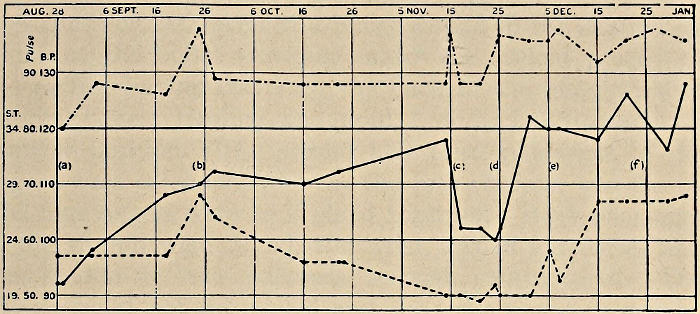
Blood pressure, surface temperature, and pulse in a case of functional mutism. (a) On admission, troubled by nightmare. (b) Able to speak in a whisper. (c) Much depressed after bad news. (d) Put on pituitrin. (e) Marked general improvement. (f) Taken off pituitrin.
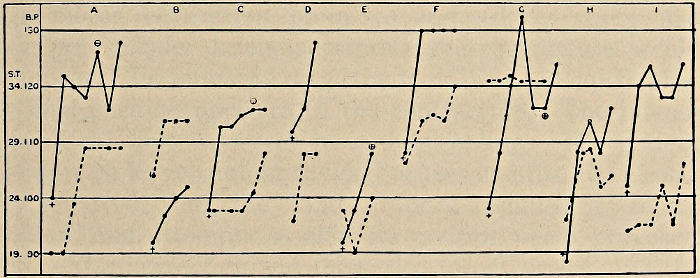
A-1 Showing the effect of pituitrin on the blood pressure and surface temperature. Each dot is one week’s interval. + is the pressure when the first dose was given. 𐌈 is the point at which the pituitrin was discontinued.
Various treatments of a contracture of hand.
Case 486. (Duvernay, November, 1915.)
A chasseur, 22, received a bullet wound in the anatomical snuffbox, the bullet emerging under the styloid process of the radius, having traversed the back of the hand without striking bone. Healing was rapid, but the hand assumed a peculiar position. The second and third phalanges of the fingers were extended, whereas the first phalanx was flexed. The four fingers were as if glued together. Both phalanges of the thumb were flexed, the wrist was in extension, and the tendon of the palmaris seemed contractured. The fingers could not be moved and the wrist was very mobile. There was pain on attempts to move the hand passively, and small clonic contractions were made by the fingers. There were no sensory disorders, but there was a maceration of the interdigital spaces.
Mechanotherapy accelerated the contracture, and massage, motor reëducation, bromides, and sedative drugs, had no effect. Under kelene-anesthesia the contracture would disappear. In January, 1915, the hand was put up in plaster in a position opposite to the contracture. The intense pain of the first days was treated by opium. The patient was sent on leave, and, at the end of two months, the plaster was removed; but the hand at once resumed its faulty position, and attempts to alter its position again provoked pain. Elastic traction was then tried for six weeks, and the bad position was somewhat modified but not improved by hyperextending the second phalanx on the first, and putting the third in slight flexion on the second. Hot compresses were unsuccessful also. May 14, 1915, the position was still irreducible; there was no R. D. or electrical hyperexcitability. This was not a question of radial paralysis, since finger extension was distinct; nor a paralysis of the median, since the thumb was flexed. The contracture, in fact, does not affect a special nerve territory, and the disorder is in the ulnar, radial, and median territories.
Orthopedic case.
Case 487. (Sollier, November, 1916.)
A patient suffered from a rupture of the peroneal nerve in its lower part, September, 1915, and had operation scars before and behind the external malleolus. He was immobilized for 45 days at first, and then for 30 days, with the foot in extension on account of the pain produced in the endeavor to put it into normal position. A 6 cm. atrophy was then found to affect the calf, and there was a fibrous retraction of the tendo Achillis and of the calf muscles. There was no anesthesia, the toes moved easily, the foot was fixed in equinus, with about 7 cm. of the heel above the ground. He was placed in various orthopedic institutions and was treated with mechanotherapy, but without result.
At the neurological center, however, in six weeks, he was got to walk, with his heel on the ground, by means of massage and manual mobilization. The atrophy diminished a centimeter and the foot became mobile in all directions.
According to Sollier, mechanotherapy by means of apparatus is apt to be ineffective, especially in contractures, because its action ceases the moment it ought to commence, namely, when the patient is beginning to react a little painfully after recovery from anesthesia. In cases of retraction, mechanotherapy with apparatus does not allow the proper combination of massage with progressive mobilization.
Re orthopedic cases, Jones classes the conditions that create an orthopedic case under four heads (note especially the fourth):
1. Mechanical injury to bone, joint, muscle, or nerve.
2. Atrophy and disease of these structures primarily due to the injury.
3. Incoördination of movement due to disease of the brain—a result of atrophy and disease of peripheral structures.
4. Psychological conditions which can be overcome by reëducational processes.
MECHANOTHERAPY (COLOLIAN)
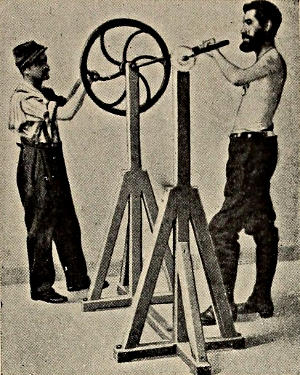
ROTATION OF SHOULDER
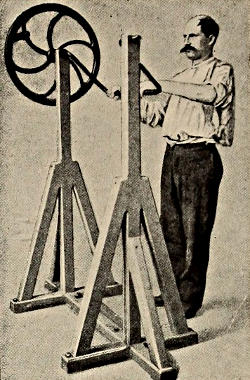
ROTATION OF SHOULDER
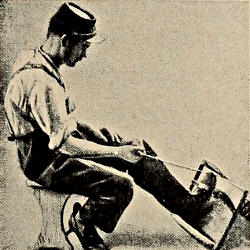
ANKLE EXTENSION
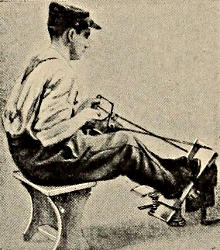
ANKLE EXTENSION
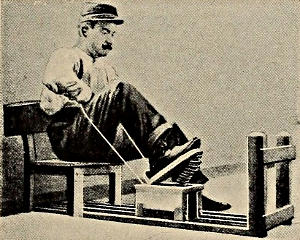
FLEXION AND EXTENSION
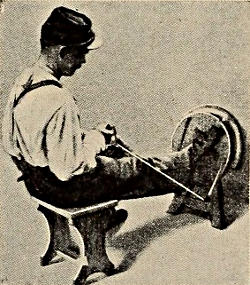
ROTATION OF HIP
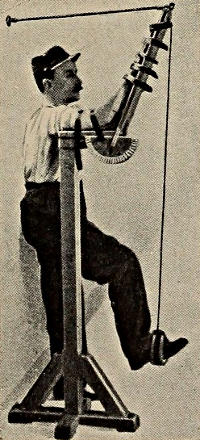
ELBOW FLEXION AND EXTENSION
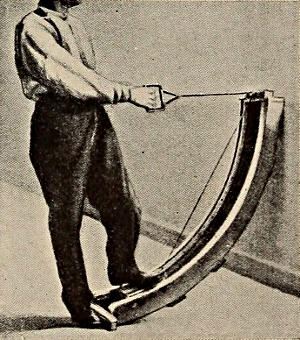
CIRCUMDUCTION OF THIGH
Favorable effects of lumbar puncture.
Case 488. (Ravaut, August, 1915.)
An accountant, 20, in the 135th infantry sustained shock from mine explosion near his trench, March 6. He was kept two days at the relief station. March 8, at the ambulance, he did not appear to understand questions and had a fixed stare. He complained of a violent headache and kept pressing his head between his hands. He kept looking about him anxiously, and the slightest noise made him jump. He would mutter a few incomprehensible words, and in reply to a question would give only the last phrase which he happened to have been saying. Lumbar puncture showed a very slight excess of albumin. Next day, he answered his name. March 12, he could speak in monosyllables, and he began to understand what was said. After the lumbar puncture, the headache disappeared and did not set in again. March 13, he began to be able to write and say short phrases. March 16, expression was good though hesitant, and the patient wrote a letter to his parents, telling about his shock. Lumbar puncture showed that the albumin was now normal. From the rear, April 5, the patient sent Ravaut a postcard in perfect form, telling how he was ready to go back to the front.
Re lumbar puncture, Imboden quotes Podmanizky as having used lumbar puncture as a method of suggestion for the cure of abasia. See also cases 560 and 561, in which Claude cured two cases of dysbasia by the device of stovaine anesthesia of the spinal cord. Pastine also has a case in which a slight improvement was produced on removal of cerebrospinal fluid, and a sudden and complete cure was brought about by the second puncture, a very painful tap. Pastine’s case is thought by him (1916) to be in part at least organic.
Bullet wound of forearm: Hysterical clenching of fist. Recovery by fatiguing the flexors.
Case 489. (Reeve, September, 1917.)
A soldier, 28, was thrice wounded between August 18, 1914, and July 14, 1916. The third time, a bullet passed through the fleshy part of the forearm, whereupon the hand became clenched and remained so after the wound was surgically healed. As a case of war neurosis, the man was treated by electricity, massage, passive movements, and fixation in a straight splint during a period of nine months, without result. He was admitted to Maghull Military Hospital, April 18, 1917.
Two days after admission a treatment was given whose principle consists in producing a condition of fatigue in the muscles responsible for contracture. This fatigue is produced by continuous passive movements in a direction opposed to the normal action of the muscles in question. Many hours of forcible movement are sometimes necessary in the case of the more powerful muscles before the limp, toneless fatigue condition is brought about. Relays of men are told off for this purpose. Patients are got to assist in the work, particularly such as have been cured by the treatment. Also, the patient is himself told about the nature of spasms and the relief which the method will bring. This patient was told that after the flexor muscles were fatigued they would no longer be able to pull the fingers into the clenched position, whereupon the antagonistic muscles on the back of the forearm would begin to work.
The fingers were forcibly opened without interruption for six hours, in each case as soon as the fingers closed into the palm. In a few hours they began to return more slowly, and at the end of the six hours remained extended. The extended position was still found the following morning. The extensor muscles were feeble in action, but improved day by day. The spasm did not return. The patient was discharged July 2, 1917, about two and a half months after admission to Maghull. The hand was now strong and useful.
Bullet through shoulder girdle: Hysterical adduction of arm. Treatment by induced fatigue.
Case 490. (Reeve, September, 1917.)
A man, 29, was in hospital more than two years before the Reeve fatigue treatment was applied to a functional contracture. This man had a bullet pass through the right scapula and out the pectoralis major, June 4, 1915, was (according to patient’s story) operated two months later, then further operated for drainage of septic wounds, and from August, 1915, had his arm fixed to the side, going into spasm at any attempt to move it passively. The elbow was extended and at first the fingers were tightly flexed and wrist extended. The finger flexion and wrist flexion cleared in March, 1917, and recurred in May. Electrical massage in June, 1917, yielded free movement, but the spasm returned.
The man was admitted to Maghull, June 12, 1917, that is, a little over two years after his injury. The arm sprang back to the side like a clasp knife on being released. The wrist and fingers were moved freely. Three days after admission the elbow was forcibly flexed for some hours, whereupon the spasm disappeared. Next day the arm was forcibly abducted and reabducted: for four or five hours the arm could be voluntarily abducted. Two assistants were necessary, such was the force of the adductor contraction. At the end of a week the patient was found able to lift his hand to the back of his head. There was no longer spasm.
Re abrupt treatments, amongst which Reeve’s treatment by induced fatigue may be counted, Babinski and Froment consider that abrupt treatment is far superior to slower psychotherapy combined with isolation, whether or not we are dealing with a recent or an old disease. So far as psychotherapy goes, Babinski wants to obtain a definite improvement, if not a cure, on the first application of treatment. According to Babinski, the patient’s faith in his physician’s power to cure him is most active at this first meeting, whose emotionality favors the cure.
Burial and bruises of back: Hysterical cross-legs. Treatment by induced fatigue of contractured muscles.
Case 491. (Reeve, September, 1917.)
A man, 32, was buried by a shell and bruised about the back, August 2, 1916. He was bedfast until February, 1917. Every attempt to move the legs brought on tremors. He was then allowed up; but the attempt to walk caused one foot to knock the other, and his ankles became bruised, necessitating cotton wool pads for feet.
He was admitted to Maghull, June 12, with one leg crossed over the other and the thigh adductors spastic, especially on the right.
The fatigue treatment was carried out in dorsal decubitus, each leg being pulled by a man, and the separation repeated when necessary. Four hours a day for three days of this work finally reduced the spasm so that the patient was able to walk with assistance. On the sixth day he walked a mile without assistance. The spasm has not returned.
Re leg contractures, Bérard got successful results by continuous extension combined with injections of 1 per cent novocain into the sciatic nerve trunk and the contractured muscles. According to Babinski and Froment, there ought to be an almost certain cure of any genuine hysterical state. They quote the observations of Souques, Meige, Albert Charpentier, Clovis Vincent, Roussy, and Léri as proving this claim.
The Reeve method, so far as it is psychotherapeutic, bears a resemblance to Clovis Vincent’s first stage of what the poilu calls torpillage, namely, the stage of crisis and of intensive reëducation. But Clovis Vincent uses in his direct and forcible reëducation the galvanic current.
Bullet wound of neck: Hysterical torticollis. Treatment by induced fatigue.
Case 492. (Reeve, September, 1917.)
A soldier, 20, had a bullet pass through the back of the neck, July 10, 1916, and returned to his dépôt surgically well October 1. A fortnight later a Zeppelin raid turned his troop out in the middle of the night, and on the morrow the man’s neck was twisted around and inclined upon the left shoulder.
Treatment followed in various hospitals, with fixation in the corrected position by plaster of Paris but without result. The patient was admitted to Maghull, April 18, 1917, with spasm of left trapezius and right sternomastoid muscles. Under hypnosis the deformity could be easily corrected. Unfortunately, it returned.
The fatigue treatment described by Reeve was started a week after admission to Maghull. The neck was forcibly straightened and restraightened upon return to its twist. In a few hours the contracting muscles had become fatigued; the neck was straight.
The next day the deformity returned slightly. The fatigue treatment was repeated. The patient was discharged well, July 2.
Burial by shell explosion: Abasia, tremors. Claw foot persistent two years cured by induced fatigue.
Case 493. (Reeve, September, 1917.)
A man, 24, buried by a shell, February, 1915, had had a functional “claw foot” for more than two years, cured by the Reeve fatigue treatment in less than a week. According to Reeve, claw foot is perhaps the most common of the war contractures, particularly intractable, and often seen out of hospital with an “inside splint.”
After his burial this man could not walk, had tremors, was in bed for four months and on getting up showed strongly inverted foot. Three months’ splint treatment, strong faradic currents, massage, passive movements, special boots with leather wedges to tilt the foot over, were methods of treatment tried, but unsuccessful. At Maghull from November 18, 1916, he was treated by exercises, passive movements, suggestive and reëducative measures, and after a few months got about without sticks.
The claw foot continued. Toward the end of June, 1917, the feet were forcibly flexed and everted for eight hours. The deformity disappeared, but returned slightly next day. Further fatigue treatment for eight hours caused the spasm to cease permanently. He was discharged quite normal, July 20, 1917. Reeve remarks that this fatigue method might be applicable to certain hysterical contractures in civil practice.
Skull trauma over right eye: Delirium, febrile? post-traumatic? exhaustive? Operation: Epileptiform excitement. Later, explosive diathesis: Operation: Euphoria. Seizures and slight mental change.
Case 494. (Binswanger, October, 1917.)
A soldier (brother choreic, sister infantile palsy) had had measles at 13 and in his fever climbed out of bed upon a couch, fell from the couch and was found by his mother lying on the floor. He was of moderate intellectual grade, of an emotional, passionate Saxon nature and had now and then been intoxicated.
In September, 1914, he was wounded over the right eye. He did not lose consciousness but concluded that he could not get back to his own lines on account of the enemy fire. Using a knapsack to cover his head, he lay down for twenty-four hours, until rescued by a passing body of the sanitary corps who were about to leave him for dead when he called loudly to them.
He was very weak in hospital and, towards the evening of the day after receiving his injury, he must have fallen into some sort of psychotic state lasting ten days. For this he remained quite amnestic, although he was told by comrades that he had hallucinations and had scolded and yelled, hearing voices. Apparently there were situation-deliria—the call to go over the top. Temperature, which had run to 38.8, after ten days sank to normal, and consciousness cleared up.
Was this a case of protracted febrile delirium? Or of psychosis due to commotio cerebri, that is, an effect of heightened intracranial pressure? Or was it exhaustion-delirium following loss of blood, sleep and food?
But this was not the end. The wound suppurated, and in May, 1915, eight months after the injury, operation was performed to relieve this abscess. Temperature immediately rose to from 38.4 to 38.6, the fever lasting three days, and a second psychotic phase with complete amnesia entered. He went into this phase immediately after recovering from the operative narcosis, looking wildly about and cursing the sister. The patient was violently excited and was put in a straight jacket on the second day. This phase may be regarded as one of epileptiform excitement with delirium. The operation may have played a part in the psychosis.
There were no further psychotic phenomena which could be attributed in any way to commotio. There were, however, attacks of cortical origin and emotional seizures. The patient became emotionally excitable and lost all inhibitions against expression of emotion, such as crying. Once he actually tried to suppress his emotion with a noose about his throat. He became seclusive and withdrew within himself—a victim of Kaplan’s explosive diathesis, or of Bonhoeffer’s emotional hyperesthetic defect condition.
A second operation was performed in September, 1916, to loosen the brain scar, and a large splinter of bone was removed. During the operation, under local anesthesia, there was a severe cortical seizure with complete disappearance of the reflexes. Ether was then administered. Later, in the same day, there were several minor cortical attacks.
After this operation the man’s emotional status changed; he was no longer irritable or exclusive, but became slightly euphoric and contented. He received during the next two weeks four tablets of Sedobrol and for a long time thereafter two tablets daily. There were never any phenomena of bromidism or any suggestive effects of the bromides.
The first attack after the second operation came in November, 1916, and was followed by slight dysarthria. Repeated attacks followed which were attributed to contractions in the scar. Accordingly, a third operation was performed and an attempt was made to bridge over a defect in the right frontal bone. The man’s emotional status remained good after the operation, but further attacks appeared six weeks later and there were spells of dizziness. Occasionally, in process of thinking, he said something stuck in between his thoughts. Sometimes thinking broke off sharply as if he had cut through a wire with an electrical current in it. There was a slight reduction in attention and a slightly increased fatiguability.
Hard service; shell explosion with loss of teeth: Vomiting. Cure by restoration of self-confidence.
Case 495. (McDowell, January, 1917.)
A married reservist was called up at the outbreak of the war and went through Mons, the Marne, and the Aisne and was finally blown up by a shell at Ypres. Early in November, 1914, he lost his speech but got it back in time to get home for Christmas. A number of teeth had been lost in the injury. Vomiting began first in England. While on leave at home he vomited at every meal. Asked whether it was his food or his thoughts, he said, “You are quite correct, Sir, you know I have always been with thinking.”
Under medical care, June, 1915, he was found suffering from hesitating speech, general tremulousness and emotionality. He worried a great deal on account of money matters at home. He lay awake thinking. A child became ill and died, and all the while he got worse, “thinking all the time.”
It was explained to him that the vomiting was a matter of emotions. The lost teeth were replaced by false ones. As he began to get control of his emotions, he vomited less and increased in weight. Finally he was boarded for discharge and was sick again on the day of the meeting. A fortnight later when sent to sign discharge papers he vomited once more.
According to McDowell, the vagus may possibly be incriminated as a cause of these gastric disturbances. Practically, the vomiting is a result of emotional stress. The cure is to produce insight on the part of the patient, the removal of worry and the restoration of self-confidence.
Michell Clarke cured such cases with milk diet.
Roussy and Lhermitte find hysterical vomiting to be relatively common and as a rule without difficulty in diagnosis; but they remark that there is often some underlying organic condition to be sought for and treated after the neuropathic element has vanished. They remark, also, that there is no tendency to spontaneous cure of the disease. They advocate a strict dietetic régime and psychotherapy.
Cure of self-accusatory (“started retreat from Mons”) and other delusions by “autognosis.”
Case 496. (Brown, January, 1916.)
Capt. William Brown, in the discussion at the Section of Psychiatry of the Royal Society of Medicine, January 25, 1916, speaks of a method of treatment which he calls autognosis—a method of giving the patient self-knowledge, by revealing to the patient through his own confessions the cause of mental change leading to his symptoms. One of Brown’s examples is that of a sergeant in the firing-line during the retreat from Mons. He was admitted to Maghull with the delusion that people thought he had given the signal for the retreat from Mons on a silver whistle, a shooting prize of his. German officers used silver whistles that made a note like his own. In fact, he had other like delusions, such as that people thought him responsible for an Edinburgh railroad accident in connection with his troop-train. A German spy might have heard this.
In the process of procuring autognosis, Capt. Brown found that at the age of 12 this man had been falsely accused of stealing pork pies from a shop, and had been brought before a magistrate. In point of fact, he proved an alibi, but he was greatly worried by the charge. According to Capt. Brown, this incident of the insistence of the false accusation was the beginning of his tendency to delusions. In two months’ time there was a remarkable improvement.
Re psychoanalysis, autognosis and various modifications, Forsyth remarks that when the acute stage is passed, the Shell-shock case becomes an everyday neurosis in which war experiences are merely the latest phases in the patient’s life, and that psychoanalysis may then become necessary. Eder regards the “mechanisms” of what he terms “war shock” as the Freudian mechanisms of hysteria, and has commended psychoanalysis for a few cases, preferring hypnotism for acute cases. Adrian and Yealland decry psychoanalysis on the score of time limitations.
Deafmutism in three men shell-shocked at one time.
Cases 497, 498, 499. (Roussy, April, 1915.)
There were three Zouaves in a first-line trench north of Arras, January 14, 1915, who were blown up by a bomb thrown from the enemy trench some hundreds of meters away, by a mortar, a crapouillaud. This projectile burst with a great noise, louder than that of a bomb, and made a very strong windage. A dozen men were blown under the trench wall, just after entering the trench; two were killed; and the others, most of whom had been buried to the neck, were pulled out and carried, trembling, to the nearest relief post. Two of the three Zouaves were bleeding at nose and ears, and all three were absolutely deaf and mute. Evacuated to an ambulance, and thence to Paris, they arrived at Val-de-Grâce, January 17, that is to say, three days after the shell burst. They communicated with the attendants by signs; one got hold of paper and wrote several hours in the day rapid notes about the accident. However, hysteria or pure simulation was suspected in these three Zouaves, and they were placed in small separate rooms. They were informed through the physician’s remarks to his staff that these were cases of nothing but simple nervous shock such as we had often observed, and the claim was made that they would be completely well either on the morrow or the day after.
On the morrow, two of them partially recovered hearing and got back their voices. They became loquacious and began to tell about the battle. The day after, the third patient began to speak. Two of them showed traces of auricular hemorrhage, and in fact, actual ear lesions were found in all three. One had a suppurative right middle ear, with perforation; another had both drums perforated and a suppurative middle ear, also on both sides. The third, who recovered his speech after the others, had perforation of the left tympanum with a little suppuration of the right ear tympanum and a slight tear of the right tympanum. In April, 1915, the hearing was cured.
These men had been under fire several months, and had taken part in the battle of the Marne. It was not a question of their first baptism of fire, and in fact, each of them had been previously wounded. According to Roussy, the story is, that the shell-burst produces by displacement of air tympanic perforation, and at the same time a violent nerve shock with loss of consciousness for a few minutes. The men come to, but the ear lesion, probably exaggerated by the nervous status of its bearer, creates a complete bilateral deafness. This deafness produces an absolute hysterical mutism.
Re case groups of war neurosis, several writers speak of dangers of contagion, but also emphasize the values of contact of patients with one another in the securing of therapeutic results. What Mott has termed the atmosphere of cure was no doubt present in the three instances of Roussy just cited. The cure of one may act heterosuggestively to produce the cure of a second, and so on. Functional deafmutes are somewhat refractory as a rule. H. Campbell states that there is some danger attached to allowing large numbers of functional cases to consort together too closely. He suggests making use of small wards and screens, and a process of sorting out patients so that they shall not affect one another injuriously. Steiner especially stresses the value of individual rooms in preventing psychic infection, of which, he says, the danger is large in open dormitories. The psychic contagion is as a rule that of hysterical seizures and tremors; but complaints about faulty hospital arrangements are also readily spread. Steiner advocates never questioning a nervous patient concerning his troubles in the presence of other soldiers. To reach 60 to 70 patients, Steiner had one examining and treatment room. Roussy’s institution at Salins in 1917 had a service limited to traumatic hysteria, from which, in three months’ time, 200 subjects had been discharged cured (see Boschi).
Dysentery: Milk diet persisted in: Vomiting, incontinence, inability to walk. Cure by persuasion.
Case 500. (McDowell, December, 1916.)
A soldier, 25, a low menial when war broke out, developed “dysentery and gastritis” at the Dardanelles, although even before the dysentery his nerves had gone bad. He had diarrhoea and vomiting, was sick every day, found himself unable to walk, and found himself always wet with urine dribbling day and night. Arriving in England and treated in a hospital, he still had vomiting. He had lived on milk and custard and been kept in bed.
Capt. McDowell convinced the patient that his legs were not as weak as he supposed. He was encouraged to walk, put upon light diet and then upon ordinary diet. He became an active worker in the ward, later going for five-mile route marches. Two months later he went back to duty in good health, weighing seven pounds more than before. This man was weakminded and, when his dysentery was cured, did not dare to start eating ordinary food. He was a victim of hospital régime. Individual attention would have obviated much of the subsequent state.
Re vomiting, see remarks under another case of McDowell (Case 495).
Re incontinence, see Case 384, of Guillain and Barré.
Officer dies in convulsions: Servant develops hysterical convulsions, which vanish on being explained as such.
Case 501. (Hurst, March, 1917.)
An officer and his servant were blown up by a shell. The servant ran to fetch a stretcher for the officer, to whom he was much attached, but on his return the officer made a few convulsive movements and died. Immediately after, the servant had a fit. During the next two months he had eleven more. Hurst made a diagnosis of hysterical fits resulting from emotion, explained his idea of their origin and nature to the servant, and the convulsions then ceased completely.
Re hysterical convulsions, see remarks under Case 443.
Course of a case with crises of trembling.
Case 502. (Roussy, April, 1915.)
A soldier in the artillery, who had been in the lines from August as a kitchenman, looking after the food of the first line trenches, with which his shelter was connected by communication trenches, 800 meters away, was on January 17, 1915, with three other men placed in the shelter kitchen of the trenches but a short distance away from the French artillery. The firing passed over the heads of these men but they could feel the windage, which obliged them to lie down each time. The evening of that day, several hours after firing had ceased, the kitchenman had a shivering spell, with trembling that lasted all night; after which these crises came on every day. He had finally to be evacuated to the rear.
According to Roussy, such patients always have neuropathic taint and a history of previous crises. Such a patient ought to be handled with rather severe discipline. In this way, according to Roussy, the reappearance of a severe attack of convulsions can be prevented. But these patients cannot go back to the front.
Re tremors, see Cases 224 and 225.
Two cases of lameness cured by persuasion: Russel.
Case 503. (Russel, August, 1917.)
A man on crutches, paralyzed completely in the right leg, partially in the left, developed paralysis in the right arm from the use of the crutch. There were marked vasomotor changes in the right leg and arm together with anesthesia to pinprick. Assured that he could move the legs perfectly he said that he had tried and failed. After a persuasive talk in private he began to use the arm, and to walk perfectly. It seems that in the trenches he had a sharp pain in the right knee, after which he did not use the leg and it gradually became more and more useless. It had been paralyzed for three months. The reason he did not use this leg was not on his own account, but on account of his mother at home. He seemed really grateful for the cure.
Case 504. (Russel, August, 1917.)
A sergeant in hospital for a year for shell-shock still had a marked shaking of the right leg whenever he raised it from the ground. He walked in leaning on a silver headed cane. The functional nature of his shaking was explained to him by Russel, whereupon he walked out normally saying he could do without his cane. Russel suggested that crutches and sticks thus given up were often donated to the shrine. The sergeant whose cane must have cost at least three pounds beat a hasty retreat carrying the cane in front of him.
Re Russel’s general point of view concerning malingerers and psychogenic cases, see under Case 458.
Hard patrol work: Delirium; head tremor augmented by excitement: Virtual recovery on bandaging neck, isolation, open air, to-and-fro transfers to mental and nervous wards.
Case 505. (Binswanger, July, 1915.)
A metal moulder in civil life, 29, in military service 1907 to 1909 (no hereditary taint, moderately good scholar), became unconscious for a half hour after taking a cold drink following a somewhat long practice march, at some time during his first year of military service.
He was in several skirmishes in Belgium and Northern France early in the war, being once surrounded in patrol work (November 11) by Turcoes and Zouaves. There was a lively exchange of shots, in the course of which five of the eight men on patrol fell. The three survivors hid themselves for three days in a quarry, and on the fourth were found by the advancing troops, and immediately went into battle.
But during a pause while on the point of taking coffee, the man suddenly fell sick, tried to carry on, but lost consciousness and apparently remained unconscious for about three-quarters of an hour. It seems that he raved and shouted and tried to bite his fingers, being held with great difficulty by several comrades. He was removed to a dressing-station three km. distant.
At the dressing-station, his head began to shake, although he was unaware of this until his attention was called to it by his comrades. He said that he felt restless and that his head ached almost continually. He was carried to the reserve hospital, and from thence, December 9, 1914, to the nerve hospital at Jena, where he was unaware of the shaking of his head (which had now lasted for three weeks), and said that he felt a thick fog in his head (to say nothing of headaches), and was only free and clear in his head while standing in the open air.
His sleep was restless and poor; there were war dreams almost every night. In the process of getting to sleep, his arms and legs frequently twitched. He would soon tire and feel weak. Also since his dangerous experience, he had noticed a change in his speech: always fluent before, it was now hard for him to speak because one had to exert one’s head so much in speaking.
This head tremor was in fact the most marked symptom of his illness. It would increase on every active motion of the head, but ceased almost entirely when attention was diverted. The head would then be held bent to the right.
During emotional excitement, the shaking spasm would spread over the entire upper part of the body, but would remain more severe upon the right than upon the left side. The forearms would fall into a lively shaking movement of pronation and supination. The hands and fingers would be attacked by a less marked tremor. After calm had set in, a fine tremor of the right hand would remain plainly noticeable. The musculature of facial expression would frequently fall into spasmodic movement, the left corner of the mouth twitching, the lips set for whistling, or the upper lip making movements as if snuffing spasmodically.
Physically the man was of medium height, strongly built, with adherent lobules, and a somewhat pointed skull. The teeth were defective and irregularly placed. Both deep and skin reflexes were increased. Marked dermatographia and mechanical excitability of the muscles: periosteal reflexes strongly developed; numerous pressure points in the head. The right temple and back of the head were painful on percussion. The patient showed no disturbance in touch and pain sensibility. Outstretched tongue showed marked fibrillary twitching; speech was difficult, being slow, awkward, stumbling, and sometimes hesitating (suggesting the speech of general paresis). At other times, the speech was of a peculiar sighing, tremulous nature, reminding one of the speech of children complaining or asking for pity. Rest was secured by injections of salt solution. A few days later, the treatment was continued by a bandage about the neck. After this the tremor grew slighter and would even remain absent for some hours. The patient was told to rest in bed and not to speak much; being “seriously ill,” he was kept alone. He was often irritated, querulous, and subject to outbursts of profanity. He took food well and slept well, receiving sodium bicarbonate.
The bandage was changed after five days. The tremor was very marked. The patient was furious because visitors were refused to him. He was especially angry with his nearest relatives and his betrothed, and wrote defiant letters to all of them. He became one of the most troublesome patients in the psychiatric division of the hospital. He complained sometimes of anxiety and feelings of unrest. He received treatment by pantopon. He continued to be a very disagreeable patient, feeling himself opposed and not properly considered. He thought himself seriously ill, behaved much like a spoiled child, and was of the opinion that he would not get well in the hospital because they were grieving him so. His appetite became bad; he complained of pains in the loins and of rheumatism in the legs. A cord was found hidden in the bed. The patient expressed suicidal thoughts at various times.
At the beginning of January there was marked improvement. The headshaking ceased almost entirely; the patient walked in the garden some hours daily. However, in the middle of January, on refusal of furlough, the head-shaking began again markedly. At his request a bandage was placed on the head again for a few days. He seemed emotionally very tender; his head would shake at the sight of a dead rabbit.
He was transferred to the nerve division of the psychiatric clinic at the end of January. He had recently begun to complain of flickering before the eyes. The ophthalmologists established an existence of a choroiditis disseminata. The eye examination had a markedly depressing effect upon the patient, and the shaking spasm of the head appeared again. Upon being told that he would have to be sent back to the psychiatric section of the clinic, the shaking immediately disappeared (24 hours after it had begun).
Thereafter slow improvement followed. He stayed in the open a great deal and walked. March 2, he showed a vehement outburst of anger, quarreling and using violence with a comrade. He was brought back to the psychiatric section, and in transit had a severe hysterical attack with unconsciousness, crying fits, and stepping movements of the extremities. He was promptly taken to a section for those seriously ill. The next day, upon his assurance that he could control himself, he was put in a more quiet division. He began to take part in gymnastic exercises, worked as a coachman, and then as an experiment was sent to a gentleman’s estate for recreation. At last accounts he was feeling well except that he occasionally had headaches during work. He could not work so hard as before on account of the rapid onset of fatigue, especially when working in the sun. The head-shaking recurred but seldom and lasted for a few hours only when the patient became angry or when there was much noise about.
Rationalization of war memories: Returned to duty.
Case 506. (Rivers, February, 1918.)
A young English officer was wounded just as he was extricating himself from burial in a mass of earth. He became nervous and sleepless and lost his appetite. After the wound had healed, he was sent home on leave, which had to be extended as he got worse. An out-patient in London for a time, he was finally sent to a convalescent home, still troubled with insomnia, battle dreams and concern about his recovery. He made light of his condition and was on the point of being returned to duty by the medical board, when his sleeplessness led to his being sent to Craighlochart War Hospital.
He could not sleep without a light in the room, else every sound attracted his attention. He tried hard all day long to banish all unpleasant and disturbing thoughts, but at night it took him a long time to get to sleep and then came vivid dreams of warfare. He did not, himself, feel that he could ever forget the war scenes.
Rivers, in general believing that the attempt to banish such experiences absolutely from the mind is poor psychotherapy, narrated his views to the patient. Rivers advised him no longer to try to banish the memories, but to try to transform them into tolerable, if not pleasant, companions. The war experiences and anxieties were talked over. That night the man had the best night he had had for five months, and during the following week the sleeplessness was no longer so painful and distressing. If unpleasant thoughts came, they had to do rather with home life than with the war. General health improved; insomnia diminished. He was at last able to return to duty.
Rationalization of war memories.
Case 507. (Rivers, February, 1918.)
An English officer was buried by shell explosion and developed severe headache, vomiting and disorder of micturition, yet remained on duty for more than two months. Collapse came when he went out to seek a fellow officer and found the body blown to pieces, with head and limbs severed from the trunk. This vision haunted him in dreams. Sometimes the officer appeared as on the battlefield; again as leprous. The officer would come nearer and nearer in the dream, until the patient woke pouring with sweat and in utmost terror. Accordingly, he was afraid to go to sleep, and spent all day thinking painfully about the night to come. Advice to keep all thoughts of war out of mind merely brought the memories in sleep upon him with redoubled force and horror.
Rivers’ therapy was to draw attention to the fact that the terrible mangling proved conclusively that the officer had been killed outright and without pain. The officer said he would now no longer attempt to banish the thoughts and memories of his friend, but would concentrate on the pain and suffering his friend had been spared. No dreams at all came for several nights, but one night in his dream he went out into No-Man’s-Land and saw the mangled body, but without horror. He knelt down, as he had in the original experience, and woke as he was taking off the Sam Browne belt to send to the relatives. A few nights later came another dream in which he talked with his friend. There was but one more dream in which horror occurred.
Rationalization of war memories: Eventually unfitted for military service.
Case 508. (Rivers, February, 1918.)
A young English officer, after doing well for a period, was rendered unconscious by shell explosion. The first thing he remembered was being led by his servant towards his base, thoroughly broken down. He had headaches, sleeplessness, war dreams and spells of terrible depression appearing with absolute suddenness, unlike ordinary “blues.” For ten days in hospital no such attack appeared, but one evening he came to Rivers pale and anxious. A few minutes before, he had been writing a letter in his usual mood, when this causeless depression came on. In the afternoon he had walked about on some neighboring hills. The letter dealt with no depressing matter. In ten minutes the depression vanished. Nine days later another came as he was standing idly looking out of a window. The attack lasted for several hours, as no physician was present to meet the issue. If he had had a revolver he would have shot himself.
Rivers was inclined to interpret these gusts of depression as due to a forgotten but active experience. As there was no definite tendency to dissociation, Rivers hesitated to plunge in with the hypnotic method, nothing short of which, however, served to recall the incident. The man was gravely apprehensive about fitness for further service, and was repressing his fear, as he thought it either was cowardice or would be called cowardice. The patient, by his discussions with Rivers, had already become familiar with the idea that the gusts of depression might be due to a submerged experience. Perhaps, however, there had been no experience, and the patient was advised that possibly the thing repressed was the idea about fitness for service. Accordingly, the patient agreed to face the situation. One transient attack of morbid depression occurred, after an operation. Then the man fell into a state of anxiety neurosis such that he was passed by a medical board as unfit for military service.
Rationalization of war memories: Commission relinquished.
Case 509. (Rivers, February, 1918.)
An oldish English officer lost consciousness while looking at the havoc wrought by shell explosion. Probably there was a second shell that sent him off. He was eventually admitted to an English hospital with paresis and anesthesia of legs, severe headache, sleeplessness and terrifying dreams. Hypnotic drugs and advice neither to read nor to talk about the war were the measures adopted and after two months in hospital he was given three months leave. He buried himself in the heart of the country, away from relatives, with aspirin and bromides. He began to sleep better and had less headache. When the president of the medical board asked a question about trenches at the end of his period of leave, however, he broke down and wept. He again repaired to the country for two months’ leave, for the chosen treatment by isolation and repression.
An order was then given that all officers must be either in hospital or on duty. He was sent to an inland watering place and treated by baths, electricity and massage, whereupon he rapidly became worse, especially as to sleep. He was transferred to Craiglochart in an emaciated state, with an expression of anxiety and dread, paresis of legs, sleeplessness and war dreams.
He was now advised to give up repressing, to read and talk a little about the war, and to accustom himself to thinking about war experiences. He did this but half-heartedly, as he thought the ideal treatment was what he had so long followed. Nevertheless, he got distinctly better and the content of the war dreams was altered to home scenes. He was still loath to acknowledge his improvement and thought that he would have recovered if he had not been taken from his retreat and sent to hospital. As it was obvious that he would be of no further use in the army, he was allowed to relinquish his commission.
Rationalization of war memories, without redeeming feature as nucleus.
Case 510. (Rivers, February, 1918.)
An English officer was flung by shell explosion so that his face struck the ruptured and distended abdomen of a dead German. The officer did not immediately lose consciousness and got distinct impressions of taste and smell and an idea of their source. After a period of unconsciousness he came to, vomiting and much shaken. He carried on several days, still troubled by vomiting and haunted by taste and smell images. Several months later he was observed by Rivers suffering from horrible dreams, in which the battle experience was faithfully reproduced. He got no relief except when he went into the country, far from every suggestion of war. Rivers’ psychotherapeutic plan of finding a redeeming feature in the experience, upon which the patient might concentrate, failed because there was no redeeming feature. Accordingly, it was thought best that the man should leave the army and seek the conditions that had given him slight relief.
Re psychoanalysis and its modifications, see remarks under Case 496, under which several favorable opinions were mentioned. Boschi in his report on French conditions gives no reference concerning psychoanalysis or hypnosis. Bruce has found blended with the war dreams many episodes quite alien to the war, and considers that the patient’s ante-bellum history is of importance, since ante-bellum emotions may be revivified by the war. Craig states that he has not been impressed favorably by the results of psychoanalytic treatment. Arinstein from Russian experience gives preference to Dubois’ psychotherapy over hypnosis and psychoanalysis. Nonne states that the data of the war prove that hysteria is neither a degenerative disease according to classical theory, nor a disease based upon Freudian principles.
Post rheumatic “paraplegia” (or abulia?) cured by removal of crutches, after question of discharge “unfit” had been raised.
Case 511. (Veale, November, 1917.)
A soldier, 23, had fever with swelling of several joints and temperature in 1915, and was furloughed to England. He complained of pains in the limbs and shortness of breath, and was put in hospital. As he did not improve, he was sent to a special hospital for baths and electricity. There he remained from August, 1915, to March, 1916, with D’Arsonval baths, cataphoresis, electric treatment and massage.
He was now sent to the second Northern General Hospital to see whether he should be discharged permanently unfit. Here he shuffled along on two crutches, very tremulous, and sweating, and suffering from palpitation on exertion. He wanted to take poison if he could not be cured.
The crutches were taken away. He was asked to walk up and down. He had to be supported at first and fell several times. The exercises were continued. Massage and drugging were stopped. The next day he was able to stand alone. In twenty-four hours he walked by himself. The other patients in the ward encouraged him on account of the genuine exertions he was making to get well. April 7, he returned to duty, smart and well set up.
Babinski and Froment always give the suspected subject the benefit of the doubt, never uttering the word simulation in the presence of the soldier, and proceed to psychotherapy; for psychotherapy will act to cure simulation or exaggeration just as it acts to cure hysteria. They say that in their experience, all these disorders of doubtful nature—that is, that lie diagnostically between hysteria, exaggeration, and simulation—are as a rule cured by resort to psychotherapy provided that the due amount of energy, tact, and perseverance is employed. See also remarks under Case 453. Veale’s case (511) never showed mauvaise volonté, and nothing more than aboulia.
“Trench foot,” “neuritis,” a year of astasia-abasia or at least of complaint of inability to stand or walk. Treatment by a “cruel though justifiable” process.
Case 512. (Veale, November, 1917.)
A regular army man, 38, well built and muscular, in Flanders the first winter, returned to England in January, 1915, with “trench foot.” “Neuritis” then developed, with loss of power to walk. Baths, electricity, massage, sympathetic wheeling about in a chair by women, all failed.
January 11, 1916, he still complained of inability to walk or stand. The reflexes were exaggerated. He was able to get into a wheel chair from bed by jerks, associated with palpitation, tremors, flushing and sweating.
He was told that he had now recovered from the neuritis. Crutches, sticks and wheelchair were removed. He flopped about and then lay on the bed exhausted. In a few days he began to shuffle about and was put on the stationary bicycle. January 29, he left the hospital well, remarking that though the treatment at first seemed cruel, it was fully justified.
Re genuine polyneuritis, Mann gives German experience regarding neuritis as somewhat frequent and affecting a special form which he terms polyneuritis neurasthenica. He states that the commonest instances of mononeuritis developing in the war are the sciatic and trigeminal. The neuritis often outlasts the other symptoms. The treatment was rest, tepid baths, and electricity. Naturally, alcohol and syphilis must be excluded in the diagnosis.
Nonne also described non-alcoholic, non-syphilitic, and non-infectious polyneuritis in neurasthenics, which he, however, finds most common in the ulnar, median, radial, anterior crural and posterior tibial nerves.
Re “spa” treatment, Turner thinks there may be easily too much massage, electricity, bathing. He prefers segregation in special hospitals to “spa” measures in general hospitals, prefers occupation to rest, and calls attention to the stimulating value of the gratuity to be paid on leaving the hospital.
Shell-shock paraplegia: Treatment by bed, cigarettes and chocolates altered to isolation, no tobacco, no visitors, faradization. Recovery.
Case 513. (Buzzard, December, 1916.)
Early in the war, a lad, 19, was blown up by a shell. He was sent home paralyzed from waist down, and was seen by Capt. Buzzard after he had spent ten months in various hospitals, “carefully nursed, on the water bed, constantly using a bed urinal, smoking innumerable cigarettes, and eating countless chocolates.” He could not move his legs. They were wasted and flaccid. The knee-jerks could be got with difficulty. Plantar reflexes flexor. Complete anesthesia from umbilicus downwards, but preservation of abdominal reflexes. The navel did not shift downwards when the patient attempted to sit up. The incontinence was not real; urine was passed into the urinal at appropriate intervals.
Buzzard directed treatment “not to his spinal cord but to his mind; isolation; the stoppage of tobacco and all visits; the assurance that he would rapidly get well, together with some suggestive faradization of his legs.” This brought about a cure in a very short period. The atrophied legs eventually grew strong enough to walk.
Re cigarettes in Shell-shock, Mott decries the over-liberal gifts of cigarettes that induced cigarette habits in both officers and men. Of course, the cigarettes are still more detrimental to cases of soldier’s heart than to other cases of neurosis. Mott remarks how over-frequent are the social tea-parties, joy rides and drives given by well-meaning ladies for the “poor dears,” actually perpetuating neuroses.
Re atrophy, Babinski and Froment again bring up the question whether muscular atrophy can be brought about by a hysterical motor disorder. In point of fact, Charcot and Babinski were the first to describe the true hysterical amyotrophy, but this hysterical amyotrophy is exceptional in hysterical paralysis, and is slight when it occurs.
Shell-shock blindness, mutism, deafness: Blindness spontaneously vanished, 24 hours. Mutism, 2-3 months. Deafness cured by “small operation.”
Case 514. (Hurst, September, 1917.)
A lance corporal, 26, became blind, deaf and dumb, though without losing consciousness, when blown up by a shell, August 29, 1916. His sight returned next day. On reaching England he talked in his sleep. Encouragement, electricity, etherization failed to effect improvement. One night in November he woke up and asked the sister for a drink; thereafter he talked normally.
Seven months after the shell explosion he was transferred to the neurological section at Netley, March 21, 1917. Deaf to air and bone conduction, a loud noise behind him caused a slight tremor of hands, with blinking and dilatation of pupils; but further stimuli of the same sort failed to produce such reactions. Normal nystagmus and giddiness on functional tests of vestibular nerve and canals. The internal ear was then probably free from organic changes. Since shell-shock mutism is always hysterical, it was probable that the deafness was hysterical. Under hypnosis (staring at lines for fifteen seconds) he showed no change. During natural sleep, also, a shout of “Fire” and metallic noises failed to wake the patient or to produce contraction of eyelids. Electric suggestion (despite the patient’s belief in electricity) and reëducation failed.
April 16, he was told that a small operation would have to be done April 20. To this he readily consented. Two small incisions were made behind the ear under light ether and suture was inserted. A loud noise was made during the “operation”; he heard this noise and jumped from the table. To his intense delight normal hearing returned in a few minutes. Next day hearing was tested and found normal to air and bone conduction. He was discharged to duty three weeks later and on his way to France, June 29, demonstrated his normal hearing to the physicians.
Deafness: cure by stimulating vestibular apparatus.
Case 515. (O’Malley, May, 1916.)
A private, 20 years of age, lost speech and hearing after the battle of Neuve Chapelle. Eight days later he came under the care of the laryngologist in a very excited state, pointing to lips and ears and carrying a note with information concerning his deafmutism.
Dr. O’Malley wrote on a piece of paper that he would restore the patient’s speech and hearing. Dr. O’Malley then used the mirror until the point of retching, and wrote, “You can speak now; count up to ten loudly.” He did.
Dr. O’Malley next used the cold water douche to the right ear to the point of giddiness, then shouting through a speaking-tube (see description below). The patient then found he could hear and the tears streamed down his face. Thereafter he was able to converse freely. Dr. O’Malley writes:
The treatment of functional deafness consists in exciting the vestibular apparatus as follows. Cold or hot water is allowed to flow in a steady stream into and out of the external auditory meatus by means of a tube attached to a receptacle placed about one and a half to two feet above the patient’s head and continued until he becomes very giddy and an active nystagmus is produced. A speaking-tube three feet long is then used by placing the ear-piece in the ear so treated, and the surgeon shouts into the mouth-piece the assertion, “You hear now,” and the answer, “Yes” comes promptly. The tube is now dropped and a conversation held as if no deafness ever existed. So far I have found the treatment of one ear sufficient. The patient is usually very emotional, as the disturbed vestibular function, which in these cases responds easily and markedly, causes him to feel as uncomfortable as a bad sailor on a stormy voyage. This feeling, however, rapidly gives way to one of pleasure at the return of his hearing. Where functional deafness and mutism co-exist it does not appear to be material which is treated first. In two cases of this kind under my care I treated the loss of voice first.
Bullet through mouth; Hysterical mutism. Treatment by operative manipulation.
Case 516. (Morestin, January, 1915.)
A Colonial infantryman, 32, was wounded December 17, 1914, at the Boisselle, being struck by a bullet which entered on the right side in the upper part of the neck and came out behind the left side of the mouth, having traversed the tongue, broken two teeth, and caused a good deal of hemorrhage by mouth. The patient felt his tongue swell, and from this time on he could not pronounce a word. He was sent to the ambulance, then to Mien, then to Saint Germain, and finally to Morestin’s surgical service. With wounds by this time healed, the patient found it hard to open his mouth. There was no trace of fracture of the lower jaw. The tongue could be only incompletely examined. The man swallowed liquids easily but could take no solid food. He tried hard to speak, made pantomime movements, grew emotional and lachrymose.
On the whole, however, it seemed that his inability to articulate sound could not be due directly to the lesion. There must be either simulation or hysteria. For four days he was attentively watched, and not once did he pronounce a word. He grew more and more stricken and humiliated by his plight. Rigorous diet did not cause his mutism to cease. Isolation and ennui did not decide him to talk. Accordingly, it was announced, in the man’s hearing, that an operation was to be done to restore speech. January 9, 1915, his face was copiously washed with alcohol and ether. Cocaine was injected to secure anesthesia and resolution of the muscles of mastication. Six c.c. of a 1-100 solution on each side. Shortly the surgeon began to open the jaws, against decreasing resistance. The tongue, which was not spastic, was seized with a tractor and rhythmic movements were executed with it. After a few of these movements, joy was painted on the features of the patient. He said that he wanted to speak and that he was about to speak. He shook the surgeon’s hands effusively and said, “Merci.” Although the first words came hard, little by little speech became free and a perfectly sincere elation at having recovered speech set in.