B. SHELL-SHOCK: NATURE AND CAUSES.
Reading edition
—la buia campagna tremò sì forte, che dello spavento la mente di sudore ancor mi bagna La terra lagrimosa diede vento, che balenò una luce vermiglia, la qual mi vinse ciascun sentimento; E caddi, come l’uom, cui sonno piglia. —the dusky plain trembled so violently, that the remembrance of my terror bathes me still with sweat. The tearful ground gave out wind which flashed forth a crimson light that conquered all my senses; And I fell, like one who is seized with sleep. Inferno, Canto III, 130-136.
Bombardment; shell explosion nearby: Mania; death in 24 hours. The AUTOPSY showed superficial punctate hemorrhages of brain and congestion of pia mater. CAUSE OF DEATH—small bulbar hemorrhage, congestion of veins, and nerve-cell changes of a local and differential nature (chromatolysis of vago-accessorius nucleus). SHELL-SHOCK SYMPTOMS due to capillary anemia and chromatolysis of various regions.
Case 197. (Mott, November, 1917.)
A soldier became rather nervous at the Somme, and later underwent intense bombardment for some four hours, February 22, 4 to 8 P.M. Although he said he “could not stand it much longer” he carried on for twelve hours more when perhaps six shells went over, February 23. One of the shells burst about ten feet away, just behind the dugout. The first day of the bombardment he was tremulous and depressed; later coarsely tremulous in the limbs. February 23 there was crying and inability to walk or do any sort of work. Questions were not answered. The pupils were dilated. The evening of February 23 the man was admitted to the field ambulance in acute mania, shouting: “Keep them back! Keep them back!” He was quieted with morphine and chloroform and slept well during the night. There were at least two hypodermic injections of morphine in the ambulance. He woke up the morning of February 24 apparently well, but suddenly died.
The autopsy showed small scratches on the anterior chest wall, but otherwise no sign of external violence. Both lungs were edematous; the left lower lobe showed a considerable hemorrhage. The heart was enlarged and the right side dilated. The liver was somewhat congested. The kidneys were small, but otherwise showed no gross change (urine without sugar or albumin).
Chart 7 EFFECTS OF HIGH EXPLOSIVE SHELLS
EMOTIONAL
COMMOTIONAL
LESIONAL
After Vincent and others
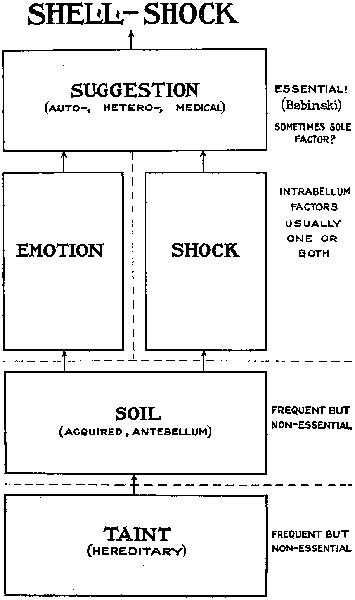
Chart 8
The scalp showed a slight frontal bruise. The brain was extremely congested. On each side of every superficial vessel there was an ecchymosis. A number of minute punctate hemorrhages was found on the surface of the brain in connection with very small vessels. The brain substance was soft, but not markedly edematous. The cerebrospinal fluid was tinged with blood. On each side of the great sinuses of the skull there was considerable ecchymosis. This examination was made by Capt. A. Stokes, R.A.M.C., in the mobile laboratory. There were no areas of large hemorrhage anywhere in the brain substance and no smaller petechiae, except the superficial ones above noted.
Microscopically Mott confirmed the pial congestion and macroscopic subpial hemorrhages described in the gross. He found besides congestion also actual hemorrhage in the vascular sheaths of the corpus callosum, internal capsule, pons and bulb. Now and then blood corpuscles were found extravasated into the nervous tissue.
The microscopic examination showed a generalized early chromatolysis in the nerve cells of varying intensity, especially affecting the small cells. The Nissl granules of the larger cells were also somewhat abnormal, being smaller and packed rather loosely together.
The small cells of the bulb and pons were slightly swollen and their nuclei large and clear. As to the larger cells of the bulb and pons, there was less evidence of this swelling and nuclear change.
According to Mott, this chromatolysis may perhaps be regarded as a sign of loss of biochemical neuropotential. The chromatolysis indicates a relative degree of exhaustion of the kinetoplasm. Mott assumes that the cells of this victim of shell-shock are in a state of beginning nervous exhaustion. He remarks that the cells of the vago-accessorius nucleus show more signs of this nervous exhaustion than others. With respect to cerebellar findings Mott remarks that the changes found are very similar to those described by Crile in the case of an exhausted and wounded soldier. Mott correlates the mania shown on the evening of February 23 with the venous congestion of the cortex, the small subpial hemorrhages and evidence of scattered arterio-capillary collapse.
HISTOPATHOLOGY OF CASE OF SHELL-SHOCK, BURIAL, GAS POISONING? (F. W. MOTT)
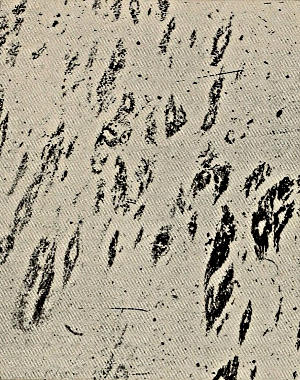
Punctate hæmorrhages in corpus callosum from a case of shell-shock and burial; very probably accompanied by gas poisoning while lying unconscious and buried. Observe the small white area in the centre of the hæmorrhage, in the middle of which is a small vessel which, under a higher magnification, will be seen to contain a hyaline thrombus. (× 20.)
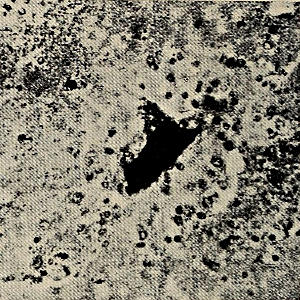
Hyaline thrombus of vessel in centre of a punctate hæmorrhage. The thrombus was stained brown by dissolved pigment. Around the blocked vessel is a white area of brown substance containing numbers of leucocytes; outside this is the hæmorrhage, not very distinctly seen. The specimen was prepared from the subcortical white matter of the frontal lobe. (× 345.)
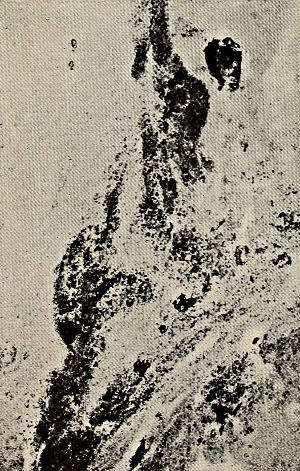
Leash of small perforating optostriate arteries filled with pigment granules. Two of the arterioles show miliary aneurisms. (× 350.)
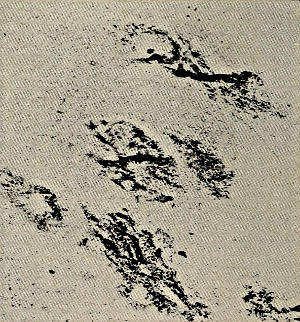
Three punctate hæmorrhages showing optostriate arterioles filled with pigment granules. (× 30.)
HISTOPATHOLOGY OF SHELL-SHOCK (F. W. MOTT)
NOTE THAT THE CHANGES IN CELLS OF FIG. 3 ARE DIFFERENTIAL FOR NUCLEUS AMBIGUUS: CELLS NEARBY PROVED NORMAL
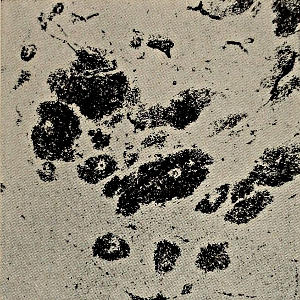
Fig. 1.—Photomicrograph of section of corpus callosum from case of shell-shock showing the capillary punctate hæmorrhages. In several a small white area is seen of brain tissue in the centre of which is a small artery or vein. (Magnification 20 diameters.)
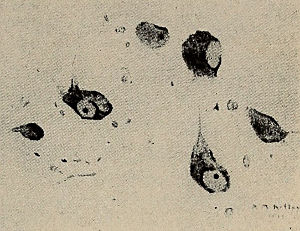
Fig. 2.—Section of medulla oblongata from case of gas poisoning, stained by Nissl method, showing the swollen cells of the nucleus ambiguus. Observe the enlarged, clear, eccentric nucleus; the surrounding cytoplasm shows an absence of Nissl granules. In not a single cell is the nucleus seen in the centre as it should be. (Magnification 450.)
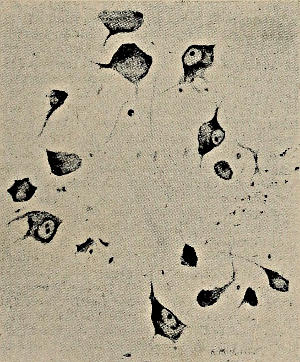
Fig. 3.—Section of medulla oblongata from case of shell-shock with burial, stained by Nissl method, showing the swollen cells of the nucleus ambiguus. Observe the enlarged, clear, eccentric nucleus; the surrounding cytoplasm shows an absence of Nissl granules. In not a single cell is the nucleus seen in the centre as it should be. (Magnification 450.)
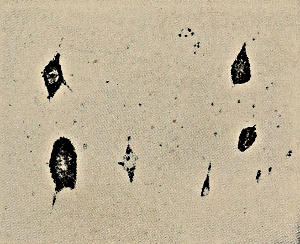
Fig. 4.—Section of third cervical segment of spinal cord from case of concussion, stained by Nissl method, showing the medium group of anterior horn cells corresponding to the nucleus diaphragmaticus. They show certain amount of perinuclear chromatolysis. But all the cells exhibit the Nissl granules. Even at the seat of concussion, the fourth segment, an external group of cells remains showing Nissl granules. Concussion therefore does not destroy the Nissl granules. Probably the cells of the nucleus diaphragmaticus show a certain amount of chromatolysis because they were continually discharging impulses along the phrenic nerves, and the few cells that were left of the nucleus had therefore much more work to do. (Magnification 300.)
Mott suggests that the sudden death of the case may be due to a hemorrhage into a sheath of a fair-sized vessel in the median raphe of the bulb; the general venous congestion; and the almost complete chromatolysis of the vago-accessorius nucleus (adjacent hypoglossal nucleus normal).
According to Mott, also, many Shell-shock symptoms, e.g., headache, giddiness, amnesia (anterograde and retrograde), dizzy feelings, lack of power of attention, and fatigue, stupor, inertia, mental confusion, terrifying dreams, are to be explained on the basis of capillary anemia and chromatolytic changes.
Mine explosion. Ecchymoses; no bone or visceral consequences seen at AUTOPSY (third day after explosion) except SUBDURAL HEMORRHAGE and PUNCTATE HEMORRHAGES OF BRAIN.
Case 198. (Chavigny, January, 1916.)
A sergeant in a Chasseur Battalion was in a mine explosion and entered hospital June 19, 1915, so agitated that he had to be tied to the stretcher during transfer from the railway. There were remains of epistaxis and blood in the right ear, not proved to be due to otorrhagia; blue-black ecchymoses of both eyelids; and small ecchymoses of the bulbar conjunctiva of the right eye. No other sign of trauma or fracture. The explosion had probably taken place on June 17 or 18. Patient was but semiconscious and irresponsive; rolled upon the mattress, beating the air with arms and legs, assuming fighting postures and uttering cries. Urinary incontinence. No fever.
There was doubt as to the diagnosis, which lay between fracture and concussion. The persistent agitation and oniric delirium pointed rather to concussion. Without further sign, however, the patient died on the night of June 20.
The autopsy was extremely careful and showed no sign of cranial fracture of vault or base. The cerebrospinal fluid was strongly bloodstained. The inner surface of the dura mater had a thin sheet of hemorrhage, hardly 1 mm. thick, covering both hemispheres and the cerebellum and spreading over the bulb. There was no distension of the lateral ventricles. Serial sections of the brain showed no lesions of the substance, except for slight hemorrhagic points.
According to Chavigny, so slight a meningeal hemorrhage is incapable of producing a mechanical disturbance of the brain and the cause of death could not be said to be meningeal hemorrhage. Massive multiple gas embolism through sudden decompression is not a suitable explanation of a case with death delayed, as in this instance, even if Arnoux’s explanation is suitable for cases of immediate death.
Mine explosion: no skin, bone, or visceral consequences seen at AUTOPSY (death in seven days) except slight LOCALIZED MENINGEAL HEMORRHAGE.
Case 199. (Roussy and Boisseau, August, 1916.)
A soldier entered Val-de-Grâce February 27, 1915, in a state of confusion following mine explosion the night before. He was delirious, thought himself on leave, and had spells of excitement. Lumbar puncture, February 29, showed a slightly darkened fluid, with approximately normal amount of albumin, one or two lymphocytes and rare red blood cells.
A brief period of slight improvement followed, but the restlessness and delirium increased once more, became particularly severe March 3, and the patient died on the night of the third, seven days after the explosion.
The autopsy showed slightly congested lungs; no other lesion except a sharply defined hemorrhage in the cervical spinal meninges and over the meninges of the temporal and occipital lobes. Microscopic section of the brain failed to show any hemorrhages within the brain substance.
Here is a case of death following explosion without external wound. The meningeal hemorrhages are hardly enough to explain the death. The explanation of the death must probably be made after histological examination.
Concussion of spinal cord from shell burst—WITHOUT spinal fracture, WITHOUT penetration of splinters of shell or bone into canal or cord substance: Microscopic demonstration of intraspinal AREAS OF SOFTENING with classical secondary degenerations. Such a case forms a link in the argument that serious lesions of the nervous system may develop as a result of VIOLENCE directly TRANSMITTED through investing tissues EN BLOC.
Case 200. (Claude and Lhermitte, October, 1915.)
A man, 23, was struck in the left thorax and shoulder, in both thighs and the neck, by fragments from a bursting shell March 27, 1915. One fragment was imbedded near the vertebral column.
Twenty days later there was an absolute, flaccid paraplegia, yet the legs occasionally gave spontaneous, jerky movements. Tactile anesthesia reached the fourth dorsal root-level, except that the perineoscrotal region and the penis were somewhat sensitive. There was anesthesia to pain and heat, as well as in bones and joints, along with the tactile anesthesia. There was a hyperesthetic region on the right side, corresponding with the distribution of the fourth dorsal root. All the cutaneous reflexes up to the abdominals were gone; but defense reflexes could be brought out in foot and leg by skin, bone or joint stimulation. The deep reflexes of the legs were also lost, whereas those of the arms were increased. Retention of urine without incontinence; no retention of feces. Sacral, trochanteric and heel decubitus had developed in the course of the three weeks following injury. A lymphangitis ran all the way up the right thigh from one of the sores, with a corresponding hyperpyrexia.
Surgical intervention was indicated from the evidence of spinal compression at a definite level, but the lymphangitis grew worse. Oniric delirium, and finally a stuporous state, set in, with death May 6, forty days after the wound, a death due to septicemia, without special alteration in the paraplegia itself or in the sensory and reflex situation.
At autopsy the spine and dura mater proved normal; but microscopically serial sections through the fourth and fifth dorsal segments showed softening of the right anterior horn and posterior columns, with cavitation in the radicular zones, and the white matter of the fifth dorsal segment was in a state of acute degeneration. There were also ependymal changes, namely, at the fifth dorsal level a dilatation with deposit of albumin; in the lumbar region, breakage of the ependymal wall, with cellular gliosis. The dilated ependyma was surrounded by an area of fibrillary gliosis which had proliferated in the form of a septum in the interior of the canal. (According to Claude and Lhermitte, these data concerning hydromyelia, which they regard as secondary to trauma, are an argument in favor of the traumatic origin of certain syringomyelias. They regard the breakage of the ependymal wall as due to hypertension of the spinal fluid due to mechanical lesions.) Their interpretation of such acute degeneration as was found in the fifth segment is that this degeneration, as well as that of the posterior roots, is due to the direct impact of the cerebrospinal fluid upon the cord structure. As for the softenings with cavitation, they regard them as surely due to spinal concussion and as very possibly due to an ischemic necrosis, suggesting that older work by Duret and Michel on concussion of the brain indicates the possibility of a temporary ischemia of the spinal cord from the violent impact of the spinal fluid upon the cord due to shock of the spinal column. The transient hypertension of the spinal fluid might well induce, they believe, a vascular spasm with anemia, to which the gray matter is well known to be especially sensitive. In the present case, a period of somewhat less than six weeks had sufficed to produce secondary degenerations above and below the fifth dorsal segment, of a quite classical sort.
Accordingly, we here deal with a severe form of spinal concussion due to a shellburst, in which intraspinal lesions were produced without spinal fracture or penetration either of bone or of shell fragments into the spinal cord or the spinal fluid.
Shell explosion (1 meter distant) kills a soldier by bursting both lungs within the intact thoracic cage.
Case 201. (Sencert, January, 1915.)
A man of the 26th Regiment of Infantry was brought October 26, 1914, to Ambulance No. 6 of the Twentieth Army Corps at the Chateau d’Henu. Weakly and jerkily the man was able to tell how, as he was going forward, a large calibre shell fell less than a meter in front of him and exploded. He fell back and lost consciousness, was picked up in the evening and carried to the relief post and then to the ambulance, where he arrived ten hours after the fall. There were signs of a considerable shakeup, with pale and anxious face, nose pinched, hollow eyes, rapid superficial respiration, small pulse, 120, and a feeble voice. There were small skin wounds of the right arm, a finger, and ear, but there was otherwise no wound. The thorax and abdomen were somewhat painful all over, but there was no especial point of pain. The chest showed a slight dulness at the bases. Examination of the abdomen produced defensive movements and the man vomited blood during examination. He was put on his back, kept warm, given artificial serum, hypodermic injections of camphorated oil and caffeine, and carefully watched. In the night he had another bloody vomiting, his pulse became smaller and smaller, dyspnea became more and more intense, and he died late in the night.
The autopsy showed that the abdomen was free of lesions and that all the organs were of a normal appearance and color. There was no sign of perforation or of peritonitis. The stomach itself was filled with blood and there was a generalized ecchymotic appearance of the mucosa, with small, submucous hematomata and a number of tears in the pyloric portion.
The pleurae were found filled with blood, almost a quart in each cavity. The right lung showed a large tear at the level of the middle lobe, 15 cm. long. An orange-size, black bit of lung protruded through the tear. There was no sign of rib fracture opposite this tear, and no subpleural, intercostal or subcutaneous contusion. The thorax wall was perfectly normal.
The left lung showed, in the middle portion of the upper lobe, a somewhat analogous pleural tear, almost as big as that on the right, with another large hernia of black lung. Bits of the herniated lung sank in water. The thorax wall was intact. The pericardium was free from blood. There was nothing else abnormal about the body.
Re effects of an explosion upon structures with intervening objects left intact, Fauntleroy notes that a shell bursting three yards from an aneroid barometer may force its levers into an abnormal position. A further fact will indicate how permanent is the physical state into which the levers are forced; for when the barometer with its levers placed right was placed under a bell-jar and the pressure therein was reduced to 410 mm., the levers resumed the position into which the explosion of the big shell had thrown them.
Re windage and internal effects in the human body, Ravaut recalls the fact that the internal and intraneural hemorrhages of Caisson disease (“bends”) are well known. The external hemorrhages of aeronauts and mountain climbers belong in the same physical class. Dynamite exploded in a pond kills fish. Dynamite may break pillars inside a building without damaging its front. Cases like Chavigny’s (198), Roussy and Boisseau’s (199), Claude and Lhermitte’s (200), as well as Ravaut’s own case (202) are in point.
Shell explosion near by: Paraplegia, interpreted as due to windage. Two foci of HEMORRHAGE (SPINAL CANAL, BLADDER) clinically proved to exist in a case without external sign of injury.
Case 202. (Ravaut, February, 1915.)
An infantry sergeant was brought to the ambulance, one day in November, 1914, with a paralysis which had set in immediately upon the explosion of a large shell a short distance away. Both legs were paralyzed and there was anesthesia to the navel. He could not urinate. It was early in the war, and Ravaut thought he would find an injury to the vertebral column, but on undressing the soldier there was no wound. The skin was intact, and there was not even an ecchymosis. The patient was suffering not at all, but said that after the shell exploded he felt a forcible shock, was stunned for a moment, and when he wanted to rise, found that his legs were inert. His state did not change during the day and he did not urinate. Catheterization showed a urine full of blood. This indicated a lumbar puncture, and a bloody fluid emerged under great pressure. Thus two foci of hemorrhage were proven to exist in this patient despite the fact that there was no external lesion.
Re windage effects, see suggestions of Ravaut under Case 201. Ravaut also suggests that certain cases of emotional jaundice may be similarly explained on the basis of internal lesion due to windage. Sundry cases of gastro-intestinal disorder and of hemoptysis fall into the same class; possibly the cases of death in a fixed posture belong there, too. Ravaut thinks, despite the look of hysteria about the shell-shock cases of paraplegia, deafness, mutism, and the like, that the cases are actually ones in which there has been at the beginning a slight or severe hemorrhage, clearing up in a few days. He states that there is a pretty definite parallelism between the course of the clinical symptoms and the chemical characteristics of the spinal fluid.
Shell-explosion in confined space; paraplegia after fifteen minutes; slight hemorrhage and LYMPHOCYTOSIS of spinal fluid; Hematomyelia.
Case 203. (Froment, July, 1915.)
A Sergeant lying down in a small dugout space, 2 × 1 m. high, had a 77 shell burst behind his head and between his head and the back of the dugout. The patient was not moved by the explosion, but was buried in a small amount of earth and stones to a depth of about 20 cm. He was not wounded and showed no ecchymoses either then or later. Aided by stretcher bearers, he was able to walk to the relief post about 400 meters from the trench. He did not lose consciousness, and got to the relief post about a quarter of an hour after the shell burst. Thereafter, however, he was unable to move his legs. The accident happened February 6 at 4 o’clock. He was examined 24 hours after the trauma. The accompanying diagrams show the variations in sensory disorder at intervals during six months.
A lumbar puncture, February 8, 1915, showed hypertensive clear fluid without macroscopic clot on centrifuging, but showing a number of red blood cells and lymphocytes—3 or 4 to the microscopic field. There was a slight hyperalbuminosis. The development of the muscular atrophy and hypo-excitability of the left lower extremity, the exaggeration of the left knee-jerk, together with the spinal fluid appearances, seemed to prove the organic nature of the paraplegia. There was an intense rhachialgia, with radiation along the sciatic nerve. This outlasted all other symptoms. Thermo-analgesia was the most prominent sensory disorder. There were no sphincter disorders.
During the first days, the anesthesia was of a pure segmentary type, with nothing about it to suggest that it was later to be supplanted by a radicular type of disorder. Hematomyelia was, years ago, thought—according to Froment—to tend to yield sensory disorders of a segmentary nature. At the outset this anesthesia was total, though there was a vague, poorly localized feeling on intense painful excitations,—as with energetic pricking or burning. Thus the protopathic sensibility of Head had remained, whereas the epicritic sensibility had disappeared.
Detailed examination of this case showed extreme errors in the position sense. For example, pricking the foot might be localized as pinching above the knee. The cremaster reflex was extremely marked and would appear upon even slight excitation of any part of the lower extremity, even at times when the patient declared he felt nothing. These phenomena at the beginning early gave place to a syringomyelic type of anesthesia.
At the time of report, July 29, 1915, Froment regarded this case as analogous to hematomyelias of divers, although there is not such a degree of decompression; the suddenness of the decompression is more marked in these Shell-shock cases than in divers.
Shell explosion; bowled over; loss of consciousness: Hemiplegia with reflex signs thought to be organic; hypertensive spinal fluid; LYMPHOCYTOSIS.
Case 204. (Guillain, August, 1915.)
A corporal in the engineers was going the night of June 7th to a creneau of mitrailleuses, when he was bowled over by a bursting shell. He lost consciousness and was carried to the cantonment by his comrades. Next morning he complained of headache and pain in the back; had a convulsion; and proved on examination to have a left-sided hemiplegia. He was given the diagnosis of hysterical hemiplegia.
He was sent to the 6th Army neurological center, and there showed a complete left-sided hemiplegia with tendency to contracture. The left knee-jerk and arm reflexes were exaggerated, and there was ankle and patella clonus with Babinski sign. There was a dysesthesia on the left side, with wrong interpretation and poor localization of painful stimuli, and non-recognition of cold and heat sensations. Muscle sense and stereognosis were impaired. There was a slight dysarthria. Lumbar puncture yielded a clear hypertensive fluid with a slight lymphocytosis.
The situation remained without change for a month, when the patient was evacuated to the rear. Thus, a shell-burst can produce destructive nerve lesions without evidence of external injury.
Re hypertensive spinal fluid, Sollier and Chartier cite Dejerine as having brought the proof of hypertension in the cerebrospinal fluid in Shell-shock cases. They also believe that the Shell-shock hysteria is built up on a physical basis, more or less after the model of Charcot’s hysterotraumatism. Shock, windage, and gas may bring about the same kind of result. They rely especially on the cases of Sencert (201) and Ravaut (202) for their argument (1915). They recall the fact that Charcot found a hysteria due to lightning stroke and to high tension electric accidents. They quote Lermoyez as attributing like results in ear cases to labyrinthine shock, tympanic rupture, and ear hemorrhages.
Shell-shock: Hemiparesis, amnesia. Lumbar punctures early (but here as late as one month after shock and after disappearance of hemiparesis) showed PLEOCYTOSIS and hyperalbuminosis.
Case 205. (Souques, Megevand and Donnet, October, 1915.)
A French sergeant, a machine gunner, was the victim of shell-burst September 25, 1915, was evacuated with a diagnosis of commotio cerebri, and, when examined at Paul-Brousse October 5, showed a right-sided hemiparesis, clouding of consciousness and somnolence, the hemiparesis involving the face, with deviation of tongue to right, Babinski reflex right, cremasteric and abdominal reflexes abolished on right. Normal respiration and pulse.
Lumbar puncture October 7, that is, thirteen days after the injury, yielded a clear fluid with an excess of albumin, 144 small lymphocytes (some degenerate) and a single endothelial cell.
October 12, the knee-jerk was a little less lively on the right side. The plantar reflex varied between extension and flexion on the right side. The cremasteric reflex had been weakly regained on the right side.
The patient was now less stupid and could tell how he jumped when the shell burst, and how he had been in the air ten minutes (!) and fell, getting up at once, with nothing wrong except nosebleed. After a half-hour he felt weaker and was ordered to leave the post, whereupon, on the road, his weakness increased and he tended to fall to the right, but reached the ambulance on foot.
October 23, there was no longer any evidence of hemiparesis, the Babinski reflex had entirely disappeared; there was no complaint except of dizziness and headaches. He got back his autocritique on the matter of remaining in the air ten minutes, but there was still an amnesia for the ten day period between the shock and his arrival at Paul-Brousse. He forgot that he had had a lumbar puncture October 7.
Another puncture, October 25, yielded some 14 or 15 lymphocytes to the cmm. There was still an excess of albumin. The lymphocytes decreased further according to a puncture November 2. Had this patient been examined some weeks after the shock there would have been no signs of an organic paresis, no special modification of the spinal fluid, and no reason for regarding the man as other than an hysteric. Early spinal puncture is, accordingly, important.
Of course, the question whether the lymphocytes and hyperalbuminosis of the fluid might not be syphilitic must be raised. At the Hospital Medical Society meeting, October 29, 1915, Souques states that Ravaut and Guillain believe that simple shell-shock often produces “syphilitic” chemical, physical or cytological changes in the spinal fluid. Roussy is cited as thinking such changes rare.
Shell-shock; burial: Coma and semicoma; BLOOD-STAINED SPINAL FLUID. Improvement on puncture. Persistent astasia abasia with spasticity.
Case 206. (Leriche, September, 1915.)
A man was buried March 15, 1915, following the bursting of a large calibre shell. He is said to have had hemoptysis and arrived at hospital March 17 in coma. He kept moaning while asleep. March 18, he was still stupid and as if stunned. He did not talk or understand what was said, but was able to write a few words. The knee-jerks were a little exaggerated. There was a slight spasticity of the limbs, which was exaggerated on emotion into a sort of spasmodic crisis.
Lumbar puncture gave a reddish fluid under strong tension. After lumbar puncture the man came out of coma and the next day, after another puncture (fluid slightly yellowish), there was further improvement and the patient spoke. The third puncture, March 20, yielded yellow fluid. The spastic phenomena still persisted, however. The patient could not walk or stand. Every time he touched the ground he had a clonic crisis. He was evacuated to a neurological center.
Re astasia-abasia, Nonne found these cases heading a group of 63 cases of war hysteria treated in a twelvemonth. Figures as follows:
Astasia-abasia14
Generalized tremor12
Brachial monoplegia11
Isolated contracture6
Crural paraplegia5
Mutism5
Isolated tic4
Hemiplegia3
Isolated respiratory convulsions2
Isolated sensory disorder1
Fifty-one of the 63 cases were freed by therapy from their main symptoms (twenty-eight cases cured in one or two hypnotic sittings).
Prolonged bombardment; shell explosion (nearby?): Depression; suicidal attempt; hypertensive spinal fluid.
Case 207. (Leriche, September, 1915.)
A patient entered an evacuation hospital June 27, having come from an ambulance with a ticket reading, “Melancholic depression, with stupor—attempt at suicide (threw himself into a pond)—sprained ankle—to be evacuated, lying down, on a milk diet.” The patient was depressed, indifferent to surroundings, irresponsive, and did not even look at an interlocutor. There was no other somatic sign except a pulse of 62. He did not eat, and remained lying down, without movement. Lumbar puncture in a sitting posture yielded a clear liquid under pressure of 34. June 30, another lumbar puncture yielded clear fluid of a dichroic appearance when looked at from above. 25 c.c. were removed. July 1, there had been a good deal of improvement. The patient said he was better and began to take a little milk. July 2, there was still some improvement. Pulse 60. He said that his condition had lasted a month and that it followed a violent and prolonged bombardment for ten days in his sector. July 3, he was much better, began to look about, talk, and eat a little. July 4, lumbar puncture yielded a clear fluid with a pressure of 30, reduced to 22 after withdrawal of 20 c.c.
According to Leriche, explosion of large calibre shells or of a mine can produce cerebral or spinal symptoms, some of which are removed by lumbar puncture. The fluid is red shortly after the explosion and under hypertension for some days. Such hypertension may be found even in shell cases that have no other sign of cerebral condition. This particular melancholy patient had a relapse and another depression with fugue.
Example of HEMATOMYELIA, indirect result of bullet wound. Partial recovery.
Case 208. (Mendelssohn, January, 1916.)
An infantry subaltern, 23 years old, was injured September 24, 1914, by a rifle bullet, which entered above the left clavicle and emerged between the right scapula and the vertebral column. The patient leaped into the air when he was struck, but fell at once and found that his legs were paralyzed. A feeling of cold crept up from the feet to the region of the umbilicus. Consciousness was preserved. There was hemoptysis because of the bullet’s passing through the left lung. The wounds all healed quickly. There was retention, followed by incontinence, of urine and feces; and the situation was complicated by eschars in the gluteal and trochanteric region.
For three months there was no change in the paraplegia, except that at the beginning of the third month the patient could move his fingers a little and raise his knees slightly. He was transferred back through three hospital units, with a diagnosis of spinal cord lesion or fracture due to a vertebral column lesion at the second and third dorsal vertebrae.
Seven months after injury, he reached a Russian hospital for a laminectomy, incapable of standing or walking without support, although able to sit and rise with extreme difficulty. He could now very slightly flex and extend the knees, and very slightly flex and rotate the ankle, and weakly move the toes. Passive movements could be carried out without much difficulty, though there was a slight joint and muscle stiffness. Both quadriceps muscles were markedly atrophied. There was slight amyotrophy of the lower legs. Tendon reflexes were exaggerated, and there was a marked ankle clonus, a Babinski reflex, and an abolition of the abdominal and cremasteric reflexes.
There was a sensory disorder of an incomplete syringomyelic pattern, with diminished sensibility to heat and complete abolition of pain sensibility. Touch and electric sensations were somewhat delayed. There was a diminution in the faradic and galvanic excitability of the legs and feet; vasomotor disturbance (slight hyperidrosis) of the paralyzed limbs. Two of the eschars had not yet cicatrized. The sphincteric disturbances had diminished. For the rest the patient was normal. The second and third vertebrae showed deformity and were painful to pressure and percussion of spinous processes.
The patient was treated by galvanization of the spine, with a current descending at first and then ascending, and by faradization of the paralyzed muscles. There was progressive improvement, irregular but constant. At the time of report, July 1, 1915, he was perfectly well, able to take long walks, and without sphincter or sensory disturbance. The tendon reflexes were still exaggerated, and there was still a slight ankle clonus and Babinski. The abdominal and cremasteric reflexes were still abolished. The last of the seven eschars had not yet healed over.
For the organic nature of this lesion, the numerous early eschars, the persistent sphincter disturbances, the limited paresis of the legs, the reflex disorders, and the dissociation of sensations seem abundant evidence. It is probable that there was no fracture of the vertebrae (X-ray confirmation), and it is probable that there was a meningeal hemorrhage, together with some hemorrhagic foci in the spinal cord substance, especially in the gray matter. A good deal remains doubtful: Mendelssohn remarks that the sphincter disturbances ought to be related to disorder of the fourth and fifth sacral segments, and the knee-jerk and Achilles jerk absence with disorder of the lower lumbar, and sacral region; the abdominal reflex disorder with the low thoracic lesion; the distribution of the anesthesia ought to indicate a lesion in the lower part of the spinal cord. Was not the hemorrhage therefore lower down than the spot where the vertebrae were displaced? It is surely of prognostic note that the eschars did not necessarily foretell a fatal outcome; in fact, the patient had become functionally well before the seventh eschar was healed over.
Shell explosion with subject lying down applied to machine-gun; no contusion: HEMATOMYELIA. Partial recovery.
Case 209. (Babinski, June, 1915.)
A veterinary student, six months captive in Germany, wrote out for Babinski the following:
“September 1, 1914, I was about to operate a machine gun when a shrapnel shell exploded very near me,—probably about two or three metres overhead. I base this estimate on comparisons made with shells I saw exploded beside me before this one.
“Just after the explosion, which deafened me and at the same time took my breath away a little, from the powder, I felt a rather severe pain in the kidney region,—a pain which then persisted without interruption. I moved my left arm, to find the effect produced by a bullet which I heard whistle by my ear and which struck the upper part of the left shoulder without entering. At the same time, I tried to turn to see what had become of my legs, and had a feeling that they had vanished. Almost immediately I felt little prickings, not very painful, in the lumbar region and in the upper part of the thighs. Just then, seeing my comrades going away I tried to imitate them, but could not. All these feelings passed very rapidly.
“A comrade then came near to tell me to go back. I told him that I could not move and that I must have been wounded in the lumbar region. He looked at my kit and my coat and said there was no trace of shot or tear. Not wanting to leave me, he lifted me by the armpits and knees. I could not help him get me up, and my legs hung flexed and inert. After a few steps he had to put me down, and tried to stand me up. I immediately crumpled. I had no sensation of my feet touching the ground. I sent my comrade back, asking him to tell my brother, who was in my squad. I did not lose consciousness or any feeling of my situation, or of the danger being run by my comrade.”
The man remained four days on the battle field without food. He was on the edge of a stream. He did not defecate, nor for two days did he urinate. Eventually the bladder and rectal functions were re-established, though they remained irregular. Catheterization was never resorted to. The lumbar pains were diffuse, fixing themselves a few days after the accident in the region below the umbilicus. There were pains at the waist predominating on the left side. The paralysis of the lower extremities grew rapidly better. Movements in the right leg reappeared, and 27 days after the accident the man was able to stand and walk around his bed. Still further movement followed (left leg weaker).
At the time of the report, May 28, 1915, the patient could walk without a cane, but he could get about only slowly. The left toes would rub against the ground, and he could not support himself for any length of time on his legs. The knee-jerks were exaggerated, especially the left. The Achilles jerks were increased. There was a Babinski reflex on the left side and an abduction of the fifth toe on plantar stimulation. The same reflexes were found on the right side, but less marked. Abdominal reflexes absent, except the right superior reflex, which was distinctly present. Cremasteric reflexes absent. Anal reflexes preserved. The defense reflexes were exaggerated, but more markedly on the left side. The zone from which the defense reflexes could be elicited on the left side included the whole lower extremity and rose as far as 2 or 3 cm. above the nipple. Stimulation of the lateral parts of the left lower extremity would even produce defense reflex movements on both sides of the body. On the right side, however, the defense reflex movements could only be tried out by scratching the anterior surface of the ankle, which was then followed by a flexion of the foot.
Sensibility to touch and deep sensibility were preserved; but sensibility to temperature and pain, normal on the left,—i.e., paralyzed—side, was weak in the right leg. There was a marked sudation on the left side, limited by the white line, the inguinal fold, the iliac spines, and a horizontal line passing through the umbilicus.
Here, then, paralysis followed a shell explosion while the subject was lying down. No contusion therefore was possible. According to Babinski, we are dealing probably with a hematomyelia, the result of shell explosion.
Struck by missile in back; unconsciousness; no wound: Hysterical paraplegia? HERPES and SEGMENTARY Hyperalgesia suggest radicular and spinal injury. Recovery.
Case 210. (Elliot, December, 1914.)
November 1, 1914, a sergeant in the 20th Hussars, with other dismounted cavalrymen, was chasing Germans with a bayonet, over turnip fields pitted by shells. Several hours later, he found himself in a house in a nearby village, to which he had been carried unconscious. Probably he had been struck by some missile in the back, as the bottom of his haversack had been torn off. His face was blackened with smoke, and his clothes were muddy. He had no wound. His left arm was weak and his legs powerless and numb. The passing of water was painful, but there was no blood in the water and no hemoptysis.
Five days later, he was examined at a base hospital and found to be paralyzed and numb in the legs. The knee-jerk and ankle-jerk were retained upon the right side only. Pain occurred on passive movements of the legs, which were flaccid; there was a hyperalgesia about Poupart’s ligament, more marked on the left side. Lower abdominal reflexes were weak on the left side; pain in lower abdomen with bladder full and at outset of micturition. Pain and paresis also affected the left arm, but there was no numbness. Pain on pressure over lumbar and cervical vertebral spines. There was no evidence of bruising.
The physicians were inclined to regard the phenomena as hysterical. Three days later, the arm movements became much freer, and after another three days, the arm movements were fairly powerful, and the legs much stronger, although the patient could not yet stand or walk. He still had pain if his bladder was full.
Chart 9 CAUSES OF SHELL-SHOCK
HEAD INJURY
ATMOSPHERIC CONCUSSION
MENTAL STRAIN
NON-NERVOUS TRAUMA
NEUROPATHIC HEREDITY
After Ballard
As against the diagnosis of hysteria, three herpetic clusters appeared on the skin of the left thigh, from three to six inches above the knee. Elliot regards it as certain that the posterior root ganglia were injured. He regards the case as one of injury to the spinal nerve roots. The hyperalgesia about the body of course suggested damage to the spinal cord. According to Elliot, therefore, this case is one of organic disease; whether of the roots or of the cord was uncertain. At any rate the cases of this type, though not functional, recovered.
Mine-explosion; burial; labyrinthine lesions and head bruises, more marked on left side: Focal canities (WHITE HAIR developing OVERNIGHT) on left side.
Case 211. (Lebar, June, 1915.)
A soldier, 23, in the Argonne was blown up by a mine in a trench, fell, and was covered by a mass of earth, from which he extricated himself. He immediately became deaf from what was medically determined to be a double hemorrhagic labyrinthitis. There were also superficial powder burns of the face, as well as several bruises on the head, especially on the left side.
The next day, at the English hospital at Arc-en-Barrois, the patient noticed tufts of white hair on the left side of the head. There were four islets of gray hair in the left fronto-parieto-occipital region, separated from one another by normal hairs. The gray hairs were gray completely from the roots to the ends of the hair. The longest hairs were as white as the shortest. There was not a brown hair amongst them. The gray hairs were solidly implanted, and could be pulled out only by strong traction. There was a discoloration also of the bulbar swelling of the hair. The rest of the head hair was dark brown. His hair was described in the military description: “deep chestnut brown.” There was no other symptom aside from an incessant twitching of the left eyelids. The place of whitening was apparently determined by the region of the scalp injured. Not only were the bruises on the left side of the head and face, but the labyrinthine lesions were more marked on this side and the twitching of the eye-lids was confined to the left side.
Shrapnel wound of skull; focal canities over wound; shell-shock and shrapnel wound of right leg. Head tremors and contractions, changing in relation to posture; glove anesthesia and local anesthesia of trunk.
Case 212. (Arinstein, September, 1915.)
A Russian private, 24, was wounded twice: once in the head by a bullet, and at another time by a bit of shrapnel that imbedded itself in the skull. The hair over the injured spot became gray.
Later, September 16, 1915, the soldier was subjected to shell-shock, and at the same time wounded by shrapnel fragment in the right leg (operated next day).
Upon examination at Petrograd, the hearing was found diminished and the eardrum was pulled in. At first the patient could not speak or open his eyes, and made incessant lateral movements of the head, jerking backwards and to the right. The right half of the face gave convulsive movements, which began at the lip and spread upwards. During sleep, there was an entire cessation of these head shakings and jerks. In the lying posture, the head shook at a rate of 100 to 120 per minute. The jerking movements became more marked when the patient sat up or walked. He carried his head bent toward the right shoulder. When he sat down, the side-shaking movements disappeared, only to reappear when he lay down. The swallowing reflexes were absent. The sensitiveness to touch, pain, and temperature was lost in the upper part of the trunk including the neck, to the level of the tenth dorsal vertebra. There was anesthesia of the arms as far as the elbow on the right, and as far as the shoulder on the left. The mucosae of the mouth were anesthetic. Dermatographia was strongly marked.
Shell explosion; burial: Hemiplegia, probably organic.
Case 213. (Marie and Levy, January, 1917.)
A soldier was blown up by a shell and then buried at Vaux, March 29, 1916, and entered the Salpêtrière, July, 1916, with a right-sided hemiplegia and contracture without evidence of wound. He remembered nothing for the first fortnight after the trauma. When he came to himself, he was paralyzed and was unable to say more than a few words, but at the end of a month his aphasia ceased and he began to walk.
The hemiplegia was spastic. There was pronounced contracture. The arm was extended, hand open, fingers stretched. Finger movements were diminished, as well as extension of the wrist, but the arm was otherwise normal. The leg was not so stiff. The great toe was in a state of continuous extension. The toes could not be moved, and the foot scarcely; but the leg could be strongly flexed and extended on the thigh. The tendon reflexes of the right side were more lively than on the left. Cloniform movements followed tapping the patellar tendon on the right side, and a patellar clonus and ankle clonus could also be demonstrated. Plantar reflex, flexor on the right. Distinct adduction of the foot. Slight disturbance of tactile sensibility in the paralyzed limbs; marked disorder of position sense and gross disturbance of stereognostic sense. Moderate dysarthria.
Ten months after the traumatism, the hemiplegia and spastic walk remained. The upper limb was now carried in extension back of the body, with hand supinated, fingers sometimes in extension, sometimes in flexion, index finger separately from the others. Finger movements difficult and shoulder movements limited. The leg, however, was almost normal except that the toes could not be moved. The tendon reflexes were more lively and cloniform on the right, but there was no longer patellar or ankle clonus. Stereognosis slow, but finger movements were naturally difficult. W. R. of blood, negative. Probably this is an organic case.
Blown up by a shell; no skin or bone lesion: Mixture of organic (e.g., lost knee-jerks) and functional (e.g., urinary retention) disorders.
Case 214. (Claude and Lhermitte, October, 1915.)
A man, 38, was blown up in a trench without sustaining skin or skeletal lesions, April 5, 1915. He lost consciousness for a half hour and, coming to, found a crural paraplegia and urinary retention. Examined July 24, in addition to the paraplegia were found tactile and algesic hypesthesia of the legs with preservation of deep sensibility. Pains were felt in the legs, especially in the hips. The knee-jerks were abolished; the Achilles jerks were preserved, as well as the flexor plantar reflexes and somewhat weakened cremasteric and abdominal reflexes. Micturition was difficult. Constipation. Slight paresis of left arm. Lumbar puncture, July 28, yielded a clear fluid of normal tension without chemical or cytological changes.
The sphincter disorders gradually disappeared. The knee-jerks reappeared in a weakened form August 31. The legs could, at the time of report, be moved somewhat, though not above the level of the bed.
We here deal, presumably, with a mild form of concussion of the spinal cord, in which, however, some of the transient symptoms are very possibly merely functional in origin.
Re complicated pictures of organic and functional nature, some experimental work has been carried out. Mairet and Durante set off explosives, such as melinite, at a distance of 1 to 1.5 metres, near rabbits. Some died at intervals from an hour to thirteen days; others lived. Pulmonary apoplexy was found in the cases dying early. Spinal cord and root hemorrhages, hemorrhages in the cortical and bulbar gray, perivascular and ependymal hemorrhages were found, always small and without diffusion, suggesting rupture by rapid decompression following the first wave of aerial compression. The functional effects are thought to be brought about through the anemia of the areas supplied by the ruptured vessels. Russca of Berne got similar results and notes direct and contrecoup brain lesions, tympanic perforations, intra- and extra-ocular hemorrhages, thoracic, cardiac, and splenic hemorrhages, ruptures of kidney, stomach, intestine, and diaphragm. As in the work of Mairet and Durante, the lung proved the most sensitive organ. (Compare also the human case of Sencert [Case 201].) Some experiments with fishes yielded lesions of the swimming bladder. Persalite and other explosives were used.
GASSING: Organic-looking picture.
Case 215. (Neiding, May, 1917.)
A German soldier, 21, was a serious case of gassing. He was unconscious two days (venesection twice). When he came to, he could not walk and felt as if he were drunk. October 22, 1916, he was incoördinate in walking and tended to fall forward when standing with eyes closed. The ataxia of the legs was demonstrable in the position of dorsal decubitus, and there was also a slight ataxia of the arms. The pupils were dilated and reacted poorly to light.
December 12, all symptoms had disappeared. The clinical picture in this case was somewhat like that of a multiple sclerosis. According to Neiding, the disorder is not a functional one but an organic cerebellar disorder.
Re the neurology of gas poisoning, Neiding regards the condition as a new nosological unit. We do not know what the ultimate results of apparently cured cases will be. Court questions of importance will doubtless arise with reference to their compensation. Ninety-six of Neiding’s 274 cases failed to show any nerve symptoms whatever; forty-six cases showed one symptom only, such as headache, dizziness, abnormality of reflexes, or abnormality in sensation. One hundred and thirty-two cases presented a fairly full picture. The picture of a complete traumatic neurosis not infrequently appears, aided perhaps by the psychic features of the gas attacks; and possibly some cases are entirely psychogenic from the beginning. Such symptoms, for example, as dermatographia, rapid and irregular heart, hyperidrosis, blepharospasm, mental perturbation, hypochondria, etc., do not necessarily point to any directly toxic effect of the gases. Thirty-seven of Neiding’s cases showed pupillary changes, hyperreflexia, and analgesia. Thirty-one showed analgesia and absence of laryngeal and corneal reflexes. Twenty-six showed pupillary changes and hyperreflexia, four of these latter showing also an absence of laryngeal and corneal reflexes. One case yielded hyperalgesia alone; ten yielded headache, dizziness, and analgesia.
GASSING: Mutism, tremors, depression, battle dreams.
Case 216. (Wiltshire, June, 1916.)
An infantryman, aged 27, had been at the front for three months. He was wounded a month before coming to hospital; but when the wound healed he went back to the front, quite mute but intelligent and able to write the following:
“We were on our way to the trenches, and as we were going through the railway cutting they started to shell us, with gas shells mostly, and we had not been there more than quarter of an hour when I was compelled to lie down from temporary blindness and weakness through getting a dose of gas through my mouth and eyes. I was lying down for about ten minutes when a shell came somewhere near, and was struck by something in the face and on my left knee and I remembered no more until I found myself in hospital. I was all of a shake and while lying down would frequently jump up and wonder where I was.”
The patient had been mute thereafter, depressed, and given to dreams about fighting and shells. There was a fine tremor controllable by the will; the knee-jerks were increased. On lateral deviation, there was difficulty in fixing the eyes. There was a slight deafness due to an old discharging left ear. According to Wiltshire, Shell-shock is only exceptionally caused by chemical poisoning from gas.
Re poisoning by certain German asphyxiating gases, Sereysky reports in 1917 that these gases contained, among other poisons, a nerve poison. He found that poor heredity was a favorable soil for the action of this nerve poison. The clinical pictures in the gassed soldiers rather suggested cerebral arteriosclerosis. He remarks that the logical distance between the “exogenous” and “endogenous” is greatly reduced in these gassed cases, as the syndrome of “exogenous” gassing closely approximates that of various “endogenous” disorders.
Hysterical speech disorder related to mechanical disorder of auditory apparatus.
Case 217. (Binswanger, July, 1915.)
Whenever a German officer’s servant, 23 years, was addressed on the ward in the Jena Nerve Hospital, his hands would tremble and the muscles of his face would fall into grimacing associated movements. He had a peculiar infantile type of speech, talking with a fixed glance and an anxious mien. He would carefully utter, as a rule, separate words, chiefly only nouns or infinitives. He would gesticulate with both hands to make what he said understood. Thus (freely translating the German) runs his description of a battle:
“Well—because—I—we had—no artillery and so many losses—then got in position again, then we—laid down a long time—perhaps until four o’clock in the afternoon—five—and—and it happened that—lay in Rübenfeld—couldn’t go back—then shell near me—fell in and I right near, how—how far—I don’t know and—grown better. Comrade said—10 meters—don’t know—un—unconscious.”
Long compound German words could not be repeated, since after the first or second syllable there was a severe emotional excitement; syllable articulation and phonation ceased. Finally, however, the patient could be gotten to pronounce the whole word. Reading aloud was very difficult: syllable sounding and omission of difficult syllables; after a time, weeping.
The patient was a somewhat small, muscular, well-nourished man, with a murmur at the apex, a somewhat rapid pulse, increased reflexes, especially skin reflexes, painful supra- and infra-orbital points, temples painful to percussion, pressure over spine painful from second thoracic to third lumbar vertebrae. There was an increased sensitiveness to touch and pain over the whole body. There was a bilateral, somewhat marked tremor, more marked on the left side than on the right. Swaying in Romberg position was slight. Tremor of tongue.
This patient was first brought to Jena November 23, 1914. An illegitimate child, a moderately good scholar, he had worked as a mason until he went into the army, in 1912. He worked as a soldier chiefly in the officers’ casino because he got pains in his legs and knees in long drills. At the outset of the campaign, however, he withstood the heavy marching, although with difficulty. He was in his first actual skirmish September 20. A shell struck nearby and threw him several meters; whereupon he became unconscious and was carried away by the hospital corps. When he woke up he could not speak or hear. Ten days later, however, speech returned, and hearing returned in right ear; October, deaf in the left ear, and he could not hear a watch tick on the right side at a distance of 16 centimeters. He was examined at the otological clinic in Jena October 12, where the drum membranes were both found opaque, without reflexes or normal contours; hysterical attack on the caloric test. The next day, on the medical visit, there was a screaming attack. His plight seemed not so much simulation as one of traumatic hysteria.
Again, after his stay at the nerve hospital, another hysterical outburst was produced by a hearing test with vestibular apparatus, in the ear clinic, February 6, 1915. The diagnosis was nervous deafness with involvement of left ear.
The insomnia was successfully treated by sodium bicarbonate. There was a slight improvement in speech. In March body weight had improved, but there was a marked tremor of the right hand. In the next few months there was a progressive improvement in general well-being, in speech disorder, and in tremor. The auditory disorder remained unchanged. The man now works in his father’s garden.
This case appears to show a combination of psychic and mechanical injury. There are severe hysterical auditory and speech disorders. Although the auditory disorder is of mechanical origin, the speech disorder appears to be of psychogenic nature. It is somewhat remarkable that the ear tests almost every time produce hysterical attacks in the form of convulsive crying. Rather unusual is the general cutaneous hyperalgesia, more marked about the ears.
Shell-shock (distant, neither seen nor heard); left tympanum ruptured; semicoma eight days: Cerebellar syndrome and hemianesthesia. Recovery, nine months.
Case 218. (Pitres and Marchand, November, 1916.)
A lieutenant underwent “shell-shock” either at night or in the early morning, September, 1915, the shell bursting at a distance. He neither saw nor heard the shell, lost consciousness and was eight days semicomatose, failing to recognize his wife.
On recovering his senses, he could not get about, as he had lost his memory, having to write down his room number and be warned of meal times. He was led about like a child. He had a continuous headache on the right side and pains in the occiput and along the spinal column, as well as in the right leg as far as the heel. These leg pains were lightning pains. Walking was difficult, staggering, leaning to left. Weakness of right arm and leg; right-sided hemianalgesia. Complete insomnia. During November there were frequent urgent desires to urinate day or night. Evacuated to the oto-rhino-laryngological center in Bordeaux, December 13, for examination of ears. The right ear was found normal, but there was a rupture of the left tympanum. There was at this time a trismus. The jaws were opened with the dilator and the man had a syncope during this operation. The question of surgical intervention for a cerebral lesion was raised, but he was first sent to the neurologists at Bordeaux. There, December 31, he was found with a facies of anguish, unstable gait, inclination to the left in walking; no Rombergism; occasional dizzy spells. In walking, the right foot was pointed outward and on request to direct it forward he complained of pain in the loins, reaching as far as the scapula. Walking with eyes closed, he leaned to the left and lost balance. With eyes open, no disorder of balance. With eyes closed, the body leaned backward. If requested to go back, he failed to flex his legs to keep balance. If he was asked to put a foot upon the chair in front of him, he immediately fell backwards. He could not support his body on the right leg more than a few moments. He had difficulty in raising both legs from the bed at one time and he could lift the right leg not so high as the left. Movements of the legs were performed hesitatingly and slowly and with greater difficulty with eyes closed.
He could not thread a needle and could hardly dress himself. Eyes closed, he could with difficulty perform the finger to nose test; eyes open, with much less difficulty. Adiadochokinesis; muscular strength less in right than left; plantar reflexes absent; knee-jerks lively; hemianalgesia, right side. Loss of deep and bony sensibility on right side and diminution of testicular sensibility. Retraction of visual field, right; diminution of smell and loss of hearing, right; position sense absent on this side; stereognostic sense preserved. Mentally, memory was poor; he was unable to read or do mental work. He slept little and had bad battle dreams. He was very impressionable and emotional and constantly complained of occipital pain. He had lost 8 kilos weight.
He grew gradually better. In May he could go out alone. The muscular strength increased. The adiadochokinesis and synergic disturbances lessened; the hemianesthesia persisted. In June there was greater improvement; in fact, there was no sign of disorder left except irregular sleep.
We here deal with a cerebellar syndrome plus a hemianesthesia.
Mine explosion: Tremors, mutism, hemiplegia. Tremors cleared by hypnosis. Mutism replaced by stuttering. Persistent hemiplegia, probably organic.
Case 219. (Smyly, April, 1917.)
A soldier was blown up by a mine and rendered unconscious. Upon recovery of consciousness, the patient was dumb, unable to work, very nervous, paralyzed as to left arm and leg. The paralysis improved so that in the hospital at home the patient became able to get about. However, he threw his legs about in an unusual fashion. Several months later the patient was much improved.
Shortly, there was a relapse. Transferred to a hospital for chronic cases, the patient was unable to walk without assistance on account of complete paralysis of the leg. There was insomnia, a general tremor, bad stuttering, and a habit of starting in terror at the slightest noise.
Hypnotic treatment was followed by almost complete disappearance of the tremor. The patient began to sleep six or seven hours a night; nervousness diminished, and the stuttering slowly improved; but neither the paralysis nor the anesthesia of the left leg was affected by suggestion. The leg remained cold, livid, anesthetic, and flaccidly paralyzed to the hip. A slight improvement has followed upon faradization but the patient still can walk only with assistance.
Smyly regards this case as probably not a true case of Shell-shock, depending as he states “more on a lesion in the nervous system than in the psyche.”
Shrapnel bullet WOUND of skull: Unconsciousness (three weeks), followed by agraphia (three weeks), insomnia (six weeks), amnesia (six to eight weeks), hemiplegia (twelve weeks), impairment of vision (twelve to sixteen weeks), dreams (seven months). Recovery save for slight overfatiguability.
Case 220. (Binswanger, October, 1917.)
A French tailor, aged 22, of healthy stock, was wounded in the left frontal bone in August, 1914. The shrapnel bullet, from an unknown distance, made a penetrative wound. The man was able to remember how at the moment he was injured he felt a sort of strain in his brain, felt his head with his hand, found he was bleeding, took out a bandage from his kit, removed it from its cover and without unfolding it put it on his head. At this moment he fell unconscious and there was then complete loss of memory for three weeks. This patient, who was intellectually keen, distinguished exactly between what he could himself remember and what he was told by his comrades. One of these had told him that he had cried out indistinctly that in a matter of fifteen days he would be well. He estimated the interval between his wound and the loss of consciousness as about five minutes.
After three weeks, the tailor came to and remembers that the first word he heard was Munich. Astonished to be in Bavaria he asked for paper and pen to write to his people, but found he could not write, though still able to dictate a little to his comrades. Besides agraphia there was hemiplegia on the right side, marked exhaustion, rapid fatiguability of vision, power of concentration but slightly diminished, and apathy for his surroundings; emotions normal.
Three weeks later the power to write returned; after six weeks, sleep; memory was restored in from six to eight weeks; the paralysis disappeared in twelve weeks; vision became normal in three or four months; the dreams ceased after seven months. The mood for the first two months after regaining consciousness was slightly elevated; for another two months slightly depressed. The mood then became normal. There was, then, in this case complete recovery save for slight overfatiguability in a period of seven months. There were still a few residuals of hemiplegia. An operation in November, 1916, removed a shrapnel ball, one centimeter in diameter, from a dural scar.
This is a case of acute reaction psychosis of exogenous origin lasting three weeks and leading to complete recovery in an after phase of from four to seven months.
Normal subject, wounded and thrown to ground by shell explosion: Recurring MEMORIES of battle scene; persistently HYPERESTHETIC healed shell WOUND, with pupil and pulse changes on pressure of the scar.
Case 221. (Bennati, October, 1916.)
A lieutenant of artillery, student (one of his brothers dead of meningitis), suffered somewhat from diarrhœa on the battlefield. He was, however, always able to obtain the best of food. External conditions did not seriously interfere with sleep. In particular there was no excessive dampness where he was. He was preoccupied with having to act as substitute for the commandant of the battery. He was not afflicted by the thought of his parents far away; their financial affairs were entirely satisfactory.
This almost normal man was wounded after a day of incessant fighting five months after going to the front. When firing ceased, he withdrew with his soldiers to a trench. Here he was followed by an enemy gas shell which killed some and wounded others. While outside the trench shifting mutilated soldiers to the rear, he was hit by another shell of which a chip wounded him in the left thigh. He felt a terrible spanking blow that threw him to the ground and gave him great pain. He was carried on a stretcher to the medical post across the zone of fire; thence to a field hospital and from there to a hospital further from the front. He had been for almost seven hours in a sector of the fighting line which had been almost continuously active.
The wound healed in less than a week. But what he had seen and felt kept tormenting his mind. There remained slight numbness in the wound where there was to be seen a spot of pigment, the size of a two-cent coin, with somewhat obscure outlines. The pain was irritated by damp weather, in certain positions, and by touch, and the pain on pressure was reflected in the pupils and in the pulse.
No other disturbance, organic or functional, was found.
Wounds; operation: Hysterical FACIAL SPASM.
Case 222. (Batten, January, 1917.)
A 23-year old soldier was admitted to the National Hospital for the Paralyzed and Epileptic, June 18, 1915, in the following state: He sat in bed, gasping, with the left side of the face set in a strong tonic spasm and jaws tightly set. The contraction of the masseters was such that his mouth could not be forcibly opened. He himself could separate his teeth for about a half a centimeter, but the jaws came together when a spatula was brought for insertion and then failed to relax. The facial spasm increased as the jaw was clenched more tightly. The patient said he was unable to breathe excepting when sitting upright, and when put into dorsal decubitus he breathed violently through his clenched teeth and held his breath as long as he could, “assuming a purple tinge,” as Dr. Batten states, “which was apt to be disconcerting until one was accustomed to it.” Faradism and force permitted the removal of false teeth but only to the accompaniment of shrieks, foaming, and violent movements of the arms, lacrimation, and sweating. During sleep, the face was at rest. The spasm of left face and of jaw would come on a few seconds after waking, when an observer was perceived. Attempts to force the mouth open invoked the same procedure as before in spite of the fact that the patient ate well. In a month he was virtually normal.
It appears that May 13, about five weeks before, the patient had been struck by shrapnel on the right hand, forearm, and shoulder, and base of the nose, while in France. He had been dazed but had not lost consciousness, and the wounds had completely healed before arrival at hospital. It was about a week after being wounded that the patient was operated upon for removal of shrapnel from the face. Upon recovery from the anesthetic, the patient found himself unable to move the right side of the face. Unable to remove his teeth, he had been fed by rubber tube.
Shell-shock: Hyperesthesia and over-reaction.
Case 223. (Myers, March, 1916.)
A stretcher-bearer, 19, who had had 18 months’ service and 6 months’ service in France, sent to Lieut-Col. Myers the day after admission to a base hospital, showed a remarkable condition of hyperesthesia and over-reaction.
It appears that four days before, he had been blown up three times by aero torpedo mortar shells while attending the wounded. One had blown him into the air, another had blown him into a dug-out, and a third had knocked him down. Two or three hours later, having finished the job of carrying wounded to the dressing station, everything seemed to “go black” in the dug-out where he was resting, and from that time on he had been shaky. It seemed that he had hardly slept for several days before he finally gave in.
There were irregular spasmodic movements of the head, arms (especially the right), and legs (especially the left). There were coarse tremors and incoördination in moving the arms. With eyes closed, he touched his nose with uncertainty. Cotton-wool touch on arms or head provoked lively movements. “I was always ticklish,” he explained, “but never like this; I can’t stand it, Sir.” Pinpricks produced almost convulsions. There was perspiration, rigidity of legs, and spasm such that knee-jerks were unobtainable. Plantar reaction, flexor. There were also visual hallucinations of bursting shells, and these were also heard when dozing.
Improvement followed with rest, but about two weeks later, on waking to find himself being carried back to his tent to avoid a shower, he was so terrified that a special nurse became necessary. He was still jumpy the next day, alarmed at footsteps, and afflicted with headache. He improved further in three days; remained two months in hospital in England, had one month’s leave, and then returned to light duty.
Shell-shock; thrown against wall; comrades killed; no visible trauma, or loss of consciousness: Persistent TREMORS, augmented in intentional movements; CRISES of agitation following noise or emotion.
Case 224. (Meige, February, 1916.)
A corporal (an expert gunner) and his squad had just entered a mine shaft on Nouvron Plateau, January 13, 1915, when a shell, bursting above them, threw him violently against the wall and killed or wounded several of his comrades. The corporal himself was not wounded, nor is it clear that consciousness was lost. The man lay waiting on the ground for some time until a communication trench could be finished and he could be evacuated without much danger from the mine shaft. He had already begun to tremble, and trembled still more while going back in the trench.
He carried on there for a fortnight, always trembling, but not eating and no longer able to handle a gun. He was evacuated a month later and sent successively to Villers-Cotterets, to Meaux, to Courneuve (a month), again to Meaux, and finally to the neurological center at Villers-Cotterets, where he remained for two months (April 13 to June 15, 1915). Here he was given the diagnosis of hysterical chorea by Guillain, and showed lively knee-jerks and Achilles jerks and great emotionality. The tremors were greatly increased when the cannon grew loud or bombs burst nearby. Lumbar puncture here showed a perfectly normal spinal fluid. He was then sent to the Salpêtrière, June 19, 1915, and was evacuated July 13 to a civil hospital until September 24, whence he was sent for convalescence to his home village, October 6 to December 15, from which he was returned to the Salpêtrière.
Throughout these transfers there had been no change whatever in his status. For almost a year, as the result of a shell explosion, he had been trembling in precisely the same way. All four extremities trembled equally, unless the right arm and the left leg might be thought to tremble a bit more. The tremor was equally pronounced in dorsal decubitus as in the sitting or upright postures, but ceased during sleep. The tremors were worse in the evening and it was hard for the man to get to sleep. The eyelids and tongue showed a few irregular, jerking movements, not synchronous with the tremor of the extremities. The head showed few tremors. The patient was able to diminish the trembling of the arms somewhat by keeping the elbows flexed at a right angle and held firmly to his body. If the tremor of the legs got more energetic, the patient would get up and take a few steps. Any movement, such as laying hold of an object, carrying a spoon or a glass to the mouth, led to an exaggeration of the tremors in such wise that the tremor of multiple sclerosis in its most extreme form was recalled. It was very hard for the man to eat. If the eyes were closed, the tremors grew more marked. The emotion caused by sudden noise or sharp command or memory of his trench life caused motor crises, with coarse, generalized movements, and even loss of balance. This agitation grew gradually less marked, but the tremors persisted. An attempt to test reflexes led to violent generalized contractions. There was no sensory disorder. The pulse was variable; at rest it stood at 60; if a table near by was struck suddenly, the pulse would go up to 120.
Sharp gunfire: TREMORS; TREMOPHOBIA. A patient’s (an artist) description of his feelings.
Case 225. (Meige, February, 1916.)
One of Meige’s victims of shell-shock tremors was an artist. He stood the hardest sort of trench life for many months without disorder. Under particularly sharp fire, “the machine went off the track,” as the artist said, and he began to tremble. Both arms and head trembled, but especially the head, which was subject to small sidewise oscillations, variable in degree, and almost permanent,—a sort of vibration which the patient could diminish somewhat by stiffening his neck muscles. His manual tremor was not exaggerated by voluntary movements. Superficially he resembled a Parkinsonian case. He presented a curious appearance of combined vibrations and stiffness.
There was no doubt that this tremor had an emotional origin. In fact, the psychopathic status of the patient was described by the artist himself. “My nervous state, which I thought ought to last not more than a fortnight, still persists more than three, or almost four, months after being evacuated, although the trembling is a little less. I am calmer and palpitate less, and my hands perspire less when I am emotional or making an effort. At first, the slightest shock immediately ran through me, followed by an uncontrollable trembling. Now there is an appreciable delay between the shock and the trembling; I can control it for a few seconds but not longer. The subway gate noises, a flaring light, a locomotive whistle, the barking of a dog, or some boyish prank is enough to set off the trembling; going to the theater, listening to music, reading a poem, or being present at a religious ceremony, acts the same way. Recently when a flag was being raised at the Invalides, I thought at first that I was going to be cured by so moving a spectacle, but then I suddenly began to tremble so violently that I had to cry out, and I had to sit down, weeping like a child. Sometimes the trembling comes on suddenly without any cause. I went to a novelty shop to do some errands with my wife. The crowd, the lights, the rustling of the silk, the colors of the goods—everything was a delight to me to look upon,—a contrast to our trench misery. I was happy and chatted merrily, like a schoolboy on a vacation. All of a sudden I felt that my strength was leaving me. I stopped talking; I felt a bad sensation in my back; I felt my cheeks hollowing in. I began to stare, and the trembling came on again, together with a great feeling of discomfort. If I can lean against something, sit down, or better, lie down, the trembling gets better and pretty soon stops. There are three conditions in which I feel well: first, upon waking after 11 or 12 hours’ sleep; next, after a meal, especially if it is a good one; and lastly, and above all, when I get the electric douche. Then, as if by magic, my ideas get clear, cheerful, and regain color; I feel myself again. That lasts for an hour or so; then I relapse into my sad state.”
As to the tremophobia, this patient says “In the tramway or in the subway, I perceive that people are looking at me, and that gives me a terrible feeling. I feel that I am inspiring pity. Some excellent woman offers me her seat. I am deeply touched; but if they look at me and say nothing, what are they thinking of me? This anxiety makes me suffer a good deal. If I am able to speak it is less painful to me, for then it is obvious that, despite my trembling, I am not a coward. What a sad situation this is!”
Meige remarks that therapeutics is not especially successful in these cases of tremor. Sedative drugs, hyoscyamin, hyoscin, duboisin, and scopolamin, do not last long and should be used cautiously. Static electricity works well in some cases. Rest, isolation, and calm.
As for the military prognosis, a period of observation of some three to four months may be necessary to learn the nature of the tremor. If the tremor then fails to alter, a convalescent leave for one or two months may be given. The patient should then be re-observed by the same physician. Upon persistence of tremor, temporary invaliding. Tremors may be wittingly cultivated for medicolegal purposes (Brissaud’s sinistrosis.)
Letters of a German soldier about his shell-shock.
Case 226. (Gaupp, April, 1915.)
A volunteer, 21, who had been in civil life a lackey, wrote as follows upon arrival in Gaupp’s clinic:
“On account of our privations and the various terrible scenes that you have to see, my nerves went back on me. Like the rest of the front, we too had to suffer terribly heavy artillery fire from December 20 onwards. December 29 at eight o’clock in the evening, when I was about to mount guard at the camp, I was thrown down by a shell that unexpectedly struck near me across the earth pushed out into a trench. I ran at once to cover as some more shots followed directly. I couldn’t be made to do anything on the thirtieth nor can I very clearly remember the events of that day. There was a terrific cannonade again, then cries of the wounded and the sight of the dead, etc. I was told afterwards that I fell down, cried, struck about me, and remained lying, dazed. The first that I can remember was that I was lying on a floor. I was then carried into another house, into a better room. Then I regained consciousness and could hear again after the noise in the ears had stopped, but I could not talk or walk. I was unconscious for two days. I got into the hospital train at R. the next day but had to be carried in as I could not walk. Travelling in the train made me quite foolish in my head and gave me bad headaches; I could not form any clear thoughts.”
It seems that this volunteer had not been quite up to the hardships of the war from the beginning; always a weakling, he had to be spared on the marches. In fact, he had been refused by the army at the first examination as unfit. He had been a nervous, tender, somewhat anxious fellow since childhood.
At the clinic there was an astasia and an abasia without any signs of organic disease. The striking feature was mutism. He could understand things spoken and written, but he was entirely mute, nodding and shaking his head properly for affirmatives and negatives. He carried with him a few slips of paper with written requests, like: “Please, can I have salt; otherwise I can’t eat the soup;” “Are we going to ride farther, I have such a bad headache. The doctor must not come. The one who wanted to shoot me if I couldn’t speak. They are all bad.”
Treatment by suggestion (laryngeal faradization, lively verbal suggestion to pronounce single vowels, syllables, and whole words and sentences with enunciation of them) removed the mutism in a few days. At first the man’s speech was low and somewhat retarded, but later it became entirely normal. Within ten days the abasia cleared up and the patient became lively and cheerful. He was depressed on finding that he had lice, but after losing them became happy and childlike again.
February 1, however, on learning that he would be able to do garrison duty again, he took the news very soberly, and grew more quiet, trembled and seemed anxious.
February 7, he was sent to the garrison, increasingly excited. His own account of it in a letter written to a hospital nurse, runs as follows:
“As you will see, I did not reach Dn. but only got as far as here [Another hospital]. I will tell you how it happened. Probably I ought to have remained in Tübingen for a while longer and perhaps then nothing would have happened to me. You will remember that I was more nervous and excited the last days than I had been before, and the cause was also known to you. I wanted to get home in some way and so I pretended to be as well as possible. That crying attack, or whatever it was [an outcry in a frightful dream] had not been thought of by the physician any further, you know, and so I didn’t think anything about it either. Then the head doctor asked me once if I had any trouble left. Well, I spoke out everything I had to say, but no further attention was paid to that either. Then when I took a walk and after walking slowly two hours could hardly stand, was trembling all over and had a high pulse and also a violent acute pain in the region of the heart, that wasn’t of any importance either. Well, then I just got better from day to day and so I got what I wanted only too easily because they wanted the space and I certainly would have gone home and not to Dn. as I should have. [His reserve battalion was at Dn.] I got into the wrong train at St. so as to go home. I kept saying to myself, ‘You can’t do that, it will be punished.’ Nevertheless I couldn’t act any other way because I was really sick from longing for home.”
Here he described an episode in a comrade who had lain beside him in the clinic, had gone off with him and had a hysterical excitement in Heidelberg so that he had to be detrained.
“I was so awfully sorry to see him so miserable. I began to cry and was startled by every train coming from the opposite direction and by every loud noise. I was stared at by everybody in Frankfort and I could only cry more. Then a soldier scolded me because I was running senselessly up and down. Finally I got into the Leipzig train. Another guard questioned me. Everything then got more and more confused in me; I heard my mother call; then I heard shooting again; and finally I was entirely confused. I came to my senses in a room in the station toward evening, and was frightened again at a loud noise somewhere or a passing train. Then I was told what I had done in the train. I had cried out and raved, tried to get out of the car, called for my father and mother, wanted to go home, imitated shooting; allowed myself to be calmed a little, but began to shout again at every loud noise. When I was out of the train I bit a soldier and tore his whole coat open, so then I was carried to the hospital here in an auto. Up to this time I have been able to calm myself very well. The physician said that it was quite natural that I should not have very strong nerves yet. I must have beaten about and got knocked against things a good deal. There are bruises on my head and I am covered with black-and-blue spots.”
A British soldier’s account of his shell-shock.
Case 227. (Batten, January, 1916.)
A British soldier, 22 years, who went out to France in November, 1914, remained well until March 12, 1915, when after shell explosion, he became unconscious for half an hour, and on recovery found he was deaf and dumb. He was able to think of words but could not say them. He remained dazed and frightened for a time, and still wakes up with a start at night.
He was admitted to the National Hospital for the Paralyzed and Epileptic, March 25, 1915, and on March 27 recovered his speech suddenly and spontaneously. By March 29 he had completely recovered and talked well. Dr. Batten remarks “how perfect the memory may be up to the time of concussion, and how complete the mechanism is for expressing the ideas in written words when that for spoken words is abolished”; which may be seen from the patient’s own account, as follows:
I went out to France on the 3/11/14 and I was two days at Le Havre and then we went on to our 1st Batt. When we arrived at our destination the regiment was in the trenches so we had to go in. It was snowing hard and I felt it very cold. This was at Givenchy. We were relieved the following night and we went back for a rest. The next place we went to was just opposite Neuve Chapelle on the La Bassée Road and it was awful, the trenches were up to the knees in mud and water. The first night was very quiet, but the following morning about 9 p.m. the Germans started shelling and continued all day; the next was the same, but about 1 o’clock the Germans were seen to be coming up in masses. They got to within a distance of about twenty-five yards, then they turned. They commenced shelling us again and they had another try about three o’clock but they did not get far. One of the men on my left had the half of his face blown away and we had about ninety-two killed and wounded. We got relieved after being in five days, then we went back for three days’ rest. The next place we went to was Rue de l’Epinette and we had an awful time there just before Christmas. We went into the trenches and we were up to our middle in water and in some places it would have taken you over the head. We were in these trenches for twenty-four hours. There was nothing unusual happened and we got relieved by the Royal North Lancs.; but we did not get far away; we had just got into our billets and were making some tea when the fall-in went and we were told that the Germans had broken through the North Lancs. We went away without any great-coats, and into the trenches we went for other seventy-two hours, and if the Germans had attacked again we could not have fired a shot as we were hardly able to stand for the cold and with the wet kilts on our legs it was awful. We got nothing to eat except three biscuits that some of the men went out and got. When we came out of the trenches on Christmas Eve we looked all like old men and a lot of them had to be carried. We went back for a rest to (Nervaille?) about thirty kilometers from the firing line for a month. When we came back again we went to La Bassée and had a pretty hot time there. The next place we were at was at that big fight at Neuve Chapelle when 472 guns bombarded the German trench for thirty-five minutes. At about 7 p.m. the word was passed along that we were to charge the German trench in front supported by the City of London Territorials. We got the trench all right and I got orders about 4 p.m. to go back to our own trench and bring along the belt-filling machine belonging to the machine gun. There was not a proper communication trench, there was a small dry ditch that ran out in the direction of the trench we had taken for a distance of 150 yards, the other 100 yards you had to come across the open. We got into our trench all right, and I got this box on my back and started back to the trench. I was just stepping out of the trench when a shell burst just over my head and I went down. When I came to my senses I was lying in our support trench where I had been carried by two of the men of the 4th Black Watch. One of them said something but I could not hear him and I tried to tell him so, then I discovered that I could not speak.
Shell-shock by windage: Hysterical crural monoplegia, of gradual development beginning four days after accident. Recovery by suggestion.
Case 228. (Léri, February, 1915.)
A number of chasseurs were doing the “tortoise-shell” under bombardment, when the last chasseur in the line was blown forward above his comrades by a shell bursting about a meter behind him. He was projected some four or five meters, got up, walked four or five kilometers, found an automobile, and was carried to Nancy. He passed, according to his story, red urine three or four times. He was six days at Nancy, where a slight abrasion of the side was treated. He began to feel heavy in his left leg on the fourth day. At Vendôme, the paralysis got worse, and by November 17 he had apparently a complete paralysis of the left lower extremity, called “spinal contusion.” He walked upon two canes, dragging left leg behind and had to be carried upstairs on a stretcher. The reflexes were normal except that there might have been a very slight excess of the left knee-jerk. There was a slight hypesthesia of the left leg, sharply limited above.
These phenomena were strikingly modified, at a single sitting, by verbal suggestion and faradism, but the man was one of those with mauvaise volonté. He did not want to get well so quickly, so that his complete cure was delayed a while.
NATURE OF SHELL-SHOCK: At the nerve clinic the patient presents, e.g., sundry CONTRACTURES, of such a nature that they may be caused to DISAPPEAR BY SUGGESTION, e.g., by mental influences during recovery from chloroform narcosis (note battle-dreams). PAINS and ANESTHESIAS disappear PARI PASSU with the contractures. The history is of shell explosion so near as to burn patient’s clothing, fall with nosebleed, eight hours unconsciousness, crural monoplegia with anesthesia (crawled 3 meters, however).
Case 229. (Binswanger, July, 1915.)
The treatment of a German private, 22, for contracture of the left leg and other phenomena, culminated in narcosis. Binswanger lays stress upon the mental influence to be exerted upon the patient at the conclusion of narcosis, at the moment in which the patient is particularly accessible to verbal suggestion. Treatment (see diagnostic details below) was carried out as follows:
After a few days of essentially suggestive treatment with continued attempts at passive movements of the contracted joints (knee, ankle, toe), with steady concentration of the patient’s attention upon the joints, a slight mobility in the toe joint on passive movement was obtained.
After a few more days, the ankle became passively mobile to some degree; the patient exerted a certain resistance to passive flexion of toes and ankle. A week later, reflex contractions of the toes could be evoked by deep pin-prick. There had been an analgesia of both lower thighs and of the soles of the feet, and this analgesia remained unchanged. At this point, the subjective complaints of the patient, namely, noises in the head, especially in the left ear, and other cephalic sensations, tended to disappear and the patient felt subjectively better; yet there was still an intolerable itching of the head and spine.
A month after the admission of the patient to the nerve hospital of the psychiatric clinic in Jena, there had been no essential change in the immobility and contracture in extension in the left leg. Accordingly, with the permission of the patient, he was placed in deep chloroform narcosis, and the knee-joint was bent at a right angle and fixed in approximately that position with a bandage. This experiment failed because, while the patient was waking out of his narcosis, the leg slipped back into extension, breaking the bandage. Accordingly, deeper narcosis was undertaken, and the leg fixed at a right angle in a plaster cast.
While the patient was coming out of narcosis, it was evident that he had been dreaming of battle scenes. In fact, Binswanger remarks that these dream pictures and the words spoken while going under and coming out of narcosis, are curiously demonstrative of “sympathy with the enemy,” for while waking out of narcosis, he cried: “Dost see, dost see the enemy there? Has he a father and mother? Has he a wife? I’ll not kill him.” At the same time, he cried hard and continually made trigger-movements with his right forefinger.[6] In point of fact, throughout his waking treatment, no one was able to learn what was going on in his mind, his sleep was good and deep, and his emotional state was entirely quiet and patient.
As the patient was coming out of chloroform and regaining consciousness of his surroundings, he was repeatedly and persistently assured that the bending of his leg was now accomplished and the cramp removed. All that he would now have to do was to get back the strength of his leg.
During the next few days he complained of violent pains in his left knee-joint and in the ankle-joint, but he remained in good spirits and full of confidence. Accordingly, in five days the plaster was removed and the contracture in the knee-joint was found to be completely absent; the knee was easily movable. The ankle-joint was but slightly movable. He could accomplish slight active flexion of the knee-joint while lying in bed, and the toe-joint had already, before the narcosis, been both actively and passively mobile. After a few days, exercises in walking were begun. The patient had a little difficulty with his left knee-joint in walking, walking in fact as if with knock-knee. The foot was not well raised from the ground on account of the persistent stiffness of the ankle-joint. Walking, however, improved daily. He walked for three hours, resting at intervals.
A sensory examination showed that the upper limit of the analgesia had come down five centimeters from its former level, now occupying the left foot and leg up to the junction of the lower with the middle third. There was now a zone of anesthesia interposed between the normal skin of the upper thigh and the anesthetic-and-analgesic skin of the lower thigh and leg. Upon the posterior aspect of the leg, the analgesia and anesthesia had disappeared to a point at about the middle of the upper thigh.