B. SHELL-SHOCK: NATURE AND CAUSES. (continued 2)
Reading edition
About five weeks after the narcotic experiment, the extended left leg could be actively raised while lying in bed, up to the full extent, with slight tremors. The patient described himself as fatigued by the active movements of this leg. The ankle-joint remained less effective. There was still a trace of resistance to passive movements. Although the passive movements of the toes were normal, active movements of these were weak and hard to execute. There was still a trace of difficulty at the knee in walking and the gait was awkward, trepidant, precipitate. He could get about without a cane, however. If unobserved, his posture was more certain and free. If he exerted himself hard, severe parietal headache on the right side would develop.
It was then proposed to the patient that another narcosis would rid him of the stiffness in his ankle-joint. He feared narcosis and was told that regular and energetic voluntary movements would also rid him of the stiffness. These will exercises consisted in his directing his whole attention to his left ankle-joint until he felt it. Then he was given the command: “Let go the joint”—whereupon he would take his attention away from the ankle-joint at once. In this way, he was told, his will would make the ankle-joint mobile. Meantime he was given twice daily a gram of bromophenacetine for his parietal headache.
The result was a rapid recovery. There were still a few traces of difficulty at date of report. The zone of sensory loss had retreated to the ankle, with a cuff-like zone of hypalgesia above the definite zone of analgesia and anesthesia.
As to the previous nature of this case, although there was neuropathic heredity on the mother’s side, there had been no sign of any individual neuropathic disposition. He had been a volunteer since 1911 in a guard regiment of infantry. His military training had been well borne; in the war he had fought through 20 battles. On November 11, 1914, in a storming attack, he had had his breeches burned from the effects of a shell. He had fallen, unconscious; the unconsciousness lasted about eight hours. He found on awaking that he had had nosebleed. When he wanted to get up, he found that his left leg was completely paralyzed and insensible; in fact, he thought it had been cut away. He crawled for about three meters to a trench in which there were several wounded. In the evening he was taken by automobile to a field hospital, and on the 17th was removed to a reserve hospital at Erfurt. Thence he was transferred to the Jena Hospital, January 25, 1915.
A strongly built man, with many reflexes increased and a lively dermatographia. The reflexes of the left, or contractured, leg were lacking; the mastoid processes were painful, and the occiput and temples were painful to percussion. The spinous processes of the vertebral column in the lumbar region were painful. The other phenomena have been sufficiently indicated above. The head sensations were peculiar; there were no pains but a peculiar itching. Contraction of the fingers of the left hand was painful. There was a feeling as if there were lice under the skin in the left upper thigh. There was itching in the nose, which the patient described as due to the sulphur “out there,” meaning shell gases. Sleep and appetite were good. Memory was imperfect: he could no longer remember the names of the battles, and of late had had to count on his fingers to find out how much was 2 times 2. As to the curious parietal headache, contralateral to the contractured leg, Binswanger inquires whether we may not here have to do with localized vascular phenomena of the brain part which might conceivably be related with the innervation of the leg. Binswanger remarks that if the plaster cast be left on too long, it may happen that hysterical contracture will take place in the new position.
As to the will exercises used in the present case, Binswanger remarks that the patients must be intelligent and attentive, and naturally they must desire to get well. Fortunately, many of the war hysterics do want to get well, since the contrary experience is had in various industrial cases.
Wound of thigh: Pseudocoxalgic monoplegia with anesthesia. Cure of anesthesia by faradism at one sitting. Cure of lameness by reëducation and electricity in one month.
Case 230. (Roussy and Lhermitte, 1917.)
An infantryman, observed at Villejuif, February 9, 1915, was suffering from a right-sided crural monoplegia of a pseudocoxalgic type, following a wound September 9, 1914. The wound had been a through-and-through one in the upper right thigh. Every active movement could be performed as well on the right side as on the left; but the strength of the movements was less on the right, especially that of leg-extension. The reflexes were normal, the lameness was slight, with toeing out; the sole came down flat upon the ground. There was an absolutely complete anesthesia of the entire right leg and side up to the umbilicus.
Energetic faradization of the skin caused the anesthesia to disappear the day the patient was brought to the hospital. The cure of the lameness required a month of reëducation and electricity.
According to Roussy and Lhermitte, crural monoplegia is less frequent than brachial monoplegia. The flaccid form is rare, and when it occurs, complete, though the patient always remains capable of executing some voluntary movements and can walk with crutches or cane. During the automatic movements of walking, some muscles may be observed to contract that remain immobile when the patient is being examined recumbent. Naturally such a difference in contractions standing and lying, would be very exceptional in a case of organic monoplegia.
Contusion of thigh: HYSTERICAL right crural MONOPLEGIA. An ORGANIC CRUTCH PARALYSIS develops in the right arm, unobserved by the patient whose main concern is his useless leg. Cure of leg by psychotherapy.
Case 231. (Babinski, 1917.)
A certain lieutenant, following contusion of the right thigh, developed a crural monoplegia of hysterical nature. In fact, although the paralysis had lasted several months, the tendon reflexes, the skin reflexes, and the electrical responses of the muscles, were absolutely normal. Moreover, the good effects of psychotherapy confirmed the hypothesis. But besides the hysterical crural monoplegia, there was a radial paralysis on the right side, clearly organic in nature, due to the nerve compression by the crutch which the patient had employed on account of the paralysis of his leg.
Babinski notes that this association of conditions was remarkable in that it demonstrated that hysteria and simulation should not be confounded with one another. To be sure, it is difficult to tell simulation from suggested phenomena, for there are no objective characters that demarcate the two. Babinski had himself said that hysteria was a demi-simulation; but a demi-simulation is not a simulation. The patient was in fact, sincere enough in his belief that he could not move his leg. To obviate this paralysis, he had in fact leaned so conscientiously upon his crutch that an organic paralysis had resulted. In fact the radial palsy had only been discovered incidentally, and the paradox appeared that a purely imaginary trouble occupied in the patient’s mind for a long time a much more important place than the genuine organic trouble which accompanied it.
Bombardment; war strain; gassing?; collapse; arthritis: Hysterical MONOPLEGIA and ANESTHESIA of leg, interpreted as a “PROTECTIVE” reaction. Later, monoplegia and anesthesia of arm.
Case 232. (MacCurdy, July, 1917.)
A corporal described as normal (“except for some shyness with the opposite sex”) adapted himself well to training and went to France in May, 1915, where he was at once thrown into 18 days of almost continuous bombardment. After some initial fright, he settled down to work well enough, but, when the weather got bad in September, 1915, grew tired of the situation. Bad dreams began (falling into a deep hole; being shelled). He thought of suicide, wanted a shell to incapacitate or kill him, began to have pains in the head, arms and legs, and was already groggy when a gas attack came. Whether he got a whiff of the gas or not, he at any rate felt giddy, got a swallow of water, and when the gas passed got out of his dugout in the open air. He was fatigued and much relieved when the company was ordered back. Now, however, he got shaky and fell in a collapse on a pile of straw, without, however, losing consciousness.
Apparently he had an attack of acute articular rheumatism. There was a sore throat and a pain in the head, radiating to left shoulder and to finger tips, with pain also in legs. The pain was worse in the right leg on moving the knee-joint. These pains lasted for a month in hospital. The leg had been like a log since the collapse on the pile of straw. Even after the pains left him a month later, the right leg was paralyzed and anesthetic. He walked with a crutch and developed a crutch palsy. After a month a hysterical paralysis of the right arm, with superficial anesthesia, supervened. During a period of eight months thereafter improvement was steady under reëducative measures.
According to MacCurdy’s analysis, the acute arthritis led to paralysis as a protective reaction. The paralyses are disabilities that would ensure absence from the front.
Lance-thrust in back, rapidly healed. Paralysis of right leg, disappearing with rest and exercises. Later, psychotic symptoms, with recovery.
Case 233. (Binswanger, July, 1915.)
N. H., 21, a laborer, industrious and sober (mother healthy, father insane and a suicide; patient somewhat sickly in childhood after pneumonia, a good scholar) volunteered at the outbreak of the war. Early in November he was on the Eastern front. November 17 to 22 he was in a number of small reconnoitring skirmishes almost daily, as a cavalryman. On the 22d, there was a clash with a Cossack patrol of far superior numbers. Eight German horsemen cut their way through, riding about 4 kilometers back to their squadron.
While dismounting, N. H. discovered that his back was wet. It occurred to him at once that he had been wounded. However, he successfully dismounted and then collapsed, feeling as if his right leg had fallen asleep. His companions found a wound in his back, which had come from a lance-thrust. The wound was bandaged. He was transported to Germany on a peasant’s wagon, the trip occupying six days, and on December 6 he came to the surgical clinic in Jena. The wound was insignificant and healed quickly.
The leg remained motionless, and on December 10 the patient was referred to the nerve hospital. He was a small, slenderly-built man, with poor nutrition, weighing 108 pounds. The scar, about 1 cm. long, alongside the thoracic vertebra, was still somewhat red and but slightly sensitive to pressure. Neurologically, the knee-jerks and Achilles jerks were greater on the right than on the left, and there was on the right side a distinct patella and ankle clonus. There was no Babinski reaction on either side.
The movements of the right leg were not of wide excursion, and flexion and extension of the knee and ankle-joints, while lying on the back, were slowly and hesitatingly performed, with an expression of pain, and with visible effort by the quadriceps muscles. Flexion and extension of the toes were likewise difficult, and when the toes were stretched there was a distinct contraction of the tibialis anticus. Electrically the muscles were normal. On passive motion, there was slight spastic tension in the musculature of the right leg, and the patient said he felt marked pain. In walking, the right leg was moved with a limp and with the evident design of sparing it. The knee was imperfectly bent and the sole of the foot was dragged along the ground. There were short out-throwing movements of the lower leg.
Pain sense was normal, or possibly slightly in excess. There were painful points on pressure on the lower part of the os sacrum and coccyx and over the right sciatic and tibial nerves. Intelligence examination showed school knowledge to be extremely poor and calculation ability poor. Critical judgment and reasoning power were deficient. Memory and perception were without marked disturbance. The patient was dull and without interest in his surroundings. He complained that his right leg was as if dead and that he felt great pain in any attempt to move it. He also complained of pains at night in the region of the right shoulder and neck. His nerves, he said, had been very weak since his trip back from the front, during which trip he had been very cold and poorly cared for.
Treatment consisted of rest in bed, application of moist packs to the right leg, active and passive exercises of the right leg. After ten days he made his first independent attempts to walk, and active movements of the right leg in dorsal decubitus became unrestricted and painless. He remained somewhat unsteady in station, showing bilateral twitchings and movements of the right leg muscles. In walking the right leg was dragged behind in a spastic-paretic fashion. Appetite improved; spasms decreased; but at the end of December foot clonus was still persistent.
Upon January 10 there was an odd mental change. He became seclusive and suspicious. January 15 he expressed ideas of poisoning; his sister, he said, wanted to poison him, and others were watching him suspiciously; his room-mates were talking about him; in fact, he thought one comrade was an Englishman. Sleep was poor. At the end of January, after a short period of improvement, he again had ideas of being poisoned, and had dream-like, unclear thoughts. His actions became incoherent: he would undress suddenly in the daytime and go to bed, getting up five minutes later and dressing. Senseless postcards were written.
This condition lasted a few days only, whereupon the mental and bodily condition greatly improved. Daily walks were then taken in the garden and in the city without exertion. The ankle-clonus on the right side was now decidedly weaker but did not entirely disappear. The muscle power on the right side was somewhat less than on the left.
The patient was very homesick, and on March 14 was sent home.
Shell-shock—six days later, crural monoplegia, cured by suggestion. “Metatraumatic” hysteria. HYPERSENSITIVE PHASE AFTER SHELL-SHOCK.
Case 234. (Schuster, January, 1916.)
On August 13, 1915, a soldier was knocked unconscious by the explosion of a shell nearby. He woke up several hours later with headache, noises in the ears, itching, but no trace of paralysis.
Six days later, on August 19, he was released from hospital, still free from paralysis. On the railway journey he met some people of his district by whom he sent greetings to his wife, meanwhile becoming greatly excited. When he tried to get out of the train he noted a weakness of the left arm and left leg; this weakness somewhat quickly grew into a severe paralysis, so that when observed in Berlin the left leg was entirely paralyzed, not a single muscle of which could be moved when the patient was examined by Schuster one month after the accident. There was also a hypesthesia on the left side with total anesthesia of the left leg, which anesthesia was related stocking-wise to the hypesthesia of the trunk. There was tremor of the hands as well as generalized increase of reflexes. The plantar reflex, though weak, was flexor. The pulse rapidly ran up under excitement. In short, the patient seemed to be suffering from hysterical palsy. Waking suggestion did so well with the man that after three weeks normal sensibility was restored to the leg, and he could walk tolerably well without a cane.
The point of interest in this case is that the symptom of greatest importance, namely paralysis of the left leg, did not arise until six days after the shell explosion and then only after the man became excited by thoughts of his home and family through meeting his town people. The term metatraumatic is suggested by Schuster for cases of this sort. The emotions and stresses of war may be regarded as labilizing and sensibilizing the nervous system sometimes for months.
Wound of left foot: ACROCONTRACTURE. Psychoelectric cure, about seven months later, at one sitting, except for some residuals that cleared shortly afterwards.
Case 235. (Roussy and Lhermitte, 1917.)
A soldier, 21 years, was observed at the Centre Neuropsychiatrique, August 30, 1916. He had been wounded in battle, March 16, 1916, near the left internal malleolus. Infection followed and inguinal adenitis, for which he was in hospital a month.
Even before the abscess began, the foot had begun to twist inward. After the abscess had been cured, a contracture set in permanently, and at entrance to hospital was irreducible. The knee-jerk and Achilles jerk were more active on the side of the equinovarus contracture. There was even a slight amyotrophy of the calf. There was no appreciable vasomotor disorder. The foot and lower part of the leg were a little warmer on the left side.
Cure followed a single sitting with psychoelectric treatment, at least so far as the contracture went. Pain and swelling remained in the evening, followed by fatigue. The patient was discharged cured, October 12, 1916.
Hysterical pes equinovarus shows the foot immobile as if frozen (figé). The foot is extended with the toes lowered and the internal border incurved, as if revolved about the axis of the leg. The surface of the sole is directed inwards and much furrowed. The tendon of the tibialis anticus is very prominent. The internal malleolus is hardly visible, while the head of the astragalus is easily made out. No passive movement is possible and the tibiotarsal and mediotarsal joints are quite out of function. Upon palpation, the excessive contracture of the anterior muscles of the leg is striking. Upon request to move the foot, the foot is not moved, but muscles of the lower leg may contract, and even those of the thigh.
There were no sensory disorders in the present case, though they often do occur in this form of acrocontracture. It is doubtful whether the skin changes sometimes seen, such as hypothermia, hyperidrosis, cyanosis, and glossiness are due to circulatory disorder induced by the contracture or to the prolonged immobility. It has been proved by Meige, Benisty and Lévy, that even in a normal subject prolonged immobility may cause a difference of temperature of several degrees. Circulatory disorders sometimes cease immediately upon cessation of the contracture. Roussy and Lhermitte insist upon energetic and early treatment of these psychoneuropathic acrocontractures, which are apt to proceed less favorably than the acroparalyses. If not treated energetically and early, actual nerve, tendon, and bone lesions may ensue.
Shell-shock; shell-wound; emotion: Hysterical paraplegia. Approximate recovery.
Case 236. (Abrahams, July, 1915.)
A private of the First East Lancs could remember a shell’s bursting and striking a wagon near him when he was carrying food to the firing-line. He also thought a spare wagon wheel might have fallen on him. A period of unconsciousness of four or five days duration elapsed, on recovery from which he found himself suffering from a shell-wound in the left buttock, complete paralysis of both legs, and pain in the back, by the fourth lumbar vertebra. He thought that he had suffered from sphincteric paralysis for eleven days after the accident; but by September 25, there was no sign of this. Besides the paraplegia, there was complete loss of sensation below Poupart’s ligament in the right leg, reaching as high as the iliac crest behind; and an anesthesia of the left foot including heel and sole, with anesthesia to light touch throughout the limb (pin-pricks being appreciated in a normal way as far as the ankle); and there was an anesthesia to touch and pain in the ulnar distribution.
April 20, 1915, the patient was found to be a robust, somewhat microencephalic slowly cerebrating subject. Total flaccid paralysis of legs; right knee-jerk slightly exaggerated; no plantar response of any sort was obtainable. Right leg entirely anesthetic; left leg and both arms showed a diminution of sensibility; suggestion of glove and stocking anesthesia; trophic changes absent. The scar of the healed bullet-wound lay over the trunk of the left sciatic nerve.
It seems that the man’s companion had both his legs blown off at the time the shell burst. It is questionable whether the paraplegic patient actually saw the legs blown off, or merely heard about the accident. Another psychic feature lay in the fact that the patient had a paralyzed sister—a possible financial burden.
April 30, nitrous acid anesthesia. During the temporary rigidity, the legs were found to stiffen slightly; the legs were flexed. Upon the return of consciousness, the patient was told that the legs had moved during anesthesia, and was asked to place them in a more convenient position. The thighs moved slightly, and throughout the day movements were encouraged against resistance.
The next day he was gradually raised to the vertical position and supported upright. But at this stage he had become mentally resistant and resentful. During the day the upright position was at intervals resumed, and the patient was made to walk between two attendants. The next day he walked alone and his mental resistance had broken down. There was no longer any evidence of exhaustion and effort in the movements, and the patient began to take pleasure in his recovery.
Improvement was progressive. A pronounced hysterical element persisted, encouraged by the perpetual attentions of visitors. When discharged, there was a slight hemi-anesthesia throughout the right side, and a doubtful patch of anesthesia on the dorsum of the foot, sole, and plantar surface of the heel.
Shell-shock; burial; flexion of spine: Paraplegia.
Case 237. (Elliot, December, 1914.)
A reservist, 34, formerly army instructor in gymnastics, a member of the 1st Battalion King’s Royal Rifles, was subject to injury from the bursting of a “Black Maria” on his trench. He was sitting with bent back in his shelter, with legs fully extended. He was in a small dug-out, a recess excavated under the earth backward from a narrow trench and not timbered. The “Black Maria” burst and covered him up to the chin in a heavy clay soil. After building up the breach twenty minutes later, his comrades dug him out.
He had received on his body the violent impact of the mass of earth pushed laterally from the crater excavated by the bursting of the shell. Accordingly his vertebral column was forcibly flexed, its ligaments were stretched, and hemorrhages were produced in the great muscles of the back. As the twelfth thoracic vertebra is the weakest spot in the spine, the roots of the cauda equina opposite this weak spot were probably injured. Such accidents are met in mines.
The legs were powerless and numb. There was nausea, no vomiting, no gas, no dizziness or trouble in the head, not even pain in the small of the back. The accident had occurred at 8 A.M. Upon nightfall, he was removed on a stretcher to the field hospital, arriving at the base hospital four days later; and on the fifth day power began to return to the legs. Knees, ankles, and toes would move slightly November 6, though passive movements of the legs caused pain in the back. The deep reflexes were weak, the plantar reflexes flexor. The left cremasteric reflex was weaker than the right. Impairment of sensation was slight in both extremities, but the left leg was a little more numb than the right. The left lower abdominal reflex was lost. A band of hyperalgesia corresponded with the left eleventh and twelfth thoracic segments November 12, slight reflex disorders and some degree of paresis of the legs.
Shell explosion: Paraplegia; sensory symptoms.
Case 238. (Hurst, January, 1915.)
A lieutenant, 23, came to the ambulance September 15, 1914, having the morning before been to the firing-line with his company and thrown to the ground on his back by the explosion of a shell which he had seen falling behind him. He had not lost consciousness, but was unable to rise. After a night in the relief post, he was brought by automobile 12 kilometers to the ambulance. He complained of pain in the back, though no wound or ecchymosis could be found there, nor any painfulness of spinous processes or irregularity of bone. He had not emptied the bladder from the time of the shock. Preparations were made to catheterize on the morning of the 16th, when the patient after effort became able to micturate. There was crural paraplegia such that he could not sit or walk even when supported. Lying down, he could move his legs slightly sidewise. Anesthesia to pin-prick and temperature was complete to the groin; but tactile anesthesia was found only in the sacral root territory, namely in the feet, the outer aspect of the legs, the posterior surface of the thighs, and the scrotum. There was loss of sense of position for the toes. The plantar reflexes were abolished; but there were no other reflex disorders; nor was there any evidence of other disorder.
September 20, the man was evacuated by sanitary train in the same status as at entry. January 27, 1915, the patient could walk on crutches, supporting himself in part on the left leg. The lumbar pain had largely disappeared.
Hurst regarded this case as one of organic origin due to commotio spinalis.
Wet, cold, heavy marching; leg pains, rheumatic; no other somatic factor or any emotional factor discoverable: Transient paraplegia; two months after period of exposure, brachial tremor, hysterical. Recovery incomplete.
Case 239. (Binswanger, July, 1915.)
A German soldier, 34 (non-alcoholic; married, father of five healthy children; on military service 1901-3; regarded as a very good soldier; father alcoholic), got bad leg pains from wet and cold in West front trenches September 8-13, 1914. Still he was able to march some 30 kilometers. But two days later (he had lain down in wet clothes in a barn), his legs became quite immobile. He was in a reserve hospital from November 3. The rheumatism disappeared, and suddenly, early in the morning of November 8, when he was washing, a lively tremor and shaking of the right arm set in.
Examination at Jena January 30, 1915, showed no special physical disorder. The sense of touch was slightly diminished on the right side; the pain sense was normal; movements were free. While at rest there was a continuous shaking tremor of the right arm and hand, which consisted of very rapid pronations and supinations, and shaking movements of the upper arm. At times the tremor would completely cease, and when attention was diverted the tremor became slighter or quite disappeared. The tremor increased when it was talked about in the man’s presence. The left grip was stronger than the right.
January 31, after he had been in bed one day and treated with moist packs, the shaking suddenly ceased. He then complained only of mild pains in the right shoulder and wanted to get up.
February 23, he was given three days’ home leave, which he stood very well. He now began to take part in the medical gymnastic work, but complained afterwards of more pains in right shoulder and arm. There was a lapse into the shaking tremor, which lasted with varying intensity for several weeks. Loud noises or calling made it worse.
Hypnotism and suggestive treatment of the tremor were without effect March 25. March 26, on passive extension of the right arm, patient complained of pain in shoulder and arm. Next day the tremors were more marked, but March 29, the tremors suddenly stopped altogether. April 4, the pains stopped never to return. April 15, he was given leave to go home for spring farm work.
Four weeks later he returned, sparing his right arm, which he held stiffly beside his body when walking. If he let the arm hang free in walking, rhythmical movements in it began. He complained of painful involuntary contractions in the right arm even when in complete rest. Nor did the condition afterward essentially change; the patient went home at the beginning of July.
The remarkable feature of this case is the complete lack of any emotional shock. The total genesis seems to have consisted in the prolonged exposure to wet and cold, and the heavy marching. The tremors, limited to the right upper extremity, occurred without any demonstrable psychic or bodily trouble, and set in after the disappearance of the so-called rheumatic disorder. Although there is no one psychogenic factor to single out, the psychic influencibility of the case is unmistakable; moreover, the incompleteness of the cure is doubtless, according to Binswanger, a matter of the imperfect suggestive therapy employed.
Fever patient watches barrage coming: unconsciousness, paraplegia: recovery.
Case 240. (Mann, June, 1915.)
A lieutenant was lying with fever in a farmhouse in upper Alsace, watching from his window the shelling of a battery about 400 meters away. He saw that the enemy was to reach the farm with shell in due course of time. The shells came nearer, say up to about 100 meters, and the lieutenant was able to reckon closely when he would be reached. He was quite defenseless and unable to get to safety. At the very moment, he thinks, when the shells began to strike the house, the lieutenant lost consciousness from fear. He was unconscious an hour before being carried to the cellar. The shelling lasted several hours more. Immediately upon coming to the patient found that, although he bore no external wound, both legs and the right arm were paralyzed.
There were never any signs of organic disorder. The patient recovered completely with purely suggestive treatment.
Incentives to paraplegia.
Case 241. (Russel, August, 1917.)
A young Canadian paid $150 to have his teeth repaired to be accepted for service and then married. The wife became pregnant. He reported sick after falling out on a route march in a heavy rainstorm. The medical officer said he had weak feet and ankles. He lay around the huts, was excused duty, and got worse in the wet and cold. He was admitted to hospital and came to Russel’s wards on a stretcher showing paralysis of both legs with slight power of movement at the knee. Stroking anesthesia to pin prick from the knee down. Reflexes not abnormal. He walked back upstairs!
According to Russel the wife’s pregnancy had furnished a sufficient incentive, and the M. O.’s suggestion had fallen on fertile soil.
CAMPTOCORMIA (MLLE. ROSANOFF-SALOFF)
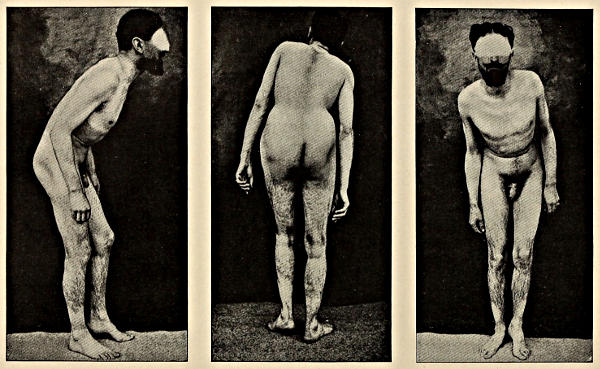
WOUNDED SEPTEMBER 3, 1914. THROWN INTO AIR BY SHELL-BURST; UNCONSCIOUS. FEBRUARY, 1915: PLASTER JACKET, 3 WEEKS; SECOND JACKET, 3 WEEKS. CURED. SENT TO GRAND-PALAIS.
Bullet wound of back: Hysterical bent-back—camptocormia.
Case 242. (Souques, February, 1915.)
A man was wounded September 6, 1914, by a bullet that entered along the axillary border of the scapula and emerged near the spine. He spat blood for several days; but the skin wounds quickly healed.
When he got up, his trunk and thighs were found to be in a state of moderate flexion upon the pelvis, the trunk being bent almost at a right angle; the legs were flexed somewhat upon the thighs. The man could not voluntarily extend his trunk, but he could extend his thighs to a moderate degree. He could bend his trunk still further forward than its habitual contractured position, being able to pick up an object from the ground. If the man was put in the ventral position, the trunk could be straightened to a considerable degree. Curiously enough, the man felt no pain, nor had there been any pain since the healing of the wound. No motor, sensory, reflex, trophic, vasomotor, electrical, visceral, or X-ray disorders could be found. It was evident that there was a contraction of the muscles of the abdominal wall and of the iliopsoas, yet it was also clear that these muscles were not contractured on account of the subject’s ability to flex his trunk and to extend his thighs.
Here, then, is a vicious attitude crystallized (in the phrase of Souques) in the form of a pseudocontracture.
Blown up by shell; unconsciousness: Camptocormia (bent-back, “cintrage”). Cure by corsets.
Case 243. (Roussy and Lhermitte, 1917.)
Camptocormia with antero lateral bending is described by Roussy and Lhermitte in an infantryman observed at Villejuif, February, 1915, after having been wounded September 3, 1914. The infantryman had been thrown into the air by the bursting of a shell, had lost consciousness, and came to with violent pains in the back. The trunk was found to be bent strongly forward and to the right side, and remained in this position thereafter. There was no evidence of wound.
In February, 1916, a plaster corset was applied by Souques, which brought the patient partly to normal station in three weeks. The trunk was now no longer bent forward, but was still bent to the right. A second corset was applied for three more weeks, with which the patient became absolutely straightened out again. He was discharged cured and sent to the Grand-Palais for the reëducation course.
This condition is a form of trunk contracture in the nature of a kyphosis (scoliotic and lordotic forms of contracture are also found in the hysterical group), for which the terms plicature of trunk, traumatic kyphosis, pseudo-spondylitis, and camptocormia have been in use. The term camptocormia has been proposed by Souques and Rosanoff-Saloff. The poilus speak of the condition as cintrage (arching). In these cases the trunk is held almost horizontally, with the head in hypertension and neck muscles and thyroid cartilage jutting. The patient looks fixedly straight forward, with eyes wide open, and carries his legs extended or half flexed. The normal folds of the abdominal wall are very deeply marked, and at the level of the groins, the epigastrium and the pubis, there are deep folds. Viewed from behind, the median lumbar fold has disappeared or is faintly marked, as are the sacro-lumbar and other masses of spinal muscles. The whole lumbar region is elongated and flattened. The dorsal spines of the back are accentuated; the buttocks are flattened and broadened transversely. The back of the neck is marked by deep transverse folds, and the seventh spine does not stand out. The patient can walk perfectly, though sometimes there is a pseudocoxalgia and lameness. Attempts to straighten the body lead to visible forcible contractions of various muscles, but the kyphosis remains persistent. There is a sense of active resistance on the part of the patient, which can be demonstrated by palpation. If an active attempt at straightening is made, lumbar or sacral pain develops, followed by a very lively and emotional state of anxiety on the part of the patient, with interrupted and accelerated breathing, an expression of terror in the face, and a rapid pulse. The patient then subsides into his earlier attitude, and his anxiety disappears in a few seconds. It is much easier in many subjects to reduce the camptocormia in the position of dorsal decubitus than upright.
Burial after shell explosion; lumbar ecchymoses; regionary pains; camptocormia, 5½ months. Cure by three months’ plaster cast about trunk.
Case 244. (Roussy and Lhermitte, 1917.)
An infantryman was buried after shell explosion August 25, 1914, but he sustained no wound or bone injury. There was, however, a large ecchymosis of the lumbar region, and he had felt violent lumbar pains. The trunk was carried flexed, symmetrically bent over and quite incapable of being straightened completely. A plaster corset was applied March 16 by Souques. Three months of this was followed by a complete straightening, which lasted after the corset was removed. The patient was discharged well.
As to these cases of camptocormia, some authors regard them as due to anatomical changes in the vertebral column itself, or in the ligaments and muscles, and accordingly regard the condition as a form of spondylitis, syndesmitis, or psoitis. This view is held by Sicard, who bases the idea upon the local pains and the results of cerebrospinal fluid examination. According to Roussy and Lhermitte, hyperalbuminosis of the fluid is extremely rare, and one case of their own with hyperalbuminosis was nevertheless cured with great rapidity. Roussy and Lhermitte even inquire whether the fluid albumin may not be due in some way to an interference with venous and lymphatic circulation.
In some cases, this condition may be at first a response to pain, a pseudospondylitis dolorosa, such as may be sometimes observed in hospitals near the front. Later, however, the suffering in camptocormia is due more to the abnormal position of the trunk, with strain upon vertebral ligaments, than to the persistence of any original pain. Moreover, these patients recover almost immediately from their pains when the contraction is relieved.
In differential diagnosis, one has to consider, according to Roussy and Lhermitte, Pott’s disease, traumatic spondylitis, as well as Bechterew’s vertebral ankylosis, Pierre Marie’s rhizomelic spondylosis, Kocher’s intervertebral disc contusions, and Schuster’s myogenic ankylosis of the vertebral column; but in Pott’s disease, the fixed pain points, rigidity of column, fluid examination, and signs of myelitis, should suffice for the differential diagnosis. Traumatic spondylitis follows the contusion after months and after a phase of neuralgia. Ankyloses do not so much concern the trunk as the vertebral column itself; disc contusion produces disorders in standing and gait as well as pains and edema. Schuster’s disease shows paresis, hyper reflexia, and amyotrophy not shown in camptocormia.
Shell explosion; partial burial; forcible flexion of spine. Paraplegia, cured by suggestion. Then camptocormia, also cured.
Case 245. (Joltrain, March, 1917.)
An infantryman in the Côte du Poivre was sitting on the ground in the opening of a dugout eating soup, when a shell burst and the roof of the sap fell in on him. The planks and the stonework fell heavily on the dorsolumbar region. The patient was almost bent in two, head to knees, legs buried, hardly able to breathe. He did not lose consciousness and cried out, feeling for a moment very anxious and fearful that his comrades had left. Only two hours later was it possible to dig him out. He said he had been absolutely unable to make any movement, had kept his body bent, and felt violent pains in the back. He was carried back twelve hours later and reached the dressing station in eight more hours, eventually reaching the neurological service two days and a half after the accident. On entrance he was prostrated, complained of lumbar pains and of inability to move, and was able to make only a few contractions on the left side when asked to try. The right leg was flaccid. The left knee-jerk was stronger than the right. Other reflexes normal. Hyperesthesia to pin prick on the right side. Slight saddle hypesthesia, reaching to the iliac crests above and perineum below with preservation of touch sensation. Slight forward posture of vertebral column. The patient complained of pain on pressure of the spinal processes and the lumbar spine. There was slight ecchymosis about the left iliac crest.
Lumbar puncture showed clear fluid without hypertension, in which were a few lymphocytes. There was a large amount of albumin. The blood pressure was normal. There had been a slight diarrhea following the accident which disappeared on entrance to the hospital. The question was raised whether the case was one of slight hematomyelia or was pithiatic.
Suggestive therapy was tried, and liquid was injected into the muscles of the lumbar region and the posterior surfaces of the thighs. In a quarter of an hour the patient found himself able to raise the foot above the bed. There remained an extensor paralysis of the right leg. When the patient was made to raise the foot he began to show the phenomenon of Souques, called camptocormia. He could walk, nevertheless, and took a few steps sustaining the weight of his body by placing his arms on his thighs. Though he complained of lumbar pain, it was finally possible for him to pick up an object from the ground and lean sidewise. He could not, however, stand up. Yet when the patient was made to lie down, his back was spontaneously straightened. Treatment of the camptocormia was also successful.
Astasia-abasia: Two cases from (a) thigh wound, and (b) shell-shock and wound of thorax. Cures by faradism.
Case 246. (Roussy and Lhermitte, 1917.)
An infantryman was wounded September 23, 1914, by a bullet in the anterior and middle part of the left thigh. From the moment of the trauma, he had not been able to walk, but gradually regained his ability to stand, and then to walk. He was returned to the front (January, 1915).
Slightly wounded again in the neck, January 6, 1915, he was evacuated and operated on. After the operation he could neither walk nor stand. His reflexes were normal; he could perform all movements when lying down, although the movements were executed very slowly. As soon as he could sit upright, he was taken with tremors and could not hold himself in a vertical standing position, nor take a single step. If he was given crutches, he dragged the two legs.
Under the influence of electric treatment—a mild faradic current—he was cured at a sitting so that he could both stand and walk (March, 1916).
Case 247. (Roussy and Lhermitte, 1917.)
Astasia-abasia after shell explosion occurred in an infantryman observed by Roussy and Lhermitte at Villejuif, July 8, 1915.
The patient had been wounded September, 1914. The wound was a superficial one in the thoracic wall, under the right nipple. He had been cast into a very deep shell hole, but had been able to get back to the aid station alone, taking very short steps only.
As soon as he reached the station, his gait became spastic, trembling and hesitant. Given two canes, he could walk painfully, trembling. At each step, he would balance his body back and forth. He gave the impression of a man drawing some sort of vehicle, who had to make a considerable effort at each step.
The faradic treatment cured this patient at one sitting.
War strain; fall into water-filled trench: Dysbasia, tremors, vasomotor disorders. Cure by hypnosis. Case to demonstrate “traumatic” hysteria WITHOUT somatic TRAUMA.
Case 248. (Nonne, December, 1915.)
An artilleryman (without hereditary or acquired neuropathic taint) underwent much stress and strain in the war in Belgium, Lorraine and Flanders. One night, on leaving his observation post, he fell into a trench filled with water. He felt pricks in the groin and gradually developed a pseudospastic tremor of the lower extremity, paraparesis inferior, depression, irritability, pressure sensations in the head, and sleeplessness. He passed through three hospitals before arriving at Hamburg and received the diagnosis of concussion of the brain and cord.
Nonne found an emotional state of depression with hypochondriacal fear, disturbance of sleep, deficient appetite, constipation and pollakisuria. He walked upon two crutches, dragging his legs inertly after him. There was marked cyanosis, lowered temperature and hyperidrosis of the feet and lower legs; exaggeration of tendon and skin reflexes and pseudoclonus; no Babinski or Oppenheim reaction. There was anesthesia of the lower extremities and of trunk as high as the ribs. Pulse 130. Visual fields normal. Sensory disorders absent.
After the first hypnotic treatment the patient was able to stand and take a number of steps, and the tremor gradually diminished. After two treatments standing became normal and walking was much improved, the tremor ceased, cyanosis and hyperidrosis disappeared, and the movements of the bowels and urination became normal. Thereafter the patient had no attention paid to him deliberately and in a week’s time became well.
Here is a case in which, as Nonne states, the somatic trauma required by Oppenheim as the basis of every traumatic neurosis did not occur. Moreover, the sudden cures by hypnotism, or by any other method in these cases, warrant us in supposing that there are no such fine molecular changes as Oppenheim and von Sarbo assert. Such experience as the cures in this group of cases confirms, according to Nonne, the surprising result first achieved in this war (Bonhoeffer, Wagner von Jauregg, Karplus, Wollenberg, Westphal) that the most severe neuroses produced by somatic and psychic traumata can be cured in an astoundingly rapid manner without residuals.
Re the controversy over Oppenheim’s traumatic neurosis, Nonne holds with the Charcot school that traumatic neurosis is clinically identical with hysteria. Oppenheim admits the part played by psychogenesis, but has always laid a greater emphasis upon the actual injury of the neuronic apparatus in which he believes. He thinks that small hemorrhages, inflammatory processes, and degenerative processes affect the neurones unfavorably, and permit the psychogenic effects to occur more readily. Of course the insurance-company attitude and the attitude of railway corporations saw malingering in all cases, and to this day, neurologists are inclined to see a great deal of “indemnity neurosis” in these cases. Opposed to the corporation men and the neurologists were the psychiatrists, who chiefly upheld an emotional theory of genesis—whence we began to hear of the neuroses of fright and of accident.
Oppenheim claims to have established with war cases the fact that an entirely normal person without heredity and without antebellum acquired soil, may develop a neurosis through war stress. Oppenheim concedes that there may be purely psychic cases, but holds that there are nevertheless, numerous purely physical cases and a great number of cases of a compound nature, which are both physical and psychical in their etiology. Oppenheim’s point is not that every single symptom described may not be upon occasion psychogenic, but that the data of this war prove that neuronic injury, particularly injury of the peripheral neurones, can also produce these effects. Nonne, Forster, Lewandowsky, and others, opposed Oppenheim’s views vehemently. See especially comments by Zeehandelaar.
Shell-shock; BURIAL HEAD DOWN: Brachial monoplegia, head-shaking, speech disorder, corneal and conjunctival reflexes absent. Determination of hysterical phenomena to parts buried.
Case 249. (Arinstein, 1916.)
A Russian private was buried after a shell explosion, September 13, 1915, head down, so that only his legs stuck out of the débris. Afterward his right hand refused to move, and there was edema of the right wrist, with pain referred to the shoulder joint. The head shook and made jerky movements during the day, but ceased them in sleep. Speech was retarded; words were uttered clearly enough but in a sing-song fashion; sometimes the man stammered. Hearing was diminished in the right ear. Pupillary responses were lively, but the swallowing reflexes were diminished, and the corneal and conjunctival reflexes were absent. The tendon reflexes were lively on both sides. There were no pathological reflexes.
At the end of October—six weeks later—the patient was sent home on convalescence for three months, and improved rapidly after a short time in family surroundings. He was examined again, two months after discharge, and found normal in all respects. He returned to the ranks.
Re Shell-shock in Russians, Arinstein concludes that concussion hysteria may occur in a perfectly normal person, yet be innocent of all organic signs indicating destruction of peripheral or central neurones. Rifle or machine-gun fire had not in his experience brought about concussion hysteria, which was invariably due to the bursting of a large projectile. With reference to Schuster’s remark that a sleeping man never acquires hysteria from the bursting of a shell near by, Arinstein confirms Schuster, finding amongst 2000 cases no instance in a soldier sleeping at the time the shell burst.
Re effects of cannonading, Gerver reports Russian instances of a kind of hysterical clavus, or sensation of a nail being driven into the back of the head, in men who have been a number of days under stiff shelling.
Multiple wounds and bullet wound of palm: ACROPARALYSIS. Cure, five months.
Case 250. (Roussy and Lhermitte, 1917.)
A patient was observed at Villejuif, February 5, 1915. He had been wounded, January 2, 1915, and showed scars of a bayonet wound on the anterior surface of the right thigh, of a lance wound on the dorsal surface of the right foot, and of a bullet wound in the palm of the left hand.
There was left wrist drop with fingers extended. On the sensory side, there was a glove anesthesia and analgesia up to the bend of the elbow. The right leg showed a paresis and contracture, but there were no sensory disorders in the legs. Reflexes were normal. The patient was discharged cured, in May, 1915 (psychoelectric method).
This is an example of the so-called acroparalyses, paralyses limited to the hand or foot, many of which have developed in this war, after grazing wounds or more severe injury. More rarely they appear as if spontaneously. Sometimes they are preceded by slight arthralgia or vague pains.
The condition in the hand suggests a radial paralysis. The patient is unable to flex his fingers, though he probably is able to make some movements with his thumb. Sometimes, on request to move the hand, a series of coarse oscillations follows, somewhat like a tremor. These oscillations are, according to Roussy and Lhermitte, apparently pathognomonic, and depend upon the contraction of the muscles antagonistic to those whose movement has been requested. These antagonistic muscles, themselves entirely incapable of voluntary movement, are seen to be contracting effectively and jerkily to meet the action of the agonists, also seen making jerky movements. If the forearm is moved passively and rapidly, the hand flops about inert, like the hand of a marionette, although not to the degree of hypotonia in organic paralysis. The hand is often cold, moist, and cyanotic, and even possibly analgesic and hypesthetic.
Bullet wound of arm: Apparent radial paralysis, not resolved by self-preservative swimming movements. Paralysis actually hysterical.
Case 251. (Chartier, October, 1915.)
A professional acrobat, 22, Corporal in an African Chasseur regiment, was rather instructively tattooed and had apparently performed some of his service in disciplinary companies. In short, one might have a legitimate suspicion of the objective value of any manifestations he might present. However, one of his chiefs had written a favorable letter concerning his services. He had had various crises of a hysterical character since adolescence, and there was alcoholism in the family.
He was wounded May 4, 1915, by a bullet which passed through the outer and lower part of the right upper arm, and thereafter the forearm and hand became completely inert, both for flexion and extension. There was a considerable hyperesthesia. The wound healed quickly, without complications.
August 5, about 10 o’clock at night, the man—then at his dépôt—tried to commit suicide (motive not related with the war). He threw himself into the Rhône from a height, where the water was deep and the current rapid. His brother and a comrade, who knew that he was going to make the attempt, saved him. Chartier himself happened to see the whole scene, and noted that throughout the affair the forearm and hand of the patient remained inert. It seemed as if there was a radial paralysis. This was the more likely as the man had been wounded in the arm. First care was given. The man had not known of Chartier’s presence. He had been under water about two minutes.
From hospital he was evacuated three weeks later with a diagnosis of radial paralysis, coming on service September 11. Examination showed a slight paralysis of the extensors and flexors of hand and fingers, and of the hand muscles. There was also a slight contracture of these muscles, more marked in the flexors. There was pain upon reduction, with some jerking of the muscles. Electrical reactions proved normal in nerves and muscles. There was a segmentary anesthesia to pin prick, reaching to the level of the elbow; deep hyperesthesia of the finger joints. There was no trophic or vasomotor disorder.
In short, here was a case of functional paralysis with contracture of the right hand, to be regarded as hysterical in the classical sense of the term, both by reason of the anesthesia and absence of trophic disorder, and on account of the hysterical history of the patient. Functional reëducative treatment quickly improved the paralysis, so that two weeks later the patient was able to extend fingers and hand. His total recovery was hoped for, when, September 26, wishing to get out of the hospital without leave, the patient jumped from a window and broke his right leg. The functional paralysis of the hand persisted and even grew more marked.
The interesting point in this case is that despite the powerful nature of instinctive efforts with drowning persons, this patient, subject to an hysterical arm paralysis, did not make defensive movements with the paralyzed arm; yet this paralysis was such as to be greatly improved by psychotherapy.
Bullet wound in brachial plexus region: SUPINATOR LONGUS CONTRACTURE, hysterical-looking. Callus of fractured rib probably at fault: Treatment surgical.
Case 252. (Léri and Roger, October, 1915.)
A man was wounded, December 21, 1914, by a bullet which entered about the middle of the spinous process of the left scapula and was extracted a few days later from the posterior border of the sternocleidomastoid muscle, two finger-breadths from the left clavicle, that is, at about Erb’s point. The left upper extremity was inert for ten days, but then began to move again, although extension and flexion of the fingers did not begin at once.
October, 1915, movements were normal, except those of extension of the forearm, due to contracture of the supinator longus muscle, a contracture that had developed about three weeks after the wound and stood out along the external border of the forearm, almost suggesting a musculotendinous retraction. There was a palpable, hard callus of a fractured rib, presumably a cause of the permanent irritation of the supinator longus, being precisely at the point where lesions usually produce superior brachial plexus palsy.
Why should the supinator longus alone of the Duchenne-Erb group be affected? Perhaps a single root was involved in the irritative lesion. The biceps showed also a partial R. D. The deltoid was normal electrically and in contraction.
The treatment planned for this case of isolated contracture of the supinator longus was surgical operation of the irritative focus. According to Léri and Roger, it is sometimes dangerous to use such measures as massage and electric baths for a paralyzed limb, since the massage or electricity excite not only the affected muscles, but also the other sound muscles,—muscles that are already more powerful than the paralyzed muscles and may go into antagonistic contracture. Even in limited galvanization, it is desirable to work with weak currents, so as not to diffuse the current into non-paralyzed muscles. In case of radial or sciatic paralysis, apparatus permitting the extremities to rest without over-action of the muscles antagonistic to the paralyzed ones may well be applied.
We here deal with a case, therefore, which looked purely functional, but in which careful examination and X-ray served to show an organic focus of irritation.
Re nerve concussion, Tubby offers the following definition: Nerve concussion is damage to a nerve trunk without actual destruction of the axis cylinders. The damage may consist of an effusion of blood between the nerve fibres following compression of a nerve against the bone by rapid passage of a foreign body near the nerve. Sometimes, however, the lesion which causes damage to the nerve trunk without actual destruction to the axis cylinders is nothing more than a temporary anemia or hyperemia. In most instances, both motor and sensory function are together interfered with, but in the case of large nerve trunks, e.g., the popliteal, there may be a separate concussion of motor or sensory bundles.
Contusion may effect a sort of STUPEFACTION OF MUSCLE and paralyze it by a non-psychic process: The SYNERGY in contraction of biceps and supinator longus is thus SPLIT. Biceps restored to synergy with the supinator by massage and faradism.
Case 253. (Tinel, June, 1917.)
A man was wounded at about the middle of his biceps and three weeks later was found to be able to flex the forearm only by means of the supinator longus. The biceps remained absolutely flaccid and soft, so that the diagnosis of a lesion of the musculocutaneous nerve (unlikely as this seemed on account of the low site of the wound) was entertained.
However, the biceps and the musculocutaneous nerve proved electrically normal. In short, this paralysis of biceps was functional in nature. But, according to Tinel, there could be no voluntary suggestive or hysterical element in such a paralysis, since flexion of the forearm is normally produced by a synergic contraction of biceps and supinator longus that cannot be separated voluntarily.
Treatment by massage and rhythmic faradization caused the biceps function to return to normal, so that voluntary synergic contractions of the biceps took place along with those of the supinator longus.
We here deal, according to Tinel, with a genuine functional paralysis, nonhysterical—a paralysis due to a kind of stupor of the muscle. Such paralyses due to muscular stupor ought to get well in a few days or weeks. Should they persist, it is clear that a stuporous paralysis might be transformed into a hysterical paralysis. In short, the direct contusion of a muscle or group of muscles may be the point of departure for various persistent paralyses.
Wound of arm: Blocking of impulses to certain hand movements. Recovery with splint.
Case 254. (Tubby, January, 1915.)
A private was wounded by a shell fragment, September 16, 1914, and admitted to the London General Hospital, September 27. A high-velocity shell fragment had passed through the soft parts of the left arm at a spot exactly corresponding to the musculospiral groove. He could extend the middle finger of the left hand, but the other fingers were held in flexion. The last two phalanges of index finger could not be moved, it was found, on account of severance of the extensor tendon some years previously. Accordingly, the loss of function due to the shell injury was that of thumb, ring, and little fingers. Supination could not be executed completely to the extent of 15 degrees; there was no R. D. upon electrical test, October 2. The sensation of affected fingers was woolly. November 3, the little finger had recovered, but supination could not be completely executed.
The treatment consisted in a bent malleable iron splint, with the wrist and affected fingers hyperextended. November 20 all power had returned with full supination, except for the two phalanges of index finger previously injured.
Major Tubby thinks this a case of physiological blocking, as from a small hemorrhage amongst the fibers or around the nerve.
Re inhibition, Myers thinks it is the functional cause of the effects of shell-shock. He thinks it is not a fixation of the idea of the paralysis of volition, but that it is a fixation of the process of inhibition itself that produces the effects we see in Shell-shock. It is a block of ascending paths that produces the anaesthesia so characteristic of Shell-shock. It is a blocking of sensory paths that produces mutism or aphonia. But according to Myers, there is also a block in certain cases of descending paths that control and coördinate various mechanisms. The result of a block in the descending paths is shown in spastic, clonic, or ataxic phenomena of, e.g., functional dysarthria. See also Case 253 (Tinel).
Eight months of war experience (often under heavy fire) without reaction; then, shell-shock; unconsciousness: Right hemiparesis; pain in the left side of head; heat sensations of right half of body; diminution of hearing in left ear; a variety of asymmetrical bilateral phenomena.
Case 255. (Gerver, 1915.)
A Russian private, 24, sustained shell-shock April 14, 1915. He was observed, when the shell burst, to crouch down, and then to fall to the ground, unconscious. The unconsciousness lasted about two days, after which he was found to be oriented, though slow and stammering of speech, hardly able to concentrate attention or sustain a conversation, and giving the impression of a man stunned. There was difficulty in the expression of thoughts, and a marked over-fatigueability. After adding and subtracting accurately two-digit figures for a time, the man quickly grew confused and said that trying to solve such a problem made him dizzy.
His imagination was filled with gunshots, shell-bursts, and the killing of comrades, and during any conversation the man frequently shuddered. Concerning the shell-shock, he remembered only that a number of shells had burst near him and that he came to in the hospital. He kept looking to one side and to a distance, as if listening, sometimes bending his head downwards. He would cry and sigh during conversation, and then be quite unable to explain why. He said there were loud noises in his ears, and that his head and the whole right side of his body felt hot. Pain was felt in the left side of the head. The right hand and the right foot were weak (on distraction, this hemiparesis remained unaltered). Tremors affected all the extremities. He had a sensation, possibly hallucinatory, of the creeping of insects on his skin. The hearing of the left ear was objectively diminished. There was palpitation of the heart and difficulty of breathing. Tendency to Romberg. There was a general hypalgesia, more marked on the left side of the body. Both conjunctival reflexes were diminished. Knee-jerks and Achilles jerks were exaggerated. All the reflexes on the right side were livelier than on the left. There was a moderate Babinski reaction on the right side. Mechanical over-excitability of muscles. Dermatographia. Both sides of the skull were sensitive on tapping, but especially the left side. Mannkopf sign on pressure of the left side of the cranium.
Hemorrhagic points without injury to the skin were noted on the skin of the left hand and foot. Speech was stammering. There was a marked digital tremor, sometimes spreading to the rest of the body during examination. The muscles of the face, eyelids, and tongue showed sharp fibrillary twitching. The pulse stood at 100 and frequently missed beats. Battle hallucinations, visual and auditory, sometimes occurred, the commands of superiors and the noise of guns, rifles, yelling, and groans; the man would see trenches or redoubts, or a field full of wounded soldiers or attacking columns of the enemy. He recognized the hallucinations as such. His sleep was troubled by nightmares of the same general description.
For eight months the man had been in action at the front, under heavy gun and rifle fire. He was a courageous man, who had never felt fear, regarding himself as used to battle and the bursting of shells. He had not been wounded. The entire situation seems to have developed after the single shell burst of April 14, 1915.
LOCALIZATION OF SHELL-SHOCK SYMPTOMS: Hemiparesis and hemianalgesia on side of body exposed to explosion; contralateral irritative symptoms of face and tongue.
Case 256. (Oppenheim, January, 1915.)
A soldier had a shell explode to his right, October 23, 1914. He declared that the concussion launched him through the air. When he recovered consciousness three hours later, he lay in a bog and was unable to move either leg. Gradual improvement followed. The symptoms were sensations of formication in the legs, pain in the back, blurred sight, hardness of hearing, disturbance of speech, headache, vertigo, weak memory. After a fortnight weakness in right arm.
He was admitted to hospital a week after the injury, unable to walk, restless, given to palpitation and attacks of anxiety. On attempts to walk, leg spasms and tachycardia.
Transferred to nerve hospital, December 2. Sleep poor, uneasy with dreams. Tic on left side of face. On opening the mouth, left-sided faciolingual spasm. Paresis of right arm. At first, right-sided ankle-clonus and paresis of leg. Knee-jerks increased. Speech hesitating. Right hemianalgesia. Concentric contraction of visual fields. Tachycardia (120). In walking the right arm failed to swing normally. Attacks of vertigo, with falling. Patient got up at night and pushed against objects in his room.
There was only slight improvement while under observation. He became psychically more frank and even talkative, and was moving more readily when transferred.
Re Oppenheim’s conception of the strongly peripheral element in traumatic neurosis, he sums up by saying that a traumatism attacking the organism at its periphery is in line to produce a neurosis without any psychic mediation whatever. The rôle of the psychic process, in Oppenheim’s view, is contributory to the fixation of neuroses. Even when there is a free interval betwixt shell burst and neurosis, still there are physical effects of trauma upon neurones.
Shell-shock; unconsciousness; after improvement in symptoms (4 months) return to trenches; more symptoms after 5 days: Sensory disorders, especially on left side (the side more exposed to explosion); exaggerated reflexes on right side with slight clonus and with Babinski sign. Improvement.
Case 257. (Gerver, 1915.)
A Russian Captain, 45 (heredity good; non-alcoholic, non-syphilitic; always in good health) sustained shell-shock in a battle in southeastern Prussia, August 13, 1914, and was unconscious for two days. He was carried to one of the provisional field hospitals, and then evacuated to Petrograd, where during a period of four months, he was given electricity, suggestion, and baths. He was feeling so much better in December, 1914, that he went back to the front and headed his company in the trenches. He stood only five days of trench work, and was sent for mental examination December 29, 1914.
The captain was of middle height, well developed but poorly nourished, of a dejected and preoccupied appearance, looking to one side in conversation, and finding difficulty in the expression of his thoughts. He talked almost exclusively of his illness. He found difficulty in adding or subtracting 2-digit figures. He seemed to have amentia, frequently being mistaken as to the most important dates in his life. He complained of general weakness and inability to work. Any endeavor to concentrate caused vertigo, irritation, and pains in the head. Day and night he was troubled about his health, his future, and his family’s future. He was going to become an invalid and a burden. He was tormented with the idea that people thought him a simulator. He complained of lumbar pains. It seems that the explosion had affected the left side of the body more than the right and he complained more of pains upon that side. In the dark his gait was unsteady, and he often had marked tremors of feet and hands. In excitement the tremor would increase uncontrollably. The patient thought that his hearing was diminished, especially upon the left side, and that his left ear was weaker than the right. He slept poorly and had many nightmares; his appetite was poor, and he was constipated. There was difficulty in respiration; the pupils were slightly dilated and sluggish in their responses. There was a marked tendency to Rombergism; dermatographia marked; the skull and especially the lumbar spine was painful on tapping; hyperesthesia of the lumbar skin; paresis of left hand and left foot. The tendon reflexes were more marked on the right side than on the left, and there was even a slight ankle and patellar clonus. The Babinski sign was present on the right side. There were frequent fibrillary contractions of the muscles of the trunk and back.
Objectively the hearing was somewhat decreased in the left ear, and the vision of the left eye appeared to be somewhat impaired also. If the eyes had been held closed for a time, there was difficulty in opening them quickly. Aside from a somewhat elevated pulse and slight cardiac arrhythmia, there was no disorder of the internal organs.
This patient remarkably improved but was not absolutely well at the date of the report.
Re organic signs in Shell-shock cases, Oppenheim warns practitioners and experts against undervaluing war neuroses. He does not like to have them set down in too offhand a way, as hysteria, wish-fulfilment, and simulation. Hysteria is not likely, according to Oppenheim, in cases with permanent cyanosis, disappearance of the radial pulse, trophic disturbances, hyperidrosis, alopecia, fibrillary tremors, myokymia, cramps, dilated and sluggish pupils, and weakening of tendon reflexes. Hyperthyroidism also has been found by Oppenheim.
Shell-shock, explosion on left side: Sensory disorders especially on left side; ecchymosis of right (uninjured) leg, possibly conditioned upon shock of left hemisphere.
Case 258. (Gerver, 1915.)
An artillery officer had had a shell burst to the left side of his horse, which veered to the right but did not fall. The officer’s left hand immediately became so numb and weak that he could not hold his reins with it; it shortly became more painful. The left foot showed a tendency to the same anesthesia and paresis.
Curiously enough, a number of punctate hemorrhages appeared on the right thigh and lower leg, upon the outer aspect. According to Gerver, these hemorrhages into the skin of the right leg may have something to do with a disturbance of circulation related with effects wrought upon the left hemisphere. During the course of the disease, pains occurred not only in the left arm and leg but also in the right leg.
Re brain injuries produced by shell explosions without external wound, Roussy and Boisseau have not found a single clinical instance amongst 133 cases observed, which suggested cerebral softening, or even hemorrhage into the brain substance, the cord substance, or the meninges. These 133 cases were observed in army neurological centres and contained instances of (a) mental disease (confusion, delirium, amnesia), (b) nervous disease (astasia-abasia, tremors, paralyses, contracture), and (c) an intermediary group (either mental confusion with stupor, or hysterical deafmutism).
Shell-shock; unconsciousness: Hysterical deafness, speech-disorder, gait. Recovery by reëducation. Brief relapse to deaf-mutism at noise of drums. Improvement. Relapse to numerous and severe hysterical symptoms at small guns fired on King’s birthday. Improvement. Speech wholly regained in a quarrel. Recovery.
Case 259. (Gaupp, March, 1915.)
A musketeer, 22, had been blind for a time at 11 on account of some spinal cord disease.
He was a soldier up to Christmas eve, 1914, when he was hurled backward in a trench in the Argonne by an exploding hand grenade. He lay unconscious for several hours, though without sign of physical injury. Coming to his senses, he worked himself out of the trench and crawled to another, but again fell unconscious. When he awoke he was in a physician’s care in quarters, to which he had been taken by ambulance men. Thence to the field hospital, and then to a private hospital at B.
Upon admission, January 17, he was hard of hearing on both sides, and his speech was peculiar: choked off and retarded. His gait was heavy, on a broad base. He was subject to headaches.
Exercises gradually improved the speech and the walking disorder was quickly overcome. February 5 came a relapse through fright at the rolling of drums near by. Speech was completely lost, deafness set in, and the patient ran restlessly to and fro in tears. After a few hours speech returned with still some minor difficulty.
From time to time came fainting spells and attacks of disorder of consciousness, with loss of orientation and the idea of being in the trench or under cover. He would ask whether it were raining through. His mood herein was at times cheerful and excited. Speech further improved from the middle of February, as well as did the other symptoms.
On the King s birthday, February 25, occurred another relapse due to his hearing small guns fired: Apathetic stupor, clonic spasm, aphonia, abasia, severe deafness, poor sleep, refusal of food. The next day he was still mute, but the spasms had ceased. He lay apathetically in bed, taking a little liquid food. February 27 he was still mute, though more active, not deaf, getting up alone, walking unsteadily on a broad base, and playing cards at the table. March 2 the word yes was again enunciated. March 3 he talked more freely and took a short walk. March 4 speech of a sudden came completely back on the occasion of getting excited in a quarrel among some other patients. The patient thereafter began to talk a great deal, was bright and cheerful, but still complained of a variety of nervous troubles. Speech was somewhat difficult, but he was free from any definite aphasia or paraphasia.
Re Shell-shock deafness, Jones Phillipson states that concussion deafness is due to three contributory factors: (a) cerebral concussion, (b) fatigue (violent oscillation of the perilymph, continued noises, strain of organ of Corti), and (c) temporary or permanent disorganization of the conductive apparatus.
Re concussion deafness, J. S. and S. Fraser found in four cases of actual explosion injury, a ruptured drumhead and hemorrhage into the fundus of the internal meatus in three cases. They did not find evidence of neuro-epithelial changes. Possibly the fundus hemorrhages, besides giving rise to deafness, may start up the tinnitus and giddiness that are sometimes found. In one case, there were changes in the delicate nerve endings of the auditory ampullae.
Shell-shock: Deafness
Case 260. (Marriage, February, 1917.)
A shell burst behind an English lieutenant in 1914 without causing any wound but making him unconscious for an hour. During the hour the Germans passed by and stripped him of all articles of value. He came to and felt himself markedly deaf in both ears with an intense headache. There was no hemorrhage, no discharge, no tinnitus, no vertigo. Four days after the shell burst he could hear spoken words on each side at two feet, but could not hear a watch that could usually be heard from 3½ to 4 feet. With tuning fork C air and bone conduction proved much subnormal, though air conduction was better than bone conduction. With tuning fork C-5 air conduction was subnormal. Drums healthy. Improvement followed; hearing became normal eighteen days after explosion. The treatment was rest in bed with bromides early and strychnine later.
Marriage states that the psychical deafness due to shell-shock is usually bilateral and absolute. It is accompanied also, as a rule, by other nervous signs and symptoms, such as aphonia, tubular vision, paralyses, and anesthesias. Milligan and Westmacott state that the deafness is due to a functional suspension of neuronic impulses. They regard the brain as in a state of physical fatigue, and the mind as in a state of strain. There is no organic lesion. The neuronic impulses which are temporarily suspended are those which run from the higher cortical cells to the periphery.
Mine-explosion: Unconsciousness: Deaf-mutism. Recovery of speech after epistaxis and fever.
Case 261. (Liébault, October, 1916.)
A soldier, 24, teacher in civil life, was in a mine explosion November 27, 1914, at Vienne-le-Château. He was unconscious six weeks and remembered nothing of what had passed. They had told him that he had been blind for a month. After regaining consciousness he was a deaf-mute and for seven months he did not speak. His mutism did not bother him, as he thought he had always been mute. He had always been able to write. He could not remember what had interfered with his speech or tell whether he could think the words which he could not utter.
May 22, 1915, there was considerable nasal hemorrhage, with fever. Upon this day he began to speak, at first a few words, telegram style, and with aphonia. A week later his voice returned. He was very irritable during the period of mutism and had ideas of persecution and of suicide and complained of becoming easily fatigued and exhausted.
His voice, however, became completely normal again and his respiration better. On the spirometer he breathed four liters, but still got out of breath easily. His diaphragmatic respiration was still imperfect. His deafness remained at the time of report about as before, though he had now been hearing for some time a slight resonance of his own voice and could hear sounds emitted a few centimeters from his ear. At time of report there was still general fatigue with insomnia.
Re war deafness, Castex states that not merely shell bursts and explosions are able to cause deafness, but the din of battle alone. There are two big groups of war deafness: one due to drum rupture, and the other due to labyrinthine shock. Labyrinthine shock—a much more serious matter—is produced when a big shell bursts. In these cases, the labyrinthine disorder is simply of the same general nature as commotio cerebri. The labyrinthine shock cases often need to be retired permanently from the front.
Shell-shock: Deaf-mutism.
Case 262. (Mott, January, 1916.)
A deaf-mute, 24, not of a neurotic temperament or of a neuropathic predisposition, was admitted to the Fourth London General Hospital November 16, 1915.
He wrote, “I left England the 8th of March, and went to Gallipoli on the 26th of May, and about the middle of August, one of our monitors fired short. I felt something go in my head; then I went to the Canada Hospital. They said it was concussion.” He had seen the monitors firing. He came to in a dug-out about an hour afterward. He was quite deaf and his head felt as if it would burst.
He could see and speak a little but lost his speech completely when Barany’s tests were applied. The headache then passed away, leaving the deaf-mutism. The ears, on examination, proved normal. The patient was able to cough and whistle. He wrote his wife a letter, telling her how he killed a Turkish woman sniper, but he did not remember that he had written the letter. Although he said he did not dream, while asleep he would assume the attitude of shooting with a rifle, as if pulling a trigger, and then the attitude of using the bayonet: the right parry, the left parry, and the thrust. Sometimes while asleep he would jump as if a shell were coming, and he would catch his right elbow as if hit there. He would then open his eyes wide and look under the bed. Then he would wake up and begin to cry, but without sound. Just such habitual attitudes occur in soldiers under anesthesia. In hypnotic sleep, although he trembled at his trench experiences, he did not assume these defensive attitudes.
Mott states in his Lettsomian lectures that hearing is often absolutely lost, but that sometimes a man is absolutely deaf on one side alone, either from the ruptured drum or from the violence with which wax has been driven against the drum. Mott speaks of the frequency of auditory hallucinations, and of hyperacusis—part of the patient’s general hypersensitivity—which may increase the violence of the neurosis and especially aggravate the headache.
Shell-shock: Deaf-mutism; convulsions and dream.
Case 263. (Myers, September, 1916.)
A private, 28, was seen by Lt. Col. Myers at a base hospital. This deaf-mute wrote, “I was standing and a shell bursted and that is all I can remember.” This might have happened six days previously. The patient wrote vaguely about a walk to “windy corner”; about being billeted in a dug-out, a train journey, and another hospital. He was deaf, deficient in sensibility throughout, especially in the left arm and left side of the face, and had severe headache. Two days later he started distinctly when hands were clapped while he was writing, but at the next hand-clapping there was no response.
After Lt. Col. Myers wrote down, “Imitate me,” and made consonant sounds, the patient succeeded imitating them. “You hear me a little now,” Lt. Col. Myers wrote. “Is this the first time you have spoken?” Patient replied, “I hope the Lord I can get my speech.” “But you did speak just now. Read this word. Say it.” Whereupon he was got to say his name and number.
The therapy was proceeding properly when suddenly he was seized with convulsions, limb movements chiefly clonic, back arched, eyes starting, later upturned. The patient pulled out a crucifix from a locker near the bed and regarded it ecstatically (pulse 85, corneal reflexes preserved). Three minutes later there was quieting down, and the patient was induced to talk. He began to talk about his wife. He had just been “seeing a farm and all the fighting.” A shell must have come in there. He had “seen the Lord Who saved him.” Intense headache and thirst followed. According to the patient the excitement was due to recovery of speech.
He later said, “It was just like a dream when I came to. I was sweating awful. I was seeing the Lord while I was in the farm by the Captain. I dreamed that I had the cross in my hand to meet him coming. I saw the trenches and the dug-outs and the wife.” In point of fact, the Captain at the farm had had his arm blown off, and he had found him lying on the straw unconscious. Under hypnosis it appeared that he had gone to a dugout from the farm and that at the clearing station he had been “raving, seeing things, shells, trenches, and things like that, sir.” A slow recovery was made after evacuation to England. Seven months later he returned to the front.
This case appears to belong to the B group of mutism cases, according to the classification of Myers, namely, to the group in which the effects are psychical rather than physical. According to Myers, whether mutism occurs as an apparent result of physicochemical or of mental causes—that is, as an A or a B case—it is actually always the result of mental—that is, psycho-physiological shock. Mutism in the A cases of physical nature, where the shock must have been grosser and more profound, generally proves more severe than in the B cases. As to the appearance of unconsciousness, apparently confirmed by the patients’ statements that they “lost consciousness,” it is a question whether these cases are not really cases of deep stupor. According to Myers, the mutism is in nearly every instance closely dependent on some form of stupor, being generally the relic of such stupor after it has passed off. Let the loss of consciousness be a profound stupor due to the lifting or burial of the patient, then from this stage there will be a transition to a state of ordinary stupor in which intelligence is active but the patient is unresponsive to stimuli. The patient is in a condition called by Myers excommunication, in which the inhibitory process may be regarded as protecting the individual against further shock. As the stupor now passes away, it is natural that the inhibition should appear lost in the case of hearing and speech, which are two main channels of intercourse with others.
Dumbness is, by far, the commonest disorder of speech, occurring in about ten per cent of shock cases in the first thousand cases of shell-shock seen by Lt. Col. Myers. Stuttering and jerky speech have occurred in about three per cent. Loss of voice is rarer.
As against the view of Babinski, that mutism, being curable by suggestion, must have been produced by suggestion, Lt. Col. Myers argues that the stupor preceding mutism is the antithesis of suggestibility and is, in fact, a condition of extreme autofixity.
Naval gun-fire effects on seaman: Aphonia. Two recurrences.
Case 264. (Blässig, June, 1915.)
A seaman from the Derfflinger was brought into a naval hospital with loss of voice, December 22, 1914, able to speak only in a whisper. As a child he had had diphtheria, but recovered without complication. He had always had a very well-controlled voice. Early in December he had had a cold owing to sentry deck duty in bad weather. Two days after the shelling of Scarboro,—December 16,—while in the munition chamber of the big guns, he suddenly lost his voice. He had been greatly upset during the firing of the guns. In two weeks he recovered speech.
February 12, 1915, he returned to the hospital with a complete aphonia. This was immediately after the naval engagement in the North Sea. Three days later he was treated with electricity directly applied to the vocal cords. March 20 he was discharged with speech completely recovered. As soon as he went on leave, however, his voice was lost for the third time, and he was still aphonic at time of report.
Shell-shock MUTES observed, then DREAMED OF: MUTISM developed the SECOND NIGHT after shell explosion.
Case 265. (Mann, June, 1915.)
A volunteer of 20 was made unconscious for a short time by a shell explosion, but was still fully able to speak when brought to the field hospital.
In the second night after the explosion, however, he dreamed that he had lost his speech. In the ward, meantime, he had seen a number of shell-shock mutes. Following this dream of aphasia, came several weeks of mutism, which then cleared up. According to Mann, this is experimental proof of the psychogenic origin of a mutism.
Mortar explosion: Hysterical deafness.
Case 266. (Lattes and Goria, March, 1917.)
A young soldier, a peasant, fell down unconscious when a mortar exploded killing several men. He regained consciousness a few hours later but was deaf on both sides. He looked dazed and did not spontaneously move, having to be called for meals. Communicating by writing, he could tell all the details of the accident.
The laryngeal and corneal reflexes were absent and there was a hyperesthesia and hypalgesia of the right side of the body. No anatomical basis for the deafness could be determined.
Shell explosion: Onomatopoeic noises in ears.
Case 267. (Ballet, 1914.)
A Zouave was with his squad at Tracy-les-Val Church, October, 1914, when the roof was burst in by a shell which wounded four men. The Zouave felt a strange emotion with trembling, and whistling in his ears. However, he helped his comrades into a neighboring car. From that time forward, he was very emotional, and felt noises in his ear, sometimes humming, sometimes whistling. At Compiègne Hospital a lumbar puncture was made, perhaps with a therapeutic purpose, but this gave no results. The noises were heard as a whistling pseeee followed by a boom,—an onomatopoeia recalling the whistling and bursting of the bomb. There was, in short, no labyrinthine lesion, but merely an obsessive mental phenomenon. There were no ear lesions objectively. The man developed a stuttering some time after the humming and whistling in the ear.
Injury of eyes by gravel from shell-burst: Photophobia, blepharospasm, facial anesthesia, pains.
Case 268. (Ginestous, January, 1916.)
A soldier of the Ninth Engineers, 28, a Beaux-Arts student, was wounded, December 19, 1915, by stones and gravel thrown in his eyes by a shell-burst. The eyelids swelled and the eyes filled with tears. He was treated at the relief station and then evacuated to Verdun. The edema disappeared in five weeks, but it was impossible for him to look at light. February 2 he was evacuated to Nice, where he received the diagnosis of traumatic keratalgia, blepharospasm, and photophobia. After eight days’ leave he went back to his corps; but the eye troubles persisted and he was sent to the ophthalmological center at Angers, May 18, 1915.
Both his father, 67, and his mother, 58, were irritable and odd. Three brothers and three sisters were also more or less neuropathic, and one of the sisters had been in a hospital for the insane with a persecutory mania. The patient had a daughter, fourteen months, well.
The man was a nervous, impressionable person, who wept at the slightest emotion. With an effort of will he could open his eyes, but if one tried to open them passively there was stout resistance. In the dark the occlusion was not so complete. Both eyelids were wrinkled and folded and made jerky, fibrillary movements. The conjunctiva and cornea were normal (fluorescein test), but the palpebral conjunctiva was red and injected. The patient said he had subcutaneous pains recurring at irregular intervals above and below the left orbit, brought out or exaggerated by pressure; but such pressure had no effect upon the lid movements. Visual acuity was normal, but the use of ophthalmometer was impossible, as was measurement of the visual field. There seemed to be no disorder of chromatic sense. The reflexes could not be fully examined; knee-jerks preserved. There was a zone of anesthesia to pin prick, less marked to heat, on the whole left side of the face. W. R. negative.
Shell-shock; burial; blow on occiput: Blindness.
Case 269. (Greenlees, February, 1916.)
A man in the third Wiltshire regiment was buried in a shell explosion and struck by a large mass of earth on the back of the head. When dug out, he was found blind. It was thought at the time that the severe blow at the back of the head had “concussed” the occipital cells for sight.
Some months later the man was sent to Mr. Pearson’s home for blind soldiers in London; but two months later was returned to Weymouth, under Greenlees’ charge. He thought himself worse, since now he could not see light at all. He had trained himself to take care of himself and steered confidently aside from obstacles in walking about. He was able even to learn the various colors by the sense of touch, according to Greenlees; thus, blue was diagnosticated against red: according to the patient, a piece of colored card always had a rougher feel if it was blue than if it was red. In fact, his work consisted of making colored net bags.
As to the possible interpretation of such a case, see Case No. 433 (man who could see large letters sometimes).
Re blindness, H. Campbell states that the number of cases of hysterical blindness appears to be decreasing as the war continues. The blindness he finds to be rarely an absolute one. As a rule, the vision is merely blurred or there is a contraction of the visual fields. The condition is much less frequent than that of deafmutism.
Re hysterical blindness, Dieufaloy is cited by Crouzon as describing a triad of conditions characteristic of hysterical blindness, namely, (a) sudden onset, (b) preservation of pupillary reflexes, and (c) normal fundus.
Shell-shock amblyopia (composite data).
Case 270. (Parsons, May, 1915.)
Parsons describes a typical case of shell explosion amblyopia. After more or less prolonged fatigue from marching and trench exposure, the soldier is knocked down or blown into the air, and more or less severely injured or wounded by concussion, fracture, bullets, or shell splinters, losing consciousness, but perhaps not enough to prevent automatic walking in a dazed state to the dressing station. Memory of this phase is lost. The man is instantaneously stricken blind, possibly also deaf; and possibly smell and taste are also lost. Blepharospasm is intense; there is lacrimation; the lids are opened with such difficulty that examination of the eyes is almost impossible (nor, according to Parsons, have the pupils yet been examined at this stage).
In a week or two the blepharospasm diminishes, and the fundi, which are found to be absolutely normal, can be examined. The eyes may be found to be quite normal, the pupils reactive to light though perhaps sluggishly and perhaps unequally. Sight is now somewhat restored, light can be perceived, and large objects distinguished. The patient can grope about and usually does not stumble against obstacles. The fields of vision are markedly contracted, and more so than the avoidance of obstacles in walking would suggest.
Vision is eventually recovered completely. The right eye (the shooting eye) is often more deeply affected and recovers more slowly. Perhaps a central scotoma may persist. Sometimes on manipulation of lenses the full vision can be produced for the types. Parsons seeks to explain the psychology of traumatic amblyopia in the light of deductions of Lloyd Morgan, Mark Baldwin and McDougall.
Shell-shock amblyopia (excitement, blinding flashes, fear, disgust, fatigue).
Case 271. (Pemberton, May, 1915.)
Pemberton calls attention to the following factors in a case of amblyopia: First, excitement during a prolonged and somewhat critical attack; second, overstimulation of eyes and ears due to brilliant flashes, night firing from many batteries close together (the gunners are always subject to temporary deafness from this firing); third, natural fear from close bursting of shells; fourth, disgust at decapitated and disemboweled soldiers; fifth, fatigue from twelve hours’ work.
The artillery sergeant worked under heavy shell fire at Gun No. 1. A direct hit killed three men serving No. 2 gun. The sergeant became somewhat excited but worked his gun until the following dawn, when he collapsed across one of the disemboweled corpses. He thus had been at work for about twelve hours. The battery had fired 400 or 500 rounds.
A few hours later, the man was conscious but very feeble and much shaken. There was amblyopia and contraction of the fields of vision to rough tests, but no change in color vision. Taste sense was blunted, and salt could hardly be told from powdered quinin tablets. Smell also was practically absent, although he had never been able to smell accurately. Hearing was not more affected than that of other men in the battery, and there were no tympanic fractures. Both thighs, from about the apex of Scarpa’s triangle to the knee, showed partial anesthesia, such that a pin prick that should have been painful was felt only as a tactile sensation, whereas lighter stimulation caused no sensation whatever. The patient himself complained of numbness in these areas. The gait was slow and spastic. The knee-jerks were brisk. Sent back to the wagon lines for a week, the patient lost his sensory disturbance, but the symptoms of mental distress increased. He walked weakly and stiffly; he continually thought of the dead men at the next gun, one of whom was a friend. He was finally sent to a hospital in England.
Shell-shock amblyopia.
Case 272. (Myers, February, 1915.)
A private, 20, lay in the booking-hall of a station, October 28-29, not securing much sleep; motored in a bus next day to another place at 7.30 p.m.; went into billets at 8 p.m.; mounted guard 10-11.30 p.m. and 1.45 to 3.45 a.m.; and went to the firing-line for the first time at 11 a.m. October 31. The platoon advanced through two sets of trenches, which were full, and had to retire. About 1.30 p.m. they were found by the German artillery.
This man had been rather enjoying it and was in the best of spirits until the shells began to burst. The platoon was retiring over open ground. He was kneeling on both knees, trying to creep under wire entanglements, when two or three shells burst near by. Three more shells burst behind and one in front. The escape was described by an eye-witness as a miracle. He managed to get back under the entanglements and into the trench, and shortly, as the fire slackened, rejoined his company.
His sight had become blurred immediately after the shell burst. Opening his eyes hurt him, and the eyes burned when closed. The right eye “caught it” more than the left. At the same time, he was seized with shivering, and cold sweat broke out, especially about the loins. He thought the shell behind caused the greater shock, like a punch on the head without pain. The shell that burst in front had cut his haversack away, bruised his side, and burned his little finger. This shell he thought caused his blindness.
He was led to the dressing station by two comrades, opening his eyes to see where he was going but finding everything blurred except immediately after opening his eyes. There was no diplopia. Objects seemed to dissolve. He was weeping and worrying about becoming blind. The horse ambulance took him to a hospital and thence to another hospital, and thence he went by motor ambulance at night to the starting point, where he arrived five days after he had entered the field. He could remember nothing about the ambulance trips. There was a slight deafness which soon passed off. In hospital he shivered almost incessantly in bed, and he kept thinking about his experience and the shell bursting. The shivering ceased November 3. No micturition from the afternoon of October 30 until the afternoon of November 2. No movements of bowels from October 30 to November 5.