B. SHELL-SHOCK: NATURE AND CAUSES. (continued 3)
Reading edition
It seems that this soldier had been for two months in the Aisne district, sleeping badly on account of lumbar pains and toothache. There had been albuminuria, and the patient said he had failed to pass a medical examination. The fields of vision were found to be distinctly contracted. There was difficulty in taste and smell, which the patient said he had lost since the shell-burst.
Hypnosis was tried but the patient “insisted on resisting.” The suggestions were offered during the concentration period. November 13 taste and smell began to return and the fields of vision were less contracted. He was transferred to England for further treatment, and by November 27 had become much improved and not so “nervy.” February 1 he had begun to attend hospital as an out-patient.
SHELL WINDAGE (NO EXPLOSION): Multiple affection of cranial nerves.
Case 273. (Pachantoni, April, 1917.)
August 22, 1914, a French officer was leading his company to an attack and carried on, though wounded in the side by a bullet. Suddenly he felt as if he had received a terrible blow with a hammer on the left cheek and eye and as if his arm had been torn off. He fell to his knees without losing consciousness. There had been no explosion, and none of his soldiers had been hit. He felt of his arm and carried his hand to his head to make sure of the wounds. There were none, but he was bleeding from the nose and the mouth. His left eye was closed and his left cheek drawn “by an invisible hand.” His tongue had swollen until it had to be pushed out of his mouth. He was breathing hard. He fell upon his side without losing consciousness and he was carried by his men to shelter in a trench. Placed on his back he felt that he could not lift his head as “it had become too heavy.” His voice was lost. He could neither cough nor spit. In order to get air he had to remove bloody saliva from his mouth with his finger. The left side of the head was swollen. On opening his eyes he could no longer see with the left eye. His cheek was covered with ecchymoses but without wound. A few hours later he was made prisoner by the Germans. For two months he had an increase of temperature every evening and for three months he lost his voice. Six months later there was still visual impairment. He was anesthetic in the left cheek, unable to chew, paralyzed in the left facialis region. There was alteration of taste, with atrophy of the left side of the tongue deviating to the paralyzed side, and nasal regurgitation. There was continual drooling and convulsive coughing. In dorsal decubitus the head could be lifted with difficulty. There was a kind of paresis of the esophagus, as he felt the bolus stop at the level of the third ribs so that with each mouthful he had to swallow a little water. Apparently he had a paralytic state of the following nerves: optic, oculomotor, trigeminal, glossopharyngeal, pneumogastric, spinal accessory and hypoglossal. There was evidence of a slight old tuberculosis at apices. The man was slightly pale. There was an atrophy of the optic nerve and some retinal swelling. No pupillary reactions to light on the left side; but the accommodation reflex and sensory reaction were preserved. Divergent strabismus of the left eye. The taste on the left side and on the anterior part of the tongue was slightly diminished. Diminution of galvanic and faradic excitability on the left side of the face. No reaction of degeneration. Bitter, salt and sweet tastes altered. Left-sided atrophy of the tongue. No reaction of degeneration in the tongue and thyroid muscles although there was a marked diminution in faradic excitability.
The author records this case of multiple lesions of cranial nerves as due to shell windage. Thirty-one months after the onset of the paralysis the cranial nerves, although manifestly regenerated, had not regained conductivity. The officer was examined by Pachantoni at Louèche-les-Bains in Switzerland.
Re windage, see remarks under Case 201.
Wound of thigh: Claudication, vasomotor disorder, hypothermia, but no exaggeration of tendon reflexes. Under CHLOROFORM, ELECTIVE EXAGGERATION OF REFLEXES, i.e., in this case, hyperreflexia of affected thigh, including patellar clonus, after other reflexes (including conjunctival) had become extinct. The case described led to the new formula of THE PHYSIOPATHIC SYNDROME (BABINSKI).
Case 274. (Babinski and Froment, 1917.)
Babinski examined in August, 1915, at the Pitié, a soldier who had been wounded in the upper and outer part of the thigh. He showed a most marked claudication with outward rotation of the foot. There was a muscular atrophy of the thigh but no appreciable disorder of the electrical reactions. There was a slight limitation in the movements of the hip, namely, the movements of flexion and internal rotation of the thigh upon the pelvis; yet this limitation of movements did not seem to be in proportion to the rest of the motor disorder. The X-ray showed no joint lesion. The right knee-jerk was a bit stronger than the left, though this was controversial. Achilles reflexes were normal and equal; epileptoid trepidation of the foot, and clonus of the patella absent; the limb showed marked and permanent vasomotor disorders and local hypothermia; both phenomena were of a sharp and definite nature.
On the basis of the intensity of these vasomotor disorders, Babinski felt that, in accordance with his general ideas, he was not dealing with hysteria, and that he was in fact dealing with the so-called physiopathic syndrome. Lacking for this syndrome was the exaggeration of the tendon reflexes of the affected limb. Might it not be that the improper attitude and muscular stiffness of the limb were based simply on retractions of tendons? The patient was chloroformed. This procedure was the more warrantable as a number of physicians had thought of the patient as an exaggerator or even as a simulator. Under chloroform there was in fact a slight tendon retraction; yet on the whole it was clear that the attitude and stiffness of the limb were largely dependent upon a contracture. When during narcosis all the other tendon reflexes and skin reflexes had become extinct, there was still to be observed on the affected side a hyperreflexia, and even a clonus of the patella; and the clonus lasted an hour after recovery from the anesthetic. This curious phenomenon of elective exaggeration of tendon reflexes in narcosis, Babinski has observed to be not infrequent. It is a valuable diagnostic sign for a sure proof of excess tendon reflexes in cases where doubt prevails under ordinary circumstances. Sometimes the contracture will yield, but only in the deepest sleep, outlasting even the conjunctival reflex and the reactions to pricking of the normal extremities. Moreover, the contracture would return from 20 to 25 minutes before any manifestation of consciousness. If an endeavor was made to reduce the contracture under full anesthesia and in complete unconsciousness, a spasmodic movement was provoked which exaggerated the abnormal attitude of the limb. Sometimes even the leg would be thrown into flexor contracture.
The case above described was the one which led Babinski to his new formula of the Physiopathic Syndrome. This he describes in general terms as follows:
These disorders consist in post-traumatic contractures, paralyses or paretic states, but are not attended by any of the signs of the so-called organic diseases, either of lesions of the central nervous system, or of the peripheral nervous system, or of the great arterial systems. In fact, these disorders somewhat resemble hysterical manifestations. The underlying lesions appear to be sometimes extremely small; in fact, so minimal as to be out of proportion with the functional disorders that they produce. These disorders do not correspond with any known anatomical regions, but they are singularly tenacious, and, unlike truly hysterical (pithiatic) phenomena, they are completely resistant to suggestion. Yet it is not merely in resistance to suggestive therapy that these reflex disorders differ from hysteria; for besides the contracture and the paralysis or paresis found in the different segments of the extremity concerned, the complete Babinski syndrome includes also muscular atrophy, exaggeration of tendon reflexes, alterations of skin reflexes (even amounting to areflexia), hypotonia, mechanical over-excitability of the muscles with retardation of the muscular contraction; quantitative changes in electrical excitability of muscles (excess or diminution without R. D.), mechanical over-excitability, and occasionally electrical over-excitability of the nerves, disturbances in objective and subjective sensibilities (anesthesia and pains), heat regulation disorders (especially hyperthermia), and disorder of the vasomotors (cyanosis, skin redness, oscillometric lowering at the periphery of the extremity in the presence of low temperature), secretory disorders, and various trophic disorders of the bony system, the skin, and the nails.
Despite the permutations and combinations of these symptoms, according to Babinski they amount to a new group of disorders and represent a nosological species: a species of disease phenomena that lies midway between the organic affections and hysterical disorders. Babinski proposes the term physiopathic for these phenomena, a term which excludes the connotation of hysteria and all forms of psychopathia, on the one hand, and seems, on the other, to express the fact of their correspondence to a physical material perturbation in the nervous system of a novel sort.
Bullet wound of ankle: Contracture effect of chloroform.
Case 275. (Babinski and Froment, 1917.)
A man was wounded, September 1, 1914, by a bullet in the left ankle. Contracture of the foot and of the four outer toes in extension followed, with a flaccid paralysis of the great toe. The left knee-jerk was a little stronger than the right; the left Achilles jerk also appeared weaker but observation was difficult on account of contracture of the foot.
Chloroformed, October 22, 1915: There was no sharply defined asymmetry of the tendon reflexes. The left Achilles reflex appeared a little weaker. In the phase of muscular resolution, the contracture disappeared entirely, but it reappeared a little after the return of the tendon reflexes. The reappearance of the contracture preceded the reappearance of consciousness from twenty to twenty-five minutes.
Post-typhoidal reflex or physiopathic disorder of right leg. Elective exaggeration under chloroform.
Case 276. (Babinski and Froment, 1917.)
A typhoid patient, October 20, 1914, showed phlebitis and abscess of the right buttock with contracture of pelvic trochanteric muscles. He was sent to the Pitié on medicolegal grounds.
September 22 there was found a slight laxity of the patella tendon, as well marked on the left side as on the right. The right side was more cyanotic, due to the inactivity of the limb. There was no edema. Tendon and skin reflexes were normal. The lack of power was diagnosticated as purely functional, and the report was rendered that the soldier could begin to walk as soon as he desired. The two knee-jerks were noted to be stronger and polykinetic, and the right knee-jerk appeared a little stronger.
The patient was chloroformed, October 25, 1915. Almost immediately, the knee-jerks, Achilles jerks, plantar, and cremasteric reflexes disappeared. During the first period of anesthesia, there was no accentuation of the reflexes, but at the beginning of recovery the anticipated reappearance of the right knee-jerk was observed. This knee-jerk was already sharply defined at a moment when the left knee-jerk was still abolished. In a later phase of recovery, the right knee-jerk was very markedly exaggerated and a patellar clonus was demonstrable on the right side. Even percussion of the left patellar tendon brought about a contraction of the right adductors. There was a true clonic and tonic spasm of these muscles. On the other hand, percussion of the right patellar tendon was able to provoke no contraction of either right or left adductors. Nor was there at any time any ankle clonus.
Hysterical lameness (bullet wound of calf) cured, but the associated “reflex” disorder (in the sense of Babinski and Froment) NOT cured.
Case 277. (Vincent, April, 1916.)
A corporal was wounded by a bullet in the calf, September 8, 1914. At the end of July, 1915, his lameness continued and he disliked to lean on his left leg which bent under him. There was a slight atrophy of the left calf. The lower leg could not be extended upon the thigh if the foot was in dorsal flexion, and the dorsal flexion of the foot was itself limited. There were no reflex, vasomotor or electrical disorders. The man was given the usual treatment by Vincent and soon learned to carry his body on either foot, and, being well disposed, speedily abandoned his lameness, acquiring such skill in movements that he became monitor over the other soldiers, watching over them in his capacity as corporal.
For about a year he thus served as monitor, and when fully dressed did not seem abnormal or look as if he were walking lame. However, after walking, say 6 kilometers, rapidly, he dragged his leg; nor was extension of the lower leg upon the thigh absolutely complete in habitual walking, though he was able to extend perfectly if requested. Dorsal flexion of the foot was also still somewhat limited, and the measurements of the two lower extremities at both calf and thigh showed a persistent slight atrophy on the left side. He was then sent into the auxiliary service and did good work as draughtsman. In the winter the left foot got cold rather easily.
This case is instanced by Vincent to support the contentions of Babinski and Froment that the truly “physiopathic” or “reflex” disorders do not completely clear up in the recovery from the associated hysterical disorders. That limb, which is the seat of physiopathic disorder, is not in a state of meiopragia.
Foot trauma: Pains and dysbasia, hysterical; slight atrophy of calf, physiopathic. Differential disappearance of hysterical symptoms; increase of physiopathic symptoms.
Case 278. (Vincent, April, 1917.)
Clovis Vincent examined a man who had been wounded in the foot but without injury to the bones. He was first examined in July, 1915, when he complained of foot pains and was walking with crutches. The left calf was smaller than the right (4 cm.). The tendon reflexes were normal. There was no abnormality of electrical reaction. There was no proportionality between the trouble with walking and the organic status. A large part of the trouble appeared to be hysterical. In fact, upon treatment, the man was soon able to abandon the crutches and to walk, though lamely. He was put into the auxiliary military service.
However, the pains grew more marked and the lameness increased. Incapable of working, the patient was sent to the neurological center at Montpellier, whence he came to the neurological center at Tours in September, 1916. He had never been confined to bed, and had never ceased his daily walking, aided by a cane. The walking disorder was very pronounced. The patient said he was still suffering much. The difference between the two calves was now 8 cm. and the thigh was atrophied, though the atrophy had been absent in July, 1915. There was hyperexcitability of leg muscles. The right foot was colder than the left. The hysterical phenomena, so pronounced in July, 1915, were now absent, yet the reflex phenomena were sufficient to invalid the man.
Shell-shock paraplegia may AFTER TWENTY MONTHS develop vasomotor and secretory disorders: The whole to vanish on treatment.
Case 279. (Roussy, April, 1917.)
A foot chasseur, 22, a farmer in civil life, sustained shell-shock à distance, June 2, 1915. He had no wound, but lost consciousness. He was evacuated for “contusion of back” to a hospital June 4 to 12; for “contusion of back and commotio cerebri” to Portarlier, to July 21; for “internal contusions and commotio cerebri” to Besançon, where he was in three hospitals up to May 31, 1916, and the diagnosis “hysteria, old commotio cerebri and trepidant astasia-abasia” was rendered and psychotherapy tried. The man was then evacuated to Saint Ferréol and the diagnosis “hysterical paraplegia” rendered. He finally reached Veil-Picard in February, 1917, still victim of paraplegia.
Up to this point there had been no signs suggestive of organic lesion of the spinal cord or any hysteroörganic intimation whatever. But in February, 1917, besides the motor disorder there was a hypothermia of several degrees, with cyanosis and hyperidrosis of both feet, with a marked diminution (and absence on one side) of the plantar cutaneous reflexes. The man was also victim of “hysterical pregnancy.” The cyanosis, hypothermia and hyperidrosis lasted six weeks.
March 23 the man was given treatment and for the first time in 21 months was able to stand and walk. The foot now turned from blue to red, and instead of cold became warm, even hot. In about a week the hyperthermia diminished, and, with the other troubles, disappeared. There remained only a slight swelling of the foot and ankle joints, due to the painful exercises given the patient.
It would seem, then, that a hysterical paraplegia of long duration may finally associate itself with marked vasomotor and secretory disorders and that these may be altered with extreme rapidity on the very day in which the hysterical phenomena are removed, and quite disappear in a fortnight.
Tetanus clinically cured: Phenomena in part reproduced UNDER CHLOROFORM ANESTHESIA five weeks afterward.
Case 280. (Monier-Vinard, July, 1917.)
An infantryman, wounded at Notre Dame de Lorette, May 9, 1915, by a shell fragment in the right popliteal space, was given a preventive injection of 5 c.c. of antitetanic serum, evacuated to a hospital, May 12, and developed signs of tetanus August 1, with trismus and pains and spasms in the right leg.
The disease progressed with dysphagia, stiffness and paroxysmal hypertonia of the legs, especially of the right leg, fixed orthotonus of the trunk, neck hyperextended, arms stiff but able to move. Antitetanic serum was given daily. At the end of eight days there was a marked improvement and the whole course ran to approximate recovery in 25 days from the onset of tetanic symptoms, at which time the man was able to get up and walk on a crutch. The external popliteal nerve had been sectioned, and the foot was in a marked equinovarus.
Chloroform was administered for the purpose of straightening the foot, September 2, that is, about five weeks after the apparent end of the tetanus. The first stage of the anesthesia lasted about two minutes, but at this point the trunk and leg muscles passed into a state of diffuse contracture. In fact, a tetanic syndrome took place in the midst of the anesthesia. At a time when the corneal reflex was completely abolished, it was still impossible, with the exertion of the greatest strength, to flex the segments of the lower extremities. Moreover, the trunk was stiffly extended and the jaws were in trismus. Tonic and clonic contractions were produced by the efforts made to straighten the foot, and these contractions passed from the right side to the left. The chloroform was now increased and a transient resolution of the muscles was obtained, lasting hardly more than a half minute. As all efforts to reduce the pedal deformity failed, anesthesia was stopped. The contractures and paroxysms lasted a few minutes. The knee-jerks were extremely exaggerated and there was a bilateral ankle clonus. After a brief phase of excitement, the patient emerged from anesthesia, began to talk with his comrades, and ate his usual meal without inconvenience. The chloroform anesthesia had lasted twenty minutes, and 60 grams had been administered.
It was now determined to section the tendo Achilles and the tibialis posticus. September 8 the man was chloroformed again and the same phenomena were exactly reproduced. Sixty grams of chloroform was again administered. The tendon resections permitted placing the foot in the proper attitude. Next day the patient was examined neurologically. The skin reflexes were found normal. The Achilles and knee-jerks were somewhat exaggerated, but equal on the two sides. There was no ankle clonus. Sensations proved normal. There was a mechanical hyperexcitability of the muscles of the anterior aspect of the thighs and of the calf.
In another case chloroformed 17 months after recovery from tetanus no such phenomena appeared. It would seem that the impregnation with tetanic virus or toxin must last in the nervous system a good deal longer than the apparent disease clinically lasts, but that this belated and concealed intoxication eventually passes.
The phenomena are perhaps analogous to those of Babinski and Froment’s so-called post-traumatic physiopathic or reflex phenomena. It was following the special work of Babinski and Froment upon the use of chloroform anesthesia in detecting physiopathic conditions that Monier-Vinard made his observations in cases of tetanus.
Shell-shock from falling of shell at a distance: Hysterical hemiplegia, terminating in brachial monoplegia. Case to show that the reflex or physiopathic disorders of Babinski and Froment may occur without mechanical injury in the region involved.
Case 281. (Ferrand, June, 1917.)
A soldier of the class of 1917 who never went to the front, while in training at Belfort, felt violent emotion on the occasion of the falling of a big shell in the town of Belfort. The explosion was a good distance from him. He lost consciousness a few moments, February 23, 1917, and almost at once found himself unable to move his left side. He was hemiplegic three months, but his leg shortly regained power. December 23 he entered a neurological center with his arm flaccid and a paralysis affecting the shoulder also. There was an almost complete anesthesia of the arm terminating in segmentary fashion about the shoulder, and the whole of the left side was slightly hypesthetic, although there was no disorder of motion except in the arm. The tendon reflexes of the left arm were exaggerated, and there was even contracture upon percussion of the muscles themselves. Percussion of the thenar and hypothenar eminences produced movements of the hand. There were several vasomotor disorders. Percussion led to large vasomotor plaques, and rubbing of the skin produced a reddening which passed away slowly. The hand was red and cold. Slight electrical hyperexcitability of flexors with feeble galvanic current; excitation of the extensors not associated with any contractions of the antagonist muscles. Threshold lower for flexors on the affected side in the forearm. Half centimeter atrophy of the biceps. The forearm and hand were possibly slightly increased in volume from a blue edema of the dorsal surfaces. The man was very timid, complained little, and accepted all treatment, which, however, was not very effective. This is presented by Ferrand as a case with physiopathic disorder in the sense of Babinski and Froment, though it does not present any sign of organic lesion whatever.
Shell fire: Delayed shell-shock symptoms, sub-lethal, appearing in England.
Case 282. (McWalter, April, 1916.)
A soldier was picked up insensible in the public street and brought to hospital by ambulance, unconscious, breathing stertorously, pupils dilated, lips parched, unresponsive to stimuli, but without signs of injury or alcoholism.
The pulse grew slower, the respirations more sighing, the heart-beat more diffused and labored; but towards evening, about eight hours after admission, he began to move the eyelids and lips, and muttered a response to the request for his name. After ten more hours, respiration grew better, and Croton oil led to a movement of the bowels. Natural sleep intervened, and 18 hours after the onset of unconsciousness, the man woke up, and in the course of a few days became fairly well though still dazed and confused.
This soldier had never received any definite injury in his war service, but McWalter attributes his break-down to the effects of the constant shocks from the bursting of shells, and the scattering of shrapnel.
McWalter generalizes that a soldier, in the course of some civil occupation after the war, might develop symptoms, even fatal symptoms, and still the death in the case would be a direct consequence of the war.
Shell-shock symptoms, some initial, with recovery—others late and gradual, with deterioration.
Case 283. (Smyly, April, 1917.)
A soldier became blind, deaf and dumb, as well as paralyzed, as a result of shell explosion. When he arrived at the hospital, he was able to see but had visual hallucinations. In a few days he recovered his hearing. There was a fine tremor of the hands, controllable by suggestion. There was an almost complete amnesia, but the patient remained able to read and write.
The pain persisted several months. The patient was physically well and seemed perfectly intelligent despite his aphasia and amnesia. One night, he sprang out of bed, shouting, “The guns are coming over us!” and from that time forward was able to speak. Amnesia, however, supervened for the months in the Dublin Hospital, and the patient believed that he was still in France. He also became unable to read or write, and was unable to recognize any letters except those he had been taught to speak during his period of dumbness. Still later he got a flaccid paralysis of the legs. From seeming perfectly intelligent, he began to seem markedly deteriorated. Hypnosis with waking suggestions had no power upon him. After a time, intelligence reappeared, but there had not been any recovery of locomotion at the time of report.
Wounds, gas, burial: Collapse on home leave.
Case 284. (E. Smith, June, 1916.)
A non-commissioned officer went through the first eleven months of the war in France and Flanders and was subjected to every kind of strain therein. He was wounded twice, gassed twice, and buried under a house, in each instance being treated in the field ambulance and returning to the trenches. Some time thereafter he was granted five days’ leave.
On reaching home, while waiting for a train, the officer suddenly collapsed and became unconscious. For months thereafter, he was the subject of a severe neurasthenia; “the whole of his trouble seemed to be due to the dread, lest on his return to the front, the added responsibilities which would fall upon his shoulders might be too much for him.” He thought his intelligence had been numbed by his experience. He thought his memory was unreliable, and that he could understand neither complex orders nor even the newspapers.
As to the reason for his maintenance of composure at the front, this may be laid to the excitement, the officer’s sense of responsibility, and the example he felt he should set his men. This kind of case “demands a great deal of patient and sympathetic attention before the real cause is elicited, and then months of daily reëducation to build up anew the man’s confidence in himself.”
Bullet wound of neck: Late sympathetic nerve effect.
Case 285. (Tubby, January, 1915.)
A Belgian was wounded, October 21, 1914, at Dixmude. The bullet wound was just below the right mastoid process. He was admitted to the London General Hospital, October 29. He said that the bullet had passed into the tonsil, lodging there, but that on the third day, while vomiting, he brought up the tonsil with the bullet in it. There was in fact a large ragged wound at the site of the right tonsil. He could swallow fluids only, but articulated clearly. There was a question of injury to the following nerves: facial, glossopharyngeal, vagus, hypoglossal, spinal accessory, and sympathetic. None of these nerves, however, appeared actually to have been injured. The difficulty in swallowing was due probably to the faucial wound, and it is hard to see how the pharynx could have been involved on account of the perfect articulation. November 3 the right sympathetic nerve was slightly affected; the right pupil was smaller than the left although it reacted to light. November 12 the patient left the hospital and nothing further is known of his history. Thus there was a late effect upon the sympathetic nerve thirteen days after the wound.
Re peripheral nerve disorders, see remarks under Case 252 (Tubby).
Fall from horse under shell fire: Crural monoplegia, hysterical. Reminiscence? Autosuggestion?
Case 286. (Forsyth, December, 1915.)
A patient of Forsyth had been exercising a high-spirited horse. Artillery fire close by made the horse leap sidewise, and the rider fell, his back striking the ground. He seemed to be curiously shaken out of proportion to the gravity of the fall. In a day or so, he lost the use of one leg.
He recalled a rather similar incident: He had taken a hand in a local uprising in a distant quarter of the world. While he was escaping up a mountain track, a rifle-shot from the enemy brought down his horse, which rolled over and threw him violently against a boulder, where the small of the back met the force of the impact. He felt intense pain and lost consciousness. Upon recovery he found he was paralyzed. At the end of several days, in a hiding-place in the rocks, he found himself still unable to move his legs. The friend who had carried him to the hiding-place refused to leave him. He thought of suicide, but then discovered that he could move: at first, the big toes, then the ankles, then the knees, and finally the hips. He was finally able to get into the saddle.
Moreover, years before, he had heard that a man who broke his back was paralyzed in the legs.
Re autosuggestion, Babinski remarks that suggestion may work in hystero-organic cases not precisely as in hysterical cases. Autosuggestion may here replace or accompany the ordinary heterosuggestion. Some temporary disturbance—a slight pain, a trivial injury, or a mere bruise—may start up a complex process of autosuggestion in which it may be difficult to unravel the part played by the patient’s own reflexes, his previous experience and beliefs (in this case, the reminiscences of a similar accident), the solicitude of his friends, and the medical examination itself. Babinski believes that hysterical paraplegia or monoplegia never appears automatically under the influence of emotion; never appears after the manner of sweating, diarrhea, or blushing.
Shell explosion; struck in cave-in: Symptoms in right leg (antebellum experience).
Case 287. (Myers, March, 1916.)
A private, 26 years old, had 11 months’ service and one month’s service in France. He arrived at a base hospital the day after his shock. Concussion had caused the dug-out in which he was standing to collapse. A beam struck him on the left side of the face, and pinned him to the ground on his right side. A piece of iron fell on the left side of his back, and his right leg was pinned by a cross beam on the back of his thigh. He was dazed by the shock; was released and was able to walk, but complained of a pain in the right groin and a giving-way of the right knee. The medical officer arrived about an hour later. A numbness, or state of no feeling, in the right thigh appeared, and increased to the point of total analgesia to the level of the upper margin of the patella save for a narrow strip in the mid-line on the posterior aspect of the leg. The only area of complete anesthesia and algesia was on the outside of the lower half of the leg.
According to the patient, it seems that about three years before, he had been buried four feet deep in a brick yard, beneath a heap of clay. He had felt it most in the right leg, but the thigh had been merely stiff and sore, and not numb. The patient admitted that the present accident immediately reminded him of his previous experience. There were no tremors or sensory disorders in the face, arms, chest, back, or abdomen. There was diminished sensibility to cotton wool of the left buttock (across which a plank had fallen), and there was a degree of hypalgesia of the buttock. The right thigh showed a degree of thermanalgesia and slight loss of vibratory sense. The corneal and conjunctival reflexes were diminished, and the knee-jerk was unobtainable on the right side. Three days later, there was a marked improvement with almost complete return to normal, whereupon the patient was sent to a convalescent camp.
Emotional subject, ALWAYS WEAK IN LEGS; shell explosion; wound of back: PARAPARESIS.
Case 288. (Dejerine, February, 1915.)
A Lieutenant, 25, was wounded at Arras about 10 a.m. October 20, 1914, just as he was leaning on another officer’s shoulder looking at a card in a chateau room. A shell burst in the court yard. A fragment came in the window, struck him in the back and pushed him forward, whereupon he felt pain in the back and a severe dyspnea, due to the gas from the shell. He lost consciousness several times and the dyspnea lasted for about two hours. When he was picked up he could not walk.
He was carried on a stretcher to the ambulance at Avin-le-Compte. During the fortnight there, he was also several times dyspneic. Strength left his legs and he could only get about on crutches. There was now a suppurating wound in the interscapular region where he had been struck by the shell fragment. Evacuated to Paris, he was operated upon on account of a tremendous abscess in the back, and the shell fragment and some bits of cloth were removed. The wound healed; but vague pains in the left thorax remained, especially when the man walked.
On examination, July 28, 1915, he would in the standing position hold his legs together with the feet resting on their external borders, especially on the left side. The toes were in plantar flexion, and the soles were arched upward more on the left side than on the right. In walking, the legs were always held in extension, the feet twisting outward. If an attempt was made to walk quickly, the man walked more and more upon the external borders of his feet, in such wise that the plantar surface and the heel turned up and became visible from above. He would get tired after five minutes’ walking even if he spread his legs out for a broader base of action. He could lift his legs only about 10 cm. from the bed, but could flex and slowly extend his lower leg on the thigh. He could not adduct or abduct the feet. Movements of extension and flexion of leg on thigh were jerky and abruptly terminated, as also movements of thigh on hip. The patient could not sit, and when leaning forward he could not straighten up against resistance. The reflexes were normal. There was no sensory disorder. The electric reactions were normal. Pupils normal. There was slight hypertension of the spinal fluid and a slight excess of albumin. There were no lymphocytes.
In accordance with Dejerine’s idea that these neuropaths always have antecedents looking in the same direction, it was found that he had always been an emotional person, easily affected, sympathetic with other people’s troubles, given to weeping. As Lieutenant, he had not had the courage to harangue his soldiers. He had often during his life felt his legs weaken during times of emotion and had sometimes been unable to walk, though nothing of the sort had happened during the campaign. He was sure he could get well, and wanted two months’ leave in order to get back to the front. There were no hereditary features in the case. A physician had told him that he had had meningitis. This possibly followed whooping cough. He had had orchitis after mumps at 16. He had not had children, nor had there been miscarriages since marriage at 21.
Wound near heart; delayed medical care; fear of having been shot through heart: Paraparesis (antebellum always “hit in the legs.”)
Case 289. (Dejerine, February, 1915.)
An infantryman, 20, was sent as a Colonel’s bicyclist about 1 p.m. September 30, 1914, with a message to one of the battalions. He was exposed on the way to shell and rifle fire, and was wounded by a bullet which entered 8 cm. below and internal to the left mammillary line and came out in the region of the left hypochondrium. He crawled to some village houses 20 or 25 meters away. Another cyclist came to transfer the order, but could not help him. A friend came to his aid but was struck by a bullet 10 meters off and remained on the ground for an hour while the young cyclist lay behind a tree on the roadside. At 3 o’clock it was possible to take him to a house around which shells were raining. Shortly afterward the house caught fire. The man was evacuated 6 kilometers to an ambulance in the night, and that night six of his wounded comrades died in the same room. The man had lost much blood and began to think that his heart had been hit. He choked, had violent palpitations, and intense thirst. By automobile next day he was taken to the railway station at Maison and was there for a day practically without food.
That evening, 36 hours after the wound, he was evacuated to Juivisez and stayed there one night in the temporary hospital. The hemorrhage had now practically ceased. When he arrived next morning at Vincennes he could hardly move, was unable to walk, had violent palpitation, precordial pain, and two nervous seizures, with outcries and weeping. Several days later he could not walk at all or raise himself in bed. He was operated on May 29; he afterward felt the same leg weakness and was still unable to walk. Early in December, when observed by Dejerine, he was able to stand on crutches with legs flexed, toes on the ground, and heels up. In walking he would scrape the ground with the dorsum of the foot. The wound was now healed. Suppuration had been intense and the scars were extensive. Lying down, the man could move, though slowly, his lower extremities in every way, nor was there any diminution in the strength of his flexors and extensors. The patient in making movements against resistance would let go quickly and jerkily. The plantar reflexes were flexor but weak. There was no other reflex disorder, no evidence of sensory disorder, nor any sign of neuritis or arthritis. Lumbar puncture gave a normal fluid without tension.
There were no hereditary features in the case. The man had been in childhood nervous and irascible, rolling on the ground, crying and weeping when crossed. He had had three attacks of appendicitis—one at 15 years and two at 19 years. After each attack he had felt weakness in the legs. He remembered, too, that after his nervous crises on being crossed, he had always felt this same weakness.
According to Dejerine, these paraplegic neuropaths, like functional gastropaths, cardiopaths, and victims of urinary disorder, have had earlier spells of the same kind, though milder than the attack which brings them to medical notice.
Wounds: Tic on attempts to walk; tremors. Recovery except for frontalis tic (ANTEBELLUM HABIT emphasized).
Case 290. (Westphal and Hübner, April, 1915.)
A substitute officer (mother nervous; always slightly excitable, easily fatiguable; had had a habit of wrinkling his forehead) sustained wounds September 8, 1914, in the foot and thigh. The wounds healed well, but in the hospital he slept badly and had battle dreams. When he essayed to walk, he had contractions of face muscles. There was a lively tic involving both face and neck muscles, with the head pulled to one side and backward. This grimacing was but slightly influencible by the will. There was a marked tremor of the arms. Gait was trippelnd. There were tremors of the whole body. There was also a slight hemi-hyperesthesia. The tendon reflexes were very lively; vasomotor disorders (feelings of cold and perspiration).
Seven months later the phenomena had all disappeared except for slight tic-like frontalis contractions.
Re heredity and soil, Mairet investigated 22 cases of Shell-shock, and found a hereditary taint in eight, and an acquired predisposition in nine. He found hereditary taint definitely absent in seven, and acquired soil definitely absent in six; whereas the rest of the cases were doubtful. He found both the taint and the soil in five cases; two cases with hereditary taint alone; no case acquired, non-hereditary.
In eight cases with head trauma, Mairet found three with hereditary taint, four without such; against one with an acquired predisposition, four without such, others doubtful.
Re cases of somatic trauma (not affecting the head), among five examined, there were none with hereditary taint, three definitely without taint, and five definitely without predisposition. According to Babinski, neither hereditary taint nor prepared terrain needs be found in hysterics.
A predisposition is not thought important by Oppenheim, especially as so many normal persons are predisposed.
War strain (fatigue, emotion): Hysterical hemiplegia. Precisely similar hemiplegia ANTEBELLUM.
Case 291. (Roussy and Lhermitte, 1917.)
A sergeant in a regiment of cuirassiers was observed at Villejuif, January 25, 1915. He had lost power on the left side as a result of fatigue and emotion, November, 1914. He had a complete paralysis of the left arm and a paresis of the left leg. There was an anesthesia of hysterical type in the left arm, and also of the left leg as far as the middle of the thigh. He dragged his leg in walking (démarche en draguant: the toe is dragged along the ground, the trunk is bent forward, and at every step plunges somewhat toward the paralyzed side. The patient is able to walk, however, by means of a cane or crutches. This walk is characteristic of hysterical hemiplegia. According to Roussy and Lhermitte, the number of cases of hysterical hemiplegia (better, hemiparesis) is not large). The plantar reflexes on both sides were those of flexion. Upon treatment (not specified), at the end of six months he went back to service in the cavalry.
The point of note in this case is that this patient had had a precisely similar phenomenon on the same side, which lasted a month, at the age of sixteen years and a half. It is noteworthy that in this case there was no traumatism and only the factors of fatigue and emotion to serve as an occasion for the hemiplegia. In fact, hysterical hemiplegia is said very rarely to follow physical trauma to an extremity. There are, however, some cases in which hemiparesis follows a slight head wound, particularly if over the region controlling the paralyzed limbs.
During the six-months’ course of successful treatment, no atrophy of limbs appeared, and there was never any inequality of the reflexes.
A good soldier (son of a tabetic sometimes hemiplegic), at 17 victim of hysterical hemiplegia, has AT 24 A RECURRENCE after two months’ field service. “Functional excommunication” of left arm and leg.
Case 292. (Duprés and Rist, November, 1914.)
A cuirassier, 24, one month in the field, began to feel in September, 1914, crawling sensations in left arm and leg; then fingers, later hand and forearm, and finally upper arm began to work awkwardly and feel heavy, and there was a little of the same sort of thing in the leg. Hand and forearm were by the middle of October completely paralyzed, whereas the arm and shoulder were only paretic. Anesthesia at this time reached the elbow. The man had to be evacuated, after two months’ active and skilful field service, in one instance (September 19) carrying out a clever and useful interception of hostile telephone messages.
It seems that at the age of 17 also the man had had a left-sided hemiplegia, with sensory and motor symptoms, lasting two months, cured by electricity applied with a small electrode in his village. The war situation was therefore actually a recurrence of the transient hysterical paraplegia.
Moreover, the patient’s father, 52, an old tabetic, had also several times shown a hemiplegia (however on the right side), a phenomenon which had strongly affected his son.
It was curious that the slight residuals of movement which the cuirassier could perform could be made only while he was looking at the parts he was requested to move, and were impossible with eyes closed. The anesthesia was a total one when observed in November, 1914, coming to a sharp and circular termination at the shoulder and garter-wise above the knee—tuning fork insensibility in the same areas. The left patellar reflex was diminished when the eyes of the patient were leveled at the knee; but a surprise test brought the knee-jerk out normally. The hand and fingers were a little darker in color, and the whole left arm a little colder than the right. There was also a slight amblyopia on the left side.
This hysterical paraplegia proved rather resistant to psychotherapy. The patient seems to have systematically eliminated from consciousness and from action the entire function of the left arm and a good deal of the left leg. Duprés and Rist speak of this as a kind of functional excommunication of the parts.
Re relapses, Wiltshire remarks that the frequency of relapses and the ways in which they are produced favor the conception that the original cause of Shell-shock must be psychic. Sir George Savage remarks that cases of Shell-shock should not return to the service under a period of six months on account of the frequency of relapse. Others have recently argued that such cases should not be sent back to the front at all. Harris notes that relapse may follow so apparently slight a factor as a vivid dream. Remarks concerning the true nature of relapses are made by Russell. Russell, for example, disapproves anesthetics in curing such a hysterical phenomenon as deafmutism. This sort of treatment does not get at the real cause of the condition, so that the man is very liable to relapse with the same symptoms. Ballet and de Fursac note the many cases of relapse after treatment and after discharge. Sometimes the relapses were due to some unfortunate happening, but in other instances no external cause could be made out. Fear of having to return to the front is a factor in certain cases, so that the true answer to the relapse question may not come until after the war.
Roussy and Boisseau insist upon the value of rapid cures (psychotherapy, electricity, cold shower, etc.), in diminishing the number of relapses. They maintain that these rapid cures abolish any chance for the man to brood over symptoms and thus to exaggerate and fixate them. These workers send their hospital return back to the regiments with a statement relative to diagnosis and the request that he be immediately returned to hospital if neurotic symptoms appear.
War strain; burial: Deafmutism. ANTEBELLUM speech difficulty.
Case 293. (MacCurdy, July, 1917.)
A private 20 (always rather tenderhearted, disliking to see animals killed; rather self-conscious; a bit seclusive; “rather more virtuous than his companions”; shy with girls; sore throat a year or more before the war, with inability to sing or talk; always a lisper) enlisted in May, 1916, spent five advantageous months in training and became increasingly sociable. However, on going to the front October, 1916, he was frightened by the first shell fire and horrorstricken by the sight of wounds and death. He grew accustomed to the horrors and five months later was sent to Armentières, where he had to fight for three days without sleep. He grew very tired and began to hope that he would receive wounds that might incapacitate him at least temporarily for service.
He was suddenly buried by a shell, did not lose consciousness, but on being dug out was found to be deaf and dumb. On the way to the field dressing station he had a fear of shells. The deafmutism persisted unchanged for a month and then was completely and permanently cured in less than five minutes. He was made to face a mirror and observe the start he gave when hands were clapped behind him. He was assured that this start was an evidence of hearing; that his hearing was not lost, nor was his speech. He had no relapses during two months.
According to MacCurdy, this case is a typical one of war neurosis of the type of a simple conversion hysteria. The man never suffered from anxiety or nightmares.
Re burial cases, Grasset suggests that some of the patients probably think that they have actually died; both sensation and motion have been lost, and it is naturally these that permit a man to believe that he is still alive. The classical case is recalled, of the almost absolutely anesthetic boy who, with eyes closed, at once fell asleep. Foucault’s patient also said he actually thought he was dead after an explosion.
War strain: Shell-shock and psychotic symptoms, with determination to parts injured ANTEBELLUM.
Case 294. (Zanger, July, 1915.)
Several years before the war, a cavalry officer had a severe concussion of the brain after a fall from his horse, but got no manifest symptoms therefrom except a mild transient deafness. There must have been a vestibular nerve injury, however, since there was a marked bilateral subexcitability of this apparatus later determined.
In September, 1914, as the result of strains and privation in the field, he got vertigo and lachrymose spells, with some obsessions as though he would have to shoot himself in the foot or spring out at the enemy from the trench.
In hospital at Jena, insomnia, anxiety, excessive perspiration and salivation, feelings of the death of various parts of the body, especially the forearms and hands, associated with hypesthesia of the parts, were determined. He had a feeling of vertigo on walking and was very sensitive to noise. He now developed a very intense and very variable degree of deafness on both sides, diagnosticated as nervous deafness. The caloric test demonstrated vestibular subexcitability above mentioned. We may suppose that in this already injured organism fresh disorder had set in on a psychogenic basis in the same region that had been injured years before.
Mine explosion; emotion at death of comrades: Unconsciousness eight days with hallucinatory delirium; later, dizziness. History of previous trauma to head with unconsciousness and dizziness.
Case 295. (Lattes and Goria, March, 1917.)
Sent at end of May to the front, an Italian soldier (Class 1895, laundryman) was placed in an advanced post where he at once sustained great hardships.
Father drunkard, mother healthy, sister nervous. Two brothers healthy, one brother died of tuberculosis. Patient had scrofula, scarlet fever, and bronchitis (tendency to rave intensely when in fever). At four, sustained a trauma on the head (skull depression), dizziness, loss of consciousness.
June 7, a mine exploded in his vicinity, smashing several of his comrades. He did not himself fall to the ground, but was overwhelmed by a violent feeling of anguish. After a while, he lost consciousness. He woke up at Bologna, June 15, as after a long sleep. During the interval he had been in a state of intense hallucinatory delirium day and night. Then his mind began gradually to clear, first with amnesia of the shock which had caused the trauma. Then he recalled this fact too. Dizziness, however, grew in intensity so that he fell to ground many times during the day. There were intermittent tremors in the limbs.
Under observation, August 7, a sturdy, robust man. Somewhat dull in demeanor. Senses intact. Cranial nerves negative. Tendon and skin reflexes lively, especially on the right. Memory intact, except for above-mentioned oniric delirium with restlessness and shouting at night, especially while falling asleep and waking up. Frequent intense dizziness.
The condition remained unchanged for a week. Patient transferred to another department, for acute catarrhal bronchitis with fever.
Sniper stricken blind in shooting eye.
Case 296. (Eder, March, 1916.)
An Australian, 19, was admitted to hospital for loss of sight in the right eye. There had been a right ptosis from childhood. January 7 nothing could be perceived but light.
According to the patient, he was sniping through a loop-hole, November 15, when a bullet knocked a piece from the stock of his rifle. He continued at his post. There were five more shots, when another bullet struck the sand around the loop-hole. His right eye began to water. He shut the loop-hole and retired for an hour. His eye improved, he returned, opened the loop-hole, braced the rifle, and found he could not see the sights. He went to the physician. Vision grew rapidly worse, and in a few hours perception of light failed. He had been stricken blind in the shooting eye (the seat of a congenital deformity).
Anticipation of warfare: Hysterical blindness.
Case 297. (Forsyth, December, 1915.)
Anticipation of warfare may provoke a neurosis as in a case of Forsyth’s. The man went blind training in England.
It seems that four months before, while mounting sentry at night, marauding gypsies had felled him by a blow on the head from behind. He had returned to duty after a day or two and was now expecting to be moved to France. He said that while sitting with a friend, he began to feel giddy, turned a somersault, and fell unconscious; and that on coming to, his mind was clear but everything was dark. For ten days he had been blind, although once he could see his parents, who visited him in hospital, almost clearly. His appearance under examination strongly recalled that of a blind man. He was induced to read some large print, then smaller print, and finally very small print. He then lapsed into blindness.
He remembered that before enlisting, he had trained in a smithy, and heard that blacksmiths often went blind at the forge.
Bareback riding: Spasmodic neurosis (similar ANTEBELLUM episode).
Case 298. (Schuster, December, 1914.)
A soldier, 32, had to do a long stretch of riding bareback. As a result, he later suffered from tonic muscular spasms whenever he had to exert himself seriously, especially whenever he had to move his legs and when sudden movements or sudden strong contacts were made. The attack appeared to be reflexly dependent on the pain. The case is regarded as one of the Wernicke Crampusneurosen, a disease somewhat related with hysteria.
A condition somewhat like the one developed in the war had occurred in this man at the age of seventeen after a drenching, but the attack was at that time much milder. He had, however, frequently had cramps in his legs.
ANTEBELLUM spasm of hands, functional.
Case 299. (Hewat, March, 1917.)
A boy, 19, had been passed as fit for laboring work at home. He had been a farm boy from 14. Once at 17 he had developed whilst working amongst turnips in wet weather, pain in the hands, which got worse and was followed by pains in legs, arm, and neck, that kept him in bed a week, and from work ten days. Even on returning to work, his hands were swollen, though he was able to drive a horse. The fingers had been somewhat firmly flexed on the palms ever since this illness at 17.
He was sent to Netley after three weeks of army work, as having a spasm of both hands. He was found to be mentally below par, nervous, apprehensive, stuttering in speech and not readily responsive, with defective vasomotor control, though of good average bodily development except for asymmetry of chest.
Both hands were found firmly closed; tips of fingers applied to palms; thumbs freely movable; forearms well developed, especially the flexors. Counterforce was exerted upon passive extension of fingers. There was no sensory or reflex disorder, and while the patient was asleep, it was found that the first and second fingers of both hands could be fully extended. Yet there was a definite contracture of the palmar fascia which prevented full extension of the third and fourth fingers. He was awakened by this test and the fingers became firmly flexed at once.
The man was treated by milk isolation behind screens, without permission to read, smoke, or talk. Twice a day he was encouraged to move the fingers and made to perform finger exercises. He became able to extend the fingers over half their normal excursion in three days, and was then able to abduct and adduct the fingers. He was allowed up in two weeks’ time, with full diet and screens removed. The contracture of the palmar fascia was still in evidence, but the power of movement in the hands and fingers was so satisfactory that he could be sent back to duty in three weeks. The interpretation of Fergus Hewat is that the painful condition of the hands which set in in the illness at the age of 17, had caused an obsession which had developed into a functional spasm of the hands.
Quarrel: Hysterical HEMICHOREA, DOUBLY REMINISCENT, of a former hysterical chorea, itself related with an organic chorea of the patient’s mother.
Case 300. (Dupuoy, October, 1915.)
A nineteen year old soldier, for some months a bit distressed and irritable, had a dispute with an old man whose jug he unluckily happened to smash. The old man said something was going to happen to him for that. That day, in point of fact, he fell and sustained an injury with water on the right knee. He was upbraided by the captain and evacuated to the ambulance. The fellow thought the old man with the broken jug had interfered, dreamed of the old man’s threats, and felt his hand on his shoulder.
Next day hemichorea developed on the right side, a partial and rhythmic chorea with jerky, regular contractions, fifty to sixty per minute, affecting synchronously the muscles of the leg, arm, face and tongue.
Dupuoy speaks of the reason for the hysterical “choice” of this disease, since his mother had had a probably organic hemichorea, also on the right side, with which she died at thirty years in a stroke. The boy was at that time thirteen years old and had had a rhythmic chorea six weeks, limited to the extensors of the hand on the forearm, treated in hospital.
This new hemichorea was quickly and completely cured by psychotherapy.
Hallucinations and delusions in a soldier, of antebellum origin. Treatment by explanation of causes.
Case 301. (Rows, March, 1916.)
A private, 31,—a case of Capt. W. Brown,—was admitted to hospital suffering from hallucinations of hearing and delusions of supervision by his family and friends; he heard his relatives telling him what to do and what not to do. He thought they belonged to a secret police entrusted with the task of supervising his actions and seeing that he did not again transgress as he had done. An inquiry into his past revealed the following facts:
He had been a bank clerk before the war and once because of a nervous breakdown as a result of drinking and smoking had been given a three months’ vacation. On this occasion he went with a prostitute—his first and only offence in sex matters. He later thought the behavior of his family indicated that they knew of his misdeed. He heard the voices of members of his family, became rapidly worse and more depressed, and attempted suicide.
He went to a private asylum. Later, he emigrated to Canada, but he was still pursued by the voices and he returned to England. He enlisted at the outbreak of the war and went to France. He was soon invalided and sent to Maghull.
The cause of his condition, according to Rows, was his affair with the prostitute and his previous drinking. This was explained to him as the basis of his strong feeling of self-reproach. The hallucinations and idea of suicide had developed therefrom. Recovery “to a large extent.”
A poor risk (hereditary and acquired); emotionality: Tremors and convulsive crises with lowering of pulse.
Case 302. (Rogues de Fursac, July, 1915.)
A man, 36 (boat painter to 30 and thereafter a wine seller; paternal grandmother insane, father alcoholic and suicide; gonorrhea, 20; two attacks of lead colic, 25 to 30; purulent pleurisy, 31; phlegmon of mouth, 34; also a chronic alcoholic), at the time of examination showed arteriosclerosis and slightly hypertrophic liver; unequal pupils, slightly contracted and sluggish to light. He complained of frequent headaches, possibly due to a combination of plumbism and alcoholism. He was not in any respect demented, and had an excellent memory. He had always been emotional, being unable to go to a funeral without many tears, or remain in a house where there was a corpse without threatening to faint. He was always overcome if he saw a fight going on; and even in his wine shop he would escape when there was a fight and get a neighbor to bring the police.
He was mobilized on the fifth day, sent first to a territorial regiment and then, in October, put into the reserve of an active regiment and sent to the front. He reached the first line trenches in the night, greatly affected by ruins he saw on the road. He slept poorly and had nightmares. At daybreak he woke up to see a pile of corpses near by, and felt an indescribable terror on account of the corpses and the noise of bullets, machine guns, and shells. By superhuman efforts—according to the man—he mastered his emotions and took his turn at the observation post. Another sleepless night. Next day he got such tremors that his sergeant sent him to the hospital where he was at first thought to be suffering from a fever. But his temperature was found normal, and he was sent back to the trenches.
He passed another night without sleep, and next day he could not hold his gun for trembling. The Captain sent him back to be a kitchen man in the rear, and here he remained six weeks—restless, trembling, eating very little. He would have anxious spells. In the morning, as he was carrying coffee to the men in his company, on seeing a pile of corpses, he dropped his pot and ran back to the kitchen declaring that whoever wanted to carry coffee might, but he would not go back. He spilled a pot of soup on his left foot. The Captain had him evacuated, saying: “Go! when you come back, I hope the war will be over!”
He was sent back to a hospital near Paris, where he was all right for a few days, happy as a prince. The burn got well, and as the time approached when he would probably have to go back to the front, the terror returned. He had visions of corpses, and imagined bullets whistling, machine guns popping, and shells bursting. He wept, lost appetite, hid in corners, made three suicidal attempts by poisoning,—though the sincerity of these attempts was doubtful (zinc oxide ointment; rose laurel leaves; verdigris). Sent back to a dépôt before getting leave, he had crises of tremor with anxiety, and was then sent to Val-de-Grâce on the mental service, and finally to Ville-Évrard. He unhesitatingly confessed his terror, becoming more and more anxious and tremulous, and almost losing his pulse while describing his experiences. He said he would commit suicide rather than return to the front. He stayed at the Hospital, working in the garden rather calmly, but when it was a question of leaving, even on convalescence, his terror and anxiety returned. Every time he was examined there was an emotional explosion, with expressions of anguish, generalized tremors and crises of clonic convulsions with respiratory disturbance even of threatening suffocation, depression of pulse. It is this latter which is the most important element in the proof that such a case is not a case of simulation.
Re war cases, Bennati remarks upon the great number that do not fall into known categories. There is, he thinks, an anaphylactic group in which the trauma acts as the secondary toxic agent; and there is another group in which exhaustion works after the manner suggested by Edinger: that is, by a physiological overwork of certain structures.
Martial misfit, dwelling on horrors of war at home; exposure; shell fire: Mental exhaustion with depression, emotionality, tachycardia.
Case 303. (Bennati, October, 1916.)
An Italian corporal, in civil life a writer (mother very nervous; patient himself rickety, unmarried; relatives well off), was in front line trenches for some fifty days. He was repeatedly excused from service on account of fatigue, distress, poor appetite, insomnia, depression and even confusion (aimless shots fired off in the night). It turned out that he had been in just this state of mind when he left home and family and that the very thought of war had seemed dreadful to him. He did not at all enjoy leaves at night, as he stumbled and fell about in the darkness and had shells burst near by. He lived immersed in mud. He reacted unfavorably to antityphoid injection.
The very day he went on winter furlough he greatly improved, but then suddenly relapsed into depression, emotionality, inattentiveness, sluggishness of mind, and exhaustion. The tendon reflexes were lively, the abdominal reflexes sluggish. There was tachycardia (120), the Mannkopf-Thomayer tests were positive at 76 and 80, oculocardiac reflexes 84 and vagotonic. Stellwag and v. Graefe symptoms.
Hereditary instability.
Case 304. (Wolfsohn, 1918.)
An English soldier, 23, had been ten months on active service in France, when he was buried by a shell December 19, 1915. He became unconscious and later suffered from nervousness and stuttering, depression, insomnia, frightful dreams, and tremor. Improvement was such, under treatment, that he was again returned to the front. A shell burst near him once more and again he grew dazed, trembled, had lapses of memory and fell into a state of general nervousness. He improved again in hospital.
On returning to the front in a few days he saw a bomb burst some distance away. He began to stammer and to wander about aimlessly. Insomnia, tremor of legs, arms and head, fatiguability, feeling of lassitude, occipital and vertical headache, fear of aircraft and crowds, frightful dreams, absences and aimless wanderings appeared. There was one attack of deafmutism. Whenever the patient saw aircraft he ran. He was easily startled by noises.
He was the son of an excitable, alcoholic father and of a nervous and bad tempered mother. A sister had had nervous prostration. The man himself had always been more or less moody and a nail-biter. According to Wolfsohn, 74 per cent of the war neuroses have a family history of neurotic or psychotic stigmata, including insanity, epilepsy, alcoholism and nervousness; 72 per cent show previous neuropathy.
According to Wolfsohn, wounded soldiers do not show war neuroses except in rare instances. In the wounded soldiers studied by him no neuropathic or psychopathic stigmata occurred in the family history and previous neuropathic tendencies in the patients themselves were found in about 10%.
A soldier that is excessively fatigued or has been under undue mental anxiety, expecting to be blown to pieces, may go into psychoneurosis more easily than one without such emotional strain.
Genealogical tree of a shoemaker.
Case 305. (Wolfsohn, 1918.)
An English private, shoemaker, 37, was partially buried in a shell explosion and came to, stupid, shaky, weak and fearful of the dark. Twice, in a dazed state, he attempted to murder companions and was afterwards amnestic. He had always been of a violent temper and his outbursts had been followed by petit mal. He had also always been afraid of the dark. One of his children had fits; three were hysterical and had temper fits. The man’s father was in an insane hospital. Sundry other facts are shown in the genealogical tree presented herewith.
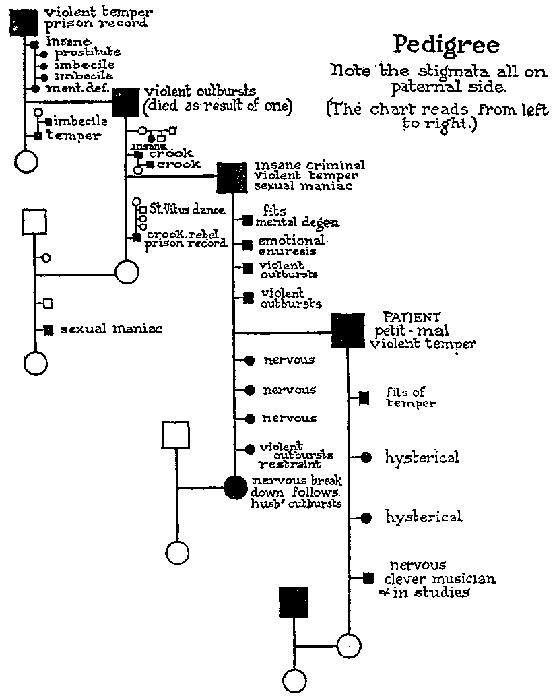
Fall from horse in battle; fear of being crushed: Hysterical crises. Case offered as showing TRAUMATIC HYSTERIA in a young physician WITHOUT HEREDITARY OR ACQUIRED PSYCHOPATHIC TENDENCY.
Case 306. (Donath, 1915.)
A physician of twenty went into the war as a volunteer Hussar. During an attack, he fell from his horse without losing consciousness, though he was at the time much afraid of being crushed. The attack ceased and he returned to the lines on horseback.
Immediately there developed an emotional crisis, and thereafter he broke into weeping on the slightest occasion. He was afraid he was going to lose his reason; that some spiritual power was going to suppress his ego and madden him. He wept as he was going under narcosis to be operated upon for an intercurrent appendicitis. He became so sensitive to noise that he wanted to choke the offender. One day he bit himself on the arm in his excitement. Sensory tests could not be executed on account of his fear of the brush. Reflexes were normal.
It took four hypnotic seances to get him in proper rapport with his physician for psychotherapy.
This case is cited by Donath as one in which traumatic hysteria has been proven to exist in a man without any sign of neuropathic or psychopathic taint, either in his previous history or in his relatives.
A perfect soldier type. Mine explosion; burial; superficial wounds: War neurosis.
Case 307. (MacCurdy, July, 1917.)
A lieutenant, 29, had been a regular soldier for eight years before the war and was made a non-commissioned officer almost at once after enlisting. He went out as a sergeant with the original expeditionary force and got through the retreat from Mons and the first battle of Ypres intact. He enjoyed the fighting hugely and even got indifferent to the burial work. The death of chums saddened him, but he carried on and soon forgot about the incidents. He might be regarded as a perfect soldier.
In August, 1915, there was a slight touch of rheumatism. Two or three months later the Germans exploded a mine immediately in front of the trench where he was. He went pale for the first time in his life, but kept his men “standing to.” Thereafter he began to think for the first time about danger. Mining was hereabouts the chief form of attack, and he frequently heard Germans digging beneath a dug-out. He slept well in billets, but was too restless for sleep on active duty.
He got more and more on edge during the next weeks. Six weeks after the mine explosion he was buried in a dug-out. Though he did not lose consciousness, he was dazed and had to lie down for two hours. Nervousness, chronic headache and insomnia, even in billets, followed. His imagination played upon the blowing out of dug-outs and the bowling over of men by shells. He had become company sergeant-major and the responsibility made him grow worse and worse. At times he tended to jump when the shells came, but was outwardly perfectly calm. He began to take morphia, though with little result. He had suicidal thoughts.
After two months of these symptoms he was sent to England. He began to sleep fairly well and three months later applied for light duty; was greatly bored by the company accountant work given him; got a commission and was sent back to the front nine months later, January, 1917. He got on with the active fighting very well, sleeping four or five hours a night. In April he was sent to Arras. He had had a dream that he was going to be bowled over, buried and wounded in the neck. Sleep got poorer. In April he led his men in an advance and actually was bowled over, buried and hit in the neck as well as in the knee and the hand, though all the wounds were superficial. He was carried back, dazed, to hospital, where he grew fairly comfortable in ten days and even undertook a journey down to the base.
He arrived in collapse, remained in camp at the base three weeks, getting steadily worse. Something, he could not tell what, was going to happen and kill him. He could not concentrate, even to read. He thought of suicide. He slept practically not at all, waking from a doze with a start, feeling that something had hit him. He had dreams of being taken prisoner and on waking would in fancy start a fight to escape from imagined imprisonment back to the British lines. After two weeks in various hospitals he spent ten days in a hospital for nervous cases and grew better. Riding on trains he was terrorized in every tunnel lest he should be crushed.
According to MacCurdy, an anxiety neurosis would have developed had not his superiors sent the lieutenant back to hospital after the final burial in April. As this perfect soldier said: “There is no man on earth who can stick this thing forever.”
Shell-shock; thrown against a wall: Tremors—TREMOPHOBIA.
Case 308. (Meige, February, 1916.)
Meige has studied shell-shock tremors, especially those occurring without external wound.
A corporal was with his squad on the Nouvron Plateau, January 13, 1915, when he was thrown against the wall by a bursting shell, which killed or wounded several comrades but did not wound the corporal. Whether he lost consciousness is unknown, but he lay on the ground for some time, until he could be moved through a communication trench. After the explosion he began to tremble, and was still trembling on his trip back. Constantly trembling, he lived on at the front for a fortnight, but without eating; and, although he had been a good rifleman, he had lost all his former skill with a gun.
There was a delay of a month before evacuation, but the trembling did not cease, and he was passed through various units, to the neurological center at Villers-Cotterets, where he remained for two months,—April 13 to June 15, 1915,—with a diagnosis of hysterical chorea. He was examined by Guillain, who found, besides the generalized tremors, lively knee-jerks and Achilles jerks, an excessive emotionality, particularly marked when the guns were going or bombs bursting. Lumbar puncture yielded a perfectly normal fluid.
June 19 the corporal went to the Salpêtrière under P. Marie. July 14 he was evacuated to the civil hospital of Arcueil, where he remained till September 24, when he was sent home to convalesce, from October 26 to December 15.
He returned to the Salpêtrière December 15, 1915. Throughout these various movements from hospital to hospital, his status was unchanged. At the time of report about a year after shell-shock, he was still constantly and uniformly trembling. All four limbs were affected, perhaps the right arm and the left leg more markedly. There was no tremor during sleep, but there was a tremor when the patient lay awake in dorsal decubitus just as when he was sitting or standing. The tremor was worse in the evening than in the morning, and the patient could get to sleep only very late. There was slight tremor of the head; the eyelids and the tongue showed a few tremors, which were not synchronous with those of the limbs. Nystagmus was absent. To diminish the effect of the trembling, the patient held his forearms flexed and kept his elbows close to his body. If the trembling of the legs got intense, the patient would rise and walk a few steps. Any movement, such as carrying a spoon or a glass to the mouth, led to an exaggeration of the tremors; and there was at this time a suggestion of the intention tremor of multiple sclerosis. The tremor was increased when the eyes were closed. Any sudden noise or sharp command, or recalling to mind of trench service, would bring about extraordinary motor crises, in which there was an intense and generalized tremor, so the patient would lose his balance. Any attempt at eliciting reflexes would produce generalized violent tremor. Sensations were normal; tendency to hyperidrosis; pulse in repose, 60, rising to 120 if one struck the table sharply.
Meige remarks that a number of examples of tremors suggestive of Parkinson’s disease were observed in the War of 1870. Might the explosion have caused properly situated lesions in the encephalon of such a nature as to produce a Parkinsonian tremor? The tremors were stationary, and if due to some lesion, the lesion remains now exactly what it was at the beginning. There was no digital tremor such as is characteristic of Parkinson’s disease. Moreover, the intention tremor of such a patient, rather than Parkinson’s disease, suggests multiple sclerosis, of which latter disease, however, there is no other sign. Nor does there seem any evidence that these tremors were of cerebellar, paretic, goitrous, or of any definite toxic origin. On the whole, Meige regards it as a neuropathic manifestation resembling what is found in traumatic neurosis. He believes that there is not sufficient evidence that it is the consequence of any structural change in the nervous system.
Meige remarks that the analysis of any case of tremor must take the mental state into account. This patient, perfectly conscious of his tremors and their critical exacerbations, was much chagrined thereby. He suffered mentally from his impotence, especially when bystanders would intentionally bring about his paroxysms. He looked like one shuddering from fear, and it is actually probable that he was afraid of his own tremors and shuddering. He was, besides subject to tremor, also a victim of tremophobia,—a kind of phobia described some years since by Meige, somewhat resembling ereutophobia, or fear of blushing, described by Pitres and Régis.
Four hours in a freezing bog: Hysterical glossolabial hemispasm twelve hours after rescue. No sensory disorder of face or tongue; sensory disorder of arm, but no motor disorder.
Case 309. (Binswanger, July, 1915.)
A man, 27, in good health, called on the second day of the mobilization, got into the line two weeks from mobilization, first in the West, and then, from mid-September, in the East. He was in the artillery and stood shell fire in a big battle very well.
However, December 27, 1914, while engaged in transport service, on the way back with his horse, he fell into a bog and gradually sank to his neck. Attempts to get the man and his horse out failed. All that saved him from drowning was the freezing of the bog surface. After four hours he was freed by his comrades, apparently frozen stiff, but with consciousness completely preserved. On the next day, at about five o’clock,—twelve hours after his release from the frozen bog,—he had a seizure. It began with headache on the left side and loss of consciousness that lasted 24 hours. The right leg was paralyzed and very painful. He passed through various hospitals and finally arrived at the Jena Nerve Hospital, January 25, 1915.
He was a tall, powerful man, with a slow regular pulse, accelerated heart sounds, lively dermatographia, increased muscular excitability, general increase of knee and Achilles reflexes (left greater than right), slight patellar and ankle clonus present on the left side, Babinski reaction absent, plantar reflex more lively on the left than on the right, but abdominal reflex more lively right than left. Head painful to percussion in the left temporal region. Touch and pain sense segmentally absent in both right extremities. Arm movements free; tremors absent. Active movements almost impossible in the right leg; on passive movement marked pain. Slight muscular tension about knee-, hip-, and ankle-joints. The patient got about with a cane, trailing the left leg. Romberg sign.
The right angle of the mouth was withdrawn slightly upward and outward, and lagged a little in active movements. The protruded tongue deviated completely into the right angle of the mouth and there remained, but without tremor. The uvula deviated to the right, and the right palate was held higher than the left. Lively palatal reflex. Speech intact. The patient’s chief complaint was attacks of coughing, which increased his headache to the point of intolerability. A harmless drug caused the coughing and headache to disappear. The patient was a quiet, willing man, who industriously went through his exercises, and on the Kaiser’s birthday was already walking in the marketplace. His tongue contractions gradually improved. His body-weight increased.
In the course of two months the glossolabial and palatal contractions had largely disappeared. The walking movements of the right leg had improved, although there was still a distinct paresis, and a stiffness in the right knee and ankle joints. Climbing stairs was impossible on account of difficulty at the hip. March 30, 1915, the sensory improvement was marked. There was a feeling as though the last three fingers of the hand were asleep; walking was improved; he could walk one or two hours a day. The walk was still slightly spastic-paretic, May 28, when he was discharged.
It is remarkable that the hysterical attack had such a long incubation period in this case: twelve hours after his removal from the marsh. There were doubtless physical factors of refrigeration, on the one hand, and on the other, psychic factors of fear of sinking alive in the marsh, at the bottom of the phenomenon. The most marked feature, of course, was the glossolabial hemispasm. In the presence of this hemispasm, it is remarkable that there should have been no anesthesia or analgesia of the face, cheek, or tongue; and moreover the paresis of the right mouth and tongue was far less marked than the contracture. It is also striking that the right upper extremity, although it had sensory disorder, failed to show motor disorder.
Slight bruise by horse: Apparently invincible complaints of pain. Cure by single-handed capture of many Russians.
Case 310. (Loewy, April, 1915.)
An infantryman was standing below an embankment when a horse fell upon him, bruising him slightly on the left hip. This infantryman later continually complained of pains in the opposite hip though there had never been a contusion there, nor anything felt there. These complaints could not be influenced by exhortation, by diversion, or by drugs. If they were purposely ignored, the patient reacted complainingly and in a way to suggest delusions of persecution.
Nevertheless, this querulous man soon proved an effective soldier in a storming attack in which the whole battalion distinguished itself, putting himself forward particularly. In fact, by himself he captured a whole group of Russians!
Thereupon all the pains in the hip ceased, nor did they recur so long as he was under observation. Morose and complaining before, he now became cheerful.
Kick in abdomen by horse: General spasticity; tremors; eye symptoms (e.g. monocular diplopia); convulsions. Improvement.
Case 311. (Oppenheim, July, 1915.)
A cuirassier was kicked by a horse on left side of abdomen, November 24, and lost consciousness. A month later, in hospital, hardness and tenderness to pressure of abdominal wall, spastic muscles everywhere, pseudospastic tremor of legs, and complaints of double vision were noted. He also had attacks of convulsions, in which he became unconscious, twitchings appeared, but the tongue was not bitten. Urine was often involuntarily passed in these attacks, but he was not always continent outside attacks, as, for instance, in coughing.
On admission to nerve hospital: Right-sided monocular diplopia; mild ptosis; ocular movements free. Rapid tremor on shaking hands. Stood with straddling legs affected by vibrating tremor. Knee-jerks considerably increased. In the dorsal position movements of the left leg were accompanied by marked tremor. He even could not go to sleep easily on account of twitching of the left leg.
His comrades observed that he had convulsions at night, and often spoke in his sleep. Inoculation against typhoid fever was made early in December. Later, permanent rise of temperature to 37.8. Several attacks, lasting about ten minutes, came under observation of the physician.
In January, progressive improvement in the motor sphere and also psychically. The urinary disturbance likewise disappeared, but the spasms persisted.
Windage from a shell; fear; fall, unconscious: Homonymous hemianopsia (organic? functional?) with blinking and vasomotor excitability.
Case 312. (Steiner, October, 1915.)
A volunteer, 19 (never ill; no nervous disease in the family) after a period of training went into the field October 3, 1914. November 5 a shell struck near his trench, but failed to explode. Up to that time everything had been quiet. The soldier had been looking out of the loop-hole, surveying the landscape. He felt a great fear, felt a blow in the neck, and fell down unconscious. How long he was unconscious is unknown. Sometime later he walked back with his comrades.
About an hour later, this volunteer—who was a very intelligent young man, possessing some knowledge of biology, including the nature of visual fields—noticed a black spot in the field of vision, which came and went, but after a few hours remained continually without disappearing. Otherwise there was no complaint except a feeling of dizziness when stooping.
Upon examination there could be found no disorder of the internal organs. Neurologically there was blinking, vasomotor excitability, slight reddening of the face, and dermatographia. An expert in ophthalmology confirmed the existence of a homonymous defect in the fields of vision. This defect could not be influenced by suggestion or by any other treatment, nor did any other change whatever occur in the condition.
Steiner inquires whether this hemianopsia is to be taken as organic or functional. The air-pressure of the shell hissing past might have produced a concussion, or the falling unconscious might have produced a commotio cerebri or a slight hemorrhage. The tic-like blinking and vasomotor excitability, however, suggest functionality.
Shell-shock PSORIASIS. Post-traumatic eczema.
Case 313. (Gaucher and Klein, May, 1916.)
A soldier, 28, came to the Saint-Louis skin clinic, May 15, 1916, for leg lesions three months old. These lesions were cicatricial, squamous, irregular-contoured, and had developed following a wound. The lesions were eczematous.
On the trunk, arms and elbow were lesions of psoriasis. These lesions had appeared after shell-shock. The man had been bowled over June 16, 1915, by a marmite. The psoriatic lesions appeared shortly afterwards. The patient had never seen anything of the sort before.
In this case the trauma provoked eczema; the emotion, psoriasis. Gaucher and Klein say that they have been struck by the recrudescence of psoriasis since the outbreak of the war, and remark, also, that there has been a relative increase of new cases since July, 1914.
There are cases of psoriasis following nervous shock, emotion and trauma. Sometimes the psoriatic lesion develops upon the scar of a wound. In the above case, as in the case of a woman of 25, a refugee from the Arras bombardment, the psoriasis began de novo and slowly developed immediately after the catastrophe of the Jena. Five, possibly six, out of eight cases totaled, appear, unlike the case sketched above, to have developed in cases either tuberculous or of tuberculous stock.
Re psoriasis, Vignolo-Nutati remarks that this is a relatively frequent skin disease amongst Italian soldiers. He states that many of these cases are due to nervous shock. Some are related to wounds appearing near the scars. In all cases an emotional disturbance is the chief cause. Vignolo-Nutati had 86 cases of psoriasis in six months, 52 of the men coming from the front. Eighteen of the men said that they had not previously suffered from the disease.
A sergeant gets the CROIX DE GUERRE and SHELL-SHOCK together: Transient deafness; later pseudohallucinatory electric bell ringing, reminiscent of civilian work; stereotyped movements, reminiscent of war experience.
Case 314. (Laignel-Lavastine and Courbon, May, 1916.)
A sergeant, 24, had worked about Parisian hotels from the age of thirteen and a half. He won the croix de guerre and was evacuated for his wounds April 24, 1915.
It seems that he carried the remains of his company, which had been decimated the night before by a mine explosion, on to the enemy trench, getting there first and facing three Germans, whom he beat down. At this time, gas shells began to rain about. Making a number of violent expiratory movements to get rid of the gas, he found himself unable to progress on account of the fall of the shells, and sat motionless with his hands before his face. He was cast to the earth by an explosion, which at the same time blew off a revolver which the wounded lieutenant had passed to him. He sat up, and, observing that the soldiers had gotten the trench, went back to the lines, where he told his story.
He then found that he was deaf, and wounded in the left leg. The wounds rapidly healed, but sundry other symptoms developed. He had a peculiar sensation back of the forehead. He could not think, read or write and was very weary. He got better in a few months, but disorders kept returning.
His deafness had left him in about a fortnight, but when his hearing came back spontaneously, there were peculiar sensations. He constantly heard an electric bell, intense and continuous, like that of a French cinema advertising its films. The sounds seemed to begin in the ear and to run out as a sort of whistling. This sensation was preceded by buzzing and associated with noises like those of a musical triangle or a steam whistle. The noise kept up during waking hours, but was often forgotten while he was at work. In sleep he heard nothing, except sometimes battle noises. August 20, 1915, he was given the diagnosis: labyrinthine shock—hearing returned.
About ten weeks after evacuation, when the headaches and thought blocking began to disappear, a generalized tremor, especially of the head, set in, which the patient called St. Vitus’ dance. Then a peculiar gait began, which lasted several weeks and then transiently reappeared. Every few steps his legs would bend, and he could only walk forward in the attitude of a man who is concealing his height. After resting a few minutes he began to walk regularly again and the cycle began over again. He had to walk with two canes. If he felt some sudden emotion, or sometimes without any obvious reason, he would stop short and look straight ahead, with body bent, and arms before his face. This would last but a moment, whereupon he would walk again normally.
When this anomalous walking disappeared, curious face movements and gestures began. If a strange person arrived, the forehead and eyebrows would contract, the eyelids would stand wide, which gave him an expression of surprise lasting a few seconds. At the same time the mouth would open and remain so for some moments. A forced expiration would be executed, suggesting a fish out of water. He would then imperatively strike the table with his fist, or the ground with his foot.
Laignel-Lavastine and Courbon explain the anomalous movements as stereotypies due to secondary automatism. They are not convulsive, are not preceded by emotion or followed by a sense of relief, and are not tics. They are gestures and postures without present significance, but adapted to certain former circumstances. The electric bell effect is a sort of pseudohallucination, differing from true hallucinations in little except the absence of the externalizing feature. The stereotypical movements are reproductions of things done in the battle, and the pseudohallucinations relate to the former hotel work of the soldier.
Cinema worker, two days after being waked up by a shell, develops a nystagmiform tremor of eyes and tachycardia. Graves’ disease? Tic (“occupational virtuosity”)?
Case 315. (Tinel, April, 1915.)
A soldier was waked up with a start Sept. 22, 1914, by a shell burst. The man was not wounded or shocked, and merely felt a good deal moved. The next day but one he felt a little movement of his eyes, which was at first intermittent but in three or four days became continuous and troublesome. These movements were those of nystagmus, almost transverse and very rapid, and suggestive rather of a vibratory trembling than of a true nystagmus of the eye or of labyrinthine disease. When the patient fixed an object, the nystagmus would stop for a few seconds and then immediately reappear. There had never been any vertigo, nausea, vomiting, deafness, ocular disorder, or disorder of equilibration. During the tests for nystagmus, the morbid nystagmus would stop and be replaced by the normal nystagmus which was obviously slower and more regular. The condition had persisted from September, 1914, to the meeting of the Neurological Society, April 15, 1915. The patient said he had become very emotional and got palpitations on the slightest occasion, such as a fast walk, going upstairs, or hearing a loud noise. There was also a slight vibratory trembling of the fingers and a permanent tachycardia (120-140 beats). Tinel regards the case as one of neurosis, due to a neuromuscular hyperexcitability comparable in some ways with that found in Graves’ disease.
Meige, in discussion, called attention to the fact that not every nystagmus is of organic origin and that there is a rare form of tic of nystagmiform nature. The victim in this case was an employee in a moving picture house, and very possibly his occupation had permitted him to utilize what Meige speaks of as a “occupational virtuosity” of the eye muscles.
Synesthesialgia: FOOT pain on rubbing dry HANDS, following bullet wound of leg.
Case 316. (Lortat-Jacob and Sézary, November, 1915.)
A foot chasseur was wounded, September 15, 1914, low in the right thigh, a bullet entering outside the biceps tendon and emerging on the inner aspect of the leg, 4 cm. below the knee joint. He at once began to feel pains in the right foot, which grew swollen and red. The leg began to flex upon the thigh and, after straightening under anesthesia, was placed in plaster. An arteriovenous aneurysm developed in the popliteal space; operation, October 22nd, followed November 1, by ligature. The pains in the foot grew better after this operation; but as soon as the wound was cicatrized they came back again as before.
For seven months the foot pains remained sharp and continuous, such that the man could not leave his bed. If a bright light struck his eyes, the pains grew much more marked, especially in the morning on awakening. The patient found that when his hands were dry he could not use them because of the violent pains which rubbing them would cause in the right foot. Accordingly he kept putting his hands to his mouth to moisten them. Finally he kept a wet rag by him which he could pass from one hand to the other.
The pain was what made walking difficult. Foot movements were only a bit less ample on the affected side than on the normal side. There was a general muscular atrophy of the lower extremity (30.5: 34 about calf, and 40: 49 about thigh). Right knee-jerk more lively than left. Right Achilles jerk absent. Negligible disorders of electrical excitability in the territory of the right sciatic nerve. The skin of the foot was a little thin and pale; the temperature was low; and the nails had transverse striations. The pains grew gradually a little less marked, but if the room temperature was increased or lowered or if the foot became cold, the pains became extreme. Pressure on the popliteal space produced pain on the external border of the foot; likewise pressure on the calf. Lasègue’s sign could not be tested for on account of the contracture of the flexors of leg on thigh. Due to the direct action of the bullet, there was an objective hyperesthesia of the dorsum and sole of the foot. The toes were anesthetic. A cold foot bath increased the pains, and a warm foot bath diminished them (contrary to experience in analgesias).
This was a case of synesthesialgia in the right foot, brought about by rubbing dry hands, exactly as if there were a direct contact with the foot. Milder painful reactions were brought about by bright lights and loud noises; but on the whole, these other effects were insignificant. It must be remembered that the man was wounded and plainly had also organic nervous disorder. He sometimes complained of radiations of the pain up to the left hypochondrium, and sometimes he showed the classical sensation of “esophageal globus” (lump in the throat). In short, there was in him a special excitability of the nervous system which may partly explain the synesthesialgia.