INDIAN LINGUISTIC FAMILIES OF AMERICA NORTH OF MEXICO. (continued 7)
Reading edition
It is believed that there are five powerful man´idōs who abide within the third-degree Midē´wigân, one of whom is the Midē´ man´idō—Ki´tshi Man´idō—one being present at the sacred stone, the second at that part of the ground between the sacred stone and the first part where the gifts are deposited, the remaining three at the three degree posts.
As the candidate starts and continues upon his walk around the interior of the inclosure the musicians begin to sing and drum, while all those remaining are led toward the left, and when opposite the
Mĭs-sa´-a-shi´-gwa wi-kan´-da´-we-an´, mĭs-sa´-a-shi´-gwa
Now is the time [I am] telling [—advising,] now is the time
wī´-di-wa´-mŏk wi-un´-o-bē-ŏg.
to be observed [I am] ready to make him sit down.
Then one of the Midē´ priests standing beside the candidate leads him to the spot between the sacred stone and the first-degree post where the blankets and other goods have been deposited, and here he is seated. This priest then walks slowly around him singing in a tremulous manner wa´, hĕ´, hĕ´, hĕ´, hĕ´, hĕ´, hĕ´, hĕ´, returning to a position so as to face him, when he addresses him as follows: Mĭs-sa´-a-shi´-gwa pŏ´-gŭ-sĕ-ni´mi-nan´ au´-u-sa´ za-a´-da-win´ man´-i-dō mī´-gis. Na´-pish-gatsh di-mâ´-gĭ-sĭ ĕ-nĕ´-nĭ-mi-an pi´-sha-gâ-an-da-i´ na´-pish-gatsh tshi-skwa´-di-na-wâd´ dzhi-ma´-dzhi-a-ka´-ma-da-mân bi-mâ´-dĭs-si´-an.
The following is a free translation:
The time has arrived for you to ask of the Great Spirit this “reverence” i.e., the sanctity of this degree. I am interceding in your behalf, but you think my powers are feeble; I am asking him to confer upon you the sacred powers. He may cause many to die, but I shall henceforth watch your course of success in life, and learn if he will heed your prayers and recognize your magic power.
At the conclusion of these remarks three others of the officiating Midē´ advance and seat themselves, with their chief, before the candidate. The Midē´ drum is handed to the chief priest, and after a short prelude of drumming he becomes more and more inspired, and sings the following Midē´ song, represented pictorially, also on Pl. XIV, B.

Plate XIV.b. Mnemonic Song.
Man´-i-dō´ we-da´, man´-i-dō´ gi-dō´ we-do´-nĭng. Let us be a spirit, let the spirit come from the mouth. The head is said to signify that of a Midē´, who is about to sing.

Nin´-de-wen´-don zha´-bon-dĕsh´-kân-mân´. I own this lodge, through which I pass. The speaker claims that he has been received into the degree of the Midē´wiwin to which he refers. The objects on the outer side of the oblong square character represent spirits, those of the bear.

Ân´-dzhe-ho ĭ´-a-ni´ o-gēn´, hwe´-ō-ke´, hwe´-ō-ke´. Mother is having it over again. The reference is to the earth, as having the ceremony of the “grand medicine” again.

Ni´-ka-nan ni´-go-sân, ni´-go-sân´ ni-ka´-ni-san´, man´-i-dō´ wi-dzhig´ nin-go-sân´ an-i-wa´-bi-dzhig ni-ka´. Friends I am afraid, I am afraid, friends, of the spirits sitting around me. [The speaker reaches his hand toward the sky, i.e., places his faith in Ki´tshi Man´idō who abides above.]

Ya´-ki-no´-sha-me´-wa, ya´-ki-no´-sha-me´-wa, ya-ki-no-si-ka-ne, ya-ki-no-si-ka-ne, hē´, ki´-no-sha´-we-wa´. I am going, with medicine bag, to the lodge. [The object represents an otter skin Midē´ sack, the property of the speaker.]

Ya´-be-kai´-a-bi, ya´-be-kai´-a-bi, hē´-ā´, hē´-ā´, ya´-be-kai´-a-bi, ya´-be-kai´-a-bi, hē´-ā´, hē´ā´, wa´-na-he´-ni´-o-ni´, ya´-be-kai´-o-bik´. We are still sitting in a circle. [A Midē´ sitting within the Midē´wigân; the circle is shown.]

A-ya´-a-bi-ta´ pa´-ke-zhĭk´, ū´, hū´, a´, Half the sky The hand is shown reaching toward the sky, imploring the assistance of Ki´tshi Man´idō that the candidate may receive advancement in power. He has only two degrees, one-half of the number desired.

Ba´-be-ke´ o´-gi-mân nish´-a-we, hē´, ne´-me-ke-hē´, nish´-a-we´-ni-mĭk o´-gi-mân. The spirit has pity on me now, [The “Great Spirit” is descending upon the Midē´wigân, to be present during the ceremony.]

Nin-dai´-a, nin-dai´-a, ha´, we´-ki-ma´, ha´, wâ-no-kwe´. In my heart, in my heart, I have the spirit. [The hand is holding the mī´gis, to which reference is made.]

I-ke´-u-ha´-ma man-ta-na´-ki-na ni-ka´-ni I take the earth, my Midē´ friends. The earth furnishes the resources necessary to the maintenance of life, both food and medicines.

Wi´-a-ya´-din shin-da´, hān´, man-da´-ha-ni´, o-hō´ ni-bĭ´. Let us get him to take this water. [The figure sees medicine in the earth, as the lines from the eyes to the horizontal strokes indicate.]

Hŭe´-shĭ-shi-kwa´-ni-an nin-ga´-ga-mūn´. I take this rattle. The rattle is used when administering medicine.

Wi-wa´-ba-mi´na hē´-na ko´-ni-a´-ni, ka´, ko´-ni-a´-ho-nā´, nī´, kā´. See how I shine in making medicine. [The speaker likens himself to the Makwa´ Man´idō, one of the most powerful Midē´ spirits. His body shines as if it were ablaze with light—due to magic power.]

This song is sung ad libitum according to the inspired condition of the person singing it. Many of the words are archaic, and differ from the modern forms.
Then the officiating priests arise and the one lowest in rank grasps his Midē´ sack and goes through the gestures, described in connection with the previous degrees, of shooting into the joints and forehead of the candidate the sacred mī´gis. At the attempt made by the chief priest the candidate falls forward apparently unconscious. The priests then touch his joints and forehead with the upper end of their Midē´ sacks whereupon he recovers and rises to a standing posture. The chief then addresses him and enjoins him to conduct himself with propriety and in accordance with the dignity of his profession. The following is the text, viz: Gi-gan´-bis-sĭn dau´-gē-in´-ni-nân´ kish-bin´-bish-in dau´-o-ân-nĭn da´-ki-ka-wa´-bi-kwe ga´-kĭ-ne ke-ke´-wi-bi´-na-mōn ki-ma´-dzhĭ-zhi we´-bĭ-zi-wĭn´.
The translation is as follows: “You heed to what I say to you; if you are listening and will do what is right you will live to have white hair. That is all; you will do away with all bad actions.”
The Midē´ priest second in rank then says to the candidate: Ke´-go-wi´-ka-za´-gi-to-wa´-kin ki-da´-no-ka´tshĭ-gân kai-ē´-gi-gīt´ a-sē´-ma, kai´-e-mī´-dzĭm, which signifies: “Never begrudge your goods, neither your tobacco, nor your provisions.” To this the candidate responds ēn´—yes, by this signifying that he will never regret what he has given the Midē´ for their services. The candidate remains standing while the members of the society take seats, after which he goes to the pile of blankets, skins, and other presents, and upon selecting appropriate ones for the officiating priests he carries them to those persons, after which he makes presents of less value to all other Midē´ present. Tobacco is then distributed, and while all are preparing to make an offering to Ki´tshi Man´idō of tobacco, the
Mi-gwĕtsh´ ga´shi-tō´-win bi-ma´-dĭ-si-wīn´,
Thanks for giving to me life,
then, stepping back, he clasps his hands and bows toward the Midē´, adding: Ni-ka´-ni, ni-ka´-ni, ni-ka´-ni, ka-na´,—“My Midē´ friend, my Midē´ friend, my Midē´ friend, friend.” To this the Midē´ responds in affirmation, hau´, ēn´—yes.
The new member then finds a seat on the southern side of the inclosure, whereupon the ushers—Midē´ appointed to attend to outside duties—retire and bring in the vessels of food which are carried around to various persons present, four distinct times.
The feast continues for a considerable length of time, after which the kettles and dishes are again carried outside the Midē´wi-gân, when all who desire indulge in smoking. Midē´ songs are chanted by one of the priests, the accompanying, reproduced pictorially in Pl. XIV C, being an example. The lines, as usual, are repeated ad libitum, the music being limited to but few notes, and in a minor key. The following are the words with translation:

Plate XIV.c. Mnemonic Song.
He´-ne-wi´-a ni´-na mi´-si-man´-i-dē-ge´ Their bodies shine over the world he-wa´-we-a´-ne-kan´. unto me as unto you, my Midē´ friend. This refers to the sun, and moon, whose bodies are united in the drawing.

Ma´-na-wi-na´ hai´-e-ne-hā´ be-wa´-bik-kun Your eyes see them both eyes made of iron, kan-din´-a-we. piercing eyes. The figure is that of the crane, whose loud, far-reaching voice is indicated by the short lines radiating from the mouth. The eyes of the crane Man´idō are equally penetrating.

Ta-be´-nĕ-wa´ he-shi-wa´, hā´ ma´-si-ni´-ni-he´-shi-wa´, hā´. Calm it leads you to guides you to your food. Knowledge of superior powers gained through familiarity with the rites of the Midē´wiwin is here referred to. The figure points to the abode of Ki´tshi Man´idō; three short lines indicating three degrees in the Midē´wiwin, which the candidate has taken.

Ha-nin´-di he-bik´-kĭn-he´ man´-i-dō ni-kan´ Whence does he rise spirit Midē´ friend wa-ba-nŭnk´, mi-dē´-man´-i-dō wa-ba-nŭnk´. from the east, midē´ man´idō from the east. [The hand reaches up as in making the gesture for rising sun or day, the “sky lines” leaning to the left, or east; one making signs is always presumed to face the south, and signs referring to periods of day, sun, sunrise, etc., are made from the left side of the body.]

Rest.

Wa-dzhi-wan´, wa-dzhi-wan´-na, Wa-dahi-wan´ ni-ka´-na-hē´. There is a mountain, there is a mountain, There is a mountain, my friends. [The upright outline represents a mountain upon which a powerful Midē´ is seated, symbolical of the distinction attainable by a Midē´.]

Wa´-bĕ-ku´ĕ-be-a´, wa´-bĕ-ku´-ĕ-be-a´, Shot it was, shot it was na´-bĕ-ku´-ĕ-be-a´ man´-i-dō´-´a nĭn-dē´. and it hit body, your man´ido your heart. man´-i-dō´-a nin-dē´. man´ido your heart. [The Mī´gis is represented in the illustration by the small rings; the arrow indicating that it was “shot” with velocity.]

Hwe´-kwo-nin´-na-ta, ki-wī´-kash´-ka-man; En-do´-ge-mā´ wesh´-in-ē´. What am I going around? I am going around the Midē´wigân.
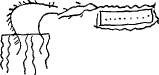
[The oblong structure represents the Midē´wigân. The otter-skin Midē´ sack is taken around it, as is shown by the outline of that animal and the line or course indicated. The Makwa´ Man´idō (bear spirit) is shown at the left, resting upon the horizontal line, the earth, below which are magic lines showing his power, as also the lines upon the back of the bear. The speaker compares himself to the bear spirit.]
Nen´-do-ne´-ha-mān-ni´ nī´-ŏ, What am I looking at. The figure denotes a leg, signifying powers of transporting one’s self to remote places; the magic power is indicated by the three transverse lines and the small spots, the mī´gis, upon it.

Ba´bin-ke´-en non´-do-wa-wē´, hī´, I soon heard him, the one who did not listen to them. [The Midē´, as a superior personage, is shown by having the horns attached to the head. The line of hearing has small rings, at intervals, indicating that something is heard.]

Hin´-ta-na´-wi ni-ka´-na-gi´, ē´, hē´, pī´-na-nī´, hin´-ta-na´-wi ni-ka´-na-ga´ na´-ge-ka-na´ ē´, hē´. The Nika´ni are finding fault with me, inside of my lodge. [The arm at the side of the Midē´wigân points to the interior, the place spoken of.]

Onsh´-konsh-na-nā´ pi-na´-wa nin-bosh´-i-na´-na. With the bear’s claws I almost hit him. The Midē´ used the bear’s claw to work a charm, or exorcism, and would seem to indicate that he claimed the powers of a Wâbĕnō´. The one spoken of is an evil man´idō, referred to in the preceding line, in which he speaks of having heard him.

At the conclusion of this protracted ceremony a few speeches may be made by a Midē´, recounting the benefits to be enjoyed and the powers wielded by the knowledge thus acquired, after which the chief priest intimates to his colleagues the advisability of adjourning. They then leave the Midē´wigân by the western door, and before night all movable accessories are taken away from the structure.
The remainder of the evening is spent in visiting friends, dancing, etc., and upon the following day they all return to their respective homes.
DESCRIPTIVE NOTES.
Although the mī´gis shell of the several degrees is generally of the same species, some of the older Midē´ priests claim that there were formerly specific shells, each being characteristic and pertaining specially to each individual grade. The objects claimed by Sika´s-sigĕ as referring to the third degree are, in addition to the Cypræa monata, L., a piece of purple wampum, and one shell of elongated form, both shown on Pl. XI, Nos. 3 and 5, respectively.
The fact of a Midē´ having been subjected to “mī´gis shooting” for the third time is an all-sufficient reason to the Indian why his powers are in a corresponding manner augmented. His powers of exorcism and incantation are greater; his knowledge and use of magic medicines more extended and certain of effect; and his ability to do harm, as in the capacity of a Wâbĕnō´, is more and more lauded and feared. He becomes possessed of a greater power in prophecy and prevision, and in this state enters the class of personages known as the Jĕs´sakkīd´, or jugglers. His power over darkness and obscurity is indicated on Pl. III, A, No. 77, upon which the head, chest, and arms are represented as being covered with lines to designate obscurity, the extended arms with outstretched hands denoting ability to grasp and control that which is hidden to the eye.
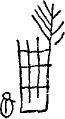
Fig. 26.—Jĕs´sakkân´ or juggler’s lodge.
The Jĕs´sakkīd´ and his manner of performing have already been mentioned. This class of sorcerers were met with by the Jesuit Fathers early in the seventeenth century, and referred to under various designations, such as jongleur, magicien, consulteur du manitou, etc. Their influence in the tribe was recognized, and formed one of the greatest obstacles encountered in the Christianization of the Indians. Although the Jĕs´sakkīd´ may be a seer and prophet as well as a practitioner of exorcism without becoming a Fig. 26.
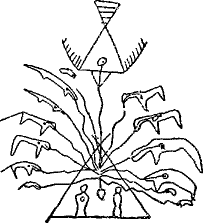
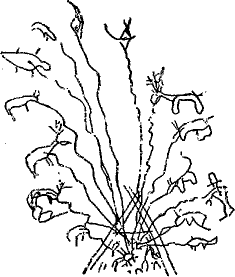
Fig. 27.—Jĕs´sakkân´, or juggler’s lodge. Fig. 28.—Jĕs´sakkân´, or juggler’s lodge.
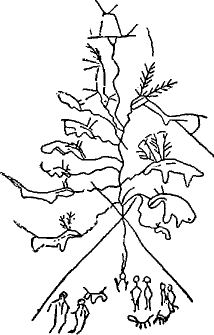
Fig. 29.—Jĕs´sakkân´, juggler’s lodge.
The accompanying illustrations, Figs. 27, 28, and 29, reproduced from birch-bark etchings, were the property of Jĕs´sakkīd´, who were also Midē´ of the third and fourth degrees. It will be noticed that the structure used by them is in the form of the ordinary wig´iwam, as their profession of medical magic is apparently held in higher esteem than the art of prophecy; their status and claims as Jĕs´sakkīd´ being indicated by the great number of ma´nidōs which they have the power of invoking. These man´idōs, or spirits, are indicated by the outline of their material forms, the heart being indicated and connected with the interior of the structure to show the power of the Jĕs´sakkīd´ over the life of the respective spirits. The Thunder-bird usually occupies the highest position in his estimation, and for this reason is drawn directly over the wig´iwam. The Turtle is claimed to be the man´idō who acts as intermediary between the Jĕs´sakkīd´ and the other man´idōs, and is therefore not found among the characters on the outside of the wig´iwam, but his presence is indicated within, either at the spot marking the convergence of the “life lines,” or immediately below it. Fig. 30.— Jĕs´sakkân´ or juggler’s lodge. Fig. 30 is a reproducton of an Pl. XIV, D. It is a reproduction of one made by a Jĕs´sakkīd´ who was also a Midē´ of the third degree. Each line is chanted as often as may be desired, or according to the effect which it may be desirable to produce or the inspired state of the singer.
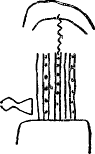

Plate XIV.d. Mnemonic Song.
Me-we´-yan, ha´, ha´, ha´, I go into the Jĕs´sakkan´ to see the medicine. The circle represents the Jĕs´sakkīd´ as viewed from above; the short lines denote the magic character of the structure, and the central ring, or spot, the magic stone used by the prophet who appears entering from the side.

Tschi-nun´-dōn´, he´, he´, he´, he´, I was the one who dug up life. The Otter Man´idō emerging from the Midē´wigân; he received it from Ki´tshi Mani´dō.

Ni´ka-nī´ we-do-kon´-a, ha´, ha´, The spirit put down medicine on earth to grow. The sacred or magic lines descending to the earth denote supernatural origin of the mī´gis, which is shown by the four small rings. The short lines at the bottom represent the ascending sprouts of magic plants.

Te-ti-ba´-tshi mŭt´-â-wit´, tē´, hē´, hē´, I am the one that dug up the medicine. The otter shown emerging from the jugglery. The speaker represents himself “like unto the Otter Man´idō.”

Ki´wan-win´-da ma´-kwa-nan´, na´, ha´, I answer my brother spirit. The Otter Man´idō responds to the invocation of the speaker. The diagonal line across the body signifies the “spirit character” of the animal.

Rest or pause.
Wa´-a-so´-at wĕn´-ti´-na-man, ha´, ha, The spirit has put life into my body. The speaker is represented as being in the Midē´-wigân, where Ki´tshi Man´idō placed magic power into his body; the arms denote this act of putting into his sides the mī´gis. The line crossing the body denotes the person to be possessed of supernatural power.
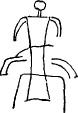
Ki-to´-na-bi´-in, nē´, hē´, hē´, This is what the medicine has given us. The Midē´wigân, showing on the upper line the guardian man´idōs.
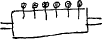
Ni´-sha-we´-ni-bĭ-ku´, hū´, hū´, hē´, I took with two hands what was thrown down to us. The speaker grasped life, i.e., the migīs´, to secure the mysterious power which he professes.

In addition to the practice of medical magic, the Jĕs´sakkīd´ sometimes resorts to a curious process to extract from the patient’s body the malevolent beings or man´idōs which cause disease. The method of procedure is as follows: The Jĕs´sakkīd´ is provided with four or more tubular bones, consisting of the leg bones of large birds, each of the thickness of a finger and 4 or 5 inches in length. After the priest has fasted and chanted prayers for success, he gets down upon all fours close to the patient and with his mouth near the affected part. After using the rattle and singing most vociferously to cause the evil man´idō to take shelter at some particular spot, so that it may be detected and located by him, he suddenly touches that place with the end of one of the bones and immediately thereafter putting the other end into his mouth, as if it were a cigar, strikes it with the flat hand and sends it apparently down his throat. Then the second bone is treated in the same manner, as also the third and fourth, the last one being permitted to protrude from the mouth, when the end is put against the affected part and sucking is indulged in amid the most violent writhings and contortions in his endeavors to extract the man´idō. As this object is supposed to have been reached and swallowed by the Jĕs´sakkīd´ he crawls away to a short distance from the patient and relieves himself of the demon with violent Pl. XVIII.
The above manner of disposing of the hollow bones is a clever trick and not readily detected, and it is only by such acts of jugglery and other delusions that he maintains his influence and importance among the credulous.

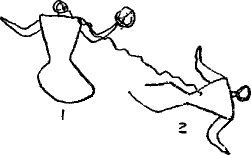
Fig. 31.—Jĕs´sakkīd´ curing woman. Fig. 32.—Jĕs´sakkīd´ curing man.
Fig. 31 represents a Jĕs´sakkīd´ curing a sick woman by sucking the demon through a bone tube. The pictograph was drawn upon a piece of birch bark which was carried in the owner’s Midē´ sack, and was intended to record an event of importance.
No. 1 represents the actor, holding a rattle in hand. Around his head is an additional circle, denoting quantity (literally, more than an ordinary amount of knowledge), the short line projecting to the right indicating the tube used.
No. 2 is the woman operated upon.
Fig. 32 represents an exhibition by a Jĕs´sakkīd´, a resident of White Earth, Minnesota. The priest is shown in No. 1 holding his rattle, the line extending from his eye to the patient’s abdomen signifying that he has located the demon and is about to begin his exorcism. No. 2 is the patient lying before the operator.
FOURTH DEGREE.
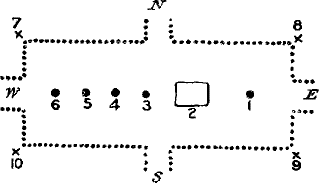
Fig. 33.—Diagram of Midē´wigân of the fourth degree.
The Midē´wigân, in which this degree is conferred, differs from the preceding structures by having open doorways in both the northern and southern walls, about midway between the eastern and western extremities and opposite to one another. Fig. 33 represents a ground plan, in which may also be observed the location of each of the four Midē´ posts. Fig. 34 shows general view of same structure. A short distance from the eastern entrance is deposited the sacred stone, beyond which is an area reserved for the presents to be deposited by an applicant for initiation. The remaining two-thirds of the space toward the western door is occupied at regular intervals by four posts, the first being painted red with a band of green around the top. (Pl. XV, No. 1.) The second post is red, and has scattered over its surface spots of white clay to symbolize Pl. XV, No. 2.) The third post is black; but instead of being round is cut square. (Pl. XV, No. 3.) The fourth post, that nearest the western extremity, is in the shape of a cross, painted white, with red spots, excepting the lower half of the trunk, which is squared, the colors upon the four sides being white on the east, green on the south, red on the west, and black on the north. (Pl. XV, No. 4.)
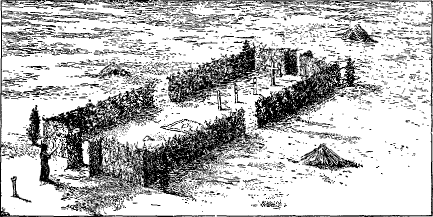
Fig. 34.—General view of Midē´wigân.
About 10 paces east of the main entrance, in a direct line between it and the sweat lodge, is planted a piece of thin board 3 feet high and 6 inches broad, the top of which is cut so as to present a three-lobed apex, as shown in Fig. 4. The eastern side of this board is painted green; that facing the Midē´wigân red. Near the top is a small opening, through which the Midē´ are enabled to peep into the interior of the sacred structure to observe the angry man´idōs occupying the structure and opposing the intrusion of anyone not of the fourth degree.
A cedar tree is planted at each of the outer corners of the Midē´wigân, and about 6 paces away from the northern, western, and southern entrances a small brush structure is erected, sufficiently large to admit the body. These structures are termed bears’ nests, supposed to be points where the Bear Man´idō rested during the struggle he passed through while fighting with the malevolent man´idōs within to gain entrance and receive the fourth-degree initiation. Immediately within and to either side of the east and west entrances is planted a short post, 5 feet high and 8 inches thick, painted red upon the side facing the interior and black upon the reverse, at the base of each being laid a stone about as large as a human head. These four posts represent the four limbs and feet of the Bear Man´idō, who made the four entrances and forcibly entered and expelled the evil beings who had opposed him. The fourth-degree Midē´ post—
PREPARATION OF CANDIDATE.
Under ordinary circumstances it requires at least one year before a Midē´ of the third grade is considered eligible for promotion, and it is seldom that a candidate can procure the necessary presents within that period, so that frequently a number of years elapse before any intimation by a candidate is made to the chief priest that the necessary requirements can be complied with. The chief reason of this delay is attributed to the fact that the fee to the officiating priests alone must equal in value and quantity four times the amount paid at the first initiation, and as the success in gathering the robes, skins, blankets, etc., depends upon the candidate’s own exertions it will readily appear why so few ever attain the distinction sought. Should one be so fortunate, however, as to possess the required articles, he has only to make known the fact to the chief and assistant Midē´ priests, when a meeting is held at the wig´iwam of one of the members and the merits of the candidate discussed. For this purpose tobacco is furnished by the candidate. The more valuable and more numerous the presents the more rapidly will his application be disposed of, and the more certainly will favorable consideration on it be had. It becomes necessary, as in former instances of preparation, for the candidate to procure the service of a renowned Midē´, in order to acquire new or specially celebrated remedies or charms. The candidate may also give evidence of his own proficiency in magic without revealing the secrets of his success or the course pursued to attain it. The greater the mystery the higher he is held in esteem even by his jealous confrères.
There is not much to be gained by preparatory instruction for the fourth degree, the chief claims being a renewal of the ceremony of “shooting the mī´gis” into the body of the candidate, and enacting or dramatizing the traditional efforts of the Bear Man´idō in his endeavor to receive from the Otter the secrets of this grade. One who succeeds becomes correspondingly powerful in his profession and therefore more feared by the credulous. His sources of income are accordingly increased by the greater number of Indians who require his assistance. Hunters, warriors, and lovers have occasion to call upon him, and sometimes antidoting charms are sought, when the evil effects of an enemy’s work are to be counteracted.
The instructor receives the visit of the candidate, and upon coming to a satisfactory agreement concerning the fee to be paid for the service he prepares his pupil by prompting him as to the part he is to enact during the initiation and the reasons therefor. The preparation and the merits of magic compounds are discussed, and 130 as follows:
There is a particular kind of charm which they use when they wish to obtain the object of their affections. It is made of roots and red ocher. With this they paint their faces, believing it to possess a power so irresistible as to cause the object of their desire to love them. But the moment this medicine is taken away and the charm withdrawn the person who before was almost frantic with love hates with a perfect hatred.
It is necessary that the candidate take a sweat-bath once each day, for four successive days, at some time during the autumn months of the year preceding the year in which the initiation is to occur. This form of preparation is deemed agreeable to Ki´tshi Man´idō, whose favor is constantly invoked that the candidate may be favored with the powers supposed to be conferred in the last degree. As spring approaches the candidate makes occasional presents of tobacco to the chief priest and his assistants, and when the period of the annual ceremony approaches, they send out runners to members to solicit their presence, and, if of the fourth degree, their assistance.
INITIATION OF CANDIDATE.
The candidate removes to the vicinity of the Midē´wigân so as to be able to go through the ceremony of purgation four times before the day of initiation. The sudatory having been constructed on the usual site, east of the large structure, he enters it on the morning of the fifth day preceding the initiation and after taking a sweat-bath he is joined by the preceptor, when both proceed to the four entrances of the Midē´wigân and deposit at each a small offering of tobacco. This procedure is followed on the second and third days, also, but upon the fourth the presents are also carried along and deposited at the entrances, where they are received by assistants and suspended from the rafters of the interior. On the evening of the last day, the chief and officiating priests visit the candidate and his preceptor, Pl. XVI, A) is a reproduction of the chant taught to and recited by the candidate. The original was obtained from an old mnemonic chart in use at Mille Lacs, Minnesota, in the year 1825, which in turn had been copied from a record in the possession of a Midē´ priest at La Pointe, Wisconsin. Many of the words are of an older form than those in use at the present day. Each line may be repeated ad libitum.
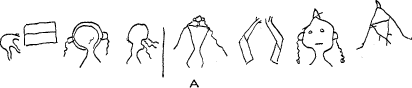
Plate XVI.a. Mnemonic Song.
Ni-ka´-ni-na´, ni-ka´-ni-na´, ni-ka´-ni-na´, I am the Nika´ni, I am the Nika´ni, I am the Nika´ni, man´-i-dō wig´-i-wam win´-di-ge´-un. I am going into the sacred lodge. [The speaker compares himself to the Bear Man´ido, and as such is represented at the entrance of the Midē´wigân.]

Ni-ka´-ni-na´, ni-ka´-ni-na´, ni-ka´-ni-na´, I am the Nika´ni, I am the Nika´ni, I am the Nika´ni, ni-kan´-gi-nun´-da wé-mĭ-dŭk´. I “suppose” you hear me. [The lines from the ear denotes hearing; the words are addressed to his auditors.]

Wâ´, he-wa´-ke-wa ke-wâ´, he-wa´-ke-wâ´, wâ´. He said, he said. Signifies that Ki´tshi Man´idō, who is seen with the voice lines issuing from the mouth, and who promised the Ani´shinâ´bēg “life,” that they might always live.

Rest. A ceremonial smoke is now indulged in.
We´-shki-nun´-do-ni-ne´, ke-nosh´-ki-nun´-do-ni-ne´. This is the first time you hear it. [The lines of hearing are again shown; the words refer to the first time this is chanted as it is an intimation that the singer is to be advanced to the higher grade of the Midē´wiwin.]

Hwe´-na-ni-ka he-na´, he-nō´ mi-tē´-win-win´ gi´-ga-wa´-pi-no-dōn´. You laugh, you laugh at the “grand medicine.” [The arms are directed towards Ki´tshi Man´idō, the creator of the sacred rite; the words refer to those who are ignorant of the Midē´wiwin and its teachings.]

Nun-te´-ma-ne´, hē´, wi´-na-nun´-te-ma-ne´ ki´-pi-nan´. I hear, but they hear it not. [The speaker intimates that he realizes the importance of the Midē´ rite, but the uninitiated do not.]

Pe´-ne-sŭi´-a ke´-ke-kwi´-yan. I am sitting like a sparrow-hawk. The singer is sitting upright, and is watchful, like a hawk watching for its prey. He is ready to observe, and to acquire, everything that may transpire in the Midē´ structure.

Upon the conclusion of the chant, the assembled Midē´ smoke and review the manner of procedure for the morrow’s ceremony, and when these details have been settled they disperse, to return to their wig´iwams, or to visit Midē´ who may have come from distant settlements.
Early on the day of his initiation the candidate returns to the sudatory to await the coming of his preceptor. The gifts of tobacco are divided into parcels which may thus be easily distributed at the proper time, and as soon as the officiating priests have arrived, and seated themselves, the candidate produces some tobacco of which all present take a pipeful, when a ceremonial smoke-offering is made to Ki´tshi Man´idō. The candidate then takes his midē´ drum and sings a song of his own composition, or one which he may have purchased from his preceptor, or some Midē´ priest. The following is a reproduction of an old mnemonic song which the owner, Sikas´sigĕ, had received from his father who in turn had obtained it at La Pointe, Wisconsin, about the year 1800. The words are archaic to a great extent, and they furthermore differ from the modern language on account of the manner in which they are pronounced in chanting, which peculiarity has been faithfully followed below. The pictographic characters are reproduced in Pl. XVI, B. As usual, the several lines are sung ad libitum, repetition depending entirely upon the feelings of the singer.
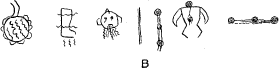
Plate XVI.b. Mnemonic Song.
Hin´-to-nâ-ga-ne´ o-sa-ga-tshī´-wēd o-do´-zhi-tōn´. The sun is coming up, that makes my dish. The dish signifies the feast to be made by the singer. The zigzag lines across the dish denote the sacred character of the feast. The upper lines are the arm holding the vessel.

Man´-i-dō i´-ya-nē´, ish´-ko-te´-wi-wa´-we-yan´. My spirit is on fire. The horizontal lines across the leg signify magic power of traversing space. The short lines below the foot denote flames, i.e., magic influence obtained by swiftness of communication with the man´idōs.

Ko´tshi-hâ-ya-nē´, nē´, ish´-ki-to´-ya-ni´, nin-do´-we-hē´, wi´-a-we-yan´. I want to try you, I am of fire. [The zigzag lines diverging from the mouth signify voice, singing; the apex upon the head superior knowledge, by means of which the singer wishes to try his Midē´ sack upon his hearer, to give evidence of the power of his influence.]

A pause. Ceremonial smoking is indulged in, after which the chant is continued.
Ni-mī´-ga-sim´-ma man´-i-dō, sa-ko´-tshi-na´. My mī´gis spirit, that is why I am stronger than you. The three spots denote the three times the singer has received the mī´gis by being shot; it is because this spirit is within him that he is more powerful than those upon the outside of the wigiwam who hear him.

Mī´-ga-ye´-nin en´-dy-ân, ya´, hō´, ya´, man´-i-dō´-ya. That is the way I feel, spirit. The speaker is filled with joy at his power, the mī´gis within him, shown by the spot upon the body, making him confident.

Ya-gō´-sha-hī´, nâ´, ha´, ha´, Ya-gō´-sha-hi´, man´-i-dō-wī´-yĭn. I am stronger than you, spirit that you are. [He feels more powerful, from having received three times the mī´gis, than the evil spirit who antagonizes his progress in advancement.]

Upon the completion of this preliminary by the candidate, the priests emerge from the wig´iwam and fall in line according to their official status, when the candidate and preceptor gather up the parcels of tobacco and place themselves at the head of the column and start toward the eastern entrance of the Midē´wigân. As they approach the lone post, or board, the candidate halts, when the priests continue to chant and drum upon the Midē´ drum. The chief Midē´ then advances to the board and peeps through the orifice near the top to view malevolent man´idōs occupying the interior, who are antagonistic to the entrance of a stranger. This spot is assumed to represent the resting place or “nest,” from which the Bear Man´idō viewed the evil spirits during the time of his initiation by the Otter. The evil spirits within are crouching upon the floor, one behind the other and facing the east, the first being Mi-shi´-bi-shi´—the panther; the second, Me-shi´-kĕ—the turtle; the third, kwin´-go-â´-gĭ—the big wolverine; the fourth, wâ´-gŭsh—the fox; the fifth, ma-in´-gŭn—the wolf; and the sixth, ma-kwa´—the bear. They are the ones who endeavor to counteract or destroy the good wrought by the rites of the Midē´wiwin, and only by the aid of the good man´idōs can they be driven from the Midē´wigân so as to permit a candidate to enter and receive the benefits of the degree. The second Midē´ then views the group of malevolent beings, after which the third, and lastly the fourth priest looks through the orifice. They then advise
It is asserted that all of the malevolent man´idōs who occupied and surrounded the preceding degree structures have now assembled about this fourth degree of the Midē´wigân to make a final effort against the admission and advancement of the candidate: therefore he impersonates the good Bear Man´idō, and is obliged to follow a similar course in approaching from his present position the entrance of the structure. Upon hands and knees he slowly crawls toward the main entrance, when a wailing voice is heard in the east which sounds like the word hān´, prolonged in a monotone. This is ge´-gi-si´-bi-ga´-ne-dât man´idō. His bones are heard rattling as he approaches; he wields his bow and arrow; his long hair streaming in the air, and his body, covered with mī´gis shells from the salt sea, from which he has emerged to aid in the expulsion of the opposing spirits. This being the information given to the candidate he assumes and personates the character of the man´idō referred to, and being given a bow and four arrows, and under the guidance of his preceptor, he proceeds toward the main entrance of the structure while the officiating priests enter and station themselves within the door facing the west. The preceptor carries the remaining parcels of tobacco, and when the candidate arrives near the door he makes four movements with his bow and arrow toward the interior, as if shooting, the last time sending an arrow within, upon which the grinning spirits are forced to retreat toward the other end of the inclosure. The candidate then rushes in at the main entrance, and upon emerging at the south suddenly turns and again employs his bow and arrow four times toward the crowd of evil man´idōs, who have rushed toward him during the interval that he was within. At the last gesture of shooting into the inclosure, he sends forward an arrow, deposits a parcel of tobacco and crouches to rest at the so-called “bear’s nest.” During this period of repose the Midē´ priests continue to drum and sing. Then the candidate approaches the southern door again, on all fours, and the moment he arrives there he rises and is hurried through the inclosure to emerge at the west, where he turns suddenly, and imitating the manner of shooting arrows into the group of angry man´idōs within, he at the fourth movement lets fly an arrow and gets down into the western “bear’s nest.” After a short interval he again approaches the door, crawling forward on his hands and knees until he reaches the entrance, where he leaves a present of tobacco and is hastened through the inclosure to emerge at the northern door, where he again turns suddenly upon the angry spirits, and after making threatening movements toward them, at the fourth menace he sends an arrow among them. The spirits are now greatly annoyed by the magic power possessed by the candidate and the assistance rendered by the Midē´
The chief Midē´ priest then takes charge of the candidate, saying:
Mi´-a-shi´-gwa wi-ka´-we-a´-kwa-mŭs-sin´-nŭk. Mī´-a-shi´-gwa
Now is the time [to take] the path that has no end Now is the time
wi-kan´-do-we-ân´ mi´-ga-ī´-zhid wen´- dzhi-bi-mâ´-dis.
I shall inform you [of] that which I was told the reason I live.
To this the second Midē´ priest remarks to the candidate, Wa´-shi-gân´-do-we-an´ mi-gai´-i-nŏk´ wa´-ka-no´-shi-dzin—which freely translated signifies: “The reason I now advise you is that you may heed him when he speaks to you.” The candidate is then led around the interior of the inclosure, the assistant Midē´ fall in line of march and are followed by all the others present, excepting the musicians. During the circuit, which is performed slowly, the chief Midē´ drums upon the Midē´ drum and chants. The following, reproduced from the original, on Pl. XVII, B, consists of a number of archaic words, some of which are furthermore different from the spoken language on account of their being chanted, and meaningless syllables introduced to prolong certain accentuated notes. Each line and stanza may be repeated ad libitum.
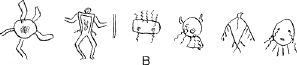
Plate XVII.b. Mnemonic Song.
Man´-i-dō, hē´, nē´-yē´, man´-i-dō, hē´, nē´, yē´, ēn´-da-na´-bi-yĕn wen´-dō-bi´-yĕn. A spirit, a spirit, you who sit there, who sit there. [The singer makes a spirit of the candidate by thus giving him new life, by again shooting into his body the sacred mīgis. The disk is the dish for feast of spirits in the dzhibai´ midē´wigân—“Ghost Lodge,” the arms reaching towards it denoting the spirits who take food therefrom. The signification is that the candidate will be enabled to invoke and commune with the spirits of departed Midē´, and to learn of hidden powers.]

He´-ha-wa´-ni, yē´, he´-ha-wa´-ni, yē´, na´-bi-nesh´-ga-na´-bi, hī´, hē´. These words were chanted, while the following are those as spoken, apart from the music. Â-wan´-ō-de´-no-wĭn nī´-bi-dĕsh´-ka-wĭn un´-de-no´-wĭn. The fog wind goes from place to place whence the wind blows. [The reason of the representation of a human form was not satisfactorily explained. The preceptor felt confident, however, that it signified a man´īdō who controls the fog, one different from one of the a-na´-mi-ki´, or Thunderers, who would be shown by the figure of an eagle, or a hawk, when it would also denote the thunder, and perhaps lightning, neither of which occurs in connection with the fog.]

Rest.
Man´-i-dō´-we ni´-mi-nan´ ku-ni´-ne man-to´-ke ni´-mi-ne´. I who acknowledge you to be a spirit, and am dying. The figure is an outline of the Midē´wigân with the sacred Midē´ stone indicated within, as also another spot to signify the place occupied by a sick person. The waving lines above and beneath the oblong square are magic lines, and indicate magic or supernatural power. The singer compares the candidate to a sick man who is seeking life by having shot into his body the mī´gis.

Ga-kwe´-in-nân´ tshi-ha´-gĕ-nâ´ ma-kwa´ ni-go´-tshi-ni´. I am trying you who are the bear. The Midē´ who is chanting is shown in the figure; his eyes are looking into the candidate’s heart. The lines from the mouth are also shown as denoting speech, directed to his hearer. The horns are a representation of the manner of indicating superior powers.

Pĭ-nē´-si ka´-ka-gī´-wai-yan´ wen´-dzhi man´-i-dō´wid. The bird, the crow bird’s skin is the reason why I am a spirit. Although the crow is mentioned, the Thunder-bird (eagle) is delineated. The signification of the phrase is, that the speaker is equal in power to a man´idō, at the time of using the Midē´ sack—which is of such a skin.

Tshin-gwe´-wi-he´-na nē´, kan´, tshi-wâ´-ba-ku-nēt´. The sound of the Thunder is the white bear of fire. The head is, in this instance, symbolical of the white bear man´idō; the short lines below it denoting flame radiating from the body, the eyes also looking with penetrating gaze, as indicated by the double waving lines from each eye. The white bear man´idō is one of the most powerful man´idōs, and is so recognized.

By the time this chant is completed the head of the procession reaches the point of departure, just within the eastern door, and all of the members return to their seats, only the four officiating Midē´ remaining with the candidate and his preceptor. To search further
The Midē´ priest of the fourth rank or place in order of precedence approaches the kneeling candidate and in a manner similar to that which has already been described shoots into his breast the mī´gis; the third, second and first Midē´ follow in like manner, the last named alone shooting his mī´gis into the candidate’s forehead, upon which he falls forward, spits out a mī´gis shell which he had previously secreted in his mouth, and upon the priests rubbing upon his back and limbs their Midē´ sacks he recovers and resumes his sitting posture.
The officiating priests retire to either side of the inclosure to find seats, when the newly received member arises and with the assistance of the preceptor distributes the remaining parcels of tobacco, and lastly the blankets, robes, and other gifts. He then begins at the southeastern angle of the inclosure to return thanks for admission, places both hands upon the first person, and as he moves them downward over his hair says: Mi-gwĕtsh´ ga-o´-shi-tō´-ĭn bi-mâ´-dĭ-sĭ-win—“Thanks, for giving to me life.” The Midē´ addressed bows his head and responds, hau´, ēn´,—yes when the newly admitted member steps back one pace, clasps his hands and inclines his head to the front. This movement is continued until all present have been thanked, after which he takes a seat in the southeastern corner of the inclosure.
A curious ceremony then takes place in which all the Midē´ on one side of the inclosure arise and approach those upon the other, each grasping his Midē´ sack and selecting a victim pretends to shoot into his body the mī´gis, whereupon the Midē´ so shot falls over, and after a brief attack of gagging and retching pretends to gain relief by spitting out of his mouth a mī´gis shell. This is held upon the left palm, and as the opposing party retreat to their seats, the side which has just been subjected to the attack moves rapidly around among one another as if dancing, but simply giving rapid utterance to the word hŏ´, hŏ´, hŏ´, hŏ´, hŏ´, hŏ´, and showing the mī´gis to everybody present, after which they place the flat hands quickly to the mouth and pretend again to swallow their respective shells. The members of this party then similarly attack their opponents, who Pl. XVII, A, and the musical notation, which is also presented, was obtained during the period of my preliminary instruction. The phraseology of the chant, of which each line and verse is repeated ad libitum as the singer may be inspired, is as follows:
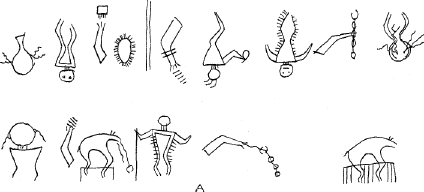
Plate XVII.a. Mnemonic Song.
Do-nâ´-ga-nī´, Na´-wa-kwe´ in-do´-shi-tōn´, do-nâ´-ga-nī´. My dish, At noon I make it, my dish. The singer refers to the feast which he gives to the Midē´ for admitting him into the Midē´wiwin.

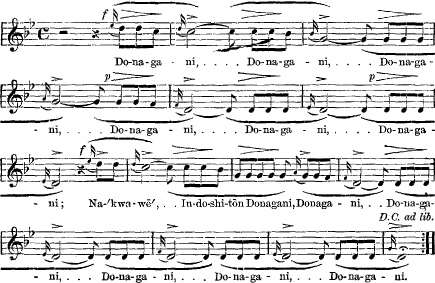
Do-na-ga-ni, Do-na-ga-ni, Do-na-ga-ni, Do-na-ga-ni,
Do-na-ga-ni, Do-na-ga-ni; Na-´kwa-wē´, In-do-shi-tōn Donagani,
Donaga-ni, Do-na-ga-ni, Do-na-ga-ni, Do-na-ga-ni, Do-na-ga-ni.
MIDI files: drum, flute, piano
Man´-ī-dō´ i-yan-nī´, Esh-ko´-te nin´-do-we´-yo-wĭn´, I am such a spirit, My body is made of fire. His power reaches to the sky, i.e., he has power to invoke the aid of Ki´tshi Man´idō. The four degrees which he has received are indicated by the four short lines at the tip of the hand.

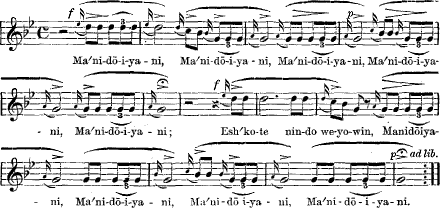
Ma´ni-dō-i-ya-ni, Ma´ni-dō-i-ya-ni, Ma´ni-dō-i-ya-ni,
Ma´ni-dō-i-ya-ni, Ma´ni-dō-i-ya-ni;
Esh´ko-te nin-do we-yo-win, Manidōiya-ni, Ma´ni-dō-i-ya-ni,
Ma´ni-dō-i-ya-ni, Ma´ni-dō-i-ya-ni.
MIDI files: drum, flute, piano
Kŏ´-tshi-hai´-o-nī´, Esh-ko´-te wa-ni´-yō. I have tried it, My body is of fire. He likens himself to the Bear Man´idō, and has like power by virtue of his mī´gis, which is shown below the lines running downward from the mouth. He is represented as standing in the Midē´wigân—where his feet rest.

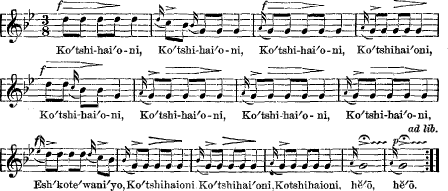
Ko´tshi-hai´o-ni, Ko´tshi-hai´o-ni, Ko´tshi-hai´o-ni,
Ko´tshihai´oni, Ko´tshi-hai´o-ni, Ko´tshi-hai´o-ni,
Ko´tshi-hai´o-ni, Ko´tshi-hai´o-ni, Esh´kote´wani´yo, Ko´tshihaioni.
Ko´tshihai´oni, Kotshihaioni, hĕ´ō, hĕ´ō.
MIDI files: drum, flute, piano
Pause. An offering of smoke is made to Ki´tshi Man´idō.
Ni-mī´-gi-sĭm´ man´-i-dō´-we, hwē´, hē´, Sha´-go-dzhĭ´-hi-na´. My mī´gis spirit, I overpower death with. [His body is covered with mī´gis as shown by the short lines radiating from the sides, and by this power he is enabled to overcome death.]
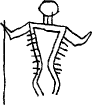
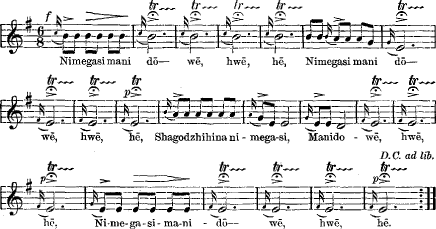
Nimegasi mani dō-wē, hwē, hē, Nimegasi mani dō-wē, hwē, hē,
Shagodzhihinani-mega-si, Manido-wē, hwē, hē.
Ni-me-ga-si-ma-ni-dō-wē, hwē, hē.
MIDI files: drum, flute, piano
Ni´-ka-ni´ nin-man´-e-dō´-we-ya´. Ya´-ho-ya´ man´-i-dō´-wa nin-da´-ho-ha´. That is the way with me, spirit that I am. [The hand shows how he casts the mī´gis forward into the person requiring life. He has fourfold power, i.e., he has received the mī´gis four times himself and is thus enabled to infuse into the person requiring it.]

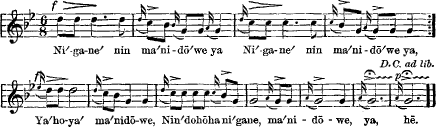
Ni´-ga-ne´ nin ma´ni-dō´we ya
Ni´-ga-ne´ nin ma´ni-dō´we ya,
Ya´ho-ya´ ma´nidō-we,
Nin´dohōha ni´gane, ma´ni-dō-we, ya, hē.
MIDI files: drum, flute, piano
Ē-kotsh´-i-na´-ha, Ē-kotsh´-ha man´-i-dō´ hwe-do´-wī. I hang it, I hang up the Spirit sack. [After using his Midē´ sack he hangs it against the wall of the Midē´wigân, as is usually done during the ceremonial of initiation.]

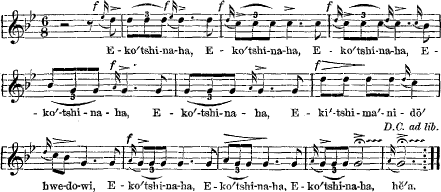
E-ko´tshi-na-ha, E-ko´tshi-na-ha, E-ko´tshi-na-ha,
E-ko´-tshi-na-ha, E-ko´-tshi-na-ha,
E-ki´-tshi-ma´-ni-dō´ hwe-do-wi, E-ko´tshi-na-ha,
E-ko´tshi-na-ha, E-ko´tshi-na-ha, hĕ´a.
MIDI files: drum, flute, piano
He´-a-wi-non´-dam-a´-ni, Man´-i-dō´ mi-de´-wi-he´ ne´-ma-da´-wi-dzig´. Let them hear, Midē´ spirit, those who are sitting around. [He invokes Ki´tshi Man´idō to make his auditors understand his power.]

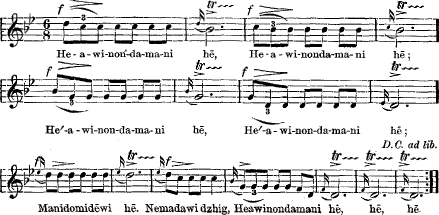
He-a-wi-non´-da-ma-ni hē, He-a-wi-nonda-ma-ni hē;
He´-a-wi-non-da-ma-ni hē, He´-a-wi-non-da-ma-ni hē;
Manidomidēwi hē, Nemadawi dzhig, Heawinondamani hē, hē, hē.
MIDI files: drum, flute, piano
He´-a-we-na´ ni´-we-dō´, Man´-i-dō´ we-a-nī´ Ni´-ka-nā´ ni´-na-nā´. He who is sleeping, The Spirit, I bring him, a kinsman. [In the employment of his powers he resorts to the help of Ki´tshi Man´idō—his kinsman or Midē´ colleague.]

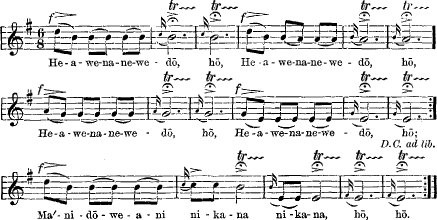
He-a-we-na-ne-we-dō, hō, He-a-we-na-ne-we-dō, hō,
He-a-we-na-ne-we-dō, hō, He-a-we-na-ne-we-dō, hō;
Ma´-ni-dō-we-a-ni ni-ka-na ni-ka-na, hō, hō.
MIDI files: drum, flute, piano
Man´-i-dō´ we-a-nī´ Esh-ke´-ta we´-a-nĭ´ man´-i-dō´ we´-a-nĭ´. I am a spirit, Fire is my spirit body. [The hand reaches to the earth to grasp fire, showing his ability to do so without injury and illustrating in this manner his supernatural power.]

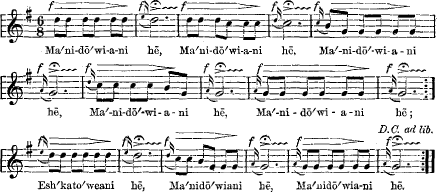
Ma´ni-dō´wi-a-ni hē, Ma´ni-dō´wi-a-ni hē, Ma´-ni-dō´-wi-a-ni hē,
Ma´-ni-dō´-wi-a-ni hē, Ma´-ni-dō´wi-a-ni hē;
Esh´kato´weani hē, Ma´nidō´wiani hē, Ma´nidō´wia-ni hē.
MIDI files: drum, flute, piano
Ai-ya´-swa-kĭt-te´, hē´, he´, He´-ā´ se-wī´-kit-te´, hē´, hē´ Na-se´-ma-gŏt´ nin-dē´. It is leaning, My heart breathes. [The phrase refers to the mī´gis within his heart. The short radiating lines indicate the magic power of the shell.]

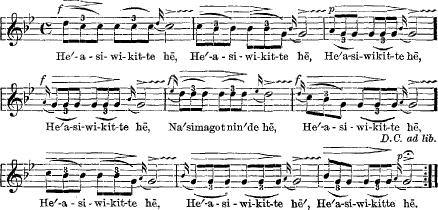
He´-a-si-wi-kit-te hē, He´-a-si-wi-kit-te hē, He´a-si-wikit-te hē,
He´a-si-wi-kit-te hē, Na´simagot nin´de hē, He´-a-si-wi-kit-te hē,
He´-a-si-wi-kit-te hē, He´-a-si-wi-kit-te hē´, He´a-si-wi-kitte hē.
MIDI files: drum, flute, piano
Rest, or pause, after which dancing accompanies the remainder of the song.
Ni-ka´-nin-ko´-tshi´-ha ni´-ka-na Ni-ka´-na-nin-ko´-tshi-ha. Midē´ friends, I am trying, Midē´ friends, Midē´ friends, I am trying. [His hand and arm crossed by lines to denote magic power, in reaching to grasp more than four degrees have given him; he has in view a fifth, or its equivalent.]

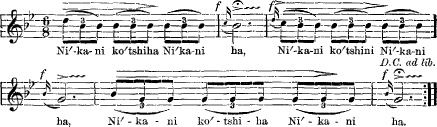
Ni´-ka-ni ko´tshiha Ni´ka-ni ha,
Ni´-ka-ni ko´tshini Ni´-ka-ni ha,
Ni´-ka-ni ko´-tshi-ha Ni´-ka-ni ha.
MIDI files: drum, flute, piano
Hi´-ne-na-wa´ ni-be´-i-dōn´ ni-di´-na. I hold that which I brought, and told him. The singer is holding the mī´gis and refers to his having its power, which he desires Ki´tshi Man´idō to augment.

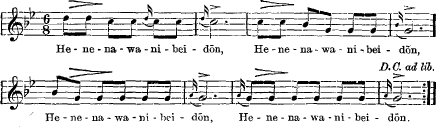
He-ne-na-wa-ni-bei-dōn, He-ne-na-wa-ni-bei-dōn,
He-ne-na-wa-ni-bei-dōn, He-ne-na-wa-ni-bei-dōn.
MIDI files: drum, flute, piano
Ye´-we-ni´-mi-dē´, hwa´, da´, Ke-wa´-shi-mi-dē´, hĭ-a, hwē´, Ye´-we-ni´-mi-dē? Who is this grand Midē´? You have not much grand medicine. Who is the Midē´? [The first line, when used with the music, is a´-we-nin-o´-au-midē´. The whole phrase refers to boasters, who have not received the proper initiations which they profess. The figure is covered with mī´gis shells, as shown by the short lines attached to the body.]

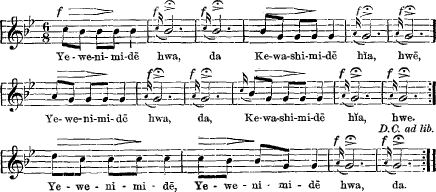
Ye-we-ni-mi-dē hwa, da. Ke-wa-shi-mi-dē hĭa, hwē,
Ye-we-ni-mi-dē hwa, da. Ke-wa-shi-mi-dē hĭa, hwe.
Ye-we-ni-mi-dē, Ye-we-ni-mi-dē hwa, da.
MIDI files: drum, flute, piano
Nai´-a-na-wi´ na-ma´, ha´, Wa-na´-he-ne-ni-wa´, ha´, O´-ta-be-we-ni´, mē´, hē´. I can not reach it, Only when I go round the Mide´wigân; I can not reach it from where I sit. [The mī´gis attached to the arrow signifies its swift and certain power and effect. The first line of the phrase, when spoken, is nin-na´-na-wi-nan´.]

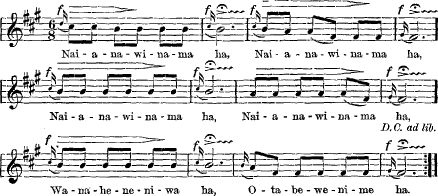
Nai-a-na-wi-na-ma ha, Nai-a-na-wi-na-ma ha,
Nai-a-na-wi-na-ma ha, Nai-a-na-wi-na-ma ha,
Wa-na-he-ne-ni-wa ha, O-ta-be-we-ni-me ha.
MIDI files: drum, flute, piano
Ai-yā´ ha´-na-wi´-na-ma´. I can not strike him. The speaker is weeping because he can not see immediate prospects for further advancement in the acquisition of power. The broken ring upon his breast is the place upon which he was shot with the mī´gis.

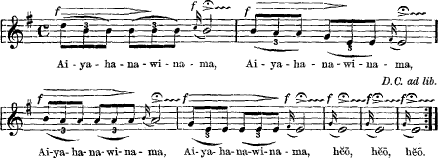
Ai-ya-ha-na-wi-na-ma, Ai-ya-ha-na-wi-na-ma,
Ai-ya-ha-na-wi-na-ma, Ai-ya-ha-na-wi-na—ma, hĕō, hĕō, hĕō.
MIDI files: drum, flute, piano
The following musical notation presents accurately the range of notes employed by the preceptor. The peculiarity of Midē´ songs lies in the fact that each person has his own individual series of notes which correspond to the number of syllables in the phrase and add thereto meaningless words to prolong the effect. When a song is taught, the words are the chief and most important part, the musical rendering of a second person may be so different from that of the person from whom he learns it as to be unrecognizable without
In some of the songs presented in this paper the bars have been omitted for the reasons presented above. The peculiarity of the songs as rendered by the preceptor is thus more plainly indicated.
When the chant is ended the ushers, who are appointed by the chief Midē´, leave the inclosure to bring in the vessels of food. This is furnished by the newly elected member and is prepared by his female relatives and friends. The kettles and dishes of food are borne around four times, so that each one present may have the opportunity of eating sufficiently. Smoking and conversation relating to the Midē´wiwin may then be continued until toward sunset, when, upon an intimation from the chief Midē´, the members quietly retire, leaving the structure by the western door. All personal property is removed, and upon the following day everybody departs.
DESCRIPTIVE NOTES.
The amount of influence wielded by Midē´ generally, and particularly such as have received four degrees, is beyond belief. The rite of the Midē´wiwin is deemed equivalent to a religion—as that term is commonly understood by intelligent people—and is believed to elevate such a Midē´ to the nearest possible approach to the reputed character of Mi´nabō´zho, and to place within his reach the supernatural power of invoking and communing with Ki´tshi Man´idō himself.
By reference to Pl. III, A, No. 98, it will be observed that the human figure is specially marked with very pronounced indications of mī´gis spots upon the head, the extremities, and more particularly the breast. These are placed where the mīgis was “shot” into the Midē´, and the functions of the several parts are therefore believed to be greatly augmented. All the spots are united by a line to denote unity and harmony of action in the exercise of power.
The mī´gis, typical of the fourth degree, consists of small pieces of deer horn, covered with red paint on one end and green upon the other. Sometimes but one color is employed for the entire object. The form is shown on Pl. XI, No. 6. No. 2, upon the same plate, represents a shell, used as a mī´gis, observed at White Earth.
Figs. 5-11, on Pl. XV, present several forms of painting midē´
The words of the Midē´ priest alluding to “the path that has no end” refer to the future course and conduct of the candidate for the last degree, as well as to the possibility of attaining unlimited powers in magic, and is pictorially designated upon the chart on Pl. III, A, at No. 99. The path is devious and beset with temptations, but by strict adherence to the principles of the Midē´wiwin the Midē´ may reach the goal and become the superior of his confrères, designated Mi-ni´-si-nō´-shkwe, “he who lives on the island.”
A Midē´-Wâbĕnō´ of this degree is dreaded on account of his extraordinary power of inflicting injury, causing misfortune, etc., and most remarkable tales are extant concerning his astounding performances with fire.
The following performance is said to have occurred at White Earth, Minnesota, in the presence of a large gathering of Indians and mixed bloods. Two small wig´iwams were erected, about 50 paces from each other, and after the Wâbĕnō´ had crawled into one of them his disparagers built around each of them a continuous heap of brush and firewood, which were then kindled. When the blaze was at its height all became hushed for a moment, and presently the Wâbĕnō´ called to the crowd that he had transferred himself to the other wig´iwam and immediately, to their profound astonishment, crawled forth unharmed.
This is but an example of the numerous and marvelous abilities with which the Wâbĕnō´ of the higher grade is accredited.
The special pretensions claimed by the Midē-Wâbĕnō´ have already been mentioned, but an account of the properties and manner of using the “love powder” may here be appropriate. This powder—the composition of which has been given—is generally used by the owner to accomplish results desired by the applicant. It is carried in a small bag made of buckskin or cloth, which the Wâbĕnō´ carefully deposits within his Midē´ sack, but which is transferred to another sack of like size and loaned to the applicant, for a valuable consideration.
One of the members of his church, a Norwegian, sixty-two years of age, and a widower, had for the last preceding year been considered by most of the residents as demented. The missionary himself had observed his erratic and frequently irrational conduct, and was impressed with the probable truth of the prevailing rumor. One morning, however, as the missionary was seated in his study, he was surprised to receive a very early call, and upon invitation his visitor took a seat and explained the object of his visit. He said that for the last year he had been so disturbed in his peace of mind that he now came to seek advice. He was fully aware of the common report respecting his conduct, but was utterly unable to control himself, and attributed the cause of his unfortunate condition to an occurrence of the year before. Upon waking one morning his thoughts were unwillingly concentrated upon an Indian woman with whom he had no personal acquaintance whatever, and, notwithstanding the absurdity of the impression, he was unable to cast it aside. After breakfast he was, by some inexplicable influence, compelled to call upon her, and to introduce himself, and although he expected to be able to avoid repeating the visit, he never had sufficient control over himself to resist lurking in the vicinity of her habitation.
Upon his return home after the first visit he discovered lying upon the floor under his bed, a Midē´ sack which contained some small parcels with which he was unfamiliar, but was afterward told that one of them consisted of “love powder.” He stated that he had grown children, and the idea of marrying again was out of the question, not only on their account but because he was now too old. The missionary reasoned with him and suggested a course of procedure, the result of which had not been learned when the incident was related.
Jugglery of another kind, to which allusion has before been made, is also attributed to the highest class of Jĕs´sakkīd´. Several years ago the following account was related to Col. Garrick Mallery, U.S. Army, and myself, and as Col. Mallery subsequently read a paper before the Anthropological Society of Washington, District of Columbia, in which the account was mentioned, I quote his words:
Paul Beaulieu, an Ojibwa of mixed blood, present interpreter at White Earth Agency, Minnesota, gave me his experience with a Jĕs´sakkīd´, at Leech Lake, Minnesota, about the year 1858. The reports of his wonderful performances had reached the agency, and as Beaulieu had no faith in jugglers, he offered to wager
A committee of twelve was selected to see that no communication was possible between the Jĕs´sakkīd´ and confederates. These were reliable people, one of them the Episcopal clergyman of the reservation. The spectators were several hundred in number, but they stood off, not being allowed to approach.
The Jĕs´sakkīd´ then removed his clothing, until nothing remained but the breech-cloth. Beaulieu took a rope (selected by himself for the purpose) and first tied and knotted one end about the juggler’s ankles; his knees were then securely tied together, next the wrists, after which the arms were passed over the knees and a billet of wood passed through under the knees, thus securing and keeping the arms down motionless. The rope was then passed around the neck, again and again, each time tied and knotted, so as to bring the face down upon the knees. A flat river-stone, of black color—which was the Jĕs´sakkīd´’s ma´nidō or amulet—was left lying upon his thighs.
The Jĕs´sakkīd´ was then carried to the lodge and placed inside upon a mat on the ground, and the flap covering was restored so as to completely hide him from view.
Immediately loud, thumping noises were heard, and the framework began to sway from side to side with great violence; whereupon the clergyman remarked that this was the work of the Evil One and ‘it was no place for him,’ so he left and did not see the end. After a few minutes of violent movements and swayings of the lodge accompanied by loud inarticulate noises, the motions gradually ceased when the voice of the juggler was heard, telling Beaulieu to go to the house of a friend, near by, and get the rope. Now, Beaulieu, suspecting some joke was to be played upon him, directed the committee to be very careful not to permit any one to approach while he went for the rope, which he found at the place indicated, still tied exactly as he had placed it about the neck and extremities of the Jĕs´sakkīd´. He immediately returned, laid it down before the spectators, and requested of the Jĕs´sakkīd´ to be allowed to look at him, which was granted, but with the understanding that Beaulieu was not to touch him.
When the covering was pulled aside, the Jĕs´sakkīd´ sat within the lodge, contentedly smoking his pipe, with no other object in sight than the black stone mánidō. Beaulieu paid his wager of $100.
An exhibition of similar pretended powers, also for a wager, was announced a short time after, at Yellow Medicine, Minnesota, to be given in the presence of a number of Army people, but at the threat of the Grand Medicine Man of the Leech Lake bands, who probably objected to interference with his lucrative monopoly, the event did not take place and bets were declared off.
Col. Mallery obtained further information, of a similar kind from various persons on the Bad River Reservation, and at Bayfield, Wisconsin. All of these he considered to be mere variants of a class of performances which were reported by the colonists of New England and the first French missionaries in Canada as early as 1613, where the general designation of “The Sorcerers” was applied to the whole body of Indians on the Ottawa River. These reports, it must be
In Pl. XVIII is shown a Jĕs´sakkīd´ extracting sickness by sucking through bone tubes.
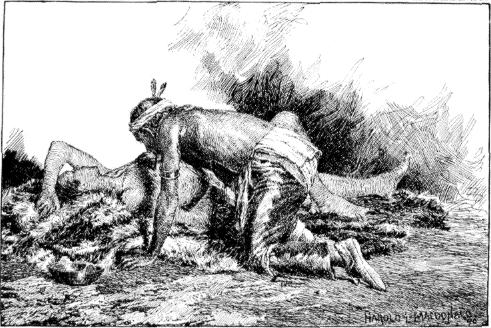
Plate XVIII. Jĕs´akkīd´ Removing Disease.
DZHIBAI´ MIDĒ´WIGÂN, OR “GHOST LODGE.”
A structure erected by Indians for any purpose whatever, is now generally designated a lodge, in which sense the term is applied in connection with the word dzhibai´—ghost, or more appropriately shadow—in the above caption. This lodge is constructed in a form similar to that of the Midē´wigân, but its greatest diameter extends north and south instead of east and west. Further reference will be made to this in describing another method of conferring the initiation of the first degree of the Midē´wiwin. This distinction is attained by first becoming a member of the so-called “Ghost Society,” in the manner and for the reason following:
After the birth of a male child it is customary to invite the friends of the family to a feast, designating at the same time a Midē´ to serve as godfather and to dedicate the child to some special pursuit in life. The Midē´ is governed in his decision by visions, and it thus sometimes happens that the child is dedicated to the “Grand Medicine,” i.e., he is to be prepared to enter the society of the Midē´. In such a case the parents prepare him by procuring a good preceptor, and gather together robes, blankets, and other gifts to be presented at initiation.
Should this son die before the age of puberty, before which period it is not customary to admit any one into the society, the father paints his own face as before described, viz, red, with a green stripe diagonally across the face from left to right, as in Pl. VI, No. 4, or red with two short horizontal parallel bars in green upon the forehead as in Pl. VI, No. 5, and announces to the chief Midē´ priest his intention of becoming himself a member of the “Ghost Society” and his readiness to receive the first degree of the Midē´wiwin, as a substitute for his deceased son. Other members of the mourner’s family blacken the face, as shown on Pl. VII, No. 5.
In due time a council of Midē´ priests is called, who visit the wig´iwam of the mourner, where they partake of a feast, and the subject of initiation is discussed. This wig´iwam is situated south and east 35, which illustration is a reproduction of a drawing made by Sikas´sigĕ.
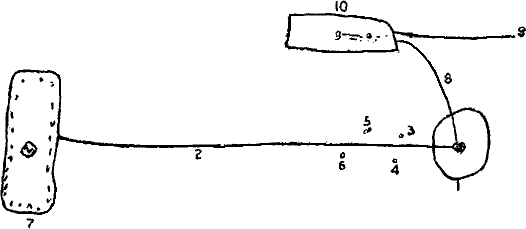
Fig. 35.—Indian diagram of ghost lodge.
The following is an explanation of the several characters:
No. 1 represents the wig´iwam of the mourner, which has been erected in the vicinity of the Midē´wigân, until after the ceremony of initiation.
No. 2 is the path supposed to be taken by the shadow (spirit) of the deceased; it leads westward to the Dzhibai´ Midē´wigân; literally, shadow-spirit wig´iwam.
No. 3, 4, 5, and 6, designate the places where the spirit plucks the fruits referred to—respectively the strawberry, the blueberry, the June cherries, and the plum.
No. 7 designates the form and location of the Dzhihai´ Midē´wigân. The central spot is the place of the dish of food for Dzhibai´ Man´idō—the good spirit—and the smaller spots around the interior of the inclosure are places for the deposit of dishes for the other Midē´ spirits who have left this earth.
No. 8 is the path which is taken by the candidate when going from his wig´iwam to the Midē´wigân.
No. 9 indicates the place of the sweat-lodge, resorted to at other periods of initiation.
No. 10 is the Midē´wigân in which the ceremony is conducted at the proper time.
It is stated that in former times the Ghost Lodge was erected west of the location of the mourner’s wig´iwam, but for a long time this practice has been discontinued. The tradition relating to the Spirit’s progress is communicated orally, while the dramatic representation is confined to placing the dishes of food in the Midē´wigân, which is selected as a fitting and appropriate substitute during the night preceding the initiation.
This custom, as it was practiced, consisted of carrying from the mourner’s wig´iwam to the Ghost Lodge the dishes of food for the spirits of departed Midē´ to enjoy a feast, during the time that the Midē´ priests were partaking of one. A large dish was placed in the center of the structure by the mourner, from which the supreme Midē´ spirit was to eat. Dishes are now carried to the Midē´wigân, as stated above.
The chief officiating Midē´ then instructs the father of the deceased boy the manner in which he is to dress and proceed, as symbolizing the course pursued by the spirit of the son on the way to the spirit
The person who desires to receive initiation into the Midē´wigân, under such circumstances, impersonates Minabō´zho, as he is believed to have penetrated the country of the abode of shadows, or ne´-ba-gī´-zis—“land of the sleeping sun.” He, it is said, did this to destroy the “Ghost Gambler” and to liberate the many victims who had fallen into his power. To be enabled to traverse this dark and dismal path, he borrowed of Kŏ-ko´-kŏ-ō´—the owl—his eyes, and received also the services of wâ´-wa-tē´-si-wŭg—the firefly, both of which were sent back to the earth upon the completion of his journey. By referring to Pl. III, A, the reference to this myth will be observed as pictorially represented in Nos. 110 to 114. No. 110 is the Midē´wigân from which the traveler has to visit the Dzhibai´ Midē´wigân (No. 112) in the west. No. 113, represented as Kŏ-ko´-kŏ-ō´—the owl—whose eyes enabled Mī´nabō´zho to follow the path of the dead (No. 114); the owl skin Midē´ sack is also sometimes used by Midē´ priests who have received their first degree in this wise. The V-shaped characters within the circle at No. 111 denote the presence of spirits at the Ghost Lodge, to which reference has been made.
The presents which had been gathered as a gift or fee for the deceased are now produced and placed in order for transportation to the Midē´wigân, early on the following morning.
The Midē´ priests then depart, but on the next morning several of them make their appearance to assist in clearing the Midē´wigân of the dishes which had been left there over night, and to carry thither the robes, blankets, and other presents, and suspend them from the rafters. Upon their return to the candidate’s wig´iwam, the Midē´ priests gather, and after the candidate starts to lead the procession
This is sung for the deceased, who is supposed to bequeath to his father his dish, or other articles the names of which are sometimes added.
The procession continues toward and into the Midē´wigân, passing around the interior by the left side toward the west, north, and east to a point opposite the space usually reserved for the deposit of goods, where the candidate turns to the right and stands in the middle of the inclosure, where he now faces the Midē´ post in the west. The members who had not joined the procession, but who had been awaiting its arrival, now resume their seats, and those who accompanied the candidate also locate themselves as they desire, when the officiating priests begin the ceremony as described in connection with the initiation for the first degree after the candidate has been turned over to the chief by the preceptor.
Sometimes the mother of one who had been so dedicated to the Midē´wiwin is taken into that society, particularly when the father is absent or dead.
INITIATION BY SUBSTITUTION.
It sometimes happens that a sick person can not be successfully treated by the Midē´, especially in the wig´iwam of the patient, when it becomes necessary for the latter to be carried to the Midē´wigân and the services of the society to be held. This course is particularly followed when the sick person or the family can furnish a fee equivalent to the gift required for initiation under ordinary circumstances.
It is believed, under such conditions, that the evil man´idōs can be expelled from the body only in the sacred structure, at which place alone the presence of Ki´tshi Man´idō may be felt, after invocation, and in return for his aid in prolonging the life of the patient the latter promises his future existence to be devoted to the practice and teachings of the Midē´wiwin. Before proceeding further, however, it is necessary to describe the method pursued by the Midē´ priest.
The first administrations may consist of mashki´kiwabūn´, or medicine broth, this being the prescription of the Midē´ in the capacity of mashki´kike´winĭ´nĭ, or herbalist, during which medication he resorts to incantation and exorcism, accompanying his song by liberal use of the rattle. As an illustration of the songs used at this period of the illness, the following is presented, the mnemonic characters being reproduced on Pl. XVI, C. The singing is monotonous and doleful, though at times it becomes animated and discordant.
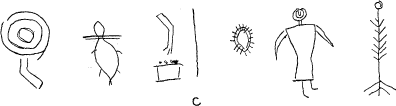
Plate XVI.c. Mnemonic Song.
In´-do-nâ-gât in-da´-kwo-nan That which I live upon has been put on this dish by the spirit. Ki´tshi Man´idō provides the speaker with the necessary food for the maintenance of life. The dish, or feast, is shown by the concentric rings, the spirit’s arm is just below it.

Mo´-ki-yan tshik´-ko-min´. I bring life to the people. The speaker, as the impersonator of the sacred Otter, brings life. The Otter is just emerging from the surface of the water, as he emerged from the great salt sea before the Âni´shi-nâ´beg, after having been instructed by Mi´nabō´zho to carry life to them.

Ni´-no-mūn´ mash-ki´-ki I can also take medicine from the lodge, or the earth The Midē´’s arm is reaching down to extract magic remedies from the earth. The four spots indicate the remedies, while the square figure denotes a hole in the ground.

Rest. During this interval the Midē´’s thoughts dwell upon the sacred character of the work in which he is engaged.
Ni´-nin-dē´ in´-dai-yo´. It is all in my heart, the life. The concentric circles indicates the mī´gis, life, within the heart, the former showing radiating lines to denote its magic power.

M´bi-mo´-se-an-kĭnk´. The spirit saw me and sent me medicine from above. The figure is that of Ki´tshi Man´idō, who granted power to the speaker.
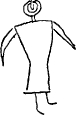
Dōn´-de-na mi-tĭz´-kŭnk. It is also on the trees, that from which I take life. The tree bears “medicine” which the speaker has at his command, and is enabled to use.

The accompanying lecture is then addressed to the sick person, viz:
Mi-shosh´-yâ-gwa´ ga´-a-nin-nan´ gi´-de-wēn´-du-nŭn ne´-tun-ga´-da-da-we´-in man´-i-dōmī´-gis. Kit´-ti-mâ´-gĭ-si ē´-ni-dau´-â-ya-we´-yĭn o-ma´-e-nâ´-sa-ba-bĭt bī-ĭ-sha´-gaban´-dĕ-a gi-bi´-sha-ban-da´-ĕt na-pĭsh-kâ-tshi-dŏsh ke´-a-yū´-ĭn-ki-go gŏt-tâ-sō-nĕn´, mi´-a-shi´-gwa-gō-dĭn´-na-wât dzhi-ma´-di-a-kad´-dŏ-yōn bi-mâ-di-si-wĭn´.
The following is a free translation of the above:
The time of which I spoke to you has now arrived, and you may deem it necessary to first borrow the sacred mī´gis. Who are you that comes here as a supplicant? Sit down opposite to me, where I can see you and speak to you, and fix your attention upon me, while you receive life you must not permit your thoughts to dwell upon your present condition, but to support yourself against falling into despondency.
Now we are ready to try him; now we are ready to initiate him.
The reference to borrowing a mī´gis signifies that the patient may have this mysterious power “shot into his body” where he lies upon the ground and before he has arrived at the place where candidates are properly initiated; this, because of his inability to walk round the inclosure.
The last sentence is spoken to the assisting Midē´. The following song is sung, the mnemonic characters pertaining thereto being reproduced on Pl. XVI, D.
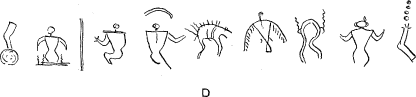
Plate XVI.d. Mnemonic Song.
O-da´-pi-nŭng´-mung oâ´-ki-wen´-dzhi man´-i-dō we´-an-ĭ-win´-zhi-gu-sân´. We are going to take the sacred medicine out of the ground. [The speaker refers to himself and the assistants as resorting to remedies adopted after consultation, the efficiency thereof depending upon their combined prayers. The arm is represented as reaching for a remedy which is surrounded by lines denoting soil.]

We-a´-ki man´-i-dō we-an-gwĭs´. The ground is why I am a spirit, my son. The lower horizontal line is the earth, while the magic power which he possesses is designated by short vertical wavy lines which reach his body.

Rest.
Nish´-u-we-ni-mi´-qu nish´-u-we-ni-mi´-qu we´-gi ma´-ŏ-dzhig´. The spirits have pity; the spirits have pity on me. The Midē´ is supplicating the Midē´ spirits for aid in his wishes to cure the sick.

Kish´-u-we-ni-mi´-qu ki´-shi´-gŭng don´-dzhi-wa´-wa-mĭk. The spirits have pity on me; from on high I see you. The sky is shown by the upper curved lines, beneath which the Midē´ is raising his arm in supplication.

Man´-i-dō´-â ni´-o. My body is a spirit. The Midē´ likens himself to the Bear Man´idō, the magic powers of which are shown by the lines across the body and short strokes upon the back.

Pi-ne´-si-wi-ân´ ke-ke´-u-wi-an´. A little bird I am: I am the hawk. Like the thunderer, he penetrates the sky in search of power and influence.

Man´-i-dō´ nu´-tu wa´-kan. Let us hear the spirit. The Ki´tshi Man´idō is believed to make known his presence, and all are enjoined to listen for such intimation.

Ka´-nun-ta´-wa man´-i-dō´ wi´-da-ku-ē´, hē´, ki´-a-ha-mī´. You might hear that he is a spirit. The line on the top of the head signifies the person to be a superior being.

Ka´-ke-na gus-sâ´ o´-mi-si´-nī´ na´-ēn. I am afraid of all, that is why I am in trouble. The Midē´ fears that life can not be prolonged because the evil man´idōs do not appear to leave the body of the sick person. The arm is shown reaching for mī´gis, or life, the strength of the speaker’s, having himself received it four times, does not appear to be of any avail.

Should the patient continue to show decided symptoms of increased illness, the singing or the use of the rattle is continued until life is extinct, and no other ceremony is attempted; but if he is no worse after the preliminary course of treatment, or shows any improvement, the first attendant Midē´ changes his songs to those of a more boastful character. The first of these is as follows, chanted repeatedly and in a monotonous manner, viz:
A´-si-na´-bi-hu´-ya, a-si´-na´-b-hu´-ya.
I have changed my looks, I have changed my looks.
[This refers to the appearance of the Midē´ stone which it is believed absorbs some of the disease and assumes a change of color.]
Nish´-a-we´nī´, hū´, gū´, mi-dē´, wug, a-ne´-ma-bī´-tshig.
The Midē´ have pity on me, those who are sitting around, and those who are sitting from us.
[The last line refers to those Midē´ who are sitting, though absent from the Midē´wigân.]
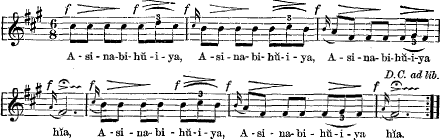
A-si-na-bi-hŭ-i-ya, A-si-na-bi-hŭ-i-ya, A-si-na-bi-hŭ-i-ya hĭa,
A-si-na-bi-hŭ-i-ya, A-si-na-bi-hŭ-i-ya hĭa.
MIDI files: drum, flute, piano
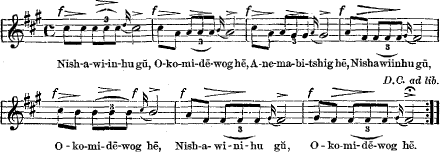
Nish-a-wi-in-hu gū, O-ko-mi-dē-wog hē, A-ne-ma-bi-tshig hē,
Nishawiinhu gū, O-ko-mi-dē-wog hē,
Nish-a-wi-ni-hu gŭ O-ko-mi-dē-wog hē.
MIDI files: drum, flute, piano
As the patient continues to improve the song of the Midē´ becomes more expressive of his confidence in his own abilities and importance.
The following is an example in illustration, viz:
Ni-ne´-ta-we-hē´ wa-wâ´-bâ-ma´ man´-i-dō, wa-wâ´-bâ-ma´.
[I am the only one who sees the spirit, who sees the spirit.]
Nin´-da-nī-wĭ-a, nin´-da-nī´-wĭ-a.
I surpass him, I surpass him.
[The speaker overcomes the malevolent man´idō and causes him to take flight.]
Na´-sa-ni-nēn´-di-yan a-we´-si-yŏk´ no-gwe´-no´-wŏk.
See how I act, beasts I shoot on the wing.
[The signification of this is, that he “shoots at them as they fly,” referring to the man´idōs as they escape from the body.]
The following is the musical notation of the above, viz:
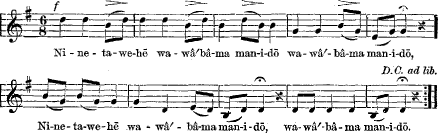
Ni-ne-ta-we-hē wa-wâ´bâ-ma man-i-dō wa-wâ´-bâ-ma man-i-dō,
Ni-ne-ta-we-hē wa-wâ´-bâ-ma man-i-dō, wa-wâ´-bâ-ma man-i-dō.
MIDI files: drum, flute, piano
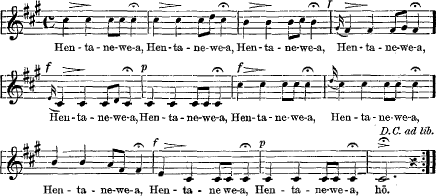
Hen-ta-ne-we-a, Hen-ta-ne-we-a, Hen-ta-ne-we-a, Hen-ta-ne-we-a,
Hen-ta-ne-we-a, Hen-ta-ne-we-a, Hen-ta-ne-we-a, Hen-ta-ne-we-a,
Hen-ta-ne-we-a, Hen-ta-ne-we-a, Hen-ta-ne-we-a, hō.
MIDI files: drum, flute, piano

Na-sa-ni-nen-di-ya, Na-sa-ni-nen-di-ya, Na-sa-ni-nen-di-ya,
Awasiyōk, Nogwenowōk.
MIDI files: drum, flute, piano
If the patient becomes strong enough to walk round the inclosure he is led to the western end and seated upon a blanket, where he is initiated. If not, the mī´gis is “shot into his body” as he reclines against the sacred stone, after which a substitute is selected from among the Midē´ present, who takes his place and goes through the remainder of the initiation for him. Before proceeding upon either course, however, the chief attendant Midē´ announces his readiness in the following manner: Mi´-o-shi´-gwa, wi-kwod´-gi-o-wŏg´ ga-mâ´-dzhi-a-ka´-dŭng bi-mâ-di-si-wĭn´—“Now we are ready to escape from this and to begin to watch life.” This signifies his desire to escape from his present procedure and to advance to another course of action, to the exercise of the power of giving life by transferring the sacred mī´gis.
The remainder of the ceremony is then conducted as in the manner described as pertains to the first degree of the Midē´wiwin.
SUPPLEMENTARY NOTES.
PICTOGRAPHY.
Before concluding, it may be of interest to refer in some detail to several subjects mentioned in the preceding pages. The mnemonic songs are in nearly every instance incised upon birch bark by means of a sharp-pointed piece of bone or a nail. The inner surface of the bark is generally selected because it is softer than the reverse. Bark for such purposes is peeled from the trunk during the spring months. On the right hand upper corner of Pl. XIX is reproduced a portion Pl. XVI, C. A piece of bark obtained at Red Lake, and known to have been incised more than seventy years ago, is shown on the right lower corner of Pl. XIX. The drawings are upon the outer surface and are remarkably deep and distinct. The left hand specimen is from the last named locality, and of the same period, and presents pictographs drawn upon the inner surface.
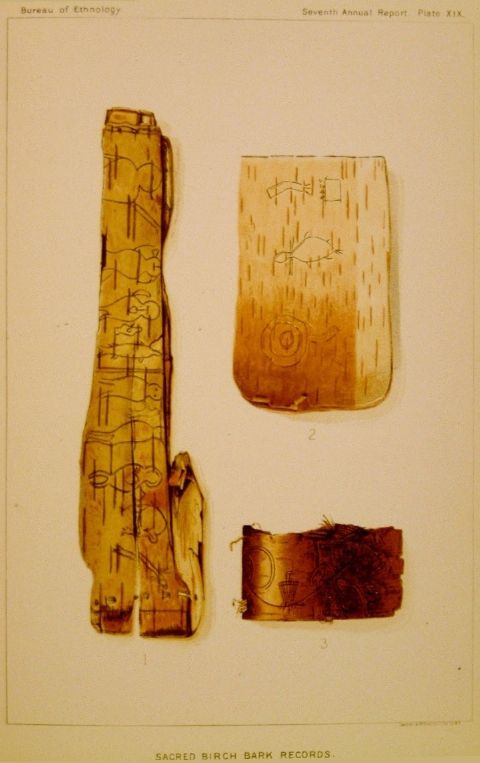
Plate XIX. Sacred Birch Bark Records.
In a majority of songs the characters are drawn so as to be read from left to right, in some from right to left, and occasionally one is found to combine both styles, being truly boustrophic. Specimens have been obtained upon which the characters were drawn around and near the margin of an oblong piece of bark, thus appearing in the form of an irregular circle.
The pictographic delineation of ideas is found to exist chiefly among the shamans, hunters, and travelers of the Ojibwa, and there does not appear to be a recognized system by which the work of any one person is fully intelligible to another. A record may be recognized as pertaining to the Midē´ ceremonies, as a song used when hunting plants, etc.; but it would be impossible for one totally unfamiliar with the record to state positively whether the initial character was at the left or the right hand. The figures are more than simply mnemonic; they are ideographic, and frequently possess additional interest from the fact that several ideas are expressed in combination. Col. Garrick Mallery, U.S. Army, in a paper entitled “Recently Discovered Algonkian Pictographs,” read before the American Association for the Advancement of Science, at Cleveland, 1888, expressed this fact in the following words:
It is desirable to explain the mode of using the Midē´ and other bark records of the Ojibwa and also those of other Algonkian tribes to be mentioned in this paper. The comparison made by Dr. E. B. Tylor of the pictorial alphabet to teach children “A was an archer,” etc., is not strictly appropriate in this case. The devices are not only mnemonic, but are also ideographic and descriptive. They are not merely invented to express or memorize the subject, but are evolved therefrom. To persons acquainted with secret societies a good comparison for the charts or rolls would be what is called the tressel board of the Masonic order, which is printed and published and publicly exposed without exhibiting any of the secrets of the order, yet is not only significant, but useful to the esoteric in assistance to their memory as to degrees and details of ceremony.
A more general mode of explaining the so-called symbolism is by a suggestion that the charts of the order or the song of a myth should be likened to the popular illustrated poems and songs lately published in Harper’s Magazine for instance, “Sally in our Alley,” where every stanza has an appropriate illustration. Now, suppose that the text was obliterated forever, indeed the art of reading lost, the illustrations remaining, as also the memory to many persons of the ballad. The illustrations kept in order would supply always the order of the stanzas and also the general subject-matter of each particular stanza and the latter would be a reminder of the words. This is what the rolls of birch bark do to the initiated Ojibwa, and what Schoolcraft pretended in some cases to show, but what for actual
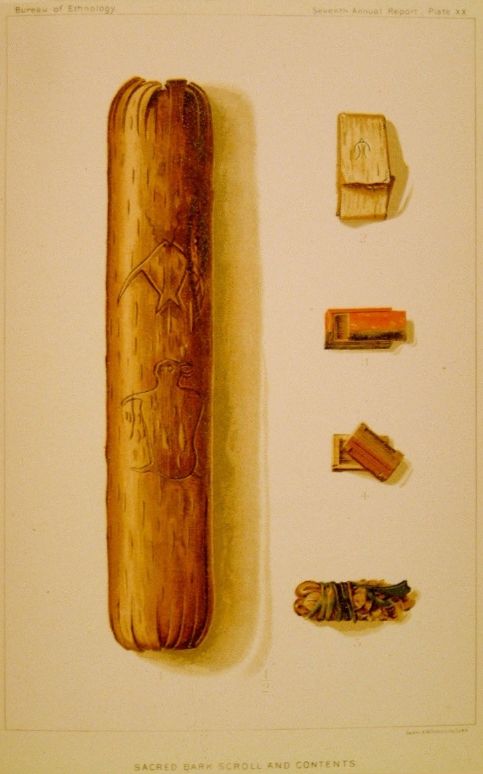
Plate XX. Sacred Bark Scroll And Contents.
On Pl. XX are presented illustrations of several articles found in a Midē´ sack which had been delivered to the Catholic priest at Red Lake over seventy years ago, when the owner professed Christianity and forever renounced (at least verbally) his pagan profession. The information given below was obtained from Midē´ priests at the above locality. They are possessed of like articles, being members of the same society to which the late owners of the relics belonged. The first is a birch-bark roll, the ends of which were slit into short strips, so as to curl in toward the middle to prevent the escaping of the contents. The upper figure is that of the Thunder god, with waving lines extending forward from the eyes, denoting the power of peering into futurity. This character has suggested to several Midē´ priests that the owner might have been a Midē´-Jĕs´sakkīd´. This belief is supported by the actual practice pursued by this class of priests when marking their personal effects. The lower figure is that of a buffalo, as is apparent from the presence of the hump. Curiously enough both eyes are drawn upon one side of the head, a practice not often followed by Indian artists.
The upper of the four small figures is a small package, folded, consisting of the inner sheet of birch-bark and resembling paper both in consistence and color. Upon the upper fold is the outline of the Thunder bird. The next two objects represent small boxes made of pine wood, painted or stained red and black. They were empty when received, but were no doubt used to hold sacred objects. The lowest figure of the four consists of a bundle of three small bags of cotton wrapped with a strip of blue cloth. The bags contain, respectively, love powder, hunter’s medicine—in this instance red ocher and powdered arbor vitæ leaves—and another powder of a brownish color, with which is mixed a small quantity of ground medicinal plants.
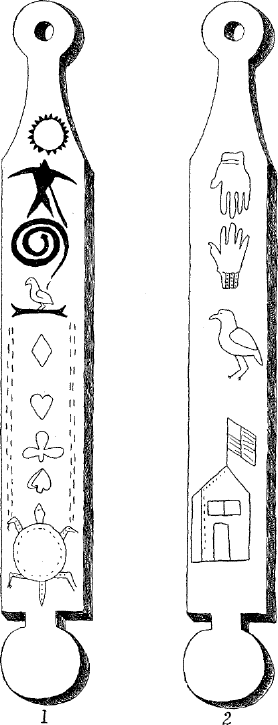
Plate XXI. Midē´ Relics From Leech Lake.
The roll of birch-bark containing these relics inclosed also the skin of a small rodent (Spermophilus sp.?) but in a torn and moth-eaten condition. This was used by the owner for purposes unknown to those who were consulted upon the subject. It is frequently, if not generally, impossible to ascertain the use of most of the fetiches and other sacred objects contained in Midē´ sacks of unknown ownership, as each priest adopts his own line of practice, based upon a variety of reasons, chiefly the nature of his fasting dreams.
Fancy sometimes leads an individual to prepare medicine sticks that are of curious shape or bear designs of odd form copied after Pl. XXI, Nos. 1 and 2, showing both the obverse and reverse. The specimen is made of ash wood and measures about ten inches in length. On the obverse side, besides the figures of man´-idōs, such as the Thunder bird, the serpent, and the tortoise, there is the outline of the sun, spots copied from playing cards, etc.; upon the reverse appear two spread hands, a bird, and a building, from the top of which floats the American flag. This specimen was found among the effects of a Midē´ who died at Leech Lake, Minnesota, a few years ago, together with effigies and other relics already mentioned in another part of this paper.
MUSIC.
In addition to the examples of Indian music that have been given, especially the songs of shamans, it may be of interest to add a few remarks concerning the several varieties of songs or chants. Songs employed as an accompaniment to dances are known to almost all the members of the tribe, so that their rendition is nearly always the same. Such songs are not used in connection with mnemonic characters, as there are, in most instances, no words or phrases recited, but simply a continued repetition of meaningless words or syllables. The notes are thus rhythmically accentuated, often accompanied by beats upon the drum and the steps of the dancers.
An example of another variety of songs, or rather chants, is presented in connection with the reception of the candidate by the Midē´ priest upon his entrance into the Midē´wigân of the first degree. In this instance words are chanted, but the musical rendition differs with the individual, each Midē´ chanting notes of his own, according to his choice or musical ability. There is no set formula, and such songs, even if taught to others, are soon distorted by being sung according to the taste or ability of the singer. The musical rendering of the words and phrases relating to the signification of mnemonic characters depends upon the ability and inspired condition of the singer; and as each Midē´ priest usually invents and prepares his own songs, whether for ceremonial purposes, medicine hunting, exorcism, or any other use, he may frequently be unable to sing them twice in exactly the same manner. Love songs and war songs, being of general use, are always sung in the same style of notation.
The emotions are fully expressed in the musical rendering of the several classes of songs, which are, with few exceptions, in a minor key. Dancing and war songs are always in quick time, the latter frequently becoming extraordinarily animated and boisterous as the participants become more and more excited.
Midē´ and other like songs are always more or less monotonous, though they are sometimes rather impressive, especially if delivered
The statement has been made that one Midē´ is unable either to recite or sing the proper phrase pertaining to the mnemonic characters of a song belonging to another Midē´ unless specially instructed. The representation of an object may refer to a variety of ideas of a similar, though not identical, character. The picture of a bear may signify the Bear man´idō as one of the guardians of the society; it may pertain to the fact that the singer impersonates that man´idō; exorcism of the malevolent bear spirit may be thus claimed; or it may relate to the desired capture of the animal, as when drawn to insure success for the hunter. An Indian is slow to acquire the exact phraseology, which is always sung or chanted, of mnemonic songs recited to him by a Midē´ preceptor.
An exact reproduction is implicitly believed to be necessary, as otherwise the value of the formula would be impaired, or perhaps even totally destroyed. It frequently happens, therefore, that although an Indian candidate for admission into the Mīdē´wiwin may already have prepared songs in imitation of those from which he was instructed, he may either as yet be unable to sing perfectly the phrases relating thereto, or decline to do so because of a want of confidence. Under such circumstances the interpretation of a record is far from satisfactory, each character being explained simply objectively, the true import being intentionally or unavoidably omitted. An Ojibwa named “Little Frenchman,” living at Red Lake, had received almost continuous instruction for three or four years, and although he was a willing and valuable assistant in other matters pertaining to the subject under consideration, he was not sufficiently familiar with some of his preceptor’s songs to fully explain them. A few examples of such mnemonic songs are presented in illustration, and for comparison with such as have already been recorded. In each instance the Indian’s interpretation of the character is given first, the notes in brackets being supplied in further explanation. Pl. XXII, A, is reproduced from a birch-bark song; the incised lines are sharp and clear, while the drawing in general is of a superior character. The record is drawn so as to be read from right to left.

Plate XXII.a. Mnemonic Song.
From whence I sit. [The singer is seated, as the lines indicate contact with the surface beneath, though the latter is not shown. The short line extending from the mouth indicates voice, and probably signifies, in this instance, singing.]

The big tree in the center of the earth. [It is not known whether or not this relates to the first destruction of the earth, when Mi´nabō´zho escaped by climbing a tree which continued to grow and to protrude above the surface of the flood. One Midē´ thought it related to a particular medicinal tree which was held in estimation beyond all others, and thus represented as the chief of the earth.]

I will float down the fast running stream. [Strangely enough, progress by water is here designated by footprints instead of using the outline of a canoe. The etymology of the Ojibwa word used in this connection may suggest footprints, as in the Delaware language one word for river signifies “water road,” when in accordance therewith “footprints” would be in perfect harmony with the general idea.]

The place that is feared I inhabit, the swift-running stream I inhabit. [The circular line above the Midē´ denotes obscurity, i.e., he is hidden from view and represents himself as powerful and terrible to his enemies as the water monster.]

You who speak to me.

I have long horns. [The Midē´ likens himself to the water monster, one of the malevolent serpent man´idōs who antagonize all good, as beliefs and practices of the Midē´wiwin.]

A rest or pause.
I, seeing, follow your example.

You see my body, you see my body, you see my nails are worn off in grasping the stone. [The Bear man´idō is represented as the type now assumed by the Midē´. He has a stone within his grasp, from which magic remedies are extracted.]

You, to whom I am speaking. [A powerful Man´idō´, the panther, is in an inclosure and to him the Midē´ addresses his request.]

I am swimming—floating—down smoothly. [The two pairs of serpentine lines indicate the river banks, while the character between them is the Otter, here personated by the Midē´.]

Bars denoting a pause.
I have finished my drum. [The Midē´ is shown holding a Midē´ drum which he is making for use in a ceremony.]

My body is like unto you. [The mī´gis shell, the symbol of purity and the Midē´wiwin.]

Hear me, you who are talking to me! [The speaker extends his arms to the right and left indicating persons who are talking to him from their respective places. The lines denoting speech—or hearing—pass through the speaker’s head to exclaim as above.]

See what I am taking. [The Midē´ has pulled up a medicinal root. This denotes his possessing a wonderful medicine and appears in the order of an advertisement.]

See me, whose head is out of water.

On Pl. XXII, B, is presented an illustration reproduced from a piece of birch bark owned by the preceptor of “Little Frenchman,” of the import of which the latter was ignorant. His idea of the signification of the characters is based upon general information which he has received, and not upon any pertaining directly to the record. From general appearances the song seems to be a private

Plate XXII.b. Mnemonic Song.
I am sitting with my pipe. [Midē´ sitting, holding his pipe. He has been called upon to visit a patient, and the filled pipe is handed to him to smoke preparatory to his commencing the ceremony of exorcism.]

I employ the spirit, the spirit of the owl. [This evidently indicates the Owl Man´idō, which has been referred to in connection with the Red Lake Mide´ chart, Pl. III, No. 113. The Owl man´idō is there represented as passing from the Midē´wigân to the Dzhibai´ Midē´wigân, and the drawings in that record and in this are sufficiently alike to convey the idea that the maker of this song had obtained his suggestion from the old Midē´ chart.]

It stands, that which I am going after. [The Midē´, impersonating the Bear Man´idō, is seeking a medicinal tree of which he has knowledge, and certain parts of which he employs in his profession. The two footprints indicate the direction the animal is taking.]

I, who fly. [This is the outline of a Thunder bird, who appears to grasp in his talons some medical plants.]

Ki´-bi-nan´ pi-zan´. Ki´binan´ is what I use, it flies like an arrow. [The Midē´’s arm is seen grasping a magic arrow, to symbolize the velocity of action of the remedy.]

I am coming to the earth. [A Man´idō is represented upon a circle, and in the act of descending toward the earth, which is indicated by the horizontal line, upon which is an Indian habitation. The character to denote the sky is usually drawn as a curved line with the convexity above, but in this instance the ends of the lines are continued below, so as to unite and to complete the ring; the intention being, as suggested by several Midē´ priests, to denote great altitude above the earth, i.e., higher than the visible azure sky, which is designated by curved lines only.]

I am feeling for it. [The Midē´ is reaching into holes in the earth in search of hidden medicines.]

I am talking to it. [The Midē´ is communing with the medicine Man´idō´ with the Midē´ sack, which he holds in his hand. The voice lines extend from his mouth to the sack, which appears to be made of the skin of an Owl, as before noted in connection with the second character in this song.]

They are sitting round the interior in a row. [This evidently signifies the Ghost Lodge, as the structure is drawn at right angles to that usually made to represent the Midē´wigân, and also because it seems to be reproduced from the Red Lake chart already alluded to and figured in Pl. III, No. 112. The spirits or shadows, as the dead are termed, are also indicated by crosses in like manner.]