INDIAN LINGUISTIC FAMILIES OF AMERICA NORTH OF MEXICO. (continued 6)
Reading edition
When the preparatory instruction has come to an end and the day of the ceremony of initiation is at hand, the preceptor sings to his pupil a song, expatiating upon his own efforts and the high virtue of the knowledge imparted. The pipe is brought forward and an offering of tobacco smoke made by both preceptor and pupil, after which the former sings a song (Pl. X, A.), the time of its utterance being tediously prolonged. The mnemonic characters were drawn by Sikas´sigĕ, and are a copy of an old birch-bark scroll which has for many years been in his possession, and which was made in imitation of one in the possession of his father, Baiē´dzĭk, one of the leading Midē´ at Mille Lacs, Minnesota.

Plate X.a. Mnemonic Song.
Wī-ka-no´-shi-an-ŏ. My arm is almost pulled out from digging medicine. It is full of medicine. The short zigzag lines signifying magic influence, erroneously designated “medicine.”

We-wī´-ka-ni´-an. Almost crying because the medicine is lost. The lines extending downward from the eye signifies weeping; the circle beneath the figure is the place where the “medicine” is supposed to exist. The idea of “lost” signifies that some information has been forgotton through death of those who possessed it.

Me-shi´-âk-kĭnk mi-sui´-a-kĭnk. Yes, there is much medicine you may cry for. Refers to that which is yet to be learned of.

Pe-i´-e-mĭ-ko-ya´-na-kĭnk´. Yes, I see there is plenty of it. The Midē´ has knowledge of more than he has imparted, but reserves that knowledge for a future time. The lines of “sight” run to various medicines which he perceives or knows of.

Rest.

We´-a-kwĕ´-nĭnk pe-ĭ-e´-mi-wĭt´-o-wan´. When I come out the sky becomes clear. When the otter-skin Midē´ sack is produced the sky becomes clear, so that the ceremonies may proceed.

We´-kwĕ-nĭnk´ ke´-tŏ-nĭnk´ e´-to-wa´. The spirit has given me power to see. The Midē´ sits on a mountain the better to commune with the Good Spirit.

Mi´-sha-kwat´-ni-yō´. I brought the medicine to bring life. The Midē´ Man´idō, the Thunderer, after bringing some of the plants—by causing the rains to fall—returns to the sky. The short line represents part of the circular line usually employed to designate the imaginary vault of the sky.

Me´-ka-yē´-nĭnk te´-a-yĕ-am´-ban. I, too, see how much there is. His power elevates the Midē´ to the rank of a man´idō, from which point he perceives many secrets hidden in the earth.

In-de´-be-mĭ´-ko. I am going to the medicine lodge. The vertical left-hand figure denotes a leg going toward the Midē´wigân.

In-de´-bi-bi´-ton. I take life from the sky. The Midē´ is enabled to reach into the sky and to obtain from Ki´tshi Man´idō the means of prolonging life. The circle at the top denotes the sacred mī´gis, or shell.

No-a´-wi´-mi-kō´. Let us talk to one another. The circles denote the places of the speaker (Midē´) and the hearer (Ki´tshi Man´idō), the short lines signifying magic influences, the Midē´ occupying the left hand and smaller seat.

Man´-i-dō-ye-na´-ni ni-kan´. The spirit is in my body, my friend. The mī´gis, given by Ki´tshi Man´idō, is in contact with the Midē´’s body, and he is possessed of life and power.

From ten days to two weeks before the day of initiation, the chief Midē´ priest sends out to all the members invitations, which consist of sticks one-fourth of an inch thick and 6 or 7 inches long. The courier is charged with giving to the person invited explicit information as to the day of the ceremony and the locality where it is to
About five or six days preceding the day set for the ceremony of initiation, the candidate removes to the neighborhood of the locality of the Midē´wigân. On the evening of the fifth day he repairs to the sudatory or sweat-lodge, which has, in the meantime, been built east of the sacred inclosure, and when seated within he is supplied with water which he keeps for making vapor by pouring it upon heated stones introduced for the purpose by assistants upon the outside. This act of purification is absolutely necessary and must be performed once each day for four days, though the process may be shortened by taking two vapor baths in one day, thus limiting the process to two days. This, however, is permitted, or desired only under extraordinary circumstances. During the process of purgation, the candidates thoughts must dwell upon the seriousness of the course he is pursuing and the sacred character of the new life he is about to assume.
When the fumigation has ceased he is visited by the preceptor and the other officiating Midē´ priests, when the conversation is confined chiefly to the candidate’s progress. He then gives to each of them presents of tobacco, and after an offering to Ki´tshi Man´idō, with the pipe, they expose the articles contained in their Midē´ sacks and explain and expatiate upon the merits and properties of each of the magic objects. The candidate for the first time learns of the manner of preparing effigies, etc., with which to present to the incredulous ocular demonstration of the genuineness and divine origin of the Midē´wiwin, or, as it is in this connection termed, religion.
Several methods are employed for the purpose, and the greater the power of the Midē´ the greater will appear the mystery connected with the exhibition. This may be performed whenever circumstances demand such proof, but the tests are made before the candidate with a twofold purpose: first, to impress him with the supernatural powers of the Midē´ themselves; and second, in an oracular manner, to ascertain if Ki´tshi Ma´nidō is pleased with the contemplated ceremony and the initiation of the candidate.
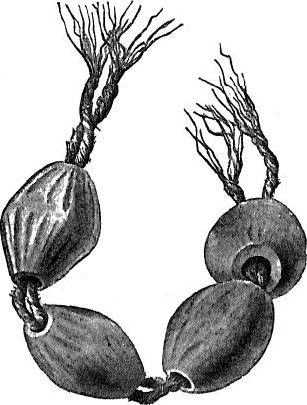
Fig. 16.
The first test is made by laying upon the floor of the wig´iwam a string of four wooden beads each measuring about 1 inch in diameter. See Fig. 16. After the owner of this object has chanted for a few moments in an almost inaudible manner the beads begin to roll from side to side as if animated. The string is then quickly restored to its place in the Midē´ sack. Another Midē´ produces a small wooden effigy of a man (Fig. 17), measuring about 5 inches in height. The body has a small orifice running through it from between the shoulders to the buttocks, the head and neck forming a separate piece which may be attached to the body like a glass stopper to a bottle.
A hole is made in the ground deep enough to reach to the hips of the effigy, when the latter is put into it and the loose earth loosely restored so as to hold it in an upright position. Some magic powder of herbs is sprinkled around the body, and into the vertical orifice in Fig. 18 represents another figure used in a similar manner. It consists of one piece, however, and is decorated with narrow bands of dark blue flannel about the ankles and knees, a patch of red cloth upon the breast and bands about the wrists, each of the eyes being indicated by three white porcelain beads.
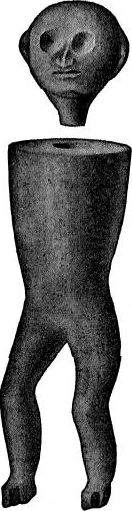
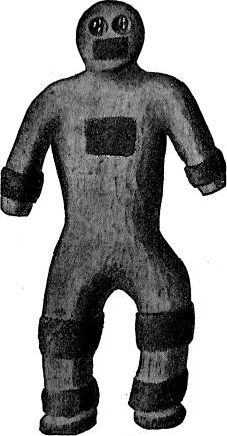
Fig. 17. Fig. 18.
One of the most astonishing tests, however, and one that can be produced only by Midē´ of the highest power, consists in causing a Midē´ sack to move upon the ground as if it were alive. This, it is confidently alleged, has been done repeatedly, though it is evident that the deception is more easily produced than in the above-mentioned instances, as the temporary retention within a bag of a small mammal could readily be made to account for the movements.
In most of these private exhibitions the light is so obscured as to prevent the deception being observed and exposed; and when public demonstrations of skill are made the auditors invariably consist of the most credulous of the uninitiated, or the confréres of the performer, from whom no antagonism or doubt would be expected.
The preceptor then consults with the Midē´ priests respecting the presents to be delivered by the candidate, and repeats the following words, viz:
Mis-shai´-ĕ-gwa tshi-dĕ-bŏg-in-de-mung´. gi´-she-gŏ-dung´
Now is the time that we shall fix the price of everything pertaining to the sky,
ka-mi´-nĕ- nŏngk gi´-she-goy-dŭng´ di´-bi-ga-dōnk´ gai-yé´.
that has been given to us from the day [and] the night also.
A-pē´-gĕ-dá´wŭnk i´-wa-pī ge-bin´-de-ga-yŏngk´,
When it shall come to pass and at the time that we shall enter,
ă-au´-wa-mi-dē´-wĭd.
he who wishes to become a Midē´.
When the four vapor baths have been taken by the candidate, and the eve of the ceremony has arrived, he remains in the sudatory longer than usual so as not to come in contact with the large crowd of visitors who have arrived upon the scene. The woods resound with the noises incident to a large camp, while in various directions may be heard the monotonous beating of the drum indicating the presence of a number of dancers, or the hard, sharp taps of the midē´ drum, caused by a priest propitiating and invoking the presence and favor of Ki´tshi Ma´nidō in the service now so near at hand.
When the night is far advanced and all becomes hushed, the candidate, with only the preceptor accompanying, retires to his own wig´iwam, while the assistant Midē´ priests and intimate friends or members of his family collect the numerous presents and suspend them from the transverse and longitudinal poles in the upper part of the Midē´wigân. Watchers remain to see that nothing is removed during the night.
At the approach of day, the candidate breakfasts and again returns to the sweat-lodge to await the coming of his preceptor, and, later, of the officiating priests. The candidate puts on his best clothing
IMPLORATION FOR CLEAR WEATHER.
Should the day open up with a threatening sky, one of the Midē´ priests accompanying the candidate sings the following song (Pl. X, B) to dispel the clouds. Each of the lines is repeated an indefinite number of times, and after being repeated once or twice is sung also by the others as an accompaniment.
It will be observed that the words as spoken vary to some extent when chanted or sung.

Plate X.b. Mnemonic Song.
Ki-na-nē´, hē´, ki´-ne-na-wē´ man´-i-dō. I swing the spirit like a child. The Midē´ Spirit, showing magic lines radiating from his body. The Midē´ claims to be able to receive special favor.

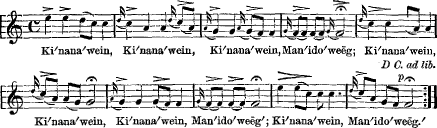
Ki´nana´wein, Ki´nana´wein, Ki´nana´wein, Man´ido´weēg;
Ki´nana´wein, Ki´nana´wein, Ki´nana´wein, Man´ido´weēg´;
Ki´nana´wein, Man´ido´weēg´.
MIDI files: drum, flute, piano
Gi-zhik´-ē´ ka-hwē´ da-mū´-nĕ. The sky is what I am telling you about. The sky and the earth united by a pathway of possible rain.

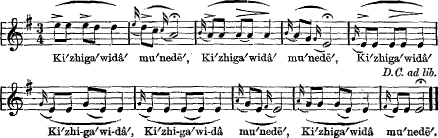
Ki´zhiga´widâ´ mu´nedē´, Ki´zhiga´widâ´ mu´nedē´,
Ki´zhiga´widâ´ Ki´zhi-ga´wi-dâ´,
Ki´zhi-ga´wi-dâ mu´nedē´, Ki´zhiga´widâ mu´nedē´.
MIDI files: drum, flute, piano
Wa-ne-o-ho ne´-ge-shi´-go-ni Ko-sa´-we, hē´, wa-ni´-sha´-na´. We have lost the sky [it becomes dark]. [Clouds obscure the sky, and the arm of the Midē´ is reaching up into it for its favor of clear weather.]

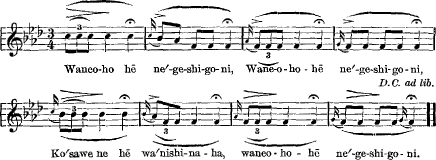
Waneo-ho hē ne´-ge-shi-go-ni, Wane-o-ho-hē ne´-ge-shi-go-ni,
Ko´sawe ne hē wa´nishi-na-ha, waneo-ho-hē ne´-ge-shi-go-ni.
MIDI files: drum, flute, piano
Wi-tshi´-hi-na´-ne-he, nē´, kō´, hō. ne´-ni-wi-tshi-nan´. I am helping you. [The Otter-skin Midē´ sack is held up to influence the Otter Spirit to aid them.]

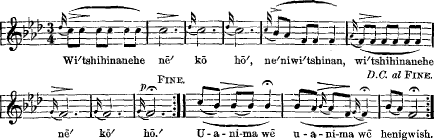
Wi´tshihinanehe nē´ kō hō´, ne´niwi´tshinan, wi´tshihinanehe
nē´ kō´ hō´. U-a-ni-ma wē u-a-ni-ma wē henigwish.
MIDI files: drum, flute, piano
U-a´-ni-ma´, wē´, he´-ni-gwĭsh. I have made an error [in sending]. The Otter-skin Midē´ sack has failed to produce the desired effect.

Rest.
The Midē´ women who have gathered without the lodge now begin to dance as the song is renewed.
Na-nin-dē´, hē´, he-yo-ya, nē´. I am using my heart. Refers to sincerity of motives in practice of Midē´ ceremony.

Yo´-na-hĭsh´-i-me´-a´-ne´, hē´. yá-na-hĭsh-a-me´-a-ne´, hē´. What are you saying to me, and I am “in my senses”?

Man´-i-dō, hē´ nē´, mē´-de-wē´, ē´. The spirit wolf. One of the malevolent spirits who is opposed to having the ceremony is assisting the evil man´idōs in causing the sky to be overcast.

Wen´-tshi-o-ne-se hē´, nē´, wen´-tshi-o-ne-se hē´. I do not know where I am going. The Midē´ is in doubt whether to proceed or not in the performance of initiation.

Mi´-shok-kwo´-ti-ne be-wa´-ne, ni-bin´-zhi man´-i-dō i-ya´-nē. I depend on the clear sky. [To have the ceremony go on. Arm reaching toward the sky for help.]

Ke-me´-ni-na-ne´ a-nō´-ē´ a´-sho-wē´ me-nō´-de ki-man´-i-dō. I give you the other village, spirit that you are. [That rain should fall anywhere but upon the assemblage and Midē´wigân.]

Tshing-gwē´-o-dē |: gē´. The thunder is heavy. The Thunder Bird, who causes the rain.A

We´-ka-ka-nō´, hō´ shi´-a-dē´. We are talking to one another. The Midē´ communes with Ki´tshi Man´idō; he is shown near the sky; his horns denoting superior wisdom and power, while the lines from the mouth signify speech.

In case the appearance of the sky becomes sufficiently favorable the initiation begins, but if it should continue to be more unfavorable or to rain, then the song termed the “Rain Song” is resorted to and sung within the inclosure of the Midē´wigân, to which they all march in solemn procession. Those Midē´ priests who have with them their Midē´ drums use them as an accompaniment to the singing and to propitiate the good will of Ki´tshi Man´idō. Each line of the entire song appears as an independent song, the intervals of rest varying in time according to the feelings of the officiating priest.
The words of the song are known to most of the Midē´ priests; but, as there is no method of retaining a set form of musicial notation, the result is entirely individual and may vary with each singer, if sung independently and out of hearing of others; so that, under
If this song does not appear to bring about a favorable change the priests return to their respective wig´iwams and the crowd of visitors disperses to return upon the first clear day.
INITIATION OF CANDIDATE.
If, however, the day be clear and promising the candidate goes early to the sweat-lodge, where he is joined by his preceptor, and later by the officiating priest. After all preliminaries have been arranged and the proper time for regular proceedings has arrived, the preceptor sings the following song (Pl. X, C), the musical notation of which varies according to his feelings, clearly showing that there is no recognized method of vocal delivery, as is the case with the music of dancing songs:

Plate X.c. Mnemonic Song.
Kan-do´-e-a-nē´, to´-e-a-nē´ kan-do´-e-a-nē´, in-nin´-nĭ man´-e-dō´-ē´. The spirit man is crying out. [The head of the Midē´, a synonym of Ki´tshi Man´idō. The voice lines show spots denoting intensity of accentuation, and that Ki´tshi Man´idō is pleased to look with favor upon the proceedings.]

Ya-ni-nē´, na´, tshi-mo-tē´, hē´, Talking around in various sections. The voice lines, as in the preceding figure, extending downward from the mouth to either side, have spots upon them to indicate “talks” in various directions addressed to the Midē´.

Man´-e-dō, wē´, hē´, pe-me´-so-wa´. The spirit is flying. The Thunder Bird, who causes the rain, is away at some remote place.

Mi-de´-we-tē-we´ me´-wa-gwi´-shak-wa´, mi-de´-we-ta´. The day is clear; let us have the grand medicine. [The Midē’s hand reaches to the sky, and rain falls at places other than upon the Midē´wigân, as shown by rain lines from the end of the curved lines denoting the sky.]

Me-shak´-kwot dung´-ke-hē´, ne-mē´-gĭs-sĭm´. I am the sign that the day will be clear. [The Midē´’s hand reaches to the sky, as indicated by the short transverse line, and the sun’s rays diverge in all directions.]

Sun´-gis-ni de´-wit-ka-nē´, hē´, wi-no´-wo-he´-she-wat´ man´-i-do-wi-tshik. I am the strongest medicine, is what is said of me. [The speaker compares himself to Makwa´ Man´idō, the Bear Spirit.]

Hwo´-ba-mī´-de, hwo´-ba-mī-de, man-ĕ-dō na´-wa-gī-zhĭk. The spirit in the middle of the sky sees me. [The upper spot denotes the abode of Ki´tshi Man´idō, the “line of vision” extending to the speaker, shown at a corresponding spot below.]

Ni-wĭ-we´-wai-a-de´ hi´-me nai´-o-nā´. I take my sack and touch him. The Midē´ will use his sacred Otter-skin sack to touch the candidate.

Man´-i-dō wi-kan-ē´, mi-de´-yo. My medicine is the sacred spirit. The Midē´ professes to have received the divine gift from Ki´tshi Man´idō; the gifts are seen descending to the hand held up to receive them.

Ha-ni-ne´ ku-mē´ ni´-kan-nē´? How do you answer me, my Midē´ friends?

This is addressed to the Midē´ priests (Nika´ni) present, and is an inquiry as to their willingness to proceed. The Midē´wigân is shown, the line running horizontally through it the path of the candidate (or one who has gone through), the two spots within the place of the sacred stone and the post, while the spot to the right of the outside of the inclosure denotes the beginning, or the sweat-lodge, symbolizing the circle of the earth upon the Midē´ chart (Pl. III), those upon the left denoting the three possible degrees of advancement in the future.
Upon the conclusion of the song there is a brief interval, during which all partake of a smoke in perfect silence, making the usual offerings to the four points of the compass, to Ki´tshi Man´idō´, and toward the earth.
The preceptor then says:
Mĭs-sa´i´-a-shi-gwa, mĭs-sa´-a-shĭ-gwa- nŏn´-do-nŭng; ka-kĭ-nâ
Now is the time, now is the time he hears us; all of us
ka-kĭn´-nâ-gi-nŏn´-do-da´g-u-nan´ ga-o´-shī-dōt mi-dē´-wĭ´-win.
he hears us all the one who made the midē´wiwin.
After this monologue he continues, and addresses to the candidate the midē´ gagĭ´kwewĭn´, or Midē´ sermon, in the following language, viz:
An-be´-bi-sĭn´-di-wi´-shĭn, wa´-i-ni´-nan;
now listen to me what I am about to say to you;
kēsh´-pin-pe´-sin-da´-nin-wĭn da-ma´-dzhi shka´ ke´-bi-mâ´-di-si-wĭn´.
If you take heed of that which I say to you shall continue always your life.
Un, nun´-gūm, ke-za´-ki-gi-zi-ton mŏn ki´-tshi man´-i-dō ō´-dik-kid´-do-wĭn´;
Now, to-day I make known to you the great spirit That which he says;
o´-wi-dŏsh kid´-di-nĭn´ ki-ī´-kid-dō´kī´-tshi man´-i-dō gi´-sa-gi-ĭg´.
and now this I say to you. This is what says the great spirit that he loves you.
to-wa´-bish-ga´ gi-shtig-wa a-pī-we- sa´-gi-sit´-to-wad
It shall be white the sacred object at the time When they shall let it be known
o-sa´-in-di-kid´-do-wīn ĕ´-kid-dōdt ki´-tshi man´-i-dō
and this is what I say That which he says the great spirit
ŏ´-gi-din´-nĭn mis-sâ´-wa ke´-a-ked´-de-wó
now this I impart to you even if they say
wa´-ba-ma-tshin´ni-bŭdt mi´-â-ma´ tshī´-ō- nish-gâd´,
That they saw him dead in this place he shall be Raised again
ini-â-má a-pe´-ni-nut´ nin-dē´ kid´-do-wĭn
in this place he puts his trust In my heart in this “saying”
min-nik´ kid-da´- kĭ-o-wink´. Ka-wī´-ka-da-an´-na-we´-was-si-nan,
the time of the duration Of the world. It shall never fail.
me-ē´-kid-dodt´ man´-i-dō. Nin´-ne-dzha´-nis
That is what he says, the spirit. My child,
ke-un´-dzhi be-mâ´-dis si´-an.
this shall give you life.
The Midē´ priests then leave the sweat-lodge and stand upon the outside, while the candidate gathers up in his arms a number of small presents, such as tobacco, handkerchiefs, etc., and goes out of the wig´iwam to join the Midē´ priests. The order of marching to the main entrance of the Midē´wigân is then taken up in the following order: First the candidate, next the preceptor, who in turn is followed by the officiating priests, and such others, and members of his family and relatives as desire. At the door of the Midē´wigân all but one of the priests continue forward and take their stations within the inclosure, the preceptor remaining on one side of the candidate, the Midē´ priest upon the other, then all march four times around the outside of the inclosure, toward the left or south, during which time drumming is continued within. Upon the completion of the fourth circuit the candidate is placed so as to face the main entrance of the Midē´wigân. When he is prompted to say:
“Man-un´-ga-bīn´-di-gĕ o-bŏg´-ga-dĭ-nan´, o-dai´-ye-din´.”
Let me come in and these I put down my things [gifts].
The presents are then laid upon the ground. The preceptor goes inside, taking with him the gifts deposited by the candidate, and remains standing just within the door and faces the degree post toward the west. Then the chief officiating priest, who has remained at the side of the candidate, turns toward the latter and in a clear, distinct, and exceedingly impressive manner sings the following chant, addressed to Ki´tshi Man´idō whose invisible form is supposed to abide within the Midē´wigan during such ceremonies, stating that the candidate is presented to receive life (the mī´gis) for which he is suffering, and invoking the divine favor.
Hai ya ha man´-i-dō, hō´, ti-bish´-ko-gish´-i-gŭng, hē´, we-zá-ba-mid´-mi
There is a spirit ho, just as the one above, he, now sits with me
nin-dzhá-nis, esh-ĭ-gan´-do-we, hē´, hwē´, mé-a-tshi-bin´-de-gan´-ni-nan,
my child and now I proclaim, he, hwe, that I enter you here
nōs, dzhi-man´-i-dō, hō´, hwō´, sha-wé-nĭ-mi-shin´, hē´, hwē´,
my father good spirit, ho, hwo, have pity on me, he, hwe
a-shig´-wa-bin´-de-gan-nŏk gé-gwa-da-gí-sid wi-bĭ-mâ´-di-sĭd,
now that I enter him here, he that is suffering for life,
dé-bwe-daú-wi-shĭn dzhí-bi-mâ´-di-sĭd´, nōs,
believe me that he shall live, my father,
wē´-o-sĭm´-in-nan´, hē´, hē´.
whose child I am, he, he.
The following is the musical notation:
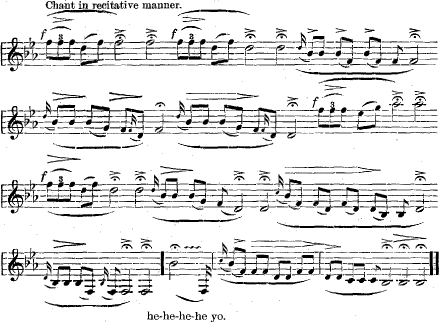
he-he-he-he yo.
MIDI files: drum, flute, piano
The candidate is then led within the inclosure when all the members of the society arise while he is slowly led around toward the southern side to the extreme end in the west, thence toward the right and back along the western side to the point of beginning. This is done four times. As he starts upon his march, the member nearest the door falls in the line of procession, each member continuing to drop in, at the rear, until the entire assembly is in motion. During this movement there is a monotonous drumming upon the Midē´ drums and the chief officiating priest sings:
Ni´-sha-bōn´-da shkan wig´-i-wam ke-nōn´-dēg,
I go through [the] “house” the long, i.e., through the Midē´wigân.
At the fourth circuit, members begin to stop at the places previously occupied by them, the candidate going and remaining with his preceptor to a point just inside the eastern entrance, while the four officiating priests continue around toward the opposite end of the inclosure and station themselves in a semicircle just beyond the degree post, and facing the western door. Upon the ground before them are spread blankets and similar goods, which have been removed from the beams above, and upon which the candidate is to kneel. He is then led to the western extremity of the inclosure where he
Mĭ-i´-shi-gwa´ bŏ´-gi-ta-mon´-nan,
The time has arrived that I yield it to you.
mi´-na-nan´-kĕ-ân-dzhi bi-mâ´-dĭ-si´-an.
[the midē´migis] that will give you life.
The preceptor then returns to his position back of and a little to one side of the candidate, when the chief officiating priest sings the following song, accompanying himself upon a small cylindrical midē´drum. The words are: Kit´-ta-non´-do-wē man´-i-do´-wid—you shall hear me, spirit that you are—, and the music is rendered as follows:
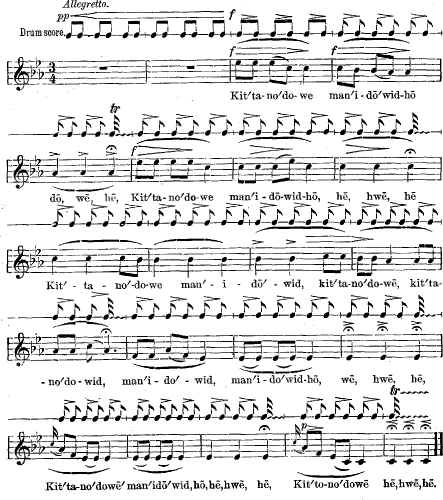
Kit´ta-no´do-we man´i-dō´wid-hō dō, wē, hē,
Kit´ta-no´do-we man´i-dō-wid-hō, hē, hwē, hē,
Kit´-ta-no´-do-we man´-i-dō´-wid, kit´ta-no´do-wē,
kit´ta-no´do-wid, man´i-do´-wid, man´i-do´wid-hō, wē, hwē, hē,
Kit´ta-no´dowē´ man´idō´wid, hō, hē, hwē, hē, hē, hwē, hē.
MIDI files: drum, flute, piano
Mĭs-sa´-a-shi´-gwa ki-bo´-gĭs-sē-na-min tshi´-ma-mâd
Now is the time that I hope of you that you shall
bi-mâ´-di-sĭ-wĭn, mĭ-nē´-sĭd.
take life the bead [mi´gis shell.]
This priest then grasps his Midē´ sack as if holding a gun, and, clutching it near the top with the left hand extended, while with the right he clutches it below the middle or near the base, he aims it toward the candidate’s left breast and makes a thrust forward toward that target uttering the syllables “yâ, hŏ´, hŏ´, hŏ´, hŏ´, hŏ´, hŏ´,” rapidly, rising to a higher key. He recovers his first position and repeats this movement three times, becoming more and more animated, the last time making a vigorous gesture toward the kneeling man’s breast as if shooting him. (See Fig. 15, page 192.) While this is going on, the preceptor and his assistants place their hands upon the candidate’s shoulders and cause his body to tremble.
Then the next Midē´, the third of the quartette, goes through a similar series of forward movements and thrusts with his Midē´ sack, uttering similar sounds and shooting the sacred mī´gis—life—into the right breast of the candidate, who is agitated still more strongly than before. When the third Midē´, the second in order of precedence, goes through similar gestures and pretends to shoot the mī´gis into the candidate’s heart, the preceptors assist him to be violently agitated.
The leading priest now places himself in a threatening attitude and says to the Midē´; “Mī´-dzhi-de´-a-mi-shĭk´”—“put your helping heart with me”—, when he imitates his predecessors by saying, “yâ, hŏ´, hŏ´, hŏ´, hŏ´, hŏ´, hŏ´,” at the fourth time aiming the Midē´ sack at the candidate’s head, and as the mī´gis is supposed to be shot into it, he falls forward upon the ground, apparently lifeless.
Then the four Midē´ priests, the preceptor and the assistant, lay their Midē´ sacks upon his back and after a few moments a mī´gis shell drops from his mouth—where he had been instructed to retain it. The chief Midē´ picks up the mī´gis and, holding it between the thumb and index finger of the right hand, extending his arm toward the candidate’s mouth says “wâ! wâ! hĕ hĕ hĕ hĕ,” the last syllable being uttered in a high key and rapidly dropped to a low note; then the same words are uttered while the mī´gis is held toward the east, and in regular succession to the south, to the west, to the north, then toward the sky. During this time the candidate has begun to partially revive and endeavor to get upon his knees, but when the Midē´ finally places the mī´gis into his mouth again, he instantly falls upon the ground, as before. The Midē´ then take up the sacks, each grasping his own as before, and as they pass around the inanimate body they touch it at various points, which causes the Ō´nishgân”—“get up”—which he does; then indicating to the holder of the Midē´ drum to bring that to him, he begins tapping and presently sings the following song:
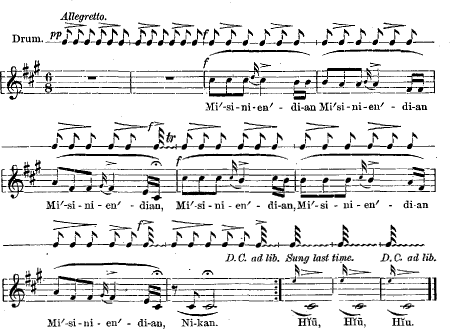
Mi´-si-ni-en´-di-an Mi´si-ni-en´-di-an Mi´-si-ni-en´-dian,
Mi´-si-ni-en´-di-an, Mi´-si-ni-en´-di-an Mi´-si-ni-en´-di-an,
Mi´-si-ni-en´-di-an, Mi´-si-ni-en´-di-an Mi´-si-ni-en´-di-an,
Ni-kan. Hĭū, Hĭū, Hĭu.
MIDI files: drum, flute, piano
The words of the text signify, “This is what I am, my fellow Midē´; I fear all my fellow Midē´.” The last syllables, hĭū´, are meaningless.
At the conclusion of the song the preceptor prompts the candidate to ask the chief Midē´:
Ni-kan´ k´kĕ´-nō´-mo´, man-dzhi´-an na´-ka-mō´-in.
Colleague instruct me, give me a song.
In response to which the Midē´ teaches him the following, which is uttered as a monotonous chant, viz:
We´-go-nĕn´ ge-gwed´-dzhi-me-an´, mi-dē´-wi-wĭn ke-kwed´-dzhi-me-an´?
What are you asking, grand medicine are you asking?
Ki´-ka-mi´-nin en-da-wĕn´-da ma-wi´-nĕn mi-dē´-wi-wĭn
I will give you you want me to give you “grand medicine”
tshi-da-si-nē´-ga´-na-win´-da-mōn; ki-ĭn´-tshun-di´-nĕ-ma´-so-wĭn,
always take care of; you have received it yourself,
tsho´-a-wa´-nin di´-sĕ-wan.
never forget.
To this the candidate, who is now a member, replies, ēn, yes, i.e., assent, fully agreeing with the statement made by the Midē´, and adds:
Mi-gwĕtsh´ a-shi´-wa-ka-kish´-da-win be-mâ´-di-si´-an.
Thanks for giving to me life.
Then the priests begin to look around in search of spaces in which to seat themselves, saying:
Mi´-a-shi´-gwa ki´-tshi-an´-wâ-bin-da-man tshi-ō´-we-na´-bi-an.
Now is the time I look around where we shall be [sit].
and all go to such places as are made, or reserved, for them.
The new member then goes to the pile of blankets, robes, and other gifts and divides them among the four officiating priests, reserving some of less value for the preceptor and his assistant; whereas tobacco is carried around to each person present. All then make an offering of smoke, to the east, south, west, north, toward the center and top of the Midē´wigân—where Ki´tshi Man´idō presides—and to the earth. Then each person blows smoke upon his or her Midē´ sack as an offering to the sacred mī´gis within.
The chief Midē´ advances to the new member and presents him with a new Midē´ sack, made of an otter skin, or possibly of the skin of the mink or weasel, after which he returns to his place. The new member rises, approaches the chief Midē´, who inclines his head to the front, and, while passing both flat hands down over either side,
Mi-gwĕtsh´, ni-ka´-ni, ni-ka´-ni, ni-ka´-ni, na-ka´.
Thanks, my colleagues, my colleagues, my colleagues.
Then, approaching the next in rank, he repeats the ceremony and continues to do so until he has made the entire circuit of the Midē´wigân.
At the conclusion of this ceremony of rendering thanks to the members of the society for their presence, the newly elected Midē´ returns to his place and, after placing within his Midē´ sack his mī´gis, starts out anew to test his own powers. He approaches the person seated nearest the eastern entrance, on the south side, and, grasping his sack in a manner similar to that of the officiating priests, makes threatening motions toward the Midē´ as if to shoot him, saying, “yâ, hŏ´, hŏ´, hŏ´, hŏ´, hŏ´,” gradually raising his voice to a higher key. At the fourth movement he makes a quick thrust toward his victim, whereupon the latter falls forward upon the ground. He then proceeds to the next, who is menaced in a similar manner and who likewise becomes apparently unconscious from the powerful effects of the mī´gis. This is continued until all persons present have been subjected to the influence of the mī´gis in the possession of the new member. At the third or fourth experiment the first subject revives and sits up, the others recovering in regular order a short time after having been “shot at,” as this procedure is termed.
When all of the Midē´ have recovered a very curious ceremony takes place. Each one places his mī´gis shell upon the right palm and, grasping the Midē´ sack with the left hand, moves around the inclosure and exhibits his mī´gis to everyone present, constantly uttering the word “hŏ´, hŏ´, hŏ´, hŏ´,” in a quick, low tone. During this period there is a mingling of all the persons present, each endeavoring to attract the attention of the others. Each Midē´ then
Food is then brought into the Midē´wigân and all partake of it at the expense of the new member.
After the feast, the older Midē´ of high order, and possibly the officiating priests, recount the tradition of the Ani´shinâ´bēg and the origin of the Midē´wiwin, together with speeches relating to the benefits to be derived through a knowledge thereof, and sometimes, tales of individual success and exploits. When the inspired ones have given utterance to their thoughts and feelings, their memories and their boastings, and the time of adjournment has almost arrived, the new member gives an evidence of his skill as a singer and a Midē´. Having acted upon the suggestion of his preceptor, he has prepared some songs and learned them, and now for the first time the opportunity presents itself for him to gain admirers and influential friends, a sufficient number of whom he will require to speak well of him, and to counteract the evil which will be spoken of him by enemies—for enemies are numerous and may be found chiefly among those who are not fitted for the society of the Midē´, or who have failed to attain the desired distinction.
The new member, in the absence of a Midē´ drum of his own, borrows one from a fellow Midē´ and begins to beat it gently, increasing the strokes in intensity as he feels more and more inspired, then sings a song (Pl. X, D), of which the following are the words, each line being repeated ad libitum, viz:

Plate X.d. Mnemonic Song.
We´-nen-wi´-wik ka´-ni-an. The spirit has made sacred the place in which I live. The singer is shown partly within, and partly above his wigwam, the latter being represented by the lines upon either side, and crossing his body.

En´-da-yan´ pi-ma´-ti-su´-i-ŭn en´-da-yan´. The spirit gave the “medicine” which we receive. The upper inverted crescent is the arch of the sky, the magic influence descending, like rain upon the earth, the latter being shown by the horizontal line at the bottom.

Rest.
Nin´-nik-ka´-ni man´-i-dō. I too have taken the medicine he gave us. The speaker’s arm, covered with mī´gis, or magic influence, reaches toward the sky to receive from Ki´tshi Man´idō the divine favor of a Midē’s power.

Ke-kĕk´-ō-ĭ-yan´. I brought life to the people. The Thunderer, the one who causes the rains, and consequently life to vegetation, by which the Indian may sustain life.

Be-mo´-se ma-kō-yan. I have come to the medicine lodge also. The Bear Spirit, one of the guardians of the Midē´wiwin, was also present, and did not oppose the singer’s entrance.

Ka´-ka-mi´-ni-ni´-ta. We spirits are talking together. The singer compares himself and his colleagues to spirits, i.e., those possessing supernatural powers, and communes with them as an equal.

O-ni´-ni-shĭnk-ni´-yo. The mī´gis is on my body. The magic power has been put into his body by the Midē priests.

Ni man´-i-dō ni´-yăn. The spirit has put away all my sickness. He has received new life, and is, henceforth, free from the disturbing influences of evil man´idōs.

As the sun approaches the western horizon, the Midē´ priests emerge from the western door of the Midē´wigân and go to their respective wig´iwams, where they partake of their regular evening repast, after which the remainder of the evening is spent in paying calls upon other members of the society, smoking, etc.
The preceptor and his assistant return to the Midē´wigân at nightfall, remove the degree post and plant it at the head of the wig´iwam—that part directly opposite the entrance—occupied by the new member. Two stones are placed at the base of the post, to represent the two forefeet of the bear Man´idō through whom life was also given to the Ani´shinâ´bēg.
If there should be more than one candidate to receive a degree the entire number, if not too great, is taken into the Midē´wigân for initiation at the same time; and if one day suffices to transact the
DESCRIPTIVE NOTES.
The mī´gis referred to in this description of the initiation consists of a small white shell, of almost any species, but the one believed to resemble the form of the mythical mī´gis is similar to the cowrie, Cypræa moneta, L., and is figured at No. 1 on Pl. XI. Nearly all of the shells employed for this purpose are foreign species, and have no doubt been obtained from the traders. The shells found in the country of the Ojibwa are of rather delicate structure, and it is probable that the salt water shells are employed as a substitute chiefly because of their less frangible character. The mī´gis of the other degrees are presented on the same plate, but special reference to them will be made. No. 2 represents the mī´gis in the possession of the chief Midē priest of the society at Leech Lake, Minnesota, and consists of a pearl-white Helix (sp?).
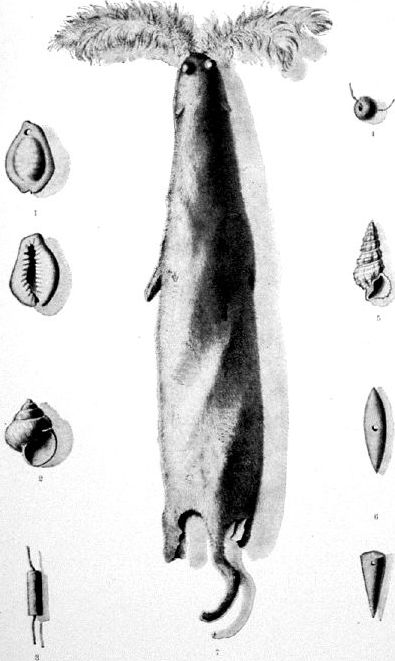
Plate XI. Sacred Objects.
The Midē´ sack represented in No. 7 (Pl. XI.) is made of the skin of a mink—Putorius vison, Gapp. White, downy feathers are secured to the nose, as an additional ornament. In this sack are carried the sacred objects belonging to its owner, such as colors for facial ornamentation, and the magic red powder employed in the preparation of hunters’ songs; effigies and other contrivances to prove to the incredulous the genuineness of the Midē´ pretensions, sacred songs, amulets, and other small man´idōs—abnormal productions to which they attach supernatural properties—invitation sticks, etc.
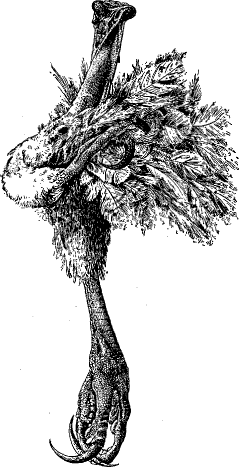
Fig. 19.—Hawk-leg fetish.
Fig. 19 is reproduced a curious abnormal growth which was in the possession of a Midē´ near Red Lake, Minnesota. It consists of the leg of a Goshawk—Astur atricapillus, Wilson—from the outer inferior condyle of the right tibia of which had projected a supernumerary leg that terminated in two toes, the whole abnormality being about one-half the size and length of the natural leg and toes.
This fetish was highly prized by its former owner, and was believed to be a medium whereby the favor of the Great Thunderer, or Thunder God, might be invoked and his anger appeased. This deity is represented in pictography by the eagle, or frequently by one of the Falconidæ; hence it is but natural that the superstitious should look with awe and reverence upon such an abnormality on one of the terrestrial representatives of this deity.
A Midē´ of the first degree, who may not be enabled to advance further in the mysteries of the Midē´wiwin, owing to his inability to procure the necessary quantity of presents and gifts which he is required to pay to new preceptors and to the officiating priests—the latter demanding goods of double the value of those given as an entrance to the first degree—may, however, accomplish the acquisition of additional knowledge by purchasing it from individual Midē´. It is customary with Midē´ priests to exact payment for every individual remedy or secret that may be imparted to another who may desire such information. This practice is not entirely based upon mercenary motives, but it is firmly believed that when a secret or remedy has been paid, for it can not be imparted for nothing, as then its virtue would be impaired, if not entirely destroyed, by the man´idō or guardian spirit under whose special protection it may be supposed to be held or controlled.
Under such circumstances certain first degree Midē´ may become possessed of alleged magic powers which are in reality part of the accomplishments of the Midē´ of the higher degrees; but, for the mutual protection of the members of the society, they generally hesitate to impart anything that may be considered of high value. The usual kind of knowledge sought consists of the magic properties and use of plants, to the chief varieties of which reference will be made in connection with the next degree.
There is one subject, however, which first-degree Midē´ seek enlightment upon, and that is the preparation of the “hunter’s medicine” and the pictographic drawings employed in connection therewith. The compound is made of several plants, the leaves and roots of which are ground into powder. A little of this is put into the gun barrel, with the bullet, and sometimes a small pinch is dropped upon the track of the animal to compel it to halt at whatever place it may be when the powder is so sprinkled upon the ground.
The method generally employed to give to the hunter success is as follows: When anyone contemplates making a hunting trip, he first visits the Midē´, giving him a present of tobacco before announcing

Fig. 20.—Hunter’s medicine.
Frequently the heart is indicated by a round or triangular figure, from which a line extends toward the mouth, generally designated the life line, i.e., that magic power may reach its heart and influence the life of the subject designated. Fig. 20 is a reproduction of the character drawn upon a small oval piece of birch bark, which had been made by a Midē´ to insure the death of two bears. Another example is presented in Fig. 21, a variety of animals being figured and a small quantity of vermilion being rubbed upon the heart of each. In some instances the representation of animal forms is drawn by the Midē´ not upon birch bark, but directly upon sandy earth or a bed of ashes, either of which affords a smooth surface. For this purpose he uses a sharply pointed piece of wood, thrusts it into the region of the heart, and afterwards sprinkles upon this a small quantity of powder consisting of magic plants and vermilion. These performances are not conducted in public, but after the regular mystic ceremony has been conducted by the Midē´ the information is delivered with certain injunctions as to the course of procedure, direction,
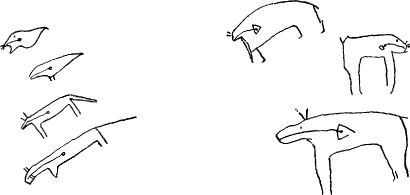
Fig. 21.—Hunter’s medicine.
For the purpose of gaining instruction and success in the disposition of his alleged medicines, the Midē´ familiarizes himself with the topography and characteristics of the country extending over a wide area, to ascertain the best feeding grounds of the various animals and their haunts at various seasons. He keeps himself informed by also skillfully conducting inquiries of returning hunters, and thus becomes possessed of a large amount of valuable information respecting the natural history of the surrounding country, by which means he can, with a tolerable amount of certainty, direct a hunter to the best localities for such varieties of game as may be particularly desired by him.
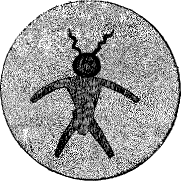
Fig. 22.—Wâbĕnō´ drum.
In his incantations a Wâbĕnō´ uses a drum resembling a tambourine. A hoop made of ash wood is covered with a piece of rawhide, tightly stretched while wet. Upon the upper surface is painted a mythic figure, usually that of his tutelaly daimon. An example of this kind is from Red Lake, Minnesota, presented in Fig. 22. The human figure is painted red, while the outline of the head is black, as are also the waving lines extending from the head. These lines denote superior power. When drumming upon this figure, the Wâbĕnō´ chants and is thus more easily enabled to invoke the assistance of his man´idō.
Women, as before remarked, may take the degrees of the Midē´wiwin, but, so far as could be ascertained, their professions pertain chiefly to the treatment of women and children and to tattooing for the cure of headache and chronic neuralgia.
Tattooing is accomplished by the use of finely powdered charcoal, soot or gunpowder, the pricking instrument being made by tying together a small number of needles; though formerly, it is said, fish spines or sharp splinters of bone were used for the purpose. The marks consist of round spots of one-half to three-fourths of an inch in diameter immediately over the afflicted part, the intention being to drive out the demon. Such spots are usually found upon the temples, though an occasional one may be found on the forehead or over the nasal eminence.
When the pain extends over considerable space the tattoo marks are smaller, and are arranged in rows or continuous lines. Such marks may be found upon some individuals to run outward over either or both cheeks from the alæ of the nose to a point near the
The female Midē´ is usually present at the initiation of new members, but her duties are mainly to assist in the singing and to make herself generally useful in connection with the preparation of the medicine feast.
SECOND DEGREE.
The inclosure within which the second degree of the Midē´wiwin is conferred, resembles in almost every respect that of the first, the only important difference being that there are two degree posts instead of one. A diagram is presented in Fig. 23. The first post is planted a short distance beyond the middle of the floor—toward the western door—and is similar to the post of the first degree, i.e., red, with a band of green around the top, upon which is perched the stuffed body of an owl; the kŏ-ko´-kŏ-ō´. The second post, of similar size, is painted red, and over the entire surface of it are spots of white made by applying clay with the finger tips. (Pl. XV, No. 2.) These spots are symbolical of the sacred mī´gis, the great number of them denoting increased power of the magic influence which fills the Midē´wigân. A small cedar tree is also planted at each of the outer angles of the inclosure.
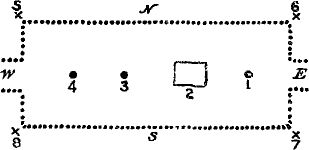
Fig. 23.—Diagram of Midē´wigân of the second degree.
The sweat-lodge, as before, is erected at some distance east of the main entrance of the Midē´wigân, but a larger structure is arranged upon a similar plan; more ample accommodations must be provided to permit a larger gathering of Midē´ priests during the period of preparation and instruction of the candidate.
PREPARATION OF CANDIDATE.
A Midē´ of the first degree is aware of the course to be pursued by him when he contemplates advancement into the next higher grade. Before making known to the other members his determination, he is compelled to procure, either by purchase or otherwise, such a quantity of blankets, robes, peltries, and other articles of apparel or ornament as will amount in value to twice the sum at which were estimated the gifts presented at his first initiation. A year or more usually elapses before this can be accomplished, as but one hunting season intervenes before the next annual meeting of the society, when furs are in their prime; and fruits and maple sugar can be gathered but once during the season, and these may be converted into money with which to purchase presents not always found
For acting in the capacity of instructor, a Midē´ priest receives blankets, horses, and whatever may be mutually agreed upon between himself and his pupil. The meetings take place at the instructor’s wig´iwam at intervals of a week or two; and sometimes during the autumn months, preceding the summer in which the initiation is to be conferred, the candidate is compelled to resort to a sudatory and take a vapor bath, as a means of purgation preparatory to his serious consideration of the sacred rites and teachings with which his mind “and heart” must henceforth be occupied, to the exclusion of everything that might tend to divert his thoughts.
What the special peculiarities and ceremonials of initiation into the second degree may have been in former times, it is impossible to ascertain at this late day. The only special claims for benefits to be derived through this advancement, as well as into the third and fourth degrees, are, that a Midē´ upon his admission into a new degree receives the protection of that Man´idō alleged and believed to be the special guardian of such degree, and that the repetition of initiation adds to the magic powers previously received by the initiate. In the first degree the sacred mīgis was “shot” into the two sides, the heart, and head of the candidate, whereas in the second degree this sacred, or magic, influence, is directed by the priests Pl. III. The second, third, and fourth degrees are practically mere repetitions of the first, and the slight differences between them are noted under their respective captions.
In addition to a recapitulation of the secrets pertaining to the therapeutics of the Midē´, a few additional magic remedies are taught the candidate in his preparatory instruction. The chief of these are described below.
Ma-kwa´ wī´-i-sŏp, “Bear’s Gall,” and Pi´-zhi-ki wī´-i-sŏp, “Ox Gall,” are both taken from the freshly killed animal and hung up to dry. It is powdered as required, and a small pinch of it is dissolved in water, a few drops of which are dropped into the ear of a patient suffering from earache.
Gō´-gi-mish (gen. et sp.?).—A plant, described by the preceptor as being about 2 feet in height, having black bark and clusters of small red flowers.
1. The bark is scraped from the stalk, crushed and dried. When it is to be used the powder is put into a small bag of cloth and soaked in hot water to extract the virtue. It is used to expel evil man´idōs which cause obstinate coughs, and is also administered to consumptives. The quantity of bark derived from eight stems, each 10 inches long, makes a large dose. When a Midē´ gives this medicine to a patient, he fills his pipe and smokes, and before the tobacco is all consumed the patient vomits.
2. The root of this plant mixed with the following is used to produce paralysis of the mouth. In consequence of the power it possesses it is believed to be under the special protection of the Midē´ Man´idō, i.e., Ki´tshi Man´idō.
The compound is employed also to counteract the evil intentions, conjurations, or other charms of so-called bad Midē´, Wâbĕnō´, and Jĕs´sakkīd´.
Tzhi-bē´-gŏp—“Ghost Leaf.”
After the cuticle is removed from the roots the thick under-bark is crushed into a powder. It is mixed with Gō´gimish.
Dzhi-bai´-ĕ-mŏk´-ke-zĭn´—“Ghost Moccasin;” “Puff-ball.”
The spore-dust of the ball is carefully reserved to add to the above mixture.
O-kwē´-mish—“Bitter Black Cherry.”
The inner bark of branches dried and crushed is also added.
Nē´-wĕ—“Rattlesnake” (Crotalus durissus, L.).
The reptile is crushed and the blood collected, dried, and used in a pulverulent form. After partially crushing the body it is hung up and the drippings collected and dried. Other snakes may be employed as a substitute.
It is impossible to state the nature of the plants mentioned in the above compound, as they are not indigenous to the vicinity of White Earth, Minnesota, but are procured from Indians living in the eastern extremity of the State and in Wisconsin. Poisonous plants are of rare occurrence in this latitude, and if any actual poisonous properties exist in the mixture they may be introduced by the Indian himself, as strychnia is frequently to be purchased at almost any of the stores, to be used in the extermination of noxious animals. Admitting that crotalus venom may be present, the introduction into the human circulation of this substance would without doubt produce death and not paralysis of the facial muscles, and if taken into the stomach it quickly undergoes chemical change when brought in contact with the gastric juice, as is well known
I mention this because of my personal knowledge of six cases at White Earth, in which paralysis of one side of the face occurred soon after the Midē´ administered this compound. In nearly all of them the distortion disappeared after a lapse of from six weeks to three months, though one is known to have continued for several years with no signs of recovery. The Catholic missionary at White Earth, with whom conversation was held upon this subject, feels impressed that some of the so-called “bad Midē´” have a knowledge of some substance, possibly procured from the whites, which they attempt to employ in the destruction of enemies, rivals, or others. It may be possible that the instances above referred to were cases in which the dose was not sufficient to kill the victim, but was enough to disable him temporarily. Strychnia is the only substance attainable by them that could produce such symptoms, and then only when given in an exceedingly small dose. It is also alleged by almost every one acquainted with the Ojibwa that they do possess poisons, and that they employ them when occasion demands in the removal of personal enemies or the enemies of those who amply reward the Midē´ for such service.
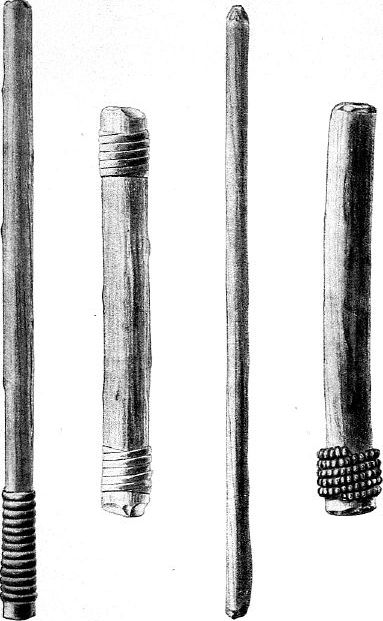
Plate XII. Invitation Sticks.
When the time of ceremony of initiation approaches, the chief Midē´ priest sends out a courier to deliver to each member an invitation to attend (Pl. XII), while the candidate removes his wig´iwam to the vicinity of the place where the Midē´wigân has been erected. On the fifth day before the celebration he visits the sweat-lodge, where he takes his first vapor bath, followed on the next by another; on the following day he takes the third bath, after which his preceptor visits him. After making an offering to Ki´tshi Man´iō the priest sings a song, of which the characters are reproduced in Pl. XIII, A. The Ojibwa words employed in singing are given in the first lines, and are said to be the ancient phraseology as taught for many generations. They are archaic, to a great extent, and have additional meaningless syllables inserted, and used as suffixes which are intoned to prolong notes. The second line of the Ojibwa text consists of the words as they are spoken at the present time, to each of which is added the interpretation. The radical similarity between the two is readily perceived.

Plate XIII.a. Mnemonic Song.
Hi´-na-wi´-a-ni-kan. (As sung.) We´-me-a´ ni-kan mi´-sha man´-i-dō I am crying my colleague great spirit. ni-wa´-ma-bi-go´ ma´-wĭ-yan´. He sees me crying. [The singer is represented as in close relationship or communion with Ki´tshi Man´idō, the circle denoting union; the short zigzag lines within which, in this instance, represent the tears, i.e., “eye rain,” directed toward the sky.]

Ki-nŭn´-no, hē´, ki-mun´-i-dō´-we, hē´, esh´-i-ha´-ni. (As sung.) Gi-nŭn´-dōn ni-kan´ ē-zhi-an. I hear you, colleague, what you say to me. [The singer addresses the Otter Spirit, whose figure is emerging from the Midē´wigân of which he is the chief guardian.]

Tē´-ti-wâ´-tshi-wi-mō´ a-ni´-me-ga´-si. (As sung.) Tē´-ti-wâ´-tshŏ-tâg´ ni-mī´-gĭ-sĭm. He will tell you (—inform you) [of] my migis. tē´-ti-wa´-tshĭ-mo-ta´ âg. He it is who will tell you. [The reference is to a superior spirit as indicated by the presence of horns, and the zigzag line upon the breast. The words signify that Ki´tshi Man´idō will make known to the candidate the presence within his body of the mī´gis, when the proper time arrives.]

Rest, or pause, in the song.
During this interval another smoke offering is made, in which the Midē´ priest is joined by the candidate.
Hĭu´-a-me´-da-ma´ ki´-a-wēn´-da-mag man´-i-dō´-wĭt hĭu´-a-wen´-da-mag. (As sung.) Ki-wĭn´-da-mag´-ū-nan man´-i-dō´-wid. He tells us he is [one] of the man´idōs. [This ma´nidō is the same as that referred to in the above-named phrase. This form is different, the four spots denoting the four sacred mī´gis points upon his body, the short radiating lines referring to the abundance of magic powers with which it is filled.]

Wa´-sa-wa´-dī, hē´, wen´-da-na-ma´, mĭ-tē´-win. (As sung.) Wa´-sa-wa´-dŭn´-da-na-ma´ I get it from afar mi-dē´-wi-wĭn´. The “grand medicine.” [The character represents a leg, with a magic line drawn across the middle, to signify that the distance is accomplished only through the medium of supernatural powers. The place “from afar” refers to the abode of Ki´tshi Man´idō.]

Ki-go´-na-bi-hin ē´-ni-na mi-tē´. (As sung.) Kin-do´-na-bī-in´ mi-dē´-wi-wĭn-ni-ni´ I place you there “in the grand medicine” (among the “Midē´ people”) a-bit´-da-win´. Half way (in the Midē´wigân). [The Midē´ priest informs the candidate that the second initiation will advance the candidate half way into the secrets of the Midē´wigân. The candidate is then placed so that his body will have more magic influence and power as indicated by the zigzag lines radiating from it toward the sky.]

Hi´-sha-we-ne´-me-go´, hē´, nē´. Ni-go´-tshi-mi, hē´. (As sung.) Ni´-sha-we´-ni-mi-go´ ĕ´-ne-mâ´-bi-dzhĭk. They have pity on me those who are sitting here. [This request is made to the invisible man´idōs who congregate in the Mide´wigân during the ceremonies, and the statement implies that they approve of the candidate’s advancement.]

Another smoke offering is made upon the completion of this song, after which both individuals retire to their respective habitations. Upon the following day, that being the one immediately preceding the day of ceremony, the candidate again repairs to the sudatory to take a last vapor bath, after the completion of which he awaits the coming of his preceptor for final conversation and communion with man´idōs respecting the step he is prepared to take upon the morrow.
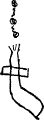
The preceptor’s visit is merely for the purpose of singing to the candidate, and impressing him with the importance of the rites of the Midē´wigân. After making the usual offering of tobacco smoke the preceptor becomes inspired and sings a song, the following being a reproduction of the one employed by him at this stage of the preparatory instruction. (See Pl. XIII, B.)
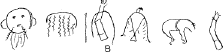
Plate XIII.b. Mnemonic Song.
Man´-i-dō´, hē´, nē, man´-i-dō´, hē´, nē´. Spirit, spirit, Ni´-man-i-dō´ win´-da-bi-an´. I am a spirit (is) the reason why I am here. [The zigzag lines extending downward and outward from the mouth indicate singing. He has reached the power of a man´idō, and is therefore empowered to sit within the sacred inclosure of the Midē´wigân, to which he alludes.]

Da´-bī-wā-ni´, ha´, hē´, An´-nĭn, e-kō´-wē-an´. Drifting snow, why do I sing. [The first line is sung, but no interpretation of the words could be obtained, and it was alleged that the second line contained the idea to be expressed. The horizontal curve denotes the sky, the vertical zigzag lines indicating falling snow—though being exactly like the lines employed to denote rain. The drifting snow is likened to a shower of delicate mī´gis shells or spots, and inquiry is made of it to account for the feeling of inspiration experienced by the singer, as this shower of mī´gis descends from the abode of Ki´tshi Man´idō and is therefore, in this instance, looked upon as sacred.]

Rest, or pause.
Gi-man´-i-dō´-wē, ni´-me-ne´-ki-nan´ wan-da. Gi´-a-wĭngk, gi-man´-i-dō´-a-ni-min´, Your body, I believe it is a spirit. Gi-a-wĭngk. your body. [The first line is sung, but the last word could not be satisfactorily explained. The first word, as now pronounced, is Ki´tshi Man´idō, and the song is addressed to him. The curved line, from which the arm protrudes, is the Midē´wigân and the arm itself is that of the speaker in the attitude of adoration: reaching upward in worship and supplication.]

Pi-nē´-si ne´-pi-mi´-a nin´-ge-gē´-kwe-an The bird as I promise the falcon mi-we´-tshi-man´-i-dō´-wid. the reason he is a spirit. [The second word is of archaic form and no agreement concerning its correct signification could be reached by the Midē´. The meaning of the phrase appears to be that Ki´tshi Man´idō promised to create the Thunder-bird, one of the man´idōs. The falcon is here taken as a representative of that deity, the entire group of Thunderers being termed a-ni´-mi-ki´.]

Zhīn´-gwe mi´-shi-ma-kwa´ Makes a great noise the bear. wen´-dzhi-wa-ba-mok-kwēd´ kŭn-nēt´. the reason I am of flame. [The character of the bear represents the great bear spirit of the malevolent type, a band about his body indicating his spirit form. By means of his power and influence the singer has become endowed with the ability of changing his form into that of the bear, and in this guise accomplishing good or evil. The reference to flame (fire) denotes the class of conjurers or Shamans to which this power is granted, i.e., the Wâbĕnō´, and in the second degree this power is reached as will be referred to further on.]

Ni´-a-wen´-din-da-sa´, ha´, sa´, man´-i-dō´-wid. Gi´-a-wĭngk in´-do-sa man´-i-dō´-wid. In your body I put it the spirit. [The first line is sung, and is not of the modern style of spoken language. The second line signifies that the arm of Ki´tshi Man´idō, through the intermediary of the Midē´ priest, will put the spirit, i.e., the mī´gis, into the body of the candidate.]

The singer accompanies his song either by using a short baton of wood, termed “singing stick” or the Midē´ drum. After the song is completed another present of tobacco is given to the preceptor, and after making an offering of smoke both persons return to their respective wig´iwams. Later in the evening the preceptor calls upon the candidate, when both, with the assistance of friends, carry the presents to the Midē´wigân, where they are suspended from the rafters,
INITIATION OF CANDIDATE.
The candidate proceeds early on the morning of the day of initiation to take possession of the sweat-lodge, where he awaits the coming of his preceptor and the eight officiating priests. He has an abundance of tobacco with which to supply all the active participants, so that they may appease any feeling of opposition of the man´idōs toward the admission of a new candidate, and to make offerings of tobacco to the guardian spirit of the second degree of the Midē´wiwin. After the usual ceremony of smoking individual songs are indulged in by the Midē´ priests until such time as they may deem it necessary to proceed to the Midē´wigân, where the members of the society have long since gathered and around which is scattered the usual crowd of spectators. The candidate leads the procession from the sweat-lodge to the eastern entrance of the Midē´wigân, carrying an ample supply of tobacco and followed by the priests who chant. When the head of the procession arrives at the door of the sacred inclosure a halt is made, the priests going forward and entering. The drummer, stationed within, begins to drum and sing, while the preceptor and chief officiating priest continue their line of march around the inclosure, going by way of the south or left hand. Eight circuits are made, the last terminating at the main or eastern entrance. The drumming then ceases and the candidate is taken to the inner side of the door, when all the members rise and stand in their places. The officiating priests approach and stand near the middle of the inclosure, facing the candidate, when one of them says to the Midē´ priest beside the latter: O-da´-pin a-sē´-ma—“Take it, the tobacco,” whereupon the Midē´ spoken to relieves the candidate of the tobacco and carries it to the middle of the inclosure, where it is laid upon a blanket spread upon the ground. The preceptor then takes from the cross-poles some of the blankets or robes and gives them to the candidate to hold. One of the malevolent spirits which oppose the entrance of a stranger is still supposed to remain with the Midē´wigân, its body being that of a serpent, like flames of fire, reaching from the earth to the sky. He is called I´-shi-ga-nē´-bĭ-gŏg—“Big-Snake.” To appease his anger the candidate must make a present; so the preceptor says for the candidate:
Ka-wī´n-nĭ-na-ga´ wa´-ba-ma´-si-ba´-shĭ-gi´-ne-gēt´?
Do you not see how he carries the goods?
This being assented to by the Midē´ priests the preceptor takes the blankets and deposits them near the tobacco upon the ground. Slight taps upon the Midē´ drum are heard and the candidate is led Pl. XIII, C). A song is part of the ritual, though it is not necessary that the candidate should sing it, as the preceptor may do so for him. In the instance under my observation the song was an old one (which had been taught the candidate), as the archaic form of pronunciation indicates. Each of the lines is repeated as often as the singer may desire, the prolongation of the song being governed by his inspired condition. The same peculiarity governs the insertion, between words and at the end of lines, of apparently meaningless vowel sounds, to reproduce and prolong the last notes sounded. This may be done ad libitum, rythmical accentuation being maintained by gently tapping upon the Midē´ drum.

Plate XIII.c. Mnemonic Song.
Hĭa´-ni-de hĕn´-da man´-i-dō, hō´, ni´-sha-bon´-de man´-i-dō´-en-dât. Where is the spirit lodge? I go through it. [The oblong structure represents the Midē´wigân, the arm upon the left indicating the course of the path leading through it, the latter being shown by a zigzag line.]

Nin-gō´-sa mĭ-dē´-kwe ni-ka´ na´-ska-wa´. I am afraid of the “grand medicine” woman; I go to her. A leg is shown to signify locomotion. The singer fears the opposition of a Midē´ priestess and will conciliate her.

Ka-ni-sa´ hi´-a-tshi´-mĭn-dē´ man´-ski-kī´, dē´, hē´, hē´. Kinsmen who speak of me, they see the striped sky. A person of superior power, as designated by the horns attached to the head. The lines from the mouth signify voice or speech, while the horizontal lines denote the stratus clouds, the height above the earth of which illustrates the direction of the abode of the spirit whose conversation, referring to the singer, is observed crossing them as short vertical zigzag lines; i.e., voice lines.

Ke´-na-nan´-do-mē´ ko-nō´-ne-nak ka-ne-hē´ nin-ko´-tshi nan´-no-me´. The cloud looks to me for medicine. [The speaker has become so endowed with the power of magic influence that he has preference with the superior Man´idōs. The magic influence is shown descending to the hand which reaches beyond the cloud indicated by the oblong square upon the forearm.]
Rest, after which dancing begins.
Wa-tshu´-a-nē´ ke´-ba-bing´-e-on´, wa-dzhū. Going into the mountains. The singer’s thoughts go to the summit to commune with Ki´tshi Man´idō. He is shown upon the summit.

Hi´-mĕ-de´-wa hen´-dĕ-a he´-na. The grand medicine affects me. In his condition he appeals to Ki´tshi Man´idō for aid. The arms represent the act of supplication.

Hai´-an-go ho´-ya o´-gĕ-ma, ha´. The chief goes out. The arms grasp a bear—the Bear Man´idō—and the singer intimates that he desires the aid of that powerful spirit, who is one of the guardians of the Midē´wigân.

Nish´-o-wē´ ni-mē´-hi-gō´, hē´, ni-gō´-tshi-mi´-go-we, hē´. Have pity on me wherever I have medicine. The speaker is filled with magic influence, upon the strength of which he asks the Bear to pity and to aid him.

Wi´-so-mi´-ko-wē´ hĕ-a-za-we´-ne-ne-gō´, hō´. I am the beaver; have pity on me. This is said to indicate that the original maker of the mnemonic song was of the Beaver totem or gens.

Hēn´-ta-no-wik´-ko-we´ de-wĕn´-da ĕn-da-â´-dân. I wish to know what is the matter with me. The singer feels peculiarly impressed by his surroundings in the Midē´wigân, because the sacred man´idōs have filled his body with magic powers. These are shown by the zigzag or waving lines descending to the earth.

As each of the preceding lines or verses is sung in such a protracted manner as to appear like a distinct song, the dancers, during the intervals of rest, always retire to their places and sit down.
As the dancing ceases, and all are in their proper seats, the preceptor, acting for the candidate, approaches the pile of tobacco and distributes a small quantity to each one present, when smoking is indulged in, preceded by the usual offering to the east, the south, the west, the north, the sky and the earth.
After the completion of this ceremonial an attendant carries the Midē´ drum to the southeast angle of the inclosure, where it is delivered to the drummer; then the officiating priests rise and approach within two or three paces of the candidate as he gets upon his knees. The preceptor and the assistant who is called upon by him take their places immediately behind and to either side of the candidate, and the Midē´ priest lowest in order of precedence begins to utter quick, deep tones, resembling the sound hŏ´, hŏ´, hŏ´, hŏ´, hŏ´, at the same time grasping his midē´ sack with both hands, as if it were a gun, and moving it in a serpentine and interrupted manner toward one of the large joints of the candidate’s arms or legs. At the last utterance of this sound he produces a quick puff with the breath and thrusts the bag forward as if shooting, which he pretends to do, the missile being supposed to be the invisible sacred mī´gis. The other priests follow in order from the lowest to the highest, each selecting a different joint, during which ordeal the candidate trembles more and more violently until at last he is overcome with the magic influence and falls forward upon the ground unconscious. The Midē´ priests then lay their sacks upon his back, when the candidate begins to recover and spit out the mī´gis shell which he had previously hidden within his mouth. Then the chief Midē´ takes it up between the tips of the forefinger and thumb and goes through the ceremony described in connection with the initiation into the first degree, of holding it toward the east, south, west, north, and the sky, and finally to the mouth of the candidate, when the latter, who has partly recovered from his apparently insensible condition, again relapses into that state. The eight priests then place their sacks to the respective joints at which they previously directed them, which fully infuses the body with the magic influence as desired. Upon this the candidate recovers, takes up the mī´gis shell and, placing it upon his left palm, holds it forward and swings it from side to side, saying he!
Mi-gwĕtsh´ ga-shi-tō´-win bi-mâ´-dĭ-si-wĭn,
Thanks for giving to me life,
after which he retreats a step, and clasping his hands and bowing toward the priest, says:
Ni-ka´-ni ni-ka´ni ni-ka´-ni ka-nia´,
fellow midē´ fellow midē´ fellow midē´,
to which each responds hau´, ēn. The word hau´ is a term of approbation, ēn signifying yes, or affirmation, the two thus used together serving to intensify the expression. Those of the Midē´ present who are of the second, or even some higher degree, then indulge in the ceremony of passing around to the eastern part of the inclosure, where they feign coughing and gagging, so as to produce from the mouth the mī´gis shell, as already narrated in connection with the first degree, p. 192.
This manner of thanking the officiating Midē´ for their services in initiating the candidate into a higher degree is extended also to those members of the Midē´wiwin who are of the first degree only, in acknowledgment of the favor of their presence at the ceremony, they being eligible to attend ceremonial rites of any degree higher than the class to which they belong, because such men are neither benefited nor influenced in any way by merely witnessing such initiation, but they must themselves take the principal part in it to receive the favor of a renewed life and to become possessed of higher power and increased magic influence.
Various members of the society indulge in short harangues, recounting personal exploits in the performance of magic and exorcism, to which the auditors respond in terms of gratification and exclamations of approval. During these recitals the ushers, appointed for the purpose, leave the inclosure by the western door to return in a short time with kettles of food prepared for the midē´ feast. The ushers make four circuits of the interior, giving to each person present a quantity of the contents of the several vessels, so that all receive sufficient to gratify their desires. When the last of the food has been consumed, or removed, the midē´ drum is heard, and soon a song is started, in which all who desire join. After the first two or three verses of the song are recited, a short interval of
The ushers, assisted by the chief Midē´, then remove the sacred post from the inclosure and arrange the interior for new initiations, either of a lower or higher class, if candidates have prepared and presented themselves. In case there is no further need of meeting again at once, the members of the society and visitors return upon the following day to their respective homes.
DESCRIPTIVE NOTES.
The mī´gis shell employed in the second degree initiation is of the same species as those before mentioned. At White Earth, however, some of the priests claim an additional shell as characteristic of this advanced degree, and insist that this should be as nearly round as possible, having a perforation through it by which it may be secured with a strand or sinew. In the absence of a rounded white shell a bead may be used as a substitute. On Pl. XI, No. 4, is presented an illustration of the bead (the second-degree mī´gis) presented to me on the occasion of my initiation.
With reference to the style of facial decoration resorted to in this degree nearly all of the members now paint the face according to their own individual tastes, though a few old men still adhere to the traditional method previously described (pp. 180, 181). The candidate usually adopts the style practiced by his preceptor, to which he is officially entitled; but if the preceptor employed in the preparatory instruction for the second degree be not the same individual whose services were retained for the first time, then the candidate has the privilege of painting his face according to the style of the preceding degree. If he follow his last preceptor it is regarded as an exceptional token of respect, and the student is not expected to follow the method in his further advancement.
A Midē´ of the second degree is also governed by his tutelary daimon; e.g., if during the first fast and vision he saw a bear, he now prepares a necklace of bear-claws, which is worn about the neck and crosses the middle of the breast. He now has the power of changing his form into that of a bear; and during that term of his disguise he wreaks vengeance upon his detractors and upon victims for whose destruction he has been liberally rewarded. Immediately upon the accomplishment of such an act he resumes his human form and thus escapes identification and detection. Such persons are termed by many “bad medicine men,” and the practice of thus debasing the sacred teachings of the Midē´wiwin is discountenanced by members of the society generally. Such pretensions are firmly believed in
In his history129 Rev. Mr. Jones says:
As the powwows always unite witchcraft with the application of their medicines I shall here give a short account of this curious art.
Witches and wizards are persons supposed to possess the agency of familiar spirits from whom they receive power to inflict diseases on their enemies, prevent good luck of the hunter and the success of the warrior. They are believed to fly invisibly at pleasure from place to place; to turn themselves into bears, wolves, foxes, owls, bats, and snakes. Such metamorphoses they pretend to accomplish by putting on the skins of these animals, at the same time crying and howling in imitation of the creature they wish to represent. Several of our people have informed me that they have seen and heard witches in the shape of these animals, especially the bear and the fox. They say that when a witch in the shape of a bear is being chased all at once she will run round a tree or a hill, so as to be lost sight of for a time by her pursuers, and then, instead of seeing a bear they behold an old woman walking quietly along or digging up roots, and looking as innocent as a lamb. The fox witches are known by the flame of fire which proceeds out of their mouths every time they bark.
Many receive the name of witches without making any pretensions to the art, merely because they are deformed or ill-looking. Persons esteemed witches or wizards are generally eccentric characters, remarkably wicked, of a ragged appearance and forbidding countenance. The way in which they are made is either by direct communication with the familiar spirit during the days of their fasting, or by being instructed by those skilled in the art.
A Midē´ of the second degree has the reputation of superior powers on account of having had the mī´gis placed upon all of his joints, and especially because his heart is filled with magic power, as is shown in Pl. III, No. 48. In this drawing the disk upon the breast denotes where the mī´gis has been “shot” into the figure, the enlarged size of the circle signifying “greater abundance,” in contradistinction to the common designation of a mī´gis shown only by a simple spot or small point. One of this class is enabled to hear and see what is transpiring at a remote distance, the lines from the hands indicating that he is enabled to grasp objects which are beyond the reach of a common person, and the lines extending from the feet signifying that he can traverse space and transport himself to the most distant points. Therefore he is sought after by hunters for aid in the discovery and capture of game, for success in war, and for the destruction of enemies, however remote may be their residence.
When an enemy or a rival is to be dealt with a course is pursued similar to that followed when preparing hunting charts, though more powerful magic medicines are used. In the following description of a pictograph recording such an occurrence the Midē´, or rather the Wâbĕnō´, was of the fourth degree of the Midē´wiwin. The indication of the grade of the operator is not a necessary part of the record, but in this instance appears to have been prompted Fig. 24 is a reproduction, was drawn upon birch-bark by a Midē´, in 1884, and the ceremony detailed actually occurred at White Earth, Minnesota. By a strange coincidence the person against whom vengeance was aimed died of pneumonia the following spring, the disease having resulted from cold contracted during the preceding winter. The victim resided at a camp more than a hundred miles east of the locality above named, and his death was attributed to the Midē´’s power, a reputation naturally procuring for him many new adherents and disciples. The following is the explanation as furnished by a Midē´ familiar with the circumstances:
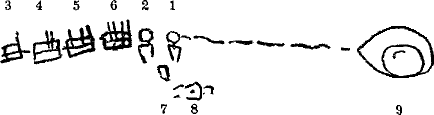
Fig. 24.—Midē´ destroying an enemy.
No. 1 is the author of the chart, a Midē´ who was called upon to take the life of a man living at a distant camp. The line extending from the midē´ to the figure at No. 9, signifies that his influence will reach to that distance.
No. 2, the applicant for assistance.
Nos. 3, 4, 5, and 6, represent the four degrees of the Midē´wiwin (of which the operator, in this instance, was a member). The degrees are furthermore specifically designated by short vertical strokes.
No. 7 is the midē´ drum used during the ceremony of preparing the charm.
No. 8 represents the body of the intended victim. The heart is indicated, and upon this spot was rubbed a small quantity of vermilion.
No. 9 is the outline of a lake, where the subject operated upon resided.
War parties are not formed at this time, but mnemonic charts of songs used by priests to encourage war parties, are still extant, and a reproduction of one is given on Pl. XIII, D. This song was used by the Midē´ priest to insure success to the parties. The members who intended participating in the exhibition would meet on the evening preceding their departure, and while listening to the words, some would join in the singing while others would dance. The lines may be repeated ad libitum so as to lengthen the entire series of phrases according to the prevalent enthusiasm and the time at the disposal of the performers. The war drum was used, and there were always five or six drummers so as to produce sufficient noise to accord with the loud and animated singing of a large body of excited men. This drum is, in size, like that employed for dancing. It is made by covering with rawhide an old kettle, or wooden vessel, from 2 to 3 feet in diameter. The drum is then attached to four sticks, or short posts, so as to prevent its touching the ground, thus affording every advantage for producing full and resonant sounds, when struck. The drumsticks are strong withes, at the end of each of which is fastened a ball of buckskin thongs. The following lines are repeated ad libitum:

Plate XIII.d. Mnemonic Song.
Hu´-na-wa´-na ha´-wā, un-do´-dzhe-na´ ha-we´-nĕ. I am looking [feeling] for my paint. [The Midē’s hands are at his medicine sack searching for his war paint.]

Hĭa´-dzhi-mĭn-de´ non´-da-kō´, hō´, They hear me speak of legs. Refers to speed in the expedition. To the left of the leg is the arm of a spirit, which is supposed to infuse magic influence so as to give speed and strength.

Hu´-wa-ke´, na´, ha´, He said, The Turtle Man´idō will lend his aid in speed. The turtle was one of the swiftest man´idōs, until through some misconduct, Min´abō´zho deprived him of his speed.

Wa´-tshe, ha´, hwē, wa´-ka-te´, hē´, wa´-tshe, ha´, hwē´. Powder, he said. [The modern form of Wa´-ka-te´, he´, hwā´, is ma´-ka-dē´-hwa; other archaic words occur also in other portions of this song. The phrase signifies that the Midē´ Man´idō favors good results from the use of powder. His form projects from the top of the Midē´ structure.]

Rest. A smoke is indulged in after which the song is resumed, accompanied with dancing.
Sin-go´-na wa-kī´ na-ha´-ka I made him cry. The figure is that of a turkey buzzard which the speaker shot.

Te-wa´-tshi-me-kwe´-na, ha´, na-ke´-nan. They tell of my powers. The people speak highly of the singer’s magic powers; a charmed arrow is shown which terminates above with feather-web ornament, enlarged to signify its greater power.

He´-wĕ-ne-nis´-sa ma-he´-ka-nĕn´-na. What have I killed, it is a wolf. By aid of his magic influence the speaker has destroyed a bad man´idō which had assumed the form of a wolf.

Sun´-gu-we´-wa, ha´, nīn-dēn´, tshi´-man-da´-kwa ha´na-nĭn-dēn´. I am as strong as the bear. The Midē´ likens his powers to those of the Bear Man´idō, one of the most powerful spirits; his figure protrudes from the top of the Midē´wigân while his spirit form is indicated by the short lines upon the back.

Wa´-ka-na´-ni, hē´, wa´-ka-na´-ni. I wish to smoke. The pipe used is that furnished by the promoter or originator of the war party, termed a “partisan.” The Midē´ is in full accord with the work undertaken and desires to join, signifying his wish by desiring to smoke with the braves.

He´-wa-hō´-a hai´-a-nē´ I even use a wooden image. Effigies made to represent one who is to be destroyed. The heart is punctured, vermilion or other magic powder is applied, and the death of the victim is encompassed.

Pa-kwa´ ma-ko-nē´ ā´, ō´, hē´, ōsh-ke´-na-ko-nē´-a. The bear goes round angry. [The Bear Man´idō is angry because the braves are dilatory in going to war. The sooner they decide upon this course, the better it will be for the Midē´ as to his fee, and the chances of success are greater while the braves are infused with enthusiasm, than if they should become sluggish and their ardor become subdued.]

THIRD DEGREE.
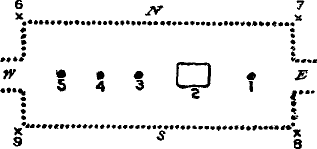
Fig. 25.—Diagram of Midē´wigân of the third degree.
The structure in which the third degree of the Midē´wiwin is conferred resembles that of the two preceding, and an outline is presented in Fig. 25. In this degree three posts are erected, the first one resembling that of the first degree, being painted red with a band of green around the top. (Pl. XV, No. 1.) This is planted a short distance to the east of the middle of the floor. The second post is also painted red, but has scattered over its entire surface spots of white clay, each of about the size of a silver quarter of a dollar, symbolical of the mī´gis shell. Upon the top of this post is placed the stuffed body of an owl—Kŏ-kó-kŏ-ō´. (Pl. XV, No. 2.) This post is planted a short distance west of the first one and about midway between it and the third, which last is erected within about 6 or 8 feet from the western door, and is painted black. (Pl. XV, No. 3.) The sacred stone against which patients are placed, and which has the alleged virtue of removing or expelling the demons that cause disease, is placed upon the ground at the usual spot near the eastern entrance (Fig. 25, No. 1). The Makwá Man´idō—bear spirit—is the tutelary guardian of this degree. Cedar trees are planted at each of the outer angles of the structure (Fig. 25, Nos. 6, 7, 8, 9). The sudatory is erected about 100 yards due east of the main entrance of the Midē´wigân, and is of the same size and for the same purpose as that for the second degree.
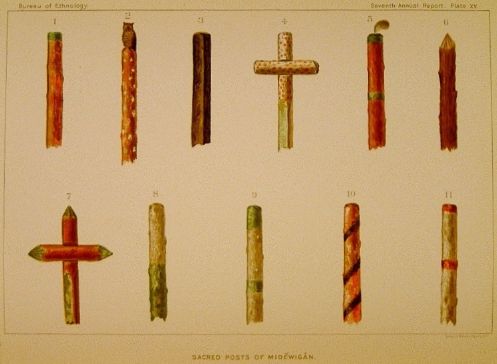
Plate XV. Sacred Posts Of Midē´wigân.
PREPARATION OF CANDIDATE.
It is customary for the period of one year to elapse before a second-degree Midē´ can be promoted, even if he be provided with enough presents for such advancement. As the exacted fee consists of goods and tobacco thrice the value of the fee for the first degree, few present themselves. This degree is not held in as high estimation, relatively, as the preceding one; but it is alleged that a Midē´’s powers are intensified by again subjecting himself to the ceremony of being “shot with the sacred mī´gis,” and he is also elevated to that rank by means of which he may be enabled the better to invoke the assistance of the tutelary guardian of this degree.
A Midē´ who has in all respects complied with the preliminaries of announcing to the chief Midē´ his purpose, gaining satisfactory evidence of his resources and ability to present the necessary presents, and of his proficiency in the practice of medical magic, etc., selects a preceptor of at least the third degree and one who is held in high repute and influence in the Midē´wiwin. After procuring the services of such a person and making a satisfactory agreement with him, he may be enabled to purchase from him some special formulæ for which he is distinguished. The instruction embraces a résumé of the traditions previously given, the various uses and properties of magic plants and compounds with which the preceptor is familiar, and conversations relative to exploits performed in medication, incantation, and exorcism. Sometimes the candidate is enabled to acquire new “medicines” to add to his list, and the following is a translation of the tradition relating to the origin of ginseng (Aralia quinquefolia, Gr.), the so-called “man root,” held in high estimation as of divine origin. In Fig. 3 is presented a pictorial representation of the story, made by Ojibwa, a Midē´ priest of White Earth, Minnesota. The tradition purports to be an account of a visit of the spirit of a boy to the abode of Dzhibai´Man´idō, “the chief spirit of the place of souls,” called Ne´-ba-gi´-zis, “the land of the sleeping sun.”
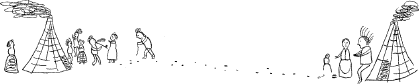
Fig. 3.—Origin of Ginseng.
Larger Figure
There appears to be some similarity between this tradition and that given in connection with Pl. V, in which the Sun Spirit restored to life a boy, by which act he exemplified a portion of the ritual of the Midē´wiwin. It is probable therefore that the following tradition is a corruption of the former and made to account for the origin of “man root,” as ginseng is designated, this root, or certain portions of it, being so extensively employed in various painful complaints.
Once an old Midē´, with his wife and son, started out on a hunting trip, and, as the autumn was changing into winter, the three erected a substantial wig´iwam. The snow began to fall and the cold increased, so they decided to remain and eat of their stores, game having been abundant and a good supply having been procured.
When the woman informed her father of the death of her son, her brother, who was present, immediately set out in advance to render assistance. The chief priest then summoned three assistant Midē´, and they accompanied his daughter to the place where the body of his dead grandson lay upon the floor of the wig´iwam, covered with robes.
The chief Midē´ placed himself at the left shoulder of the dead boy, the next in rank at the right, while the two other assistants stationed themselves at the feet. Then the youngest Midē´—he at the right foot of the deceased—began to chant a midē´ song, which he repeated a second, a third, and a fourth time.
When he had finished, the Midē´ at the left foot sang a midē´ song four times; then the Midē´ at the right shoulder of the body did the same, after which the chief Midē´ priest sang his song four times, whereupon there was a perceptible movement under the blanket, and as the limbs began to move the blanket was taken off, when the boy sat up. Being unable to speak, he made signs that he desired water, which was given to him.
The four Midē´ priests then chanted medicine songs, each preparing charmed remedies which were given to the boy to complete his recovery. The youngest Midē´, standing at the foot of the patient, gave him four pinches of powder, which he was made to swallow; the Midē´ at the left foot did the same; then the Midē´ at the right shoulder did likewise, and he, in turn, was followed by the chief priest standing at the left shoulder of the boy; whereupon the convalescent immediately recovered his speech and said that during the time that his body had been in a trance his spirit had been in the “spirit land,” and had learned of the “grand medicine.”
The boy then narrated what his spirit had experienced during the trance, as follows: “Gi´-gi-min´-ĕ-go´-min mi-dē´-wi-wĭn mi-dē´ man´-i-dō´ B’n-gi-gĭn´-o-a-mâk ban-dzhi´-ge´-o-we´-ân ta´-zi-ne´-zho-wak´ ni-zha´-nĕ-zak, kĭ-wi´-de-gĕt´ mi´-o-pi´-ke´-ne-bŭi´-yan ka-ki´-nĕ ka-we´-dĕ-ge´ mi´-o-wŏk-pi´ i-kan´-o-a-mag´-ĭ-na mi-dē´ man´i-dō wi-we´-ni-tshi mi-dē´-wi-wĭn, ki´-mi-mâ´-dĭ-si-win´-in-ân´ ki-mi´-nĭ-go-nan´ ge-on´-dĕ-na-mŏngk ki´-mi-mâ´-di-si´-wa-in-an´; ki´-ki-no´-a-mag´-wi-nan´ mash´-kĭ-ki o-gi´-mi-ni´-go-wan´ o-dzhi-bi´-gân gi-me´-ni-na-gŭk´ mash´-kĭ-ki-wa´-bon shtĭk-wan´-a-ko-se´-an o-ma´-mâsh´-kĭ-ki ma´-gi-ga´-to ki´-ka-ya-tōn.”
The following is a translation:
“He, the chief spirit of the Midē´ Society, gave us the “grand medicine,” and he has taught us how to use it. I have come back from the spirit land. There will be twelve, all of whom will take wives; when the last of these is no longer without a wife, then will I die. That is the time. The Midē´ spirit taught us to do right. He gave us life and told us how to prolong it. These things he taught us, and gave us roots for medicine. I give to you medicine; if your head is sick, this medicine put upon it, you will put it on.”
The revelation received by the boy was in the above manner imparted to the Indians. The reference to twelve—three times the sacred number four—signifies that twelve chief priests shall succeed each other before death will come to the narrator. It is observed, also, that a number of the words are archaic, which fact appears to be an indication of some antiquity, at least, of the tradition.
The following are the principal forms in which a Midē´ will utilize Aralia quinquefolia, Gr., ginseng—Shtĕ´-na-bi-o´-dzhi-bik:
1. Small quantities of powdered root are swallowed to relieve stomachic pains.
2. A person complaining with acute pains in any specific part of the body is given that part of the root corresponding to the part affected; e.g., for pleurisy, the side of the root is cut out, and an infusion given to relieve such pains; if one has pains in the lower extremities, the bifurcations of the root are employed; should the pains be in the thorax, the upper part of the root—corresponding to the chest—is used in a similar manner.
INITIATION OF CANDIDATE.
As the candidate for promotion has acquired from his Midē´ friends such new information as they choose to impart, and from his instructor all that was practicable, he has only to await the day of ceremony to be publicly acknowledged as a third-degree Midē´. As this time approaches the invitation sticks are sent to the various members and to such non-resident Midē´ as the officiating priests may wish to honor. On or before the fifth day previous to the meeting the candidate moves to the vicinity of the Midē´wigân. On that day the first sweat bath is taken, and one also upon each succeeding day until four baths, as a ceremony of purification, have been indulged in. On the evening of the day before the meeting his preceptor visits him at his own wig´iwam when, with the assistance of friends, the presents are collected and carried to the Midē´-wigân and suspended from the transverse poles near the roof. The officiating priests may subsequently join him, when smoking and singing form the chief entertainment of the evening.
By this time numerous visitors have gathered together and are encamped throughout the adjacent timber, and the sound of the drum, where dancing is going on, may be heard far into the night.
Early on the morning of the day of the ceremonies the candidate goes to the sudatory where he first awaits the coming of his preceptor and later the arrival of the Midē´ priests by whom he is escorted to the Midē´wigân. With the assistance of the preceptor he arranges his gift of tobacco which he takes with him to the sacred inclosure, after which a smoke offering is made, and later Midē´ songs are chanted. These may be of his own composition as he has been a professor of magic a sufficient lapse of time to have composed them, but to give evidence of superior powers the chief, or some other of the officiating priests, will perhaps be sufficiently inspired to sing. The following was prepared and chanted by one of the Midē´ priests at the third-degree meeting at White Earth, Minnesota, and the illustration in Pl. XIV, A, is a reproduction of the original. The words, with translation, are as follows:

Plate XIVa. Mnemonic Song.
Ni-ka´-ni-na man´-do-na-mō´-a. My friend I am shooting into you in trying to hit the mark. [The two arms are grasping the mī´gis, which he the Midē´ is going to shoot into the body of the candidate. The last word means, literally, trying to hit the mark at random.]

Me-kwa´-me-sha-kwak´, mi-tē´-wi-da´. While it is clear let us have it, the “grand medicine.” The Midē´ arm, signified by the magic zigzag lines at the lower end of the picture, reaches up into the sky to keep it clear; the rain is descending elsewhere as indicated by the lines descending from the sky at the right and left.

Rest. During this interval a smoke offering is made.
Mi-sha´-kwi-tō-nĭ mī´-gĭs-sĭm´. As clear as the sky [is] my mī´gis. The figure represents the sacred mī´gis, as indicated by the short lines radiating from the periphery. The mī´gis is white and the clear sky is compared to it.

Sōn´-gi-mi-dē´ wi-ka´-ne, hē´, Wi-nō´-a man´-i-dō´-wi-dzhī´-id-e´-zhi-wât. Take the “grand medicine” strong, as they, together with the “Great Spirit,” tell me. [The candidate is enjoined to persevere in his purpose. The associate Midē´ are alluded to, as also Ki´tshi Man´idō, who urge his continuance and advancement in the sacred society. The arm reaches down to search for the sacred mī´gis of the fourth degree—designated by four vertical lines—which is, as yet, hidden from the person addressed.]

Hwa´-ba-mi-dē´, hwa´-ba-mi-dē´, Na´-wa-kin-tē´. He who sees me, he who sees me, stands on the middle of the earth. [The human figure symbolizes Ki´tshi Man´idō; the magic lines cross his body, while his legs rest upon the outline of the Midē´wigân. His realm, the sky, reaches from the zenith to the earth, and he beholds the Midē´ while chanting and conducting the Midē´wiwin.]

Man´-i-dō´ wi´-ka-ni´ ni-mi-dē´. To the spirit be a friend, my Midē´. The speaker enjoins the candidate to be faithful to his charge, and thus a friend to Ki´tshi Man´idō, who in return will always assist him. The figure holds a mī´gis in its right hand, and the Midē´ drum in its left.

The greater number of words in the preceding text are of an archaic form, and are presented as they were chanted. The several lines may be repeated ad libitum to accord with the feeling of inspiration which the singer experiences, or the amount of interest manifested by his hearers.
All the members of the society not officially inducting the candidate have ere this entered the Midē´wigân and deposited their invitation sticks near the sacred stone, or, in the event of their inability
The drummers, who are seated in the southwestern angle of the inclosure, begin to drum and sing, while the candidate is led slowly around the exterior, going by the south, thus following the course of the sun. Upon the completion of the fourth circuit he is halted directly opposite the main entrance, to which his attention is then directed. The drumming and singing cease; the candidate beholds two Midē´ near the outer entrance and either side of it. These Midē´ represent two malevolent man´idō and guard the door against the entrance of those not duly prepared. The one upon the northern side of the entrance then addresses his companion in the following words: I´-ku-tan ka´-wi-nad´-gĭ wa´-na-mâ´-sĭ ē´-zhĭ-gĭ´-nĭ-gĕd—“Do you not see how he is formed?” To which the other responds: O-da´-pĭ-nŏ´ ke´-no-wĭn-dŭng shkwan´-dĭm—“Take care of it, the door;” [i.e., guard the entrance.] The former then again speaks to his companion, and says: Ka-wīn´-nĭ-na-ga´ wâ´-ba-ma´-si-ba´-shĭ-gi´-ne-gēt´—“Do you not see how he carries the goods?” The Midē´ spoken to assents to this, when the preceptor takes several pieces of tobacco which he presents to the two guards, whereupon they permit the candidate to advance to the inner entrance, where he is again stopped by two other guardian man´idō, who turn upon him as if to inquire the reason of his intrusion. The candidate then holds out two parcels of tobacco and says to them: O-da´-pin a-sē´-ma—“Take it, the tobacco,” whereupon they receive the gift and stand aside, saying: Kun´-da-dan—“Go down;” [i.e., enter and follow the path.] As the candidate is taken a few steps forward and toward the sacred stone, four of the eight officiating priests receive him, one replacing the preceptor who goes to the extreme western end there to stand and face the east, where another joins him, while the remaining two place themselves side by side so as to face the west.