INDIAN LINGUISTIC FAMILIES OF AMERICA NORTH OF MEXICO. (continued 4)
Reading edition
TAÑOAN FAMILY.
> Tay-waugh, Lane (1854) in Schoolcraft, Ind. Tribes, V. 689, 1855 (Pueblos of San Juan, Santa Clara, Pojuaque, Nambe. San Il de Conso, and one Moqui pueblo). Keane, App. Stanford’s Comp. (Cent, and So. Am.), 479, 1878.
> Taño, Powell in Rocky Mountain Presbyterian, Nov., 1878 (includes Sandia, Téwa, San Ildefonso, San Juan, Santa Clara, Pojoaque, Nambé, Tesuque, Sinecú, Jemez, Taos, Picuri).
> Tegna, Keane, App. Stanford’s Comp. (Cent, and So. Am.), 479, 1878 (includes S. Juan, Sta. Clara, Pojuaque, Nambe, Tesugue, S. Ildefonso, Haro).
= Téwan, Powell in Am. Nat., 605, Aug., 1880 (makes five divisions: 1. Taño (Isleta, Isleta near El Paso, Sandía); 2. Taos (Taos, Picuni); 3. Jemes (Jemes); 4. Tewa or Tehua (San Ildefonso, San Juan, Pojoaque, Nambe, Tesuque, Santa Clara, and one Moki pueblo); 5. Piro).
> E-nagh-magh, Lane (1854) in Schoolcraft, Ind. Tribes, V, 689, 1855 (includes Taos, Vicuris, Zesuqua, Sandia, Ystete, and two pueblos near El Paso, Texas). Keane, App. Stanford’s Comp. (Cent, and So. Am.), 479, 1878 (follows Lane, but identifies Texan pueblos with Lentis? and Socorro?).
> Picori, Keane, App. Stanford’s Comp. (Cent, and So. Am.), 479, 1878 (or Enaghmagh).
= Stock of Rio Grande Pueblos, Gatschet in U.S. Geog. Surv. W. 100th M., vii, 415, 1879.
= Rio Grande Pueblo, Gatschet in Mag. Am. Hist., 258, 1882.
Derivation: Probably from “taínin,” plural of tá-ide, “Indian,” in the dialect of Isleta and Sandia (Gatschet).
In a letter97 from Wm. Carr Lane to H. R. Schoolcraft, appear some remarks on the affinities of the Pueblo languages, based in large part on hearsay evidence. No vocabularies are given, nor does any real classification appear to be attempted, though referring to such of his remarks as apply in the present connection, Lane states that the Indians of “Taos, Vicuris, Zesuqua, Sandia, and Ystete, and of two pueblos of Texas, near El Paso, are said to speak the same language, which I have heard called E-nagh-magh,” and that the Indians of “San Juan, Santa Clara, Pojuaque, Nambe, San Il de Conso, and one Moqui pueblo, all speak the same language, as it is said: this I have heard called Tay-waugh.” The ambiguous nature of his reference to these pueblos is apparent from the above quotation.
The names given by Lane as those he had “heard” applied to certain groups of pueblos which “it is said” speak the same language, rest on too slender a basis for serious consideration in a classificatory sense.
Keane in the appendix to Stanford’s Compendium (Central and South America), 1878, p. 479, presents the list given by Lane, correcting his spelling in some cases and adding the name of the Tusayan pueblo as Haro (Hano). He gives the group no formal family name, though they are classed together as speaking “Tegua or Tay-waugh.”
The Taño of Powell (1878), as quoted, appears to be the first name formally given the family, and is therefore accepted. Recent investigations of the dialect spoken at Taos and some of the other pueblos of this group show a considerable body of words having Shoshonean affinities, and it is by no means improbable that further research will result in proving the radical relationship of these languages to the Shoshonean family. The analysis of the language has not yet, however, proceeded far enough to warrant a decided opinion.
GEOGRAPHIC DISTRIBUTION.
The tribes of this family in the United States resided exclusively upon the Rio Grande and its tributary valleys from about 33° to about 36°. A small body of these people joined the Tusayan in northern Arizona, as tradition avers to assist the latter against attacks by the Apache—though it seems more probable that they fled from the Rio Grande during the pueblo revolt of 1680—and remained to found the permanent pueblo of Hano, the seventh pueblo of the group. A smaller section of the family lived upon the Rio Grande in Mexico and Texas, just over the New Mexico border.
Population.—The following pueblos are included in the family, with a total population of about 3,237:
Hano (of the Tusayan group) 132
Isleta (New Mexico) 1,059
Isleta (Texas) few
Jemez 428
Nambé 79
Picuris 100
Pojoaque 20
Sandia 140
San Ildefonso 148
San Juan 406
Santa Clara 225
Senecú (below El Paso) few
Taos 409
Tesuque 91
TIMUQUANAN FAMILY.
= Timuquana, Smith in Hist. Magazine, II, 1, 1858 (a notice of the language with vocabulary; distinctness of the language affirmed). Brinton. Floridian Peninsula, 134, 1859 (spelled also Timuaca, Timagoa, Timuqua).
= Timucua, Gatschet in Proc. Am. Phil. Soc., XVI, April 6, 1877 (from Cape Cañaveral to mouth of St. John’s River). Gatschet, Creek Mig. Legend I, 11-13, 1884. Gatschet in Science, 413, April 29, 1887.
= Atimuca, Gatschet in Science, ibid, (proper name).
Derivation: From ati-muca, “ruler,” “master;” literally, “servants attend upon him.”
In the Historical Magazine as above cited appears a notice of the Timuquana language by Buckingham Smith, in which is affirmed its distinctness upon the evidence of language. A short vocabulary is appended, which was collated from the “Confessionario” by Padre Pareja, 1613. Brinton and Gatschet have studied the Timuquana language and have agreed as to the distinctness of the family from any other of the United States. Both the latter authorities are inclined to take the view that it has affinities with the Carib family to the southward, and it seems by no means improbable that ultimately the Timuquana language will be considered an offshoot of the Carib linguistic stock. At the present time, however, such a conclusion would not be justified by the evidence gathered and published.
GEOGRAPHIC DISTRIBUTION.
It is impossible to assign definite limits to the area occupied by the tribes of this family. From documentary testimony of the sixteenth and seventeenth centuries the limits of the family domain appear to have been about as follows: In general terms the present northern limits of the State of Florida may be taken as the northern frontier, although upon the Atlantic side Timuquanan territory may have extended into Georgia. Upon the northwest the boundary line was formed in De Soto’s time by the Ocilla River. Lake Okeechobee on the south, or as it was then called Lake Sarrape or Mayaimi, may be taken as the boundary between the Timuquanan tribes proper and the Calusa province upon the Gulf coast and the Tegesta province upon the Atlantic side. Nothing whatever of the languages spoken in these two latter provinces is available for comparison. A number of the local names of these provinces given by Fontanedo (1559) have terminations similar to many of the Timuquanan local names. This slender evidence is all that we have from which to infer the Timuquanan relationship of the southern end of the peninsula.
PRINCIPAL TRIBES.
The following settlements appear upon the oldest map of the regions we possess, that of De Bry (Narratio; Frankf. a.M. 15, 1590):
(A) Shores of St. John’s River, from mouth to sources:
Patica. Saturiwa. Atore. Homolua or Molua. Alimacani. Casti. Malica. Melona. Timoga or Timucua. Enecaqua. Choya. Edelano (island). Astina. Utina. Patchica. Chilili. Calanay. Onochaquara. Mayarca. Mathiaca. Maiera. Mocoso. Cadica. Eloquale. Aquonena.
(B) On a (fictitious) western tributary of St. John’s River, from mouth to source:
Hicaranaou. Appalou. Oustaca. Onathcaqua. Potanou. Ehiamana. Anouala.
(C) East Floridian coast, from south to north:
Mocossou. Oathcaqua. Sorrochos. Hanocoroucouay. Marracou.
(D) On coast north of St. John’s River:
Hiouacara.
(E) The following are gathered from all other authorities, mostly from the accounts of De Soto’s expedition:
Acquera. Aguile. Basisa or Vacissa (1688). Cholupaha. Hapaluya. Hirrihiqua. Itafi (perhaps a province). Itara Machaua (1688). Napetuca. Osile (Oxille). San Juan de Guacara (1688). San Mateo (1688). Santa Lucia de Acuera (SE. coast). Tacatacuru. Tocaste. Tolemato. Topoqui. Tucururu (SE. coast) Ucita. Urriparacuxi. Yupaha (perhaps a province).
TONIKAN FAMILY.
= Tunicas, Gallatin in Trans. and Coll. Am. Antiq. Soc., II, 115, 116, 1836 (quotes Dr. Sibley, who states they speak a distinct language). Latham, Nat. Hist. Man, 341, 1850 (opposite mouth of Red River; quotes Dr. Sibley as to distinctness of language).
= Tonica, Gatschet, Creek Mig. Legend, I, 39, 1884 (brief account of tribe).
= Tonika, Gatschet in Science, 412, April 29, 1887 (distinctness as a family asserted; the tribe calls itself Túniχka).
Derivation: From the Tonika word óni, “man,” “people;” t- is a prefix or article; -ka, -χka a nominal suffix.
The distinctness of the Tonika language, has long been suspected, and was indeed distinctly stated by Dr. Sibley in 1806.98 The statement to this effect by Dr. Sibley was quoted by Gallatin in 1836, but as the latter possessed no vocabulary of the language he made no attempt to classify it. Latham also dismisses the language with the same quotation from Sibley. Positive linguistic proof of the position of the language was lacking until obtained by Mr. Gatschet in 1886, who declared it to form a family by itself.
GEOGRAPHIC DISTRIBUTION.
The Tonika are known to have occupied three localities: First, on the Lower Yazoo River (1700); second, east shore of Mississippi River (about 1704); third, in Avoyelles Parish, Louisiana (1817). Near Marksville, the county seat of that parish, about twenty-five are now living.
TONKAWAN FAMILY.
= Tonkawa, Gatschet, Zwölf Sprachen aus dem Südwesten Nordamerikas, 76, 1876 (vocabulary of about 300 words and some sentences). Gatschet, Die Sprache der Tonkawas, in Zeitschrift für Ethnologie, 64, 1877. Gatschet (1876), in Proc. Am. Philosoph. Soc., XVI, 318, 1877.
Derivation: the full form is the Caddo or Wako term tonkawéya, “they all stay together” (wéya, “all”).
After a careful examination of all the linguistic material available for comparison, Mr. Gatschet has concluded that the language spoken by the Tonkawa forms a distinct family.
GEOGRAPHIC DISTRIBUTION.
The Tónkawa were a migratory people and a colluvies gentium, whose earliest habitat is unknown. Their first mention occurs in 1719; at that time and ever since they roamed in the western and southern parts of what is now Texas. About 1847 they were engaged as scouts in the United States Army, and from 1860-’62 (?) were in the Indian Territory; after the secession war till 1884 they lived in temporary camps near Fort Griffin, Shackelford County, Texas, and in October, 1884, they removed to the Indian Territory (now on Oakland Reserve). In 1884 there were seventy-eight individuals living; associated with them were nineteen Lipan Apache, who had lived in their company for many years, though in a separate camp. They have thirteen divisions (partly totem-clans) and observe mother-right.
UCHEAN FAMILY.
= Uchees, Gallatin in Trans. and Coll. Am. Antiq. Soc., II., 95, 1836 (based upon the Uchees alone). Bancroft, Hist. U.S., III., 247, 1840. Gallatin in Trans. Am. Eth. Soc. II., pt. 1, xcix, 77, 1848. Keane, App. Stanford’s Comp. (Cent. and So. Am.), 472, 1878 (suggests that the language may have been akin to Natchez).
= Utchees, Gallatin in Trans. and Coll. Am. Antiq. Soc., II., 306, 1836. Gallatin in Schoolcraft, Ind. Tribes, III., 401, 1853. Keane, App. Stanford’s Comp. (Cent. and So. Am.), 472, 1878.
= Utschies, Berghaus (1845), Physik. Atlas, map 17, 1848. Ibid., 1852.
= Uché, Latham, Nat. Hist. Man, 338, 1850 (Coosa River). Latham in Trans. Philolog. Soc. Lond., II., 31-50, 1846. Latham, Opuscula, 293, 1860.
= Yuchi, Gatschet, Creek Mig. Legend, I, 17, 1884. Gatschet in Science, 413, April 29, 1887.
The following is the account of this tribe given by Gallatin (probably derived from Hawkins) in Archæologia Americana, page 95:
The original seats of the Uchees were east of Coosa and probably of the Chatahoochee; and they consider themselves as the most ancient inhabitants of the country. They may have been the same nation which is called Apalaches in the accounts of De Soto’s expedition, and their towns were till lately principally on Flint River.
GEOGRAPHIC DISTRIBUTION.
The pristine homes of the Yuchi are not now traceable with any degree of certainty. The Yuchi are supposed to have been visited by De Soto during his memorable march, and the town of Cofitachiqui chronicled by him, is believed by many investigators to have stood at Silver Bluff, on the left bank of the Savannah, about 25 miles below Augusta. If, as is supposed by some authorities, Cofitachiqui was a Yuchi town, this would locate the Yuchi in a section which, when first known to the whites, was occupied by the Shawnee. Later the Yuchi appear to have lived somewhat farther down the Savannah, on the eastern and also the western side, as far as the Ogeechee River, and also upon tracts above and below Augusta, Georgia. These tracts were claimed by them as late as 1736.
In 1739 a portion of the Yuchi left their old seats and settled among the Lower Creek on the Chatahoochee River; there they established three colony villages in the neighborhood, and later on a Yuchi settlement is mentioned on Lower Tallapoosa River, among the Upper Creek.99 Filson100 gives a list of thirty Indian tribes and a statement concerning Yuchi towns, which he must have obtained from a much earlier source: “Uchees occupy four different places of residence—at the head of St. John’s, the fork of St. Mary’s, the head of Cannouchee, and the head of St. Tillis” (Satilla), etc.101
Population.—More than six hundred Yuchi reside in northeastern Indian Territory, upon the Arkansas River, where they are usually classed as Creek. Doubtless the latter are to some extent intermarried with them, but the Yuchi are jealous of their name and tenacious of their position as a tribe.
WAIILATPUAN.
= Waiilatpu, Hale, in U.S. Expl. Exp., VI, 199, 214, 569, 1846 (includes Cailloux or Cayuse or Willetpoos, and Molele). Gallatin, after Hale, in Trans. Am. Eth. Soc., II, pt. 1, c, 14, 56, 77, 1848 (after Hale). Berghaus (1851), Physik. Atlas, map 17, 1852. Buschmann, Spuren der aztek. Sprache, 628, 1859. Bancroft, Nat. Races, III, 565, 1882 (Cayuse and Mollale).
= Wailatpu, Gallatin in Schoolcraft, Ind. Tribes, III, 402, 1853 (Cayuse and Molele).
X Sahaptin, Latham, Nat. Hist. Man, 323, 1850 (cited as including Cayús?).
X Sahaptins, Keane, App. Stanford’s Comp. (Cent. and So. Am.), 474, 1878 (cited because it includes Cayuse and Mollale).
= Molele, Latham, Nat. Hist. Man, 324, 1850 (includes Molele, Cayús?).
> Cayús?, Latham, ibid.
= Cayuse, Gatschet in Mag. Am. Hist., 166, 1877 (Cayuse and Moléle). Gatschet in Beach, Ind. Misc., 442, 1877.
Derivation: Wayíletpu, plural form of Wa-ílet, “one Cayuse man” (Gatschet).
Hale established this family and placed under it the Cailloux or Cayuse or Willetpoos, and the Molele. Their headquarters as indicated by Hale are the upper part of the Walla Walla River and the country about Mounts Hood and Vancouver.
GEOGRAPHIC DISTRIBUTION.
The Cayuse lived chiefly near the mouth of the Walla Walla River, extending a short distance above and below on the Columbia, between the Umatilla and Snake Rivers. The Molále were a mountain tribe and occupied a belt of mountain country south of the Columbia River, chiefly about Mounts Hood and Jefferson.
PRINCIPAL TRIBES.
Cayuse. Molále.
Population.—There are 31 Molále now on the Grande Ronde Reservation, Oregon,102 and a few others live in the mountains west of Klamath Lake. The Indian Affairs Report for 1888 credits 401 and the United States Census Bulletin for 1890, 415 Cayuse Indians to the Umatilla Reservation, but Mr. Henshaw was able to find only six old men and women upon the reservation in August, 1888, who spoke their own language. The others, though presumably of Cayuse blood, speak the Umatilla tongue.
WAKASHAN FAMILY.
> Wakash, Gallatin in Trans. and Coll. Am. Antiq. Soc., II, 15, 306, 1836 (of Nootka Sound; gives Jewitt’s vocab.). Gallatin in Trans. Am. Eth. Soc., II, pt. 1, 77, 1848 (based on Newittee). Berghaus (1851), Physik. Atlas, map 17, 1852. Gallatin in Schoolcraft, Ind. Tribes, III, 402, 1853 (includes Newittee and Nootka Sound). Latham in Trans. Philolog. Soc. Lond., 73, 1856 (of Quadra and Vancouver’s Island). Latham, Opuscula, 340, 1860. Latham, El. Comp. Phil., 403, 1862 (Tlaoquatsh and Wakash proper; Nutka and congeners also referred here).
X Wakash, Latham, Nat. Hist. Man, 301. 1850 (includes Naspatle, proper Nutkans, Tlaoquatsh, Nittenat, Klasset, Klallems; the last named is Salishan).
X Nootka-Columbian, Scouler in Jour. Roy. Geog. Soc., XI, 221, 1841 (includes Quadra and Vancouver Island, Haeeltzuk, Billechoola, Tlaoquatch, Kawitchen, Noosdalum, Squallyamish, Cheenooks). Prichard, Phys. Hist. Mankind, V, 435, 1847 (follows Scouler). Latham in Jour. Eth. Soc. Lond., I, 162, 1848 (remarks upon Scouler’s group of this name). Latham, Opuscula, 257, 1860 (the same).
< Nootka, Hale in U.S. Expl. Exp., VI, 220, 569, 1846 (proposes family to include tribes of Vancouver Island and tribes on south side of Fuca Strait).
> Nutka, Buschmann, Neu-Mexico, 329, 1858.
> Nootka, Gatschet in Mag. Am. Hist., 170, 1877 (mentions only Makah, and Classet tribes of Cape Flattery). Gatschet in Beach, Ind. Misc., 446. 1877.
X Nootkahs, Keane, App. Stanford’s Comp. (Cent. and So. Am.), 473, 1878 (includes Muchlahts, Nitinahts, Ohyahts, Manosahts, and Quoquoulths of present family, together with a number of Salishan tribes).
X Nootka, Bancroft, Nat. Races, III, 564, 607, 1882 (a heterogeneous group, largely Salishan, with Wakashan, Skittagetan, and other families represented).
> Straits of Fuca, Gallatin in Trans. and Coll. Am. Antiq. Soc., II, 134, 306, 1836 (vocabulary of, referred here with doubt; considered distinct by Gallatin).
X Southern, Scouler in Jour. Roy. Geog. Soc., XI, 224, 1841 (same as his Noctka-Columbian above).
X Insular, Scouler ibid. (same as his Nootka-Columbian above).
X Haeltzuk, Latham in Jour. Eth. Soc. Lond., I, 155, 1848 (cities Tolmie’s vocab. Spoken from 50°30' to 53°30' N.L.). Latham, Opuscula, 251, 1860 (the same).
> Haeeltsuk and Hailtsa, Latham, Nat. Hist. Man, 300, 1850 (includes Hyshalla, Hyhysh, Esleytuk, Weekenoch, Nalatsenoch, Quagheuil, Tlatla-Shequilla, Lequeeltoch).
> Hailtsa, Latham in Trans. Philolog. Soc. Lond., 72, 1856. Buschmann, Neu-Mexico, 322, 1858. Latham, Opuscula, 339, 1860. Latham, El. Comp. Phil., 401, 1862 (includes coast dialects between Hawkesbury Island, Broughton’s Archipelago, and northern part of Vancouver Island).
> Ha-eelb-zuk, Schoolcraft, Ind. Tribes, V, 487, 1855. Kane, Wand. of an Artist, app., 1859 (or Ballabola; a census of N.W. tribes classified by language).
> Ha-ilt´-zŭkh, Dall, after Gibbs, in Cont. N.A. Eth., I, 144, 1877 (vocabularies of Bel-bella of Milbank Sound and of Kwákiūtl’).
< Nass, Gallatin in Trans. Am. Eth. Soc., II, pt 1, c, 1848.
< Naass, Gallatin in Trans. Am. Eth. Soc., II, pt. 1, 77, 1848 (includes Hailstla, Haceltzuk, Billechola, Chimeysan). Gallatin in Schoolcraft, Ind. Tribes, III, 402, 1853 (includes Huitsla).
X Nass, Bancroft, Nat. Races, III, 564, 606, 1882 (includes Hailtza of present family).
> Aht, Sproat, Savage Life, app., 312, 1868 (name suggested for family instead of Nootka-Columbian).
> Aht, Tolmie and Dawson, Comp. Vocabs., 50, 1884 (vocab. of Kaiookwāht).
X Puget Sound Group, Keane, App. Stanford’s Comp. (Cent. and So. Am.), 460, 474, 1878.
X Hydahs, Keane, App. Stanford’s Comp. (Cent. and So. Am.), 473, 1878 (includes Hailtzas of the present family).
> Kwakiool, Tolmie and Dawson, Comp. Vocabs., 27-48, 1884 (vocabs. of Haishilla, Hailtzuk, Kwiha, Likwiltoh, Septs; also map showing family domain).
> Kwā´kiūtl, Boas in Petermann’s Mitteilungen, 130, 1887 (general account of family with list of tribes).
Derivation: Waukash, waukash, is the Nootka word “good” “good.” When heard by Cook at Friendly Cove, Nootka Sound, it was supposed to be the name of the tribe.
Until recently the languages spoken by the Aht of the west coast of Vancouver Island and the Makah of Cape Flattery, congeneric tribes, and the Haeltzuk and Kwakiutl peoples of the east coast of Vancouver Island and the opposite mainland of British Columbia, have been regarded as representing two distinct families. Recently Dr. Boas has made an extended study of these languages, has collected excellent vocabularies of the supposed families, and as a result of his study it is now possible to unite them on the basis of radical affinity. The main body of the vocabularies of the two languages is remarkably distinct, though a considerable number of important words are shown to be common to the two.
Dr. Boas, however, points out that in both languages suffixes only are used in forming words, and a long list of these shows remarkable similarity.
The above family name was based upon a vocabulary of the Wakash Indians, who, according to Gallatin, “inhabit the island on which Nootka Sound is situated.” The short vocabulary given was collected by Jewitt. Gallatin states103 that this language is the one “in that quarter, which, by various vocabularies, is best known to us.” In 1848104 Gallatin repeats his Wakash family, and again gives the vocabulary of Jewitt. There would thus seem to be no doubt of his intention to give it formal rank as a family.
The term “Wakash” for this group of languages has since been generally ignored, and in its place Nootka or Nootka-Columbian has been adopted. “Nootka-Columbian” was employed by Scouler in 1841 for a group of languages, extending from the mouth of Salmon River to the south of the Columbia River, now known to belong to several distinct families. “Nootka family” was also employed by Hale105 in 1846, who proposed the name for the tribes of Vancouver Island and those along the south side of the Straits of Fuca.
The term “Nootka-Columbian” is strongly condemned by Sproat.106 For the group of related tribes on the west side of Vancouver Island this author suggests Aht, “house, tribe, people,” as a much more appropriate family appellation.
Though by no means as appropriate a designation as could be found, it seems clear that for the so-called Wakash, Newittee, and other allied languages usually assembled under the Nootka family, the term Wakash of 1836 has priority and must be retained.
GEOGRAPHIC DISTRIBUTION.
The tribes of the Aht division of this family are confined chiefly to the west coast of Vancouver Island. They range to the north as far as Cape Cook, the northern side of that cape being occupied by Haeltzuk tribes, as was ascertained by Dr. Boas in 1886. On the south they reached to a little above Sooke Inlet, that inlet being in possession of the Soke, a Salishan tribe.
The neighborhood of Cape Flattery, Washington, is occupied by the Makah, one of the Wakashan tribes, who probably wrested this outpost of the family from the Salish (Clallam) who next adjoin them on Puget Sound.
The boundaries of the Haeltzuk division of this family are laid down nearly as they appear on Tolmie and Dawson’s linguistic map of 1884. The west side of King Island and Cascade Inlet are said by Dr. Boas to be inhabited by Haeltzuk tribes, and are colored accordingly.
PRINCIPAL AHT TRIBES.
Ahowsaht. Ayhuttisaht. Chicklesaht. Clahoquaht. Hishquayquaht. Howchuklisaht. Kitsmaht. Kyoquaht. Macaw. Manosaht. Mowachat. Muclaht. Nitinaht. Nuchalaht. Ohiaht. Opechisaht. Pachenaht. Seshaht. Toquaht. Yuclulaht.
Population.—There are 457 Makah at the Neah Bay Agency, Washington.107 The total population of the tribes of this family under the West Coast Agency, British Columbia, is 3,160.108 The grand total for this division of the family is thus 3,617.
PRINCIPAL HAELTZUK TRIBES.
Aquamish. Belbellah. Clowetsus. Hailtzuk. Haishilla. Kakamatsis. Keimanoeitoh. Kwakiutl. Kwashilla. Likwiltoh. Mamaleilakitish. Matelpa. Nakwahtoh. Nawiti. Nimkish. Quatsino. Tsawadinoh.
Population.—There are 1,898 of the Haeltzuk division of the family under the Kwawkewlth Agency, British Columbia. Of the Bellacoola (Salishan family) and Haeltzuk, of the present family, there are 2,500 who are not under agents. No separate census of the latter exists at present.
WASHOAN FAMILY.
= Washo, Gatschet in Mag. Am. Hist., 255, April, 1882.
< Shoshone, Keane, App. Stanford’s Comp. (Cent. and So. Am.), 477, 1878 (contains Washoes).
< Snake, Keane, ibid. (Same as Shoshone, above.)
This family is represented by a single well known tribe, whose range extended from Reno, on the line of the Central Pacific Railroad, to the lower end of the Carson Valley.
On the basis of vocabularies obtained by Stephen Powers and other investigators, Mr. Gatschet was the first to formally separate the language. The neighborhood of Carson is now the chief seat of the tribe, and here and in the neighboring valleys there are about 200 living a parasitic life about the ranches and towns.
WEITSPEKAN FAMILY.
= Weits-pek, Gibbs in Schoolcraft, Ind. Tribes, III, 422, 1853 (a band and language on Klamath at junction of Trinity). Latham, El. Comp. Phil., 410, 1862 (junction of Klamath and Trinity Rivers). Gatschet in Mag. Am. Hist., 163, 1877 (affirmed to be distinct from any neighboring tongue). Gatschet in Beach, Ind. Misc., 438, 1877.
< Weitspek, Latham in Trans. Philolog. Soc. Lond., 77, 1856 (junction of Klamath and Trinity Rivers; Weyot and Wishosk dialects). Latham, Opuscula, 343, 1860.
= Eurocs, Powers in Overland Monthly, VII, 530, June, 1872 (of the Lower Klamath and coastwise; Weitspek, a village of).
= Eurok, Gatschet in Mag. Am. Hist., 163, 1877. Gatschet in Beach, Ind. Misc., 437, 1877.
= Yu´-rok, Powers in Cont. N.A. Eth., III, 45, 1877 (from junction of Trinity to mouth and coastwise). Powell, ibid., 460 (vocabs. of Al-i-kwa, Klamath, Yu´-rok.)
X Klamath, Keane, App. Stanford’s Comp. (Cent. and So. Am.), 475, 1878 (Eurocs belong here).
Derivation: Weitspek is the name of a tribe or village of the family situated on Klamath River. The etymology is unknown.
Gibbs was the first to employ this name, which he did in 1853, as above cited. He states that it is “the name of the principal band on the Klamath, at the junction of the Trinity,” adding that “this language prevails from a few miles above that point to the coast, but does not extend far from the river on either side.” It would thus seem clear that in this case, as in several others, he selected the name of a band to apply to the language spoken by it. The language thus defined has been accepted as distinct by later authorities except Latham, who included as dialects under the Weitspek language, the locality of which he gives as the junction of the Klamath and Trinity Rivers, the Weyot and Wishosk, both of which are now classed under the Wishoskan family.
By the Karok these tribes are called Yurok, “down” or “below,” by which name the family has recently been known.
GEOGRAPHIC DISTRIBUTION.
For our knowledge of the range of the tribes of this family we are chiefly indebted to Stephen Powers.109 The tribes occupy the lower Klamath River, Oregon, from the mouth of the Trinity down. Upon the coast, Weitspekan territory extends from Gold Bluff to about 6 miles above the mouth of the Klamath. The Chillúla are an offshoot of the Weitspek, living to the south of them, along Redwood Creek to a point about 20 miles inland, and from Gold Bluff to a point about midway between Little and Mad Rivers.
PRINCIPAL TRIBES.
Chillúla, Redwood Creek. Mita, Klamath River. Pekwan, Klamath River. Rikwa, Regua, fishing village at outlet of Klamath River. Sugon, Shragoin, Klamath River. Weitspek, Klamath River (above Big Bend).
WISHOSKAN FAMILY.
> Wish-osk, Gibbs in Schoolcraft, Ind. Tribes, III, 422, 1853 (given as the name of a dialect on Mad River and Humboldt Bay).
= Wish-osk, Powell in Cont. N.A. Eth., III, 478, 1877 (vocabularies of Wish-osk, Wi-yot, and Ko-wilth). Gatschet in Mag. Am. Hist., 162, 1877 (indicates area occupied by family). Gatschet in Beach, Ind. Misc., 437, 1877.
> Wee-yot, Gibbs in Schoolcraft, Ind. Tribes, III, 422, 1853 (given as the name of a dialect on Eel River and Humboldt Bay).
X Weitspek, Latham in Trans. Philolog. Soc. Lond., 77, 1856 (includes Weyot and Wishosk). Latham, Opuscula, 343, 1860.
< Klamath, Keane, App. Stanford’s Comp. (Cent. and So. Am.), 475, 1878 (cited as including Patawats, Weeyots, Wishosks).
Derivation: Wish-osk is the name given to the Bay and Mad River Indians by those of Eel River.
This is a small and obscure linguistic family and little is known concerning the dialects composing it or of the tribes which speak it.
Gibbs110 mentions Wee-yot and Wish-osk as dialects of a general language extending “from Cape Mendocino to Mad River and as far back into the interior as the foot of the first range of mountains,” but does not distinguish the language by a family name.
Latham considered Weyot and Wishosk to be mere dialects of the same language, i.e., the Weitspek, from which, however, they appeared to him to differ much more than they do from each other. Both Powell and Gatschet have treated the language represented by these dialects as quite distinct from any other, and both have employed the same name.
GEOGRAPHIC DISTRIBUTION.
The area occupied by the tribes speaking dialects of this language was the coast from a little below the mouth of Eel River to a little north of Mad River, including particularly the country about Humboldt Bay. They also extended up the above-named rivers into the mountain passes.
TRIBES.
Patawat, Lower Mad River and Humboldt Bay as far south as Arcata.
Weeyot, mouth of Eel River.
Wishosk, near mouth of Mad River and north part of Humboldt Bay.
YAKONAN FAMILY.
> Yakones, Hale in U.S. Expl. Exp., VI, 198, 218, 1846 (or Iakon, coast of Oregon). Buschmann, Spuren der aztek. Sprache, 612, 1859.
> Iakon, Hale in U.S. Expl. Exp., VI, 218, 569, 1846 (or Lower Killamuks). Buschmann, Spuren der aztek. Sprache, 612, 1859.
> Jacon, Gallatin in Trans. Am. Eth. Soc., II, pt. 1, c, 77, 1848.
> Jakon, Gallatin in Trans. Am. Eth. Soc., II, pt. 1, 17, 1848. Berghaus (1851), Physik. Atlas, map 17, 1852. Gallatin in Schoolcraft, Ind. Tribes, III, 402, 1853 (language of Lower Killamuks). Latham in Trans. Philolog. Soc. Lond., 78, 1856. Latham, Opuscula, 340, 1860.
> Yakon, Latham, Nat. Hist. Man, 324, 1850. Gatschet, in Mag. Am. Hist., 166, 1877. Gatschet in Beach, Ind. Misc., 441, 1877. Bancroft, Nat. Races, III, 565, 640, 1882.
> Yákona, Gatschet in Mag. Am. Hist., 256, 1882.
> Southern Killamuks, Hale in U.S. Expl. Exp., VI, 218, 569, 1846 (or Yakones). Gallatin in Trans. Am. Eth. Soc., II, 17, 1848 (after Hale).
> Süd Killamuk, Berghaus (1851), Physik. Atlas, map 17, 1852.
> Sainstskla, Latham, Nat. Hist. Man, 325, 1850 (“south of the Yakon, between the Umkwa and the sea”).
> Sayúskla, Gatschet in Mag. Am. Hist., 257, 1882 (on Lower Umpqua, Sayúskla, and Smith Rivers).
> Killiwashat, Latham, Nat. Hist. Man, 325, 1850 (“mouth of the Umkwa”).
X Klamath, Keane, App. Stanford’s Comp. (Cent. and So. Am.), 475, 1878 (cited as including Yacons).
Derivation: From yakwina, signifying “spirit” (Everette).
The Yakwina was the leading tribe of this family. It must have been of importance in early days, as it occupied fifty-six villages along Yaquina River, from the site of Elk City down to the ocean. Only a few survive, and they are with the Alsea on the Siletz Reservation, Tillamook County, Oregon. They were classed by mistake with the Tillamook or “Killamucks” by Lewis and Clarke. They are called by Lewis and Clarke111 Youikcones and Youkone.112
The Alsea formerly dwelt in villages along both sides of Alsea River, Oregon, and on the adjacent coast. They are now on the Siletz Reservation, Oregon. Perhaps a few are on the Grande Ronde Reservation, Oregon.
The Siuslaw used to inhabit villages on the Siuslaw River, Oregon. There may be a few pure Siuslaw on the Siletz Reservation, but Mr. Dorsey did not see any of them. They are mentioned by Drew,113 who includes them among the “Kat-la-wot-sett” bands. At that time, they were still on the Siuslaw River. The Ku-itc or Lower Umpqua villages were on both sides of the lower part of Umpqua River, Oregon, from its mouth upward for about 30 miles. Above them were the Upper Umpqua villages, of the Athapascan stock. A few members of the Ku-itc still reside on the Siletz Reservation, Oregon.
This is a family based by Hale upon a single tribe, numbering six or seven hundred, who live on the coast, north of the Nsietshawus, from whom they differ merely in language. Hale calls the tribe Iakon or Yakones or Southern Killamuks.
The Sayúsklan language has usually been assumed to be distinct from all others, and the comments of Latham and others all tend in this direction. Mr. Gatschet, as above quoted, finally classed it as a distinct stock, at the same time finding certain strong coincidences with the Yakonan family. Recently Mr. Dorsey has collected extensive vocabularies of the Yakonan, Sayúskla, and Lower Umpqua languages and finds unquestioned evidence of relationship.
GEOGRAPHIC DISTRIBUTION.
The family consists of four primary divisions or tribes: Yakwina, Alsea, Siuslaw, and Ku-itc or Lower Umpqua. Each one of these comprised many villages, which were stretched along the western part of Oregon on the rivers flowing into the Pacific, from the Yaquina on the north down to and including the Umpqua River.
TRIBES.
Alsea (on Alseya River). Yakwĭ´na. Kuitc. Siuslaw.
Population.—The U.S. Census Bulletin for 1890 mentions thirty-one tribes as resident on the Siletz Reservation with a combined population of 571. How many Yakwina are among this number is not known. The breaking down of tribal distinctions by reason of the extensive intermarriage of the several tribes is given as the reason for the failure to give a census by tribes.
YANAN FAMILY.
= Nó-zi, Powers in Cont. N.A. Eth., III, 275, 1877 (or No-si; mention of tribe; gives numerals and states they are different from any he has found in California).
= Noces, Gatschet in Mag. Am. Hist., 160, March, 1877 (or Nozes; merely mentioned under Meidoo family).
Derivation: Yana means “people” in the Yanan language.
In 1880 Powell collected a short vocabulary from this tribe, which is chiefly known to the settlers by the name Noje or Nozi. Judged by this vocabulary the language seemed to be distinct from any other. More recently, in 1884, Mr. Curtin visited the remnants of the tribe, consisting of thirty-five individuals, and obtained an extensive collection of words, the study of which seems to confirm the impression of the isolated position of the language as regards other American tongues.
The Nozi seem to have been a small tribe ever since known to Europeans. They have a tradition to the effect that they came to California from the far East. Powers states that they differ markedly in physical traits from all California tribes met by him. At present the Nozi are reduced to two little groups, one at Redding, the other in their original country at Round Mountain, California.
GEOGRAPHIC DISTRIBUTION.
The eastern boundary of the Yanan territory is formed by a range of mountains a little west of Lassen Butte and terminating near Pit River; the northern boundary by a line running from northeast to southwest, passing near the northern side of Round Mountain, 3 miles from Pit River. The western boundary from Redding southward is on an average 10 miles to the east of the Sacramento. North of Redding it averages double that distance or about 20 miles.
YUKIAN FAMILY.
= Yuki, Powers in Cont. N.A. Eth., III, 125-138, 1877 (general description of tribe).
= Yú-ki, Powell in ibid., 483 (vocabs. of Yú-ki, Hūchnpōm, and a fourth unnamed vocabulary).
= Yuka, Powers in Overland Monthly, IX, 305, Oct., 1872 (same as above). Gatschet in Mag. Am. Hist., 161, 1877 (defines habitat of family; gives Yuka, Ashochemies or Wappos, Shumeias, Tahtoos). Gatschet in Beach, Ind. Misc., 435, 1877. Bancroft, Nat. Races, III, 566, 1882 (includes Yuka, Tahtoo, Wapo or Ashochemic).
= Uka, Gatschet in Mag. Am. Hist., 161, 1877. Gatschet in Beach, Ind. Misc., 435, 1877 (same as his Yuka).
X Klamath, Keane, App. Stanford’s Comp. (Cent. and So. Am.), 475, 1878 (Yukas of his Klamath belong here).
Derivation: From the Wintun word yuki, meaning “stranger;” secondarily, “bad” or “thieving.”
A vocabulary of the Yuki tribe is given by Gibbs in vol. III of Schoolcraft’s Indian Tribes, 1853, but no indication is afforded that the language is of a distinct stock.
Powell, as above cited, appears to have been the first to separate the language.
GEOGRAPHIC DISTRIBUTION.
Round Valley, California, subsequently made a reservation to receive the Yuki and other tribes, was formerly the chief seat of the tribes of the family, but they also extended across the mountains to the coast.
PRINCIPAL TRIBES.
Ashochimi (near Healdsburgh). Chumaya (Middle Eel River). Napa (upper Napa Valley). Tatu (Potter Valley). Yuki (Round Valley, California).
YUMAN FAMILY.
> Yuma, Turner in Pac. R. R. Rep., III, pt. 3, 55, 94, 101, 1856 (includes Cuchan, Coco-Maricopa, Mojave, Diegeño). Latham in Trans. Philolog. Soc. Lond., 86, 1856. Latham, Opuscula, 351, 1860 (as above). Latham in addenda to Opuscula, 392, 1860 (adds Cuchan to the group). Latham, El. Comp. Phil., 420, 1862 (includes Cuchan, Cocomaricopa, Mojave, Dieguno). Gatschet in Mag. Am. Hist., 156, 1877 (mentions only U.S. members of family). Keane, App. Stanford’s Comp. (Cent. and So. Am.), 460, 479, 1878 (includes Yumas, Maricopas, Cuchans, Mojaves, Yampais, Yavipais, Hualpais). Bancroft, Nat. Races, III, 569, 1882.
= Yuma, Gatschet in Beach, Ind. Misc., 429, 1877 (habitat and dialects of family). Gatschet in U.S. Geog. Surv. W. 100th M., VII, 413, 414, 1879.
> Dieguno, Latham (1853) in Proc. Philolog. Soc. Lond., VI, 75, 1854 (includes mission of San Diego, Dieguno, Cocomaricopas, Cuchañ, Yumas, Amaquaquas.)
> Cochimi, Latham in Trans. Philolog. Soc. Lond., 87, 1856 (northern part peninsula California). Buschmann, Spuren der aztek. Sprache, 471, 1859 (center of California peninsula). Latham, Opuscula, 353, 1860. Latham, El. Comp. Phil., 423, 1862. Orozco y Berra, Geografía de las Lenguas de México, map, 1864. Keane, App. Stanford’s Comp. (Cent. and So. Am.), 476, 1878 (head of Gulf to near Loreto).
> Layamon, Latham in Trans. Philolog. Soc. Lond., 88, 1856 (a dialect of Waikur?). Latham, Opuscula, 353, 1860. Latham, El. Comp. Phil., 423, 1862.
> Waikur, Latham in Trans. Philolog. Soc. Lond., 90, 1856 (several dialects of). Latham, Opuscula, 353, 1860. Latham, El. Comp. Phil., 423, 1862.
> Guaycura, Orozco y Berra, Geografía de las Lenguas de México, map, 1864.
> Guaicuri, Keane, App. Stanford’s Comp. (Cent. and So. Am.), 476, 1878 (between 26th and 23d parallels).
> Ushiti, Latham in Trans. Philolog. Soc. Lond., 88, 1856 (perhaps a dialect of Waikur). Latham, Opuscula, 353, 1860.
> Utshiti, Latham, El. Comp. Phil., 423, 1862 (same as Ushiti).
> Pericú, Latham in Trans. Philolog. Soc. Lond., 88, 1856. Latham, Opuscula, 353, 1860. Orozco y Berra, Geografía de las Lenguas de México, map, 1864.
> Pericui, Keane, App. Stanford’s Comp. (Cent, and So. Am.), 476, 1878 (from 23° N.L. to Cape S. Lucas and islands).
> Seri, Gatschet in Zeitschr. für Ethnologie, XV, 129, 1883, and XVIII, 115, 1886.
Derivation: A Cuchan word signifying “sons of the river” (Whipple).
In 1856 Turner adopted Yuma as a family name, and placed under it Cuchan, Coco-Maricopa, Mojave and Diegeno.
Three years previously (1853) Latham114 speaks of the Dieguno language, and discusses with it several others, viz, San Diego, Cocomaricopa, Cuohañ, Yuma, Amaquaqua (Mohave), etc. Though he seems to consider these languages as allied, he gives no indication that he believes them to collectively represent a family, and he made no formal family division. The context is not, however, sufficiently clear to render his position with respect to their exact status as precise as is to be desired, but it is tolerably certain that he did not mean to make Diegueño a family name, for in the volume of the same society for 1856 he includes both the Diegueño and the other above mentioned tribes in the Yuma family, which is here fully set forth. As he makes no allusion to having previously established a family name for the same group of languages, it seems pretty certain that he did not do so, and that the term Diegueño as a family name may be eliminated from consideration. It thus appears that the family name Yuma was proposed by both the above authors during the same year. For, though part 3 of vol. III of Pacific Railroad Reports, in which Turner’s article is published, is dated 1855, it appears from a foot-note (p. 84) that his paper was not handed to Mr. Whipple till January, 1856, the date of title page of volume, and that his proof was going through the press during the month of May, which is the month (May 9) that Latham’s paper was read before the Philological Society. The fact that Latham’s article was not read until May 9 enables us to establish priority of publication in favor of Turner with a reasonable degree of certainty, as doubtless a considerable period elapsed between the presentation of Latham’s paper to the society and its final publication, upon which latter must rest its claim. The Yuma of Turner is therefore adopted as of precise date and of undoubted application. Pimentel makes Yuma a part of Piman stock.
GEOGRAPHIC DISTRIBUTION.
The center of distribution of the tribes of this family is generally considered to be the lower Colorado and Gila Valleys. At least this is the region where they attained their highest physical and mental development. With the exception of certain small areas possessed by Shoshonean tribes, Indians of Yuman stock occupied the Colorado River from its mouth as far up as Cataract Creek where dwell the Havasupai. Upon the Gila and its tributaries they extended as far east as the Tonto Basin. From this center they extended west to the Pacific and on the south throughout the peninsula of Lower California. The mission of San Luis Rey in California was, when established, in Yuman territory, and marks the northern limit of the family. More recently and at the present time this locality is in possession of Shoshonean tribes.
The island of Angel de la Guardia and Tiburon Island were occupied by tribes of the Yuman family, as also was a small section of Mexico lying on the gulf to the north of Guaymas.
PRINCIPAL TRIBES.
Cochimi. Cocopa. Cuchan or Yuma proper. Diegueño. Havasupai. Maricopa. Mohave. Seri. Waicuru. Walapai.
Population.—The present population of these tribes, as given in Indian Affairs Report for 1889, and the U.S. Census Bulletin for 1890, is as follows:
Of the Yuma proper there are 997 in California attached to the Mission Agency and 291 at the San Carlos Agency in Arizona.
Mohave, 640 at the Colorado River Agency in Arizona; 791 under the San Carlos Agency; 400 in Arizona not under an agency.
Havasupai, 214 in Cosnino Cañon, Arizona.
Walapai, 728 in Arizona, chiefly along the Colorado.
Diegueño, 555 under the Mission Agency, California.
Maricopa, 315 at the Pima Agency, Arizona.
The population of the Yuman tribes in Mexico and Lower California is unknown.
ZUÑIAN FAMILY.
= Zuñi, Turner in Pac. R. R. Rep., III, pt. 3, 55, 91-93, 1856 (finds no radical affinity between Zuñi and Keres). Buschmann, Neu-Mexico, 254, 266, 276-278, 280-296, 302, 1858 (vocabs. and general references). Keane, App. Stanford’s Com. (Cent. and So. Am.), 479, 1878 (“a stock language”). Powell in Rocky Mountain Presbyterian, Nov., 1878 (includes Zuñi, Las Nutrias, Ojo de Pescado). Gatschet in Mag. Am. Hist., 260, 1882.
= Zuñian, Powell in Am. Nat., 604, August, 1880.
Derivation: From the Cochití term Suinyi, said to mean “the people of the long nails,” referring to the surgeons of Zuñi who always wear some of their nails very long (Cushing).
Turner was able to compare the Zuñi language with the Keran, and his conclusion that they were entirely distinct has been fully substantiated. Turner had vocabularies collected by Lieut. Simpson and by Capt. Eaton, and also one collected by Lieut. Whipple.
The small amount of linguistic material accessible to the earlier writers accounts for the little done in the way of classifying the Pueblo languages. Latham possessed vocabularies of the Moqui, Zuñi, A´coma or Laguna, Jemez, Tesuque, and Taos or Picuri. The affinity of the Tusayan (Moqui) tongue with the Comanche and other Shoshonean languages early attracted attention, and Latham pointed it out with some particularity. With the other Pueblo languages he does little, and attempts no classification into stocks.
GEOGRAPHIC DISTRIBUTION.
The Zuñi occupy but a single permanent pueblo, on the Zuñi River, western New Mexico. Recently, however, the summer villages of Tâiakwin, Heshotatsína, and K’iapkwainakwin have been occupied by a few families during the entire year.
Population.—The present population is 1,613.
CONCLUDING REMARKS.
The task involved in the foregoing classification has been accomplished by intermittent labors extending through more than twenty years of time. Many thousand printed vocabularies, embracing numerous larger lexic and grammatic works, have been studied and compared. In addition to the printed material, a very large body of manuscript matter has been used, which is now in the archives of the Bureau of Ethnology, and which, it is hoped, will ultimately be published. The author does not desire that his work shall be considered final, but rather as initiatory and tentative. The task of studying many hundreds of languages and deriving therefrom ultimate conclusions as contributions to the science of philology is one of great magnitude, and in its accomplishment an army of scholars must be employed. The wealth of this promised harvest appeals strongly to the scholars of America for systematic and patient labor. The languages are many and greatly diverse in their characteristics, in grammatic as well as in lexic elements. The author believes it is safe to affirm that the philosophy of language is some time to be greatly enriched from this source. From the materials which have been and may be gathered in this field the evolution of language can be studied from an early form, wherein words are usually not parts of speech, to a form where the parts of speech are somewhat differentiated; and where the growth of gender, number, and case systems, together with the development of tense and mode systems can be observed. The evolution of mind in the endeavor to express thought, by coining, combining, and contracting words and by organizing logical sentences through the development of parts of speech and their syntactic arrangement, is abundantly illustrated. The languages are very unequally developed in their several parts. Low gender systems appear with high tense systems, highly evolved case systems with slightly developed mode systems; and there is scarcely any one of these languages, so far as they have been studied, which does not exhibit archaic devices in its grammar.
The author has delayed the present publication somewhat, expecting to supplement it with another paper on the characteristics of those languages which have been most fully recorded, but such supplementary paper has already grown too large for this place and is yet unfinished, while the necessity for speedy publication of the present results seems to be imperative. The needs of the Bureau of Ethnology, in directing the work of the linguists employed in it, and especially in securing and organizing the labor of a large body of collaborators throughout the country, call for this publication at the present time.
In arranging the scheme of linguistic families the author has proceeded very conservatively. Again and again languages have been thrown together as constituting one family and afterwards have been separated, while other languages at first deemed unrelated have ultimately been combined in one stock. Notwithstanding all this care, there remain a number of doubtful cases. For example, Buschmann has thrown the Shoshonean and Nahuatlan families into one. Now the Shoshonean languages are those best known to the author, and with some of them he has a tolerable speaking acquaintance. The evidence brought forward by Buschmann and others seems to be doubtful. A part is derived from jargon words, another part from adventitious similarities, while some facts seem to give warrant to the conclusion that they should be considered as one stock, but the author prefers, under the present state of knowledge, to hold them apart and await further evidence, being inclined to the opinion that the peoples speaking these languages have borrowed some part of their vocabularies from one another.
After considering the subject with such materials as are on hand, this general conclusion has been reached: That borrowed materials exist in all the languages; and that some of these borrowed materials can be traced to original sources, while the larger part of such acquisitions can not be thus relegated to known families. In fact, it is believed that the existing languages, great in number though they are, give evidence of a more primitive condition, when a far greater number were spoken. When there are two or more languages of the same stock, it appears that this differentiation into diverse tongues is due mainly to the absorption of other material, and that thus the multiplication of dialects and languages of the same group furnishes evidence that at some prior time there existed other languages which are now lost except as they are partially preserved in the divergent elements of the group. The conclusion which has been reached, therefore, does not accord with the hypothesis upon which the investigation began, namely, that common elements would be discovered in all these languages, for the longer the study has proceeded the more clear it has been made to appear that the grand process of linguistic development among the tribes of North America has been toward unification rather than toward multiplication, that is, that the multiplied languages of the same stock owe their origin very largely to absorbed languages that are lost. The data upon which this conclusion has been reached can not here be set forth, but the hope is entertained that the facts already collected may ultimately be marshaled in such a manner that philologists will be able to weigh the evidence and estimate it for what it may be worth.
The opinion that the differentiation of languages within a single stock is mainly due to the absorption of materials from other stocks, often to the extinguishment of the latter, has grown from year to year as the investigation has proceeded. Wherever the material has been sufficient to warrant a conclusion on this subject, no language has been found to be simple in its origin, but every language has been found to be composed of diverse elements. The processes of borrowing known in historic times are those which have been at work in prehistoric times, and it is not probable that any simple language derived from some single pristine group of roots can be discovered.
There is an opinion current that the lower languages change with great rapidity, and that, by reason of this, dialects and languages of the same stock are speedily differentiated. This widely spread opinion does not find warrant in the facts discovered in the course of this research. The author has everywhere been impressed with the fact that savage tongues are singularly persistent, and that a language which is dependent for its existence upon oral tradition is not easily modified. The same words in the same form are repeated from generation to generation, so that lexic and grammatic elements have a life that changes very slowly. This is especially true where the habitat of the tribe is unchanged. Migration introduces a potent agency of mutation, but a new environment impresses its characteristics upon a language more by a change in the semantic content or meaning of words than by change in their forms. There is another agency of change of profound influence, namely, association with other tongues. When peoples are absorbed by peaceful or militant agencies new materials are brought into their language, and the affiliation of such matter seems to be the chief factor in the differentiation of languages within the same stock. In the presence of opinions that have slowly grown in this direction, the author is inclined to think that some of the groups herein recognized as families will ultimately be divided, as the common materials of such languages, when they are more thoroughly studied, will be seen to have been borrowed.
In the studies which have been made as preliminary to this paper, I have had great assistance from Mr. James C. Pilling and Mr. Henry W. Henshaw. Mr. Pilling began by preparing a list of papers used by me, but his work has developed until it assumes the proportions of a great bibliographic research, and already he has published five bibliographies, amounting in all to about 1,200 pages. He is publishing this bibliographic material by linguistic families, as classified by myself in this paper. Scholars in this field of research will find their labors greatly abridged by the work of Mr. Pilling. Mr. Henshaw began the preparation of the list of tribes, but his work also has developed into an elaborate system of research into the synonymy of the North American tribes, and when his work is published it will constitute a great and valuable contribution to the subject. The present paper is but a preface to the works of Mr. Pilling and Mr. Henshaw, and would have been published in form as such had not their publications assumed such proportions as to preclude it. And finally, it is needful to say that I could not have found the time to make this classification, imperfect as it is, except with the aid of the great labors of the gentlemen mentioned, for they have gathered the literature and brought it ready to my hand. For the classification itself, however, I am wholly responsible.
I am also indebted to Mr. Albert S. Gatschet and Mr. J. Owen Dorsey for the preparation of many comparative lists necessary to my work.
The task of preparing the map accompanying this paper was greatly facilitated by the previously published map of Gallatin. I am especially indebted to Col. Garrick Mallery for work done in the early part of its preparation in this form. I have also received assistance from Messrs. Gatschet, Dorsey, Mooney and Curtin. The final form which it has taken is largely due to the labors of Mr. Henshaw, who has gathered many important facts relating to the habitat of North American tribes while preparing a synonymy of tribal names.
FOOTNOTES
Problems of Transcription
The phonetic symbol ⁿ has been expressed as superscript n.
In the printed text it was not clear whether the author intended hacek (Unicode “caron”) ˇ or breve ˘. Breve was chosen as it is phonetically plausible and the characters are more widely available.
The spelling “Lewis and Clarke” was used consistently in the original text, as was “Zuñi” with tilde.
All parenthetical references to “obvious typographical error,” “evident misprint” and the like are retained from the original text.
The variation between “Ojibwa” and “Ojibway” is as in the original. In correction popups, superscript n is shown as {n}.
Note on language.
Note on MIDI files.
THE MIDĒ´WIWIN OR “GRAND MEDICINE SOCIETY”
OF
THE OJIBWA.
BY
W. J. HOFFMAN.
CONTENTS.
Page
Introduction 149
Shamans 156
Midē´wiwin 164
Midē´wigân 187
First degree 189
Preparatory instruction 189
Midē´ therapeutics 197
Imploration for clear weather 207
Initiation of candidate 210
Descriptive notes 220
Second degree 224
Preparation of candidate 224
Initiation of candidate 231
Descriptive notes 236
Third degree 240
Preparation of candidate 241
Initiation of candidate 243
Descriptive notes 251
Fourth degree 255
Preparation of candidate 257
Initiation of candidate 258
Descriptive notes 274
Dzhibai´ Midē´wigân 278
Initiation by substitution 281
Supplementary notes 286
Pictography 286
Music 289
Dress and ornaments 298
Future of the society 299
Musical Notation: following Plate X.b (pgs. 207-208) pages 213, 214, 216 following Plate XVII.a (pgs. 266-273) pages 285, 286
ILLUSTRATIONS.
Illustrations have been placed as close as practicable to their discussion in the text. Multi-part Plates have been divided. The page numbers show the original location of the illustrations.
Page.
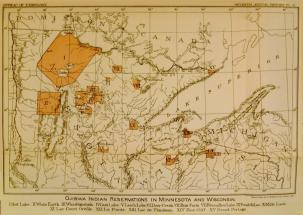
Plate II. Map showing present distribution of Ojibwa 150
III. Red Lake and Leech Lake records 166
IV. Sikas´sige’s record 170
V. Origin of Âníshinâ´bēg 172
VI. Facial decoration 174
VII. Facial decoration 178
VIII. Ojibwa’s record 182
IX. Mnemonic songs: IX.a — IX.b — IX.c 193
X. Mnemonic songs: X.a — X.b — X.c — X.d 202
XI. Sacred objects 220
XII. Invitation sticks 236
XIII. Mnemonic songs: XIII.a — XIII.b — XIII.c — XIII.d 238
XIV. Mnemonic songs: XIV.a — XIV.b — XIV.c — XIV.d 288
XV. Sacred posts 240
XVI. Mnemonic songs: XVI.a — XVI.b — XVI.c — XVI.d 244
XVII. Mnemonic songs: XVII.a — XVII.b 266
XVIII. Jĕs´sakkīd´ removing disease 278
XIX. Birch-bark records 286
XX. Sacred bark scroll and contents 288
XXI. Midē´ relics from Leech Lake 390
XXII. Mnemonic songs: XXII.a — XXII.b 392
XXIII. Midē´ dancing garters 298
Fig. 1. Herbalist preparing medicine and treating patient 159
2. Sikas´sigĕ’s combined charts, showing descent of Mī´nabō´zho 174
3. Origin of ginseng 175
4. Peep-hole post 178
5. Migration of Âníshinâ´bēg 179
6. Birch-bark record, from White Earth 185
7. Birch-bark record, from Bed Lake 186
8. Birch-bark record, from Red Lake 186
9. Eshgibō´ga 187
10. Diagram of Midē´wigân of the first degree 188
11. Interior of Midē´wigân 188
12. Ojibwa drums 190
13. Midē´ rattle 191
14. Midē´ rattle 191
15. Shooting the Mīgis 192
16. Wooden beads 205
17. Wooden effigy 205
18. Wooden effigy 205
19. Hawk-leg fetish 220
20. Hunter’s medicine 222
21. Hunter’s medicine 222
22. 223
23. Diagram of Midē´wigân of the second degree 224
24. Midē´ destroying an enemy 238
25. Diagram of Midē´wigân of the third degree 240
26. Jĕs´sakkân´, or juggler’s lodge 252
27. Jĕs´sakkân´, or juggler’s lodge 252
28. Jĕs´sakkân´, or juggler’s lodge 252
29. Jĕs´sakkân´, or juggler’s lodge 252
30. Jĕs´sakkân´, or juggler’s lodge 252
31. Jĕs´sakkīd´ curing woman 255
32. Jĕs´sakkīd´ curing man 255
33. Diagram of Midē´wigân of the fourth degree 255
34. General view of Midē´wigân 256
35. Indian diagram of ghost lodge 279
36. Leech Lake Midē´ song 295
37. Leech Lake Midē´ song 296
38. Leech Lake Midē´ song 297
39. Leech Lake Midē´ song 297
Larger Map Plate II. Ojibwa Indian Reservations in Minnesota and Wisconsin. I Red Lake. II White Earth. III Winnibigoshish. IV Cass Lake. V Leech Lake. VI Deer Creek. VII Bois Forte. VIII Vermillion Lake. IX Fond du Lac. X Mille Lacs. XI Lac Court Oreílle. XII La Pointe. XIII Lac de Flanibeau. XIV Red Cliff. XV Grand Portage.
THE MIDĒ´WIWIN OR “GRAND MEDICINE SOCIETY” OF THE OJIBWAY.
By W. J. Hoffman.
INTRODUCTION.
The Ojibwa is one of the largest tribes of the United States, and it is scattered over a considerable area, from the Province of Ontario, on the east, to the Red River of the North, on the west, and from Manitoba southward through the States of Minnesota, Wisconsin, and Michigan. This tribe is, strictly speaking, a timber people, and in its westward migration or dispersion has never passed beyond the limit of the timber growth which so remarkably divides the State of Minnesota into two parts possessing distinct physical features. The western portion of this State is a gently undulating prairie which sweeps away to the Rocky Mountains, while the eastern portion is heavily timbered. The dividing line, at or near the meridian of 95° 50' west longitude, extends due north and south, and at a point about 75 miles south of the northern boundary the timber line trends toward the northwest, crossing the State line, 49° north latitude, at about 97° 10' west longitude.
Minnesota contains many thousand lakes of various sizes, some of which are connected by fine water courses, while others are entirely isolated. The wooded country is undulating, the elevated portions being covered chiefly with pine, fir, spruce, and other coniferous trees, and the lowest depressions being occupied by lakes, ponds, or marshes, around which occur the tamarack, willow, and other trees which thrive in moist ground, while the regions between these extremes are covered with oak, poplar, ash, birch, maple, and many other varieties of trees and shrubs.
Wild fowl, game, and fish are still abundant, and until recently have furnished to the Indians the chief source of subsistence.
Tribal organization according to the totemic system is practically broken up, as the Indians are generally located upon or near the several reservations set apart for them by the General Government, where they have been under more or less restraint by the United States Indian agents and the missionaries. Representatives of various totems or gentes may therefore be found upon a single reservation,
The present distribution of the Ojibwa in Minnesota and Wisconsin is indicated upon the accompanying map, Pl. II. In the southern portion many of these people have adopted civilized pursuits, but throughout the northern and northwestern part many bands continue to adhere to their primitive methods and are commonly designated “wild Indians.” The habitations of many of the latter are rude and primitive. The bands on the northeast shore of Red Lake, as well as a few others farther east, have occupied these isolated sites for an uninterrupted period of about three centuries, as is affirmed by the chief men of the several villages and corroborated by other traditional evidence.
Father Claude Alloüez, upon his arrival in 1666 at Shagawaumikong, or La Pointe, found the Ojibwa preparing to attack the Sioux. The settlement at this point was an extensive one, and in traditions pertaining to the “Grand Medicine Society” frequent allusion is made to the fact that at this place the rites were practiced in their greatest purity.
Mr. Warren, in his History of the Ojibwa Indians,115 bases his belief upon traditional evidence that the Ojibwa first had knowledge of the whites in 1612. Early in the seventeenth century the French missionaries met with various tribes of the Algonkian linguistic stock, as well as with bands or subtribes of the Ojibwa Indians. One of the latter, inhabiting the vicinity of Sault Ste. Marie, is frequently mentioned in the Jesuit Relations as the Saulteurs. This term was applied to all those people who lived at the Falls, but from other statements it is clear that the Ojibwa formed the most important body in that vicinity. La Hontan speaks of the “Outchepoues, alias Sauteurs,” as good warriors. The name Saulteur survives at this day and is applied to a division of the tribe.
According to statements made by numerous Ojibwa chiefs of importance the tribe began its westward dispersion from La Pointe and Fond du Lac at least two hundred and fifty years ago, some of the bands penetrating the swampy country of northern Minnesota, while others went westward and southwestward. According to a statement116 of the location of the tribes of Lake Superior, made at Mackinaw in 1736, the Sioux then occupied the southern and northern extremities of that lake. It is possible, however, that the northern bands of the Ojibwa may have penetrated the region adjacent to the Pigeon River and passed west to near their present location, thus avoiding their enemies who occupied the lake shore south of them.
In the reports of early travelers and missionaries no special mention is made of the Midē´, the Jes´sakkīd´, or the Wâbĕnō´, but the term sorcerer or juggler is generally employed to designate that class of persons who professed the power of prophecy, and who practiced incantation and administered medicinal preparations. Constant reference is made to the opposition of these personages to the introduction of Christianity. In the light of recent investigation the cause of this antagonism is seen to lie in the fact that the traditions of Indian genesis and cosmogony and the ritual of initiation into the Society of the Midē´ constitute what is to them a religion, even more powerful and impressive than the Christian religion is to the average civilized man. This opposition still exists among the leading classes of a number of the Algonkian tribes, and especially among the Ojibwa, many bands of whom have been more or less isolated and beyond convenient reach of the Church. The purposes of the society are twofold; first, to preserve the traditions just mentioned, and second, to give a certain class of ambitious men and women sufficient influence through their acknowledged power of exorcism and necromancy to lead a comfortable life at the expense of the credulous. The persons admitted into the society are firmly believed to possess the power of communing with various supernatural beings—manidos—and in order that certain desires may be realized they are sought after and consulted. The purpose of the present paper is to give an account of this society and of the ceremony of initiation as studied and observed at White Earth, Minnesota, in 1889. Before proceeding to this, however, it may be of interest to consider a few statements made by early travelers respecting the “sorcerers or jugglers” and the methods of medication.
In referring to the practices of the Algonkian tribes of the Northwest, La Hontan117 says:
When they are sick, they only drink Broth, and eat sparingly; and if they have the good luck to fall asleep, they think themselves cur’d: They have told me frequently, that sleeping and sweating would cure the most stubborn Diseases in the World. When they are so weak that they cannot get out of Bed, their Relations come and dance and make merry before ’em, in order to divert ’em. To conclude, when they are ill, they are always visited by a sort of Quacks, (Jongleurs); of whom ’t will now be proper to subjoin two or three Words by the bye.
A Jongleur is a sort of Physician, or rather a Quack, who being once cur’d of some dangerous Distemper, has the Presumption and Folly to fancy that he is immortal, and possessed of the Power of curing all Diseases, by speaking to the Good and Evil Spirits. Now though every Body rallies upon these Fellows when
When the Quack comes to visit the Patient, he examines him very carefully; If the Evil Spirit be here, says he, we shall quickly dislodge him. This said, he withdraws by himself to a little Tent made on purpose, where he dances, and sings houling like an Owl; (which gives the Jesuits Occasion to say, That the Devil converses with ’em.) After he has made an end of this Quack Jargon, he comes and rubs the Patient in some part of his Body, and pulling some little Bones out of his Mouth, acquaints the Patient, That these very Bones came out of his Body; that he ought to pluck up a good heart, in regard that his Distemper is but a Trifle; and in fine, that in order to accelerate the Cure, ’t will be convenient to send his own and his Relations Slaves to shoot Elks, Deer, &c., to the end they may all eat of that sort of Meat, upon which his Cure does absolutely depend.
Commonly these Quacks bring ’em some Juices of Plants, which are a sort of Purges, and are called Maskikik.
Hennepin, in “A Continuation of the New Discovery,” etc.,118 speaks of the religion and sorcerers of the tribes of the St. Lawrence and those living about the Great Lakes as follows:
We have been all too sadly convinced, that almost all the Salvages in general have no notion of a God, and that they are not able to comprehend the most ordinary Arguments on that Subject; others will have a Spirit that commands, say they, in the Air. Some among ’em look upon the Skie as a kind of Divinity; others as an Otkon or Manitou, either Good or Evil.
These People admit of some sort of Genius in all things; they all believe there is a Master of Life, as they call him, but hereof they make various applications; some of them have a lean Raven, which they carry always along with them, and which they say is the Master of their Life; others have an Owl, and some again a Bone, a Sea-Shell, or some such thing;
There is no Nation among ’em which has not a sort of Juglers or Conjuerers, which some look upon to be Wizards, but in my Opinion there is no Great reason to believe ’em such, or to think that their Practice favours any thing of a Communication with the Devil.
These Impostors cause themselves to be reverenced as Prophets which fore-tell Futurity. They will needs be look’d upon to have an unlimited Power. They boast of being able to make it Wet or Dry; to cause a Calm or a Storm; to render Land Fruitful or Barren; and, in a Word to make Hunters Fortunate or Unfortunate. They also pretend to Physick, and to apply Medicines, but which are such, for the most part as have little Virtue at all in ’em, especially to Cure that Distemper which they pretend to.
It is impossible to imagine, the horrible Howlings and strange Contortions that those Jugglers make of their Bodies, when they are disposing themselves to Conjure, or raise their Enchantments.
Marquette, who visited the Miami, Mascontin and Kickapoo Indians in 1673, after referring to the Indian herbalist, mentions also the ceremony of the “calumet dance,” as follows:
They have Physicians amongst them, towards whom they are very liberal when they are sick, thinking that the Operation of the Remedies they take, is proportional to the Presents they make unto those who have prescrib’d them.
Juglers, and their solemn Dances in honor of the Calumet, in which they may sing, but it is not lawful for them to dance. They are call’d to their Councils, and nothing is determin’d without their Advice; for, because of their extraordinary way of Living, they are look’d upon as Manitous, or at least for great and incomparable Genius’s.”
That the calumet was brought into requisition upon all occasions of interest is learned from the following statement, in which the same writer declares that it is “the most mysterious thing in the World. The Sceptres of our Kings are not so much respected; for the Savages have such a Deference for this Pipe, that one may call it The God of Peace and War, and the Arbiter of Life and Death. Their Calumet of Peace is different from the Calumet of War; They make use of the former to seal their Alliances and Treaties, to travel with safety, and receive Strangers; and the other is to proclaim War.”
This reverence for the calumet is shown by the manner in which it is used at dances, in the ceremony of smoking, etc., indicating a religious devoutness approaching that recently observed among various Algonkian tribes in connection with the ceremonies of the Midē´wiwin. When the calumet dance was held, the Illinois appear to have resorted to the houses in the winter and to the groves in the summer. The above-named authority continues in this connection:
They chuse for that purpose a set Place among Trees, to shelter themselves against the Heat of the Sun, and lay in the middle a large Matt, as a Carpet, to lay upon the God of the Chief of the Company, who gave the Ball; for every one has his peculiar God, whom they call Manitoa. It is sometime a Stone, a Bird, a Serpent, or anything else that they dream of in their Sleep; for they think this Manitoa will prosper their Wants, as Fishing, Hunting, and other Enterprizes. To the Right of their Manitoa they place the Calumet, their Great Deity, making round about it a Kind of Trophy with their Arms, viz. their Clubs, Axes, Bows, Quivers, and Arrows. ***Every Body sits down afterwards, round about, as they come, having first of all saluted the Manitoa, which they do in blowing the Smoak of their Tobacco upon it, which is as much as offering to it Frankincense. ***This Preludium being over, he who is to begin the Dance appears in the middle of the Assembly, and having taken the Calumet, presents it to the Sun, as if he wou’d invite him to smoke. Then he moves it into an infinite Number of Postures sometimes laying it near the Ground, then stretching its Wings, as if he wou’d make it fly, and then presents it to the Spectators, who smoke with it one after another, dancing all the while. This is the first Scene of this famous Ball.
The infinite number of postures assumed in offering the pipe appear as significant as the “smoke ceremonies” mentioned in connection with the preparatory instruction of the candidate previous to his initiation into the Midē´wiwin.
As for their Opinion concerning the Earth, they make use of a Name of a certain Genius, whom they call Micaboche, who has cover’d the whole Earth with water (as they imagine) and relate innumerable fabulous Tales, some of which have a kind of Analogy with the Universal Deluge. These Barbarians believe that there are certain Spirits in the Air, between Heaven and Earth, who have a power to foretell future Events, and others who play the part of Physicians, curing all sorts of Distempers. Upon which account, it happens, that these Savages are very Superstitious, and consult their Oracles with a great deal of exactness. One of these Masters-Jugglers who pass for Sorcerers among them, one day caus’d a Hut to be erected with ten thick Stakes, which he fix’d very deep in the Ground, and then made a horrible noise to Consult the Spirits, to know whether abundance of Snow wou’d fall ere long, that they might have good game in the Hunting of Elks and Beavers: Afterward he bawl’d out aloud from the bottom of the Hut, that he saw many Herds of Elks, which were as yet at a very great distance, but that they drew near within seven or eight Leagues of their Huts, which caus’d a great deal of joy among those poor deluded Wretches.
That this statement refers to one or more tribes of the Algonkian linguistic stock is evident, not only because of the reference to the sorcerers and their peculiar methods of procedure, but also that the name of Micaboche, an Algonkian divinity, appears. This Spirit, who acted as an intercessor between Ki´tshi Man´idō (Great Spirit) and the Indians, is known among the Ojibwa as Mi´nabō´zho; but to this full reference will be made further on in connection with the Myth of the origin of the Midē´wiwin. The tradition of Nokomis (the earth) and the birth of Manabush (the Mi´nabō´zho of the Menomoni) and his brother, the Wolf, that pertaining to the re-creation of the world, and fragments of other myths, are thrown together and in a mangled form presented by Hennepin in the following words:
Some Salvages which live at the upper end of the River St. Lawrence, do relate a pretty diverting Story. They hold almost the same opinion with the former [the Iroquois], that a Woman came down from Heaven, and remained for some while fluttering in the Air, not finding Ground whereupon to put her Foot. But that the Fishes moved with Compassion for her, immediately held a Consultation to deliberate which of them should receive her. The Tortoise very officiously offered its Back on the Surface of the Water. The Woman came to rest upon it, and fixed herself there. Afterwards the Filthiness and Dirt of the Sea gathering together about the Tortoise, there was formed by little and little that vast Tract of Land, which we now call America.
They add that this Woman grew weary of her Solitude, wanting some body for to keep her Company, that so she might spend her time more pleasantly. Melancholy and Sadness having seiz’d upon her Spirits, she fell asleep, and a Spirit descended from above, and finding her in that Condition approach’d and knew her unperceptibly. From which Approach she conceived two Children, which came forth out of one of her Ribs. But these two Brothers could never afterwards agree together. One of them was a better Huntsman than the other; they quarreled every day; and their Disputes grew so high at last, that one could not bear with the other. One especially being of a very wild Temper, hated mortally his Brother who was of a milder Constitution, who being no longer able to endure the Pranks of the other,
Sometime after the Spirit descended again on that Woman, and she conceived a Daughter, from whom (as the Salvages say) were propagated these numerous People, which do occupy now one of the greatest parts of the Universe.
It is evident that the narrator has sufficiently distorted the traditions to make them conform, as much as practicable, to the biblical story of the birth of Christ. No reference whatever is made in the Ojibwa or Menomoni myths to the conception of the Daughter of Nokomis (the earth) by a celestial visitant, but the reference is to one of the wind gods. Mi´nabō´zho became angered with the Ki´tshi Man´idō, and the latter, to appease his discontent, gave to Mi´nabō´zho the rite of the Midēwiwin. The brother of Mi´nabō´zho was destroyed by the malevolent underground spirits and now rules the abode of shadows,—the “Land of the Midnight Sun.”
Upon his arrival at the “Bay of Puans” (Green Bay, Wisconsin), Marquette found a village inhabited by three nations, viz: “Miamis, Maskoutens, and Kikabeux.” He says:
When I arriv’d there, I was very glad to see a great Cross set up in the middle of the Village, adorn’d with several White Skins, Red Girdles, Bows and Arrows, which that good People had offer’d to the Great Manitou, to return him their Thanks for the care he had taken of them during the Winter, and that he had granted them a prosperous Hunting. Manitou, is the Name they give in general to all Spirits whom they think to be above the Nature of Man.
Marquette was without doubt ignorant of the fact that the cross is the sacred post, and the symbol of the fourth degree of the Midē´wiwin, as will be fully explained in connection with that grade of the society. The erroneous conclusion that the cross was erected as an evidence of the adoption of Christianity, and possibly as a compliment to the visitor, was a natural one on the part of the priest, but this same symbol of the Midē´ Society had probably been erected and bedecked with barbaric emblems and weapons months before anything was known of him.
The result of personal investigations among the Ojibwa, conducted during the years 1887, 1888 and 1889, are presented in the accompanying paper. The information was obtained from a number of the chief Midē´ priests living at Red Lake and White Earth reservations, as well as from members of the society from other reservations, who visited the last named locality during the three years. Special mention of the peculiarity of the music recorded will be made at the proper place; and it may here be said that in no instance was the use of colors detected, in any birch-bark or other records or mnemonic songs, simply to heighten the artistic effect; though the reader would be led by an examination of the works of Schoolcraft to believe this to be a common practice. Col. Garrick Mallery; U.S. Army, in a paper read before the Anthropological Society of
The general character of his voluminous publications has not been such as to assure modern critics of his accuracy, and the wonderful minuteness, as well as comprehension, attributed by him to the Ojibwa hieroglyphs has been generally regarded of late with suspicion. It was considered in the Bureau of Ethnology an important duty to ascertain how much of truth existed in these remarkable accounts, and for that purpose its pictographic specialists, myself and Dr. W. J. Hoffman as assistant, were last summer directed to proceed to the most favorable points in the present habitat of the tribe, namely, the northern region of Minnesota and Wisconsin, to ascertain how much was yet to be discovered. ***The general results of the comparison of Schoolcraft’s statements with what is now found shows that, in substance, he told the truth, but with much exaggeration and coloring. The word “coloring” is particularly appropriate, because, in his copious illustrations, various colors were used freely with apparent significance, whereas, in fact, the general rule in regard to the birch-bark rolls was that they were never colored at all; indeed, the bark was not adapted to coloration. The metaphorical coloring was also used by him in a manner which, to any thorough student of the Indian philosophy and religion, seems absurd. Metaphysical expressions are attached to some of the devices, or, as he calls them, symbols, which, could never have been entertained by a people in the stage of culture of the Ojibwa.
SHAMANS.
There are extant among the Ojibwa Indians three classes of mystery men, termed respectively and in order of importance the Midē´, the Jĕs´sakkīd´, and the Wâbĕnō´, but before proceeding to elaborate in detail the Society of the Midē´, known as the Midē´wiwin, a brief description of the last two is necessary.
The term Wâbĕnō´ has been explained by various intelligent Indians as signifying “Men of the dawn,” “Eastern men,” etc. Their profession is not thoroughly understood, and their number is so extremely limited that but little information respecting them can be obtained. Schoolcraft,119 in referring to the several classes of Shamans, says “there is a third form or rather modification of the medawin, ***the Wâbĕnō´; a term denoting a kind of midnight orgies, which is regarded as a corruption of the Meda.” This writer furthermore remarks120 that “it is stated by judicious persons among themselves to be of modern origin. They regard it as a degraded form of the mysteries of the Meda.”
From personal investigation it has been ascertained that a Wâbĕnō´ does not affiliate with others of his class so as to constitute a society, but indulges his pretensions individually. A Wâbĕnō´ is primarily prompted by dreams or visions which may occur during his youth, for which purpose he leaves his village to fast for an indefinite number of days. It is positively affirmed that evil man´idōs favor his desires,
As a general rule, however, the Wâbĕnō´ will seek entrance into the Midē´wiwin when he becomes more of a specialist in the practice of medical magic, incantations, and the exorcism of malevolent man´idōs, especially such as cause disease.
The Jĕs´sakkīd´ is a seer and prophet; though commonly designated a “juggler,” the Indians define him as a “revealer of hidden truths.” There is no association whatever between the members of this profession, and each practices his art singly and alone whenever a demand is made and the fee presented. As there is no association, so there is no initiation by means of which one may become a Jĕs´sakkīd´. The gift is believed to be given by the thunder god, or Animiki´, and then only at long intervals and to a chosen few. The gift is received during youth, when the fast is undertaken and when visions appear to the individual. His renown depends upon his own audacity and the opinion of the tribe. He is said to possess the power to look into futurity; to become acquainted with the affairs and intentions of men; to prognosticate the success or misfortune of hunters and warriors, as well as other affairs of various individuals, and to call from any living human being the soul, or, more strictly speaking, the shadow, thus depriving the victim of reason, and even of life. His power consists in invoking, and causing evil, while that of the Midē´ is to avert it; he attempts at times to injure the Midē´ but the latter, by the aid of his superior man´idos, becomes aware of, and averts such premeditated injury. It sometimes happens that the demon possessing a patient is discovered, but the Midē´ alone has the power to expel him. The exorcism of demons is one of the chief pretensions of this personage, and evil spirits are sometimes removed 121 that “while he thus exercises the functions of a prophet, he is also a member of the highest class of the fraternity of the Midâwin—a society of men who exercise the medical art on the principles of magic and incantations.” The fact is that there is not the slightest connection between the practice of the Jĕs´sakkīd´ and that of the Midē´wiwin, and it is seldom, if at all, that a Midē´ becomes a Jĕs´sakkīd´, although the latter sometimes gains admission into the Midē´wiwin, chiefly with the intention of strengthening his power with his tribe.
The number of individuals of this class who are not members of the Midē´wiwin is limited, though greater than that of the Wâbĕnō´. An idea of the proportion of numbers of the respective classes may be formed by taking the case of Menomoni Indians, who are in this respect upon the same plane as the Ojibwa. That tribe numbers about fifteen hundred, the Midē´ Society consisting, in round numbers, of one hundred members, and among the entire population there are but two Wâbĕnō´ and five Jĕs´sakkīd´.
It is evident that neither the Wâbĕnō´ nor the Jĕs´sakkīd´ confine themselves to the mnemonic songs which are employed during their ceremonial performances, or even prepare them to any extent. Such bark records as have been observed or recorded, even after most careful research and examination extending over the field seasons of three years, prove to have been the property of Wâbĕnō´ and Jĕs´sakkīd´, who were also Midē´. It is probable that those who practice either of the first two forms of ceremonies and nothing else are familiar with and may employ for their own information certain mnemonic records; but they are limited to the characteristic formulæ of exorcism, as their practice varies and is subject to changes according to circumstances and the requirements and wants of the applicant when words are chanted to accord therewith.
There is still another class of persons termed Mashkī´kĭkē´winĭnĭ, or herbalists, who are generally denominated “medicine men,” as the Ojibwa word implies. Their calling is a simple one, and consists in knowing the mysterious properties of a variety of plants, herbs, roots, and berries, which are revealed upon application and for a fee. When there is an administration of a remedy for a given complaint, based upon true scientific principles, it is only in consequence of such practice having been acquired from the whites, as it has usually been the custom of the Catholic Fathers to utilize all ordinary and available remedies for the treatment of the common disorders of life. Although these herbalists are aware that certain plants or roots will produce a specified effect upon the human system, they attribute the benefit to the fact that such remedies are distasteful and injurious to the demons who are present in the system and to whom the disease is attributed. Many of these herbalists are found among women, also; and these, too, are generally members of the Midē´wiwin. In Fig. 1 is shown an herbalist preparing a mixture.
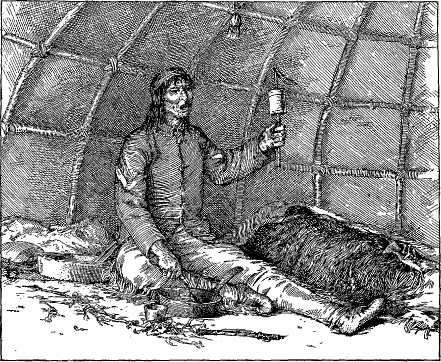
Fig. 1.—Herbalist preparing medicine and treating patient.
The Midē´, in the true sense of the word, is a Shaman, though he has by various authors been termed powwow, medicine man, priest, seer, prophet, etc. Among the Ojibwa the office is not hereditary; but among the Menomoni a curious custom exists, by which some one is selected to fill the vacancy one year after the death of a Shaman. Whether a similar practice prevailed among other tribes of the Algonkian linguistic stock can be ascertained only by similar research among the tribes constituting that stock.
Among the Ojibwa, however, a substitute is sometimes taken to fill the place of one who has been prepared to receive the first degree of the Midē´wiwin, or Society of the Midē´, but who is removed by death before the proper initiation has been conferred. This occurs when a young man dies, in which case his father or mother may be accepted as a substitute. This will be explained in more detail under the caption of Dzhibai´ Midē´wigân or “Ghost Lodge,” a collateral branch of the Midē´wiwin.
As I shall have occasion to refer to the work of the late Mr. W. W. Warren, a few words respecting him will not be inappropriate. Mr. Warren was an Ojibwa mixed blood, of good education, and later a member of the legislature of Minnesota. His work, entiled “History of the Ojibwa Nation,” was published in Vol. V of the Collections of the Minnesota Historical Society, St. Paul, 1885, and edited by Dr. E. D. Neill. Mr. Warren’s work is the result of the labor of a lifetime among his own people, and, had he lived, he would undoubtedly have added much to the historical material of which the printed volume chiefly consists. His manuscript was completed about the year 1852, and he died the following year. In speaking of the Society of the Midē´,122 he says:
The grand rite of Me-da-we-win (or, as we have learned to term it, “Grand Medicine,”)and the beliefs incorporated therein, are not yet fully understood by the whites. This important custom is still shrouded in mystery even to my own eyes, though I have taken much pains to inquire and made use of every advantage possessed by speaking their language perfectly, being related to them, possessing their friendship and intimate confidence has given me, and yet I frankly acknowledge that I stand as yet, as it were, on the threshold of the Me-da-we lodge. I believe, however, that I have obtained full as much and more general and true information in truth to become a member of their Me-da-we lodge.
An entrance into the lodge itself, while the ceremonies are being enacted, has sometimes been granted through courtesy; though this does not initiate a person into the mysteries of the creed, nor does it make him a member of the Society.
These remarks pertaining to the pretensions of “a great and standard authority” have reference to Mr. Schoolcraft, who among numerous other assertions makes the following, in the first volume of his Information Respecting the Indian Tribes of the United States, Philadelphia, 1851, p. 361, viz:
I had observed the exhibitions of the Medawin, and the exactness and studious ceremony with which its rites were performed in 1820 in the region of Lake Superior; and determined to avail myself of the advantages of my official position, in 1822, when I returned as a Government agent for the tribes, to make further inquiries into its principles and mode of proceeding. And for this purpose I had its ceremonies repeated in my office, under the secrecy of closed doors, with every means of both correct interpretation and of recording the result. Prior to this transaction I had observed in the hands of an Indian of the Odjibwa tribe one of those symbolic tablets of pictorial notation which have been sometimes called “music boards,” from the fact of their devices being sung off by the initiated of the Meda Society. This constituted the object of the explanations, which, in accordance with the positive requisitions of the leader of the society and three other initiates, was thus ceremoniously made.
This statement is followed by another,123 in which Mr. Schoolcraft, in a foot-note, affirms:
Having in 1823 been myself admitted to the class of a Meda by the Chippewas, and taken the initiatory step of a Sagima and Jesukaid in each of the other fraternities, and studied their pictographic system with great care and good helps, I may speak with the more decision on the subject.
Mr. Schoolcraft presents a superficial outline of the initiatory ceremonies as conducted during his time, but as the description is meager, notwithstanding that there is every evidence that the ceremonies were conducted with more completeness and elaborate dramatization nearly three-quarters of a century ago than at the present day, I shall not burden this paper with useless repetition, but present the subject as conducted within the last three years.
Mr. Warren truly says:
In the Me-da-we rite is incorporated most that is ancient amongst them—songs and traditions that have descended not orally, but in hieroglyphs, for at least a long time of generations. In this rite is also perpetuated the purest and most ancient idioms of their language, which differs somewhat from that of the common everyday use.
In referring to the rapid changes occurring among many of the Western tribes of Indians, and the gradual discontinuance of aboriginal ceremonies and customs, Mr. Warren remarks124 in reference to the Ojibwa:
Even among these a change is so rapidly taking place, caused by a close contact with the white race, that ten years hence it will be too late to save the traditions of their forefathers from total oblivion. And even now it is with great difficulty that genuine information can be obtained of them. Their aged men are fast falling into their graves, and they carry with them the records of the past history of their people; they are the initiators of the grand rite of religious belief which they believe the Great Spirit has granted to his red children to secure them long life on earth and life hereafter; and in the bosoms of these old men are locked up the original secrets of this their most ancient belief. ***
They fully believe, and it forms part of their religion, that the world has once been covered by a deluge, and that we are now living on what they term the “new earth.” This idea is fully accounted for by their vague traditions; and in their Me-da-we-win or religion, hieroglyphs are used to denote this second earth.
Furthermore,
They fully believe that the red man mortally angered the Great Spirit which caused the deluge, and at the commencement of the new earth it was only through the medium and intercession of a powerful being, whom they denominate Manab-o-sho, that they were allowed to exist, and means were given them whereby to subsist and support life; and a code of religion was more lately bestowed on them, whereby they could commune with the offended Great Spirit, and ward off the approach and ravages of death.
It may be appropriate in this connection to present the description given by Rev. Peter Jones of the Midē´ priests and priestesses. Mr. Jones was an educated Ojibwa Episcopal clergyman, and a member of the Missasauga—i.e., the Eagle totemic division of that tribe of Indians living in Canada. In his work125 he states:
Each tribe has its medicine men and women—an order of priesthood consulted and employed in all times of sickness. These powwows are persons who are believed to have performed extraordinary cures, either by the application of roots and herbs or by incantations. When an Indian wishes to be initiated into the order of a powwow, in the first place he pays a large fee to the faculty. He is then taken into the woods, where he is taught the names and virtues of the various useful plants; next he is instructed how to chant the medicine song, and how to pray, which prayer is a vain repetition offered up to the Master of Life, or to some munedoo whom the afflicted imagine they have offended.
The powwows are held in high veneration by their deluded brethren; not so much for their knowledge of medicine as for the magical power which they are supposed to possess. It is for their interest to lead these credulous people to believe that they can at pleasure hold intercourse with the munedoos, who are ever ready to give them whatever information they require.
The first important event in the life of an Ojibwa youth is his first fast. For this purpose he will leave his home for some secluded spot in the forest where he will continue to fast for an indefinite number of days; when reduced by abstinence from food he enters a hysterical or ecstatic state in which he may have visions and hallucinations. The spirits which the Ojibwa most desire to see in these dreams are those of mammals and birds, though any object, whether animate or inanimate, is considered a good omen. The object which first appears is adopted as the personal mystery, guardian spirit, or tutelary daimon of the entranced, and is never mentioned by him without first making a sacrifice. A small effigy of this man´idō is made, or its outline drawn upon a small piece of birch bark, which is carried suspended by a string around the neck, or if the wearer be a Midē´ he carries it in his “medicine bag” or pinji´gosân. The future course of life of the faster is governed by his dream; and it sometimes occurs that because of giving an imaginary importance to the occurrence, such as beholding, during the trance some powerful man´idō or other object held in great reverence by the members of the Midē´ Society, the faster first becomes impressed with the idea of becoming a Midē´. Thereupon he makes application to a prominent Midē´ priest, and seeks his advice as to the necessary course to be pursued to attain his desire. If the Midē´ priest considers with favor the application, he consults with his confrères and action is taken, and the questions of the requisite preliminary instructions, fees, and presents, etc., are formally discussed. If the Midē´ priests are in accord with the desires of the applicant an instructor or preceptor is designated, to whom he must present himself