VIII THE ESCAPE OF THE SPEEDWELL
Reading edition
“Gude marnin’ to ye, John Marsh,” croaked old Thomas Wiles, looking over the side of the little wooden quay and watching the fisherman in the boat busy with his lines.
“Marnin’, feyther!” replied Marsh cheerily, looking up at the old man with a pleasant smile. “What d’ye make o’ th’ weather?”
“Middlin’ fine, me son,” answered the ancient, taking the pipe out of his mouth and looking up at the sky. “Middlin’ fine. Sou’-westerly breeze’ll hold. We’ll have a drap o’ rain, maybe, but nothin’ much, I’m thinkin’.”
Wiles, aged eighty, was the oldest man in the village of Bembridge, in the Isle of Wight, and being an old man-of-war’s man was generally regarded as the local know-all on all matters nautical. The fishermen of the place used to flock to the Barleycorn tavern to hear the words of wisdom which fell from the old seaman’s lips, and though they did sometimes laugh at him behind his back, and call him an old croaker, it must be admitted that his prognostications regarding the weather usually turned out to be correct, and that, more often than not, they took his advice. He had served in the Navy “way back in th’ ’sixties,” as he himself called it, and though it was now 1805, and he was firmly convinced that “th’ Sarvice was gwine to th’ dawgs; nothin’ like ’twas when I was in th’ ole Andromeeda,” he never tired of watching the frigates and line-of-battle ships when they sometimes came to an anchor in St. Helen’s Roads.
He watched Marsh for some minutes without speaking.
“Be ye gwine out this marnin’?” he inquired at length.
“Yes, feyther,” answered the fisherman with a nod. “Me an’ Tom here,” he pointed to his fourteen-year-old son, who was hard at work baiting some lines. “Me an’ Tom has our livin’ t’earn.”
The old wiseacre on the jetty shook his head in disapproval.
“Bean’t ye afeerd o’ bein’ copped by them Frenchies?” he asked. “Them privateers wot got ole Tom Martin t’other day?”
“Afeerd, feyther,” laughed Marsh. “No, I bean’t afeerd, I reckon, but I doan’t want to see th’ inside o’ one o’ them prisons. Lor’ bless me, though, when I wus in the Sarvice along o’ Lard Nelson, we allus said each man was wuth three on ’em froggies!” He spat over the side to show his contempt.
Marsh himself had served in the Navy, but had retired some years before to eke out a scanty livelihood by fishing, and though his profits were not large, they had sufficed to keep his wife and two children. Tom, his eldest son, had been used to his father’s boat for the last four years, and always accompanied him on his expeditions to his favourite fishing ground near the Owers shoal off Selsey Bill, and as the boy had made up his mind to enter the Navy when he was old enough, there was no doubt that his knowledge of boat work and his general acquaintance with the sea would help him to become a prime seaman in His Majesty’s Fleet when his turn came.
“Well, me son,” resumed Wiles after a lengthy silence. “Maybe ye ain’t afeerd on ’em, but mark me words, ye’ll sing a diff’rent tune if they cops ye an’ claps ye an’ Tom in one o’ them prisons. The grub’s crool bad!” The old man shook his head knowingly, and stumped off up the jetty on his way back to the Barleycorn.
There was no doubt about it that Marsh was running a grave risk, for it was 1805, and war time, and the Channel swarmed with the enemy’s privateers. The latter, as a general rule, were luggers varying in size between fifty and seventy tons, and were used, in time of peace, as fishing craft. Now, however, as war had taken away their legitimate vocation, the owners of these chasse-marées had converted them into privateers by fitting them with small guns and manning them with large crews armed to the teeth. They were extraordinarily fast, and would swoop down on any defenceless vessels they came across, and carry them off from under the very noses of the British frigates and sloops-of-war stationed in the Channel. Even the merchant ships in the home-coming convoys, protected though they were by men-of-war, were not safe from capture, while the hostile luggers would often approach the English coast in broad daylight and harry the hapless fishing craft within a mile or two of the shore. The crews would be captured, the prizes looted and burnt, and then the chasse-marées would clap on all sail and make off, trusting to their superior speed to escape. They generally succeeded in doing so, in spite of the vigilance of the men-of-war, and the consequence was many English fishermen found themselves in French prisons, while many more, unwilling to face the risk of losing all they possessed, were thrown out of employment and stayed ashore with starvation staring them in the face. Marsh, however, had had good luck up to date, and had never so much as sighted a privateer, and although he fully realised the risk he was running in continuing his fishing, he was not to be put off, in spite of old Wiles and his dismal warnings. “Needs must where the devil drives,” and his occupation was the only thing he could rely upon to keep his family and himself from absolute penury.
Soon afterwards, therefore, the Speedwell had slipped her moorings and was sailing seawards with the fair south-westerly breeze. She was a handy little cutter-rigged craft of about five tons, and carried a large spread of canvas which gave her a good turn of speed in anything like a wind, and by noon she had reached her destination. The sails were furled, and the anchor dropped, and after the midday meal father and son were soon busy fishing with lines.
The fish were biting well, and by the latter part of the afternoon the little wooden tank amidships was all but filled with pollack, ling, whiting, and many other varieties of fish.
“Are ye thinkin’ o’ goin’ back home this a’ternoon, Dad?” asked Tom, rebaiting a hook and throwing it overboard.
“No, son, don’t think so,” answered the fisherman. “Fush is bitin’ so well that I think we’d best put the lines out at sundown, an’ stay out all night. We’ll up anchor an’ go back home to-morrow marnin’.”
Tom was not at all averse to the idea, for he had often undergone a similar experience, and really, in spite of their narrowness, the lockers in the cabin of the cutter were quite comfortable to sleep upon. He rather liked the idea of cooking his own supper, too, and he was so accustomed to the sea that the gentle rolling of the little ship did not disturb him in the slightest.
The wind had been lulling all through the afternoon, and towards sunset it died away completely. Soon afterwards the sun sank to rest in a blaze of yellow and orange which predicted a breezy day for the morrow, while the sea presented a glassy shining surface only disturbed by a gentle swell rolling in from the south-westward. Overhead, in the darkening blue of the sky, scattered bunches of mares’ tails hung motionless in the still air, and sitting in the stern sucking at his pipe, instinctively swaying his body in rhythm to the gentle movement of the boat, Marsh looked up at them.
“There’s a fair capful o’ wind about yet,” he remarked pensively. “That yaller on the ’orizon an’ them mares’ tails shows this calm won’t last.”
“Will it blow harder than it did to-day, Dad?” asked the boy.
“No,” returned the fisherman, shaking his head. “’Bout the same, I reckon. Son,” he added, “ye’d best get th’ night lines laid now, afore it’s dark. They’re ready in th’ tub forrard.”
The boy clambered into the dinghy made fast astern, and sculled off to do the job. Twenty minutes saw the lines laid, and when Tom returned he found his father had prepared their supper. After finishing the meal they hoisted the light on the forestay, and then, as darkness had fallen, retired to the cabin and were soon stretched out on the lockers in the little den. No sounds broke the stillness of the night except the gentle lapping of the water against the side. The cutter rolled a little on the swell, but the movement did not disturb the slumber of her weary inmates, and ten minutes later, tired out after their day’s work, they were both fast asleep.
There was no such thing as a clock or watch on board the Speedwell—timepieces in those days were expensive luxuries; but Marsh, like most seamen, could wake himself at any hour he wanted to, and at four o’clock the next morning he was on deck. The first gleams of daylight were just appearing through a heavy mist which overhung the surface of the water, but true to his prophecy of the night before the breeze had again risen, and was gaining strength every minute.
“Rouse out, Tom!” he shouted, going to the hatch leading to the cabin where the boy was still fast asleep. “Come up and give us a hand to get th’ mains’l on her. When we’ve done that we’ll get th’ lines in, an’ start off home!”
“Coming, Dad!” answered the sleepy Tom, rolling off his narrow locker and feeling about for his sea-boots, the only portion of his attire he had discarded on turning in. Within a couple of minutes he had joined his father above, and after some trouble, for it was still very dark, they had hoisted the mainsail, which flapped in the ever-freshening breeze.
“Come on, son,” said Marsh, when this operation was finished. “We’d best weigh th’ lines now.”
He went aft to haul in the dinghy, but hardly had he taken a couple of paces when Tom stopped dead. “Ssh!” he whispered, pointing out in the mist on the port quarter.
“What ails ’e, son?” asked his father in a low undertone.
“Ssh!” hissed the lad, cocking his ear. “I heered somethin’ over there.”
“What wus it?” asked Marsh.
The answer was not long in coming, for hardly were the words out of his mouth when the unmistakable creaking of blocks and the sound of conversation broke the stillness of the morning.
They looked intently in the direction from which the noises came, but so far nothing could be seen, but every instant the light was getting stronger, and the mist was gradually dispersing as the breeze freshened. The voices came nearer and nearer, and then the fisherman suddenly felt his heart leap into his mouth.
“Tom, they’re Frenchies!” he gasped. “Hark to their chatterin’! They’ll have heard this mains’l o’ our’n slattin’ in th’ wind!”
“What ’ud we best do, Dad?” queried the boy nervously, for he had never seen an enemy at close quarters, and did not exactly relish the idea of meeting one.
“Go down to th’ cabin, son,” ordered the father, “an’ get th’ axe. We’ll have to cut the cable!”
“What about th’ lines?”
“Let ’em go,” said the man in an undertone, gazing anxiously through the murk. “Go below an’ fetch th’ axe. Doan’t ’e make any noise, now!”
The boy did as he was told, and creeping down the ladder soon reappeared with the weapon, which he handed to his father.
“Look ’e here, lad,” whispered Marsh. “Take th’ helm. I’m going forrard to cut th’ cable. We’ll get th’ fores’l up after.”
Louder and louder became the sounds, and then a dark blurred shape began to slide out of the mist. It was approaching fast, whatever it was, and creeping forward the fisherman stood ready in the bows with his axe poised.
Tom jammed the tiller over, and as the Speedwell’s bows began to pay off, his father brought the broad-bladed weapon down on the taut cable with a crunch which completely severed it.
But it was too late, for they had been seen, and before the little craft had gathered way the blurred outline of the mast astern had resolved itself into the shape of one of the dreaded luggers, and at the same instant a loud shout rang out from her direction. Marsh, having freed the cutter, jumped to the fore halliards and hoisted the foresail, and then clambered aft into the stern.
“She must ha’ seen us!” he remarked breathlessly, noticing that the lugger had altered her course slightly.
“Must have,” replied Tom, feeling very anxious. “How fur off is she?”
“Not more’n a hundred yards,” said his father. “I doan’t think she’s comin’ up, though,” he added.
The Speedwell, with her mainsail and foresail set, was apparently holding her own, for the shadow behind her did not become more distinct. Presently she was dashing along with her lee gunwale perilously near the water’s edge, but the lugger did not seem to be gaining, and for a moment Marsh thought he still had a chance of escaping.
Presently they ran out of the fog bank into clear daylight, for the sun had now risen, but looking astern they soon saw the bowsprit and then the black hull and three tanned lugsails of the chasse-marée following dead in their wake.
“I’m afeerd we’re collared this time, Tom!” exclaimed Marsh, as he watched the lugger dashing along with the spray smoking over her weather gunwale. “Yon’s a faster craft than our’n!”
He was right, for now the stranger was undoubtedly closing, and a few seconds later a ruffianly-looking individual, clad in a blue jersey and a long red cap, clambered forward on board the lugger and shouted something in his own language. His words could not be heard on account of the wind, but there was no mistaking his gestures. He was telling the Speedwell to heave to, or to take the consequences.
“Heave to be jiggered!” exclaimed Marsh indignantly, shaking his fist at his pursuer. “I’m not a-goin’ to pipe down to a set o’ pirates like that! Look e’ here, son, we must get th’ tops’l on her, it’ll give us a bit more speed. Lord knows we’ll want it,” he added, with an apprehensive glance astern.
No sooner said than done, and after a certain amount of difficulty, for the breeze was fresh, they succeeded in getting the gaff topsail above the mainsail. Feeling the extra canvas the cutter leapt through the water faster than before, but they had lost ground during the manœuvre, and the Frenchman was now barely fifty yards astern.
It could now be seen that she carried four small guns each side, while crowded on her decks were over thirty armed men. Several of them were clustered in the bows, and the morning sun could be seen glinting on the barrels of muskets, and before long another man rose to his feet and hailed, in broken English this time, for the Speedwell to heave to and surrender.
Marsh shook his fist in reply, but hardly had he done so when a ragged volley of musketry broke out from the lugger. Some of the bullets came perilously close, while one scored a long weal in the wood of the bulwark close to which Tom was standing. He ducked involuntarily, a thing which many a brave man has done the first time he has been under fire.
“Lie down flat on th’ deck, me son,” said his father, with a smile on his weather-beaten face. “There ain’t no call for ye to get exposin’ yerself.”
“All right, Dad,” said the boy. “But can’t we do anythin’ to go a bit faster? She’s gainin’ on us!”
“I dunno,” answered Marsh. “P’raps if we cut away th’ boat astern it’ll help us along a bit. Get th’ axe an’ cut her adrift!”
Tom cut the dinghy free, and as she was floating astern another volley rang out from the lugger. This time the muskets had been better aimed, for the bullets hummed through the air closer to the cutter’s deck, but still no damage was done.
“I wish we had a musket or two to fire on th’ swabs!” growled Marsh.
But his wish was useless, for beyond the axe the cutter had no weapons of any kind on board, and all the time the chasse-marée drew closer and closer. It was lucky she could not use her guns, for a discharge from them would have blown the Englishman out of the water; but even as it was, affairs were bad enough, for the lugger’s crew had opened up an independent fire, and the range was so short that the flying missiles were coming closer and closer every second.
They lay flat on the deck, where they were protected to some extent by the low bulwarks; but though pursuer and pursued were both travelling fast, the lugger was coming up hand over fist. Presently she was no more than twenty yards astern, and as a sudden gust heeled the Speedwell over Marsh rose to his knees to get a better purchase on the tiller. The moment he did so more shots came from the lugger, and to Tom’s horror he suddenly saw his father relinquish his hold on the helm and clap a hand to his left shoulder.
“Dad! Dad!” he cried. “Have they hit ye?”
“Yes, th’ frog-eatin’ pirates!” groaned the fisherman, with the blood trickling down his arm. “Lucky ’tis only through th’ shoulder. Take th’ tiller, son,” he added, grinding his teeth in pain.
Tom, crouching low, steered the boat as best he could while sheltering himself from the flying bullets. He could do nothing to help his father, who had sunk to the deck more or less unconscious from the pain of his wound, for he had his work cut out in keeping the cutter on a steady course. But all the time the chasse-marée was drawing closer, and at last, glancing astern, the boy saw her short bowsprit barely ten yards off the Speedwell’s quarter.
For a moment his heart failed him, for the lugger was sailing close to the wind and evidently intended to run up on the cutter’s weather quarter and then board, for several red-capped ruffians, armed with cutlasses and pistols, were standing by her foremast, ready to jump the moment the vessels touched.
Tom glanced at his father, undecided what to do, but then he was suddenly struck by a brilliant idea, and putting all his weight on the tiller jammed it hard down. The Speedwell’s head flew round into the wind with a rattling of ropes and a slapping of canvas, but though the wrench when the heavy boom came over nearly carried away the mast, the rigging held, and leaving the boat to steer herself for a minute, the boy jumped forward to secure the fore sheet. Muskets and pistols were fired at him, but he accomplished it in safety, and clambering aft again took his place at the helm.
Putting about a cutter-rigged craft like the Speedwell was an easy manœuvre enough, but with the lugger, who had to lower and dip her three lugsails every time she tacked it was by no means so simple. The Frenchmen, moreover, were not expecting Tom’s jibe, and dashed on, with her crew yelling with mad excitement.
Though the Speedwell was now heading out to sea with her stern pointing at the lugger’s broadside, the guns of the latter were not fired. Probably they were not loaded, and lucky it was that they were not.
Soon the boy heard the shouts and the slatting of canvas as the chasse-marée went about, but by the time she was in pursuit again the handy little cutter had gained at least two hundred yards. Tom’s course, however, was now carrying him out into the English Channel, while the Isle of Wight, still shrouded in a pall of mist, was somewhere away on his port quarter. He determined, nevertheless, to wait until his pursuer should be close before attempting to go about again.
Presently the fisherman, noticing a change in the movement, opened his eyes and looked up.
“What have ye done, lad?” he asked feebly.
Tom explained.
“Good lad!” exclaimed his father. “If ye keep on goin’ about every time she comes alongside o’ us, p’raps we’ll weather her arter all. How fur astarn is she now?”
“’Bout two hundred yards,” said the boy, with a glance over his shoulder.
The lugger, however, was still gaining, and within twenty minutes was close astern again. As before, she approached on the cutter’s weather quarter, her men standing by ready to board, while occasional musket shots whistled over Tom’s head.
Nearer and nearer she came, until Marsh, thinking his son was waiting too long, raised himself on his uninjured arm.
“Now’s yer time, son!” he shouted, seeing the chasse-marée’s bowsprit getting nearer and nearer. “I’ll take the tiller, jump forrard an’ stan’ by th’ fore sheet.”
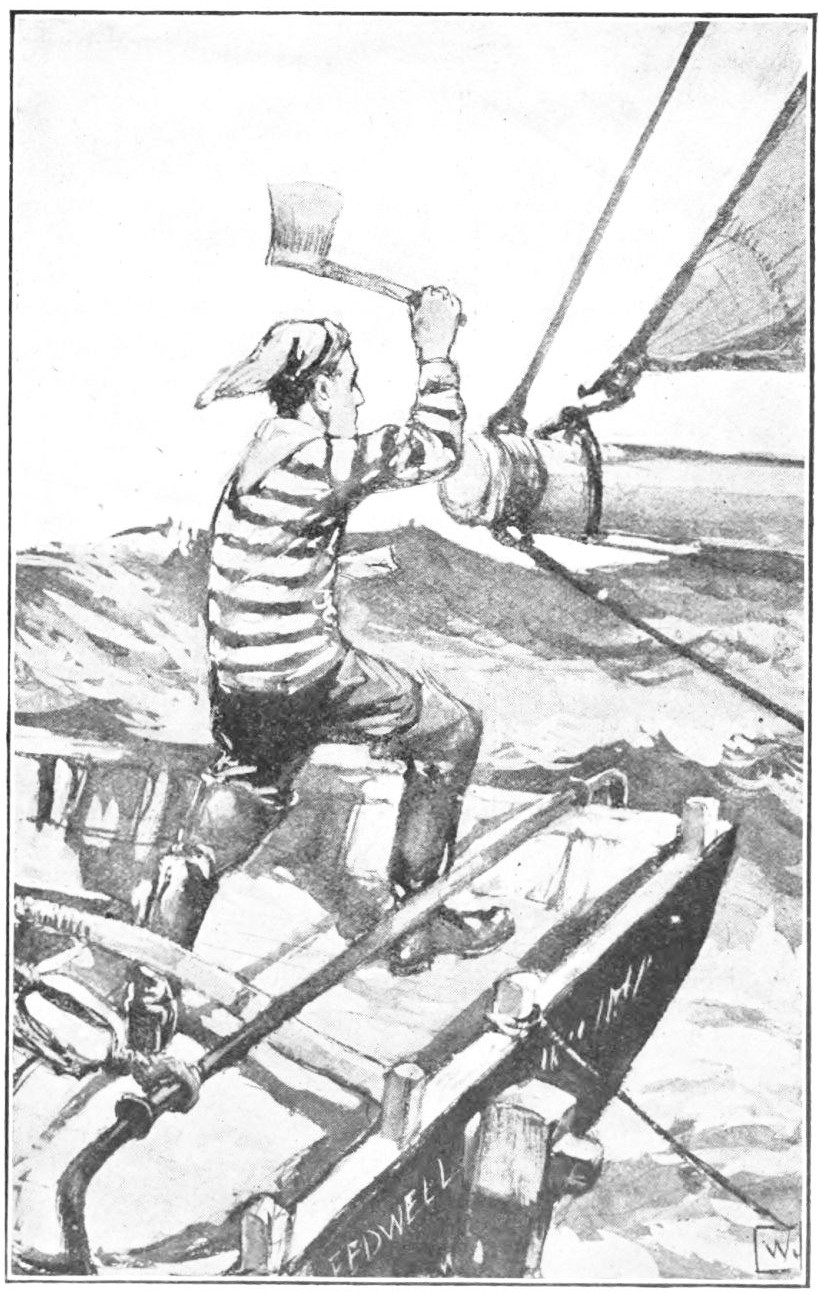
He reached out his uninjured hand and jammed the helm hard down, and once more the Speedwell came up head to wind with her canvas flapping in the breeze. The lugger’s bowsprit was perilously close, almost overlapping the cutter’s quarter, but Tom, who was just about to dash forward to readjust the fore sheet, was suddenly seized with a brilliant inspiration. He seized the axe and made a wild slash at the lashing securing the lugger’s jib to the end of her bowsprit, now within easy reach. It was done on the spur of the moment, but his eye was sure, and the keen edge of his weapon bit through the tough rope.
The Frenchmen were instantly thrown into utter confusion. The jib, no longer stayed forward, flew aft in a cloud of canvas and precipitated two red-capped Frenchmen into the water, while the man at the helm, seeing his companions struggling in the sea, relinquished his hold on the wheel, and endeavoured to save them. The lugger promptly came up into the wind with her sails thrashing against her masts; the air became blue with “Sacrés!” and wild shouts of rage, and in spite of his danger Tom could not help chuckling. It was fully ten minutes before order was restored on board the foreigner, and by the time she had repaired her damage, picked up her men, and was once more in chase of her nimble quarry, the latter was over a mile ahead.
About half a mile beyond the Speedwell was a bank of low-lying fog, and Tom was looking at it and wondering whether or not it would hide him from his pursuer, when he heard the sullen boom of a gun from the southward. At first he could see nothing to account for it, but presently
“He seized the axe and made a wild slash.” To face page 142
he noticed the dim shape of a large ship emerging out of a pall of mist about two miles away to port.
The lugger had seen the stranger, for she had altered her course and was flying off to seaward. The big ship gradually sailed into view, and once in the sunlight the boy saw from her towering canvas and black and yellow chequered sides that she was a man-of-war.
“We’re saved!” he yelled excitedly, as a puff of smoke left the ship’s side, and a round shot splashed into the water midway between her and the chasse-marée.
“What’s that, son?” queried Marsh, sitting up. “What did yer sing out?”
“There’s a big ship firing at the Frenchie!” repeated the boy delightedly.
The fisherman looked over the gunwale.
“Snakes!” he exclaimed an instant later. “Yon’s th’ Amazon. See the White Ensun at her peak!”
The frigate fired again, but once more the shot pitched short, and from the way the lugger was winging seaward it seemed that she was travelling faster than the man-of-war, and that she would make good her escape after all.
“Set yer royals! Set yer royals!” muttered Marsh, seeing that the frigate was under top-gallant sails. “You won’t catch her else! Ah!” he exclaimed an instant later, when, as if in answer to his suggestion, three clouds of canvas descended simultaneously on the man-of-war’s masts. “That’s better, capten!”
The light sails were sheeted home and hoisted, but even with their assistance the frigate was no match for her nimble quarry.
“There she goes again!” sang out Tom, as another tongue of red flame and a cloud of white smoke leapt out from the man-of-war’s side. “Hurrah!” he yelled, waving his hat in his excitement. “That’s done it!”
It had, for the foremast of the chasse-marée had suddenly toppled overboard with its sail. It was a lucky shot, for the range was great, but the thirty-two pound ball had shorn off the mast close to the deck, and had effectually stopped the lugger’s progress, though she still strove to escape with the sails on her fore and main masts.
“Won’t do, me son,” murmured the fisherman, looking at her. “Yer copped all right!”
He was perfectly correct, for the Amazon was now sailing two feet to her one, and ten minutes later had hove to close alongside the Frenchman. They saw the smoke of a volley of musketry; but it was the enemy’s last effort, for a minute or two later the tricolour fluttered down from her peak. She had surrendered.
The Speedwell still held on her course for Bembridge, and when the frigate had transferred her prisoners she took her crippled prize in tow, and steered up towards Spithead. She came booming along at a great speed, far faster than the cutter, and half an hour later the two vessels were close alongside.
Tom took off his hat and cheered as she passed; an answering yell came back from the man-of-war’s men, and shortly afterwards an officer with a speaking trumpet jumped up on to the white hammock cloths and stood balancing himself with one arm hooked round a backstay.
“Cutter, ahoy!” he bellowed.
Tom waved his hand in reply.
“We’ve captured the Trois Sœurs of Saint Malo. Eight guns and forty men. She very nearly had you! D’you want any help?”
“Tell ’em no,” growled Marsh; “this prick o’ mine can wait till we get back home.”
“No, sir,” shouted the boy.
“Right!” came back the answer. “What’s the name of the cutter and her owner?”
“The Speedwell of Bembridge, sir,” replied Tom. “John Marsh, owner!”
“Right! Good-bye! Glad to have been able to help you!” The frigate drove ahead out of earshot, and the figure in blue and gold leapt down on deck.
A couple of hours later the Speedwell arrived at Bembridge, and the little town, as may well be imagined, was thrown into a state of frantic excitement when the story of her narrow escape became public property.
Tom became a sort of public hero, and one day about a fortnight later, when his father was convalescent, for the bullet had broken no bones, they were once more at work in the cutter moored up alongside the jetty.
“What did I tell ’e, John Marsh?” said the well-known voice of old Wiles from above. “Didn’t I tell ’e as ’ow th’ Frenchies was cruisin’ around?”
“Aye, feyther,” replied the fisherman, busy putting patches in the sails through which the French bullets had driven holes. “But we wusn’t copped, all th’ same!”
“It wurn’t none o’ yer fault, then,” retorted the old gentleman. “If it ’adn’t bin fur that son o’ yourn ye’d a’ tasted t’inside of a French gaol. I knows!” he concluded, wagging his head wisely.
“Never mind, feyther,” laughed John Marsh. “We wusn’t copped, an’ Tom did save th’ Speedwell. Didn’t ’e, son?” he added, putting his hand on the boy’s shoulder.
Tom merely blushed and felt a fool.