III THE GUNNER’S LUCK
Reading edition
(The following story is not mere fiction, for the events therein described actually occurred during the South African War.)
H.M. Torpedo-boat Number 60 was pursuing her way northward along the western coast of Cape Colony at a steady ten knots. As a matter of fact the exact course was N.N.W., and this took the little craft along parallel to the coast and some fifteen miles off it, while Robben Island, thirty miles to the northward of Capetown, had been abeam at noon, so the ship was well on her way up the coast in the direction of Cape Castle.
It was a beautiful afternoon, with a clear blue sky, unflecked by the least vestige of cloud, while the sun overhead converted the sea into one vast expanse of shimmering light. There was a gentle breeze from the south-east, but it was not sufficient to raise a sea, and the great ocean was only disturbed by a slight swell rolling in from the westward, over which the little torpedo-boat rode with an easy movement.
It was 1901, when the South African War was at its height and the whole of Cape Colony and Natal was one great military camp. The daily arrival of transports had come to be looked upon as a mere matter of routine, for the war had been going on for eighteen months. The Navy, too, was not idle, for many men belonging to the Cape of Good Hope Squadron had been at the front with their guns, fighting side by side with their soldier comrades, while the coasts of Cape Colony and Natal had also to be patrolled.
There were at that time comparatively few ships on the Cape station, and as many hundreds of miles of coast had to be covered, all the torpedo-boats in reserve at the naval base at Simonstown had been requisitioned for this service, and though hardly suitable for the task, they performed their work with a thoroughness which left nothing to be desired. Through lack of lieutenants the greater number of them were commanded by gunners, and No. 60, the little vessel with which we are concerned, was in charge of Mr. Samuel Hyne, a warrant officer of this rank.
Small as she was, he was proud of her, and though her 65 tons displacement, her 127½ feet of length, her 15 men, and her armament of four 14-inch torpedo tubes, besides one three-pounder Hotchkiss and a solitary 45-inch maxim, made her a very puny and insignificant little craft, she was, in Hyne’s eyes, quite the smartest thing afloat flying the White Ensign. He was proud of her, for his pennant flew at her masthead, and though in 1886, when she first saw the light of day, she could do her 20½ knots with her single screw, and now could steam no more than, as he himself would call it, “eighteen and a kick,” he revelled, like many others, in the delights of his first independent command.
Close alongside the after torpedo tubes, and near the hatch leading to the stuffy wardroom, the skipper sat on a camp stool having a friendly yarn with the chief engine-room artificer, Watson, who, though only a chief petty officer, was the engineer of the ship. It was hardly possible to tell the chief E.R.A. from his commanding officer, for both were clad in nothing but trousers and singlets open at the neck. It was noticeable, though, that the engineer never omitted the “Sir” when addressing his senior, even though the two men were close friends.
“It’s all very well for you to say I’m lucky to have this job,” the gunner was saying. “I dare say I am, but lucky or not, I’d far sooner have had a chance of getting to the front!”
“Yes,” nodded the chief E.R.A., reaching for his tobacco pouch, “but if you ’ad, sir, maybe you’d a got a bullet through you, same as Mister McFiggis, o’ the Doris, did up at Graspan. ’E was full o’ beans when ’e left the ship, but ’e nearly pegged out in ’orspital. Lor’ bless me ’eart an’ soul, ’e didn’t want no more soldierin’. Lor’ lumme, no!”
“I wouldn’t mind running the risk of that,” answered Hyne, “if only I had the chance of doing something. They’ll get medals and bars, and distinguished service orders, and goodness only knows what, and I’m busted if we’ll get so much as a bloomin’ ‘thank you’ for patrolling this blessed coast. Not so much as a thank you,” he reiterated mournfully, glancing at the dull purple serrated edge of the mountains away on the starboard beam. “I’m sick of it all!”
“Well, it’s not your fault, sir,” went on the chief E.R.A. “You can’t do more’n obey your orders, an’ if you don’t get your chance you don’t, and that’s all about it.”
The gunner laughed, and both men relapsed into a silence which was only broken by the gentle ripple of the water as the torpedo-boat forced her way through it.
The afternoon wore on, and at four o’clock Hyne went forward to relieve the coxswain on watch. The orders were turned over, and the petty officer went aft to his little cupboard of a mess, and was soon busy with his tea, which meal consisted of stale bread, fried eggs of doubtful origin, and well-stewed navy tea with no milk, for in those days condensed milk was not served out by a paternal Government.
It was about one bell in the first dog-watch (4.30 p.m.) that the gunner, who was gazing abstractedly at the distant land, felt a sudden tremor from the after part of the ship. At first he paid no attention to it, for the little ship always vibrated badly, but when there came an awful bump, followed by a jarring grind, and then a fearful clatter from the neighbourhood of the engine-room, he realised something serious had happened, and commenced to run aft.
He was just in time to see the chief E.R.A. disappear down the engine-room hatch like a shot rabbit, while the coxswain, with an anxious face, was climbing up the ladder from his mess.
“What’s happened?” cried Hyne.
“I don’t rightly know, sir,” answered Naylor, the coxswain. “Me an’ th’ chief was sittin’ in th’ mess when we ’ears a bump an’ then a grindin’, an’ then th’ engines start ’eavin’ round fit ter bust!”
Descending the greasy ladder, the gunner went below into the engine-room. Seeing a group of perspiring men in the after part of the little compartment, he went up to them.
“What’s the matter?” he asked.
“Shaft’s gone clean in half, sir,” said Watson, looking up.
“Lord help us!” gasped the skipper. “Is it possible to do anything to it?”
“No, sir,” replied Watson, wiping his perspiring face with a bit of dirty oily waste until it was streaked with black. “It’s a proper dockyard job I’m afraid, it’s gone clean across!”
“Are we making any water?”
“Don’t think so, sir,” said the other. “If we had a’ been it ’ud found its way for’ard by this time. It’ll have strained the stern gland a bit, but the broken part of the shaft’s still there, and I expect I can keep the flow under with the ejectors.”
“I hope you can,” remarked Hyne, “but let’s go aft and have a look.”
They left the engine-room, and going aft along the upper deck visited all the stern compartments in turn.
“There’s no damage to speak of,” said Watson, when the survey was completed. “Th’ gland’s weeping a bit more’n usual, an’ one or two rivet heads are sheared off an’ one or two plates a bit buckled. We can keep the water under all right, an’ I’ll get th’ ejectors workin’ at once. But we can’t steam another inch, of course.”
He vanished below, and while he set the pumps to work Hyne thought over the situation. He was placed in a most unenviable position, for No. 60, having, like the majority of the older torpedo-boats, only one screw, was absolutely helpless with her tail shaft fractured. Even if they had a spare length of shafting it could not be placed in position. He grew pale as he thought of what might happen. The mighty Agulhas current would carry the disabled ship to the northward, and though he had food and water sufficient for perhaps a week’s consumption if he put the men on half rations, affairs still looked pretty desperate, unless some passing steamer gave the torpedo-boat a tow into harbour. She was, however, out of the track of steamers running to Capetown, and her size did not make her a very conspicuous object.
The one small dinghy the little vessel carried would not accommodate more than eight of her men at the very outside, and if the ship had to be abandoned the other men would have to be towed astern in life-buoys, while their progress would naturally be slow, and their chance of reaching the coast, twenty miles distant, doubtful in the extreme. Even allowing that it was possible, the sea was infested with sharks, so Hyne dismissed the idea as impossible almost as soon as he thought of it.
Going aft he was met by the coxswain.
“Get the ship’s company aft, Naylor,” he ordered.
“Aye, aye, sir.”
Soon afterwards the little crew had been collected, and, stepping forward, the petty officer reported, “Ship’s company present, sir,” in his best battleship manner.
“Men,” began Hyne, getting on to the after torpedo tube, “I’ve not brought you up here to spin a long yarn. You all know what’s happened, and that we’re practically helpless twenty miles from land, and out of the track of shipping. We’ve got three days’ grub on board, say four with what we’ve got in the wardroom, so, in case of accidents, we’ll pool the lot and put everyone on half whack!
“It’s a poor look out, I don’t mind telling you,” he went on to say, “but still we’ve a chance. The weather’s fine, and though we can’t steam, we can sail....
“Yes,” he said, noticing that the men were looking at each other in surprise, “I daresay sailing a torpedo-boat sounds strange, but it’s got to be done! Saldanha Bay’s the best place to make for, it’s about thirty miles nor’-east of us, and as the wind’s freshening every minute and going round to the southward, we’ll have it on the starboard quarter. We must buckle to, and rig up a couple of extra masts—bearing out spars’ll do—and we must cut up every bit o’ canvas in the ship, and make it into sails. Four hours at the outside must see us under way, and though we shan’t go very fast, I hope we’ll make Saldanha Bay some time to-morrow. That’s all I’ve got to say, and now I want you to buckle to and rig up the masts and make the sails.”
The men cheered as he dismissed them, and before long they were hard at work furling the awnings while the storerooms were burgled for every inch of canvas they contained. Presently those of the men who could use a sail-maker’s palm and needle were busy sewing the lengths together, while others placed and stayed the spars to serve as main and mizzen masts, for the torpedo-boat only carried one stumpy mast forward.
By eight o’clock, when the sun sank to rest beneath the western horizon in a blaze of scarlet and gold, everything was ready except the sails.
“Come on, lads! Bear a hand!” shouted Hyne cheerfully to encourage the men sewing, and noting with satisfaction that the breeze from the southward was momentarily freshening. “We must get sail on her as soon as we can!” The bluejackets worked with a will, and half an hour later a small jib and triangular trysail were set on the foremast. They were anything but well cut or shapely, for they had been made out of the awning, but still they served their purpose, for as soon as they were hoisted the wind bellied them out, and the little vessel heeled over and began to move through the water.
“Steer east-nor’-east!” said Hyne to the coxswain, as the latter ran forward to take the wheel, and, as the rudder went over, the skipper saw with satisfaction that the ship answered her helm.
By nine o’clock it was pitch dark, and the stars had begun to twinkle in the dark blue of the sky overhead, and soon afterwards the other sails were ready, and were set on the spars serving as main and mizzen masts. The torpedo-boat slipped still faster through the water, until she was making about four knots, while the men, highly satisfied with their work, had their frugal supper of stale bread and bully beef.
The hours dragged wearily by, but by midnight the breeze had developed into a strong wind, which still blew from the same direction. The sea, however, had got up, and the little ship wallowed
“He saw to his inexpressible relief that the entrance to Saldanha Bay was in sight.” To face page 57
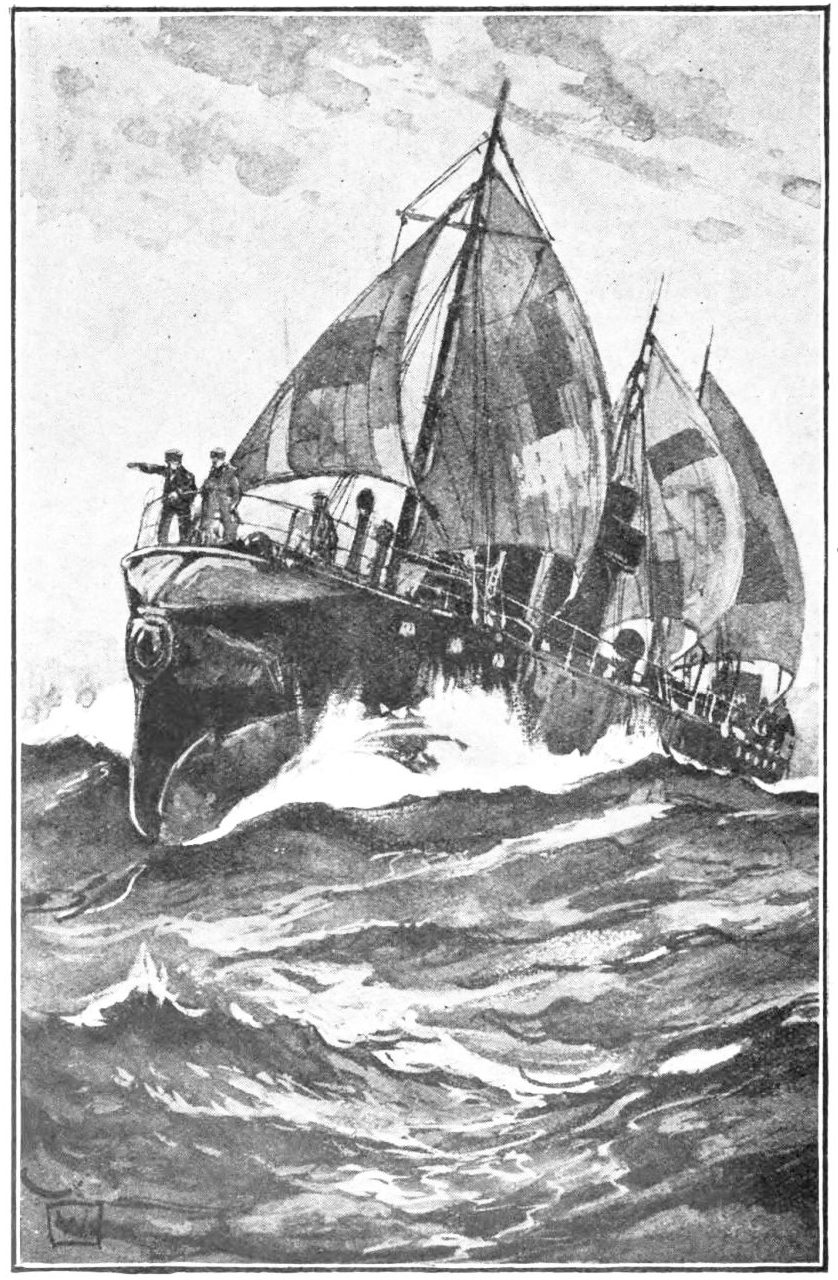
heavily as she crawled along at her leisurely gait, but as the stars still shone it did not appear as if the weather was going to get any worse. The gunner and coxswain spent the whole night on deck, and at five o’clock the next morning the first signs of dawn appeared over a serrated band of obscurity on the horizon which could only be land. Hyne, exhausted as he was, felt quite cheerful when he saw it, and when daylight came he saw, to his inexpressible relief, that the entrance to Saldanha Bay was in sight a short distance to the northward.
Two hours later the crippled torpedo-boat crawled into the harbour, and passing several steamers and sailing craft at anchor, whose crews broke into ironical cheers as she crept by, finally dropped her anchor off the settlement.
“Well, sir,” remarked the chief E.R.A. to Hyne, as the latter went aft towards the wardroom hatch, “you’ve had your chance all right, if you’ll excuse my saying so, sir, and I reckon the Admiral’ll have something nice to say to you when we get back to Simonstown.”
“Nice!” sniffed Hyne. “Nice indeed! I expect he’ll order me to be court-martialled on the spot because the shaft broke. Endangering one of His Majesty’s ships, and all the rest of it!”
“I ’ope not!” declared Watson, dropping his h’s in his nervousness. “Hindeed! I ’ope not!”
“Well, we’ll see,” said the gunner, going down the ladder; “but meanwhile I’m going to send a wire reporting what has happened.”
. . . . . .
A week later H.M. Torpedo-boat No. 60 arrived at Simonstown behind the second-class cruiser which had been sent to Saldanha Bay to tow her back. The news of her vicissitudes was already common property, and as she passed by, the men-of-war on her way to the dockyard, a string of coloured bunting crept to the masthead of the flagship and fluttered out in the breeze. An instant later the sides and rigging of the war vessels were black with men, and as No. 60 passed cheer after cheer rang out across the water.
“What the deuce do they want to make all that shindy about?” growled Hyne, who, if the truth must be told, felt rather relieved at the reception.
“I expects you’ll find out orl rite when yer reports yer arrival to the Admiral, sir,” murmured the coxswain.
An hour later the gunner was reporting his arrival to the Admiral on board the flagship. The Commander-in-Chief got up from the table at which he was writing.
“I’m glad to see you back, Mr. Hyne,” he said graciously, shaking hands. “I’m glad you came out of it all right. Let me hear all about it; your wire didn’t give me much news beyond the fact that you’d broken down and had ... er, sailed your torpedo-boat into Saldanha Bay.”
The story was soon told, and when the narrative was complete the Admiral rose from his chair.
“Mr. Hyne,” he said, “I congratulate you. I knew when I appointed you to No. 60 you’d do well, but I never expected this. I shall forward a report of your conduct to the Admiralty.”
“Thank you, sir!” gasped the astonished Hyne, his face turning the colour of a beet.
“And,” continued the Commander-in-Chief, “I shall be very pleased if you will come and dine at Admiralty House to-night. My wife will be interested in your story, and I’m afraid you’ll have to tell it all over again.”
. . . . . .
Six weeks later Hyne was sitting on the deck of his little command, which was on the torpedo-boat slip in the dockyard, after having been fitted with a new screw shaft. It was a hot day, and he was half dozing in his chair with his pipe between his teeth, when he was roused by the sound of shouting from forward. Presently the signalman came running aft with a signal pad in his hand.
“What’s all the noise about forward?—tell ’em to stop it at once,” said Hyne.
“Signal, sir,” said the man, “just come from the flagship. Reads ‘Admiralty informs me that Mr. Samuel Hyne, gunner, has been promoted to the rank of lieutenant. I am sure that all officers and men under my command will congratulate this officer on his well-merited promotion.’”
“Good Lord!” gasped the newly-made lieutenant, hardly able to believe his ears. “Are you quite certain it is all right? Perhaps someone’s pulling my leg.”
“No, sir, they ain’t,” declared the signalman, breaking into a grin, “an’ th’ signal goes on to say: ‘Chief Engine-room Artificer Jeremiah Watson is advanced to the rank of Artificer Engineer!’”
“What’s that?” said a voice, as the chief E.R.A.’s head appeared on deck. “Let’s have a look. Are you sure it ain’t a ’oax?”
“’Oax, ’oax!” exclaimed the man; “beggin’ yer pardon, sir, the Admiral ain’t goin’ ter pull yer leg!”
He handed the signal pad across as he spoke.
“It’s all right,” said Hyne breathlessly. “I congratulate you, Mr. Watson.”
“Same here, Lieutenant Hyne,” said the other. “Didn’t I say, sir, as how they wouldn’t forget you? Aren’t you a jolly sight better off than Mister McFiggis, who got a bullet through ’im at Graspan?... Lor’ save us, though!” he added, “I didn’t know as I ’ad done anythink!”
“No, but I did, though,” said the new lieutenant, as he went below to figure out how much it would cost him to send a lengthy cable home to his wife in England.