V THE SALVAGE OF THE CASHMERE
Reading edition
“Well,” remarked Captain Morris of the tug Evening Star, as he slowly refilled his pipe, “things have been pretty bad wi’ us fur th’ last six months. As ye know, mate, I sank all me capital in this old hooker when me poor missus died. The craft’s cost me more’n I care to think about, what wi’ th’ coal, upkeep, an’ wages, and we’ve not had a job wuth calling a job fur a long time. There’s Tom’s schoolin’ to think about, too,” he continued, glancing at his sixteen-year-old son, who sat on the cushioned locker beside him.
Johnson, the mate, nodded, but said nothing.
“Why don’t you let me take that job at the shipbuilding yard, father?” said the boy. “I should earn enough to live on, and then I should cost you nothing.”
“I don’t grudge the money, my son,” continued the skipper; “don’t think that. You’ve bin a good lad, an’ ’tis money well spent. I did want to get ye that job along o’ th’ Wireless Telegraphy Company. The work here in the yard’ll lead to nothing, an’ ye’ll be stuck here all yer life.”
Tom himself did not fancy the idea of spending his days in the little seaport town of Halmouth, though, to save his father expense, he was quite prepared to enter Mr. Saunders’ shipbuilding yard.
“But,” he said, “if nothing else turns up, I must take what I can.”
“I’m afraid so,” replied Morris with a sigh.
“What are ye thinkin’ o’ doin’, then, cap’n?” broke in the mate. “Goin’ to chuck the sea?”
“I’ll have to sell this craft an’ get a job ashore,” growled the skipper. “The Tug an’ Lighter Company have made me an offer for her, an’, though ’tis two hundred less than I gave for her two year ago, I’ll have to take it. Buyin’ an’ sellin’ are two different things, an’ she’s runnin’ sweeter now than ever she was; besides, look at the money I’ve spent on her.”
The mate muttered something under his breath, for he did not like the idea of serving under some other skipper.
“Well,” continued Morris, glancing at the clock on the bulkhead, and rising to his feet and stretching himself, “’tis close on time; we’d best be getting off. Tom, my son, you’d best turn in; it’ll give ye a chance of gettin’ to sleep afore we starts lollopin’ about outside.”
“No, father,” exclaimed the boy; “I’m not a bit tired, and I’d much rather stay up with you.”
“Right ye are, then,” replied his father with a smile; “but when I was your age I liked my bed a fair sight more’n you do.”
With this concluding remark he went on deck, followed by Tom and the mate.
The Evening Star lay anchored in the harbour, while all round her glittered the lights of the coasting craft, taking shelter from the bad weather outside.
The little vessel rolled gently on the slight swell coming in from seaward, while overhead the detached masses of cloud, scurrying across the face of the sky on the strong south-westerly wind, showed that it was blowing a full gale. The glass was also falling rapidly, so there was every prospect of the weather outside being bad.
Tom, at the time of which I write, was studying at a school some distance away from Halmouth, and was now home on his holidays. He was trying for a position in a wireless telegraphy company, a profession in which the prospects were good, and being naturally intelligent and a hard worker, he had every prospect of success in the entrance examination which was due to be held in six months’ time.
The news that his father would not be able to afford his school fees any more came as rather a shock; but, though it was a bitter disappointment, he put a brave face upon it.
As a rule he spent his holidays with his unmarried aunt, who had a little house in Halmouth; but, if the truth must be told, he was not over-fond of the austere old lady, who had such strange ideas as to how boys should behave; so more often than not he lived on board the Evening Star with his father, and looked upon the occasional trips to sea as a great treat.
Once on deck, the skipper glanced round with his practised eye.
“I don’t like the look of the weather,” he observed to Johnson; “look at all that wrack up there to wind’ard.”
“Looks pretty bad,” agreed the mate.
“We must go out,” said the skipper, “for all the weather may be. Are ye all ready for gettin’ the anchor up?”
“All ready, cap’n.”
“All right; get her up, then,” ordered Morris, making his way to the little bridge, followed by his son. “We’re in for a dirty night, my lad,” he observed, “an’ we’d best get our oilskins on now.”
He disappeared into the wheelhouse, and presently reappeared with two bundles.
“Here ye are, boy,” he said, throwing one into Tom’s arms; “they’ll be a bit big for ye, but ye’ll want ’em afore the night’s out.”
Tom put them on, and, with a sou’wester crammed down over his ears, took his place on the bridge alongside his father.
A quarter of an hour later the tug was threading her way through the crowded anchorage, and soon afterwards passed the bobbing buoys at the harbour mouth.
Once in the open water, the combined forces of the wind and sea began to make themselves felt, and whiffs of spray rattled on the painted canvas weather screens of the bridge like volleys of small shot, and this soon developed into a regular shower of water as the little ship drove her way seaward at ten knots.
“How d’ye like it, Tom?” asked the skipper. “Feelin’ seasick?”
“Seasick!” exclaimed Tom indignantly. “I’m enjoying myself fine; much better than being with Aunt Susan, and having to be in bed by half-past eight!”
Morris laughed, and clutching the bridge rail with one brawny hand to steady himself, motioned to the helmsman to put the wheel over.
The bows of the little ship swung round as she took up her new course, and as she was now heading the sea, she rolled and pitched horribly. One instant the bows of the tug were under water, while the next they would be flung high in the air as a gigantic sea raced in from the gloom ahead.
Shipping heavy masses of water, and with the spray driving over her funnel top, the brave little vessel fought her way westward. The water washed round the sea-booted legs of those on the bridge, but holding on to the rails, they peered ahead through the darkness.
Nothing could be seen except the dark gloom of the land and the flashes from a lighthouse away on the starboard bow, while from the south-westward the enormous hillocks of water, the broken water on their summits showing grey in the darkness of the night, advanced on the labouring tug.
At midnight the skipper turned over the watch to the mate, and leaving orders to be called at two o’clock, retired to his tiny cabin.
Tom also went below, and taking off his dripping oilskins, wedged himself firmly on the cushioned lockers in the little saloon. He was dog-tired, and in spite of the violent movement, was soon fast asleep.
By the time the skipper returned to the bridge the Evening Star was well out at sea, and when the mate had gone below the engines were eased to dead slow. The movement instantly became
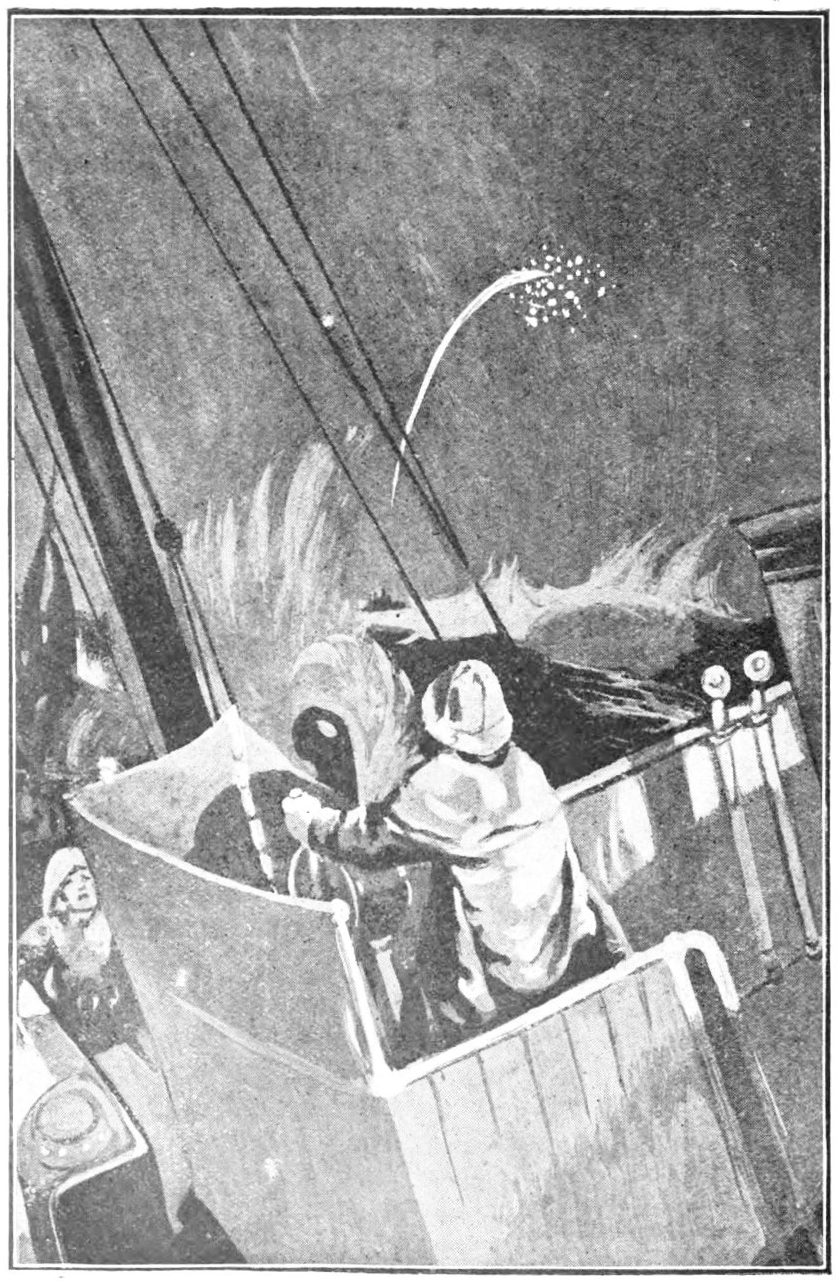
“The fiery trail of a rocket leapt out from the darkness.” To face page 89
gentler, and the tug rode over the seas without shipping a drop of water.
Morris stumped up and down the bridge smoking his pipe, stopping every now and then to look round the horizon; but nothing rewarded his gaze except the lights of a few ships making their way up Channel.
Three o’clock came, and by this time the sky overhead had commenced to clear, and presently stars appeared.
The skipper noted these changes with a grunt of satisfaction, and was just about to continue his walk when he suddenly stopped dead. His eye had been caught by a shower of bright falling stars far ahead, in the deep blue sky on the horizon.
“By gum! What’s that?” he muttered.
He had not long to wait, for hardly were the words out of his mouth when the fiery trail of a rocket leapt out from the darkness. He watched it until it burst in a shower of white stars, and then, motioning to the helmsman to steer straight for it, jumped to the engine-room telegraph and put it to “full speed ahead.” He then took the syren lanyard and gave it several lusty pulls.
The hoarse braying of the powerful instrument bellowed out in a series of loud “whoops,” and before the noise had died away, Tom, the mate, and the engineer came rushing on to the bridge.
“What is it?” they all asked in chorus.
“Ship in distress,” said the skipper abruptly, as the tug forged ahead. “She’s bin firin’ rockets.”
As he spoke there was another trail of fire, followed by a shower of stars, as a third rocket climbed upwards and then burst.
“It may mean a salvage job for us,” ejaculated Morris, feeling strangely excited. “Mate, get a blue light to answer them.”
The engineer had vanished on the mention of the word “salvage,” and soon the little tug was quivering as she leapt forward at her best speed.
Johnson quickly reappeared, and before long a blue light had been ignited and was spluttering in his hand. The flare shone out over the heaving sea, illuminating the wave tops as they rushed by, and presently it was answered by a flare from something dead ahead.
“She’s seen us, whoever she is!” exclaimed Morris.
The Evening Star was rapidly approaching, and in about twenty minutes a dull black blur, punctuated by row after row of lighted portholes, became visible in the darkness right ahead.
“She’s a thunderin’ great ship!” gasped the mate, gazing at her in astonishment.
“One of the Australian mail boats, I think,” remarked the skipper, who was looking at her through his binoculars. “I can see two masts and funnels, and—yes, by gum! she’s showing her two red not-under-control lights!” he added, with a pleased, excited laugh.
“Mail boat!” exclaimed Johnson; “that’ll mean a tidy lot o’ money for us if we give her a tow!”
“It will, mate!” agreed Morris joyfully.
Tom, too, felt pleased, for the opportunity for which they had all wished had evidently come.
Steaming on, the tug was soon close alongside the great liner, round whose hull the sea broke in masses of spray. Taking his ship close, Morris took a megaphone and stepped to the end of his bucketing bridge.
“What ship is that?” he bellowed. “D’you want assistance?”
“Yes,” came back a voice from the towering bulk above. “We’re the Cashmere. We struck sunken wreckage about a couple of hours ago, and our rudder’s gone, while the port propeller’s damaged. We’re not making any water to speak of.”
“D’you want a tow, then?” shouted the skipper.
“Yes,” came back the reply. “Could you get us along to Halmouth? We can land the passengers and mails there.”
“I can take ye there,” answered the joyful Morris.
A few more shouted directions passed between the two vessels while a knot of men on the liner’s forecastle made the end of a coir hawser fast to a life-buoy.[B] This was then thrown overboard, and the line was paid out while the tug backed astern.
After what seemed an eternity the buoy was seen floating on the heaving water close to the side of the Evening Star, and when several unsuccessful attempts had been made, it was at length dragged on board. It was then taken to the steam winch, and the powerful little engine commenced to heave in fathom after fathom as Morris manœuvred the tug so as to get ahead of theº Cashmere.
It all took time, but before long a wire hawser appeared, made fast to the end of the coir. The end of this was secured to the towing hook in the tug, and at length there came a hail from the liner to say the other end had also been made fast.
Putting the engine-room telegraph at “Half speed,” Morris circled the Evening Star round for her course for Halmouth. But the engineer below made a fatal mistake; he gave the engines rather too much speed, and as the weight of the liner came on the hawser it suddenly tautened and flew out of the water. The skipper saw at once what had happened, and dashed to the telegraph to stop the engines.
He was too late, however, for there was a sharp crack, and the steel wire suddenly snapped in two. The vessels were once more separated.
“That comes o’ using their bloomin’ wires,” muttered the skipper angrily; “a decent bit o’ hemp ’ud never part like that!”
The men in both ships hauled in the ends of the broken wire, and as they did so Morris reviewed the situation in his mind. He had on board the Evening Star a strong 18-inch hemp rope, which would tow the liner with safety, but the question was how to get it across to the other ship.
He could not float it on account of its weight, while the sea was still too great to lower a boat, and to take the tug close to the disabled ship was too risky to be attempted. He did not wish to lose the chance of towing the Cashmere, but though he thought hard, he could see no way out of the difficulty.
“I don’t know what to do, my son,” he at length remarked to Tom in a puzzled voice; “their blessed wire’s parted, and how are we to get another across?”
The boy thought for a moment.
“Couldn’t I swim across with a thin line, father?” he said at length. “We could tie a life-buoy on to the end of it, and then they could haul a hawser across.”
The skipper looked surprised.
“Swim!” he exclaimed. “How d’ye expect to do it in this sea? You’d never get there.”
“Oh, yes, I would, father,” replied Tom confidently; “you forget I won a prize for swimming last summer term.”
“I couldn’t let ye do it,” said Morris; “it’s too dangerous, an’ I don’t want to lose ye. Look at the sea!”
Tom looked at the heaving waste of water, and it certainly did appear alarming, for the wind whistled across the great rolling waves until their broken tops were flung to leeward in clouds of flying scud.
“Oh, do let me!” he pleaded. “I shall be perfectly safe if I have a lifebelt on, and I shall be holding on to a life-buoy the whole time. You can always haul me back if there’s any danger.”
“I don’t like to,” returned his father hesitatingly; “not but what ye’d do it, but supposing ye got drowned.”
“I won’t get drowned, father,” answered Tom. “How can I if I’ve got a lifebelt on? Just think of what it means. If you tow this ship home you’ll make a lot of money, and if you don’t, somebody else will. You must let me go, father!”
“Yes, it means a lot to me; but suppose—— ”
“You’ll let me go, then?” interrupted Tom, who saw his father was coming round to his way of thinking.
The skipper waited a moment or two, thinking, and then nodded slowly.
“Hooray!” shouted the boy. “I’ll get ready at once!” He ran off the bridge.
Ten minutes later, with a cork jacket round his body and clutching a life-buoy, to which the end of a thin line had been made fast, Tom leapt into the water over the tug’s stern. The line was slacked, and, striking out with his legs, he pushed the buoy through the water and soon got clear of the tug.
In five minutes he was half-way between the two ships, but it was becoming hard work.
At times he would be borne skywards on the foaming crest of a sea, while the next moment he would be deep down in a hollow. Still he struggled on with dogged perseverance, and though breathing was difficult and his eyes were full of scud, so that he could hardly see where he was going, he was moving slowly forward.
Those in the liner had noticed what had taken place, and while the passengers thronged the side and watched the lad’s gallant struggle, for it was now daylight, a rope ladder was lowered over the bows, and a man with a rope round his waist and with the coil of another in his hand, descended to the bottom to help Tom on his arrival.
On and on struggled the swimmer, until at last he came within fifty feet of the great ship, whose tall, black side towered high above him. He was beginning to feel tired and cold; but he still swum strongly, and in a short time was close to the foot of the ladder.
A second or two later a gigantic sea lifted him towards it, and he made a frantic grasp for the lower rung. He missed it, and was being swept away, when the man on the ladder seized his opportunity and threw his rope.
The bowline in the end fell close to the boy, who had the presence of mind to clutch it and place it round his body under his arms. He then undid the smaller rope attached to the life-buoy, and made that also fast round his waist, and, lifting his hand, gave the signal for those on deck to haul in. They pulled with a will, and in a second he felt himself swing into the air, and managed to grasp the ladder.
He rested for a moment, for his ordeal had tired him out, and then, with the man’s assistance, slowly climbed on deck. He had done what he said he would, and as he appeared the crew and passengers of the Cashmere broke into cheer after cheer.
Tom was exhausted after his swim, but was soon taken below to a cabin and provided with a suit of clothes, while before he reappeared on deck the hawser from the Evening Star had been hauled on board, and the two vessels were moving slowly up Channel.
Soon afterwards the wind and sea began to go down, and eight hours later the two ships dropped their anchors in Halmouth harbour. Morris came on board the Cashmere immediately afterwards, and was greeted by his son at the top of the accommodation ladder.
“I’m proud of ye, my son,” exclaimed the skipper, with a quiver in his voice, and wringing the boy’s hand; “I’m proud of ye!”
“So are we all,” said the captain of the liner, coming forward with outstretched hand, “and the passengers have all been spoiling him. I should be proud to have a son like him!”
Tom blushed.
“Well, well,” said Morris, “he’s a good son, an’ all’s well that ends well.”
“You’ve both done us a good turn,” said the other, “and a good stroke of business for yourself at the same time, for I can assure you my owners won’t forget it. Come along to the saloon, captain,” he continued, “for the passengers want to thank you, too.”
Much against his will, the skipper was ushered below, and on his appearance in the gorgeously decorated saloon, where all the passengers were assembled, there was a burst of cheering.
Morris stood nervously fingering his cap, for he was unused to things of this kind; but, holding up his hand for silence, the captain of the liner made a short speech.
“Ladies and gentlemen,” he said, “you have all met the captain’s son, but now I must introduce the captain himself. He saw our rockets and came to our assistance, and Master Tom here swam across with the line after the hawser broke. It is due to them both that we have reached our journey’s end in safety, and I will ask you to give them three cheers. I think they deserve it.”
This was the signal for another outburst, and when at length it had subsided a well-groomed, portly old gentleman advanced.
“Captain Morris,” he began, “I have been asked by the passengers to express to you, your noble son, and your gallant crew, our heartfelt thanks for what you have done for us. Er—you have saved us from a predicament which might well have resulted in a tragedy had it not been for your timely assistance, and I have great pleasure in handing you this small gift on behalf of us all, as a thank-offering for our deliverance.”
Here he handed the skipper a small brown-paper parcel.
Ten minutes later Tom and his father, having thanked the passengers for their gift, were back on board the tug, and when the skipper, and his son, the mate, and the engineer were sitting down to tea in the little cabin, the skipper produced the parcel from his pocket, and opening it took out two envelopes, one addressed to himself and the other to Tom.
“By gum!” he cried, opening his, and pulling out a bundle of notes and cheques, “fifty, a hundred, two hundred, three hundred pounds!”
“And a hundred here!” shouted Tom, displaying a cheque. “Father, they have been good to us!”
. . . . . .
Little more remains to be said. The captain distributed the money among his crew in shares, the latter insisting that Tom should keep the whole of his hundred pounds.
Soon afterwards another substantial sum of money was received from the owners of the Cashmere, and it far exceeded the amount Morris had expected; for his share, when invested, gave him an income sufficient to keep him in comfort for the remainder of his life.
The skipper has now left the sea, but the Evening Star is still running, under the command of her former mate.
Tom realised his ambition, for he is now a wireless telegraphy operator on board one of the large Transatlantic liners, and, though he has been through many adventures, he has never forgotten his swim on the occasion when he helped to salve the Cashmere.