II THE STRANDING OF THE HOI-HAU
Reading edition
I
“Pirates!” laughed the mate. “Of course there are. Why d’you ask?”
“I was reading in a book this afternoon that there were no such things nowadays,” replied the boy. “But tell me,” he queried anxiously, “do they still kill people, and make them walk the plank, and all that sort of thing?”
“Don’t think they make ’em walk the plank,” answered the mate, cutting himself another slice of bread. “But nearly every Chinese fisherman is a pirate at heart, and some of ’em ’ud think nothing of attacking a ship if they had half a chance.”
“Do they come out to sea, then?” asked Jim excitedly, for the subject fascinated him.
“No, there are too many gunboats and cruisers knocking about, but if a junk full of Chinamen came across a defenceless ship they’d attack her all right, and kill every soul on board if they resisted. They’re born thieves when there’s any loot to be had—aren’t they, sir?” he asked, turning to the captain.
“Aye, that they are,” agreed Captain McCaul. “I’ve heard of a good many cases where they’ve done it.”
“Is that why we’ve got those rifles on board, then?” asked Jim, who remembered having seen half-a-dozen weapons in a rack in the chartroom.
The mate and skipper nodded together.
The three of them, Captain McCaul, Mr. Dowell, the mate, and Jim McCaul, the captain’s son, were sitting at supper in the saloon of the steamer Hoi-Hau, now steaming up the Yellow Sea on her way from Shanghai to the North China ports with a general cargo.
The Hoi-Hau was rather an old tub, and though his owners had offered Captain McCaul the command of one of their larger vessels, the gruff old Scotsman had preferred to remain where he was. His wife and family lived in Shanghai, and as the ship was engaged in the North China trade, he saw more of his home than if he were in command of a passenger boat.
Jim McCaul, his eldest son, a boy of fifteen, was at school at Shanghai, and with the idea of giving him a change the skipper frequently took him to sea when the holidays came round.
The boy naturally looked upon his occasional sea trips as a great treat, for besides giving him the opportunity of seeing all sorts of strange places, Mr. Dowell took a great interest in him, and it was really due to the officer’s coaching that Jim had become quite a good seaman.
Supper was soon over, and, accompanied by his son, Captain McCaul left the saloon and clambered up on to the bridge. The sun had set, and overhead the stars were beginning to twinkle in the sky, while there was hardly a breath of wind to mar the smooth surface of the sea.
“By George!” exclaimed Jim, “it’s a ripping night!”
“Don’t know so much about that,” growled the skipper, sniffing the air. “I’d rather have a little breeze. With calm weather like this we may find ourselves in for a fog off the Shantung Promontory. What d’you think about it, Martin?” he asked the second mate, who happened to be on watch.
“Don’t like it at all, sir,” replied that officer.
The captain grunted.
“Well,” he said, “we ought to be rounding the Promontory at about three o’clock to-morrow morning. I’ll turn in now, as I shall be on deck at midnight. Call me at once if it comes on thick.”
McCaul, accompanied by Jim, left the bridge.
“Good night, my son,” he said, halting outside his cabin by the charthouse. “To-morrow I’ll take you for a run at Chifu. I’ve to go ashore to see the agents.”
“That’ll be grand,” said Jim, pleased at the idea. “Good night, father.”
The skipper disappeared into his cabin, and Jim went below and turned in. For an hour he lay reading, but then his weariness overcame him, and blowing out his candle he fell asleep with the regular throb of the propeller sounding in his ears.
The captain’s prophecy about fog turned out to be correct, for shortly after he went on deck at midnight, the clear horizon ahead of the ship became blotted out. By one o’clock the stars were barely visible through the pall overhead, while half an hour later it was thick fog.
The skipper accordingly eased the engines until the vessel was travelling at six knots, and began pulling the syren lanyard every two minutes in making the prescribed fog signal.
The hoarse braying of the powerful instrument woke all the sleepers, but Jim felt too lazy to get up, and after getting used to the dismal sound, rolled over and fell off to sleep again.
Soon afterwards, Dowell, clad in a greatcoat over his pyjamas, went up on to the bridge.
“Hullo,” said the captain. “What’s brought you up here?”
“Syren kept me awake, sir,” the mate explained, “and I came up to see if you wanted any soundings taken.”
“Thanks. I think you’d better get the machine going,” said the skipper.
Dowell went aft to the poop with two of the Chinese crew, and before long the wire of the sounding machine was released, and the lead descended to the bottom. He noticed that it took a much shorter time than it should have, for the ship ought to have been in sixty fathoms, and winding up the wire as fast as he could, he anxiously compared the glass tube with the graduated scale. To his horror the depth was no more than seventeen fathoms!
He began to run forward to report the fact to the bridge, for it was quite obvious that the ship was too near the shore, but hardly had he taken two steps when the vessel gave a quivering shudder, and he could feel her grinding and bumping over some object far below the waterline.
Presently the engines stopped with a jar, and all movement ceased. The ship had struck a ledge of submerged rock, and was fast ashore.
Dowell, with the second mate and Jim, the two latter having been awakened by the shock, all arrived on the bridge at much the same moment, while the native crew, terrified out of their senses, had turned out of the forecastle, and were clustered on deck chattering loudly.
“What’s happened, sir?” asked Dowell breathlessly, although he well knew what the answer would be.
“We’re ashore,” replied the captain. “You’d better get the boats turned out, provisioned, and ready for lowering, Martin,” he went on, addressing the second mate. “Go round with the chief engineer and see what damage has been done, and then report to me.”
The boats were turned out and provisioned, and presently Parton, the chief engineer, came on to the bridge to make his report.
“Well, captain,” he said, “I don’t think there’s much damage.”
The skipper heaved a deep sigh of relief.
“From what I can see she’s leakin’ a bit under number one and two holds, but the pumps are keeping the flow down quite easily.”
“Thank goodness for that!” ejaculated McCaul. “There’s no reason why we shouldn’t float off at high water, then?”
The fog was still very thick, but soon after daylight, when the effect of the morning sun began to make itself felt, the outline of land became visible, and when at length the mist had completely dispersed it could be seen that the steamer was ashore on a ledge of rock within a stone’s throw of the coast.
To the right, the shore was one uninterrupted line of cliff, but a mile or so to the left of where the vessel lay, these abrupt slopes gave way to a shallow, sandy bay in which were anchored several Chinese junks.
At the head of the bay was a straggling native village, and on looking at it through his glasses the captain could see the inhabitants clustered on the beach gazing with obvious astonishment at the stranded steamer.
An hour passed without incident, the pumps managing to keep down the flow of water, but towards eight o’clock the nearest junk weighed her anchor, and with her brown sails bellying out in the breeze drew near the Hoi-Hau.
She approached rapidly, and when within a hundred yards of the steamer hove to. Soon afterwards a native sampan put off from her side, and came to the steamer, while a big, dark-skinned Chinaman, clad in loose blue coat and trousers, clambered up the rope ladder, and appeared on deck.
“Steamer makee go ashore, cap’n,” he remarked in pidgin English. “Velly much damage, wanchee help, eh?”
“No, thanks,” answered McCaul. “Ship no b’long damage. Can get off at high water.”
“Have got plentee coolie makee help,” repeated the visitor. “Plentee stlong coolie.”
“No wanchee,” repeated the skipper, who did not like the look of the man. “No wanchee, savvy?”
“All light,” said the Chinaman, with an evil grin. “S’pose you wanchee coolie, I bling.”
The visitor descended to his sampan, and returned to the junk, which presently weighed her anchor and returned towards the neighbouring village.
“Those fellows are up to no good, sir,” observed Dowell. “That chap had a revolver under his coat, I saw the bulge it made. And look,” he continued, pointing towards the village, “something’s evidently in the wind; you don’t see Chinamen crowding together like that for nothing. I expect that fellow came aboard to have a look round, and now he’s gone back to tell the others how many of us there are. His talk about coolies was only a blind.”
“Well, I hope not,” answered the captain. “He’ll have seen there are only six Europeans aboard, counting Jim here. We can’t trust our native crew to fight.”
“What d’you propose to do, sir, if they do attack?” asked the mate.
“Prevent ’em boarding as long as possible, and then if they do get aboard, we’d better barricade ourselves under the poop. There are scuttles in the saloon there, and we can fire through them on to the deck.”
An hour later three of the native craft anchored off the village hoisted their sails, and after weighing their anchors came towards the steamer. One of them, filled with brown-skinned men, circled round, lowered her sails, and secured to the steamer’s side. Immediately she did so, the man who had been aboard before, followed by several others, began to climb the ladder.
This was the last thing Captain McCaul wanted, and going to the top of the ladder he waited till the first man’s head appeared.
“No wanchee,” he said. “Wilo”—go away—“no wanchee coolie!”
The man, however, persisted in trying to come aboard, and not liking the look of affairs the captain pushed him backwards, intending to force him down the ladder.
The Chinaman, however, slipped, and, tumbling backwards with a yell, suddenly disappeared from view, sweeping several of his friends off the ladder as he fell. They all descended with a crash on to the deck of the junk, the other occupants of which gave a series of unearthly howls as the human avalanche descended.
At this moment the mate put his head over the side of the ship to enjoy the fun, but a second later he drew it back in haste, for a shot rang out, and a bullet whistled close by his head.
Within a second or two an irregular volley broke out from the other junks. The enemy were armed with modern weapons.
The shots were ill-aimed, for though several bullets struck the superstructure close to where the officers and Jim stood, the greater number pinged harmlessly through the air overhead.
At the first discharge, the Chinese crew of the steamer fled in terror, and shut themselves up in the forecastle, leaving the six Europeans alone to defend the ship.
“They mean business!” shouted the captain, dashing to the chartroom and seizing a rifle. “Cut the ladder adrift, someone!”
The mate whipped out a knife and sawed at the rope lashing, but the blade was blunt and the rope tough, and before he was half-way through one strand, a yellow face, with a long, evil-looking knife between its teeth, appeared at the ladder top.
But the stroke never came, for the rope suddenly parted with a crack, and the man disappeared backwards.
There was no time for further talking, for the enemy had now opened a furious fire, while the Europeans, having armed themselves with rifles, were lying on the deck emptying their magazines at their assailants. They succeeded in dropping a good many, but the defenders were outnumbered by more than twenty to one.
The second mate suddenly sat up with a muttered word.
“They’ve got me, the devils!” he remarked, clenching his teeth with pain. “Lucky it’s only through the left arm, so I can still use a rifle.”
He bandaged the injured member with his handkerchief and calmly went on shooting. But the enemy’s fire was becoming more accurate, and at last a bullet went through the mate’s cap and sent it flying.
“We must take cover!” exclaimed the captain, noticing what had happened. “Down on the upper deck, everyone, and take shelter behind the bulwarks!”
They got up one by one and dashed down the ladder leading to the deck, with the bullets flying round them like hail, but they all succeeded in reaching their haven of refuge without being hit.
Once behind the bulwarks they were comparatively safe, for no bullet could penetrate the stout steel, and they only had to expose their heads to fire.
The fight went on for a quarter of an hour without any advantage to either side, when suddenly Jim, happening to glance round, saw a blue-clad figure with a rifle in its hand slinking along underneath the bridge.
The boy wheeled in an instant, brought the weapon to his shoulder, and fired. The shot went wide, but it served its purpose, for the man vanished.
“They’ve boarded us forward, father!” he exclaimed.
As if to prove the truth of his statement, two more pirates suddenly appeared in the direction he pointed out.
“We shall have to barricade ourselves aft,” ejaculated the captain to the others. “Come on, there’s no time to lose!”
No sooner said than done. Within two minutes the defenders had entered the saloon, and after barricading the door with such movable furniture as they could find, they took up their positions with their rifle muzzles pointing through the portholes opening out on to the deck.
For some time nothing happened, and Jim’s eyes grew tired from the glare of the strong sunlight outside. He waited, however, with rifle ready, and at last the head and shoulders of a pirate appeared round the corner of the superstructure.
He watched intently, and was just about to fire, when there came a wild yell, and fully twenty pirates came running along the superstructure deck.
“Bang—bang! Bang, bang, bang!” went the rifles, and several of the blue figures fell headlong. But some of them reached the deck untouched, and taking up a position behind the hatchway coaming, opened a heavy fire.
Their bullets struck the steel bulkhead with a series of loud clangs, while Jim at his porthole had a narrow escape, a bullet whistling past his cheek and shattering a mirror the other end of the saloon. It rather unnerved him, but still he went on loading and firing, loading and firing, like a veteran.
Several more of the enemy had been hit, but before long the second engineer dropped his weapon with a clatter and clutched at his right shoulder, through which a bullet had passed.
His place at the porthole was taken by the second mate, who, though wounded, could use his rifle, and while the captain bandaged the engineer, the firing continued.
The pirates now tried rushing towards the bulkhead, but the defenders’ steady, accurate fire upset their calculations, and time after time they were driven back with loss.
For another hour nothing further happened, and though wild yelling could be heard in the fore part of the ship, there was no more firing.
“I expect they’re trying to loot the foremost hold, sir,” remarked Dowell. “They’ll have a tough job, though,” he remarked, with a grin. “All the cargo’s in big cases, and they won’t shift them in a hurry.”
The captain was just about to reply, when Jim, who happened to be taking a breath of fresh air at one of the portholes in the ship’s side, suddenly gave a yell of delight.
“What’s the matter?” asked his father.
“There’s a ship out at sea,” exclaimed the boy excitedly.
They all crowded round and gazed in the direction in which he pointed, and there, sure enough, was a small white vessel steering a course to round the point of land some distance astern of the steamer.
So far the Chinese had been too intent upon their loot to notice her, for there were no signs of movement on the part of the junks.
“I wonder if she’ll spot us?” queried the skipper anxiously. “Can’t we think of something to attract her attention?”
They all looked at each other anxiously, for this was a difficulty they had not considered.
But Jim came to the rescue.
“Father!” he said suddenly, “from her colour I believe she’s a man-of-war. Why shouldn’t we signal to her?”
The captain looked at his son.
“But how d’you propose to do it?” he asked.
“Signal to ’em by the Morse code,” said Jim.
No sooner said than done. Round the saloon were the cabins of several of the officers, and going to all of them in turn Jim purloined all the walking sticks he could lay his hands upon. He found eight in all, and lashing them together, succeeded in forming a fairly stout pole about ten feet in length. Then, tearing a large piece off a white tablecloth, he secured it to one end, and going to one of the portholes thrust his improvised flag through it, and began to wave it to and fro in a series of longs and shorts.
————,—,—————,——————
it went, spelling out the word HELP time after time.
But the Chinese had spotted the flag, and before Jim had been at work for two minutes he heard wild yells, and an instant later the rifles of his comrades were once more hard at work.
II
H.M. Sloop Lucifer was proceeding towards the Shantung Promontory at a steady twelve knots.
On her bridge the lieutenant on watch leant listlessly against a stanchion, slowly sweeping his telescope from side to side as he gazed through it at the land on the port bow. He was doing it more from pure force of habit than anything else, but he suddenly gave vent to a low exclamation, and, bracing himself up, held his glass perfectly steady.
“Great Cæsar’s ghost!” he remarked to himself, “there’s a steamer ashore there with some junks alongside her, and someone’s waving something white from one of her ports. Short short short short, short, short long short short, short long long short,” he read out. “Great Scott!” he exclaimed, “the fellow’s spelling out HELP!”
He left his position and went amidships, and, leaning over the bridge, gave an order to the man at the wheel below.
“Starboard, three points!”
The helmsman put the wheel over, and while the Lucifer swung round until her bows were pointing directly towards the stranded vessel, a messenger was sent to the commander to inform him of what had been sighted, and, before a minute had passed, he was on the bridge gazing intently at the stranded ship through his binoculars.
“It’s my opinion,” he remarked at length, and seeing the white flag waving to and fro, “that the Chinamen from those junks are giving the fellows on board that steamer a pretty rotten time. She probably ran ashore in that fog early this morning, and they’re looting her.”
He walked across to the engine-room telegraph, and jammed it on to “Full Speed.”
“Travers,” he resumed, turning to the officer of the watch, “get a gun’s crew up and load one of the foremost 4-inch guns.”
The lieutenant saluted, and a few minutes later the quickfirer had been cleared away, and its lean muzzle was pointing in the direction of the steamer.
It was not until the sloop was within a couple of miles of the wreck that the pirates noticed her, but the minute they did so they were flung into a state of frantic confusion, for they could be seen tumbling over each other in their haste as they clambered down the sides of the steamer and aboard their junks.
By the time the Lucifer was within half a mile the clumsy native craft had hoisted their sails and were speeding back towards the village.
The commander slowed his engines, and at the same moment hailed the officer on the forecastle. The gun muzzle quivered until it was pointing full at the leading junk, now well clear of the Hoi-Hau, and a second later there was a sharp report, a sheet of blinding flame, and a four-inch shell screeched its way through the air.
. . . . . .
Aboard the Hoi-Hau things had not been progressing very satisfactorily.
Again and again the Chinese had attacked and had been repulsed, but finally the sheer weight of numbers had told, and when at last the ammunition of the defenders had dwindled to an alarming degree, the pirates had succeeded in reaching the bulkhead.
Once in this position, the British could not fire without exposing themselves, and the enemy began to beat down the door to get at those inside.
Captain McCaul and his officers had made up their minds for the worst, when Jim suddenly stopped waving his flag.
“Hurrah!” he yelled. “She’s coming this way!”
The welcome announcement put new heart into the defenders and they nerved themselves for a desperate resistance, for the entry of the Chinese was now a matter of minutes.
A short time later events took quite an unexpected turn. The enemy, seeing the approaching man-of-war for the first time, suddenly abandoned the attack and retreated to their junks, while the defenders, too thankful to speak, made their way out of the saloon and went on deck.
Closer and closer came the little sloop, until, when the junks were all clear of the steamer and had hoisted their sails, she opened fire. The first shell struck up the water a hundred yards short of the leading junk, and flew off into the air with a savage whine.
The pirates redoubled their efforts to escape, shrieking and yelling as they plied the sweeps to assist the sails. But it was too late, and their efforts were in vain, for the four-inch gun barked
“Jim saw the masts of the native craft falling whilst masses of debris were flung skywards by the force of the powerful explosive.” To face page 47
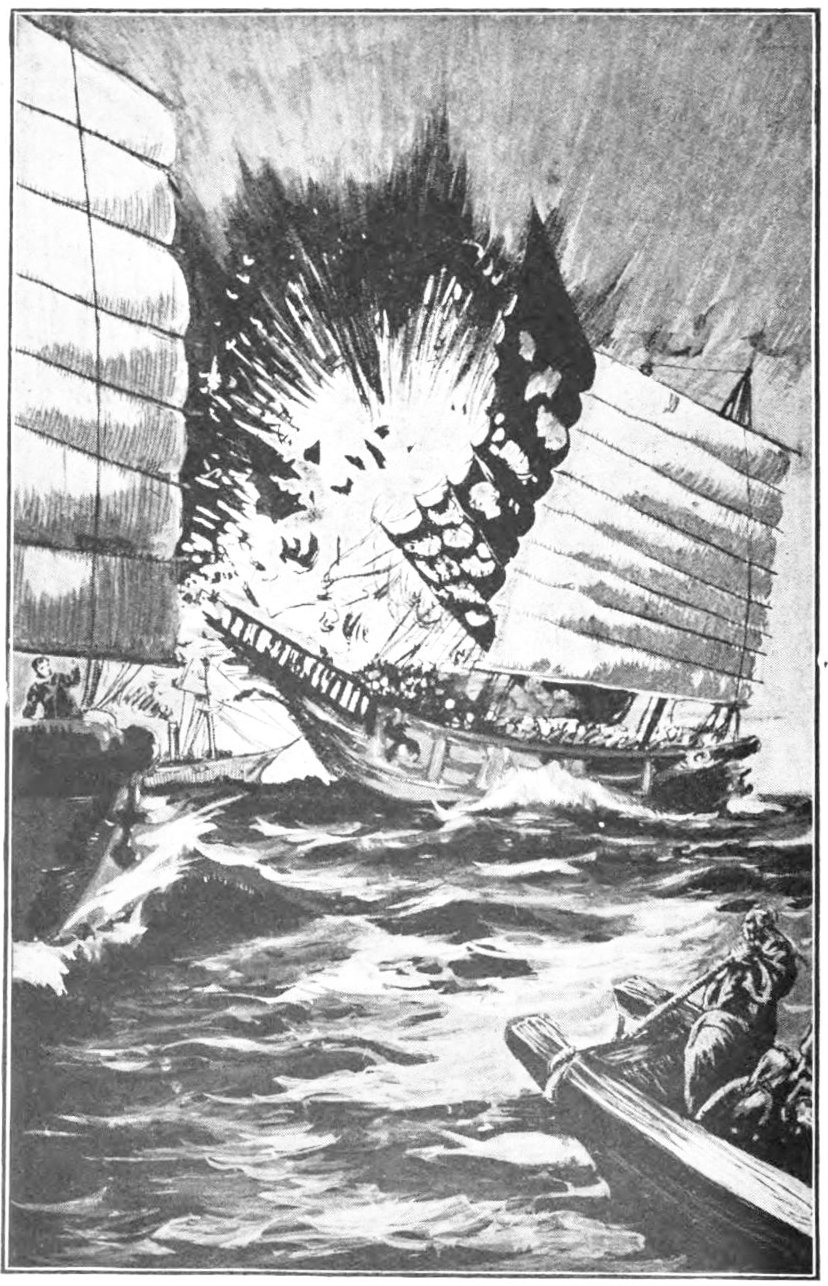
again, and this time the projectile hit the leading junk full in the stern.
Jim had a fleeting glimpse of a sheet of flame; he saw the masts of the native craft falling, whilst masses of debris were flung skywards by the force of the powerful explosive.
When the smoke cleared away the junk was barely recognisable, for she lay low in the water like a derelict, and already the flames were licking at her battered timbers.
Another sharp report came from the sloop, and this time the shot pitched into the water under the bows of a second enemy.
The Chinese then realised that the game was up, for, lowering the sails, most of them jumped overboard and began to swim for the shore, while before very long the Lucifer’s boats, filled with armed bluejackets, were taking possession of the abandoned craft.
Soon afterwards the commander of the sloop came aboard the Hoi-Hau.
“Good morning, captain,” he said, advancing towards McCaul, and glancing round the decks in astonishment. “You seem to have been having a pretty bad time.”
“If you hadn’t come,” said the skipper gratefully, wringing his visitor’s hand, “they’d have broken down the door and murdered the lot of us.”
“By the way,” remarked the commander, “Who was that fellow of yours making signals to us?”
“Here he is,” replied McCaul, pushing Jim forward. “He’s my son.”
“It’s lucky you made that signal, youngster,” said the naval officer. “We’d spotted you all right, but if you hadn’t waved your flag we might have been too late. Where did you learn your Morse, by the way?”
“I’m a Scout, sir,” Jim explained, blushing furiously.
“Just as well you are, my boy,” said the officer with a twinkle in his eye. “You ought to be proud of your son, captain,” he resumed, turning to McCaul.
“Proud!” laughed the skipper. “Proud! Of course I am!”
. . . . . .
When the tide rose, the Hoi-Hau floated off the rocks with but little damage, and before long was once more on her voyage to Chifu.
The bluejackets of the sloop succeeded in capturing the greater number of the pirates, and it was subsequently found that they belonged to a notorious band who had preyed on the defenceless trading junks for some time past.
Jim, as may well be imagined, has never forgotten his one and only brush with pirates.