THE PAINTING OF GEORGE BUTLER By W. C. Brownell
Reading edition

The painting of George Butler has the interest of all art that is not manifestly the product of the influences of the moment, but owes its quality to the personality of the painter. Such is the interest of Whistler's, Winslow Homer's, the late Homer Martin's, LaFarge's, Vedder's. It is art that has a direct rather than an illustrative interest—a real rather than a historical value. It does not contribute much to the race, the moment, and the milieu theory. And, of course, it suffers some neglect at the present time, which apparently belongs to the theoreticians, and when, accordingly, the illustrative and historical interest of all data that can contribute to the construction of formulary is felt so universally and so nearly exclusively. But the play of those forces that are so highly differentiated as to escape classification—the forces that make up personality—rewards contemplation in quite a different way. It eludes the pursuit of philosophy, but it repays the æsthetic attention quite as much, quite as legitimately, as the study of that impersonal and rather mechanical result of current habits of mind and points of view, the art of the schools. Butler was a pupil—long ago—of Couture, and one may still see evidences of the fact in his portraits now and then. But compare his relation to Couture with that of Sargent to Carolus Duran, for example, in order to see how wholly personal his painting is and how little he owes to any mere source of acquisition, except in certain means of technical expression, early adopted and perhaps rather lazily adhered to. Power and distinction such as Sargent's, even when exhibited almost solely within the range of technical expression, have certainly an individuality of their own that is most striking and admirable. But it is an individuality of accomplishment rather than of quality, marked more by its eminence of excellence than by its native idiosyncrasy. Of course, any intimate association of the two painters would be more misleading than illuminating, and in contrasting them in this single but fundamental respect I only have in mind the radical difference thus illustrated between a painter who has achieved fame by distancing competition in following traditional lines and expressing current tendencies, and a painter who has a controlling personal bent and has followed that.
Butler has, at all events, always done just what he wanted to do, and in the strictest sense. His temperament has always dictated his expression, and in thoroughly imperious fashion. It may be said, indeed, to have dominated his intelligence to the extent, at least, of eliminating, as objects of curiosity, interest, or effort, everything not strictly in accord with itself. But the result has been the felicity of extreme concentration. If in doing what he wanted to do his wants have been few, he has, on the other hand, wanted them with an intensity proportionate to its singleness. Beauty exhibited in the human face and form has absorbed his artistic attention and activity. I remember not only no landscapes, but nothing really to be called a composition among his works. A few Barye-like animal fragments, of heroic mould—a tiger's head, a dog's head and shoulders, the foreparts of an extremely leonine lion, some very feline cats—are, I fancy, the only diversion of his devotion to the single figure and the portrait, and they are but examples of the instinctive exercise of his remarkable gift of representation, and show a fine faculty at play rather than at work. They do not illustrate the "discipline of genius" as some writer has defined art to be, but are merely "artistic" in the sense in which artists use the word, i.e., born of the impulse to create or reproduce an "effect" of some kind. In the portrait and the single figure, however, he has expressed himself with freedom, with zest, and with completeness.
Portraiture is a branch of art in which artistic aptitudes exhibit themselves in as individual a way as in any other perhaps, despite the preponderance usually assigned to the "likeness." And neither à priori nor historically can it be asserted that the imagination itself plays in portraiture an inferior part. The material is possibly less varied than that of landscape or decorative art; but that is nothing. A painter shows his quality quite as much within a limited as within a wider range. And the material of portraiture is at least as highly differentiated as it is limited. The interest of the "Lesson in Anatomy" resides in many of its various pictorial elements no doubt, but also and in the supreme degree in what Burger calls "the working of intellect," as seen in the countenances of the listening circle around the demonstrator. A painter who exhibits himself in portraying human intellect, emotions, character, personality, and with these highly complicated and maturely developed phenomena shows us his point of view and way of looking at things—which are what art and genius mainly are, according to Mr. Henry James—has an opportunity certainly of doing so on a very high plane. And on such a plane Butler is, I think, very much at home. The quality that all his portraits show in common is displayed with perfect freedom and the effect only to be attained by the easy exercise of a native gift.
In the first place they are extremely human. They are in no degree portraits à la mode and do not exploit the painter's virtuosity. They show, on the contrary, his respect for, and interest in, his model. One establishes relations through them with their originals. They have character in the moral and intellectual, as well as in the artistic sense. They acquire in this way a typical value. The Century Club's portrait of General Greene is also a portrait of the American soldier, as many another, easily mentioned, is that of the American lady. They are intellectually generalized, that is to say, endowed with a wider than merely individual interest. In the second place they are extremely pictorial. The most intractable subject is made agreeable by being handled with a touch directed by an instinctive preference for, and delight in, the beautiful. The sitter receives the benefit of a translation into a heightened and poetized medium without loss of anything essentially characteristic. In both these respects—their humanity and their pictorial quality—Butler's portraits are decidedly exceptional in current art.
Current art is certainly concentrated upon physical character rather than upon beauty, and current appreciation of it is in harmonious accord with its realistic effort and aim. One may refine speculation to the point of asserting that there is no opposition, essentially considered, between the two; that Rembrandt is as distinguished for his beauty as Raphael, and that on the other hand there is as much character in "The School of Athens" as in the "Lesson in Anatomy." But in matters of this kind terms are approximate only, and the fact that definition is a difficult matter does not obscure the plain truth that a marked difference exists between the work of a painter in whose mind an agreeable conception of an object mirrors itself, and that of one mainly anxious to be exact. Technic has spread prodigiously (quite as much perhaps as it has developed) in the present epoch, and has become rather arrogant in its aggrandizement. Criticism, too, in becoming largely technical has assisted the tendency, so far as it exerts an influence on practice. It has grown tired, no doubt, of its own commonplaces and generalities, its easy habit of estimating aims rather than accomplishment, its routine insensitiveness to aspect and perfunctory absorption in significance. But in assuming the painter's point of view—not a very esoteric one, certainly—it has not been quite self-respectfully discriminating enough to avoid the purely professional attitude. And it is perhaps time for the pendulum to swing back again a little, so that both in estimating and in enjoying the painter's art we may once more think of its intellectual rather than so wholly of its mechanical side, which latter we may also be sure, nowadays, will be quite carefully, and in many cases competently, attended to by the painters themselves.
In this way, at any rate, having in mind Butler's portraits, we shall be able, whether or no they have the accent and relief requisite for a portrait of the striking or "stunning" order—in this way we shall be able to appreciate what a fine talent it predicates to say of a painter that he sees the finest side of his subject. This is often understood as lightly as it is said, and taken to indicate merely a preference for the agreeable to the more markedly characteristic. And this is no doubt especially true in the field of portraiture. But certainly, and especially in portraiture, very little reflection is needed to show one that the great peril to be avoided, and the most constant menace, is caricature of one sort or another. It may be the caricature that comes from imperfectly seizing and imperfectly rendering the traits of the subject, the caricature that inadequacy is. Or it may be that which comes from undue and disproportionate accentuation of what is perceived too exclusively. Success depends upon avoiding both by forming a correspondent conception of the subject—a conception that is clear and consistent and positive—and painting that. The painter then copies his conception, not his model, and the representative value of his portrait will have precisely the interest of his conception—in so far, of course, as he is able to convey it. In a sense, to be sure, it may be said that it is impossible to paint a portrait without proceeding in this way, without first forming a conception of the sitter plastically, if not morally; that the result is necessarily the product of some preliminary conception. But that is metaphysical fine-spinning. Empirically we all know that unconscious caricature—which is the caricature here referred to—is due to either a defective or a distorted conception, in other words, to a mental image either so faint or so little correspondent to the original as to be practically no conception at all. Of a very large number of portraits, assuredly, it may be asserted that they embody no more developed and complete an antecedent image in the mind of the painter than a mere mechanical impression, barely distinct enough to direct the muscular movements requisite to register it upon canvas.
Butler's conception is, as I have intimated, always very sympathetically formed. It seems to indicate that he likes the sitter. His own cordiality enters into it. It is a result of harmonious relations between his imagination and the sitter's nature—the qualities, as well as the appearance, of the subject. Landscape painting, says Eugène Véron, is "the painting of one's emotions in the presence of nature." Butler's portraits, similarly, seem the painting of his idea of the subject in its suggestive, stimulating, rectifying presence. His conception implies a certain slowness of formation—the time to become acquainted, at least. That of such a painter as Sargent is so rapid as to seem quite impersonal, in comparison. It is apparently formed so quickly as to be really an impression rather than a conception at all. Though occasionally plainly transitory, it is often wonderfully vivid and searching, but rarely does it attest that assimilation which is a necessary preliminary of synthesis of such complexity as the conception of an active personality is entitled to. Its qualities are fundamentally "artistic." Butler's is at the same time more mature and less objective. Sargent's grandes dames, for example, are always fine ladies, but Butler's portraits of women have, all of them, whatever the sitter's type, the patrician look. Yet they are noble rather than elegant, and simple in their refinement. Their graciousness is native, and there is something ample in the ease with which they carry themselves. Add to this a poetic strain that characterizes very intimately their unaffected naturalness and gives them a universal as well as a specific interest, making of them abiding works of art.
The Italian type, which almost all his single figures illustrate, has had a particular charm for Butler—as the accompanying illustrations attest. And to its interpretation he has brought a remarkable and an instinctive sympathy. Stendhal would have liked his Italian figures—Stendhal, who better than any other writer, perhaps, has understood the Italian national character in its nobility as well as its finesse. Its finesse has not interested Butler, as indeed it could hardly interest a painter of his frank nature, and it is not, of course, a particularly paintable quality, though it must be confessed that Velasquez made something of it in his Innocent X. of the Doria Gallery. But its nobility, its largeness, its elemental and untormented quality, its freedom from pettiness and perplexities, its naturalness, its frank following of the dictates of will and passion, unsophisticated by the restraints and complications of vanity or self-consciousness in any of its myriad forms—can be read in Butler's Capri peasants as in a book. Health and vigor, an animation that is not feverish or hardly alert, the charm of pensiveness without sadness, of repose without revery, of work without strain, and existence without effort, they show in every expression of their large lines and simple, graceful attitudes. Now and then from the face shines a beautiful soul, its innocence untouched by experience and acquiring an almost pathetic quality from its unworldly, yet by no means spiritual serenity. They win your admiration and your heart. They have infinite capacities of feeling, of loving, of wilfulness, of self-sacrifice. They have been refined but not corrupted by their not too close or too reciprocal contact with civilization. They are all of a piece, and one comprehends the tragedy that excess would mean for them. In their way they are the acme of poetry and beauty expressed in character that has a wonderful correspondence to the envelope of its plastic manifestation. "I would rather," exclaimed once a friend of mine—a lady, naturally—"I would rather know one Jew than forty Gentiles, they have so much more character." Character in this sense the Italians possess in effusion, so to speak, and Butler's Capriotes and Venetians exhibit it with a native dignity and charm that one has only to think of such contrasts as Bastien-Lepage's, or even Millet's, peasants (far more interesting in many other respects, of course) to appreciate.
Some of them are beautifully painted, as all are sympathetically understood. The elder of the two boys here reproduced is an especially lovely bit of handling, of quality, of clarity in the gently gradated tones. A Capri woman seated in a straight-backed chair upon a homespun carpet making lace, is very nearly a marvel in the same way—a figure that painters themselves are particularly pleased with. The blue dress, the white bodice, the dark face and hands, the blue-black hair, the greenish background, and the gray and red carpet compose largely in masses of importance, and are painted with a liquid and luisant effect that is nevertheless as far as possible from a blended and effeminate one. The touch is firmer, perhaps, more positive and vigorous, certainly, in the Venetian water-carrier here engraved, though it is equally distant from anything brutal, and the brush is restrained by refinement within the lines of true distinction, with the result that the reader may discern even in black and white. Is she not a majestic creature—for pictorial purposes, at all events? Pictorially, at least, she is superb. This is what a painter of genuine temperament and an instinct for character can make out of a bare-headed girl lugging a jar of water. One perceives at once the vitality and completeness of Butler's purely plastic impressions.
So vital and complete indeed are his plastic impressions that they explain, I think, his fondness for the single figure, his carelessness for composition. It may be argued from this fondness that his talent is an impressionable rather than an imaginative one; that his plastic exceeds his architectonic faculty. But to argue this is to miss an important side of his art. He does not, it is true, see things in their relations so much as in their essence. The genius for image-making, for originating conceptions of complex and interdependent interest, for composition, in a word, he certainly does not possess in any marked degree, or we should have had from him at least some experimentation in this sort. But it is remarkable how little, in looking at one of his noble figures, one feels this as a limitation, how close an equivalent he gives us for it. He has comprehended his model so thoroughly, and realized it so perfectly; he has conveyed the character itself so essentially, so subtly, and so intimately, merely in presenting its plastic phenomena, that he has amply suggested its characteristic environment and everything related to it that, in an elaborate composition of which it should be the centre, might contribute to its completer expression and relief. It does not look in the least like the study for a figure in some picture or other. It is a picture in itself. We do not get the pleasure that the pictorial presentation of this contributory environment would give us; we forego the sensuous delight that composition is capable of affording; but the striking thing about Butler's single figures is that they themselves so impress the imagination as to make us forget that they are unaided by accessories. One may add, by the way, the not impertinent corollary that it would be difficult to find among contemporary painters one who could satisfactorily supply this omission on the same plane of conception and workmanship.
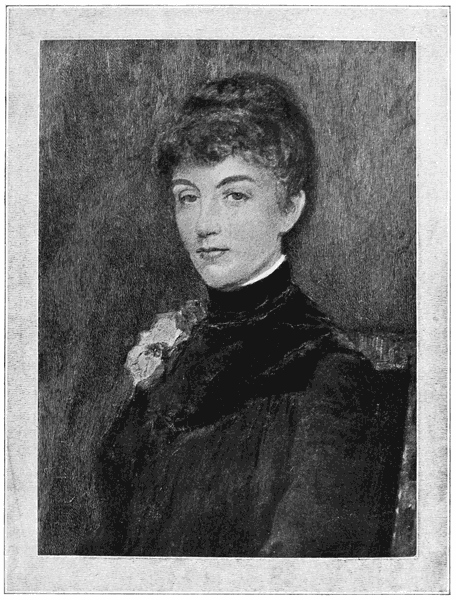
Portrait.
Butler's color is one of the prominent qualities of his painting. It is extremely full and rich, at the same time that it is quiet and grave. Color as color interests him, plainly, and he does not leave it to take care of itself, as is a frequent practice at the present time, when painters seem largely to have given over the illustration of its decorative possibilities and to be devoting themselves either to the value or the vibration, instead of the quality, of their color. On the one hand, the prevailing middle tint that is obviously middle tint, and, on the other, the high key of luminosity that is obviously mere pitch instead of melody, make such canvases as Butler's seem, perhaps, a trifle old-fashioned. How long is it since Titian was mentioned in a modern studio except as a subject of interest to the antiquarian? The practitioner who, twenty-five years ago, was endeavoring to divine his "secret," perhaps abandoning the quest as hopeless, has exchanged his atmosphere for one more rarefied, where, if the prospect is considerably more arid, there is correspondingly less demand on the vital forces. The lack in Butler's work of the current display of machinery—which is what an exclusive devotion to values or vibration may not unfairly be called—the lack of this inversion of the normal relations between means and ends, is not felt particularly, I fancy, by anyone but the professional practitioner. His low key and his unconcern for illustrating the potentialities of pure technic à propos de bottes, enable him to exhibit, very charmingly, his feeling for color in and for itself.
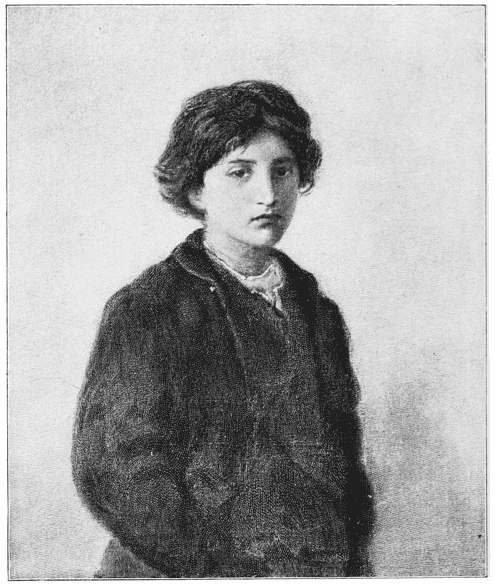
Roman Boy.
This gives his work an agreeable element of contrast to that most in vogue. One of his canvases is a welcome sight in a contemporary exhibition for this reason alone. A disproportionate devotion to color means the loss of many admirable sources of pleasure in art, beyond any doubt. And in the main these are especially admirable, because they are intellectual sources rather than sensuous. But the content of art is beauty, and beauty implies sensuousness, and in painting there is no such source of sensuous impression as color. A feeling for it is shared alike by the savage and the civilized man, and no doubt there is something barbarous in the delight which certain of its manifestations inspire. But this fact in itself shows the elemental and universal quality of this feeling and exhibits it as a mark of temperament. An acute or profound sense of its intimate appeal has characterized all epochs of expansion in the history of art, and its neglect has been the invariable accompaniment of that petrifaction by system which has assailed art at its every apogee. It is so sensitive as well as so elemental that it has suffered neglect as well in the development as in the decay of art; in the admirable evolution of Florentine line and mass following the lovely harmonies of Giottesque color, as well as in the sterilities succeeding the high Renaissance. It is the sign-manual of the spirit of invention, of imagination, of novelty, of free exercise of the faculties; and it individualizes the painter more sharply, perhaps, than any other characteristic. Color is his short-cut to sentiment, his most eloquent expression, his readiest means of communicating emotion. More than his style one may say that his color is the man.
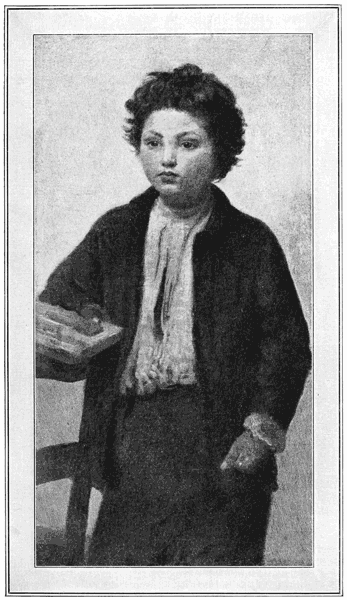
Painted by George Butler.
Match Seller.
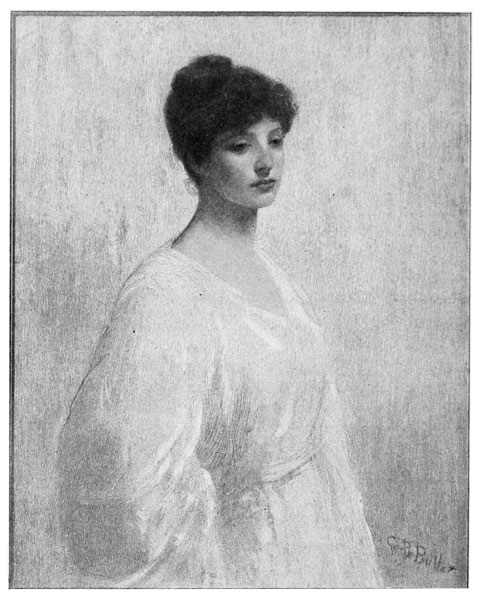
Portrait.
Butler's feeling for color is not feeling for its subtleties. It is a broad and tranquil delight in its simpler effects. He is not fond of hues and tints, of gradations and oppositions, of jewel-like harmonies and delicate flushes, of iridescence and sheen and sparkle. His color is the suave and sweet vibration of tone, now rich and deep, now clear and soft, but vibrating mainly near the primaries. Its distinction is that it is always color; that one of his canvases nowhere loses its music, so to say, and becomes mere sound. Locally, it is always treated in large masses, giving the eye repose rather than stimulus, and the general harmony is correspondingly large. He sees things in color, evidently, which is very different from seeing color in things, as also from not seeing color at all. It is through their color that his figures acquire their solidity and firmness—a greater relief than they would have, perhaps, if wholly dependent on justness of value. Their color is so pervasive and penetrating, it characterizes and expresses them so forcibly, it is so emphatically the instrument of their realization, that without it they would lose identity.
It is difficult, for instance, to judge of the "Girl with Tambourine" minus the rich glow that pervades the orange background, warms the olive of the soft, smiling countenance, the plump neck, the slender arm and hand, and mellows the brown and red of the contadina costume. Reduced to black and white, with its values as carefully preserved as has been essayed in the accompanying reproduction, it unfailingly loses, in some measure, its reality, its roundness, its "tactile values"—to employ Mr. Berenson's favorite term. Scientifically speaking, this perhaps involves a contradiction since, speaking thus, "tactile values" depend upon the light and dark relations of color, and not upon its kind or quality. But the kind and quality of color have such power over the emotions, and leave such a lively impress on the retina that, practically and concretely, they serve to increase wonderfully the sense of a picture's substantiality at the same time that, and in virtue of the fact that, they increase the vivacity of the beholder's interest. Is it not possible that this consideration has been somewhat lost sight of in the logic that dictates the practice of much current painting? The old masters are there to show what a loss in mere substantiality, in weight and force, the neglect of color involves. Indeed, the "valueless" coach-panel painting of the English pre-Raphaelites points a similar moral, and perhaps accounts for the revival of interest in it. As to color as a vehicle for the communication of poetry, there is, of course, nowhere any dispute. Poetry implies personal feeling, and in no way can feeling be expressed more personally than in color. And if Butler's color, as well as his sympathetic interpretation of character, makes his canvases contrast, in a way that may be stigmatized as "old-fashioned," with the colorlessness and the brutality that abound, one may properly retort that the limitedness of the laudator temporis acti is clairvoyance itself compared with the partisanship of the pedant of the present.