THE LETTERS OF ROBERT LOUIS STEVENSON Edited by Sidney Colvin
Reading edition
SARANAC LAKE:—WINTER, 1887-1888

During the two years and nine months of Stevenson's residence at Bournemouth preceding the date of his father's death, he had made no apparent progress toward recovery. Every period of respite had been quickly followed by a relapse, and all his work, brilliant and varied as it was, had been done under conditions which would have reduced almost any other man to inactivity. The close and frequently recurring struggles against the danger of death from hemorrhage and exhaustion, which he had been used, when they first occurred, to find exciting, grew in the long run merely irksome, and even his persistent high courage and gayety, sustained as they were by the devoted affection of his family and many friends, began occasionally, for the first time, to fail him. Accordingly when in May, 1887, the death of his father severed the strongest of the ties which bound him to the old country, he was very ready to listen to the advice of his physicians, who were unanimous in thinking his case not hopeless, but urged him to try some complete change of climate, surroundings, and mode of life. His wife's connections pointing to the West, he thought of the mountain health-resorts of Colorado, and of their growing reputation for the cure of lung patients. Having let his house at Bournemouth, he accordingly took passage on board the steamship Ludgate Hill, sailing for New York from London on August 17, 1887, with his whole party, consisting of his wife, his widowed mother, whom they had persuaded to join them, his young stepson, and a trusted servant, Valentine.
It was the moment when his reputation had first reached its height in the United States, owing especially to the immense impression made by the Strange Case of Dr. Jekyll and Mr. Hyde. He experienced consequently—for the first time—the pleasures, such as they were, of celebrity, and also its inconveniences; found the most hospitable of refuges in the house of his kind friends, Mr. and Mrs. Fairchild, of Newport; and quickly made many other friends, including the owner and the editor of this Magazine, from whom he immediately received and accepted very advantageous offers of work. Having been dissuaded from braving, for the present, the fatigue of the long journey to Colorado and the extreme rigors of its winter climate, he determined to try instead a season at the mountain station of Saranac Lake, in the Adirondack Mountains, New York State, which had lately been coming into reputation as a place of cure. There, under the care of the well-known resident physician, Dr. Trudeau, he spent nearly seven months, from the end of September, 1887, to the end of April, 1888, with results on the whole favorable to his own health, though not to that of his wife, who at these high altitudes was never well. His work during the winter consisted of the twelve papers published in the course of 1888 in Scribner's Magazine, including, perhaps, the most striking of all his essays, A Chapter on Dreams, Pulvis et Umbra, Beggars, The Lantern Bearers, Random Memories, etc.; as well as the greater part of the Master of Ballantrae and The Wrong Box—the last originally conceived and drafted by Mr. Lloyd Osbourne—and the ballad of Ticonderoga.
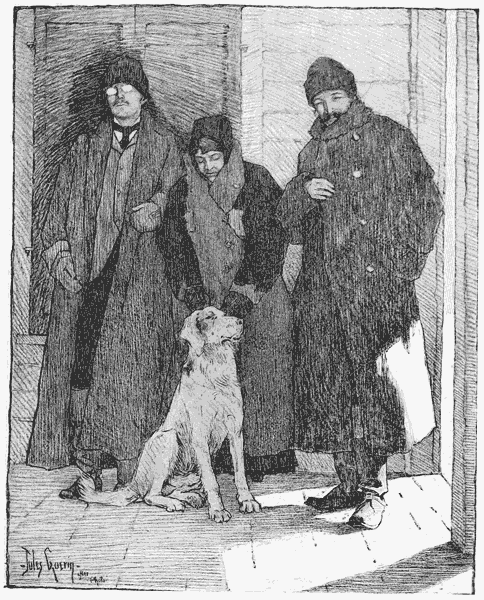
Lloyd Osbourne. Mrs. Stevenson. R. L. Stevenson. On the Porch of the Cottage at Saranac, in the Adirondacks, U. S. A. (From a Photograph.)
The following letters are extracted from those which tell of his voyage to New York and his reception there at this date, and of his winter's life and work at Saranac:
Newport, R. I., U. S. A. [September, 1887].
My dear Colvin,—So long it went excellent well, and I had a time I am glad to have had; really enjoying my life. There is nothing like being at sea, after all. And O why have I allowed myself to rot so long on land? But on the Banks I caught a cold, and I have not yet got over it. My reception here was idiotic to the last degree.... It is very silly, and not pleasant, except where humor enters; and I confess the poor interviewer lads pleased me. They are too good for their trade; avoided anything I asked them to avoid, and were no more vulgar in their reports than they could help. I liked the lads.
O, it was lovely on our stable-ship, chock full of stallions. She rolled heartily, rolled some of the fittings out of our state-room, and I think a more dangerous cruise (except that it was summer) it would be hard to imagine. But we enjoyed it to the masthead, all but Fanny; and even she perhaps a little. When we got in, we had run out of beer, stout, cocoa, soda-water, water, fresh meat, and (almost) of biscuit. But it was a thousandfold pleasanter than a great big Birmingham liner like a new hotel; and we liked the officers, and made friends with the quartermasters, and I (at least) made a friend of a baboon (for we carried a cargo of apes), whose embraces have pretty near cost me a coat. The passengers improved, and were a very good specimen lot, with no drunkard, no gambling that I saw, and less grumbling and backbiting than one would have asked of poor human nature. Apes, stallions, cows, matches, hay, and poor men-folk all or almost all came successfully to land—Yours ever,
R. L. S.
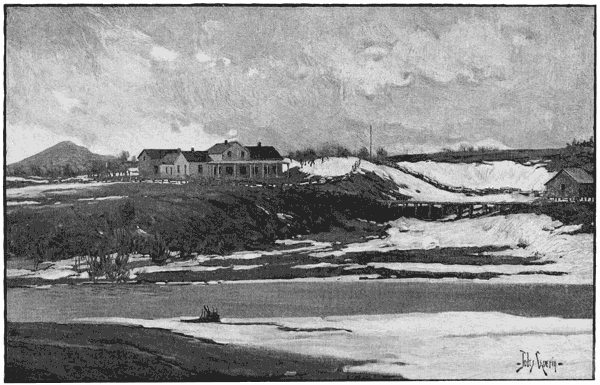
Drawn from a photograph by Jules Guérin.
The Cottage at Saranac Occupied by Robert Louis Stevenson.
[Newport, U. S. A., September, 1887.]
My dear James,—Here we are at Newport in the house of the good Fairchilds; and a sad burthen we have laid upon their shoulders. I have been in bed practically ever since I came. I caught a cold on the Banks after having had the finest time conceivable, and enjoyed myself more than I could have hoped on board our strange floating menagerie; stallions and monkeys and matches made our cargo; and the vast continent of these incongruities rolled the while like a haystack; and the stallions stood hypnotised by the motion, looking through the ports at our dinner-table, and winked when the crockery was broken; and the little monkeys stared at each other in their cages, and were thrown overboard like little bluish babies; and the big monkey, Jacko, scoured about the ship and rested willingly in my arms, to the ruin of my clothing; and the man of the stallions made a bower of the black tarpaulin, and sat therein at the feet of a raddled divinity, like a picture on a box of chocolates; and the other passengers, when they were not sick, looked on and laughed. Take all this picture, and make it roll till the bell shall sound unexpected notes and the fittings shall break loose in our stateroom, and you have the voyage of the Ludgate Hill. She arrived in the port of New York, without beer, porter, soda-water, curaçoa, fresh meat, or fresh water; and yet we lived, and we regret her.
My wife is a good deal run down, and I am no great shakes.
America is, as I remarked, a fine place to eat in, and a great place for kindness; but, Lord, what a silly thing is popularity; I envy the cool obscurity of Skerryvore. If it even paid, said Meanness! and was abashed at himself.—Yours most sincerely,
R. L. S.
[New York; end of September, 1887.]
My dear S. C.,—Your delightful letter has just come, and finds me in a New York Hotel, waiting the arrival of a sculptor (St. Gaudens) who is making a medallion of yours truly and who is (to boot) one of the handsomest and nicest fellows I have often seen. I caught a cold on the Banks; fog is not for me; nearly died of interviewers and visitors, during twenty-four hours in New York; cut for Newport with Lloyd and Valentine, a journey like a fairy-land for the most engaging beauties, one little rocky and pine-shaded cove after another, each with a house and a boat at anchor, so that I left my heart in each and marvelled why American authors had been so unjust to their country; caught another cold on the train; arrived at Newport to go to bed and grow worse, and to stay in bed until I left again; the Fairchilds proving during this time kindness itself; Mr. Fairchild simply one of the most engaging men in the world, and one of the children, Blair, aet. ten, a great joy and amusement in his solemn adoring attitude to the author of Treasure Island.
Here I was interrupted by the arrival of my sculptor. I have begged him to make a medallion of himself and give me a copy. I will not take up the sentence in which I was wandering so long, but begin fresh. I was ten or twelve days at Newport; then came back convalescent to New York. Fanny and Lloyd are off to the Adirondacks to see if that will suit; and the rest of us leave Monday (this is Saturday) to follow them up. I hope we may manage to stay there all winter. I have a splendid appetite and have on the whole recovered well after a mighty sharp attack. I am now on a salary of £500 a year for twelve articles in Scribner's Magazine on what I like; it is more than £500 but I cannot calculate more precisely [it was £700]. You have no idea how much is made of me here; I was offered £2000 for a weekly article—eh heh! how is that? but I refused that lucrative job. They would drive even an honest man into being a mere lucre-hunter in three weeks; to make me gober is I think more difficult; I have my own views on that point and stick to them. The success of Underwoods is gratifying. You see, the verses are sane, that is their strong point, and it seems is strong enough to carry them.
A thousand thanks for your grand letter, ever yours,
R. L. S.
Saranac Lake, Adirondacks, New York, U. S. A. [October, 1887.]
My dear Bob,
The cold [of Colorado] was too rigorous for me; I could not risk the long railway voyage, and the season was too late to risk the Eastern, Cape Hatteras side of the steamer one; so here we stuck and stick. We have a wooden house on a hill top, overlooking a river, and a village about a quarter of a mile away, and very wooded hills; the whole scene is very Highland, bar want of heather and wooden houses.
I have got one good thing of my sea voyage; it is proved the sea agrees heartily with me, and my mother likes it; so if I get any better, or no worse, my mother will likely hire a yacht for a month or so in summer. Good Lord! what fun! Wealth is only useful for two things; a yacht and a string quartette. For these two I will sell my soul. Except for these I hold that £700 a year is as much as anybody can possibly want; and I have had more, so I know, for the extry coins were of no use excepting for illness, which damns everything.
I was so happy on board that ship, I could not have believed it possible; we had the beastliest weather, and many discomforts; but the mere fact of its being a tramp-ship gave us many comforts; we could cut about with the men and officers, stay in the wheel-house, discuss all manner of things, and really be a little at sea. And truly there is nothing else. I had literally forgotten what happiness was, and the full mind—full of external and physical things, not full of cares and labours and rot about a fellow's behaviour. My heart literally sang; I truly care for nothing so much as for that. We took so North a course that we saw Newfoundland; no-one in the ship had ever seen it before.
It was beyond belief to me how she rolled; in seemingly smooth water, the bell striking, the fittings bounding out of our stateroom. It is worth having lived these last years, partly because I have written some better books, which is always pleasant, but chiefly to have had the joy of this voyage. I have been made a lot of here, and it is sometimes pleasant, sometimes the reverse; but I could give it all up, and agree that — was the author of my works, for a good seventy ton schooner and the coins to keep her on. And to think there are parties with yachts who would make the exchange! I know a little about fame now; it is no good compared to a yacht; and anyway there is more fame in a yacht, more genuine fame; to cross the Atlantic and come to anchor in Newport (say) with the Union Jack, and go ashore for your letters and hang about the pier, among the holiday yachtsmen—that's fame, that's glory—and nobody can take it away; they can't say your book is bad; you have crossed the Atlantic. I should do it South by the West Indies, to avoid the damned banks; and probably come home by steamer, and leave the skipper to bring the yacht home.
Well, if all goes well, we shall maybe sail out of Southampton water some of these days and take a run to Havre, and try the Baltic, or somewhere.
Love to you all Ever your afft. Robert Louis Stevenson.
Low was delightful as always. St. Gaudens, a very nice fellow too, has done a medallion of me.
[The following refers to a review by Mr. Gosse of Stevenson's volume of verse called "Underwoods." The book had been published a few weeks previously, and is dedicated, as readers will remember, to a number of physicians who had attended him at sundry times and places.]
Saranac Lake, Oct. 8th, 1887.
My dear Gosse,—I have just read your article twice, with cheers of approving laughter; I do not believe you ever wrote anything so funny; Tyndall's 'shell,' the passage on the Davos press and its invaluable issues, and that on V. Hugo and Swinburne, are exquisite; so, I say it more ruefully, is the touch about the doctors. For the rest, I am very glad you like my verses so well; and the qualities you ascribe to them seem to me well found and well named. I own to that kind of candour you attribute to me; when I am frankly interested, I suppose I fancy the public will be so too—and when I am moved, I am sure of it. It has been my luck hitherto to meet with no staggering disillusion. 'Before' and 'After' may be two; and yet I believe the habit is now too thoroughly ingrained to be altered. About the doctors, you were right, that dedication has been the subject of some pleasantries that made me grind, and of your happily touched reproof which made me blush. And to miscarry in a dedication is an abominable form of book-wreck; I am a good captain, I would rather lose the tent and save my dedication.
I am at Saranac Lake in the Adirondacks, I suppose for the winter; it seems a first-rate place; we have a house in the eye of many winds, with a view of a piece of running water—Highland, all but the dear hue of peat—and of many hills—Highland also, but for the lack of heather. Soon the snow will close on us; we are here some twenty miles—twenty-seven they say, but this I profoundly disbelieve—in the woods; communication by letter is slow and (let me be consistent) aleatory; by telegram is as near as may be impossible.
I had some experience of American appreciation; I liked a little of it, but there is too much; a little of that would go a long way to spoil a man; and I like myself better in the woods. I am so damned candid and ingenuous (for a cynic), and so much of a 'cweatu' of impulse—aw' (if you remember that admirable Leech), that I begin to shirk any more taffy; I think I begin to like it too well. But let us trust the Gods; they have a rod in pickle; reverently I doff my trousers, and with screwed eyes await the amari aliquid of the great God Busby.
I thank you for the article in all ways, and remain yours affectionately,
R. L. S.
Saranac, October, 1887.
[To W. H. Low.]
Sir,—I have to trouble you with the following paroles bien senties. We are here at a first-rate place. 'Baker's' is the name of our house; but we don't address there, we prefer the tender care of the Post-Office, as more aristocratic (it is no use to telegraph even to the care of the Post-Office, who does not give a single damn). Baker's has a prophet's chamber, which the hypercritical might describe as a garret with a hole in the floor; in that garret, sir, I have to trouble you and your wife to come and slumber. Not now, however: with manly hospitality, I choke off any sudden impulse. Because first, my wife and my mother are gone (a note for the latter, strongly suspected to be in the hand of your talented wife, now sits silent on the mantel shelf), one to Niagara and t' other to Indianapolis. Because, second, we are not yet installed. And because, third, I won't have you till I have a buffalo robe and leggings, lest you should want to paint me as a plain man, which I am not, but a rank Saranacker and wild man of the woods.
Yours, Robert Louis Stevenson.
I am well.
[The Wondrous Tale referred to in the following is Stevenson's Black Arrow, which had been through Mr. Archer's hands in proof.]
Saranac Lake, October, 1887.
Dear Archer,—Many thanks for the Wondrous Tale. It is scarcely a work of genius, as I believe you felt. Thanks also for your pencillings; though I defend 'shrew,' or at least many of the shrews.
We are here (I suppose) for the winter in the Adirondacks, a hill and forest country on the Canadian border of New York State, very unsettled and primitive and cold, and healthful, or we are the more bitterly deceived. I believe it will do well for me; but must not boast.
My wife is away to Indiana to see her family; my mother, Lloyd, and I remain here in the cold, which has been exceeding sharp, and the hill air, which is inimitably fine. We all eat bravely, and sleep well, and make great fires, and get along like one o'clock.
I am now a salaried party; I am a bourgeois now; I am to write a monthly paper for Scribner's, at a scale of payment which makes my teeth ache for shame and diffidence. The editor is, I believe, to apply to you; for we were talking over likely men, and when I instanced you, he said he had had his eye upon you from the first. It is worth while, perhaps, to get in tow with the Scribners; they are such thorough gentle-folk in all ways that it is always a pleasure to deal with them. I am like to be a millionaire if this goes on, and be publicly hanged at the social revolution; well, I would prefer that to dying in my bed; and it would be a godsend to my biographer, if ever I have one. What are you about? I hope you are all well and in good case and spirits, as I am now, after a most nefast experience of despondency before I left; but indeed I was quite run down. Remember me to Mrs. Archer, and give my respects to Tom—Yours very truly,
Robert Louis Stevenson.
[The lady to whom the following letter is addressed, as well as a good many others to come, had been a close friend of the Stevenson family at Bournemouth, and on their departure had been trusted to keep an eye on their interests in connection with their house (which had been let) and other matters, and to report thereon from time to time. In their correspondence Stevenson is generally referred to as the Squire and the lady as the Gamekeeper.]
[Saranac Lake, December, 1887.]
My dear Miss Boodle,—I am so much afraid, our gamekeeper may weary of unacknowledged reports! Hence, in the midst of a perfect horror of detestable weathers of a quite incongruous strain, and with less desire for correspondence than—well, than—well, with no desire for correspondence, behold me dash into the breach. Do keep up your letters. They are most delightful to this exiled backwoods family; and in your next, we shall hope somehow or other to hear better news of you and yours—that, in the first place—and to hear more news of our beasts and birds and kindly fruits of the earth and those human tenants who are (truly) too much with us.
I am very well; better than for years: that is for good. But then my wife is no great shakes; the place does not suit her—it is my private opinion that no place does—and she is now away down to New York for a change, which (as Lloyd is in Boston) leaves my mother and me and Valentine alone in our wind-beleaguered hilltop hatbox of a house. You should hear the cows butt against the walls in the early morning while they feed; you should also see our back log when the thermometer goes (as it does go) away—away below zero, till it can be seen no more by the eye of man—not the thermometer, which is still perfectly visible, but the mercury, which curls up into the bulb like a hibernating bear; you should also see the lad who "does chores" for us, with his red stockings and his thirteen year old face, and his highly manly tramp into the room; and his two alternative answers to all questions about the weather; either "Cold," or with a really lyrical movement of the voice, "Lovely—raining!"
Will you take this miserable scrap for what it is worth? Will you also understand that I am the man to blame, and my wife is really almost too much out of health to write—or at least doesn't write?—And believe me, with kind remembrances to Mrs. Boodle and your sister, very sincerely yours,
Robert Louis Stevenson.
Saranac Lake, Winter, 1887-8.
My dear Henry James,—It may please you to know how our family has been employed. In the silence of the snow the afternoon lamp has lighted an eager fireside group; my mother reading, Fanny, Lloyd, and I devoted listeners; and the work was really one of the best works I ever heard; and its author is to be praised and honoured; and what do you suppose is the name of it? and have you ever read it yourself? and (I am bound I will get to the bottom of the page before I blow the gaff, if I have to fight it out on this line all summer; for if you have not to turn a leaf, there can be no suspense, the conspectory eye being swift to pick out proper names; and without suspense, there can be little pleasure in this world, to my mind at least), and, in short, the name of it is Roderick Hudson, if you please. My dear James, it is very spirited, and very sound, and very noble too. Hudson, Mrs. Hudson, Rowland, O, all first-rate: Rowland a very fine fellow; Hudson as good as he can stick (did you know Hudson? I suspect you did), Mrs. H. his real born mother, a thing rarely managed in fiction.
We are all keeping pretty fit and pretty hearty; but this letter is not from me to you, it is from a reader of R. H. to the author of the same, and it says nothing, and has nothing to say but thank you.
We are going to re-read Casamassima as a proper pendant. Sir, I think these two are your best, and care not who knows it.
May I beg you, the next time Roderick is printed off, to go over the sheets of the last few chapters, and strike out 'immense' and 'tremendous'? You have simply dropped them there like your pocket-handkerchief; all you have to do is to pick them up and pouch them, and your room—what do I say?—your cathedral! will be swept and garnished.—I am, dear sir, your delighted reader,
Robert Louis Stevenson.
P.S.—Perhaps it is a pang of causeless honesty, perhaps I hope it will set a value on my praise of Roderick, perhaps it's a burst of the diabolic, but I must break out with the news that I can't bear the Portrait of a Lady. I read it all, and I wept too; but I can't stand your having written it; and I beg you will write no more of the like. Infra, sir; Below you: I can't help it—it may be your favourite work, but in my eyes it's BELOW YOU to write and me to read. I thought Roderick was going to be another such at the beginning; and I cannot describe my pleasure as I found it taking bones and blood, and looking out at me with a moved and human countenance, whose lineaments are written in my memory until my last of days.
R. L. S.
My wife begs your forgiveness; I believe for her silence.
[The following narrates the beginning of the author's labours on the Master of Ballantrae. An unfinished paper written some years later in Samoa, and intended for Scribner's Magazine, tells how the story first took in his mind. See Ed. ed. Miscellanies, vol. iv., p. 297.]
[Saranac, December 24, 1887-8.]
My dear Colvin,—Thank you for your explanations. I have done no more Virgil since I finished the seventh book, for I have first been eaten up with Taine, and next have fallen head over heels into a new tale, The Master of Ballantrae. No thought have I now apart from it, and I have got along up to page ninety-two of the draught with great interest. It is to me a most seizing tale: there are some fantastic elements, the most is a dead genuine human problem—human tragedy, I should say rather. It will be about as long, I imagine, as Kidnapped.
DRAMATIS PERSONAE
(1) My old Lord Durrisdeer.
(2) The Master of Ballantrae, and
(3) Henry Durie, his sons.
(4) Clementina, engaged to the first, married to the second.
(5) Ephraim Mackellar, land steward at Durrisdeer and narrator of the most of the book.
(6) Francis Burke, Chevalier de St. Louis, one of the Prince Charlie's Irishmen and narrator of the rest.
Besides these many instant figures, most of them dumb or nearly so: Jessie Brown, the whore, Captain Crail, Captain McCombie, our old friend Alan Breck, our old friend Riach (both only for an instant), Teach the pirate (vulgarly Blackbeard), John Paul and Macconochie, servants at Durrisdeer. The date is from 1745 to '65 (about). The scene near Kirkcudbright, in the States, and for a little moment in the French East Indies. I have done most of the big work, the quarrel, duel between the brothers, and announcement of the death to Clementina and my Lord—Clementina, Henry, and Mackellar (nicknamed Squaretoes) are really very fine fellows; the Master is all I know of the devil; I have known hints of him, in the world, but always cowards: he is as bold as a lion, but with the same deadly, causeless duplicity I have watched with so much surprise in my two cowards. 'Tis true, I saw a hint of the same nature in another man who was not a coward; but he had other things to attend to; the Master has nothing else but his devilry. Here come my visitors ... and have now gone, or the first relay of them; and I hope no more may come. For mark you, sir, this is our 'day'—Saturday, as ever was; and here we sit, my mother and I, before a large wood fire and await the enemy with the most steadfast courage; and without snow and greyness: and the woman Fanny in New York, for her health which is far from good; and the lad Lloyd at the inn in the village because he has a cold; and the handmaid Valentine abroad in a sleigh upon her messages; and to-morrow Christmas and no mistake. Such is human life: la carrière humaine. I will enclose, if I remember, the required autograph.
I will do better, put it on the back of this page. Love to all, and mostly, my very dear Colvin, to yourself. For whatever I say or do, or don't say or do, you may be very sure I am,—Yours always affectionately,
R. L. S.
Saranac, February, 1888.
Raw Haste Half Sister to Delay.
Dear Mr. Burlingame,—1. Enclosed please find another paper.
2. There will be another severe engagement over the Master; a large part will have to be rehandled. I am very sorry; but you see what comes of my trying to hurry. As soon as I have got a bit ahead again with the papers I shall tackle this job. I am better; my wife also.—Yours sincerely,
R. L. S.
P.S., and a P.S. with a vengeance.—Pray send me the tale of the proof if already printed—if not, then the tale of the MS.—and—throw the type down. I will of course bear the expense. I am going to recast the whole thing in the third person; this version is one large error. Keep standing, however, the Chevalier's narration, as I may leave that in the first person.
R. L. S.
Monday.
To yesterday's two barrels I add two requests. 1st. Will you let the cost of the printing stand over against the Master, as otherwise I may be involved in 'pecuniary embarrassments'? And that, sir, is no joke. 2nd. Will you send me (from the library) some of the works of my dear old G. P. R. James. With the following specially I desire to make or to renew acquaintance: The Songster, The Gypsy, The Convict, The Stepmother, The Gentleman of the Old School, The Robber.
Excusez du peu.
This sudden return to an ancient favorite hangs upon an accident. The 'Franklin County Library' contains two works of his, The Cavalier and Morley Einstein. I read the first with indescribable amusement—it was worse than I feared, and yet somehow engaging; the second (to my surprise) was better than I dared to hope: a good, honest, dull, interesting tale, with a genuine old-fashioned talent in the invention when not strained; and a genuine old-fashioned feeling for the English language. This experience awoke appetite, and you see I have taken steps to stay it.
R. L. S.
Saranac, February, 1888.
Dear Mr. Burlingame,—1. Of course then don't use it. Dear Man, I write these to please you, not myself, and you know a main sight better than I do what is good. In that case, however, I enclose another paper, and return the corrected proof of Pulvis et Umbra, so that we may be afloat.
2. I want to say a word as to the Master. (The Master of Ballantrae shall be the name by all means.) If you like and want it, I leave it to you to make an offer. You may remember I thought the offer you made when I was still in England too small; by which I did not at all mean, I thought it less than it was worth, but too little to tempt me to undergo the disagreeables of serial publication. This tale (if you want it) you are to have; for it is the least I can do for you; and you are to observe that the sum you pay me for my articles going far to meet my wants, I am quite open to be satisfied with less than formerly. I tell you I do dislike this battle of the dollars. I feel sure you all pay too much here in America; and I beg you not to spoil me any more. For I am getting spoiled; I do not want wealth, and I feel these big sums demoralize me.
My wife came here pretty ill, she had a dreadful bad night; to-day she is better. But now Valentine is ill; and Lloyd and I have got breakfast, and my hand somewhat shakes after washing-dishes.—Yours very sincerely,
Robert Louis Stevenson.
P.S.—Please order me the Evening Post for two months. My subscription is run out. The Mutiny and Edwardes to hand.
Saranac, March, 1888.
My dear Colvin,—Fanny has been very unwell. She is not long home, has been ill again since her return, but is now better again to a degree. You must not blame her for not writing, as she is not allowed to write at all, not even a letter. To add to our misfortunes, Valentine is quite ill and in bed. Lloyd and I get breakfast; I have now, 10.15, just got the dishes washed and the kitchen all clear, and sit down to give you as much news as I have spirit for, after such an engagement. Glass is a thing that really breaks my spirit: I do not like to fail, and with glass I cannot reach the work of my high calling—the artist's.
I am, as you may gather from this, wonderfully better: this harsh, grey, glum, doleful climate has done me good. You cannot fancy how sad a climate it is. When the thermometer stays all day below 10°, it is really cold; and when the wind blows, O commend me to the result. Pleasure in life is all delete; there is no red spot left, fires do not radiate, you burn your hands all the time on what seem to be cold stones. It is odd, zero is like summer heat to us now; and we like, when the thermometer outside is really low, a room at about 48°: 60° we find oppressive. Yet the natives keep their holes at 90° or even 100°.
This was interrupted days ago by household labors. Since then I have had and (I tremble to write it, but it does seem as if I had) beaten off an influenza. The cold is exquisite. Valentine still in bed. The proofs of the first part of the Master of Ballantrae begin to come in; soon you shall have it in the pamphlet form; and I hope you will like it. The second part will not be near so good; but there—we can but do as it'll do with us. I have every reason to believe this winter has done me real good, so far as it has gone; and if I carry out my scheme for next winter, and succeeding years, I should end by being a tower of strength. I want you to save a good holiday for next winter; I hope we shall be able to help you to some larks. Is there any Greek isle you would like to explore? or any creek in Asia Minor?—Yours ever affectionately,
R. L. S.
Saranac Lake, March, 1888.
My dear, delightful James,—To quote your heading to my wife, I think no man writes so elegant a letter, I am sure none so kind, unless it be Colvin, and there is more of the stern parent about him. I was vexed at your account of my admired Meredith; I wish I could go and see him, as it is I will try to write. I read with indescribable admiration your Emerson. I begin to long for the day when these portraits of yours shall be collected; do put me in. But Emerson is a higher flight. Have you a Tourgueneff? You have told me many interesting things of him, and I seem to see them written, and forming a graceful and bildend sketch. My novel is a tragedy, four parts out of six or seven are written, and gone to Burlingame. Five parts of it are sound, human tragedy; the last one or two, I regret to say, are not so soundly designed; I almost hesitate to write them; they are very picturesque, but they are fantastic; they shame, perhaps degrade, the beginning. I wish I knew; that was how the tale came to me however. I got the situation; it was an old taste of mine: The older brother goes out in the '45, the younger stays; the younger, of course, gets title and estate and marries the bride designate of the elder—a family match, but he (the younger) had always loved her, and she had really loved the elder. Do you see the situation? Then the devil and Saranac suggested this dénouement, and I joined the two ends in a day or two of constant feverish thought, and began to write. And now—I wonder if I have not gone too far with the fantastic. The elder brother is an Incubus; supposed to be killed at Culloden, he turns up again and bleeds the family of money; on that stopping he comes and lives with them, whence flows the real tragedy, the nocturnal duel of the brothers (very naturally, and indeed, I think, inevitably arising), and second supposed death of the elder. Husband and wife now really make up, and then the cloven hoof appears. For the third supposed death and the manner of the third reappearance is steep; steep, sir. It is even very steep, and I fear it shames the honest stuff so far; but then it is highly pictorial, and it leads up to death of the elder brother at the hands of the younger in a perfectly cold-blooded murder, of which I wish (and mean) the reader to approve. You see how daring is the design. There are really but six characters, and one of these episodic, and yet it covers eighteen years, and will be, I imagine, the longest of my works.—Yours ever,
R. L. S.
Read Gosse's Raleigh.
First rate,—Yours ever,
R. L. S.
To S. R. Crockett
[Saranac Lake, Spring, 1888.]
Dear Minister of the Free Kirk at Penicuik,—For O, man, I cannae read your name!—That I have been so long in answering your delightful letter sits on my conscience badly. The fact is I let my correspondence accumulate until I am going to leave a place; and then I pitch in, overhaul the pile, and my cries of penitence might be heard a mile about. Yesterday I despatched thirty-five belated letters; conceive the state of my conscience, above all the Sins of Omission (see boyhood's guide, the Shorter Catechism) are in my view the only serious ones; I call it my view, but it cannot have escaped you that it was also Christ's. However, all that is not to the purpose, which is to thank you for the sincere pleasure afforded by your charming letter. I get a good few such; how few that please me at all, you would be surprised to learn—or have a singularly just idea of the dulness of our race; how few that please me as yours did, I can tell you in one word—None. I am no great kirkgoer, for many reasons—and the sermon's one of them, and the first prayer another, but the chief and effectual reason is the stuffiness. I am no great kirkgoer, says I, but when I read yon letter of yours, I thought I would like to sit under ye. And then I saw ye were to send me a bit buik, and says I, I'll wait for the bit buik, and then I'll mebbe can read the man's name, and anyway I'll can kill twa birds wi' ae stane. And, man! the buik was ne'er heard tell o'!
That fact is an adminicle of excuse for my delay.
And now, dear minister of the illegible name, thanks to you, and greeting to your wife, and may you have good guidance in your difficult labors, and a blessing on your life.
Robert Louis Stevenson.
(No just so young sae young's he was, though—I'm awfae near forty, man).
Address c/o Charles Scribner's Sons, 743 Broadway, New York.
Don't put "N.B." in your paper, put Scotland, and be done with it. Alas, that I should be thus stabbed in the home of my friends! The name of my native land is not North Britain, whatever may be the name of yours.
R. L. S.
[Saranac], April 9th!! 1888.
My dear Colvin,—I have been long without writing to you, but am not to blame. I had some little annoyances quite for a private eye, but they ran me so hard that I could not write without lugging them in, which (for several reasons) I did not choose to do. Fanny is off to San Francisco, and next week I myself flit to New York: address Scribners. Where we shall go I know not, nor (I was going to say) care; so bald and bad is my frame of mind. Do you know our—ahem!—fellow clubman, Colonel Majendie? I had such an interesting letter from him. Did you see my sermon? [Pulvis et Umbra] It has evoked the worst feeling: I fear people don't care for the truth, or else I don't tell it. Suffer me to wander without purpose. I have sent off twenty letters to-day, and begun and stuck over a twenty-first, and taken a copy of one which was on business, and corrected several galleys of proof, and sorted about a bushel of old letters; so if any one has a right to be romantically stupid it is I—and I am. Really deeply stupid, and at that stage when in old days I used to pour out words without any meaning whatever and with my mind taking no part in the performance. I suspect that is now the case. I am reading with extraordinary pleasure the life of Lord Lawrence: Lloyd and I have a mutiny novel—
(Next morning, after twelve other letters)—mutiny novel on hand—The White Nigger—a tremendous work—so we are all at Indian books. The idea of the novel is Lloyd's: I call it a novel. 'Tis a tragic romance, of the most tragic sort: I believe the end will be almost too much for human endurance—when the White Nigger was thrown to the ground with one of his own (Sepoy) soldier's knees upon his chest, and the cries begin in the Beebeeghar. Oh, truly, you know it is a howler! The whole last part is—well the difficulty is that, short of resuscitating Shakespeare, I don't know who is to write it.
I still keep wonderful. I am a great performer before the Lord on a penny whistle. Dear sir, sincerely yours,
Andrew Jackson.
[Saranac Lake, April, 1888.]
My dear Gamekeeper,—Your p. c. (proving you a good student of Micawber) has just arrived, and it paves the way to something I am anxious to say. I wrote a paper the other day—Pulvis et Umbra;—I wrote it with great feeling and conviction; to me it seemed bracing and healthful; it is in such a world (so seen by me), that I am very glad to fight out my battle, and see some fine sunsets, and hear some excellent jests between whiles round the camp fire. But I find that to some people this vision of mine is a nightmare, and extinguishes all ground of faith in God or pleasure in man. Truth I think not so much of; for I do not know it. And I could wish in my heart that I had not published this paper, if it troubles folks too much: all have not the same digestion, nor the same sight of things. And it came over to me with special pain that perhaps this article (which I was at the pains to send to her) might give dismalness to my Gamekeeper at Home. Well, I cannot take back what I have said; but yet I may add this. If my view be everything but the nonsense that it may be—to me it seems self-evident and blinding truth—surely of all things it makes this world holier. There is nothing in it but the moral side—but the great battle and the breathing-times with their refreshments. I see no more and no less. And if you look again, it is not ugly, and it is filled with promise.
Pray excuse a desponding author for this apology. My wife is away off to the uttermost parts of the States, all by herself. I shall be off, I hope, in a week; but where? Ah! that I know not. I keep wonderful, and my wife a little better, and the lad flourishing. We now perform duets on two D tin whistles; it is no joke to make the bass; I think I must really send you one, which I wish you would correct....
I may be said to live for these instrumental labours now; but I have always some childishness on hand.—I am, dear Gamekeeper, your indulgent, but intemperate Squire,
Robert Louis Stevenson.
[On the 16th of April Stevenson and his party left Saranac. After spending a fortnight in New York, where, as always in cities, his health quickly flagged again, he went for the month of May into seaside quarters at Union House, Manasquan, on the New Jersey coast, for the sake of fresh air and boating. Here he enjoyed the society of some of his New York friends, including Mr. St. Gaudens and Mr. W. H. Low, and was initiated in the congenial craft of cat-boat sailing. In the meantime Mrs. Stevenson had gone to San Francisco, to see whether a sailing yacht was to be found available for a few months' cruise in the Pacific. The Casco, Captain Otis, was found accordingly; Stevenson signified by telegraph his assent to the arrangement; determined to risk in the adventure the sum of £2,000, of which his father's death had put him in possession, hoping to recoup himself by a book of Letters recounting his experiences; and on the 2d of June started with his mother and stepson for San Francisco, and thence for that island cruise from which he was never to return.]
Union House, Manasquan, N. J., but address to Scribner's. May 11, 1888.
My dear Charles,—I have found a yacht, and we are going the full pitch for seven months. If I cannot get my health back (more or less), 'tis madness; but, of course, there is the hope, and I will play big.... If this business fails to set me up, well, £2,000 is gone, and I know I can't get better. We sail from San Francisco, June 15th, for the South Seas in the yacht Casco.—With a million thanks for all your dear friendliness, ever yours affectionately,
Robert Louis Stevenson.
[The following is addressed from Manasquan to a boy, the son of the writer's friend, the sculptor St. Gaudens; for the rest, it explains itself.]
Manasquan, New Jersey, 27th May, 1888.
Dear Homer St. Gaudens,—Your father has brought you this day to see me, and he tells me it is his hope he may remember the occasion. I am going to do what I can to carry out his wish; and it may amuse you, years after, to see this little scrap of paper and to read what I write. I must begin by testifying that you yourself took no interest whatever in the introduction, and in the most proper spirit displayed a single-minded ambition to get back to play, and this I thought an excellent and admirable point in your character. You were also (I use the past tense, with a view to the time when you shall read, rather than to that when I am writing) a very pretty boy, and (to my European views) startlingly self-possessed. My time of observation was so limited that you must pardon me if I can say no more: what else I marked, what restlessness of foot and hand, what graceful clumsiness, what experimental designs upon the furniture, was but the common inheritance of human youth. But you may perhaps like to know that the lean flushed man in bed, who interested you so little, was in a state of mind extremely mingled and unpleasant: harassed with work which he thought he was not doing well, troubled with difficulties to which you will in time succeed, and yet looking forward to no less a matter than a voyage to the South Seas and the visitation of savage and of desert islands.—Your father's friend,
Robert Louis Stevenson.