A COPLEY BOY By Charles Warren
Reading edition

Bellingham was intoxicated; there's no doubt about that at all," said Dawson of the Standard. "All the men on the press noticed it, and the chairman of his own party city committee admitted it to us."
"Well, that makes no difference except that it's all the better for us," said Blakely. "It was a rascally, indecent attack, and I guess the Governor won't hesitate any longer about using that matter you and I worked up for him."
Jim Blakely was the editor of a small newspaper with a very limited circulation but having an immense political influence. More keen than the shrewdest of the political managers, more powerful than the chairman of the State committee, more resourceful than all the party candidates, Jim Blakely sat in his little office and suggested the most successful political movements throughout the State. No candidate for Governor even thought of conducting a campaign without the aid and supervision of Jim Blakely.
But Governor Clinton in this campaign had been somewhat restive under his management, and had declined to follow absolutely the lines laid out for him by Blakely and his other party associates. Clinton's opponent, Alfred P. Bellingham, the rival candidate for Governor, was a man of fifty years or thereabout—a political nonentity, having no opinion on any question which he could not readily change the next day with the greatest facility. Bellingham had evaded every honest political issue which Clinton had tried to force him to meet, and had conducted a campaign of the lowest and meanest personalities. But, in opposition to the advice of his party managers, Governor Clinton had steadfastly declined to meet Bellingham with his own weapons; and to indulge in attacks upon his private career.
Then one day the reporter Dawson had brought to Blakely's attention certain important discoveries which he had made in raking over Bellingham's past life. The first was the record of an indictment found twenty-three years ago against Bellingham for altering ballots cast at a representative election, with intent to defraud, but which had been nol prossed by the District Attorney owing to political pressure. The other was the record of an arrest of Bellingham some ten years ago for drunkenness and disorderly conduct, and his conviction and fine.
Clinton's party managers had received the news with great enthusiasm. They had recognized the splendid ammunition which these records would furnish; and they earnestly urged the Governor to make use of them upon the stump.
"No," he had said, "I won't descend to that depth. If I can't be elected without the aid of those things, then let the people defeat me." And he had persisted in this refusal, despite the entreaties of his political friends and the disgust of his managers.
It was a quarter before nine; and at nine o'clock it was the custom for Governor Clinton to meet his party managers every morning, to discuss the speeches of his opponent made the night before and to plan out the trend for the evening's speeches.
"This vile abuse of last night of Bellingham's I guess will settle it," said Blakely again; and he went to his safe and brought out the certified copies of the legal proceedings. As he did so Governor Clinton came into the office. He looked flushed and angry.
"Have you read that scoundrel's attack on me, Jim?" he asked, hurriedly.
"Yes," said Blakely in a casual manner, as if it was of no importance. He knew enough now not to try to force the Governor's hand.
"Well?" said the Governor.
"Well," answered Blakely, "it's only what you've got to expect all the rest of the campaign." Clinton hesitated.
"No," he said; "Jim, I've got enough. He's pushed me too far. I can't keep silent any longer. Have you got those documents you were telling me about?" Blakely pointed silently to the papers on his desk and lit his pipe. Clinton examined them with curiosity.
"How do you account for last night's speech?" he asked.
"Drunk again," replied Blakely. "Tell him, Bill." Dawson repeated to the Governor what he had just told Blakely.
"I'm going up to Stanfield at half-past nine," the Governor said, still red with wrath, "to my old school, Copley School. They've asked me to make the speech on the awarding of the prize cups. It's Founder's Day. I'm billed for a rally to-night, I believe, at Dunster. Well, give me those papers and I'll make a speech there at Dunster to-night that will make that fool Bellingham wish he'd never been born."
Blakely, metaphorically speaking, inwardly hugged himself; but he did not allow Clinton to see his joy at the Governor's conversion. Placing the papers carefully in his pocket, Clinton, after a few minutes' further talk, left the room, rode down to the station, and boarded the Southwestern Limited. Blakely waited until the door closed behind him and then slapped Dawson on the back. "I thought we'd land him finally. The Governor's a mighty good fellow, but he's got some high-toned views about politics that have to be gradually knocked out of him. His political ideas are very crude. He thinks you catch an election just as you catch cold. He expects a grateful people to present him with the election on a silver salver."
"Whereas," replied Dawson, "the usual way is for the candidate to present the silver salver, or, rather, the silver salve to the people."
On the way to Stanfield in the train the Governor dictated his speech to his private secretary. He realized that he was reversing entirely his former course of action by entering now into a personal conflict. But the attack made upon him by Bellingham had been so gross, so violent, and so savagely uncalled for in every way, that Clinton felt that the people of the State should now be told the plain facts regarding the manner of man held out to them to be accepted as their Governor.
He began his speech in a vein of cool, keen sarcasm, taking up, point by point, the portions of Bellingham's career that had protruded into the public gaze. He showed how he had started as the smallest and lowest kind of a political hanger-on, and how he had then become a ward boss. He then charged him with the indictment for altering ballots. He pointed out how, although this was twenty-three years ago, Bellingham had done nothing since which showed that he was any more fit for election now than then. To be sure, the mark of the criminal law had appeared in his life but once since then. But a negative life, a life lacking in results, was no qualification for the high office of Governor. He took up the conviction for intoxication and disorderly conduct and the payment of the fine of ten years ago. With high scorn, he asked the people how they would be pleased to have a man with that record at the State House. Then coming down to last night's assault, he declared in positive language that he could not believe that any man in his normal condition would make such statements as Bellingham had done; that there was but one explanation; and that one, an explanation which he disliked to consider, but which it was his duty to state. The Governor then repeated the account of the meeting as given by the reporters, and he asked the people to draw their own inferences. In reference to the infamous personal charges made against him, he would condescend to reply but to three. He then showed how utterly groundless they were, and demanded that Bellingham instantly furnish proof or retract them in public. Having finished with a tremendous avalanche of scorn and contempt for his opponent's personal character and accusations, the Governor turned his attention to the political issues. He showed how Bellingham had been unwilling, or else too cowardly, to declare his position on any of the great questions; how he had evaded them on every stump, and had refused to reply to the direct and pertinent questions put to him every night by the Governor, vainly seeking to find out where he stood.
The Governor grew more and more rapid in his dictation as his feelings mastered him, and the private secretary had hard work in keeping up with him. The speech, however, was wholly finished in thirty-five minutes; and the secretary drew in his breath in relief and said, "Well, Governor, if there is anything left of old Bellingham after you've made that speech, they'll have to take a microscope to find it with."
"You think I'm right in making it, don't you?" asked the Governor. "I hate to resort to this style of warfare; but I am not obliged to sit still in silence forever under such a plan of campaign as they've been carrying on, am I?"
"Not at all," said the secretary; "I consider it your duty to the people of the State to show him up."
Vivid had been the excitement for the last two weeks at Copley, after it was definitely known that Governor Clinton was to visit his old school on Founder's Day and make the speech awarding the cups. Founder's Day was the great day of the year at Copley. The athletic games came in the afternoon, and in the evening the prize speaking, and later a dance. Two cups were always awarded for excellence in the field sports: one, the Master's Cup, which was awarded to the House, or dormitory, whose inmates won the greatest number of points in the games; the other—vastly prized by the boy who won it, and whose name was inscribed upon it for future generations of boys to admire—was the Founder's Cup, and was given to the boy who singly won the most points, showing the greatest all-around general excellence in the sports.
Every year there was the most vigorous rivalry between the boys of the Master's House and those of Prescott House, the other dormitory, for the possession of the Master's Cup; but this year there was still keener rivalry for the possession of the person of the Governor. When it became known that the Master of Prescott House was a class-mate in college of Governor Clinton, the Prescott House boys were certain that he would lunch with Mr. Toppan and with them. The Master's House boys were equally positive that only the Head Master, "Popper" Stoughton, was high enough to do honor to the head of the State. On the Governor's decision as to lunch, therefore, depended large transfers of property; and it was said that "Goggles" Livingston had even risked a whole week's allowance upon the less favored Prescott House side.
Application to studies at the recitation building that morning had been very desultory. Although the school was not to be dismissed until one o'clock, the delightful impending event of the Governor's arrival proved a distraction disastrous to continued efforts of learning. And the subdued excitement was so pervasive that when "Stump" Taylor translated "Gubernator navem navigat," as "the Governor sails a boat," little Mr. Saunders, the Latin tutor, forgot to correct him.
At about a quarter before twelve, steps were heard in the outer corridor, and every boy who had sufficient ingenuity immediately discovered that it was necessary for him to ask permission to leave the room and to consult the Master about something.
The Governor crossed the threshold of the old building with an interest that was solemn, and even almost painful, for this was the first time that he had been back to his old school for eighteen years.
After a few minutes' talk with the Head Master in his room, the Governor asked that the whole school might be called together. At the first sound of the bell a race began from all over the building toward the Master's room. And as Clinton stepped forward to speak, a continuous chorus of shrill cheers split the air. "Boys," he said, when a semblance of quiet began, "boys, I'm going to make a very short speech." Again the cheers broke out. "I see you appreciate that remark as well as your elders," he said. "You will be glad of its shortness, because you'll have to listen to a longer one this afternoon. All that I've got to say is that I've asked Mr. Stoughton to dismiss you now instead of at one o'clock. He has thought best to submit to my request before I order out the State troops to enforce it. I hope you'll get lots of fresh air and sport now before we meet on the field this afternoon. This session is now adjourned sine die. Those of the Latin class who can't translate that will have to stay after school." Tumultuous laughter followed these remarks, as if the restricted air of the school-room made a laugh easier there than elsewhere, when it was allowed at all. Many of the boys filed out at once; but a large number clustered in the doorway and vigorously discussed the Governor in low tones.
Clinton looked round the room. How natural it seemed, and how little changed! Certainly the school must have been very conservative.
"Why, you've even got the same old desks still," he said to Mr. Stoughton. Then he stepped down from the platform and went to a very much battered and inked-up desk which stood in front of all the others, and directly under the eyes of the master as he sat at his desk. "Who sits here now?" he asked, turning to a group of boys beside him.
"That's 'Kid' Nelson's," one said.
"Where is he?" asked Clinton. Amidst a great scuffling and pulling, and with many muttered jests flung at him, a handsome boy, old in face but small in stature, with a light of deviltry in his eye, came shambling forward and gently grinned in a somewhat shame-faced fashion. The Governor paused a moment, smiling. "I rather think I know why you sit here, Nelson," he said. "I guess my old master had as much trouble with me, 'Kid,' as Mr. Stoughton has now with you. That used to be my seat most of the time when I was here." Saying this, the Governor sat down at the low desk and squeezed his long legs in under the bottom of the desk, almost prying it from its iron feet.
Meanwhile "Kid" Nelson straightened up with a proud look, and when he went back to the group he was evidently being congratulated as a hero.
As he started to leave the room, Clinton suddenly stopped before a full-length portrait of a noble-looking, pleasant-faced man apparently about sixty years old. It was his old master—"Old Winthrop," as the boys used to call him. He had died ten years ago, and Clinton had hardly seen him more than once or twice since he left the school; but the picture almost brought the tears to his eyes as he stood there and thought how much he owed to that man. Winthrop had been a stern, almost relentless, master; but he had had a complete and true understanding of a boy's feelings and motives, and his boys had respected him as they had respected no one else, then or since. They had, every one of them, placed the most absolute confidence and reliance in him. No boy ever thought of questioning "Old Winthrop's" decision, whether the decision was on a point of school discipline, or athletics, or local etiquette, or morals, or base-ball, or religion. He had taught his boys, and they had learned the lesson well, that "honor" and "loyalty" were the two great things in life; that to do what was not honorable was to commit the greatest crime; that to be disloyal to one's friends, to one's school, to one's trust, to one's self, was to render one unfit to associate with gentlemen. "He made me all that I am now," murmured Clinton to himself, and his voice was a little husky. "If I've ever done anything well, it was due to him."
The Governor walked out across the fields with the Master and Mr. Toppan in the direction of Prescott House; and when it became noised about that, after all, he was to lunch there, and not at the Master's, the Prescott boys yelled with joy and jeered at their crestfallen rivals across the way.
On the way, Clinton stopped to look in at the Chapel, where the prize speaking was to take place that evening. He laughed as he saw the well-remembered platform with its faded red carpet, and as he thought of his woeful failure the last time he had engaged in a speaking competition there. How he had vainly and weakly struggled with "Webster's Reply to Hayne," and lost his memory in the middle of it, and had sat down ignominiously, and how Old Winthrop had said, "Well, Clinton, whatever else you may do when you grow up, you will never make a speaker. Your effort was the worst I ever heard here." That was the only point that Clinton could remember on which Winthrop had ever been wrong. Certainly the audiences that were nightly cheering the keen, eloquent speeches which the Governor had been making for the past four campaigns would vigorously question the fulfilment of Mr. Winthrop's prophecy.
"Well, boys, who is going to win the Founder's Cup to-day?" Clinton asked as he sat down in the lounging-room of the Prescott House and a crowd of boys stood round the doorway, while the bolder sat uneasily on the edge of a table in the middle of the room.
"'Scotty,' I mean Bruce Campbell," replied one, rather grudgingly. "He's a Master's House fellow; but we're afraid he'll get it; although 'Skipper' Cunningham—he's one of us"—he said, pointing to a tall, stalwart, nice-looking boy outside in the hall, "will give him a hard push for it. You see, 'Scotty's' bound to get three firsts at any rate, and it's a close thing in the two-twenty-yard dash. 'Skipper's' good for a lot of seconds and one first, anyway," he said, enthusiastically.
"Oh, no, two!" shouted another boy. And thereupon so lively a discussion arose that the overawing presence of the Governor was quite forgotten.
"Prescott House is sure of the Master's Cup, anyway," said "Kid" Nelson, confidentially, to the Governor; "you can bet on that." Since his interview in the school-room, "Kid" had quite taken Clinton under his personal care.
Meanwhile, the Governor arose, and examined the pictures of the old athletic teams on the wall, and to the delight of the boys pointed out his own picture, a disreputable-looking member of one of the old foot-ball teams, absolutely unrecognizable now as the portrayal of the tall, determined, grave-looking man who stood towering up above his devoted Copley School mates for the time being.
And he still further won their undying devotion when, after asking to be taken to a certain bedroom upstairs, he very knowingly walked to the window, leaned far out, then jerked himself back with a satisfied air; and then showed them how a boy, by hanging far out of the window while two other boys grasped his legs from within, could reach round the corner of the House, get hold of a portico-railing, and escape from the room and down to the earth in that fashion. It was undoubtedly an immoral thing for the Governor to do, but he could not resist the temptation, so delightful was it to find how the memory of all the most minute old misdeeds came back.
The Masters of Prescott House, indeed, were very sure that Governor Clinton's influence had been very far from good on their charges, when during the next week they found that five boys made use of this highly reprehensible method of exit from the House during evening study-hour.
And at dinner what could more delight the boys than that Clinton should decline to sit at the head of the table, next to the Master and the other teachers, but should sit opposite, with a boy on either side, where he could learn all the details of the present school life, its rivalries, revelries, hardships, and zests!
Time passed quickly, until at three o'clock all assembled on the field for the great expected sports. The day was glorious for them; a crisp, cold, sunny October day, with the air intensely clear and full of life. What a day and what splendid games, thought Clinton. And he cheered and shouted like a small boy, and was far less stately than the grave First Class fellows who called themselves "Sub-Freshmen" in a manner anticipatory of future dignities.
Firsts, Clinton found, counted ten; seconds, six; thirds, three, and fourths, one; and the contest between the two houses was as close as the greatest lover of sports could desire. And so it happened that when the two-hundred-and-twenty yard dash came off, the Master's House had won 78 points and Prescott House 80 points; and of the two favorites, "Skipper" Cunningham had won 44 and Bruce Campbell 41. It was admitted that this race would practically decide the day; for the few remaining points, it was fairly well settled in advance, would be equally divided between the various champions from the two houses.
"It's a good deal more exciting than a political campaign," said the Governor to his friend Toppan.
There was a half hush as the two rivals lined up for the famous event in the final heat—all the other competitors having fallen before them in the preliminary heats. Both Cunningham and Campbell were shapely formed youths, lithe and muscular, as each leaned far forward with his arms stretched out in the starting posture, waiting for the signal.
The pistol cracked and the two boys were off. By the time they had gone half the distance Campbell was leading by about eight feet. Suddenly he was seen to stagger and something appeared to fly off from his legs. He fell down upon the track and Cunningham darted by him with the race well in hand. As he went by, he looked to see what the matter was, and then suddenly stopped and turned around. His Prescott House followers held their breath in amazement, dismay, and confusion. Then the spectators saw what had happened. Campbell's running-shoe had become loose and the spikes had stuck in a clayey bit of soil, pulling the shoe off the foot, and causing Campbell's ankle to turn and throw him. Cunningham, panting for breath, walked up to Campbell as he rose slowly, and said, "Too bad, Bruce, old man; are you hurt?"
"No," said Campbell, "I got my wind a little knocked out. What did you stop for?"
"Oh, all right," said Cunningham; "then we'll start the race over again." And he walked down to the starting-line in a simple, unconcerned way.
And how the boys were cheering him,—even the Prescott House boys, though it was a great disappointment to them! The failure to win then might cost them both cups; and if Cunningham had won that race, both cups would have surely been theirs. But they cheered just the same.
The Governor turned to the Head Master. "By George!" he exclaimed, "that's a splendid piece of work. That boy is a boy to be proud of. Did you see, he had that race cold? It was a sure thing and he didn't choose to win it in that way."
Mr. Stoughton was looking proud and happy. "That's the kind of a boy he is," he answered; "and I believe," he added, with enthusiasm, "they all are, here."
The Governor was about to say that the credit was due to Stoughton when he noticed that preparations were being made to start the race over again. Again the pistol sounded and the two were off, this time Cunningham doing a little better than before, but still a few feet behind Campbell. Toward the end he began to gain, and the Prescott House boys plucked up courage again and yelled themselves hoarse; but Campbell was still in the lead and finally won by about three feet. The rest of the games came out just as expected; and, as prophesied, the two-twenty-yard dash was the decisive match, giving the Master's cup to the Master's House with 98 points, as against Prescott House with 96 points, and the Founder's Cup going to Campbell, with 51 points as opposed to Cunningham's 50 points. And so the Master's House boys celebrated their victory, and the Prescott House boys celebrated their defeated hero's, "Skipper" Cunningham's, deeds with almost as much vigor as if they owned the cups. And really it was not much of a defeat after all.
After the games, before going back to the school to award the cups formally, the Governor went up to where Cunningham stood. "Cunningham," he said, holding out his hand, "I want to shake hands with you. I'm proud of my school and that you're in it, and I'm proud of you. I want to ask you what made you stop and offer to run the race over again."
"Why," said the "Skipper," blushing and confused and very much surprised, "what else could I have done?"
"I know," said Clinton, "but it was only one of the fortunes of war that is likely to happen in any contest. The race was yours, legally, even if Campbell did have an accident. Why shouldn't you have run it out and won the cup for your House and for yourself?"
"Oh," replied the "Skipper," simply, "but that wouldn't have been honorable. It wouldn't have been fair and square. No Copley boy would do that."
It was all said in so matter of course a way that the Governor saw that the idea that elsewhere such a thing was often done had never entered the boy's head. As he walked away, the boy's words rang in the Governor's ears: "Not fair and square." "Not honorable." "No Copley boy would do that."
How the Governor made a splendid speech, and how he called them all "old fellows," and how he spoke of the fine traditions of honor which Mr. Winthrop began and Mr. Stoughton was continuing, and how he told them interesting stories of political fights—where they would be tempted to forget some of the Copley standard of conduct—and how he praised old "Skipper" Cunningham and said he was as good as the victor, and how he said that he was going to present a cup to the school to be fought for every year, to be called the "Winthrop Cup," and to be given to the second best athlete, and how he said he wanted the "Skipper's" name to be placed first upon it, and how he proposed three cheers for "Popper" Stoughton—all these things are part of the school history, and are handed down from one class to another as they tell of that memorable "Governor's Day."
And then all the boys escorted him down to the station, and gave their school, class, and House yells, and nearly jerked his arm off in their anxiety to shake hands with him. And at six o'clock the Governor and his private secretary boarded the limited express, which was due to arrive at the great manufacturing city of Dunster at half-past seven, just in time for the rally.
"Well, Mr. Porter, I'm sorry you were busy writing out that dictation, for you missed a good time. I haven't had as much fun for years. But now comes the serious part of life again. Have you got my speech all written out?"
Porter produced it; and the Governor read it through, while the lines in his face deepened and his look became again severe and judicial. "I guess that is sufficiently strong," he said, when he had finished reading—"but no more so than the man deserves; isn't that so?" he burst out heartily.
"No," said Porter.
"You don't think that I'm taking any unfair advantage of him?" Clinton asked, in a thoughtful manner. "Of course, his getting drunk may have been more in the nature of an accident than anything else and doesn't necessarily mean that a man is unfit," he said half to himself. "It's a rather small issue, isn't it, to make against a man?"
"You didn't make it; he did," answered Porter.
"You're right," said the Governor, suddenly, and he began to study the speech carefully in order to get it clearly in his head. "Let me have those copies of the court record," he said. Porter handed them over. "I don't want to use these against a man if it wouldn't be a square thing to do," again argued the Governor, "I don't want to take unfair advantage of a weakness on his part."
"As I said before," replied the private secretary, "I consider it your duty to the party."
"Of course," said the Governor, "that makes the difference; if only I personally were the gainer, I might hesitate, but the party welfare demands it."
At half-past seven the train drew into the station in Dunster; and a delegation of the city committee met the Governor with a barouche and four horses and a band playing "Hail to the Chief," to the Governor's great weariness. At the city hall, where the rally was to be held, a large crowd of representative men of the party were assembled in one of the ante-rooms behind the stage. As the party leaders filed up, Clinton addressed a few happy words to each, calling most of them by name, for he had spoken in Dunster before.
Then the signal was given and the chairman of the meeting, looking worried and overweighted by the responsibilities of the occasion, marched up on the stage with the Governor, the rest shambling on behind in a shamefaced manner and with a certain want of confidence, like a flock of sheep. While the chairman was making his speech of introduction, which occupied thirty-five minutes, and during which he carefully anticipated every point which the real speakers of the evening might make, the Governor took out the pages of his speech, together with the court documents, and again carefully read them through. At last the chairman finished and the Governor walked slowly forward on the platform. The audience cheered wildly and the band hurriedly played "Hail to the Chief." The Governor took his manuscript and the other papers out of his breast-pocket, laid them on the reading-desk, opened them, gave a last glance at them, and then stood waiting for the uproar to subside.
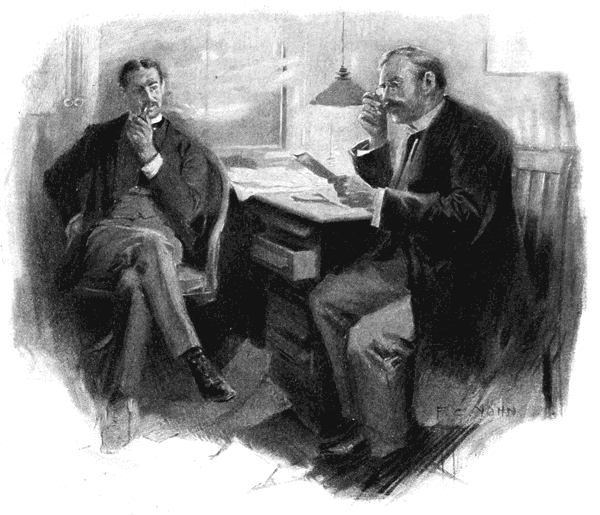
Clinton examined them with curiosity.—Page 327.
As he stood there looking at the excited audience, a man's face in the row next to the front caught his eye, and he looked hard at him. It seemed familiar. He gazed still harder; and then saw that it was no one whom he knew, but that the face was the very image of "Skipper" Cunningham's. Like a flash Clinton's mind reverted to the scene at Copley School. He heard the frank, manly, ringing tones of Cunningham as he replied to the Governor's remarks.... Then Clinton perceived that the audience was waiting for him, and he began,
"My friends of Dunster, not alone my party mates, I thank you for this warm welcome. I have tried my best while your Governor to earn it...."
Those who were there said that Governor Clinton had never before in his life made so strong and so ringing a speech. The argument was searching, filled with sarcasm, and unanswerable. It stirred his audience from the bottom of their souls, for the Governor's words seemed instinct with truth and sincerity. As he sat patiently waiting for the local candidate for the Legislature, who was speaking on painfully uninteresting local issues, to finish, Clinton felt, himself, that his speech had distinctly been a success. He also felt that he had done right.
After the Governor and his private secretary, Mr. Porter, rode back to the hotel, he said, "Porter, I wish you'd take down a note which I want to dictate to-night to Bellingham. Enclose with it the manuscript of my speech and the copies of those court records. Take a copy of it and send it to-night."
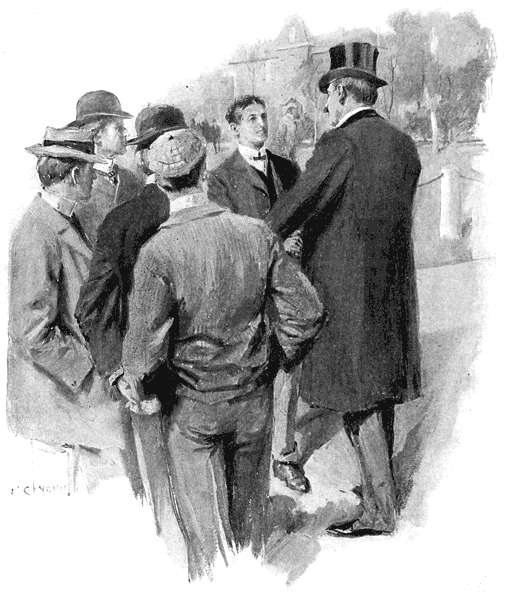
"I'm proud of my school and that you're in it, and I'm proud of you."—Page 331.
On reaching the hotel the note was written and mailed with the enclosures that night; and the Bellingham episode in the campaign appeared to be closed so far as Clinton was concerned.
The Governor reached the State House the next day about noon; and at three o'clock it was announced to him that Mr. Bellingham was outside and desired to see him.
"This is a nuisance," muttered the Governor as Bellingham entered. The latter walked up to the Governor and held out his hand.
"Governor," he said, "I am here to apologize to you most sincerely for what I said in my speech the other night. I want to tell you that I will make full explanation of it in the newspapers and to my audience to-night. I cannot tell you how much I appreciate and how much I thank you for your note and for your forbearance in not delivering that speech which you sent me. For I admit you had the greatest provocation to return the attack."
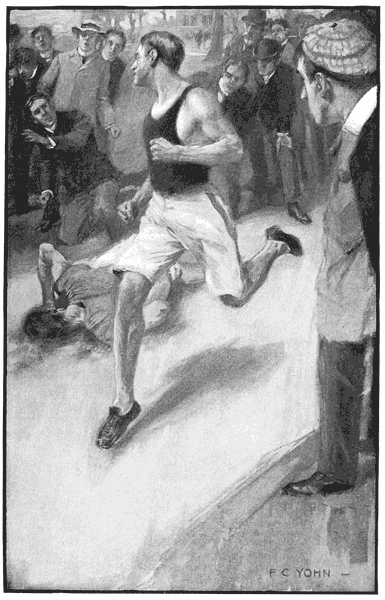
Drawn by F. C. Yohn.
He fell down upon the track and Cunningham darted by him with the race well in hand.—Page 331.
"Oh, that's all right," replied Clinton. "It's all over with now. Sit down."
Just at that moment Jim Blakely and Dawson, the Standard reporter, were waiting outside in the private secretary's office for a chance to see Clinton, and conversing excitedly with Mr. Porter.
"What in Heaven's name made the Governor give up his idea of attacking Bellingham in his speech last night?" asked Blakely. "I thought we had it all decided on that he was to produce those convictions and make a rousing assault on that blackguardly politician," he continued; "and now he goes up to Dunster and makes a speech with not a word in it on Bellingham's personal record, and confines himself to political issues. He's a damned fool, that's what he is. He's throwing away his election."
"I don't know," said Porter, "how it happened. All I know is, that he had his speech all prepared and was studying it all the way to Dunster. He had it on his desk before him, and I was never so surprised in all my life as I was when I heard him go on without a word regarding Bellingham's career or in reply to his disreputable assaults. And you could have knocked me down with a feather when the Governor told me last night to write to Bellingham and enclose the legal papers. Wait a minute and I'll show you what he wrote. I know I can rely on you two not to make it public."
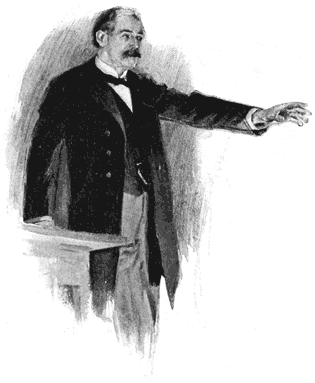
The Governor's words seemed instinct with truth and sincerity.—Page 333.
Both men nodded, and Porter took up some paper on his desk and read:
"Alfred P. Bellingham, Esq.,
"Dear Sir:—I have read your remarks of last night and I enclose you the speech which I intended to deliver in reply to them. It will never be delivered, however. I also enclose you certain documents which may be of interest to you. Upon careful consideration of these and of your recent course in this campaign, I feel sure that you will be of the opinion, as a gentleman, that the way to your election or to mine in this State does not lie along such a road.
"Yours truly,
"Robert Clinton."
"Well, I call the Governor, with all due respect, a tenderfoot," said the reporter, whistling loudly as he heard the letter. "Did the Governor give you any explanation of his change of heart?"
"Nothing very intelligible," answered Porter. "He said something about Copley School that I couldn't make out."
"And now," said Bellingham, inside the Executive Chamber, to Clinton, "I want to explain to you the other night's speech. I admit that I was drunk. I admit also that many years ago I was indicted for fraud at an election, and I was convicted and fined for drunkenness; but, God help me, I believe that during the past twenty years I have lived down these things. I hadn't touched a drop of liquor for five years up to the other night. It was, you remember, a very biting cold night, and I had driven six miles from the railroad station and was thoroughly chilled through. I felt it in my lungs, and my host over-persuaded me to take some whiskey. It went straight to my head, and you unfortunately know the result. But as I said before, Governor, I cannot sufficiently apologize to you and thank you for your forbearance."
The Governor paused a moment. "You needn't thank me," he said. "You should thank 'Skipper' Cunningham."
Bellingham looked confused and waited for the Governor to explain his remark. The Governor, however, offered no explanation. Instead, he said, abruptly, "Bellingham, I'm going to tell you, as man to man, that I think you've done a very square thing by coming here to me to-day and saying what you've said. I think it was a mighty frank and honorable thing in you to do. I'm proud to be fighting you as my opponent."
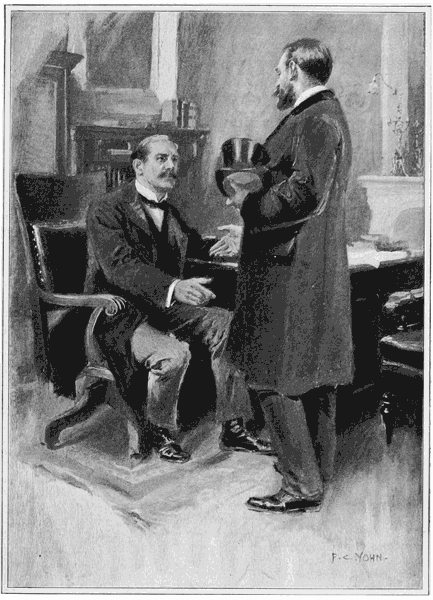
"Governor," he said, "I am here to apologize to you."—Page 334.
He paused again, and then suddenly asked, "You never were a Copley School boy, were you?"
"No," said Bellingham.
"You ought to have been," answered the Governor.