THE EDUCATION OF PRAED By Albert White Vorse Illustrations by Henry McCarter.
Reading edition

Daniel Webster cut from the seal a morsel of meal eight inches long by two inches square. He crowded out of sight as much of the delicacy as his mouth and part of his œsophagus would hold—about six inches—and sliced off the visible two inches with a blow of his knife.
"I never knew before," commented Praed, "why the Eskimo nose was so snubby. I now see it all. It is a beautiful example of the law of survival. If you touch an Eskimo anywhere, you draw blood. The long-nosed men of the Stone Age slashed their skins at meal-times and died of hemorrhage. Only the short-nosed men could live. Even Daniel carves perilously close to his lovely snub—and if Daniel's nose were a little shorter it would be a cavity."
"Just so," I replied, indifferently. Praed's jaunty talk jarred upon me, and his superior tone toward the Eskimos displeased me. He was attached to the Relief Party as botanist. I believe he was a Professor of Natural History in some Western college. He had climbed a mountain in the Canadian Rockies, a minor peak, no difficult ascent. I am told that a carriage road has recently been opened to the summit. But the mountain was a virgin peak and bore a living glacier, and Praed wrote for the papers about it and made a great achievement of his exploit. Upon the strength of his reputation he assumed to direct the policy of the Relief Expedition, and when the leader refused to fall in with his views, Praed grumbled, and once or twice approached open insubordination. The leader, a modest fellow, took his unruly botanist quietly, but several members of the party told me the man worried him.
However, when it suited his purpose, Praed could be humble enough. He discovered my irritation at once and evidently thought to soothe it.
"Oh, come now, old fellow," he said. "Don't take your Eskimos too seriously; I admire them as much as you do. Here, Daniel—Dahlgren, how do you say 'I like you' in Husky-tongue?"
"Iblee pee-yook amishuwa," answered I, in the pidgin-Eskimo we had learned to use during our year in the Far North.
"Iblee kumook amistwa," repeated Praed. Daniel received the communication with that heavy gravity which had won him his nick-name; his birth-name was Meeoo. Praed shrugged his shoulders.
"I never shall learn the lingo," he sighed. "Tell him I am going to give him this knife."
"Ooma pilletay iblee savik," I translated.
Daniel received the knife without comment. I caught a flash of pleasure in his eye, but it escaped Praed.
"He doesn't seem very grateful," he said. "I despair of the aborigine. He has no sense of humor, no gratitude, apparently no more affection than his dogs. He is pure selfishness. He is homely, he is fearfully unclean—"
"Professor Praed," I interrupted, "you arrived in Greenland three days ago. After you have knocked about with these fellows for a month you will change your opinions. As for dirt, eight or nine months in every year that bay is skimmed over with a little matter of five or six feet of ice. Until your party came, there was not a hatchet in the tribe to cut baths. In winter all these little streams that you see disappear. The Husky has to melt ice for drinking-water, and that is no light affair for him. In summer, it's true, he might bathe; perhaps you would like to try it."
"Those are all very well as excuses," responded Praed; "but they don't remove facts. Your dear friends are disgustingly soiled. And I am going to accept your invitation to take a bath."
He did accept it. He said he was accustomed to cold water, every morning (implying in his tone, that he feared I wasn't); that he had been baptized in the Susquehanna River through a hole in the ice, and that he guessed he could stand a summer sea in Greenland. He took off his clothes, swam out to a berg, grounded some forty feet off the beach, climbed hurriedly upon the ice, and danced up and down and shouted until we put off in a boat and rescued him. For three days afterward he shivered under blankets and drank up the little store of whiskey that remained in our supplies.
I was not sorry that this object-lesson had occurred. Our expedition had lived for nineteen months among the Eskimos. Two or three of us, whose chief duty was hunting, had learned to know the Innuit as one knows brothers. In a savage land you choose your friends, not because they can judge a picture or say witty things about their neighbors, but because they will go through any emergency by your side. More than once Daniel or one and another of our Eskimo comrades had saved us from death; more than once we had interposed between a Husky and the Kokoia. It was not pleasant to hear the cock-a-whoop members of the Relief Party, with their amateur knowledge of Arctic conditions, classify our comrades among the Greenland fauna.
But the Relief Party got on well with the Eskimos. They had a cargo of knives, hatchets, saws, needles, scissors, wooden staves, and all things that represent wealth to the Innuit. These things they distributed freely among the settlements; it was but natural that they should win the hearts of the Husky-folk.
Praed reappeared after his chill with a triumphant air, bearing bead necklaces and mirrors—for trading, he said. The Eskimos, however, shook their heads at these gewgaws, and Praed had to fall back upon useful articles. He obtained for himself the office of chief distributor, and waxed popular in the tribe.
One day, a fortnight or so after the episode of the bath, Daniel's wife, Megipsu, came running up the beach.
"The man with gifts is at my tupik. He desires something. I do not understand him. Will you come?"
I found Praed holding out the skirt of his coat toward Megipsu's little daughter.
"Like this," he was repeating. "Make me a coat. Scion of a savage race, if I had you at home, I should chastise you. You are stupid."
The child stared blankly at him.
"What is it, Professor Praed?" I asked.
His face turned red, and his reply came hesitatingly.
"Well, you see," he said, "your Greenland climate is not what I expected. When the wind is quiet, everything is warm. When the gale comes up in the afternoon, it is cold. Now the—the fur clothes; their odor is as the odor of abattoirs. At first I didn't comprehend the evident joy you have in them. But, on the whole, you seem so comfortable in all weathers, that I thought I'd try a suit myself. You see, I don't like to be lumbered with a leather jacket all the time."
"Hm!" reflected I, "Praed is learning his Greenland." All I suggested, however, was that if he minded the smell he might carry his leather coat out with him and leave it upon a rock until he should need it.
"And have it stolen," he said, with a glance of pity.
I perceived that he had a great deal of Greenland yet to learn. The most northern Eskimos do not steal. I arranged with Megipsu for a sealskin suit, however, to cost two pairs of scissors, a packet of sail-needles, a hunting-knife, a cracker-box, and Praed's wooden signal-whistle, which Megipsu fancied. In a week the Professor appeared in the silvery clothes. He was highly enthusiastic. I listened patiently while he explained the garments.
"You see, when it is warm," he said, "I can loosen the draw-string and throw back the hood, and a draught of air comes in from the bottom and goes out at the neck and carries off the perspiration. When the wind rises, snap! I haul in the draw-string, cover my head, and I am hermetically sealed. Not a chill can touch me."
"Precisely," I agreed. I had been wearing Eskimo clothes for a year and two months. "I understand," I added, "that you are going oogsook-hunting with Meeoo."
"Yes," he laughed. "I'm going to show the untutored savage the superiority of the rifle over the harpoon."
He learned more about Greenland upon that expedition. There was a floe, perhaps a mile wide, anchored near the mouth of the bay by half a dozen grounded bergs. To this floe the Eskimo and the white man set forth in kayaks. It was midnight when they left and we were asleep, but the Huskies at the village told us that the Professor couldn't manage his canoe, and finally had to permit Daniel to tow him.
Next night they returned with a seal. The Professor had many words of praise for a country where the sun never sets and there is no loss of working-time, but nothing to say about the hunting. At last he confessed that Daniel had killed the seal.
"The phoca barbata is a wary animal," he protested. "He will not permit a white face to approach. Two or three of the creatures were taking sun-baths upon the floe, but before I could creep within shooting distance they flopped into the water—a most ungraceful gait. All Arctic animals seem to be clumsy. I fired at one seal and I think I hit him, but he, too, dived. At last I resigned the rifle to Daniel. The savage squirmed over the ice like a worm. When the seals lifted their heads, Daniel lifted his. It is not surprising that he deceived them. His black muzzle looks precisely like that of the seal, and he wears a seal's fur. But his methods would never do in civilization. It took him half a day to crawl across that ice-floe."
"But he shot the seal," someone put in.
"No," replied the Professor. "That's just the point. He wormed himself along until he could almost reach the creature, and then sprang upon it and clubbed it to death with the butt."
I do not think Praed fully appreciated the marvellous adroitness of the hunter, nor the thoughtfulness of the man in saving a cartridge. He never seemed to comprehend that a charge of powder and bullet is worth more to an Eskimo than a diamond is to a bride at home. However, he began after that to treat the Huskies somewhat as if they were human beings.
His complete enlightenment as to the Eskimo character came all in a blaze at the end of our stay in Greenland. Our work there was done. Our explorations had been successful, our scientific collections were almost completed. There were only the loose ends to be gathered up.
The Professor had seen some desirable flowers in a valley across a glacier. Near that same glacier, in the preceding summer, I, who was acting as mineralogist of the main party, had piled a few specimens in a cranny to be carried to camp later, and I thought I might as well have them. We started forth together. Daniel and one or two other Huskies went with us for comradeship.
At the edge of the glacier we halted. It was a stupendous thing, crawling through a gap in the hills down into the sea like a section of the Midgard serpent. Halfway up the flank, I remember, there was a round hole, and out of it spouted a waterfall, red with basaltic mud. One of the Æsir might have made such a wound with his spear.
The back of the monster was rugged with crevasses.
"You can't cross here," I counselled. "You'd better try farther up, where it's smoother. I'll climb the cliff and take an observation, while you wait here and eat your luncheon. It doesn't do to hurry too much in Greenland."
I was almost an hour making my way up the crags to a point where I could take a bird's-eye view of the mass of ice. It was not a wide glacier—the cliffs opposite were not more than four miles away—but the great number of icebergs it threw off bore witness to the rapidity of its motion.
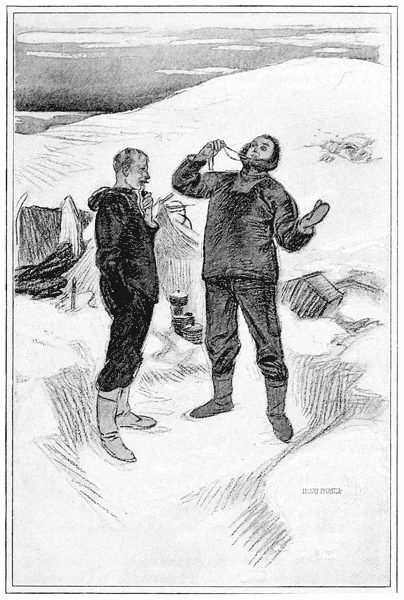
While he explained the garments.—Page 292.
Suddenly, almost below me upon the blue-white ice, appeared four or five black figures. They emerged out of a cleft near the edge and marched steadily toward the centre of the glacier. The surface beyond them and upon either hand was criss-crossed with blue crevasses. Glints from the shining icicles hanging down their sides darted up to me as I stood, a mile away. It was very picturesque, but I had no heart for enjoyment.
"The man is crazy!" I burst out and scrambled down the rough stones to overtake him.
In a quarter of an hour I had reached the bottom of the gorge, between the glacier and the mountain. A furious torrent roared along the side of the ice, but a few pinnacles of rock protruding out of the stream gave foothold to cross. Opposite my landing-place a huge blue cleft in the ice, with a gradually rising peak, furnished easy ascent to the surface.
As soon as my head was clear of the cleft, I saw one of the Eskimos running toward me. I hastened to meet him.
"Pra' has fallen!" cried the man. "The ice has eaten him. He has gone to sleep forever."
"Damnation!" I shouted. "Run to the ship. Tell all the white men to come and bring a rope!"
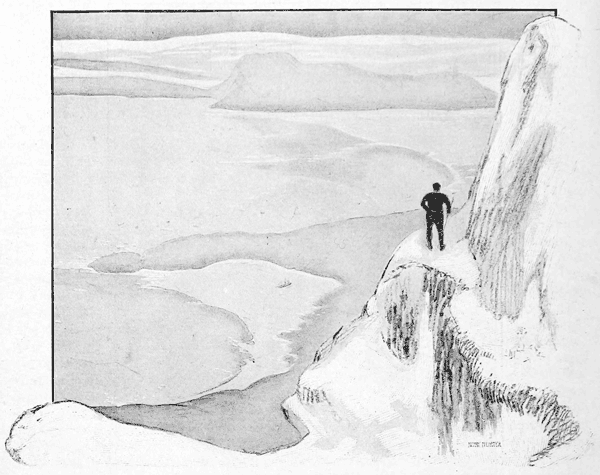
I was ... making my way up the crags.—Page 292.
He sped into the cleft and I moved on. Surmounting a mound in the ice, I could scan the whole surface. A quarter of a mile beyond me, the dark figures of the party crouched beside a long narrow crevasse. As I drew near, the tall figure of the Professor rose and faced me. He made no move to meet me, and when I had approached within a few feet of him, I saw that his hands hung limp at his sides and that he was sobbing. He could not speak, but he pointed to the crevasse. I threw myself at full length upon the ice and peeped over the brink.
A hundred feet below me, on the edge of a block of ice that hung unsteadily upon a mass of débris, lay Daniel. His head was doubled unnaturally forward upon his chest. The trash about him was stained with red. He must have died in an instant.
One look was enough. I sprang to my feet and faced the Professor.
"How did that happen?" I exclaimed. "Good God, man, speak! Don't act like a baby!"
Praed burst out sobbing afresh. It was a moment before he could control his tongue. When he spoke he clinched his hands and gazed blankly up the glacier toward the sun.
"It was I," he said; "he saved me. I fell—"
"Well?" I demanded.
"Do you see that shoulder of ice on this side of the crevasse, and the shelf jutting out opposite?"
I peered over the edge once more. The wall hung slightly out at the top and I had a good view of everything beneath. The cleft was not more than five feet wide, but, except for the débris lodged below me, it sank away into darkness. It may have been a thousand feet deep.
Some twenty feet down the side a ledge, perhaps twelve inches broad, started from the wall. Upon the opposite wall, about six feet higher, as far as I could estimate, allowing for the foreshortening, there was another shelf, considerably broader. Upon it sprang up the stumps of two or three heavy icicles that had grown down from an ice-bridge. Doubtless, anciently the débris caught below had been part of this bridge, and in its fall had carried the upper ends of the icicles with it. One end of the shelf slanted up almost to the surface.
I took this in at a glance.
"Yes," I said; "go on."
"I must confess from the beginning," he proceeded, in a curious monotone, as if his body, not his mind, were talking, "I doubted your judgment of the glacier. The access to the summit was evidently so easy that, I thought, some route across would surely open out before us. I desired to surprise you; I knew you could easily overtake us. Therefore, I set forth. The Eskimos hung back, but I promised them knives if they would follow.
"It was easy enough until we came to this crevasse. I attempted to leap across, but I slipped and fell. I do not know how it happened, but I struck several times and whirled over and over, and felt a blow upon the back of my head. It dazed me. When I came to myself I was seated upon that ledge, with my back against the wall. The wall slants in, as you see, and the outer edge of the ledge is raised, so I was secure.
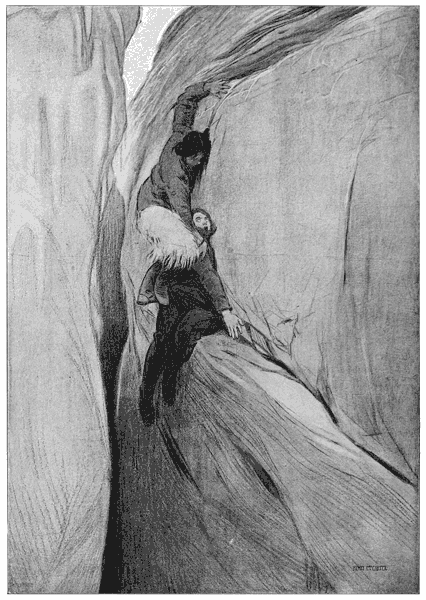
"But I had only half recovered my senses and I began to cry out for help. I was so much disturbed that I didn't know what was going on until I saw someone upon the shelf opposite. Then I think I shouted louder. Suddenly there came another shock and I should have fallen, but someone held me up. It was Daniel. He must have leaped across."
He paused and I looked down again. The ledge, at its broadest barely a foot and a half wide, fell away into the wall, not two feet from the spot where Praed must have brought up. It was a brave leap.
"Go on," I commanded.
"Daniel laughed at me," resumed the Professor, like a child reading from a book, "and waited till I got back some of my self-possession. Then he made signs to me to spring across and catch the icicles with my arms. I was afraid. He laughed again and made another sign that he would lift me across. I let him take me by the knees and lift me until my head and waist rose above the shelf, and then I leaned forward and we both toppled over. I caught the icicles, and he held me firm and perhaps—I don't know—if I had kept still—"
I hastened to steady him.
"What did you do?" I asked. "Keep cool."
"I struggled. I squirmed with my feet in getting up—and kicked him free. When I was safe I tried to help him—I meant to help him. But the ledge was empty and he lay there."
"Good God!" was all I could say.
We passed the succeeding three hours in dead silence. Praed never moved, I think, and never took his eyes from the sky above the névé basin. The Eskimos sat quietly beside the grave of their friend. I sprang across the crevasse where it narrowed, descended to the shelf with the icicles, and mused upon the courage that had dared a leap to that narrow footing.
At last the party from the ship arrived with ropes. The leader of the Relief Party hastened in advance. His pale face turned red as he saw Praed, and he sprang forward with hand outstretched.
"Praed, old fellow!" he exclaimed. "By the Lord, I'm glad to see you alive. How did you get out?"
Praed turned toward him. I couldn't see his face, but the leader fell back.
"What's the matter?" he said. "What is it?"
"It's an accident," I put in. "Daniel has fallen and is dead."
Then Praed showed the first sign of manliness that I had ever seen in him.
"It is my fault," he proclaimed. "I am to blame for his death. I demand the right to fetch up his body."
In pity for his evident wretchedness, the leader consented. We lowered the Professor by a rope to the heap of trash. But as his weight bore upon the block where the body lay, the ice tilted and fell. Daniel fell with it. The ringing of icicles on either wall of the glacier lessened to a tinkling; the tinkling merged into a sustained harmonic, like the final note of some violin sonata. The tone died away. No final crash followed. The utmost depths were beyond our hearing.
Drawn by Henry McCarter.
I should have fallen but someone held me up—it was Daniel.—Page 295.
During most of the voyage home, Praed behaved like a man in a dream. He rarely spoke, and when we addressed him he started before he replied. Only once did he show any trace of his ancient aggressive manner, and that was when someone said a slighting word of an Eskimo.
"The Eskimos," retorted Praed, "are heroes."
That was absurd. Perhaps there are three or four left in the tribe who would have done what Daniel did. The Professor was pitiful in his broken condition. We deemed him a chastened man.
The other day, however, a member of our old party came to see me. There is only one topic of conversation among men who have journeyed to the Far North. In the course of our Arctic gossip I asked for news of Praed.
"Haven't you heard?" asked my friend. "He is lecturing through the West. He has won a great reputation for his courage in descending into the crevasse."
"Hm!" I said, and both of us were silent. We were thinking of a strain of ice-music as unearthly as the Theme of the Grail, and of a vast white tomb, now doubtless afloat upon some Arctic sea. It bears the body of a better man than Praed.
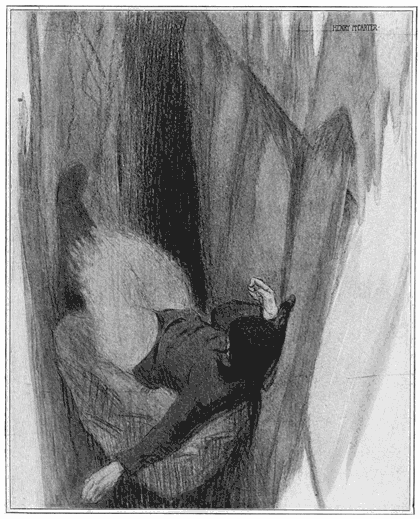
A hundred feet below ... lay Daniel.—Page 294.