Volume 40 — HINTS TO CORRESPONDENTS.
Reading edition
No attention will be paid to communications unless accompanied with the full name and address of the writer.
Names and addresses of correspondents will not be given to inquirers.
We renew our request that correspondents, in referring to former answers or articles, will be kind enough to name the date of the paper and the page, or the number of the question.
Correspondents whose inquiries do not appear after a reasonable time should repeat them.
Persons desiring special information which is purely of a personal character, and not of general interest, should remit from $1 to $5, according to the subject, as we cannot be expected to spend time and labor to obtain such information without remuneration.
(1) S. Q.—The speed of a circular saw at the periphery should be from 6,000 to 7,000 feet per minute. The number of revolutions per minute will of course vary with the diameter of the saw.
(2) T. J. F. asks (1) for the best way to fasten emery on a wooden wheel, to be used in place of a solid emery wheel. A. Cover the wheel with leather devoid of grease, and coat the leather surface, a portion at a time, with good glue; immediately roll the glued surface in emery spread out on a board. 2. How can I fasten small pieces of looking glass on iron? A. Use equal parts of pitch and gutta percha mixed together.
(3) W. C. asks: 1. What is the power of the simple electric light described in Supplement No. 149? A. When supplied with a strong current it is equal to 5 or 6 5-foot gas burners. It is designed for temporary use only. 2. What is the cost of manufacturing the dynamo-electric machine in Supplement No. 161? A. The one shown in the article referred to cost about $35.
(4) L. D. asks: 1. Which is the better conductor, silver or copper? A. Silver. 2. And the comparative resistance offered to the electric current by water and the above? A. Taking pure silver as 100,000,000, the conductivity of distilled water would be 0.01.
(5) H. J. F. writes: In Supplement 162 a simple electric light is described. I wish to light a room 20x20x10 feet. 1. How large is the bell glass? A. 2½ inches. 2. Can I use battery carbon? A. Use a carbon pencil made for electric lamps. 3. How can I make tray water tight after putting wire through? A. With gutta percha. 4. I have one large cell Bunsen and one Smee. How many more and of what kind shall I get? A. One of the batteries described in Supplements 157, 158, 159, will do, probably 8 or 10 Bunsen elements would be the best.
(6) W. B. F. writes: I tried to make an electric pen, like the one described in your Scientific American, of February 22d, 1879, using a Smee's battery, a circuit breaker, and an induction coil, but it did not work. Is there anything wrong, or is a condenser different from an induction coil? A. A condenser consists of a number of sheets of tin foil separated from each other by larger sheets of paper. One half of the tin foil sheets are connected with one terminal of the primary coil, the other half with the other terminal; the tin foil sheets connected with one terminal alternate with those of the other terminal. The condenser is essential to the working of the coil. For complete directions for making induction coils, see Scientific American Supplement No. 160.
(7) J. De F. asks: 1. Knowing the resistance of a wire of given conductivity, length, and diameter, will the resistance of any other wire be in proportion inversely? A. Yes. 2. Is there heat enough developed in the secondary coil of an induction coil to prevent the use of paraffine as an insulating material? A. With proper battery power, no. 3. How high in the list of non-conductors does paraffine stand? A. It is one of the best. 4. Will a cotton insulator soaked in paraffine answer as well as silk? A. No, because it renders the covering of the wire too thick. 5. Can you recommend any insulating material for making induction coils which will dry rapidly? A. Alcoholic shellac varnish. Rosin to which a little beeswax has been added is an excellent insulator; it must be applied in a melted state. 6. What is the composition of the black material covering the Leclanche porous cell? A. Gutta percha. 7. Is the magneto-electric machine described in the Scientific American Supplement patented? A. To which do you refer? Most, if not all of them are patented.
(8) B. V. F. writes: With reference to item 8, on page 139, of Scientific American, March 1, 1879, I think there is some mistake about the coal you think required to heat 1,000 cubic feet space. I burn some 8 tons coal to heat, in the whole year, such part of my house as must exceed 25x20x18=9,000 cubic feet. We keep up a moderate heat at night. Ventilate more than most families do; take part only of the cool air, and only in part of the coldest weather, from the cellar, which at such times is opened into the main entries. House wood, back plastered, and stands alone. If 100 lbs. coal would heat 1,000 feet one day, I ought to burn 900 lbs. a day, or nearly 14 tons in December and 14 more in January. A. We are glad to receive these data, which correspond quite closely with some obtained by recent accurate experiments. The estimate given in the Scientific American also agrees well with experiments on the use of hot air heaters for very small buildings or rooms. Of course, the larger the space to be heated, the more economically it can generally be done.
(9) W. M. S. asks: Will the coil described in Supplement No. 160 do for the electric pen described in a recent number of the Scientific American? If not how must it be changed? A. It is too large; make it one half the size given.
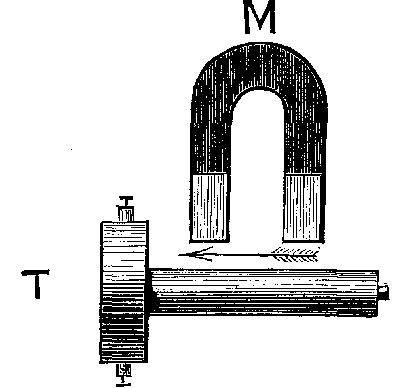
(10) B. G.—In reply to your inquiry as to Mr. Stroh's telephone experiment, we give the following, which we clip from the English Mechanic: A singular experimental effect, of special interest just now from its possible bearing on the theory of the source of sound in the Bell telephone, has just been observed by Mr. Stroh, the well known mechanician. If a telephone, T, with the circuit of its coil left open, be held to the ear, and a powerful magnet, M, be moved gently up and down along the length of the magnet, as shown by the arrow, and at a distance of an inch or two from it, a faint breathing sound will be heard, the recurring pulses of sound keeping time with the up and down motion of the magnet. The sound may be aptly compared to the steady breathing of a child, and there is a striking resemblance between it and the microphonic sounds of gases diffusing through a porous septum as heard by Mr. Chandler Roberts. We understand that Professor Hughes is investigating the cause of this curious sound by help of the microphone.
(11) "Enterprise" asks: What part of its volume will iron expand in passing from a temperature of 60° to melting temperature? A. The cubical expansion of iron for each degree (C.) between 0° and 100° is 0.00003546 of its volume, its volume being 1. This ratio however, increases somewhat at higher temperatures, since the mean coefficient of expansion for each degree between 0° C. and 300° C. is 0.00004405. The question you ask has probably never been settled. You may form an approximation by the use of the above ratios, knowing the melting point of the iron.
(12) P. L. O. asks for a good chemistry for a beginner to study without a teacher. A. Fownes' "Chemistry;" Gorup-Besanez, "Inorganic, Organic and Physiological Chemistry."
(13) L. E. M. asks: What is the best method of keeping fine guns from rusting, and what oil should be used? A. For the outside, clear gum copal 1 part, oil of rosemary 1 part, absolute alcohol 3 parts. Clean and heat the metal and apply a flowing coat of the liquid by means of a camel's hair brush. Do not handle until the coat becomes dry and hard. For the inside of the barrel a trace of refined sperm oil is as good as anything, but an excess should be avoided.
(14) A. H. B. asks how much weight, falling 10 feet, will be required to produce one horse power for five hours? A. One horse power for 5 hours = 33,000 × 300 = 9,900,000 foot pounds—so that the weight required is 9,900,000 ÷ 10 = 990,000 lbs.
(15) A. D. R. asks: 1. In renewing a Leclanche battery, do the zincs have to be amalgamated? A. They are usually amalgamated. 2. Will two cells large size Leclanche battery give any light, using the simple lamp described in Supplement No. 162? A. No.
(16) H. L. J. writes: In a recent issue of the Scientific American you state that the floating of solid iron on melted iron is on the same principle as the floating of ice in water. I do not quite understand how it can be. Please explain. A. Solid iron, at an elevated temperature, floats upon molten iron for the same reason that ice floats upon molten ice-water—because it is specifically lighter. You will find the subject discussed at length in Tyndall's "Heat as a Mode of Motion."
(17) J. W. will find full directions for canning corn, etc., on p. 394 (4), vol. 39, Scientific American.
(18) "Amateur" writes: I wish to make some small bells that have a clear ring. What metal or metals can I use that I can melt easily? A. Use an alloy of tin and antimony. See Scientific American Supplement No. 17.
(19) H.—A nutritious mixed diet is unquestionably the best, care being taken to avoid an excess of meat.
(20) W. F. writes: I have made an engine, and would like to find out what size of boiler it will require. The cylinder has 2¼ inch bore and 3 inches stroke. A. It depends upon pressure and speed to be maintained; probably a vertical tubular boiler, 15 inches diameter, and 32 to 36 inches high, would suit you.
(21) R. G. (Salt Lake).—Please send full name.
(22) J. M. G. asks: If two persons each pull one hundred pounds on opposite ends of a rope, what will be the strain on the rope? A. The strain on the rope will be 100 lbs.
(23) W. M. M. asks: In laying off a mill stone in furrows, what draught is given? What amount of the space of a stone is given to furrows and what to grinding surface? A. There is considerable difference in the practice of various millers, and we would be glad to receive communications from those experienced in the art of dressing millstones.
Minerals, Etc.—Specimens have been received from the following correspondents, and examined, with the results stated:
S. (New Orleans.)—The powder consists of a mixture of zinc oxide and finely powdered resin. A quantitative analysis would be necessary to determine the proportions.
Any numbers of the Scientific American Supplement referred to in these columns may be had at this office. Price 10 cents each.
COMMUNICATIONS RECEIVED.
Life Preserving Stone. By J. D. W. On Ventilation. By D. W. What is Mental Action? By N. K. Panama Railroad or Canal. By G. R. P. A Problem. By K. On the Gary Motor. By G. F. M. Magnetic Motor. By G. W. W., W. A. A., G. H. F. House Warming. By H. B. F. The Injector. By M. A. B. Columbus' Problem; Cure for Diphtheria; The Mullein Cure for Consumption. By R. W. L. A Visit to Tula. By L. R. On Vacuum in Pumps and the Atwood Machine. By P. J. D. On the Patent Bill. By R.
[OFFICIAL.]
INDEX OF INVENTIONS
FOR WHICH Letters Patent of the United States were Granted in the Week Ending February 18, 1879, AND EACH BEARING THAT DATE.
[Those marked (r) are reissued patents.]
A complete copy of any patent in the annexed list, including both the specifications and drawings, will be furnished from this office for one dollar. In ordering, please state the number and date of the patent desired, and remit to Munn & Co., 37 Park Row, New York city.
Air heater, W. Pickhardt212,499
Anchor, A. F. White212,340
Animal trap, S. J. Bennett212,430
Axle box, vehicle, P. K. Hughes212,382
Axle, carriage, C. H. Kendall212,387
Axle for wagons, trussed, J. Herby212,378
Axle, vehicle, C. H. Kendall212,386
Barrel cover, C. Brinton212,350
Bed bottom, J. Flinn212,451
Bed bottom, spring, W. B. Crich212,443
Bedstead, sofa, A. N. Hornung212,312
Bedstead, wardrobe, H. P. Blackman212,348
Belt hook templet, E. Card212,353
Boot and shoe laster, L. Graf212,460
Boot and shoe sole polisher, etc., O. Gilmore212,372
Boot and shoe sole edge trimmer, C. H. Helms212,311
Boot fronts, cutting in, C. H. Colburn212,357
Boot, India-rubber, G. Watkinson (r)8,587
Bottle filler, W. S. Paddock212,494
Bread board, H. Van Doren212,334
Brick, shed for drying, C. H. Roselius212,511
Bridge gate, A. Stempel212,329
Broom corn tabler, G. W. Foulger212,454
Button F. E. Williams212,418
Calculator, tax, P. F. Pettibone212,498
Car coupling, G. R. Hamilton212,462
Car coupling, S. A. Haydock212,464
Car coupling, J. Worrall212,529
Car heaters, coupling for pipes of railway, J. W. Graydon212,376
Car heater, railway, J. W. Graydon212,375
Car heating pipe coupling, railway, J. W. Graydon212,374
Car ventilation, J. Knipscheer212,475
Cars, heating, J. & J. W. Russell212,403
Cars, supplying water to wash stands on, D. H. Jones212,385
Carbureter feed regulator, W. H. Reed212,502
Card machine burr conveyer, W. C. Bramwell212,435
Carpet beater, J. L. Leach212,476
Carriage, C. H. Palmer, Jr.212,397
Carriage bow, F. H. Niemann212,491
Carriage, child's, F. H. Way (r)8,583
Carriage top prop, J. P. Simpson212,519
Carriage canopy top, D. Gleason212,458
Cartridge, W. W. Hubbell212,313
Chair foot or leg rest, M. E. Keiran212,474
Chimney, locomotive engine, H. R. Walker212,414
Chuck, lathe, J. H. Vinton212,413
Churn power motion, W. F. Witherington212,527
Cigarette, C. C. Millaudon212,392
Coat, reversible, N. H. Lund212,479
Cock and faucet, etc., self-closing, J. Broughton212,436
Coffee pot, teapot, etc., stand, D. H. Murphy212,395
Coffee roaster, R. Davis212,445
Corset, W. Thomas212,411
Corset steel, E. M. Smith211,520
Dental plugger, W. G. A. Bonwill212,434
Door securer and combined tool, P. E. Rudel212,512
Door sill and carpet strip, S. M. Stewart212,521
Drip pan and self-oiler for bearings, R. B. Eason212,449
Egg cup and opener, D. H. Murphy212,394
End gate, wagon, W. H. Parkin212,398
File, bill, E. H. Owen212,493
Files, recutting, M. J. Murphy212,490
Filter, J. W. Lefferts212,477
Firearm, breech-loading, H. Goodman212,459
Firearm lock, Kaufmann & Warnant212,473
Fire extinguisher, D. T. Perkins212,322
Fires in buildings, extinguishing, C. Barnes212,346
Fluid motor, Chase & Bowker212,356
Fountain tip, H. G. Fiske212,368
Furnace, G. B. Field212,366
Game apparatus, W. T. Ebert212,304
Garter, etc., clasp, L. Lobenstein212,390
Gate, McKinley & Ellis212,482
Gate, G. W. Pyle212,501
Glassware, decorating, H. Feurhake212,365
Glassware shaper and finisher, Atterbury & Beck212,421
Glazier's tool, W. H. G. Savage212,515
Governor and friction brake for machinery, speed, T. A. Weston212,337
Grain drill, C. F. Davis (r)8,589
Harness breeching strap, H. Holt212,467
Harrow, toothless, J. W. Mulvey212,393
Harvester, W. A. Wood212,528
Harvester cutter, B. Pratt212,323
Harvester, grain binding, J. F. Appleby212,420
Harvester reel, B. Moreland212,318
Harvesting machine, Dutton & Tornquist212,303
Hat formers, web tender for, R. Eickemeyer212,450
Hay binder and elevator, P. H. Nichols212,319
Hay elevator, H. Barlow212,427
Hay tedder, E. J. Knowlton212,388
Headlights, signal for locomotive, W. Kelley (r)8,591
Heat regulator for furnaces, A. C. Norcross (r)8,582
Hoisting bucket, F. H. C. Mey212,317
Hoisting drums, etc., friction brake and clutch for, T. A. Weston212,338
Hoisting machine, T. A. Weston212,339
Horse toe weight, G. C. Clausen212,440
Hydrant, J. Snell212,408
Hydrant, street, G. C. Morgan212,486
Hydraulic motor, W. S. Puckett212,500
Injector, steam boiler, G. R. Buckman212,438
Keg trussing machine, E. & B. Holmes212,381
Kettle, H. C. McLean212,483
Kitchen cabinet, C. A. Adams212,343
Lamp, J. H. Irwin212,470
Lamp burner, E. B. Requa212,401
Lamp, fountain, C. Stockmann212,522
Lamp shade holder, Brown & Taplin212,437
Lamp, street, J. Stewart212,410
Lamp wick, H. Halvorson212,309
Life preserver, T. Richards212,402
Life preserver, R. E. Rose212,404
Lock, W. E. Forster212,452
Lock gate, D. Risher, Jr.212,506
Mechanical movement, C. B. Hitchcock212,380
Metal tube maker, A. Ball212,425
Middlings separator, J. Schoonover212,406
Milker, cow, A. C. Baldwin212,423
Millstone adjustment, S. P. Walling212,525
Millstone curb or hoop, J. S. Detwiler212,361
Miter machine, J. J. Spilker212,409
Mop head, H. Murch212,489
Needle eye polisher, George & Payne212,455
Oil cup, F. Lunkenheimer212,480
Ore concentrator, E. W. Stephens212,330
Ore roaster, C. E. Robinson212,508
Oven bottom and slide, J. Jewett212,471
Oysters, board bank for fattening, F. Lang212,389
Package or box filler, Bolton & Strieby212,349
Paper cutter, J. M. Jones212,384
Paper folder, R. M. Hoe212,466
Paper machines, method and apparatus for producing a vacuum in the suction box of, Dunn & Hollister212,362
Paper machines, wire guide for J. W. Moore212,485
Paper making, treating pulp stock, S. & J. Deacon212,447
Paper scorer and cutter, G. L. Ingram212,314
Paper scorer and cutter, W. F. Lodge212,315
Permutation lock dial screen, Corbett & Miller212,359
Picture exhibitor, A. L. High212,465
Pill machine, Fort & Moore212,453
Pipe wrench, S. W. Hudson212,468
Pipe wrench with cutter, Franklin & Gilberds212,369
Plant protector, E. R. Frederick212,306
Plants, etc., poison distributer for, G. Townsend212,412
Planter and drill, check row, G. J. Hyer212,469
Planter, corn, J. A. Roderick212,509
Plow, E. Walker212,524
Plow attachment, A. O. Bement212,429
Plow cutter, A. Aldrich212,419
Plow, sulky, J. R. Whitney212,341
Printer's roller, T. M. Fisher212,367
Printing machine, L. C. Crowell212,444
Pumping engine, duplex, G. F. Blake (r)8,585
Radiator for steam heaters, Covert & Snyder212,360
Railway crossing, Bernard & Perkins212,432
Railway switch, C. F. Gessert212,456
Ratchet mechanism and clutch for machinery, T. A. Weston212,336
Rocking chair, J. W. Hamburger212,461
Rotary engine, A. B. Haughey212,463
Rubber mat, E. L. Perry212,497
Sad iron holder, A. Failor212,363
Safety pin, I. W. Stewart (r)8,592
Salt cellar, W. Sellers212,518
Sandpaper roll, O. Gilmore212,371
Sash cord guide, Clarkson & Kesler (r)8,586
Sash fastener, J. Benson212,431
Sash fastener, G. W. Cary212,354
Sash fastener, J. B. Morris212,487
Saw, circular, G. Schleicher212,516
Saw handle, E. R. Osgood212,396
Saw, jig, G. W. Gary212,355
Saw mill, gang, H. D. & E. N. Wickes212,526
Saw mill head block, J. T. James212,383
Sawing machine, scroll, N. P. Selden212,326
Scales, platform, F. Fairbanks212,364
Scales, weighing, G. L. C. Coulon212,300
Scarf pins, etc., making ball heads of, J. N. Allen212,297
Scythe snath fastening, P. E. Rudel212,513
Sewer trap, J. P. Cahill212,352
Sewing implement, A. J. Lytle212,481
Sewing machine, C. O. Parmenter212,495
Sewing machine attachment, J. B. Sulgrove212,523
Sewing machine plaiter, White & Bowhannan212,417
Sheet metal vessel bottom, F. W. Moseley212,484
Shoe, Searl & Bly212,517
Skate, C. T. Day (r)8,590
Skylight, J. Friend212,307
Slate frame, E. Butler (r)8,588
Sled propeller, G. F. Shaver (r)8,593
Smelting furnace, iron, P. L. Weimer212,415
Sole edge burnisher, T. P. Young212,342
Spoke tenoning machine, A. J. Roberts212,507
Sprinkling can, G. F. Payne212,321
Stamp, postage and revenue, K. Wheeler212,416
Staple machine, W. M. Collins212,441
Staples in paper, etc., device for inserting metallic, G. W. McGill212,316
Stave crozer and chamferer, H. H. Dunlevy212,448
Steak tenderer, E. Richmond212,505
Steam boiler, fire tube, J. Cowhig212,301
Steam brake for locomotives, etc., W. L. Card212,439
Steam piping for heating, etc., B. F. Osborne212,420
Steam trap, I. W. Merrill212,391
Stove and furnace grate, S. Smyth212,407
Stove, cooking, G. H. Hess212,379
Stove, cooking, J. Jewett212,472
Stove, oil, Fleming & Hamilton212,305
Stove oven door and shelf, C. W. Brieder212,351
Strainer, gravy, J. Scheider (r)8,584
Strap for garments, adjusting, T. O. Potter212,400
Street motor, J. T. Cord212,442
Surveying instrument leveler, G. N. Saegmuller212,405
Swing, J. Ryan212,514
Telephone apparatus, speaking, E. Gray212,373
Telephony, electric, Black & Rosebrugh212,433
Telephony, electric, A. M. Rosebrugh212,510
Thill coupling, D. C. Bacon212,422
Thill coupling, C. E. Gillespie et al.212,308
Thill coupling, M. F. Ten Eyck212,333
Thill supporter, vehicle, H. O. Rector212,325
Ticket, passenger, J. H. Purdy212,324
Tiles for use as stands, frame for holding ornamental or fancy pottery, C. A. Wellington212,335
Tiles, decorative, J. G. Low212,478
Tiles, paving blocks, etc., composition for drain, W. H. Haight212,377
Tire upsetter, B. K. Taylor212,332
Tobacco, curing, A. P. Poladura212,399
Tobacco cutter, Bauer & Seitz212,347
Tobacco flavoring compound, D. Sternberg212,331
Tobacco manufacture, J. T. Harris212,310
Tobacco presser, F. B. Deane212,446
Traction engine, J. Cooper212,358
Truss, J. R. Alexander212,344
Type distributer, A. C. Richards212,503
Type setter, A. C. Richards212,504
Umbrella, M. Girbardt212,457
Umbrella runner, W. H. Belknap212,428
Undershoe or slipper, G. Gardner212,370
Vehicle seat lock, W. G. Allen212,345
Vehicle spring, M. H. Crane212,302
Vehicle spring bolster, J. G. Snyder212,328
Velocipede, E. C. F. Otto212,492
Wash boiler, F. J. Boyer212,299
Washing and bath tub, J. B O. Shevill212,327
Washing machine, J. W. Patterson212,496
Water meter diaphragm, W. B. Mounteney212,488
Whip holder, Curtis & Worden (r)8,581
Wire measurer and cutter, G. A. Baron212,426
Wire, winding tubes and rods with, A. Ball212,424
Wrench, C. B. Billings212,298
TRADE MARKS.
Boots, shoes, and brogans, W. F. Thorne & Co.7,037
Cigars, Sullivan & Burk7,035
Cigars, cigarettes, and smoking and chewing tobacco, B. Hilson7,038
Cotton gins, Printup, Brother & Pollard7,042
Fertilizers for flowers, W. H. Bowker & Co.7,041
Grain fans, J. Montgomery7,032
Hair goods for ladies' wear, M. E. Thompson7,040
Hoes, Semple & Birge Manufacturing Company7,039
Medicine for the cure of neuralgia, and the like diseases, J. S. Nicolds7,033
Roofing paper, carpet paper, or paper felt, and building paper, Watson & Janes7,043
Soap, Gallup & Hewitt7,036
Spool cotton, J. & J. Clark & Co7,031
Table cutlery, John Russell Cutlery Company7,034
DESIGNS.
Carpet, T. J. Stearns11,029
Combined sleigh bell and terret ring, H. M. Richmond11,027
Crocheted body for shawls, L. Howard11,028
Oil cloth, C. T. & V. E. Meyer11,024 to 11,026
Statue, A. Bartholdi11,023
English Patents Issued to Americans. From February 18 to February 21, inclusive.
Bed bottoms, etc.—C. D. Flynt, Brooklyn, N. Y. Berth.—D. Huston, Boston, Mass. Lead smelting furnace.—G. T. Lewis, Philadelphia, Pa. Locks.—A. P. Thomas et al., Baltimore, Md. Railway joint.—P. T. Madison, Indianapolis, Ind. Spikes for railroads.—R. Bocklen, New York city. Ventilating buildings.—F. S. Norton, New York city.