Volume 40 — Correspondence.
Reading edition
The Gary Motor.
To the Editor of the Scientific American:
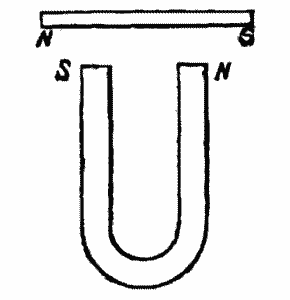
In your article on the "Gary Motor," issue of March 8, page 144, you say: "There is no neutral line in the sense that polarity changes when Mr. Gary moves his piece of sheet iron with its attached shingle nail across the pole or near the pole of a magnet." "The most delicate instruments fail to detect such a change of polarity," etc. Mr. Gary's claim of a neutral line is of course absurd, but you are wrong in saying that the polarity does not change under the conditions described in the Harper's Monthly article. Mr. Gary is perfectly correct in claiming a change of polarity in that experiment, although his other claim of deriving from this change of polarity a continuous motion without consuming energy are manifestly absurd.
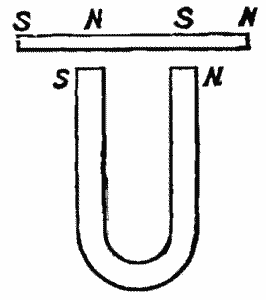
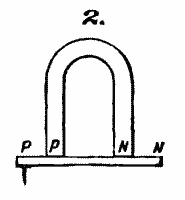
The change of polarity is easily explained. If a bar of soft iron, whose length is two or three times the distance between the poles of the horseshoe magnet, be placed in front of the latter as in the sketch, and at some distance, poles will be induced, as shown by the letters N S. Now let the bar approach the magnet. When within a short distance consequent points will be formed and the polarity at the ends will be reversed, the bar having four poles, as in the second sketch. The bar of soft iron must have certain dimensions depending on the size and power of the horseshoe magnet. By using a powerful electro-magnet in place of a permanent one, a soft iron bar of considerable size may be used, and the change of polarity exhibited by showing the repulsion in one case for the south pole and in the other for the north pole of a heavy permanent magnet. When in the proper position a very small movement of the soft iron bar is sufficient to produce the change.
Wm. A. Anthony.
Cornell University, Ithaca, N. Y., March 2, 1879.
Gary's Neutral Line.
To the Editor of the Scientific American:
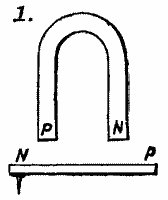
I have just read the article in the issue of March 8, on the Gary Motor, and cannot refrain from offering a suggestion on the subject. When I read the article referred to in Harper's, I formed the same opinion of the so-called invention that the writer in the Scientific American has expressed, and, in the main, such is my opinion still. I, however, tried the experiment by which Gary claims to prove the existence of his neutral line, and soon found the same explanation that the writer in the American has given. I then, curiously enough, modified the experiment in precisely the manner he suggests, placing the magnet in a vertical position, and using first a piece of sheet iron and then an iron wire under it. This was before seeing the article in the Scientific American. My experiment is well illustrated by the writer's diagram, except that the nail should be at the end of the iron wire, where its polarity is of course most strongly marked. But the result is not as he states it. For, as the wire is brought up toward the magnet, the nail drops off before the wire touches the magnet. When the sheet iron is used, the point at which the nail drops off is farther from the magnet than in the case of the wire, and when it is brought nearer it will again pick up the nail, which then continues to cling until the iron touches the magnet and afterwards. Thus the existence of a line in which the soft iron, or induced magnet, does not attract the nail, and above and below which it does attract it, is demonstrated. That the polarity of the induced magnet is reversed when it crosses this line may be demonstrated as follows: When it is held beyond (or below) this line (Fig. 1), the negative pole of the permanent magnet, the positive being kept at a distance, may be made to approach the iron and touch it, without causing the nail to drop. (Fig. 3.) But when contact occurs, the whole of the iron must possess the polarity of that part of the magnet which it touches, namely, negative. Hence in the position indicated in Fig. 1, the polarity of the induced magnet does not correspond with that of the permanent magnet, but is as indicated by the letters. On the other hand, if the positive pole alone be made to approach, the nail will drop; but when it is very near, or in contact, it again holds the nail, and the iron is now positive; and if the negative pole also be now brought into contact, the polarity of the soft iron will correspond with that of the magnet, as shown in Fig. 2.
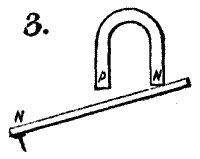
These experiments should be performed with the soft iron under both poles of the magnet, and the ends of the former should extend somewhat beyond the poles of the latter, or the nail is liable to jump to the magnet as the "neutral" line is crossed. The position of the letters in Fig. 1, of the previous article, represents the polarity of the induced magnet to be the same as that of the permanent, which is true only within (or above) the line described; and this, together with his statement that no such line can be discovered, appears to indicate that the writer relied upon his knowledge of the laws of magnetism to state what would be the result, without testing it experimentally. It is probable that this reversal of polarity is susceptible of explanation by the known laws of magnetic currents, but if it has hitherto escaped observation, its discovery is certainly deserving of notice, and may lead to valuable results. Of the fact, any one may easily convince himself by the simple experiments above described.
G. H. FELTON, M.D.
Haverhill, Mass., February 28, 1879.
Pneumatic Clocks.
To the Editor of the Scientific American:
In the description of the pneumatic clock, copied from La Nature, and published in your journal of date 1st of March, the invention is credited to me. Such is not the case. By an arrangement between Mr. Wenzel, Mr. Brandon of Paris, and myself, patents have been obtained in France, England, etc., for the clock, and issued in my name; but the honor of the invention belongs exclusively to Hermann J. Wenzel, of San Francisco.
Yours faithfully,
E. J. Muybridge.
San Francisco, Cal., February 27, 1879.
The Ice Cave of Decorah, Iowa.
To the Editor of the Scientific American:
Some years ago I visited the "Ice Cave" of Decorah, Winneshiek county, Iowa, and having since been unable to receive any explanation of the wonderful phenomenon exhibited by it, I write, hoping that you or some correspondent may explain the paradox.
The thriving town of Decorah lies in a romantic valley of the Upper Iowa River, and the cave is almost within its corporate limits. Following the left bank of the stream, one soon reaches the vicinity, and with a hard scramble through a loose shale, up the side of a precipitous hill, forming the immediate bank of the river, the entrance is gained—an opening 5 feet wide and 8 feet high. These dimensions generally describe the cave's section. From the entrance the course is a steep decline—seldom less than 40°. At times the ceiling is so low that progress on hands and knees is necessary. About 125 feet from the entrance the "Ice Chamber" is reached. At this spot the cave widens into a well proportioned room, 8 by 12 feet. The floor is solid ice of unknown thickness, and on the right hand wall of the room a curtain of ice drops to the floor, from a crevice extending horizontally in the rock at the height of one's eyes. Close examination discovers the water oozing from this crevice, and as it finds its way down the side it freezes in the low temperature of the chamber. Singularly this one crevice, and that no wider than a knife edge, furnishes this, nature's ice house, with the necessary water. It was a hot day in August, the thermometer marking 80° in the shade when the visit was made, and comparatively the cold was intense. In common with all visitors, we detached some large pieces of ice and with them hurriedly departed, glad to regain the warmth of the outside world.
The most remarkable fact in connection with this wonder is that the water only freezes in the summer. As the cold of actual winter comes on the ice of the cave gradually melts, and when the river below is frozen by the fierce cold of Northern Iowa, the ice has disappeared and a muddy slush has taken the place of the frigid floor. I would add that the ice chamber forms the terminus of the cave. Beyond a shallow crevice in the crumbling rock forbids further advance. The rock formation of this region is the Portland sandstone.
Why should the temperature of the ice chamber be such as to freeze the water trickling into it? And above all, why should the ice disappear with the cold of winter?
Mansfield, O. H. M. W.