SYSTEMATIC RELATIONS OF PLATYPSYLLUS, AS DETERMINED BY THE LARVA.[12]
Reading edition
SYSTEMATIC RELATIONS OF PLATYPSYLLUS, AS DETERMINED BY THE LARVA.[12]
By Dr. C. V. Riley.
There is always a great deal of interest attaching to organisms which are unique in character and which systematists find difficulty in placing in any of their schemes of classification. A number of instances will occur to every working naturalist, and I need only refer to Limulus, and the extensive literature devoted, during the past decade, to the discussion of its true position, as a marked and well-known illustration. In hexapods the common earwig and flea are familiar illustrations. These osculant or aberrant forms occur most among parasitic groups, as the Stylopidæ, Hippoboscidæ, Pulicidæ, Mallophaga, etc. Probably no hexapod, however, has more interested entomologists than Platypsyllus castoris Ritsema, a parasite of the beaver. I cannot better illustrate the diversity of opinion respecting its true position in zoology than by giving an epitome of the more important literature upon it.
J. Ritsema, in Petites Nouvelles Entomologiques for September 15, 1869, described the species as Platypsyllus castoris. He found it on some American beavers (Castor canadensis) in the zoological garden of Rotterdam. He considered it to "undoubtedly" belong to the Suctoria of De Geer, and to form a new genus of Pulicidæ.
In the same year, in the Tijdschrift voor Entomologie, 2d ser., vol. v., p. 185 (which I have not seen), the same author publishes what is apparently a redescription of the insect. He gives his views more fully as to its systematic position, considering that it belongs to the Aphaniptera, and is equivalent to the Pulicidæ.
In the same year, Prof. J. O. Westwood (having previously read a description of the species, November 9, 1868, before the Ashmolean Society of Oxford) published in the Entomologist's Monthly Magazine, vol. vi., October, 1869, pp. 118-119, a full characterization of the insect under the name of Platypsyllus castorinus. A new order, Achreioptera, is established upon the species, which he very aptly likens, in general appearance, to a cross between a flattened flea and a diminutive cockroach. "The abnormal economy of the insect, its remarkable structure, the apparent want of mandibles, our ignorance of its transformations, and the possibility that the creature may be homomorphous in the larva and pupa states," are the reasons assigned for establishing the new order, and here Prof. Westwood is perfectly consistent, as in his famous "Introduction to the Classification of Insects" the Forficulidæ are placed in the order Euplexoptera; the Thripidæ in the order Thysanoptera; the Phryganeidæ in the order Thrichoptera; the Stylopidæ in the order Strepsiptera; and the Pulicidæ in the order Aphaniptera.
In 1872, Dr. J. L. Le Conte published his paper "On Platypsyllidæ, a New Family of Coleoptera" (Proc. Zool. Soc. of London for 1872, pp. 779-804, pl. lxviii.), in which he shows that Platypsylla is undoubtedly coleopterous and cannot possibly be referred to the Aphaniptera. Careful descriptions and figures of anatomical details are given, and he finds that its affinities are very composite, but in the direction of the Adephagous and Clavicorn series. Its most convenient place is shown to be between the Hydrophilidæ and Leptinidæ. There seems to be no good reason why the name Platypsyllus is here changed to Platypsylla, a spelling adopted by most subsequent American writers.
In 1874, Prof. Westwood, in the "Thesaurus Entomologicus Oxoniensis" (Oxford, 1874), p. 194, pl. xxxvii., gives figures with details; reprints his previous diagnosis, and maintains his previous course in erecting a new order for the insect, without giving any additional reasons.
In 1880, P. Megnin, in "Les Parasites et les maladies parasitaires," etc., Paris, 1880, gives (pp. 66-67) a description of the family "Platypsyllines" without expressing an opinion concerning the systematic position. He also describes and figures the species.
In 1882, Dr. Geo. H. Horn (Trans. Amer. Ent. Soc., x., 1882-83; Monthly Proc., Feb. 10, 1882, p. ii.) exhibited drawings illustrating the anatomy of Platypsylla and Leptinus, and showed that a close relationship exists between these genera. Later, in his "Notes on Some Little Known Genera and Species of Coleoptera" (Trans. Amer. Ent. Soc., x., 1882-83, pp. 113-126, pl. v., 114-116), he reviews the characters, and explains and illustrates the anatomical details. The differences he points out between his observations and those of Le Conte are more particularly in the mandibles. In connection with this paper he also describes and illustrates the structure of Leptinillus, which he separates from Leptinus, and demonstrates their close relationship with Platypsyllus.
In 1883, Le Conte and Horn, in their "Classification of the Coleoptera of North America" (Washington, Smithsonian Institution, 1883), give (pp. 13-15) a full description of the family characters, a little modified from Le Conte's first description, but sustaining his views on the systematic position of Platypsyllidæ.
In 1883, Alphonse Bonhoure (Ann. Soc. de France, 1883; Bull, des Seances, p. cxxvi.) exhibited drawings and specimens of Platypsyllus castoris found in the Departement des Bouches du Rhone.
In 1884, Edm. Reitter, in "Platypsylla castoris Rits. als Vertreter einer neuer europaischen Coleopteren-Familie" (Wiener entom. Zeit. iii., 1884, pp. 19-21) gives a lengthy description of the species with special regard to the sexual differences. He shows that the European insect is not specifically distinct from the American form, but he does not express an opinion on the position of the family among the Coleoptera.
In the same year, Bonhoure (Ann. Soc. Ent. de France, 1884, pp. 143-153) more fully records its discovery on Castor fiber taken in the Petit-Rhone. It is a question whether this European beaver, now quite rare, is distinct from ours. He gives a very good review of the subject, with a plate of the most important details, after Horn, and he fully indorses the coleopterological position of the insect.
In the same year Ritsema (Tijdschrift voor Entomologie, 1883-84, lxxxvi.) refers to Bonhoure's discovery of Platypsylla in France, and corrects Reitter in some unimportant details.
In 1885, Reitter, in "Coleopterologische Notizen" xiii. (Wiener entomolog. Zeit., vol. iv., 1885, p. 274), answers Ritsema's criticism.
In the same year, Dr. Friederich Brauer, in his masterly "Systematisch-zoologische Studien" (Sitzh. der Kais. Akad. der Wissensch., xci., p. 364), speaks of the relationship in the thoracic characters between Mallophaga and Coleoptera as illustrated by Platypsyllus, by inference admitting the coleopterous nature of the latter, but recognizing that it has mallophagous affinities.
In 1886, H. J. Kolbe, in his "Ueber die Stellung von Platypsyllus im System" (Berlin entom. Zeitsch., xxx., 1886, pp. 103-105), discusses the subject, without any new evidence, however. He concludes that most of its characteristics relate it to the Corrodentia, and particularly to the sub-order Mallophaga, in which it has its closest kinship in Liotheidæ. The remarkable tripartite mentum he thinks should not be compared with the bipartite mentum of Leptinus, and calls attention to the fact that in Ancistrona in Mallophaga it is also trilobed.
The above are the more important papers on the subject, though the insect has been referred by other authors to both Neuroptera and Orthoptera.
CHARACTERS OF PLATYPSYLLUS.
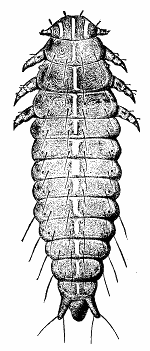
LARVA OF PLATYPSYLLUS CASTORIS—DORSAL VIEW.
PLATYPSYLLUS CASTORIS.
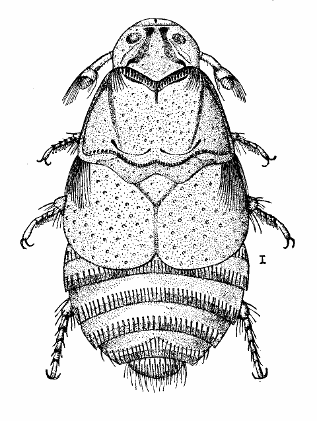
Where the characters of the image have been so often described, it is unnecessary to refer to them in detail, and I will only call attention to the more striking structural features and to some omissions by, or differences between, previous authors. A glance at the illustrations which I have prepared will show the prevailing characteristics of this interesting creature, its general
On the ventral surface we find among the more curious characteristics, first the antennæ; these were originally described by Westwood as three-jointed, the club being annulated. Le Conte could not distinctly make out the number of annular joints upon this club, though he thought he detected seven, which made nine joints to the whole antenna. The club is received in the deep cup-shaped excavation of the second joint. Horn thought he detected a division of the second joint, and resolved but six segments in the club, making also nine joints to the whole antenna, but in a somewhat different fashion from Le Conte. Westwood's figure shows eight annuli to the club. He failed to find any trace of the mandibles, but Le Conte described them as small, flat, subquadrate, with the inner side deeply crenulate, and resembling those of Corylophus; the stipes well developed, and biarticulate. Horn could not entirely make out the mandibles as described by Le Conte, and rather concluded that what Le Conte described is really one of the granules which occur behind the labrum. He considered that the piece could hardly be even an aborted mandible, because of its diminutive size.
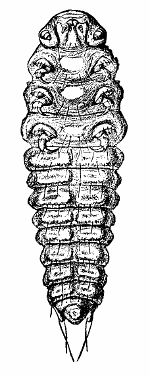
YOUNG LARVA.
What all authors have agreed in calling the mentum is very noticeable, being large and broad, and trilobed behind. The maxillæ are strong, with complicated stipes and with two flat, thin lobes, the inner one smaller than the outer and rounded at the tip, both lobes being ciliate. The maxillary palpi are four-jointed, the labial palpi three-jointed. The prosternum is very large, subtriangular, concealing the insertion of the coxæ, and extending over the front part of the mesosternum, as does this over the front of the metasternum. Six ventral segments of the abdomen are visible behind the posterior coxæ, which conceal two and the base of a third. The coxæ are flat and not at all prominent. The legs are characterized by broad and flattened tibiæ and femora, and the strong spines with which they are armed. The tarsi are five-jointed, the front and middle pair with a row of claviform membraneous appendages each side, which Le Conte found only in the male.
American entomologists have been satisfied to follow Le Conte and Horn as to the position of Platypsyllus. Yet with such diversity of opinion on the subject among high European authorities, the importance of a knowledge of the adolescent states has been recognized, as the character of either the larva or pupa would settle the question.
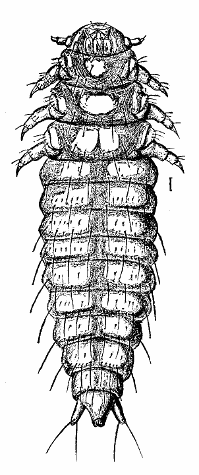
During a stay at West Point, Neb., in October, 1886, I learned from one of my agents, Mr. Lawrence Bruner, that there was a beaver in a creek not far from that point, and I at once made arrangements for him to trap the beaver, and to look particularly for living specimens of Platypsyllus on the skin, and especially the earlier stages. He succeeded in capturing the beaver and sent me some fifteen specimens of the larva and also some imagos, but neither eggs nor pupæ were found. A glance at the larva satisfied me at once of its coleopterous nature; but as we have, waiting to be embarras de richesses entomologiques in the collections of the National Museum, and as circumstances largely decide the precedence, I should probably not have called attention to this larva for some time, had it not been that at the last monthly meeting of the Entomological Society of Washington, Dr. Horn, who was present, announced the finding, the present spring, by one of his correspondents, of this very larva, and exhibited a specimen. Some points about it, and especially the position of the spiracles, being yet rather obscure in his mind, he requested me to examine my material, which I have thus been led to do. I have made a figure of this larva which will sufficiently indicate its nature.
The general form of the trophi, and particularly the anal cerci, fully settle the disputed point, and remove this insect completely from the Mallophaga (none of which possess them), and confirm its position in the Clavicorn series of the Coleoptera. Yet in the larva, as in the imago, the effects of its parasitic life are shown in certain modifications which approach the running section of the Mallophaga. Without going into details I may say that, besides its general and more decided coleopterological features, this larva is distinguished by the shortness and stoutness of its legs, by the size and stoutness of the antennæ, by the stiff and long depressed hairs on the dorsal and more particularly on the ventral surface, and by the dorsal position of the abdominal spiracles, all characters approaching the Mallophaga. The first pair of spiracles is lateral, and may be said to be mesothoracic, being placed on the mesothoracic joint, but on a distinct fold. The eight abdominal spiracles are placed on the sides of the dorsum, and in this respect recall the parasitic triungulin of the meloid larvæ. The mandibles are barely corneous, and they are more elongate and curved in the younger than in the older larva, while the legs are also relatively stouter, more curved, and with a much longer and sharper claw in the younger larva, which seems well fitted for grasping the hairs of its host.
There can no longer be any doubt, therefore, about the true position of Platypsyllus. The eggs will probably be found attached in some way to the hairs of the animal they are laid on, much as they are in Mallophaga, and the pupa is probably formed in the nests of the host, and not upon the skin, which will explain the reason for its not occurring with the larva and imago upon the beaver, either in the case of my specimens or those of Dr. Horn.
The greatest resemblance of Platypsyllus in the imago state to the Mallophaga is found in the spinous comb on the hind border of the occiput, the arrangement of the spines on the abdomen, and the superficial antennal structure, but particularly in the broad trilobed mentum. All of the other characteristics are readily referable to the Coleoptera, though, as Le Conte pointed out, they are composite, recalling in the antennæ the Grynidæ, in the pronotum the Silphidæ, in the mesosternum Limulodes, in the elytra the Staphilindæ, in the legs the Anisotomidæ, and in the mandibles the Corylophidæ. The scutellum and the five-jointed tarsi at once remove it from Mallophaga, and it is a wonder that Le Conte and Horn have not more fully insisted on this fact. The trophi are very complicated, and there are various details of structure not noticed or not mentioned by any of the writers upon the subject hitherto.
I have been led to very carefully examine the imago, and the more closely I have done so, the more completely I realize the accuracy of Le Conte's original work. The mandibles are visible or not, according as they are exposed or withdrawn, and their existence may depend on the sex, as, so far as my material justifies conclusion, they are visible in the male only. Where found they correspond to Le Conte's description. Even in the larva they are weak and of doubtful service in mastication, while in the imago they are, as is also the labrum, quite rudimentary, which fact hardly justifies us, however, in arguing their non-existence.
As confirmatory of the affinities of Platypsyllus, as here proved, it may be mentioned that Leptinus testaceous Mull., the only species of its genus, is known to be parasitic on mice, as it has been found upon them in Philadelphia by Dr. Jno. A. Ryder, and I have taken it in the nests of a common field mouse near Washington. But still more interesting is the fact that Leptinillus validus Horn (also the only species of its genus) is an associate parasite of Platypsyllus on the beaver, a number of both having been taken by one of my agents, Mr. A. Koebele, in San Francisco, from beaver skins brought from Alaska.
LARVA OF PLATYPSYLLUS CASTORIS.
In reference to the classificatory value that should be attached to an aberrant type like this, I have already expressed my opinion in a paper on Megathymus, a Lepidopteron that connects in many ways the two great divisions of butterflies and moths, published in the Transactions of the Academy of Sciences of St. Louis, volume iii., 1876, and will take the liberty of reading a few passages therefrom:
"Between all classificatory divisions, from variety to kingdom, the separating lines we draw get more and more broken in proportion as our knowledge of forms, past and present, increases. Every step in advance toward a true conception of the relations of animals brings the different groups closer together, until at last we perceive an almost continuous chain. Even the older naturalists had an appreciation of this fact. Linnæus' noted dictum, 'Natura saltus non facit' implies it; and Kirby and Spence justly observe that 'it appears to be the opinion of most modern physiologists that the series of affinities in nature is a concatenation or continuous series; and that though an hiatus is here and there observable, this has been caused either by the annihilation of some original group or species, or that the objects required to fill it up are still in existence but have not yet been discovered.'"
"Modern naturalists find in this more or less gradual blending their strongest arguments in favor of community of descent; and speculation as to the origin, or outcome rather, in the near present or remote past of existing forms is naturally and very generally indulged, even by those who a few years back were more inclined to ridicule than accept Darwinian doctrine. Shall we then say that the old divisions must be discarded because not absolute? As well might we argue for the abolition of the four seasons because they differ with the latitude, or because they gradually blend into each other. Entomologists will always speak of moths and butterflies, howsoever arbitrary the groups may come to be looked upon, or however numerous the intermediate gradations."
"Families should, I think, be made as comprehensive as possible, and not unduly multiplied; and in considering aberrant forms, the objects of classification are best subserved by retaining them in whatever division can claim the balance of characters. It is better to widen than to restrict in the higher groups. Le Conte does better service in bringing Platypsylla among the Coleoptera than does Westwood in creating a new order—Achreioptera—for it. Phylloxera, in Homoptera, is much more wisely retained in the Aphididæ than made the type of a new family."
Platypsyllus, therefore, is a good Coleopteron, and in all the characters in which it so strongly approaches the Mallophaga it offers merely an illustration of modification due to food habit and environment. In this particular it is, however, of very great interest as one of the most striking illustrations we have of variation in similar lines through the influence of purely external or dynamical conditions, and where genetic connection and heredity play no part whatever. It is at the same time interesting because of its synthetic characteristics, being evidently an ancient type from which we get a very good idea of the connection in the past of some of the present well-defined orders of insects.
Westwood, though now an octogenarian, may safely be called England's most eminent entomologist by virtue of the character and volume of the work which he has accomplished. Dr. Le Conte was, facile princeps, America's leading coleopterist. I do not know that any greater tribute could be added to the sound judgment and deep knowledge possessed by that late distinguished member of the Academy than the confirmation of his views as opposed to the views of Westwood and other European authorities which the discovery of this larva now gives us.