THE GENERATION OF STEAM, AND THE THERMODYNAMIC PROBLEMS INVOLVED.1
Reading edition
THE GENERATION OF STEAM, AND THE THERMODYNAMIC PROBLEMS INVOLVED.1
By Mr. WILLIAM ANDERSON, M.I.C.E.
It will not be necessary to commence this lecture by explaining the origin of fuel; it will be sufficient if I remind you that it is to the action of the complex rays of the sun upon the foliage of plants that we mainly owe our supply of combustibles. The tree trunks and branches of our forests, as well as the subterranean deposits of coal and naphtha, at one time formed portions of the atmosphere in the form of carbonic acid gas; that gas was decomposed by the energy of the solar rays, the carbon and the oxygen were placed in positions of advantage with respect to each other—endowed with potential energy; and it is my duty this evening to show how we can best make use of these relations, and by once more combining the constituents of fuel with the oxygen of the air, reverse the action which caused the growth of the plants, that is to say, by destroying the plant reproduce the heat and light which fostered it. The energy which can be set free by this process cannot be greater than that derived originally from the sun, and which, acting through the frail mechanism of green leaves, tore asunder the strong bonds of chemical affinity wherein the carbon and oxygen were hound, converting the former into the ligneous portions of the plants and setting the latter free for other uses. The power thus silently exerted is enormous; for every ton of carbon separated in twelve hours necessitates an expenditure of energy represented by at least 1,058 horse power, but the action is spread over an enormous area of leaf surface, rendered necessary by the small proportion of carbonic acid contained in the air, by measure only 1/2000 part, and hence the action is silent and imperceptible. It is now conceded on all hands that what is termed heat is the energy of molecular motion, and that this motion is convertible into various kinds and obeys the general laws relating to motion. Two substances brought within the range of chemical affinity unite with more or less violence; the motion of transition of the particles is transformed, wholly or in part, into a vibratory or rotary motion, either of the particles themselves or the interatomic ether; and according to the quality of the motions we are as a rule, besides other effects, made conscious of heat or light, or of both. When these emanations come to be examined they are found to be complex in the extreme, intimately bound up together, and yet capable of being separated and analyzed.
As soon as the law of definite chemical combination was firmly established, the circumstance that changes of temperature accompanied most chemical combinations was noticed, and chemists were not long in suspecting that the amount of heat developed or absorbed by chemical reaction should be as much a property of the substances entering into combination as their atomic weights. Solid ground for this expectation lies in the dynamic theory of heat. A body of water at a given height is competent by its fall to produce a definite and invariable quantity of heat or work, and in the same way two substances falling together in chemical union acquire a definite amount of kinetic energy, which, if not expended in the work of molecular changes, may also by suitable arrangements be made to manifest a definite and invariable quantity of heat.
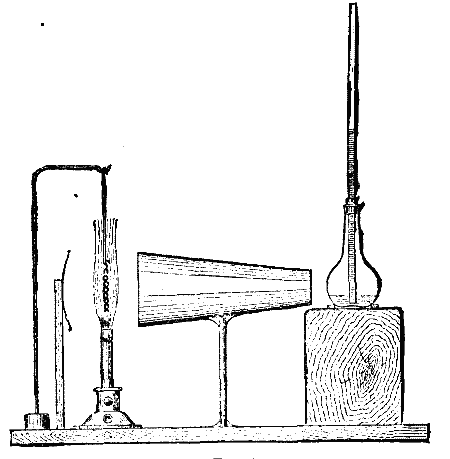
At the end of last century Lavoisier and Laplace, and after them, down to our own time, Dulong, Desprez, Favre and Silbermann, Andrews, Berthelot, Thomson, and others, devoted much time and labor to the experimental determination of the heat of combustion and the laws which governed its development. Messrs. Favre and Silbermann, in particular, between the years 1845 and 1852, carried out a splendid series of experiments by means of the apparatus partly represented in Fig. 1 (opposite), which is a drawing one-third the natural size of the calorimeter employed. It consisted essentially of a combustion chamber formed of thin copper, gilt internally. The upper part of the chamber was fitted with a cover through which the combustible could be introduced, with a pipe for a gas jet, with a peep hole closed by adiathermanous but transparent substances, alum and glass, and with a branch leading to a thin copper coil surrounding the lower part of the chamber and descending below it. The whole of this portion of the apparatus was plunged into a thin copper vessel, silvered internally and filled with water, which was kept thoroughly mixed by means of agitators. This second vessel stood inside a third one, the sides and bottom of which were covered with the skins of swans with the down on, and the whole was immersed in a fourth vessel tilled with water, kept at the average temperature of the laboratory. Suitable thermometers of great delicacy were provided, and all manner of precautions were taken to prevent loss of heat.
THE GENERATION OF STEAM. Fig 1.
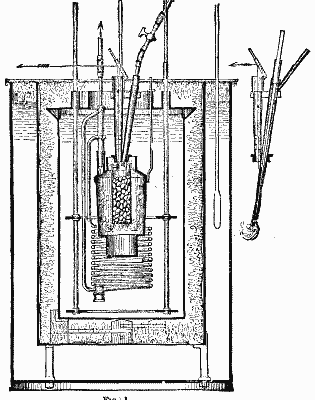
It is impossible not to admire the ingenuity and skill exhibited in the details of the apparatus, in the various accessories for generating and storing the gases used, and for absorbing and weighing the products of combustion; but it is a matter of regret that the experiments should have been carried out on so small a scale. For example, the little cage which held the solid fuel tested was only 5/8 inch diameter by barely 2 inches high, and held only 38 grains of charcoal, the combustion occupying about sixteen minutes. Favre and Silbermann adopted the plan of ascertaining the weight of the substances consumed by calculation from the weight of the products of combustion. Carbonic acid was absorbed by caustic potash, as also was carbonic oxide, after having been oxidized to carbonic acid by heated oxide of copper, and the vapor of water was absorbed by concentrated sulphuric acid. The adoption of this system showed that it was in any case necessary to analyze the products of combustion in order to,m detect imperfect action. Thus, in the case of substances containing carbon, carbonic oxide was always present to a variable extent with the carbonic acid, and corrections were necessary in order to determine the total heat due to the complete combination of the substance with oxygen. Another advantage gained was that the absorption of the products of combustion prevents any sensible alteration in the volumes during the process, so that corrections for the heat absorbed in the work of displacing the atmosphere were not required. The experiments on various substances were repeated many times. The mean results for those in which we are immediately interested are given in Table I., next column.
Comparison with later determinations have established their substantial accuracy. The general conclusion arrived at is thus stated:
"As a rule there is an equality between the heat disengaged or absorbed in the acts, respectively, of chemical combination or decomposition of the same elements, so that the heat evolved during the combination of two simple or com-pound substances is equal to the heat absorbed at the time of their chemical segregation."
TABLE I.—SUBSTANCES ENTERING INTO THE COMPOSITION OF FUEL.
Symbol and Atomic Weight.Heat evolved in the Combustion of 1 lb. of Fuel.
Before CombustionAfter CombustionIn British Thermal Units.In Pounds of Water Evaporated from and at 212°.
Hydrogen burned in oxygen.H1H2O1862,03264.21
Carbon burned to carbonic oxide.C12CO284,4514.61
Carbon burned to carbonic acid.C12CO24414,54415.06
Carbonic oxide burned to carbonic acid.CO28CO2444,3264.48
Olefiant gas (ethylene) burnt in oxygen.C2H4 2H2O282CO212421,34322.09
Marsh gas (methane) burnt in oxygen.CH4162CO2 2H2O8023,51324.34
Composition of air—
{by volume 0.788 N + 0.197 O + 0.001 CO2 + 0.014 H2O
by weight 0.771 N + 0.218 O + 0.009 CO2 + 0.017 H2O
This law is, however, subject to some apparent exceptions. Carbon burned in protoxide of nitrogen, or laughing gas, N2O, produces about 38 per cent. more heat than the same substance burned in pure oxygen, notwithstanding that the work of decomposing the protoxide of nitrogen has to be performed. In marsh gas, or methane, CH4, again, the energy of combustion is considerably less than that due to the burning of its carbon and hydrogen separately. These exceptions probably arise from the circumstance that the energy of chemical action is absorbed to a greater or less degree in effecting molecular changes, as, for example, the combustion of 1 pound of nitrogen to form protoxide of nitrogen results in the absorption of 1,157 units of heat. Berthelot states, as one of the fundamental principles of thermochemistry, "that the quantity of heat evolved is the measure of the sum of the chemical and physical work accomplished in the reaction"; and such a law will no doubt account for the phenomena above noted. The equivalent heat of combustion of the compounds we have practically to deal with has been experimentally determined, and therefore constitutes a secure basis on which to establish calculations of the caloric value of fuel; and in doing so, with respect to substances composed of carbon, hydrogen, and oxygen, it is convenient to reduce the hydrogen to its heat-producing equivalent of carbon. The heat of combustion of hydrogen being 62,032 units, that of carbon 14,544 units, it follows that 4.265 times the weight of hydrogen will represent an equivalent amount of carbon. With respect to the oxygen, it is found that it exists in combination with the hydrogen in the form of water, and, being combined already, abstracts its combining equivalent of hydrogen from the efficient ingredients of the fuel; and hence hydrogen, to the extent of 1/8 of the weight of the oxygen, must be deducted. The general formula then becomes:
Heat of combustion = 14,544 {C + 4.265 (H-(O/8))},
and water evaporated from and at 212°, taking 966 units as the heat necessary to evaporate 1 pound of water,
lb. evaporated = 15.06 {C + 4.265 (H-(O/8))},
carbon, hydrogen, and oxygen being taken at their weight per cent. in the fuel. Strictly speaking, marsh gas should be separately determined. It often happens that available energy is not in a form in which it can be applied directly to our needs. The water flowing down from the mountains in the neighborhood of the Alpine tunnels was competent to provide the power necessary for boring through them, but it was not in a form in which it could be directly applied. The kinetic energy of the water had first to be changed into the potential energy of air under pressure, then, in that form, by suitable mechanism, it was used with signal success to disintegrate and excavate the hard rock of the tunnels. The energy resulting from combustion is also incapable of being directly transformed into useful motive power; it must first be converted into potential force of steam or air at high temperature and pressure, and then applied by means of suitable heat engines to produce the motions we require. It is probably to this circumstance that we must attribute the slowness of the human race to take advantage of the energy of combustion. The history of the steam engine hardly dates back 200 years, a very small fraction of the centuries during which man has existed, even since historic times.
The apparatus by means of which the potential energy of fuel with respect to oxygen is converted into the potential energy of steam, we call a steam boiler; and although it has neither cylinder nor piston, crank nor fly wheel, I claim for it that it is a veritable heat engine, because it transmits the undulations and vibrations caused by the energy of chemical combination in the fuel to the water in the boiler; these motions expend themselves in overcoming the liquid cohesion of the water and imparting to its molecules that vigor of motion which converts them into the molecules of a gas which, impinging on the surfaces which confine it and form the steam space, declare their presence and energy in the shape of pressure and temperature. A steam pumping engine, which furnishes water under high pressure to raise loads by means of hydraulic cranes, is not more truly a heat engine than a simple boiler, for the latter converts the latent energy of fuel into the latent energy of steam, just as the pumping engine converts the latent energy of steam into the latent energy of the pumped-up accumulator or the hoisted weight.
If I am justified in taking this view, then I am justified in applying to my heat engine the general principles laid down in 1824 by Sadi Carnot, namely, that the proportion of work which can be obtained out of any substance working between two temperatures depends entirely and solely upon the difference between the temperatures at the beginning and end of the operation; that is to say, if T be the higher temperature at the beginning, and t the lower temperature at the end of the action, then the maximum possible work to be got out of the substance will be a function of (T-t). The greatest range of temperature possible or conceivable is from the absolute temperature of the substance at the commencement of the operation down to absolute zero of temperature, and the fraction of this which can be utilized is the ratio which the range of temperature through which the substance is working bears to the absolute temperature at the commencement of the action. If W = the greatest amount of effect to be expected, T and t the absolute temperatures, and H the total quantity of heat (expressed in foot pounds or in water evaporated, as the case may be) potential in the substance at the higher temperature, T, at the beginning of the operation, then Carnot's law is expressed by the equation:
W = H ( T - t )
T
I will illustrate this important doctrine in the manner which Carnot himself suggested.
THE GENERATION OF STEAM. Fig 2.
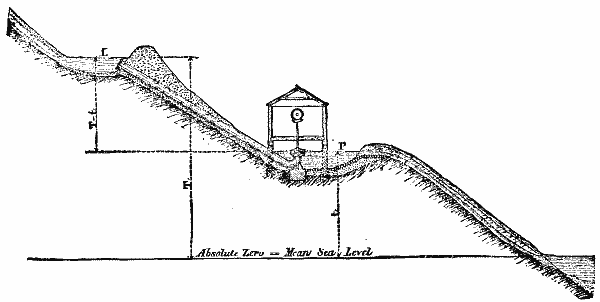
Fig. 2 represents a hillside rising from the sea. Some distance up there is a lake, L, fed by streams coming down from a still higher level. Lower down on the slope is a millpond, P, the tail race from which falls into the sea. At the millpond is established a factory, the turbine driving which is supplied with water by a pipe descending from the lake, L. Datum is the mean sea level; the level of the lake is T, and of the millpond t. Q is the weight of water falling through the turbine per minute. The mean sea level is the lowest level to which the water can possibly fall; hence its greatest potential energy, that of its position in the lake, = QT = H. The water is working between the absolute levels, T and t; hence, according to Carnot, the maximum effect, W, to be expected is—
W = H ( T - t T )
but H = QT ∴W = QT ( T - t )
T
W = Q (T - t),
that is to say, the greatest amount of work which can be expected is found by multiplying the weight of water into the clear fall, which is, of course, self-evident.
Now, how can the quantity of work to be got out of a given weight of water be increased without in any way improving the efficiency of the turbine? In two ways:
1. By collecting the water higher up the mountain, and by that means increasing T.
2. By placing the turbine lower down, nearer the sea, and by that means reducing t.
Now, the sea level corresponds to the absolute zero of temperature, and the heights T and t to the maximum and minimum temperatures between which the substance is working; therefore similarly, the way to increase the efficiency of a heat engine, such as a boiler, is to raise the temperature of the furnace to the utmost, and reduce the heat of the smoke to the lowest possible point. It should be noted, in addition, that it is immaterial what liquid there may be in the lake; whether water, oil, mercury, or what not, the law will equally apply, and so in a heat engine, the nature of the working substance, provided that it does not change its physical state during a cycle, does not affect the question of efficiency with which the heat being expended is so utilized. To make this matter clearer, and give it a practical bearing, I will give the symbols a numerical value, and for this purpose I will, for the sake of simplicity, suppose that the fuel used is pure carbon, such as coke or charcoal, the heat of combustion of which is 14,544 units, that the specific heat of air, and of the products of combustion at constant pressure, is 0.238, that only sufficient air is passed through the fire to supply the quantity of oxygen theoretically required for the combustion of the carbon, and that the temperature of the air is at 60° Fahrenheit = 520° absolute. The symbol T represents the absolute temperature of the furnace, a value which is easily calculated in the following manner: 1 lb. of carbon requires 2-2/3 lb. of oxygen to convert it into carbonic acid, and this quantity is furnished by 12.2 lb. of air, the result being 13.2 lb. of gases, heated by 14,544 units of heat due to the energy of combustion; therefore:
T = 520° + 14,544 units = 5,150° absolute.
13.2 lb. × 0.238
The lower temperature, t, we may take as that of the feed water, say at 100° or 560° absolute, for by means of artificial draught and sufficiently extending the heating surface, the temperature of the smoke may be reduced to very nearly that of the feed water. Under such circumstances the proportion of heat which can be realized is
= 5,150° - 560° = 0.891;
5,150°
that is to say, under the extremely favorable if not impracticable conditions assumed, there must be a loss of 11 per cent. Next, to give a numerical value to the potential energy, H, to be derived from a pound of carbon, calculating from absolute zero, the specific heat of carbon being 0.25, and absolute temperature of air 520°:
Units.
1 lb. of carbon × 0.25 × 520=130
12.2 of air × 0.238 × 520=1,485
Heat of combustion=14,544
16,159
Deduct heat equivalent to work of displacing atmosphere by products of combustion raised from 60° to 100°, or from 149.8 cubic feet to 161.3 cubic feet,32
Total units of heat available16,127
Equal to 16.69 lb. of water evaporated from and at 212°. Hence the greatest possible evaporation from and at 212° from a lb. of carbon—
W = 16,159 u. × 0.891 - 32 u. = 14.87 lb.
966 u.
I will now take a definite case, and compare the potential energy of a certain kind of fuel with the results actually obtained. For this purpose the boiler of the eight-horse portable engine, which gained the first prize at the Cardiff show of the Royal Agricultural Society in 1872, will serve very well, because the trials, all the details of which are set forth very fully in vol. ix. of the Journal of the Society, were carried out with great care and skill by Sir Frederick Bramwell and the late Mr. Menelaus; indeed, the only fact left undetermined was the temperature of the furnace, an omission due to the want of a trustworthy pyrometer, a want which has not been satisfied to this day.2 The data necessary for our purpose are:
Steam pressure 80 lb. temperature324° = 784°absolute.
Mean temperature of smoke389° = 849°"
Water evaporated per 1 lb of coal, from and at 212°11.83 lb.
Temperature of the air60° = 520°absolute.
Temperature of feed water209° = 669°"
Heating surface220 square feet.
Grate surface3.29 feet.
Coal burnt per hour41 lb.
The fuel used was a smokeless Welsh coal, from the Llangennech colleries. It was analyzed by Mr. Snelus, of the Dowlais Ironworks, and in Table II. are exhibited the details of its composition, and the weight and volume of air required for its combustion. The total heat of combustion in 1 lb of water evaporated:
= 15.06 × (0.8497 + 4.265 × (0.426 - 0.035/8)) = 15.24 lb. of water from and at 212° = 14,727 units of heat.
TABLE II.—PROPERTIES OF LLANGENNECH COAL.
Analyses of 1 lb. of Coal.Oxygen required for Combustion. Pounds.Products of Combustion at 32° F.
Cubic feet.Volume per cent.
Carbon0.84972.26625.311.1
Hydrogen0.04260.3097.63.4
Oxygen0.0350———
Sulphur0.0042———
Nitrogen0.1045—0.18}85.5
Ash0.0540——
Total1.00002.572—
9-1/3.lb nitrogen——118.9
6 lb. excess of air.——71.4
Total cubic feet of products per 1 lb. of coal——226.4100.0
The temperature of the furnace not having been determined, we must calculate it on the supposition, which will be justified later on, that 50 per cent more air was admitted than was theoretically necessary to supply the oxygen required for perfect combustion. This would make 18 lb. of air per 1 lb. of coal; consequently 19 lb. of gases would be heated by 14,727 units of heat. Hence:
T = 14,727 u. = 3,257°
19 lb. × 0.238
above the temperatures of the air, or 3,777° absolute. The temperature of the smoke, t, was 849° absolute; hence the maximum duty would be
3,777° - 849° = 0.7752.
3,777°
The specific heat of coal is very nearly that of gases at constant pressure, and may, without sensible error, be taken as such. The potential energy of 1 lb. of coal, therefore, with reference to the oxygen with which it will combine, and calculated from absolute zero, is:
Units.
19 lb. of coal and air at the temperature of the air contained 19 lb. × 520° × 0.2382,350
Heat of combustion14,727
17,078
Deduct heat expended in displacing atmosphere 151 cubic feet- 422
Total potential energy16,656
Hence work to be expected from the boiler:
17,078 units × ( 3,777° - 849° ) - 422 units
3,777°
=————————————————— = 13.27 lb.
966 units
of water evaporated from and at 212°, corresponding to 12,819 units. The actual result obtained was 11.83 lb.; hence the efficiency of this boiler was
11.83= 0.892.
13.27
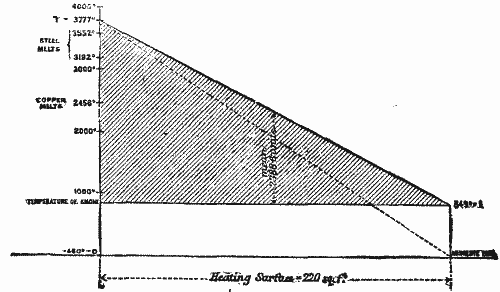
I have already claimed for a boiler that it is a veritable heat engine, and I have ventured to construct an indicator diagram to illustrate its working. The rate of transfer of heat from the furnace to the water in the boiler, at any given point, is some way proportional to the difference of temperature, and the quantity of heat in the gases is proportional to their temperatures. Draw a base line representing -460° Fahr., the absolute zero of temperature. At one end erect an ordinate, upon which set off T = 3,777°, the temperature of the furnace. At 849° = t, on the scale of temperature, draw a line parallel to the base, and mark on it a length proportional to the heating surface of the boiler; join T by a diagonal with the extremity of this line, and drop a perpendicular on to the zero line. The temperature of the water in the boiler being uniform, the ordinates bounded by the sloping line, and by the line, t, will at any point be approximately proportional to the rate of transmission of heat, and the shaded area above t will be proportional to the quantity of heat imparted to the water. Join T by another diagonal with extremity of the heating surface on the zero line, then the larger triangle, standing on the zero line, will represent the whole of the heat of combustion, and the ratio of the two triangles will be as the lengths of their respective bases, that is, as (T-t) / T, which is the expression we have already used. The heating surface was 220 square feet, and it was competent to transmit the energy developed by 41 lb. of coal consumed per hour = 12,819 u. × 41 u. = 525,572 units, equal to an average of 2,389 units per square foot per hour; this value will correspond to the mean pressure in an ordinary diagram, for it is a measure of the energy with which molecular motion is transferred from the heated gases to the boiler-plate, and so to the water. The mean rate of transmission, multiplied by the area of heating surface, gives the area of the shaded portion of the figure, which is the total work which should have been done, that is to say, the work of evaporating 544 lb. of water per hour. The actual work done, however, was only 485 lb. To give the speculations we have indulged in a practical turn, it will be necessary to examine in detail the terms of Carnot's formula. Carnot labored under great disadvantages. He adhered to the emission theory of heat; he was unacquainted with its dynamic equivalent; he did not know the reason of the difference between the specific heat of air at constant pressure and at constant volume, the idea of an absolute zero of temperature had not been broached; but the genius of the man, while it made him lament the want of knowledge which he felt must be attainable, also enabled him to penetrate the gloom by which he was surrounded, and enunciate propositions respecting the theory of heat engines, which the knowledge we now possess enables us to admit as true. His propositions are:
1. The motive power of heat is independent of the agents employed to develop it, and its quantity is determined solely by the temperature of the bodies between which the final transfer of caloric takes place.
2. The temperature of the agent must in the first instance be raised to the highest degree possible in order to obtain a great fall of caloric, and as a consequence a large production of motive power.
3. For the same reason the cooling of the agent must be carried to as low a degree as possible.
4. Matters must be so arranged that the passage of the elastic agent from the higher to the lower temperature must be due to an increase of volume, that is to say, the cooling of the agent must be caused by its rarefaction.
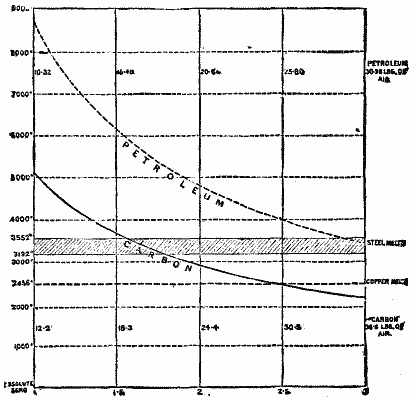
This last proposition indicates the defective information which Carnot possessed. He knew that expansion of the elastic agent was accompanied by a fall of temperature, but he did not know that that fall was due to the conversion of heat into work. We should state this clause more correctly by saying that "the cooling of the agent must be caused by the external work it performs." In accordance with these propositions, it is immaterial what the heated gases or vapors in the furnace of a boiler may be, provided that they cool by doing external work and, in passing over the boiler surfaces, impart their heat energy to the water. The temperature of the furnace, it follows, must be kept as high as possible. The process of combustion is usually complex. First, in the case of coal, close to the fire-bars complete combustion of the red hot carbon takes place, and the heat so developed distills the volatile hydrocarbons and moisture in the upper layers of the fuel. The inflammable gases ignite on or near the surface of the fuel, if there be a sufficient supply of air, and burn with a bright flame for a considerable distance around the boiler. If the layer of fuel be thin, the carbonic acid formed in the first instance passes through the fuel and mixes with the other gases. If, however, the layer of fuel be thick, and the supply of air through the bars insufficient, the carbonic acid is decomposed by the red hot coke, and twice the volume of carbonic oxide is produced, and this, making its way through the fuel, burns with a pale blue flame on the surface, the result, as far as evolution of heat is concerned, being the same as if the intermediate decomposition of carbonic acid had not taken place. This property of coal has been taken advantage of by the late Sir W. Siemens in his gas producer, where the supply of air is purposely limited, in order that neither the hydrocarbons separated by distillation, nor the carbonic oxide formed in the thick layer of fuel, may be consumed in the producer, but remain in the form of crude gas, to be utilized in his regenerative furnaces.
THE GENERATION OF STEAM. Fig 3.
THE GENERATION OF STEAM. Fig 4.
THE GENERATION OF STEAM. Fig 5.
THE GENERATION OF STEAM. Fig 6.
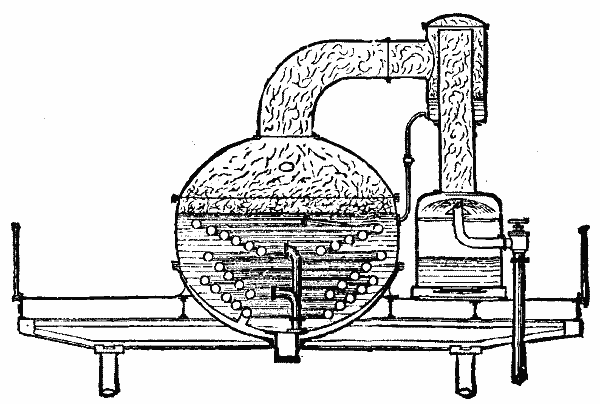
THE GENERATION OF STEAM. Fig 7.
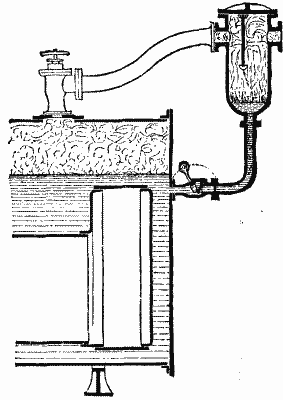
(To be continued.)
[Continued from SUPPLEMENT No. 437, page 6970.]