DR. FEUSSNER'S NEW POLARIZING PRISM.
Reading edition
In a recent number of the Zeitschrift fur Instrumentenkunde (iv., 42-50, February, 1884), Dr. K. Feussner of Karlsruhe has given a detailed description of a polarizing prism lately devised by him, which presents several points of novelty, and for which certain advantages are claimed. The paper also contains an account, although not an exhaustive one, of the various polarizing prisms which have from time to time been constructed by means of different combinations of Iceland spar. The literature of this subject is scattered and somewhat difficult of access, and moreover only a small part of it has hitherto been translated into English; and it would appear therefore that a brief abstract of the paper may not be without service to those among the readers of Nature who may be unacquainted with the original memoirs, or who may not have the necessary references at hand.
Following the order adopted by Dr. Feussner, the subject may be divided into two parts:
I.—OLDER FORMS OF POLARIZING PRISMS.
In comparing the various forms of polarizing prisms, the main points which need attention are—the angular extent of the field of view, the direction of the emergent polarized ray, whether it is shifted to one side of, or remains symmetrical to the long axis of the prism; the proportion which the length of the prism bears to its breadth; and lastly, the position of the terminal faces, whether perpendicular or inclined to the long axis. These requirements are fulfilled in different degrees by the following methods of construction:
Figs. 1., 2., and 3.
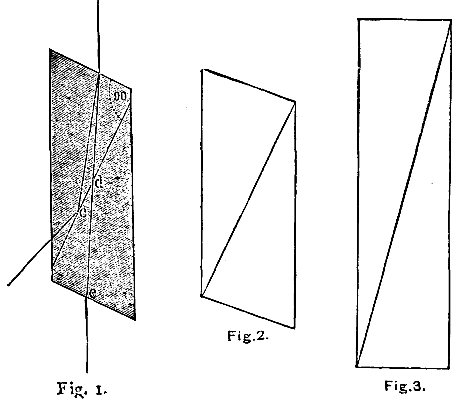
1. The Nicol Prism (Edin. New Phil. Journal, 1828, vi., 83).—This (Fig. 1), as is well known, is constructed from a rhombohedron of Iceland spar, the length of which must be fully three times as great as the width. The end faces are cut off in such a manner that the angle of 72° which they originally form with the lateral edge of the rhombohedron is reduced to 68°. The prism is then cut in two in a plane perpendicular to the new end surfaces, the section being carried obliquely from one obtuse corner of the prism to the other, in the direction of its length. The surfaces of this section, after having been carefully polished, are cemented together again by means of Canada balsam. A ray of light, on entering the prism, is separated by the double refraction of the calc-spar into an ordinary and an extraordinary ray; the former undergoes total reflection at the layer of balsam at an incidence which allows the extraordinary ray to be transmitted; the latter, therefore, passes through unchanged. This principle of obtaining a single polarized ray by means of total reflection of the other is common to all the forms of prism now to be described.
Dr. Feussner gives a mathematical analysis of the paths taken by the two polarized rays within the Nicol prism, and finds that the emergent extraordinary ray can include an angular field of 29°, but that this extreme value holds good only for rays incident upon that portion of the end surface which is near to the obtuse corner, and that from thence it gradually decreases until the field includes an angle of only about half the previous amount. He finds, moreover, that, although of course the ray emerges parallel to its direction of incidence, yet that the zone of polarized light is shifted to one side of the central line. Also that the great length of the Nicol—3.28 times its breadth—is not only an inconvenience, but owing to the large pieces of spar thus required for its construction, prisms of any but small size become very expensive. To this it may be added that there is a considerable loss of light by reflection from the first surface, owing to its inclined position in regard to the long axis of the prism.
Figs. 4., 5., and 6.
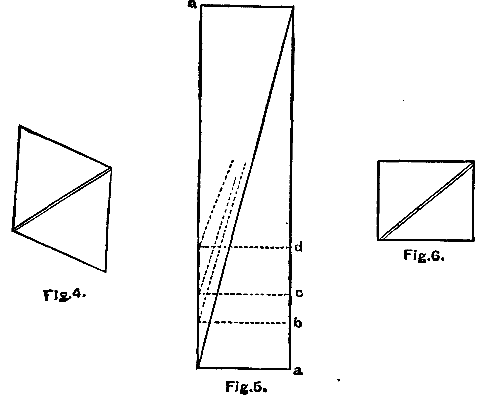
It is with the view of obviating these defects that the modifications represented in Figs. 2 to 6 have been devised.
2. The Shortened Nicol Prism.—This arrangement of the Nicol prism is constructed by Dr. Steeg and Reuter of Homburg v.d.H. For the sake of facility of manufacture, the end surfaces are cleavage planes, and the oblique cut, instead of being perpendicular, makes with these an angle of about 84°. By this alteration the prism becomes shorter, and is now only 2.83 times its breadth; but if Canada balsam is still used as the cement, the field will occupy a very unsymmetrical position in regard to the long axis. If balsam of copaiba is made use of, the index of refraction of which is 1.50, a symmetrical field of about 24° will be obtained. A prism of this kind has also been designed by Prof. B. Hasert of Eisenach (Pogg. Ann., cxiii., 189), but its performance appears to be inferior to the above.
3. The Nicol Prism with Perpendicular Ends.—The terminal surfaces in this prism are perpendicular to the long axis, and the sectional cut makes with them an angle of about 75°. The length of the prism is 3.75 times its breadth, and if the cement has an index of refraction of 1.525, the field is symmetrically disposed, and includes an angle of 27°. Prisms of this kind have been manufactured by Dr. Steeg, Mr. C.D. Ahrens, and others.
4. The Foucault Prism (Comptes Rendus, 1857, xlv., 238).—This construction differs from all those hitherto mentioned, in that a film of air is employed between the two cut surfaces as the totally reflecting medium instead of a layer of cement. The two halves of the prism are kept in position, without touching each other, by means of the mounting. The length of the prism is in this way much reduced, and amounts to only 1.528 times its breadth. The end surfaces are cleavage planes, and the sectional cut makes with them an angle of 59°. The field, however, includes not more than about 8°, so that this prism can be used only in the case of nearly parallel rays; and in addition to this the pictures which may be seen through it are to some extent veiled and indistinct, owing to repeated internal reflection.
5. The Hartnack Prism (Ann. de Ch. et de Physique, ser. iv., vii., 181).—This form of prism was devised in 1866 by MM. Hartnack and Prazmowiski; the original memoir is a valuable one; a translation of it, with some additions, has lately been published (Journ. of the R. Microscopical Soc., June, 1883, 428). It is considered by Dr. Feussner to be the most perfect prism capable of being prepared from calc-spar. The ends of the prism are perpendicular to its length; the section carried through it is in a plane perpendicular to the principal axis of the crystal. The cementing medium is linseed oil, the index of refraction of which is 1.485. This form of prism is certainly not so well known in this country as it deserves to be; a very excellent one, supplied to the present writer by Dr. Steeg is of rectangular form throughout, the terminal surfaces are 19 × 15 mm., and the length 41 mm. The lateral shifting of the field is scarcely perceptible, the prism is perfectly colorless and transparent, and its performance is far superior to that of the ordinary Nicol. The field of view afforded by this construction depends upon the cementing substance used, and also upon the inclination of the sectional cut in regard to the end of the prism; it may vary from 20° to 41°. If the utmost extent of field is not required, the prism may be shortened by lessening the angle of the section, at the expense, however, of interfering with the symmetrical disposition of the field.
6. The Glan Prism (Carl's "Repertorium," xvi., 570, and xvii., 195).—This is a modification of the Foucault, and in a similar manner includes a film of air between the sectional surfaces. The end surfaces and also the cut carried through the prism are parallel to the principal axis of the calc-spar. The ends are normal to the length, and the field includes about 8°. This prism is very short, and may indeed be even shorter than it is broad. It is subject to the same defect as that mentioned in the case of the Foucault, although perhaps not quite to the same extent.
II.—THE NEW POLARIZING PRISM.
This prism differs very considerably from the preceding forms, and consists of a thin plate of a doubly refracting crystal cemented between two wedge-shaped pieces of glass, the terminal faces of which are normal to the length. The external form of the prism may thus be similar to the Hartnack, the calc-spar being replaced by glass. The indices of refraction of the glass and of the cementing medium should correspond with the greater index of refraction of the crystal, and the directions of greatest and least elasticity in the latter must stand in a plane perpendicular to the direction of the section. One of the advantages claimed for the new prism is that, it dispenses with the large and valuable pieces of spar hitherto found necessary; a further advantage being that other crystalline substances may be used in this prism instead of calc-spar. The latter advantage, however, occurs only when the difference between the indices of refraction for the ordinary and extraordinary rays in the particular crystal made use of is greater than in calc-spar. When this is the case, the field becomes enlarged, and the length of the prism is reduced.
Fig. 7.
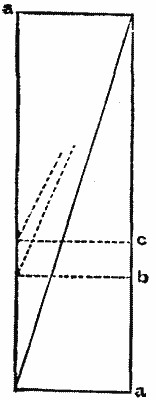
The substance which Dr. Feussner has employed as being most suitable for the separating crystal plate is nitrate of soda (natronsalpeter), in which the above-mentioned values are ω = 1.587 and η = 1.336. It crystallizes in similar form to calcite, and in both cases thin plates obtained by cleavage may be used.
As the cementing substance for the nitrate of soda, a mixture of gum dammar with monobromonaphthalene was used, which afforded an index of refraction of 1.58. In the case of thin plates of calcite, a solid cementing substance of sufficiently high refractive power was not available, and a fluid medium was therefore employed. For this purpose the whole prism was inclosed in a short glass tube with airtight ends, which was filled with monobromonaphthalene. In an experimental prism a mixture of balsam of tolu was made use of, giving a cement with an index of refraction of 1.62, but the low refractive power resulted in a very considerable reduction of the field. The extent and disposition of the field may be varied by altering the inclination at which the crystal lamina is inserted (Fig. 7), and thereby reducing the length of the prism, as in the case of the Hartnack.
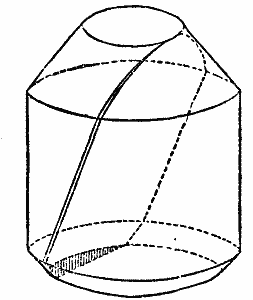
In order to obviate the effects of reflection from the internal side surfaces if the prism, the wedge-shaped blocks of glass of which it is built up may be made much broader than would otherwise be necessary; the edges of this extra width are cut obliquely and suitably blackened.
The accompanying diagram (Fig. 8) represents a prism of cylindrical external form constructed in this manner, the lower surface being that of the incident light. In this the field amounts to 30°, and the breadth is about double the length.
Fig. 8.
Dr. Feussner remarks that a prism similar in some respects to his new arrangement was devised in 1869 by M. Jamin (Comptes Rendus, lxviii., 221), who used a thin plate of calc-spar inclosed in a cell filled with bisulphide of carbon; and also by Dr. Zenker, who replaced the liquid in M. Jamin's construction by wedges of flint glass.
Among others, the carefully considered modifications of the Nicol prism which have recently been devised by Prof. S.P. Thompson (Phil. Mag., November, 1881, 349, and Jour. R. Micros. Soc., August, 1883, 575), and by Mr. R.T. Glazebrook (Phil. Mag., May, 1883, 352), do not appear to have been known to Dr. Feussner.
The following tabular view of different forms of polarizing prisms is taken from the conclusion of Dr. Feussner's paper:
Field.Inclination of section in regard to long axis.Ratio of length to clear width.Fig.
I. THE OLD POLARISING PRISMS.°°
1. Nicol's prism.29223.281
2. Shortened Nicol prism—
a. Cemented with Canada balsam.13252.832
b. Cemented with copaiba balsam.24252.832
3. Nicol with perpendicular ends—
a. With Canada balsam.20153.733
b. With cement of index of refraction of 1.525.27153.733
4. Foucault's prism.8401.5284
5. Hartnack's prism—
a. Original form.3515.93.515ab
b. With largest field.41.913.94.045aa
c. With field of 30°.3017.43.195ac
d. With field of 20°.2020.32.705ad
6. Glan's prism.7.950.30.8316
II. THE NEW POLARISING PRISM.
1. With calc-spar:largest field.4413.24.265aa
2. "field of 30°.3017.43.195ac
3. "field of 20°.2020.32.705ad
4. With nitrate of soda:largest field.5416.73.537aa
5. "field of 30°.30242.257ab
6. "field of 20°.20271.967ac
As an analyzing prism of about 6 mm. clear width, and 13.5 mm. long, the new prism is stated by its inventor to be of the most essential service, and it would certainly appear that the arrangement is rather better adapted for small prisms than for those of considerable size. Any means by which a beam of polarized light of large diameter—say 3 to 3½ inches—could be obtained with all the convenience of a Nicol would be a real advance, for spar of sufficient size and purity for such a purpose has become so scarce and therefore so valuable that large prisms are difficult to procure at all. So far as an analyzer is concerned, the experience of the writer of this notice would lead to the opinion that improvements are to be looked for rather in the way of the discovery of an artificial crystal which absorbs one of the polarized rays than by further modifications depending upon total reflection. The researches of Dr. Herapath on iodosulphate of quinine (Phil. Mag., March, 1852, 161, and November, 1853, 346) are in this direction; but crystals of the so-called herapathite require great manipulative skill for their production. If these could be readily obtained of sufficient size, they would be invaluable as analyzers.
This opinion is supported by the existence of an inconvenience which attends every form of analyzing prism. It is frequently, and especially in projecting apparatus, required to be placed at the focus of a system of lenses, so that the rays may cross in the interior of the prism. This is an unfavorable position for a prismatic analyzer, and in the case of a powerful beam of light, such as that from the electric arc, the crossing of the rays within the prism is not unattended with danger to the cementing substance, and to the surfaces in contact with it.
PHILIP R. SLEEMAN.