BORNHARDT'S ELECTRIC MACHINE FOR BLASTING IN MINES.
Reading edition
We shall not attempt to pass in review the several apparatus that have hitherto been devised for igniting blasts in mining operations, but shall simply describe in this place a machine recently invented for this purpose by Mr. Bornhardt, an engineer to the Grand Duke of Brunswick.
This apparatus (shown in the accompanying engravings) consists essentially of two hard-rubber disks, A (Figs. 2 and 3), keyed to an iron axle, and of two rubbers, B, that are formed of skin and are held against the disks by small springs, R; motion is communicated to the axle, a, by means of a pair of gearings, a and b, and a crank, f.
BORNHARDT'S ELECTRIC MACHINE FOR BLASTING IN MINES.
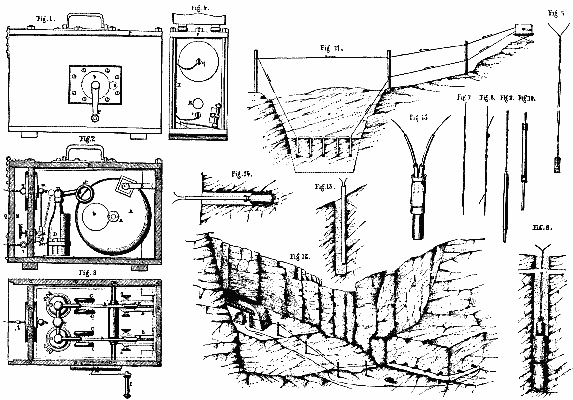
Each disk revolves between two metallic rings, c, provided with points that attract and collect in Leyden jars, D, the electricity produced by the friction. For discharging the condensers there is employed a manipulator formed of a rod, mm, which can be acted upon, from the exterior, by means of a button, k. Upon bringing the ball, m, of the rod in contact with the ball, p, of the condenser, the lever (which then takes the position shown by the dotted line) continues to remain in connection with a small ring, q, through a special spring. Another ring, t, is connected in the same way with the external armature of the condenser. Upon connecting the rings, p and t, by a wire to which cartridges are attached, any number of the latter may be ignited.
The parts that we have just enumerated are inclosed in a tin box covered with a wooden casing, P. Between the two there is inserted a sheet of hard rubber in order to prevent a loss of electricity; the whole is held in place by strong springs.
In order to show the normal state of the condenser, a scale consisting of 15 metallic buttons to give the dimensions of the sparks, is arranged at X. This scale is capable of being connected with the rings, q and t, by means of chains; when the spark obtained after 15 or 20 revolutions considerably exceeds the intervals of the scale, it is a sure thing that the machine is in a proper state.
In order to prepare the apparatus for carriage, the winch is taken off and placed in the compartment, m, which is closed by means of a door, Q.
Figs. 5 and 6 show the arrangement of the dynamite cartridges and wires in the blast hole. Figs. 7 to 10 show different arrangements of the igniting wires. Figs. 11 and 12 give the general arrangement for igniting a number of cartridges simultaneously by means of the electric machine. Fig. 13 shows the arrangement where powder is employed. Fig. 14 shows the arrangement of a horizontal hole.—Annales Industrielles.