Notes and Queries. (Continued from page vi.)
Reading edition
Notes and Queries. (Continued from page vi.)
so as to form a mixture having the consistency of cream, and apply it immediately with a brush. If this composition be allowed to remain for a day or two, and be then washed off with soap and water, the marble will appear as though it were new.
(6) J. M. D. asks: Is there any virtue in the “divining rod,” so called, as a means of determining the locality of hidden streams of water? A. None whatever. The bobbing of the stick is due to a muscular pressure by the holder.
(7) C. W. C. desires (1) a recipe for a stain to imitate mahogany on white birch wood, that will not raise the grain of the wood. A. A dark mahogany stain is made as follows: Boil half a pound of madder and 2 ounces of logwood chips in 1 gallon of water, and brush well over the wood while hot; when dry, go over the whole with pearlash solution, 2 drachms to the quart. 2. Can you give recipe for making the acid stain? A. In the acid stain you take nitric acid, and dilute with 10 parts of water, and wash the wood with it. 3. Are there any books which give full directions for imitating the different woods? A. We would recommend for your purpose Spons’ Workshop Receipts (second series), which we can send you, postpaid, for $2.00.
(8) A subscriber asks how to make spirit varnish suitable for varnishing carved wood. A. Take 1 ounce copal and ½ ounce shellac; powder them well, and put them into a bottle or jar containing 1 quart alcohol. Place the mixture in a warm place and shake it occasionally until the gums are completely dissolved; and when strained the varnish will be ready for use.
(9) J. W. B. desires a recipe for some fire‐extinguishing liquid. A. One of the best solutions for the extinction of incipient fires consists of crude calcium chloride 20 parts, salt 5 parts, dissolved in water 75 parts. Keep at hand, and apply with a hand pump.
(10) G. H. A. says: I have lately made a workshop of an upper room, and have put in a lathe, boiler, and engine of a total weight of 2,400 pounds, resting upon 3 joists 3 inches by 9 inches by 16 feet 0 inches. Will it strengthen the floor sufficiently to enable it to carry the increased weight if I bolt three 3 inch by 8 inch joists to the existing ones? A. You had better use 4 inch by 8 inch joists bolted with ⅜ inch bolts about 10 inches apart. Take care to provide solid bearings for your new joists, wedging the ends up with tiles in cement.
(11) W. A. writes: I have noticed in your issue of the Scientific American, at various times, the receipt for making a printing machine called the hektograph. You also gave a recipe for making a black ink to be used with the same. I have tried both, but I find a great difficulty in gaining a success. I have tried the process for the ink in the manner you describe, but I fail to produce any copies. Ink is prepared with nigrosine. It will not create a bronze. Would you therefore kindly direct me in the right direction, that is to say, to get a black ink that can be used by the hektograph? A. The ink you desire is made by dissolving soluble nigrosine (aniline black) in 5 to 7 parts of water. It should be a saturated solution and rather thick. For use on the hektograph it is best to use a purple ink. See “The Copying Pad,” etc., contained in Scientific American Supplement, No. 438.
(12) A. C. R. writes: Can you recommend me a good rubber cement? I wish to cement leather together, the cement to be waterproof, to resist oil, and the leather to retain its elasticity after pressing. A. Dissolve gutta percha in bisulphide of carbon; shave off the edges of the leather, and pour on the cement; allow to evaporate to dryness. Then put the two faces together, previously heating thoroughly, and press until cool.
(13) G. F. asks the best kind of a vessel to make liquid gold in, for potter’s use. A. Either a glass or a porcelain vessel will answer.
(14) W. J. M. asks how papier mache is made to stand the action of water. A. Coat with a mixture made by fusing together equal parts of pitch and gutta percha, to which is added two parts of linseed oil containing five parts of litharge. Continue the heat until the ingredients are uniformly commingled, and apply warm.
(15) J. D. & Co. ask a process to prevent the smuts from escaping in the air from a lampblack house. A. Carry the outlet of your lampblack chamber to one side and into the top of a vertical shaft, where place a rose jet of water. Have the water drop vertically in an even spray, so as to produce a draught down the shaft. The water will gather the waste lampblack, which can be either utilized or run into the sewer. A vent at the bottom of the shaft may connect with a chimney or into the open air. A pump or city water supply will be required.
(16) W. D. G., Jr., asks how large a main pipe will be required to supply 6 hydrants and 50 dwelling houses, the water to be brought 1 mile with a 70′ head; the hydrants to be used with a 1″ nozzle, and there being no probability of more than two being required at a time? A. About a 6″ pipe; a smaller one would not give the desired pressure for hydrant uses.
(17) S. M. writes: Can you give a formula for a brilliant waterproof finishing polish to be used on veneer after it is rubbed down with pumice stone and water? The polish to be applied the same as French polish. Use linseed oil 1½ pounds, amber 1 pound, litharge 5 ounces, white lead, pulverized, 5 ounces, minium 5 ounces. Boil the linseed oil in an untinned copper vessel, and suspend in it the litharge and minium in a small bag, which must touch the bottom of the vessel. Continue the boiling until the oil has acquired a deep brown color, then take out of the bag and put in a clove of garlic; this is to be repeated 7 or 8 times, the boiling being always continued. Before the amber is added to the oil it is to be mixed with 2 ounces linseed oil and melted over a fire that is well kept up. When the mass is fluid, it is to be boiled and stirred continually for 2 or 3 minutes; afterward filter the mixture, and preserve it in bottles tightly corked. When this varnish is used, the wood must be previously well polished and covered with a thin coat of soot and spirits of turpentine. When the coat is dry some of the varnish may be applied, which should be equally distributed on every part with a small, fine sponge. This operation must be repeated four times, being always careful that each coat will be well dried first. After the last coat of varnish, the wood must be dried in an oven and afterward polished.
(18) G. P. writes: We want some plan to prevent the noise or work of our lodge room (I.O.O.F.) from being heard in the room below; we have a good floor and carpet, good partitions, walls plastered, etc., but are willing to go to quite an expense to remedy the present defect on this score. A. Probably you have no deafening under the floor. In such case there are only two ways that we can suggest for your trouble: To take up the floor and put in a plaster deafening between the seams. Next, to take up the carpet and lay two thicknesses of roof felting or paper boards (book‐binders’ boards might do, or paper carpet lining). Then lay battens across the floor, and a new floor on the battens. Do not nail the battens to the old floor. Then lay the carpet lining and the carpet on the lining.
(19) W. A.—To clean marble from discoloration: Try 2 parts sodium carbonate, 1 of pumice stone, and 1 of finely powdered chalk. Mix into a fine paste with water. Rub this over the marble, and the stains will be removed; then wash with soap and water.
(20) F. B. asks in regard to papier mache floor covering: 1. Will it hurt to use printed paper? A. According to the article “A Papier Mache Floor Covering” we find Manila paper recommended. It is very likely that newspaper would answer, but it is by no means as strong an article as the variety spoken of. 2. How thick will that covering be? A. The thickness depends upon whether more than a single thickness of the paper is used—probably from one‐sixteenth to one‐eighth of an inch in thickness. 3. How long will it be before it is ready for use? A. That depends entirely upon the drying; if artificial heat is applied, we should think that the whole operation could be carried through and the covering finished within a week.
(21) C. C. C. asks: Which would be the best test for water works—to have three streams on one main near each other, or three streams on different mains scattered over the town? The mains 8 inches, 6 inches, and 4 inches, works half a mile from town. A. If you are testing in the interest of contractors, place the trial streams as near the source of supply as possible, and also near the 8 inch main. A fair test will be to locate the streams widely apart on one distributing branch.
(22) F. L. asks how to imitate walnut graining. A. Try the following: The wood, previously thoroughly dried and warmed, is coated once or twice with a stain composed of 1 ounce extract of walnut peel dissolved in 6 ounces of soft water by heating it to boiling, and stirring. The wood, thus treated, when half dry is brushed with a solution of 1 ounce potassium bichromate in 5 ounces boiling water, and is then allowed to dry thoroughly, and is to be rubbed and polished as usual.
(23) Z. T. D. asks: How much water per second will flow through a 14 inch pipe, 80 feet long, with 8 feet head? Also, 18 inch and 21 inch pipes, same conditions? A. The discharge for 14 inch pipe, 18 cubic feet per second. For 18 inch pipe, 34 cubic feet per second. For 21 inch pipe, 50 cubic feet per second.
Full plans and specifications for any of the various buildings illustrated in this work may be obtained, on very moderate terms, at this office. These include churches, schools, dwellings, enlargements, extensions, wings, etc. The two volumes for the past year, which may be purchased for $3, contain nearly 200 elevations and many plans. Address Munn & Co., 361 Broadway, Architects and Builders Edition Scientific American.
PATENTS.
Messrs. Munn & Co., in connection with the publication of the Scientific American, continue to examine improvements, and to act as Solicitors of Patents for Inventors.
In this line of business they have had forty‐one years’ experience, and now have unequaled facilities for the preparation of Patent Drawings, Specifications, and the prosecution of Applications for Patents in the United States, Canada, and Foreign Countries. Messrs Munn & Co. also attend to the preparation of Caveats, Copyrights for Books, Labels, Reissues, Assignments, and Reports on Infringements of Patents. All business intrusted to them is done with special care and promptness, on very reasonable terms.
A pamphlet sent free of charge, on application, containing full information about Patents and how to procure them; directions concerning Labels, Copyrights, Designs, Patents, Appeals, Reissues, Infringements, Assignments, Rejected Cases, Hints on the Sale of Patents, etc.
We also send, free of charge, a Synopsis of Foreign Patent Laws, showing the cost and method of securing patents in all the principal countries of the world.
MUNN & CO., Solicitors of Patents, 361 Broadway, New York. BRANCH OFFICES.—No. 622 and 624 F Street, Pacific Building, near 7th Street, Washington, D. C.
Duplex Steam‐Heater Co. Manufacturers under FISKE’S PATENTS, 10 Barclay Street, New York.
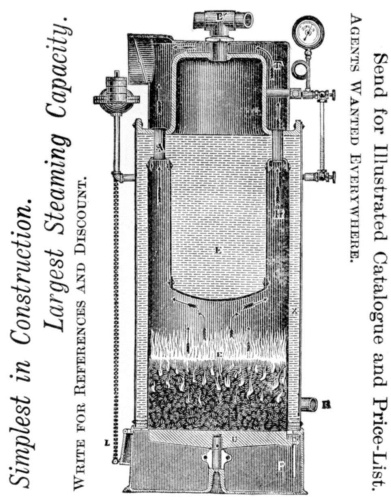
Simplest in Construction. Largest Steaming Capacity. Write for References and Discount.
Send for Illustrated Catalogue and Price‐List. Agents Wanted Everywhere.
THE NEW ERA RADIATOR
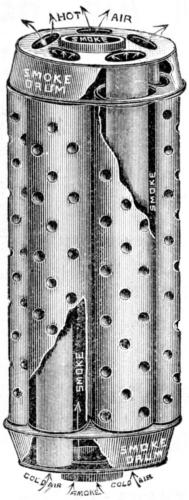
SEMI‐SECTIONAL VIEW.
Will utilize the heat that now escapes up your chimney.
It will save 500 to 1,000 lbs. of coal out of every ton.
Can be put on any stove pipe, either in the room with the stove, to increase the heat, or it will heat room adjoining or room above.
COSTS LITTLE. SAVES MUCH.
Send for Circular and Testimonials.
Wilmot Castle & Co., Rochester, N. Y.
GATES IMPROVED HOT WATER HEATER
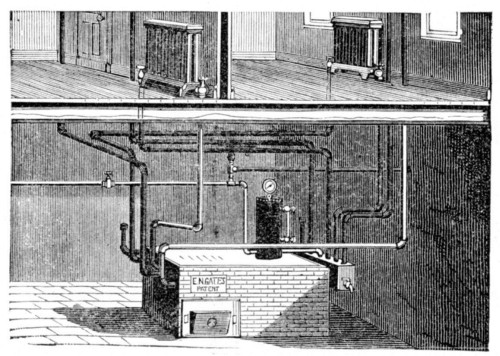
Office of FITCHBURG GAS CO.
Fitchburg, May 17, 1887. Mr. E. N. Gates. Dear Sir: Having now used your system of Hot Water Circulation in my house from December first to May fifth, it gives me pleasure to say that it has met the requirements of the extreme cold of the past winter and the mild weather of the spring months in the most perfect manner, giving out just the temperature for comfort in all the variations of temperature outside, and with great economy in fuel. Yours respectfully, H. F. COGGSHALL, Treasurer and Manager.
The following Special Advantages over other Methods of Heating:
1st.—Over Hot Air Furnaces.—No Dust! No Burnt Air! No Gas! and ability to send the heat where it is wanted, without regard to direction of wind or height of cellar, and using less fuel for amount of space heated.
2d.—Over Steam, High or Low Pressure.—From the fact the temperature of water in radiators can be between 70° and 212° or higher, thus adapting it to all degrees of outside temperature, thereby, taking the season through, it makes a great saving in fuel in this point alone, besides the comfort of having a building evenly heated.
3d.—Over Other Hot Water Systems.—In all others, the water goes to Radiators from one common reservoir. Therefore, being next to impossible to have all rooms heated alike. Different rooms will receive current of water at different rates of speed. With this system all rooms can be heated alike, when desired, from the fact that each current is provided with an independent boiler, and the hot water must go where the pipe leads, and you have perfect control over every room, and can be put in at less cost than any other system of hot water heating to do the same work.
For Illustrated Circular, References, and Full Particulars, address E. N. GATES, Box 1504, FITCHBURGH, MASS.
NEW YORK SAFETY DUMB WAITER FIXTURES Patented United States, April 19th, 1887; in Canada, May 18th, 1887.
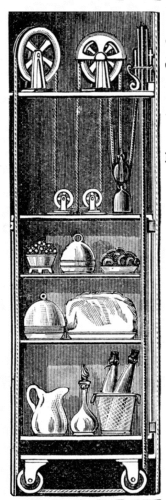
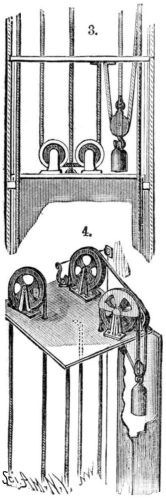
The MOST COMPLETE, SIMPLE and ABSOLUTELY SAFE WAITER made. Provided with SAFETY ROPE, AVOIDING ACCIDENT. ENTIRELY NOISELESS, and moves with perfect ease.
FIXTURES ONE SIZE ONLY, adapted to any size waiter. Can be adjusted by any CARPENTER or MECHANIC. DIAGRAM and FULL DIRECTIONS ACCOMPANY EACH SET.
HANDSOMELY BRONZED, and packed ONE SET in a BOX. Sold by the Hardware trade.
PRICE, 15.00.
For catalogue address the manufacturers.
THE EDWARD STORM SPRING CO., Limited, Poughkeepsie, N. Y. or, JOHN H. GRAHAM & CO., Sole Mfrs. Agents, 113 Chambers Street, New York.
N. W. AYER–SON. PHILA.
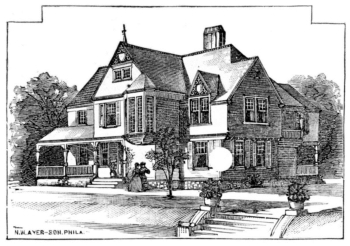
ARTISTIC HOMES, 1887.
The most practical work published. Contains 76 full page Illustrations of Queen Anne and Colonial Villas and Cottages, costing from $1500 upward. Price $4.50. Parties contemplating building cheap or expensive residences will find it to their advantage to correspond with us.
FULLER & WHEELER,
Architects, ALBANY, N. Y.
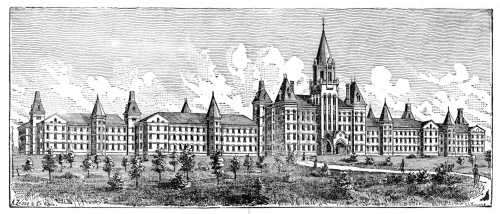
Our celebrated ALDERLY brand was selected by the Commissioners of the Western Tennessee Hospital for the Insane at Bolivar, Tennessee, for the Roof, Gutters and Valleys of the building, over all other leading brands of Terne Plates after a thorough test of all its qualities.
These buildings required over 1000 boxes of ALDERLY Brand Terne Plate, which is the largest contract ever made for one particular brand of Roofing Tin.
The ALDERLY Brand was selected purely on its merits.
GUMMEY, SPERING, INGRAM & CO., PHILADELPHIA—LIVERPOOL.
P. S.—The ALDERLY is the only perfectly square Terne plate in the market, being resheared before coating.
THE FEW ADVANTAGES OF THE COMBINATION SYSTEM AS DEMONSTRATED BY
THE PERFECTLY COMBINED STEAM AND WARM AIR HEATING APPARATUS.
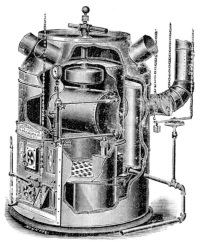
Portable: 3 sizes, 28, 32, and 36 inch.
1st.—Two results with but one fire.
2d.—All benefit derived from a Steam Heater is radiated in the Combination, while no sacrifice is made in wasting what you are compelled to burn before reaching Steam Radiation (212 degrees).
3d.—With steam, when fire is banked for the night, radiation ceases—in the Combination, never!
4th.—With steam, the consumption of fuel is the same at 60° as it is at zero. In the Combination, you burn only what the outside temperature demands.
5th.—The drafts are automatically arranged, requiring no further attention.
6th.—In zero weather all Hot Air Heaters are weak—in the Combination, steam supplies the power whenever wanted.
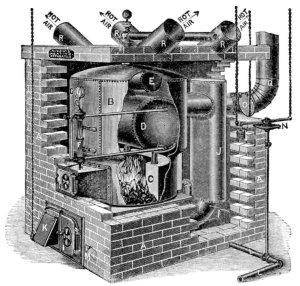
Brick set: 5 sizes, 28, 32, 36, 40, and 48 inch.
With these positive advantages, it is no difficult matter to decide which to purchase.
A home well heated is a necessity. This comfort can be secured by a little outlay.
THE PERFECTLY COMBINED
Steam and Warm Air Heating Apparatus IS MANUFACTURED BY THE WEIR & NIXON STEAM and WARM AIR HEATING CO. 1410 & 1412 North Sixth St., Philadelphia, Pa. CATALOGUES SENT TO PARTIES WISHING HEATING APPARATUS.
The OMEGA FIREPLACE FURNACE
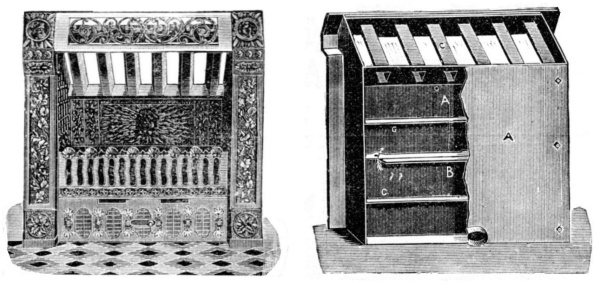
20 page illustrated catalogue, containing full information and prices, sent to any address.
A Double Heater and Perfect Ventilator. A Revolution in Fireplace Heating. Gives the combined heat of both a Furnace and Fireplace, with Perfect Ventilation. Equalizes the heat in every part of the room. Burns equally well Hard or Soft Coal, Wood or Coke. Address
OMEGA STOVE AND GRATE CO., 89 Euclid Ave., Cleveland, Ohio.
The Draper Recording Thermometer.
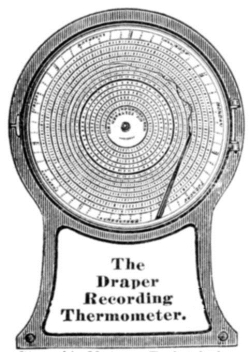
Size 14 × 20 in. Patented. Copyrighted.
This thermometer gives a permanent and continuous record in ink of the temperature. The chart indicating hours of the day and days of the week gives the degrees of temperature from 20° below zero to 110° above. All instruments are accurately adjusted and warranted. The record is easily read and absolutely correct. Sold by the leading instrument dealers and opticians throughout the United States and Canada, and by
The DRAPER MANUFACTURING CO.
Owners of the United States and foreign patents. 152 Front Street, New York
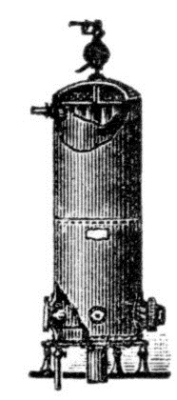
THE BARAGWANATH STEAM JACKET Feedwater Boiler and Purifier.
Boils the feedwater. Keeps the boiler clean. Saves boiler repairs. Saves from 15 to 40 per cent. of fuel. Large heating surface. No radiating surface. No back pressure. Thoroughly utilizes the exhaust. Strong and durable. Over 5,000 in use. Send for circular.
WM. BARAGWANATH & SON. 40 West Division Street, Chicago, Ill.
JAS. B. CROUTHERS, M. E., General Eastern Manager, 112 Liberty Street, New York.
DRAWING INSTRUMENTS, DRAWING PAPER, BLUE PROCESS PAPER, AMERICAN LIQUID INK.
A fully illustrated and priced catalogue of 200 pages of all instruments and materials used by draughtsmen sent upon mention of this paper.
G. S. WOOLMAN, 116 FULTON ST., NEW YORK.
“MERSHON” PATENT
SHAKING GRATE
For Steam and Hot Air Furnaces. The most reliable and Perfect Shaking Grate in the world. Send for catalogue. “Mershon” Patent Shaking Grate, Heater and Range Works,
1203 Filbert Street, Philadelphia, Pa.
HOW TO MAKE AN INCUBATOR.— Full directions, illustrated with 7 figures. Also directions for operating the apparatus. Contained in SCIENTIFIC AMERICAN SUPPLEMENT, No. 612. Price 10 cents. To be had at this office and from all news‐dealers.
MINERAL WOOL!
INDESTRUCTIBLE. FIRE‐PROOF. SOUND‐PROOF. FROST‐PROOF. VERMIN‐PROOF. ODORLESS.
For Deadening, Fire‐Proofing, Insulation of Heat and Cold in Buildings, Prevention of Frost in Water or Gas Pipes.
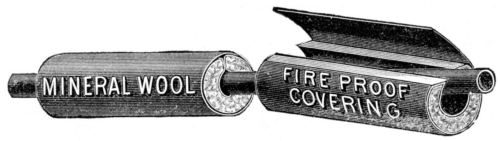
MINERAL WOOL FIRE PROOF COVERING (Patented May 29, 1883.)
Also Fire‐Proof Sectional Coverings for Steam Pipes and Boilers. Best non‐conductor for all surfaces, Steam or Fire Heat. Will not Char, Crack, or Burn. Easily applied and removed by any one, and is indorsed by Insurance Companies. For full information and sample free, address
Western Mineral Wool Co., Box 123. CLEVELAND, O.
EDWARD FORD, Prest. E. L. FORD, Secy.
A. PITCAIRN, Vice‐prest. JOHN F. SCOTT, Treas.
PITTSBURGH PLATE GLASS CO.,
CREIGHTON, PA.,
MANUFACTURERS
POLISHED PLATE GLASS.
Ground and Rough Plate Glass for Floors and Skylights.
Three‐sixteenths thickness, made expressly for fine residences.
LARGE AND WIDE GLASS A SPECIALTY.
The Largest Plates of Glass in the cities of Chicago, Cleveland, Detroit, St. Paul, Syracuse, Pittsburgh, Philadelphia, Baltimore, and in many New York buildings, were manufactured at our works.
IMMENSE PRODUCTION.
The combined production of our two factories is 260,000 square feet per month. The largest production of any factory in the world, which enables us to fill our orders promptly.
The high reputation and unprecedented large sale of glass made by this company since its organization is due entirely to its superior quality, NATURAL GAS alone being used throughout both works as fuel.
—CORRESPONDENCE SOLICITED.—
Works No. 1, Works No. 2,
CREIGHTON, PA. TARENTUM, PA.
WESTERN UNION WIRE AND TELEPHONE CONNECTION IN GENERAL OFFICE, CREIGHTON, PA.
REFRIGERATORS.
Estimates furnished (under new construction) for Hotels, Stores and Butchers’ Use ALSO A LINE
FOR RESIDENCES, BY FRANK W. LOCKWOOD, 240 South Second St., Philadelphia.

J. I. CASE T. M. Cᴼ. Saw Mills
Stationary & Portable Engines and Threshers.
Racine Wisconsin.
Send for Illustrated Catalogue
23 Awards of Merit for Superiority.
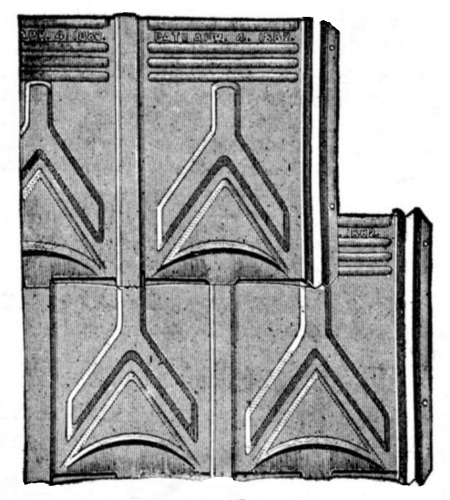
Walter Shingle.
The oldest, the best, the cheapest.

Locks of one piece. No cleats or springs. Simple and perfect. Made in four sizes, of Copper, Tin, Steel, or Galvanized Tin.
Full line of Roofing Sundries.
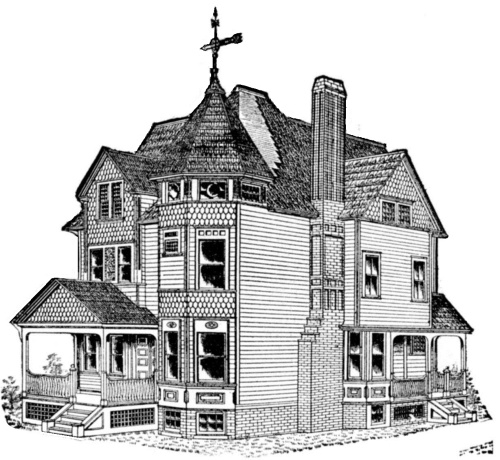
If you want an antique finish, get our Queen Anne Shingles.
Send for Catalogue and Price List, special to the trade.
Wholesale Agents:
W. W. Montague & Co., San Francisco, Cal., Pacific Coast.
Knisely & Miller, Chicago, Ill.
Geo. Tritch Hardware Co., Denver, Col.
Phillips & Buttorff Mfg. Co., Nashville, Tenn.
McDonald, Kemp & Co., Toronto, Sole Agts., Canada.
Jerome Twichell & Co., Kansas City, Mo.
The Nat’l Sheet Metal Roofing Co., 510 to 520 E. 20th St. N. Y.

ARTESIAN
Wells, Oil and Gas Wells, drilled by contract to any depth, from 50 to 3000 feet. We also manufacture and furnish everything required to drill and complete same. Portable Horse Power and Mounted Steam Drilling Machines for 100 to 600 ft. Send 6 cents for illustrated catalogue.
Pierce Well Excavator Co. New York.
USEFUL BOOKS.
Manufacturers, Agriculturists, Chemists, Engineers, Mechanics, Builders, men of leisure, and professional men, of all classes, need good books in the line of their respective callings. Our post office department permits the transmission of books through the mails at very small cost. A comprehensive catalogue of useful books by different authors, on more than fifty different subjects, has just been published for free circulation at the office of this paper. Subjects classified, with names of author. Persons desiring a copy have only to ask for it, and it will be mailed to them.
TITLE OF SUBJECTS:
AGRICULTURE. ANATOMY & PHYSIOLOGY. ANIMALS, DOMESTIC. ARCHITECTURE & BUILDING. ANALYSIS AND ASSAYING. ASTRONOMY. BIOLOGY, ZOOLOGY, ETC. BOTANY. BREWING AND DISTILLING. CABINET MAKING, CARVING, AND TURNING. CARPENTRY. CHEMISTRY. CIVIL ENGINEERING. COOKING. DICTIONARIES AND CYCLOPEDIAS. DRAWING, ETCHING, ENGRAVING, ETC. DYEING AND PRINTING. ELECTRICITY. FISHING, SHOOTING, ETC. GAS. GEOLOGY & MINERALOGY. HEAT. HORTICULTURE AND ARBORICULTURE. HOROLOGY. HYDRAULICS. LAW. LEATHER. MATHEMATICS AND SURVEYING. MACHINERY. MARINE ENGINEERING. MECHANICS. MEDICINE AND SURGERY. MENTAL SCIENCE. METALLURGY. MICROSCOPY. MILLS AND MILLING. MILITARY ENGINEERING TACTICS, ETC. MINING. MISCELLANEOUS. MOULDING AND FOUNDING. NATURAL HISTORY, ETC. NAVIGATION. PAINTING. PERFUMERY. PHOTOGRAPHY. PHYSICS. POLITICAL ECONOMY. POTTERY. SANITARY ENGINEERING. SCIENCE SERIES. STEAM ENGINEERING. STEEL AND IRON. STONE. TAXIDERMY. TEXTILE MANUFACTURES. TECHNOLOGY.
Address MUNN & CO., 361 Broadway, New York.

RUBBER BELTING, PACKING, HOSE, AND ALL OTHER KINDS OF RUBBER GOODS, ——FOR—— MECHANICAL and MANUFACTURING PURPOSES.
The Largest and Most Extensive Manufacturers in America.
THE GUTTA PERCHA AND RUBBER MFG. CO.
New York, Chicago, San Francisco, Toronto.
CONANT BOSTON
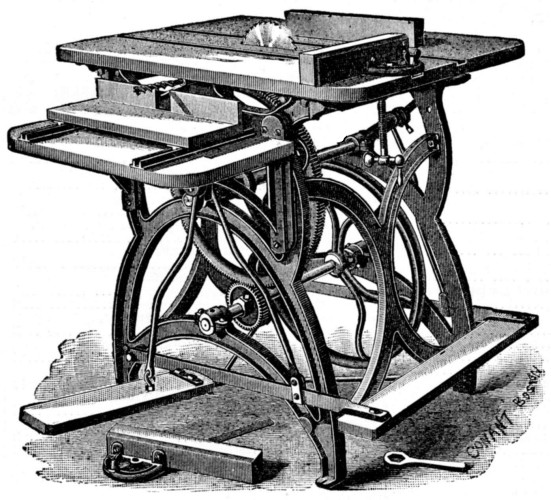
MARSTON’S
Hand & Foot Power
Circular Saw.
Iron frame 36 inches high. Top 80 × 40 inches, centre part of iron with planed grooves on each side of saw for cutting off gauges to slide in. Ripping gauge slides in iron groove. Steel shafts. Gears are all machine cut from solid iron. Boring table and side treadle. Two 6‐inch saws and two cranks with each machine. Weight 350 pounds.
Send for price list.
J. M. Marston & Co. Cor. Appleton & Tremont Sts., BOSTON, MASS.
Plans and Specifications.
Full plans, specifications, and sheets of details, complete, ready for the builder, may be obtained at this office, for any of the structures illustrated in this publication. We also prepare plans for buildings of every description, including churches, colleges, schools, stores, dwellings, carriage houses, barns, etc.
We are assisted in this work by able architects, and we try to make our estimates reliable, so that the work can be done by any reliable builder at the prices named. Terms moderate.
MUNN & CO., 361 Broadway New York.
Valuable Books for Architects, Builders, Etc.
Promptly sent, on receipt of the price, by MUNN & Co. No. 361 Broadway, New York City.
AMERICAN COTTAGES. Consisting of 44 large quarto plates. Containing Original Designs of Medium and Low‐cost Cottages, Seaside and Country Houses; also a Club House, School House, Pavilion, and a small Seaside Chapel, together with a Form of Specification for Cottages. One large quarto volume. $5.00
ARCHITECTS’ AND BUILDERS’ POCKET‐BOOK. Containing Original Tables and Valuable Information for Architects, Builders, Engineers, and Contractors. By E. F. Kidder. Fully illustrated with plates. Put up in pocket‐book form, morocco flaps $3.50
ARCHITECT’S HAND‐BOOK. A Hand‐Book of Formulæ, Tables, and Memoranda, for Architectural Surveyors and others engaged in Building. By J. T. Hurst, C.E. Thirteenth edition. Royal 32mo, roan $2.00
ARCHITECTURAL DETAILS. Containing 387 designs and 967 illustrations of the various Parts needed in the Construction of Buildings, Public and Private, both for the City and Country; also, Plans and Elevations of Houses, Stores, Cottages, and other Buildings. By M. F. Cummings, M.A., Architect, Associate Author of “Architecture, by Cummings & Miller.” One large 4to volume, 56 plates. Reduced from $10.00 to $6.00
ARCHITECTURAL STUDIES. PART I.—12 Designs for Low‐cost Houses. This set includes the Prize Designs for $2,500 Houses of “Building Competition No. 1.” These will show Elevations, Plans, and Details, together with Specifications, Bills of Materials, and Estimates of Cost. In addition to the above, there are given a number of other Designs, ranging in cost from $500 to $4,000 $1.00 PART II.—Store Fronts and Interior Details. Containing 12 plates of Designs and Details for the following classes of Stores: Drug Store, Restaurant, Village Shop, Retail 25‐ft. Store, Bank and Office Finish, Cigar Store, Corner Dry Goods Store, Store Front, Basement, and First Story, and others $1.00 PART III.—Stables. Containing 12 plates of Stables suitable for Village Lots, ranging in cost from $300 upward. This set of plates will contain a fine selection of Designs giving Exteriors, Plans, and some Details. Paper portfolio $1.00 PART IV.—Seaside and Southern Houses. 12 plates of Designs for Cheap Houses, with ample Verandas, suited to a summer climate. Average cost, $1,500 $1.00 PART V.—Outbuildings. Containing 12 plates of Designs of small Stables, Summer Houses, Pavilions, Privies, Fences, Gates, etc. $1.00 PART VI.—Perspectives, Elevations, and Plans, with Specifications, Bills of Materials, etc., of Houses costing from $500 to $2,500 $1.00 PART VII.—Designs for Door and Window Finish, Wainscoting, Mantels, Closets, etc. $1.00
ARCHITECTURE. Encyclopedia of Gwilt’s, Historical, Theoretical, and Practical. New edition, revised, with Alterations and considerable Additions. By Wyatt Papworth, F.R.I.B.A. Nearly 1,600 wood engravings (about 500 being new to the work). Thick 8vo, cloth $20.00
BRICKS, TILES, AND TERRA COTTA. A Treatise on the Manufacture and Materials, Tools, Machines, and Kilns used. By Charles T. Davis. 800 pages, 228 engravings, and 6 plates $5.00
BUILDING SUPERINTENDENCE. By Professor Theodore M. Clark. One vol. Profusely illustrated with Plans, Diagrams, etc. $3.00
BUILDING CONSTRUCTION. A Complete Manual of the Details of Construction, illustrated with a large number of engravings. PART I. Contents: Walling and Arches; Brickwork; Masonry; Carpentry; Floors; Partitions; Timber Roofs; Iron Roofs; Slating; Plumbers’ Work; Cast Iron Girders, etc.; Joinery. PART II. Contents: Brickwork and Masonry; Timber Roofs; Roof Coverings; Built‐up Beams; Curved Ribs; Timber and Iron Girders; Centers; Joinery; Stairs; Riveting; Fire‐Proof Floors; Iron Roofs; Plasterers’ Work; Painting, Paper‐Hanging and Glazing. Price of each $3.50 PART III. Materials: 1. Stone; 2. Bricks, Tiles, Terra Cotta, etc.; 3. Limes, Cements, Mortar, Concrete, Plaster, and Asphalts; 4. Metals; 5. Timber; 6. Paints and Varnishes; 7. Glass; 8. Paper‐Hanging; 9. Miscellaneous. Post‐paid $6.00
CARPENTRY MADE EASY; Or, The Science and Art of Framing on a New and Improved System. With Specific Instructions for Building Balloon Frames, Barn Frames, Mill Frames, Warehouses, Church Spires, etc. Comprising also a System of Bridge Building, with Bills, Estimates of Cost, and valuable Tables. Illustrated by 44 plates, comprising nearly 200 figures. By William L. Bell, Architect and Practical Builder. 8vo $5.00
CHURCH ARCHITECTURE, WITHERS’. One large volume of fifty‐one 9 × 14 plates, substantially bound in extra cloth, sent by mail or express to any part of the United States upon receipt of price, reduced from $15.00 to $10.00
CONCRETE. A Practical Treatise on Natural and Artificial Concrete, its Varieties and Constructive Adaptations. By Henry Reid, C.E., author of “The Science and Art of the Manufacture of Portland Cement.” Third edition, 8vo, cloth $6.00
COTTAGES; Or, Hints on Economical Building. Containing 24 plates of Medium and Low‐cost Houses, contributed by different New York Architects; together with descriptive letterpress, giving Practical Suggestions for Cottage Building. Compiled and edited by A. W. Brunner, Architect. And a chapter on the Water Supply, Drainage, Sewerage, Heating, and Ventilation, and other Sanitary Questions relating to Country Houses. By Wm. Paul Gerhard. One 8vo volume, cloth $1.00
COTTAGE, THE SUBURBAN. Its Design and Construction. Containing over 100 illustrations and full descriptive letterpress. This book gives Practical Instruction on every question arising in House Building, and should be in the hands of every one intending to build. One 8vo vol., cloth $1.50
DECORATION, INTERIOR. By A. W. Brunner and Thomas Tryon, Architects, with 65 illustrations, giving suggestions about Hall, Staircase, Library, Parlor, Dining‐Room, etc. Study, Bed‐Rooms. Fifteen plates. Just published $3.00
MANTELS, ALBUM OF. One large quarto volume, bound in cloth $4.00 Unbound in portfolio 4.00
This book contains 60 plates and 103 designs of mantels and shelves.
MASONRY AND STONECUTTING, In which the Principles of Masonic Projection and their Application to the Construction of Curved Wing‐Walls, Domes, Oblique Bridges, and Roman and Gothic Vaulting, are explained. By Edward Dobson, M.R.I.B.A., etc. $1.50
HOUSE PAINTER. Modern House Painting, containing 20 colored lithographic plates, exhibiting the Use of Color in Exterior and Interior House Painting, and embracing examples of simple and elaborate in Plain, Graded, and Parti‐colors; also the Treatment of old style of Houses, together with full descriptive letter‐press, covering the Preparation, Use, and Application of Colors, with Special Directions applicable to each example; the whole Work offering Valuable Hints and Suggestions on Harmonious Color Treatment, suitable to every variety of Building. By E. K. Rossiter and F. A. Wright. Oblong, 4to, cloth $5.00
LEFFEL’S HOUSE PLANS. Containing Elevations, Plans, and Descriptions of Houses costing from $500 to $3,000, and adapted to families having good taste and moderate means. Including the six prize plans in the Mechanical News competition. One oblong quarto $2.00
Band Saws. Band Saws.
DAMASCUS TEMPERED BY NATURAL GAS HEAT, SUPERIOR TOUGHNESS.
After more than ten years’ experience in the manufacture of Band Saws, we have discovered a new process of Tempering and Straightening all at one operation. This process insures absolute perfection. We specially request all users of Band Saws to send us their address in full, and also a description of the sizes of saws used, and we will, by return mail, quote them special prices, and also send them our pamphlet on the Band Saw, which contains much valuable information for all users of Band Saws.
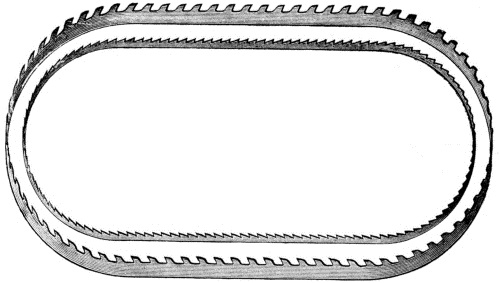
The Superior Quality of our Band Saws, All Tempered, Straightened, and Trued at one operation, which we have patented, makes them so perfect that our SALES HAVE MORE THAN TREBLED IN THE PAST YEAR. Our largest and best customers prefer them to the best imported saws.
☞WRITE FOR OUR CIRCULAR AND REDUCED PRICE LISTS.☜
NATURAL GAS
Is perfectly free from all impurities, and steel heated by its use does not scale. It contains no sulphur or other base substances. We are the first to adopt its use in heating saws for tempering, which explains the cause of our saws being tougher than any others now made.
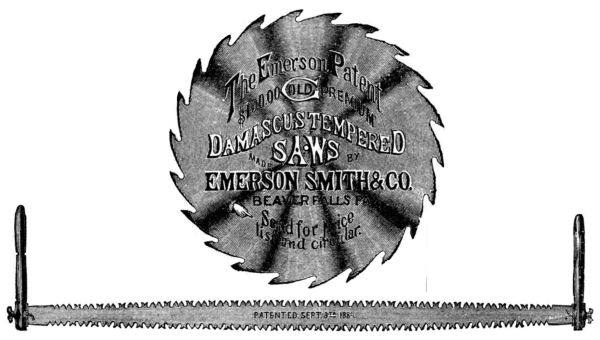
The Emerson Patent $100.00 GOLD PREMIUM DAMASCUS TEMPERED SAWS MADE BY EMERSON SMITH & CO. BEAVER FALLS PA Send for price list and circular
PATENTED SEPT. 9ᵀᴴ 1884.
OUR CIRCULAR SAW
Of all sizes from 6 inches in diameter to 6 feet, both Solid and Inserted Teeth, also our
Double Toothed Cross Cuts (two saws in one), for all uses HAVE NO EQUAL.
Our SAWYER’S HANDBOOK will be sent FREE to any part of the world on receipt of full name and address.
Address EMERSON, SMITH & CO. (LIMITED). Beaver Falls, Pa.