"Saved from the Sea" (continued 5)
Reading edition
I cannot recount one tenth part of the adventures we met with during that long march northward across the Sahara. Occasionally the monotony of our life was diversified by hunting ostriches and several kinds of deer. The former were run down by horsemen, who formed a large circle, compelling the birds to turn round and round till their strength was exhausted.
Water became scarcer as we advanced into the Desert. The camels and other animals had drunk their fill at some pools in a valley, the water-skins had been filled, and we had now an immense extent of arid sand to traverse before we could reach another well. There was no means of avoiding this region, which even the bravest looked on with dread. We commenced our march before the sun was up, stopping only for a hasty prayer, and then pushing on again. Instead of spreading over the plain, as usual, the camels and other animals were kept close together, forming a broad, dense line. A few hours of rest were to be allowed at night; we were then again to advance; and so we were to proceed till the oasis could be reached, as the destruction of the whole caravan might be the result of delay. Almost in silence we moved over the glittering plain. The fiery sun struck down on our heads, and the heat was such that the air seemed to dance around us. Hour after hour we moved on, a few words being now and then exchanged, or songs sung by the light-hearted, or tales told by the most loquacious of story-tellers. I observed skeletons of camels and men sticking out of the sand, as the caravan deviated slightly to avoid them; for they extended across the plain half a mile or more. On making inquiries, I found that the skeletons were those of a caravan which, while crossing the Desert on their way south, had been overtaken by a simoom, and had perished, when only half a day’s journey from the pools we had left. The sight certainly did not tend to raise our spirits; we had nearly three days’ journey before us, and in the course of that time we might be exposed to the same danger.
We encamped for a little at night, but having no fuel, were compelled to eat our provisions cold.
During the next day the heat was more intense than ever, and our thirst increased in proportion. Soon after mid-day, a bright lake of shining water, as it seemed, appeared before us, with animals feeding on its banks; the walls of a city, with its domes, and spires, and tall palm-trees, behind. How delightful was the spectacle! Eager to reach it, I could not help urging on my camel; many others did the same, but our leaders proceeded as deliberately as before, regarding the spectacle with no concern; when, as we advanced, it suddenly vanished, and I found that we had been deceived by a mirage, so common in the Desert.
The atmosphere had hitherto been calm, not a cloud dimmed the bright blue sky; but before long the wind, hot as from a furnace, swept by us, the sun struck down on our heads with irresistible force, while the azure of the sky changed to a lurid tint. I saw the Arabs looking anxiously at each other. Stronger and stronger came the wind, blowing the sand like spray from off the ground. Turning my head, I observed a dark cloud advancing towards us, sweeping over the ground. On it came, rising upwards, and completely obscuring the heavens. In vain would we have attempted to escape from it; almost immediately we were enveloped in a vast mass of sand, through which even the sun’s rays, with all their power, could not penetrate. Darker and darker it grew, till we could scarcely distinguish those who rode on either side of us; while sand filled eyes, ears, and mouth, and covered our hair, even penetrating through our clothes. The Arabs shouted to each other to keep together, and dashed forward; but thicker and thicker came the storm. My tongue felt as if turned to leather, a burning thirst attacked me, and it was with difficulty I could speak; while others were suffering even more severely than I was.
The sheikh had called a halt; and those in the rear came crowding up, almost riding over the front ranks before they were aware that they had reached them. Men and animals stood huddled together in a vast mass. To lie down would have been death; had any attempted to do so, they would either have been trampled under foot or have been buried beneath the sand. The fierce wind rendered it useless to pitch the tents, seeing they would have been blown down as soon as erected, or carried away before the blast. Occasionally those nearest each other would ask whether the storm was at the worst; but no one dared reply.
The clouds of sand became thicker and thicker; we seemed to have death alone to expect. Complete silence prevailed; the horses hung their tongues out of their mouths, the camels drooped their heads, while the sheep and goats struggled to free themselves from the sand collecting around them.
Thus hour after hour went by, and many of the Arabs, though accustomed to such storms, gave themselves up for lost. But suddenly the wind changed, and seemed to drive back the clouds which surrounded us; objects hitherto obscured came into view; and once more the voices of the leaders could be heard. The order to advance was given, and again we dashed forward, though so exhausted with thirst that we could scarcely keep our seats, while those on foot with difficulty dragged on their weary limbs.
At nightfall we encamped, and small measures of water, or of such milk as the camels and goats could yield, were served out to the people; but the portion we obtained was scarcely sufficient to cool our parched tongues. Our very skin felt like leather, and was cracked and scorched all over. A short time only could be given for rest, however; another blast might sweep up clouds of sand and overwhelm us; another fatiguing march during a day and night over the Desert had to be passed. Besides, every drop of water was expended; and though the camels might go on with comparative ease, we must all of us expect to suffer dreadfully,—but more especially the women and children.
Again we advanced; but another day might witness the destruction of many who had hitherto held out bravely. We went on as fast as the camels could move their limbs. The expectation that water would be found ahead incited us to exertion, I suppose, otherwise many would have sunk down and resigned themselves to their fate. At length the faint outline of palm-trees was seen in the far distance. Shouts of joy were uttered by those in advance, and taken up by the multitude in the rear. Soon the palm-trees became more and more distinct; and even the animals seemed to know that relief would soon be obtained.
In a short time the whole caravan was collected round a large well, from which eager hands were employed in drawing water. Some time passed, however, before we could obtain a draught, as even the animals were considered more worthy to enjoy the water than we Nazarenes were.
We here encamped, that both human beings and animals might recruit their strength. It was curious to remark the contrast between the flocks which came up to receive water at the well and those which had already slaked their thirst; the latter bounded and leaped about, showing how quickly the refreshing liquid had restored their strength.
I have elsewhere described the appearance of our camp, and the mode of proceeding never varied. Before we started in the morning, the male part of the population were called out to prayer; the herdsmen then departed in all directions to tend the camels, horses, sheep, and goats while grazing. As the day advanced, the extreme heat, and the absence of most of the men, deprived the camp of all its bustle: a few women were alone to be seen, occupied in grinding between two stones the barley which was to serve for the evening repast; others were employed at their looms, weaving camel-hair cloth, within the shade of the tents.
In the evening the whole scene became one of the greatest animation. Various travellers were arriving, and seeking the hospitality of the sheikh and his people: some came in troops, lightly mounted; others with camels loaded with articles to dispose of in the Desert. The sheikh sat on his carpet in front of his tent, calmly smoking his long hookah, and habited in a white haique of extreme fineness, which hung over another garment of sky-blue, ornamented on each side of the breast with silk embroidery of various colours. On his feet were red morocco boots, tastefully figured; while, instead of a turban, he wore round his head—which was entirely shaved—a band of blue silk, a sign of his rank. Each Arab as he arrived made his camel kneel before the tent, and then, holding his musket in one hand, he touched the sheikh’s head with the other in token of respect. The sheikh congratulated each one on his arrival, and returned the numerous salutations, without even inquiring from whence the traveller came, or whither he was going.
Before dark, all were assembled for evening prayer; after which the travellers formed themselves into groups, partaking out of one common bowl the couscoussu prepared for them by their hosts. As night approached the camels and flocks came trotting in; and by a peculiar instinct each herd arranged itself before the tent to which it belonged, the women hurrying out to milk the she-camels and goats. The hubbub which ensued, caused by the numerous animals assembled, may be imagined. A perfect calm then succeeded the bustle: the inhabitants retired to their tents—the travellers, enveloped in their cloaks, lying down with their camels by the side of the waning fires; the cattle, closely packed together, remained immovable till morning,—and, notwithstanding the number collected, not a sound was heard during the night.
The routine of every ordinary day, when we were not travelling, was similar to that I have described.
Our position in the camp had not improved of late. By some means or other I had offended my hasty mistress and her young daughters, and this prejudicing the mind of the sheikh against me, I was ordered to perform the same sort of service as that to which Halliday and Ben had been condemned; while we were told that from henceforth we must march, like the other slaves, on foot. This encouraged a marabout, who hitherto had not interfered with us, to insist that we should turn Mohammedans; and every day we were summoned to hear him abuse the Christians, and to listen to his arguments in favour of the faith of the Prophet. Boxall, too, had not been so successful in his cures as at first. One of his patients, suffering from some internal disease, and who had broken his arm by a fall from a camel, died, and Boxall was accused of killing him—though he protested his innocence, and even the sheikh said that the man might have died from other causes. But from that day the people lost faith in him; and he was finally reduced from his post as surgeon-general of the tribe to serve with us as a camel-driver.
Though the life he had now to bear, however, was one of daily toil, he accepted his position without complaining. “I confess, my dear Charlie,” he said to me soon afterwards, “that I often felt ashamed of myself, while I was enjoying the favour of the sheikh and the abundant food he provided for me,—simply because I happened to know a little about medicine and surgery,—to see you and Halliday ill-treated and badly fed, and to be unable to help you. However, now that we are together, perhaps we may be better able to manage some means of escape. I have been endeavouring to calculate our present position, and I believe that we are not more than four hundred miles south of the borders of Morocco or Algiers. Should we reach Morocco, we might not be much better off in some respects than we are at present, as the Moors are even more fanatical than these wandering Arabs; but we might find the means of communicating with one of the English consuls on the coast, and probably obtain our release: whereas, if we could get into the neighbourhood of the frontier of Algiers, we might, on escaping, place ourselves under the protection of the French. To reach one of their outposts would, of course, be a difficulty; for, even supposing that we could escape from the camp, a journey by ourselves of three or four hundred miles across the Desert would be dangerous in the extreme, with the probability of being pursued by the Arabs. Notwithstanding this, I am inclined to the latter plan, provided my calculations of our position should prove correct.”
“So am I,” I answered. “As for the dangers we may have to encounter, I am perfectly ready to face them; so I am sure will Halliday, Ben, and Selim—for we must not on any account leave the black lad behind.”
The plans for escape formed the subject of our conversation whenever we met. We were all of one mind about it, and we resolved not to desert each other, but to remain or escape together.
Seeing I could converse with the Arabs with greater ease than the others, Boxall charged me to try and ascertain exactly whereabout we were, adding—“But be cautious about exhibiting any special interest in the matter.”
Whenever strangers came into the camp, therefore, I got into conversation with them, and tried to learn whence they had come, and how long they had been on their journey, hoping to find some one who had visited either the Atlantic or Mediterranean shores of the continent; but no one I had met with had performed less than a journey of thirty days in coming from the city of Morocco, or forty or more from Fez—which of course placed us still a long way to the south of Algiers. We had therefore to wait patiently till the sheikh should move his camp further northward. We heard, however, of several large cities in different parts of the Desert: Timbuctoo, a long way to the south; Tintellust and Agadly, to the east; Tafleet and the beautiful oasis of Draha, to the north-west of us,—to all of which places travellers were proceeding.
Ben was at this time in a better position than we were. Being a handy fellow, and understanding something of smith-work, he had mended the locks of some of the Arabs’ firearms; and the whole of his time, when not occupied in tending his camel, was employed in repairing the damaged weapons of our masters. He held his position, however, among those capricious people, by a very uncertain tenure. The marabouts fancied, from his easy, good-natured manner, that they could without difficulty induce him to turn Mohammedan, and set to work with him, as they had done with us, to show the excellence of their religion.
“Look you here, my friends,” answered Ben, after listening with perfect gravity for some time, when one evening he and I, with the rest of our party, were seated on the ground at our supper, and two of these so-called holy men came up to us. “If it’s a good thing for a man to have a dozen—or even fifty—wives, to cut throats, to steal, and commit all sorts of rogueries, then your religion may be a good one; but if not, why, do ye see—begging your pardons, no offence being intended—to my mind it was invented by the devil, and your Prophet, as you call him, was as big a rogue as ever lived.—Just tell them, Mr Blore, what I say; for I never can make these marabout chaps understand my lingo.”
Knowing that Ben’s remarks would not be favourably received, I confess that I did not translate them literally, but replied: “My brother listens with all respect to the wisdom which has proceeded from your mouths. We all acknowledge Allah, and look to him for everything we possess; but we have been taught to put faith in another Prophet, whom we believe to be greater than any human being, and therefore we cannot deny Him by acknowledging any other.”
“Mohammed was superior to all other prophets!” exclaimed the marabouts. “Those who do not believe this are worthy of death and eternal damnation.”
“It is just on that point we differ, my friends,” I answered with perfect calmness. “You believe one thing, we believe another. In the end we shall know which is right. In the meantime, why should we wrangle and dispute? or why should you grow angry with us because we do not agree with you?”
“The more we love you, the more anxious we are for your conversion,” answered the marabouts.
“You take a curious way of showing it,” I could not help observing, causing thereby something like a smile on the grave countenances of the priests—who did not, however, again attempt a theological discussion with us. Ben managed to make his opinions known, though, and received very severe treatment in consequence. The sheikh no longer continued to protect him any more than he did us; and when the tribe moved forward, he was compelled to trudge on foot, separated from his camel—which on such occasions was bestrode by his master.
Many a weary day’s march we had to make. Sometimes, however, we remained for several weeks together at an oasis, where wells would be found, and herbage for the beasts, with groves of date-trees. Here we had time to regain our strength; and our masters being generally in better humour, we were in consequence less harshly dealt with.
Still, our existence was daily becoming more and more unendurable, and only the hope of ultimately escaping kept up our spirits, and prevented us sinking altogether into despair. Had we consented to abandon our religion, our homes, and civilisation, we might have been raised to a high position among these barbarians; and I believe that Boxall and I might have become sheikhs ourselves. The beautiful Coria, the youngest of the sheikh’s daughters, showed me at first many marks of her esteem; but my refusal to embrace their religion, even for her sake, changed her love into hatred, and she became my most bitter persecutor.
At length we heard that we were approaching a town, which we hoped might prove to be at no great distance from the borders of Algiers. Our knowledge of the interior of Africa, however, was very imperfect; or, I may say, we knew nothing at all about it—our only recollection of the Desert being a vast blank space, with a few spots upon it marked “oases,” with Lake Tchad and Timbuctoo on its southern border, and a very indefinite line marked Algiers and Morocco. The place we were approaching was, we heard, the permanent abode of the sheikh; and the country, though arid according to European notions, was more fertile than any we had yet seen—palms and other trees being scattered about, with ranges of hills in the distance.
The Arabs manifested their joy by singing and uttering shouts of delight, praising the country to us as if it were a perfect paradise. Here and there were fields of barley, with some low tents in their midst; and a grove of date-trees circling a well, near which was an open space. The sheikh advanced into the centre, and the camels immediately halting, they were unloaded, and all hands set to work to erect the tents. The tribe had reached their home, after their long pilgrimage.
There seemed, however, no prospect of our lot being improved. We had not been long settled when a cavalcade arrived, the persons composing which differed greatly in appearance from those among whom we had so long lived. Their leader was a handsomely dressed, fine-looking Arab. He wore a haique, over which was a cloak of blue cloth, with a well-arranged turban on his head. The costume of his followers was nearly as becoming; their horses were large and well-caparisoned, their saddles being covered with scarlet cloth, to which hung enormous silver stirrups; while they were profusely covered with ornaments of the same material. Each horseman was armed with a poignard and sabre, and pistols in his sash; while he carried before him—the but resting on the saddle—a fine silver-mounted Moorish gun.
The same ceremonies as I have before described were gone through; an entertainment also being prepared for the new-comers.
After some time we were summoned to attend the sheikh, when we found that he was offering to sell us to his visitors. The price to be paid we could not ascertain, nor the object of our proposed purchasers; our only consolation was that we were to be sold together, and should not thus be separated.
What other object the visitors had in coming to the camp we could not learn. I had my suspicions, however, when I heard the young sheikh—whose name was Siddy Ischem—invite our master to accompany him.
“No! Allah be praised, I have never been accustomed to towns and their ways; and within stone and brick walls I hope not to enter, unless I go at the head of my people, sword in hand, to plunder and destroy the cursed infidels,—when, with the blessing of Mohammed, I will get out again as soon as the work is accomplished.”
“Each man to his taste,” answered Siddy Ischem. “A city affords its pleasures as well as the Desert.”
The greater part of the next morning was spent at the camp. We were then ordered to be ready to march. Siddy Boo Cassem, owner of the famous Bu Saef camel, with several of his tribe, accompanied our party. No camels or horses were allowed us, however, and having to march on foot, a dreary, fatiguing journey we found it. Some of our masters rode on either side of us, to prevent the possibility of our running away; though where we could have run to it was hard to say. We travelled on all day, the night overtaking us while we were still on the road. In about an hour, however, the moon rose, and enabled us better to see the path.
Not long afterwards, we caught sight of a lofty tower rising out of the plain, and the dark frowning walls of a fortified town; and from the remarks of the Arabs we learned that this was our destination. We soon came under the walls, when the leaders of our band began to defile through a narrow archway. My heart sank within me, for I felt that the difficulties of escape would be increased. I expressed my feelings to Boxall; but he rejoined,—“Such walls as these can be easily scaled; and if we once get on the outside, we are not so likely to be observed and followed as from an open camp. Cheer up, Charlie; ‘it’s a long lane that has no turning.’”
Even he, however, felt somewhat dispirited when we were conducted to a long, low building, into which we were thrust, and the door closed upon us. All we could discover in the gloom was that the walls were of bare stone, with rings and chains secured to them, and that the floor was excessively dirty. We were so tired from our journey that we longed to lie down; but we were unable to do so until we could scrape from the floor the offal which thickly covered it.
“I hope they are not going to send us supperless to bed,” exclaimed Ben. “Can’t you sing out that we are in want of food, Mr Blore, and that we shall be much obliged to them if they will send us something to drink at the same time?”
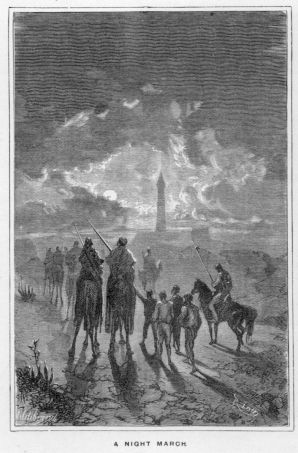
There was a single, strongly-barred window in the room, looking into the street. I went to it, and cried at the top of my voice, “Oh, pity! oh, pity! oh, pity! Will any one have compassion on us, and bring us some food to supply our wants?”
My appeal was not in vain, for before long the door opened and a veiled female appeared, bringing a basket with the universal couscoussu, some dates, and a bottle of water. Without uttering a word she placed the basket on the ground, and retired as silently as she had entered; not even allowing us time to thank her for her kindness. All we could do was to bless her after she had gone, and wonder who she could be; and then we set to with hearty appetites to devour the viands she had brought us. Finding some pieces of wood, we next scraped a spot in the corner of our prison clear of dirt; and then throwing ourselves on the ground, forgot our cares in sleep.
Chapter Fifteen.
Ben displays his ability as a gunsmith—I act the part of eavesdropper—How Siddy Boo Cassem obtained Bu Saef—Selim goes on a dangerous expedition—Its result—Boxall doctors Siddy Boo Cassem—We take French leave of our masters.
Scarcely had daylight appeared when the door opened, and a number of inquisitive faces—belonging to people of all descriptions who had come to see us—appeared at the entrance. Some gazed in silence, but many amused themselves by abusing us, and bestowing on us all sorts of uncomplimentary names. We endured the abuse for some time without replying; but at last I got up and said—
“What is it that excites your curiosity, O followers of the prophet Mohammed? Are we not formed like yourselves? In what do we differ, except that your skins are dark and ours light; that you are at home, and we come from a far-distant land; that you speak one language, and we speak another—although Allah has given us the power of acquiring yours? We have no wish to insult you, and why should you take a pleasure in insulting us?”
The people were greatly astonished at hearing me address them in their own language. What I had said had also considerable effect, for they instantly ceased abusing us; and several of them began to ask questions about our country, and the business which had brought us to Africa.
Affairs were taking a more favourable turn, when one of those abominable marabouts came in and reminded the people that we were Nazarenes, and haters of the Prophet, and endeavoured thus to incite their fanatical zeal against us. What would have been the result I do not know, had not Siddy Ischem made his appearance. As we had become his property, he had no wish to see us injured; so he quickly drove the people away, and ordered us to accompany him to the house where he was staying.
We soon reached a one-storied building, having a gateway, through which we passed into a courtyard, round which ran a colonnade. Part of the courtyard was covered with an awning, under which, on a carpet, sat a richly dressed Arab, by whose side Siddy Ischem took his seat, and then calling us up, desired us to narrate our adventures. I did so, explaining that three of us were officers who had been wrecked on the coast; that I felt sure a handsome price would be paid for our ransom; whereas, if we were kept in slavery, though we might labour ever so hard we could be of little profit to our masters.
I do not know whether the sheikh was moved by what I said, but he told a slave standing by to bring us some food, and desired us to sit down in the shade and eat it. He then ordered us to go to the stables and groom the horses, saying at the same time that we must be prepared to continue our journey the next day.
We found that the town in which we were, was one of those built by the Romans when their colonies spread over the northern shores of Africa. The town had long fallen into decay, the sands of the Desert having gradually encroached on it till the greater portion of the land fit for cultivation had been overwhelmed. The only habitable houses were one story in height, composed of sunburned bricks, and with flat roofs, on which the occupants seemed to spend most of their time.
I forgot to say that we discovered our abode, which we at first took for a prison, to be merely a stable, and that the rings and chains were simply intended to secure refractory horses.
We performed the duties assigned us as well as we could; and Ben’s talent as a gunsmith being noised abroad, he was called on to repair all the damaged firearms in the place—we assisting him as well as we could—at a smith’s shop to which we were conducted.
“What wonderful people are these Nazarenes!” observed some of the bystanders. “They know everything.”
“Yes,” remarked others; “the Jins teach them. It is their turn now; but they will burn throughout eternity. Curses rest on them! Allah is great; we have paradise for our portion.”
Similar remarks were made during the time we were at work; while some of the spectators, to show their contempt, spat at us; and several came up threatening us with their fists, to prove their zeal for their religion. But we had been too long accustomed to this sort of treatment to take any notice of it; and even Ben went on with his work, filing, hammering, and screwing away,—only remarking, when he understood what was said, “That’s all you know about it.”
Those who had their weapons mended went away contented; but as we could not repair half the number brought to us, the owners of the rest were very indignant, and we were glad to get back to our dirty stable out of their way.
During the evening, Siddy Boo Cassem, Ben’s master, made his appearance, and informed him that he was to remain in his service, to attend to his Bu Saef camel when he himself was not riding the animal.
“Not a few clever rogues have attempted to run off with the creature, which is to me as the apple of my eye; but I know that you Nazarenes would not know where to run to, so I can trust you,” he observed.
I told Ben what Siddy Boo Cassem had said.
“Let him give me the chance, and I will see what I can do,” he answered.
We were allowed another night’s rest, with a sufficiency of food,—for just then provisions were plentiful in the place, or we should have been left by our masters to pick up what we could. We tried in vain to discover who the charitable female was who had brought us provisions on the previous evening. It confirmed my belief, however, that Woman is the same all the world over; and that in every place some are to be found who, according to the light within them, endeavour to do their duty in the sight of God, by affording sympathy and help to their fellow-creatures in distress.
Again we were on the road,—Ben being summoned to attend to his master, while we trudged wearily on foot. Having neither cattle, sheep, nor goats to impede us, our progress was more rapid than it had been across the Desert. The baggage was carried on camels and asses; while the more wealthy people rode, and the rest had to walk.
For several days we advanced, passing numerous ruins, which showed how thickly the country at one time had been populated. At last one afternoon we encamped on high ground, outside an ancient town or fortress, amid which palms and other trees had grown up, attesting its antiquity. The tents were pitched, and Boxall, Halliday, and I were sent out with the horses and camels to graze on the pastures surrounding the hill. Returning in the evening, we met Ben with his camel—beside which it was his duty to sleep close to his master’s tent. Ours was not far off.
“I have a notion, Mr Blore,” said Ben, “that if you could take my place for the evening, you would find out more of what these fellows are about than I can. Half-a-dozen or more are sure to be seated in front of the tent for a couple of hours or so after dark, talking away, and smoking their pipes; but for the life of me, though I listen, I cannot make out what they say. They will not know the difference between you and I, however, and the camel will be as quiet with you as he is with me.”
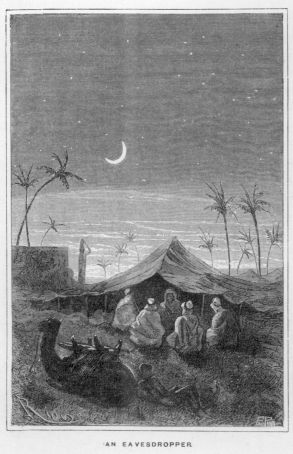
I was very willing to take advantage of Ben’s suggestion; so giving my horses into his keeping, I took his camel and led it up in front of Siddy Boo Cassem’s tent, where, making it lie down, I threw myself on the ground near it. Its owner and several friends were seated, as Ben expected,—the hoods of their burnouses, drawn over their heads, making them look more like a party of old crones than stalwart Arabs habituated to war and the chase; or I might have taken them for the witches in “Macbeth” discussing their malevolent designs. On one side were the ruined walls of the Roman town, with a tall monument rising above them; in front were the tents, spread beneath a few sparsely scattered palm-trees; while beyond could be seen the boundless Desert, the crescent moon casting a pale light over the scene.
As Siddy Boo Cassem knew that Ben could not understand him, even had he been, as he supposed, near at hand, he and his friends spoke in loud tones; every now and then indulging in a chuckling laugh at each other’s wit, or at the recollection of some scene in which they had been engaged. I listened attentively, endeavouring to catch all they said. Much of their conversation was not very edifying, but I became all attention when Siddy Boo Cassem began to talk of his famous camel, and to boast of his deads.
“Curses on the mother who bore them!” he exclaimed. “The rogues would like to have him again, if they knew how near he was to them; but I will take good care that none of their tribe scour again over the plain on his back. He is not likely to remember his old haunts, or the masters who owned him, or I should not have brought him so near them again.”
“How did you obtain him, O friend of the Prophet?” asked one of the party.
“As wise men obtain what they desire and cannot otherwise get,” answered Siddy Boo Cassem. “I stole him. I heard the report of his swiftness, and determined to become his master. At that time I possessed two fine black slaves, nimble of foot, and cunning in all their ways. Mounted on a fleet steed, of black hue, in case I should have to beat a retreat, and accompanied by my two slaves, I approached the camp an hour after midnight. One of the slaves had also visited the camp some days before, that he might ascertain where the Bu Saef was wont to be tethered; and I had promised him his liberty should we succeed. I remained behind a ruined wall, through which I had a view of the camp. Anxiously I watched, till in less than an hour I distinguished through the gloom the shadowy figure of the longed-for camel coming across the plain towards me. I already felt that he was mine, and could scarcely refrain from galloping forward to meet him. He reached the ruins, the faithful lad leading him; but just at the moment I was mounting on his back a party of horsemen were seen issuing from the camp. Alee threw himself upon my horse, while I gave Bu Saef the rein. Fleet as the wind he flew over the plain. A shriek reached my ears; my slave had received his death-blow. A shot followed; neither Alee nor my black horse did I ever see more. But I had obtained the object of my desire, at the price of a horse and two slaves, which was as nothing compared to his value. Ever since, for many a long year, have I ridden Bu Saef across the Desert in safety, distancing every foe when pursued, following up their traces when they have been attempting to escape, and ascertaining the whereabouts of their camp.”
“Allah is great! you performed a fine stroke of business,” exclaimed the company in chorus.
“Ho, ho! if you stole Bu Saef, we shall be justified in returning him to his former owners, Siddy Boo Cassem,” I thought to myself. But how that was to be done, was the question. Bu Saef could not carry all five of us, that was certain; and probably would refuse to move unless mounted by his accustomed rider. I listened as eagerly as before to the conversation, which went on without cessation for some hours; for the Arabs are as good talkers as any people on the earth. I gathered from what I heard that our party had advanced nearly as far north as it was considered prudent to go, as the country beyond was held by the infidels, or by tribes on friendly terms with them; that the great chief, Abd-el-Kader, having been captured, his hordes were dispersed; and that the tribe from which the Bu Saef had been stolen was now encamped at no great distance from where we were. Of course, I knew that the infidels spoken of were the French; and I felt sure that, could we communicate with any outpost, the officer in command would do his utmost to obtain our liberation—though that might be a difficult matter to accomplish. The tribes of the Desert still entertained hostile feelings towards those who were on friendly terms with the French, and no intercourse was maintained between them. The exact object of our expedition I could not learn; but that was of little consequence. The great point to decide was the means of getting away; and that I did not despair of, difficult as it appeared.
I lay perfectly still, so that, should any of the Arabs look towards me, they might suppose I was asleep. My only fear was that Siddy Boo Cassem might summon Ben, when I should run a great risk of being discovered, and he might suspect that I had an object in taking his slave’s place. I was relieved at length when the Arabs separated, some going into Siddy Boo Cassem’s tent, and others elsewhere. At last, on hearing loud snoring from the tent, I crept slowly away, crouching down on the ground till I found Ben, who in like manner returned to his proper place.
After this, as may be supposed, we could talk of nothing else but the means of escape. The distance between us and the tribe we wished to reach was about thirty miles. On foot, it would be scarcely possible to accomplish that distance during the night, even were we to run the whole distance. We should also probably fall in with natives, who might take it into their heads to stop us, and perhaps put us to death; while, as soon as our flight was discovered, we should certainly be pursued.
Selim, who was as anxious to escape as we were, volunteered to go first, to try and find some place in which we might conceal ourselves should we be pursued, and where we might remain till the camp had broken up and returned southward. He believed that he would have time to make a search during the night for the sort of place which would answer our purpose, and to return before daybreak without being discovered.
If not pursued, we intended to push on as far as we could without stopping. We therefore hid away as large a stock of provisions as we could, so that, should we be obliged to lie concealed for any length of time, we might not be starved. From the information I gained, too, it seemed likely that we should soon be shifting our camp, and we could scarcely expect to reach a place from which we were so likely to make our escape as where we now were. Besides, the moon was nearly at its full, and though we might get out of the camp more easily during the dark, still we could not find our way unless with the light which it would afford us. We had already wandered over the country for some distance from the hill, and had carefully noted the road that it was evident we should take. We determined, therefore, no longer to put off our adventure.
Selim slipped out directly all around him were asleep, made his way down the hill without being seen, and was soon lost in the darkness. We resolved, should he return unobserved, and report favourably, to start the next night.
So anxious were we all, we could with difficulty go to sleep, though we did not expect him back for some hours. My eyes at length closed; and it seemed but a moment afterwards when I heard a voice whispering in my ear, and looking up, saw Selim seated by my side. “All right,” he said; “I have discovered an old ruin, about a mile from this, some way off the highroad; and though I had no little fear of meeting with hyenas or other wild beasts, I explored it completely, and found within the walls a hollow space with a narrow entrance, in which we might remain concealed—even if the people are looking for us—by blocking up the passage with a few stones. The place I speak of will do even though we are pursued immediately on leaving the camp. After this I went on for two hours, when I found, amid a grove of palm-trees, a still larger ruin. One side had fallen down; and I thought that if I could climb up I might find some chambers or hollows in the heaps of ruins, in which we might conceal ourselves without much risk of being discovered. I was not disappointed; and if we can reach that spot without being seen, we may remain there in safety till our pursuers have returned.”
This information greatly raised our spirits, and we resolved to leave the camp without further delay, and make our way to the tribe in alliance with the French.
We had of late performed our respective duties with such apparent cheerfulness that the Arabs supposed we were reconciled to our lot. Providence, too, just then favoured us in a way we little expected. Siddy Boo Cassem fell ill, and recollecting that Boxall was supposed to possess medical knowledge, he sent for him; directing me to come also, to act as interpreter. Boxall very conscientiously recommended a sudorific, and charged him to keep himself well covered up during the night, and on no account to leave his couch. We accordingly piled on the top of him all the cloaks and rugs we could find, and so wrapped him up that he could not well move had he wished it. Unsuspicious of our designs, he promised to follow Boxall’s injunctions.
The moon was now waning, and would not rise till some time after the occupants of the camp had gone to sleep. Selim, we agreed, was to start first; Boxall, Halliday, and I, should we not be interrupted, were to follow; while Ben, mounted on the camel, was to make his way down the hill, and place himself at our head, in order that, should he be seen, he might be taken for some traveller, with his attendants, leaving the camp on a night journey. As soon as we were out of sight of the camp, Ben was to start off at full speed to the northward; and as I had instructed him what to say, we hoped he would be able to make himself sufficiently understood to induce the tribe to move forward to our rescue.
Selim set off at the time agreed on, and soon disappeared in the darkness. We then crept out one by one, and made our way among the sleeping camels and horses, unobserved by any of their keepers. We next waited anxiously for the appearance of Ben; who, to our great satisfaction, at last came riding down the hill, and placed himself at our head,—when it was almost ludicrous to observe the air of unconcern he assumed as he rode forward at our head. The plain we had to pass was perfectly open, without a tree or shrub to conceal us, so that all we could hope for was that no suspicious eyes might be turned in the direction we were pursuing. On we went, wishing that Ben would hasten forward with the camel; but there he sat, letting the beast walk at its usual pace—which, when it was not obliged to put forth its powers, was unusually slow.
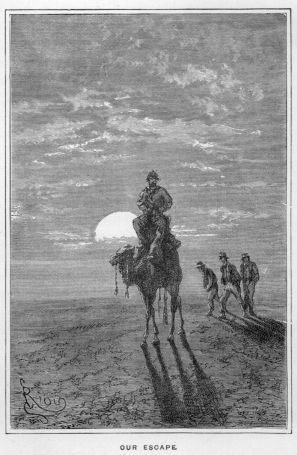
We had got round the hill, and were steering northward, when, as we looked over our shoulders, what was our dismay to see several Arabs mounted on camels coming down from the camp at full speed! It was evident that Ben had been seen, and his object suspected.
Boxall shouted to him to push on without thinking of us, and not to pull rein till he had reached those who might be induced to come to our assistance.
“Ay, ay, sir,” he answered. “Trust me for that. I’ll not drop anchor till Bu Saef has rejoined his old masters.”
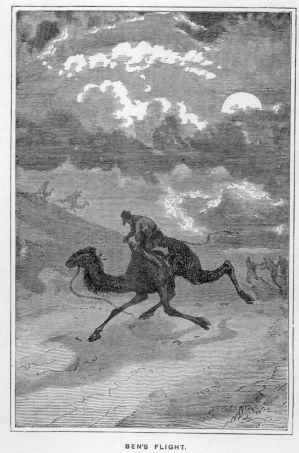
Saying this, off he went; and we felt very sure that, fleet as were the camels who were pursuing him, he would not be overtaken. In a few seconds he was out of sight.
Chapter Sixteen.
Hotly pursued—Ben gallops off on Bu Saef—We find concealment in a ruin—Surrounded by our pursuers—A fierce conflict—Ben appears—A friendly reception—How Ben arrived at the French camp—Sail for Old England—Conclusion.
We ran on as fast as our legs could carry us, hoping that the Arabs, having their eyes fixed on Ben, had not perceived us. Bu Saef had a long start, for the other camels while descending the hill could not advance so rapidly as on the plain. We had thus also an advantage, of which we were determined to make the best use: inured to long tramps across the Desert, with but little flesh on our bones, and our muscles well strung, we could run as fast as any ordinary camels over the hard ground. We were in good wind, too, and had no fear of getting tired; instead, therefore, of stopping at the first place Selim had discovered, we pushed on for the ruined temple he had discovered in the wood. I may formerly have run faster for a short distance, but never had I gone over so many miles of ground at such a rate.
Almost before I thought it possible that we could have got so far, Selim, who led the way, pointing to a wood, cried out, “There’s the place where we can hide ourselves!” We immediately darted into it, he leading us amid the trees to the ruins he had described, and up which we quickly scrambled. Now and again turning our heads where the ground was more open, and where no trees or other objects impeded the view, we caught glimpses of the shadowy forms of our pursuers against the dark sky; but the sight only nerved us to fresh exertions. Mounting up steps formed by the fallen walls, we gained the top ledge, which had apparently once supported a floor; and creeping along it, and through a narrow doorway, we found ourselves in a small chamber some twenty feet or so above the ground. Numbers of loose stones lay about, with which we instantly set to work to block up the entrance, making as little noise in the operation as we could. A small fracture in the wall would serve as a window, too, on the side which commanded the road, and enable us to look out. By piling up a few stones, I found I was able to reach it; so I took post there to watch our pursuers, while the rest were working as I have described.
Scarcely had I begun to look out when I saw five men on camels, the moon shining on their arms, pushing along as fast as they could go to the northward, evidently supposing that we were before them. I had little fear of their overtaking Ben; indeed, they themselves could scarcely have expected to do so. Had we, however, continued on, they would certainly have come up with us.
Though I would gladly have thrown myself on the ground to rest, I continued looking out from my watchtower. But no other Arabs followed. Probably it was thought that the five armed men could easily master us. My fear was that, when they could not find us, they might suspect where we were hidden, and should come and search the ruins. No one appeared, however; and I had waited for upwards of an hour when I saw the five camels returning at a leisurely pace, the riders looking about them on every side. The trees in front of the building at length hid them from sight. Would they now venture to stop and search for us? As the Arabs have a notion that such places are inhabited by Jins or evil spirits, I was in hopes that they would, at all events, not attempt to explore it till daylight; but even if they did, we considered that we were so securely hidden that they were not likely to find us. At last their voices ceased; whatever might have been their suspicions, they continued their way back to the camp.
We now held a consultation whether we should at once push on to meet our expected friends, or remain in our secure hiding-place till their arrival.
Tired as we were with our long run, during which we had strained every muscle to the utmost, we settled to remain in the ruins till the afternoon; indeed, it was not likely that, even should Ben induce the allies of the French to come to our assistance, they could reach the place for some hours. He would not know, either, whether we had been captured or not; and as it must have seemed to him that there was every probability of our having again fallen into the hands of our task-masters, he might have advised the sheikh to wait till he could send forward a force able to cope with the party under Siddy Boo Cassem.
Our spirits were high, for we had accomplished far more than we expected, and we had every hope of escaping from the galling bondage we had for so long endured.
“Come, Charlie,” said Boxall, “I’ll take the look-out now.” So gladly yielding up my place, I threw myself on the ground, and was asleep in a few moments.
When I awoke, daylight was streaming in through our narrow look-out hole, at which Selim was now stationed, while Boxall and Halliday were fast asleep, they having been in the interval on the watch. I did not wake them; but climbing up where Selim stood, I asked if he had seen anything.
“No,” he answered; “not a single person has passed. The peasantry, I suspect, have fled from this part of the country, and we may possibly make our way to the camp of our friends without meeting any one. It would, however, be a long journey on foot; and should Siddy Boo Cassem send out an expedition, we might run the risk of being overtaken and recaptured.”
Notwithstanding what he said, I could not help feeling a strong desire to push on, and I thought of proposing to Boxall and Halliday to do so. Still, while they slept so soundly, I did not like to awake them.
After some time I told Selim to lie down again, and I would keep watch.
Feeling very hungry, I munched some of the dates and barley-bread which we had brought with us. This made me thirsty, and reminded me that we must search for water before we could attempt to proceed. I was, therefore, on the point of awaking Selim and asking him to make his way out to look for some—he being more likely to succeed than any of us—when the sound of horses’ hoofs on the hard ground reached my ear. Turning my head round, I saw, marching from behind the grove of trees which concealed the road abreast of us, a troop of horsemen, among whom I recognised a number of the chiefs and others whom I had seen at the camp. Several of them dashed into the wood, through which they passed quickly, and then, as I guessed from the sounds which reached me, came close up to the ruin. I fancied that some had dismounted, and were scrambling among the masses of stone searching for us, and I trembled lest we might have left some traces by which they should discover our retreat. I dared not move, for fear they might hear me; and I dreaded every moment that my companions would awake, and, unaware of our danger, utter some sound which might draw attention to us. I was almost afraid to breathe.
More horsemen now appeared on the road, and from the movements of the party there was no doubt that they were convinced we were hiding in the neighbourhood. I listened to the voices of those who were searching for us, and tried to make out what was said. They appeared to be stumbling among the masses of fallen ruins, looking into every hole, and poking their swords into every crevice.
“The cursed Nazarenes cannot be here,” I at last heard one exclaim. “They must have gone on further, if they are not concealed nearer the camp.”
“They may have fleet heels, but they could not have got further than this when we passed the place,” exclaimed a second.
“May curses rest on them and their ancestors,” growled another.
Still my companions slept. Even now I dreaded lest the slightest sound they might make should catch the ears of our pursuers, who at that moment were close under us. It did not occur to them that, like cats, we should have climbed up to such a height; nor, of course, were they aware of the existence of the secret chamber in which we lay hid. Perhaps hundreds of years had passed since it was entered by a human being, and it was next to a miracle that Selim should have discovered it.
How thankful I felt when, by the sounds made by the Arabs as they scrambled over the ruins, I knew that they were returning to their horses. Presently I caught sight of them, as they passed in front of my look-out hole on their way to join their comrades, who had gone on in advance. Not, however, till they were at a considerable distance, did I venture to arouse my companions. I then got Boxall to look out at them, for I suspected he might otherwise suppose that the account I had to give was a creation of my imagination.
He and the rest were all now convinced of the danger we had escaped. The question as to whether we should leave our place of concealment was settled, too, for the present; for, of course, we determined to remain where we were till the Arabs had left the neighbourhood.
I have not repeated one tenth part of the curses heaped on our heads, or the threats of vengeance uttered by our pursuers. Their chief cause of anger, however, was the loss of the famed Bu Saef. Among them I now recognised Siddy Boo Cassem, as well as several of his relatives and friends; and I had not the slightest doubt but that they would have put us to death in revenge for our having carried off the animal. Should they overtake Ben, his fate would be sealed; but we had little fear on his account, as he must, unless some accident had happened to him, be many leagues ahead of his pursuers.
None of us felt inclined to go to sleep again; but we judged it prudent to remain close in our lair, for fear any passer-by should catch sight of us, and inform our enemies on their return. At length we suffered so greatly from thirst, that we were induced to let Selim creep out to try and find water. Boxall had thoughtfully brought away a leathern bottle, such as Arabs always carry with them; but he had not filled it, on account of the weight. We charged Selim not to go far, however, and to conceal himself as much as possible, while he kept a sharp look-out on every side, as it would be far better to endure the severest thirst rather than run the risk of being discovered. Often before had we endured thirst, but on such occasions we had been unable to obtain water; now that it was possible to get it, we could not resist the temptation, notwithstanding the risk to be run.
Having removed a few of the stones, Selim crawled out, and scrambled down among the ruins; but we could not watch him without exposing ourselves, and had therefore to remain in anxious suspense during his absence. It seemed to us a terribly long time; and at length we began to fear that Siddy Boo Cassem’s party would return before he got back to us. We waited and waited, our thirst increasing till we could scarcely bear it longer—one of us all the while keeping a look-out at the only aperture by which we could command a view of the road.
A couple of hours, at the least, must have passed, when we heard a slight noise beneath us; and the next instant Selim came crawling along the ledge, and entered by the hole we had made.
“Quick, quick!” he whispered, “stop it up. I was pursued, and must have been noticed entering the ruin.”
He had brought the bottle full of water, and, in spite of our anxiety, we could not resist putting it in succession to our lips till we had drained it to the bottom.
While the rest sat down, I continued to look out; and we listened anxiously for the approach of the people Selim had seen. In a short time we heard people speaking beneath us. They were Arabs, and, from their style of speaking, natives of the place—who would probably be as ready to deliver us up to one party as the other, and would choose the one with whom they could make the best bargain. They were far more likely to discover us than Siddy Boo Cassem’s followers, as they most probably were well acquainted with the ruin. Our anxiety was somewhat relieved, however, when we heard one of them remark—
“It must have been a Jin, though he looked like a black slave; and this is known to be the dwelling-place of Jins.”
“Take care lest any of them rush out on us,” cried another.
“Allah, Allah, Allah is great, and Mohammed is his Prophet!” they sang out in chorus, as a charm to keep the Jins at a distance.
Notwithstanding their fears, they continued to hunt about. We might possibly, by uttering some wild shrieks or other strange sounds, have put them to flight, but the risk was too great, as they were evidently climbing about among the stones, and making a more thorough search than the other party had done.
Just then I caught sight, in the distance, of a horseman galloping along the road at full speed. His turban was off, and his sword broken. Others followed, in even worse plight; and as they came nearer I saw that blood was streaming from the heads or sides of several of them.
Presently the sound of a dropping fire reached us. A larger body of those who had ridden by in such gallant trim in the morning now galloped past in an opposite direction, without turbans, their weapons broken or lost, their dresses torn, and covered with dust from head to foot. A still larger body followed, keeping close together, and firing as they advanced,—evidently in pursuit of the former.
The Arabs who were hunting for us rushed off on hearing the sounds, and we were left in safety, as far as they were concerned; but whether the pursuers of our late masters would prove friends or foes, we could not tell. They were just at the end of the wood when the fugitives rallied, and charged them with such fury that they were driven back, and we feared that the fortunes of the day would be changed. Several fell on both sides. Siddy Boo Cassem fought with the greatest bravery, and encouraging his followers to merit paradise, again and again charged his foes.
We looked in vain for Bu Saef. Had the camel appeared, our doubts as to Ben’s safety, and the way we should be treated by the hitherto victorious party, would have been set at rest.
Just then, amid the clouds of dust which surrounded the combatants, we caught sight of a fresh body of horsemen coming from the northward. In a few minutes they had reached the scene of conflict, shouting, as they advanced, various battle-cries, some in Arabic, others in French. Presently a cry louder than all the rest reached our ears—a truly British Hurrah!—and at the same time I caught sight of Ben, sticking like wax to the back of a fiery steed, and flourishing a huge sabre, as he led on a party of dark-skinned Arabs, who had to urge forward their steeds to keep up with him. The front ranks, which had hitherto been hotly engaged and hard pressed, wheeled aside to let the new-comers pass. Siddy Boo Cassem saw them coming, and knowing that all hope of victory was lost, shouted to his people, wheeled round his horse, and galloped off as fast as the animal could put his feet to the ground. Ben and his followers then swept by like a whirlwind, and our only fear now was that the gallant fellow might lose his life by a chance shot from the flying enemy.
Having no longer any doubt as to the reception we would meet with, we were about to rush out and join the Algerines; but Boxall stopped us. “Stay,” he exclaimed; “they may suppose we are a party of the enemy lying in ambush. Let one of us go forward and present himself.”
I volunteered, and descending from our place of concealment, advanced outside the wood. Already a party of the Algerine forces had halted to attend to the wounded; while several of the Arabs levelled their rifles at me, and two or three bullets whistled near my head, before I could make them understand that I was a friend.
On reaching the main body, I found several persons dressed in half Oriental and half European costume, some of whom I guessed were French surgeons, from the way they were attending to the wounded Arabs. I quickly made myself known, and met with a cordial reception.
Going to a spot whence I could be seen from the tower, I made the signal agreed on to my friends within it, who at once descended and hurried to the spot. The French officers congratulated us warmly on our wonderful escape, they having heard from Ben of our long captivity. One of them—who was the officer in command—spoke English fairly, and gave us an account of the sailor’s arrival among them, at which they, and even the Arabs, who guessed what we were talking about, laughed heartily.
The information of the approach of an enemy had a short time before been brought to them, and the French had just arrived at the Arab camp preparatory to commencing a march southward, when, by the light of the full moon, a camel, fleet as the wind, was seen approaching the camp. The animal, instead of being reined up by its rider, galloped forward, the assembled multitude making way on either side; when suddenly it stopped, and, as a natural consequence, off flew honest Ben from its back into their midst. Without being in the least disconcerted, as soon as he had picked himself up he began to shout out, in English and such Arabic as he could command—
“Come along, all of you, as fast as you can, and save my officers from being knocked on the head by the villainous crew from whom we have escaped, as we had a right to do.”
How Ben might have been received by the Arabs, it is hard to say; but at that moment the sheikh, the former owner of Bu Saef, came forward and recognised his well-beloved and long-lost camel. In a moment Ben found himself treated with the greatest respect and attention. The French commandant coming up, quickly learned all about us; and finding that there was no time to be lost, he at once despatched the first party of Arab cavalry that was ready to start, following himself shortly afterwards with others, accompanied by Ben.
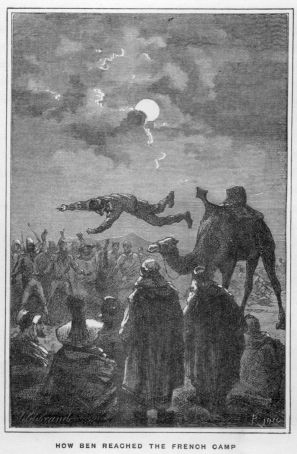
The French commandant having posted men in the wood and among the ruins, so as to attack the enemy on their flank, in the event of those who had gone in pursuit being compelled to retreat, we waited anxiously for their return. Presently we saw clouds of dust rising from the south, out of which the Algerine forces at length emerged. I looked out eagerly for Ben; and not seeing him, feared that he must have fallen. At length, to my great joy, I caught sight of him, with his huge sabre in his hand, alongside the sheikh; with whom he seemed to be on the most intimate terms. Ben’s delight at seeing us was great in the extreme; and throwing himself from his horse, he ran up to us, shaking us all in succession warmly by the hand.
“Beg pardon, gentlemen, for the liberty I take,” he exclaimed; “but I cannot help it—on my life, I cannot—I am so glad to see that you have got away all right from those cut-throat fellows! They will not dare to make slaves of English officers again in a hurry.”
As the French commandant was doubtful of the strength of the enemy, who might possibly descend in force, he ordered his troops to return. The wounded were placed in panniers on the backs of mules, which were brought up for the purpose; and several of the enemy’s horses being caught, we were soon all mounted, and on the way with our new friends to the northward. We reached the French outposts by nightfall, where we were most hospitably entertained by the commandant and his officers, who supplied us with clothing and other necessaries.
The sheikh, to show his gratitude to Ben for having brought him back Bu Saef, offered to receive him into his tribe, and to make him a chief.
“Please, Mr Blore, tell the old gentleman that I am much obliged to him,” answered Ben; “but as I have not fallen quite into his style of living, I beg he will excuse me; and, to say the truth, I had rather serve on board a man-of-war till I can get a pension, and go and settle down with my Susan in Old England, than turn into an Arab sheikh with a dozen wives and a thousand blackamoor followers.”
Having recruited our strength, we some days after left our kind French friends and set off for Algiers, where we arrived safely; and soon afterwards, accompanied by Selim, we embarked for England.
I need not say that we were welcomed there as if from the dead, by our friends; and I trust that we were all thankful for the merciful way in which we had been preserved from the numberless dangers we had gone through. Andrew Spurling was delighted to see us. “I told you, Mr Blore, that you would find Arabic useful, though I little thought at the time how much service its acquirement would render you,” he exclaimed as he shook me by the hand. “However, it proves, as I once observed to you, that the more knowledge we can pick up the better, as we can never tell how valuable it may become to us.”
| Chapter 1 | | Chapter 2 | | Chapter 3 | | Chapter 4 | | Chapter 5 | | Chapter 6 | | Chapter 7 | | Chapter 8 | | Chapter 9 | | Chapter 10 | | Chapter 11 | | Chapter 12 | | Chapter 13 | | Chapter 14 | | Chapter 15 | | Chapter 16 |