"Saved from the Sea" (continued 3)
Reading edition
“Now is the time to get near them, then,” exclaimed Ben. “We shall be able to see them though they cannot see us, and we shall thus have a better chance of finding out whether Mr Boxall is among them.”
We at once got up; and, guided by the light, we made our way without difficulty. It evidently proceeded from a large encampment, as the fires covered a considerable extent of ground,—which showed us that there must be a number of bushes or trees in the neighbourhood, to supply fuel. On we went, the light still increasing, till we found ourselves on somewhat rougher ground, slanting upwards, behind which we had no doubt the camp would be found. After going on for some time longer, we could clearly distinguish the forms of a number of horses standing up, and of camels lying down, with their drivers among them—the light of the fires on the further side throwing them into bold relief. As we walked side by side, with our eyes turned up at them, we were all three nearly falling down together head foremost into a deep hole, to the edge of which we had suddenly come. Ben, who was the first to see it, caught hold of me, and I held back Halliday.
“What can it be?” he asked, kneeling down and peering into the hole.
“A well,” I answered, “at which probably the animals from yonder encampment have been watered.”
“I only hope, then, that they have left us enough to quench our thirst,” said Halliday.
Ben offered to go down and explore the hole, for in the darkness we could not see how deep it was; and we knelt down, grasping him by the hand while he descended.
“It’s all right,” he said in a low voice. “I can touch the bottom—or a ledge, at all events; I will feel my way, and take care not to slip down into a bottomless pit.”
It was too dark to see him as he moved about, but presently a slight splash of water sounded in our ears; after which we could hear it, as it seemed, gurgling down his throat.
In less than a minute he came close under us. “Put down your hands,” he said; “here is something you will be thankful for.”
We did as desired, and drew up a large wooden bowl attached to the end of a rope. I gave it to Halliday first, who I knew was suffering most; and between us we emptied the contents of the bowl, and then handed it down to Ben,—who went back with the same caution as before and procured an additional supply for himself and us. Having satisfied our thirst, we hauled him up; and then sitting down on the side of the well, we consulted what we should next do. I was of opinion that Boxall had not been carried to this camp; but that the Arab we had seen belonged to some other tribe, and probably had been reconnoitring in the neighbourhood, and, catching sight of Boxall, he had hoped to gain some advantage by making him prisoner. Ben, on the other hand, who was convinced that our companion had been carried to the camp, was anxious to be certain whether this was the case or not. I warned him of the risk we should run if discovered in the neighbourhood.
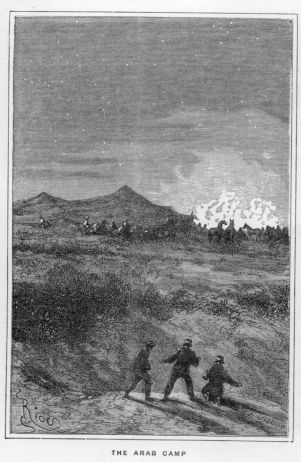
“Well, they can’t do more than kill us,” he answered. “If they make prisoners of us, we must do our best to escape; and if the blackamoors have got hold of Mr Boxall, and we find him, we shall be able to help him to get off too.”
“But if we don’t find him, we shall have had all our risk for nothing,” said Halliday.
“Nothing venture, nothing win,” answered Ben. “Just let me go, and I’ll take good care that these Arab rascals don’t get hold of me.”
At length Halliday and I, won over by honest Ben’s arguments, agreed to let him do as he proposed; it being settled that we should wait for him close to the well.
“Thank you, gentlemen,” he said. “I will make a ‘circumbendibus’ of the camp; and if so be I can’t get sight of Mr Boxall, I will be back here in an hour at the furthest. If I am caught or knocked on the head by the Arabs, it will all be in the way of duty; and you will say a good word for Ben Blewett if you ever get home.”
Shaking hands with us warmly, as if he were going on a forlorn hope, he stole off round the well towards the Arab camp.
It did not occur to us at the time, but we had really chosen as dangerous a spot as any in the neighbourhood. In the first place, wild beasts prowling about at night were very likely to approach the spot to drink; and then, as a pathway led down to the well from the opposite side, the Arabs of the camp were sure, at early dawn, to come down to fill their water-skins,—so that should we, while waiting for Ben, fall asleep, we must inevitably be surprised. Fatigued by our long march, however, we could not resist the temptation of stretching our limbs on the sand, regardless of the risk we were running—but of which, as I have observed, neither of us thought at the time. We did our best to keep awake, however, and after, as we supposed, an hour had elapsed, began anxiously to look out for Ben.
The time passed by. “I say, Charlie, I am sure Ben has been gone more than an hour,” said Halliday in a drowsy tone. I scarcely understood what he said; I tried to arouse myself—he repeated his remark.
“We must wait for him, at all events,” I answered. “So, I say, keep awake, and rouse me up should you find me dropping off to sleep.” But poor Halliday was even more sleepy than I was; and in another minute we must both have dropped off.
We had been sleeping, I suppose, for some time, when I was aroused by feeling a hand on my arm; and opening my eyes, I saw a black fellow scantily clothed standing over me. He put his hand on my mouth, as a sign that I must not cry out, showing the blade of a sharp dagger—which he drew from his side—to enforce his commands. I saw that another had hold of Halliday; while, to my sorrow, I found that they had also secured Ben. His hands, poor fellow, were tied behind him; notwithstanding which, he was making the most strenuous efforts to escape—though it would have availed him nothing had he succeeded, as he could not have rescued us, and must either have fallen into the hands of other Arabs or have died of starvation.
Compelling us to get up, our captors next secured our hands in the same fashion as they had done Ben’s, and ordered us to move on. Instead of taking us to the camp, however, they began to drag us away in the opposite direction, towards the sea-shore, hurrying us along as fast as they could run,—making it evident that our captors did not belong to the camp we had seen, and were anxious to get a distance from it before daylight. In vain, therefore, did we try to get near Ben, to ask him if he had seen Boxall, and to learn what had happened.
I found, on looking up at the stars, that after going a short distance they turned off to the south-west, keeping on the harder and more elevated ground, but still verging towards the coast. This strengthened my conviction that they belonged to a different tribe from those in the camp, and that they had been on a marauding expedition when they fell in with us. Perhaps they believed that we belonged to their enemies, and hence their anxiety to hurry us away from the camp.
Day had just dawned when we saw before us a line of low dark tents, pitched on the side of a sand-hill just above the sea-shore, with camels and other animals standing near them, as if ready to receive their loads, in case an immediate start should be necessary. The light of day also revealed to us the hideous and savage countenances of our captors—their skins almost black, and in features, many of them, closely resembling negroes; though, from the dress of their chief, and their camels and tents, I should have supposed them to be Arabs. They had but scant clothing, in addition to the belts hanging over their shoulders, and to which their daggers were attached. Their other arms were short swords and spears.
Our arrival at the camp was announced by loud shouts from the people assembled in front of it; on which a number of other men, with women and children, came rushing out of the tents. Their chief, before whom we were brought, was a tall man, of rather lighter complexion than the rest, but with countenance not less hideous and sinister than those of his remarkably unprepossessing followers. He inquired, in a sort of mongrel Arabic,—which, however, I could partly understand,—who we were, whence we had come, and how we had been found. To the latter question alone, his people could give a reply. I heard him remark that there must have been a shipwreck on the coast not far off, and that we were some of the people who had escaped from it. The others agreeing that he was right, a consultation was then held as to the direction in which it had occurred. Thinking it was time to speak, I now stepped forward, and making a profound salaam—for I felt that it was wise to be polite to the savages—I said, in as good Arabic as I could command—
“Know, sheikh, that the ship on board which we were voyaging was consumed by fire; but the great Allah whom we worship allowed us to escape, and conducted us to your shores on a raft,—which, as a proof that I speak the truth, will be found a day’s journey to the north.”
The astonishment of the black Arabs, on hearing me speak in their own language, was very great.
“Who are you, and how is it that you can speak in our tongue?” asked the sheikh.
“It is the custom of my people to learn the tongues of the nations they are likely to visit, as they voyage to all the lands under the sun; and before long we hope that our countrymen will come here to take us off, and reward those who have treated us with hospitality,” I answered, trying to look as important as I could.
“O Nazarene, you speak big words,” exclaimed the sheikh. “But understand that your countrymen, however large their ships, will find it a hard matter to follow you into the Desert, should we think fit to carry you there.”
“True, O sheikh; your wisdom approaches that of Solomon,” I answered, trying to imitate the Arabic style of language. “But you will then lose the reward you would have obtained by restoring us safe to our friends. The few articles we carry about us, seeing that we could save nothing from the wreck, are not worthy of your acceptance. May I now inquire what powerful prince of the Desert I have the honour of addressing?”
The sheikh appeared somewhat pleased at this speech; but he did not relax the sternness of his features while he answered—
“Know, O Nazarene, that you are in the presence of the Sheikh Boo Bucker Saakhi, chief of the Ouadlims,” was the answer.
Though the sheikh did not appear a man likely to be won over by soft speeches, I determined to persevere. Unslinging my telescope, I held it out to him.
“Here is an instrument which will enable a person who looks through it to see ten times as far as he can with his naked eye. I will present it to you, and show you how to use it, the day a ship appears in sight, and you enable us to get on board her.”
I thought the sheikh was going to laugh; but he only grinned sarcastically as he replied—
“Know, O Nazarene, that I can at any moment take it from you, as well as everything else you carry, and strip you to the skin; so I value not your promise as you think I should.”
“But, O Sheikh Boo Bucker Saakhi, we wish you to understand that our countrymen will reward you handsomely with numerous articles such as your soul desires, if you treat us with that hospitality for which you princes of the Desert are famed throughout the world.”
“That may be true; but a bird in the hand is worth two in the bush,” answered the sheikh. At least, he made use of an Arab proverb of a similar tenor. “However, I will consider the matter. In the meantime, I will receive you and the other Nazarene as guests in my tent, where you will be pleased to exhibit the various articles you possess.”
Of course, I said that we should be delighted, though I suspected what would be the result of exhibiting our property.
“And who is yonder white man, who seems so greatly inclined to knock over my followers?” inquired the sheikh. “His dress, I observe, differs from yours. Is he one of your people?”
“That man, O sheikh, is a faithful follower of ours; a lion in war, and a lamb in peace when not interfered with,” I answered, looking at Ben, who was at that minute engaged in a struggle with a dozen or more Ouadlims, from whom he had broken loose, and who were again trying to bind his hands.
“Let him be allowed to come here at liberty, and I will prove that what I state regarding him is true,” I added.
The sheikh shouted to his followers, and I called Ben to come to us. As he did so, he pulled off his hat, which he flourished in the air, and made the sheikh a polite bow. Then putting out his hand, he exclaimed—
“Give us your flipper, old fellow, and we will be good friends!—only, tell your people to keep decent tongues in their heads, and their hands to themselves.”
“What is he talking about?” asked the sheikh, who, of course, did not understand a word Ben had said, and was unable to comprehend his movements.
“He says that he is ready to fight for and serve you, O sheikh, as he has served his own chief,” I answered. “You will find him faithful to yourself, and a terror to your enemies, while he remains with you.”
I said this for the sake of getting Ben well treated, though it was an imprudent observation—and I was wrong in saying what was not the truth—as the sheikh might not be willing to part with Ben again. But for the present it answered its object; for the sheikh, bidding us all three follow him, led the way to the entrance of his tent, to the astonishment of his followers. Though it was considerably larger than a gipsy tent in England, it had much the appearance of one. The cover consisted of camel-hair cloth, supported by a couple of long poles in the centre, the skirts being stretched out and fastened to the ground by pegs. Heaps of sand were also piled up, as a further security to prevent it being blown away. The ground inside was covered with a dirty piece of carpet, while a few pots hanging to the tent-poles formed the whole of the furniture.
The women of the tribe were most of them even more ugly than the men; and though they were decently clothed as to quantity, their garments were dirty in the extreme. They appeared to go about the camp as freely as the men, who showed no anger or annoyance when we looked at them,—which, as Ben observed, was not surprising, considering how hideous they were. They gathered round, looking with curiosity at our white skins and strange dresses; but, out of respect to the chief, of whom they seemed to stand in awe, they did not further annoy us.
“Come into my tent, O Nazarenes, and we will talk this matter over more at our ease,” said the sheikh, walking inside, and making a sign to Ben—who, from the character we had given of him, was looked upon as an important personage—to follow. The sheikh sank down on his carpet, and we imitated his example, endeavouring, like him, to tuck our legs under us—Halliday and Ben on one side, and I on the other. But our attempts were not very successful. Halliday tried two or three times in vain, and at last stretched them out comfortably before him; while Ben, after rolling from side to side, fairly toppled over on his nose, before he could get his legs stowed away—greatly to the amusement of the sheikh, in whose estimation he was thereby considerably lowered, I am afraid.
After we were settled, and the sheikh’s cachinnations had ceased, he clapped his hands; on which one black damsel brought him in his hookah, while another appeared with a piece of charcoal to light it. He did not, however, hand us his pipe.
“You are hungry, strangers,” he next observed.
“Yes, indeed we are, and very thirsty too,” said Halliday, who had not attempted to speak till now.
“I forgot,” said the sheikh; and calling to the black damsels, he ordered them to bring us food and water. In a short time one of them returned with a large bowl of couscoussu, a sort of porridge made of wheat beaten into powder. We had our fingers only to eat it with.
“Set to, strangers,” said the sheikh, nodding; but he took none of the food himself.
“It is not bad stuff when a fellow is hungry,” observed Halliday, stuffing the porridge into his mouth as fast as he could lift it with his fingers; “but it’s very flavourless; I wish we had some salt to put into it.”
“So do I, for more reasons than one,” I answered. “I do not quite like the appearance of things.”
“But he seems to be a pretty good-natured kind of fellow; perhaps he does not know we like our food salted,” said Halliday.
“We must take people as we find them; and I hope he has not omitted the salt intentionally, though I suspect he has not made up his mind whether to trust us or not,” I observed.
We all did justice to the sheikh’s couscoussu, however; for, notwithstanding its want of salt, we had eaten no food so wholesome since we were on board the Spanish ship. Another girl next brought in an earthen jar of water, which we in a few minutes completely emptied.
“Thank you, Mr Sheikh,” said Ben, after his meal; “long life to your honour.”
“What does he say?” asked our host.
“He hopes that your shadow may never grow less, and that you may live to be a blessing to your people for as long as the patriarchs of old.”
The sheikh seemed pleased, and answered,—“Your lion-hunter is a fine fellow.”
I explained that I only said he was as brave as a lion; but the sheikh replied that his bravery must have been proved by his hunting lions—and that he, at all events, would give him an opportunity of exhibiting his prowess.
Ben, tired of sitting so long on his feet, now got up, and, pulling a lock of his hair, walked out of the tent. Not supposing he would be molested, we sat on, wishing to practise our Arabic by talking to the sheikh, who made numerous inquiries about our country and other parts of Europe, evidently being not altogether ignorant of what had been taking place of late in the world. We at last also got up, to take the fresh air outside, when he said—
“Stop, stop! young Nazarenes. You came here to show me the precious treasures you possess; I desire you to exhibit them.”
“Of course we will,” I said, unslinging my telescope.
He looked at it, putting the field-glass to his eye, when he saw his own ugly face reflected in it.
“Bismillah! it’s wonderful,” he cried out.
I explained that this was the wrong way to use it; and inviting him to come to the door of the tent, I put it to my own eye to show him how it was to be used. As I did so, turning it eastward, what was my surprise to observe a sail standing towards the shore.
“Thank Heaven! here comes a vessel which may rescue us,” I exclaimed.
“Let me look at her,” said Halliday, taking the glass from me.
“Look again, Charlie,” he said, returning it to me. “I am afraid that it is only a small boat.”
“You are right,” I answered; “or rather, it is no boat at all, but a raft!” Indeed, by this time we could distinguish the raft with our naked eyes.
“What is all this about?” asked the sheikh, observing our agitation. I gave him the glass, but he could not fix it on the object. He saw the raft, however, without it.
“Allah be praised! yonder vessel will certainly be thrown on our shore, and we shall obtain a rich booty,” he exclaimed.
I did not undeceive him.
“Can that be the large raft, I wonder?” asked Halliday. “If so, some of the poor wretches have escaped death after all.”
I examined it attentively, and saw that it was very much smaller than the large raft, and could not support more than two or three people. I also now observed that a reef of rocks ran parallel with the coast for some distance, the sea breaking heavily upon it.
There was soon a general commotion in the camp, and all fully believing that a vessel was approaching which could not escape being wrecked, were highly delighted at the prospect of making themselves the possessors of her cargo. The sheikh was as eager as any one, and, accompanied by his family, hastened down to the beach, hoping to be among the first on board.
Nearer drew the raft, and at length I made out that only one person sat upon it, steering with an oar. The people—who were all by this time down on the beach—soon discovered their mistake, and began to vent their disappointment by uttering curses on the head of the stranger,—we coming in for a share of their anger.
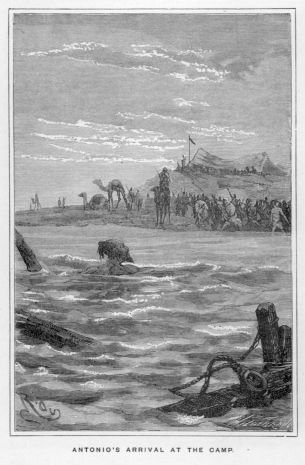
On came the raft, and presently, as we expected would be the case, was dashed on the reef, suffering even a worse fate than ours—being utterly broken to pieces. Its occupant, however, sprang forward, and we saw him striking out bravely in the calmer water, into which he had been thrown, towards the shore. He was followed by fragments of the raft, which I thought would strike him; but he escaped from them, and came on with rapid strokes towards us. The Arabs, some of whom rushed half-naked into the water, waved their hands and encouraged him by their shouts. As he drew near we saw that he was either an Arab or a black man; and before he landed we recognised him as Antonio, the black we had met on board the Spanish ship. The Arabs now stretched out their hands to help him, and he was soon in their midst, supported by their arms.
Whether he had recognised us or not we could not tell, for at first he appeared to be too much exhausted to speak; and from the eagerness with which the Arabs gathered round him, and his general appearance, we suspected that he either belonged to their tribe, or to some other tribe on friendly terms with them. Such we had soon too good reason to know was the case. Presently we saw him borne to the tent of the sheikh, where food and water were carried to him. Remembering his conduct to us on board the Spanish ship, we could not but fear that his coming boded us no good; still, of course, if he was an honest man he could not fail to corroborate our story, and so we waited with some anxiety to speak to him.
In the meantime the women and children gathered round us, the latter especially treating us with scant respect; the urchins, like so many imps, grinning from ear to ear at us, pulled at our clothes and pinched our arms and legs; while several of them, pious, I have no doubt, according to their notions, spit at us to show their hatred of the Nazarenes. We knew that it would be of no use to run after the little wretches and punish them, so we bore the indignities we received with as much stoical indifference as we could assume. A big fellow whom we heard called Sinné—one of the men who had captured us—encouraged them; and at last approaching Ben, he insulted him with abusive language and gestures, snatching at his hat, and even trying to pull off his jacket. On this, Ben, without considering the consequences, lifted his fist and knocked the fellow down. Sinné got up considerably cowed for the moment, and stalked away; but, from the malignant glances he cast at Ben and us, we could not doubt that he meditated vengeance.
“Come back, old fellow, and I will do it again,” shouted Ben; but the Arab did not wish to put himself within reach of the seaman’s sturdy fists.
“I wish that you had not knocked the fellow over, Ben,” I said; “our only hope of escaping is to keep on good terms with the Arabs.”
“And so I wish to do, sir,” answered Ben. “It may be, if I knock a few more of them over, they will be all the better friends with us; and it may teach them that we will stand no nonsense!”
Certainly, Ben’s mode of proceeding appeared at first likely to answer, for both women and children kept at a more respectful distance, while none of the men seemed inclined to molest us.
Being tired with our previous exertions, we now sat down under the shade of a tent, whence we could watch the wide expanse of sea stretched out before us; but our eyelids were heavy, and, in spite of the doubtful disposition of the natives, we all dropped off to sleep.
Chapter Nine.
An unpleasant change—Ben undergoes a severe trial—The Ouadlims receive an unwelcome visit—We are made peace-offerings—A curious spectacle—I make friends with the Sheikh’s brother Abdalah—The shipwrecked party—Discover a valuable friend—Antonio’s escape from the wreck.
We were aroused by the voice of the sheikh. “Get up, you lazy sons of dogs!” he was exclaiming in an angry tone. “You have been deceiving me, I find, by passing yourselves off as people of importance, when you are mere servants of servants. Get up, I say;” and he began to enforce his commands by kicks and blows. We sprang to our feet, and Ben, doubling his fists, would have knocked the sheikh down had I not held him back.
“What have we done to merit this treatment, O sheikh?” I asked.
“Told lies, vile Nazarene,” he answered. “Henceforward know that you and your companions are to be slaves—should my people not prefer putting you to death.”
The sheikh was heard by the rest of the community, who now gathered round us, delighted at being able to renew their insults,—some of them pulling off our caps, while others tugged away at our jackets and pinched us as before, even spitting at us in their fury. At length Antonio stalked out of the tent, casting malignant glances at us as he passed.
“I say, mate, you know what better manners are,” exclaimed Ben. “Do try and teach these people to treat us decently.”
Antonio made no reply, but, without even turning his head, walked on.
“You are a pretty fellow,” shouted Ben; “I thought you would have wished to be civil, at least.”
Remembering the black’s behaviour on board the Spanish ship, however, I felt that it would be useless to appeal to him.
Presently we saw him returning, accompanied by Sinné and several other fellows, mostly as ill-favoured as himself. Approaching Ben, they threw themselves upon him, and, pinioning his arms, led him off, ordering us to follow.
“I am afraid they mean mischief,” said Halliday in a melancholy voice. “Do you think, Charlie, that they intend to murder poor Ben?”
“I hope not,” I answered, though I did not feel over confident about the matter. “I will do all I can to save him.”
We followed Ben and his captors. He turned his head towards us, and, by his look, evidently thought that his last hour had come; so indeed did we, and very sad we felt. We walked on till we had got some hundred yards from the camp, when we saw a sort of bench formed by boards on the top of a sand-hill, to which Ben was conducted. Sinné and Antonio having led Ben up to the bench, made him kneel down before it; when, to our horror, the former drew a pistol from his belt and presented it at the honest seaman’s head.
“Fire away, you rascals,” cried Ben in a loud voice, fixing his eyes on his executioners. “I am not afraid of you!”
Every instant we expected to hear the fatal shot fired, but still Sinné refrained from pulling the trigger. Feeling sure that if we rushed forward to Ben’s assistance it would be the signal for his death, we stood stock-still, not daring to move. In equally fixed attitudes stood the Arabs, evidently taking delight in our horror and anxiety. I dared not even pull out my watch to note how the time went by, but it seemed to me that a whole hour must have thus passed,—the Arab all the while standing motionless, till I thought his arm must have ached with holding the pistol. Halliday declared that he thought at least two hours must have elapsed, when Sinné, giving a self-satisfied grunt, restored the pistol to his belt, and stalked off towards the camp, followed by Antonio, and leaving Ben kneeling before the bench.
Ben, on finding that they were gone, got up and gave himself a violent shake. “I thought I was done for!” he exclaimed, with that cool air which an habitual indifference to danger can alone inspire. “I didn’t care so much for myself; but I thought the villains would treat you in the same way as they were going to serve me, and I was terribly sorry for you, that I was.”
We thanked Ben for his interest in us, assuring him how glad we were that he had escaped; and not having before had an opportunity of hearing the result of his expedition to the Arab camp, we inquired if he had seen Boxall.
“Not a glimpse of him,” he answered. “I went round and round the camp, so if he was there he must have been inside a tent; but as a number of people, whom I took to be slaves, were busy either pounding corn or cleaning their beasts, I am pretty sure that if he had been carried there he would have been among them, and I should have seen him. I believe, Mr Blore, you were right after all; and that the Arab who got hold of him must have gone off to another camp. All we can hope is, that he is among better people than these black fellows here.”
I hoped so likewise, though I began to fear that our chances of escape were very small, and that we should be doomed to perpetual slavery by our savage captors. Of course, from the first we had determined to escape if we could; but the question was, In what direction should we fly? The desert was terminable on the east by the Nile; on the north, by the barbarous empire of Morocco, or by Algiers, Tripoli, or Tunis; while to the south were hordes of savages of whom we knew nothing, with only one insignificant French settlement where we might expect a kind reception: and we should undoubtedly have many hundred miles of an almost barren region to traverse, either to the east or to the north or south, with but a bare possibility of escaping on board some vessel which might appear off the coast, provided we could keep along the shore and avoid recapture.
We were not allowed many minutes for conversation, for our savage tormentors quickly gathered round us again, and seemed to take delight in insulting and tormenting us in every way they could think of. We had been left for some time to the tender mercies of the women and children; the men having assembled together to hold, as we afterwards found, a consultation regarding our disposal—their savage yells and cries reaching our ears even above the shrill shrieks and shouts of the women. It was evident that our captors were engaged in a hot discussion, but not one of them, we had reason to suppose, was lifting up his voice in our favour.
At length Sinné appeared, and ordered us to accompany him. Advancing with rapid strides, he led us into the centre of a circle of Arabs; but as we glanced round at their scowling countenances, we observed no sign of kindly feeling or sympathy for our sufferings. The sheikh then calling to me, ordered me to interpret to the rest. He said that we were all three to be separated,—he himself intending to take me. Ben was to fall to the lot of Sinné; while Halliday was to become the slave of another chief man. This announcement affected us more than anything which had occurred. Together, we thought that we could have borne our misfortunes; but parted from each other, we felt they would be insupportable.
“You are all young and active, and can each do more work than any three women,” he observed; “let me see that you are not idle, or you will repent it. And you shall begin at once.”
On this some heavy mallets or pestles were put into our hands, and we were ordered to pound some corn in wooden mortars, which were brought out and placed before us, while our new masters looked on to see that we laboured with all our strength. Ben grumbled and growled, the only way in which he could express his feelings; but seeing Halliday and me working, he thought it prudent to obey.
I may say here that we had from the first observed that the people were in a somewhat uneasy state of mind, as if aware that an enemy was in the neighbourhood. No fires had been lighted. The tents had been pitched close to the shore, so that they and the camels were hidden, by the first line of sand-hills rising above them, from any one passing on the opposite side; while men on foot were sent out as scouts at night, to watch far and wide round the camp.
After we had finished our task we were told that we might go down to the beach and obtain shell-fish for our own supper. Our fare was not much better than we had before been able to obtain for ourselves; for, no fires being allowed, we were unable to cook our shell-fish—and only a small portion of porridge was given us, while we were compelled to drink the brackish water which we procured from a well dug in the sand some way off.
Darkness at length coming on, we were permitted to lie down, worn out with fatigue, outside the chiefs tent, thankful that we were not as yet separated from each other. The women and children, however, would not for some time allow us to go sleep; but again coming round us, joined this time by some of the younger men, amused themselves in jeering at and taunting us. But at length they retired, and we fell asleep.
Dawn had just broken, when we were aroused by the voices of the people in the camp; and on looking out, we saw a number of the scouts hurrying in, with alarm on their countenances. We were not kept long in doubt as to the cause of their agitation; for on glancing to the eastward we saw, coming over the hills of sand, several bands of Bedouins mounted on camels, their arms glittering brightly in the rays of the rising sun. On they advanced at full gallop, till they got within gun-shot of our camp, when they suddenly pulled up. The camels then slowly kneeling down, their masters dismounted, and secured fetters to their legs, to prevent them from going away. Two Arabs were mounted on each camel: the first seated on a small side-saddle, something in the style of a lady’s; and the second as a man sits on horseback. We counted nearly twenty different bands, each composed of twelve men, who took up their stations one after the other. Whether they came as friends or foes, was at first difficult for us to determine; but, from the state of agitation and alarm into which the Ouadlims were thrown, it was soon clear that they regarded the strangers in no friendly light. To escape, however, was impossible, as they were greatly outnumbered by the new arrivals; who were also better armed, and under superior discipline, than the savage tribe into whose hands we had fallen. As we stood watching them, we saw in the far distance numerous other camels, as well as horses, and apparently sheep and goats, approaching.
The Bedouin sheikh and several other principal men now advanced, being well protected by the firelocks of their men, who stood in front of the camels. The black sheikh, Boo Bucker, being summoned, then advanced to meet them, with Sinné and other heads of families, cutting a very sorry appearance in the presence of the superior tribe. They had a long discussion, after which the whole party came to the top of the hill, where they could view the coast. No one hindering us, we drew near them; when, from the remarks made, I found they had supposed that a shipwreck had taken place, and their object was to participate in the plunder, or rather, to take it away from the Ouadlims should they have got possession of it—just as the frigate-bird seizes the prey which the smaller wild-fowl has obtained.
The new-comers appeared to be somewhat angry at being disappointed in their hope of obtaining a rich booty, and from the talking and wrangling which took place we thought they would have come to blows with our captors. The latter endeavoured to pacify them, however, and I gathered from what I heard that we were to be delivered up as a peace-offering. This to us mattered very little; indeed, we hoped that our condition would be improved by falling into the hands of a less barbarous tribe than those who had first taken possession of us. Still, it was not pleasant to find ourselves handed over, like so many sheep or oxen, by one party of savages to another.
Boo Bucker then coming up, seized me by the arm and dragged me forward to the strange sheikh; while another chief led Halliday. Sinné was about to seize hold of Ben; who, however, drew back, exclaiming,—“Come, come, old fellow, you are not going to touch me; I am going where my officers go, so don’t you be afraid. And to show you that I don’t harbour ill-will, here’s my fist;” and he seized the Arab’s hand and wrung it till the fellow cried out, and seemed glad to let him go. Ben soon came up to us, laughing and slapping his legs to exhibit his pleasure at the trick he had played the ill-favoured savage.
Still the Bedouins did not appear satisfied, and more wrangling took place. At length Boo Bucker and his companions retired to their camp, and in a short time reappeared, dragging forward Antonio, who seemed very unwilling to accompany them. Notwithstanding the resistance he made, however, he was brought up to the Bedouin chief, who placed his hand on his shoulder and claimed him as his slave. Antonio was at first furiously indignant at being so treated by his treacherous friends, but seeing that there was no help for it, he yielded to circumstances.
“I say, Charlie, it won’t do to let these black fellows keep up our jackets and caps!” exclaimed Halliday. “Cannot you ask our new masters to get them back for us?”
“I will do my best, at all events,” I answered; and turning to one of the Arabs who surrounded us, I inquired the name of their chief. The Arab seemed very much surprised at being addressed in his own language, and answered,—“Sheikh Hamed ben Kaid.”
I thanked him in due form for the information he had given me; then stepping up to the sheikh, I made him a profound salaam, and addressing him by name, told him that we had been deprived of our garments, and begged that he would recover them. He at once turned to Boo Bucker, and upbraiding him for keeping back what ought to have been his, ordered him at once to bring the jackets and caps. The Ouadlim chief looked very much annoyed, as he had evidently expected to retain the articles; but a few menacing words made him hasten away, and return in a short time with the things, as well as my spy-glass,—all of which we expected would be restored to us. Such, however, we found to be very far from Sheikh Hamed’s intention. He inquired if any other articles had been taken from us; and on my replying that everything had been given back, he ordered Boo Bucker to move with his people to the northward, as it was his intention to camp in the neighbourhood. On this the two parties separated; and we were not sorry to see the last, as we hoped, of our former masters.
Sheikh Hamed now mounted his camel, and ordering us to follow, moved on to the southward—to look out for a spot suitable for encamping, as we supposed. We marched on as directed; but Antonio, who showed an evident inclination to be refractory, was handed over to the keeping of some of Sheikh Hamed’s followers. In a short time we reached a spot not far from the shore, which appeared to satisfy the requirements of the chief; and sticking his spear into the ground, he called a halt, when the various bands as they came up reined in their camels—the animals kneeling down as before, that their riders might dismount.
I looked out eagerly in the hope of seeing Boxall, but could nowhere discover him. I inquired of one of the people, who seemed inclined to be communicative, if a white man had been taken prisoner and brought to the camp. His answer fully satisfied me that the Arab who had carried off our friend must have belonged to some other tribe.
On the arrival of the baggage camels we were ordered to assist in unloading them and erecting the tents, and many a curse and blow we received for our want of skill in performing the operation. We took notice, however, of the mode in which everything was done, so that another time we should know how to proceed. The tents were quickly set up, much in the fashion of those of the Ouadlims,—though these were larger, and that of the sheikh had a somewhat better and cleaner carpet than the dirty cloth which covered the floor of Boo Bucker’s tent. Having performed this duty, we were next ordered to assist in digging wells. Fortunately, we had retained our wooden swords. At first, the Arabs looked at them with contempt; but when they saw how we used them to dig up the sand, they treated them with more respect, and inquired if we could manufacture some for them. I replied that if we could find a cask on the sea-shore we could easily do so, but without the proper wood we could not gratify their wishes.
“Then look out and find a cask speedily,” said the Arab who was superintending the operation.
The wells being dug, we had to bail out the water in wooden bowls, and carry it to the different animals. Fuel was then collected, and a line of fires kindled in order to drive away the mosquitoes and other insects, which appeared to torment the animals even as much as they did us. We were then ordered to assist the black slaves in cleaning the oxen and cows; which operation was managed in a curious way. The animals being seized by the horns, were thrown down on the sand, where they lay perfectly quiet, while the blacks with great dexterity cleansed their bodies from the insects. After this, they were washed with water from the sea. The cows were then milked.
These various processes employed the greater number in the camp till near midnight. We were then allowed to lie down inside one of the tents, already crowded with Arabs and blacks. Some sheep-skins were thrown to us for coverings; and though we did not require them for warmth—the heat was almost insupportable—they were a slight protection from the attacks of the mosquitoes which swarmed around us, and for long hours, it seemed, prevented us from falling asleep, weary as we were.
The next morning we were aroused at daybreak by several kicks from the foot of an Arab, who ordered us to go down to the shore and collect shell-fish—furnishing us with a basket for the purpose. Our taskmaster followed us, to see that we laboured diligently; and I observed that he and the other Arabs took great care not to wet their feet in the salt water. Believing that they would thus become defiled, when they were compelled to do so they invariably washed them afterwards in fresh water.
While we were thus employed in the grey dawn, the sheikh issued from his tent, and mounting the summit of the nearest sand-hill, shouted,—“Allah akbar!” (God is great!) At this summons the whole male population of the camp assembled in lines behind him, turning their faces eastward in the direction of Mecca; and as the sun rose above the horizon, they knelt down, and throwing sand over their bodies, bowed their heads to the ground, while they offered up their prayers, repeating,—“There is one God, and Mohammed is his prophet.” The women at the same time came to the front of their tents, where they performed a similar ceremony.
We stood at a distance, struck by the solemnity of the scene.
“Well, after all, these appear to be decent fellows,” observed Ben. “I only hope they will treat us in a proper manner.”
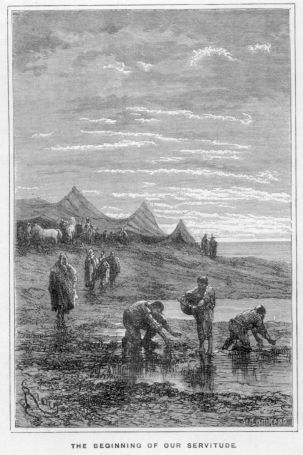
But alas for Ben’s good opinion of them! No sooner were their prayers over than the Arabs, with kicks and cuffs, set the slaves to work; while we had to return to the sea-shore to collect more shell-fish. We were thus employed for the greater part of the day, and could with difficulty obtain a little porridge, or get leave to cook our shell-fish at any of the fires.
Several days passed in a similar manner. We frequently met Antonio,—as I will still call him, though he had another name among the Arabs,—and he never failed to cast a look of anger at us, as if he supposed we had been the cause of his captivity. At length, every root and blade of grass in the neighbourhood being consumed, the sheikh gave the order to prepare for marching. The baggage camels were brought up, the tents struck, the animals loaded (we assisting), and every preparation quickly made. We had hoped to be allowed camels to ride on, but the sheikh ordering us to proceed on foot, we had no help for it but to obey.
On we trudged all day, under a burning sun, sinking up to our ankles in the soft sand. Ben did his best to keep up our spirits, talking away, and even singing; though neither Halliday nor I were able to join him. When we arrived at night, we had to assist in pitching the tents and grinding corn; while frequently we were sent to a distance in charge of flocks of goats. On such occasions, however, we were always separated from each other, and carefully watched, so that we could not attempt to make our escape.
The tribe, as it moved along through the desert, had the appearance of a large army. There were, to begin with, between eight and nine hundred camels, nearly two hundred of which belonged to the chief; and there were fully two thousand sheep, and nearly as many goats. There were also twenty or thirty horses, with a few jackasses; and numerous dogs, chiefly of the greyhound and bloodhound breed, which were used for the purpose of killing hares, foxes, and wolves. Each family possessed a tent, which, with their provisions, water, and effects, was carried by the male camels, while the young and the milch camels were not loaded. When we moved on, the sheep and goats of each family moved in separate droves—the animals keeping close together, and following their respective shepherds; but when we encamped or met with vegetation, they were allowed to spread over the country. They were again quickly collected by the shepherd’s whistle, or, if at a distance, by the sound of his horn. However far-off they might be, the instant they heard the horn in they all flocked; having been taught to do so from their earliest days at the appearance of a wild beast, when their instinct showed them that it was the surest way of escaping from danger. On encamping at night, the camels and flocks belonging to each family took up their proper position in front of the respective tents, near the fires which were immediately kindled for cooking. On several occasions, when we were in what was considered a dangerous neighbourhood, either on account of hostile tribes or wild beasts, the tents were pitched in a large circle, the camels, flocks, and herds being placed in the centre. On such occasions the male camels and horses were kept saddled, while the men lay down by their sides, ready to start up at a moment’s notice. The sheep and goats are much larger than any I have seen in England, with long legs and thin bodies; and when sufficiently fed they can keep up with the camels on a journey, and can run as fast as a greyhound. It is extraordinary, too, how long camels can go without food and water, and on what scanty herbage they manage to subsist.
From being able to talk to the people, Halliday and I had much softened their feelings towards us; and I determined to try what I could do to win the regard of the sheikh. He had a brother, Abdalah by name, a fine-looking young man, who thought a good deal of himself. Making him a profound salaam as he was passing one day, I said: “May your shadow never be less. O brother of the great sheikh, I have heard of your valour and prowess, and I doubt not that your generosity equals it! You see before you two young chiefs, who may some day become great water sheikhs, in command of many thousands of men; and knowing this, I trust you will not allow them longer to endure the pain and suffering they have gone through for many days.”
“Bismillah! is what you speak the truth?” exclaimed Abdalah.
“Your servant would not condescend to speak a lie. Among our people it is looked upon as a disgraceful act,” I answered.
Abdalah did not seem quite to understand this; but my bold address had some effect upon him, and he promised to make a request to the sheikh that we might be permitted to ride on camels when we had long journeys to take. Halliday and I thanked him; and I asked him if he had ever looked through my telescope, of which his brother had possession. He had not done so; and having described its wonders, I promised to show him how to use it the next day.
After we had performed our morning tasks, the sheikh pointed out two camels, with saddles on their backs, and told us that we might mount them. I then asked if Ben might have the same privilege.
“No, no,” he answered. “You might take it into your heads to try and gallop off; and though you would not escape, it would give us the trouble of going after you.”
As we rode along that day, I found that we were once more verging towards the sea-shore. While we were moving onwards, Abdalah came up with my spy-glass hung over his shoulder, and said that he wished me to show him its use. We soon afterwards—being a considerable distance ahead of the caravan—came to a halt, when, dismounting, I pulled the telescope out and put it to my eye. What was my surprise to see, in the far distance, a white spot on the beach, which on more minute examination I discovered to be a tent made of a ship’s sails! Instead of letting Abdalah see it, I turned the glass towards some distant camels, which appeared mere specks rising out of the sandy desert. Abdalah’s astonishment on seeing them, as it were, on a sudden brought within reach, was much greater than mine had been on catching sight of the tent.
After he had amused himself for some time, I informed him that I believed we should find some white men encamped at a distance of less than an hour’s journey, and entreated him to be merciful to them. “That will be as the sheikh thinks fit,” he answered evasively.
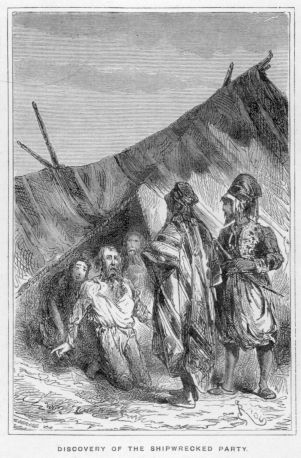
We were now anxious to hurry on, in order to ascertain who the people were; so, mounting our camels, we started off. I was considerably raised in the opinion of the sheikh and Abdalah when they found my prediction true. Dismounting from their camels, Halliday and I following them, they made their way towards the tent. As they drew aside a loose portion, a sad scene met the view. In the interior were a number of persons apparently in the last stage of starvation, whose haggard countenances, long hair and beards, and scanty clothing, showed the hardships they had endured. One of them coming forward, threw himself on his knees, imploring the chief in piteous accents to have compassion on him and his companions.
“Who are you?” asked the sheikh; but the man made no reply.
Halliday and I then stepped forward and looked on. I thought I recognised several of them, and at length was convinced that they were some of the people we had seen on board the Spanish ship. I then asked them if this was the case.
“Yes,” answered the poor man on his knees. “We escaped in one of the boats, and after enduring many hardships were thrown on this inhospitable shore,—several of our people being drowned at the same time.”
I told the sheikh of the sufferings they had endured, hoping to excite his compassion; but he seemed unmoved thereat, though he allowed Abdalah to show us a spot where, by digging, we could obtain some fresh water. The eagerness with which they took it when we carried it to them proved the amount of their thirst; indeed, I believe that all of them would have died in a few hours had we not arrived to their rescue, as they had long exhausted the small stock of water they had brought on shore, and had no idea that, by exerting themselves, they could have obtained a supply close at hand.
Among others I recognised the black boy, our young friend Selim, or Pedro as he was called on board. He at once came forward, expressing his pleasure at seeing us; for, believing that we had been left on board the burning ship, he supposed that we had perished. He had before shown so friendly a feeling towards us that we also were glad to meet him, especially as he did not appear to dread his future lot.
“I am at home everywhere, and I shall not find the Arabs worse masters than others with whiter skins,” he said, shrugging his shoulders.
He and Ben—to whom he had been very attentive on board—at once became fast friends; indeed, he was the only person besides ourselves with whom poor Ben could converse. When the boy caught sight of Antonio, however, he looked anything but delighted. “What, he not drowned!” he exclaimed. “He too bad for that. Well, take care. He do some of us a mischief if he can.”
Having myself formed a similar opinion of the big negro, I was not surprised to hear Selim say this of his countryman; and it was very clear that we must be on our guard against Antonio, who had already exhibited his ill-will towards us. At present our attention was taken up with the castaways, who were, we felt, still more unfortunate than ourselves.
Chapter Ten.
The fate of the shipwrecked party—The well in the desert—We see Boxall—A panther visits the camp—Treachery—Selim proves himself a true friend—Antonio made prisoner—His escape—We rescue the sheikh from a mountain of sand—The salt region.
The fate of the unfortunate people whose boat, after they had escaped from the burning ship, had been wrecked, was cruel indeed; their strength, reduced by famine, made them utterly unable to work, while the hard-hearted Arabs not only refused to assist them, but threatened them with perpetual slavery. The party consisted of an officer of the ship, two seamen, Pedro the black boy, four civilians, and an unhappy lady,—the wife of a Don Fernando, the principal person among them, who had treated us with marked contempt when we were on board the Spanish galleon. His manner was now greatly changed; and we, of course, did not allude to his former behaviour, which we endeavoured to forget. It seemed wonderful that the poor lady should have survived the hardships she had already endured. They were all reduced to the last stage of starvation, with the exception of the black boy Pedro, or Selim,—as will call him in future,—who, accustomed as he was to coarse food, had flourished on the shell-fish, and the roots of some low bushes which grew in the neighbourhood.
Notwithstanding the treatment we had received from some of the unhappy people on board their ship, and though we had been intentionally abandoned, we felt bound to do our utmost to assist them. The camp having been pitched in the neighbourhood, the sheikh ordered them to pack up their tent and move to it. This they were utterly unable to do; but, after much entreaty, we obtained a camel, on which we placed the canvas, arranging it so as to form a seat for the poor lady—her husband mounting to assist in holding her on. As we placed her on it, I doubted whether she would reach the camp alive. The others were compelled to walk, and though somewhat strengthened by the food we had obtained for them, they could with difficulty drag their feet over the sand. On reaching the camp, we divided the canvas so as to form a small tent for the dying lady, and put up another for the rest of the party, who faintly expressed their gratitude to us.
We did not escape having to perform our allotted duties, for all that. The next morning, at daybreak, we were sent down with a couple of baskets to bring up shell-fish from the shore. On our return we found a party of strange Arabs in the camp, engaged in a discussion with the sheikh; and on drawing near I discovered that they were bargaining for the purchase of the unfortunate people who had just fallen into his power, and who, from their weakness, he did not wish to carry along with him.
They took the information I conveyed to them almost with indifference. “It matters little indeed into whose hands we fall,” observed Don Fernando, the chief man among them; “but I beg you to say that if they will convey us to the neighbourhood of any place where a European consul resides, they will obtain a large sum for our ransom.”
I told the strange sheikh this, and it made him ready to give a better price than he might otherwise have done, much to the satisfaction of Hamed.
On going to the tent of Don Fernando I found him stretched over the body of his wife, who had just breathed her last. Sad indeed was the poor man’s fate, and we pitied him from our hearts, though we could do little to comfort him. His once haughty spirit was completely broken down. We at length aroused him; and calling Ben to our assistance, Halliday and I conveyed the body of his wife to a distance from the camp, where we dug a grave and buried her, he attending as the only mourner. He was then delivered over to his purchaser with the rest of the Spaniards, the young black alone remaining with us. We could not help pitying the poor people as we saw them carried away, though their fate might not be worse than ours; indeed, as they had some prospect of being redeemed, it might be better.
I must now give a more rapid account than heretofore of my adventures. Again we struck the tents and proceeded more inland, over hard ground producing wild bushes, but not a blade of grass or a drop of water. We then came to a region consisting of hills and valleys of sand, over which we had to trudge on foot, suffering fearfully from thirst. After proceeding about ten miles we saw before us a low circular wall of sunburned bricks, with a few stunted palm-trees. The Arabs pointed towards it eagerly, and even the camels and other animals lifted up their heads. It marked the position of a deep well, near which we encamped; and for the remainder of that day and the greater part of the next we were employed in drawing up water, not only to furnish ourselves and the animals, but to fill the water-skins carried by the camels, on which we were to depend for several days to come. This task accomplished, we continued our route over the sand. Here we saw a few deer, of a small size and of a somewhat yellow colour, with black streaks along their sides, and small straight horns; their legs were long and slender, and they flew over the sand at a speed which the fleetest greyhound could not equal. Here and there we met with small bushes of a palm-like form. When we halted at night we were employed in getting some roots which ran along the sand, and which were about the thickness of a man’s finger. They were sweet as sugar, and the people as well as the cattle ate them. Barren as the region appeared, we saw three or four species of birds, the largest of which were bustards; and on searching in the sand we frequently came on their eggs, which afforded us the most satisfactory food we had yet enjoyed. About ten days we spent in passing through this sandy district. We then entered on a region of firm soil, sometimes presenting a hilly surface, and occasionally plains of hard clay sprinkled over with bushes, but without any other vegetation, and almost destitute of water. We were fully a month traversing this kind of country. We had left it a couple of days, when we saw before us a stream of running water. Oh, how eagerly we rushed forward, expecting to enjoy a draught; but when we knelt down and plunged in our faces, how bitter was our disappointment on finding that it was far too brackish to drink. However, Halliday, Ben, and I ran in and had the luxury of a bath; but the Arabs, being indifferent at all times about washing, would not give themselves the trouble of taking off their clothes for the purpose.
This was the first of several streams we met with of the same character. When encamping near them, however, the brackish water served to wash the cattle in the way I have before described. Again fresh water failed us, and in a short time the stock carried by the camels was exhausted, and not a drop remained in our skin-bottles. Nearly a whole day we had marched, under the fiery rays of the sun, our mouths so parched that Halliday and I thought we should sink to the ground; but knowing that we should meet with little or no sympathy from our task-masters, we did our utmost to keep up with Hamed and his brother. The ground was covered with bushes, and here and there a few stunted palm-trees reared their heads somewhat higher above the surface. At last I was obliged to cry out to Hamed that I could go no further.
“Courage, Nazarene! You will see water before long,” he answered.
Scarcely had he spoken when we caught sight of a party of Arabs approaching from the opposite direction. Hamed and his followers urged on their camels; and it soon became doubtful who would first arrive at the water. If we did, by the law of the Desert it would be for our use and that of our beasts till all were satisfied; but the law of the Desert is often superseded by the law of the strongest. The other party still came hurrying on; when all at once we saw Sheikh Hamed, who had urged on his camel ahead of us, suddenly rein it in, and wave his spear. We therefore exerted ourselves, and were soon up to him. The strangers halted at a little distance off, under some palm-trees. There were five of them, besides three men on foot. We stood thus for some minutes eyeing each other. Would they yield to our inferior numbers? They stood still, as if in doubt—perhaps intending to wait till we and our beasts were satisfied, unaware of the numerous bands in our rear.
As I looked at them I could not help fancying that one of the persons on foot was a white man. I asked Halliday if he could make him out.
“A white man he certainly is, and it is my belief that it is Boxall,” he answered.
I thought so too, but feared I might be mistaken. We waved our hands. He recognised us, I felt sure, though Halliday doubted it; at all events, we were about to hurry forward to meet him, regardless of our thirst, when the leading columns of the caravan appeared in the distance, and the strangers, seeing that they had no prospect of successfully disputing the water with us, hauled the men on foot up on their saddles, and went off at a round gallop. We were grievously disappointed at thus missing the opportunity of speaking to Boxall; and should he have failed to recognise us, the chances of our being able to hold any communication with each other would be greatly lessened. However, as he was in the neighbourhood, we might still hope to meet him, and concoct some plan for effecting our escape.
The pool over which the Arabs would have been ready to shed each others’ blood was between thirty and forty feet in circumference, five or six feet deep, and contained little more than a foot or so of stagnant water; but, stagnant as it was, we drank eagerly of it. At the edge was sitting a huge frog, its sole living occupant, as far as we could see. We were about to drive the reptile away, when the sheikh exclaimed, in an agitated tone, “Stay, Nazarenes! disturb not the creature. It is the guardian of the pool, and should it be destroyed the water may dry up for ever.” Obeying the sheikh’s commands, we let his frogship watch on; but I suspect that he must have had an uneasy time of it, while the animals of the caravan were drinking up his water till every drop was exhausted.
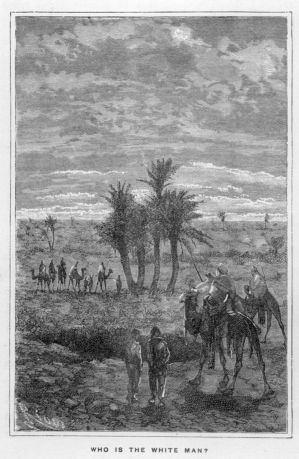
As we travelled on, we frequently came in sight of other Arab tribes, but though moving in the same direction we never pitched our tents near each other. Occasionally, however, when the chiefs were on friendly terms, they would ride on together; though they always parted before the time of camping arrived. This was done because of the difficulty of finding water and food for their cattle. Sometimes we fell in with hostile tribes, when the cattle were driven close together, and the armed men drew up in battle array, ready to resist an attack. The Arabs do not, however, often engage in battle with each other, unless one party can surprise an enemy, or is much superior in numbers.
In vain did we look out for Boxall; and when I tried to ascertain from the sheikh’s brother to what tribe the Arabs belonged whom we had seen at the pool, he would only tell me that they were enemies, and not good people.
At length, in the far distance, we caught sight of groups of tall palm-trees rearing their heads above the plain. At first, so accustomed were we to low bushes, I expected to see them only a little higher than usual, and was surprised at the length of time which elapsed before we reached them. We were delighted to find ourselves under their cool shade, and on the borders of a stream flowing in their midst. The Arabs, however, did not exhibit the same satisfaction; the animals were kept closer together than usual, while a vigilant watch was placed over them. I inquired the cause of these precautions, and was told that the forest was infested with wild beasts, and that we should be fortunate did we escape without being attacked. We had not gone far, indeed, when we caught sight of a lion stalking amid the trees; but after looking at us for some time, as if he would like to pounce upon some of the sheep or goats, he walked off, intimidated by the shouts and cries of the Arabs. We took warning, and did not stray from the camp.
Among many other trees in this forest, I remarked cocoa-nut, date, and wild orange trees; indeed, the region appeared so fertile, that at first it seemed surprising that the Arabs should not have taken up their abode there. There were many reasons, however, for their not doing so: the strongest was their unconquerable love of a wandering life through the desert wilds; another and very important reason was, that the vast number of wild beasts which inhabited the forest would have proved very destructive to their flocks and herds. There were also several tribes already in possession, who would have proved formidable enemies had they attempted to settle in the neighbourhood.
We had evidence the following day of the destructive power of the wild beasts. The caravan was already in motion, the chief men and the baggage camels being in front, a small guard only bringing up the rear. Halliday, Ben, and I, with our young negro companion Selim, were tending the flocks placed under our charge—several of those belonging to other families of the tribe being on the outside of us. It was about noon, and the rays of the sun struck down between the lofty branches, rendering the heat almost insupportable. As we were moving on we observed the camels ahead hesitating to advance, notwithstanding the efforts of their drivers to urge them forward. A cry was then quickly passed from rank to rank that wild beasts were at hand; and the guards looked to their firearms. Suddenly a huge panther leapt from a thicket almost into the midst of the nearest flock. Muskets were discharged from all sides, at the no small risk of hitting either the shepherds or the sheep. Several men, bolder than the rest, rushed forward with their spears to attack the panther; but, with a blow of its paw, and regardless of the spears thrust at it, it knocked over two of its assailants; and springing at a third, who was endeavouring to make his escape, brought him to the ground. The panther was now in the midst of the flock; and while some of the guards were reloading their weapons, it seized a sheep, and, before they could fire, bounded off with it as easily as a dog would with a fowl. Though several shots were sent after it, the animal, unhurt, disappeared in the forest. And this was only one of several instances of a similar character which occurred during our journey.
We now ran to the assistance of the three men who had been struck down; but they were all dead. Loud wailings arose from their comrades, who, taking up their bodies, carried them to the spot where we halted for the night. Double guards were set, and fires lighted round the camp to frighten away the wild beasts. The night was spent by the Arabs in bewailing the loss of their companions; and at daybreak the next morning the dead were carried forth and graves were dug, when they were committed to the earth—some time being spent in piling up stones over their bodies, to prevent the hyenas or other wild beasts from digging them up.
The instance I have mentioned was too common an occurrence, however, to make much impression on the rest of the people.
Antonio had of late appeared to have forgotten his former animosity towards us, and whenever he could find opportunity he entered into conversation with Halliday and me. Still, notwithstanding the friendly manner he put on, I did not trust him; for there was something so singularly repulsive in his countenance, that I could not believe he was sincere.
He told us at last that we were approaching his country. “Now will be the time for you to make your escape,” he said in a confidential tone. “You are weary of this life, I am sure; and if you will fly with me, you will be welcomed by my people, and be treated as great chiefs: besides which, as they have constant communication with the coast, you will without difficulty be able to return to your own country.”
He was one day speaking in this way, when Selim, who was near, overheard him, but pretended to take no notice. The lad, however, watched for an opportunity when I was alone, and warned me not to trust the black, “He hates you and your friends, and has resolved on your destruction,” he whispered to me. “I overheard him, when he did not know I was near, speaking to Abdalah, and it is clear that his intention is to betray you. Now, we will try to be even with him; the sheikh already mistrusts him, for he has been the cause of much trouble in the camp, about which I will tell you by-and-by. Do you therefore pretend to agree to his plans, and tell him that he must steal out first to a certain place beyond the camp, and that you will join him. I will then take care to let the sheikh know that he has gone, and that you have no intention of deserting, and will advise that men should be sent to seize him. If he is caught, it will prove that what I have said is true; and if he escapes, he will be afraid to return, and we shall be quit of him.”
“But we should thus be acting a very treacherous part, to which I can on no account consent,” I answered.
“You must leave that to me,” replied Selim. “All you have to do is to listen to his plans: and depend upon it, if you do not, as I advise, pretend to agree with them, he will find some other means to betray you.”
Notwithstanding what Selim had said, I, of course, could not consent to do as he proposed. However, I found he was not to be defeated. He managed to insinuate himself into the confidence of Antonio, and persuaded him that it would be imprudent to be seen conversing with me, but that he himself would act as go-between; and he was thus able to manage matters according to his own fancy. Had I known at the time how Selim was acting, I should have felt it my duty to put a stop to his proceedings, although they were intended for our benefit.
The very next night there was a commotion in the camp, and we heard that Antonio had been sent for by the sheikh. His name was shouted in all directions, but he was nowhere to be found. Soon afterwards a party, accompanied by Selim, set out from the camp; from which circumstance I had little doubt that the young black had carried out his treacherous plan. I could not help fearing, at the same time, that, notwithstanding his precautions, Ben, Halliday, and I might be implicated in it, and suffer accordingly.
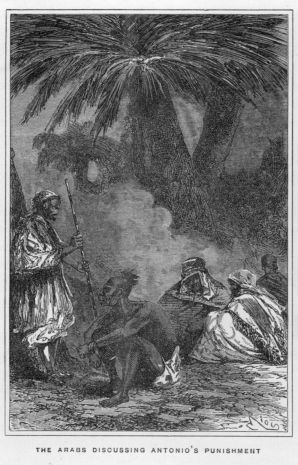
We were still employed in our usual evening’s occupation when the party returned, bringing back Antonio, with his hands securely bound together. As the light of the fire, opposite which he was led, fell on his countenance, it struck me that it had more of an angry and vindictive than of a downcast look. He threw his fierce glance on me especially, appearing even then to be meditating a bitter revenge, as he naturally considered that it was owing to my treachery that he had been captured. He was forthwith conducted into the presence of the sheikh, who, with his brother Abdalah and other elders of the tribe, was seated by a fire beneath a group of palm-trees. Here, squatting on the ground, with a guard standing over him, he was allowed to listen to the consultation they were holding as to the punishment he merited.
Selim, who managed to get near enough to hear what was going on, told us that some were for shooting him forthwith, or cutting off his head, while others considered that a sound beating would be sufficient to keep him in order. Though the Arabs are as well acquainted with the bastinado as the Moors and Turks, policy rather than mercy decided them on not inflicting it, as he would thus be unable to march, and it would be necessary to burden a camel with him for many days to come. It was at length decided that he should receive a severe beating; and that, should he still be refractory, he should be sold to the first slave-caravan for any sum he would fetch. That might seem a light punishment; but, as strong slaves are often compelled to carry burdens as well as work hard, should he be sold he would have to march for many months over the burning desert,—and as slave-merchants keep a watchful eye on their property, he would have but little chance of escape: so the fate in store for him was calculated, it was considered, to keep him on his good behaviour.
“The camp will not be long troubled with him, however,” said Selim, when he had finished his account. “He is sure before long to create a disturbance, and the sheikh will sell him to the first caravan we meet with.”
The Arabs, however, little knew the man they had to deal with. A guard was set over him; but though watchful enough when an enemy is expected to attack them, the Children of the Desert are, when in charge of a prisoner, as liable to yield to drowsiness as other people, under the belief that he too will fall asleep. Such, probably, was the case in the present instance. When morning dawned, Antonio was not to be found. His guards declared that they had seen a thick smoke ascend from where he lay, and that when they went to the spot he had disappeared,—thus proving without doubt that the Jins (or evil spirits) had carried him off. A diligent search was made round the camp, but no traces of him could be found, and no one could guess the direction he had taken.
We now again moved forward, and were once more in the open country. By Selim’s advice, Halliday and I did our best to ingratiate ourselves with the sheikh. “He thinks well of you already,” he observed, “because you can speak his language; and if you can gain his confidence you will certainly be better treated, and perhaps be able to obtain your liberty.” We were well-disposed to take this advice. The sheikh, I considered, was only following the instincts of his nature in making us slaves; and I hoped, by working on his good feelings (supposing he possessed any), ultimately to obtain our liberty: and, at all events, we should be better off while we remained with him.
I must briefly describe the chief incidents of our journey. We had now again obtained the use of camels, and were riding on ahead with the sheikh, who usually liked to converse with us, as we could tell him of strange countries, and of events of which he had no previous conception. The noonday sun was beating down on our heads, without a breath of wind to cool the air, when we saw before us a vast, almost perpendicular wall of sand, which seemed completely to bar our way, extending as it did so far to the east and west that it might require not only one, but several days’ journeys to get round it. The sheikh, though at first somewhat daunted at the appearance of the barrier, declared that there must be a passage through it, and that through it we must go if such passage could be found.
Turning to the left, he led the way under the sand cliff, narrowly eyeing the ground in the hope of finding the footmarks of any camels which might have preceded us. On we went, the remainder of the caravan waiting for a sign from their chief to advance. At length there appeared a gap in the cliff, if I may so call it,—just as if a violent current of wind had forced its way through the barrier. The sheikh examined it, evidently doubting whether it would afford a safe passage for himself and his numerous followers, with their flocks and herds.
At last he moved forward ahead of us, to examine the passage more narrowly; now looking to the right, now to the left, as if disliking the appearance of the towering masses of sand above his head. At length he exclaimed, “If it is the will of Allah that we should perish, why longer hesitate?” and waving his spear, he urged on his camel into the centre of the gorge.
I was on the point of shouting to him to stop, for I observed the summit of the cliff begin to tremble ominously, as if it felt the effect of the camel’s feet at its base; but in another instant down came the avalanche of sand, entirely surrounding the sheikh, who in vain endeavoured to force his way out. Higher and higher it rose, his camel struggling violently—while he clung to its back, knowing that should he lose his hold he himself would be speedily overwhelmed. His brother and the rest of the leading party stood aghast, afraid of sharing his fate should they attempt to go to his rescue; while, regardless of what might be the consequences to myself, I dashed forward, calling to Halliday and Ben. Fortunately, I carried secured to my saddle a long coil of rope, which I had found useful in surrounding my flock at night; and telling my companions to hold fast to one end, I took the other, and, throwing myself from my camel, dashed into the midst of the sand. I knew, however, that at any moment, should I be completely overwhelmed, they could draw me out.
I made my way with great difficulty, almost at times covered up by the sand, till I succeeded in crawling rather than walking up to the spot where the sheikh was struggling.
“I have been sent to your rescue, O sheikh,” I cried out, throwing him the end of the rope. “Secure this to your camel’s body.” He quickly did as I advised him.
“Is it secure?” I asked. The reply was in the affirmative.
“Hold on then, O sheikh, and we will draw you forth!” I exclaimed; when, hurrying back to my companions, we fastened the other end of the rope to our three camels, which with might and main we urged away from the bank.
Faster and faster came down the sand from above; but we pulled and pulled, while the sheikh’s camel struggled, trampling the sand down with its fore feet; and in a few seconds we had hauled him out from the midst of the sand, and once more safe among his followers—who rode up to congratulate him, and to compliment us on the service we had rendered.
“You have done well, O young Nazarene,” he exclaimed, turning to me; “and from henceforth know me as your friend. Though I cannot grant you your liberty—which in this place would be of no use, as you would certainly be murdered were you to attempt to cross the desert alone—yet, on my return to the north, I will venture as near the settled districts as I can, that you may have an opportunity of reaching your countrymen.”
I thanked the sheikh in proper terms, assuring him of the satisfaction my companions and I felt at having rescued him from the dangerous position in which he had been placed.
Quickly recovering himself, and being quite indifferent to the quantity of sand clinging to his garments, he rode along in search of a more practicable opening. This at length was found; and as the valley was much broader, and the sand slanted more gradually on either side, there appeared a fair prospect of our being able to pass through. The whole caravan then entered the defile between the sand-hills; but we were fully three hours travelling between those prodigious masses of sand. Sand was below our feet, sand in front and behind, sand on each side. A sudden blast would inevitably cover us with it for many feet. It was nervous work. Fatalism alone could have induced men, fully alive to the danger they were incurring, to venture into such a position. To add to our danger, the loaded camels frequently fell down, and we were compelled to take off their burdens to enable them to rise.
At length, overcome with fatigue, the whole caravan emerged from the defile on firm ground, where we encamped,—but without a drop of water to quench our burning thirst. The only liquid that we could procure, and that in very small quantities, was milk from the camels and goats.
We at length reached a pool of brackish water, which somewhat restored us. Further on we passed over a region of salt. Here the ground, as we advanced over it, gave way under our feet, producing a crackling noise, just as snow does when trod on after being slightly melted and again hardened by the frost. I observed numerous heaps of beautiful crystallised salt, perfectly white, arranged in peculiar order and symmetry. This salt region was of considerable extent. In certain places we found that the ground had been dug up; and I heard that caravans came there for the express purpose of loading their animals with salt, to convey it to far-distant parts of the continent.
Though the sheikh may have thought it beneath his dignity to express many signs of gratitude to us for the service we had rendered him, yet our condition was considerably improved, and we had less hard work than usual to perform; still, we were by no means allowed to eat the bread of idleness.
As we were travelling on, when I happened to be in the rear I observed in the far distance a small black object, which, from its constantly appearing in the same direction, I could not help believing was some person following the caravan. The Arabs did not seem to have noticed any one; but my mind instantly fixed on Antonio, and I felt sure that he had some treacherous object in view. However, until I had ascertained that I was right in my conjectures, I thought it would be more prudent not to tell the Arabs, as, should he be pursued, he would in all probability make his escape or hide himself, and I should be accused of creating a false alarm, and might be ill-treated in consequence. I contented myself, therefore, with merely telling Halliday and Ben, who were of opinion that I was right; and we agreed to be on the watch, lest he should steal into the camp at night with the intention of murdering us, or watch for us should we venture outside. At all events, we were certain he was capable of any treachery, and that he would run any risk for the sake of gratifying his revenge.
Chapter Eleven.
Conversation on religious matters with the Sheikh and Marabouts—The slave track—At the shrine of the saint—I start on a journey—The sheikh grants me a favour—An unpleasant duty—attacked by a wild beast—Antonio haunts our camp—Arrival at our destination.
Day after day we continued to travel southward—further and further from home, as it seemed to us. Whenever we could meet, Halliday, Ben, and I—not trusting to the sheikh’s promises, of whose fickleness we had many proofs—eagerly discussed the possibility of escaping. Ben’s idea was, that if we should arrive at length at a river running into the sea, we might either steal a canoe or build a raft, and float down the stream. We might thus escape from our present masters, who, unaccustomed to the water, would be unable to follow us; but we should run the risk of falling into the hands of still greater savages, who might very likely murder us. Still, our present slavery was well-nigh unbearable, and we were ready to run every risk to escape from it. We were doubtful whether we might venture to take Selim into our counsels. He seemed attached to us, and especially to me; but then, as he had shown a readiness to act treacherously in the case of Antonio, he might, should it be to his interest, play us a similar trick, Halliday thought. I was more inclined to trust him; I liked the expression of the lad’s countenance, and he had hitherto, as far as we could judge, been faithful to us. During the time he had been on board an English ship-of-war, he had learned the truths of Christianity from the boatswain and three or four of the men, who, having become truly converted themselves, had endeavoured to win over their shipmates, and had taken great pains with him. He had been the only survivor of a boat’s crew wrecked on the northern coast of Africa—he, being an excellent swimmer, having gained the shore. He had been kept in slavery a year or more by the Moors; but he at length managed to swim off to a Spanish vessel, and afterwards entered on board the galleon where we first met with him. Accustomed, therefore, to the habits of the Moors, he was able to conduct himself discreetly towards them; and passing for a good Mohammedan, he had in a considerable degree gained their confidence. He had, however, expressed to me more than once his regret at having to play the hypocrite.
“What can I do?” he would observe. “I know that Mohammed was a false prophet; but if I were to say so I should have my head cut off—and to that I cannot make up my mind. Every time I cry out ‘Allah is great, and Mohammed is his prophet,’ I know that I am telling a lie, and pray to be forgiven. Do you think that the true God will forgive me?”
I replied that it was not for me to decide, but that I thought he was bound to try and escape from such thraldom on the first opportunity.
“That is what I shall do,” he answered; “but I will not escape without you; and as I know the ways of the country, and can speak the language of the black people further south, I may, I hope, be of use to you.”
After this conversation, he came to me one day and told me that the sheikh and two marabouts, or priests, who were in the camp, had resolved to make me and my companions turn Mohammedans. “I warn you, that you may know how to behave. Let me advise you not to show any indignation, but rather to pretend that you are ready to listen to what they call the truth.”
The very next day the sheikh summoned me into his presence. I found him seated with the two marabouts; and they at once explained the doctrines of the Mohammedan faith, and to which, according to Selim’s advice, I listened with all the respect I could assume.
“Are you acquainted, O sheikh, with my religion, from which you wish to turn me?” I asked quietly.
“Yes; you worship Jins, and have dealings with the Evil One,” he answered in a confident tone, as if he knew all about the matter.
I have since met others, in more enlightened lands, equally confident as to their knowledge of the religious opinions of those who differ from them, and equally wrong.
“You have been misinformed, O sheikh; pardon me for saying so,” I replied calmly. “I worship the one true God. Listen to the prayer I offer up every morning.” I then repeated slowly, and with all due emphasis, the Lord’s Prayer. The sheikh and marabouts listened with astonishment depicted on their countenances.
“Can this be so?” asked the sheikh. “Such a prayer as that any true believer might be ready to offer up.”
“Forgive us our offences, as we forgive them that offend against us,” I said slowly, looking at the sheikh. “Can you pray thus and expect to be forgiven?” I asked.
“Truly the young Nazarene has put a puzzling question,” observed the sheikh, turning to the marabouts. They shook their heads, unable to reply, but still unwilling to confess themselves defeated.
“Now, O sheikh, understand that we Christians desire to follow that precept, not from cowardice or a mean spirit, but from obedience to our Lord and Master; and would you therefore wish to induce me and my companions to abandon a faith inculcating so pure and holy a precept? Understand that where it is practised, blood feuds, and the many other causes which produce the quarrels and bloody wars so constantly prevailing in this region, are impossible. Peace and prosperity reign in exact proportion as the true Christian faith gains the ascendency among a people.”