"Saved from the Sea" (continued 4)
Reading edition
“You argue well, young Nazarene,” said the sheikh. “I may not see with your eyes, but I respect your opinions.”
We said much more on the subject, and I had reason to hope that, without sacrificing my principles, I had gained the respect of the sheikh; but one of the marabouts, at least, was far from contented with the result of our conversation. He constantly afterwards attacked both Halliday and me, endeavouring to convert us, and threatening us with severe penalties if we refused.
We had now got a considerable way to the east, and were passing along the track of caravans moving northward with slaves, collected in the Black States, to the southward of the Desert. The whole road was marked by the skeletons of human beings, who had expired from thirst and hunger. As I was riding along on my camel, dozing in consequence of the heat of the sun, I was awoke by hearing a crashing sound, and on looking down I saw that my beast’s feet had stepped upon the perfect skeletons of three or four human beings, which gave way beneath them. The head of one of the skeletons, detached by a kick from the animal’s foot, rolled on like a ball some way before me. The Arabs took no notice of the occurrence, however, remarking that they were only those of black slaves, and of no account.
It was about this time that several of our camels knocked up; and seeing that they would not live, the sheikh gave the order for them to be killed. I was struck with the savage expression of the Arabs, who stood ready with their knives in their hands, waiting for the signal to plunge them into the bodies of the poor animals—which, before they were cool, were cut up to supply food for the caravan. The head of the camel to be slaughtered being turned towards the east, an Arab stuck his dagger into its heart, when it almost instantly dropped dead.
A good many camels having been thus lost, Halliday, Ben, and I were compelled, as at first, to trudge on on foot.
All this time I had not forgotten Antonio, and I was sure that I occasionally caught glimpses of him. How he managed to subsist, might seem surprising; but he had armed himself, and was thus able to kill any animals he might meet with: he might also pick up subsistence from the remains of the camels, sheep, and cattle which dropped on the road. Possibly, too, he had some confederates in the camp, who might have hidden food as well as ammunition,—which, when we moved on, he would know by certain marks where to find.
We at length reached a somewhat more fertile region, where date, cocoa-nut, and other palm-trees were once more seen; while beyond it was a large lake, on the borders of which we heard was the shrine of a Mohammedan saint, at which the people of the caravan were about to worship. Out of the lake, we learned, ran a broad river to the westward; a fact which created in us the most lively interest, for it might afford us the long-looked-for means of making our escape.
As we neared the sacred precincts, the marabouts again endeavoured to make us change our religion. On our refusing, as formerly, to do so, they became very angry, even the sheikh himself appearing to be much disappointed. While we lay encamped, a day’s journey, I understood, from the shrine,—which was to the eastward of us,—he sent for me, and expressing his confidence in my fidelity, informed me that he intended to trust to my care the widow and children of a friendly chief, who had died while visiting the tomb of the saint. “Her relatives, to whom she desires to return, dwell about twelve days’ journey off; and you will return before we again set forth on our journey northward. I will send two guides with you who know the country; but as our camels require rest, you will be compelled to proceed on foot. The widow and her children will, however, be provided with a camel; and the guides will conduct another laden with provisions and water. Here,” he said, giving me an old-fashioned, large-mouthed pistol, “is a weapon with which you can defend yourself and your charges; and here, also, is a pouch with ammunition. You will set out to-morrow morning; and may no harm befall you on the way!”
I hardly knew whether to be pleased or not at the confidence placed in me. Halliday and I had been hoping that while at this spot we might find an opportunity of escaping down the river, as we had proposed,—and should I be separated from him and Ben, our plan might be defeated. So as soon as I had left the sheikh I went in search of them, and told them of the expedition I had been ordered to make.
“I am afraid you will have to await my return before we can venture to carry out our plan.”
“I don’t quite see that, sir,” said Ben. “You are going to the west; and that is, I suppose, the direction the river takes. Now my idea is, that if we can make off while the Arabs are praying to their saint, we can meet you half-way on your return; and then we can all steer for the river together, and either borrow a canoe or build a raft, as you proposed.”
“But the risk of missing each other is very great,” I answered. “I am therefore still inclined to hold to my opinion, that it will be better to wait till I can get back; and if I can give a favourable account of my mission, the sheikh will place more confidence in us, and we shall be less strictly watched than heretofore.”
“I propose that we consult Selim,” said Halliday. “He has been making inquiries about the country, and has picked up a good deal of information which might be useful to us.”
“I am sure, from what he has said to me lately, that he can be trusted, and that he is as anxious to escape as we are,—so I agree with you, Halliday,” I said. “Perhaps the sheikh will allow him to accompany me; if so, he will be of great assistance in enabling me to find you out. I might ask to have him, on the plea that he understands the language of the people.”
My companions agreed to this proposal, and I undertook at once to petition the sheikh that he would allow me to take Selim. It was also settled that my friends should endeavour to escape from the camp exactly twelve days after I had left it, when they were to make their way along the banks of the river for six days, and then look out for me. I undertook, on my part, to return eastward for the same length of time, also keeping as closely as possible to the river. By this plan we had good hopes of meeting, though we could not conceal from ourselves that there were many dangers to be encountered; but yet no more feasible plan presented itself.
So confident did I feel in Selim’s honesty, that, without speaking to him, I at once went back to the sheikh and boldly requested that he might be allowed to accompany me. To my great satisfaction, he at once consented.
“He is a sharp lad, and you will find him of great use on your journey,” he added.
Selim, whom I soon afterwards found, was greatly pleased at what I told him.
“We may hope, then, to shake the dust of the camp off our feet for the last time,” he said quietly.
I had fixed my eyes on Selim’s countenance as he spoke. He turned his on me with so honest a look, that I was more than ever convinced he was sincere. I took his hand, and said,—“We understand each other, then; if we escape to my country, notwithstanding the difference in the colour of our skins you shall be my friend for life.”
“I hope so,” he answered. “Though we may be wide apart, our hearts may be joined; and we may meet above, in that happy land to which all Christians are bound.”
I had no longer a shade of doubt as to Selim proving faithful.
Next morning Selim and I, according to the sheikh’s directions, waited outside the camp, when he, his brother Abdalah, and two other chiefs appeared, conducting a couple of camels. On the first was placed a palanquin of wicker-work, ornamented with silk hangings, and a tuft of feathers on the top. Within it was seated a veiled lady and three small children, whose black curly heads made them look more like negroes than Arabs. There was apparently some mystery in the matter, into which it was not my business to inquire. Leading the other camel, which was laden with provisions and a small tent, were two guides, both of whom were negroes, though dressed in the Arab fashion. The sheikh then uttered a benediction on the occupant of the palanquin and her young family, and ordered us to advance. The guides, with Selim, went first, by the side of the baggage camel; and I, with the veiled lady, followed. Whether I was to see her face or not, I could not tell, nor was I very curious about piercing the mystery connected with her.
The sun was still rising at our backs, as, moving forward at a tolerably quick pace, we soon lost sight of the camp.
We had gone several miles, Selim always keeping ahead with the guides, with whom he was apparently engaged in an interesting conversation. I was already beginning to feel somewhat tired, when a voice from the palanquin desired me to take out one of the children, as the little urchin had a fancy to be carried instead of being cooped up within it. Unwilling to disoblige the lady, I obeyed; so, placing the child on my shoulder, we again moved on—though, as I dragged my weary limbs along, I felt very much inclined to let the young urchin drop. Feeling, at last, that I could no longer carry him, I begged the veiled lady to take him in again; but she, looking on me as a slave bound to obey her commands, replied that he preferred riding on my back, and that I must carry him as long as he wished. Accordingly, to avoid a dispute, I again took up the urchin and staggered on, strengthened by the hope that my days of slavery would soon come to an end.
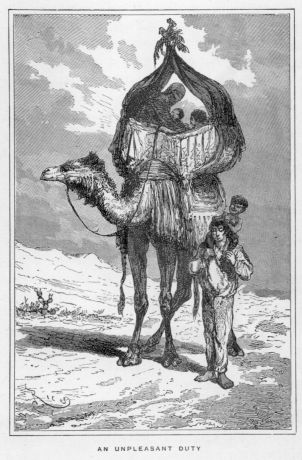
I had not forgotten my suspicions about Antonio, and wondered whether he was still in the neighbourhood, or if he had observed us quitting the camp. If so, I had little doubt that he would follow in our footsteps, and attack us should he find an opportunity. He might, indeed, at the present moment be stealing upon us to shoot me, and carry off the lady, before the guards could be aware of his approach. As may be supposed, therefore, I very frequently turned my head anxiously round, almost expecting to see him. I also began to think that the sheikh had acted very imprudently in sending the lady with so small an escort, and I regretted that I had not begged to have a greater number of guards; at the same time, it occurred to me that I should have had more difficulty in escaping from them than from the two men who accompanied us.
The thought of the possibility of being suddenly attacked by Antonio added not a little to the annoyance I felt at having to carry the little blackamoor. Still, unwilling to offend his mother, I went on without complaining as long as I could walk. I felt very much inclined, I confess, to pinch his legs and make him cry out, especially when he amused himself by pulling at my hair, evidently thinking it very good fun.
We had gone some distance when, turning my head, I saw—not Antonio, but a large panther, stealing out from a thicket at some distance on our left, and approaching us with stealthy steps. “Now, lady, unless you wish your child to be gobbled up by yonder monster, you must take him,” I cried, throwing the urchin, without waiting for a reply, into the palanquin, and shouting out to Selim and the guides to come to my assistance, as I had only my pistol slung to my back—a very unsatisfactory weapon with which to encounter a wild beast. The guides had carbines and spears, indeed; but it was a question whether they would use them or run away.
Selim at once gave proof of his courage and fidelity, however, by snatching a carbine from one of his companions, and rushing back at full speed towards me. “Don’t fire your pistol,” he cried out; “keep that, lest my carbine fail to kill the beast.”
The panther came on, in spite of the shouts which the guides set up, while they waved their cloaks and spears, and did their utmost to frighten it away. When within about a hundred yards of us, however, the savage creature stopped. This encouraged the guides, who now moved hesitatingly towards us. But again the panther crept on, though with less boldness than at first, as if it had expected to pick off the rearmost of the party, and was disappointed in its object. Seeing that should we move on the panther would follow with rapid bounds, I ordered the guides to stand still; and snatching the carbine from Selim’s hand, I knelt down that I might take a surer aim. Knowing, however, that the Arabs’ powder is often very bad, and that, consequently, their weapons frequently miss fire, I felt very doubtful whether such might not be the case on the present occasion.
“Silence!” I cried out to my companions, who were still shouting and hurling fearful epithets at the head of the panther. “Only cry out should it attempt to spring.”
The savage brute came on, and was now within twenty paces. Two or three bounds might bring it upon us. So, praying that my weapon might prove faithful, I drew the trigger, aiming at the panther’s breast. The piece going off, I was knocked over by the rebound; for the owner, in loading it, had put in a double charge: indeed, it was a wonder that it did not burst. When the smoke cleared away, I caught sight of the panther struggling on the ground, a few paces only in advance of the spot where I had last seen it; and the Arabs, shouting “E’sheetan! E’sheetan!” now rushing forward, plunged their spears into the creature’s body, uttering a curse with every thrust they gave it.
“Allah akbar!” exclaimed one. “It was a regular Jin.”
“No doubt about it. You Nazarene have done well; for if you had not killed him, he might have carried one or all of us off,” cried the other.
I felt very thankful at having succeeded, because I had not only killed the panther, but had risen considerably in the estimation of my companions. I should have liked to have had the animal’s skin; but I was unwilling to delay our journey, and we therefore pushed on. I beckoned to Selim to walk alongside me; and I still carried the carbine, which I had reloaded from the guide’s pouch.
“I think we shall do well,” said Selim; “I have been talking to those men, and they are well-disposed towards us. We shall, therefore, have no difficulty in escaping from them; indeed, one of them was once a slave himself, and would like to leave the tribe altogether. I have been telling him of the countries I have visited and the wonderful things I have seen, and he is eager to go and see them.”
“They may be well-disposed; but we must take care, Selim, that we are not betrayed by them,” I observed. “We must first accomplish the object of our mission; and we have a good many dangers yet to encounter.” I then told him of my apprehensions regarding Antonio, and charged him to keep a good look-out himself, and warn the guides also to be on their guard.
Selim listened with attention to what I said.
“I am afraid that you are right,” he answered. “Last night, while we were encamped, I fancied that I caught sight of an object moving in the distance. I took it for a wild beast, and accordingly threw more wood on the fire and made it blaze up, and thus, as I supposed, frightened the beast away. I remarked, however, its extraordinary shape, and for some moments believed it to be a man; but as I gazed towards it, it disappeared in the darkness, and so I thought that my fancy had deceived me.”
From what Selim said I now felt perfectly sure that Antonio was following us, and so determined the next night to remain myself on the watch, with the carbine by my side. Accordingly, after we had pitched the tent and had taken our supper, I lay down close to the camel,—the palanquin, which had been taken off its back, assisting to form a screen. The other camel lay on the opposite side,—the fire being in the centre,—while boughs of prickly pear, which we cut down, formed the remainder of the circle. This was our usual style of encampment, and it afforded a tolerable protection against wild animals.
I had not been long on the watch, when, as I was looking eastward, I saw a shadowy form slowly emerge from the darkness; as it approached it resolved itself into the figure of a man of gigantic size, as it appeared to me, but having certainly the air of Antonio. He stopped, and appeared to be surveying the camp. I saw that he grasped a large scimitar in his hand; but he had evidently no firearms. This accounted for his hesitation about attacking us unless he could take us by surprise. I could have shot him where he stood, but, though convinced that he meditated mischief, I could not bring myself to do so unless he actually attacked us.
I lay quiet, attentively watching him; and at length he began to move forward, grasping his sword. On seeing this I started up, and the light of the fire behind me brought my figure into view. He immediately turned and fled, and in a few seconds I lost sight of him. He would now be aware, however, that we suspected his design, and were on the watch; which would make him approach more cautiously another time.
Calling up Selim, I told him to take my place while I got some sleep, which I much required; but the night passed away, and nothing more was seen of Antonio.
I cannot describe each day’s journey. We kept along the skirts of a woody country, occasionally crossing shallow streams which furnished us with an ample supply of water. On two other occasions we caught sight of that mysterious figure,—once in the daytime, and once at night; but we were at both times on our guard, and he did not venture to approach. Still, the knowledge that he was following us, evidently with sinister intentions, caused us great anxiety, for we could not tell at what moment he might make a dash at us, at all hazards, and wreak his vengeance on our heads. Selim and I would certainly be his first victims, and probably he would put the rest of the party to death.
At length the guides told me that we were approaching the end of our journey, and that the tents of the black sheikh were not far off. It had been arranged that we should encamp at a short distance from them, when I was to go forward with the camel, and deliver the widow and her children to her father.
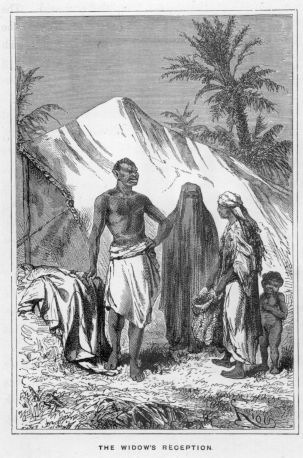
I had expected to see an encampment somewhat similar to the one I had left; but, as we drew near, a few low, cotton-covered tents alone met my view. The lady desired me to make her camel kneel down, saying that she, with her eldest child, would go forward, and begged me to take charge of the younger ones. I did as she wished; and, taking a basket which contained her valuables, she advanced with trembling steps towards one of the tents. Two figures stood at the entrance: one was a gigantic negro, with about as ugly and sinister an expression of countenance as I ever saw; the other was a veiled woman, whom I concluded to be the sheikh’s wife. They received the poor lady without the slightest expression of pleasure or affection, and seemed to be demanding why she had come back; but, on account of the distance I was from them, I could not hear what was said. The widow had, I concluded, a long story to tell, and the black stood eyeing her with a look of contempt, which showed me that her reception was anything but a pleasant one. The old dame—for such, I was convinced, she was, though I could not see her features—stood quite still. At last I saw the widow go forward and kneel at the sheikh’s feet; when, lifting her up, he seemed, as far as I could judge, to be assuring her of his protection, and forgiveness for any fault she might have committed. She then turned round and beckoned to me, when I brought forward the other two youngsters. As her father did not invite me to remain, however, I made my salaam to the lady and returned to our camp.
I told Selim what had occurred.
“The sooner we are away, the better, then,” he said; “that sheikh is one of the fiercest and most barbarous in this part of the country, and it is impossible to tell how he may act towards us.”
I agreed with Selim, that if such was his character his countenance certainly did not belie him. It was then too late to move, however, so we arranged with the two guides to stop till the following morning, when we proposed setting out at daybreak.
Having lighted our fire, and formed our camp as usual, while the guides lay down by the side of their camels, Selim and I sat and talked over our plans for the future. The question to be decided was, How could we best separate from our companions without being followed? There were difficulties, but we hoped to overcome these. Selim was of opinion that the safest plan would be for me to run off a couple of hours before dawn,—when he, taking the carbine of one of the guides, would set out as if in pursuit of me. The guides, finding that we did not return, and the one afraid of losing the other, would proceed on their journey, and report at the camp that we had been lost. Should Halliday and Ben, in the meantime, have been unable to make their escape, this would prevent suspicion being cast on them.
To this plan I agreed, provided no better should present itself.
Chapter Twelve.
I escape from the camp—A terrible encounter—Selim arrived—We cross the stream—A joyful meeting.
Having but a small stock of provisions and little water to carry, Selim and I rode on one of the camels, while the guides mounted the other, and we made the first part of our return journey more pleasantly and rather more rapidly than we had come. We at the same time kept a good look-out for Antonio, but not a glimpse of him could be seen, and I began to hope that he had abandoned his design of murdering us,—if he had entertained it,—and had gone off to try and reach his own country.
We at length arrived at the spot where Selim and I had agreed to quit the camp and strike off for the river, which we believed to be not more than a day’s journey to the south of us. The country was wild and barren in the extreme, here and there a few cacti and stunted shrubs alone being visible. It would be imprudent to attempt escaping by day, with the possibility of being followed by the guides; even should they not follow us, they would naturally, on their arrival at the camp, inform the Arabs of the direction we had taken. Of course, we might have shot them, or have hamstrung the camels; but though Selim suggested that such might be necessary, I would not for a moment entertain the idea. If we were to escape, we must escape with clean hands and clear consciences. I would only consent to Selim carrying off one of the carbines, and as much ammunition as he could obtain; while I provided myself with as many dates and as much other food as I could stow away.
We determined to commence our enterprise that very night, as soon as the moon had risen. I believed that I should have no difficulty, by the aid of her light, in making my way due south; and I agreed to stop at daybreak to look out for Selim. He would follow as soon as he thought that I had got to a sufficient distance to render it unlikely that the guides, should they propose to accompany him, would overtake me; and even in that case he hoped to be able to slip away from them.
We encamped as usual, when Selim and I undertook to keep the first watch; and the guides, unsuspicious of our intentions, went to sleep. We had intentionally kept only a small fire burning, and as soon as the guides’ eyes were closed we let it get still lower. Selim might have made his escape with me, but then he would have been unable to obtain one of the carbines and the ammunition, which it was essential for our future safety we should possess,—and which, according to the Arab fashion, the men slept with close to their hands, ready for instant use.
Having fully agreed as to our future proceedings, so that there might be as little risk as possible of missing each other, I looked once more to the priming of my pistol, took a draught of water (that I might require none for some time to come), and then stole noiselessly out of the camp. I waited for a minute to ascertain that the Arabs were really asleep, and not watching me; then I took another survey in every direction, lest Antonio might possibly be in the neighbourhood; but no one appearing, I started off, running towards the south.
I had before dark carefully surveyed the ground, and ascertained that it was perfectly level, without any impediment to stop my course. As soon as I had got out of sight, however, I went on more leisurely. The moon did not rise so soon as I had expected, while clouds gathering in the sky obscured the stars, and made it more difficult to keep a direct course. Still I hoped that I was steering to the south, and so continued on. Now and then I stopped to listen, but no sound reached my ears, and I was satisfied that I was not followed. On and on I went, anxious to reach some wood or thicket in which I could conceal myself should the guides, contrary to our expectations, accompany Selim.
Often had I found trudging over the desert with bare feet in the daytime very painful, but at night, unable to discern the inequalities of the ground, and the prickly plants which grew on it, I suffered far more than I had ever done before, hardened as my feet had become by going so long without shoes. I had hitherto reached no trees, and although I tried to pierce the gloom I could discern no trace of the forest I expected to meet with in the distance. The moon now rising, enabled me better to see my way; but, though my feet pained me greatly, finding that I was making slower progress than I had calculated on, I pushed forward, still hoping before daybreak to reach some spot where I could conceal myself. At length I could bear the pain no longer, and, overcome with fatigue, a faintness seized me, and I sank down on the ground.
How long I had continued in this state I could not tell. When I came to myself the moon was high in the sky, occasionally obscured, however, by the clouds which a strong wind drove across it; now her rays cast a bright light over the desert, now all again was in comparative darkness. I could only hope that no wild beast, prowling in search of prey, might find me, as I could, I felt, offer but a slight resistance. With the thought that such a thing might possibly occur, I took my pistol, which I had carried slung to my back, and grasped it in my hand.
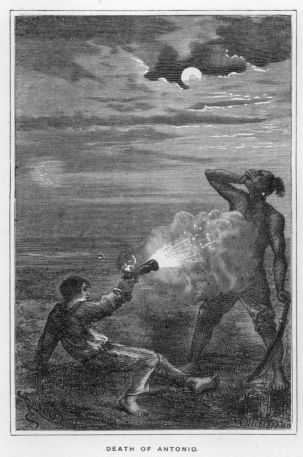
Again the faintness seized me, and I lay stretched out on the hard ground. As my senses returned, my ear being close to the ground, I fancied that I heard a footfall. Opening my eyes,—a cloud at that moment having passed the moon, which now shone brightly forth,—I saw approaching, a few paces off, the figure of a tall black man, with a scimitar raised in his hand—the light of the moon revealing to me the vindictive features of Antonio. In another moment his weapon, raised to strike, would have descended on my neck. His attitude convinced me of his intentions, so there was not a moment for deliberation. I was unwilling to have his blood on my head, but had I even ventured to speak my life would have been sacrificed. Suddenly lifting my pistol, I fired. The shot took effect. Raising his hand to his head, and dropping his sword, the black fell backward to the ground.
For a moment it seemed as if I had been in a fearful dream, but the still smoking pistol in my hand convinced me of the reality of what had occurred; so, rising, at length I staggered towards where Antonio lay. Not a limb, not a muscle, moved, however. He had been shot through the heart. Feeling a horror of remaining near the dead body, and knowing also that it would certainly attract beasts of prey, I was anxious, in spite of the pain my feet suffered, to get to a distance. Reloading my pistol, therefore, and taking the scimitar,—which might enable me to defend myself against savage beasts as well as human foes,—I hurried forward as fast as my maimed feet would allow me.
At length I made out a dark mass rising above the ground, which I hoped was the commencement of the forest bordering the river; and in a short time I reached the trunk of a large tree, which stood out at some distance from the others, when, unable longer to endure the pain of walking, I sank down at its base. It was just the sort of place in which I knew Selim would search for me. Suddenly the dreadful thought occurred, Had Antonio first encountered him, and taken his life? Such, I feared, was but too possible, as the savage black must have discovered our camp after I had left it, and pursued me to the spot where, intending to take my life, he had met his own doom. This idea caused me much anxiety, and greatly damped the satisfaction I felt at finding myself free. How many difficulties and dangers also yet lay before me! Should I meet Halliday and Ben? I asked myself. If not, what would become of us all? Could they find their way to the sea alone? Could I, indeed, expect to do so? How deeply I regretted having been separated from Boxall, who, with his good sense and courage, was far better calculated than any of us to conduct to a successful issue the hazardous undertaking proposed.
Afraid of going to sleep, lest Selim should approach or any wild beast find me, I watched the moon sinking lower and lower, till she gradually disappeared altogether at the break of day. As the light increased I found myself on the borders of a forest, denser than any I had yet seen in Africa; while to the north the wide plain over which I had passed lay stretched out before me. I looked out anxiously for any figure which might prove to be that of Selim. Strange birds flew overhead, and a herd of deer went bounding by at no great distance. Had I possessed a more efficient weapon than my clumsy pistol, I should have tried to shoot one of the latter, in the hope of being able to manufacture shoes or sandals out of the hide to protect my lacerated feet, which were so swollen that I felt it would be almost torture to proceed further without some protection for them. As soon as there was sufficient light, however, I employed myself in picking out the thorns, with which they were full; after which operation I felt some slight relief. I then looked around for water in which I might cool them, but no stream or pool was in sight—though I knew, from the appearance of the vegetation, that water could not be far-off; and I felt sure that if I could but drag myself to it, I should soon be able to proceed.
As the sun rose, his rays threw a bright glare across the plain, almost roasting me where I lay. To avoid the heat, I moved round to the western side of the tree, in the cool shade of which I stretched myself out at my length to rest my weary limbs, and turned my anxious eyes northward—from which direction I expected Selim would come. At length some one appeared on the top of a small hillock in the far distance, and stopped and looked about him. It must be Selim, I thought; and yet, until I was certain, I did not like to show myself. I anxiously watched the person. “Yes, it must be Selim,” I exclaimed aloud. My fear was that, not seeing me, he might go off to the east or west. I knew that my voice could not reach him at that distance. I tried to drag myself up by means of the trunk, so as to lean against it when I was on my feet; but I could stand with difficulty even then. The only means I had of drawing Selim’s attention was to fire off my pistol, but I was unwilling to throw away any of the ammunition. The person was by this time about to descend the hillock. With great pain and difficulty I got round the tree into the sunlight, and fired. Immediately the person began to run towards me; when, unable longer to stand, I sank down on the sand, fearing that after all he might be an enemy. I reloaded my weapon, therefore, and leaned back against the tree, with the scimitar I had taken from Antonio in my hand, determined to defend myself to the last.
The person approached rapidly, stopping every now and then to look about him—surprised, apparently, at not seeing any one. As he came nearer, to my great joy I saw that it was no other than the faithful Selim. He bounded forward as he caught sight of me, uttering exclamations of joy; but his joy was turned to sorrow at finding me in the painful condition to which I had been reduced.
“But still I have reason to be thankful that you are alive,” he said. “Soon after you had gone, what was my dismay to catch sight of Antonio’s shadowy form in the distance. He had apparently been watching the camp, and must have seen you leave it; but I suspect he was waiting to ascertain whether any person would follow you. Had I had the carbine in my hand, I might have been tempted to fire at him; but I should thus have awakened the guides, and your flight would have been discovered. I went up, as it was, to the sleeping men, to try and get one of their carbines, but found that I could not do so without arousing them; and when I looked again, the mysterious figure had disappeared. I trembled for your safety, but notwithstanding my anxiety I had to wait till the time agreed on. Then, arousing the guides, I told them that I thought you had escaped; and while they were rubbing their eyes, and trying to understand what I had said, I got hold of one of their weapons, with a bag of ammunition, and shouting out that I would quickly overtake you, rushed forth from the camp. ‘Take care of the camels, or they will escape,’ I exclaimed as I dashed forward. They, believing that I should soon be back, did not follow, and I was soon out of their sight.
“I was hurrying on, when I fell over the dead body of Antonio. My mind was greatly relieved, for I was satisfied that, instead of his killing you, you had killed him; and with revived spirits I pushed on till I reached the sand-hill and heard the report of your pistol. We have, however, no time to lose, for when the guides find that I do not return, they are very likely to come in pursuit of us.”
I told Selim how unable I was to walk.
“I see that,” he said; “but I must carry you till we get to water.”
“But you have not strength enough,” I said.
“Try me,” he answered, and insisted on taking me on his back; and, though I was fully as heavy as he was, he managed to carry me with far greater ease than I should have supposed possible.
We were soon making our way through the forest, which was more open than it had appeared at a distance. It contained a great variety of trees, few of which I had ever seen before. Many bore fruit and nuts, which Selim told me would furnish us with an ample supply of food. Among them were several shea-trees, from which vegetable butter is prepared; the fruit greatly resembling a large olive.
At length we caught sight of water glittering amid the green foliage. Selim staggered on towards it, though his strength was well-nigh giving way. It was a comparatively narrow stream, running, we supposed, into the main river which we wished to reach. We had great difficulty in making our way amid the tangled foliage which grew on its banks; but at last we succeeded in finding a tree which had fallen into the water, and by scrambling along it we were able to reach the edge of the stream.
“We must take care not to be picked off by any passing crocodile,” observed Selim. “Stay, I will get a long stick, and, by splashing it in the water, we shall soon drive the creatures away, should any be near.”
He did as he proposed, and then we stooped down without fear and took an ample draught to satisfy our burning thirst.
I quickly felt a beneficial effect from sitting with my feet in the stream and cooling them, Selim carefully beating the surface all the time; and being much refreshed, we soon returned to a more open part of the forest, where we sat down to rest, and to satisfy our hunger with the dates I had in my shirt, and some fruit which Selim collected. He also got some large leaves, possessing, he said, healing qualities; these he bound round my feet, and they produced even a more soothing effect than the water had done. Soon, relieved of pain, I felt excessively drowsy; and Selim promising to keep watch, in a few seconds I was fast asleep.
When I awoke I found that the day was far advanced. Selim had been busy, in the meantime, in making me a hat with palm leaves—which, he said, I greatly required to shield my head from the sun. He had also, from the same material, manufactured a pair of slippers, which assisted to protect my feet, though they could not defend them altogether from the thorns which lay on the ground.
Knowing that he must be in need of sleep, I told him that I would watch while he got some rest. He acknowledged that he should be very glad of it; and in a few seconds he was fast asleep. I sat with his carbine in my hand, ready to fire at any wild beast which might approach us; but happily none came near. And in a couple of hours or less Selim awoke, and declared that he was quite able to proceed.
Our first object was to gain the bank of the river, to look out for Halliday and Ben, whom we hoped might have found their way to it. Though I still walked with difficulty, I managed to get along. We had not gone far when Selim observed a tree from which, he said, the people in his country were accustomed to manufacture bows.
“I must make one at once,” he observed; “it will save our ammunition—which will serve to defend us from human foes or wild beasts, while we can shoot small birds or animals with arrows.”
He quickly cut off a branch which he fixed on for the purpose, and as we walked along he began to shape it with his knife.
We had followed the course of the stream, which, as we caught glimpses of it through the trees, widened considerably. We had now arrived near the point where the stream joined the larger river, but both of us felt that we could go no further. We had still a good supply of dates, and Selim quickly collected some fruit, which enabled us to satisfy our hunger. We then cut down a number of saplings and a quantity of branches, with which we constructed a hut between the buttressed roots of a gigantic baobab-tree, with a strong barricade in front. Here we hoped to rest more securely than we had done for a long time, as we could not be attacked in the rear, and we believed that no wild beast would attempt to break through it; then, as we had met with no traces of inhabitants, we consequently did not expect to be attacked by human beings. We had our hut completed before dark; and in the meantime Selim managed to collect a number of reeds for arrows, and the strong fibre of a plant to twist into a bow-string. We had thus plenty of occupation—till night coming on compelled us to retire within our hut, and build up the barricade in front of it.
When I awoke in the morning, I found that Selim had completed his bow and arrows; so as soon as we had breakfasted on our remaining stock of provisions we set out towards the bank of the main river. It should be understood that we were on the eastern side of the stream. We had not gone far down it when, coming to an opening amid the numerous trees which lined its banks, I caught sight of a human figure moving, at some distance off, on the opposite shore. Telling Selim, in a whisper, what I had seen, I dragged him behind a tree, from whence we could look out and observe the stranger. We eagerly watched him; and presently we saw him joined by two other persons.
“Why,” exclaimed Selim, “they are our friends!”
“If so, Boxall must be with them,” I said joyfully.
The uncertain light of the forest had before prevented me from distinguishing them; but as we made our way to the bank I was convinced that Selim was right. They had their backs turned towards us, and were proceeding westward, or down the river. We shouted to them; but our voices were lost amid the forest, or they did not recognise them, for they hurried on, and were soon lost to sight.
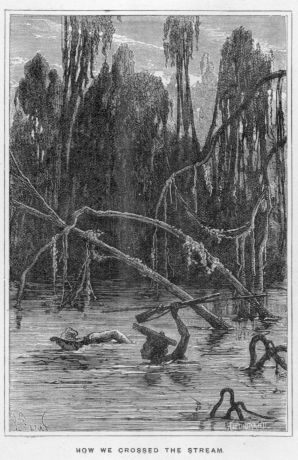
Fearing that we should miss them altogether, we now determined to swim the stream—without reflecting on the dangers we might run. Selim fastened his bundle of arrows and my pistol on his head, and lifting his carbine and bow in one hand, he boldly struck out. I followed his example; but, laden though he was, he swam better than I did. Happily the stream was not very rapid, and a draught of water which I took as I swam across contributed to restore my strength; so in a few minutes we were on the opposite bank.
Losing no time in shaking the water from our clothes, we hurried on, shouting to our friends. Again we caught sight of them. They looked round, and seeing us coming, hurried towards us.
The meeting, as we all grasped each other’s hands, was indeed a happy one. But how Boxall had fallen in with them I could not conceive.
A few words, however, sufficed to explain how it had happened. It was he, as we had supposed, whom we had seen at the water-hole; and the tribe among whom he was a captive had, like many others, travelled south to worship at the shrine of the saint. A far greater intimacy than usual had taken place between the people of the different camps which at that period had assembled in the neighbourhood, and he thus came to hear that three Englishmen were held in slavery by Sheikh Hamed. He of course guessed that we were the persons spoken of, and resolved to communicate with us, though he knew that he ran a great risk of being severely punished should he be discovered. He took the opportunity, while all the men in his camp were worshipping at the shrine of the saint, to wander as far away as he could venture without creating suspicion in the minds of those who might be watching him, in the hope of meeting with one of us, or with some of our people who might give him information and take a message from him. He had proceeded further than was prudent, when, as it happened, a party of our Arabs returning to the camp caught sight of him, and supposing, from his white skin and dress, that he was one of us, seized and bound him, and carried him off as a prisoner. His capture, as he afterwards learned, was observed by a shepherd and some boys of his own camp, who carried back intelligence of what had occurred.
Fortunately, Ben, who was outside our camp, met the party, and recognising Boxall, claimed him as a friend; telling him, without loss of time, of our intention of escaping. This made Boxall—who had been well treated by his captors, and expected to be liberated on his return to the north—abandon his resolution of going back to them, if he could escape from our camp. He pretended, therefore, to be well satisfied with his change of masters, and—as was really the case—to be delighted at finding an old friend. The Arabs, being thus deceived, believed that there was no necessity for watching him, and gave him over without hesitation into Ben’s charge.
Now, as I had left the camp secretly, it was not known by the people generally, and especially by the women, that I was absent, and Ben calculated rightly that Boxall would be mistaken for me. He accordingly conducted him boldly into the camp, where they soon found Halliday; and it was agreed that as soon as night came on they should all three make their escape together. This they had done; and having supplied themselves with food and some leathern bottles filled with water, they had pushed on during the night and the whole of the next day, till they reached the shelter of the wood. Arriving at the very stream we had discovered, and supposing that they would find us on the western side, they had crossed it, and had been waiting the whole day in expectation of our arrival.
Boxall had gone through numerous adventures; but having been fortunate enough to cure some of the sheikh’s family and several other persons by practising the slight knowledge of medicine he possessed, he had been held in high estimation, and had gained the confidence of the sheikh and all the chief people,—so that he had had few of the irksome duties to perform which had fallen to our lot.
I now fondly hoped that, with Boxall as our leader, though we might have many difficulties to encounter, we should be able to overcome them, and finally reach the sea. We all agreed, however, that, from the direction the caravans had taken, we must still be at a considerable distance from it, and that we should certainly have a long voyage to perform on the river.
“No matter how long it is,” exclaimed Ben in a confident tone; “if we can get a few planks under our feet, and a bit of canvas for a sail, with Mr Boxall as captain, we’ll do it!”
Chapter Thirteen.
The raft upset—We discover a canoe—A fight for liberty—Recaptured—The black woman’s kindness—The black sheikh better than he looks—Sheikh Hamed’s anger—A frightful doom—Rescued.
We did not spend much time in relating our adventures—knowing that we should have opportunities enough by-and-by of spinning as many yarns about them as we might.
Boxall approved of our plan of trying to find a canoe; or if not, of building a raft on which we might float down the stream until we could fall in with one; so we accordingly made our way at once to the bank of the river. It was not so broad as we expected to find it, yet the volume of water was sufficient to make us suppose that it flowed on in an uninterrupted course to the ocean. Of the character of the natives we knew nothing; indeed, we believed that no European had ever explored that part of the country. Selim alone could give us any information. His idea was that the people were among the most barbarous of any to be found on the borders of the Sahara. This was not satisfactory, but we could only hope that we might escape them.
“At all events,” observed Ben, “I have a notion that four Englishmen with a carbine, a large pistol, and a Turkish cutlass, backed by an honest black fellow with his bow and arrows, are a match for any number of savages; so if they come we must give them a thrashing—and that’s what I’ve got to say about the matter.”
Though not quite so confident as Ben, we hoped that we should be able to keep at bay any enemies who might attack us.
The bank of the river was thickly wooded, and we made but slow progress. Despairing at last of finding a canoe, we determined to build a raft. Reaching a part of the bank where a few feet of open ground gave us space to work, we commenced operations. My cutlass was invaluable, as it enabled us to cut down a number of young palms, the wood of which was soft and light. There were also plenty of creepers, which served instead of ropes for binding the logs together. We first placed a row of young trees side by side, and then secured another row at right angles upon them. By evening our raft was complete. We also provided ourselves with long poles, which would enable us to guide it in shallow water or keep it off overhanging trees; and, in addition, we formed five rough paddles—one being larger than the rest, for steering. We intended also to form a triangle, between which we could spread our shirts to serve as a sail should the wind be fair. Well satisfied with our day’s performance, we launched our raft, which had been built close to the water, and secured it to the bank. It floated us all well; and as it was likely to afford a more secure resting-place than the shore, we lay down on it to sleep—two of us at a time keeping watch, lest any wild beast might, attack us. But although lions were heard roaring all night long, and other strange sounds came out of the forest, we slept securely on our floating bed.
At daybreak, and in good spirits, we commenced our adventurous voyage. At first we floated tranquilly down the stream, having only occasionally to use our paddles to keep the raft off from the trunks of sunken trees—called snags, in America—which appeared above the water. In a short time, however, the current became more rapid, and we found, by the way the water leaped about, that we were being carried over a shallow part of the river. Our poles, too, showed that the depth was not above three or four feet. Presently the water became more shallow and more agitated, and we thought it wise to make for the bank. We were steering towards it, when the raft, striking an unseen rock, was whirled rapidly round and round: the water rushed over it, and we ourselves were swept off; while the raft, freed from our weight, was carried downwards, and quickly dashed to pieces among a number of rocks, over which the water furiously rushed, not a hundred yards below us. Happily we were all good swimmers, and we managed to reach shallow water and climb up the bank.
“What has become of our weapons?” was the first question we asked. They, with my Moorish sword, had been placed in the centre of the raft, and so had been lost. We had cause to be thankful however, for having escaped with our lives.
Undaunted by the accident, we determined to persevere, and to try and find a canoe in which to prosecute our voyage. Ben had saved one of the long poles, which, after sharpening at the end, would serve as a weapon—the only one we now possessed. Selim offered to supply us with bows and arrows, which might serve to kill birds for our meals. He showed himself one of the most active of the party, too, and as he went on ahead he looked into every little bay or hollow in which a canoe was likely to be concealed.
At length we caught sight of some low, conical-shaped, thatched huts in the distance, and Selim said he was sure he could find a canoe not far off from thence. The only doubt was whether he should take it without asking the owner’s leave, or try to obtain the loan of it: but then we had absolutely nothing to offer in return; and the natives might not only refuse to give it us, but might make us prisoners—and perhaps carry us back to the Arabs from whom we were escaping, or sell us to some other tribe.
“Beggars must not be choosers,” said Ben. “To my mind, if we can find a canoe, we have a right to her, considering that we have been kept in slavery, and worked pretty hard too, by the friends of these people.”
Certainly, I would rather have bought the canoe; but as that was out of the question, I could not help agreeing with Ben.
We had not gone far, when we came to a path evidently made by human feet. “This probably leads to some plantation, or to another village, through the forest,” observed Boxall. “We must proceed cautiously, so as not to come suddenly upon the natives.”
Selim offered to go on first and explore the way.
In a short time he came running back. “I have discovered a canoe afloat and secured to the bank,” he said. “She has paddles in her, so the owners cannot be far-off. We are indeed, fortunate, and must not lose the opportunity of escaping, as we are not likely again to meet so good a one.”
We hurried on. There lay the canoe, as Selim had described; she was large enough to hold us all—indeed, large enough to navigate the river to its mouth. Without further consideration we stepped into her, and seizing the paddles, cast off the painter, and shoved out into the stream. We did not feel quite as happy as we might have done had we been able to obtain her by lawful purchase from the owners. They would naturally be enraged on discovering that we had run off with their property, and if they could obtain the means, would, of course, follow us; we hoped, however, by paddling on, to get well ahead before being discovered. We should be in most danger when passing the village we had seen on the bank some way down the stream.
Boxall told Selim to take the helm—as his black face might make the natives suppose that we were a party of white slaves sent down the river by our owner—while we four paddled with might and main. As we neared the village we plied our paddles harder than ever. Just as we got abreast of it, we saw a native in the front of one of the huts. Discovering us, he shouted to some others, who rushed out of their huts and followed him down to the river. We did not stop to ascertain what they were about to do, but paddled on. We had not got far, however, before we saw a canoe being launched from the bank. We might easily have distanced her, and were expecting to do so, when there appeared two more canoes some way ahead of us, putting off from the shore, evidently with the intention of intercepting us. Our only hope now was that we could fight our way past them. Had we possessed our firearms, or even Antonio’s scimitar, this we might have done without much danger; but with only our paddles and Ben’s long pole for weapons of defence, we should run, we knew, a great risk of losing our lives: still the attempt must be made.
We paddled on boldly, shouting at the top of our voices, in the hope of intimidating our enemies. Those in one of the canoes seemed doubtful about attacking us, but the others came boldly on, sending, as they got near, a flight of arrows towards us. Selim shouted to them, telling them to keep off, and saying that we only wished to be allowed to pass in peace. To this they paid no attention, however, but, uttering loud cries in reply to our shouts, came dashing towards us. Ben, who had got his long pole ready, sprang up, and plunged it with such force that it ran through the body of one of the savages, who was dragged overboard. The others, alarmed by the death of their companion, paddled to a distance, and assailed us with fresh flights of arrows. Happily, they were not well aimed, and none of us were struck.
We now began to hope that we should escape, though, as we paddled on, we were hotly pursued by two canoes. We were, however, distancing them, when we found that the river made a sharp bend, and ran back close to the village we had at first seen. At the same time we caught sight of four or five large canoes putting off from the shore, evidently for the purpose of intercepting us. In vain we attempted to escape; the canoes completely surrounded us, and unless we had resolved, rather than yield, to sacrifice our lives, resistance would have been useless. We merely, therefore, warded off with our paddles the blows aimed at our heads, while we cried out to the people that we were ready to give in if they would desist from striking. Before they understood us, however, we had received several cuts and bruises, and in a pitiable condition were conducted on shore.
On landing we were placed in an open space on the ground, with guards over us; while the more influential persons seated themselves under a widespreading baobab-tree, and discussed what was to be done with us. Though we could not hear clearly what was said, from their gestures we fully believed they contemplated putting us to death.
“We might as well have made a stouter fight for our liberty,” observed Ben, who seemed to be sorry that we had yielded so easily.
“If they believe that they can make anything by us, they will not kill us,” said Boxall. “We may still, I hope, escape death.”
Anxiously we watched the gestures of the assembly. They were savage-looking fellows enough, but yet it soon became evident that some were for mild measures; and Selim, who understood better than we did what they were saying, caught a few words, and told us that they were waiting the arrival of some one, who had been sent for, and who was to decide our fate.
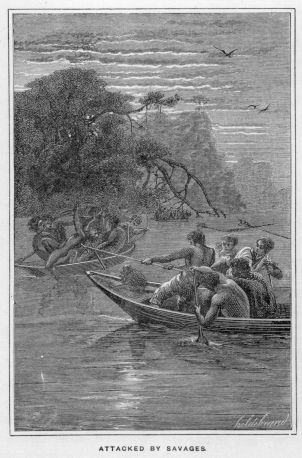
Some hours passed, during which we were kept without food, and exposed to the burning rays of the sun. At length there was a movement among our captors, and we caught sight of several horsemen coming through the forest, with a person, who was evidently a chief of importance, at their head. As he approached, we recognised the black, ill-looking sheikh to whose camp we had conducted the veiled lady. My heart, I confess, sunk within me, for I expected very little mercy at his hands. Without dismounting, he listened to the account the chiefs of the village gave of our capture. When they had finished, I thought it was time for me to speak, and I knew that by so doing I could not make our case worse; I therefore addressed him in Arabic, which, at our former interview, I found that he understood. I reminded him that I had conducted his daughter and her family, placed under my charge, in safety to him; and that, having faithfully performed my duty, I felt that I had a right to escape from slavery, and to try and get back to my own country; that on my way I had fallen in with my present companions, and that when we were captured we were only doing what he and any of his people would, under similar circumstances, have attempted.
He seemed more moved by my address than I had expected. “What you say is true, O Nazarene,” he answered; “but those from whom you have escaped are my friends, and they will demand you at my hands. You know the penalty you have incurred by attempting to escape, and you must be prepared to pay it.”
I felt it would be of no use pleading for mercy with the savage, or I would have entreated him to set us at liberty, and to allow us to continue our voyage down the river. I had frequently heard, too, of the fearful cruelties which were practised on slaves who attempted to escape from their Arab masters, so I could not help thinking of those we should be doomed to suffer were we to be delivered up to Sheikh Hamed.
The black sheikh now held a short consultation with the chiefs of the place and with those who accompanied him, and finally decided that we were to be carried next day to his camp. We were, in the meantime, thrust into a small hut, there to remain till the following morning, when we were to set out. Of course, we could not help being greatly cast down by the turn affairs had taken; Boxall, however, did his best to keep up our spirits, and urged us to look above for that strength and courage which we required in our time of need. “Our lives have been preserved when we expected to have lost them. Let us hope that even now some means of escape may be found,” he observed.
“I wonder whether the savages think we can live without eating,” said Halliday. “I wish they would bring us some food.”
Not many minutes after this the door opened, and a black woman appeared, carrying a couple of baskets containing a bowl of couscoussu, a calabash of water, and some fruit. Though her countenance was shrivelled, it beamed with kindness.
“I heard that there were white men starving, and in captivity, and I hastened from my home down the river to bring food to them,” she said. “Here it is. Eat, strangers, and may your strength be restored.”
We thanked her for her charity.
“I myself have reason to be thankful to white men,” she answered. “When I was young, and just married, our village was attacked by a party of Moors, when my husband and I were carried down to the coast, to be conveyed across the wide ocean to slavery in a distant land. While waiting to embark, the kind governor of the place purchased us, kept us in his house, and fed and clothed us; and at last, when the country was at peace, he sent us back to our own home. There we continued to live, and my husband is now a rich man. Our great pleasure since then has been to help those white men who have been made slaves by the Arabs, or who are otherwise in distress.”
As she said this, the hope arose in me that she might possibly help us to escape. I asked her without hesitation if she could do so. She shook her head. At last she answered:—
“My husband is now old, and has no influence with the people of this place. They respect me, so they allow me to bring this food to you, but my power extends no further; still, I will do what I can. I must not now delay, or I may be accused of endeavouring to assist you to escape.”
Of course, after hearing this we could not detain the kind negress; and wishing us good-bye, she took her departure, while we set to at the welcome food she had brought us.
“We have indeed reason to be thankful for this unexpected assistance,” observed Boxall. “He who put it into the heart of this kind negress to bring us this food, will find us the means of escape.”
With our spirits somewhat raised by this event, we stretched our weary limbs on the hard ground, and were all soon asleep.
We were awakened at daybreak by one of our guides, who told us that we must immediately set out on our journey. We had barely time allowed us to eat the remainder of the provisions the good negress had brought us, and were compelled to abandon any hope we had entertained of escaping by her assistance.
We had now to march with guards on either side, and our hands tied, two and two: Boxall and I, Halliday and Ben, with Selim bringing up the rear. The journey was a fatiguing one, for after we had left the belt of forest which bordered the river we had a wide expanse of open country, where we were exposed to the rays of the hot sun. It was not desert, however; for numerous plantations covered it.
At length we reached another woody district on the very borders of the Sahara, where the chief had pitched his camp. He had preceded us, we found; for on our arrival he appeared at the door of his tent, and called me up to him.
“I have saved your life and that of your companions,” he said; “but as you were attempting to escape from bondage, I am bound to deliver you up to Sheikh Hamed Aben Kaid, who will treat you as he thinks fit. All I can do is to report favourably of the way in which you conducted yourself towards my daughter and her children, and this may tell in your favour; but I warn you that a severe punishment awaits those who attempt to fly from their masters. You will set out to-morrow morning. And take my advice: as soon as you arrive you must express your desire to become faithful followers of the Prophet, and all will be well; if not, you may expect no mercy.”
I thanked the black sheikh for the kindly feeling which prompted his advice, but did not say whether I intended to take it. I felt very sure that my companions would suffer anything rather than turn Mohammedans, and I hoped that even the fear of death would not make me do so.
For the remainder of the day we were placed in a tent by ourselves, and were amply supplied with food. As soon as we were alone, I told my friends what the black sheikh had said. Their answers were as I expected; and we all agreed to support each other in the resolution we had formed to be firm to our faith.
Next morning we set out at daybreak on our dreary journey, escorted by a party of black troops on foot, with a few camels to carry provisions. We kept the road I had come, turning neither to the right nor to the left. Nothing occurred to us during the march worth narrating; we were not ill-treated, and were sufficiently supplied with food, our guards wishing to bring us back in good condition. We had got within about a day’s journey of the camp, when we saw a party of Arabs approaching, mounted on camels, and as our guards did not appear alarmed we knew that they must be friends. As they drew nearer I recognised Sheikh Hamed at their head; and as he saw us a frown gathered on his brow, and he inquired of the leader of our guards how we had been taken. On being told what had happened, his anger increased, his own people gathering round him and crying out that we deserved nothing but death. While he and they were discussing the matter, one of the marabouts, who had taken part in the discussion I once had with the sheikh on religious subjects, proposed that we should be forgiven, provided we would acknowledge Mohammed as the Prophet of God, and conform in all other respects to the true religion, as he called it. As the question was not formally put to us, we had no reason to reply, and therefore stood silent while the discussion was going forward. As soon as it was over, the marabout came to us and inquired whether we were willing to conform to the faith of the Prophet, promising that if we did so our lives would be spared. We answered boldly, and at once, that we would not be hypocrites, and that we had resolved to abide by the religion in which we had been brought up.
Our determined answer greatly enraged the marabout, who had expected to make easy converts of us. “Then you must be prepared for the fate you have brought upon yourselves,” he answered.
As evening was approaching, both parties encamped; and we were left during the night in doubt as to what our punishment would be.
Ben was as firm as any of us. “A pretty sort of prophet Mohammed must have been, if he could not teach his followers to behave themselves better than they do,” he exclaimed. “I cannot say but what they bow and pray enough, and go through all sorts of curious forms, but to my mind it’s all outside show; and if their religion don’t teach people to be kind and merciful, and to do to others as they would others should do to them, it’s not worth a bit of rotten rope yarn.”
Selim, who had hitherto professed to be a follower of Mohammed, declared, after hearing our conversation, that he was ready to acknowledge himself a Christian, and to die with us if we were to be put to death. Boxall thereupon spoke very earnestly to him, as he had done to us, and urged him to adhere to his resolution. “It is far better to die than to live a hypocrite, or to acknowledge that Mohammed was a true prophet of God, when we know that he was an emissary of Satan sent to deceive the world,” he observed.
Next morning, after the Arabs and blacks had gone through their usual ceremonies, we were brought out, with our arms bound to our sides.
The marabout had, in the meantime, been among the people, endeavouring to excite them against us, and they now gathered round from every side with savage gestures, hurling bitter curses at our heads, calling us vile Christians, despisers of the true Prophet, Nazarene dogs, accursed infidels, children of Satan, and similar names, till they had exhausted their vocabulary of abuse.
The two sheikhs and the other chiefs now appeared on the field, and were received with loud acclamations. “Allah, Allah! God is great, and Mohammed is his Prophet!” shouted the crowd surrounding us, while their countenances exhibited their hostile feelings.
Terrible was the doom preparing for us; whatever might have been the wishes of Sheikh Hamed and the black chief, the voices of the marabouts and the people prevailed. We were doomed to a fate scarcely less terrible than that of Tantalus. We were condemned to be buried alive, with our heads above the sand,—water and food being placed just beyond our reach, so that we might see the means of saving life and yet be unable to profit thereby. Certainly, I think, the vivid imaginations of the old heathens could not have invented a more horrible punishment.
Again the marabouts came to us, and asked whether we would become faithful followers of the Prophet; promising to receive us as brothers, and to raise us to rank and honour in their tribe, if we would do so, and pointing out the dreadful fate which would be ours if we refused. But we all remained firm, declaring that we could not embrace a religion in which we did not believe.
Selim, influenced by our example, shouted out,—“I once professed to be a follower of your false prophet, and I am sorry for it. I don’t believe in him, or the Koran, or in the wrong and foolish things it teaches. You may kill me, along with these white men; I would rather die with them than live with such wretches as you are.” The marabouts, as he spoke, rushed forward and struck him, and tried to drown his words by their shouts and execrations. Boxall, Halliday, and I, seeing no advantage in irritating the fanatical feelings of our captors, had said nothing, except that we would not turn Mohammedans; but Ben shouted out, in the best Arabic he could command,—“I believe in one God; but I know very well that Mohammed was not one of His prophets; and only blind, ignorant fools such as you are would believe in him or the stupid book he wrote. You may bury me, or do what you like; but as long as I have got a tongue above ground to wag, I will not knock off speaking the truth.—I say, Mr Blore, I don’t think they quite make out what I mean. You just tell them, please; and give them a bit of your own mind too.”
Fortunately for Ben, only the first words of his speech were comprehended, and many of the people fancied that he was ready to turn Mohammedan; so that, instead of attacking him, many of them demanded that he should be set free and allowed to do as he wished. Indeed, by his good-humour, and readiness to help any one who wanted assistance, he had become a general favourite in the camp. The marabouts, however, suspecting, from his tone of voice, that he was not very complimentary to them or their religion, answered that he must be left to share our fate. They were also greatly enraged against Selim, and decided that he (in consequence of his perversion from the true faith) and Boxall (as the eldest of the party) should be the first to suffer.
In the meantime, preparations were being made for our punishment; spades had been brought, and two holes dug in the sand about six feet apart.
While we lay bound on the ground, the marabouts again came forward, and asked Boxall if he would turn Mohammedan; reminding him that he would be the cause of our death, and that of the young black, if he refused, as we should all undoubtedly follow. It was very clear that they would rather make converts of us than put us to death.
“No, my friends,” answered Boxall calmly. “In our country each man is allowed to believe as he thinks best; and I tell you that I cannot believe as you do.”
“Then take the consequences of your obstinate unbelief,” answered the marabout, making a sign to the people surrounding us.
They instantly seized Boxall and Selim, and dragged them to the holes, into which they thrust them,—one facing the other, and with their arms bound tightly down by their sides,—till their heads alone were visible above ground. The sand was then shovelled in till their bodies were entirely buried; after which a bowl of water and two pieces of well-cooked meat, emitting a pleasant odour, were placed between them, at such a distance that they could not possibly be reached.
The Arabs had begun to dig two more holes, when we observed some disturbance among them. Presently the sheikh hurried to the top of a neighbouring mound, while all eyes were turned northward across the Desert. Leaving Boxall and Selim in their fearful position, and entirely disregarding us, those possessing firearms began to look to the priming, and all appeared to be getting their weapons ready for use, when, even as we lay on the ground, the heads of men in a long line came into view above our limited horizon. Then we could distinguish camels—of which there seemed to be a hundred or more—advancing rapidly in close order. On they came,—the ground shaking beneath their tread,—surrounded by clouds of dust stirred up by their feet.
The two sheikhs now marshalled their men, and calling on them to fight bravely and merit paradise, led them forward to meet the foe. We watched them with painful interest, for our lives depended on the result. Whether the strangers had come for the purpose of rescuing us, we could not tell; but should they be defeated, there could be little doubt that our present masters would carry out their intention of putting us to death. If, on the contrary, the strangers gained the day, we had good hopes that we should be rescued, though we might still be kept in slavery.
Sheikh Hamed and the black chief fought bravely; but they and their followers were but ill-armed, and greatly outnumbered. Back and back they were driven, and many soon lay stretched on the ground. Still others, who had remained as a reserve, advanced, rushing with their muskets and swords right up to the camels; but they too were driven back, while many of them took to flight. I prayed that the tide of battle would not sweep our way, lest we might be trampled to death. Several of the blacks, however, passed us, but these were in too great a hurry to escape to knock us on the head.
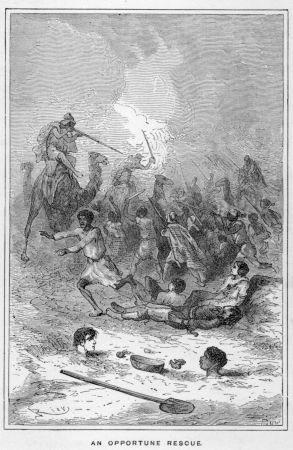
Ben, meantime, had been working away desperately to get his hands free. “Hurrah! I have done it,” he shouted, and instantly came and released Halliday and me. We then hurried to the assistance of Boxall and Selim, and with one of the spades which had been left behind we quickly dug them out. It was fortunate that we were not delayed, for they were already beginning to feel the weight of the sand pressing round them, though they might possibly have lived for many hours in that position.
We had been so eager in extricating them, that we had not observed how the battle went, till, looking round, we saw the new-comers in full pursuit of our late owners, many of whom had been cut down. No prisoners had been taken, however; for it being known that the blacks were followers of the Prophet, it was not considered worth while to capture them, as they could not be held in slavery.
Boxall, on catching sight of the victorious party, at once recognised them as his friends; and as they now halted and drew together, he led us towards them. Their leader at once knew him, and gave him a cordial welcome, expressing his satisfaction at having rescued him. Boxall then introduced us, and said that we wished to place ourselves under the protection of him and his tribe. The sheikh then ordering five of his followers each to take one of us up behind him on his camel, the victorious party rode off with us across the Desert, in the direction from which they had come, carrying away with them some of the arms and a few camels which they had captured.
The band of warriors who had so opportunely come to our rescue belonged, I learned from the man behind whom I rode, to the powerful tribe of the Sheikh Salem Alsgoon, between whom and Sheikh Hamed Ben Kaid a feud had long existed. Although they could not come to blows at the tomb of the saint, a constant watch had been kept on the movements of Sheikh Hamed; and when it was found that he had set out from his camp to meet us, an expedition had been despatched with all haste to surprise him. To this circumstance we owed our preservation. Sheikh Salem, however, would have had sufficient excuse, according to the law of the Desert, for attacking Sheikh Hamed, on account of his having, as was supposed, carried off one of his slaves; indeed, the desire to recover Boxall was one of the motives which had induced him to undertake it. Had we not been found, he had ordered his people to make a few prisoners, in order that they might be exchanged for Boxall. Thus the very circumstance which at first appeared the most disastrous to us, as is often the case in life, resulted ultimately in our favour.
Chapter Fourteen.
The old recluse—Description of the camp—Night intruders—Bu Saef—The mirage—Overtaken by a sand-storm—Fearful sufferings—Arrive at an oasis—Falling fortunes—Another conversation with Marabouts—Visitors at the camp—Sold—Arrive at a town.
We rode on without stopping till the sun had sunk low in the western horizon, the object of the Arabs being to join the main body by daylight,—for our leader well knew that Sheikh Hamed, having escaped, would hasten back to his camp and summon his followers to pursue us; and as we had to pass at no great distance from the camp, there was every probability of our party being overtaken.
Sheikh Salem’s people, however, were full of fight, and boasted that, even should the whole of the hostile tribe come up with us, they would quickly put them to flight. They nevertheless dashed on with unabated speed, and never had I before ridden so fast through the Desert.
Although rescued from a cruel and lingering death, we could not expect that our lot in other respects would be greatly improved. We were going back to slavery, and our new masters were likely to treat us as the others had intended doing, should we attempt to escape or refuse to embrace their religion.
Just at sunset we reached a hollow with a few bushes growing at the bottom, from the midst of which sprang up a strange figure. It was that of an old man of most repulsive appearance, with a long white beard, a dark ragged garment thrown over his withered body, and a long stick in his hand. He was, I was told, a holy recluse, who lived upon the alms of passing pilgrims. He saluted our leader as an old acquaintance, and mounting on a camel, offered to guide us on our way during the night. It is no easy matter at any time, even for the Arabs, to find the way in a direct line across the boundless Desert; and when clouds obscure the stars, it is almost impossible without a compass. The old recluse, on seeing white strangers, cast a look of disgust and disdain at us, expressing his surprise that any true believers should allow infidel Nazarenes to remain in their company. But our leader only laughed, and answered that, as we had not eaten pork for a year, we had become almost as clean as Arabs. Considering that we had had a bath only a few days before, we considered ourselves a good deal cleaner. However, we did not say so, but let the dirty old saint abuse us to his heart’s content without replying.
Even camels cannot go on for ever; and at length we reached a rocky ridge with a hollow beyond it. Crossing over the ridge, we descended into the hollow, where we at length halted to spend the night. On this ridge several sentries were placed, to give early notice of the approach of the foe. No fires were lighted; and each man, having taken his frugal meal of dates and flour-cakes, lay down among the weary camels to rest.
The night passed off without any alarm, and before daybreak we were again mounted and proceeding on our journey. Just as the sun was about to appear a halt was called, when all the men dismounted, and prostrating themselves towards the east, threw sand on their heads, while they uttered aloud their prayers as the sun rose above the horizon. Though anxious to push forward, as our pursuers would be employed in the same way, yet they did not hesitate to expend the time required in offering up their prayers. They mounted again as soon as possible, however, and once more we went ahead.
A sharp look-out was kept for the camp, of the position of which the old Arab did not appear certain; for the tribe had been moving on for the last two days, in order to put as wide a space as possible between themselves and their foes. At length we saw a horseman spurring across the plain, when, catching sight of our camels, he turned and galloped towards us. He was one of several scouts who had been sent out to look for our party. Guided by him, we now went forward with confidence, and soon came in sight of numerous troops of camels, spreading, it seemed, right across the horizon; while Arabs were arriving from all directions,—some mounted on camels, others on foot. Passing through the line of camels, we saw before us a number of low tents, pitched at a short distance from a pool of water bordered by tall reeds, stunted palms, and other trees. As our party approached, we were welcomed with loud shouts. No sooner had we dismounted than the wife of the sheikh—a tall woman of commanding aspect—advanced from her tent to meet Boxall, who went forward with confidence, we following. I cannot say that she looked benignantly at us, for her countenance was stern, though unusually handsome for an Arab woman of her age. She gave orders that a tent should be prepared for our use, however; and as soon as we had taken possession of it she sent us a bowl of couscoussu, with some dates and camel’s milk, so that we fared sumptuously after our fatiguing ride.
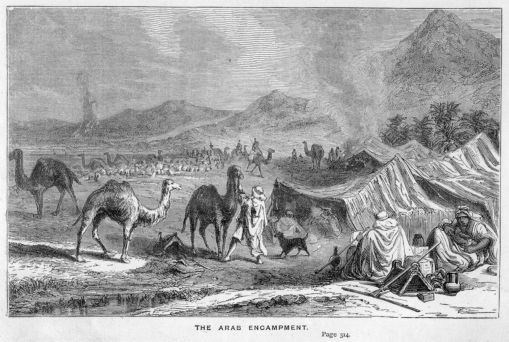
“I feel almost as if I had got home again,” said Boxall, as we lay at our ease with our legs stretched out on the carpet covering the floor of our tent. “I am really thankful to have you with me. Besides, we enjoy an advantage in being under the protection of a powerful sheikh, though I am afraid that our chance of escape is as remote as ever; while I suspect, notwithstanding the sheikh’s promises, he will be very unwilling, when the time comes, to give me my liberty.”
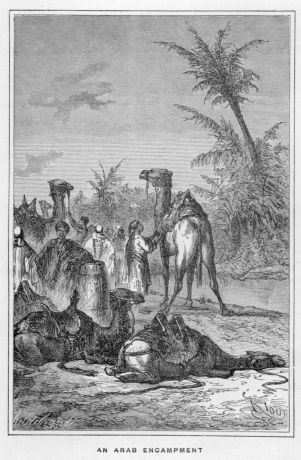
“Where there’s a will there’s a way; and we must look out for that way,” observed Ben. “I only hope that we shall some day get back to the sea, or be in the neighbourhood of some town where Christian people live. We must look out, at all events, for a chance of giving our friends the slip. I, for one, have no fancy to spend my days among these fellows, who never think of serving out an honest piece of roast beef, and turn up their ugly noses at a man because he may chance to have a liking for boiled pork and pease-pudding.”
We were not allowed to remain long in quiet. After we had enjoyed a couple of hours’ rest, our tent was besieged by a number of people who came to have a look at the strangers. Among them were the two daughters of the chief. They were not much darker than Spanish women, and had graceful figures and really beautiful features. Their teeth were brilliantly white; and their eyes full of expression and vivacity, heightened by the colour they had given to their eyelashes and eyebrows by means of a blue stone. Their dress consisted of a woollen robe, which covered them from the shoulders, where it was secured by a silver buckle, and hung in folds down to their feet. They asked us all manner of questions, some of them very difficult to answer. Unfortunately, we had no presents to offer them in order to gain their goodwill. They looked upon us as their father’s chattels, and with a mixture of contempt and curiosity, as if we were strange animals. Nor can I say that they appeared to feel any of that pity for our condition which we might suppose would animate the hearts of such lovely damsels. In truth, I fear that Ben was right when he observed,—“The good looks of them gals is only skin-deep; we may depend on that. They are more likely to do us an ill turn than a good one. I can tell it by the eyes they cast at us; so we mustn’t be taken in by them.” Alas! the Arab maidens had none of that true beauty which adorns the mind, for which our own fair countrywomen are so justly celebrated, and without which all outward beauty is a mockery and deception, as Ben justly remarked in his own way.
I must here describe the encampment, which was similar to many others we met with during our wanderings. It was about ten or twelve hundred yards in circumference. The tents were made of camel-hair cloth, manufactured by the inhabitants. They were supported in the middle by poles, round the top of which was some basketwork, to give them ventilation; the lower edges being fixed to the ground by pegs, and further weighted by stones or sand. The sheikh’s tent differed but little from those of his people, being only more spacious, and rather higher. It was pitched in the middle of the enclosure; the others being on either side, according to the rank of the occupants. A large part of the ground within was covered over with carpets, on which the family slept; the tents of the less wealthy people being furnished with mats only. On a few short poles stuck in the ground were hung the goat-skin bottles containing milk or water; as also arms, and a few garments, which, together with some wooden bowls, jugs, small millstones for grinding corn, cooking utensils, looms for weaving camel-hair cloth, and sundry small articles, constituted the whole furniture of the habitations of these wanderers of the Desert.
The people continued to press around us in a most annoying manner. Boxall said he would complain to the sheikh’s wife, in order that we might be allowed to rest in peace. He accordingly made his way through the crowd—who treated him with more respect than they did the rest of us—and that lady soon made her appearance, and in a threatening way ordered them to disperse. Though they obeyed her, they cast no very friendly glances at us; and in a short time many returned—with others who, though they did not enter the tent, crowded round the opening to have a look at us. Indeed, not till some time after night closed in were we allowed to rest in quiet.
We had been asleep some hours when I was aroused by a shout; and starting up, I heard Ben cry out, “Hallo! what do you want with us, old fellow?” Selim gave a shriek, and Boxall and Halliday sprang to their feet, when by the dim light of the stars I caught sight of a number of heads, adorned with horns and long beards, at the entrance of the tent. The creatures, undaunted by our shouts, rushed in, butting against us, and evidently determined to take possession of the tent. We soon discovered them to be goats, which had been turned out for our accommodation, and now seemed inclined to dispute possession and reclaim their former abode.
“Since you have come here you shall pay for your footing, and give us some milk for breakfast,” exclaimed Ben, trying to seize one of them. The creature, however, was not to be easily caught; and eluding his grasp, it bolted out, followed by the rest, which we in vain tried to secure. They did not return, and we were allowed to pass the rest of the night in quiet.
The next morning, after the usual form of prayer had been gone through, the scouts reported that Sheikh Hamed’s people were nowhere in the neighbourhood, and the order was given to strike camp. The women immediately began to lower the tents, and to roll up the coverings in packages suitable for stowage on the camels’ backs. Even the sheikh’s wife and daughters performed their part, with our assistance. The men were in the meantime bringing in the baggage camels—which, kneeling down, were rapidly loaded.
We marched much as we had been accustomed to do with Sheikh Hamed’s tribe: a strong guard of armed men brought up the rear, scouts were sent out on our flanks, and another body, with which the sheikh generally rode, went ahead,—the whole covering the plain for an immense distance. There must have been three thousand camels, at the least, with several thousand sheep and goats, and a considerable number of horses and asses. Thus we moved forward day after day towards the north-east; not in a direct line, however, for we had frequently to make détours to reach wells or water-holes, or spots where water could be obtained by digging. Sometimes, too, we had to push across sandy regions in which not a drop of water could be found. On such occasions the poor animals, with the exception of the camels, suffered greatly; and even they became sensibly weakened, while we ourselves suffered greatly, from the want of water.
We were allowed to ride on camels, but were otherwise—with the exception of Boxall—treated as slaves. I was allotted to the sheikh’s wife, who proved a very imperious mistress. Ben had been claimed by a relation of the sheikh, the owner of a camel of the celebrated Bu Saef breed, noted for its speed, which it was his especial duty to tend; while Halliday and Selim became the property of other principal men related to the sheikh. Boxall, in his character of a doctor, belonged to the sheikh, though he was allowed to practise among all in the camp who claimed his services. My condition, from being able to act as interpreter, was better than it might otherwise have been; and I often blessed my old friend Andrew Spurling for having incited me to study Arabic. Boxall, however, confessed to me that he was on dangerous ground. Had he possessed a stock of simple medicines with the properties of which he was well acquainted, he believed he might have been the means of alleviating the sufferings of many; but he was well aware that if any patient should die to whom he had given a draught, he would be accused of murdering him, and in all probability be put to death. He had therefore to confine his skill to bruises, wounds, or broken limbs, which he invariably treated with the cold-water system whenever water was to be procured; and as his patients recovered, his reputation was thus maintained.