"Saved from the Sea" (continued 2)
Reading edition
Their leader, starting up, cried out,—“It’s time to have more food; come, Mr Carpenter, give it to us at once.”
“Be quiet, friends; you know that is impossible,” was the mild reply.
It failed to influence them, however; and drawing their knives, with which most of them were armed, they sprang towards us. Just at that moment some one at the other end of the raft shouted out,—“A sail! a sail!” The welcome sound arrested even the savage wretches, and, sheathing their knives, they looked round in the direction in which the man was pointing. We cast our eyes towards the spot. There could be no doubt that there was a sail, but I saw at once that it must be a very small vessel, or a boat. I thought it best, however, not to tell the Spaniards this.
The mutineers sat down, looking out towards the sail. Though the prospect of relief was sufficient, one might have supposed, to arouse every one, yet so weak and dispirited were many of the Spaniards, that they scarcely moved from their positions, but sat, as before, with their heads resting on their knees. One thing was certain—that the craft, whatever she was, was standing towards us, bringing up a breeze; yet she approached very slowly.
“I suspected from the first what she was,” observed Boxall. “Let me have your glass, Charlie, that I may be certain.” I gave him my telescope, which I had kept slung at my back. “As I thought: it is a small raft—probably Ben’s. Honest fellow, I wronged him. He calculated the direction in which we were likely to have drifted, and is coming to our assistance.”
In a short time the carpenter also observed to me that it was a raft, with our countryman on it.
“We will not tell the mutineers so—let them find it out for themselves; as they may form a plan for taking possession of it, if they think that it would serve them better than this one,” I observed.
How anxiously we waited the arrival of the raft! It came on very slowly, for the breeze was light. Our own sail remained hoisted, but as one of the sheets had been let go it remained partly furled round the mast, and did not move the raft. Looking through my glass, I made out Ben and another man. It was evident, then, that they had not succeeded in saving any people from the burning wreck; probably, therefore, all had perished.
The raft was soon visible to the dullest eyes of all on board. As she approached, Boxall shouted to Ben, and advised him not to approach too near—telling him of the disorderly state of those with us, and that they would certainly attempt to take from him any water or provisions he might have. Ben on this hauled down his sail, and we saw him apparently endeavouring to make his companion understand the warning he had received.
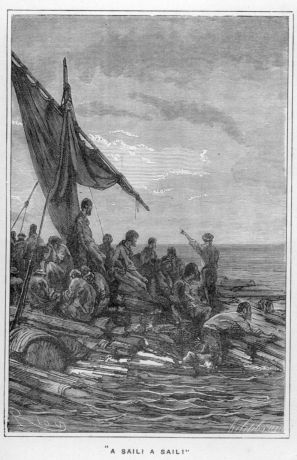
“We will do as you advise, sir,” he shouted in return. “We have got food and water enough on board for three or four people; and knowing that you were likely to be short of both, we came to look for you. My mate here is the brother of the boatswain, and is a very good fellow. As you say, it will be dangerous for us to come alongside; but if Mr Boxall, Mr Halliday, and you will swim off to us, we will run in closer and take you aboard.”
“No, no! don’t come any nearer; we can all easily reach you,” answered Boxall. He did not wish to let the Spaniard know of his brother’s death, in case he might be less willing to remain faithful to us.
The mutineers, as well as the other people, suspected from this conversation what we were about to do, and also from seeing that the raft did not come nearer. It struck me that, since the poor boatswain was dead, we ought to invite the carpenter to accompany us. Boxall agreed with me; I therefore asked him in a low voice if he could swim, and was willing to try and get on board the small raft.
“I cannot swim,” he answered; “and if I could, I would not desert these poor people who are trusting to me, for the mutineers would very soon put them to death. But as you are not bound to remain, I will help you to escape.”
Thanking him heartily, I said that we would leap overboard suddenly, in order that no one might attempt to stop us. We were all very sorry to leave the carpenter, for we could not help fearing that when we should be gone the mutineers would attack him, and in all probability treat him as they had done the boatswain. We were still talking to him, when once more the ruffians at the other end of the raft shouted out that they must have water and provisions served out to them immediately.
“Ask them to wait patiently till the evening, and say that you will then do as they wish; you will have fewer mouths to feed by that time.”
I little thought at the moment how truly I spoke; for scarcely had the carpenter uttered the words when the mutineers rose in a body, and, drawing their knives, made a desperate rush at us. We had only time to spring to our feet and defend ourselves. Though we might have leaped overboard and escaped, we felt that it would be cowardly to desert the carpenter and those who sided with him. As it was, three of the unfortunate people who remained neutral, and were without weapons to defend themselves, being nearest to the savages, were stabbed before we could help them. We fought with the greatest desperation. Boxall cut down one of the fellows, and the carpenter and I wounded two others. Still they came on, as if resolved to overpower us. I observed, also, that Ben was near enough to see what was taking place, and was hoisting his sail, unable to resist his desire to come to our assistance. Should he come near enough to enable any of the people on our raft to leap on to his, I felt sure that our chance of escape would be lost.
“Are we bound to sacrifice our lives for these people?” I asked Boxall.
“Not when we have lost all hope of assisting them,” he answered. “Ask the carpenter again if he will accompany us.”
I was on the point of putting the question, when the ruffians—who seemed resolved on his destruction, believing that then they could have everything their own way—made a desperate rush at him. He cut down one of them, and would have treated the others in the same way, when his foot slipped, and he fell into an opening between the spars. They immediately, before he could regain his feet, threw themselves upon him, and plunged their knives into his body.
“It is useless further to contend with the villains. Now is our time!” cried Boxall; and driving back the fellows who were attacking us, we made our way to the side of the raft.
“Now, Halliday, leap!” shouted Boxall, while he kept those who were attempting to stop us at bay. Halliday plunged into the water, letting go his axe as he did so, and struck out towards Ben’s raft.
“Keep hold of your sword, Charlie,” said Boxall; “I will defend you from these fellows.” I did as he advised me; and putting the sword in my mouth, where I held it fast between my teeth, I leaped into the water, and struck out with all my might towards the small raft. With a sweep of his weapon my brave friend drove back the ruffians, who had now turned their fury on him, and were pressing him hard; then springing overboard, he followed close at my heels. Happily, none of the savages could swim,—or, at all events, they dared not trust themselves in the water, fearing that if they did so Boxall might have attacked them with his sword; though some, in their rage, threw large pieces of wood and other articles, which came very near us; and one of the most furious flung his knife, which happily passed between Boxall’s legs. Shrieks, cries, and shouts for us to come back, were uttered by our enemies, with threats of vengeance; but these, of course, only made us strike out the faster.
Ben and his companion, in spite of the warning we had given them, had hoisted their sail, and urging on the raft at the same time with a couple of oars, were approaching us rapidly.
“Shorten sail!” cried Boxall; “don’t come nearer; we can easily reach you.”
Ben obeyed; and we had the satisfaction of seeing Halliday—who, having no weapon in his mouth, had kept well ahead of us—helped on to the raft. Just then Ben cast a look of dismay towards us. “Strike with all your might, and splash with your feet! Make haste! make haste!” he shouted frantically. At the same time seizing a lump of wood, he flung it into the water on one side of us; while he called to his companion, who had been steering the raft, to put in his oar to help us. The thought of the cause of his excitement flashed into my mind: he had seen close to us a huge shark, which he dreaded every instant would seize our legs. I had, I may say, less fear for myself than for Boxall, who was a little behind me; and I had made but a few more strokes when Ben and the Spaniard seized me by the hands, almost jerking off my arms as they hoisted me on board. The moment my feet were on the raft, my first impulse was to take my sword in my hand, ready to attack the shark should it approach.
In a few seconds, greatly to my relief, I saw Boxall hauled up likewise. Scarcely were his feet out of the water when the hideous monster made a dash at the raft, his jaws closing on a projecting part of it, which trembled with the blow. A stroke which I dealt with right good will at its throat,—for a moment exposed to me as it turned on its back to bite,—made it relinquish its hold; and it darted away.
Frail as was the structure on which we now found ourselves, we felt in comparative safety; but the impulse which had been given to the raft before the sail was lowered sent it dangerously near the big one. Judging from the attitudes of the people on it, we could make out that several were preparing to swim off to us; with the intention, in all likelihood, of making us prisoners, and taking possession of the provisions and water on the raft. On this Boxall called to Ben to work one of the oars, and Halliday and I assisted the Spaniard at the other. While we did our utmost to increase our distance from those whom we were now compelled to look upon as our enemies, they were all shouting and shrieking; some ordering us to come back, others entreating us not to leave them.
As we had to pull against the wind, we made but slow progress; and at length three of the boldest of the mutineers, urged by their companions,—probably because they were good swimmers,—leaped into the sea with their knives in their mouths, and made towards us. The attempt was a mad one, as with our swords and axes we could easily have prevented them from getting on our raft. As they evidently had not seen the monster shark which had so nearly caught us, I shouted to them, telling them of their danger, and advising them to go back; but, believing that it was merely to prevent them from attacking us, they disregarded my warning.
On they came, swimming with long powerful strokes, and threatened quickly to overtake us. Unwilling to injure them, we continued to row away as fast as we could—now and then turning our heads to watch them. They had got about half-way when a piercing shriek rent the air, and one of them, throwing up his arms, disappeared beneath the surface: a shark had seized him. His companions, seeing what had happened, turned round and endeavoured to regain the raft. We watched them anxiously, for we had no desire for their destruction, and gladly would we have saved them if we could. They had got some way back, and we hoped that they would succeed in reaching the raft; but when about a dozen fathoms from it, another huge shark rose to the surface, and dragged down a second shrieking victim. The third swam on frantically, crying out to his companions for assistance. They stretched out their arms to him, and we were thankful to see that he at length gained the raft in safety.
What the fate of those miserable wretches would be, with no one to command them, to maintain discipline, or to direct them how to gain the land, we dared not think. As for ourselves, we felt in comparative safety on our small but well-constructed raft.
Boxall consulted with Ben whether we could take off any of the unfortunate people; but the latter was strongly opposed to the attempt being made.
“In the first place, it would be impossible to get off those we might select,” said Ben. “And then,” he added, “this craft carries us very well in smooth water; but should it come on to blow, and a heavy sea get up, it’s more than she would do if we had half-a-dozen more people on board. Then, you see, we have water and provisions for ourselves; but we should be on short commons if we had more people to consume it.”
Ben’s arguments prevailed; and though we felt sad at the thought of having to leave so many people to almost certain destruction, yet we could do no more.
The wind had now completely fallen, and as Ben and his companion, as well as ourselves, had been awake all the previous night, we felt too weary to continue working the oars. We were, also, both hungry and thirsty, though we had hitherto been too much excited to think about it. Halliday was, as usual, the first to cry out.
“Of course, we will get some food for you, sir. I forgot how sharp set you must have been,” said Ben; “but as we have no galley aboard this craft of ours, you must be content to eat your supper raw.”
“We shall be content to eat anything we can get our teeth into,” cried Halliday. “Oh, do give me a cup of water, as we had only a few thimblefuls on board the big raft.”
Ben quickly drew a small-sized cupful from one of several casks ranged round the raft.
“I should like to serve out more, gentlemen; but Mr Boxall will agree with me that it’s necessary to be careful, as our stock is but small, and we shall not get more till we reach the shore—and perhaps not even then.”
Ben had secured some flour, which he rolled up into small balls. We ate these thankfully, with some salt fish, from which they assisted to take off the saltness. We made a better meal than we had enjoyed since we left the ship; but I observed that neither Ben nor his companion ate anything.
Night now came on. The ocean was as calm as a mirror, and the stare came forth from the cloudless sky and shone down upon us, their soft light tending greatly to tranquillise our spirits. One of us kept watch at a time, while the rest lay down, with the sail as an awning, on the planks with which Ben had formed a raised deck to the raft. We could dimly distinguish the large raft in the distance; while voices, borne over the tranquil ocean with peculiar distinctness, reached our ears, though I could not make out what was said. Again there came shrieks and cries, then all was quiet. Once more loud voices—as if the people were holding a violent debate, or were fiercely disputing—reached us. After all was quiet, I lay down and slept as soundly as I had ever done in my life.
Chapter Five.
A frightful encounter with sharks—A chase, and an escape—Land! land!—Breakers ahead.
I was aroused by a cry from one of my companions; and, sitting up, I saw a small raft with four men on it approaching from the direction of the large one. I at once knew that it must have been formed by them during the night, for the purpose of trying to overtake us. The men were urging it on with frantic efforts, evidently resolved to board us; so we got out our oars, and began to row away to keep ahead of them. Day was just breaking. They probably had wished to surprise us during the darkness of night, but had been unable to finish their raft in time. We were, it must be understood, to the eastward of them, and a somewhat stiffish breeze had just got up, blowing from off the shore, which, although the water remained pretty calm, impeded our progress,—for our raft, though strongly put together, and able to contend with a heavy sea, was deep in the water, and could not be impelled by rowing at much speed. If overtaken, we must expect, we knew, a fearful struggle; for though we outnumbered those who were approaching, four desperate men, all armed, might overpower us, as we possessed no missiles, not even a boarding-pike or boat-hook with which to drive them off—nor could we prevent them from getting alongside, or commencing the fight till their feet were actually on our raft.
On they came, uttering fearful oaths. “They have probably attacked the spirit-cask, and in their drunken fury are indifferent to consequences,” observed Boxall. “It will be madness to show them the slightest mercy if they get up with us.”
While we rowed away with all our might, I could not help frequently turning my head to watch their progress. They had, I should have said, stepped a mast on their raft, but had no sail; indeed, they could not have used it had they possessed one. This was another sign of the haste in which they must have embarked. Their raft was also, it was evident, carelessly put together; and as it drew nearer we saw that the men could with difficulty keep their feet on it—for the wind by this time having caused the sea to get up slightly, it rocked from side to side.
They were within half a cable’s length of us, when the feet of one of the men slipped, and overboard he fell. His companions, not seeing him, continued to row on. He shrieked to them to stop; the man next to him was stooping down, holding out his hands to haul him in, when suddenly he too was drawn into the water. Piercing cries sounded in our ears. “See, see,” exclaimed Ben; “the sharks have got them!” In an instant they had disappeared, while their companions looked on horror-struck. The next moment a huge shark rose to the surface. One of the men struck it with his oar, which was immediately torn from his grasp; and directly afterwards another shark darted at him. He seized his axe, and, holding on to the mast, attempted to defend himself, while the remaining man continued to row as desperately as before. We would gladly even then have saved the wretched men, but we were unable to do anything to help them. There must have been half-a-dozen sharks or more surrounding the raft, one after the other attacking the frail structure, and threatening every instant to capsize it. In vain the man on the fore-part of the raft attempted to turn it round; again and again the savage creatures assailed it; and at length one, more ferocious than its companions, threw itself upon the raft, and over it went—the two unhappy beings instantly becoming the prey of the monsters.
We turned our eyes away from the sight, not without a dread that we might ere long be attacked in the same way. We had, however, the advantage of a strong raft, considerably higher out of the water than the other; and thus we had less reason to fear that the sharks would succeed in upsetting it.
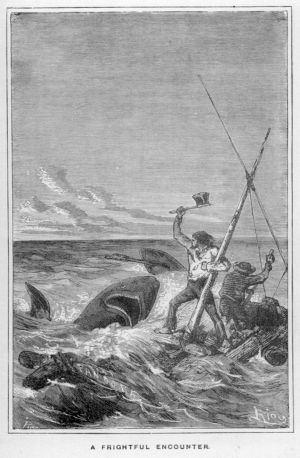
“It serves the fellows right,” observed Ben; “though, villains as they were, I could have wished them a better fate.”
Wearied with our exertions, and as there was no immediate necessity for rowing—seeing we could not hope to reach the shore until a breeze got up in our favour—we put in our oars to rest.
“Of course, Mr Boxall, you will take command of the raft,” said Ben, touching his hat; “and maybe you will think fit to pipe to breakfast, as, I dare say, Mr Blore and Mr Halliday are getting hungry again.”
“That I will, very gladly,” said Boxall; “and I will try, at all events, to do my best for all hands.”
“Hungry! I should think I am,” exclaimed Halliday.
We had some more fish, with some biscuit,—which, though soaked in salt water, afforded nourishment. The fish we could eat raw better than some salt pork which Ben told me he had on board. Although our food was not palatable, we had not much apprehension of starving. We were chiefly anxious about water, of which our supply was very small; and we could not help being struck by Ben’s fidelity in coming to look for us, knowing, as he must, that we should consume so much of the precious liquid, which was little more than sufficient for himself and his companion.
The day wore on, and still no breeze got up. “I wish that we had had an oar apiece, as we might then have had better hopes of making progress with the raft towards the shore,” I observed. Halliday, however, declared that he thought we were pretty well off as we were,—as it would be a pity to exert ourselves, and to find that after all it was of no use; for a strong breeze from the shore would send us back in an hour the distance we had made good during a day’s labour.
“Still, if every day we make some progress, when the breeze does come from the westward we shall be so much nearer the shore,” observed Boxall. “Therefore we ought, while we have strength, to do our best to urge on our raft.”
Though we were all agreed as to the wisdom of this, yet the sun came down with such strength on our heads that we had little inclination to exert ourselves. We had also hopes that, when the breeze did get up, a sail might come near us. This, perhaps, made us exert ourselves less than we should otherwise have done.
The large raft, I should have said, was still in sight; and, looking through my telescope, I could see the people moving about on it,—though, as far as I could judge, there were fewer than there had been when we left it. What had become of the others? Too probably many had been killed by the ruffianly mutineers; and some, having succumbed to hunger and thirst, had been thrown overboard.
As the day wore on, we could not help acknowledging that we felt weaker than we had been, while a strong inclination to sleep overpowered us. So, while we waited anxiously for a breeze, we spent some hours sleeping under the sail,—persuading ourselves that we should be better able to row during the cool hours of night, when we determined to set manfully to work.
I may venture to say, though I have not before taken notice of it, that a feeling of compassion made us unwilling to desert altogether the unfortunate people still on the raft until, for our own safety, we were compelled to do so. Before long, it was but too probable, their numbers would be greatly diminished. Already six of the mutineers had lost their lives, and their fate would, we hoped, be a warning to the others; perhaps, too, the better disposed people might gain the upper hand.
“Whether we can venture to take them off now, is a question,” observed Boxall; “but we may possibly be able to reach the shore and gain assistance for them: and it would certainly tend to prevent them giving way to despair, could we, before we leave the neighbourhood, tell them of our intentions.”
Halliday and I acquiesced in this; Ben was doubtful.
“After the spirit they have shown, I am afraid it would be of no use, sir,” he observed. “They are not to be dealt with like Englishmen; and if we go near them, they will only try to get hold of our raft. I will ask José what he thinks.”
The Spaniard shook his head. “They will not believe us, señor,” he answered. “Our officers having deserted them, they will not believe that a party of foreigners can intend to treat them with better faith. As they have killed my poor brother, one of the best of men, so they will try to kill us.”
I could not help thinking that there was much force in what José said; still, until a breeze should get up, we agreed to remain where we were.
Another day came to a close. Occasionally we could see the triangular fins of sharks gliding round the raft, their wicked eyes turned up towards us; but they made no attempt to attack us. After supper we again held a discussion as to what was best to be done. At last compassion gained the day, and we agreed to approach the large raft sufficiently near to hail the people, and to tell them that we would, if possible, send them assistance.
“You will do so at great risk,” said José. “I warn you of that; but, at the same time, I will not be the one to oppose your kind intentions towards my countrymen.”
We accordingly took our oars and began slowly to approach the large raft. As we drew near, we could hear the voices of the people on it; some shouting in hoarse tones, others shrieking and crying out, as if imploring mercy.
“It is useless to go on, señors,” said José. “They will not listen to reason.”
Still, impelled by a feeling superadded to that of the compassion which chiefly influenced us, and for which I can scarcely now account,—resembling that which is said to induce birds or other animals to hurry forward into the open mouth of the serpent,—we continued to row towards the fatal raft. Perhaps, too, Boxall, who was the person to order us to stop, still hoped that our presence, and the promise we were about to give, might induce the people to remain quiet till assistance could reach them.
At length we got near enough to hail; but it was some time before we could make our voices heard, or the uproar ceased. I desired José to tell them what we intended doing.
“Come nearer, come nearer,” was the answer. “Give us a little water and a little food; and if you will take two of our number,—only two,—who are suffering greatly, it will show us that you are in earnest, and that you wish to save our lives.”
“Don’t trust them, don’t trust them, señor,” cried José, in an agony of fear. “They don’t mean what they say. If once we get within their power, they will detain us.”
I told Boxall what José said. He still hesitated, however. Just then I felt the wind fan my cheek.
“Here comes a breeze from the westward,” shouted Ben.
“We have given our message,” I observed to Boxall; “and I cannot help thinking that José is right. We must not forget the sample they have given us of their feelings.”
“I am afraid it must be so,” said Boxall with a sigh. “For our own safety, we must make for the shore without further delay. Hoist the sail, Ben. I will take the steering-oar; José can manage the bow oar; and you, Halliday, and Charlie can tend the halyards and sheet.”
We assisted Ben to hoist the sail, which was somewhat large for the raft, except under a very light wind. Before the sail was set, however, the breeze had greatly increased, and scarcely had we brought the sheet aft when over went the mast, carried off at the heel. We of course set to work to get in the sail, while Ben, with an axe, endeavoured to cut out the broken heel from the step, in which he had fixed it. This took some time, as the raft was rocking about far more than it had hitherto done, and he could not work quickly in the darkness. Having at length succeeded, he had next to chop the heel of the mast to the proper size to fit the step. He was working away as rapidly as possible, and we were stooping down to assist him, when José shouted out, “They are coming, they are coming!” Looking round, we observed that the sail of the big raft was hoisted, and that she was coming towards us faster than we should have supposed it was possible for her to move. In little more than a minute she might be up with us; while the wild shouts and execrations of the miscreants who were on the raft rang in our ears, and showed us what he had to expect from them.
Ben worked away as composedly but as rapidly as he could, while we were engaged in taking a reef in the sail.
“It’s done,” cried Ben at last; and lifting the mast, we found, to our great satisfaction, that the heel fitted into the step. We immediately set up four stays.
“Be smart now,” cried Boxall. “Hoist away with the sail.”
He had good reason to give the order, for, as we looked round, we saw the head of the big raft with several people on it, some rowing to give it more impetus, while one stood with a boat-hook ready to catch hold of us. In another instant the fellow might have hooked on, or have run the point of it into the back of Boxall, who had again resumed the steering-oar; but, hoisting away with all our might, we got the sail up, and while Ben was making fast the halyards Halliday and I carried the sheet aft.
Over the now foaming sea we flew, while the big raft followed close astern,—those on it uttering the most fearful oaths and execrations as they found themselves disappointed in their project of seizing us. Our light raft went over the water far more rapidly than theirs, and we soon distanced them; but for long their shrieks and cries sounded in our ears.
“I thought, sir, that they intended treachery,” observed José to me; “and we may be thankful that we escaped them.” I agreed with him; at the same time, having escaped, we had the satisfactory reflection that we would have done our best to have rendered them assistance, and that we could not blame ourselves for deserting our fellow-creatures. What would now be their fate, it was not difficult to say. They might possibly reach the shore; but the large raft, hurriedly put together, was but ill calculated to resist the now fast rising sea, and we could not but fear that many of the unfortunate wretches would speedily be washed off it. Our little raft was tolerably strong, but the way the pieces of which it was constructed worked, gave us a notion what would be the fate of theirs.
We were tossed fearfully about, and had to run now to one side, now to the other, to balance it as it was lifted by the seas. Boxall kept his seat on a cask, endeavouring to steer it, but he had at length to call me to his assistance, while Ben helped José. On and on we flew. As the clouds gathered in the sky the night grew darker and darker, and we soon lost sight of the large raft, while the voices of those on it no longer reached our ears. I asked Boxall what he thought would happen to the miserable people.
“Too probably they have been washed off the raft, or it has been capsized, by this time,” he answered. “I confess, I do not like to think of what must have been their fate.”
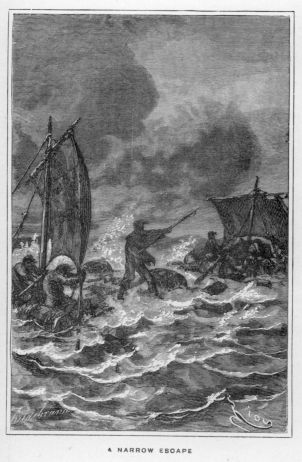
Our thoughts were now turned towards what might happen to ourselves. We had no means of judging how far off we were from the coast, but I calculated that, as we had not seen it, we could not be within fifteen miles or so of it—an opinion which I expressed to Boxall.
“You forget that, low down as we are in the water, our horizon is very circumscribed; while for miles together, on this part of the African coast, the sandy shore rises but a few feet above the level of the sea,” he answered. “It may therefore be much nearer, than we suppose. We must, at all events, keep a good look-out; although, with the wind blowing strong, and running as we are directly before it, we shall have no choice where to land, and shall have to make good our footing on the dry land as best we can.”
We were silent for some time; indeed, we had enough to do to steer the raft.
“Keep a bright look-out, Ben,” cried Boxall. “Do you see anything of the land?”
“No, sir,” answered Ben, somewhat surprised; for he supposed, as I had done, that we were still a long way off. “I don’t expect to see it for the next three or four hours.”
“We may reach it sooner than you fancy,” said Boxall.
“Very glad to hear that, sir,” answered Ben; “for though I am very well satisfied with this craft of ours, I would sooner feel my feet on dry land than aboard of her, if it should come on to blow much harder than it does now.”
I suspect we all felt as Ben did. The sea was fast rising, and as the foaming crests of the tumbling waves came hissing over the raft, we had to hold on tightly to avoid being carried away. But our chief anxiety was about our mast. Should that give way, the raft would be left tossing helplessly amid the seas, and in all probability be washed off. We had, however, stayed it up securely, and we could only hope that it would hold.
I now proposed taking another reef in the sail.
“No, we will let it stand,” said Boxall; “we shall only run a greater risk than we do now of being pooped, should we shorten sail, and if the wind does not increase we shall easily carry it; indeed, by the look of the sky, I have hopes that the weather will not grow worse,—and perhaps by the morning we shall have it calm again.”
“We may then congratulate ourselves on having had the strong breeze which is sending us along so famously,” observed Halliday.
“We shall have reason to be thankful to Him who has caused the westerly wind to blow,” answered Boxall. “It might have come from the eastward, and we should have been driven still further off the coast—when, if not swamped, we would in all probability die of starvation, did we fail to fall in with a passing vessel.”
Fully two hours passed by, and still Ben’s sharp eyes could not detect the land. We had been steering by the stars, and though they had for some time been obscured, we had reason to believe that the wind had not changed, and therefore, being directly before it, that we had kept the same course.
I asked Boxall how fast he thought we were going through the water.
“Considering the breeze we have got, I should say five or six knots an hour,” he answered.
“Beg pardon, sir,” said Ben, who overheard him; “you forget, I dare say, that this raft does not sail like a boat. I suspect that we don’t get much more than three or four knots out of her.”
“I believe you are right, Ben,” answered Boxall. “In that case, it will take us an hour or so more than I calculated on to gain the shore. However, it may be to our advantage, for it will be far safer to land when it is calm than with so strong a breeze as is now blowing. At all events, unless the wind changes, we shall reach the shore at last.”
Another hour went by. According to Boxall’s predictions, the weather was improving. The dark clouds which had obscured the sky cleared away, and the stars shone forth brightly as before; still the wind did not decrease, and the seas kept tumbling, foaming, and hissing around us as before. More than once we looked astern, thinking it possible that the large raft might be again within sight; but no sign of her could be seen. By degrees we had got accustomed to the tossing and the occasional breaking of the seas over us, and even had we expected to perform a much longer voyage we should not have complained; indeed, it now seems surprising to me how little concerned we all appeared to be.
We were running much as we had been doing for the last three hours, when Ben exclaimed, “Land! land!”—and directly afterwards, “Breakers ahead!”
We all looked out under the sail at what appeared to be the dark outline of a hilly country,—it seemed strange that we had not seen it before,—while the intervening line of white foaming breakers stretched out parallel with the coast, and threatened our destruction before we could reach it.
“Do you see any opening through which we may pass, Ben?” asked Boxall.
“No, sir; none at all,” answered Ben. “All we can do is to hold fast to the raft, and pray that we may be earned through the breakers.”
“Had we not better lower the sail, then, and keep the raft off till daylight?” I asked.
“We may lower the sail; but all the strength we possess could not keep us out of the breakers,” answered Boxall. “We had better do as Ben suggests—stand on, and hope to be carried safe through them. Hold fast, all of you!” cried Boxall; “here we are close upon them.”
As he spoke, we saw the waters hissing and foaming and dancing up to a prodigious height, as it appeared, directly before us, while the land rose still more distinctly behind them. The next instant we were in their midst.
“Hold fast! hold fast!” again shouted Boxall, “and we shall be carried safely through.”
The breakers did not appear so high as they had done a little way off, and we all had hopes that Boxall’s predictions would prove correct. But we had not much time for thinking; my head whirled and I felt giddy as I looked at the tumbling, foaming waters surrounding us. The raft lifted on the top of a sea, and came down with a fearful crash on a rock; and I felt myself torn from the grasp I had of the raft, and carried far away from it. I looked for my companions, and distinguished Halliday struggling near me. Striking out, I caught hold of him and urged him to endeavour to reach the shore, which appeared at no great distance before us. I then shouted to the rest of my companions, and was thankful to hear Boxall’s voice.
“Strike out ahead; we have not far to swim,” he answered, and presently he was close up to us. Neither Ben nor José, however, replied to our shouts; but self-preservation compelled us to try and make the best of our way to the shore, without attempting to look for them.
We had not struck out far when I felt my feet touch something. For an instant the horrid thought occurred to me that it might be a shark; but I retained my presence of mind,—and directly afterwards, greatly to my astonishment, I felt my feet touching the ground. I told my companions; and soon we all found ourselves standing, with the water scarcely up to our armpits. Still, though we distinctly saw the shore, it appeared to be a long way off. We now stopped to look around us. Not far-off, on one side, rose a rock to a considerable height, as it seemed, above the water. Believing that we were on a sand-bank, and that we might possibly have to swim a considerable distance, we agreed to make for the rock and rest on it till daylight. Holding each other’s hands, we accordingly waded on, when suddenly we found that we had reached the rock,—on which we without difficulty climbed. The upper part of it, which was much lower than we expected, was perfectly dry; showing that the sea, in moderate weather, did not break over it. Boxall was of opinion that we had struck on a reef which extended parallel with the coast, and broke the force of the waves, and that we were in an intervening lagoon,—so that should it be now low water, which he thought probable, we could have no difficulty in reaching the shore.
We again shouted to Ben and José, but no reply came; and fearing that they must have been lost, we gave up calling to them and sat down.
The wind fell soon afterwards, and wet through as we were, by sheltering ourselves in a crevice of the rock we did not suffer much from the cold. After waiting for some time, we found that the tide was ebbing.
“If we wait till the morning we shall have high-water again; and in my opinion we shall be wise to try and get on shore at once,” said Boxall.
Halliday and I agreed with him; for, our strength being restored, we were anxious to find ourselves safe on dry ground. We could not, however, fail to grieve for the loss of Ben, who had been so faithful to us; and also for his companion, José, who seemed a truly honest fellow.
“Now,” said Boxall, “let us start.”
“We are ready,” answered Halliday; and he and I following Boxall’s example by slipping off the rock, found ourselves in water scarcely up to our middle and once more began to wade towards the shore.
Chapter Six.
A deceptive coast—What is it?—Our disappointment—A strange apparition.
An attempt to cross an unknown expanse of water, such as seemed the lagoon stretching out before us, was a hazardous experiment. Still, the water was calm, and we concluded that it was shallow, so that we hoped by perseverance to gain the dry land at last. There was no time to be lost, however, as the tide might soon rise again, and make the undertaking more difficult. I felt like a person in a dream as we waded on, surrounded on all sides by water, over which hung a peculiar silvery mist, curiously deceiving the senses,—though perhaps I was not aware of it at the time. The appearance of the shore even seemed changed. It looked altogether very different from what we expected to find it. Instead of a low sandy beach, with here and there hillocks of sand, it appeared to rise to a considerable height, with hills and intervening valleys, and lofty rocks springing directly out of the water. “We must have been further to the south than we supposed,” I observed to Boxall. “Surely we must be near the French settlements. The shore before us cannot be on the border of the great Desert of Sahara.”
“I cannot make it out,” he answered. “Still I am pretty certain as to our latitude. The country, however, is but little known, and we may have been thrown on a more fertile region than was supposed to exist.”
“I hope, then, that we shall be able to find some food,” said Halliday; “I am terribly hungry and thirsty. Don’t you think that we may by chance have got to the mouth of a river, and so may soon find fresh water?”
“This, at all events, is salt enough,” said Boxall, lifting a handful to his lips. “No; it is merely a lagoon filled by the ocean.”
We waded on and on, but the shore appeared no nearer.
“We may have a fearfully long way to swim, should the water grow deeper,” observed Halliday.
“If it does, we can easily return to the rock and wait till the low tide during daylight, when we shall be better able to judge what course to take,” I observed.
As I said this I turned round to look at the rock, and to see how far we were from it, when what was my astonishment to be unable to distinguish it! Behind us the lagoon appeared to stretch out to an illimitable distance, without a single object rising above the surface. To attempt to return would have been madness, as we should certainly have lost our way; we therefore could do nothing else than push boldly forward. The sand below our feet was smooth and even, but walking in water almost up to our middle was fatiguing work, and we made but slow progress. Still on and on we went, when suddenly we saw before us a high conical hill, and directly afterwards a bright light appeared beyond it. Presently the upper circle of the full moon rose behind the hill, though it seemed six times the size of any moon I ever saw; indeed, I could scarcely believe that it was the moon.
“I suppose that the African moons are much larger than those of any other part of the world. At all events, that is a whopper,” exclaimed Halliday, without considering what he was saying.
“It will give us light to see our way,” observed Boxall, “and we should be thankful for it. We had better keep to our right, however, where the shore seems somewhat lower.”
He was turning aside, and I was about to follow him, when Halliday exclaimed—
“Look! look! what can that terrific creature be?”
We turned our eyes towards the summit of the hill, and to our horror saw an enormous animal with arched back and glaring eyes—so we pictured it—gazing down upon us, seemingly prepared to make a terrific leap right down on our heads. Such a creature I had never even read of; for it looked far larger than any ordinary elephant, and might have swallowed us all at a gulp.
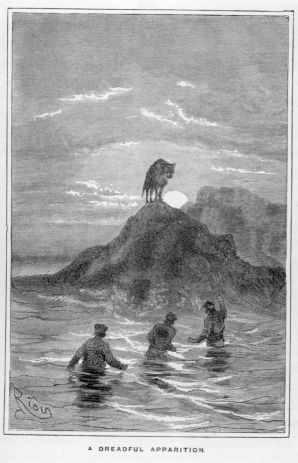
“What is to be done?” cried Halliday. “If we run, it will certainly be after us.”
“We cannot run, at all events,” said Boxall with less anxiety in his tone than I should have supposed possible, though I knew him to be a dauntless fellow. “We will keep to our right, as I proposed, and perhaps the monster won’t follow us after all. It is not likely to come into the water to get at us.”
We kept away to our right, and found the water growing shallower and shallower. It was now but a little above our knees. I confess that I turned my head very frequently, to see whether the monster was coming after us. There it stood, however, in the same attitude as before—which was some comfort, as it thus showed no inclination to act as we had dreaded.
“What can it be?” I asked of Boxall.
“A wild beast, certainly,” he answered. “I might have supposed it a part of the rock, or some gigantic figure hewn out of it, but it is too much like a real creature for that; and I begin to think that the mist which hangs over the water must have given it its supernatural magnitude. I would have said, from its shape, that it was a hyena or jackal, but neither the one nor the other approaches to anything like it in size.”
“Whatever it was or is, it has disappeared,” I exclaimed; for on looking round once more, the monster was no longer to be seen on the top of the hill. The water was now but a very little way above our knees, while the ascent was much steeper than it had been.
“I only hope we shan’t see the creature again on shore,” said Halliday.
“We have not much further to go to reach it,” observed Boxall. The last few yards we had taken we had rapidly shoaled the water. “Thank Heaven, we are ashore at last!” he added, as the light surf which rolled up slowly went hissing back and left our feet uncovered. A few paces more, and we were standing on dry sand.
“Halloa! what has become of the mountains?” exclaimed Halliday. “I thought we were going to land on a rocky country, but I see nothing but sand-hills around us.”
Such indeed was the case. As far as our eyes could reach, we could discern, in the moonlight, only a succession of sand-hills, rising but a few feet above the rest of the country.
“I suspected that we should find that to be the case,” observed Boxall. “If we were to measure the rock on the top of which we saw the monster standing, we should find that the creature’s dimensions were not quite so gigantic as we supposed. However, here we are talking away, and neglecting to return thanks for our deliverance from the dangers we have gone through, and forgetting all about our unfortunate companions.”
I felt rebuked by Boxall’s remark, and so, I dare say, did Halliday. We all knelt down, and I know that I tried to return hearty thanks for our preservation; but my mind was still in a confused state, thinking of Ben, and our long wade, and the monster which we had seen, and of what might be our future fate. My strength, indeed, was fast failing me; and though I was generally stronger than Halliday, I was the first to sink down on the sand. He imitated me, and Boxall soon afterwards sat down beside us. We none of us felt much inclined to speak; yet we were afraid to go to sleep, when we recollected the creature we had seen,—which, though it might not be of extraordinary size, would, if it were a hyena, prove an ugly customer should it take us unawares. Otherwise, we had no reason to dread it. Such creatures, indeed, seldom attack human beings unless first assailed, as they five on carrion, and act a useful part as scavengers.
Wet through as we were, the night air chilled us to the bones; but we were too much exhausted to feel inclined to move about and try and warm ourselves. We sat for some time gazing on the wild, desolate scene around us, lighted up by the rays of the full moon, which seemed to increase its aspect of dreariness. On three sides appeared a succession of sand-hills, one beyond another; while before us was seen the lagoon across which we had waded, with the tumbling seas, on the crests of which the moonbeams played, breaking on the reef in the distance. Every instant the water in front of us became more and more agitated, as the rising tide flowed over the reef; and we could not but be thankful that we had crossed the lagoon when we did, as later the undertaking would have been far more difficult, if not impossible, and we should probably have been engulfed by the foaming waters, which now with greater and greater violence rolled up on the shore.
Our thoughts naturally turned to the future. How were we to support life in this dreary region? or, supposing it to be inhabited, what would be the character of, and disposition shown towards us by, the people we might encounter? I had read of the Arabs of the Desert, and of their generous hospitality to strangers, and I had hopes that such might be the people we should find. I mentioned this to my companions.
“Poets and romance—writers may have pictured them as you describe, but I am afraid that we shall find the reality differ greatly from their glowing accounts,” observed Boxall. “My notion is that they are a set of utter barbarians, who will rob us of everything we possess, and only feed us for the sake of keeping us alive to work for them.”
This was not encouraging, and I could not but hope that Boxall was wrong.
“We shall soon find out,” said Halliday. “I only wish that in the meantime we had something to eat.”
“Well, we are better off than poor Ben and José, who have lost their lives,” I said.
“I don’t think we ought altogether to give them up,” said Boxall. “Now that we have rested, I propose that we go along the shore and look for them. They may possibly have been carried in a different direction from that which we took. I felt the current, though not very strong, setting to the southward as we crossed; and if they stuck to the raft, or any portion of it, not being aware that they could wade, they would be carried in that direction. I have been thinking the matter over, and believe that they may possibly have escaped.”
As Boxall founded his opinion on sound grounds, I began to hope that Ben might still be in the land of the living; and as Halliday said he felt strong enough to walk, we set off along the shore. We every now and then shouted out, “Ben Blewett, ahoy! ahoy!” joining our voices to send them to a greater distance. But no answer came.
“I am afraid poor Ben must be lost,” I said.
“He is not within hearing,—or, at all events, we are not within hearing of him; but let us still persevere. Had it not been for him, we should have lost our lives; and we are bound on every account to do our utmost to find him,” observed Boxall.
We accordingly dragged on our weary feet through the yielding sand. Walking was now excessively fatiguing, as the sea had come up and covered that part of the shore which had been hardened by the constant washing of the water over it. Again we stopped and shouted, “Ben Blewett, ahoy! ahoy!” We waited, hoping against hope that a reply would come.
“I am so tired, I must sit down and rest for a few minutes,” said Halliday. Boxall and I acknowledged that we felt much in the same condition, so we threw ourselves down on the sand. Scarcely had we lain down when the sound of a voice reached our ears. It seemed to come from a long way off, yet we all felt sure that it was a voice. We accordingly started up, forgetting our fatigue, and trudged on,—the sand seeming to our weary feet softer than ever.
We went on for some time, but still we saw no one. We began to fear that we had been mistaken; still we pushed on, and in another minute I saw a dark object in the water, which I took to be a rock, close to the white beach. Directly afterwards I made out a human figure, which appeared to be coming towards us. I had got a little ahead of my companions. I called to them, and we tried to hurry on through the soft sand, which seemed to mock our efforts to advance.
“Is that you, Ben?” I shouted.
“Ay, ay, sir,” was the answer, in a tone which showed that the speaker had but little strength left. We soon reached him. It was indeed Ben himself.
“I am thankful to see you, gentlemen,” he said. “It’s what I little expected, when you disappeared from the raft. But how did you get on shore?”
We told him, and then asked how he had escaped.
“It’s more than I can tell you,” he answered. “All I know is, that I found myself floating alone on what remained of the raft, away from the reef, with the mast and sail gone and the oars lost. After some time I was carried again into the breakers, and, clinging on for dear life, though I couldn’t tell where I was going, was sent right through them into smooth water. I looked about me, but could see nothing, nor hear any sounds. On I drifted, wondering what would next happen, when at last I was cast on shore,—the raft, which was turned over, being sent by a sea almost on the top of me. One of my feet, as it was, got caught; and if it had not been for the sand under it, my leg would have been broken: indeed, I had to dig it out before I could set myself free. Thinking that the tide might still be rising, and that I should be caught by it, I dragged myself on to the side of a hillock, where I lay down, and must at once have fallen fast asleep. I was at last awoke, I suppose, by your hails; though I first heard them several times in my dreams. I tried to hail in return, but felt my tongue clinging to the roof of my mouth; and it was not till after some time that I could open my eyes, and recollect where I was and what had happened. As soon as I did this, I got up as fast as I was able. And again I say, I am thankful to have found you, gentlemen; that I am.”
“And we are very glad to have found you, Ben,” I answered. “Do you think that poor José has escaped?”
“I am afraid not, sir,” answered Ben. “He could not swim, and he must have been washed off the raft on the outside of the reef.”
“Have you managed to save any of the provisions?” inquired Halliday.
“I am sorry to say, sir, that I am afraid they are all lost. The raft, however, was knocking about so much that I couldn’t get hold of it by myself, to see if anything is still fast to it; but now you have come, we will try what we can do.”
Weary as we were, hunger prompted us to exert ourselves; and approaching the raft, which was heaving up and down in the surf, we got hold of it, after some difficulty, and at the risk of being crushed, and succeeded in dragging it partly up the beach. On examining it, to our infinite satisfaction we found a pork-cask,—which Ben had fastened so securely that it had escaped being carried away. It was, however, almost crushed in two. We examined it eagerly, and found that, though part of the contents had been washed out, several pieces of pork still remained. The water-casks, which we should have been still more thankful to find, had, alas! been completely destroyed.
It required all the exertion we were capable of to secure the pork-cask, which we managed to drag out of reach of the water; and though very thirsty, our hunger induced us to eat a portion of the pork raw—which, however, we could with difficulty get down.
“Never fear! Chaw, sir, chaw!” cried Ben, as he saw me hesitating about putting a piece between my parched lips. “It will seem dry at first; but go on, and it will slip down easy enough at last, and do you good.”
I followed his advice, and found that I could get down far more of the raw meat than I could have supposed possible.
The wind had in the meantime been increasing, and the surf broke with a loud, sullen roar on the beach. Having eaten as much as we could swallow, we now turned the undamaged side of the cask uppermost, so as to cover its contents; and then, at Boxall’s suggestion, we made our way to a spot a short distance off, between some sand-hills, where, pretty well worn out, we threw ourselves down to rest.
Though thankful to get back honest Ben, we felt very melancholy at the dreary prospect before us. Strong as he was, he also appeared utterly worn out with his exertions; and, stretched at full length on the sand, he was soon fast asleep. I had rashly undertaken to keep the first watch.
“Awake me soon, and I will relieve you,” said Boxall. “I am afraid you will not be able to keep your eyes open long.”
“No fear,” I answered. “I will do my best, depend on it; for I have no wish to be earned off by a hyena, or any other wild beast which may chance to visit us.”
Boxall and Halliday sat with their heads between their knees, and very quickly dropped off. As long as I was able to remain on my legs and walk about, I proved a faithful sentinel; but feeling very weary, I at last sat down, and the natural consequences followed—I fell fast asleep. The howling of the wind among the sand-hills and the ceaseless roar of the surf rather tended to lull my senses than to arouse me from my slumber. I dreamed of the events which had occurred, and fancied that I knew exactly where I was and what was happening. Now I was looking towards the foaming sea, when I observed in the offing a vessel under all sail approaching the coast. Gradually she faded from my view. And now, turning my head, I saw to my dismay a pack of hyenas stealing silently along towards us. I started up, and was thankful to find that the hyenas had disappeared; but, near the spot where I had seen them, my waking sight fell on a strange-looking animal with a long neck, a pointed head, and huge hump on its back, which I at once recognised as a camel. It advanced at a slow pace, not regarding us, and making its way directly to the beach. Though unwilling to wake my companions, I could not help crying out, when Boxall and Halliday started up, though poor Ben remained as fast asleep as ever.
“What can that strange monster be?” exclaimed Halliday.
At which Boxall, though certainly not in a merry mood, could not help laughing loudly.
“Why, a camel, to be sure; coming down to the beach to get a lick of salt, of which most beasts are very fond,” he answered.
“I wonder if it’s a wild one, then,” said Halliday; “if it is, we may hamstring it, or kill it in some other way, and it will give us an ample supply of food.”
“There are no wild camels, that I ever heard of,” answered Boxall; “and if we were to kill it, depend on it its owners would make us repent having done so. I suspect they are not far off.”
The appearance of the camel, as may be supposed, completely aroused us, and we watched it as it stalked down to the sands.
“I propose that we catch it, and make it carry us somewhere or other,” said Halliday. “Its back is long enough to let us all ride on it: you, Boxall, on the top of the hump, as the post of honour; Ben, astern; and Charlie and I in front.”
I could not help laughing at Halliday’s proposal; Boxall did likewise.
“We must catch the beast first, then get it to lie down while we are mounting. And then, should we ever get on its back, seeing that it has no halter, it would certainly carry us—not where we wished to go, but to the tents of its masters; who would probably knock us on the head, or, if mercifully disposed, make slaves of us,” observed Boxall.
“Then I vote we don’t interfere with Mr Camel,” said Halliday. “But perhaps, if we were to follow its footsteps, it might lead us to where we could get some fresh water; or, should it go back to its owners, we might have time to reconnoitre them at a distance, and judge whether it would be prudent to trust ourselves in their power.”
“A very good idea,” said Boxall. “If, however, we are to trace its steps, we must wait till daylight; for as it probably walks much faster than we can, we should very likely lose sight of it, and get bewildered among the sand-hills.”
We were watching the camel as it came towards us, when, either seeing us or scenting us, it stopped short, poking out its head, as if wondering what curious creatures we could be. Then turning round, it stalked leisurely away, and was lost in the gloom.
“I hope it won’t go and tell its masters—unless they happen to be well-disposed individuals,” said Halliday. “I trust that they may prove friendly; and the camel, perhaps, has come to guide us to them.”
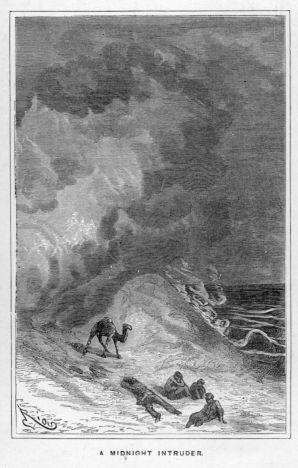
“It seems to me that daylight is breaking,” I remarked.
“We shall soon know all about the matter, then; only I do wish we could get something to eat,” said Halliday.
“So do I; but there is no use talking about it,” I observed.
“I am not much afraid of starving,” said Boxall. “We may hope to find oysters, or some other shell-fish, in the lagoon. I am more anxious about water; but even that we may possibly find by digging in the sand.”
Ben, overcome with fatigue, still slept on, undisturbed by our voices. I agreed with Boxall that he required rest even more than we did, and we therefore determined not to arouse him till daylight.
Chapter Seven.
Ben’s dream—An unpleasant discovery—A search for water—Friends or foes?—Boxall’s ingenious mode of obtaining a light—Our companion spirited away.
We lay on the ground, watching the stars gradually disappearing in the sky overhead, and still unwilling to awake Ben, who slumbered on, completely overcome by the fatigue he had endured for the last few days. At length the sun, like a huge ball of fire, rose above the region of sand-hills stretching out to the eastward. It was time therefore for us to get up and obtain a supply of pork from the store we had left on the beach, as also to commence a search for water. We called to Ben; who, starting to his feet, rubbed his eyes and looked wildly about him, as if not quite certain where he was.
“I mind all about it now,” he said, slapping his leg. “But, bless me, how I should like to have snoozed on: for I was dreaming that I was away back in Old England, in my sister Susan’s cottage, with the youngsters playing about in front of the porch, and Betsy Dawson—who has promised to marry me when I next get back—just coming in at the door to have a cup of tea and a quiet chat; and I was putting out my hand to take hers, when I found myself clutching a heap of sand.”
Poor Ben scarcely seemed to be aware that he was speaking aloud, for when he heard our voices he cast a bewildered look at us. We did not laugh at him, however,—that you may depend on.
“Well, well, Ben, we must be prepared for a good many trials and disappointments; but I hope that we shall all meet them like men,” said Boxall.
“Yes, sir, that we will; and I am ready for anything that turns up,” said Ben, giving himself a shake. “We want water and we want food, in the first place, I suspect.”
“The water, I have a notion, we can get by digging, as we did on the sand-bank the other day; and as for food, it’s hard if the sea does not give us something to eat, besides the pork,” observed Boxall.
The hot sun having quickly dried our wet clothes, we felt, as we began to move, in somewhat better spirits. We soon reached the spot where we had left the cask,—being guided to it by the remains of the raft on the beach. Halliday was the most hungry, and ran on first.
“Hallo, the cask has been overturned; and what has become of the pork?” he exclaimed, as he began hunting about in the sand. “That monster of a hyena must have been here; and I am afraid the brute has not even left us enough for breakfast.”
We hurried on, and speedily joined in the search.
“Here is a piece, fortunately, jammed between the staves,” said Halliday, dragging forth the remnant of a joint of pork.
“We may be thankful to get even that,” said Boxall.
We hunted round in every direction, but a couple of gnawed bones, with scarcely any flesh on them, were the miserable remains of the provision on which we had depended.
“There can be no doubt about the hyena being the thief,” I observed.
“I am very sure of it,” said Boxall. “Even had we buried the pork several feet deep, the creature would have dug it up; for the brutes are said sometimes to visit graveyards, and there to disinter human bodies unless carefully covered up with heavy stones.”
I shuddered, and felt but little inclined to eat the meat which the animal had left us. However, Ben was not so particular, and offered to take the bones as his share—by which arrangement he got a larger amount than either of us. Hunger had compelled us to eat the pork raw; and this having the natural effect of increasing our thirst, we agreed to lose no time in looking for water.
The staves of the cask furnished us with tolerable implements for digging; and would serve us also for weapons of defence, in default of better. We fortunately had our knives, and as the wood was hard, we could shape them into wooden swords and sharpen the edges. So we at once began to search for a spot where a little verdure might tempt us to dig. For this purpose we scattered about, agreeing to keep in sight of each other, and the person who first found a likely spot was to wave his stave above his head.
The hot sun now getting high in the heavens, his rays beat down on our heads, and made us eager to discover the refreshing fluid. Boxall said he was sure it was to be found along the coast, although he acknowledged that such spots might be miles and miles apart. “However,” he observed, “there is nothing like trying.”
We agreed to go towards the south; one taking the beach, another on his left hand on the summit of the first line of sand-hills, the third further in, and the fourth in a like manner on his left. Ben took the beach, Boxall was next to him, but I was outside of all. It occurred to me that it would be wise not only to look for water, but occasionally to turn my spy-glass to the east in the chance of any natives appearing. I scarcely knew whether or not it would be desirable to fall in with our fellow-creatures, remembering what Boxall had said about the natives; but still I thought that we might trust to the generosity and hospitality of the Arabs, and therefore should have felt no apprehensions had any appeared. As far as my eye could reach, however, with the aid of my spy-glass, wide plains of arid sand, and sand-hills rising one beyond the other, were alone visible. It was a region in which it appeared impossible that human beings could exist. At last I shut up the glass, believing that we were not likely to be molested, and that we must depend on our own exertions for support. My mouth and throat were becoming dreadfully parched, and I would have given everything I possessed for a drop of pure water; but, from the appearance of the country, I now began to despair of finding any.
We had gone on for some miles, it seemed to me, when I heard Halliday give a shout, and turning my head I saw Boxall waving his stave. I hurried after Halliday, who was making towards him. There was a slight depression in the ground, with a little verdure. Boxall had already begun digging, and we all joined with an ardour inspired by the parched state of our tongues. We exchanged but few words; indeed, we could speak but with difficulty. The staves served very well the purpose of shovels; and remembering that by perseverance we had before reached water, we dug on and on, believing that our labour would not be in vain.
We had got down fully four feet, and yet no water appeared. “Dig away,” cried Boxall; “even if we have to go two or three feet deeper, we need not despair.”
At last our efforts were rewarded by the appearance of moisture, and after we had thrown out more of the sand a whitish fluid flowed into the hole. On tasting it we found that it was drinkable, though somewhat bitter and brackish.
“I have no doubt that it is wholesome, as the water which the Arabs dig for in their journeys is described in the books I have read as exactly like this,” observed Boxall.
So thirsty were we that we did not allow it to settle, when it would probably have become more limpid. But we all felt greatly refreshed, and thankful that we had not been thrown on this desert region to perish with thirst.
Fatigued with our previous walk, we now sat down to rest. I turned my eyes in the direction of the reef,—which, however, was not visible,—and saw Ben looking in the same quarter.
“I wonder if we could repair the raft, and make our way to one of the settlements to the southward,” I said. “We might land if we saw bad weather coming on; and we should not, at all events, be worse off than we now are.”
“That’s just what I have been thinking about, sir,” observed Ben. “But then, do you see, we should not have fresh water, and we should have nothing to eat; and besides, I don’t know whether there is enough of the raft remaining to make it fit for use—though, to be sure, we might pick up some more pieces along the beach.”
“We need not give the matter much thought,” said Boxall. “We are several hundred miles from the nearest settlement, and the want of fresh water alone would make the voyage impossible, even should we succeed in putting our raft to rights. All we can do is to push boldly on to the southward; and if we can obtain oysters or anything else for food, and retain our health, we may hope, with God’s mercy, to succeed.”
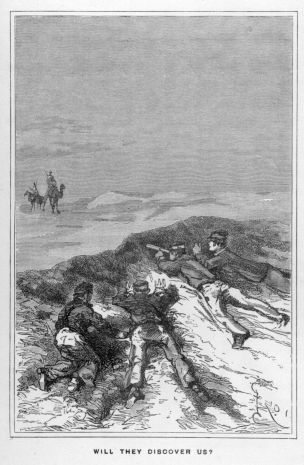
We were, it must be understood, seated on a sandy mound facing the sea, the light air coming from which enabled us to bear the heat of the sun. As we were about to get up and proceed on our journey, I caught sight of some objects moving among the sand-hills in the far distance. I told my companions, who threw themselves down on the ground; while, unslinging my telescope, I turned it towards the moving objects, which I at once made out to be two camels with riders on their backs.
The strangers drew nearer, and stopping, looked about them. “I am afraid their quick eyes have caught sight of the gold on our caps or the brass on my spy-glass,” I observed. “What are we to do?”
“Remain perfectly quiet,” answered Boxall. “We might possibly improve our condition by joining them, but it might become very much worse. We can now calculate pretty well what we shall have to go through; but if we place ourselves in their power, we may be ill-treated, or compelled to labour for them, if we are not murdered.”
“Well, by all means let us keep out of their power. I for one have no wish to be reduced to slavery,” said Halliday.
“And I am sure I don’t want to work for these blackamoors,” observed Ben.
The general feeling, therefore, being against putting ourselves in the power of the Arabs, and thinking we could hold out, we remained perfectly still, completely concealed by the side of the bank. The strangers continued to approach, and it appeared very probable that we should be discovered. We lay quiet, however, and watched them; and at length, satisfied that they were mistaken, they continued their route to the southward, along the line of sand-hills which ran parallel with the coast. We watched them as long as they were in sight, and then descending to the sea-shore, the tide being out, continued our march over the hard sand. We had allowed the strangers to get so far ahead that we were not likely again to fall in with them.
“It strikes me, sir, that while the water is low we ought to be looking out for some oysters or mussels, or we shall have nothing to eat when dinner-time comes,” observed Ben to Boxall. “I see some rocks on ahead where we are very likely to find them.”
“You are right, Ben,” answered Boxall. “I ought to have thought of that myself, but I was considering how we should meet the Arabs should we again fall in with them, or what bribe we could offer to induce them to conduct us either to Magador in Morocco, the nearest place where we shall find an English consul, or else to Saint Louis, a French settlement in the south, which is, I conceive, considerably nearer. It is a pretty long march either way,—half the width of the great Desert of Sahara, north and south.”
“I can, at all events, make myself understood, and I will say whatever you advise,” I observed.
“My opinion is, that on all occasions we should speak the truth,” observed Boxall. “We must therefore say that we are British officers, wrecked on the coast, and that, if they will conduct us to any place from whence we can communicate with our friends, we will reward them handsomely.” To all which, of course, Halliday and I agreed.
We had now reached the rocks where Ben had hoped to find some shell-fish. Taking off our shoes and socks, and tucking up our trousers, we commenced our search, armed with our knives and wooden swords. No oysters were to be found on the rocks, or in the shoal water in which we waded. However, we obtained as many mussels and some other shell-fish as we could carry in our pockets; and Ben captured a large crab, which was a prize, we agreed, worth having. And as by this time the tide was running in, we were now obliged to return to the shore.
“We must endeavour to light a fire and cook this food,” observed Boxall. “If we attempt to live much longer on raw provisions, we shall be attacked by scurvy, and shall assuredly be unable to continue our journey.”
“As there are no trees hereabouts, and as we have neither flint nor tinder, I don’t see how we shall get a fire to cook our food,” Ben observed.
“But there are roots on some of the sand-hills; and here is a stone I picked up, which I think is a flint,” answered Boxall.
We could, however, find neither roots nor shrubs of any sort for fuel, and were obliged to content ourselves with chewing some of the mussels to stay our hunger as we walked along.
Having trudged on for some miles, some slight signs of verdure again greeted our eyes, although the bushes rose scarcely a foot above the ground. The branches, however, from their dry state, would, we imagined, ignite; though it would require a large number of them to make even a tolerable fire. We carried our fuel to a hole between two sand-hills, hoping that the smoke, by the time it had ascended above them, might become so attenuated as not to be observed by any passing Arabs. The difficulty was how to light our fire. We required first the means of striking a spark, and then the tinder to catch it, and finally to produce a flame. Boxall tried with his knife and the stone he had picked up, but was much disappointed when no spark proceeded from them, the knife and stone producing only a light with a phosphoric appearance. “We must not give it up, though,” he said. “I have another idea—we must form a burning-glass.”
“How is that to be done?” I asked.
“Let me look at your watch, that I may compare it with mine,” he said. The glasses exactly corresponding in size, he took them both out. “Now,” he continued, “by filling the interior with water we shall have a powerful burning-glass, which will in a few seconds set fire to any inflammable substance, or burn a hole in our clothes.”
I bethought me at that moment of the inside cotton-wool lining of my cap, on which the rays of the sun had been beating all the morning, and I felt sure that it would quickly catch fire; so teasing out a small piece, I followed Boxall down to the beach, where he was employed in filling the two watch-glasses with water. I held the wool, while he lifted the glasses over it; and in a few seconds a hole was burned, and I observed some sparks travelling round it. I rushed back to the heap of fuel, blowing as I went; while Halliday stood ready with a leaf of paper, which he had torn from his pocket-book, and with a heap of withered twigs and leaves, which with infinite perseverance he had gathered together. By all of us blowing together a flame was produced, to our infinite joy. A milky sap, however, came from the shrubs, and only a small portion of them would ignite, while the smoke which ascended was so pungent and smelt so disagreeably that we could scarcely bear it. It had the effect, however, of keeping the mosquitoes, which had hitherto annoyed us terribly, at a distance. By degrees also a few burning embers appeared, and we placed our shell-fish upon them. Seeing Ben poking in his wooden sword, I asked, “Why are you burning that?”
“I am not burning it, sir, but hardening the point and edge; and I would advise you to do the same with yours.”
And following his example, we found it greatly improved our weapons.
In a short time the shell-fish were cooked, and we enjoyed our repast, though we should have been glad to have had some substitute for bread to eat with the molluscs. Having cleaned out some of the larger shells, we cooked a further supply, which we packed within them, and then tied them up in our handkerchiefs, that we might be saved the necessity of lighting another fire. Indeed, we should, we knew, be unable to do so, except during the daytime, unless we could pick up a real flint—and that Boxall feared we were not likely to find.
Our hunger being satisfied, our thirst returned, and our next object, as we advanced, was to discover water. The tide being high, we were compelled to seek the harder ground on the summit of the sand-hills, as the mosquitoes and sand-flies rendered walking on the sand excessively disagreeable. We kept in a line, as we had before done in our search for water, at a short distance from each other,—Boxall having chosen a position on the left,—and had trudged on for a couple of miles or more, as we calculated, without discovering any signs which tempted us to dig; for we were unwilling to make the attempt without a prospect of success. I was next to Boxall; and after we had gone some way he came nearer to me, and shouted that he would diverge to the left, towards a slight elevation, desiring us to go on slowly, and to halt should we lose sight of him. “I will make a signal, should I find any sign of water,” he added. By this time my mouth and tongue had become fearfully parched, and I earnestly hoped that he would succeed. Continuing to look out for the usual signs—a little verdure, with a slight depression in the sand—I went on slowly till I got near enough to Halliday to tell him what Boxall had said; and he repeated the order to Ben. We had not gone much further when I felt great hopes, from the appearance of a spot before me, that water might be found; so calling to Halliday and Ben, they joined me. I looked round to make the sign agreed on to Boxall, when, to our dismay, we saw an Arab on a camel rapidly approaching him! We had been partly concealed by a sand-hill, and so the Arab had not, apparently, observed us. It was evident, however, that Boxall had not a chance of escape. He must have thought so himself, as he stood calmly awaiting the arrival of the Arab, who pulled up his camel as he got close to him. We stood for a minute irresolute, not knowing what to do; but as the Arab did not raise his weapon, we believed he had no hostile intentions, and was not likely to injure our friend. Boxall had now thrown down his wooden sword, and was holding out his hand as if to greet the Arab in a friendly way. The latter also stretched out his hand, and we hoped that the interview would pass off peaceably, when, to our astonishment, we saw the Arab lean over from his saddle, and by a sudden jerk seize Boxall by the arm and place him by his side; then giving the animal a blow with his spear or goad, it set off at a gallop across the desert.
We now rushed forward, Halliday and I shouting to the Arab to stop, while Ben with loud cries advised Boxall to give the black rascal a thundering clout on the head, and that we would quickly come to his assistance; but I am inclined to think that neither the one nor the other heard us. Boxall did endeavour to release himself, but the Arab held him fast. Indeed, at the rate the camel was going, he could not otherwise have stuck on.
Fast as the wind, the fleet creature, regardless of the weight of the two men struggling on its back, moved across the desert, its broad feet scarcely making an impression on the sand. We ran and shouted in vain: the camel rapidly distanced us, and making towards the south-east, disappeared at length among the sand-hills; while we, almost exhausted, sank down on the ground.
All our previous misfortunes had not weighed so heavily on me as this. As far as we could tell, our friend might be carried into helpless captivity far away in the interior of Africa. Poor fellow! my heart bled for him. He had fully expected to obtain his promotion on returning home, and to be married to a very charming girl, of whom he had often spoken to me; for he had an independent property, though, having no interest, he had long remained a mate.
We felt ourselves still at liberty, and did not consider that his fate might probably be ours before long; for how could we hope, without the help of his judgment and thoughtfulness, to make our way over some hundred miles of desert? Had we known, indeed, one tenth part of the difficulties to be encountered, we should have said that it was impossible.
“We are not going to let Mr Boxall be carried off by that black chap without trying to get him back, I hope,” exclaimed Ben at length.
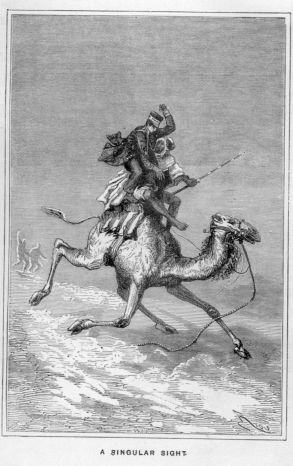
“Certainly not,” I said.
“Of course not,” exclaimed Halliday. “We must follow him till we get near the Arab camp, and then try and let him know that we are near at hand to help him to escape.”
It struck me that this proposition was very good in theory, but unlikely to succeed in practice. I did not say so, however, as I was unwilling to damp the ardour of my companions, or to show any want of interest in our friend.
“If we are to overtake him, we must set forth at once,” I observed. “It will be difficult enough to trace him in the daytime, and impossible in the darkness; and that fleet camel may have passed over many miles of ground before night sets in.”
Halliday, I should have said, had a small compass attached to his watch-chain. It was a trifling little thing, and of scarcely any use at sea; but, placed on the ground, it would enable us to take the bearings of an object with tolerable accuracy. He at once put it down, and we marked the direction the Arab had taken; it was almost due south-east.
“Shall we make sail, sir?” asked Ben, who was eager to be off.
“Yes,” I said. “You, Ben, lead, and keep straight ahead for the northern end of the most distant sand-hill in sight; while Mr Halliday and I will keep twelve paces apart, and twelve paces behind you. We shall thus form a triangle, and if we see you turning we will put you straight again. I think in that way we shall be able to keep a direct course.”
“I understand, sir,” said Ben.
Having measured our distances, we set off. We were already on the edge of the level desert, so that we had no impediments to interfere with our march. Had I been more sanguine of success, I should have gone on with better spirits; but with the slight hopes I entertained of overtaking Boxall, and suffering in common with my companions from excessive thirst, my spirits flagged, and I could with difficulty drag on my weary feet over the hot sand. But having reached the point for which we had been steering, we brought up; and again placing the compass on the ground, took a fresh departure. We had now no object by which to direct our course, and had it not been for the plan I had thought of, we should have had constantly to stop and ascertain by the compass whether we were steering right. The long shadows in front of us—or rather somewhat to the left—showed us that the sun was sinking low, and that unless we could reach the neighbourhood of the Arab camp before dark we should have to pass the night in the open desert. We pushed on bravely. Still, I confess I could hardly drag my feet after me; and I observed when I turned my eyes towards Halliday, that he was walking with yet greater difficulty, though unwilling to complain. Longer and longer grew our shadows—still the apparently illimitable desert stretched out before us—but nowhere was the camel to be seen. Influenced by Ben’s zeal, I had been induced to undertake the pursuit; but I now began to repent having yielded to it.
At length Halliday cried out, “Charlie, I can do no more!” and sank on the ground. So I called to Ben to stop, and we threw ourselves down by our companion’s side.
Chapter Eight.
The search for Boxall—The Arab encampment—We find water—Ben makes a “circumbendibus” of the Arab camp—Captured by black Arabs—Antonio’s escape from the wreck—His reception by the Ouadlims.
Night found us in the midst of the vast desert, numberless low sand-hills scattered about around us, and the starry sky overhead. Here we must remain until daylight, or retrace our steps to the sea-shore. We might manage to get back, if we had strength sufficient to walk, as the stars would serve us as a guide, and a few points out of our direct course would not make much difference; whereas, should we attempt to keep to the south-east, we should very probably pass some distance either on the one side or the other of the line we wished to follow, and miss the Arab camp altogether. We could not hide from ourselves, too, the danger to which we were exposed from wild beasts; for besides hyenas—of the existence of which in the neighbourhood we had had ocular evidence—there was reason to believe that tigers, panthers, and even lions might be prowling about in search of prey; and our wooden swords, even though their points had been hardened in the fire, would be of little avail should we be attacked. I did not express my apprehensions to my companions, however, though I had no doubt they also entertained them. My duty, I felt, as the leader of the party in the place of Boxall, was to do my utmost to keep up my own and their spirits.
We sat silent for some time; Halliday was the first to speak. “I wish that I had a mouthful of water,” he said, in a hoarse voice. “Should we push on and find none to-morrow, what are we to do?”
I could not answer his question.
“But we may find some, sir,” said Ben. “The Arabs are sure not to encamp unless they can get it for themselves and their beasts.”
“But suppose we miss the Arab encampment?” asked Halliday.
Ben could not answer that question. I thought it was time for me to speak.
“I am very unwilling to give up the search for Mr Boxall,” I said; “but unless we are prepared to lose our own lives, with a very remote prospect of assisting him, I believe that our only course is to make our way back to the coast, where we have a better chance than here of obtaining both food and water. I propose, therefore, that we remain here till we are rested, and then make the best of our way to the sea-shore. We must manage, in the meantime, to do without water; and as we have a supply of cooked limpets in our pockets, we had better make our supper off them, and then lie down and rest. I am ready to take the first watch; you, Ben, shall take the second; and that will give time to Mr Halliday, who is more tired than either of us, to recover his strength.”
My companions agreed to the proposal; and hunger being our sauce, we managed to get down a considerable portion of our store of limpets.
Knowing that should I go to sleep both myself and my companions might be pounced upon by some wild beast, I did not venture to lie down, but leaned forward as I sat on the ground, supporting my hands on my wooden sword; and the moment I began to get drowsy I rose to my feet, with the intention, as long as I could walk, of pacing up and down close to them. I had just risen, when, turning my eyes to the north-east, I observed a bright glare in the sky. My first idea was that it must be the moon rising; and then I recollected that it would not appear above the horizon for some hours, and was convinced that the light was produced by an extensive fire. Never having heard of prairie fires in that part of Africa,—there being little or no grass to burn,—I came to the conclusion that there must be a camp in that direction; possibly the one to which the Arab had carried off Boxall, though he appeared to us to have taken a much more southerly route. I watched the light carefully, till I was convinced that I was right, and that it came from an Arab camp; then I at once aroused my companions.