Part 2 — CASE HISTORY NO. 5 Would Time Delay Be a Problem in Using a Synchronous Satellite?
Reading edition
Peter D. Bricker Psychologist—Member of Staff, Behavioral Research Laboratory
THE PROBLEM
One of the satellite communications systems that has been proposed would make use of stationary synchronous satellites. These would be precisely located above the earth’s equator in orbits 22,300 miles high, where they would circle the earth once every 24 hours, and thus appear to remain stationary over a point on the earth. There are several advantages to this type of system—the most important being that we would need only three satellites for communications between almost all the inhabited regions of the earth.
On the other hand, there are several problems in establishing a synchronous system. Just getting the satellites into exactly the right places and keeping them in position is a formidable one. We also have something of a mystery to contend with, because of the tremendous distances that would be involved. Although we can communicate at speeds close to that of light—186,000 miles per second—we cannot go any faster than that. You might think that 186,000 miles a second was fast enough for us, and most of the time it is. However, if you send signals 22,300 miles up into the sky, transmit them back to earth, perhaps send them up again to a second satellite, and finally bring them 22,300 miles back down to earth, even the speed of light may not be fast enough. The delay will be only about a second or so, but it may—for some kinds of communications—be long enough to cause trouble. How much trouble, we don’t yet know.
For one-way signals such as television, a transmission delay of about one second obviously makes little or no difference. But for two-way conversations on the telephone, where there is rapid back-and-forth talking, even this tiny amount of time delay may be a problem. And then again, it may not be. There have been a lot of experiments to find out something about this delay problem, and these have given us a lot of different answers. Work is still going on, and there is still much to find out. In this chapter, we tell you about one small, early experiment. Its results were not conclusive, but they should give you one example of how to set up and carry out a typical experimental study on human behavior.
71
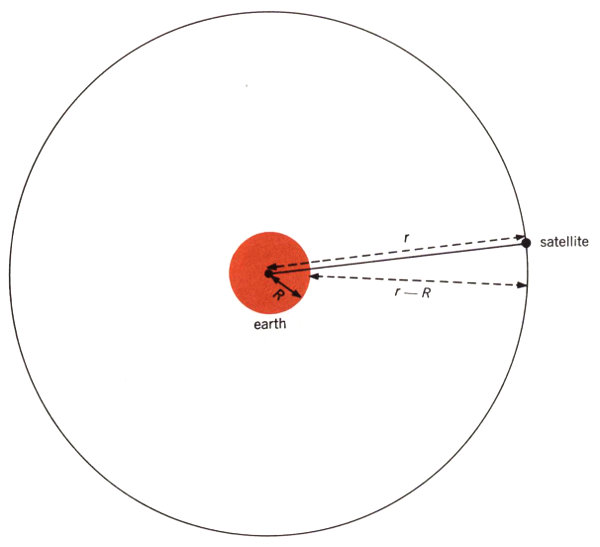
Typical circular satellite orbit: r is distance from center of earth to satellite; R is radius of earth.
How a Synchronous Satellite Would Work
For our purposes, we will not be concerned with all the problems of launching a synchronous satellite into its proper orbit. But you may be curious why we know that this orbit must be 22,300 miles high. It can be calculated by using two basic formulas from elementary physics.
From Newton’s Law of Gravitation we know that the velocity, v, of a satellite moving in a circular orbit[5] will be
v
=
√
gR²
r
,
where R is the radius of the earth, r is the distance from the center of the earth to the satellite, and g is the acceleration due to gravity (see diagram above).
We also know that this velocity must be
v
=
2πr
T
,
since the distance the satellite travels to complete an orbit is 2πr, and T is the time of one complete revolution. Thus we have the equality
√
gR²
r
=
2πr
T
,
and, solving for r, we get
r
=
gR²T²
4π²
⅓
Since we are interested in a synchronous satellite, T in this case will be 24 hours. We can now find r (using g = 32 feet per second per second and R = 3960 miles), and then obtain the distance r - R, which will be 22,300 miles. By using our previous formulas, we also can find the velocity of a satellite moving in this orbit, which will turn out to be v = 6870 miles per hour.
72
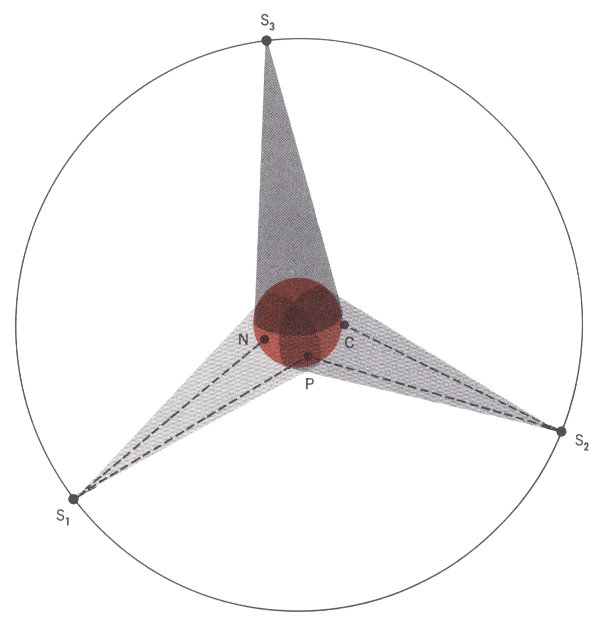
One possible method of using synchronous satellites. Signals from New York (N) to Paris (P) would go via satellite S₁; signals from New York to Calcutta (C) would go via satellites S₁ and S₂.
The illustration above gives a rough idea of how a synchronous satellite system might be set up. Three communications satellites, S₁, S₂, and S₃, are above the equator in fixed positions equal distances apart and 22,300 miles up. Located in this manner, they would cover the major part of the earth’s surface. From a point directly beneath it, the distance would be 22,300 miles to a satellite; from other points the slant range would be greater. Signals sent from, say, New York (point N) to Paris (point P) would be reflected via satellite S₁. In doing this, they would travel a total distance of about 46,000 miles. Because we can’t send signals any faster than the speed of light (186,000 miles per second), it would take at least a quarter of a second for a signal to go this far. For communicating a much greater distance, say from New York to Calcutta (point C), the signal path would use two satellites, S₁ and S₂. In this case, the total distance traveled by a signal would be more than 90,000 miles, and the one-way time delay would be about half a second.
The Effects of Time Delay
Delays of a quarter- or half-second have different effects on various kinds of communications. However, we are concerned here only with what they might do to telephone 73 conversations. Time delay will affect conversations in two ways. One of these—pure delay—depends on the nature of speech and the way people use it to converse; the other—echo—has to do with the nature of the world’s telephone systems.
The first effect can be illustrated by an example. Suppose that George in Paris is talking to me in New York. He says, “Do you want to go?” and I answer “Yes” immediately upon hearing the word “go.” But that word didn’t arrive in New York until a quarter of a second after George said it, and my reply was delayed another quarter-second, so George hears my instantaneous reply a half-second late. Under some circumstances, he might interpret this delay to mean that I was less than enthusiastic about going. We don’t know exactly what response times people expect in conversation, or how much variation in such intervals they can tolerate. But it has been assumed that delays of a half-second or more would make a noticeable and perhaps disturbing difference. A little later on, I will describe an experiment dealing with this first effect. But first we must briefly discuss the second effect of delay on telephone conversation, to show why we decided to try to isolate the first effect and study it separately.
The Echo Problem
All the world’s telephones are individually connected to the rest of the system by what we call two-wire local loops. Speech travels in both directions on the same wires over these local parts of the circuit. In other parts of the system, where speech travels farther and must be amplified, it is carried over four-wire circuits. These consist of two pairs of wires, one for transmission in each direction. At the junctions where the two-wire and four-wire parts of the telephone system meet, specially designed transformers, called hybrid coils, are used.
It is impossible to have these junctions between two-wire and four-wire circuits always in perfect balance, so part of the speech that reaches a local loop will be reflected back along the path on which it arrived. Unless a circuit has been specially treated, this reflected speech will get all the way back to where it started, and the talker will hear an echo of his own voice. When the circuit is short enough, the echo is heard almost instantaneously, and is not bothersome. But when the echo is delayed by a twentieth of a second or more, it can become extremely annoying, and even temporarily destroy one’s ability to speak coherently.
Telephone engineers have long been aware that this echo effect was present on their long-distance circuits, and they have not let it go unchecked. Devices known as echo suppressors are installed on circuits that have more than a critical amount of delay. They are placed in a four-wire part of the circuit, where there is one-way transmission over each pair. Since incoming and outgoing sounds are using separate paths, an echo suppressor can attenuate or shut off the return path when speech is coming in on the other path.
Unfortunately, echo suppressors have effects of their own on transmission. They may, for example, cut off some speech that should be getting through, because they can’t distinguish it from echo. Echo suppressors can be made more sophisticated, but whether they can be made to operate more successfully than present ones is not clear. And the problem of adapting them to the long delays of synchronous satellite circuits will require a great deal of research and development effort.
74
Experimenting With Pure Delay
Although we don’t know how good echo suppressors can get, we do know that a long circuit with the best possible suppressors could never be better than a circuit of the same length that had no echos. This brings us back to the problem of how serious the effect of delay alone is on conversations. If the delay in a synchronous satellite system, even without any echo, made conversation all but impossible, there would be little point in developing echo suppressors for such satellites.
This question looked like one that we could answer, at least in part, by experimenting with special four-wire circuits that had delay but no echo. The strategy we adopted, then, was to do some experiments on pure delay while other people at Bell Telephone Laboratories began to attack the problem of testing and improving echo suppressors. In the pages that follow, I will describe one of our experiments on the pure delay problem. More elaborate ones have been performed since, and there will be more to come.
It should now be clear how this sort of experiment might be helpful to the development of a synchronous satellite communications system. If it showed pretty convincingly that conversation was extremely difficult with a pure echo-free delay of about a second, synchronous satellites for two-way conversations would be less practical. On the other hand, if the experiment were to show that some conversation, at least, could be carried on without too much difficulty, our results would be less decisive. We would know only that echo-free delayed circuits might sometimes be all right. But we would not know how bad they were under a variety of conditions or how closely they resembled a real circuit with echoes and echo suppressors. In either case, the experiment would have no bearing on the use of synchronous satellites for one-way purposes, such as television.
Designing the Experiment
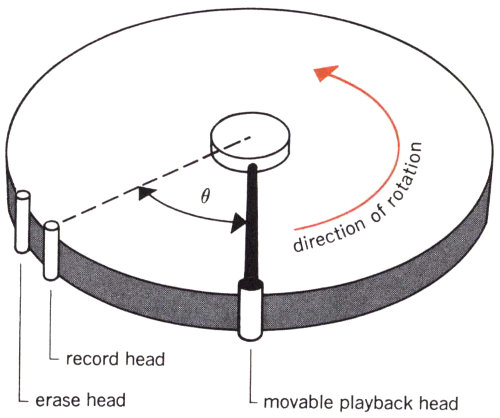
Recording equipment used in the experiment.
delay =
θ
360
ρ, where ρ is the period of rotation in seconds
“Can people converse over an echo-free, four-wire circuit that has delay like that of a synchronous satellite?”—that is one way of putting the question we isolated to study. The next problem was to find a way of setting up this question in the form of an experiment whose results might be interpreted as a meaningful answer. The problem of apparatus, fortunately, was fairly simple. Two telephone sets in separate rooms were connected by four wires, with one pair going directly from each transmitter to the other receiver, so that no echo would go back the way it came. This gave us the “echo-free, four-wire circuit” we wanted. To simulate the satellite, I inserted a magnetic delay device (see sketch) between one of the 75 transmitters and the other receiver. This had a revolving drum on which speech could be recorded and then played back a short interval later. By moving the playback head, I could produce any amount of delay up to two satellite bounces’ worth. At this point, the equipment was ready, but there were still two major problems: (1) how to get people to converse over the circuit in a natural way, and (2) what to observe and measure that would give us an answer to our question.
When you think about the first problem, you soon realize that it is hard to say exactly what a “natural” conversation is. But even if we can’t describe it, we can try to find examples of it. I experimented with several ways of making people talk that could be recognized as unnatural: word games, list-checking, shape description and recognition, and a system of rewards for spurts of talk. None of these schemes seemed to generate the real conversational interplay we wanted. Finally, I noticed that my coworkers often got involved in vigorous conversations on political and social issues at the lunch table. So I circulated a questionnaire to help me pick pairs of people who might enter into lively discussions on one or more topics. I arranged seven conversations of this sort, and they became the basic material of my study. Only one of these lacked sufficient spirit to yield good data, and six out of seven is a pretty good percentage when you try to study human behavior in such a free situation. Note that the conversers expressed ideas that came from within them at the time—not from any external materials—and that they usually felt rather strongly about what they were saying to the other fellow, who disagreed and therefore needed some convincing. Of course, these conversations do not represent the whole range of possible conversations; they are only a small sample of one type. This doesn’t limit the truth of the particular result we got, but it does limit how far we may generalize from these results.
What Should We Observe?
You might think we could solve this problem simply by asking the conversers their opinions. We found out long ago, however, that the opinions you get are affected by a lot of things: how you ask the question, the attitude of the respondent, and his unrelated experiences outside the experiment. So we usually try a more subtle approach. In this case, my basic observation was of what psychologists call escape behavior. The conversers were told that they would start talking over a normal circuit, and that delay would be introduced at some point. (The delay was inserted in such a way that an abrupt change could not be noticed.) All the conversers had pushbuttons for signaling the experimenter. If they thought they noticed a delay, they were told that it would be removed if they pushed the button. Thus they could always escape from this possibly unpleasant condition.
My reasoning was this: If the conversers found it very difficult to talk with delay in the circuit, they would surely push the button soon after the delay was introduced. On the other hand, any time when they continued to converse without pushing the button—while delay was in the circuit—was obviously also a time when the delay did not make conversation impossible. So we had at least one measurable quantity—the time taken to detect delay—which we could interpret as an answer to our question. Note that we could tell if people pushed the button “just to be on the safe side” by seeing how often they did this when there actually was no delay in the circuit.
76
There are just a few more necessary details before we discuss the results:
I recorded the conversations for later analysis, but the conversers knew that the recordings would be held in confidence.
The amount of delay used was 1.2 seconds, which represents the total round-trip delay for a circuit using two satellites, including the delay in typical end connections on the ground. We used this much delay because our preliminary tests indicated that it would be more likely to produce an effect than would the 0.6 second delay in a one-satellite link.
The entire 1.2 seconds of delay was put into one of the lines, since we had discovered that, where there is no echo, conversers cannot tell the difference between a delay of 2t seconds in one line and a delay of t seconds in each of two lines. I did this for the sake of convenience, so that I could introduce delay in the quiet line while the other one was active.
After someone detected delay, I removed it immediately and then waited at least a minute before putting it back in.
Altogether, I collected about two hours of conversation and introduced delay 22 times.
The Results and What They Mean
Now we could answer the question, “How long does it take people to detect 1.2 seconds of delay?” As you can see from the table opposite, the times ranged all the way from 20 seconds to over 10 minutes, and, in two cases delay was not detected at all. The results in the table are also shown in the histogram on the next page, which depicts how broadly the detection times were distributed. To me, one of the most interesting things is that even people who were able to detect delay quickly sometimes did not detect it for a couple of minutes. For example, the pair K/G had two times under a minute, one of 143 seconds, and one of 421 seconds. I interpret their two short times to mean that they knew what to look for, since they made no incorrect responses while delay was not present. However, their long times seem to mean that they sometimes didn’t notice delay for quite a while. Incidentally, only two responses were made during the total of about 40 minutes when I did not introduce delay, and these “false alarms” were by two of the fastest pairs at true detection—F/K and S/H.
Length of Time Before Seven Pairs of Talkers Could Detect 1.2 Seconds of Delay
PAIRS OF TALKERS NUMBER OF SECONDS BEFORE TALKERS DETECTED DELAY
G/H 161
224
107
F/K 87
65
43
220
false alarm
A/L 618
95
367
F/T no detection after 954 seconds
S/H 227
false alarm
90
75
83
K/G 38
421
20
143
S/W 257
229
no detection after 260 seconds
77
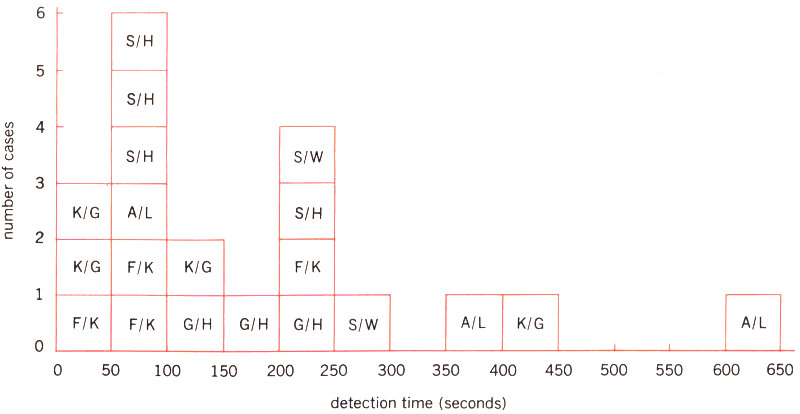
Data from table have been arranged in this histogram to show wide range of delay detection times that were recorded in the experiment. Each block represents a single delay detection, identified by initials of conversers.
number of cases
6
S/H
5
S/H
4
S/H S/W
3
K/G A/L S/H
2
K/G F/K K/G F/K
1
F/K F/K G/H G/H S/W A/L K/G A/L
0
0 50 100 150 200 250 300 350 400 450 500 550 600 650
detection time (seconds)
Now, to answer our question about whether people can converse over our circuit, we can say something like this: We have found some cases (of a certain type of conversation) where people can use a circuit with 1.2 seconds of echo-free delay for the amounts of time listed in our table. But there are two important things to remember about our results:
The findings are a non-negative answer to the original question, “Can people converse over a four-wire, echo-free circuit that has delay like that of a synchronous satellite?”
The experiment applies only to four-wire, echo-free circuits, and does not help with the problem of improving echo suppressors or with that of finding out how good synchronous satellite circuits with the best possible echo suppressors would be if they were used to interconnect the world’s telephones.
Since we didn’t get a “no” answer to our question, we have been encouraged to do more experiments with other subjects and other types of conversations. We also have begun to look for more than a yes-or-no answer; we now want to find out how serious various amounts of pure delay would be. Some of my colleagues have been working on this problem by furnishing special four-wire telephones to a group of people, so that echo-free delay can be inserted in the line when one member of this test group calls another member. Their experiment has confirmed our finding that conversation with a round-trip pure delay of 1.2 seconds is not impossible, but it has also shown that the degradation of conversation that results is not trivial.
Recently an international committee on commercial telephone standards set the maximum permissible echo-free delay (round-trip) at 0.7 seconds. However, the search for a more precise evaluation is still going on.
Peter D. Bricker was born in Scranton, Pennsylvania, and received an A.B. from Bucknell University in 1950 and an M.A. in 1952 and a Ph.D. in 1954 from the Johns Hopkins University. He joined Bell Telephone Laboratories in 1954, and has been engaged in psychological studies of telephone color preferences, pushbutton set designs, voice identification, and transmission quality evaluation.
78