Part 2 — CASE HISTORY NO. 2 What Color Should a Satellite Be?
Reading edition
Peter Hrycak Mechanical Engineer—Member of Staff, Electron Device Laboratory
THE PROBLEM
It is important for a satellite to stay at the proper temperature while it is orbiting in space. The instruments aboard it must continue to operate properly, and one way of insuring this is to keep them from being exposed to extreme heat or cold. We can, of course, regulate a satellite’s temperature somewhat with various kinds of devices, and we can see that one of its ends does not point towards the sun for too long. But in designing the Telstar satellite we also wanted to control temperature in an easier way: by covering the satellite’s external surface with material with the best properties—including the right color—for maintaining its over-all temperature at the right level.
49
The Radiation of Heat
A satellite’s temperature is determined by the balance between the heat that enters the satellite and the heat that leaves it. This means that we must be concerned with how heat is transferred. Heat can be transferred in three ways: by conduction, when two bodies are in direct contact and their molecules collide; by convection, which utilizes the movement of warm currents in a fluid; and by radiation, in which heat energy travels as electromagnetic waves at the speed of light. With a satellite, we are concerned only with the last of these, since the only way energy can be gained or lost in space is by radiation.
In the transfer of heat by radiation, the surface of the heated body—such as a satellite—is very important. All energy gained must be absorbed at the surface; all energy leaving must be emitted at the surface. So the physical properties of this surface control how energy is absorbed and how it is emitted. The origin of the radiant energy is vitally important; most surfaces, for instance, will behave differently when exposed to solar radiation from the sun’s temperature of 10,000° Fahrenheit than when exposed to radiation from nearby objects at room temperature.
Absorptivity and Emissivity
The physical property of a material that controls the way it absorbs radiant energy is called its absorptivity, and the property that controls its emission of energy is its emissivity. For absorptivity we use the symbol α; for emissivity we use the symbol ε.
When radiant energy reaches a surface, only a certain part of it is absorbed; the rest is either reflected, just as light rays are reflected, or else passes right through it. The absorptivity, α, of a substance tells us what percentage of radiant energy it will absorb. A perfect absorber, or black body, would absorb all the radiant energy that reached it. If such an ideal substance existed (which it doesn’t) we would say it had an α of 1. The actual absorptivities of real substances are indicated by numbers between 0 and 1: The α of black velvet cloth, for example, is about 0.97; that of a polished silver mirror is about 0.08 for solar radiation (absorptivity for most polished metals for room temperature radiation is even lower).
We measure emissivity, ε, in very much the same way. A hypothetical black body would emit all the energy it possibly could and have an ε of 1; the emissivities of real substances are indicated by numbers between 0 and 1. For any given frequency (or color) of light, a substance’s absorptivity and emissivity are equal; however, the total spectrum of frequencies of the energy absorbed is usually different from that of the energy emitted.
The ratio between emissivity and absorptivity, α/ε, is very important, as we shall see later. If this ratio is greater than 1, it means that a substance absorbs heat faster than it emits it, and thus tends to become warmer. If the ratio is less than 1, the reverse is true—the surface emits radiant energy at a faster rate than it absorbs it, and tends to become cooler.
How We Measure the Radiation of Heat
This is one of the fundamental relationships of modern physics:
Qbody = εAσT⁴.
It was discovered experimentally by Josef Stefan in 1879, and verified theoretically by Ludwig Boltzmann; it is known as the Stefan-Boltzmann Law. This formula tells us the amount of radiant energy, Qbody, 50 that will be emitted by a body having the surface area A when it is at the temperature T. Temperature, here, is measured in degrees Rankine (°R), or Fahrenheit temperature above absolute zero (to calculate degrees Rankine, add 460 to the temperature in degrees Fahrenheit). The expression εA is used to show that only a certain fraction of the energy that would leave a perfect black body of area A will actually leave a real body of the same size; the size of this fraction is determined by the body’s emissivity. The symbol σ is a quantity we call the Stefan-Boltzmann constant.
We can also calculate the heat from the sun that will be absorbed by a body. If we let S be the total amount of solar energy that would be absorbed by a perfect black body, αS will be the amount that is actually absorbed by a body with an absorptivity of α for solar radiation. If our body is a spherical satellite, the sun’s rays will only strike it from a single direction. Thus only an area equivalent to the sphere’s cross-section (largest inscribed circle) will receive energy at any one time. Since, as shown in the sketch, this area (a = πr²) is one-fourth that of the sphere’s total surface area (A = 4πr²), we know that the radiant energy from the sun that is absorbed will be
Q
sun
=
A
4
α
S
.
A man-made satellite’s position relative to the earth is very like that of the earth in relation to the sun; the earth, after all, is itself a satellite of the sun. And during most of its useful life a satellite will be in thermal equilibrium—it will be losing just as much heat energy by its own radiation into space as it will be gaining from other sources, primarily the sun. Since the total amount of energy it absorbs is equal to the amount of energy it emits, Qbody is equal to Qsun. This means that we have the equality
ε
A
σ
T
⁴ =
A
4
α
S
.
Now, if we solve this for temperature, we will get
T
=
(
α
ε
×
S
4σ
)
¼
.
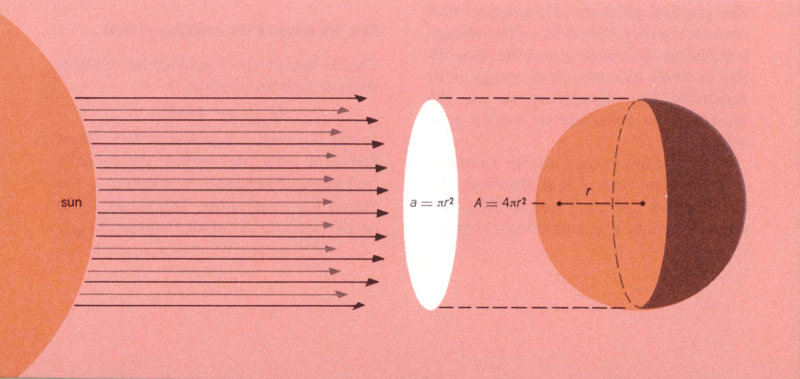
Although the total surface area, A, of a sphere is 4πr², light rays from the sun only strike half the surface at any one time. This area, a, is effectively equal to the sphere’s cross-section, πr².
This equation is well known in astronomy, and has been used for more than 80 years to calculate the temperatures of various 51 objects in the sky. Today, we still find it useful for measuring the surface temperatures of man-made satellites such as Telstar. Since both S and σ are known constants (in this case, we use the quantities S = 445 and σ = 0.173 × 10⁻⁸), you can see that temperature is dependent on the α/ε ratio.
Finding the Right Surface for Telstar
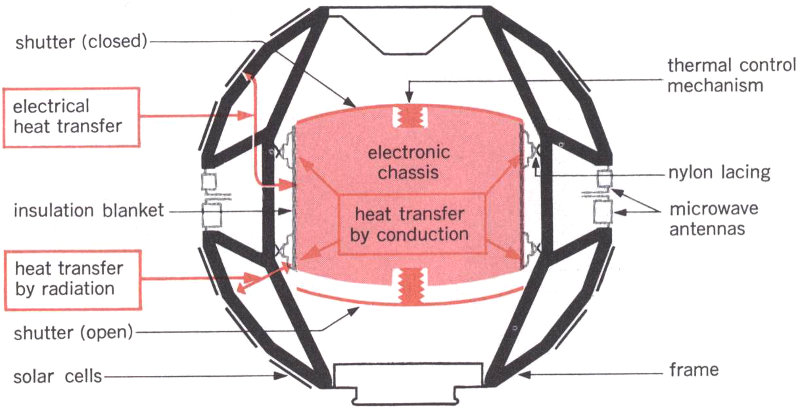
Cutaway view of the inside of the Telstar I satellite, showing the electronics canister covered with its protective blanket of many layers of Mylar. To control temperature, shutters automatically open all the way if the canister gets hotter than 80°F, close completely if it goes down to 50°F.
shutter (closed)
electrical heat transfer
insulation blanket
heat transfer by radiation
shutter (open)
solar cells
electronic chassis
heat transfer by circulation
thermal control mechanism
nylon lacing
microwave antennas
frame
In designing the Telstar satellite, both its internal and external temperatures had to be controlled. The electronics canister inside the satellite operates best if it stays at approximately room temperature of 65 to 75°F. This much heat is supplied in the canister by dissipation of electrical energy from the solar cells. The container is well insulated to keep its temperature relatively stable, and it has shutters that open automatically if it begins to get overheated (see above). The operating characteristics of the solar cells on Telstar’s surface also had to be considered; they work better at rather cool temperatures. So we decided to keep the satellite’s skin at an average temperature of about 0°F, although temperatures actually will range quite a bit above and below the average as the satellite moves from sun to shadow.
Now, using this average temperature of 0°F (converted to 460°R) as T in our formula, we can solve for α/ε. We find that this gives us a ratio of approximately 0.7 for the satellite’s surface. However, this presents a problem. Almost 40 per cent of Telstar’s surface is taken up by its power plant of 3600 sapphire-covered solar cells. These cells, unfortunately, have a relatively high α/ε ratio—their α is 0.8 and their ε is 0.54, for an α/ε of 1.5. This means that the portion of the surface not used by either solar cells or antenna openings must, in order to give us an over-all average of about 0.7, have a very low α/ε ratio—less than 0.3.
To get this sort of ratio, we had to select carefully the material for the outer surface of the Telstar satellite. There were many kinds of surfaces that might have been used; they could have been metal or non-metal, rough or smooth, shiny or dull. And 52 they could have been any color from black to white. However, to get a 0.3 ratio we needed something with a relatively high emissivity for the low-frequency electromagnetic radiation that the satellite emits and a rather low absorptivity for the high-frequency radiation coming from the sun. High emissivity meant that we should use a nonmetal surface rather than polished metal, since the emissivity of nonmetals is quite high at the temperatures in which we were interested, while that of polished metals is relatively low. And, to get low absorptivity, we decided that the color of these surface areas should be very close to a pure white.
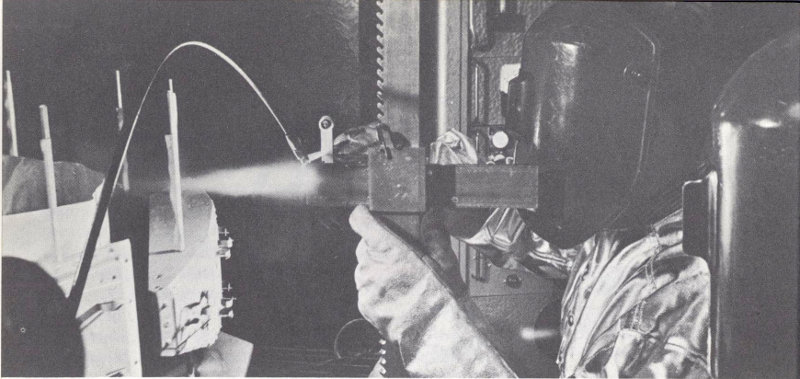
Partially molten aluminum oxide particles being sprayed onto aluminum outer surface panels.
There were several substances that met our requirements. After testing a number of them, we decided to use aluminum panels coated with a thin layer of aluminum oxide (Al₂O₃). This coating is very pure, hard, and stable, and we left it rough to minimize changes due to meteoroid abrasion. Its α/ε ratio is 0.24. The aluminum oxide coating can be applied by means of the plasma jet process—particles of aluminum oxide are heated to a partially molten state, mixed with gases, and then sprayed onto the cleaned, pre-coated aluminum panels (see illustration above).
Using this carefully selected outer surface has helped solve the temperature-control problem. Since Telstar has been in orbit its internal and skin temperatures have kept well within the ranges we wanted them to. Thus you can see how some basic formulas from classical physics helped us choose the right material for the satellite’s surface—and even what color it should be. The blue-and-white checkered appearance that Telstar I finally took on was no accident—it was the result of carefully combining various colors and materials in just the right amounts to obtain the temperature balance we needed.
Peter Hrycak was born in Przemysl, Western Ukraine, and received a B.S. in 1954, an M.S. in 1955, and a Ph.D. in 1960 from the University of Minnesota. He joined Bell Telephone Laboratories in 1960, and has worked on low temperature refrigeration problems and thermal design and thermal testing of the Telstar satellite.
53