Part 1 — The Twelve Apostles. (continued 2)
Reading edition
The mosaics in the old church, which represented the life and actions of St. Paul, were executed by the Greek mosaic masters of the eleventh century. They appear to have comprised the same subjects which still exist as a series in the church of Monreale near Palermo, and which I shall now describe.
1. Saul is sent by the high-priest to Damascus. Two priests are seated on a raised throne in front of the Temple; Saul stands before them.
2. The Conversion of Saul, as already described (p. 214).
3. Saul, being blind, is led by his attendants to the gate of Damascus.
4. Saul seated. Ananias enters and addresses him.
5. Paul is baptized: he is standing, or rather sitting, in a font, which is a large vase, and not much larger in proportion than a punch-bowl.
6. St. Paul disputes with the Jews. His attitude is vehement and expressive: three Jewish doctors stand before him as if confounded and put to silence by his eloquent reasoning.
7. St. Paul escapes from Damascus; the basket, in which he is lowered down from a parapet, is about the size of a hand-basket.
8. St. Paul delivers a scroll to Timothy and Silas; he consigns to their direction the deacons that were ordained by the apostles and elders. (Acts xvi. 4.)
9. St. Paul and St. Peter meet at Rome, and embrace with brotherly affection. I believe this subject to represent the reconciliation of the two apostles after the dispute at Antioch. The inscription is, Hic Paulus venit Romam et pacem fecit cum Petro. (In the Christian Museum in the Vatican there is a most beautiful small Greek picture in which Peter and Paul are embracing; it may represent the reconciliation or the parting: the heads, though minute, are extremely characteristic.)
10. The decollation of St. Paul at the Aqua Salvias; one fountain only is introduced.
This is the earliest instance I can quote of the dramatic treatment of the life and actions of St. Paul in a series of subjects. The Greek type of the head of St. Paul is retained throughout, strongly individualised, and he appears as a man of about thirty-five or forty. In the later schools of art, which afford some celebrated examples of the life of St. Paul treated as a series, the Greek type has been abandoned.
The series by Raphael, executed for the tapestries of the Sistine Chapel in the Vatican, consists of five large and seven small compositions.
1. The conversion of Saul, already described: the cartoon is lost. 2. Elymas the sorcerer struck blind: wonderful for dramatic power. 3. St. Paul and Barnabas at Lystra. 4. Paul preaches at Athens. Of these three magnificent compositions we have the cartoons at Hampton Court. 5. St. Paul in prison at Philippi. The earthquake through which he was liberated is here represented allegorically as a Titan in the lower corner of the picture, with shoulders and arms heaving up the earth. This, which strikes us as rather pagan in conception, has, however, a parallel in the earliest Christian Art, where, in the baptism of Christ, the Jordan is sometimes represented by a classical river-god, sedge-crowned, and leaning on his urn.
The seven small subjects, which in the set of tapestries run underneath as borders to the large compositions, are thus arranged:—
1. ‘As for Saul, he made havoc of the church, entering into every house, and haling men and women committed them to prison.’ (Acts viii. 3.) At one end of a long narrow composition Saul is seated in the dress of a Roman warrior, and attended by a lictor; they bring before him a Christian youth; farther on are seen soldiers ‘haling men and women’ by the hair; others flee in terror. This was erroneously supposed to represent the massacre at Prato, in 1512, by the adherents of the Medici, and is so inscribed in the set of engravings by Bartoli and Landon.
2. John and Mark taking leave of the brethren at Perga in Pamphylia. (Acts xiii. 3.)
3. Paul, teaching in the synagogue at Antioch, confounds the Jews. (Acts xviii. 3.)
4. Paul at Corinth engaged in tent-making with his host. This is an uncommon subject, but I remember another instance in a curious old German print, where, in the lower part of the composition, the apostle is teaching or preaching; and above there is a kind of gallery or balcony, in which he is seen working at a loom: ‘You yourselves know that these hands have ministered to my necessities, labouring night and day, because we would not be chargeable unto you.’ (Acts xviii. 6.)
5. Being at Corinth, he is mocked by the Jews. (Acts viii. 12.)
6. He lays his hand on the Christian converts.
7. He is brought before the judgment-seat of Gallio.[200]
‘Paul, in the island of Melita, shaking the viper from his hand,’ is not a common subject, and yet it is capable of the finest picturesque and dramatic effects: the storm and shipwreck in the background, the angry heavens above, the red firelight, the group of astonished mariners, and, pre-eminent among them, the calm intellectual figure of the apostle shaking the venomous beast from his hand,—these are surely beautiful and available materials for a scenic picture. Even if treated as an allegory in a devotional sense, a single majestic figure, throwing the evil thing innocuous from him, which I have not yet seen, it would be an excellent and a significant subject. The little picture by Elzheimer is the best example I can cite of the picturesque treatment. That of Le Sueur has much dignity; those of Perino del Vaga, Thornhill, West, are all commonplace.
Thornhill, as everybody knows, painted the eight principal scenes of the life of the apostle in the cupola of St. Paul’s.[201] Few people, I should think, have strained their necks to examine them; the eight original studies, small sketches en grisaille, are preserved in the vestry, and display that heartless, mindless, mannered mediocrity, which makes all criticism foolishness; I shall, however, give a list of the subjects.
1. Paul and Barnabas at Lystra. 2. Paul preaching at Athens. 3. Elymas struck blind. 4. The converts burn their magical books. 5. Paul before Festus. 6. A woman seated at his feet; I presume the Conversion of Lydia of Thyatira. 7. Paul let down in a basket. 8. He shakes the viper from his hand.
At the time that Thornhill was covering the cupola at ‘the rate of 2l. the square yard,’ Hogarth, his son-in-law, would also try his hand. He painted ‘St. Paul pleading before Felix’ for Lincoln’s. Inn Hall; where the subject, at least, is appropriate. The picture itself is curiously characteristic, not of the scene or of the chief personage, but of the painter. St. Paul loaded with chains, and his accuser Tertullus, stand in front; and Felix, with his wife Drusilla, are seated on a raised tribunal in the background; near Felix is the high-priest Ananias. The composition is good. The heads are full of vivid expression—wrath, terror, doubt, fixed attention; but the conception of character most ignoble and commonplace. Hogarth was more at home when he took the same subject as a vehicle for a witty caricature of the Dutch manner of treating sacred subjects—their ludicrous anachronisms and mean incidents. St. Paul, in allusion to his low stature, is mounted on a stool; an angel is sawing through one leg of it; Tertullus is a barrister, in wig, band, and gown; the judge is like an old doting justice of peace, and his attendants like old beggars.
In the Florentine Gallery there is a very curious series of the lives of St. Peter and St. Paul in eight pictures, in the genuine old German style; fanciful, animated, full of natural and dramatic expression, and exquisitely finished,—but dry, hard, grotesque, and abounding in anachronisms.[202]
Among the few separate historical subjects in which St. Peter and St. Paul are represented together, the most important is the dispute at Antioch,—a subject avoided by the earliest painters. St. Paul says, ‘When Peter was come to Antioch, I withstood him to the face, because he was to be blamed.’ Guido’s picture in the Brera at Milan is celebrated: Peter is seated, looking thoughtful, with downcast eyes, an open book on his knees; Paul, in an attitude of rebuke, stands over against him. There is another example by Rosso: here both are standing; Peter is looking down; Paul, with long hair and beard floating back, and a keen reproving expression, ‘rebukes him to his face.’ I presume the same subject to be represented by Lucas van Leyden in a rare and beautiful little print, in which St. Peter and St. Paul are seated together in earnest conversation. St. Peter holds a key in his right hand, and points with the other to a book which lies on his knees. St. Paul is about to turn the leaf, and his right hand appears to rebuke St. Peter; his left foot is on the sword which lies at his feet.
‘The Parting of St. Peter and St. Paul before they are led to death.’ The scene is without the gates of Rome; and as the soldiers drag Peter away, he turns back to Paul with a pathetic expression. This picture, now in the Louvre, is one of Lanfranco’s best compositions.[203]
When the crucifixion of St. Peter and the decollation of St. Paul are represented together in the same picture, such a picture must be considered as religious and devotional, not historical; it does not express the action as it really occurred, but, like many pictures of the crucifixion of our Saviour, it is placed before us as an excitement to piety, self-sacrifice, and repentance. We have this kind of treatment in a picture by Niccolò dell’ Abate:[204] St. Paul kneels before a block, and the headsman stands with sword uplifted in act to strike; in the background, two other executioners grasp St. Peter, who is kneeling on his cross and praying fervently: above, in a glory, is seen the Virgin; in her arms the Infant Christ, who delivers to two angels palm-branches for the martyred saints. The genius of Niccolò was not precisely fitted for this class of subjects. But the composition is full of poetical feeling. The introduction of the Madonna and Child stamps the character of the picture as devotional, not historical—it would otherwise be repulsive, and out of keeping with the subject.
There is a Martyrdom of St. Peter and St. Paul engraved after Parmigiano,[205] which I shall notice on account of its careless and erroneous treatment. They are put to death together; an executioner prepares to decapitate St. Peter, and another drags St. Paul by the beard: the incidents are historically false, and, moreover, in a degraded and secular taste. These are the mistakes that make us turn disgusted from the technical facility, elegance, and power of the sixteenth century, to the simplicity and reverential truth of the fourteenth.
There are various traditions concerning the relics of St. Peter and St. Paul. According to some, the bodies of the two apostles were, in the reign of Heliogabalus, deposited by the Christian converts in the catacombs of Rome, and were laid in the same sepulchre. After the lapse of about two hundred years, the Greek or Oriental Christians attempted to carry them off; but were opposed by the Roman Christians. The Romans conquered; and the two bodies were transported to the church of the Vatican, where they reposed together in a magnificent shrine, beneath the church. Among the engravings in the work of Ciampini and Bosio are two rude old pictures commemorating this event. The first represents the combat of the Orientals and the Romans for the bodies of the Saints; in the other, the bodies are deposited in the Vatican. In these two ancient representations, which were placed in the portico of the old basilica of St. Peter, the traditional types may be recognised—the broad full features, short curled beard, and bald head of St. Peter, and the oval face and long beard of St. Paul.
Here I must conclude this summary of the lives and characters of the two greatest apostles, as they have been exhibited in Christian Art; to do justice to the theme would have required a separate volume. One observation, however, suggests itself, and cannot be passed over. The usual type of the head of St. Peter, though often ill rendered and degraded by coarseness, can in general be recognised as characteristic; but is there among the thousand representations of the apostle Paul, one on which the imagination can rest completely satisfied? I know not one. No doubt the sublimest ideal of embodied eloquence that ever was expressed in Art is Raphael’s St. Paul preaching at Athens. He stands there the delegated voice of the true God, the antagonist and conqueror of the whole heathen world:—‘Whom ye ignorantly worship, Him declare I unto you’—is not this what he says? Every feature, nay, every fold in his drapery, speaks; as in the other St. Paul leaning on his sword (in the famous St. Cecilia), every feature and every fold of drapery meditates. The latter is as fine in its tranquil melancholy grandeur, as the former in its authoritative energy: in the one the orator, in the other the philosopher, were never more finely rendered: but is it, in either, the Paul of Tarsus whom we know? It were certainly both unnecessary and pedantic to adhere so closely to historic fact as to make St. Paul of diminutive stature, and St. Peter weak-eyed: but has Raphael done well in wholly rejecting the traditional portrait which reflected to us the Paul of Scripture, the man of many toils and many sorrows, wasted with vigils, worn down with travel, whose high bald forehead, thin flowing hair, and long pointed beard, spoke so plainly the fervent and indomitable, yet meditative and delicate, organisation,—and in substituting this Jupiter Ammon head, with the dark redundant hair, almost hiding the brow, and the full bushy beard? This is one of the instances in which Raphael, in yielding to the fashion of his time, has erred, as it seems to me,—though I say it with all reverence! The St. Paul rending his garments at Lystra, and rejecting the sacrifice of the misguided people, is more particularly false as to the character of the man, though otherwise so grandly expressive, that we are obliged to admire what our better sense—our conscience—cannot wholly approve.
I shall now consider the rest of the apostles in their proper order.
St. Andrew.
Lat. S. Andreas. Ital. Sant’ Andrea. Fr. St. André. Patron saint of Scotland and of Russia. Nov. 30 A.D. 70.
St. Andrew was the brother of Simon Peter, and the first who was called to the apostleship. Nothing farther is recorded of him in Scripture: he is afterwards merely included by name in the general account of the apostles.
In the traditional and legendary history of St. Andrew we are told, that after our Lord’s ascension, when the apostles dispersed to preach the Gospel to all nations, St. Andrew travelled into Scythia, Cappadocia, and Bithynia, everywhere converting multitudes to the faith. The Russians believe that he was the first to preach to the Muscovites in Sarmatia, and thence he has been honoured as titular saint of the empire of Russia. After many sufferings, he returned to Jerusalem, and thence travelled into Greece, and came at length to a city of Achaia, called Patras. Here he made many converts; among others, Maximilla, the wife of the proconsul Ægeus, whom he persuaded to make a public profession of Christianity. The proconsul, enraged, commanded him to be seized and scourged, and then crucified. The cross on which he suffered was of a peculiar form (crux decussata), since called the St. Andrew’s cross; and it is expressly said that he was not fastened to his cross with nails, but with cords,—a circumstance always attended to in the representations of his death. It is, however, to be remembered, that while all authorities agree that he was crucified, and that the manner of his crucifixion was peculiar, they are not agreed as to the form of his cross. St. Peter Chrysologos says that it was a tree: another author affirms that it was an olive tree. The Abbé Méry remarks, that it is a mistake to give the transverse cross to St. Andrew; that it ought not to differ from the cross of our Lord. His reasons are not absolutely conclusive:—‘Il suffit pour montrer qu’ils sont là-dessus dans l’erreur, de voir la croix véritable de St. André, conservée dans l’Église de St. Victor de Marseille; on trouvera qu’elle est à angles droits,’ &c.[206] Seeing is believing; nevertheless, the form is fixed by tradition and usage, and ought not to be departed from, though Michael Angelo has done so in the figure of St. Andrew in the Last Judgment, and there are several examples in the Italian masters.[207] The legend goes on to relate, that St. Andrew, on approaching the cross prepared for his execution, saluted and adored it on his knees, as being already consecrated by the sufferings of the Redeemer, and met his death triumphantly. Certain of his relics were brought from Patras to Scotland in the fourth century, and since that time St. Andrew has been honoured as the patron saint of Scotland, and of its chief order of knighthood. He is also the patron saint of the famous Burgundian Order, the Golden Fleece; and of Russia and its chief Order, the Cross of St. Andrew.
Since the fourteenth century, St. Andrew is generally distinguished in works of art by the transverse cross; the devotional pictures in which he figures as one of the series of apostles, or singly as patron saint, represent him as a very old man with some kind of brotherly resemblance to St. Peter; his hair and beard silver white, long, loose, and flowing, and in general the beard is divided; he leans upon his cross, and holds the Gospel in his right hand.
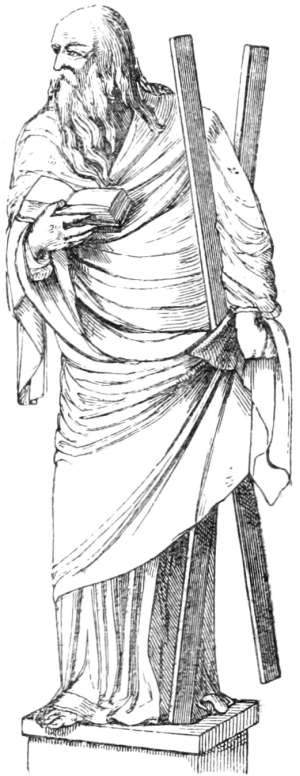
74 St. Andrew (Peter Vischer)
The historical subjects from the life of St. Andrew, treated separately from the rest of the apostles, are very few; his crucifixion is the only one that I have found treated before the fifteenth century. On the ancient doors of San Paolo, the instrument of his martyrdom has the shape of a Y, and resembles a tree split down the middle. The cross in some later pictures is very lofty, and resembles the rough branches of a tree laid transversely.
I know but two other subjects relating to the life of St. Andrew which have been separately treated in the later schools of art—the Adoration of the Cross, and the Flagellation.
‘St. Andrew adoring his cross,’ by Andrea Sacchi, is remarkable for its simplicity and fine expression; it contains only three figures. St Andrew, half undraped, and with his silver hair and beard floating dishevelled, kneels, gazing up to the cross with ecstatic devotion; he is addressing to it his famous invocation:—‘Salve, Croce preziosa! che fosti consecrata dal corpo del mio Dio!’—an executioner stands by, and a fierce soldier, impatient of delay, urges him on to death.[208]
‘St. Andrew taken down from the cross’ is a fine effective picture by Ribera.[209]
When Guido and Domenichino painted, in emulation of each other, the frescoes in the chapel of Sant’ Andrea in the church of San Gregorio, at Rome, Guido chose for his subject the Adoration of the Cross. The scene is supposed to be outside the walls of Patras in Achaia; the cross is at a distance in the background; St. Andrew, as he approaches, falls down in adoration before the instrument of his martyrdom, consecrated by the death of his Lord; he is attended by one soldier on horseback, one on foot, and three executioners; a group of women and alarmed children in the foreground are admirable for grace and feeling—they are, in fact, the best part of the picture. On the opposite wall of the chapel Domenichino painted the Flagellation of St. Andrew, a subject most difficult to treat effectively, and retain at the same time the dignity of the suffering apostle, while avoiding all resemblance to a similar scene in the life of Christ. Here he is bound down on a sort of table; one man lifts a rod, another seems to taunt the prostrate saint; a lictor drives back the people. The group of the mother and frightened children, which Domenichino so often introduces with little variation, is here very beautiful; the judge and lictors are seen behind, with a temple and a city in the distance. When Domenichino painted the same subject in the church of Sant’ Andrea-della-Valle, he chose another moment, and administered the torture after a different manner: the apostle is bound by his hands and feet to four short posts set firmly in the ground; one of the executioners in tightening a cord breaks it and falls back; three men prepare to scourge him with thongs: in the foreground we have the usual group of the mother and her frightened children. This is a composition full of dramatic life and movement, but unpleasing. Domenichino painted in the same church the crucifixion of the saint, and his apotheosis surmounts the whole.
All these compositions are of great celebrity in the history of Art for colour and for expression. Lanzi says, that the personages, ‘if endued with speech, could not say more to the ear than they do to the eye.’ But, in power and pathos, none of them equal the picture of Murillo, of which we have the original study in England.[210] St. Andrew is suspended on the high cross, formed, not of planks, but of the trunks of trees laid transversely. He is bound with cords, undraped, except by a linen cloth; his silver hair and beard loosely streaming in the air; his aged countenance illuminated by a heavenly transport, as he looks up to the opening skies, whence two angels of really celestial beauty, like almost all Murillo’s angels, descend with the crown and palm. In front, to the right, is a group of shrinking sympathising women; and a boy turns away, crying with a truly boyish grief; on the left are guards and soldiers. The subject is here rendered poetical by mere force of feeling; there is a tragic reality in the whole scene, far more effective, to my taste, than the more studied compositions of the Italian painters. The martyrdom of St. Andrew, and the saint preaching the Gospel, by Juan de Roelas, are also mentioned as splendid productions of the Seville school.
I think it possible that St. Andrew may owe his popularity in the Spanish and Flemish schools of art to his being the patron saint of the far-famed Burgundian Order of the Golden Fleece. At the time that Constantinople was taken, and the relics of St. Andrew dispersed in consequence, a lively enthusiasm for this apostle was excited throughout all Christendom. He had been previously honoured chiefly as the brother of St. Peter; he obtained thenceforth a kind of personal interest and consideration. Philip of Burgundy (A.D. 1433), who had obtained at great cost a portion of the precious relics, consisting chiefly of some pieces of his cross, placed under the protection of the apostle his new order of chivalry, which, according to the preamble, was intended to revive the honour and the memory of the Argonauts. His knights wore as their badge the cross of St. Andrew.
St. James the Great.
Lat. Sanctus Jacobus Major. Ital. San Giacomo, or Jacopo, Maggiore. Fr. St. Jacques Majeur. Spa. San Jago, or Santiago. El Tutelar. Patron saint of Spain. July 25. A.D. 44.
St. James the Great, or the Elder, or St. James Major, was nearly related to Christ, and, with his brother John (the evangelist) and Peter, he seems to have been admitted to particular favour, travelled with the Lord, and was present at most of the events recorded in the Gospels. He was one of the three who were permitted to witness the glorification of Christ on Mount Tabor, and one of those who slept during the agony in the garden. After our Saviour’s ascension, nothing is recorded concerning him, except the fact that Herod slew him with the sword. In the ancient traditions he is described as being of a zealous and affectionate temper, easily excited to anger: of this we have a particular instance in his imprecation against the inhospitable Samaritans, for which Christ rebuked him: ‘Ye know not what manner of spirit ye are of. The Son of man is not come to destroy men’s lives, but to save them.’ (Luke, ix. 55.)
As Scripture makes no farther mention of one so distinguished by his zeal and by his near relationship to the Saviour, the legends of the middle ages have supplied this deficiency; and so amply, that St. James, as St. Jago or Santiago, the military patron of Spain, became one of the most renowned saints in Christendom, and one of the most popular subjects of Western Art. Many of these subjects are so singular, that, in order to render them intelligible, I must give the legend at full length as it was followed by the artists of the fourteenth and fifteenth centuries.
According to the Spanish legend, the apostle James was the son of Zebedee, an illustrious baron of Galilee, who, being the proprietor of ships, was accustomed to fish along the shores of a certain lake called Gennesareth, but solely for his good pleasure and recreation: for who can suppose that Spain, that nation of Hidalgos and Caballeros, would ever have chosen for her patron, or accepted as the leader and captain-general of her armies, a poor ignoble fisherman? It remains, therefore, indisputable, that this glorious apostle, who was our Lord’s cousin-german, was of noble lineage, and worthy of his spurs as a knight and a gentleman;—so in Dante:—
Ecco il Barone Per cui laggiù si visita Galizia.‘
But it pleased him, in his great humility, to follow, while on earth, the example of his divine Lord, and reserve his warlike prowess till called upon to slaughter, by thousands and tens of thousands, those wicked Moors, the perpetual enemies of Christ and his servants. Now, as James and his brother John were one day in their father’s ship with his hired servants, and were employed in mending the nets, the Lord, who was walking on the shores of the lake, called them; and they left all and followed him; and became thenceforward his most favoured disciples, and the witnesses of his miracles while on earth. After the ascension of Christ, James preached the Gospel in Judea; then he travelled over the whole world, and came at last to Spain, where he made very few converts, by reason of the ignorance and darkness of the people. One day, as he stood with his disciples on the banks of the Ebro, the blessed Virgin appeared to him seated on the top of a pillar of jasper, and surrounded by a choir of angels; and the apostle having thrown himself on his face, she commanded him to build on that spot a chapel for her worship, assuring him that all this province of Saragossa, though now in the darkness of paganism, would at a future time be distinguished by devotion to her. He did as the holy Virgin had commanded, and this was the origin of a famous church afterwards known as that of Our Lady of the Pillar (’Nuestra Señora del Pillar‘). Then St. James, having founded the Christian faith in Spain, returned to Judea, where he preached for many years, and performed many wonders and miracles in the sight of the people: and it happened that a certain sorcerer, whose name was Hermogenes,[211] set himself against the apostle, just as Simon Magus had wickedly and vainly opposed St. Peter, and with the like result. Hermogenes sent his scholar Philetus to dispute with James, and to compete with him in wondrous works; but, as you will easily believe, he had no chance against the apostle, and, confessing himself vanquished, he returned to his master, to whom he announced his intention to follow henceforth James and his doctrine. Then Hermogenes, in a rage, bound Philetus by his diabolical spells, so that he could not move hand or foot; saying, ‘Let us now see if thy new master can deliver thee:’ and Philetus sent his servant to St. James, praying for aid. Then the apostle took off his cloak, and gave it to the servant to give his master; and no sooner had Philetus touched it, than he became free, and hastened to throw himself at the feet of his deliverer. Hermogenes, more furious than ever, called to the demons who served him, and commanded that they should bring to him James and Philetus, bound in fetters; but on their way the demons met with a company of angels, who seized upon them, and punished them for their wicked intentions, till they cried for mercy. Then St. James said to them, ‘Go back to him who sent ye, and bring him hither bound.’ And they did so; and having laid the sorcerer down at the feet of St. James, they besought him, saying, ‘Now give us power to be avenged of our enemy and thine!’ But St. James rebuked them, saying, ‘Christ hath commanded us to do good for evil.’ So he delivered Hermogenes from their hands; and the magician, being utterly confounded, cast his books into the sea, and desired of St. James that he would protect him against the demons, his former servants. Then St. James gave him his staff, as the most effectual means of defence against the infernal spirits; and Hermogenes became a faithful disciple and preacher of the word from that day.
But the evil-minded Jews, being more and more incensed, took James and bound him, and brought him before the tribunal of Herod Agrippa; and one of those who dragged him along, touched by the gentleness of his demeanour, and by his miracles of mercy, was converted, and supplicated to die with him; and the apostle gave him the kiss of peace, saying, ‘Pax vobis!’ and the kiss and the words together have remained as a form of benediction in the Church to this day. Then they were both beheaded, and so died.
And the disciples of St. James came and took away his body; and, not daring to bury it, for fear of the Jews, they carried it to Joppa, and placed it on board of a ship: some say that the ship was of marble, but this is not authenticated; however, it is most certain that angels conducted the ship miraculously to the coast of Spain, where they arrived in seven days; and, sailing through the straits called the Pillars of Hercules, they landed at length in Galicia, at a port called Iria Flavia, now Padron.
In those days there reigned over the country a certain queen whose name was Lupa, and she and all her people were plunged in wickedness and idolatry. Now, having come to shore, they laid the body of the apostle upon a great stone, which became like wax, and, receiving the body, closed around it: this was a sign that the saint willed to remain there; but the wicked queen Lupa was displeased, and she commanded that they should harness some wild bulls to a car, and place on it the body, with the self-formed tomb, hoping that they would drag it to destruction. But in this she was mistaken; for the wild bulls, when signed by the cross, became as docile as sheep, and they drew the body of the apostle straight into the court of her palace. When Queen Lupa beheld this miracle, she was confounded, and she and all her people became Christians: she built a magnificent church to receive the sacred remains, and died in the odour of sanctity.
But then came the darkness and ruin which during the invasion of the Barbarians overshadowed all Spain; and the body of the apostle was lost, and no one knew where to find it, till, in the year 800, the place of sepulture was revealed to a certain holy friar.
Then they caused the body of the saint to be transported to Compostella; and, in consequence of the surprising miracles which graced his shrine, he was honoured not merely in Galicia, but throughout all Spain. He became the patron saint of the Spaniards, and Compostella, as a place of pilgrimage, was renowned throughout Europe. From all countries bands of pilgrims resorted there, so that sometimes there were no less than a hundred thousand in one year. The military Order of Saint Jago, enrolled by Don Alphonso for their protection, became one of the greatest and richest in Spain.
Now, if I should proceed to recount all the wonderful deeds enacted by Santiago in behalf of his chosen people, they would fill a volume. The Spanish historians number thirty-eight visible apparitions, in which this glorious saint descended from heaven in person, and took the command of their armies against the Moors. The first of these, and the most famous of all, I shall now relate.
In the year of our Lord 939, King Ramirez, having vowed to deliver Castile from the shameful tribute imposed by the Moors, of one hundred virgins delivered annually, collected his troops, and defied their king Abdelraman, to battle:
The king call’d God to witness, that, came there weal or woe, Thenceforth no maiden tribute from out Castile should go.— ‘At least I will do battle on God our Saviour’s foe, And die beneath my banner before I see it so!’
Accordingly he charged the Moorish host on the plain of Alveida or Clavijo: after a furious conflict, the Christians were, by the permission of Heaven, defeated, and forced to retire. Night separated the combatants, and King Ramirez, overpowered with fatigue, and sad at heart, flung himself upon his couch and slept. In his sleep he beheld the apostle St. Jago, who promised to be with him next morning in the field, and assured him of victory. The king, waking up from the glorious vision, sent for his prelates and officers, to whom he related it; and the next morning, at the head of his army, he recounted it to his soldiers, bidding them rely on heavenly aid. He then ordered the trumpets to sound to battle. The soldiers, inspired with fresh courage, rushed to the fight. Suddenly St. Jago was seen mounted on a milk-white charger, and waving aloft a white standard; he led on the Christians, who gained a decisive victory, leaving 60,000 Moors dead on the field. This was the famous battle of Clavijo; and ever since that day, ‘Santiago!’ has been the war-cry of the Spanish armies.
But it was not only on such great occasions that the invincible patron of Spain was pleased to exhibit his power: he condescended oftentimes to interfere for the protection of the poor and oppressed, of which I will now give a notable instance, as it is related by Pope Calixtus II.
There was a certain German, who with his wife and son went on a pilgrimage to St. James of Compostella. Having come as far as Torlosa, they lodged at an inn there; and the host had a fair daughter, who, looking on the son of the pilgrim, a handsome and a graceful youth, became deeply enamoured; but he, being virtuous, and, moreover, on his way to a holy shrine, refused to listen to her allurements. Then she thought how she might be avenged for this slight put upon her charms, and hid in his wallet her father’s silver drinking-cup. The next morning, no sooner were they departed, than the host, discovering his loss, pursued them, accused them before the judge, and the cup being found in the young man’s wallet, he was condemned to be hung, and all they possessed was confiscated to the host.
Then the afflicted parents pursued their way lamenting, and made their prayer and their complaint before the altar of the blessed Saint Jago; and thirty-six days afterwards as they returned by the spot where their son hung on the gibbet, they stood beneath it, weeping and lamenting bitterly. Then the son spoke and said, ‘O my mother! O my father! do not lament for me, for I have never been in better cheer; the blessed apostle James is at my side, sustaining me and filling me with celestial comfort and joy!’ The parents, being astonished, hastened to the judge, who at that moment was seated at table, and the mother called out, ‘Our son lives!’ The judge mocked at them: ‘What sayest thou, good woman? thou art beside thyself! If thy son liveth, so do those fowls in my dish.’ And lo! scarcely had he uttered the words, when the fowls (being a cock and a hen) rose up full-feathered in the dish, and the cock began to crow, to the great admiration of the judge and his attendants.[212] Then the judge rose up from table hastily, and called together the priests and the lawyers, and they went in procession to the gibbet, took down the young man, and restored him to his parents; and the miraculous cock and hen were placed under the protection of the Church, where they and their posterity long flourished in testimony of this stupendous miracle.
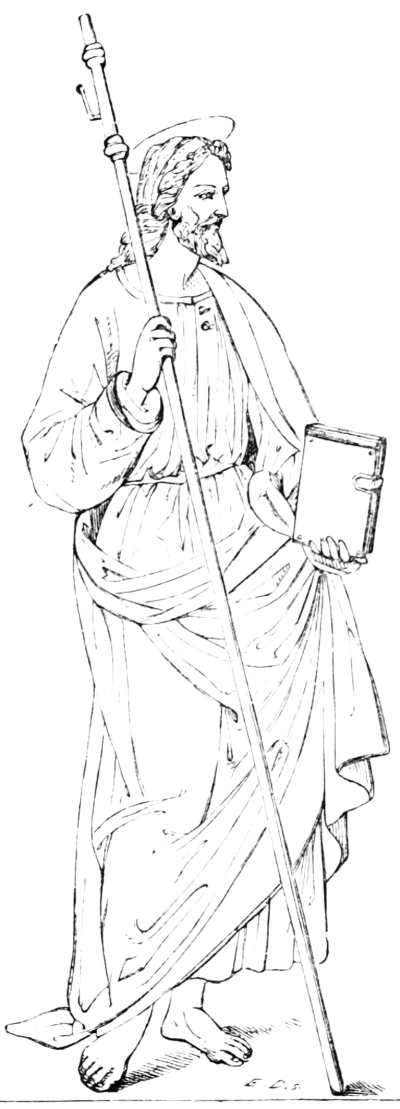
75 St. James Major (Gio. Santi)
There are many other legends of St. James; the Spanish chroniclers in prose and verse abound in such; but, in general, they are not merely incredible, but puerile and unpoetical; and I have here confined myself to those which I know to have been treated in Art.
Previous to the twelfth century, St. James is only distinguished among the apostles by his place, which is the fourth in the series, the second after St. Peter and St. Paul. In some instances he is portrayed with a family resemblance to Christ, being his kinsman; the thin beard, and the hair parted and flowing down on each side. But from the thirteenth century it became a fashion to characterise St. James as a pilgrim of Compostella: he bears the peculiar long staff, to which the wallet or gourd of water is suspended; the cloak with a long cape, the scallop-shell on his shoulder or on his flapped hat. Where the cape, hat, and scallop-shells are omitted, the staff, borne as the first of the apostles who departed to fulfil his Gospel mission, remains his constant attribute, and by this he may be recognised in the Madonna pictures, and when grouped with other saints.
The single devotional figures of St. James represent him in two distinct characters:—
1. As tutelar saint of Spain, and conqueror of the Moors. In his pilgrim habit, mounted on a white charger, and waving a white banner, with white hair and beard streaming like a meteor, or sometimes armed in complete steel, spurred like a knight, his casque shadowed by white plumes, he tramples over the prostrate Infidels; so completely was the humble, gentle-spirited apostle of Christ merged in the spirit of the religious chivalry of the time. This is a subject frequent in Spanish schools. The figure over the high altar of Santiago is described as very grand when seen in the solemn twilight.
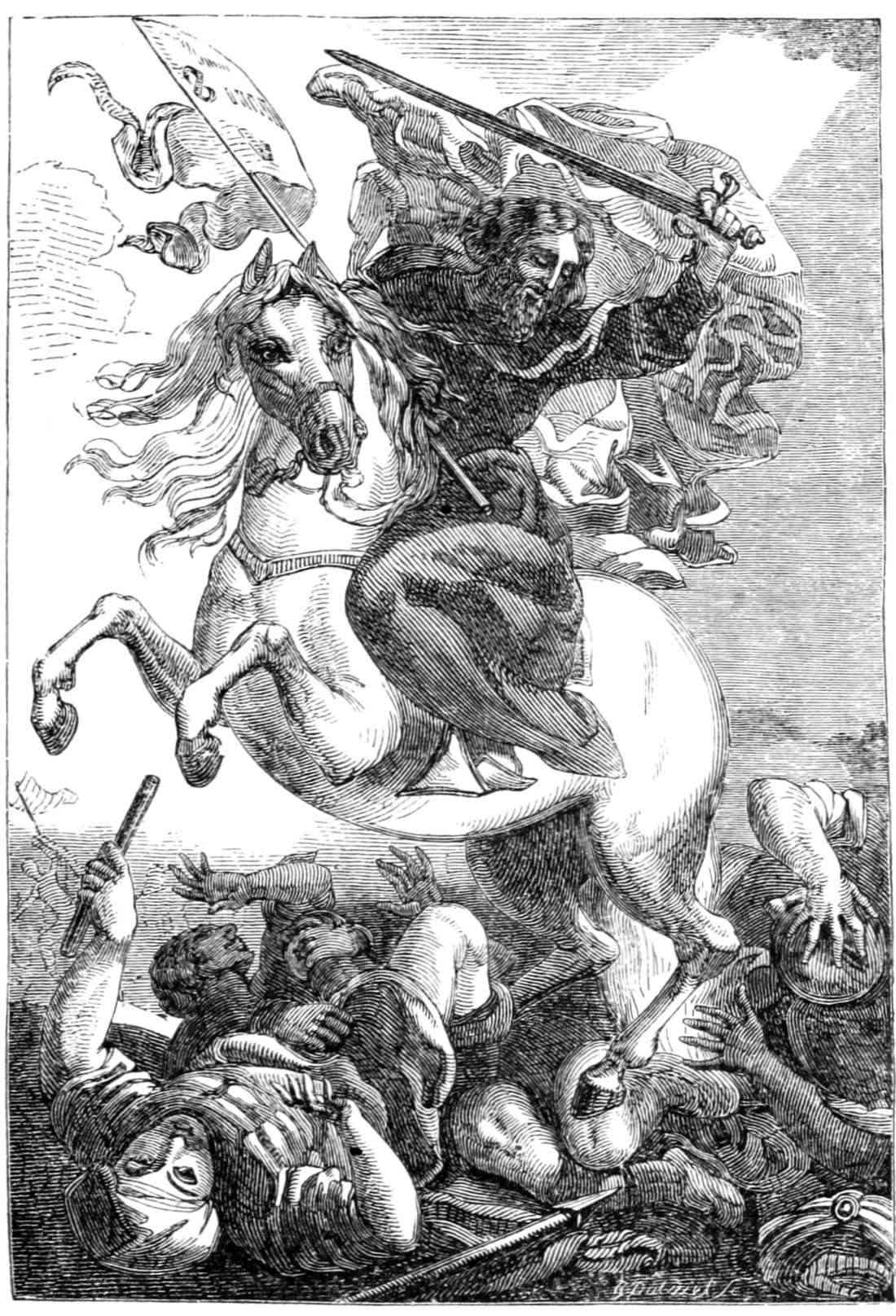
76 Santiago (Carreño de Miranda)
2. St. James as patron saint in the general sense. The most beautiful example I have met with is a picture in the Florence Gallery, painted by Andrea del Sarto for the Compagnia or Confraternita of Sant’ Jacopo, and intended to figure as a standard in their processions. The Madonna di San Sisto of Raphael was painted for a similar purpose: and such are still commonly used in the religious processions in Italy; but they have no longer Raphaels and Andrea-del-Sartos to paint them. In this instance the picture has a particular form, high and narrow, adapted to its especial purpose: St. James wears a green tunic, and a rich crimson mantle; and as one of the purposes of the Compagnia was to educate poor orphans, they are represented by the two boys at his feet. This picture suffered from the sun and the weather, to which it had been a hundred times exposed in yearly processions; but it has been well restored, and is admirable for its vivid colouring as well as the benign attitude and expression.
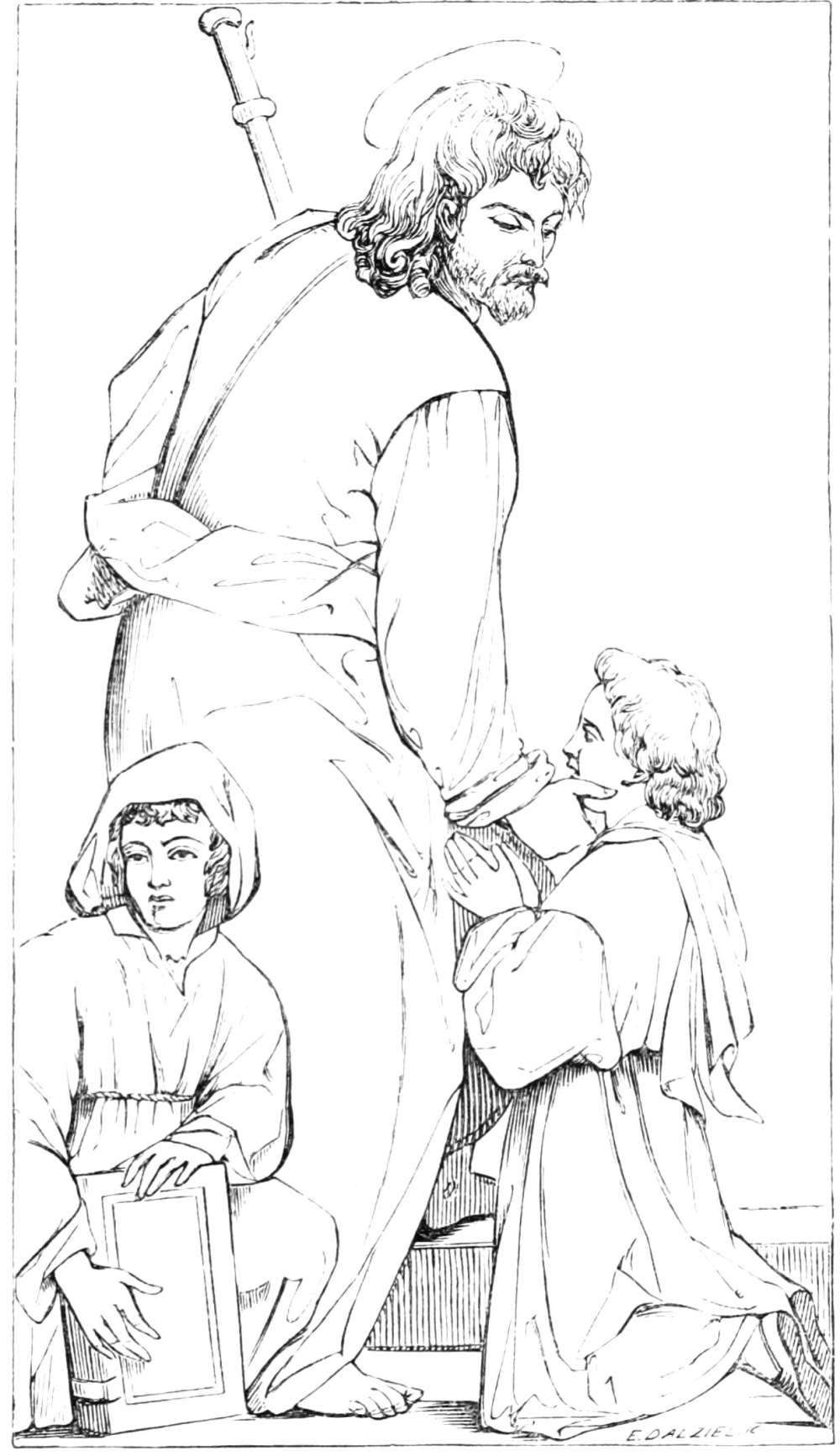
77 St. James Major (A. del Sarto)
3. St. James seated; he holds a large book bound in vellum (the Gospels) in his left hand—and with his right points to heaven: by Guercino, in the gallery of Count Harrach, at Vienna. One of the finest pictures by Guercino I have seen.
Pictures from the life of St. James singly, or as a series, are not common; but among those which remain to us there are several of great beauty and interest.
In the series of frescoes painted in a side chapel of the church of St. Antony of Padua (A.D. 1376), once called the Capella di San Giacomo, and now San Felice, the old legend of St. James has been exactly followed; and though ruined in many parts, and in others coarsely repainted, these works remain as compositions amongst the most curious monuments of the Trecentisti. It appears that, towards the year 1376, Messer Bonifacio de’ Lupi da Parma, Cavaliere e Marchese di Serana, who boasted of his descent from the Queen Lupa of the legend, dedicated this chapel to St. James of Spain (San Jacopo di Galizia), and employed M. Jacopo Avanzi to decorate it, who no doubt bestowed his best workmanship on his patron saint. The subjects are thus arranged, beginning with the lunette on the left hand, which is divided into three compartments:
1. Hermogenes sends Philetus to dispute with St. James. 2. St. James in his pulpit converts Philetus. 3. Hermogenes sends his demons to bind St. James and Philetus. 4. Hermogenes brought bound to St. James. 5. He burns his books of magic. 6. Hermogenes and Philetus are conversing in a friendly manner with St. James. 7. St. James is martyred. 8. The arrival of his body in Spain in a marble ship steered by an angel. 9. The disciples lay the body on a rock, while Queen Lupa and her sister and another personage look on from a window in her palace. Then follow two compartments on the side where the window is broken out, much ruined; they represented apparently the imprisonment of the disciples. 12. The disciples escape and are pursued, and their pursuers with their horses are drowned. 13. The wild bulls draw the sarcophagus into the court of Queen Lupa’s palace. 14. Baptism of Lupa. 15 and 16 (lower compartments to the left): St. Jago appears to King Ramirez, and the defeat of the Moors at Clavijo.
There is a rare and curious print by Martin Schoen, in which the apparition of St. James at Clavijo is represented not in the Spanish but the German style. It is an animated composition of many figures. The saint appears on horseback in the midst, wearing his pilgrim’s dress, with the cockle-shell in his hat: the Infidels are trampled down, or fly before him.
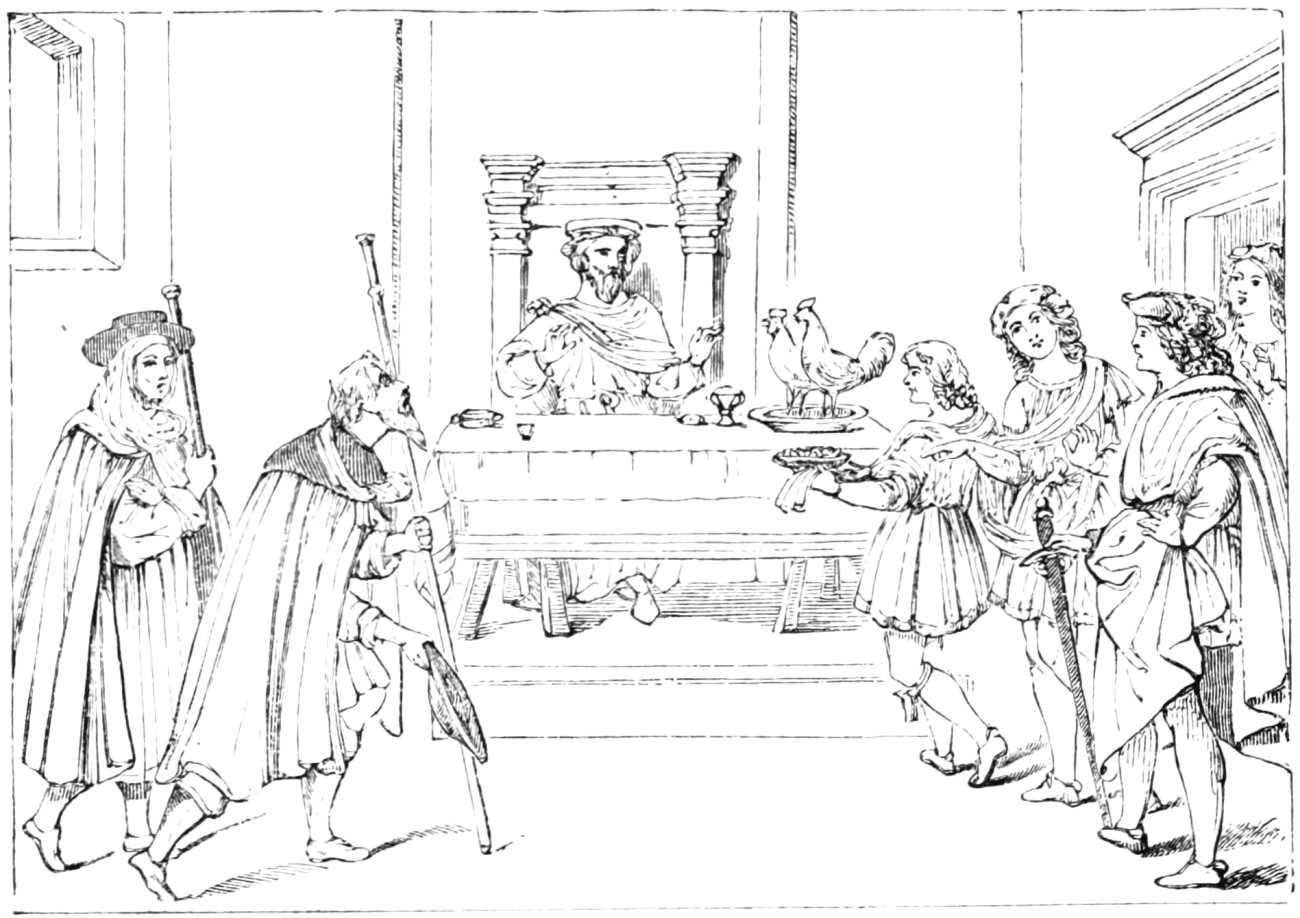
78 The miracle of the Fowls (Lo Spagna)
On the road from Spoleto to Foligno, about four miles from Spoleto, there is a small chapel dedicated to St. James of Galizia. The frescoes representing the miracles of the saint were painted by Lo Spagna (A.D. 1526), the friend and fellow pupil of Raphael. In the vault of the apsis is the Coronation of the Virgin; she kneels, attired in white drapery flowered with gold, and the whole group, though inferior in power, appeared to me in delicacy and taste far superior to the fresco of Fra Filippo Lippi at Spoleto, from which Passavant thinks it is borrowed.[213] Immediately under the Coronation, in the centre, is a figure of St. James as patron saint, standing with his pilgrim’s staff in one hand, and the Gospel in the other; his dress is a yellow tunic with a blue mantle thrown over it. In the compartment on the left, the youth is seen suspended on the gibbet, while St. James with his hands under his feet sustains him; the father and mother look up at him with astonishment. In the compartment to the right, we see the judge seated at dinner, attended by his servants, one of whom is bringing in a dish: the two pilgrims appear to have just told their story, and the cock and hen have risen up in the dish (78). These frescoes are painted with great elegance and animation, and the story is told with much naïveté. I found the same legend painted on one of the lower windows of the church of St. Ouen, and on a window of the right-hand aisle in St. Vincent’s at Rouen.
Of St. John, who is the fifth in the series, I have spoken at large under the head of the Evangelists.
St. Philip.
Ital. San Filippo Apostolo. Fr. Saint Philippe. Patron of Brabant and Luxembourg. May 1.
Of St. Philip there are few notices in the Gospel. He was born at Bethsaida, and he was one of the first of those whom our Lord summoned to follow him. After the ascension, he travelled into Scythia, and remained there preaching the Gospel for twenty years; he then preached at Hieropolis in Phrygia, where he found the people addicted to the worship of a monstrous serpent or dragon, or of the god Mars under that form. Taking compassion on their blindness, the apostle commanded the serpent, in the name of the cross he held in his hand, to disappear, and immediately the reptile glided out from beneath the altar, at the same time emitting such a hideous stench, that many people died, and among them the king’s son fell dead in the arms of his attendants: but the apostle, by Divine power, restored him to life. Then the priests of the dragon were incensed against him, and they took him, and crucified him, and being bound on the cross they stoned him; thus he yielded up his spirit to God, praying, like his Divine Master, for his enemies and tormentors.
According to the Scripture, St. Philip had four daughters, who were prophetesses, and made many converts to the faith of Christ (Acts, xxi. 9). In the Greek calendar, St. Mariamne, his sister, and St. Hermione, his daughter, are commemorated as martyrs.
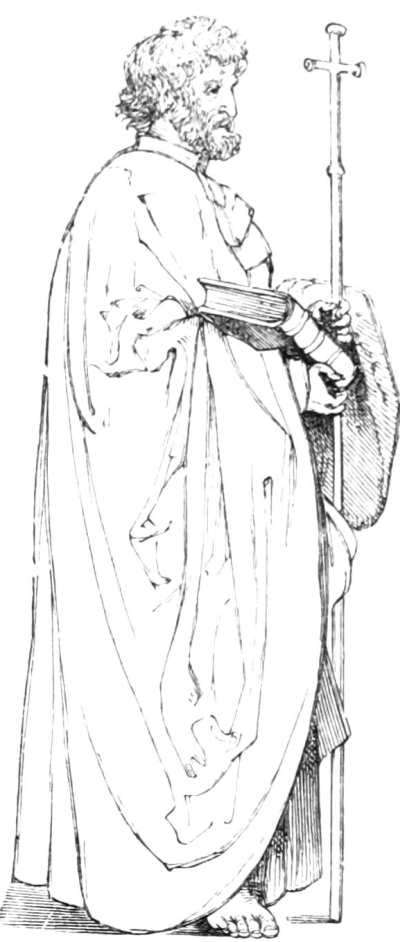
79 St. Philip (A. Dürer)
When St. Philip is represented alone, or as one of the series of apostles, he is generally a man in the prime of life, with little beard, and with a benign countenance, being described as of a remarkably cheerful and affectionate nature. He bears, as his attribute, a cross, which varies in form; sometimes it is a small cross, which he carries in his hand; sometimes a high cross in the form of a T, or a tall staff with a small Latin cross at the top of it (79). The cross of St. Philip may have a treble signification: it may allude to his martyrdom; or to his conquest over the idols through the power of the cross; or, when placed on the top of the pilgrim’s staff, it may allude to his mission among the barbarians as preacher of the cross of salvation. Single figures of St. Philip as patron are not common: there is a fine statue of him on the façade of San Michele at Florence; and a noble figure by Beccafumi, reading;[214] another, seated and reading, by Ulrich Mair.[215]
Subjects from the life of St. Philip, whether as single pictures or in a series, are also rarely met with. As he was the first called by our Saviour to leave all and follow him, and his vocation therefore a festival in the Church, it must, I think, have been treated apart; but I have not met with it. I know but of three historical subjects taken from his life:—
1. Bonifazio. St. Philip stands before the Saviour: the attitude of the latter is extremely dignified, that of Philip supplicatory; the other apostles are seen in the background: the colouring and expression of the whole like Titian. The subject of this splendid picture is expressed by the inscription underneath (John, xiv. 14): ‘Domine, ostende nobis Patrem, et sufficit nobis.’ ‘Philippe, qui videt me, videt et Patrem meum: ego et Pater unum sumus.‘[216]
2. St. Philip exorcises the serpent. The scene is the interior of a temple, an altar with the statue of the god Mars: a serpent, creeping from beneath the altar, slays the attendants with his poisonous and fiery breath. The ancient fresco in his chapel at Padua, described by Lord Lindsay, is extremely animated, but far inferior to the same subject in the Santa Croce at Florence by Fra Filippo Lippi, where the dignified attitude of the apostle, and the group of the king’s son dying in the arms of the attendants, are admirably effective and dramatic. St. Philip, it must be observed, was the patron saint of the painter.
3. The Crucifixion of St. Philip. According to the old Greek traditions, he was crucified with his head downwards, and he is so represented on the gates of San Paolo; also in an old picture over the tomb of Cardinal Philippe d’Alençon, where his patron, St. Philip, is attached to the cross with cords, and head downwards, like St. Peter;[217] but in the old fresco by Giusto da Padova, in the Capella di San Filippo, he is crucified in the usual manner, arrayed in a long red garment which descends to his feet.
It is necessary to avoid confounding St. Philip the apostle with St. Philip the deacon. It was Philip the deacon who baptized the chamberlain of Queen Candace, though the action has sometimes been attributed to Philip the apostle. The incident of the baptism of the Ethiopian, taking place in the road, by running water, ‘on the way that goeth down from Jerusalem to Gaza,’ has been introduced into several beautiful landscapes with much picturesque effect. Claude has thus treated it; Salvator Rosa; Jan Both, in a most beautiful picture in the Queen’s Gallery; Rembrandt, Cuyp, and others.
St. Bartholomew.
Lat. S. Bartholomeus. Ital. San Bartolomeo. Fr. St. Barthélemi. Aug. 24.
As St. Bartholomew is nowhere mentioned in the canonical books, except by name in enumerating the apostles, there has been large scope for legendary story, but in works of art he is not a popular saint. According to one tradition, he was the son of a husbandman; according to another, he was the son of a prince Ptolomeus. After the ascension of Christ he travelled into India, even to the confines of the habitable world, carrying with him the Gospel of St. Matthew; returning thence, he preached in Armenia and Cilicia; and coming to the city of Albanopolis, he was condemned to death as a Christian: he was first flayed and then crucified.
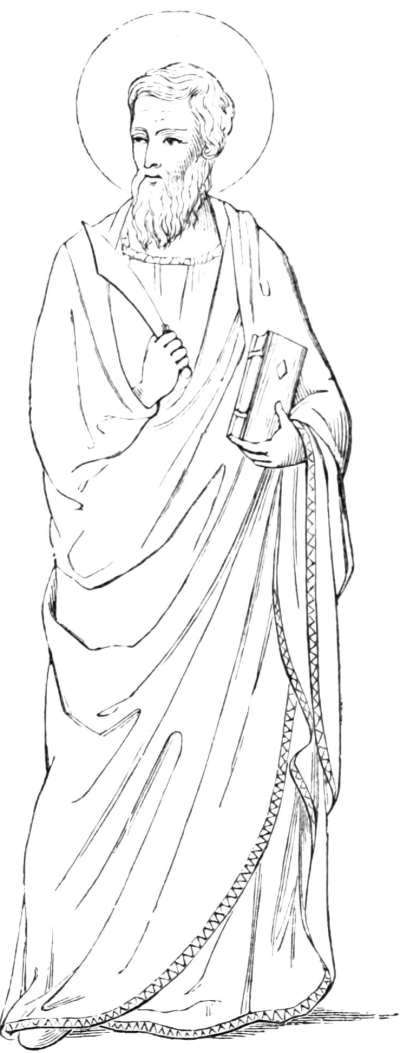
80 St. Bartholomew (Giotto)
In single figures and devotional pictures, St. Bartholomew sometimes carries in one hand a book, the Gospel of St. Matthew; but his peculiar attribute is a large knife, the instrument of his martyrdom. The legends describe him as having a quantity of strong black hair and a bushy grizzled beard; and this portrait being followed very literally by the old German and Flemish painters, gives him, with his large knife, the look of a butcher. In the Italian pictures, though of a milder and more dignified appearance, he has frequently black hair; and sometimes dark and resolute features; yet the same legend describes him as of a cheerful countenance, wearing a purple robe and attended by angels. Sometimes St. Bartholomew has his own skin hanging over his arm, as among the saints in Michael Angelo’s Last Judgment, where he is holding forth his skin in one hand, and grasping his knife in the other: and in the statue by Marco Agrati in the Milan Cathedral, famous for its anatomical precision and its boastful inscription, Non me Praxiteles sed Marcus pinxit Agratis. I found in the church of Nôtre Dame at Paris a picture of St. Bartholomew healing the Princess of Armenia. With this exception, I know not any historical subject where this apostle is the principal figure, except his revolting and cruel martyrdom. In the early Greek representation on the gates of San Paolo, he is affixed to a cross, or rather to a post, with a small transverse bar at top, to which his hands are fastened above his head; an executioner, with a knife in his hand, stoops at his feet. This is very different from the representations in the modern schools. The best, that is to say, the least disgusting, representation I have met with, is a small picture by Agostino Caracci, in the Sutherland Gallery, which once belonged to King Charles I.: it is easy to see that the painter had the antique Marsyas in his mind. That dark ferocious spirit, Ribera, found in it a theme congenial with his own temperament;[218] he has not only painted it several times with a horrible truth and power, but etched it elaborately with his own hand: a small picture, copied from the etching, is at Hampton Court.
St. Thomas.
Ital. San Tomaso. Sp. San Tomé. Dec. 21. Patron Saint of Portugal and Parma.
St. Thomas, called Didymus (the twin), takes, as apostle, the seventh place. He was a Galilean and a fisherman, and we find him distinguished among the apostles on two occasions recorded in the Gospel. When Jesus was going up to Bethany, being then in danger from the Jews, Thomas said, ‘Let us also go, that we may die with him.’ (John, xi. 16, xx. 25.) After the resurrection, he showed himself unwilling to believe in the reappearance of the crucified Saviour without ocular demonstration: this incident is styled the Incredulity of Thomas. From these two incidents we may form some idea of his character: courageous and affectionate, but not inclined to take things for granted; or, as a French writer expresses it, ‘brusque et résolu, mais d’un esprit exigeant.’ After the ascension, St. Thomas travelled into the East, preaching the Gospel in far distant countries towards the rising sun. It is a tradition received in the Church, that he penetrated as far as India; that there meeting with the three Wise Men of the East, he baptized them; that he founded a church in India, and suffered martyrdom there. It is related, that the Portuguese found at Meliapore an ancient inscription, purporting that St. Thomas had been pierced with a lance at the foot of a cross which he had erected in that city, and that in 1523 his body was found there and transported to Goa.
In Correggio’s fresco of St. Thomas as protector of Parma he is surrounded by angels bearing exotic fruits, as expressing his ministry in India.
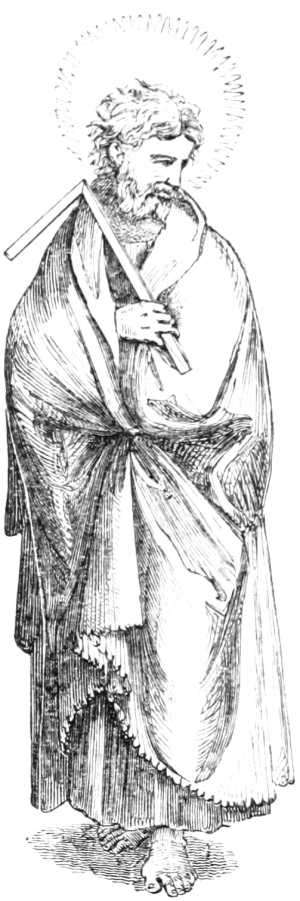
81 St. Thomas the Apostle
There are a number of extravagant and poetical legends relating to St. Thomas. I shall here limit myself to those which were adopted in ecclesiastical decoration, and treated by the artists of the middle ages.
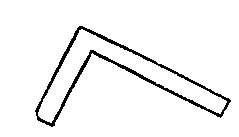
When St. Thomas figures as apostle, alone or with others, in all the devotional representations which are not prior to the thirteenth century he carries as his attribute the builder’s rule, of this form—
Now, as he was a fisherman, and neither a carpenter nor a mason, the origin of this attribute must be sought in one of the most popular legends of which he is the subject.
‘When St. Thomas was at Cesarea, our Lord appeared to him and said, “The king of the Indies, Gondoforus, hath sent his provost Abanes to seek for workmen well versed in the science of architecture, who shall build for him a palace finer than that of the Emperor of Rome. Behold, now, I will send thee to him.” And Thomas went, and Gondoforus commanded him to build for him a magnificent palace, and gave him much gold and silver for the purpose. The king went into a distant country, and was absent for two years; and St. Thomas meanwhile, instead of building a palace, distributed all the treasures entrusted to him among the poor and sick; and when the king returned, he was full of wrath, and he commanded that St. Thomas should be seized and cast into prison, and he meditated for him a horrible death. Meantime the brother of the king died; and the king resolved to erect for him a most magnificent tomb; but the dead man, after that he had been dead four days, suddenly arose and sat upright, and said to the king, “The man whom thou wouldst torture is a servant of God: behold I have been in Paradise, and the angels showed to me a wondrous palace of gold and silver and precious stones,” and they said, “This is the palace that Thomas the architect hath built for thy brother King Gondoforus.” And when the king heard these words, he ran to the prison, and delivered the apostle; and Thomas said to him, “Knowest thou not that those who would possess heavenly things, have little care for the things of this earth? There are in heaven rich palaces without number, which were prepared from the beginning of the world for those who purchase the possession through faith and charity. Thy riches, O king, may prepare the way for thee to such a palace, but they cannot follow thee thither.”’[219]
The builder’s rule in the hand of St. Thomas characterises him as the spiritual architect of King Gondoforus, and for the same reason he has been chosen among the saints as patron of architects and builders.
There is in this legend or allegory, fanciful as it is, an obvious beauty and significance, which I need not point out. It appears to me to be one of those many legends which originally were not assumed to be facts, but were related as parables, religious fictions invented for the instruction of the people, like our Saviour’s stories of the ‘Good Samaritan,’ the ‘Prodigal Son,’ &c., and were rendered more striking and impressive by the introduction of a celebrated and exalted personage—our Saviour, the Virgin, or one of the apostles—as hero of the tale. This beautiful legend of St. Thomas and King Gondoforus is painted on one of the windows of the cathedral at Bourges,—an appropriate offering from the company of builders in that ancient city. It is also the subject of one of the finest of the ancient French mysteries, which was acted with great applause at Paris in the fourteenth century.
But, in the historical subjects from the life of St. Thomas, the first place must be given to the one scriptural incident in which he figures as a principal person. ‘The Incredulity of St. Thomas’ occurs in all the early series of the life of Christ, as one of the events of his mission, and one of the proofs of his resurrection. On the ancient gates of San Paolo it is treated with great simplicity as a sacred mystery, St. Thomas being the principal personage in the action, as the one whose conviction was to bring conviction to the universe. Christ stands on a pedestal surmounted by a cross; the apostles are ranged on each side, and St. Thomas, approaching, stretches forth his hand. The incident, as a separate subject, is of frequent occurrence in the later schools of Italy, and in the Flemish schools. The general treatment, when given in this dramatic style, admits of two variations: either St. Thomas is placing his hand, with an expression of doubt and fear, on the wounds of the Saviour; or, his doubts being removed, he is gazing upwards in adoration and wonder. Of the first, one of the finest examples is a well-known picture by Rubens,[220] one of his most beautiful works, and extraordinary for the truth of the expression in the countenance of the apostle, whose hand is on the side of Christ; St. John and St. Peter are behind. In Vandyck’s picture at Petersburg, St. Thomas stoops to examine the Saviour’s hand. In a design ascribed to Raphael, we have the second version: the look of astonished conviction in St. Thomas.[221] Niccolò Poussin has painted it finely, introducing twelve figures.[222] Guercino’s picture is celebrated, but he has committed the fault of representing the two principal figures both in profile.[223]
The legendary subject styled ‘La Madonna della Cintola’ belongs properly to the legends of the Virgin, but as St. Thomas is always a principal personage I shall mention it here. The legend relates that when the Madonna ascended into heaven, in the sight of the apostles, Thomas was absent; but after three days he returned, and, doubting the truth of her glorious translation, he desired that her tomb should be opened; which was done, and lo! it was found empty. Then the Virgin, taking pity on his weakness and want of faith, threw down to him her girdle, that this tangible proof remaining in his hands might remove all doubts for ever from his mind: hence in many pictures of the Assumption and Coronation of the Virgin, St. Thomas is seen below holding the sacred girdle in his hand. For instance, in Raphael’s beautiful ‘Coronation’ in the Vatican; and in Correggio’s ‘Assumption’ at Parma, where St. Thomas holds the girdle, and another apostle kisses it.
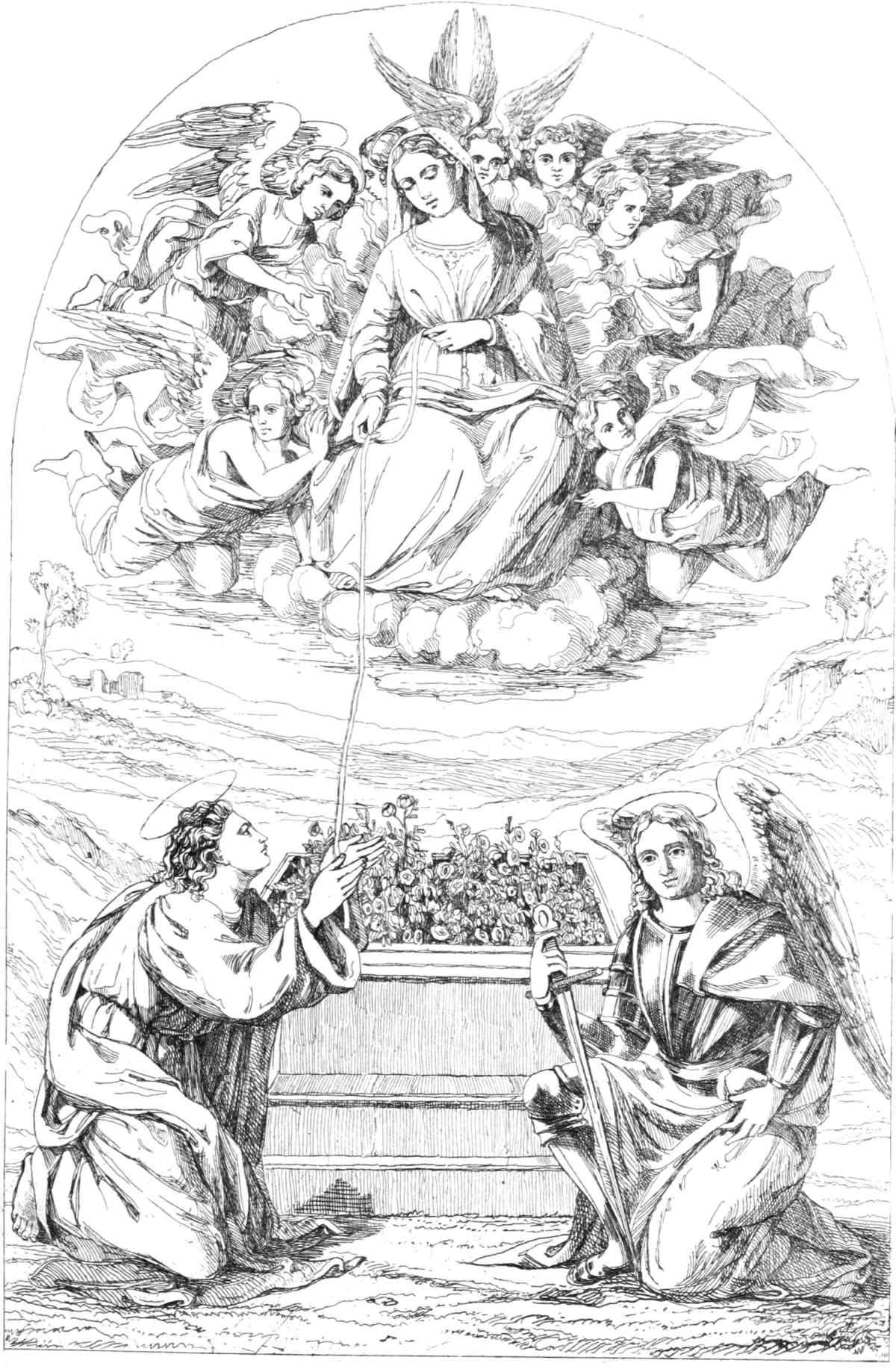
The Madonna of the Girdle
The belief that the girdle is preserved in the Cathedral at Pistoia has rendered this legend a popular subject with the Florentine painters; and we find it treated, not merely as an incident in the scene of the Assumption, but in a manner purely mystic and devotional. Thus, in a charming bas-relief by Luca della Robbia,[224] the Virgin, surrounded by a choir of angels, presents her girdle to the apostle. In a beautiful picture by Granacci,[225] the Virgin is seated in the clouds; beneath is her empty sepulchre: on one side kneels St. Thomas, who receives with reverence the sacred girdle; on the other kneels the Archangel Michael. In simplicity of arrangement, beauty of expression, and tender harmony of colour, this picture has seldom been exceeded. Granacci has again treated this subject, and St. Thomas receives the girdle in the presence of St. John the Baptist, St. James Major, St. Laurence, and St. Bartholomew.[226] We have the same subject by Paolino da Pistoia; by Sogliani; and by Mainardi, a large and very fine fresco in the church of Santa Croce at Florence.
A poetical and truly mystical version of this subject is that wherein the Infant Saviour, seated or standing on his mother’s knee, looses her girdle and presents it to St. Thomas. Of this I have seen several examples; one in the Duomo at Viterbo.[227]
In the Martyrdom of St. Thomas, several idolaters pierce him through with lances and javelins. It was so represented on the doors of San Paolo, with four figures only. Rubens, in his large picture, has followed the legend very exactly; St. Thomas embraces the cross, at the foot of which he is about to fall, transfixed by spears. A large picture in the gallery of Count Harrach at Vienna, called there the Martyrdom of St. Jude, I believe to represent the Martyrdom of St. Thomas. Two of the idolatrous priests pierce him with lances. Albert Dürer, in his beautiful print of St. Thomas, represents him holding the lance, the instrument of his martyrdom: but this is very unusual.
The eighth in the order of the Apostles is the Evangelist St. Matthew, of whom I have spoken at length.
St. James Minor.
Lat. S. Jacobus Frater Domini. Gr. Adelphotheos. Ital. San Jacopo or Giacomo Minore. Fr. St. Jacques Mineur. (May 1.)
The ninth is St. James Minor, or the Less, called also the Just: he was a near relative of Christ, being the son of Mary, the wife of Cleophas, who was the sister of the Virgin Mary; hence he is styled ‘the Lord’s brother.’ Nothing particular is related of him till after the ascension. He is regarded as first Christian bishop of Jerusalem, and venerated for his self-denial, his piety, his wisdom, and his charity. These characteristics are conspicuous in the beautiful Epistle which bears his name. Having excited, by the fervour of his teaching, the fury of the Scribes and Pharisees, and particularly the enmity of the high-priest Ananus, they flung him down from a terrace or parapet of the Temple, and one of the infuriated populace below beat out his brains with a fuller’s club.
In single figures and devotional pictures, St. James is generally leaning on this club, the instrument of his martyrdom. According to an early tradition, he so nearly resembled our Lord in person, in features, and deportment, that it was difficult to distinguish them. ‘The Holy Virgin herself,’ says the legend, ‘had she been capable of error, might have mistaken one for the other:’ and this exact resemblance rendered necessary the kiss of the traitor Judas, in order to point out his victim to the soldiers.
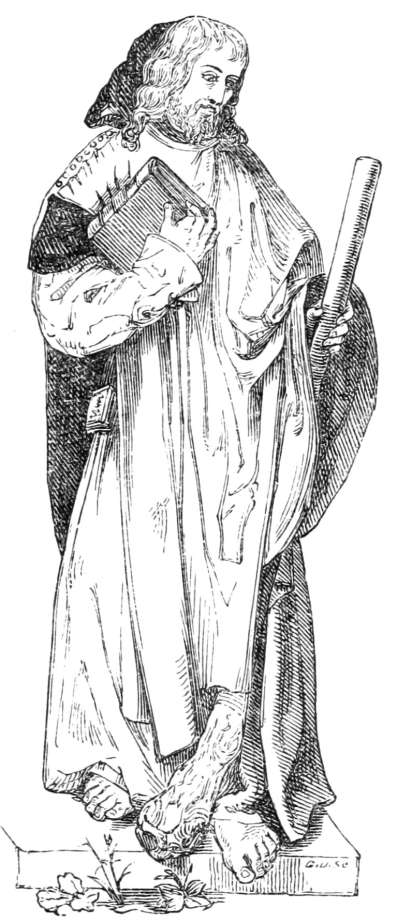
82 St. James Minor
This characteristic resemblance is attended to in the earliest and best representations of St. James, and by this he may usually be distinguished when he does not bear his club, which is often a thick stick or staff. With the exception of those Scripture scenes in which the apostles are present, I have met with few pictures in which St. James Minor is introduced: he does not appear to have been popular as a patron saint. The event of his martyrdom occurs very seldom, and is very literally rendered: the scene is a court of the Temple, with terraces and balconies; he is falling, or has fallen, to the ground, and one of the crowd lifts up the club to smite him.
Ignorant artists have in some instances confounded St. James Major and St. James Minor. The Cappella dei Belludi at Padua, already mentioned, dedicated to St. Philip and St. James, contains a series of frescoes from the life of St. James Minor, in which are some of the miraculous incidents attributed in the Legenda Aurea to St. James Major.
1. The Council of the Apostles held at Jerusalem, in which St. James was nominated chief or bishop of the infant Church. 2. Our Saviour after his resurrection appears to St. James, who had vowed not to eat till he should see Christ.[228] 3. St. James thrown down from the pulpit in the court of the Temple. 4. He is slain by the fuller. 5. A certain merchant is stript of all his goods by a tyrant, and cast into prison. He implores the protection of St. James, who, leading him to the summit of the tower, commands the tower to bow itself to the ground, and the merchant steps from it and escapes; or, according to the version followed in the fresco, the apostle lifts the tower on one side from its foundation, and the prisoner escapes from under it, like a mouse out of a trap. 6. A poor pilgrim, having neither money nor food, fell asleep by the way-side, and, on waking, found that St. James had placed beside him a loaf of bread, which miraculously supplied his wants to the end of his journey. These two last stories are told also of St. James of Galicia, but I have never met with any pictures of his life in which they are included. Here they undoubtedly refer to St. James Minor, the chapel being consecrated to his honour.
St. Simon Zelotes (or the Zealot). St. Jude (Thaddeus, or Lebbeus).
Ital. San Simone; San Taddeo. Fr. St. Simon le Zélé. St. Thaddée. Ger. Judas Thaddäus. (Oct. 28.)
The uncertainty, contradiction, and confusion which I find in all the ecclesiastical biographies relative to these apostles, make it impossible to give any clear account of them; and as subjects of Art they are so unimportant, and so uninteresting, that it is the less necessary. According to one tradition, they were the same mentioned by Matthew as our Lord’s brethren or kinsmen. But, according to another tradition, they were not the same, but two brothers who were among the shepherds to whom the angel and the heavenly host revealed the birth of the Saviour. Those painters who followed the first tradition represent Simon and Jude as young, or at least in the prime of life. Those who adopt the second represent them as very old, taking it for granted that at the birth of Christ they must have been full-grown men; and this, I think, is the legend usually followed. It seems, however, generally agreed, that they preached the Gospel together in Syria and Mesopotamia, and together suffered martyrdom in Persia: in what manner they suffered is unknown; but it is supposed that St. Simon was sawn asunder, and St. Thaddeus killed with a halberd.
In a series of apostles, St. Simon bears the saw, and St. Thaddeus a halberd. In Greek Art, Jude and Thaddeus are two different persons. Jude is represented young, Thaddeus old. St. Simon in extreme old age, with a bald head, and long white beard. In the Greek representation of his martyrdom, he is affixed to a cross exactly like that of our Saviour, so that, but for the superscription Ο CΙΜΩΝ, he might be mistaken for Christ. I do not know of any separate picture of these apostles.
There is, however, one manner of treating them, with reference to their supposed relationship to our Saviour, which is peculiarly beautiful. Assuming that the three last-named apostles, James, the son of Mary Cleophas; Simon and Jude; Joseph or Joses the Just, also named by Matthew among the brethren of Christ; together with James and John, the sons of Mary Salome,—were all nearly related to the Saviour; it was surely a charming idea to group as children around him in his infancy those who were afterwards called to be the chosen ministers of his Word. Christianity, which has glorified womanhood and childhood, never suggested to the Christian artist a more beautiful subject, nor one which it would be more easy, by an unworthy or too picturesque treatment, to render merely pretty and commonplace. This version, however, of the Sacra Famiglia is rarely met with. There is an example in the Louvre, signed ‘Laurentius’ (Lorenzo di Pavia, A.D. 1513), which is remarkable as a religious representation; but the most beautiful instance of this treatment is a chef-d’œuvre of Perugino, in the Musée at Marseilles. In the centre is the Virgin, seated on a throne; she holds the Infant Christ in her arms. Behind her is St. Anna, her two hands resting affectionately on the shoulders of the Virgin. In front, at the foot of the throne, are two lovely children, undraped, with glories round their heads, on which are inscribed their names, Simon and Thaddeus. To the right is Mary Salome, a beautiful young woman, holding a child in her arms—St. John, afterwards the evangelist. Near her is Joachim, the father of the Virgin. At his feet another child, James Major. To the left of the Virgin, Mary the wife of Cleophas, standing, holds by the hand James Minor: behind her, Joseph, the husband of the Virgin, and at his feet another child, Joseph (or Joses) Justus. I have also seen this subject in illuminated MSS., and, however treated, it is surely very poetical and suggestive.[229]
St. Matthias.
Ital. San Mattia. Fr. St. Mathias. (Feb. 24.)
St. Matthias, who was chosen by lot to fill the place of the traitor Judas, is the last of the apostles. (Acts i.) He preached the Gospel in Judea, and suffered martyrdom at the hands of the Jews, either by the lance or by the axe. In the Italian series of the apostles, he bears as his attribute the lance; in the German sets, more commonly the axe.[230] The ceremony of choosing St. Matthias by lot is the subject of a mediocre picture by Boschi. St. Denis says that the apostles were directed in their choice by a beam of divine splendour, for it were impious to suppose that such an election was made by chance. In this picture of Boschi, a ray of light falls from heaven on the head of St. Matthias.
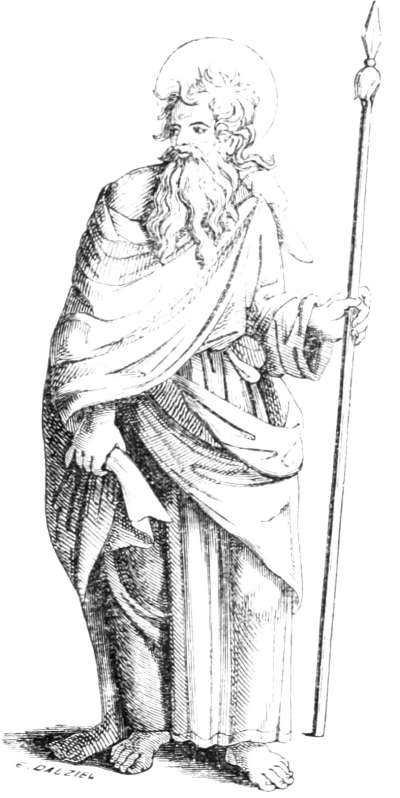
83 St. Matthias (Raphael)
There is a figure of this apostle by Cosimo Roselli, holding a sword by the point: what might be the intention of that capricious painter it is now impossible to guess.[231] Separate pictures of St. Matthias are very rare, and he is seldom included in sets of the apostles.
Judas Iscariot.
Ital. Giuda Scariota. Fr. Judas Iscariote.
The very name of Judas Iscariot has become a by-word; his person and character an eternal type of impiety, treachery, and ingratitude. We shudder at the associations called up by his memory; his crime, without a name, so distances all possible human turpitude, that he cannot even be held forth as a terror to evil doers; we set him aside as one cut off; we never think of him but in reference to the sole and unequalled crime recorded of him. Not so our ancestors; one should have lived in the middle ages, to conceive the profound, the ever-present, horror with which Judas Iscariot was then regarded. The devil himself did not inspire the same passionate hatred and indignation. Being the devil, what could he be but devilish? His wickedness was according to his infernal nature: but the crime of Judas remains the perpetual shame and reproach of our humanity. The devil betrayed mankind, but Judas betrayed his God.
The Gospels are silent as to the life of Judas before he became an apostle, but our progenitors of the middle ages, who could not conceive it possible that any being, however perverse, would rush at once into such an abyss of guilt, have filled up the omissions of Scripture after their own fancy. They picture Judas as a wretch foredoomed from the beginning of the world, and prepared by a long course of vice and crime for that crowning guilt which filled the measure full. According to this legend, he was of the tribe of Reuben. Before his mother brought him forth, she dreamed that the son who lay in her womb would be accursed, that he would murder his father, commit incest with his mother, and sell his God. Terrified at her dream, she took counsel with her husband, and they agreed to avert the threatened calamity by exposing the child. As in the story of Œdipus, from which, indeed, this strange wild legend seems partly borrowed, the means taken to avert the threatened curse caused its fulfilment. Judas, at his birth, is enclosed in a chest, and flung into the sea; the sea casts him up, and, being found on the shore, he is fostered by a certain king and queen as their own son; they have, however, another son, whom Judas, malignant from his birth, beats and oppresses, and at length kills in a quarrel over a game at chess. He then flies to Judea, where he enters the service of Pontius Pilate as page. In due time he commits the other monstrous crimes to which he was predestined; and when he learns from his mother the secret of his birth, he is filled with a sudden contrition and terror; he hears of the prophet who has power on earth to forgive sins; and seeking out Christ throws himself at his feet. Our Saviour, not deceived, but seeing in him the destined betrayer, and that all things may be accomplished, accepts him as his apostle: he becomes the seneschal or steward of Christ, bears the purse, and provides for the common wants. In this position, avarice, the only vice to which he was not yet addicted, takes possession of his soul, and makes the corruption complete. Through avarice, he grudges every penny given to the poor, and when Mary Magdalene anoints the feet of our Lord he is full of wrath at what he considers the waste of the precious perfume: ‘Why was not this ointment sold for three hundred pence, and given to the poor? This he said, not that he cared for the poor, but because he was a thief.’ Through avarice, he yields to the bribe offered by the Jews. Then follow the scenes of the betrayal of Christ, and the late repentance and terrible suicide of the traitor, as recorded in Scripture. But in the old Mystery of the ‘Passion of Christ’ the repentance and fate of Judas are very dramatically worked out, and with all possible circumstances of horror. When he beholds the mild Saviour before the judgment-seat of Herod, he repents: Remorse, who figures as a real personage, seizes on the fated wretch, and torments him till in his agony he invokes Despair. Despair appears, almost in the guise of the ‘accursed wight’ in Spenser, and, with like arguments, urges him to make away with his life:—
And brings unto him swords, rope, poison, fire, And all that might him to perdition draw, And bids him choose what death he would desire.
Or in the more homely language of the old French mystery,—
Il faut que tu passes le pas! Voici dagues et coutelas, Forcettes, poinçons, allumettes,— Avise, choisis les plus belles, Et celles de meilleure forge, Pour te couper à coup la gorge; Ou si tu aimes mieux te pendre, Voici lacs et cordes à vendre.
The offer here of the bodkins and the allumettes reminds us of the speech of Falconbridge:—
If thou would’st drown thyself, Put but a little water in a spoon, And it shall be as all the ocean, Enough to stifle such a villain up.
Judas chooses the rope, and hangs himself forthwith; ‘and falling headlong, he burst asunder in the midst, and all his bowels gushed out:’ which account is explained by an early tradition, that being found and cut down, his body was thrown over the parapet of the Temple into the ravine below, and, in the fall, was riven and dashed to pieces.
There required but one more touch of horror to complete the picture; and this is furnished by a sonnet of Giani, which I remember to have read in my youth. When Judas falls from the fatal tree, his evil genius seizes the broken rope, and drags him down to the seething abyss below: at his approach, hell sends forth a shout of rejoicing; Lucifer smooths his brow, corrugated with fire and pain, and rises from his burning throne to welcome a greater sinner than himself:—
Poi fra le braccia incatenò quel tristo, E colla bocca sfavillante e nera Gli rese il bacio ch’ avea dato a Christo!
The retribution imaged in the last two lines borders, I am afraid, on a concetto; but it makes one shiver, notwithstanding.
Separate representations of the figure or of the life of Judas Iscariot are not, of course, to be looked for; they would have been regarded as profane, as ominous,—worse than the evil-eye. In those Scripture scenes in which he finds a place, it was the aim of the early artists to give him a countenance as hateful, as expressive of treachery, meanness, malignity, as their skill could compass,—the Italians having depended more on expression, the German and Spanish painters on form. We have a conviction, that if the man had really worn such a look, such features, he would have been cast out from the company of the apostles; the legend already referred to says expressly that Judas was of a comely appearance, and was recommended to the service of Pontius Pilate by his beauty of person; but the painters, speaking to the people in the language of form, were right to admit of no equivocation. The same feeling which induced them to concentrate on the image of the Demon all they could conceive of hideous and repulsive, made them picture the exterior of Judas as deformed and hateful as the soul within; and, by an exaggeration of the Jewish cast of features combined with red hair and beard, they flattered themselves that they had attained the desired object. But as if this were not enough, the ancient painters, particularly in the old illuminations, and in Byzantine Art, represent Judas as directly and literally possessed by the Devil: sometimes it is a little black demon seated on his shoulder, and whispering in his ear; sometimes entering his mouth: thus, in their simplicity, rendering the words of the Gospel, ‘Then entered Satan into Judas.’
The colour proper to the dress of Judas is a dirty dingy yellow; and in Spain this colour is so intimately associated with the image of the arch-traitor, as to be held in universal dislike: both in Spain and in Italy, malefactors and galley-slaves are clothed in yellow.[232] At Venice the Jews were obliged to wear yellow hats.
In some of the scriptural scenes in which Judas is mentioned or supposed to be present, it is worth while to remark whether the painter has passed him over as spoiling the harmony of the sacred composition by his intrusive ugliness and wickedness, or has rendered him conspicuous by a distinct and characteristic treatment. In a picture by Niccolò Frumenti[233] of the Magdalene at the feet of our Saviour, Judas stands in the foreground, looking on with a most diabolical expression of grudging malice mingled with scorn; he seems to grind his teeth as he says, ‘To what purpose is this waste?’ In Perugino’s beautiful picture of the washing the feet of the disciples,[234] Judas is at once distinguished, looking askance with a wicked sneer on his face, which is not otherwise ugly. In Raphael’s composition of the Magdalene anointing the feet of Christ, Judas leans across the table with an angry look of expostulation.
Those subjects in which Judas Iscariot appears as a principal personage follow here.
1. Angelico da Fiesole.[235] He is bribed by the Jews. The high-priest pays into the hand of Judas the thirty pieces of silver. They are standing before a doorway on some steps; Judas is seen in profile, and has the nimbus as one of the apostles: three persons are behind, one of whom expresses disapprobation and anxiety. In this subject, and in others wherein Judas is introduced, Angelico has not given him ugly and deformed features; but in the scowling eye and bent brow there is a vicious expression.
In Duccio’s series of the ‘Passion of our Saviour,’ in the Duomo at Siena, he has, in this and in other scenes, represented Judas with regular and not ugly features; but he has a villanous, and at the same time anxious, expression;—he has a bad conscience.
The scene between Judas and the high-priest is also given by Schalken as a candle-light effect, and in the genuine Dutch style.
2. ‘Judas betrays his Master with a kiss.’ This subject will be noticed at large in the Life of Christ. The early Italians, in giving this scene with much dramatic power, never forgot the scriptural dignity required; while the early Germans, in their endeavour to render Judas as odious in physiognomy as in heart, have, in this as in many other instances, rendered the awful and the pathetic merely grotesque. We must infer from Scripture, that Judas, with all his perversity, had a conscience: he would not else have hanged himself. In the physiognomy given to him by the old Germans, there is no trace of this; he is an ugly malignant brute, and nothing more.
3. Rembrandt. ‘Judas throws down the thirty pieces of silver in the Temple, and departs.’[236]
4. ‘The remorse of Judas.’ He is seated and in the act of putting the rope about his neck; beside him is seen the purse and the money, scattered about the ground. The design is by Bloemart, and, from the Latin inscription underneath, appears to be intended as a warning to all unrighteous dealers.
5. ‘Judas hanging on a tree’ is sometimes introduced into the background, in ancient pictures of the Deposition and the Entombment: there is one in the Frankfort Museum.
6. ‘Demons toss the soul of Judas from hand to hand in the manner of a ball:’ in an old French miniature.[237] This is sufficiently grotesque in representation; yet, in the idea, there is a restless, giddy horror which thrills us. At all events, it is better than placing Judas between the jaws of Satan with his legs in the air, as Dante has done, and as Orcagna in his Dantesque fresco has very literally rendered the description of the poet.[238]
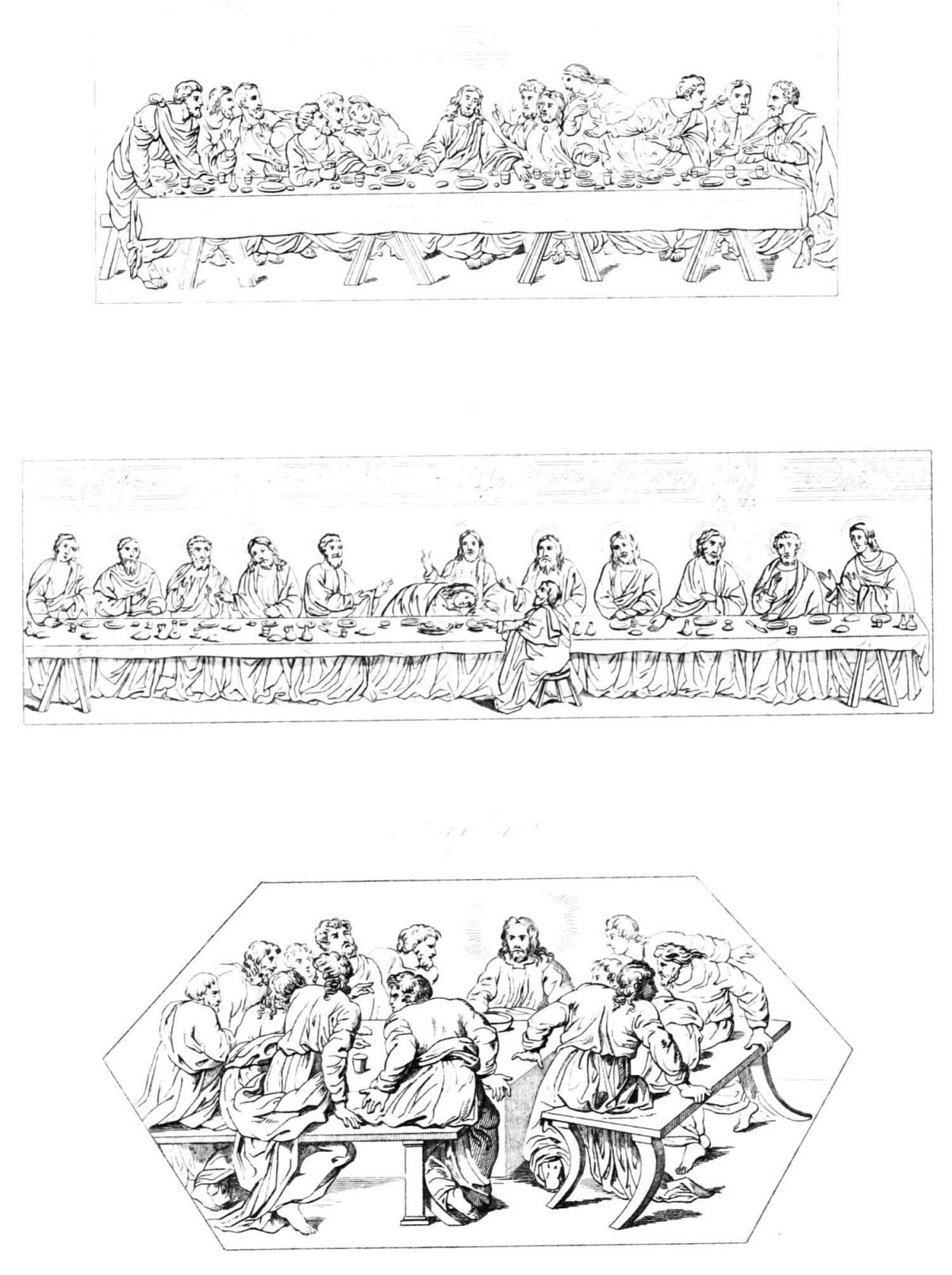
Lionardo da Vinci Giotto Raphael
The Last Supper.
Ital. Il Cenacolo. La Cena. Fr. La Cène. Ger. Das Abendmal Christi.
I have already mentioned the principal scenes in which the Twelve always appear together; there is, however, one event belonging properly to the life of Christ, so important in itself, presenting the Apostles under an aspect so peculiar, and throwing so much interest around them collectively and individually, that I must bring it under notice here.
Next to the Crucifixion, there is no subject taken from the history of our redemption so consecrated in Art as the Last Supper. The awful signification lent to it by Protestants as well as Catholics has given it a deep religious import, and caused its frequent representation in churches; it has been, more particularly, the appropriate decoration of the refectories of convents, hospitals, and other institutions having a sacred character. In our Protestant churches, it is generally the subject of the altar-piece, where we have one.
Besides being one of the most important and interesting, it is one of the most difficult among the sacred subjects treated in Art. While the fixed number of personages introduced, the divine and paramount dignity of One among them, the well-known character of all, have limited the invention of the artist, they have tasked to the utmost his power of expression. The occasion, that of a repast eaten by twelve persons, is, under its material aspect, so commonplace, and, taken in the spiritual sense, so awful, that to elevate himself to the height of his theme, while keeping the ideal conscientiously bounded within its frame of circumstance, demanded in the artist aspirations of the grandest order, tempered by the utmost sobriety of reflection; and the deepest insight into the springs of character, combined with the most perfect knowledge of the indications of character as manifested through form. On the other hand, if it has been difficult to succeed, it has been equally difficult to fail signally and completely; because the spectator is not here, as in the crucifixion, in danger of being perpetually shocked by the intrusion of anomalous incidents, and is always ready to supply the dignity and meaning of a scene so familiar in itself out of his own mind and heart. It has followed, that mediocrity has been more prevalent and more endurable in this than in any other of the more serious subjects of Art. But where excellence has been in some few instances attained, it has been attained in such a supreme degree, that these examples have become a perpetual source of contemplation and of emulation, and rank among the most renowned productions of human genius.
But, before I come to consider these analytically, it is necessary to premise one or two observations, which will assist us to discrimination in the general treatment.
Pictures and works of art, which represent the Last Supper of our Lord, admit of the same classification which I have adhered to generally throughout this work. Those which represent it as a religious mystery must be considered as devotional; those which represent it merely as a scene in the passion of our Saviour are historical. In the first, we have the spiritual origin of the Eucharist; in the second, the highly dramatic detection of Judas. It is evident that the predominating motif in each must be widely different. In paintings which are intended for the altar, or for the chapels of the Holy Sacrament, we have the first, the mystical version;—it is the distribution of the spiritual food. In the second form, as the Last Supper eaten by Christ with his disciples, as leading the mind to an humble and grateful sense of his sacrifice, as repressing all sinful indulgence in food, it has been the subject chosen to decorate the refectory or common dining-room of convents.
It is curious that on the Christian sarcophagi the Last Supper does not occur. There is, in the Vatican, a rude painting taken from the catacombs representing twelve persons in a semicircle, with something like plates and dishes before them. I could not determine whether this was our Saviour and his apostles, or merely one of those feasts or suppers instituted by the early Christians called Agapæ or love-feasts; but I should think the latter.
On the Dalmatica (deacon’s robe) preserved in the sacristy of the Vatican, there is, if the date be exact (A.D. 795), the most ancient representation I have seen of the institution of the Sacrament. The embroidery, which is wonderfully beautiful, is a copy from Byzantine Art. On one side, our Saviour stands by a table or altar, and presents the cup to his apostles, one of whom approaches in a reverential attitude, and with his hands folded in his robe; on the other side, Christ presents the wafer or host: so that we have the two separate moments in separate groups.
There exists in the Duomo of Lodi the most ancient sculptural example of this subject I have met with; it is a bas-relief of the twelfth century, dated 1163, and fixed in the wall to the left of the entrance. Christ and the apostles are in a straight row, all very much alike; six of the apostles lay their hands on their breast,—‘Lord, is it I?’ and Christ presents the sop to Judas, who sits in front, and is as ugly as possible.
Although all the Byzantine pictures of the twelfth and thirteenth centuries which have come under my notice represent Christ breaking the bread or holding the cup, that is, the institution of the Sacrament, the Greek formula published by Didron distinguishes between this scene and that of the repast in which Judas is denounced as a traitor. The earliest representation to which I can refer in Western Art, as taking the historical form, is the Cenacolo of Giotto, the oldest and the most important that has been preserved to us; it was painted by him in the refectory of the convent of Santa Croce at Florence. This refectory, when I visited it in 1847, was a carpet manufactory, and it was difficult to get a good view of the fresco by reason of the intervention of the carpet-looms. It has been often restored, and is now in a bad state; still, enough remains to understand the original intention of the artist, and that arrangement which has since been the groundwork of similar compositions.
A long table extends across the picture from side to side: in the middle, and fronting the spectator, sits the Redeemer; to the right, St. John, his head reclining on the lap of Christ; next to him, Peter; after Peter, St. James Major; thus placing together the three favourite disciples. Next to St. James, St. Matthew, St. Bartholomew, and a young beardless apostle, probably St. Philip.
On the left hand of our Saviour is St. Andrew; and next to him, St. James Minor (the two St. Jameses bearing the traditional resemblance to Christ); then St. Simon and St. Jude; and lastly, a young apostle, probably St. Thomas. (The reader will have the goodness to recollect that I give this explanation of the names and position of the eleven apostles as my own, and with due deference to the opinion of those who on a further study of the fresco may differ from me.) Opposite to the Saviour, and on the near side of the table, sits Judas, apart from the rest, and in the act of dipping his hand into the dish. It is evident that the moment chosen by the artist is, ‘He that dippeth with me in the dish, the same shall betray me.’
Although the excuse may be found in the literal adoption of the words of the Gospel,[239] it appears to me a fault to make St. John leaning, as one half asleep, on the lap of our Saviour, after such words have been uttered as must have roused, or at least ought to have roused, the young and beloved apostle from his supine attitude; therefore, we may suppose that Christ is about to speak the words, but has not yet spoken them. The position of Judas is caused by the necessity of placing him sufficiently near to Christ to dip his hand in the same dish; while to have placed him on the same side of the table, so as to give him the precedence over the more favoured disciples, would have appeared to the early artists nothing less than profane. Giotto has paid great attention to the heads, which are individually characterised, but there is little dramatic expression; the attention is not yet directed to Judas, who is seen in profile, looking up, not ugly in feature, but with a mean vicious countenance, and bent shoulders.
The arrangement of the table and figures, so peculiarly fitted for a refectory, has been generally adopted since the time of Giotto in pictures painted for this especial purpose. The subject is placed on the upper wall of the chamber; the table extending from side to side: the tables of the monks are placed, as in the dining-rooms of our colleges, length-ways; thus all can behold the divine assembly, and Christ appears to preside over and sanctify the meal.
In another Cenacolo by Giotto,[240] which forms one of the scenes in the history of Christ, he has given us a totally different version of the subject; and, not being intended for a refectory, but as an action or event, it is more dramatic. It is evident that our Saviour has just uttered the words, ‘He that dippeth with me in the dish, the same shall betray me.’ Judas, who has mean, ugly, irregular features, looks up alarmed, and seems in the act of rising to escape. One apostle (Philip, I think) points at him, and the attention of all is more or less directed to him. This would be a fault if the subject were intended for a refectory, or to represent the celebration of the Eucharist. But here, where the subject is historical, it is a propriety.
The composition of Duccio of Siena, in the Duomo at Siena, must have been nearly contemporary with, if it did not precede, those of Giotto (A.D. 1308); it is quite different, quite original in motif and arrangement. Seven apostles sit on the same side with Christ, and five opposite to him, turning their backs on the spectator; the faces are seen in profile. The attitude of St. John, leaning against our Saviour with downcast eyes, is much more graceful than in the composition of Giotto. St. Peter is on the right of Christ; next to him St. James Minor: two young apostles sit at the extreme ends of the table, whom I suppose to be St. Philip and St. Thomas: the other apostles I am unable to discriminate, with the exception of Judas, who, with regular features, has a characteristic scowl on his brow. Christ holds out a piece of bread in his hand: two of the apostles likewise hold bread, and two others hold a cup; the rest look attentive or pensive, but the general character of the heads is deficient in elevation. The moment chosen may be the distribution of the bread and wine; but, to me, it rather expresses the commencement of the meal, and our Saviour’s address: ‘With desire have I desired to eat this passover with you before I suffer’ (Luke xxii. 15). The next compartment of the same series, which represents the apostles seated in a group before Christ, and listening with upturned faces and the most profound attention to his last words, has much more of character, solemnity, and beauty, than the Last Supper. Judas is here omitted; ‘for he, having received the sop, went immediately out.’