Part 1 — The Four Evangelists.
Reading edition

The Four Evangelists.
‘Matthew wrote for the Hebrews; Mark, for the Italians; Luke, for the Greeks; for ALL, the great herald John.’—Gregory Nazianzen.
Since on the Four Evangelists, as the witnesses and interpreters of a revealed religion, the whole Christian Church may be said to rest as upon four majestic pillars, we cannot be surprised that representations of them should abound, and that their effigies should have been introduced into Christian places of worship, from very early times. Generally, we find them represented together, grouped, or in a series; sometimes in their collective character, as the Four Witnesses; sometimes in their individual character, each as an inspired teacher, or beneficent patron. As no authentic resemblances of these sacred personages have ever been known or even supposed to exist, such representations have always been either symbolical or ideal. In the symbol, the aim was to embody, under some emblematical image, the spiritual mission; in the ideal portrait, the artist, left to his own conception, borrowed from Scripture some leading trait (when Scripture afforded any authority for such), and adding, with what success his skill could attain, all that his imagination could conceive, as expressive of dignity and persuasive eloquence—the look ‘commercing with the skies,’ the commanding form, the reverend face, the ample draperies—he put the book or the pen into his hand, and thus the writer and the teacher of the truth was placed before us.
The earliest type under which the Four Evangelists are figured is an emblem of the simplest kind: four scrolls placed in the four angles of a Greek cross, or four books (the Gospels), represented allegorically those who wrote or promulgated them. The second type chosen was more poetical—the four rivers which had their source in Paradise: representations of this kind, in which the Saviour, figured as a lamb holding the cross, or in his human form, with a lamb near him, stands on an eminence, from which gush four rivers or fountains, are to be met with in the catacombs, on ancient sarcophagi preserved among the Christian relics in the Vatican, and in several old churches constructed between the second and the fifth century.
At what period the four mysterious creatures in the vision of Ezekiel (ch. i. 5) were first adopted as significant symbols of the Four Evangelists, does not seem clear. The Jewish doctors interpreted them as figuring the four Archangels,—Michael, Raphael, Gabriel, Uriel; and afterwards applied them as emblems of the Four Great Prophets,—Isaiah, Jeremiah, Ezekiel, and Daniel. By the early Oriental Christians, who typified the whole of the Old Testament, the transfer of the emblem to the Four Evangelists seems obvious and easy; we find it alluded to as early as the second century. The four ‘Beasts’ of corresponding form in the Revelation (chap. iv. 7), which stood round the throne of the Lamb, were likewise thus interpreted; but it was not till the fifth century that we find these symbols assuming a visible form, and introduced into works of art. In the seventh century they had become almost universal, as distinctive attributes.
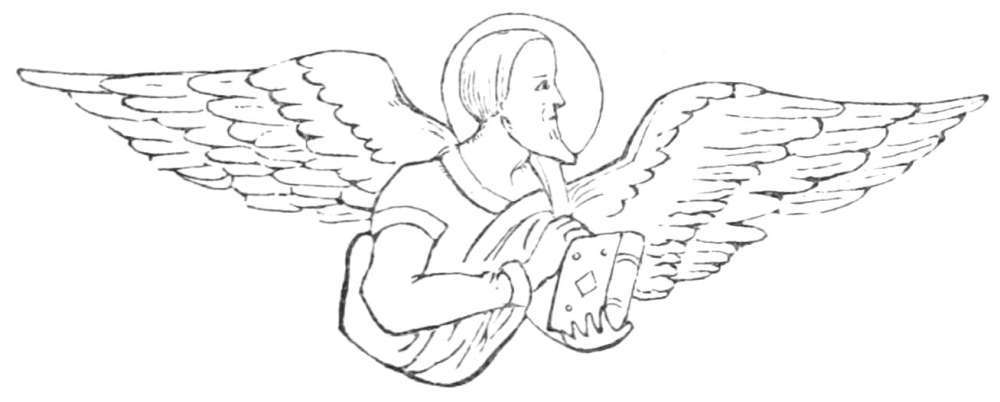
The general application of the Four Creatures to the Four Evangelists is of much earlier date than the separate and individual application of each symbol, which has varied at different times; that propounded by St. Jerome, in his commentary on Ezekiel, has since his time prevailed universally. Thus, then, 1. To St. Matthew was given the Cherub, or human semblance, because he begins his gospel with the human generation of Christ; or, according to others, because in his gospel the human nature of the Saviour is more insisted on than the divine. In the most ancient mosaics, the type is human, not angelic, for the head is that of a man with a beard. 2. St. Mark has the Lion, because he has set forth the royal dignity of Christ; or, according to others, because he begins with the mission of the Baptist—‘the voice of one crying in the wilderness’—which is figured by the lion: or, according to a third interpretation, the lion was allotted to St. Mark, because there was, in the middle ages, a popular belief that the young of the lion was born dead, and after three days was awakened to vitality by the breath of its sire; some authors, however, represent the lion as vivifying his young not by his breath, but by his roar. In either case the application is the same; the revival of the young lion was considered as symbolical of the resurrection, and Mark was commonly called the ‘Historian of the Resurrection.’ Another commentator observes that Mark begins his gospel with ‘roaring’—‘the voice of one crying in the wilderness;’ and ends it fearfully with a curse—‘He that believeth not shall be damned;’ and that, therefore, his appropriate attribute is the most terrible of beasts, the lion.[101] 3. Luke has the Ox, because he has dwelt on the priesthood of Christ, the ox being the emblem of sacrifice. 4. John has the Eagle, which is the symbol of the highest inspiration, because he soared upwards to the contemplation of the divine nature of the Saviour.
But the order in which, in theological Art, these symbols are placed, is not the same as the order of the Gospels according to the canon. Rupertus considers the Four Beasts as typical of the Incarnation, the Passion, the Resurrection, and the Ascension; an idea previously dwelt upon by Durandus, who adds, that the man and the lion are placed on the right, because the incarnation and the resurrection are the joy of the whole earth; whilst the ox is on the left, because Christ’s sacrifice was a trouble to the apostles; and the eagle is above the ox, as suggestive of our Lord’s upward flight into heaven: according to others, the proper order in the ascending scale is thus—at the lowest point on the left, the ox; to the right, the lion; above the ox, the eagle; and above all, the angel. So in Raphael’s Vision of Ezekiel, the angel gazes into the face of the Holy One, the others form his throne.
I have dwelt on these fanciful interpretations and disquisitions, because the symbols of the Evangelists meet us at every turn; in the mosaics of the old Italian churches, in the decorative sculpture of our old cathedrals, in the Gothic stained glass, in the ancient pictures and miniatures, on the carved and chased covers of old books; everywhere, in short, where enters the idea of their divine mission—and where is it not? The profound thought, as well as the vivid imagination, exercised in some of these early works of art, is beginning to be appreciated; and we should lose the half of what is poetical, and significant, and venerable in these apparently arbitrary and fanciful symbols, if we merely seized the general intention, and not the relative and appropriate meaning of each.
I will only add (for I have restricted myself to the consideration of the mysteries of faith only so far as they are carried into the forms of Art) that these symbols of the Four Evangelists were in their combination held to be symbolical of the Redeemer, in the fourfold character then universally assigned to him, as man, as king, as high-priest, and as God; according to this Latin verse:
Quatuor hæc Dominum signant animalia Christum: Est Homo nascendo, vitulusque sacer moriendo, Et Leo surgendo, cœlos aquilaque petendo; Nec minus hos scribas animalia et ipsa figurant.
This would again alter the received order of the symbols, and place the angelic or human semblance lower than the rest: but I have never seen them so placed, at least I can recollect no instance.
A Greek mosaic, existing in the Convent of Vatopedi, on Mount Athos, exhibits an attempt to reduce to form the wild and sublime imagery of the prophet Ezekiel: the Evangelists, or rather the Gospels, are represented as the tetramorph, or four-faced creature, with wings full of eyes, and borne on wheels of living flame (49).
The Tetramorph, i.e. the union of the four attributes of the Evangelists, in one figure, is in Greek Art always angelic or winged—a mysterious thing. The Tetramorph in Western Art has in some instances become monstrous, instead of mystic and poetical. In a miniature of the Hortus Deliciarum, we find the new Law, or Christianity, represented as a woman crowned and seated on an animal which, with the body of a horse, has the four heads of the mystic creatures; and of the four feet, one is human; one hoofed, for the ox; one clawed like an eagle’s; and one like a lion’s: underneath is inscribed Animal Ecclesiæ. In some other examples, the Church, or the new Law, is seated in a triumphal car drawn by the eagle, the lion, and the ox, while the angel holds the reins and drives as charioteer.
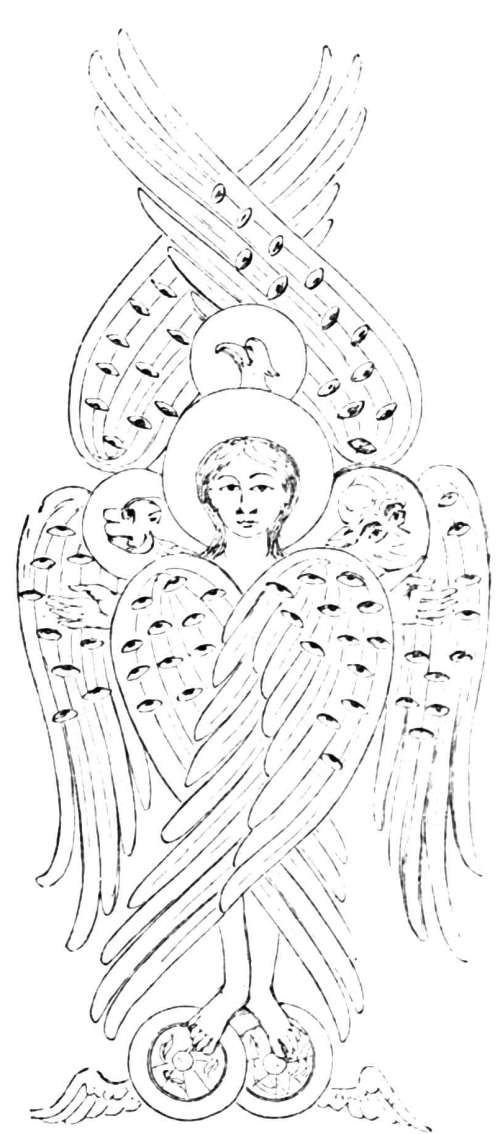
49 Tetramorph
The early images of the Evangelical symbol are uniformly represented with wings, for the same reason that wings were given to the angels,—they were angels, i.e. bringers of good tidings: for instance, in the earliest example to which I can refer, a rude fragment of a bas-relief in terracotta, found in the catacombs, which represents a lamb with a glory holding a cross; on the right, an angel in a sacerdotal garment (St. Matthew), on the left the winged ox (St. Luke), each holding a book.
In the most ancient Christian churches we find these symbols perpetually recurring, generally in or over the recess at the east end (the apsis, or tribune), where stands the altar. And as the image of Christ, as the Redeemer, either under the semblance of the lamb, or in his human likeness, as a grand, calm, solemn figure enthroned, and in the act of benediction, forms invariably the principal object; almost as invariably the Evangelists are either at the four corners, or ranged in a line above or below, or they are over the arch in front of the tribune. Sometimes they are the heads only of the mystic creatures, on an azure ground, studded with stars, floating as in a firmament, thus (50): or the half figure ends in a leafy scroll, like the genii in an arabesque, as thus (51): or the creature is given at full length and entire, with four wings, holding the book, and looking much like a figure in heraldry (52, 53).
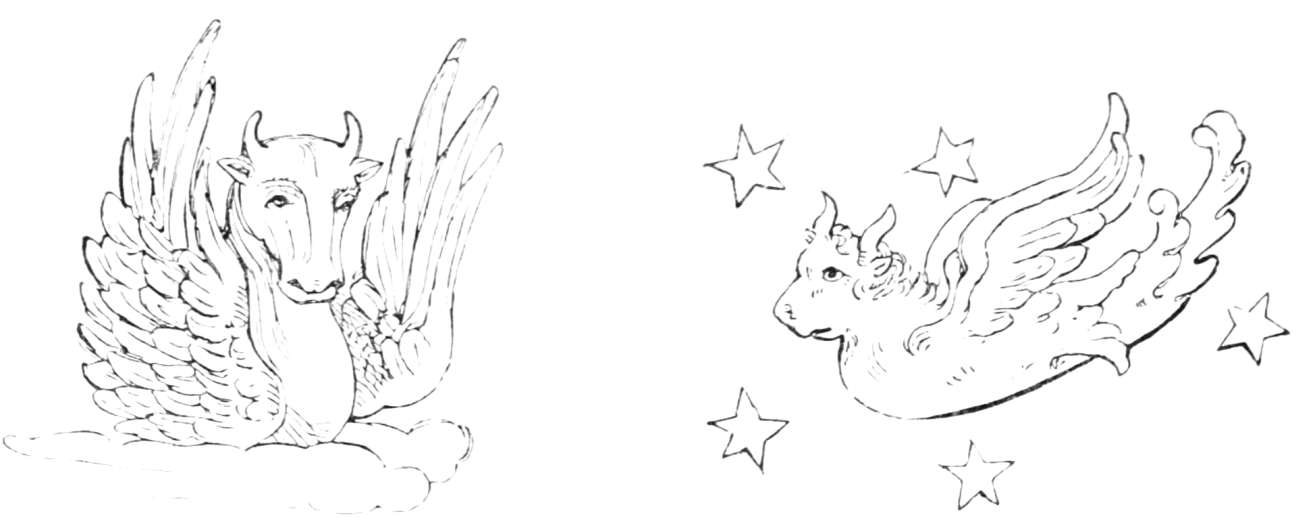
50 St. Luke (Mosaic, A.D. 750) [51] St. Luke (Mosaic, fifth century)
The next step was the combination of the emblem with the human form, i.e. the head of the lion, ox, or eagle, set upon the figure of a man. Here is a figure of St. John standing with the head of an eagle, holding the gospel (54). There is another rudely engraved in Münter’s work, with the eagle’s head, wings upon the shoulders, and a scroll. I remember another of St. John seated, writing, with the head and clawed feet of an eagle, and the body and hands of a man. Such figures as a series I have seen in ornaments, and frequently in illuminated MSS., but seldom in churches, and never of a large size. A very striking and comparatively modern example of this peculiar treatment occurs in a bas-relief on the door of the College of St. Stephen and St. Lawrence, at Castiglione, in which the Four Evangelists are represented as half-length human figures, amply draped and holding the gospels, each with the emblematic head and large outspread wings (55). The bronze bas-reliefs of the Evangelists on each side of the choir of St. Antonio, at Padua, are similar in form, and very fine, both in conception and workmanship.
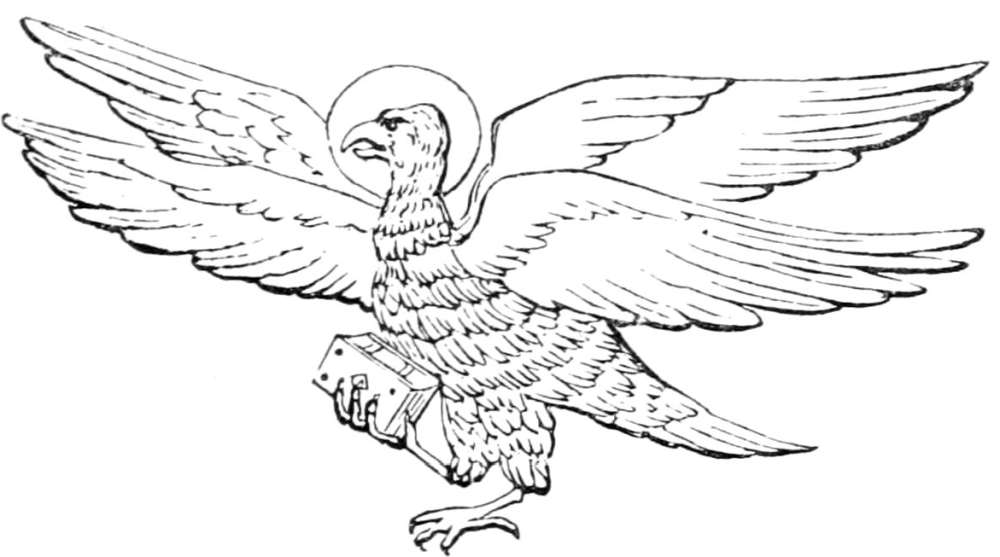
52 St. John (Mosaic, ekeventh century)
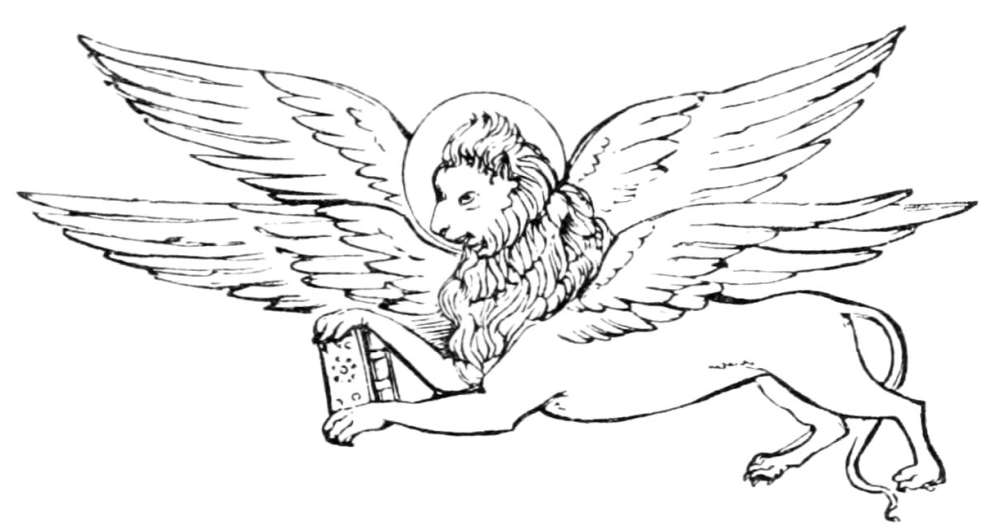
53 St. Mark (Mosiac)
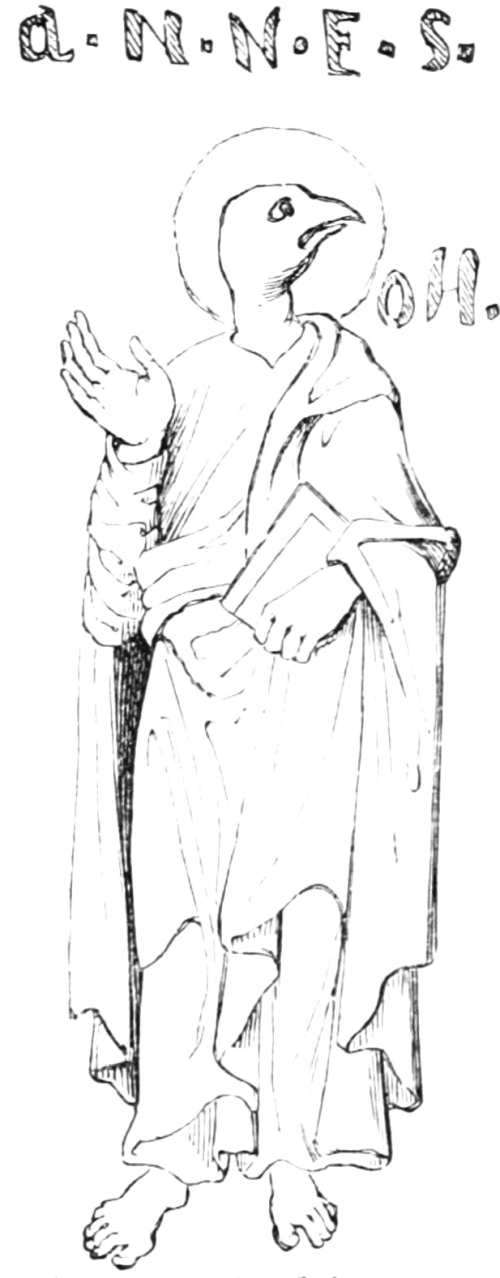
54 St. John
This series of full-length figures is from the first compartment of the Life of Christ by Angelico da Fiesole.[102] In the original the figures stand round a mystic circle, alternately with the prophets (56). We must remember, that however monstrous and grotesque such figures may appear to the eye, they are not more unnatural than the angelic representations with which we are so familiar that we see in them beauty only—not considering that men with the wings of birds are as merely emblematical and impossible as men with animal heads. It is interesting, and leads the mind to many speculations, to remark that the Babylonish captivity must have familiarised the Israelites with the combination of the human and animal attributes in the same figure. The gigantic bas-reliefs from Nineveh show us winged bulls with human heads, and the human form with the eagle’s head and wings. This figure, for example, (57) is not unlike some early figures of St. John, if we substitute the book and the pen for the basket and the pine-cone.
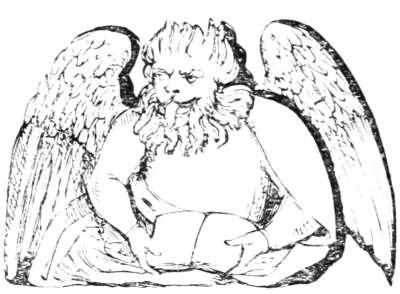
55 St. Mark
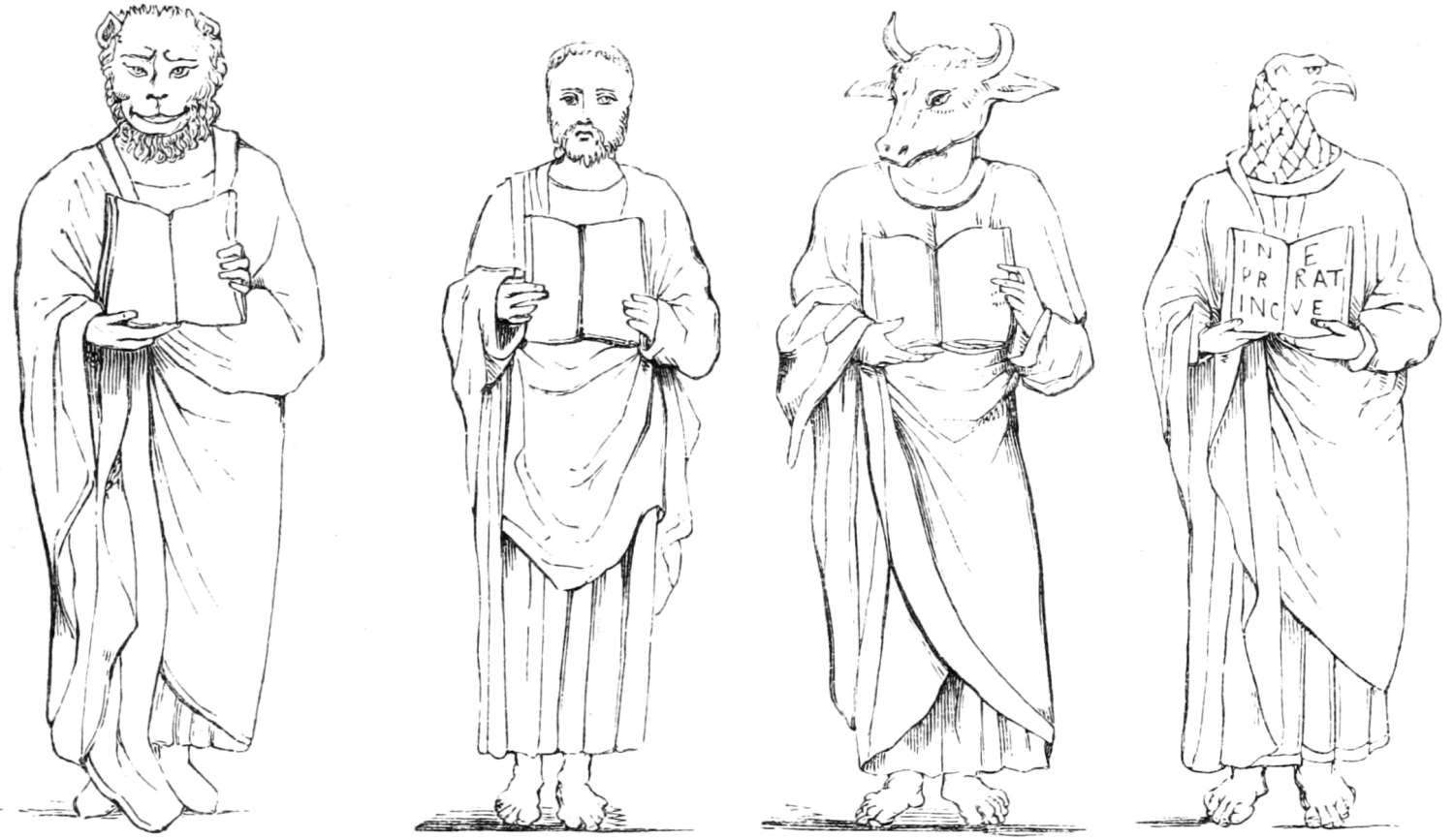
[56]
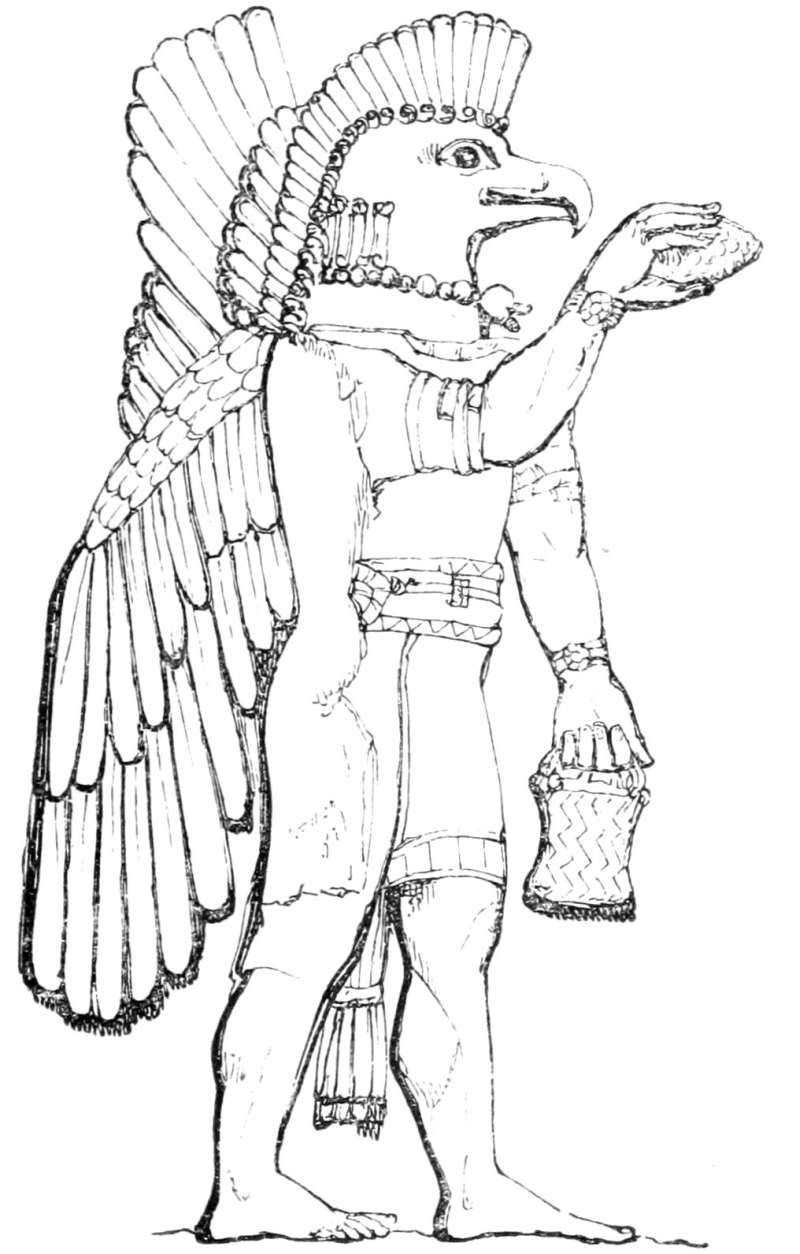
57 From Nineveh
In a few later examples the only symbolical attribute retained is a pair of wings. The next figure (58) is from a curious set of Evangelists, of a minute size, and exquisitely engraved by Hans Beham: they are habited in the old German fashion; each has his book, his emblem, and in addition the expressive wings.
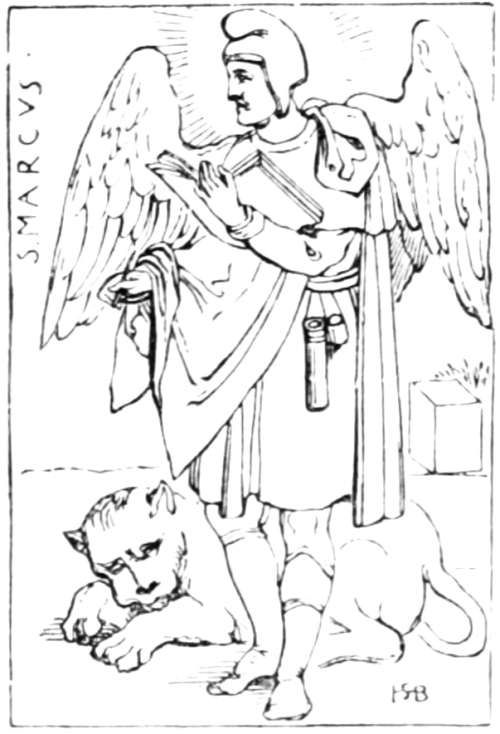
[58]
These animal symbols, whether alone or in combination with the human forms, were perfectly intelligible to the people, sanctified in their eyes by tradition, by custom, and by the most solemn associations. All direct imitation of nature was, by the best painters, carefully avoided. In this respect how fine is Raphael’s Vision of Ezekiel! how sublime and how true in feeling and conception! where the Messiah comes floating along, upborne by the Four Creatures—mysterious, spiritual, wonderful beings, animals in form, but in all else unearthly, and the winged ox not less divine than the winged angel![103] Whereas in the later times, when the artist piqued himself upon the imitation of nature, the mystic and venerable significance was wholly lost. As a striking instance of this mistaken style of treatment, we may turn to the famous group of the Four Evangelists by Rubens,[104] grand, colossal, standing or rather moving figures, each with his emblem, if emblems they can be called which are almost as full of reality as nature itself:—the ox so like life, we expect him to bellow at us; the magnificent lion flourishing his tail, and looking at St. Mark as if about to roar at him!—and herein lies the mistake of the great painter, that, for the religious and mysterious emblem, he has substituted the creatures themselves: this being one of the instances, not unfrequent in Art, in which the literal truth becomes a manifest falsehood.
In ecclesiastical decoration the Four Evangelists are sometimes grouped significantly with the Four Greater Prophets; thus representing the connexion between the new and the old Law. I met with a curious instance in the Cathedral of Chartres. The five great windows over the south door may be said to contain a succinct system of theology, according to the belief of the thirteenth century: here the Virgin, i.e. the Church or Religion, occupies the central window; on one side is Jeremiah, carrying on his shoulders St. Luke, and Isaiah carrying St. Matthew; on the other side, Ezekiel bears St. John, and Daniel St. Mark; thus representing the New Testament resting on the Old.
In ecclesiastical decoration, and particularly in the stained glass, they are often found in combination with the Four Doctors, the Evangelists being considered as witnesses, the Doctors as interpreters, of the truth: or as a series with the Four Greater Prophets, the Four Sibyls, and the Four Doctors of the Church, the Evangelists taking the third place.
If, as late as the sixteenth century, we find the Evangelists still expressed by the mystic emblems (as in the fine bronzes in the choir of Sant’ Antonio at Padua), as early as the sixth we have in the Greek MSS. and mosaics the Evangelists as venerable men, and promulgators of a revelation; as in San Vitale at Ravenna (A.D. 547): on each side of the choir, nearest the altar, we find the prophets Isaiah and Jeremiah; then follow the Evangelists, two on each side, all alike, all classically draped in white tunics, each holding an open book, on which is inscribed ‘Secundum Marcum,’ ‘Secundum Johannem,’ &c.; and above each the animal symbol or attribute, large, full length, and grandly designed. In modern ecclesiastical decoration, the usual and appropriate situation of the Four Evangelists is immediately under the dome, nearest to the Saviour after the angels, or after the prophets, where either are introduced. I will mention here a few examples celebrated in the history of Art; premising that among the works of Leonardo, of Michael Angelo, and Raphael, we find no representations of the Four Evangelists; which is singular, considering that such figures entered necessarily into every scheme of theological decorative art.
By Cimabue (A.D. 1270), larger than life, on the vault of the choir in San Francesco d’Assisi.
By Giotto (A.D. 1320), in the choir of Sant’ Apollinare, at Ravenna; seated, and each accompanied by one of the doctors of the Church.
By Angelico (A.D. 1390), round the dome of the chapel of San Niccolò, in the Vatican; all seated, each with his emblem.
By Masaccio (A.D. 1420), round the dome of the chapel of the Passion in San Clemente, at Rome; admirable for simple grandeur.
By Perugino (A.D. 1490), on the dome of the chapel del Cambio, at Perugia; the heads admirable.
By Correggio (A.D. 1520), immediately under the cupola of San Giovanni, in four lunettes, magnificent figures: and again in the Cathedral of Parma, each seated in glory, with one of the doctors of the Church.
By Domenichino, two sets (A.D. 1620). Those in the church of St. Andrea della Valle, at Rome, are considered his finest works, and celebrated in the history of Art: they are grand figures. The emblematical animals are here combined with the personages in a manner the most studied and picturesque; and the angels which sport around them, playing with the mane of St. Mark’s lion, or the pallet and pencils of St. Luke, are like beautiful ‘Amoretti,’—but we hardly think of angels. The series at Grotta-Ferrata is inferior.
The Four Evangelists by Valentin (A.D. 1632), in the Louvre, had once great celebrity, and have been often engraved; they appear to me signal examples of all that should be avoided in character and sentiment. St. Matthew, for example, is an old beggar; the model for the attendant angel is a little French gamin, ‘à qui Valentin a commandé de sortir un bras de la manche de sa chemise, que de l’autre main il soutient gauchement.’
Le Sueur (A.D. 1655) has represented the Four Evangelists seated at a table writing; the Holy Ghost descends upon them in the form of a dove.
Towards the end of the seventeenth century, we find sets of the Evangelists in which the emblems are altogether omitted, and the personages distinguished by their situation, or by their names inscribed under or over them: but we miss those antique scriptural attributes which placed them before us as beings foreshadowed in the prophecies uttered of old; they have become mere men.
This must suffice for the Evangelists considered as a series and in their collective character; but it will be interesting to pause for a moment, and take a rapid retrospective view of the progress, from first to last, in the expression of an idea through form.
First, we have the mere fact; the four scrolls, or the four books.
Next, the idea; the four rivers of salvation flowing from on high, to fertilise the whole earth.
Thirdly, the prophetic Symbol; the winged cherub of fourfold aspect.
Next, the Christian Symbol; the four ‘beasts’ in the Apocalypse, with or without the angel-wings.
Then the combination of the emblematical animal with the human form.
Then the human personages, each of venerable or inspired aspect, as becomes the teacher and witness; and each attended by the scriptural emblem—no longer an emblem, but an attribute—marking his individual vocation and character.
And, lastly, the emblem and attribute both discarded, we have the human being only, holding his gospel, i.e. his version of the doctrine of Christ.
St. Matthew.
Lat. S. Mattheus. Ital. San Matteo. Fr. Saint Matthieu. Ger. St. Matthäus. (Sept. 21.)
St. Matthew among the Apostles takes the seventh or eighth place, but as an Evangelist he always stands first, because his gospel was the earliest written. Very little is certainly known concerning him, his name occurring but once in his own gospel, and in the other gospels only incidentally with reference to two events.
He was a Hebrew by birth; by profession a publican, or tax-gatherer, in the service of the Romans—an office very lucrative, but particularly odious in the sight of his countrymen. His original name was Levi. It is recorded in few words, that as he sat at the receipt of custom by the lake of Gennesareth, Jesus in passing by saw him, and said unto him, ‘Follow me,’ and he left all and followed him; and farther, that he made a feast in his house, at which many publicans and sinners sat down with the Lord and his disciples, to the great astonishment and scandal of the Jews. So far the sacred record: the traditional and legendary history of St. Matthew is equally scanty. It is related in the Perfetto Legendario that after the dispersion of the apostles he travelled into Egypt and Ethiopia, preaching the Gospel; and having arrived in the capital of Ethiopia, he lodged in the house of the eunuch who had been baptized by Philip, and who entertained him with great honour. There were two terrible magicians at that time in Ethiopia, who by their diabolical spells and incantations kept all the people in subjection, afflicting them at the same time with strange and terrible diseases; but St. Matthew overcame them, and having baptized the people, they were delivered for ever from the malignant influence of these enchanters. And further, it is related that St. Matthew raised the son of the King of Egypt from the dead, and healed his daughter of the leprosy. The princess, whose name was Iphigenia, he placed at the head of a community of virgins dedicated to the service of God; and a certain wicked heathen king, having threatened to tear her from her asylum, was struck by leprosy, and his palace destroyed by fire. St. Matthew remained twenty-three years in Egypt and Ethiopia, and it is said that he perished in the ninetieth year of our era, under Domitian: but the manner of his death is uncertain; according to the Greek legend, he died in peace, but according to the tradition of the Western Church, he suffered martyrdom either by the sword or the spear.
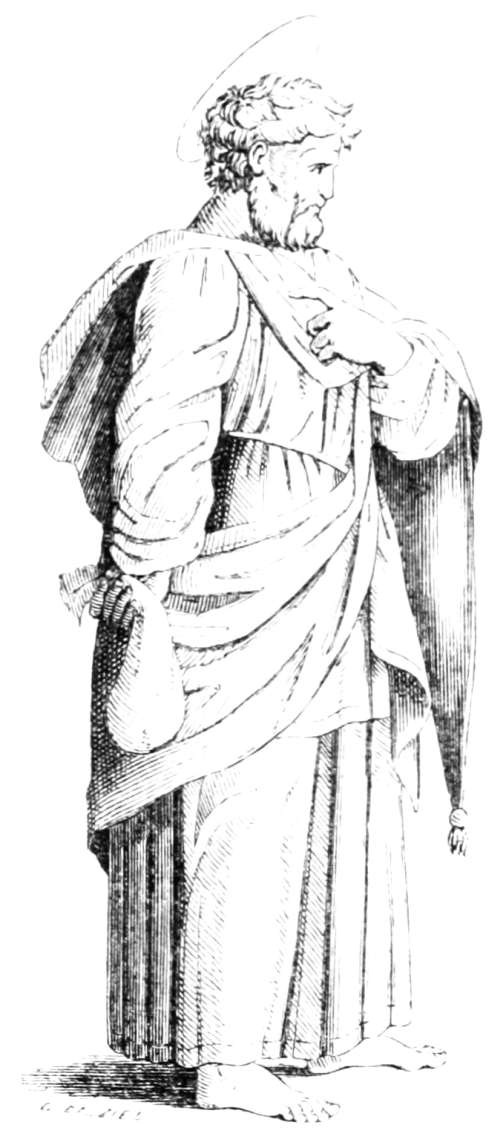
59 St. Matthew
Few churches are dedicated to St. Matthew. I am not aware that he is the patron saint of any country, trade, or profession, unless it be that of tax-gatherer or exciseman; and this is perhaps the reason that, except where he figures as one of the series of evangelists or apostles, he is so seldom represented alone, or in devotional pictures. In a large altar-piece, the ‘San Matteo’ of Annibal Caracci,[105] he is standing before the throne of the Madonna, as a pendant to John the Baptist, and gives his name to the picture: but such examples are uncommon. When he is portrayed as an evangelist, he holds a book or a pen; and the angel, his proper attribute and attendant, stands by, pointing up to heaven, or dictating; or he holds the inkhorn, or he supports the book. In his character of apostle, St. Matthew frequently holds a purse or money-bag, as significant of his former vocation (56).
Neither are pictures from his life of frequent occurrence. The principal incident, entitled the ‘Calling of Matthew,’ has been occasionally, but not often, treated in painting. The motif is simple and not easily mistaken. St. Matthew is seated at a kind of desk with money before him; various personages bring tribute; on one side is seen Christ, with one or two of his disciples, generally Peter and Andrew; St. Matthew is either looking towards him with an expression of awe-struck attention, or he is rising from his seat, as in the act to follow: the mere accessories and number of the personages vary with the period of the composition and the taste of the painter.
1. The earliest instance I can cite, probably the oldest which has come down to us, is in a Greek MS. of the ninth century.[106] St. Matthew sits with both hands on a heap of gold, lying on a table before him: he looks round at Christ, who is a little behind.
2. St. Matthew is about to rise to follow the Saviour; by Matte di Ser Cambio of Perugia, who has represented his patron saint in a small composition.[107]
3. In the Queen’s Gallery at Buckingham Palace, there is a very curious and interesting picture of this subject, by Mabuse, which once belonged to King Charles I., and is quaintly described in the old catalogue of his pictures ‘as a very old, defaced, curious altar-piece, upon a thick board, where Christ is calling St. Matthew out of the custom-house; which picture was got in Queen Elizabeth’s days, in the taking of Calus Malus (Cadiz), in Spain. Painted upon a board in a gilded arched frame, like an altar-piece; containing ten big figures, less than half so big as the life, and some twenty-two afar off less figures. Given to the King.’ In the foreground there is a rich architectural porch, from which St. Matthew is issuing in haste, leaving his money-bags behind; and in the background is seen the lake of Gennesareth and shipping. This picture was among the booty taken in Essex’s expedition against Cadiz in 1596, and probably stolen from some church.
4. In the Vienna Gallery I found three pictures of the same subject, all by Hemessen, very quaint and curious.
5. At Dresden the same subject in the Venetian style by Pordenone.
6. By Ludovico Caracci, a grand scenic picture, painted for the Mendicanti in Bologna.
7. In a chapel of the church of San Luigi de’ Francesi, at Rome, there are three pictures by Caravaggio from the life of St. Matthew. Over the altar is the saint writing his gospel; he looks up at the attendant angel, who is behind with outspread wings, and in the act of dictating. On the left is the calling of St. Matthew; the saint, who has been counting money, rises with one hand on his breast, and turns to follow the Saviour: an old man, with spectacles on his nose, examines with curiosity the personage whose summons has had such a miraculous effect: a boy is slyly appropriating the money which the apostle has thrown down. The third picture is the martyrdom of the saint, who, in the sacerdotal habit, lies extended on a block, while a half-naked executioner raises the sword, and several spectators shrink back with horror. There is nothing dignified or poetical in these representations; and though painted with all that power of effect which characterised Caravaggio, then at the height of his reputation, they have also his coarseness of feeling and execution: the priests were (not without reason) dissatisfied; and it required all the influence of his patron, Cardinal Giustiniani, to induce them to retain the pictures in the church where we now see them;—here we sympathise with the priests, rather than with the artist and his patron.
The Feast which St. Matthew made for our Saviour and his disciples is the subject of one of Paul Veronese’s gorgeous banquet scenes; that which he painted for the refectory of the Convent of St. John and St. Paul at Venice. It is now in the Academy, filling up the end wall of one of the great rooms from side to side, and seeming to let in light and air through the lofty marble porticoes, which give us such a magnificent idea of the splendour which surrounded Levi before he left all to follow Jesus.
In all the representations of the death of St. Matthew, except those of the Greek or Byzantine school, he dies by the sword. The Greek artists uniformly exhibit him as dying in peace, while an angel swings the censer beside his bed: as on the ancient doors of San Paolo at Rome.
Pictures from the legendary life of St. Matthew are very rare. The most remarkable are the frescoes in the chapel of San Matteo at Ravenna, attributed to Giotto. They are so much ruined, that, of the eight subjects represented, only three—his vocation, his preaching and healing the sick in Ethiopia, and the baptism of the king and queen—can be made out. In the Bedford missal at Paris I found a miniature, representing St. Matthew ‘healing the son and daughter of King Egyptus of the leprosy;’ but, as a subject of art, he is not popular.
St. Mark.
Lat. S. Marcus. Ital. San Marco Evangelista. Fr. St. Marc. Ger. Der Heilige Marcus. (April 25. A.D. 68.)
St. Mark the Evangelist was not one of the twelve Apostles: his conversion apparently took place after the ascension. He was the companion and assistant of Paul and Barnabas, with whom he preached the Gospel among the Gentiles. According to the traditions received in the Roman Church, he was converted by St. Peter, and became his favourite disciple; attended him first to Aquileia, where they converted and baptized the people on the shores of the Adriatic, and thence to Rome. While there he wrote his gospel for the use of the Roman converts,—some say from the dictation of the apostle. He afterwards, by command of St. Peter, went to preach the Gospel in Egypt; and after preaching in Lybia and Thebais for twelve years, he founded the church of Alexandria, subsequently one of the most celebrated of all the early Christian churches. The ire of the heathen being stirred up against him because of his miracles, they reviled him as a magician, and, during the feast of their god Serapis, seized him while in the act of worship, bound him, and dragged him along the streets and highways, and over stony and rocky places, till he perished miserably; at the same time a dreadful tempest of hail and lightning fell upon his murderers, by which they were dispersed and destroyed. The Christians of Alexandria buried his mangled remains, and his sepulchre was regarded with great reverence for several centuries. About 815 A.D., some Venetian merchants trading to Alexandria carried off the relics (literally stole them,—‘convey the wise it call!’), and they were deposited in the city of Venice, where the stately church of St. Mark was built over them. Since that time, St. Mark has been honoured as the patron saint of Venice, and his legendary history has supplied the Venetian painters with many beautiful and picturesque subjects.
When St. Mark is represented as one of the four Evangelists, either singly or grouped with the others, he is almost invariably accompanied by the lion, winged or unwinged, but generally winged,—which distinguishes him from St. Jerome, who is also accompanied by the lion, but unwinged, as we shall see hereafter.
In devotional representations, St. Mark often wears the habit of bishop, as first bishop of Alexandria. He is thus represented in the colossal mosaic over the principal door of St. Mark’s at Venice[108] in the pontificals of a Greek bishop, no mitre, short grey hair and beard; one hand raised in benediction, the other holding the gospel.
Of the innumerable pictures in which St. Mark figures as patron of Venice, I can afford to give a few examples only.
1. A. Busati. He is seated on a throne; an open book in one hand, bearing inscribed the Venetian motto (‘la Leggenda de’ Veneti‘) Pax tibi, Marce, Evangelista meus; the other hand blessing: behind him a fig-tree, with leaves and no fruit; probably in allusion to the text, ch. xi. 13, which is peculiar to St. Mark. On his right stands St. Andrew bearing a cross; on the left St. Bernardino of Siena; behind him the apple-tree which ‘brought death into the world and all our woe.’ This votive picture, from its mystical accessories and the introduction of St. Bernardino, was probably painted for the Franciscans (i Frari) of Venice: it is now in the Academy there.
2. St. Mark on a lofty throne holds his gospel in his hand; at his feet the four saints who are protectors against sickness and pestilence, St. Sebastian, St. Roch, St. Cosmo, and St. Damian: a splendid picture, in Titian’s early manner.[109] 3. St. Mark plants the standard of Venice, by Bonifazio. And 4. ‘San Marco che assista all’ coscrizione maritima;’ (i.e. the enlisting of the mariners for the service of the State) by G. del Moro, both curious instances of the manner in which the Venetians mixed up their patron saint with all their political and military transactions. 5. St. Mark presents the Doge Leonardo Dona to the Virgin; the most remarkable of a numerous class of votive pictures common in the Venetian school, in which St. Mark introduces either the Doge or some general or magnifico to the Virgin.[110]
Among the devotional pictures of St. Mark, one of the most famous is that of Fra Bartolomeo, in the Palazzo Pitti. He is represented as a man in the prime of life, with bushy hair and a short reddish beard, throned in a niche, and holding in one hand the gospel, in the other a pen; the lion is omitted. The Frate painted this picture for his own convent of San Marco at Florence. It is much lauded and celebrated, but the attitude appeared to me rather forced, and the features rather commonplace.
The legend which describes St. Mark as the disciple and amanuensis of St. Peter, has given occasion for those votive pictures in which they are represented together. 1. In the treasury of St. Mark’s is preserved a golden reliquary of a square form, containing, it is said, a fragment of the original gospel in the handwriting of St. Mark; the chased cover represents St. Peter on a throne, and before him kneels the evangelist, writing from his dictation.[111] 2. And again, in an ancient Greek Evangelarium, St. Mark is seated, writing; St. Peter stands before him with his hand raised as dictating. 3. In a beautiful picture by Angelico da Fiesole,[112] St. Peter is in a pulpit preaching to the Romans; and Mark, seated, is taking down his words in a book. 4. St. Peter and St. Mark standing together, the former holding a book, the latter a pen, with an inkhorn suspended from his girdle, by Bellini;[113] and, 5, a similar one by Bonvicino—very beautiful.[114] Such pictures are extremely interesting, showing the opinion generally entertained of the origin of St. Mark’s Gospel.
Historical pictures from the legendary life of St. Mark abound in the Venetian school, but are not often found out of Venice.
St. Mark preaching the Gospel at Alexandria, by Gentil Bellini,[115] a very large composition with numerous figures, is on many accounts extremely curious. The painter, who had been at Constantinople, transferred to Alexandria the Oriental scenery and costume with which he had become acquainted. The church of St. Euphemia at Alexandria, in the background, has the air of a Turkish mosque; a crowd of persons, men and women, in the costume of the Turks, surround the saint, who is standing on a kind of pedestal or platform, ascended by a flight of steps, from which he addresses his audience with great fervour. Gentil Bellini painted this picture for the Scuola di San Marco, at Venice.
It is related that one day St. Mark, in his progress through the city of Alexandria, saw a poor cobbler, who had wounded his hand severely with his awl, so as to be incapacitated from gaining his bread: St. Mark healed the wound; and the cobbler, whose name was Anianus, being converted and properly instructed, became a zealous Christian, and succeeded St. Mark as bishop of Alexandria. This miraculous cure of St. Anianus, and his subsequent baptism, are represented in two pictures by Mansueti.[116] In the Berlin Gallery is the cure of St. Anianus, by Cima da Conegliano; a large composition with many figures. The cure and baptism of St. Anianus, represented as a very aged man, form the subjects of two fine bas-reliefs on the façade of the School of St. Mark, by Tullio Lombardo, A.D. 1502.
In the Martyrdom of St. Mark, he is dragged through the streets by the enraged populace, who haul him along by a rope; a storm from above overwhelms the idolaters. The subject is thus represented by Angelico da Fiesole.[117]
A famous legend of St. Mark, which has been the subject of several pictures, can only be worthily given in the language of the old Venetian chronicle: there is something perfectly charming in the picturesque naïveté and matter-of-fact detail with which this wild and wonderful story is related; and if you, reader, have ever stood on the steps of the Piazzetta and looked over to San Giorgio, or San Niccolò, when the waves of the Lagune were foaming and driving up to your feet, and storm-clouds stooping and lowering seemed to touch the very domes and campanile around, then you will have the whole scene as a reality before you.
‘On the 25th of February, 1340, there fell out a wonderful thing in this land; for during three days the waters rose continually, and in the night there was fearful rain and tempest, such as had never been heard of. So great was the storm that the waters rose three cubits higher than had ever been known in Venice; and an old fisherman being in his little boat in the canal of St. Mark, reached with difficulty the Riva di San Marco, and there he fastened his boat, and waited the ceasing of the storm. And it is related that, at the time this storm was at the highest, there came an unknown man, and besought him that he would row him over to San Giorgio Maggiore, promising to pay him well; and the fisherman replied, “How is it possible to go to San Giorgio? we shall sink by the way!” But the man only besought him the more that he should set forth. So, seeing that it was the will of God, he arose and rowed over to San Giorgio Maggiore; and the man landed there, and desired the boatman to wait. In a short while he returned with a young man; and they said, “Now row towards San Niccolò di Lido.” And the fisherman said, “How can one possibly go so far with one oar?” And they said, “Row boldly, for it shall be possible to thee, and thou shalt be well paid.” And he went; and it appeared to him as if the waters were smooth. Being arrived at San Niccolò di Lido, the two men landed, and returned with a third, and, having entered into the boat, they commanded the fisherman that he should row beyond the two castles. And the tempest raged continually. Being come to the open sea, they beheld approaching, with such terrific speed that it appeared to fly over the waters, an enormous galley full of demons (as it is written in the Chronicles, and Marco Sabellino also makes mention of this miracle): the said bark approached the castles to overwhelm Venice, and to destroy it utterly; anon the sea, which had hitherto been tumultuous, became calm; and these three men, having made the sign of the cross, exorcised the demons, and commanded them to depart, and immediately the galley or the ship vanished. Then these three men commanded the fisherman to land them, the one at San Niccolò di Lido, the other at San Giorgio Maggiore, and the third at San Marco. And when he had landed the third, the fisherman, notwithstanding the miracle he had witnessed, desired that he would pay him; and he replied, “Thou art right; go now to the Doge, and to the Procuratore of St. Mark, and tell them what thou hast seen, for Venice would have been overwhelmed had it not been for us three. I am St. Mark the evangelist, the protector of this city; the other is the brave knight St. George; and he whom thou didst take up at the Lido is the holy bishop St. Nicholas. Say to the Doge and to the Procuratori[118] that they are to pay you; and tell them likewise that this tempest arose because of a certain schoolmaster dwelling at San Felice, who did sell his soul to the devil, and afterwards hanged himself.” And the fisherman replied, “If I should tell them this, they will not believe me.” Then St. Mark took off a ring which was on his finger, which ring was worth five ducats; and he said, “Show them this, and tell them when they look in the sanctuary they will not find it:” and thereupon he disappeared. The next morning, the said fisherman presented himself before the Doge and related all he had seen the night before, and showed him the ring for a sign. And the Procuratori having sent for the ring, and sought in the usual place, found it not; by reason of which miracle the fisherman was paid, and a solemn procession was ordained, giving thanks to God, and to the relics of the three holy saints, who rest in our land, and who delivered us from this great danger. The ring was given to Signor Marco Loredano and to Signor Andrea Dandolo the Procuratori, who placed it in the sanctuary; and, moreover, a perpetual provision was made for the aged fisherman above mentioned.’[119]
This legend is the subject of two celebrated pictures:—The first, attributed to Giorgione,[120] represents the storm. A ship, manned by demons, is seen towering over the waves: the demons appear to be seized with consternation; some fling themselves headlong over the side of their vessel, others are clinging to the rigging, others sit on the masts which flame with fire, and the glare is seen over the murky sky and sea. More in front are two barks, one rowed by four satyr-like demons, splendid figures admirably painted, literally glowing as if they were red-hot, and full of fierce animation. In the other bark are seen the three saints, St. Mark, St. Nicholas, and St. George, rowed by the fisherman; sea-monsters are sporting amid the waves, demons bestride them; the city of Venice is just visible in the far-off distance. The whole picture is full of vigour and poetic feeling; the fiery glow of colour and the romantic style of Giorgione suited the subject; and it has been admirably restored.
The second picture is by Paris Bordone,[121] and represents the fisherman presenting the miraculous ring of St. Mark to the Doge Gradenigo. It is like a grand piece of scenic decoration: we have before us a magnificent marble hall, with columns and buildings in perspective; to the right, on the summit of a flight of steps, sits the Doge in council; the poor fisherman, ascending the steps, holds forth the ring. The numerous figures, the vivid colour, the luxuriant architecture, remind us of Paul Veronese, with, however, more delicacy, both in colour and execution.
A Christian slave, in the service of a certain nobleman of Provence, disobeyed the commands of his lord, and persisted in paying his devotions at the shrine of St. Mark, which was at some distance. On his return home, he was condemned to the torture. As it was about to be inflicted, the saint himself descended from heaven to aid his votary; the instruments of torture were broken or blunted, the oppressor and his executioners confounded. This legend is the subject of a celebrated picture by Tintoretto,[122] of which Mr. Rogers had the original sketch. The slave lies on the ground amid a crowd of spectators, who look on, animated by all the various emotions of sympathy, rage, terror; a woman in front, with a child in her arms, has always been admired for the life-like vivacity of her attitude and expression. The executioner holds up the broken implements; St. Mark, with a headlong movement, seems to rush down from heaven in haste to save his worshipper; the dramatic grouping in this picture is wonderful; the colouring, in its gorgeous depth and harmony, is in Mr. Rogers’s sketch finer than in the picture.
In St. Mark’s, at Venice, we find the whole history of St. Mark on the vault of the Cappella Zen (opening from the Baptistery), in a series of very curious mosaics of the twelfth century. The translation of the body of St. Mark; the carrying off the relics from Alexandria; their arrival in Venice; the grand religious ceremonies which took place on their arrival; are also represented in the mosaics over the portico of St. Mark’s, executed chiefly between 1650 and 1680. We have the same legend in two compositions of Tintoretto:[123] in the first, the remains of St. Mark are taken forcibly from the tomb by the Venetian mariners; in the other, they are borne away to sea in a night-storm, while in the air is seen hovering a bright transparent form,—the soul of the saint flitting with his body to Venice.
St. Luke.
Lat. Sanctus Luca. Ital. San Luca. Fr. Saint Luc. (Oct. 18.)
Of the real history of St. Luke we know very little. He was not an apostle; and, like St. Mark, appears to have been converted after the ascension. He was a beloved disciple of St. Paul, whom he accompanied to Rome, and remained with his master and teacher till the last. It is related, that, after the martyrdom of St. Peter and St. Paul, he preached the Gospel in Greece and Egypt; but whether he died a natural death, or suffered martyrdom, does not seem clear. The Greek traditions represent him as dying in peace, and his death was thus figured on the ancient doors of San Paolo at Rome. Others affirm that he was crucified at Patras with St. Andrew.
There is some ground for the supposition that Luke was a physician. (Col. iv. 14.) But the pretty legend which makes him a painter, and represents him as painting the portrait of the Virgin Mary, is unsupported by any of the earlier traditions. It is of Greek origin, still universally received by the Greek Church, which considers painting a religious art, and numbers in its calendar of saints a long list of painters, as well as poets, musicians, and physicians. ‘Les Grecs,’ says Didron, ‘semblent avoir canonisé des chrétiens uniquement parce qu’ils s’occupaient de soulager le corps ou de charmer l’esprit.’ In the west of Europe, the legend which represents St. Luke as a painter can be traced no higher than the tenth century; the Greek painters introduced it; and a rude drawing of the Virgin discovered in the catacombs, with an inscription purporting that it was ‘one of seven painted by Luca,’ confirmed the popular belief that St. Luke the evangelist was meant. Thus originated the fame of innumerable Virgins of peculiar sanctity, all attributed to his hand, and regarded with extreme veneration. Such ancient pictures are generally of Greek workmanship, and of a black complexion.[124] In the legend of St. Luke we are assured that he carried with him everywhere two portraits, painted by himself; one of our Saviour, and one of the Virgin; and that by means of these he converted many of the heathen, for not only did they perform great miracles, but all who looked on these bright and benign faces, which bore a striking resemblance to each other, were moved to admiration and devotion. It is also said, that St. Luke painted many portraits of the Virgin, delighting himself by repeating this gracious image; and in the church of Santa Maria in Via Lata, at Rome, they still show a little chapel in which, ‘as it hath been handed down from the first ages, St. Luke the Evangelist wrote, and painted the effigy of the Virgin-Mother of God.’
On the strength of this tradition, St. Luke has been chosen as the patron saint of painters. Academies of art are placed under his particular protection; their chapels are dedicated to him, and over the altar we see him in his charming and pious avocation, that of painting portraits of the Blessed Virgin for the consolation of the faithful.
The devotional figures of St. Luke, in his character of evangelist, represent him in general with his gospel and his attendant ox, winged or unwinged, as already described; but in Greek Art, and in those schools of Art which have been particularly under the Byzantine influence (as the early Venetian), we see St. Luke as evangelist young and beardless, holding the portrait of the Virgin as his attribute in one hand, and his gospel in the other. A beautiful figure of St. Luke as evangelist and painter is in the famous ‘Heures d’Anne de Bretagne.’[125]
In an engraving by Lucas v. Leyden, executed as it should seem in honour of his patron saint, St. Luke is seated on the back of his ox, writing the gospel; he wears a hood like an old professor, rests his book against the horns of the animal, and his inkstand is suspended on the bough of a tree. But separate devotional figures of him as patron are as rare as those of St. Matthew.
St. Luke painting the Virgin has been a frequent and favourite subject. The most famous of all is a picture in the Academy of St. Luke, at Rome, ascribed to Raphael. Here St. Luke, kneeling on a footstool before an easel, is busied painting the Virgin with the Child in her arms, who appears to him out of heaven sustained by clouds: behind St. Luke stands Raphael himself, looking on. Another of the same subject, a very small and beautiful picture, also ascribed to Raphael, is in the Grosvenor Gallery. In neither of these pictures is the treatment quite worthy of that great painter, wanting his delicacy both of sentiment and execution. There is a most curious and quaint example in the Munich Gallery, attributed to Van Eyck: here the Virgin, seated under a rich Gothic canopy, holds on her lap the Infant Christ, in a most stiff attitude; St. Luke, kneeling on one knee, is taking her likeness. There is another, similar in style, by Aldegraef, in the Vienna Gallery. Carlo Maratti represents St. Luke as presenting to the Virgin the picture he has painted of her. St. Luke painting the Madonna and Child, while an angel is grinding his colours, I remember in the Aguado Gallery; a late Spanish picture.[126]
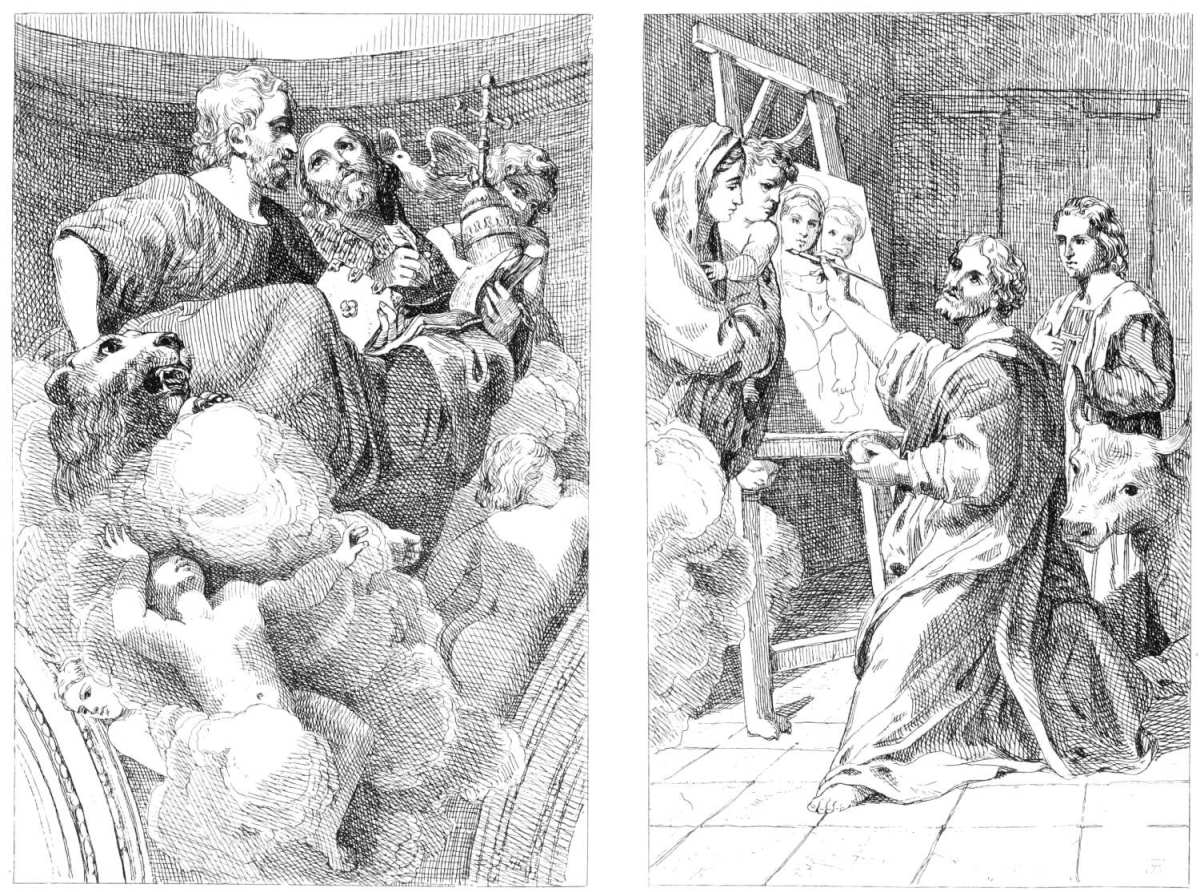
St. Mark attended by St. Gregory. St. Luke painting the Virgin.
St. John.
Lat. Sanctus Johannes. Gr. St. John Theologos, or the Divine. Ital. San Giovanni Evangelista. Fr. Saint Jean; Messire Saint Jehan. Ger. Der Heilige Johann. (Dec. 27, A.D. 99.)
Of St. Matthew, St. Mark, and St. Luke, so little is certainly known, that we have no data on which to found an individual portrait; therefore any representation of them as venerable and inspired teachers suffices to the fancy: but it is quite otherwise with St. John, the most distinguished of the evangelists, and the most beloved of the disciples of our Lord. Of him sufficient is known to convey a distinct impression of his personal character, and an idea of what his personal appearance may have been, supposing this outward semblance to have harmonised with the inward being.
He was the son of the fisherman Zebedee, and, with his brother James, among the first followers of the Saviour. He is emphatically called ‘the disciple whom Jesus loved;’ a preference which he merited, not only from the extreme purity of his life and character, but from his devoted and affectionate nature. He appears to have been at all times the constant companion of his divine Lord; and his life, while the Saviour was on earth, inseparable from His. In all the memorable circumstances recorded in the Gospel he was a party, or at least present. He witnessed the glory of the transfiguration; he leaned on the bosom of Jesus at the last supper; he stood by the cross in the hour of agony; he laid the body of his crucified Master in the sepulchre. After the death of the Virgin Mother, who had been confided to his care, he went about Judæa, preaching the Gospel with St. Peter. He then travelled into Asia Minor, where he founded the Seven Churches, and resided principally at Ephesus. During the persecution of the Christians under Domitian, St. John was sent in fetters to Rome; and, according to a tradition generally received in the Roman Church, he was cast into a cauldron of boiling oil, but was miraculously preserved, and ‘came out of it as out of a refreshing bath.’ He was then accused of magic, and exiled to the island of Patmos, in the Ægean Sea, where he is said to have written his Revelation. After the death of the Emperor Domitian he was released, and returned to his church at Ephesus; and for the use of the Christians there he is said to have written his gospel, at the age of ninety. A few years afterwards he died in that city, being nearly a century old. All the incidents here touched upon occur frequently as subjects of art, but most of them belong properly to the life of Christ.
The personal character of St. John, at once attractive and picturesque, has rendered him popular as a patron saint, and devotional pictures of him are far more numerous than of any of the other evangelists.
He is represented in one of his three characters: 1, as evangelist; 2, as apostle; 3, as prophet; or the three are combined in one figure.
1. Of the early eagle symbol, I have spoken at length.
In Greek Art, whether as apostle or evangelist, St. John is always an aged man with white hair, and a venerable beard descending to his breast; and by the earlier Latin painters, where he figures as evangelist only, not as apostle, this type has been adhered to; but the later painters set it aside, and St. John the Evangelist, nearly a century old, has all the attributes of the youthful apostle. He is beardless, with light curling hair, and eyes gazing upwards in a rapture of inspiration: he is sometimes seated with his pen and his book, sometimes standing; the attendant eagle always near him, and frequently holding the pen or inkhorn in his beak.
In some of the old prints and pictures, which represent St. John as writing the gospel, his eyes are turned on the Virgin with the Infant Christ in her arms, who appear as a vision in the skies above; underneath, or on his book, is inscribed,—‘The Word was made flesh,’ or some other text of the same import. The eagle at his side has sometimes the nimbus or a crown of stars,[127] and is then perhaps intended to figure the Holy Ghost.
I remember an instance in which the devil, intent on intercepting the message of reconcilement and ‘goodwill towards men,’ which was destined to destroy his empire on earth, appears behind St. John, and is oversetting the ink upon the pages; another, in which he is stealing away the inkhorn.
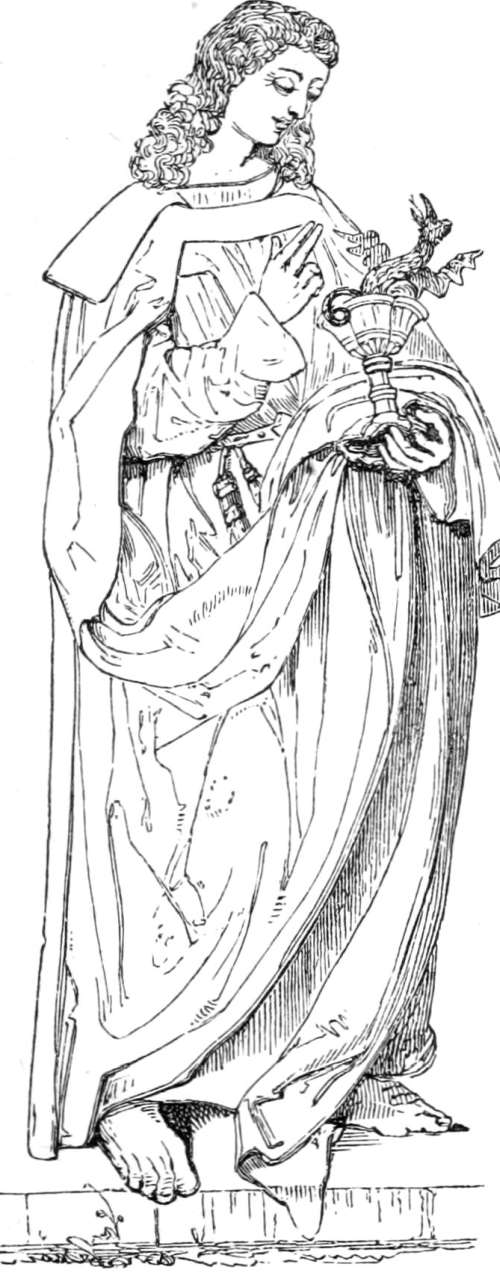
60 St. John (Hans Hemling)
2. As one of the series of apostles, St. John is always, in Western Art, young, or in the prime of life; with little or no beard; flowing or curling hair, generally of a pale brown or golden hue, to express the delicacy of his nature; and in his countenance an expression of benignity and candour. His drapery is, or ought to be, red, with a blue or green tunic. He bears in his hand the sacramental cup, from which a serpent is seen to issue. St. Isidore relates that, at Rome, an attempt was made to poison St. John in the cup of the sacrament: he drank of the same and administered it to the communicants without injury, the poison having by a miracle issued from the cup in the form of a serpent, while the hired assassin fell down dead at his feet. According to another version of this story, the poisoned cup was administered by order of the Emperor Domitian. According to a third version, Aristodemus, the high-priest of Diana, at Ephesus, defied him to drink of the poisoned chalice, as a test of the truth of his mission; St. John drank unharmed,—the priest fell dead. Others say, and this seems the more probable interpretation, that the cup in the hand of St. John alludes to the reply given by our Saviour, when the mother of James and John requested for her sons the place of honour in heaven,—‘Ye shall drink indeed of my cup.’ As in other instances, the legend was invented to explain the symbol. When the cup has the consecrated wafer instead of the serpent, it signifies the institution of the Eucharist.
Some of the old German representations of St. John are of singular beauty: for example, one by Hans Hemling, one by Isaac von Melem,[128] standing figures; simple, graceful, majestic; in the prime of youth, with a charming expression of devotion in the heads: both hold the sacramental cup with the serpent; no eagle; therefore St. John is here to be considered as the apostle only: when, with the cup, the eagle is placed by his side, he is represented in the double character of apostle and evangelist (61).
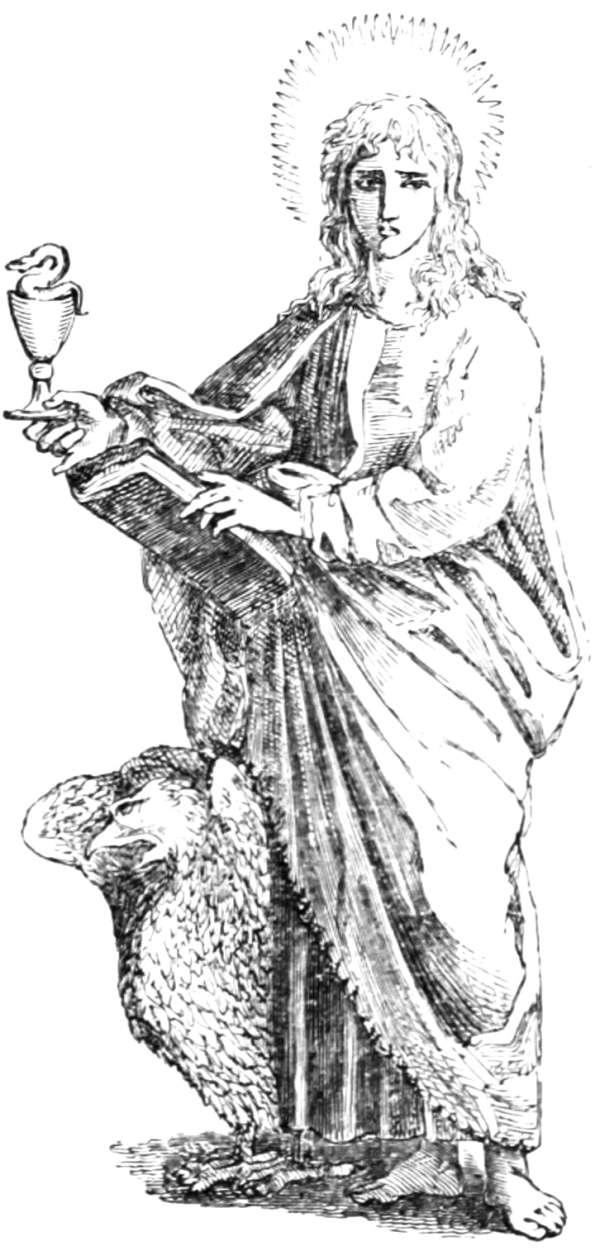
61 St. John (Raphael)
In the early Siena school, and in some old illuminations, I have seen St. John carrying in his hand a radiant circle, inscribed ‘In primo est verbum,’ and within the circle an eagle with outspread wings: but this is uncommon.
3. St. John as the prophet, the writer of the Revelation, is usually an aged man, with a white flowing beard, seated in a rocky desert; the sea in the distance, or flowing round him, to represent the island of Patmos; the eagle at his side. In the old frescoes, and the illuminated MSS. of the Apocalypse, this is the usual representation.
Some examples of the ideal and devotional figures of St. John, as evangelist and prophet, will give an idea of the variety of treatment in this favourite subject:—
1. Ancient Greek. St. John, with the head of an eagle and large wings, the figure fully draped, is soaring upwards. In such representations the inscription is usually ‘Quasi aquila ascendet et avolabit’ (‘Behold, he shall come up and fly as the eagle.’ Jer. xlix. 22).
2. Perugino. St. John as an aged man, with long grey beard and flowing hair, attended by a black eagle, looking up at the Madonna in glory.[129]
3. Raphael (?). St. John, young and beautiful, mounted on the back of an eagle, and soaring heavenwards: in one hand he holds a tablet, in the other a pen: sea and land below. This treatment, which recalls the antique Jupiter bestriding his eagle, appears to me at once too theatrical and too commonplace for Raphael.[130]
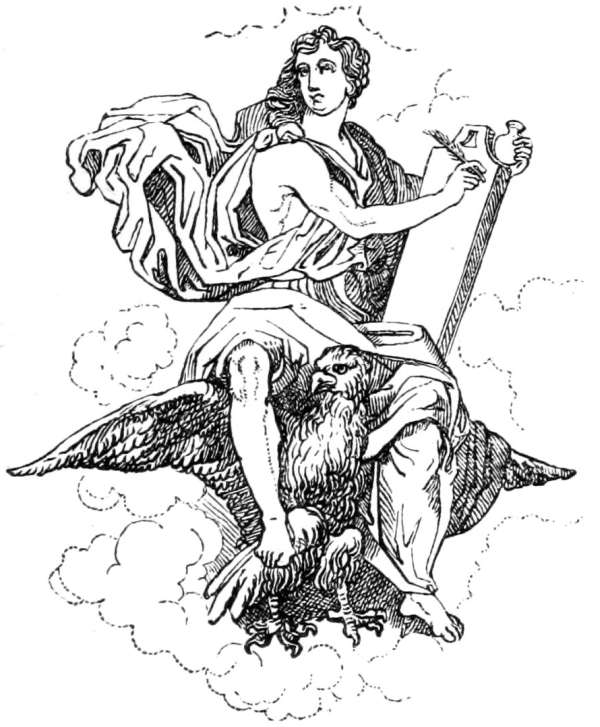
62 St. John
4. Correggio. St. John seated writing his gospel; the eagle at his feet is pluming his wing: inscribed ‘Altius cæteris Dei patefecit arcana.’ One of the series of Evangelists in the Duomo of Parma—wonderfully beautiful.
5. Domenichino. St. John, full length, life size; young and beautiful, in an ecstasy of inspiration, and sustained by two angels; the eagle at his feet: formerly in the Giustiniani Gallery;[131]—finer, I think, than the St. John in Sant’ Andrea. Another, half length, a scroll in his hand, looking upwards as one to whom the glory of the heavens had been opened;—you see it reflected in his eyes,—while love, wonder, devotion, beam from his beautiful face and parted lips: behind him hovers the attendant eagle, holding the pen in his beak; near him is the chalice, with the serpent; so that here he is in his double character of apostle and evangelist.[132] Domenichino excelled in St. Johns, as Guido in Magdalenes; perhaps the most beautiful of all is that in the Brera, at Milan, where St. John bends on one knee at the foot of the throne of the Madonna and Child, his pen in one hand, the other pressed to his bosom, and looking up to them with an air of ecstatic inspiration. Two little angels, or rather amoretti, are in attendance: one has his arms round the neck of the eagle, sporting with it; the other holds up the cup and the serpent. Every detail is composed and painted to admiration; but this is the artistic and picturesque, not the religious, version of the subject.
St. John is frequently represented with St. Peter, because, after the ascension, they taught and acted in concert. In such pictures, the contrast between the fiery resolve and sturdy, rugged grandeur which is given to St. Peter, and the refinement, mildness, and personal grace of St. John, produces a fine effect: as in Albert Dürer’s picture,[133] where John is holding open the Gospel, and Peter apparently reading it; two grand and simple figures, filling the mind as we gaze upon them. As this picture was painted after Albert Dürer became a Protestant, I have thought it possible that he might have had some particular meaning in thus making Peter study the Gospel of John. At all events, Albert Dürer was quite capable of such an intention; and, whether intended or not, the picture may be, and has been, thus interpreted. The prophets and the poets often say more than they intended, for their light was for others more than for themselves: so also the great painters—the Raphaels and Albert Dürers—prophets and poets in their way. When I have heard certain critics ridiculed because they found more in the productions of a Shakspeare or a Raphael than the poet or painter himself ever perceived or ‘intended,’ such ridicule has appeared to me in the highest degree presumptuous and absurd. The true artist ‘feels that he is greater than he knows.’ In giving form or utterance to the soul within him, does he account to himself for all the world of thoughts his work will excite in the minds of others? Is its significance to be circumscribed either by the intention and the knowledge of the poet, or the comprehension of the age in which he lived? That is the characteristic of the second-rate, self-conscious poets or painters, whom we read or study because they reflect to us a particular meaning—a particular period,—but not of the Homers and Shakspeares, the Raphaels and Albert Dürers; they speak to all times, to all men, with a suggestive significance, widening, deepening with every successive generation; and to measure their depth of meaning by their own intention, or by the comprehension of their own or any one generation, what is it but to measure the star of heaven by its apparent magnitude?—an inch rule will do that!
But to return from this digression. In devotional pictures we often see St. John the Evangelist and St. John the Baptist standing together; or on each side of Christ, or of the Madonna and Child. There is a peculiar propriety and significance in this companionship: both are, then, to be considered as prophets; they were, besides, kinsmen, and bore the same name; and St. John the Evangelist was the disciple of John the Baptist before he was called by Christ. Here, again, the contrast between the dark, emaciated, hairy prophet of the wilderness, and the graceful dignity of the youthful apostle, has a striking effect. An example at hand is the bronze bas-relief on the tomb of Henry VII.[134] Madonna pictures, in which the two St. Johns stand before her throne, occur frequently. I remember, also, a marble group of the Virgin and Child, in which the two St. Johns, as infants, are playing at her feet, one with his eagle, the other with his reed cross.[135]
As one who bore the most direct testimony to the Incarnation, St. John is often introduced into Madonna pictures, and pictures of the Nativity; but in the later schools only. In these instances he points significantly to the Child, and the sacramental cup and wafer is either in his hand or at his feet, or borne by an angel.
The historical and dramatic subjects in which St. John figures as a principal personage are very numerous. As the scriptural scenes belong properly to the life of Christ, I shall confine myself here to some observations on the manner in which St. John is introduced and treated in such pictures. In general he is to be distinguished from the other apostles by his youth and beauty, and flowing hair; and by being placed nearest to Christ as the most beloved of his disciples.
‘The mother of James and John imploring from our Saviour the highest place in heaven for her two sons.’ (Matt. xx. 21): a picture by Bonifazio, in the Borghese Gallery, beautiful both in sentiment and colour. There is another example by Paul Veronese; and another, by Tintoretto, was in the Coesvelt Gallery. I must observe that, except in Venetian pictures, I have not met with this incident as a separate subject.
In the last supper, Peter is generally on the right of Christ, and St. John on the left: he leans his head down on the bosom of Christ (this is always the attitude in the oldest pictures); or he leans towards Christ, who places his hand upon his shoulder, drawing him towards him with an expression of tenderness: this is the action in the fresco by Raphael lately discovered at Florence. But I must reserve the full consideration of this subject for another place.
Where, instead of the last supper, our Saviour is represented as administering the Eucharist, St. John is seen on his right hand, bearing the cup.
In the crucifixion, when treated as a religious rather than an historical subject, St. John stands on the left of the Cross, and the Virgin on the right; both in attitudes of the profoundest grief and adoration mingled. In general the motif of this sacred subject does not vary; but I remember examples, in which St. John is seen trampling a Jew under his feet; on the other side the Virgin tramples on a veiled woman, signifying the old law, the synagogue, as opposed to the Christian Church, of which the Virgin was the received symbol.
When the crucifixion is a scene or action, not a mystery, then St. John is beheld afar off, with the women who followed their divine Master to Calvary.
St. John and the Virgin Mary returning from the crucifixion: he appears to be sustaining her slow and fainting steps. I have only once met with this beautiful subject, in a picture by Zurbaran, in the Munich Gallery.
In the descent from the Cross, St. John is a chief actor; he generally sustains the head of the Saviour, and is distinguished by an expression of extreme sorrow and tenderness. In the entombment he is sometimes one of the bearers, sometimes he follows lamenting. In a print of the entombment after Andrea Mantegna, he is not only weeping and wringing his hands as usual, but absolutely crying aloud with the most exaggerated expression of anguish. In pictures of the descent of the Holy Ghost, St. John is usually a conspicuous figure, and in the foreground. In the assumption of the Virgin, he is also conspicuous, generally in front, as the pendant to St. Peter, and gazing upwards with ecstatic faith and devotion.
Of course there is great variety in these representations: the later painters thought less of individual character and significant propriety of arrangement than of artistic grouping; therefore the above remarks have reference to the early painters only.
In the scenes taken from the Acts, St. John is always in companionship with St. Peter, and becomes the secondary figure.
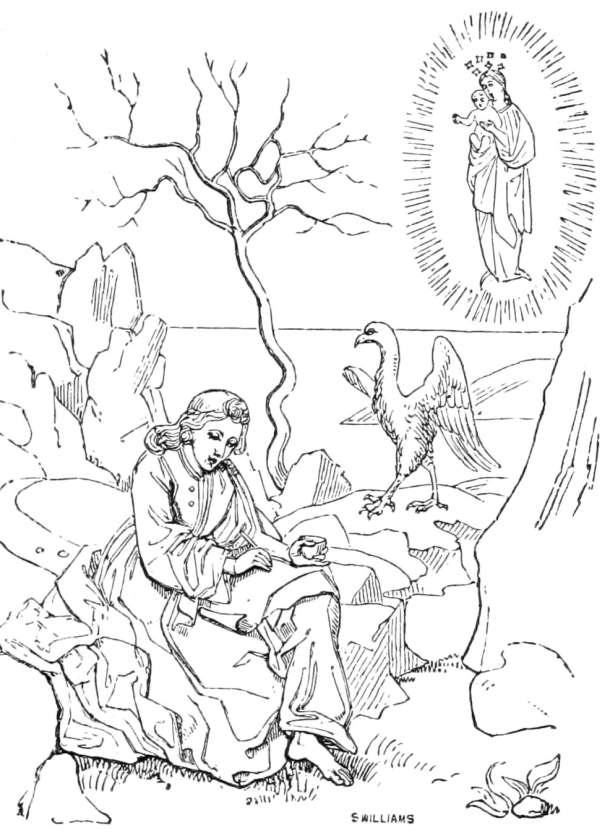
63 St. John (Lucas v. Leyden)
St. John writing his Revelation in the island of Patmos is a subject which frequently occurs in MSS. of the Apocalypse, and in the chapels dedicated to St. John. The motif is generally the same in all; we have a desert island, with the sea in the distance, or flowing round it; St. John, seated on a rock or under a tree, is in the act of writing; or he is looking up to heaven, where the ‘Woman crowned with stars,’ or ‘the Woman fleeing from the dragon,’ appears as in his vision.[136] (Rev. xii.) Or he beholds St. Michael, armed, cast down the dragon in human form; he has the eagle and book, and looks up at the Virgin, as in a picture by Ambrogio Figino.[137] The eagle is always in attendance as the symbol of inspiration in a general sense; when represented with a diadem, or glory, as in some very early examples, it is a symbol of the Holy Ghost, which, among the Jews, was figured by the eagle.
The subjects from the legendary life of St. John are exceedingly interesting, but they are not easily recognised, and require particular attention; some are of frequent occurrence, others rarely met with.
1. Israel v. Meckenen. St. John instructing his disciples at Ephesus. (Acts iv. 37.) The scene is the interior of a Gothic church, the windows painted with heraldic emblazonments: St. John is seated expounding the Scriptures, and five disciples sit opposite to him with coarse ugly faces, but most intent, expressive countenances; in the background, a large chest full of money.
2. Vatican, Chr. Mus. St. John drinking from the poisoned chalice; a man falls down dead at his feet, several figures look on with awe and astonishment: this is a frequent subject in the elder schools of art, and in the illuminated MSS. of the Gospel and Apocalypse: but I have never met with a representation later than the beginning of the fourteenth century.[138]
3. It is related by Clement of Alexandria, that when St. John was at Ephesus, and before he was exiled to Patmos, he had taken to his care a young man of promising qualities of person and mind. During his absence he left him under the spiritual guidance of a certain bishop; but, after a while, the youth took to evil courses, and, proceeding from one excess to another, he at length became the leader of a band of robbers and assassins who struck terror into the whole country. When St. John returned to Ephesus, he went to the bishop and demanded ‘the precious deposit he had left in his hands.’ At first the priest did not understand him; but when St. John explained the allusion to his adopted son, he cast down his eyes with sorrow and shame, and told of what had befallen. Then St. John rent his garments, and wept with a loud voice, and cried out, ‘Alas! alas! to what a guardian have I trusted our brother!’ And he called for a horse and rode towards the forest in which the robbers sojourned; and when the captain of the robbers beheld his old master and instructor, he turned and would have fled from his presence; but St. John, by the most fervent entreaties, prevailed on him to stop and listen to his words. After some conference, the robber, utterly subdued, burst into tears of penitence, imploring forgiveness; and while he spoke, he hid beneath his robe his right hand, which had been sullied with so many crimes; but St. John, falling on his knees before him, seized that blood-polluted hand, and kissed it, and bathed it with his tears; and he remained with his re-converted brother till he had, by prayers and encouraging words and affectionate exhortations, reconciled him with Heaven and with himself.
This beautiful legend is the subject of some old engravings, in which St. John is represented embracing the robber, who is weeping on his neck, having flung away his weapons. It has been, however, too rarely treated; I have never met with a picture of the subject; and yet it abounds in picturesque capabilities: the forest background—the contrast of youth and age—bright armour, flowing drapery, and the most striking and affecting moral, are here all combined.
4. Another very pretty apologue relating to St. John is sometimes included in a series of subjects from his life. Two young men, who had sold all their possessions to follow him, afterwards repented. He, perceiving their thoughts, sent them to gather pebbles and faggots, and, on their return, changed these into money and ingots of gold, saying to them, ‘Take back your riches and enjoy them on earth, as you regret having exchanged them for heaven!’ This story is represented on one of the windows of the Cathedral at Bourges. The two young men stand before St. John, with a heap of gold on one side, and a heap of stones and faggots on the other.
5. When St. John had sojourned in the island of Patmos a year and a day, he returned to his church at Ephesus; and as he approached the city, being received with great joy by the inhabitants, lo! a funeral procession came forth from the gates; and of those who followed weeping he inquired ‘who was dead?’ They said, ‘Drusiana.’ Now when he heard that name he was sad, for Drusiana had excelled in all good works, and he had formerly dwelt in her house; and he ordered them to set down the bier, and having prayed earnestly, God was pleased to restore Drusiana to life; she arose up, and the apostle went home with her and dwelt in her house.
This incident is the subject of a fine fresco, painted by Filippo Lippi, on the left-hand wall of the Strozzi Chapel at Florence. It has the forcible expression and dramatic spirit of the painter, with that characteristic want of elevated feeling in the countenances and in the general treatment which is apparent in all his works: the group in one corner, of a child starting from a dog, is admired for its truth; but, by disturbing the solemnity of the marvellous scene, it repels like a falsehood.
6. There is another beautiful and picturesque legend relating to St. John, of which I have never seen any representation; but it may, possibly, have occasioned the frequent introduction of a partridge into the pictures of sacred subjects, particularly in the Venetian School. St. John had a tame partridge, which he cherished much; and he amused himself with feeding and tending it. ‘A certain huntsman, passing by with his bow and arrows, was astonished to see the great apostle, so venerable for his age and sanctity, engaged in such an amusement. The apostle asked him if he always kept his bow bent? He answered, that would be the way to render it useless. “If,” replied St. John, “you unbend your bow to prevent its being useless, so do I thus unbend my mind for the same reason.”’
7. The subject entitled the Martyrdom of St. John represents his immersion in a cauldron of boiling oil, by order of the Emperor Domitian. According to the received tradition, this event took place outside the Latin gate at Rome; and on the spot stands the chapel of San Giovanni in Olio, commemorating his miraculous deliverance, which is painted in fresco on the walls. The subject forms, of course, one of a series of the life of St. John, and is occasionally met with in old prints and pictures; but it is uncommon. The treatment affords little variety; in Albert Dürer’s famous woodcut, St. John is sitting in a pot of boiling oil; one executioner is blowing the fire, another is pouring oil from a ladle on the saint’s head; a judge, probably intended for Domitian, is seated on a throne to the left, and there are numerous spectators. Padovanino painted this subject for the San Pietro at Venice; Rubens, with horrible truth of detail, for the altar-piece of St. John at Malines.
It is the martyrdom in the boiling oil which gives St. John the right to bear the palm, with which he is occasionally seen.
8. St. John, habited in priest’s garments, descends the steps of an altar into an open grave, in which he lays himself down, not in death, but in sleep, until the coming of Christ; ‘being reserved alive with Enoch and Elijah (who also knew not death), to preach against the Antichrist in the last days.’ This fanciful legend is founded on the following text: ‘Peter, seeing the disciple whom Jesus loved following, saith unto Jesus, Lord, and what shall this man do? Jesus saith unto him, If I will that he tarry till I come, what is that to thee? Then went this saying abroad among the brethren that that disciple should not die.’ (John xxi. 21, 22.)
The legend which supposes St. John reserved alive has not been generally received in the Church, and as a subject of painting it is very uncommon. It occurs in the Menologium Græcum,[139] where the grave into which St. John descends is, according to the legend, ‘fossa in crucis figuram’ (in the form of a cross). In a series of the deaths of the Apostles,[140] St. John is ascending from the grave; for, according to the Greek legend, St. John died without pain or change, and immediately rose again in bodily form, and ascended into heaven to rejoin Christ and the Virgin.
In a small and very curious picture which I saw at Rome,[141] forming part of a Predella, there is a tomb something like the Xanthian tombs in form: one end is open; St. John, with a long grey beard, is seen issuing from it, and, as he ascends, he is met by Christ, the Virgin, St. Peter, and St. Paul, who are descending from above; while figures below look up with astonishment. On the ancient doors of San Paolo he is lying in an open grave or sarcophagus.
Of the miracles performed by John after his death, two are singularly interesting in the history of Art; both have been treated in sculpture.
9. When the Empress Galla Placidia was returning from Constantinople to Ravenna with her two children (A.D. 425), she encountered a terrible storm. In her fear and anguish she vowed a vow to St. John the Evangelist, and, being landed in safety, she dedicated to his honour a magnificent church. When the edifice was finished, she was extremely desirous of procuring some relics of the evangelist, wherewith to consecrate his sanctuary; but as it was not the manner of those days to exhume, and buy and sell, still less to steal, the bodies of holy men and martyrs, the desire of the pious empress remained unsatisfied. However, as it is related, St. John himself took pity upon her; for one night, as she prayed earnestly, he appeared to her in a vision; and when she threw herself at his feet to embrace and kiss them, he disappeared, leaving one of his slippers or sandals in her hand, which sandal was long preserved.
The antique church of Galla Placidia still exists at Ravenna, to keep alive, after the lapse of fourteen centuries, the memory of her dream, and of the condescension of the blessed apostle. Not much of the original building is left; the superb mosaics have all disappeared, except a few fragments, in which may be traced the storm at sea, and Galla Placidia making her vow. Over the principal porch, which is of white marble, in the Lombard style, and richly and elegantly ornamented, the miracle of the slipper is represented in two bas-reliefs, one above the other. The lower compartment, or lunette, represents a tabernacle, and within it an altar: St. John the Evangelist is seen offering incense; on the other side is Barbation, the confessor of the empress; she, prostrate at the feet of the apostle, seems to take off his sandal: on each side are six hovering angels bearing the implements of the mass. In the upper compartment, Galla Placidia is seen kneeling at the feet of Christ, and offering to him the sacred sandal, while the evangelist stands on one side, and Barbation on the other. These bas-reliefs are not older than the twelfth century, and are in excellent preservation: I should suppose, from the style of the grouping, that they were copied, or imitated, from the older mosaics, once in the interior of the church.
10. The other miracle has the rare interest of being English in its origin and in its representation. ‘King Edward the Confessor had, after Christ and the Virgin Mary, a special veneration for St. John the Evangelist. One day, returning from his church at Westminster, where he had been hearing mass in honour of the evangelist, he was accosted by a pilgrim, who asked of him an alms for the love of God and St. John. The king, who was ever merciful to the poor, immediately drew from his finger a ring, and, unknown to any one, delivered it to the beggar. When the king had reigned twenty-four years, it came to pass that two Englishmen, pilgrims, returning from the Holy Land to their own country, were met by one in the habit of a pilgrim, who asked of them concerning their country; and being told they were of England, he said to them, “When ye shall have arrived in your own country, go to King Edward, and salute him in my name: say to him, that I thank him for the alms which he bestowed on me in a certain street in Westminster; for there, on a certain day, as I begged of him an alms, he bestowed on me this ring, which till now I have preserved, and ye shall carry it back to him, saying that in six months from this time he shall quit the world, and come and remain with me for ever.” And the pilgrims, being astounded, said, “Who art thou, and where is thy dwelling-place?” And he answered, saying, “I am John the Evangelist. Edward, your king, is my friend, and for the sanctity of his life I hold him dear. Go now, therefore, deliver to him this message and this ring, and I will pray to God that ye may arrive safely in your own country.” When St. John had spoken thus, he delivered to them the ring, and vanished out of their sight. The pilgrims, praising and thanking the Lord for this glorious vision, went on their journey; and being arrived in England, they repaired to King Edward, and saluted him, and delivered the ring and the message, relating all truly. And the king received the news joyfully, and feasted the messengers royally. Then he set himself to prepare for his departure from this world. On the eve of the Nativity, in the year of our Lord 1066, he fell sick, and on the eve of the Epiphany following he died. The ring he gave to the Abbot of Westminster, to be for ever preserved among the relics there.’[142]
According to one account,[143] the pilgrims met the king near his palace at Waltham, at a place since called Havering. The writer adds,—‘In allusion to this story, King Edward II. offered at his coronation a pound of gold made in the figure of a king holding a ring, and a mark of gold (8 oz.) made like to a pilgrim putting forth his hand to receive the ring.’ These must have been two little statuettes of gold.
The legend of King Edward and St. John the Evangelist is represented, with other legends of the same monarch, along the top of the screen of Edward the Confessor’s chapel. It is in three compartments. The first represents King Edward bestowing the ring on St. John in the disguise of a pilgrim; Westminster Abbey is seen behind. The second shows us the meeting of the pilgrims and St. John in Palestine; he holds what seems a palm. In the third the pilgrims deliver the ring to King Edward, who is seated at table. The sculpture is very rude; the figures disproportioned and ungraceful. They are supposed to be of the time of Henry VI.
The same legend was painted on one of the windows of Romford church, in Essex, but whether it still exists there I know not.[144]
Before I quit the subject of the Evangelists, it is worth while to observe that, in Greek Art, not only the Four Evangelists, but the six writers of the Acts and Epistles, are considered as a sacred series. In an ancient and beautiful MS. of the Epistole Canoniche, presented by the Queen of Cyprus to Pope Innocent VIII., they are thus represented, two and two together:—
St. Luke, with a very thoughtful, earnest countenance, holds a scroll, on which is written in Greek the commencement of the Acts, ‘The former treatise have I made, O Theophilus; &c.; and St. James, with a long, very earnest, and refined face, holds a single roll.
St. Peter, with a broad, coarse, powerful physiognomy, strongly characterised, holds two rolls; and St. John, with a long and very refined face, grey hair and beard, holds three rolls.
St. Jude, with a long white beard and very aquiline nose, holds one roll. St. Paul, bald in front, with long brown hair and beard, and a refined face, bears many rolls tied up together.
All the figures are on a gold ground, about six inches in height, very finely conceived, though, as is usual in Byzantine Art, formal and mechanical in execution. They look like small copies of very grand originals. The draperies are all classical; a pale violet or brown tunic and a white mantle, as in the old mosaics; the rolls in their hands corresponding with the number of their writings.