Part 1 — The Doctors of the Church. (continued 2)
Reading edition
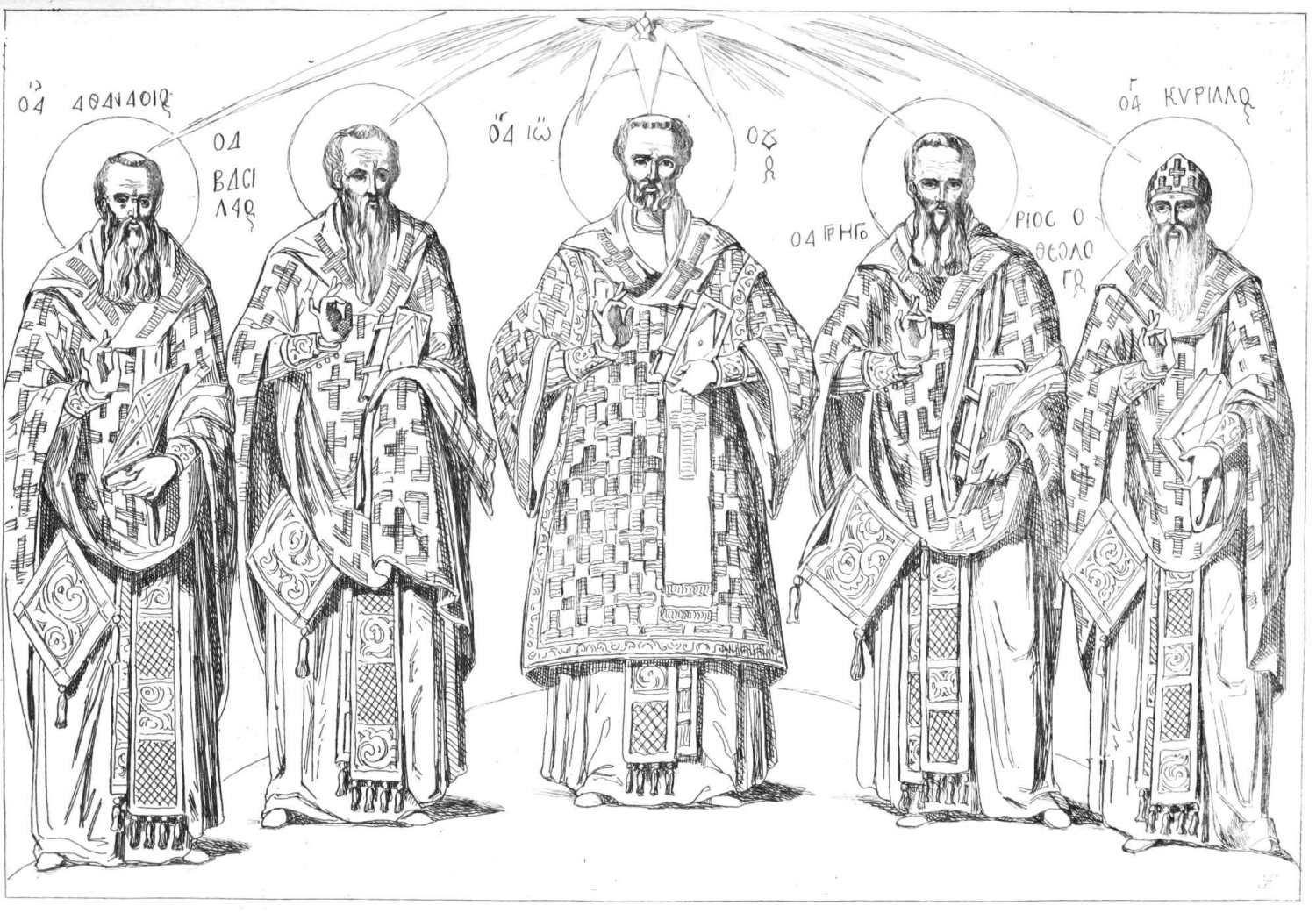
The five Greek Fathers.
The Greek bishops do not wear mitres; consequently, when in the Italian or German pictures St. Basil or any of his companions wear the mitre, it is a mistake arising from the ignorance of the artist.
The Fathers of the Greek Church have been represented by Domenichino at Grotta Ferrata, placed over the cornice and under the evangelists, their proper place: they are majestic figures, with fine heads, and correctly draped according to the Greek ecclesiastical costume. They are placed here with peculiar propriety, because the convent originally belonged to the Greek order of St. Basil, and the founder, St. Nilus, was a Greek.[290]
The etched outline, from a beautiful ancient Greek miniature, will give an accurate idea of the characteristic figures and habits of the Greek Fathers.
As separate devotional and historical representations of these Fathers do sometimes, though rarely, occur, I shall say a few words of them individually.
St. John Chrysostom.
Lat. Sanctus Johannes Chrysostom. Ital. San Giovanni Crisostomo, San Giovanni Bocca d’ Oro. Fr. St. Jean Chrysostome. Died Sept. 14, A.D. 407. His festival is celebrated by the Greeks on the 13th of November, and by the Latin Church on the 27th of January.
St. John, called Chrysostom, or of the Golden Mouth, because of his extraordinary eloquence, was born at Antioch in 344. His parents were illustrious, and the career opened to him was of arts and arms; but from his infancy the bent of his mind was peculiar. He lost his father when young; his mother Arthusia, still in the prime of her life, remained a widow for his sake, and superintended his education with care and intelligence. The remark of Sir James Mackintosh that ‘all distinguished men have had able mothers,’ appears especially true of the great churchmen and poets. The mother of St. John Chrysostom ranks with the Monicas and Sylvias, already described.
John, at the age of twenty, was already a renowned pleader at the bar. At the age of twenty-six, the disposition to self-abnegation and the passion for solitude, which had distinguished him from boyhood, became so strong, that he wished to retire altogether from the world; his legal studies, his legal honours, had become hateful to him: he would turn hermit. For a time his mother’s tears and prayers restrained him. He has himself recorded the pathetic remonstrance in which she reminded him of all she had done and suffered in her state of widowhood for his sake, and besought him not to leave her. For the present he yielded: but two years later he fled from society, and passed five or six years in the wilderness near Antioch, devoting himself solely to the study of the Scriptures, to penance and prayer; feeding on the wild vegetables, and leading a life of such rigorous abstinence that his health sank under it, and he was obliged to return to Antioch.
All this time he was not even an ordained priest; but shortly after he had emerged from the desert, Flavian, bishop of Antioch, ordained him, and appointed him preacher. At the moment of his consecration, according to the tradition, a white dove descended on his head, which was regarded as the sign of immediate inspiration. He then entered on his true vocation as a Christian orator, the greatest next to Paul. On one occasion, when the people of Antioch had offended the Emperor Theodosius, and were threatened with a punishment like that which had fallen on Thessalonica, the eloquence of St. John Chrysostom saved them: he was so adored by the people, that when he was appointed patriarch of Constantinople, it was necessary to kidnap him, and carry him off from Antioch by a force of armed soldiers, before the citizens had time to interfere.
From the moment he entered on his high office at Constantinople, he became the model of a Christian bishop. Humble, self-denying, sleeping on a bare plank, content with a little bread and pulse, he entertained with hospitality the poor and strangers: indefatigable as a preacher, he used his great gift of eloquence to convert his hearers to what he believed to be the truth: he united the enthusiasm and the imagination of the poet, the elegant taste of the scholar, the logic of the pleader, with the inspired earnestness of one who had authority from above. He was, like St. Jerome, remarkable for his influence over women; and his correspondence with one of his female converts and friends, Olympias, is considered one of the finest of his works remaining to us: but, inexorable in his denunciations of vice, without regard to sex or station, he thundered against the irregularities of the monks, the luxury and profligacy of the Empress Eudosia, and the servility of her flatterers, and brought down upon himself the vengeance of that haughty woman, with whom the rest of his life was one long contest. He was banished: the voice of the people obliged the emperor to recall him. Persisting in the resolute defence of his church privileges, and his animadversions on the court and the clergy, he was again banished; and, on his way to his distant place of exile, sank under fatigue and the cruel treatment of his guards, who exposed him, bareheaded and bare-footed, to the burning sun of noon: and thus he perished, in the tenth year of his bishopric, and the sixty-third of his age. Gibbon adds, that, at the pious solicitation of the clergy and people of Constantinople, his relics, thirty years after his death, were transported from their obscure sepulchre to the royal city. The Emperor Theodosius advanced to receive them as far as Chalcedon, and, falling prostrate on the coffin, implored, in the name of his guilty parents, Arcadius and Eudosia, the forgiveness of the injured saint.‘
It is owing, I suppose, to the intercourse of Venice with the East, that one of her beautiful churches is dedicated to San Gian Grisostomo, as they call him there, in accents as soft and sonorous as his own Greek. Over the high altar is the grandest devotional picture in which I have seen this saint figure as a chief personage. It is the masterpiece of Sebastian del Piombo,[291] and represents St. John Chrysostom throned and in the act of writing in a great book; behind him, St. Paul. In front, to the right, stands St. John the Baptist, and behind him St. George as patron of Venice; to the left Mary Magdalene, with a beautiful Venetian face; behind her, St. Catherine, patroness of Venice: close to St. J. Chrysostom stands St. Lucia holding her lamp; she is here the type of celestial light or wisdom.[292] This picture was for a long time attributed to Giorgione. There was also a very fine majestic figure of this saint by Rubens, in the collection of M. Schamp: he is in the habit of a Greek bishop; in one hand he holds the sacramental cup, and the left hand rests on the Gospel: the celestial dove hovers near him, and two angels are in attendance.
I cannot quit the history of St. John Chrysostom without alluding to a subject well known to collectors and amateurs, and popularly called ‘La Pénitence de St. Jean Chrysostome.’ It represents a woman undraped, seated in a cave, or wilderness, with an infant in her arms; or lying on the ground with a new-born infant beside her; in the distance is seen a man with a glory round his head, meagre, naked, bearded, crawling on his hands and knees in the most abject attitude; beneath, or at the top, is inscribed S. Johannes Crisostomus.
For a long time this subject perplexed me exceedingly, as I was quite unable to trace it in any of the biographies of Chrysostom, ancient or modern: the kindness of a friend, learned in all the byways as well as the highways of Italian literature, at length assisted me to an explanation.
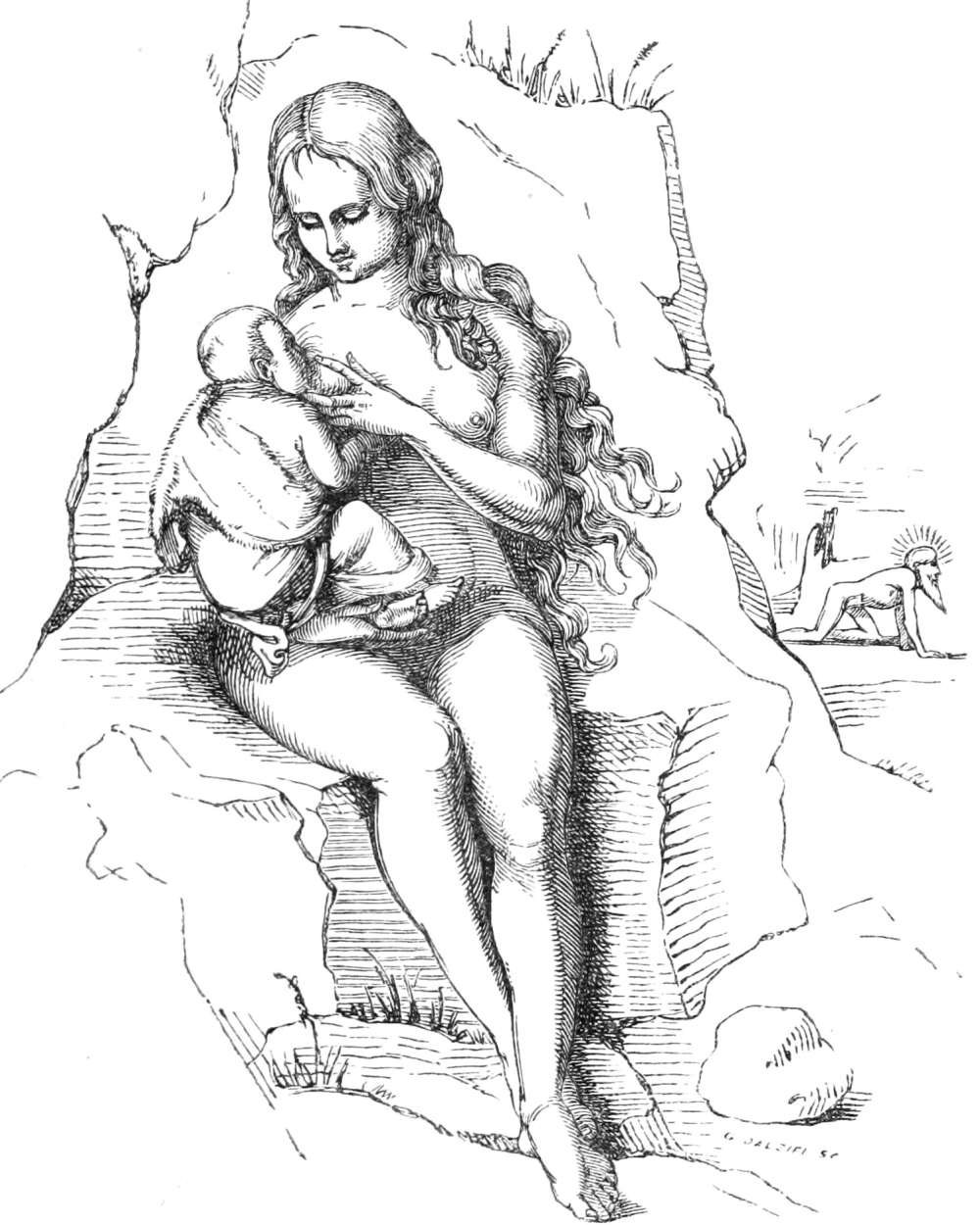
90 The Penance of St. Chrysostom (Albert Dürer)
The bitter enmity excited against St. John Chrysostom in his lifetime, and the furious vituperations of his adversary, Theophilus of Alexandria, who denounced him as one stained by every vice, ‘hostem humanitatis, sacrilegorum principem, immundum dæmonem,’ as a wretch who had absolutely delivered up his soul to Satan, were apparently disseminated by the monks. Jerome translated the abusive attack of Theophilus into Latin; and long after the slanders against Chrysostom had been silenced in the East, they survived in the West. To this may be added the slaughter of the Egyptian monks by the friends of Chrysostom in the streets of Constantinople; which, I suppose, was also retained in the traditions, and mixed up with the monkish fictions. It seems to have been forgotten who John Chrysostom really was; his name only survived in the popular ballads and legends as an epitome of every horrible crime; and to account for his being, notwithstanding all this, a saint, was a difficulty which in the old legend is surmounted after a very original, and, I must needs add, a very audacious fashion. ‘I have,’ writes my friend, ‘three editions of this legend in Italian, with the title La Historia di San Giovanni Boccadoro. It is in ottava rima, thirty-six stanzas in all, occupying two leaves of letter-press. It was originally composed in the fifteenth century, and reprinted again and again, like the ballads and tales hawked by itinerant ballad-mongers, from that day to this, and as well known to the lower orders as “Jack the Giant-killer” here. I will give you the story as succinctly and as properly as I can. A gentleman of the high roads, named Schitano, confesses his robberies and murders to a certain Frate, who absolves him, upon a solemn promise not to do three things—
Che tu non facci falso sacramento, Nè homicidio, nè adulterare.
Schitano thereupon takes possession of a cave, and turns Romito (Hermit) in the wilderness. A neighbouring king takes his daughter out hunting with him; a white deer starts across their path; the king dashes away in pursuit ten miles or more, forgetting his daughter; night comes on; the princess, left alone in the forest, wanders till she sees a light, and knocks for admittance at the cave of Schitano. He fancies at first that it must be the “Demonio,” but at length he admits her after long hesitation, and turns her horse out to graze. Her beauty tempts him to break one of his vows; the fear of discovery induces him to violate another by murdering her, and throwing her body into a cistern. The horse, however, is seen by one of the cavaliers of the court, who knocks and inquires if he has seen a certain “donzella” that way? The hermit swears that he has not beheld a Christian face for three years, thus breaking his third vow; but, reflecting on this three-fold sin with horror, he imposes on himself a most severe penance (“un’ aspra penitenza”), to wit—
Di stare sette anni nell’ aspro diserto. Pane non mangerò nè berò vino, Nè mai risguarderò il ciel scoperto, Non parlerò Hebraico nè Latino, Per fin che quel ch’ io dico non è certo, Che un fantin di sei di porga favella, “Perdonato t’ ha Dio; va alla tua cella.”
That is, he swears that for seven years he will neither eat bread nor drink wine, nor look up in the face of heaven, nor speak either Hebrew or Latin, until it shall come to pass that an infant of seven days old shall open its mouth and say, “Heaven hath pardoned thee—go in peace.” So, stripping off his clothes, he crawls on hands and knees like the beasts of the field, eating grass and drinking water.
‘Nor did his resolution fail him—he persists in this “aspra penitenza” for seven years—
Sette anni e sette giorni nel diserto; Come le bestie andava lui carpone, E mai non risguardò il ciel scoperto, Peloso egli era a modo d’ un montone; Spine e fango il suo letto era per certo, Del suo peccato havea contrizione; E ogni cosa facea con gran fervore, Per purgar il suo fallo e grand’ errore.
In the meantime it came into the king’s head to draw the covers where the hermit was leading this life. The dogs of course found, but neither they nor the king could make anything of this new species of animal, “che pareva un orso.” So they took him home in a chain and deposited him in their zoological collection, where he refused meat and bread, and persisted in grazing. On new year’s day the queen gives birth to a son, who, on the seventh day after he is born, says distinctly to the hermit,—
Torna alla tua cella, Che Dio t’ ha perdonato il tuo peccato, Levati su, Romito! ova favella!
But the hermit does not speak as commanded; he makes signs that he will write. The king orders the inkstand to be brought, but there is no ink in it: so Schitano at once earns his surname of Boccadoro (Chrysostom) by a simple expedient: he puts the pen to his mouth, wets it with his saliva, and writes in letters of gold—
Onde la penna in bocca si metteva, E a scrivere cominciò senza dimoro, Col sputo, lettere che parevan d’ oro!
‘After seven years and seven days, he opens his golden mouth in speech, and confesses his foul crimes to the king; cavaliers are despatched in search of the body of the princess; as they approach the cavern they hear celestial music, and in the end they bring the donzella out of the cistern alive and well, and very sorry to leave the blessed Virgin and the angels, with whom she had been passing her time most agreeably: she is restored to her parents with universal festa e allegrezza, and she announces to the hermit that he is pardoned and may return to his cell, which he does forthwith, and ends in leading the life of a saint, and being beatified. The “discreti auditori” are invited to take example—
Da questo Santo pien di leggiadria Che Iddio sempre perdona a’ peccatori,
and are finally informed that they may purchase this edifying history on easy terms, to wit, a halfpenny—
Due quattrini dia senza far più parole.
The price, however, rose; for in the next century the line is altered thus:—
Pero ciascun che comperarne vuole, Tre quattrini mi dia senza più parole.’
The woodcuts prefixed to the ballad represent this saintly Nebuchadnezzar on all fours, surprised by the king with his huntsmen and dogs; but no female figure, as in the German prints, in which the German version of the legend has evidently been in the mind of the artists. It differs in some respects from the Italian ballad. I shall therefore give as much of it here as will explain the artistic treatment of the story.
‘When John Chrysostom was baptized, the Pope[293] stood godfather. At seven years old he went to school, but he was so dull and backward, that he became the laughing-stock of his schoolfellows. Unable to endure their mockery, he took refuge in a neighbouring church, and prayed to the Virgin; and a voice whispered, “Kiss me on the mouth, and thou shalt be endowed with all learning.” He did so, and, returning to the school, he surpassed all his companions, so that they remained in astonishment: as they looked, they saw a golden ring or streak round his mouth, and asked him how it came there? and when he told them, they wondered yet more. Thence he obtained the name of Chrysostom. John was much beloved by his godfather the Pope, who ordained him priest at a very early age; but the first time he offered the sacrifice of the mass, he was struck to the heart by his unworthiness, and resolved to seek his salvation in solitude; therefore, throwing off his priestly garments, he fled from the city, and made his dwelling in a cavern of the rock, and lived there a long while in prayer and meditation.
‘Now not far from the wilderness in which Chrysostom dwelt, was the capital of a great king; and it happened that one day, as the princess his daughter, who was young and very fair, was walking with her companions, there came a sudden and violent gust of wind, which lifted her up and carried her away, and set her down in the forest, far off; and she wandered about till she came to the cave of Chrysostom, and knocked at the door. He, fearing some temptation of the devil, would not let her in; but she entreated, and said, “I am no demon, but a Christian woman; and if thou leavest me here, the wild beasts will devour me!” So he yielded perforce, and arose and let her in. And he drew a line down the middle of his cell, and said, “That is your part, this is mine; and neither shall pass this line.” But this precaution was in vain, for passion and temptation overpowered his virtue; he over-stepped the line, and sinned. Both repented sorely; and Chrysostom, thinking that if the damsel remained longer in his cave it would only occasion further sin, carried her to a neighbouring precipice, and flung her down. When he had done this deed, he was seized with horror and remorse; and he departed and went to Rome to his godfather the Pope, and confessed all, and entreated absolution. But his godfather knew him not; and, being seized with horror, he drove him forth, and refused to absolve him. So the unhappy sinner fled to the wilderness, and made a solemn vow that he would never rise from the earth nor look up, but crawl on his hands and knees, until he had expiated his great sin and was absolved by Heaven.
‘When he had thus crawled on the earth for fifteen years, the queen brought forth a son; and when the Pope came to baptize the child, the infant opened its mouth and said, “I will not be baptized by thee, but by St. John;” and he repeated this three times: and none could understand this miracle; but the Pope was afraid to proceed. In the meantime, the king’s huntsmen had gone to the forest to bring home game for the christening feast: there, as they rode, they beheld a strange beast creeping on the ground; and not knowing what it might be, they threw a mantle over it and bound it in a chain and brought it to the palace. Many came to look on this strange beast, and with them came the nurse with the king’s son in her arms; and immediately the child opened its mouth and spake, “John, come thou and baptize me!” He answered, “If it be God’s will, speak again!” And the child spoke the same words a second and a third time. Then John stood up; and the hair and the moss fell from his body, and they brought him garments; and he took the child, and baptized him with great devotion.
‘When the king heard his confession, he thought, “Perhaps this was my daughter, who was lost and never found;” and he sent messengers into the forest to seek for the remains of his daughter, that her bones at least might rest in consecrated ground. When they came to the foot of the precipice, there they found a beautiful woman seated, naked, and holding a child in her arms; and John said to her, “Why sittest thou here alone in the wilderness?” And she said, “Dost thou not know me? I am the woman who came to thy cave by night, and whom thou didst hurl down this rock!” Then they brought her home with great joy to her parents.‘[294]
This extravagant legend becomes interesting for two reasons: it shows the existence of the popular feeling and belief with regard to Chrysostom, long subsequent to those events which aroused the hatred of the early monks; and it has been, from its popular notoriety, embodied in some rare and valuable works of art, which all go under the name of ‘the Penance or Penitence of Johannes Chrysostom or Crisostomos.’
1. A rare print by Lucas Cranach, composed and engraved by himself. In the centre is an undraped woman reclining on the ground against a rock, and contemplating her sleeping infant, which is lying on her lap; a stag, a hind crouching, a pheasant feeding near her, express the solitude of her life; in the background is ‘the savage man’ on all fours, and browsing: here, he has no glory round his head. The whole composition is exceedingly picturesque.
2. A rare and beautiful print by B. Beham, and repeated by Hans Sebald Beham, represents a woman lying on the ground with her back turned to the spectator; a child is near her; Chrysostom is seen crawling in the background, with the glory round his head.
3. A small print by Albert Dürer, also exquisitely engraved (from which I give a sketch). Here the woman is sitting at the entrance of a rocky cave, feeding her child from her bosom: in the background the ‘savage man’ crawling on all fours, and a glory round his head. This subject has been called St. Geneviève of Brabant; but it is evidently the same as in the two last-named compositions.
All these prints, being nearly contemporaneous, show that the legend must have been particularly popular about this time (1509-1520). There is also an old French version of the story which I have not seen.
St. Basil the Great.
Lat. St. Basilius Magnus. Ital. San Basilio Magno. Fr. St. Basile. (June 14, A.D. 380.)
St. Basil, called the Great, was born at Cesarea in Cappadocia, in the year 328. He was one of a family of saints. His father St. Basil, his mother St. Emmelie, his two brothers St. Gregory of Nyssa and St. Peter of Sebaste, and his sister St. Macrina, were all distinguished for their sanctity, and renowned in the Greek calendar. The St. Basil who takes rank as the second luminary of the Eastern Church, and whose dogmatical and theological works influenced the faith of his own age, and consequently of ours, was the greatest of all. But, notwithstanding his importance in the Greek Church, he figures so seldom in the productions of Western Art, that I shall content myself with relating just so much of his life and actions as may render the few representations of him interesting and intelligible.
He owed his first education to his grandmother St. Macrina the elder, a woman of singular capacity and attainments, to whom he has in various parts of his works acknowledged his obligations. For several years he pursued his studies in profane learning, philosophy, law, and eloquence, at Constantinople, and afterwards at Athens, where he had two companions and fellow-students of very opposite character: Gregory of Nazianzen, afterwards the Saint; and Julian, afterwards the Apostate.
The success of the youthful Basil in all his studies, and the reputation he had obtained as an eloquent pleader, for a time swelled his heart with vanity, and would have endangered his salvation but for the influence of his sister, St. Macrina, who in this emergency preserved him from himself, and elevated his mind to far higher aims than those of mere worldly science and worldly distinction. From that period, and he was then not more than twenty-eight, Basil turned his thoughts solely to the edification of the Christian Church; but first he spent some years in retreat among the hermits of the desert, as was the fashion of that day, living, as they did, in abstinence, poverty, and abstracted study; acknowledging neither country, family, home, nor friends, nor fortune, nor worldly interests of any kind, but with his thoughts fixed solely on eternal life in another world. In these austerities he, as was also usual, consumed and ruined his bodily health; and remained to the end of his life a feeble wretched invalid,—a circumstance which was supposed to contribute greatly to his sanctity. He was ordained priest in 362, and bishop of Cesarea in 370; his ordination on the 14th of June being kept as one of the great feasts of the Eastern Church.
On the episcopal throne he led the same life of abstinence and humility as in a cavern of the desert; and contended for the doctrine of the Trinity against the Arians, but with less of vehemence, and more of charity, than the other Doctors engaged in the same controversy. The principal event of his life was his opposition to the Emperor Valens, who professed Arianism, and required that, in the Church of Cesarea, Basil should perform the rites according to the custom of the Arians. The bishop refused: he was threatened with exile, confiscation, death: he persisted. The emperor, fearing a tumult, resolved to appear in the church on the day of the Epiphany, but not to communicate. He came, hoping to overawe the impracticable bishop, surrounded by all his state, his courtiers, his guards. He found Basil so intent on his sacred office as to take not the slightest notice of him; those of the clergy around him continued to chant the service, keeping their eyes fixed in the profoundest awe and respect on the countenance of their bishop. Valens, in a situation new to him, became agitated: he had brought his oblation; he advanced with it; but the ministers at the altar, not knowing whether Basil would accept it, dared not take it from his hands. Valens stood there for a moment in sight of all the people, rejected before the altar,—he lost his presence of mind, trembled, swooned, and would have fallen to the earth, if one of the attendants had not received him in his arms. A conference afterwards took place between Basil and the emperor; but the latter remained unconverted, and some concessions to the Catholics was all that the bishop obtained.
St. Basil died in 379, worn out by disease, and leaving behind him many theological writings. His epistles, above all, are celebrated, not only as models of orthodoxy, but of style.
Of St. Basil, as of St. Gregory and St. John Chrysostom, we have the story of the Holy Ghost, in visible form as a dove of wonderful whiteness, perched on his shoulder, and inspiring his words when he preached. St. Basil is also celebrated as the founder of Monachism in the East. He was the first who enjoined the vows of poverty, chastity, and obedience; and his Rule became the model of all other monastic Orders. There is, in fact, no other Order in the Greek Church, and when either monks or nuns appear in a Greek or a Russian picture they must be Basilicans, and no other: the habit is a plain black tunic with a cowl, the tunic fastened round the waist with a girdle of cord or leather. Such is the dress of the Greek caloyer, and it never varies.
The devotional figures of St. Basil represent him, or ought to represent him, in the Greek pontificals, bareheaded, and with a thin worn countenance, as he appears in the etching of the Greek Fathers.
‘The Emperor Valens in the church at Cesarea,’ an admirably picturesque subject, has received as little justice as the scene between Ambrose and Theodosius. When the French painter Subleyras was at Rome in 1745, he raised himself to name and fame by his portrait of Benedict XIV.,[295] and received, through the interest of his friend Cardinal Valenti, the commission to paint a picture for one of the mosaics in St. Peter’s. The subject selected was the Emperor Valens fainting in presence of St. Basil. We have all the pomp of the scene:—the altar, the incense, the richly attired priests on one side; on the other, the Imperial court. It is not easy to find fault, for the picture is well drawn, well composed, in the mannered taste of that time; well coloured, rather tenderly than forcibly; and Lanzi is enthusiastic in his praise of the draperies; yet, as a whole, it leaves the mind unimpressed. As usual, the original sketch for this picture far excels the large composition.[296]
The prayers of St. Basil were supposed by the Armenian Christians, partly from his sanctity, and partly from his intellectual endowments, to have a peculiar, almost resistless, power; so that he not only redeemed souls from purgatory, but even lost angels from the abyss of hell. ‘On the sixth day of the creation, when the rebellious angels fell from heaven through that opening in the firmament which the Armenians call Arocea, and we the Galaxy, one unlucky angel, who had no participation in their sin, but seems to have been entangled in the crowd, fell with them.’ (A moral, I presume, on the consequences of keeping bad company.) ‘And this unfortunate angel was not restored till he had obtained, it is not said how, the prayers of St. Basil. His condition meantime, from the sixth day of the creation to the fourth century of the Christian era, must have been even more uncomfortable than that of Klopstock’s repentant demon in “The Messiah.”’
There are many other beautiful legendary stories of St. Basil, but, as I have never met with them in any form of Art, I pass them over here. One of the most striking has been versified by Southey in his ballad-poem, ‘All for Love.’ It would afford a great variety of picturesque subjects.
St. Athanasius.
Lat. S. Athanasius, Pater Orthodoxiæ. Ital. Sant’ Atanasio. Fr. St. Athanase. (May 2, A.D. 373.)
St. Athanasius, whose famous Creed remains a stumbling-block in Christendom, was born at Alexandria, about the year 298; he was consequently the eldest of the Greek Fathers, though he does not in that Church take the first rank. He, like the others, began his career by the study of profane literature, science, and eloquence; but, seized by the religious spirit of the age, he, too, fled to the desert, and became, for a time, the pupil of St. Anthony. He returned to Alexandria, and was ordained deacon. His first appearance as a public character was at the celebrated council of Nice (A.D. 325), where he opposed Arius and his partisans with so much zeal and eloquence, that he was thenceforth regarded as the great pillar of orthodoxy. He became Bishop of Alexandria the following year; and the rest of his life was a perpetual contest with the Arians. The great schism of the early Church blazed at this time in the East and in the West, and Athanasius, by his invincible perseverance and intrepidity, procured the victory for the Catholic party. He died in 372, after having been Bishop of Alexandria forty-six years, of which twenty years had been spent in exile and tribulation.
It is curious that, notwithstanding his fame and his importance in the Church, St. Athanasius should be, as a patron and a subject of Art, of all saints the most unpopular. He figures, of course, as one of the series of Greek Doctors; but I have never met with any separate representation of him, and I know not any church dedicated to him, nor any picture representing the vicissitudes of his unquiet life, fraught as it was with strange reverses and picturesque incidents. Such may exist, but in Western Art, at least, they have never been prominent. According to the Greek formula, he ought to be represented old, bald-headed, and with a long white beard, as in the etching.
St. Gregory Nazianzen.
Gr. St. Gregory Theologos. Lat. S. Gregorius Nazianzenus. Ital. San Gregorio Nazianzeno. Fr. St. Grégoire de Naziance. Ger. St. Gregor von Nazianz. (May 9, A.D. 390.)
This Doctor, like St. Basil, was one of a family of saints; his father, St. Gregory, having been bishop of Nazianzus before him; his mother, St. Nonna, famous for her piety; and two of his sisters, St. Gorgonia and St. Cesarea, also canonized. Gregory was born about the year 328; and his mother, who fondly believed that he had been granted to her prayers, watched over his early education, and guided his first steps in piety and literature. When a boy, he had a singular dream, which he has related himself. He beheld in his sleep two virgins of celestial beauty; they were clothed in white garments, and their faces shone upon him like two stars out of heaven: they took him in their arms and kissed him as if he had been their child. He, charmed by their virgin beauty and their caresses, asked who they were, and whence they came? One of them replied, ‘I am called Chastity, and my sister here is Temperance; we come to thee from Paradise, where we stand continually before the throne of Christ, and taste ineffable delights: come to us, my son, and dwell with us for ever;’ and having spoken thus, they left him and flew upwards to heaven. He followed them with longing eyes till they disappeared, and as he stretched his arms towards them he awoke.
This dream—how natural in a boy educated between a tender mother, who had shielded him, as only mothers can, against all sinful temptations, and a lovely and saintly sister!—he regarded as a direct revelation from heaven: it decided his future life, and he made a vow of perpetual continence and temperance. Like the other Greek doctors, he began by the study of profane literature and rhetoric. He went to Athens, where he formed an enduring friendship with St. Basil, and pursued his studies with Julian, afterwards Cæsar and Apostate. After leaving Athens, in his thirtieth year, he was baptized; and, devoting himself solemnly to the service of God and the study of the Scriptures, like his friend Basil, he destroyed his health by his austerities and mortifications: he confesses that they were wholly repugnant to his nature —a nature sensitive, imaginative, poetical; but this of course only added to their merit and efficacy. His aged father withdrew him from his solitude, and ordained him as his coadjutor: in 362 he succeeded to the bishopric of Nazianzus: but great part of his time was still spent at Constantinople, whither he was invited to preach against the Arians. It was a strange spectacle to see, in the capital of the world, a man, from a distant province and an obscure town, of small shrunken stature, bald-headed, wrinkled, haggard with vigils and fasting, poor, ill-clothed, and in his address unpolished and abrupt, stand up to oppose himself to a luxurious court and prevalent sect. The people began by stoning him; but at length his earnestness and eloquence overcame all opposition.
Religious disputes were the fashion at that time in Constantinople, not merely among the priesthood, but among the laity, the lawyers, and above all the women, who were heard, in assemblies and at feasts, at home and abroad, declaiming and arguing on the most abstruse mysteries of the evangelical doctrine, till they lost temper and modesty:—so true it is, that there is nothing new under the sun. This was in 378, and St. Gregory found more difficulty in silencing their squabbles than in healing the schisms of the Church. He was ordained Bishop of Constantinople by the favour of Theodosius; but, unable to endure the odious cabals and uncharitable contests which at that time distracted and disgraced Christianity, he resigned his sacred office, and retired to a small paternal estate, where he lived, with his usual self-denial and austerity, till his death. He composed in his retreat a number of beautiful poems in his native Greek: he was, in fact, the earliest Christian poet on record. These poems are not hymns only, but lyrics, in which he poured forth his soul, his aspirations, his temptations, his joys, his sufferings, his plaintive supplications to Christ, to aid him in his perpetual combats against a too vivid imagination, and feelings and passions which not even age and penance had subdued.
St. Gregory Nazianzen ought to be represented as an old man wasted by fasting and vigils, with a bald head, a long beard of a reddish colour, and eyebrows the same. He is always the last in a series of the Four Greek Fathers, and, though often occurring in Greek Art, the popularity of St. Gregory the Great has completely banished St. Gregory the Poet from Western Art.
There remains, however, a very valuable and singular monument to the honour of St. Gregory Nazianzen, in the Greek MS. of his sermons preserved in the Imperial Library at Paris, and adorned with Byzantine miniatures, which must once have been beautiful and brilliant: ruined as they are, they present some of the most ancient examples which remain to us of the treatment of many sacred subjects from the Old and the New Testament, and give a high idea of the classic taste and the skill of the Byzantine limners of the ninth century. Besides the sacred subjects, we have numerous scenes interspersed from the life of Gregory himself, his friend St. Basil, and the Emperor Theodosius. As these are subjects which are exceptional, I need not describe them. Of the style of the miniatures I have already spoken, and given one example (v. p. 75).
St. Cyril.
Lat. S. Cyrillus. Ital. San Cirillo. Fr. St. Cyrille. (Jan. 28, A.D. 444.)
St. Cyril, Patriarch of Alexandria from the year 412 to 444, was famous in his time as deeply engaged in all the contests which disturbed the early Christian Church. He has left a great number of theological writings, which are regarded as authority in matters of faith. He, appears to have been violent against the so-called heresies of that day, and opposed Nestorius with the same determined zeal and inexorable firmness with which Athanasius had opposed Arius. The ascendency of Cyril was disgraced by the death of the famous female mathematician and philosopher Hypatia, murdered with horrible cruelty, and within the walls of a church, by the fanatic followers of the Patriarch, if he did not himself connive at it. He is much more venerated in the Greek than in the Latin Church. In the Greek representations he is the only bishop who has his head covered; he wears a veil or hood, coming over his head, falling down on his shoulders, and the front embroidered with a cross, as in the illustration.
With the Greek Fathers I conclude the list of those saints who are generally represented in their collective character, grouped, or in a series.