Part 1 — The Doctors of the Church.
Reading edition

The Doctors of the Church.
I. THE FOUR LATIN FATHERS.
The Evangelists and the Apostles represented in Art the Spiritual Church, and took their place among the heavenly influences. The great Fathers or Doctors were the representatives of the Church Militant on earth: as teachers and pastors, as logicians and advocates, they wrote, argued, contended, suffered, and at length, after a long and fierce struggle against opposing doctrines, they fixed the articles of faith thereafter received in Christendom. For ages, and down to the present time, the prevailing creed has been that which was founded on the interpretations of these venerable personages. They have become, in consequence, frequent and important subjects of Art, particularly from the tenth century—the period when, in their personal character, they began to be regarded not merely as gifted and venerable, but as divinely inspired; their writings appealed to as infallible, their arguments accepted as demonstration. We distinguish them as the Latin and the Greek Fathers. In Western Art, we find the Latin Fathers perpetually grouped together, or in a series: the Greek Fathers seldom occur except in their individual character, as saints rather than as teachers.
The four Latin Doctors are St. Jerome, St. Ambrose, St. Augustine, and St. Gregory. When represented together, they are generally distinguished from each other, and from the sacred personages who may be grouped in the same picture, by their conventional attributes. Thus St. Jerome is sometimes habited in the red hat and crimson robes of a cardinal, with a church in his hand; or he is a half-naked, bald-headed, long-bearded, emaciated old man, with eager wasted features, holding a book and pen, and attended by a lion. St. Ambrose wears the episcopal robes as bishop of Milan, with mitre and crosier, and holds his book; sometimes, also, he carries a knotted scourge, and a bee-hive is near him. St. Augustine is also habited as a bishop, and carries a book; he has often books at his feet, and sometimes a flaming heart transpierced by an arrow. The origin and signification of these symbols I shall explain presently.
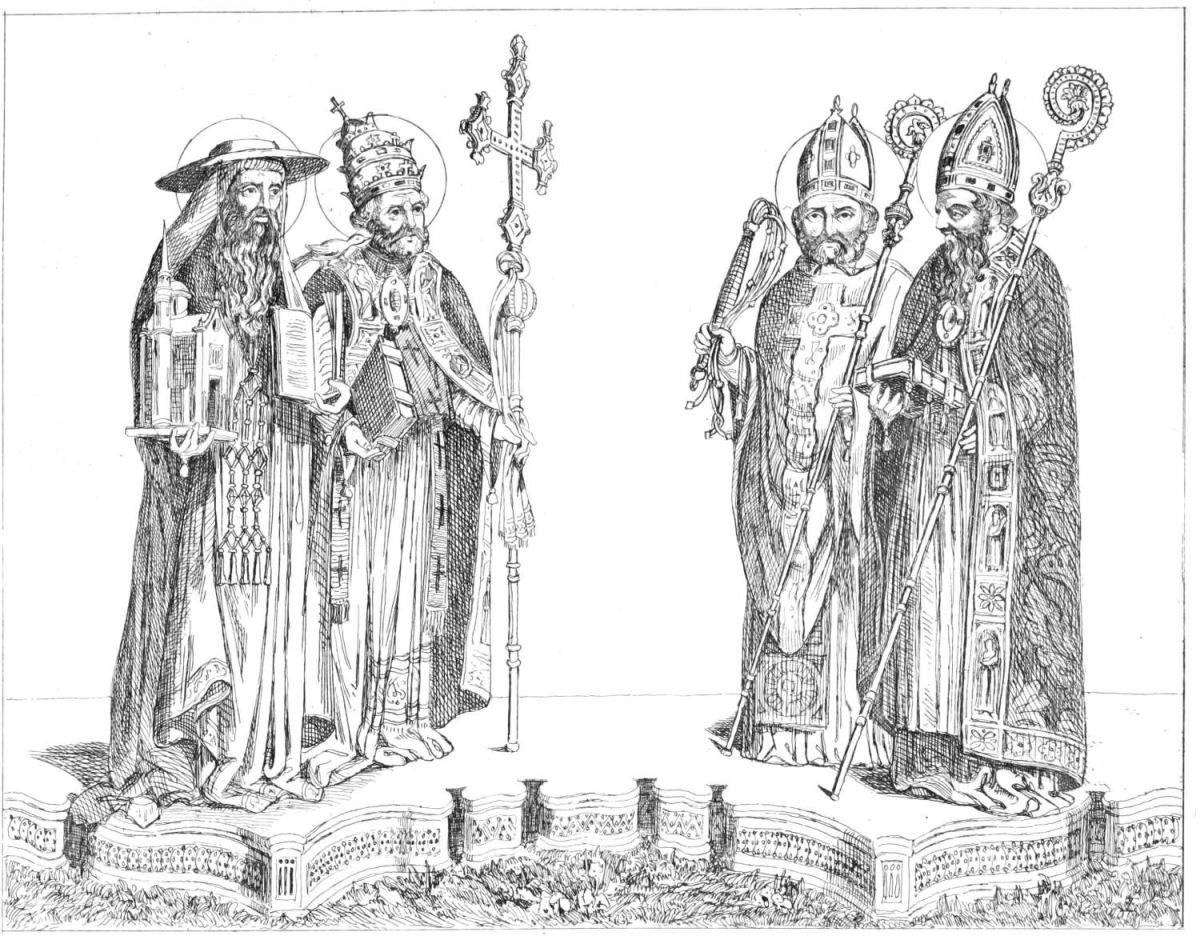
The Four Latin Fathers.
In the most ancient churches the Four Doctors are placed after the Evangelists. In the later churches they are seen combined or grouped with the evangelists, occasionally also with the sibyls; but this seems a mistake. The appropriate place of the sibyls is neither with the evangelists nor the fathers, but among the prophets, where Michael Angelo has placed them.
Where the principal subject is the glory of Christ, or the coronation or assumption of the Virgin, the Four Fathers attend with their books as witnesses and interpreters.
1. A conspicuous instance of this treatment is the dome of San Giovanni at Parma. In the centre is the ascension of Christ, around are the twelve apostles gazing upwards; below them, in the spandrils of the arches, as if bearing record, are the Four Evangelists, each with a Doctor of the Church seated by him as interpreter: St. Matthew is attended by St. Jerome; St. Mark, by St. Gregory; St. Luke, by St. Augustine; and St. John, by St. Ambrose.
2. A picture in the Louvre by Pier-Francesco Sacchi (A.D. 1640) represents the Four Doctors, attended, or rather inspired, by the mystic symbols of the Four Evangelists. They are seated at a table, under a canopy sustained by slender pillars, and appear in deep consultation: near St. Augustine is the eagle; St. Gregory has the ox; St. Jerome, the angel; and St. Ambrose, the lion.
3. In a well-known woodcut after Titian, ‘The Triumph of Christ,’ the Redeemer is seated in a car drawn by the Four Evangelists; while the Four Latin Doctors, one at each wheel, put forth all their strength to urge it on. The patriarchs and prophets precede, the martyrs and confessors of the faith follow, in grand procession.
4. In a Coronation of the Virgin, very singularly treated, we have Christ and the Virgin on a high platform or throne, sustained by columns; in the space underneath, between these columns, is a group of unwinged angels, holding the instruments of the Passion. (Or, as I have sometimes thought, this beautiful group may be the souls of the Innocents, their proper place being under the throne of Christ.) On each side a vast company of prophets, apostles, saints, and martyrs, ranged tier above tier. Immediately in front, and on the steps of the throne, are the Four Evangelists, seated each with his symbol and book: behind them the Four Fathers, also seated. This picture, which as a painting is singularly beautiful, the execution finished, and the heads most characteristic and expressive, may be said to comprise a complete system of the theology of the middle ages.[245]
5. We have the same idea carried out in the lower part of Raphael’s ‘Disputa’ in the Vatican. The Four Doctors are in the centre of what may be called the sublunary part of the picture: they are the only seated figures in the vast assembly of holy, wise, and learned men around; St. Gregory and St. Jerome on the right of the altar, St. Ambrose and St. Augustine on the left. As the two latter wear the same paraphernalia, they are distinguished by having books scattered at their feet, on which are inscribed the titles of their respective works.
The Madonna and Child enthroned, with the Doctors of the Church standing on each side, is a subject which has been often, and sometimes beautifully, treated; and here the contrast between all we can conceive of virginal and infantine loveliness and innocence enshrined in heavenly peace and glory—and these solemn, bearded, grand-looking old Fathers, attending in humble reverence, as types of earthly wisdom—ought to produce a magnificent effect, when conceived in the right spirit. I can remember, however, but few instances in which the treatment is complete and satisfactory.
1. One of these is a picture by A. Vivarini (A.D. 1446), now in the Academy at Venice. Here, the Virgin sits upon a throne under a rich canopy sustained by four little angels. She looks out of the picture with a most dignified, tranquil, goddess-like expression; she wears, as usual, the crimson tunic and blue mantle, the latter being of a most brilliant azure; on her brow, a magnificent jewelled crown; the Divine Child stands on her knee, and raises his little hand to bless the worshipper. To the right of the Virgin, and on the platform of her throne, stands St. Jerome, robed as cardinal, and bearing his church; with St. Gregory, habited as pope. To the left stands St. Ambrose, holding his crosier and knotted scourge, and St. Augustine with his book. This is a wonderful picture, and, as a specimen of the early Venetian school, unequalled. The accuracy of imitation, the dazzling colour, the splendid dresses and accessories, the grave beauty of the Madonna, the divine benignity of the Infant Redeemer, and the sternly thoughtful heads of the old Doctors, are not only positively fine, but have a relative interest and value as being stamped with that very peculiar character which belonged to the Vivarini and their immediate followers. It was painted for the Scuola della Carità.[246]
2. A different and a singular treatment of the Four Fathers occurs in another Venetian picture.[247] Christ is represented seated on a throne, and disputing with the Jewish doctors, who are eagerly arguing or searching their books. In front of the composition stand St. Jerome, St. Ambrose, St. Augustine, and St. Gregory; who, with looks fixed on the youthful Saviour, appear to be reverentially listening to, and recording, his words. This wholly poetical and ideal treatment of a familiar passage in the life of Christ, I have never seen but in this one instance.
3. A third example is a picture by Moretto, of extraordinary beauty.[248] The Virgin sits on a lofty throne, to which there is an ascent of several steps; the Child stands on her right; she presses him to her with maternal tenderness, and his arms are round her neck. At the foot of the throne stand St. Ambrose, with his scourge, and St. Augustine; St. Gregory, wearing the papal tiara, and without a beard, is seated on a step of the throne, holding an open book; and St. Jerome, kneeling on one knee, points to a passage in it; he wears the cardinal’s dress complete. This picture is worthy of Titian in the richness of the effect, with a more sober grandeur in the colour. The Virgin is too much like a portrait; this is the only fault.[249]
In the Chapel of San Lorenzo, in the Vatican, Angelico has painted eight Doctors of the Church, single majestic figures standing under Gothic canopies. According to the names now to be seen inscribed on the pedestals beneath, these figures represent St. Jerome,[250] St. Ambrose, St. Augustine, St. Gregory, St. Athanasius, St. Leo, St. John Chrysostom, and St. Thomas Aquinas. St. John Chrysostom and St. Athanasius represent the Greek doctors. St. Leo, who saved Rome from Attila, is with peculiar propriety placed in the Vatican; and St. Thomas Aquinas, the angelic doctor, naturally finds a place in a chapel painted by a Dominican for a pope who particularly favoured the Dominicans,—Nicholas V.
The Four Fathers communing on the mystery of the Trinity, or the Immaculate Conception, were favourite subjects in the beginning of the seventeenth century, when church pictures, instead of being religious and devotional, became more and more theological. There is an admirable picture of this subject by Dosso Dossi.[251] Above is seen the Messiah, as Creator, in a glory; he lays his hand on the head of the Virgin, who kneels in deep humility before him; St. Gregory sits in profound thought, a pen in one hand, a tablet in the other; St. Ambrose and St. Augustine are similarly engaged; St. Jerome, to whom alone the celestial vision appears to be visible, is looking up with awe and wonder. Guido, in a celebrated picture,[252] has represented the Doctors of the Church communing on the Immaculate Conception of the Virgin. The figures are admirable for thoughtful depth of character in the expression, and for the noble arrangement of the draperies; above is seen the Virgin, floating amid clouds, in snow-white drapery, and sustained by angels; visible, however, to St. Jerome and St. Ambrose only.
Rubens has treated the Fathers several times: the colossal picture in the Grosvenor Gallery is well known, where they appear before us as moving along in a grand procession: St. Jerome comes last; (he should be first; but on these points Rubens was not particular:) he seems in deep contemplation, enveloped in the rich scarlet robes of a cardinal of the seventeenth century, and turning the leaves of his great book. In another picture we have the Four Fathers seated, discussing the mystery of the Eucharist; St. Jerome points to a passage in the Scriptures; St. Gregory is turning the page; they appear to be engaged in argument; the other two are listening earnestly. There is another picture by Rubens in which the usual attributes of the Fathers are borne aloft by angels, while they sit communing below.
These examples will suffice to give a general idea of the manner in which the four great Doctors of the Western Church are grouped in devotional pictures. We will now consider them separately, each according to his individual character and history.
St. Jerome.
Lat. Sanctus Hieronymus. Ital. San Geronimo or Girolamo. Fr. St. Jérome, Hiérome, or Géroisme. Ger. Der Heilige Hieronimus. Patron of scholars and students, and more particularly of students in theology. (Sept. 30, A.D. 420.)
Of the four Latin Doctors, St. Jerome, as a subject of painting, is by far the most popular. The reasons for this are not merely the exceedingly interesting and striking character of the man, and the picturesque incidents of his life, but also his great importance and dignity as founder of Monachism in the West, and as author of the universally received translation of the Old and New Testament into the Latin language (called ‘The Vulgate’). There is scarcely a collection of pictures in which we do not find a St. Jerome, either doing penance in the desert, or writing his famous translation, or meditating on the mystery of the Incarnation.
Jerome was born about A.D. 342, at Stridonium, in Dalmatia. His father, Eusebius, was rich; and as he showed the happiest disposition for learning, he was sent to Rome to finish his studies. There, through his own passions, and the evil example of his companions, he fell into temptation, and for a time abandoned himself to worldly pleasures. But the love of virtue, as well as the love of learning, was still strong within him: he took up the profession of law, and became celebrated for his eloquence in pleading before the tribunals. When more than thirty, he travelled into Gaul, and visited the schools of learning there. It was about this time that he was baptized, and vowed himself to perpetual celibacy. In 373, he travelled into the East, to animate his piety by dwelling for a time among the scenes hallowed by the presence of the Saviour; and, on his way thither, he visited some of the famous Oriental hermits and ascetics, of whom he has given us such a graphic account, and whose example inspired him with a passion for solitude and a monastic life. Shortly after his arrival in Syria, he retired to a desert in Chalcis, on the confines of Arabia, and there he spent four years in study and seclusion, supporting himself by the labour of his hands. He has left us a most vivid picture of his life of penance in the wilderness; of his trials and temptations, his fastings, his sickness of soul and body: and we must dwell for a moment on his own description, in order to show with what literal and circumstantial truth the painters have rendered it. He says, in one of his epistles, ‘Oh how often, in the desert, in that vast solitude which, parched by the sultry sun, affords a dwelling to the monks, did I fancy myself in the midst of the luxuries of Rome! I sate alone, for I was full of bitterness. My misshapen limbs were rough with sackcloth, and my skin so squalid that I might have been mistaken for an Ethiopian. Tears and groans were my occupation every day and all day long. If sleep surprised me unawares, my naked bones, which scarcely held together, rattled on the earth.’ His companions, he says, ‘were scorpions and wild beasts;’ his home, ‘a recess among rocks and precipices.’ Yet, in the midst of this horrible self-torture and self-abasement, he describes himself as frequently beset by temptations to sin and sensual indulgence, and haunted by demons: at other times, as consoled by voices and visions from heaven. Besides these trials of the flesh and the spirit, he had others of the intellect. His love of learning, his admiration of the great writers of classical antiquity,—of Plato and Cicero,—made him impatient of the rude simplicity of the Christian historians. He describes himself as fasting before he opened Cicero; and, as a further penance, he forced himself to study Hebrew, which at first filled him with disgust, and this disgust appeared to him a capital sin. In one of his distempered visions, he fancied he heard the last trumpet sounded in his ear by an angel, and summoning him before the judgment-seat of God. ‘Who art thou?’ demanded the awful voice. ‘A Christian,’ replied the trembling Jerome. ‘‘Tis false!’ replied the voice, ‘thou art no Christian: thou art a Ciceronian. Where the treasure is, there will the heart be also.’ He persevered, and conquered the difficulties of Hebrew; and then, wearied by the religious controversies in the East, after ten years’ residence there, he returned to Rome.
But neither the opposition he had met with, nor his four years of solitude and penance in the desert, had subdued the fiery enthusiasm of temperament which characterised this celebrated man. At Rome he boldly combated the luxurious self-indulgence of the clergy, and preached religious abstinence and mortification. He was particularly remarkable for the influence he obtained over the Roman women; we find them, subdued or excited by his eloquent exhortations, devoting themselves to perpetual chastity, distributing their possessions among the poor, or spending their days in attendance on the sick, and ready to follow their teacher to the Holy Land—to the desert—even to death. His most celebrated female convert was Paula, a noble Roman matron, a descendant of the Scipios and the Gracchi. Marcella, another of these Roman ladies, was the first who, in the East, collected together a number of pious women to dwell together in community: hence she is, by some authors, considered as the first nun; but others contend that Martha, the sister of Mary Magdalene, was the first who founded a religious community of women.
After three years’ sojourn at Rome, St. Jerome returned to Palestine, and took up his residence in a monastery he had founded at Bethlehem. When, in extreme old age, he became sensible of the approach of death, he raised with effort his emaciated limbs, and, commanding himself to be carried into the chapel of the monastery, he received the Sacrament for the last time from the hands of the priest, and soon after expired. He died in 420, leaving, besides his famous translation of the Scriptures, numerous controversial writings, epistles, and commentaries.
We read in the legendary history of St. Jerome, that one evening, as he sat within the gates of his monastery at Bethlehem, a lion entered, limping, as in pain; and all the brethren, when they saw the lion, fled in terror: but Jerome arose, and went forward to meet him, as though he had been a guest. And the lion lifted up his paw, and St. Jerome, on examining it, found that it was wounded by a thorn, which he extracted; and he tended the lion till he was healed. The grateful beast remained with his benefactor, and Jerome confided to him the task of guarding an ass which was employed in bringing firewood from the forest. On one occasion, the lion having gone to sleep while the ass was at pasture, some merchants passing by carried away the latter; and the lion, after searching for him in vain, returned to the monastery with drooping head, as one ashamed. St. Jerome, believing that he had devoured his companion, commanded that the daily task of the ass should be laid upon the lion, and that the faggots should be bound on his back, to which he magnanimously submitted, until the ass was recovered; which was in this wise. One day, the lion, having finished his task, ran hither and thither, still seeking his companion; and he saw a caravan of merchants approaching, and a string of camels, which, according to the Arabian custom, were led by an ass; and when the lion recognised his friend, he drove the camels into the convent, and so terrified the merchants, that they confessed the theft, and received pardon from St. Jerome.
The introduction of the lion into pictures of St. Jerome is supposed to refer to this legend; but in this instance, as in many others, the reverse was really the case. The lion was in very ancient times adopted as the symbol befitting St. Jerome, from his fervid, fiery nature, and his life in the wilderness; and in later times, the legend invented to explain the symbol was gradually expanded into the story as given above.
Representations of St. Jerome, in pictures, prints, and sculpture, are so numerous that it were in vain to attempt to give any detailed account of them, even of the most remarkable. All, however, may be included under the following classification, and, according to the descriptions given, may be easily recognised.
The devotional subjects and single figures represent St. Jerome in one of his three great characters. 1. As Patron Saint and Doctor of the Church. 2. As Translator and Commentator of the Scriptures. 3. As Penitent. As Doctor of the Church, and teacher, he enters into every scheme of decoration, and finds a place in all sacred buildings. As Saint and Penitent, he is chiefly to be found in the convents and churches of the Jeronymites, who claim him as their Patriarch.
When placed before us as the patron saint and father of divinity, he is usually standing full length, either habited in the cardinal’s robes, or with the cardinal’s hat lying at his feet. It may be necessary to observe, that there is no historical authority for making St. Jerome a cardinal. Cardinal-priests were not ordained till three centuries later; but as the other fathers were all of high ecclesiastical rank, and as St. Jerome obstinately refused all such distinction, it has been thought necessary, for the sake of his dignity, to make him a cardinal: another reason may be, that he performed, in the court of Pope Dalmasius, those offices since discharged by the cardinal-deacon. In some of the old Venetian pictures, instead of the official robes of a cardinal, he is habited in loose ample red drapery, part of which is thrown over his head. When represented with his head uncovered, his forehead is lofty and bald, his beard is very long, flowing even to his girdle; his features fine and sharp, his nose aquiline. In his hand he holds a book or a scroll, and frequently the emblematical church, of which he was the great support and luminary: and, to make the application stronger and clearer, rays of light are seen issuing from the door of the church.
1. A signal instance of the treatment of Jerome as patron saint occurs in a fine picture by Wohlgemuth, the master of Albert Dürer.[253] It is an altar-piece representing the glorification of the saint, and consists of three compartments. In the centre, St. Jerome stands on a magnificent throne, and lays his left hand on the head of a lion, raised up on his hind legs: the donors of the picture, a man and a woman, kneel in front; on each side are windows opening on a landscape, wherein various incidents of the life of St. Jerome are represented; on the right, his Penance in the Wilderness and his Landing at Cyprus; and on the left, the merchants who had carried off the ass bring propitiatory gifts, which the saint rejects, and other men are seen felling wood and loading the lion. On the inner shutters or wings of the central picture, are represented, on the right, the three other doctors,—St. Augustine, with the flaming heart; St. Ambrose, with the bee-hive; both habited as bishops; and St. Gregory, wearing his tiara, and holding a large book (his famous Homilies) in his hand. On the left, three apostles with their proper attributes, St. Andrew, St. Thomas, and St. Bartholomew; on the other side are represented, to the right, St. Henry II. holding a church (the cathedral of Bamberg), and a sword, his proper attributes; and his wife St. Cunegunda.[254] On the left St. Elizabeth of Hungary and St. Martin. There are besides, to close in the whole, two outer doors: on the inner side, to the right, St. Joseph and St. Kilian;[255] on the left, St. Catherine and St. Ursula; and on the exterior of the whole the mass of St. Gregory, with various personages and objects connected with the Passion of Christ. The whole is about six feet high, dated 1511, and may bear a comparison, for elaborate and multifarious detail and exquisite painting, with the famous Van Eyck altar-piece in St. John’s Church at Ghent.[256]
2. In his character of patron, St. Jerome is a frequent subject of sculpture. There is a Gothic figure of him in Henry the Seventh’s Chapel, habited in the cardinal’s robes, the lion fawning upon him.
When St. Jerome is represented in his second great character, as the translator of the Scriptures, he is usually seated in a cave or in a cell, busied in reading or in writing; he wears a loose robe thrown over his wasted form; and either he looks down intent on his book, or he looks up as if awaiting heavenly inspiration: sometimes an angel is dictating to him.
1. In an old Italian print, which I have seen, he is seated on the ground reading, in spectacles;—an anachronism frequent in the old painters. Sometimes he is seated under the shade of a tree; or within a cavern, writing at a rude table formed of a stump of a tree, or a board laid across two fragments of rock; as in a beautiful picture by Ghirlandajo, remarkable for its solemn and tranquil feeling.[257]
2. Very celebrated is an engraving of this subject by Albert Dürer. The scene is the interior of a cell, at Bethlehem; two windows on the left pour across the picture a stream of sunshine, which is represented with wonderful effect. St. Jerome is seen in the background, seated at a desk, most intently writing his translation of the Scriptures; in front the lion is crouching, and a fox is seen asleep. These two animals are here emblems;—the one, of the courage and vigilance, the other of the wisdom or acuteness, of the saint. The execution of this print is a miracle of Art, and it is very rare. There is an exquisite little picture by Elzheimer copied from it, and of the same size, at Hampton Court. I need hardly observe, that here the rosary and the pot of holy water are anachronisms, as well as the cardinal’s hat. By Albert Dürer we have also St. Jerome writing in a cavern; and St. Jerome reading in his cell: both woodcuts.
3. Even more beautiful is a print by Lucas v. Leyden, in which St. Jerome is reclining in his cell and reading intently; the lion licks his foot.
4. In a picture by Lucas Cranach, Albert of Brandenburg, elector of Mayence (1527), is represented in the character of St. Jerome, seated in the wilderness, and writing at a table formed of a plank laid across two stumps of trees: he is in the cardinal-robes; and in the foreground a lion, a hare, a beaver, a partridge, and a hind, beautifully painted, express the solitude of his life. In the background the caravan of merchants is seen entering the gate of the monastery, conducted by the faithful lion.
5. The little picture by Domenichino, in our National Gallery, represents St. Jerome looking up from his book, and listening to the accents of the angel. 6. In a picture by Tiarini,[258] it is St. John the Evangelist, and not an angel, who dictates while he writes. 7. In a picture by Titian, St. Jerome, seated, holds a book, and gazes up at a crucifix suspended in the skies; the lion is drinking at a fountain. Out of twenty prints of St. Jerome after Titian, there are at least eight which represent him at study or writing.
It is in the double character of Doctor of the Church, and translator of the Scriptures, that we find St. Jerome so frequently introduced into pictures of the Madonna, and grouped with other saints. Two of the most celebrated pictures in the world suggest themselves here as examples:—1. ‘The Madonna della Pesce’ of Raphael; where the Virgin, seated on a raised throne, holds the Infant Christ in her arms; on her right hand, the archangel Raphael presents the young Tobias, who holds the fish, the emblem of Christianity or Baptism. On the other side kneels St. Jerome, holding an open book, his beard sweeping to his girdle; the lion at his feet; the Infant Christ, while he bends forward to greet Tobias, has one hand upon St. Jerome’s book: the whole is a beautiful and expressive allegory.[259] 2. Correggio’s picture, called ‘The St. Jerome of Parma,’ represents the Infant Christ on the knees of his mother: Mary Magdalene bends to kiss his feet: St. Jerome stands in front, presenting his translation of the Scriptures.
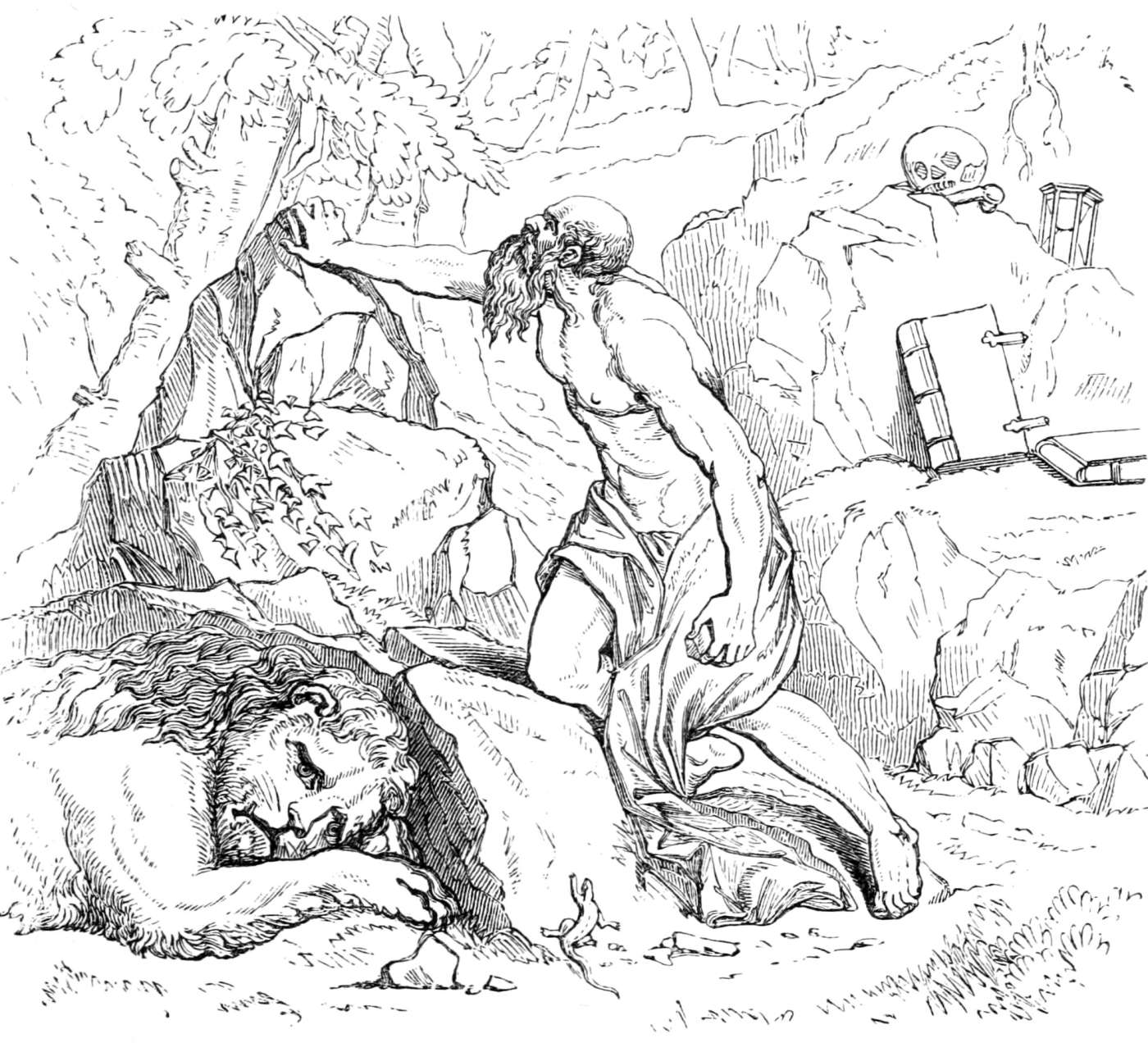
85 St. Jerome doing Penance (Titian)
The penitent St. Jerome seems to have been adopted throughout the Christian Church as the approved symbol of Christian penitence, self-denial, and self-abasement. No devotional subject, if we except the ‘Madonna and Child’ and the ‘Magdalene,’ is of such perpetual recurrence. In the treatment it has been infinitely varied. The scene is generally a wild rocky solitude: St. Jerome, half naked, emaciated, with matted hair and beard, is seen on his knees before a crucifix, beating his breast with a stone. The lion is almost always introduced, sometimes asleep, or crouching at his feet; sometimes keeping guard, sometimes drinking at a stream. The most magnificent example of this treatment is by Titian:[260] St. Jerome, kneeling on one knee, half supported by a craggy rock, and holding the stone, looks up with eager devotion to a cross, artlessly fixed into a cleft in the rock; two books lie on a cliff behind; at his feet are a skull and hour-glass; and the lion reposes in front. The feeling of deep solitude, and a kind of sacred horror breathed over this picture, are inconceivably fine and impressive. Another by Titian, but inferior, is in the Louvre; and there are at least twelve engravings of St. Jerome doing penance, after the same painter: among them a superb landscape, in which are seen a lion and a lioness prowling in the wilderness, while the saint is doing penance in the foreground. By Agostino Caracci there is a famous engraving of ‘St. Jerome doing penance in a cave,’ called from its size the great St. Jerome. But to particularise further would be endless: I know scarcely any Italian painter since the fifteenth century who has not treated this subject at least once.
The Spanish painters have rendered it with a gloomy power, and revelled in its mystic significance. In the Spanish gallery of the Louvre I counted at least twenty St. Jeromes: the old German painters and engravers also delighted in it, on account of its picturesque capabilities.
Albert Dürer represents St. Jerome kneeling before a crucifix, which he has suspended against the trunk of a massy tree; an open book is near it; he holds in his right hand a flint-stone, with which he is about to strike his breast, all wounded and bleeding from the blows already inflicted; the lion crouches behind him, and in the distance is a stag.
The penitent St. Jerome is not a good subject for sculpture; the undraped, meagre form, and the abasement of suffering, are disagreeable in this treatment: yet such representations are constantly met with in churches. The famous colossal statue by Torrigiano, now in the Museum at Seville, represents St. Jerome kneeling on a rock, a stone in one hand, a crucifix in the other. At Venice, in the Frari, there is a statue of St. Jerome, standing, with the stone in his hand and the lion at his feet; too majestic for the Penitent. There are several other statues of St. Jerome at Venice, from the Liberi and Lombardi schools, all fine as statues; but the penitent saint is idealised into the patron-saint of penitents.
When figures of St. Jerome as penitent are introduced in Madonna pictures, or in the Passion of Christ, then such figures are devotional, and symbolical, in a general sense, of Christian repentance.
There is an early picture of the Crucifixion, by Raphael,[261] in which he has placed St. Jerome at the foot of the cross, beating his breast with a stone(86).
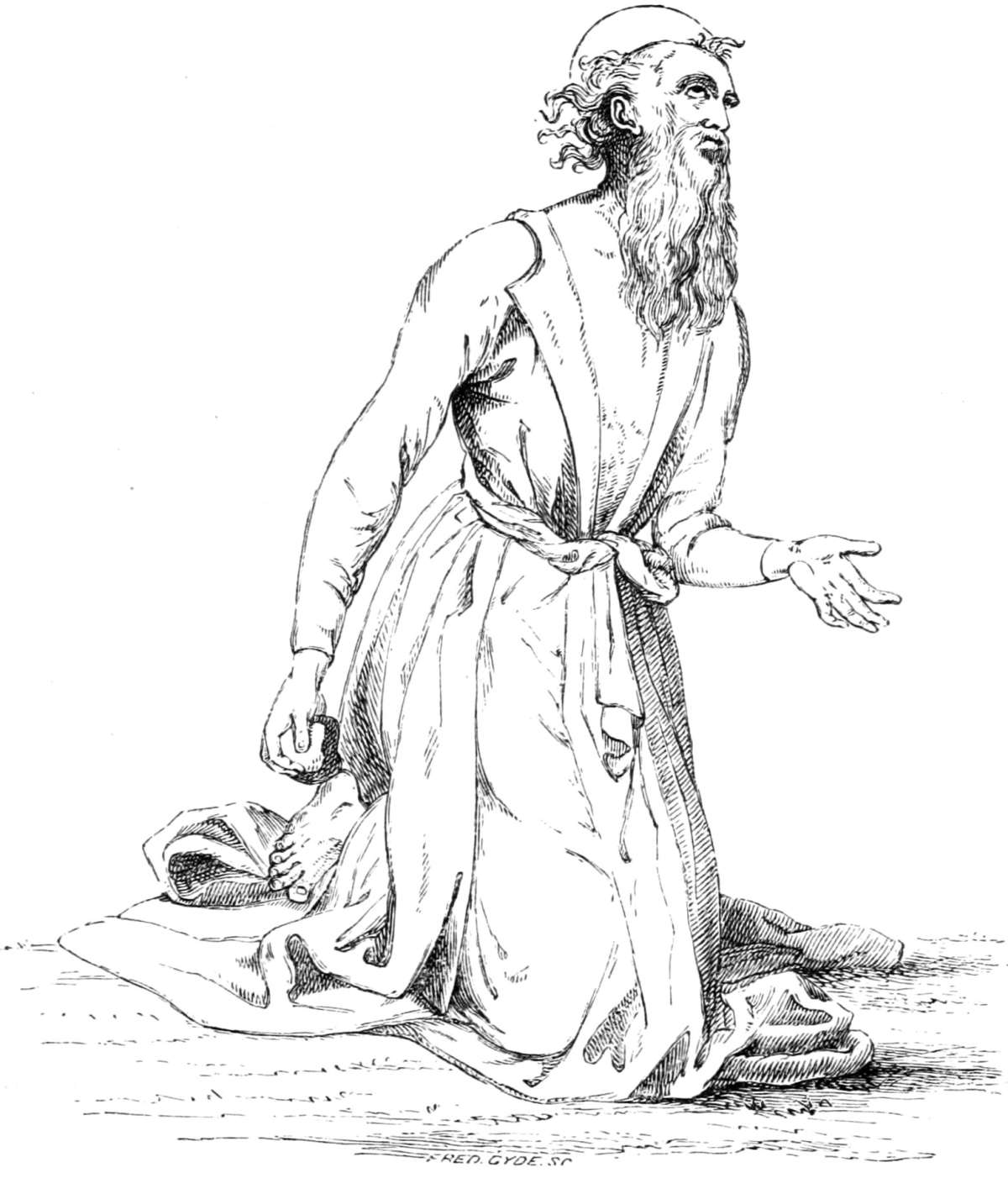
86 St. Jerome, as Penitent, in a Crucifixion (Raphael)
The pictures from the life of St. Jerome comprise a variety of subjects:—1. ‘He receives the cardinal’s hat from the Virgin:’ sometimes it is the Infant Christ, seated in the lap of the Virgin, who presents it to him. 2. ‘He disputes with the Jewish doctors on the truth of the Christian religion;’ in a curious picture by Juan de Valdes.[262] He stands on one side of a table in an attitude of authority: the rabbis, each of whom has a demon looking over his shoulder, are searching their books for arguments against him. 3. ‘St. Jerome, while studying Hebrew in the solitude of Chalcida, hears in a vision the sound of the last trumpet, calling men to judgment.’ This is a common subject, and styled ‘The Vision of St. Jerome.’ I have met with no example earlier than the fifteenth century. In general he is lying on the ground, and an angel sounds the trumpet from above. In a composition by Ribera he holds a pen in one hand and a penknife in the other: he seems to have been arrested in the very act of mending his pen by the blast of the trumpet: the figure of the saint, wasted even to skin and bone, and his look of petrified amazement, are very fine, notwithstanding the commonplace action. In a picture by Subleyras, in the Louvre, St. Jerome is gazing upwards, with an astonished look; three archangels sound their trumpets from above. In a picture by Antonio Pereda, at Madrid, St. Jerome not only hears in his vision the sound of the last trump, he sees the dead arise from their graves around him. Lastly, by way of climax, I may mention a picture in the Louvre, by a modern French painter, Sigalon: St. Jerome is in a convulsive fit, and the three angels, blowing their trumpets in his ears, are like furies sent to torment and madden the sinner, rather than to rouse the saint.
While doing penance in the desert, St. Jerome was sometimes haunted by temptations, as well as amazed by terrors.
4. Domenichino, in one of the frescoes in St. Onofrio, represents the particular kind of temptation by which the saint was in imagination assailed: while he is fervently praying and beating his breast, a circle of beautiful nymphs, seen in the background, weave a graceful dance. Vasari has had the bad taste to give us a penitent St. Jerome with Venus and Cupids in the background: one arch little Cupid takes aim at him;—an offensive instance of the extent to which, in the sixteenth century, classical ideas had mingled with and depraved Christian Art.[263]
5. Guido. ‘St. Jerome translating the Scriptures while an angel dictates:’ life size and very fine (except the angel, who is weak, and reminds one of a water-nymph[264]); in his pale manner.
6. Domenichino. ‘St. Jerome is flagellated by an angel for preferring Cicero to the Hebrew writings:’ also in the St. Onofrio. The Cicero, torn from his hand, lies at his feet. Here the saint is a young man, and the whole scene is represented as a vision.
7. But St. Jerome was comforted by visions of glory, as well as haunted by terrors and temptations. In the picture by Parmigiano, in our National Gallery, St. Jerome is sleeping in the background, while St. John the Baptist points upwards to a celestial vision of the Virgin and Child, seen in the opening heavens above: the upper part of this picture is beautiful, and full of dignity; but the saint is lying stretched on the earth in an attitude so uneasy and distorted, that it would seem as if he were condemned to do penance even in his sleep; and the St. John has always appeared to me mannered and theatrical.
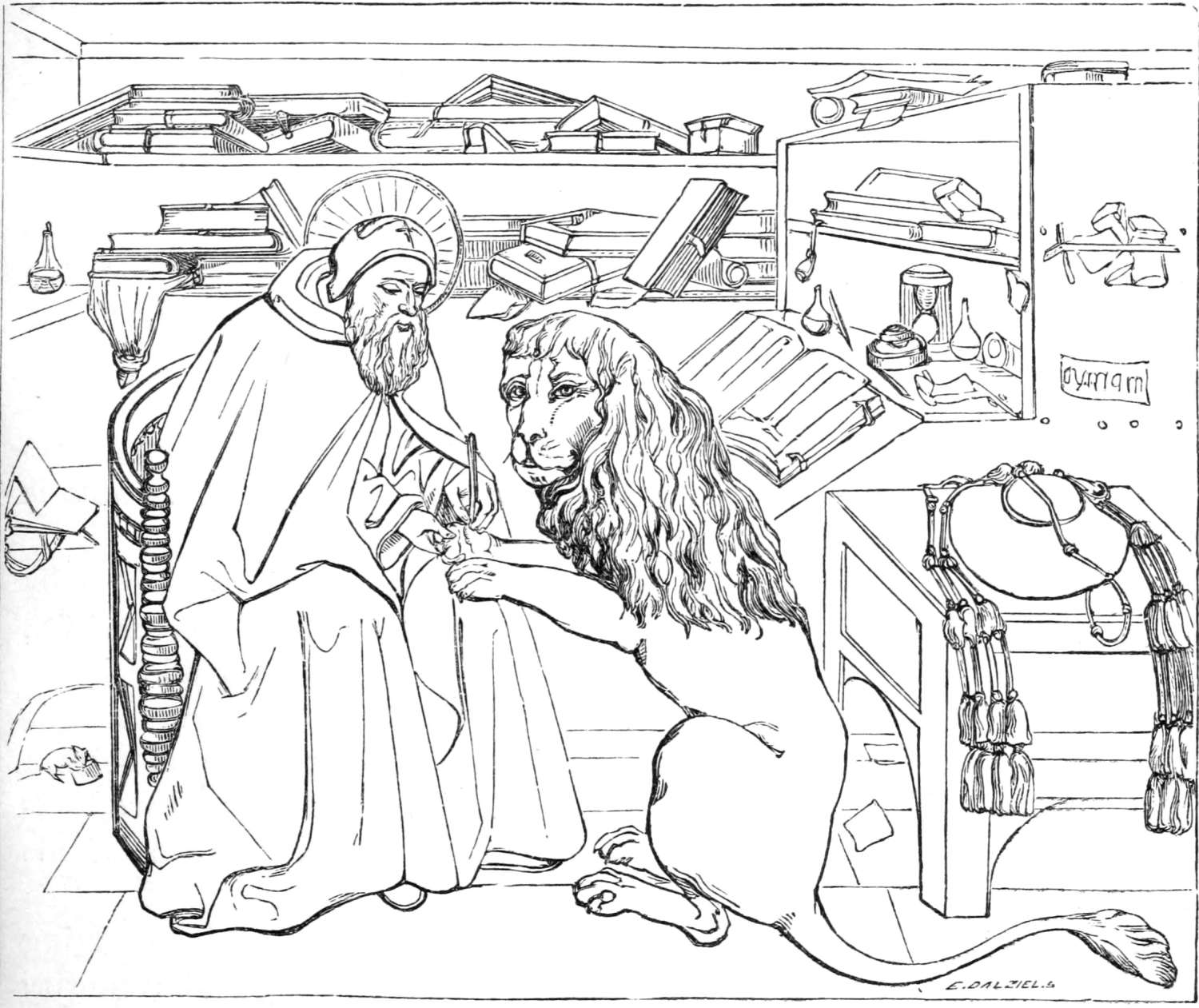
87 St. Jerome and the Lion (Coll’ Antonio da Fiore) Naples
8. The story of the lion is often represented. St. Jerome is seated in his cell, attired in the monk’s habit and cowl; the lion approaches, and lays his paw upon his knee; a cardinal’s hat and books are lying near him; and, to express the self-denial of the saint, a mouse is peeping into an empty cup (87).[265]
In another example, by Vittore Carpaccio, the lion enters the cell, and three monks, attendants on St. Jerome, flee in terror.
9. The Last Communion of St. Jerome is the subject of one of the most celebrated pictures in the world,—the St. Jerome of Domenichino, which has been thought worthy of being placed opposite to the Transfiguration of Raphael, in the Vatican. The aged saint—feeble, emaciated, dying—is borne in the arms of his disciples to the chapel of his monastery, and placed within the porch. A young priest sustains him; St. Paula, kneeling, kisses one of his thin bony hands; the saint fixes his eager eyes on the countenance of the priest, who is about to administer the sacrament,—a noble dignified figure in a rich ecclesiastical dress; a deacon holds the cup, and an attendant priest the book and taper; the lion droops his head with an expression of grief; the eyes and attention of all are on the dying saint, while four angels, hovering above, look down upon the scene.
Agostino Caracci, in a grand picture now in the Bologna Gallery, had previously treated the same subject with much feeling and dramatic power: but here the saint is not so wasted and so feeble; St. Paula is not present, and the lion is tenderly licking his feet.
Older than either, and very beautiful and solemn, is a picture by Vittore Carpaccio, in which the saint is kneeling in the porch of a church, surrounded by his disciples, and the lion is seen outside.
10. ‘The Death of St. Jerome.’ In the picture by Starnina he is giving his last instructions to his disciples, and the expression of solemn grief in the old heads around is very fine. In a Spanish picture he is extended on a couch, made of hurdles, and expires in the arms of his monks.
In a very fine anonymous print, dated 1614, St. Jerome is dying alone in his cell (this version of the subject is contrary to all authority and precedent): he presses to his bosom the Gospel and the crucifix; the lion looks up in his face roaring, and angels bear away his soul to heaven.
11. ‘The Obsequies of St. Jerome.’ In the picture by Vittore Carpaccio, the saint is extended on the ground before the high altar, and the priests around are kneeling in various attitudes of grief or devotion. The lion is seen on one side.[266]
I will mention here some other pictures in which St. Jerome figures as the principal personage.
St. Jerome introducing Charles V. into Paradise is the subject of a large fresco, by Luca Giordano, on the staircase of the Escurial.
St. Jerome conversing with two nuns, probably intended for St. Paula and St. Marcella.[267]
The sleep of St. Jerome. He is watched by two angels, one of whom, with his finger on his lip, commands silence.[268]
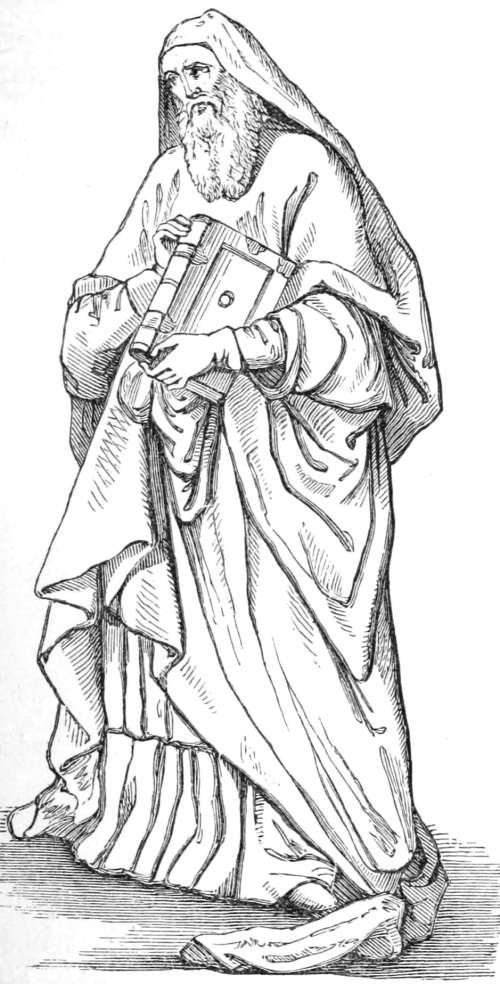
88 Venetian St. Jerome
It is worth remarking, that in the old Venetian pictures St. Jerome does not wear the proper habit and hat of a cardinal, but an ample scarlet robe, part of which is thrown over his head as a hood (88).
The history of St. Jerome, in a series, is often found in the churches and convents of the Jeronymites, and generally consists of the following subjects, of which the fourth and sixth are often omitted:—
1. He is baptized. 2. He receives the cardinal’s hat from the Virgin. 3. He does penance in the desert, beating his breast with a stone. 4. He meets St. Augustine. 5. He is studying or writing in a cell. 6. He builds the convent at Bethlehem. 7. He heals the wounded lion. 8. He receives the Last Sacrament. 9. He dies in the presence of his disciples. 10. He is buried.
Considering that St. Jerome has ever been venerated as one of the great lights of the Church, it is singular that so few churches are dedicated to him. There is one at Rome, erected, according to tradition, on the very spot where stood the house of Santa Paula, where she entertained St. Jerome during his sojourn at Rome in 382. For the high altar of this church, Domenichino painted his masterpiece of the Communion of St. Jerome already described. The embarkation of Saint Paula, to follow her spiritual teacher St. Jerome to the Holy Land, is the subject of one of Claude’s most beautiful sea pieces, now in the collection of the Duke of Wellington; another picture of this subject, the figures as large as life, is in the Brera, by a clever Cremonese painter, Giuseppe Bottoni.
St. Jerome has detained its long; the other Fathers are, as subjects of Art, much less interesting.
St. Ambrose.
Lat. S. Ambrosius. Ital. Sant’ Ambrogio. Fr. St. Ambroise. Ger. Der Heilige Ambrosius. Patron Saint of Milan. (April 4, A.D. 397.)
We can hardly imagine a greater contrast than between the stern, enthusiastic, dreaming, ascetic Jerome, and the statesman-like, practical, somewhat despotic Ambrose. This extraordinary man, in whose person the priestly character assumed an importance and dignity till then unknown, was the son of a prefect of Gaul, bearing the same name, and was born at Treves in the year 340. It is said that, when an infant in the cradle, a swarm of bees alighted on his mouth, without injuring him. The same story was told of Plato and of Archilochus, and considered prophetic of future eloquence. It is from this circumstance that St. Ambrose is represented with the bee-hive near him.
Young Ambrose, after pursuing his studies at Rome with success, was appointed prefect of Æmilia and Liguria (Piedmont and Genoa), and took up his residence at Milan. Shortly afterwards the Bishop of Milan died, and the succession was hotly disputed between the Catholics and the Arians. Ambrose appeared in his character of prefect, to allay the tumult; he harangued the people with such persuasive eloquence that they were hushed into respectful silence; and in the midst a child’s voice was heard to exclaim, ‘Ambrose shall be bishop!’ The multitude took up the cry as though it had been a voice from heaven, and compelled him to assume the sacred office. He attempted to avoid the honour thus laid upon him by flight, by entreaties,—pleading that, though a professed Christian, he had never been baptized: in vain! the command of the emperor enforced the wishes of the people; and Ambrose, being baptized, was, within eight days afterwards, consecrated bishop of Milan. He has since been regarded as the patron saint of that city.
He began by distributing all his worldly goods to the poor; he then set himself to study the sacred writings, and to render himself in all respects worthy of his high dignity. ‘The Old and the New Testament,’ says Mr. Milman, ‘met in the person of Ambrose: the implacable hostility to idolatry, the abhorrence of every deviation from the established formulary of belief;—the wise and courageous benevolence, the generous and unselfish devotion to the great interests of humanity.’
He was memorable for the grandeur and magnificence with which he invested the ceremonies of worship; they had never been so imposing. He particularly cultivated music, and introduced from the East the manner of chanting the service since called the Ambrosian chant.
Two things were especially remarkable in the life and character of St. Ambrose. The first was the enthusiasm with which he advocated celibacy in both sexes: on this topic, as we are assured, he was so persuasive, that mothers shut up their daughters lest they should be seduced by their eloquent bishop into vows of chastity. The other was his determination to set the ecclesiastical above the sovereign or civil power: this principle, so abused in later times, was in the days of Ambrose the assertion of the might of Christianity, of mercy, of justice, of freedom, over heathenism, tyranny, cruelty, slavery. The dignity with which he refused to hold any communication with the Emperor Maximus, because he was stained with the blood of Gratian, and his resolute opposition to the Empress Justina, who interfered with his sacerdotal privileges, were two instances of this spirit. But the most celebrated incident of his life is his conduct with regard to the Emperor Theodosius, the last great emperor of Rome;—a man of an iron will, a despot, and a warrior. That he should bend in trembling submission at the feet of an unarmed priest, and shrink before his rebuke, filled the whole world with an awful idea of the supremacy of the Church, and prepared the way for the Hildebrands, the Perettis, the Caraffas of later times. With regard to St. Ambrose, this assumption of moral power, this high prerogative of the priesthood, had hitherto been without precedent, and in this its first application it certainly commands our respect, our admiration, and our sympathy.
Theodosius, with all his great qualities, was subject to fits of violent passion. A sedition, or rather a popular affray, had taken place in Thessalonica; one of his officers was ill-treated, and some lives lost. Theodosius, in the first moment of indignation, ordered an indiscriminate massacre of the inhabitants, and seven thousand human beings—men, women, and children—were sacrificed. The conduct of Ambrose on this occasion was worthy of a Christian prelate: he retired from the presence of the emperor, and wrote to him a letter, in which, in the name of Christ, of his Church, and of all the bishops over whom he had any influence, he denounced this inhuman act with the strongest expressions of abhorrence, and refused to allow the sovereign, thus stained with innocent blood, to participate in the sacraments of the Church;—in fact, excommunicated him. In vain the emperor threatened, supplicated; in vain he appeared with all his imperial state before the doors of the cathedral of Milan, and commanded and entreated entrance. The doors were closed; and even on Christmas-day, when he again as a suppliant presented himself, Ambrose appeared at the porch, and absolutely forbade his entrance, unless he should choose to pass into the sanctuary over the dead body of the intrepid bishop. At length, after eight months of interdict, Ambrose consented to relent, on two conditions: the first, that the emperor should publish an edict by which no capital punishment could be executed till thirty days after conviction of a crime; the second, that he should perform a public penance. The emperor submitted; and, clothed in sackcloth, grovelling on the earth, with dust and ashes on his head, lay the master of the world before the altar of Christ, because of innocent blood hastily and wrongfully shed. This was a great triumph, and one of incalculable results—some evil, some good.
Another incident in the life of St. Ambrose should be recorded to his honour. In his time, ‘the first blood was judicially shed for religious opinion’—and the first man who suffered for heresy was Priscilian, a noble Spaniard: on this occasion, St. Ambrose and St. Martin of Tours raised their protest in the name of Christianity against this dreadful precedent; but the animosity of the Spanish bishops prevailed, and Priscilian was put to death; so early were bigotry and cruelty the characteristics of the Spanish hierarchy! Ambrose refused to communicate with the few bishops who had countenanced this transaction: the general voice of the Church was against it.
The man who had thus raised himself above all worldly power was endued by popular enthusiasm with supernatural privileges: he performed cures; he saw visions. At the time of the consecration of the new cathedral at Milan, a miraculous dream revealed to him the martyrdom of two holy men, Gervasius and Protasius, and the place where their bodies reposed. The remains were disinterred, conveyed in solemn procession to the cathedral, and deposited beneath the high altar; and St. Gervasius and St. Protasius became, on the faith of a dream, distinguished saints in the Roman calendar. Ambrose died at Milan, in 397, in the attitude and the act of prayer.
There were many poetical legends and apologues relating to St. Ambrose current in the middle ages.
It is related that an obstinate heretic who went to hear him preach, only to confute and mock him, beheld an angel visible at his side, and prompting the words he uttered; on seeing which, the scoffer was of course converted; a subject represented in his church at Milan.
One day, Ambrose went to the prefect Macedonius, to entreat favour for a poor condemned wretch; but the doors were shut against him, and he was refused access. Then he said, ‘Thou, even thou, shalt fly to the church for refuge, and shalt not enter!’ and a short time afterwards, Macedonius, being pursued by his enemies, fled for sanctuary to the church; but, though the doors were wide open, he could not find the entrance, but wandered around in blind perplexity till he was slain. Of this incident I have seen no picture.
On another occasion, St. Ambrose, coming to the house of a nobleman of Tuscany, was hospitably received; and he inquired concerning the state of his host: the nobleman replied, ‘I have never known adversity; every day hath seen me increasing in fortune, in honours, in possessions. I have a numerous family of sons and daughters, who have never cost me a pang of sorrow; I have a multitude of slaves, to whom my word is law; and I have never suffered either sickness or pain.’ Then Ambrose rose hastily from table, and said to his companions, ‘Arise! fly from this roof, ere it fall upon us; for the Lord is not here!’ and scarcely had he left the house, when an earthquake shook the ground, and swallowed up the palace with all its inhabitants. I have seen this story in a miniature, but cannot at this moment refer to it.
St. Ambrose falls asleep, or into a trance, while celebrating mass, and sees in the spirit the obsequies of St. Martin of Tours: the sacristan strikes him on the shoulder to wake him. This is the subject of a very old mosaic in his church at Milan.
When St. Ambrose was on his death-bed, Christ visited him and comforted him; Honorat, bishop of Vercelli, was then in attendance on him, and having gone to sleep, an angel waked him, saying, ‘Arise, for he departs in this hour;’ and Honorat was just in time to administer the sacrament and see him expire. Others who were present beheld him ascend to heaven, borne in the arms of angels.
Devotional pictures of St. Ambrose alone as patron saint do not often occur. In general he wears the episcopal pallium with the mitre and crosier as bishop: the bee-hive is sometimes placed at his feet; but a more frequent attribute is the knotted scourge with three thongs. The scourge is a received emblem of the castigation of sin: in the hand of St. Ambrose it may signify the penance inflicted on the Emperor Theodosius; or, as others interpret it, the expulsion of the Arians from Italy, and the triumph of the Trinitarians. It has always this meaning, we may presume, when the scourge has three knots, or three thongs. I have seen figures of St. Ambrose holding two human bones in his hand. When this attribute occurs (as in a picture by Vivarini, Venice Acad.), it alludes to the discovery of the relics of Gervasius and Protasius.
Among the few representations of St. Ambrose as patron saint, the finest beyond all comparison is that which adorns his chapel in the Frari at Venice, painted conjointly by B. Vivarini and Basaiti (A.D. 1498). He is seated on a throne, raised on several steps, attired in his episcopal robes and mitre, and bearing the triple scourge in his hand. He has a short grey beard, and looks straight out of the picture with an expression of stern power;—nothing here of the benignity and humility of the Christian teacher! Around his throne stands a glorious company of saints: on the right, St. George in complete armour; St. John the Baptist; a young saint, bearing a sword and palm, with long hair, and the most beautiful expression of mild serene faith, whom I suppose to be St. Theodore; St. Sebastian; and another figure behind, part of the head only seen. On the left, St. Maurice, armed; the three Doctors, St. Gregory, St. Augustine, St. Jerome, and two other saints partly seen behind, whose personality is doubtful. All these wait round St. Ambrose, as guards and counsellors round a sovereign; two lovely little angels sit on the lower step of the throne hymning his praise. The whole picture is wonderful for colour, depth, and expression, and shows to what a pitch of excellence the Vivarini family had attained in these characteristics of the Venetian school, long before it had become a school.
Most of the single figures of St. Ambrose represent him in his most popular character, that of the stern adversary of the Arians. I remember (in the Frari at Venice) a picture in which St. Ambrose in his episcopal robes is mounted on a white charger, and flourishing on high his triple scourge. The Arians are trampled under his feet, or fly before him. I have seen an old print, in which he is represented with a short grey beard, stern countenance, and wearing the bishop’s mitre: underneath is the inscription ‘Antiquis ejus imaginibus Mediolani olim depictis ad vivum expressa;’ but it seems certain that no authentic portrait of him exists.
His church at Milan, the Basilica of Sant’ Ambrogio Maggiore, one of the oldest and most interesting churches in Christendom, was founded by him in 387, and dedicated to all the Saints. Though rebuilt in the ninth century and restored in the seventeenth, it still retains the form of the primitive Christian churches (like some of those at Rome and Ravenna), and the doors of cypress wood are traditionally regarded as the very doors which St. Ambrose closed against the Emperor Theodosius, brought hither from the ancient cathedral. Within this venerable and solemn old church may be seen one of the most extraordinary and best-preserved specimens of Mediæval Art: it is the golden shrine or covering of the high altar, much older than the famous pala d’ oro at Venice; and the work, or at least the design, of one man:[269] whereas the pala is the work of several different artists at different periods. On the front of the altar, which is all of plates of gold, enamelled and set with precious stones, are represented in relief scenes from the life of our Saviour: on the sides, which are of silver-gilt, angels, archangels, and medallions of Milanese saints. On the back, also of silver-gilt, we have the whole life of St. Ambrose, in a series of small compartments, most curious and important as a record of costume and manners, as well as an example of the state of Art at that time. I have never seen any engraving of this monument, but I examined it carefully. In the centre stand the Archangels Michael and Gabriel, in the Byzantine style; and below them, St. Ambrose blesses the donor, Bishop Angelbertus, and the goldsmith Wolvinus. Around, in twelve compartments, we have the principal incidents of the life of St. Ambrose, the figures being, as nearly as I can recollect, about six inches high.
1. Bees swarm round his head as he lies in his cradle. 2. He is appointed prefect of the Ligurian provinces. 3. He is elected Bishop of Milan in 375. 4. He is baptized. 5. He is ordained. 6. and 7. He sleeps, and beholds in a vision the obsequies of St. Martin of Tours. 8. He preaches in the cathedral, inspired by angels. 9. He heals the sick and lame. 10. He is visited by Christ. 11. An angel wakes the bishop of Vercelli, and sends him to St. Ambrose. 12. Ambrose dies, and angels bear away his soul to heaven.
I was surprised not to find in his church what we consider as the principal event of his life—his magnanimous resistance to the Emperor Theodosius. In fact, the grand scene between Ambrose and Theodosius has never been so popular as it deserves to be: considered merely as a subject of painting, it is full of splendid picturesque capabilities; for grouping, colour, contrast, background, all that could be desired. In the great picture by Rubens,[270] the scene is the porch of the church. On the left the emperor, surrounded by his guards, stands irresolute, and in a supplicatory attitude, on the steps; on the right and above, St. Ambrose is seen, attended by the ministering priests, and stretches out his hand to repel the intruder. There is a print, after Andrea del Sarto, representing Theodosius on his knees before the relenting prelate. In the Louvre is a small picture, by Subleyras, of the reconciliation of Ambrose and Theodosius. In our National Gallery is a small and beautiful copy, by Vandyck, of the great picture by Rubens.
As joint patrons of Milan, St. Ambrose and St. Carlo Borromeo are sometimes represented together, but only in late pictures.
There is a statue of St. Ambrose, by Falconet,[271] in the act of repelling Theodosius, which is mentioned by Diderot, with a commentary so characteristic of the French anti-religious feeling of that time,—a feeling as narrow and one-sided in its way as the most bigoted puritanism,—that I am tempted to extract it; only premising, that if, after the slaughter at Ismaël, Catherine of Russia had been placed under the ban of Christendom, the world would not have been the worse for such an exertion of the priestly power.
C’est ce fougneux évêque qui osa fermer les portes de l’église a Théodose, et à qui un certain souverain de par le monde [Frederic of Prussia] qui dans la guerre passée avoit une si bonne envie de faire un tour dans la rue des prêtres, et une certaine souveraine [Catherine of Russia] qui vient de débarrasser son clergé de toute cette richesse inutile qui l’empêchoit d’être respectable, auroient fait couper la barbe et les oreilles, en lui disant: ‘Apprenez, monsieur l’abbé, que le temple de votre Dieu est sur mon domain, et que si mon prédécesseur vous a accordé par grâce les trois arpens de terrain qu’il occupe, je puis les reprendre et vous envoyer porter vos autels et votre fanatisme ailleurs. Ce lieu-ci est la maison du Père commun des hommes, bons ou méchans, et je veux entrer quand il me plaira. Je ne m’accuse point à vous; quand je daignerois vous consulter, vous n’en savez pas assez pour me conseiller sur ma conduite, et de quel front vous immiscez-veus d’en juger?’ Mais le plat empereur ne parla pas ainsi, et l’évêque savoit bien à qui il avoit à faire. Le statuaire nous l’a montré dans le moment de son insolent apostrophe.’
In Diderot’s criticisms on Art, which are often quoted even now, there is in general a far better taste than prevailed in his time, and much good sense; but a low tone of sentiment when he had to deal with imaginative or religious Art, and an intolerable coarseness—‘most mischievous foul sin in chiding sin.’
St. Augustine.
St. Austin. Lat. Sanctus Augustinus. Ital. Sant’ Agostino. Fr. St. Augustin. (Aug. 28, A.D. 430.)
St. Augustine, the third of the Doctors of the Church, was born at Tagaste, in Numidia, in 354. His father was a heathen; his mother, Monica, a Christian. Endowed with splendid talents, a vivid imagination, and strong passions, Augustine passed his restless youth in dissipated pleasures, in desultory studies, changing from one faith to another, dissatisfied with himself and unsettled in mind. His mother, Monica, wept and prayed for him, and, in the extremity of her anguish, repaired to the bishop of Carthage. After listening to her sorrows, he dismissed her with these words: ‘Go in peace; the son of so many tears will not perish!’ Augustine soon afterwards went to Rome, where he gained fame and riches by his eloquence at the bar; but he was still unhappy and restless, nowhere finding peace either in labour or in pleasure. From Rome he went to Milan; there, after listening for some time to the preaching of Ambrose, he was, after many struggles, converted to the faith, and was baptized by the bishop of Milan, in presence of his mother, Monica. On this occasion was composed the hymn called the ‘Te Deum,’ still in use in our Church; St. Ambrose and St. Augustine reciting the verses alternately as they advanced to the altar. Augustine, after some time spent in study, was ordained priest, and then bishop of Hippo, a small town and territory not far from Carthage. Once installed in his bishopric, he ever afterwards refused to leave the flock intrusted to his care, or to accept of any higher dignity. His life was passed in the practice of every virtue: all that he possessed was spent in hospitality and charity, and his time was devoted to the instruction of his flock, either by preaching or writing. In 430, after he had presided over his diocese for thirty-five years, the city of Hippo was besieged by the Vandals; in the midst of the horrors that ensued, Augustine refused to leave his people, and died during the siege, being then in his seventy-sixth year. It is said that his remains were afterwards removed from Africa to Pavia, by Luitprand, king of the Lombards. His writings in defence of Christianity are numerous and celebrated; and he is regarded as the patron saint of theologians and learned men.
Of his glorious tomb, in the Cathedral of Pavia, I can only say that its beauty as a work of art astonished me. I had not been prepared for anything so rich, so elegant in taste, and so elaborate in invention. It is of the finest florid Gothic, worked in white marble, scarcely discoloured by time. Augustine lies upon a bier, and angels of exquisite grace are folding his shroud around him. The basso-relievos represent the events of his life; the statues of the evangelists, apostles, and other saints connected with the history of the Church, are full of dignity and character. It comprises in all 290 figures. This magnificent shrine is attributed by Cicognara to the Jacobelli of Venice, and by Vasari to the two brothers Agostino and Agnolo of Siena; but he does not speak with certainty, and the date 1362 seems to justify the supposition of Cicognara, the Sienese brothers being then eighty or ninety years old.
Single figures of St. Augustine are not common; and when grouped with others in devotional pictures, it is not easy to distinguish him from other bishops; for his proper attribute, the heart flaming or transpierced, to express the ardour of his piety or the poignancy of his repentance, is very seldom introduced: but when a bishop is standing with a book in his hand, or a pen, accompanied by St. Jerome, and with no particular attribute, we may suppose it to be St. Augustine; and when the title of one of his famous writings is inscribed on the book, it of course fixes the identity beyond a doubt.
1. B. Vivarini. St. Augustine seated on a throne, as patron saint, mitred and robed; alone, stern, and majestic.[272]
2. Dosso Dossi. St. Augustine throned as patron, attended by two angels; he looks like a jovial patriarch.[273]
3. F. Filippo Lippi. St. Augustine writing in his chamber; no emblem, no mitre; yet the personalité so marked, that one could not mistake him either for Ambrose or Jerome.[274]
4. Andrea del Sarto. St. Augustine as doctor; before him stand St. Dominic and St. Peter Martyr; beside him St. Laurence, listening; in front kneel St. Sebastian and Mary Magdalen.[275]
5. V. Carpaccio. St. Augustine standing; a fine, stern, majestic figure; he holds his book and scourge.[276]
6. Paris Bordone. The Virgin and Child enthroned; the Virgin places on the head of St. Augustine, who kneels before her, the jewelled mitre.[277]
7. Florigerio. St. Augustine, as bishop, and St. Monica, veiled, stand on each side of the Madonna.[278]
As a series of subjects, the history of St. Augustine is not commonly met with; yet certain events in his life are of very frequent occurrence.
I shall begin with the earliest.
1. Monica brings her son to school; the master receives him; the scholars are sitting in a row conning their hornbooks. The names of Monica and Augustine are inscribed in the glories round their heads. This is a very curious little oval picture of the early part of the fourteenth century.[279]
Benozzo Gozzoli has painted the same subject in a large fresco in the church of San Geminiano at Volterra (A.D. 1460). Monica presents her son to the schoolmaster, who caresses him; in the background a little boy is being whipped, precisely in the same attitude in which correction is administered to this day in some of our schools.
2. St. Augustine under the fig-tree meditating, with the inscription, ‘Dolores animæ salutem parturientes;’ and the same subject varied, with the inscription, Tolle, lege. He tells us in his Confessions, that while still unconverted and in deep communion with his friend Alypius on the subject of the Scriptures, the contest within his mind was such that he rushed from the presence of his friend and threw himself down beneath a fig-tree, pouring forth torrents of repentant tears; and he heard a voice, as it were the voice of a child, repeating several times, ‘Tolle, lege,’ ‘Take and read;’ and returning to the place where he had left his friend, and taking up the sacred volume, he opened it at the verse of St. Paul’s Epistle to the Romans, ‘Not in rioting and drunkenness, not in chambering and wantonness, not in strife and envying; but put ye on the Lord Jesus Christ, and make not provision for the flesh.’ Considering that this was the voice of God, he took up the religious profession, to the great joy of his mother and his friend.
3. C. Procaccino. The Baptism of St. Augustine in the presence of St. Monica. This is a common subject in chapels dedicated to St. Augustine or St. Monica.[280]
4. As the supposed founder of one of the four great religious communities, St. Augustine is sometimes represented as giving the rules to his Order: or in the act of writing them, while his monks stand around, as in a picture by Carletto Cagliari:[281] both are common subjects in the houses of the Augustine friars. The habit is black.[282]
5. St. Augustine dispensing alms, generally in a black habit, and with a bishop’s mitre on his head.
6. St. Augustine, washing the feet of the pilgrims, sees Christ descend from above to have his feet washed with the rest; a large picture in the Bologna Academy by Desubleo, a painter whose works, with this one exception, are unknown to me. The saint wears the black habit of an Augustine friar, and is attended by a monk with a napkin in his hand. I found the same subject in the Louvre, in a Spanish picture of the seventeenth century; above is seen a church (like the Pantheon) in a glory, and Christ is supposed to utter the words, ‘Tibi commendo Ecclesiam meam.’[283]
7. St. Augustine, borne aloft by angels in an ecstatic vision, beholds Christ in the opening heavens above, St. Monica kneeling below. This fine picture, by Vandyck, is or was in the gallery of Lord Methuen at Corsham: and at Madrid there is another example, by Murillo: St. Augustine kneeling in an ecstasy sees a celestial vision; on one hand the Saviour crucified, on the other the Virgin and angels.
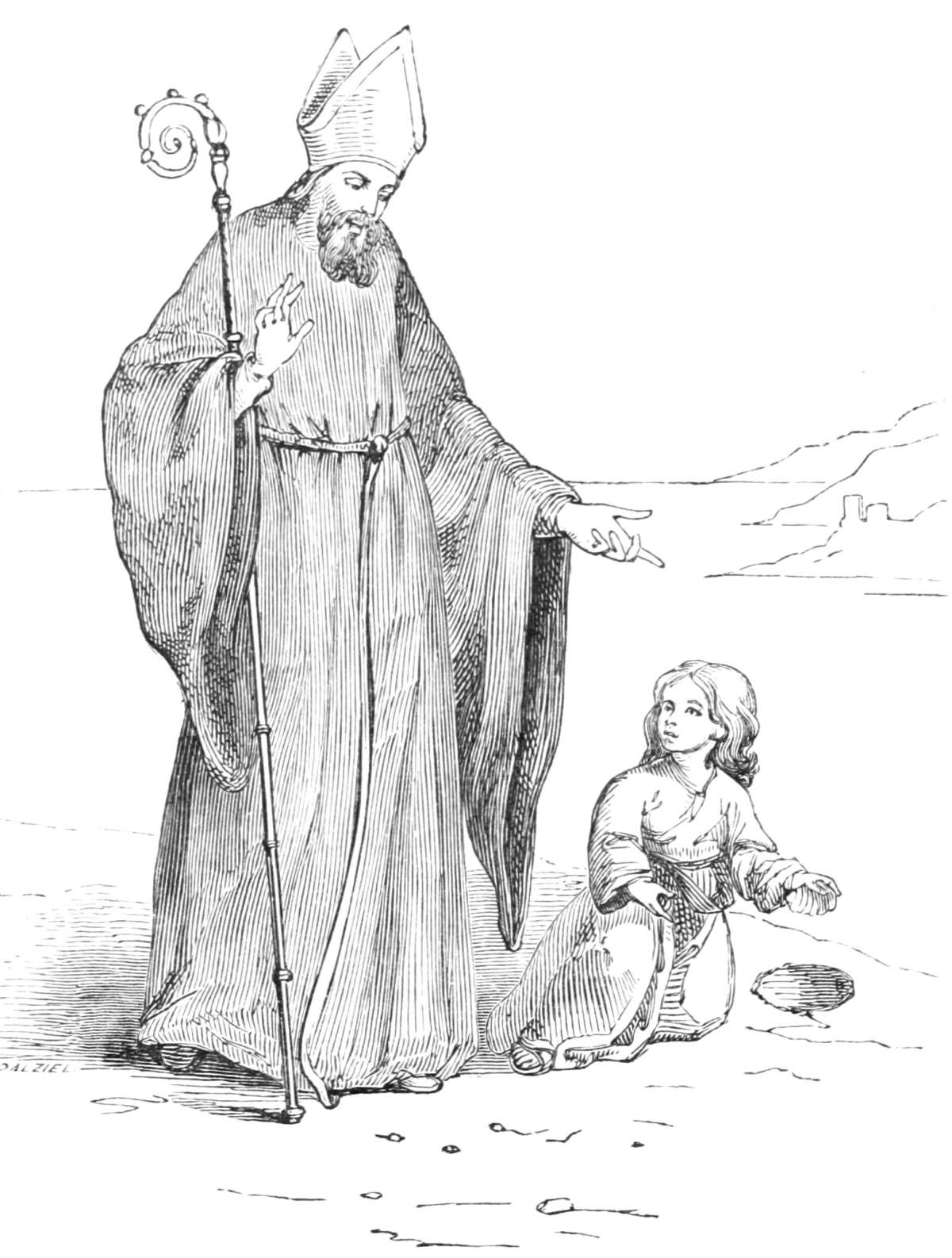
[89] The Vision of St. Augustine (Murillo)
This, however, is not the famous subject called, in general, 8. ‘The Vision of St. Augustine,’ which represents a dream or vision related by himself. He tells us that while busied in writing his Discourse on the Trinity, he wandered along the sea-shore lost in meditation. Suddenly he beheld a child, who, having dug a hole in the sand, appeared to be bringing water from the sea to fill it. Augustine inquired what was the object of his task? He replied, that he intended to empty into this cavity all the waters of the great deep. ‘Impossible!’ exclaimed Augustine. ‘Not more impossible,’ replied the child, ‘than for thee, O Augustine! to explain the mystery on which thou art now meditating.’
No subject from the history of St. Augustine has been so often treated, yet I do not remember any very early example. It was adopted as a favourite theme when Art became rather theological than religious, and more intent on illustrating the dogmas of churchmen than the teaching of Christ. During the 16th and 17th centuries we find it everywhere, and treated in every variety of style; but the motif does not vary, and the same fault prevails too generally, of giving us a material fact, rather than a spiritual vision or revelation. Augustine, arrayed in his black habit or his episcopal robes, stands on the sea-shore, gazing with an astonished air on the Infant Christ, who pauses, and looks up from his task, holding a bowl, a cup, a ladle, or a shell in his hand. Thus we have it in Murillo’s picture—the most beautiful example I have seen: the child is heavenly, but not visionary, ‘palpable to feeling as to sense.’
In Garofalo’s picture of this subject, now in our National Gallery, Augustine is seated on a rock by the margin of the sea, habited in his episcopal robes, and with his books and writing implements near him; and while he gazes on the mysterious child, the Virgin appears amid a choir of angels above: behind Augustine stands St. Catherine, the patron saint of theologians and scholars: the little red figure in the background represents St. Stephen, whose life and actions are eloquently set forth in the homilies of St. Augustine: the introduction of St. Catherine, St. Stephen, and the whole court of heaven, gives the picture a visionary character. Rubens has painted this subject with all his powerful reality: here Augustine wears the black habit of his Order. Vandyck in his large grand picture has introduced St. Monica kneeling, thus giving at once the devotional or visionary character.[284] Albert Dürer has designed and engraved the same subject. The most singular treatment is the classical composition of Raphael, in one of the small chiaro-scuro pictures placed significantly under the ‘Dispute of the Sacrament.’ St. Augustine is in a Roman dress, bare-beaded, and on horseback; his horse starts and rears at the sight of the miraculous child.
There is something at once picturesque and mystical in this subject, which has rendered it a favourite with artists and theologians; yet there is always, at least in every instance I can recollect, something prosaic and literal in the treatment which spoils the poetry of the conception.
9. ‘St. Augustine and St. Stephen bury ‘Count Orgaz’—the masterpiece of Domenico el Greco, once in the Cathedral of Toledo, now in the Madrid Gallery. This Conde de Orgaz, as Mr. Ford tells us in his Handbook, lived in 1312, and had repaired a church in his lifetime, and therefore St. Stephen and St. Augustine came down from heaven to lay him in his tomb, in presence of Christ, the Virgin, and all the court of heaven. ‘The black and gold armour of the dead Count is equal to Titian; the red brocades and copes of the saints are admirable; less good are the Virgin and celestial groups. I have before mentioned the reason why St. Augustine and St. Stephen are often represented in companionship.
St. Monica is often introduced into pictures of her son, where she has, of course, the secondary place; her dress is usually a black robe, and a veil or coif, white or grey, resembling that of a nun or a widow. I have met with but one picture where she is supreme; it is in the Carmine at Florence. St. Monica is seated on a throne and attended by twelve holy women or female saints, six on each side. The very dark situation of this picture prevented me from distinguishing individually the saints around her, but Monica herself as well as the other figures have that grandiose air which belongs to the painter—Filippo Lippi.
I saw in the atelier of the painter Ary Scheffer, in 1845, an admirable picture of St. Augustine and his mother Monica. The two figures, not quite full length, are seated; she holds his hand in both hers, looking up to heaven with an expression of enthusiastic undoubting faith;— ‘the son of so many tears cannot be cast away!’ He also is looking up with an ardent, eager, but anxious, doubtful expression, which seems to say, ‘Help thou my unbelief!’ For profound and truthful feeling and significance, I know few things in the compass of modern Art that can be compared to this picture.[285]
St. Gregory.
Lat. Sanctus Gregorius Magnus. Ital. San Gregorio Magno or Papa. Fr. St. Grégoire. Ger. Der Heilige Gregor. (March 12, A.D. 604.)
The fourth Doctor of the Latin Church, St. Gregory, styled, and not without reason, Gregory the Great, was one of those extraordinary men whose influence is not only felt in their own time, but through long succeeding ages. The events of his troubled and splendid pontificate belong to history; and I shall merely throw together here such particulars of his life and character as may serve to render the multiplied representations of him both intelligible and interesting. He was born at Rome in the year 540. His father, Gordian, was of senatorial rank: his mother, Sylvia, who, in the history of St. Gregory, is almost as important as St. Monica in the story of St. Augustine, was a woman of rare endowments, and, during his childish years, the watchful instructress of her son. It is recorded that when he was still an infant she was favoured by a vision of St. Antony, in which he promised to her son the supreme dignity of the tiara. Gregory, however, commenced his career in life as a lawyer, and exercised during twelve years the office of prætor or chief magistrate of his native city; yet, while apparently engrossed by secular affairs, he became deeply imbued with the religious enthusiasm which was characteristic of his time and hereditary in his family. Immediately on the death of his father he devoted all the wealth he had inherited to pious and charitable purposes, converted his paternal home on the Celian Hill into a monastery and hospital for the poor, which he dedicated to St. Andrew: then, retiring to a little cell within it, he took the habit of the Benedictine Order, and gave up all his time to study and preparation for the duties to which he had devoted himself. On the occasion of a terrific plague which almost depopulated Rome, he fearlessly undertook the care of the poor and sick. Pope Pelagius having died at this time, the people with one voice called upon Gregory to succeed him: but he shrank from the high office, and wrote to the Emperor Maurice, entreating him not to ratify the choice of the people. The emperor sent an edict confirming his election, and thereupon Gregory fled from Rome, and bid himself in a cave. Those who went in search of him were directed to the place of his concealment by a celestial light, and the fugitive was discovered and brought back to Rome.
No sooner had he assumed the tiara, thus forced upon him against his will, than he showed himself in all respects worthy of his elevation. While he asserted the dignity of his station, he was distinguished by his personal humility: he was the first pope who took the title of ‘Servant of the Servants of God;’ he abolished slavery throughout Christendom on religious grounds; though enthusiastic in making converts, he set himself against persecution; and when the Jews of Sardinia appealed to him, he commanded that the synagogues which had been taken from them, and converted into churches, should be restored. He was the first who sent missionaries to preach the Gospel in England, roused to pity by the sight of some British captives exposed for sale in the market at Rome. Shocked at the idea of an eternity of vengeance and torment, if he did not originate the belief in purgatory, he was at least the first who preached it publicly, and made it an article of faith. In his hatred of war, of persecution, of slavery, he stepped not only in advance of his own time, but of ours. He instituted the celibacy of the clergy, one of the boldest strokes of ecclesiastical power; he reformed the services of the Church; defined the model of the Roman liturgy, such as it has ever since remained—the offices of the priests, the variety and change of the sacerdotal garments; he arranged the music of the chants, and he himself trained the choristers. ‘Experience,’ says Gibbon, ‘had shown him the efficacy of these solemn and pompous rites to soothe the distress, to confirm the faith, to mitigate the fierceness, and to dispel the dark enthusiasm of the vulgar; and he readily forgave their tendency to promote the reign of priesthood and superstition.’ If, at a period when credulity and ignorance were universal, he showed himself in some instances credulous and ignorant, it seems hardly a reproach to one in other respects so good and so great.
His charity was boundless, and his vigilance indefatigable: he considered himself responsible for every sheep of the flock intrusted to him; and when a beggar died of hunger in the streets of Rome, he laid himself under a sentence of penance and excommunication, and interdicted himself for several days from the exercise of his sacerdotal functions.
Such was St. Gregory the Great, the last pope who was canonised: celestial honours and worldly titles have often been worse—seldom so well—bestowed.
During the last two years of his life, his health, early impaired by fasts and vigils, failed entirely, and he was unable to rise from his couch. He died in 604, in the fourteenth year of his pontificate. They still preserve, in the church of the Lateran at Rome, his bed, and the little scourge with which he was wont to keep the choristers in order.
The monastery of St. Andrew, which he founded on the Celian Hill, is now the church of San Gregorio. To stand on the summit of the majestic flight of steps which leads to the portal, and look across to the ruined palace of the Cæsars, makes the mind giddy with the rush of thoughts. There, before us, the Palatine Hill—pagan Rome in dust: here, the little cell, a few feet square, where slept in sackcloth the man who gave the last blow to the power of the Cæsars, and first set his foot as sovereign on the cradle and capital of their greatness.
St. Gregory was in person tall and corpulent, and of a dark complexion, with black hair, and very little beard. He speaks in one of his epistles of his large size, contrasted with his weakness and painful infirmities. He presented to the monastery of St. Andrew his own portrait, and those of his father, and his mother St. Sylvia: they were still in existence 300 years after his death, and the portrait of Gregory probably furnished that particular type of physiognomy which we trace in all the best representations of him, in which he appears of a tall, large, and dignified person, with a broad full face, black hair and eyebrows, and little or no beard.
As he was, next to St. Jerome, the most popular of the Four Doctors, single figures of him abound. They are variously treated: in general, he bears the tiara as pope, and the crosier with the double cross, in common with other papal saints; but his peculiar attribute is the dove, which in the old pictures is always close to his ear. He is often seated on a throne in the pontifical robes, wearing the tiara: one hand raised in benediction; in the other a book, which represents his homilies, and other famous works attributed to him: the dove either rests on his shoulder, or is hovering over his head. He is thus represented in the fine statue, designed, as it is said, by M. Angelo, and executed by Cordieri, in the chapel of St. Barbara, in San Gregorio, Rome; and in the picture over the altar-piece of his chapel, to the right of the high altar. In the Salviati Chapel, on the left, is the ‘St. Gregory in prayer,’ by Annibal Caracci. He is seen in front bareheaded, but arrayed in the pontifical habit, kneeling on a cushion, his hands outspread and uplifted; the dove descends from on high; the tiara is at his feet, and eight angels hover around:—a grand, finely-coloured, but, in sentiment, rather cold and mannered picture.[286]
By Guercino, St. Gregory seated on a throne, looking upwards, his hand on an open book, in act to turn the leaves; the dove hovers at his shoulder: to the left stands St. Francis Xavier; on the right, and more in front, St. Ignatius Loyola. Behind St. Gregory is an angel playing on the viol, in allusion to his love and patronage of sacred music; in front an infant angel holds the tiara. The type usually adopted in figures of St. Gregory is here exaggerated into coarseness, and the picture altogether appears to me more remarkable for Guercino’s faults than for his beauties.[287]
Several of the legends connected with the history of St. Gregory are of singular interest and beauty, and have afforded a number of picturesque themes for Art: they appear to have arisen out of his exceeding popularity. They are all expressive of the veneration in which he was held by the people; of the deep impression left on their minds by his eloquence, his sanctity, his charity; and of the authority imputed to his numerous writings, which commonly said to have been dictated by the Holy Spirit.
1. John the deacon, his secretary, who has left a full account of his life, declares that he beheld the Holy Ghost in the form of a dove perched upon his shoulder while he was writing or dictating his famous homilies. This vision, or rather figure of speech, has been interpreted as a fact by the early painters. Thus, in a quaint old picture in the Bologna Gallery, we have St. Gregory seated on a throne writing, the celestial dove at his ear. A little behind is seen John the deacon, drawing aside a curtain, and looking into the room at his patron with an expression of the most naïve astonishment.
2. The Archangel Michael, on the cessation of the pestilence, sheathes his sword on the summit of the Mole of Hadrian. I have never seen even a tolerable picture of this magnificent subject. There is a picture in the Vatican, in which Gregory and a procession of priests are singing litanies, and in the distance a little Mola di Adriano, with a little angel on the summit;—curious, but without merit of any kind.
3. The Supper of St. Gregory. It is related that when Gregory was only a monk, in the Monastery of St. Andrew, a beggar presented himself at the gate, and requested alms: being relieved, he came again and again, and at length nothing was left for the charitable saint to bestow, but the silver porringer in which his mother, Sylvia, had sent him a potage; and he commanded that this should be given to the mendicant. It was his custom, when he became pope, to entertain every evening at his own table twelve poor men, in remembrance of the number of our Lord’s apostles. One night, as he sat at supper with his guests, he saw, to his surprise, not twelve, but thirteen seated at his table. And he called to his steward, and said to him, ‘Did I not command thee to invite twelve? and behold, there are thirteen!’ And the steward told them over, and replied, ‘Holy Father, there are surely twelve only!’ and Gregory held his peace; and after the meal, he called forth the unbidden guest, and asked him, ‘Who art thou?’ And he replied, ‘I am the poor man whom thou didst formerly relieve; but my name is the Wonderful, and through me thou shalt obtain whatever thou shalt ask of God.’ Then Gregory knew that he had entertained an angel (or, according to another version of the story, our Lord himself). This legend has been a frequent subject in painting, under the title of ‘The Supper of St. Gregory.’ In the fresco in his church at Rome, it is a winged angel who appears at the supper-table. In the fresco of Paul Veronese, one of his famous banquet-scenes, the stranger seated at the table is the Saviour habited as a pilgrim.[288] In the picture painted by Vasari, his masterpiece, now in the Bologna Gallery, he has introduced a great number of figures and portraits of distinguished personages of his own time, St. Gregory being represented under the likeness of Clement VII. The unbidden guest, or angel, bears the features of the Saviour.
This is one of many beautiful mythic legends, founded on the words of St. Paul in which he so strongly recommends hospitality as one of the virtues: ‘Be not forgetful to entertain strangers: for thereby some have entertained angels unawares.’ (Heb. xiii. 2.) Or, as Massinger has rendered the apostolic precept,—
Learn all, By this example, to look on the poor With gentle eyes, for in such habits often Angels desire an alms.
4. The Mass of St. Gregory. On a certain occasion, when St. Gregory was officiating at the mass, one who was near him doubted the real presence; thereupon, at the prayer of the saint, a vision is suddenly revealed of the crucified Saviour himself, who descends upon the altar, surrounded by the instruments of his passion. This legend has been a popular subject of painting from the beginning of the fifteenth century, and is called ‘The Mass of St. Gregory.’ I have met with it in every variety of treatment and grouping; but, however treated, it is not a pleasing subject. St. Gregory is seen officiating at the altar, surrounded by his attendant clergy. Sometimes several saints are introduced in a poetical manner, as witnesses of the miracle: as in an old picture I saw in the gallery of Lord Northwick;—the crucified Saviour descends from the cross, and stands on the altar, or is upborne in the air by angels; while all the incidental circumstances and instruments of the Passion,—not merely the crown of thorns, the spear, the nails, but the kiss of Judas, the soldiers’ dice, the cock that crew to Peter,—are seen floating in the air. As a specimen of the utmost naïveté in this representation may be mentioned Albert Dürer’s woodcut.
The least offensive and most elegant in treatment is the marble bas-relief in front of the altar in the Chapel of St. Gregory at Rome.
5. The miracle of the Brandeum. The Empress Constantia sent to St. Gregory requesting some of the relics of St. Peter and St. Paul. He excused himself, saying that he dared not disturb their sacred remains for such a purpose, but he sent her part of a consecrated cloth (Brandeum) which had enfolded the body of St. John the Evangelist. The empress rejected this gift with contempt: whereupon Gregory, to show that such things are hallowed not so much in themselves as by the faith of believers, laid the Brandeum on the altar, and after praying he took up a knife and pierced it, and blood flowed as from a living body. This incident, called the ‘miracle dei Brandei,’ has also been painted. Andrea Sacchi has represented it in a grand picture now in the Vatican; the mosaic copy is over the altar of St. Gregory in St. Peter’s. Gregory holds up to view the bleeding cloth, and the expression of astonishment and conviction in the countenances of the assistants is very fine.
6. St. Gregory releases the soul of the Emperor Trajan. In a little picture in the Bologna Academy, he is seen praying before a tomb, on which is inscribed Trajano Imperador; beneath are two angels raising the soul of Trajan out of the flames. Such is the usual treatment of this curious and poetical legend, which is thus related in the Legenda Aurea:—‘It happened on a time, as Trajan was hastening to battle at the head of his legions, that a poor widow flung herself in his path, and cried aloud for justice, and the emperor stayed to listen to her; and she demanded vengeance for the innocent blood of her son, killed by the son of the emperor. Trajan promised to do her justice when he returned from his expedition. “But, Sire,” answered the widow, “should you be killed in battle, who then will do me justice?” “My successor,” replied Trajan. And she said, “What will it signify to you, great emperor, that any other than yourself should do me justice? Is it not better that you should do this good action yourself than leave another to do it?” And Trajan alighted, and having examined into the affair, he gave up his own son to her in place of him she had lost, and bestowed on her likewise a rich dowry. Now, it came to pass that as Gregory was one day meditating in his daily walk, this action of the Emperor Trajan came into his mind, and he wept bitterly to think that a man so just should be condemned as a heathen to eternal punishment. And entering into a church he prayed most fervently that the soul of the good emperor might be released from torment. And a voice said to him, “I have granted thy prayer, and I have spared the soul of Trajan for thy sake; but because thou hast supplicated for one whom the justice of God had already condemned, thou shalt choose one of two things: either thou shalt endure for two days the fires of purgatory, or thou shalt be sick and infirm for the remainder of thy life.” Gregory chose the latter, which sufficiently accounts for the grievous pains and infirmities to which this great and good man was subjected, even to the day of his death.’
This story of Trajan was extremely popular in the middle ages: it is illustrative of the character of Gregory, and the feeling which gave rise to his doctrine of purgatory. Dante twice alludes to it; he describes it as one of the subjects sculptured on the walls of Purgatory, and takes occasion to relate the whole story:—
... There was storied on the rock Th’ exalted glory of the Roman prince, Whose mighty worth moved Gregory to earn His mighty conquest—Trajan the Emperor. A widow at his bridle stood attired In tears and mourning. Round about them troop’d Full throng of knights: and overhead in gold The eagles floated, struggling with the wind. The wretch appear’d amid all these to say: ‘Grant vengeance, Sire! for, woe beshrew this heart, My son is murder’d!’ He, replying, seem’d: ‘Wait now till I return.’ And she, as one Made hasty by her grief: ‘O Sire, if thou Dost not return?’—‘Where I am, who then is, May right thee.’—‘What to thee is others’ good, If thou neglect thy own?’—‘Now comfort thee,’ At length he answers. ‘It beseemeth well My duty be perform’d, ere I move hence. So justice wills; and pity bids me stay.’ Cary’s Dante, Purg. x.
It was through the efficacy of St. Gregory’s intercession that Dante afterwards finds Trajan in Paradise, seated between King David and King Hezekiah. (Par. xx.)
As a subject of painting, the story of Trajan was sometimes selected as an appropriate ornament for a hall of justice. We find it sculptured on one of the capitals of the pillars of the Ducal Palace at Venice: there is the figure of the widow kneeling, somewhat stiff, but very simple and expressive, and over it in rude ancient letters—‘Trajano Imperador, che die justizia a la Vedova.’ In the Town Hall of Ceneda, near Belluna, are the three Judgments (i tre Giudizi), painted by Pompeo Amalteo: the Judgment of Solomon, the Judgment of Daniel, and the Judgment of Trajan. It is painted in the Town Hall of Brescia by Giulio Campi, one of a series of eight righteous judgments.
I found the same subject in the church of St. Thomas of Canterbury at Verona. ‘The son of the Emperor Trajan trampling over the son of the widow’ is a most curious composition by Hans Schaufelein.[289]
7. There was a monk, who, in defiance of his vow of poverty, secreted in his cell three pieces of gold. Gregory, on learning this, excommunicated him, and shortly afterwards the monk died. When Gregory heard that the monk had perished in his sin, without receiving absolution, he was filled with grief and horror; and he wrote upon a parchment a prayer and a form of absolution, and gave it to one of his deacons, desiring him to go to the grave of the deceased and read it there: on the following night the monk appeared in a vision, and revealed to him his release from torment.
This story is represented in the beautiful bas-relief in white marble in front of the altar of his chapel; it is the last compartment on the right. The obvious intention of this wild legend is to give effect to the doctrine of purgatory, and the efficacy of prayers for the dead.
St. Gregory’s merciful doctrine of purgatory also suggested those pictures so often found in chapels dedicated to the service of the dead, in which he is represented in the attitude of supplication, while on one side, or in the background, angels are raising the tormented souls out of the flames.
In ecclesiastical decoration I have seen the two popes, St. Gelasius, who reformed the calendar in 494, and St. Celestinus, who arranged the discipline of the monastic orders, added to the series of beatified Doctors of the Church.
II. THE FOUR GREEK FATHERS.
The Four Greek Fathers are St. John Chrysostom, St. Basil the Great, St. Athanasius, and St. Gregory Nazianzen. To these, in Greek pictures, a fifth is generally added, St. Cyril of Alexandria.
From the time of the schism between the Eastern and Western Churches, these venerable personages, who once exercised such an influence over all Christendom, who preceded the Latin Fathers, and were in fact their teachers, have been almost banished from the religious representations of the west of Europe. When they are introduced collectively as a part of the decoration of an ecclesiastical edifice, we may conclude in general, that the work is Byzantine and executed under the influence of Greek artists.
A signal example is the central dome of the baptistery of St. Mark’s at Venice, executed by Greek artists of the 12th and 13th centuries. In the four spandrils of the vault are the Greek Fathers seated, writing (if I well remember), and in the purest Byzantine style of art. They occupy the same places here that we find usually occupied by the Latin Doctors in church decoration: each has his name inscribed in Greek characters. We have exactly the same representation in the Cathedral of Monreale at Palermo. The Greek Fathers have no attributes to distinguish them, and the general custom in Byzantine Art of inscribing the names over each figure renders this unnecessary: in general, each holds a book, or, in some instances, a scroll, which represents his writings; while the right hand is raised in benediction, in the Greek manner, the first and second finger extended, and the thumb and third finger forming a cross. According to the formula published by M. Didron, each of the Greek Fathers bears on a scroll the first words of some remarkable passage from his works: thus, St. John Chrysostom has ‘God, our God, who hath given us for food the bread of life,’ &c.: St. Basil, ‘None of those who are in the bondage of fleshly desires are worthy,’ &c.: St. Athanasius, ‘Often, and anew, do we flee to thee, O God,’ &c.: St. Gregory Nazianzen, ‘God, the holy among the holies, the thrice holy,’ &c.: and St. Cyril, ‘Above all, a Virgin without sin or blemish,’ &c.