WAC Corporal
Reading edition
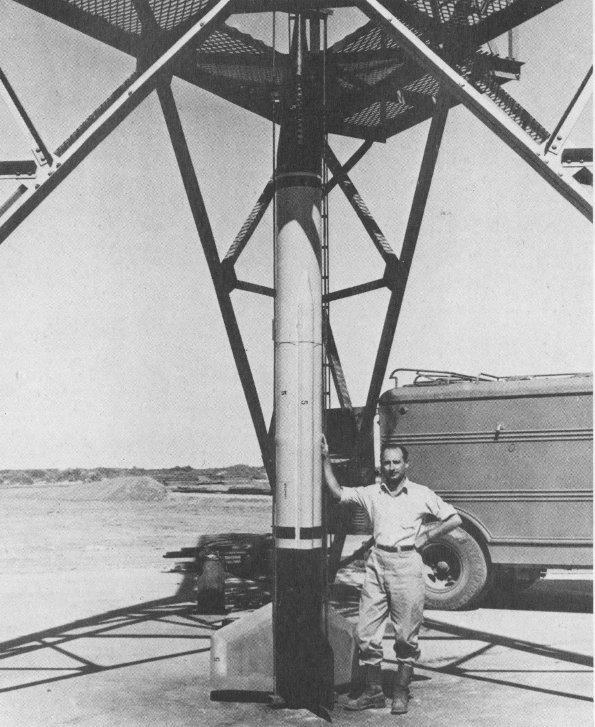
21. Frank Malina, project leader in the development of the WAC Corporal, stands beside the high-altitude sounding rocket.
The WAC Corporal was the first successful American sounding rocket to reach significant altitude. The first WAC Corporal, launched in 1944 from White Sands Proving Ground in New Mexico, reached a height of 71,600 meters (235,000 feet). The fin-stabilized rocket was powered by a liquid-propellant engine that burned a self-igniting fuel and oxidizer combination. Use of these propellants eliminated the need for an ignition system. By March 1946, these rockets had attained altitudes of over 72.4 kilometers (45 miles) with a booster. The WAC Corporal was later used as a second stage on a German V-2 rocket. This U.S. program, code-named “Bumper,” tested techniques for ignition and separation of stages at high altitudes.
The WAC Corporal was designed in 1944 by the staff of the Jet Propulsion Laboratory, California Institute of Technology.
The rocket on exhibit is from the California Institute of Technology.
Length 4.9 m. (16 ft., 2 in.) as exhibited
Diameter 30.5 cm. (12 in.)
Fuel Aniline-furfuryl alcohol
Oxidizer Red-fuming nitric acid
Thrust 680 kg. (1500 lb.)
Velocity 4500 km. (2800 mi.) per hr. at burnout
Altitude 72 km. (45 mi.) with a 11.3-kilogram (25-lb.) payload
20