Surveyor
Reading edition
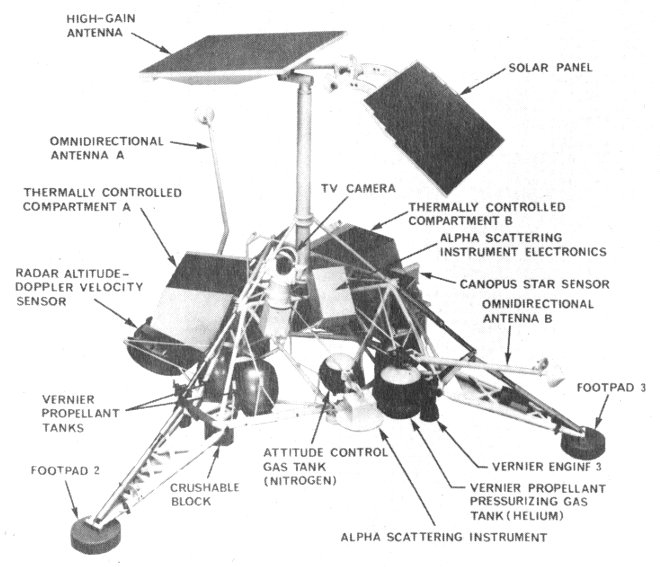
43. Surveyor.
High-gain Antenna
Omnidirectional Antenna A
Thermally Controlled Compartment A
Radar Altitude - Doppler Velocity Sensor
Vernier Propellant Tanks
Footpad 2
Crushable Block
Attitude Control Gas Tank (Nitrogen)
Solar Panel
TV Camera
Thermally Controlled Compartment B
Alpha Scattering Instrument Electronics
Canopus Star Sensor
Omnidirectional Antenna B
Footpad 3
Vernier Engine 3
Vernier Propellant Pressurizing Gas Tank (Helium)
Alpha Scattering Instrument
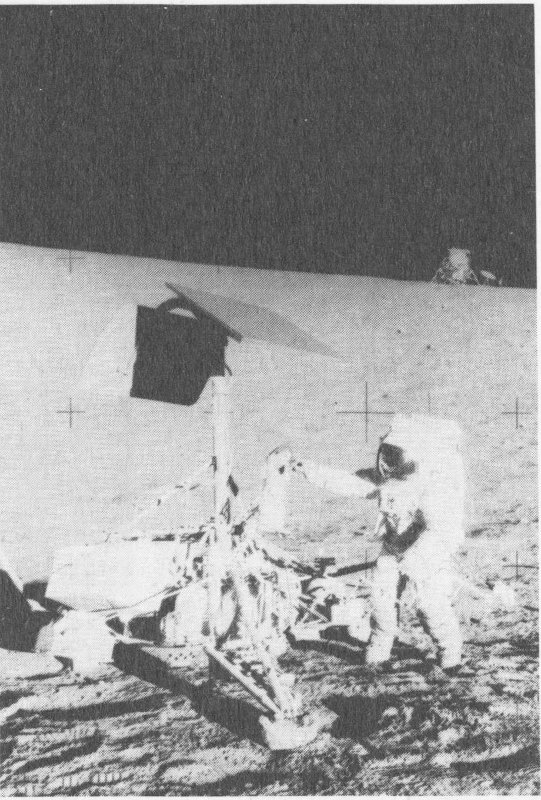
44. Apollo 12 crewman examines Surveyor 3, which soft-landed on the Moon on April 19, 1967. The Apollo 12 (1969) Lunar Module is in the background.
The Surveyor Project, begun in 1960, consisted of seven unmanned spacecraft which were launched between May 30, 1966, and January 6, 1968. The craft were used to develop lunar soft-landing techniques, to survey potential Apollo landing sites, and to improve scientific understanding of the Moon.
Five of the seven Surveyor spacecraft successfully landed on the Moon and performed their tasks well. They responded to 600,545 commands from Earth and returned 87,632 television images of their lunar surroundings. (Surveyors 2 and 4 crashed into the Moon and were destroyed.)
Besides returning TV images, Surveyors 3, 5, 6, and 7 carried a soil-sampling claw which could dig a trench, and test soil hardness and other characteristics. The soil-sampler tests showed that the lunar surface would bear the weight of an Apollo Lunar Module.
Surveyors 5, 6, and 7 carried instruments capable of making simple chemical analyses of the lunar soil near the spacecraft. This information told scientists that most lunar soil near the Surveyors was basalt, a common rock on Earth as well.
The Surveyor spacecraft on exhibit, designated S-10, was used in ground-based tests of on-board equipment, and was not used on a mission. S-10 is exhibited as it would have appeared just before landing on the Moon.
Prime contractor for the Surveyor spacecraft was the Hughes Aircraft Company. The project was managed by the National Aeronautics and Space Administration, Jet Propulsion Laboratory, California Institute of Technology, Pasadena, California.
The spacecraft on exhibit is from the National Aeronautics and Space Administration.
Height 3 m. (10 ft.)
Distance across footpads 3.5 m. (11 ft., 6 in.)
Weight 1000 kg. (2204 lb.) at launch; 292 kg. (644 lb.) as exhibited
Electrical power One .83 sq. m. (9 sq. ft.) solar panel providing 89 w. to a silver-zinc battery
Landing vernier rocket system Three throttleable liquid-propellant rockets each providing from 14.6 to 47.2 kg. thrust (30 to 104 lb. thrust). Fuel—Monomethylhydrazine monohydrate; oxidizer 90% nitrogen tetroxide and 10% nitric oxide.
37