Goddard Rockets: May 1926 and “Hoopskirt,” 1928
Reading edition
The American pioneer of astronautics, Robert H. Goddard (1882-1945) not only outlined the physical principles that would govern space flight, but he also constructed and tested many rocket engines, airframes, control devices, and guidance mechanisms between 1926 and 1942.
Goddard held a doctorate in physics, and was a professor at Clark University, Worcester, Massachusetts. The Smithsonian Institution began funding Goddard’s experiments as early as 1917 and published his first major work, A Method of Reaching Extreme Altitudes, in 1919.
Goddard was not only a trained scientist, but a talented and ingenious engineer as well. On March 16, 1926, he launched the world’s first liquid-propellant rocket. By 1930, he had established a rocket test facility at Mescalero Ranch, near Roswell, New Mexico. Here, he conducted research, funded by the Daniel and Florence Guggenheim Foundation, on rocket power plants, pumps and fuel systems, control mechanisms, and other vital elements of the modern rocket.
The Rocket of May 4, 1926
This vehicle is the oldest surviving liquid-propellant rocket in the world. Built of parts employed in the first liquid-propellant rocket launched on March 16, 1926, the engine was moved from the nose of the vehicle to the rear for the May 4 trial. Other changes were introduced to reduce the weight of the rocket to 2.5 kilograms (5.5 pounds). The motor burned gasoline and liquid oxygen.
The alcohol burner under the liquid oxygen tank was inadvertently not ignited, causing the May 4 attempted launch to fail. A second test on May 5 also proved unsuccessful. However, the rocket engine was fired on both occasions.
The May 4 rocket is from Mrs. Robert H. Goddard and the Daniel and Florence Guggenheim Foundation.
May 1926 rocket
Length 1.95 m. (6 ft., 4 in.)
Weight 2.5 kg. (5.5 lb.)
Fuel Gasoline
Oxidizer Liquid oxygen
The “Hoopskirt” Rocket
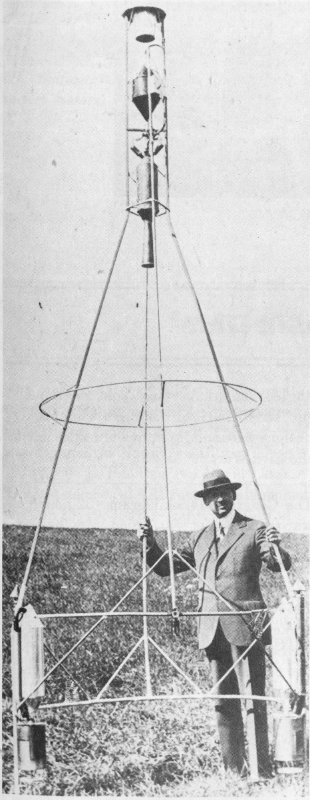
45. Dr. Goddard and the “Hoopskirt.” Propellant tanks are on legs of frame.
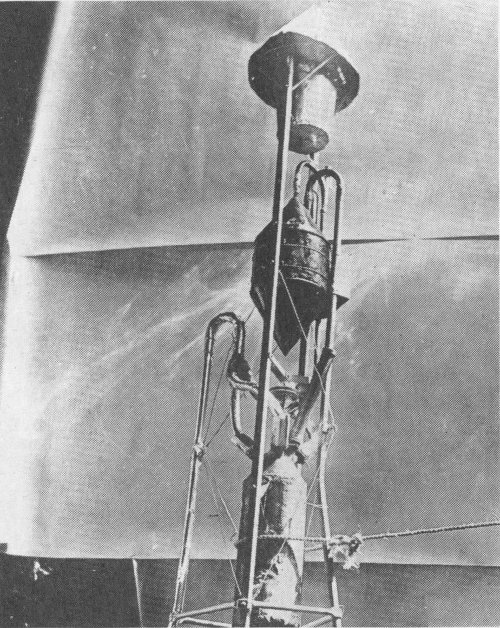
46. The upper section of the “Hoopskirt” rocket.
Developed by Dr. Goddard during the late summer and early fall of 1928, the “Hoopskirt” rocket featured a small rocket engine mounted in the nose and a system of tanks and alcohol burners—to maintain fuel pressure—mounted on two legs. On December 26, 1928, the rocket flew 62.33 meters (204.5 feet) in 3.2 seconds—its most successful flight. Like all Goddard rockets, the “Hoopskirt” burned gasoline and liquid oxygen.
The “Hoopskirt” rocket is from Mrs. Robert H. Goddard.
“Hoopskirt”
Height 4.5 m. (14 ft., 8 in.)
Weight 12.93 kg. (28.5 lb.)
Fuel Gasoline
Oxidizer Liquid oxygen
38