Volume 7 — CONTENTS OF VOLUME VII. (continued 5)
Reading edition
Here Mrs. Trudge sobbed aloud, and it was a long time before poor Mr. Trudge could be made to understand the mistake he had made. He was at last compelled to order the piano, even though it cost four hundred dollars, and he considered the peace with his wife, 142 which he thus purchased, to have been cheaply obtained.
Another vexation which Mrs. Trudge experienced, arose from her servants. Sometimes she was familiar, sometimes imperious and tyrannical. She therefore secured neither the respect nor affection of those around her. She was accordingly accustomed to indulge in the fashionable outcry against her “help.”
An incident which throws some light upon this topic, it may be worth while to relate. Mrs. Million had recently introduced bells into her house, and Bridget followed suit. The servants conceived a dislike to being thus summoned into the presence of their mistress. It struck them not only as an innovation, but as a rude and harsh mode of calling them. Mrs. Trudge’s manner was not calculated to allay this aversion, for while the bells were being put up, she seemed to assume a loftier tone than usual.
When they were at last arranged, she attired herself in a splendid satin dress, took a bottle of hartshorn, reclined luxuriously upon a sofa, and then pulled the bell-rope, which was near. She waited a little, but no one came at the summons. She pulled again, but there was no answer. At last, she gave the cord an imperious twitch, which nearly sundered the wires. In a few seconds, the chambermaid popped her head in at the door, and said spitefully to her mistress, “You may pull and pull till you are gray, Miss Trudge; the more you ring, the more I won’t come.”
Such were some of the vexations which disturbed the brilliant career of our heroine. There were others, also, and even those of a more serious character. But she still pressed forward in her course of ambition. She seemed indeed to be always in a flurry, and to keep everybody around her in a constant state of uneasy excitement. She was indeed never happy for a moment, and seemed ever to be tormented with the desire of chasing a phantom she could never obtain. If, indeed, she had any enjoyments, they consisted only of the fleeting pleasures which characterize little minds—the idea that she was exciting the envy and admiration of those around her.
Thus affairs proceeded for several years, but, at last, a crisis came. The extravagance of the family not only exhausted the whole of Trudge’s fortune, but ran him in debt. His creditors came upon him, and as he could not meet their demands, he was declared a bankrupt. The event found Mrs. Trudge upon the full tide of fashionable dissipation. She was struck like a bird in mid flight. She could not, and would not at first, believe the melancholy tidings. It was, alas! too true, and she was compelled to submit to her cruel fate.
With scarcely a shilling in his pocket, and only a few necessary articles of furniture which his creditors had allowed him, poor Tom set out with his wife and children to return to the little brown dwelling, which he had occupied before his drawing the prize. They were obliged to go on foot, and as Bridget proceeded down the nicely-gravelled walk, thus taking leave of her splendid mansion forever, she felt a keener pang than 143 can be well uttered in words. She was indeed the very image of despair. Her pride was humbled—her prospects blighted—her heart broken. Tom led the way, and though he felt for his wife and children, there was a remarkable aspect of cheerfulness in his countenance.
The party at length arrived at their dwelling. It seemed so desolate and bare, that for two or three days Bridget seemed utterly crushed. Tom treated her with great tenderness, and, at the same time, kept up a cheerful air. In a few days, Bridget’s good sense and energy of character prevailed. She entered upon her duties, and before a fortnight had passed, she seemed not only resigned to her fate, but absolutely content. Tom whistled, and danced, and said that he was ten times happier than when he lived in the great house. He could now wear an easy old coat, and shoes that did not pinch his corns. Beside, he had been weary of the idle life he had led, and he now entered upon his old trade as a pedler, with pleasure and alacrity. The children soon became accustomed to the change, and, in less than three months after their downfall, Tom and his wife both agreed that they were happier in their brown house than they ever had been in the big mansion.
“Style and splendor may do for those who are brought up to it,” said Tom; “but, after all, the comfort and content of the cottage are much better. Don’t you think so, Bridget?”
“Yes, Tom, I do indeed,” said the spouse.
Tom. It’s almost equal to the jinnysyquaw, an’t it, Bridget?
Mrs. T. Hold your tongue, Tom!
Anecdote of a Tiger.—One day a singular circumstance took place in a menagerie near London, which shows the retentive memory of the tiger. A sailor, who had been strolling round the exhibition, loitering here and there to admire the animals, was attracted by a strange noise, made by a tiger, who seemed irritated beyond endurance. Jack, somewhat alarmed, sought the keeper to inquire the cause of so singular a display of feeling, which, he remarked, became more boisterous, the nearer he approached the animal. The keeper replied, that the behavior of the tiger indicated that he was either vastly pleased, or very much annoyed. Upon this, the sailor again approached the den, and gazed at the tiger a few minutes, during which time the animal became frantic with seeming rage, lashing his tail against his sides, and giving utterance to the most frightful bellowings. He soon discovered the tiger to be one that he had, not long before, brought to England, and which had been his especial care.
It now was Jack’s turn to be delighted, as it appears the tiger was, in thus recognizing his old friend; and, after making repeated applications to be permitted to enter the den, for the purpose, he said, of “shaking a fist” with the beautiful animal, he was suffered to do so. The iron door was opened, and in jumped Jack, to the delight of himself and his striped friend, and the astonishment of the lookers-on. The affection of the animal was now shown by caressing and licking the pleased sailor, whom he seemed to welcome with the heartiest satisfaction; and when the honest tar left the den, the anguish of the poor animal seemed almost insupportable.
144
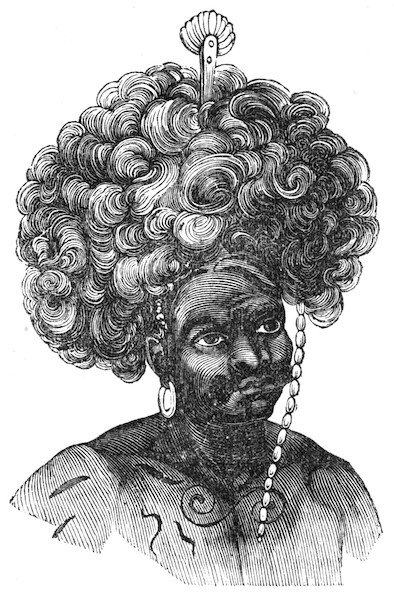
Miss Pappoo.
Here she is—Miss Pappoo—all the way from New Guinea—a specimen of humanity which shows the lovely, fascinating, bewitching effect of an exuberant quantity of hair. It is all her own, too! not purchased at Gilbert’s, nor forced by beef marrow, antique oil, bear’s grease, or Macassar ointment! No; it is pure, genuine nature.
It may be that there are some persons who cannot appreciate the loveliness of Miss Pappoo’s locks; but every day, we see in our streets, certain young and middle-aged men, who strike us as kindred spirits. They possess long, tangled locks, and an immense quantity of beard, covering each side of the face, the throat, and the chin. Sometimes it is permitted also to cover the upper lip. This bushy beard gives to a man the somewhat simpering aspect of an old goat; but still, it would seem that many of our beaux are delighted at making such a figure. Their great desire seems to be to run to hair.
It is to be remarked that in general these excessively whiskered gentry have low crowns, and of course a small quantity of brains, and probably the little they have is of rather an inferior quality. 145 Still, they seem satisfied, nay, delighted—conceited even—if they can make up this deficiency with an enormous quantity of bristles growing out of their chins.
To all such persons, we present Miss Pappoo, not doubting that there will be a sympathy—a fellow-feeling between her and them. They truly can appreciate a character so eminently distinguished for hair. She is a native of the great island of Papua, or New Guinea, lying in the Pacific Ocean, near New Holland. She is dressed in the highest fashion of her country, and doubtless would pass for a belle of the first order there.
Now, if any of our whiskered countrymen, impelled by a fellow-feeling for Miss Pappoo, are desirous of a nearer acquaintance, we will do what we can to bring about an introduction between them and the fair Papuan. Let the letters of all applicants be written upon pink paper, perfumed with the otto of roses, marked on the outside with Cupid’s bow, and contain a specimen of the applicant’s whiskers.
Cosmopolite.
The Old Man in the Corner.
NO. V.
FABLES.
We must not be too much captivated with the deeds of those called great. It often happens that their victories and triumphs over others are obtained by unfair means; their successes are frequently purchased by meanness and treachery; and thus it is that, if we could see the truth even beneath their rays of glory, we should sometimes be taught to despise, rather than applaud their actions. The fable that follows may throw some light upon this subject.
THE GOLDEN SHIELD.
There was once a famous knight, who went forth in search of adventures. Now, he was a great coward and knave, but he got himself a shield of burnished gold, and so brilliant was it, that every eye was dazzled which looked upon it. When he met another knight, instead of giving him fair and honorable fight, he used to ride near him, and then slyly and unawares, would stab him with a dirk. His enemy would fall murdered to the ground, but the people, being dazzled by the glittering armor, would cry out, “Victory and honor to the knight of the golden shield!”
VANITY.
This folly or vice usually belongs to the weak and the idle—those who do little good to others, and are mostly occupied in thinking of themselves. Vanity is generally large and strong in proportion to the littleness of the individual who exercises it: one who is its victim, is incapable of judging of things rightly; even in the presence of what is great and sublime, he is blind to everything 146 except his important self. Hear the story of the
GRASSHOPPER AND THUNDER-CLOUD.
Upon the top of a mullen-stalk, sat a grasshopper, who thus complacently sang of himself:--
Was ever seen, in earth or air, As my sweet self, a thing so fair? My coat is made of shining green, My little wings are glossy sheen, My form is such as fairies love, My motions those that mark the dove; But oh! my voice, so soft and low, No music can so sweetly flow. The thrush is silent when I sing— The linnet stays on balanced wing— The oak doth hush its whispering leaves, No more its web the spider weaves, The rill and river cease their roar, And all around confess my power, E’en yonder passing thunder-cloud Pauses to hear, though yet so proud!
While the grasshopper thus indulged its strain of self-conceit, a bolt of lightning fell upon an oak near by, and shattered its trunk into a thousand splinters. One of them struck the mullen-stalk, and the vain insect was crushed in an instant.
Pictures of Various Nations.
CHAPTER V.
I could tell you a great deal more about the Indians, especially of the Cherokees, Creeks, Chickasaws, and other tribes, which have been removed by the government of the United States to a fine country northwest of Louisiana, where they have schools and churches, and cultivate their lands, and live much like white people. But I am afraid I am making too long a story. I shall, therefore, tell you something of certain queer tribes that seem to be a mixture of the American Indian and Esquimaux, and then proceed to other countries.
NOOTKA SOUND.
Let us cross to the western side of the continent of America. Here, far to the northwest, we find Nootka Sound, which is a bay in the Pacific Ocean, discovered by captain Cook, in 1778. Around this bay live a set of people, who in some respects differ from the North American Indians, though they have many traits in common with them.
On board one of the vessels which first entered Nootka Sound, in 1778, was John Ledyard, one of our own countrymen. He resided in Hartford some time after his return, where he wrote an account of his voyage. That account I have seen, and in it he speaks of the inhabitants who live round the Sound.
He says that the people there resemble the Indians on this side of the Rocky Mountains. They are tall, robust, and well made; but in this last respect, they do not equal the Indians farther east. Some of the women, however, appeared quite handsome.
They have large and full faces, high and prominent cheek bones, small and black eyes, broad and flat noses, thick lips, and teeth of the most brilliant whiteness. They fill their hair with oil, paint, and the down of birds. They also paint their faces with red, blue, and white colors. They look odd enough.
Some accounts represent them to be a 147 quiet, peaceable people; but others say that they are bold and ferocious. They give some evidence of being rather a wise people,—they do not talk much; but, perhaps, it is because they have not many ideas. This last, I think, is true, for they have no books, and no means of knowing much.
I am sorry to add, that they are said to be cannibals; that is, they eat human flesh. Ledyard saw, when he was there, not only human skulls and bones for sale; but, also, human flesh ready cooked. This made the sailors shudder, and well it might.
The only inhabited parts of the Sound are two villages, containing about two thousand people. Their houses are made of very long and broad plank, resting upon the edges of each other, fastened together by means of withes, and supported by posts.
As you enter one of their houses, you find benches raised on the sides of the room. These are covered with mats, upon which the family sit and sleep. The fireplace is in the middle of the floor, but they have neither hearth nor chimney.
They have very fine furs; and when Captain Cook was there, he purchased some, not thinking they were very valuable, but when he arrived in China, he sold skins, which cost but sixpence, for a hundred dollars. Since Captain Cook’s time, many vessels have been to Nootka Sound after furs, and made their voyages very profitable.
I will only add, that Nootka Sound lies west of Boston, about three thousand miles. But should any of my readers over go thither, they will probably go by water. In this case, if they sail from New York, they will proceed south along the American coast, round Cape Horn, and then north to the Sound. The voyage will take them about five months, and they will sail not less than fifteen thousand miles.
ONALASKA.
Before we return to the eastern side of the continent, we must notice the people who inhabit the Fox Islands, the largest of which is called Onalaska. This island lies in the Pacific Ocean, at some distance from the peninsula of Alaska, as you may perceive by looking on a map.
This island, also, was first discovered by Captain Cook, in 1778. The inhabitants here are described as being in stature about middle size, with full round faces, flat noses, black eyes and hair, but no beard; for this they pluck out by the roots as soon as it begins to grow. Their skin is quite dark, but is rendered still more so by the manner in which they live.
The inhabitants appear to be good-natured and benevolent; but if their anger is once roused, it is not easily allayed. Their common dress, in rainy weather, is a garment, made of the entrails of the sea-dog. This secures them against the rain. In dry and cold weather, they wear a garment made of feathers, curiously sewed together, and which costs a person sometimes a whole year’s labor. Their hats are made of wood, and very much resemble an umbrella.
They are quite fond of ornaments, particularly beads, and small ivory figures cut from the teeth of the sea-cow, 148 and with the bristles of the sea-lion’s beard—all of which they put upon their hats. The women ornament themselves with rings upon their fingers, and with belts of glass beads upon their wrists and ankles.
The houses in which they dwell are large holes, dug in the ground, and covered with a roof, over which earth is thrown, and grass grows upon it. In the centre of the roof a hole is cut. This is all the door, window, and chimney which they have. They enter the house, and go out of it, by means of an upright post, with pins in it. Their habitations are generally filthy places. They are filled with the smoke of burnt oil, which they use for light and cooking. They live principally upon fish and sea-dogs.
The canoes of these people are very ingenious. They build a wooden frame, which they cover with sea-dogs’ skins. They are light, and are pushed forward in the water with amazing rapidity.
CANADA.
It is a long distance from the island of Onalaska to Canada; but as we travel, we are soon there. Canada now belongs to Great Britain, and there are many English, Scotch and Irish people resident there; but it was first settled by the French, and there are more French than there are English. Some Americans, also, have settled there, for the purpose of trade.
The English and American inhabitants of Canada are intelligent and polished people, resembling the higher classes in England and America. These live principally in the large towns and cities.
The common people, or true Canadians, are French. They speak the French language; but it has lost much of its purity. Few among them know how either to read or write. They are, however, quite an honest, hospitable, and inoffensive people. They are very poor; and no wonder they are so, for they are a very lazy people. They seem to have few wants, and to be quite happy, and contented with their condition. Within a few years they have improved somewhat; but it will be a long time before they make much advance.
At an early period of life, the Canadian is healthy and robust; but he soon looks old and sallow, owing to his exposure to the weather, and the toils of the field. This is also true of the women, many of whom are quite handsome when young; but they soon fade. Both men and women frequently live, however, to advanced age.
Canada is a cold country. The winters are long and severe. The inhabitants protect themselves when they go abroad, by means of furs, in which they envelop themselves. They travel, during the cold season, in a kind of sledge, or open carriage, called a cariole. In these, they glide over deep snows and frozen rivers, with surprising celerity.
At the beginning of winter, the farmers, who are called habitants, kill hogs, cattle, and poultry, sufficient to serve them till spring, as well as to supply the markets. The carcasses they store in their garrets, where they soon become frozen, and keep without injury; or they bury them, and dig them out as wanted. Vegetables are preserved in a similar manner. The French Canadians are 149 chiefly Roman Catholics; the other inhabitants are of various sects.
I don’t want to go!—A curious incident occurred near Paris, not long since, in consequence of a balloon starting on its own hook, without the consent of the proprietor. A large concourse of people had assembled to see an æronaut take flight for the regions of upper air, but, unfortunately, before he took his seat in the car, the ærostat got loose, and the grappling-hook, which was dangling from the machine, hitched into the indescribables of a boy, who was gazing, open-mouthed, at the ascending mass, and carried him up willy-nilly.
The women screamed and fainted, but the lad, who seemed to have been a hero in his way, clasped the rope tightly with his hands and his feet, and, with an awful rent in his aforesaids, was introduced by his inflated companion into the upper circles. After a short voyage, the balloon descended, and deposited the little fellow safe and sound on the firm earth.
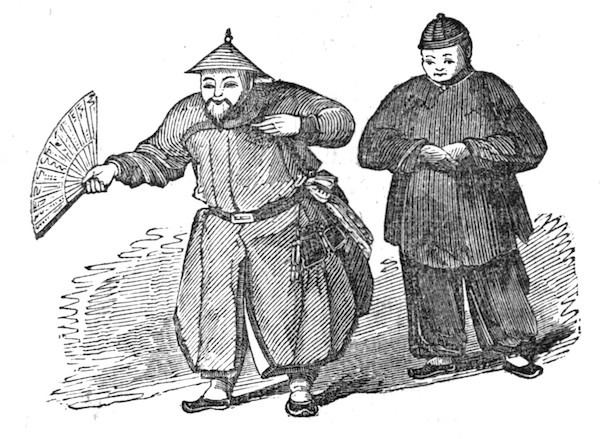
A Chinese Dandy.
The following description of a Chinese exquisite, is from a new work on China, by P. Dobel, formerly Russian Consul to China, and a resident in that country for seven years:—
“His dress is composed of crapes and silks of great price, his feet are covered with high-heeled boots of the most beautiful Nankin satin, and his legs are encased in gaiters, richly embroidered, and reaching to the knee. Add to this an acorn-shaped cap of the latest taste, an elegant pipe, richly ornamented, in which burns the purest tobacco of the Fokien, an English watch, a toothpick suspended to a button by a string of pearls, a Nankin 150 fan, exhaling the perfume of the tcholane, (a Chinese flower,) and you will have an exact idea of a fashionable Chinese.
“The Chinese dandy, like dandies of all times and all countries, is seriously occupied with trifles. He belongs either to the Quail Club or the Cricket Club. Like the ancient Romans, the Chinese train quails, quarrelsome birds, intrepid duellists, whose combats form the subject of senseless wagers. In imitation of the rich, the poorer Chinese place at the bottom of an earthen basin, two field crickets. These insects they excite and provoke, until they grow angry, attack each other, and the narrow field of battle is soon strewed with their claws, antennæ and corselets.
“There is between the Chinese and the old Romans as great a difference as there is between the combats of the crickets and the terrible combats of the gladiators.”
A Thrilling Narrative.
The town of St. Etienne, in the department of the Loire, has acquired, by its manufactures of iron and silk, the appellation of the Birmingham and Coventry of France. Though very far from contemptible, it is however, at most, only a miniature likeness of the two celebrated towns to which it is compared. For its prosperity, it is indebted to the circumstance of iron oar and coal being abundant in its vicinity. Among the coal mines in its immediate neighborhood, is that of Bois Monzil, the scene of the event which is now to be described.
On the 2d of February, 1831, about eight in the morning, when there were twenty-six men at work, a sudden detonation was heard, instantly followed by the roar of water, rushing from the adjoining pit. The cry of alarm was quickly spread through the mine, but only ten of the laborers were able to reach the entrance. One of them was driven forward with such violence, by the condensed air and the torrent, that his escape was miraculous; another was so terrified, that he hurried forward, without thinking to disencumber himself of a sack of coals which he had upon his shoulders; a third, who possessed both presence of mind and humanity, snatched up a boy of eleven years old and bore him away in his arms.
Eight individuals perished. Some of them were swept away by the deluge—but at least one of them had to endure a lingering death. He was heard for some hours knocking against the sides of his prison; at the end of that time the knocking ceased—the flood had overwhelmed him. The remaining eight workmen were fortunate enough to reach a gallery on a higher level; but, as it had no other outlet than that by which they entered, their fate was certain, unless the water should recede, or their friends could open a passage through the rock beneath them.
On hearing of the accident, the engineers of the mine hastened with their assistants to the spot. Thirty hours elapsed before the miners could penetrate into some of the lower galleries from which the water had retired. They repeatedly called aloud to their lost companions, but no voice was heard in reply. 151 They then struck with their pickaxes upon the roof, and after several fruitless trials, they were rejoiced to hear an equal number of answering knocks.
Measures were immediately adopted for opening a communication with the imprisoned men; the principal of them were the boring a hole through the rock, in the supposed direction whence the sound came, and the forming of an inclined tunnel. But there was much difficulty in ascertaining the point to which they ought to direct their efforts; for the sound of their blows on the roof, far from offering a certain criterion, or at least a probable one, seemed each time to excite fresh doubts. The rock, too, was so hard and thick, that the gunpowder employed in blasting it produced but a trifling effect; nor could the pumps be got to work, and they were therefore obliged to resort to the slow and incompetent method of forming a line of men from the gallery to the mouth of the mine, and passing the buckets from hand to hand.
The persons who were thus employed, had to work upon a rapid slope, in a crouching posture, with the water dropping all round them, and generally rising up to the middle of their bodies. They had to endure that which was still worse to men not devoid of humanity. The wives of the hapless miners had heard that all hope was not extinct, and they hastened to the spot. With heart-rending cries, and shedding tears alternately of despair and hope, they exclaimed, “Are they all there? Where is the father of my children? Is he amongst them, or has he been swallowed up by the waters?”
When it became known at St. Etienne and its vicinity, that there was a prospect of saving a part of the victims, the whole of the National Guards, and several hundreds of miners and other persons, thronged to lend their assistance. The pumps were now got to work, and the line of men with buckets was consequently discontinued. Yet, notwithstanding the number of additional hands, the work proceeded but slowly. Such was the flinty hardness of the rock, that frequently the tools either broke, or remained immovably fixed in the stone. The water also filtered in rapidly through the perforation which they were making, and seemed to threaten another irruption.
It was now Sunday, and the spirits of the workmen began to flag. On the following day an alarming incident occurred which spread a general panic. A terrific noise was heard, which was prolonged in echoes throughout the mine. When their terror had sufficiently subsided to allow of their investigating its cause, they found that an enormous mass of rock had fallen into one of the draining wells. Though this fall was attended by no bad consequences, the workmen were so much disheartened by it, that it required much management to bring them back to their labors, and revive their courage and perseverance.
By dint of persuasion and argument, the superintendents at length prevailed on the men to make a vigorous effort. In a very short time, that effort was crowned with success. The instrument of one of the miners penetrated into the shut-up gallery, and was drawn from his hands by the poor imprisoned miners. But the man who had thus been the first to open a way into their dungeon, was 152 still more unfortunate than they were. At the moment when hope dawned to them, it set forever to him. He was the father of one of the men who had disappeared in the mine. His paternal feelings seemed to have endowed him with superhuman strength. Night and day he quitted his work only for a few minutes to return to it with redoubled vigor.
One absorbing thought occupied his whole soul; the idea that his son, his only son, was with those who were heard from within. In vain he was solicited to retire; in vain they strove to force him from labors too fatiguing for his age. “My son is among them,” said he; “I hear him; nothing shall prevent me from hastening his release;” and from time to time he called on his son, in accents that tore the hearts of the bystanders. His first question, on the instrument being drawn from his hand, was, “My child!” His Antoine was no more; he had been drowned.
For four days, medical men had been present in the mine, to be ready to give their aid, as soon as a passage should be opened. They now directed soup to be introduced through a tube, and air to be forced into the gallery by means of bellows. Food was, however, by no means the most urgent want of the captives; light was what they first and most pressingly requested. A tinder-box was conveyed to them, but the vitiated air of their dungeon rendered it of no use. At first, they seemed to be strengthened by the soup, of which they had made their oldest and weakest companions the earliest partakers; but afterwards it had a contrary effect. They therefore for the present rejected the nourishment which was occasionally supplied, and expressed but one wish, which was that their friends would make haste. Yet one at least there was, who had not lost all his gaiety. This was a man, named Fereol. When he was asked what day he thought it was, be replied, “Sunday;” and upon being told it was Monday, he rejoined, “Ah, I ought to have known that—for yesterday we indulged ourselves by tippling freely—of water.”
But though some of them retained their cheerfulness, the strength of all was rapidly failing. Their utterance grew gradually more faint; and about six in the evening, the last words that could be distinguished were, “Brothers, make haste.” By ten in the evening, they had broken through sixteen feet of solid rock, and liberated the captives. Looking more like spectres than human beings, the miners, one by one, slowly traversed the gallery, and emerged into open air, which they had so recently almost despaired of ever breathing again. From the mouth of the mine to the temporary residence allotted them, the whole way was illuminated. The engineers, the pupils, and the workmen, with the National Guard under arms, were drawn up in two lines to form a passage; and thus, in the midst of a religious silence, did these poor fellows traverse an attentive and sympathizing crowd, who, as they passed along, inclined their heads, as a sort of respect and honor to their sufferings.
Generosity is a pleasant, agreeable, fascinating virtue; justice is more stern, but must be regarded as the higher virtue of the two.
153
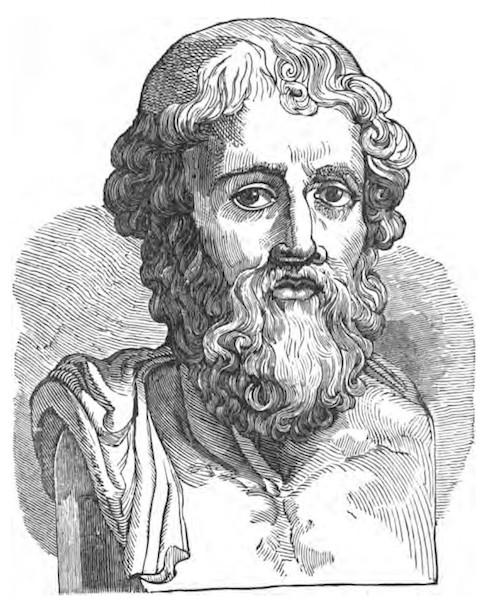
Demosthenes.
This greatest of the Grecian orators was born about 385 or 384 years before Christ, when Athens had reached the zenith of her literary, and had passed that of her political glory. Juvenal has represented him slightingly as the son of a blacksmith, the fact being that the elder Demosthenes was engaged in various branches of trade, and among others was owner of a sword manufactory. His maternal grandmother was a Thracian woman, a circumstance noticeable because it enabled his enemies, in the spirit of exaggeration and ill-will, to taunt him as a barbarian and hereditary enemy of his country—for the Greeks in general regarded the admixture of barbarian, 154 that is, other than Greek blood, with the same sort of contempt and dislike as do the whites of America the taint of African descent.
Being left an orphan when seven years old, Demosthenes fell into the hands of dishonest guardians, who embezzled a large portion of the property which his father had bequeathed to him. His constitution appears to have been delicate, and it may have been on this account, that he did not attend the gymnastic exercises, which formed a large portion of the education of the youths in Greece; exercises really important where neither birth nor wealth set aside the obligation to military service common to all citizens; and where, therefore, skill in the use of arms, strength, and the power to endure fatigue and hardship, were essential to the rich as well as to the poor. It may have been on this account that a nickname expressive of effeminacy was bestowed on him, which was afterwards interpreted into a proof of unmanly luxury and vicious habits; indeed, the reproach of wanting physical strength stuck by him through life, and apparently not undeservedly. Another nickname that he obtained was that of “Viper.” In short, the extant anecdotes tend pretty uniformly to show that his private character was harsh and unamiable.
His ambition to excel as an orator is said to have been kindled by hearing a masterly and much admired speech of Callistratus. For instruction, he resorted to Isæus, and, as some say, to Isocrates, both eminent teachers of the art of rhetoric. He had a stimulus to exertion in the resolution to prosecute his guardians for the abuse of their trust; and having gained the cause, B. C. 364, in the conduct of which he himself took an active part, recovered, it would seem, a large part of his property. The orations against Aphobus and Onetor profess to have been delivered in the course of the suit; but it has been doubted, on internal evidence, whether they were really composed by him so early in life.
Be this as it may, his success emboldened him to come forward as a speaker in the assemblies of the people: on what occasion, and at what time, does not appear. His reception was discouraging. He probably had underrated, till taught by experience, the degree of training and mechanical preparation requisite at all times to excellence, and most essential in addressing an audience so alive to the ridiculous and so fastidious as the Athenians. He labored also under physical defects, which almost amounted to disqualifications. His voice was weak, his breath short, his articulation defective; in addition to all this, his style was thought strained, harsh, and involved.
Though disheartened by his ill success, he felt, as Sheridan is reported to have expressed himself on a similar occasion, that it was in him, and it should come out; beside, he was encouraged by a few discerning spirits. One aged man, who had heard Pericles, cheered him with the assurance that he reminded him of that unequalled orator; and the actor Satyrus pointed out the faults of his delivery, and instructed him to amend them. He now set himself in earnest to realize his notions of excellence; and the singular and irksome method which he adopted, denoting certainly no common 155 energy and strength of will, are too celebrated and too remarkable to be omitted, though the authority on which they rest is not free from doubt. He built a room under ground, where he might practise gesture and delivery without molestation, and there he spent two or three months together, shaving his head that the oddity of his appearance might render it impossible for him to go abroad, even if his resolution should fail. The defect in his articulation he cured by reciting with small pebbles in his mouth. His lungs he strengthened by practising running up hill, while reciting verses. Nor was he less diligent in cultivating mental, than bodily requisites, applying himself earnestly to study the theory of the art, as explained in books, and the examples of the greatest masters of eloquence. Thucydides is said to have been his favorite model, insomuch that he copied out his history eight times, and had it almost by heart.
Meanwhile, his pen was continually employed in rhetorical exercises; every question suggested to him by passing events served him for a topic of discussion, which called forth the application of his attainments to the real business of life. It was perhaps as much for the sake of such practice, as with a view to reputation, or the increase of his fortune, that he accepted employment as an advocate, which, until he began to take an active part in public affairs, was offered to him in abundance.
Such was the process by which he became confessedly the greatest orator among the people by whom eloquence was cultivated, as it has never been since by any nation upon earth. He brought it to its highest state of perfection, as did Sophocles the tragic drama, by the harmonious union of excellences which had before only existed apart. The quality in his writings which excited the highest admiration of the most intelligent critics among his countrymen, in the later critical age, was the Protean versatility with which he adapted his style to every theme, so as to furnish the most perfect examples of every order and kind of eloquence.
Demosthenes, like Pericles, never willingly appeared before his audience with any but the ripest fruits of his private studies, though he was quite capable of speaking on the impulse of the moment in a manner worthy of his reputation. He continued to the end of his career to cultivate the art with unabated diligence, and even in the midst of public business, his habits were known to be those of a severe student.
The first manifestation of that just jealousy of Philip, the ambitious king of Macedon, which became the leading principle of his life, was made B. C. 352, when the orator delivered the first of those celebrated speeches called Philippics. The word has been naturalized in Latin and most European languages, as a concise term to signify indignant invective.
From this time forward, it was the main object of Demosthenes to inspire and keep alive in the minds of the Athenians a constant jealousy of Philip’s power and intentions, and to unite the other states of Greece in confederacy against him. The policy and the disinterestedness of his conduct have both been questioned; the former, by those 156 who have judged, from the event, that resistance to the power of Macedonia was rashly to accelerate a certain and inevitable evil; the latter, by those, both of his contemporaries and among posterity, who believe that he received bribes from Persia, as the price of finding employment in Greece for an enemy, whose ambition threatened the monarch of the East. With respect to the former, however, it was at least the most generous policy, and that of the elder Athenians in their most illustrious days, not to await the ruin of their independence submissively, until every means had been tried for averting it; for the latter, such charges are hard either to be proved or refuted. The character of Demosthenes certainly does not stand above the suspicion of pecuniary corruption, but it has not been shown, nor is it necessary or probable to suppose, that his jealousy of Philip of Macedon was not in the first instance far-sighted and patriotic. During fourteen years, from 352 to 338, he exhausted every resource of eloquence and diplomatic skill to check the progress of that aspiring monarch; and whatever may be thought of his moral worth, none can undervalue the genius and energy, which have made his name illustrious, and raised a memorial of him far more enduring than sepulchral brass.
In 339, B. C., Philip’s appointment to be general of the Amphyctionic League gave him a more direct influence than he had yet possessed; and in the same year, the decisive victory of Cheronea, won over the combined forces of Thebes, Athens, &c., made him master of Greece. Demosthenes served in this engagement, but joined early in the flight, with circumstances, according to report, of marked cowardice and disgrace. He retired for a time from Athens, but the cloud upon his character was but transient; for shortly after he was entrusted with the charge of putting the city in a state of defence, and was appointed to pronounce the funeral oration over those who had been slain. After the battle of Cheronea, Philip, contrary to expectation, did not prosecute hostilities against Athens; on the contrary, he used his best endeavors to conciliate the affections of the people, but without success; the party hostile to Macedon soon regained the superiority, and Demosthenes was proceeding with his usual vigor in the prosecution of his political schemes, when news arrived of the murder of Philip, in July, 336.
The daughter of Demosthenes had then lately died; nevertheless, in violation of national usage, he put off his mourning, and appeared in public crowned with flowers, and with other tokens of festive rejoicing. This act, a strong expression of triumph over the fall of a most dangerous enemy, has been censured with needless asperity; the accusation of having been privy to the plot for Philip’s murder beforehand, founded on his own declaration of the event some time before intelligence of it came from any other quarter, and the manifest falsehood as to the source of the information, which he professed to derive from a divine revelation, involves, if it be judged to be well founded, a far blacker imputation.
Whether or not it were of his own procuring, the death of Philip was hailed 157 by Demosthenes as an event most fortunate for Athens, and favorable to the liberty of Greece. Thinking lightly of the young successor to the Macedonian crown, he busied himself the more in stirring up opposition to Alexander, and succeeded in urging Thebes into that revolt, which ended in the entire destruction of the city, B. C. 335. This example, as it well might, struck terror into Athens. Alexander demanded that Demosthenes, with nine others, should be given up into his hands, as the authors of the battle of Cheronea, and of the succeeding troubles of Greece; but finally contented himself with requiring the banishment of Charidemus alone.
Opposition to Macedon was now effectually put down, and until the death of Alexander we hear little more of Demosthenes as a public man. During this period, however, one of the most memorable incidents of his life occurred in that contest of oratory with Æschines, which has been more celebrated than any strife of words since the world began. The origin of it was as follows. About the time of the battle of Cheronea, one Ctesiphon brought before the people a decree for presenting Demosthenes with a crown for his distinguished services; a complimentary motion, in its nature and effects very much like a vote of parliament declaratory of confidence in the administration. Æschines, the leading orator of the opposite party, arraigned this motion, as being both untrue in substance and irregular in form; he indicted Ctesiphon on these grounds, and laid the penalty at fifty talents, equivalent to about $45,000. Why the prosecution was no long delayed, does not clearly appear; but it was not brought to an issue until the year 330, when Æschines pronounced his great oration “against Ctesiphon.” Demosthenes defended him in the still more celebrated speech “on the crown.” These, besides being the most admirable specimens of rhetorical art, have the additional value, that the rival orators, being much more anxious to uphold the merits of their own past policy and conduct, than to convict or defend the nominal object of prosecution, have gone largely into matters of self-defence and mutual recrimination, from which much of our knowledge of this obscure portion of history is derived. Æschines lost the cause, and not having the votes of so much as a fifth part of the judges, became liable, according to the laws of Athens, to fine and banishment. He withdrew to Rhodes, where he established a school of rhetoric.
Demosthenes roused the Athenians against Antipater the successor of Alexander in Greece, but when that general triumphed, he fled to Calmesia, and took refuge in a temple. He retired into the inner part of the building, on pretence of writing a letter, where he took poison and speedily died.
Such was the life of Demosthenes, the greatest orator Greece ever produced, and one of the most famous that ever lived.
Man is made to live on the earth, but to regard heaven as his resting place. He must keep both objects in view: if he forgets heaven, he imitates the brutes which perish; if he forgets the earth, he will tumble into the first ditch that lies across his path.
158
Walking on Stilts.
In some countries the inhabitants walk on stilts from necessity. In England, boys do so for fun; and it is astonishing with what agility, after a very short practice, they do so. Any boy may make his own stilts; nothing is required but a pair of poles, about six or seven feet long, upon which some broad pieces of leather or iron hoop are nailed for the feet, so as to leave the top of the stilt within a few inches of the arm-pit. The boy may at first place his foot-holds very low, till he can balance himself, and then raise them every few days, till he obtains a complete command over them. I have known boys who had great command over stilts, to wade through rivers three or four feet deep; which would be of some importance in certain situations, to which all are subject, as by such aids small rivers might at any time be crossed, and life even saved in a case of necessity.
I once, however, knew a boy, who, having attained this art in great perfection, was not content with amusing himself in a rational and innocent manner, but set his wits to work to frighten two of his playfellows, a little boy and girl, who lived in the neighborhood. He had often heard foolish people talk of ghosts, and thought it would be good fun to make one; so he got a large white tablecloth, and having scraped out the inside of a turnip, so as to leave nothing but the rind, he cut two holes for eyes, made an enormous mouth with gnashing teeth; in this he put a lantern, and putting himself on his stilts, which made him seven feet high, and fastening the turnip lantern to his hat, he sallied forth into a by-lane, where he knew his play-fellows were to pass.
After a while he heard their footsteps, and then he made himself ready by pulling his white garment about him, and placing himself under the shade of an old tree. Then he gave a loud, unearthly groan, and with a slow and measured step came forth. It was nearly dark, and a little girl and boy came gaily on, singing and dancing. But the moment the little girl saw the supposed spectre, she gave a thrilling scream, and dropped senseless on the ground. Her brother, poor fellow, who at once saw the trick, ran towards the spectre, and with a blow of a stick which he held in his hand, felled him to the ground. He then ran to his sister, but she was insensible. After a while, assistance came; but when they had taken the little girl home, and put her to bed, they found that her senses had fled forever. The fright had turned her brain, and she became an idiot, and did not live many years.
Be careful then, my young friends, never to play upon the fears or feelings of your companions. It is not only very wicked, but cruel in the extreme; and as the consequences may be serious, guard yourself against every temptation of the kind. A sudden start at the word “Boo,” has been known to produce severe illness; and it is by no means an uncommon thing to hear of persons meeting with sudden death through fright.
It is pleasant to some persons to give; but if one gives only to gratify himself, he is merely selfish, and can claim no praise.
159
[For Merry’s Museum.]
THE LITTLE SOLDIER.
(Concluded.)
Mr. Merry:
Your young readers will remember, I hope, that they left our “little soldier” at the commencement of his journey homewards. Weak and faint from his long confinement in the hospital, without money, and with the sad prospect of two hundred miles on foot before him, it seemed impossible to him that he could ever accomplish the journey. But “home,” that blessed word, at mention of which, “the sailor, clinging to the dripping yard-arm,” feels a glow of rapture, filled the heart of the soldier with hope, and he proceeded on. Children of the present day, cannot imagine the change which has been made in the country since that period. What was at that time a “wilderness,” has now become a “fruitful field;” and where our tired soldiers at the close of the day sheltered themselves beneath some large tree, may now be seen the splendid hotel, inviting the traveller to comfort and rest. Then, too, at the nightfall, where our two friends heard only the mournful note of the “whip-poor-will,” may now be heard the shrill whistle of the locomotive, as it scuds over mountain and valley with the speed of thought. I cannot take time to give the details of adventures which cheered and discouraged our friends from day to day. They found great difficulty in supplying themselves with food; and I think it was in some lonely place, on this journey, that the sick soldier was fortunate enough to catch a young woodpecker, and he said nothing could be more delicious than the little bird. He pulled out the feathers, and ate it just as it was! He said it was meat and drink too, for the blood was warm! If I am not mistaken, it was three or four weeks after they left New York, that the two friends reached a village, called Farmington, in the State of Connecticut. They had been a long time coming a short distance, as the strength of the little soldier had been gradually failing during the journey thus far. Just at dark, after a day of great suffering from exhaustion and fatigue, they came to a house which stood on an eminence rather difficult of ascent. Here, the poor fellow’s courage failed, and he said to his companion, “Let me stop at the foot of this hill and die. I can never reach the house,”—and he sank upon the ground, entirely overcome. His companion, however, had strong confidence that if he could have food and rest, he would soon be restored. He accordingly went to the door of the house, which was opened by a very respectable middle-aged woman. He proceeded to an inner room, where an old man was sitting, reading the Bible. He made as earnest an appeal as he could for the friend he had left in the road; but the thought of having such a burden upon them, (for they were rather poor,) seemed more than they could bear. Now, whether the old gentleman happened to be reading in Matthew, the passage, “Inasmuch as ye did it unto one of the least of these, ye did it unto me,” I cannot say; but he did not hesitate long. “Let him come in,” said he; “we will do the best we can for him.” Here, then, new courage came to him, and, with the utmost exertion, he reached the door. The table was spread for the evening meal; and such a sight our “little soldier” had not seen since he left his father’s house, where was “bread enough and to spare.” He has been heard to say often, that at no other period in his life, was he ever so much overcome, as at the sight of that table! He wept and sobbed like an infant. The utmost caution was needed, or he would no doubt have sacrificed his life in the indulgence of his appetite. At this house he remained several weeks,—and I would to God that this account might fall into the hands of some of the descendants of that pious family. The man was named Thomas Cowles. A maiden daughter kept the house, and took care of her father. They were unwearied in their attentions to the invalid, and he began to recruit at once. His companion came on to their native place, and a brother of the sick soldier immediately started on horseback for him, with money to remunerate the family who had shown him so much kindness. When the young soldier came to take his leave, which he did with many tears, the good people refused all compensation. Now, I hope, Mr. Merry, some of your young readers will know why this was. Our “little soldier” loved and feared God. They had taken “sweet counsel together,” and felt that they had their reward. Many years after these events occurred, and after the little traveller had been in the service of his Divine Master a long time, an opportunity was given to send to this daughter, who had survived her father several years. With deep emotion he took from his library a handsome volume, and presented it to Miss Cowles, with the simple quotation, “I was a stranger, and ye took me in.”
Should any one of the name meet with this account—a branch of that family—“may the Lord bless them seven fold,” for their father’s sake.
A Soldier’s Daughter.
To make room for the remainder of the story of “The Little Soldier,” we are obliged to defer our Correspondence until the next number.
160
[Audio content is not currently supported on your device.
The Goldfinch.
THE MUSIC COMPOSED FOR MERRY’S MUSEUM, BY GEORGE J. WEBB.
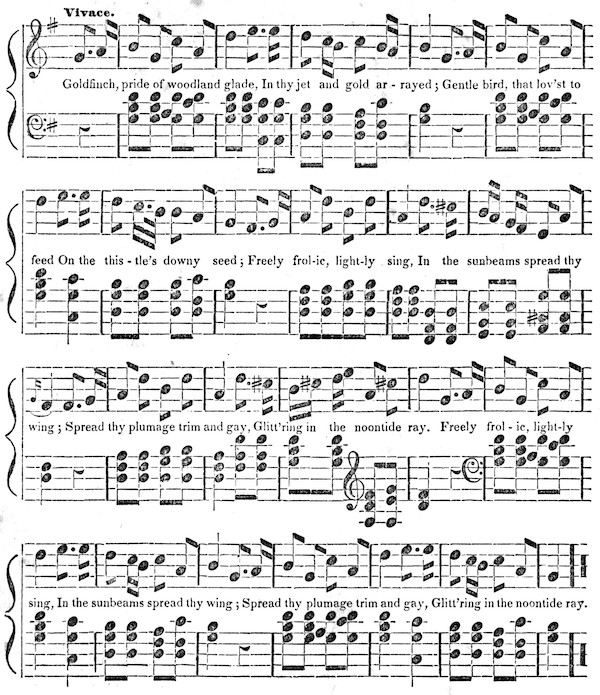
Goldfinch, pride of woodland glade, In thy jet and gold ar-rayed; Gentle bird, that lov’st to feed On the thistle’s downy seed; Freely frolic, lightly sing, In the sunbeams spread thy wing; Spread thy plumage trim and gay, Glitt’ring in the noontide ray. Freely frolic, lightly sing, In the sunbeams spread thy wing; Spread thy plumage trim and gay, Glitt’ring in the noontide ray. Fickle bird, forever roaming, Endless changes ever loving, Now in orchards gaily sporting, Now to flowery fields resorting; Chasing now the thistle’s down, By the gentle zephyr blown, Lightly on thou wing’st thy way, Always happy, always gay.
161
MERRY’S MUSEUM.
Vol. VII JUNE, 1844. No. 6.
une, the first of the summer months, presents us with many interesting things. The meadows are now covered with flowers in full bloom: the forests have put on their beautiful garments of green: the birds are busy in tending their young; the mornings are ushered in with silvery dews, and the evenings come like a soft veil thrown over the cradle of her children, by the gentle hand of nature, to make their slumbers sweet and secure.
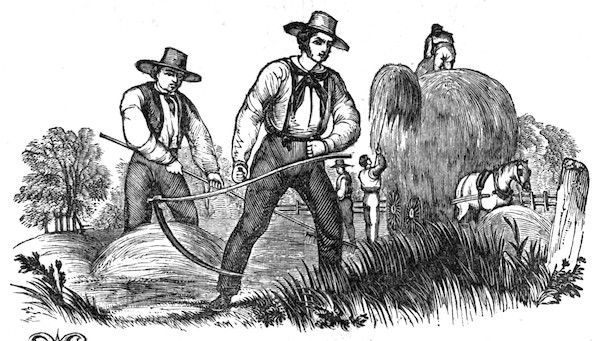
The farmer is now busy in gathering his crop of hay,—though, as he swings his scythe, he unhappily disturbs many a pretty nest of the meadow lark, the sparrow, and the boblink. How the latter does sing “Get out o’ the way old Dan Tucker,”—as the mowers intrude upon his dominion! However, it is better that Bob should be disturbed now and then, than that the cattle should starve, and every body go without milk and meat.
But let us go to some field, where the mower has not yet appeared. Let us stop and listen to Bob—with his white nightcap on. What a set of names he has got—boblink—bob o’ lincoln—skunk black bird—and rice bird. He seems to have as many names as those rascals who are sent to the state’s prison, yet he has no other quality in common with pick-pockets and counterfeiters. He is 162 no thief, for what he takes he takes in open day; he is no pick-pocket, for while the cat-bird filches cherries, strawberries, raspberries, and grapes, Bob is content with the waste seeds of the meadows. He is no counterfeiter,—no, he is a downright fellow, and is never ashamed of his name. Meet him where you will, he springs into the air, and seems to give you a challenge in the following words—
“Jem Richardson, Jem Richardson,—get away—yet away: it’s very disagreeable of you to trouble us: get away! get away!”
Different people fancy the boblink to say different things. A girl of sixteen blushes at his open, impertinent calling out the name of her lover, which she supposed a secret to every one but herself; the miser thinks his song like the jingling of keys; a tory fancies that the rogue calls him a whig; a whig, that he reviles him as a tory; a boy going home from school, imagines that he is mocking him for spelling the word jingo, with two gs—and a town-meeting orator, regards him as a lecturer upon that species of eloquence which at town-meetings is usually displayed—a succession of nasal, brassy sounds, with very little sense.
But let us leave boblink to pursue his cheerful, happy life, and look at that bird with long legs and a sly appearance, stealing through the grass. He is a meadow lark,—and a magnificent bird, streaked with gray and brown upon the back, with a breast of bright yellow. See! he is very timid, and has already flown. Alas, his flesh is excellent, and man has taught him that there is danger in his near approach. Yet listen to his clear, shrill note, as he flies in the air. See! there he lights on the topmost bough of yonder apple-tree. How plaintive, yet how beautiful, his prolonged note! He is not, however, so sweet a singer as the lark of Europe.
Let us take a stroll in yonder thicket. How still and secluded is this little dell. Not a sound is to be heard. Hush! I heard a rustle among the bushes! Oh, it is a brown thrush; there he sits, trying to hide himself behind the oak leaves. He has a nest near, and being engaged in important business, does not wish to be disturbed. He will not speak to you till evening. If you are then within a quarter of a mile, you will hear his song. It consists of imitations and variations that might put Ole Bull to the blush. Some passages are exquisitely beautiful, and would excite the envy of that conceited bird, the English talk so much of,—the nightingale,—a bird, that is so solicitous to be heard, that it will sing only in the night, when all honest birds are asleep.
We will say no more of this month, after introducing to you the following description of it, in the oldest English lay extant:
“Summer is yeomen in— Loud sing cuckoo; Groweth seed, and bloweth mead, And springeth the weed new.”
The new King.—The king of the Sandwich Islands has so much improved in his condition since he signed the pledge, that the people call him THE NEW KING.
163
Inquisitive Jack.
CHAPTER V.
About Quadrupeds.
I must tell you that by this time, Jack had learned to read, and this was now a source of great delight to him. It often happened that he could not go into the fields to study nature, because the weather was stormy, or perhaps it was winter, and the ground was covered with snow. It is true that his aunt Piper was generally ready to answer his questions, and to give him information—but she could not attend to him always. Beside, he found in books that there were more exact and scientific accounts of birds, beasts, fishes, insects and other things which interested him, than even aunt Betsey Piper could give.
Thus, Jack devoted a good deal of his time to reading, though he did not lay aside his habit of observing and investigating. This habit is very important, and I advise all my young friends to adopt, and continue it, however much they may read. Reading will indeed store the mind, and make it full of knowledge; but observation and investigation render that knowledge clear, distinct, and useful. So, I wish to have every body follow Jack’s plan to read a great deal, and also to investigate a great deal. Thinking is to the mind what exercise is to the body—it makes it strong, cheerful, and full of health. Thus my plan is that reading books and reading nature should go together. Now, I will tell you how Inquisitive Jack managed this.
164 One day, he was going through a little wood, where he saw a squirrel running along upon the fence. It was of a reddish color, and exceedingly nimble. It seemed almost to fly along the rails of the fence, and at last, it mounted upon a tree. It then ran about upon the limbs, and sprang to another tree. Then it dashed from tree to tree almost like a bird, until at last, it reached a large oak. It now seemed to consider itself out of the reach of harm, and accordingly, it began to chatter in the most extraordinary manner. There was something about it that made Jack feel that the fellow was making fun of him. He was annoyed at this, and picking up a stone, he hurled it at the offender with all his force.
The squirrel dodged the stone, ran up the tree a little higher, and chattered louder than ever. It seemed to say something like this, “Oh Jack—Jack—you are a very silly fellow—get you gone and leave the woods to me and my companions!—chickaree!—chickaree!—chickaree!” While the squirrel was saying this, he flourished his long red tail, and seemed to be in a state of violent agitation.
When Jack went home, he told his aunt Piper about the squirrel, but she did not know as much of squirrels, as of bees, butterflies, and birds, and therefore she could not wholly satisfy his curiosity. He therefore consulted a book of natural history, and there he found a full account of the red squirrel, or chickaree. He found it described just as he had seen it, and furthermore he learned that it was one of the most lively of the whole squirrel family; that it lives upon nuts, and is common in the forests of New England and the Middle States—that it builds its nest in hollow trees, and lays up a store of its favorite fruit against the winter season.
Now you will be able to see the advantage of combining observation with reading;—Jack had seen the squirrel, had noticed its color, form, air, and manners. He had therefore distinct, indelible impressions respecting these things, and when he began to read about this squirrel, it was of something he had seen; something of which he had a lively knowledge; something associated in his mind with his walk through the woods, and the pleasure of a ramble. He read, therefore, with a keen delight; he understood what he read, he remembered it all, and he was incited to go on and pursue the subject, till at last he had read the story of the whole squirrel family, red, black and gray!
I tell you this just to give you a specimen of Jack’s way of combining observation with reading. I must now tell you about another thing, which I have alluded to before. It would seem that ideas resemble boys; they don’t love to be alone. One idea wants another; and several ideas want a good many others. You show a child a beautiful shell, it gives him a new idea, and that immediately suggests a desire of other ideas, and he asks, “Who made the shell?” “Where did the shell come from?” “What is it made of,” &c., &c.
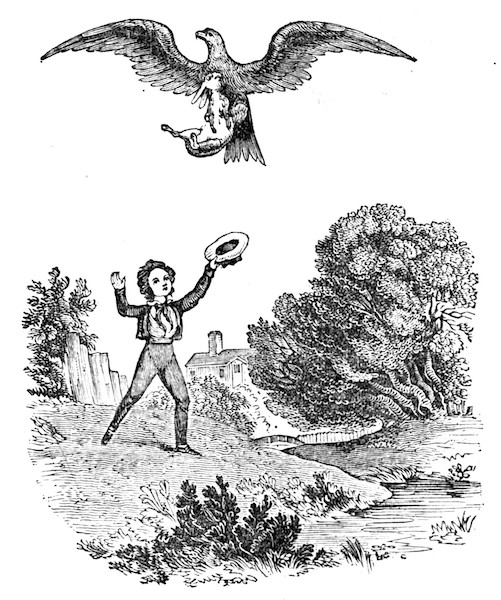
I have almost got through my story, so do not be impatient if I tell you one thing more, and that is how Jack used to think about what he saw and read. I shall give you an instance. One day, he was strolling through the fields, at a 165 distance from any house, when he saw a large hawk pounce down upon a rabbit. The talons of the bird pierced the very heart of the little animal, and it was almost instantly killed, and borne away by the destroyer, struggling however in the pangs of death. As it was carried over his head, Jack noticed the four legs of the rabbit, and he began to reflect upon the fact that a hawk has two legs, and a rabbit four. Having made this comparison, he proceeded to make others; and now it struck him, for the first time, that the whole feathered race are two-legged creatures, while rabbits, squirrels, cats, dogs, pigs, foxes, lions, tigers, cows, horses, and elephants are four-legged creatures. As he was thus ruminating upon this matter, he happened to take up his book, and he there found that the animal creation is divided into groups—such as orders and classes, &c., according to their formation.
He learned that four-legged animals, called quadrupeds, form one great class; that birds form another class; fishes another; reptiles another; and insects still another. And in pursuing this subject, he found that each class was divided into many families or kinds. Among the quadrupeds, he found the family of cats, including old puss in the corner, as well as the lynx, cougar, leopard, tiger, and lion. He learned that among the bears, there are many kinds, and also among the wolves and foxes, and all other races of animals.
And now, a new source of interest grew up in Jack’s mind. This classifying of animals became intensely interesting. He loved to compare one kind with another; to note the resemblances and differences; to observe the influence of climate, and see how nature had diversified her works, so as to adapt everything to the purpose it was designed to accomplish. Thus, at every step, his knowledge increased, and became more and more permanently fixed in his mind; while the interest he took in study, was enhanced even in a greater degree.
Sketches in Egypt.
In a former number of our Museum, we have given some account of the wonderful things, displaying the manners and customs of the Egyptians, and setting forth many points of history, which have been discovered among the ruins of their ancient cities and temples. We now give a few passages, showing some of the manners and customs of the present inhabitants of Egypt.
IRRIGATION.
Throughout the whole of Egypt, even in the Delta, there are numerous canals to preserve the water after the overflow; and from these the country is supplied with moisture. The lands in Upper Egypt—to aid the process of artificial irrigation—are dug into small squares, connected by gutters or furrows; and the water, being raised from the stream either with a machine or by manual labor, is admitted into these ridges, and flows from one square into another. This operation forms the most laborious part of a fellah’s employment; particularly where the Persian water-wheel is not in use.
HARVEST.
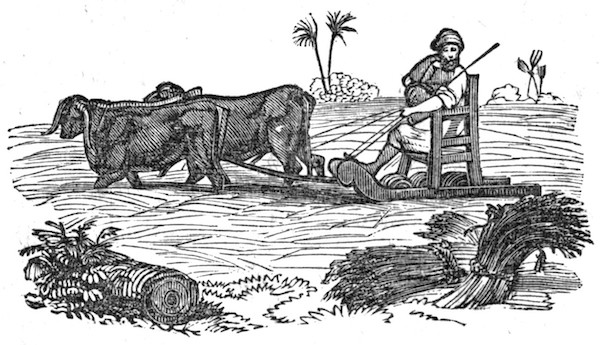
Egyptian mode of thrashing corn.
Immediately after the water has run off, sowing commences, the seed only 166 requiring to be strewed over the land, when it sinks into the soft earth by its own weight, or is trodden down by the cattle driven over it; a process generally performed in November. The harvest commences in April, when the corn is cut with a sickle, close to the ear, and the straw is appropriated for fodder, or converted into fuel. The ears, having been carried from the field in baskets, are laid upon the ground. A sort of sledge drawn by oxen is then driven over it, which answers the end of thrashing, separating the corn from the ears.[2] It is next stored, and the husbandman having none of the labors of ploughing, furrowing, or manuring his land—those duties being superseded by the bounteous Nile—he is at leisure till the next overflow.
MARRIAGE.
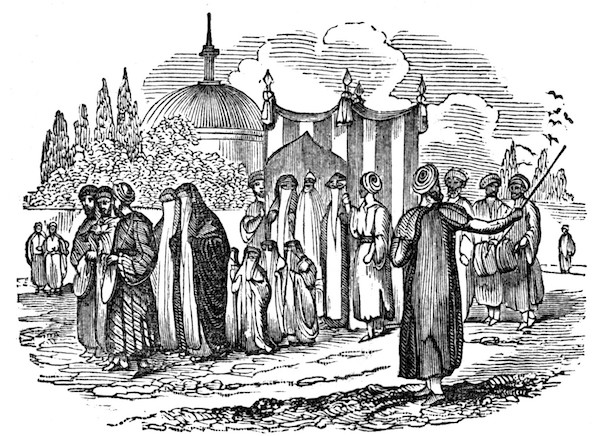
Marriage procession.
A day or two before the wedding, the bride elect goes in procession to the public bath, which is often hired exclusively 167 for her and her friends. A canopy of silk is borne over her by four men, preceded by musicians, and sometimes by persons who perform some feat of strength or a mock fight with swords; the female relations of the maiden are also of the party; and when in the bath, the company is amused by almehs and other musicians.
On returning from the bath the bride takes a large lump of henna, and going round to her guests solicits a contribution of money, when each person generally sticks a small piece of gold into the henna, which on being relieved of the coins, is afterwards applied to her hands and feet. The evening of this ceremony is called “The night of the henna.”
The next day, the bride proceeds to the house of her future lord in the same order as when she goes to the bath; and on arriving at the harem all her friends leave her, except her mother or other near relation, the bridegroom remaining below with his friends. Sometimes he goes to a mosque, and on his return, after seeing the company supplied with pipes and sherbet, is for the first time introduced to his wife; and having been left alone with her he presents her money, which is called “the price of uncovering the face.” This is an awkward moment for the bride, whose form and features do not always bear out the praises that the match-maker has previously bestowed on them by way of description; and lovers have been known to betray disappointment at this delicate juncture. On removing the covering it is however proper for him to say, “In the name of God, the compassionate, the merciful, blessed be this night!” the lady must answer “God bless thee!” Several women are stationed outside the door, who, at a signal from the bridegroom, set up cries of joy—which are responded to by others below and in the neighborhood—to signify that he acknowledges his bride, and that she equals his expectations: these ceremonies over, the man rejoins his male friends, with whom he spends an hour or two in sociality, and then returns to his wife.
MOSQUES.
The houses of worship in Cairo are magnificent and spacious. The principal mosque, called the church of Lazarus, is situated in the middle of the city. Van Egmont says that between five and six thousand persons receive their subsistence from it, and that two thousand lie in it every night. Formerly the interior was as a sealed book to all who did not follow the faith of the prophet; for, if any stranger happened to enter it, he was instantly imprisoned, and his only chance of escape from death was to turn Mohammedan.
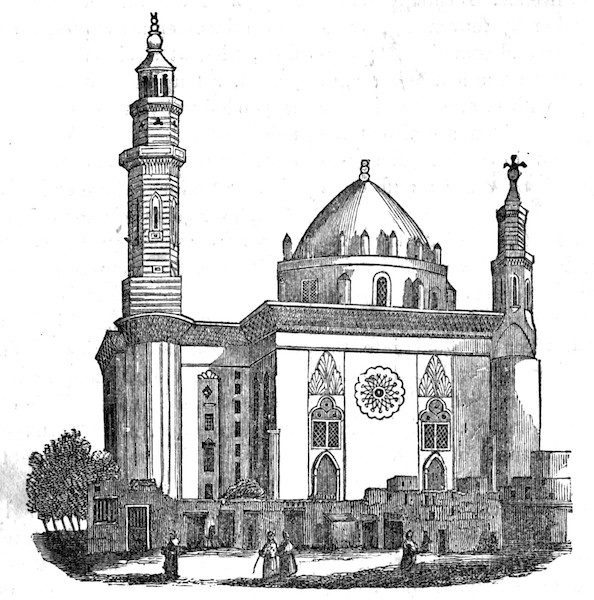
Great Mosque of Sultan Hassan, Grand Cairo.
The minarets, or high towers of the mosques, are surrounded, at a great elevation, with projecting galleries, in which stand the public criers, who announce the stated times of prayer prescribed by the Mohammedan law. Upwards of eight hundred voices may be heard at once from these lofty stations, from which, also, prayers are on extraordinary occasions, offered up.
BURIALS.
The Egyptians seldom keep a corpse in their houses on the night succeeding death; and never bury their dead after sunset. Rose-water, camphor, and other perfumes, are sprinkled over the deceased, 168 his nostrils and ears are stuffed with cotton, the ankles bound, and the hands placed over his breast. If he have been a man of wealth, he is wrapped successively in layers of muslin, cotton cloth, and cloth of cotton and silk, and lastly, a Cashmere shawl. He is then placed on a bier, and a procession is formed of chanters, with the relations and domestics of the deceased; and passages from the Koran, with a dirge, are recited during the way. The bier is first carried into a mosque, when the imán and his assistant repeat certain prayers over it; and after the performance of some minor rites, the funeral train proceeds to the burial-ground.[3] When within the tomb a singular ceremony is performed by a person called “the instructor of the dead;” who, sitting before it, speaks to the corpse as if it were a living person, saying, that there will come two angels who will ask certain questions, which he also tells the body how to answer. The two angels are supposed to visit the dead on the succeeding night, when the soul will depart and the body be tortured for its sins. After burial, prayers are recited and certain forms gone through by the relatives, to facilitate the entrance of the deceased 169 into paradise. Wailers are sometimes hired at funerals, to make loud lamentations; but in the case of a welee, or reputed saint, these mournings are turned into cries of joy at the release of the pious man from this world, to the world of happiness; to which it is believed he has certainly departed.
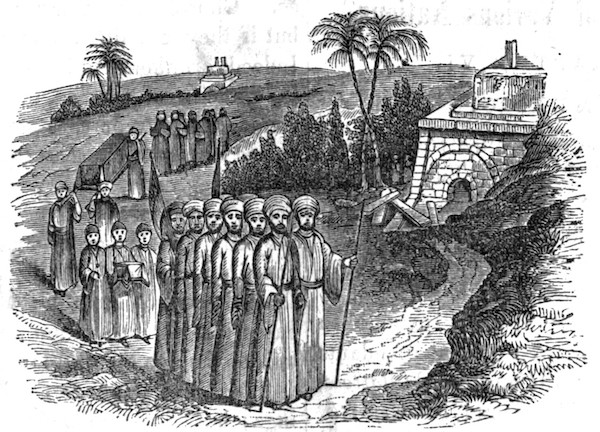
Burial procession.
The religious superstitions of the Egyptians present a remarkable feature in their character; as many of them are not only believed in by the learned, but are sanctioned by the Koran. The principal of these is the belief in genii, a class of spirits who play so prominent a part in the “Arabian Nights Entertainments.” These supernatural beings are supposed to hold a sort of middle rank between angels and men—to be created of fire, capable of assuming any form, and of becoming invisible. They are presumed to inhabit rivers, ruined houses, wells, baths, ovens, &c.
TINGING THE EYES.
It is a common practice with ladies in Egypt as in Persia, to tinge their eyes with a black powder, called khol. This seems to have been an ancient practice, for vessels containing this powder have been found in the tombs. The hands and feet are also tinged with a decoction of the henna tree, a kind of privet, which imparts an orange hue. Women of the lower classes mark their bodies with a blue tint, like that used by sailors in tattooing their wrists and arms.
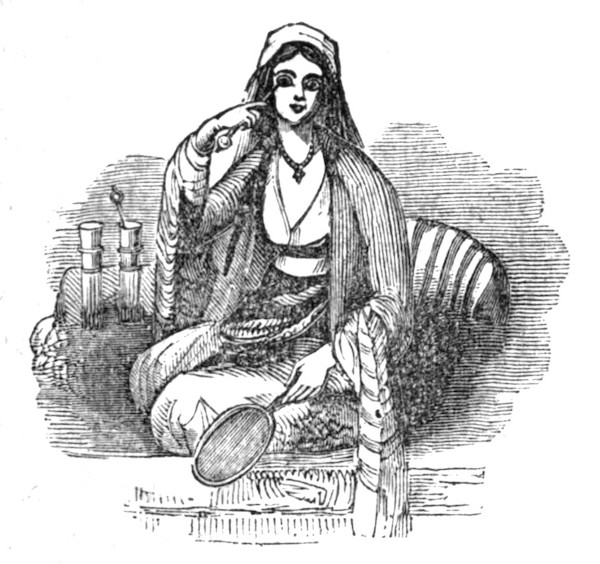
Tinging the eyes.
170
Pictures of Various Nations.
CHAPTER VI.
MEXICO.
South-west of the United States is the country of Mexico. Till within a few years, it was a Spanish colony; but is now independent.
In Mexico there are seven kinds of people: 1. Whites, born in Europe; 2. Creoles, born of Spanish parents in America; 3. Mestizoes, or descendants of Whites and Indians; 4. Mulattoes, sprung from Whites and Negroes; 5. Zambas, the offspring of Indians and Negroes; 6. Indians, who are the copper-colored native race; and 7. African Negroes.
The Mexicans are of good stature, well proportioned, and so free from personal defects, that there is scarcely upon the earth a nation, in which fewer deformed persons are to be met with. Their skin is of a copper-color; and they have good complexions, narrow foreheads, black eyes, white, firm, regular teeth, and thick, glossy, black hair.
Some of the ladies are said to be very beautiful; but they have one practice, which is very disgusting—that of smoking cigars. They carry their cigars in a gold, or silver case, suspended by a ribbon at their side; and as soon as one cigar is exhausted, another is lighted; and they only cease to smoke, when they eat or sleep.
It is said that the Mexicans are moderate in eating; yet one would think they must eat a great deal, as they have eight meals a day. This I suppose, however, is only among the higher classes. Chocolate is a favorite beverage, but if they eat little, they drink much. Indeed, drunkenness is so common, that in the city of Mexico, the police send round tumbrils, or carts, to collect such as are found stretched in the streets.
The senses of these people are very acute, especially that of sight, which they enjoy to old age, unimpaired. Their constitutions are naturally sound; and, though most of them die of severe diseases, it is not uncommon for them to attain to the age of a hundred years.
The Mexicans have good understandings; but education among them is not very general. They are said not to be as passionate as the people of some other countries. They are slow, and very persevering in respect to works, which require time. They are generous and disinterested. They set but little value upon gold. The Spanish inhabitants dress very expensively. They generally wear silks, and adorn their hats with belts of gold, and roses of diamonds. Even some of the slaves have bracelets, and necklaces of gold, silver, pearls, and gems.
The Roman Catholic is the established religion. The natives retain many of their superstitious notions and practices. When one of them dies, the deceased has a jug of water given him, and pieces of paper, with directions where to go. At the same time, a little dog, or some other domestic animal, is killed, to accompany the deceased on his journey, to the invisible world. The corpse and the animal are now burned, and the ashes placed in an earthen pot, which is buried in a deep ditch.
171 BRAZIL.
Before we speak of the inhabitants of Brazil, however, we shall say a word or two of the country. Scarcely a finer country is to be found on the globe. Its climate is healthful; its soil fertile; its scenery charming, and even romantic; thick forests crown its hills, and perpetual verdure adorns its valleys; noble rivers pass in every direction, and the richest tropical fruits abound in every quarter. Brazil also is famous for its gold and diamonds. Until recently, the country belonged to the king of Portugal; but it is now independent. The Roman Catholic is the established religion.
The European settlers are generally gay and fond of pleasure. The men generally wear cloaks and swords. The ladies have fine dark eyes, and expressive countenances. They adorn their heads with tresses, tied with ribbons and flowers. The labor of this class of persons is chiefly performed by slaves.
If you go into the country, but not into the mining districts, you will find the people living in small mud cottages, covered with tiles or leaves. The people here use no knives or forks; and but few have tables. They eat their meals, squatting on the ground, with dishes, bowls or gourds, placed in the centre. The people dress in a slovenly and mean manner, but the women more so than the men.
In the mining districts, the inhabitants are still more degraded. You may indeed see cups, coffee-pots, wash-basins, and the like, all of silver; but other things, food, dress, and manner of living, by no means correspond.
The native Indians of Brazil are divided into numerous tribes, and speak different languages; but they all agree in wearing few clothes. Many are entirely naked. They are of a copper-color, with long, coarse, black hair; but, like the more northern Indians, they are destitute of beards. They are a strong, lively, and gay race of people. Few diseases are known among them. They delight in feasting and dancing, both of which they carry to excess.
Their huts are made of the branches of trees, and covered with palm leaves. Their articles of furniture are few and simple. Their weapons of war are bows, arrows, and wooden clubs. The flesh of monkeys is their principal animal food. This they so prepare, that at the same time it is roasted, it is blackened with smoke. A monkey roasted by a Brazilian, would frighten an American: or if it did not frighten, it would disgust him, for it is always roasted with its head on, and in a sitting posture.
PERU.
To the west of Brazil, lies Peru; and hither we shall now conduct our readers, to take a view of the inhabitants of that country.
We must first tell them, however, a few words of the country itself. Peru is a hot and barren country. It is barren, because it seldom rains there. It has many dreary deserts. The lofty Andes pass through, and divide it. It abounds in gold, and silver, and mercury, or quicksilver. Here, too, is found Peruvian bark, which is so much used in this, and other parts of the world.
Peru is a large country; and yet it has but about a million and a half of inhabitants. 172 They consist of Creoles, Mestizoes, and Indians, or natives of the country. The Creoles are natives of Spanish descent. They are well made, and of good stature, with lively, agreeable countenances. The Mestizoes are a mixed race. They are, also, generally well made, very robust, and quite tall.
By far the greater part of the inhabitants of Peru are Indians; but they are not now what they once were. Many years ago, the Spaniards conquered them. At that time, they were a rich and flourishing people. They understood several of the arts, and many of them lived in a style of magnificence.
At that time, gold was so common among them, that they used it, as we use iron and brass. Their sovereigns were called Incas. They believed the sun to be a god, and worshipped it as such. The glory of their former days has, however, passed away. They are now almost savages. They are well proportioned, and even strong; but are generally low in stature, and some of them remarkably so. They have deep black hair, which is thick, long, harsh and coarse, like that of a horse. The men wear theirs loose, but the women plait theirs behind with a ribbon. They set great value upon their hair; the greatest insult which can be offered to either sex, is to cut it off; and when this is done by way of punishment, they never forgive the disgrace put upon them.
Their dress consists of white cotton drawers, reaching to the calf of the leg, loose, and edged with lace. Instead of a shirt, they wear a black cotton frock, in the form of a sack, with two openings for the arms, and a third for the head to pass through; over this, they throw a kind of cloak, and cover the head with a hat.
This dress they never put off, even when they sleep. Some of the richer class distinguish themselves by the fineness of their drawers, and wear shirts with lace four or five inches broad, fastened round the neck like a ruff. Though they wear no stockings, they have silver or gold buckles in their shoes; and their cloak, which is of fine cloth, is often adorned with gold or silver lace.
Intemperance in England.—At a meeting recently held in Exeter Hall, London, the Hon. J. S. Buckingham stated, that £53,000,000 was the annual cost of intoxicating drinks to the people of that country. That this sum was fifty times as much as all the collections for the relief of the distressed, under every form of appealing to public sympathy.
In that land of distress and wretchedness, where thousands perish for the necessaries of life, and tens of thousands more gain a scanty subsistence, fifty-three millions of pounds, or 250 millions of dollars, are annually spent for poison to augment the poverty, misery, and death. Strange infatuation!—When will old England be alive to the interests of the great mass of her citizens, and place an everlasting quarantine upon this source of physical and moral disease, temporal and eternal death.
The whole community of whites on the Columbia River, and the various settlements in Oregon, have abandoned the use of intoxicating drinks.
173
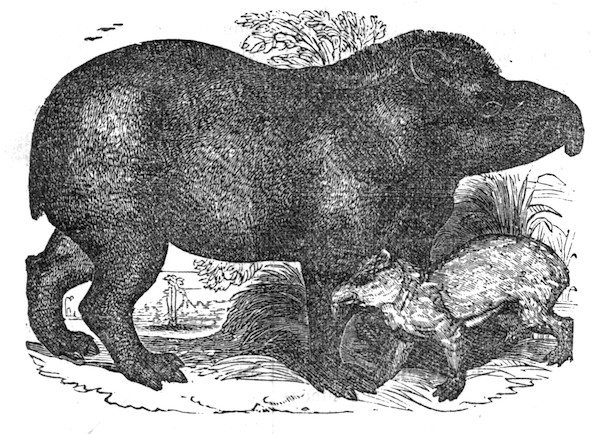
A Tapir.
Dick Boldhero.
CHAPTER V.
The adventure of the monkeys concluded—strange animals—weariness, despair—a terrible incident.
My readers can hardly imagine the bewildered state of my mind, occasioned by the scenes described in my last chapter. The little apes, who grinned, chattered, frisked, and frolicked in the moonlight around me, appeared like so many fantastic sprites, and I could scarcely believe that it was not all a dream. Never shall I forget some of their quizzical countenances and grotesque gestures, as they peeped at me between the branches of the trees. After they had hung around me for several minutes, one of them uttered a shrill cry, and with many a leap, and jirk, and bound, they disappeared. They seemed to run along upon the trees, passing from the branches of one to another, as easily as a rabbit upon the solid ground.
They were indeed supplied with limbs to accomplish this. They had not only four hands, but they were furnished with a tail, which seemed amazingly convenient and useful. Never was any instrument employed with more dexterity and success. They wound it around the limbs of the trees, where they hung suspended, or swung from branch to branch. When they were travelling upon the giddy heights of the forests, they held it erect, in order to keep them steady, thus using it as a rope-dancer does his balance pole.
At this time I knew very little about these creatures, but I afterwards learned that the forests of Guiana, as well as other warm parts of South America, abound in various kinds of monkeys, and that the species who made me the nocturnal visit I have described, are called howlers. They are particularly noisy at night, and make the forests ring with their elvish din. It is common for one of them to mount a tree, and seem to address 174 the assembled group around him, embellishing his discourse with the most extraordinary grimaces, gestures, and contortions. One can hardly look upon a scene of this sort, and not feel it to be a sort of satire upon human oratory.
I did not close my eyes again that night. Morning at last came, and I attempted to grope my way back through the thickets, to the path I had lost. But I was encompassed by lofty forests, and my mind was in some degree bewildered, I rambled about the whole day, and at night found myself at the precise spot from which I had started in the morning.
My heart was now full. The prospect of perishing in the wilderness, was before me; I had eaten the last morsel of food that remained in my wallet; it seemed impossible, therefore, that I should escape. The thoughts of never again seeing my mother and my home—of dying without a friend at my side, and leaving my form to be torn limb from limb, by wild beasts, all rushed upon me with frightful force, and for a few moments, I gave way to despair.
But these feelings gradually subsided, and though no situation could be more hopeless than mine, still, hope revived, and I determined to make another effort the next morning, to effect my escape. Having formed this resolution, I stretched myself out upon the ground and fell asleep, and nothing remarkable occurred during the night. At early dawn, I arose, and set forward with the determination of being more wary than before, in order to avoid a similar result. I was very hungry, but I soon found some berries, which I ventured to eat, though I was not sure that they were wholesome. I pushed forward, as I imagined, in a direct line toward the path. But when one’s head is turned, south seems north, and north south—so that a great part of the day, I travelled in the direction opposite to that which I intended to follow.
Toward evening, I came in sight of a lake, and as I was exceedingly thirsty, I approached it. It was encircled with tall trees and thickly matted shrubbery, except on the side where I was. Here was a little opening, and as I came to the edge of the water, I was about to stoop down and quench my thirst; but what was my astonishment to behold before me a huge beast, bearing a resemblance to a large black hog. It was completely in the water, but I could distinctly see it walking on the bottom and approaching the shore. Being not a little alarmed at this strange apparition, I ran hastily back from the lake, and concealed myself in a thicket, at the distance of several yards. My position was such, however, as to command a view of the water.
I could soon perceive an undulation on its glassy surface, and shortly after the bristly back of the animal became visible. He leisurely come to the shore, looked around, snuffed the air, a little suspiciously, and then began to devour the coarse herbage that grew along the margin of the water. The whole aspect of this creature was swinish, and I should have set him down as one of the hog family, but for two reasons. He was twice as big as any specimen of that race, I had ever seen; and he had a long, flexible snout, which he used like 175 an elephant’s trunk. I watched him narrowly, and never have I seen a more extraordinary looking creature. He seemed, indeed, to be half hog and half elephant, though his manners resembled the former, rather than the latter. He seemed to feel perfectly at home, ate voraciously, flourished his little tail, and at last, sat down upon his rump, like a tired dog.
I had now remained for half an hour in my concealment, and being weary of inaction, I rushed out from the thicket, club in hand, and suddenly stood before the beast. Never have I seen such a gaze of stupid wonder, as the monster at first exhibited. But he soon made up his mind to retreat, and uttering a grunt by way of exclamation, he plunged into the water, and I saw him no more. I afterwards learned that this animal is common in the waters of South America, and probably is known to most of my readers, under the name of tapir.
Night soon followed this scene, and I was obliged again to find a pillow beneath the boughs of the forest; I slept soundly, however, and again in the morning began my rambles. My strength, however, was impaired; my courage was gradually ebbing away; still I continued to roam about, making the best effort I could for my deliverance. I was not alone in the forest, for innumerable parrots were chattering among the branches of the trees, and birds of many forms and hues, were glancing through the air, or reposing in the leafy shade of the wilderness.
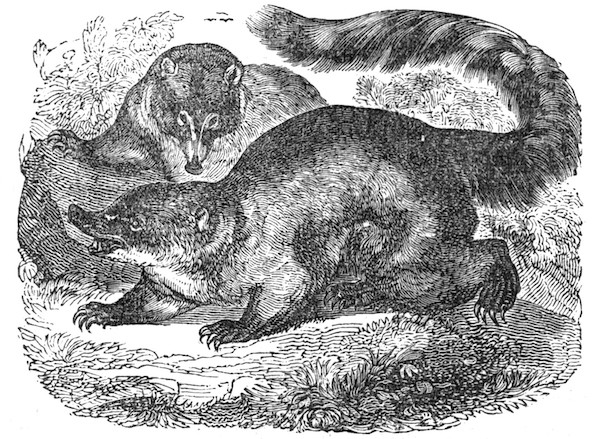
I frequently met with monkeys, skipping from tree to tree, and as they grinned at me from above, I could fancy that there was a sneering and malicious expression in their faces, as if they understood and rejoiced in my forlorn condition. I once saw an animal bounding along upon the ground, which greatly resembled a raccoon, and a momentary flash of pleasure came over my bosom, at being thus reminded of a creature 176 with which I was familiar in my native woods. But I soon perceived that the animal had a longer tail and snout than the raccoon. He speedily bounded up a tree, and coiling his tail around one of the branches, looked down upon me with a gaze of curious wonder. I learned that this creature was the coaiti; an animal which is famous for eating up his own tail!
Another and another day followed, my strength and spirits gradually failing beneath the efforts I was making, particularly as the food I procured, consisting wholly of berries, seemed to give me but little sustenance. It was, I believe, on the sixth day after I had wandered from my path, that I sat down, overpowered with heat, exhaustion, and despair. I felt that my final hour was come—that I had found my resting place, and that I must prepare in solitude to die. The anguish of my feelings was not so great as might have been imagined—I was worn out both in body and mind, and was contemplating my release, if not with satisfaction, at least with some degree of composure, when a fearful spectacle arrested my attention.
At the distance of about thirty feet, lay an object, which at first, I had taken to be the fallen branch of a tree. But its dull, earthy colors, gradually changed to the most brilliant hues; its relaxed and flattened form, became rigid, rounded, and curved. Its head rose with a slow motion, and I could now perceive that it was an enormous serpent, gliding with a noiseless motion towards me. Its eye was fixed upon me with a glassy and terrific stare; its jaws were expanded; its tongue brandished, ready to strike the fatal blow. I had sufficient recollection to know that this must be an anaconda, and I expected the next instant to be crushed in its folds. The thought was too horrible to be endured. I felt a faintness come over me, and while a rushing sound filled my ears, my senses departed.
The Old Man in the Corner.
NO. VI.
PETER AND THE PIG.
There was once a youth, who being born in poverty, was brought up to labor for his living. But being of an indolent turn, he felt this to be a great hardship. He was also as unwilling to study his books, as he was to perform other tasks. He hated all exertion; and seemed indeed to think that toil was the only curse, and idleness the only bliss. If he was not the same youth, who, when asked what he deemed the highest state of happiness, replied—“swinging on a gate, with one’s mouth full of molasses candy,”—he was still, of much the same way of thinking.
Now lazy Peter, as he was called, went one day to feed the pig. The animal 177 was very fat, and even when he heard the corn rattle into his trough, he only uttered a kind of affected grunt, pricked up his ears, wagged his tail, and kept his place. Peter looked into the stye, and beheld with unaffected admiration, the luxurious beast, imbedded in straw, and too happy in the enjoyment of his digestion and repose, even to get up and eat. “This is the perfection of comfort,”—said Peter to himself. “How pleasant it must be to have nothing to do, but to eat and sleep; no chores to do; no boots and shoes to put on; no jackets and trowsers to button up; no musty books to learn; no Emerson’s Arithmetic to make one’s head muzzy; no awful looking schoolmaster, whose very countenance makes one’s stomach ache, to watch over him; no sharp voice to call him at 5 o’clock in the morning! No, no—he eats and sleeps and sleeps and eats—gets up and goes to bed just as he pleases. Really, I half wish I was a pig!”