Volume 7 — CONTENTS OF VOLUME VII. (continued 3)
Reading edition
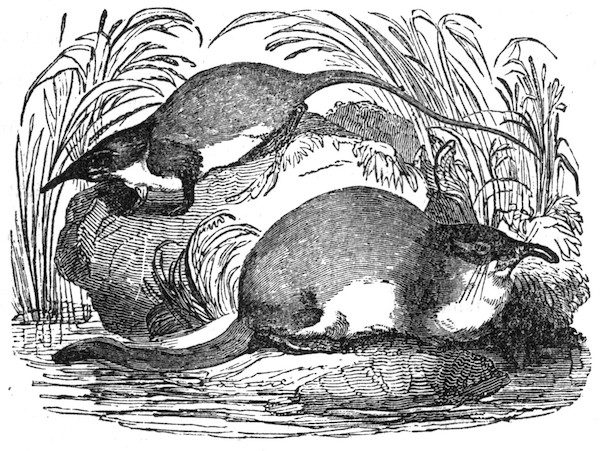
The Desman, or Russian Musk-Rat.
This creature resembles the common musk-rat, and is found both in Russia and Sweden. It is about the size of the common hedgehog, the body being eight or nine inches long. Its coat is like that of the beaver, and is composed of hair intermixed with soft, clear and delicate fur. The color is brown above, and silvery beneath. The tail, which is seven inches long, is one of the most extraordinary mechanical instruments in the whole animal kingdom. It is composed of three parts, each of which has a motion peculiar to itself.
75 The Desman chooses the margin of such places as are convenient for the burrows which it digs under water. These are sometimes seven yards in length, and are used as hiding-places. The water freezes over these entrances, and numbers of the animals are suffocated every winter. If there are any cracks or fissures in the ice, they crowd to them, eagerly thrusting their noses up to get the air.
The Desman preys at the bottom of the water, and dabbles with its nose in the mud, in search of the small insects which inhabit it. Its senses of touch and smell are very acute; this is rendered necessary from the fact that the animals upon which it preys are silent and invisible. Although nearly blind, it is not a nocturnal animal, but sleeps during the night, at which time it keeps its nose constantly moving, in order, it is supposed, to retain the organs in a proper state for work. Water is indispensable to its existence, and after having remained in a small quantity for any time, it is rendered very offensive from a strong musky odor, from which it derives its common name of musk-rat.
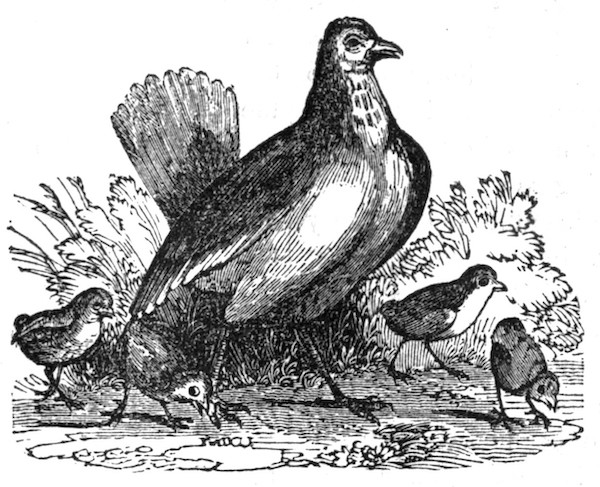
Inquisitive Jack.
CHAPTER II.
About the hen and her chickens.
It seems natural for mankind to love accumulation. When a child has got two or three pieces of money, he wants more, and his desire of increasing his stores, increases with his little wealth. When a person gets together a few minerals, his wish to form a cabinet begins, and in proportion as his collection enlarges, his eagerness for more specimens is stimulated. This love of increase, is what I call a love of accumulation, or a love of laying up.
Nov it is all the same with knowledge. A person who has only a few ideas, is like the child who has only a 76 few coppers; he is usually eager to spend them and get rid of them. But one who has stored his mind with many ideas, is like a person who has commenced a cabinet of minerals: he wishes to increase his collection; he wishes to get new specimens, and is delighted with those which are rare and beautiful.
Now, our hero, Jack, was just in this condition: he had begun his mental cabinet of knowledge; he had learned a good deal about insects; and he had entered the gate of a new and beautiful science—Ornithology—or the study of birds. How little did he think that his acquaintance with the wren family had advanced him so far into the delightful mysteries of science. Yet so it was. He now began to notice other birds, such as the blue-bird, which belongs only to America; the sparrows and finches, which build their nests in the hedges and bushes, and sing so sweetly.
About this time his attention was very strongly attracted by a hen and her chickens. Jack had himself set the hen; that is, he had put the eggs under her, there being thirteen; for he was told that an even number was unlucky, and an uneven number lucky; a notion, by the way, that is very common, but utterly destitute of foundation. He was told that the eggs would be hatched in just three weeks, and so it proved.
It is a curious thing that the eggs of hens should always be hatched in just three weeks, and I must stop to tell you a story about this. A man who pretended to be good and religious, told one of his neighbors that his hens always hatched on Sunday, and he wondered what the reason was. “I can tell you,” said the neighbor; “it is because you set them on Sunday!” Thus we see that the improper conduct of the pretended good man was exposed.
But to return to Jack. About the time the hen was to hatch, he went every day to see if the chickens had come along. He could not help wondering at the patience of the old hen, in sitting night and day so faithfully upon her eggs. He noticed that she went off her nest but once a day; that she was then in a great hurry to get a little food and drink, and return to her duty, as if she was afraid her eggs would suffer. He observed that nothing could tempt her from her charge; the other hens were out in the fields, scratching the earth, feasting on worms and insects, and delighting in the spring time; but the old hen, forsaking these pleasures, remained upon her eggs. Though she was wasted by hunger, thirst and fever, nothing could induce her to betray her trust. There she continued, obeying that voice within, which we call instinct.
On the twenty-first day of the hen’s sitting, Jack went early in the morning to the nest, and his delight knew no bounds, when he heard, on approaching it, the chickens peeping under the old biddy’s feathers. The good mother herself seemed to be filled with a sort of quiet ecstacy. When she heard the gentle cries of her offspring she endeavored to hush them to rest by a few low notes, as much as to say,—
“Hush, my dear—lie still and slumber.”
All this day, the hen remained on her nest, and Jack gave her a little Indian meal mixed with water, to eat. The 77 next day, twelve of the thirteen eggs were hatched, and the old hen, with an air of importance, and great caution, set forth with her brood. It was interesting indeed to witness the scene.
No sooner had the mother and her flock issued from the shed in which the hatching or incubation had taken place, than she began to scratch away the leaves and grass with all her might. The chickens kept close to her side, and though but a day old, seemed to know perfectly well what it all meant. They picked up the little seeds and insects and swallowed them down, taking care to avoid stones and dirt, and things that are not fit for food. How could these little creatures know so much? That is a curious question, and I can only answer, that God has made them so!
The old hen went on from place to place, clucking all the time, and taking the utmost pains to keep her brood together, and under her own immediate inspection. She made her legs fly merrily among the leaves, and many a bug and grub and worm did she discover for her little ones. She would eat nothing herself, but gave everything to her chickens, except once in a while she came across a beetle or other insect, too big for her infant flock, and then she swallowed it.
Nothing could exceed the industry, energy and watchfulness of the old biddy. For hours together, she continued to scratch and dig for her young ones, as if life depended upon it. And all this time, it was delightful to see how careful she was of her brood. Her head was bobbing up and down every instant, and her sharp eye was turned on every side, to see if there was danger. Not a bird flew over unmarked, and if it was in any degree threatening in its appearance, the whole flock was instantly drawn to a place of safety. If a cat or dog came near, they were sure to repent it, and learn better manners for the future.
When, at last, the young emigrants had filled their little crops, and become weary, the old hen gathered them under her wings. There is nothing in all nature more pleasing than a hen brooding her chickens. The little creatures themselves are marked with a singular smoothness, beauty and look of innocence. Those which are most weary bury themselves deep in the plumage of their mother’s breast, and here, cherished by a genial warmth, embedded in down, and every want and fear appeased, they fall to sleep. Those which are not yet so drowsy, peep out their heads from their mother’s feathers, and look around; or they linger outside and pick among the gravel for food; or they nibble at the old hen’s beak; or perchance they smooth some bit of their delicate plumage that is ruffled; or possibly climb up the old hen’s back. The look of innocence, peace and happiness displayed by the chickens, and the mingled aspect of care and content borne by Mistress Biddy, afford a touching and delightful picture. Who can witness it and not feel that the God of love is the author of what we call nature?
All these things were noted by Jack, and after he had observed them a long time, he went for his aunt. He found her quite busy, but he could not be contented till she left her work and went 78 with him to see the hen and her chickens. After looking at them a long time, they went to the house, and some days after the following conversation took place:
Jack. Pray tell me, aunt Betsey, why the hen that has chickens always keeps clucking?
Aunt Betsey. So that the chickens may always know where she is. The chickens are continually running about, and sometimes they go to a considerable distance, but as the hen is always clucking, they can at any time find her. But for this they would inevitably get lost. If the Creator had forgotten to teach hens to cluck, and had neglected to make any other adequate provision, a brood of chickens could never have been raised.
J. Well, why do the chickens always keep peeping?
Aunt B. So that the hen may know where they are. You will observe that if two or three chickens are wandering together, away from the hen, their peeping is usually faint and low; but if one is straying alone, his tones are loud and distinct. They seem to feel confidence when several are together, but if one is alone, he feels that it is necessary to speak out. The clucking of the hen may be considered as continually calling to her scattered brood, “Here I am, chicks—here I am,” and the peeping of the chickens may be considered as saying, “Here I am, mother—here am I.” In this way, a communication is kept up even while the brood is scattered over a wide space, in search of food. Almost all birds have natural cries, which answer the same purposes with them, as the clucking of the hens and the peeping of the chickens with these.
J. Well, aunt Betsey, I observe that the old hen seems to talk to her chickens. If a wren or a sparrow, or any other little harmless bird flies by, the old hen says, “curr-r-r-r-r,” in a moderate tone, as much as to say “look out,” and so all the chicks just cast their eyes around and seem to take no notice of what has happened. But if a hawk appear in the air, and near by, the “curr-r-r-r-r” is uttered in a wilder key. The old hen steps high, and seeks a shelter, and the little chickens run to her as if frightened out of their little wits. Now, what I want to say is, how do the chickens, only two or three days old, know so much and understand so well what their mother means and says?
Aunt B. You might as well ask, Jack, how the chickens know so much as to pick up seeds and worms when only a day old. The seeming knowledge of these little creatures, which is often so wonderful, is to be explained, as we explain the skill of the bees in building their cells, and the ants in constructing their little cities in the earth—by instinct—a power or knowledge implanted by nature, or, in other words, by God, the author of nature. He gives those powers; and though we may see their effects, he only can explain their operation. But there is one thing in your observations upon the chickens, to which I wish to call your attention, Jack. Did you ever know the old hen to call to her chickens in danger, when they neglected or disobeyed the call?
J. No, not that I remember.
Aunt B. Let this, then, be a lesson 79 to you, my boy. The little birds are taught obedience to their parents by God; and they obey. So God has taught children obedience, for he has said in the solemn commandment, “Honor thy father and thy mother;” and the apostle adds, “Children, obey your parents in the Lord, for this is right.” The hen, the parent of the chickens, is their guardian; she knows more than they do; she is stronger, and sees farther, and is wiser than they. It is best for the chickens, therefore, that they should obey her. Were they to neglect her counsel, they would be devoured by prowling beasts or birds of prey. The obedience, therefore, that they are called upon to exercise, is imposed for their good. And just so it is with respect to children; their parents have more experience, knowledge, and wisdom than they have; they know what is best for them. It is, therefore, for the true happiness of children that they should obey their parents.
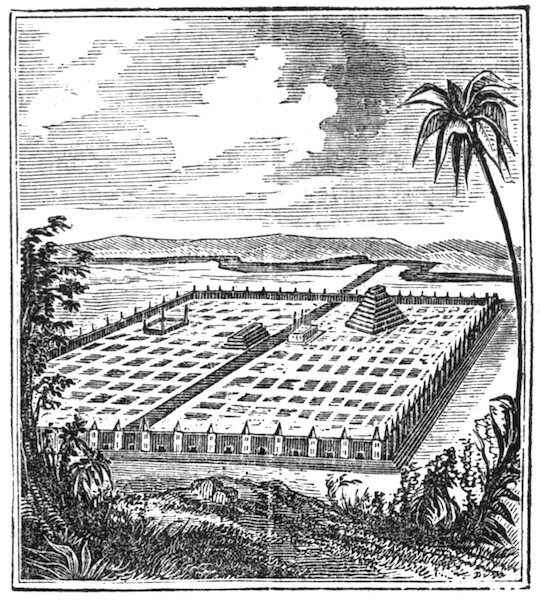
City of Ancient Babylon.
Among the most wonderful things handed down to us by history, is the account of the ancient city of Babylon, which is so often mentioned in the Bible, and the remains of which astonish the traveller at the present day. The most particular description we have of it is furnished by the Greek historian, Herodotus, who visited it about four hundred and fifty years before Christ.
80 He says that it was situated in a great plain, the river Euphrates running through it from north to south.
Its form was square; each side measured fifteen miles, and the whole circuit sixty miles. It was surrounded with walls, three hundred and fifty feet high and eighty-seven feet thick. Upon these walls were two hundred and fifty towers. The entrance to the city was by one hundred gates of brass. Without the wall, there was a deep ditch around the city, filled with water.
Upon the tops of the walls, there were buildings on each side containing one room each. Between these there was space to drive a chariot with horses. The walls were built of bricks cemented together by bitumen. At every thirty layers of bricks, there was a layer of reeds to give the fabric strength. The engraving at the head of this article is intended to give some idea of the form of this mighty city, as described by Herodotus.
The streets in the city were straight, the houses being four or five stories high. The temple of Belus was of amazing magnitude, being nearly as large as the great pyramid of Gizeh. It was a regular square, each side measuring six hundred feet. It consisted of eight towers one above another, and was of immense height. Beside this, there was a magnificent palace, and connected with it were hanging gardens of great extent.
The history of Babylonia goes back to a period of high antiquity. Its founders were among the earliest nations that have been formed upon the earth, and they appear to have reached a certain degree of science and civilization, nearly two thousand years before Christ. Nimrod is mentioned in the Bible as the founder of this empire, of which Babylon was the capital. Here the kings of Assyria held their court, and displayed a magnificence, the accounts of which strike us with wonder. Here many of the arts were carried to great perfection, particularly the manufacture of cotton, linen and silk.
Babylon reached its magnificence through the efforts of several succeeding sovereigns. But Semiramis, the wife of Ninus, is said to have been its founder. In the year 538 B. C. it was taken by Cyrus, king of Persia, who made it his winter residence. At this place, Alexander, who had conquered Persia, died, 323 B. C.
The ruins of this wonderful city are to be seen about forty-eight miles south of the present city of Bagdat. Its prodigious walls have entirely disappeared, and it is not easy to trace even the outline of this once mighty metropolis. The remains consist of heaps of rubbish, principally bricks. It does not appear that the architecture of the Babylonians had reached a high degree of refinement. Its chief characteristic was colossal dimensions. The remains of the temple of Belus are still to be distinguished, and consist of a heap of ruins about one hundred and twenty feet in height. This complete destruction of Babylon, and the desolation which presides over the scene, is regarded as a terrific fulfilment of the prophetic denunciations uttered against it by the prophets.
81
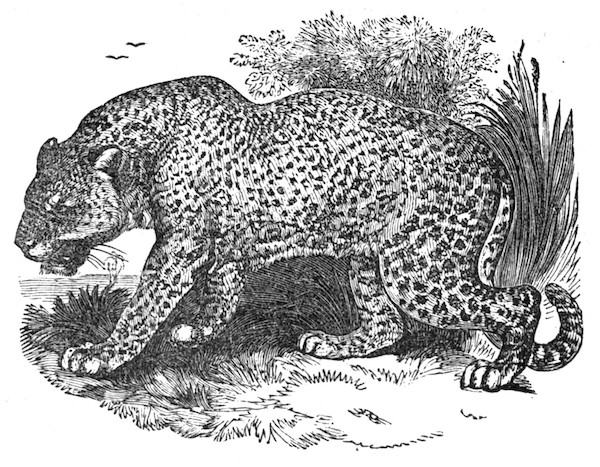
The Leopard.
This animal, a handsome, but fierce member of the great family of cats, is smaller than either the lion or the tiger. Its skin is very beautiful, being spotted with large ocellated black spots on a light ground, which sometimes approaches to a bright yellow color. The leopard is remarkably lithe and flexible in all its motions. It is a very symmetrical animal, and as its expression partakes as much of wildness as of fierceness, it is among the handsomest of its tribe. It preys upon small animals, is frequently on the hunt, and probably kills more creatures than do the tiger or the lion. It is said to be found only in the islands of the Oriental Archipelago, and in the Eastern peninsula.
The leopard climbs trees with astonishing rapidity, so that few animals are safe from his ravages. Man alone seems to be respected by him, but if pressed hard in the pursuit by the hunter, it will turn upon him, and much skill and prowess is then necessary to guard against the fury of his attacks.
Two men in Southern Africa fell in with a leopard in a mountain ravine, and immediately gave chase to him. The animal at first endeavored to escape by clambering up a precipice, but being hotly pressed, and slightly wounded by a musket ball, he turned upon his pursuers with that frantic ferocity which he frequently displays, and springing upon the man who had fired upon him, tore him from his horse to the ground, biting him at the same time very severely on the shoulder, and tearing his face and arms with his claws. The other hunter, seeing the danger of his comrade, sprung from his horse, and attempted to shoot the leopard through the head; but, whether owing to trepidation, or the fear of 82 wounding his friend, or the sudden motions of the animal, he unfortunately missed his aim.
The leopard now, abandoning his prostrate enemy, darted with redoubled fury on this second antagonist, and before the poor man could stab him with his hunting knife, he struck him in the eyes with his claws, and had torn the scalp over his forehead. In this frightful condition, the hunter grappled with the savage beast, and, struggling for life, they both rolled down a steep declivity. All this passed so rapidly that the other man had scarcely time to recover from the confusion into which his feline foe had thrown him, to seize his gun and rush forward to aid his comrade, when he beheld them rolling together down the steep bank, in mortal combat.
In a few moments, he was at the bottom with them, but too late to save the life of his friend. The leopard had so dreadfully torn the throat of the unfortunate man that his death was inevitable—and he had only the satisfaction of completing the destruction of the savage beast, which was already exhausted by the wounds given in his breast by the desperate knife of the expiring huntsman.
In a captive state, the leopard is easily domesticated. There was a pair of these animals recently in the tower of London. The female was very tame and gentle, and would allow herself to be patted and caressed by the keepers, while she purred and licked their hands. She had one curious peculiarity; she was very fond of destroying parasols, umbrellas, muffs and hats, which she frequently contrived to lay hold of before the unwary spectator could prevent it, and tore them to pieces in an instant. While this creature was in a playful mood, she bounded about her cell with the quickness of thought, touching the four sides of it nearly at one and the same instant. So rapid were her motions that she could scarcely be followed by the eye; and she would even skim about the ceiling of her apartment with the same amazing rapidity—evincing great muscular powers and wonderful pliability of form.
The Old Man in the Corner.
NO. III.
REMINISCENCES OF A RAG.
(Continued.)
We shall now proceed to tell what appeared to be written on the mysterious scroll handed forth by the seeming ghost of the rag-bin.
“I remained for a long time in the bale of cotton, shut out from the light of heaven, and in a state of uncertainty as to my condition or fate. At last I felt the bale to be tumbled about, and finally I conjectured that we were now on shipboard. This proved to be correct; for in about a month we were landed at Liverpool, a great city on the western coast of England. In a few weeks we were taken by canal through a beautiful country, 83 to Manchester, thirty-six miles east of Liverpool.
“As we glided along, I could see that the whole country was highly cultivated, and almost covered with cities and villages. Hundreds of tall steepling chimneys rose from their places, and poured forth volumes of smoke or flame, thus showing that the people, on all hands, were busy in their various manufactories. Never did I imagine such scenes of industry and activity.
“On arriving at Manchester, I was amazed to see so great a city; it consisted, in part, of many buildings four and five stories high, some of them having a hundred windows! It was night when we arrived, and these buildings, which were chiefly cotton factories, were all lighted up. Never did I see such a display; it seemed as if the whole city was illuminated.
“Our bale was soon landed at one of the factories, and we were stowed into a ware-room, almost as big as a church. Here were at least three hundred bales of cotton, as big as ours. Thinks I to myself, it will be a long time before it will be our turn to be spun, and twisted, and woven into cloth. In this, however, I was mistaken, for, in about a month, I found myself twitched out of the bale and put into a machine, where I was picked all to pieces. I was then put into the carding machine, which made me dance up and down and whirl about and about with such velocity, and amid such an everlasting hubbub, that I completely lost my senses. When I came to myself, I was made into a smooth roll, about a yard long, and one end of me was being twisted into thread. The room where this took place, was as big as a church, and several thousand spindles were twirling about and twisting the cotton into threads as fine as a hair. I was fairly giddy with the operation, and did not feel comfortable till I found myself wound snug and smooth upon a little spool or bobbin.
“I was not permitted to remain long in this state, for I was shortly placed upon a loom with a multitude of other spools, and was soon woven into a piece of fine muslin. I now went through various operations, and was finally done up with the piece, consisting of twenty-seven yards. I was despatched in a car, with forty-nine other pieces, to London, and in about a month we were shipped to Brazil, in South America. Our case was then purchased by an American merchant: this was bought by a shopkeeper of Rio de Janeiro, who soon opened it and took out the piece I was in and laid it upon a shelf. In a day or two I was bought by a beautiful lady, and made into a frock for her infant.
“It was a gay time now, for I was dandled up and down and made a great deal of. Everybody said, what a beautiful baby! and what a pretty frock! But sorrow soon followed. The lovely infant died; it was laid in its coffin, and I was its burial dress! The corpse was borne to the church with a long retinue of priests, holding torches in their hands. When they came to the church, they sung a solemn dirge, and the dim arches of the holy edifice seemed to echo back the sad and wailing tones. The coffin was deposited in its vault—the music ceased—the throng dispersed, and a fearful stillness reigned around. I could see 84 and feel, even amid the darkness of my prison house, how sweet was the placid face of that lovely babe—smiling in its lonely, desolate grave! I clung to its bosom, and was happy, even though I had no other hope than to perish, and moulder, and be forgotten.
“A day passed, and midnight came. A fearful stillness rested upon the church and all around—save that, perchance, the wings of the bats might be heard, fanning the dark recesses of the cathedral; or the drops of moisture that fell upon the lids of the coffins, at long intervals, from the arches of the tombs, caught the listening ear of silence. But at last the stillness was disturbed; a light, sliding step was heard upon the marble floor of the church; the door of the tomb where I lay was opened, the lid of the coffin was lifted, and the rays of a dark lantern were turned upon the corpse of the babe. I could see that it was the sexton who thus invaded the sanctuary of the dead. He first took a diamond from the bosom of the infant, and then, disrobing the body, carried me away. I was borne to his house, where his wife soon took the frock to pieces, and the long skirt was now but a simple piece of muslin. It was carefully ironed and sold to a pawnbroker.
“I was soon purchased by a negro girl, a slave, black and glittering as anthracite, who carried me home and made me into a wedding turban. Three days after I had been sleeping as a shroud in the crypt of the church of St. Nicholas, I was the head-dress of a bride, named ‘Phillipina Squash!’”
[To be continued.]
The Pyramids of Egypt.
These gigantic monuments, erected before the period at which authentic history begins, have ever excited the curiosity and wonder of mankind. Their vast antiquity, their amazing magnitude, the mystery which hangs over their origin and design, contribute to render them objects of intense interest.
There are great numbers of these structures in Egypt, and about eighty in Nubia. Those of the former country are all situated on the west side of the Nile, and extend, in an irregular line, to the distance of nearly seventy miles. The most famous are those of Jizeh, opposite the city of Cairo. The largest, which is said to have been built by Cheops, a king of Egypt, about 900 years B. C., is by far the greatest structure in stone that has been reared by the hand of man. Near this great pyramid, are two others, of considerable size, and several smaller ones. All have square foundations, and their sides face the cardinal points. The largest pyramid excited the wonder of Herodotus, who visited Egypt 450 B. C. He says that one hundred thousand men were employed twenty years in building it, and that the body of Cheops was placed in a room beneath the bottom of the pyramid. The second pyramid is said to have been built by Cephrenes, the brother of Cheops, and the third by Mycerines, the son of Cheops.
The great pyramid consists of a series of platforms, each of which is smaller than the one on which it rests, and consequently presents the appearance of steps. Of these steps there are two hundred 85 and three. They are of unequal thickness, from two feet and eight inches, to four feet and eight inches. The stones are cut and fitted to each other with great nicety. The whole height is four hundred and fifty-six feet. The top is a platform, thirty-two feet square. The foundation is seven hundred and sixty-three feet on each side, and covers a space of about thirteen acres.
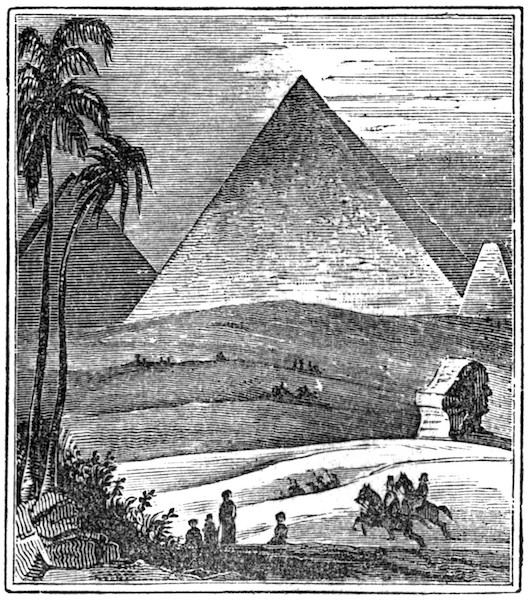
The pyramid has been entered, and has been found to consist of chambers and passages, some of great extent.
The material of which the pyramids are built is limestone, and it is probable that this was obtained from limestone quarries contiguous to the place where they now stand. The stones of the great pyramid rarely exceed nine feet in length, six and a half in breadth, and four feet eight inches in thickness. The ascent is attended with great difficulty and danger, on account of the broken state of the steps; yet it is frequently accomplished, and sometimes by females. The scene from the top is described by travellers as inconceivably grand.
The purpose for which these monuments were reared, has been a question of great interest. It has been conjectured that they were built as observatories, but this seems to be an absurd supposition; for why build three or four close together of nearly the same elevation? There is no good reason to doubt that they were erected as burial places for the Egyptian kings, who caused them to be constructed. The natural pride of man, the desire of being remembered for ages, and probably some superstitious notions connected with the religion of the country, doubtless 86 furnished the motives for the construction of these vast monuments. Nothing can better show the folly of human ambition, than that, while these senseless stones remain, their builders have perished, and their memories been blotted out forever.
Pictures of Various Nations.
CHAPTER III.
The Indians.
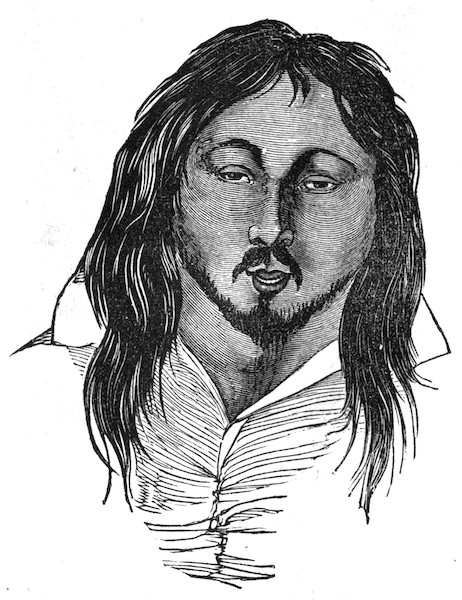
In a former number we have given some account of the northern Indians, called Esquimaux; and as our readers may like to know how these people look, we give a likeness of one of them. He would hardly be thought a beauty among us, but no doubt he would find some one to fancy him among the girls of his tribe, who live on fish and blubber oil.
All our readers know that when America was discovered, it was inhabited by tribes of copper-colored people, whom we generally call Indians. These were 87 divided into many tribes, and spoke many different languages, but they bore a general resemblance, which led to the conclusion that this remarkable race came originally from Asia, and had a near affinity to the roving, warlike tribes there, called Tartars.
The American Indians, at the time of the discovery of Columbus, might be viewed in four groups: 1st. The Mexicans, who had built cities, established a permanent government, carried on manufactures and commerce, and cultivated the earth with care and success; 2d. The Peruvians, who had made nearly the same advances in civilization as the Mexicans, though differing in many of their arts, manners, customs, and opinions; 3d. The Caribs, a warlike nation, inhabiting the Caribbean isles and the adjacent coast of South America; and, 4th. The various scattered tribes of the continent.
We shall not enter into a minute account of these several groups, for so much has been said of the Indians, that almost all persons are pretty well acquainted with the subject. Among the chief tribes of New England, when our forefathers settled there, were the Pequots, Narragansets and Mohegans. In New York, are the Mohawks, Senecas, Oneidas, Delawares and Ottoes. In the south and west, there are many other bands or nations.
These tribes, of which there were perhaps several hundred in North America, varied in number from two hundred to five thousand inhabitants each. They all lived chiefly by hunting and fishing, raising a few pumpkins and melons, and a little corn, to aid in obtaining a subsistence. They knew not the use of iron or other metals for cutting; they had no domestic fowls or animals, except, perhaps, dogs far to the north; they lived a wandering life, having no better houses than huts of wood and mud.
Their weapons of war were hatchets of stone, bows and arrows; their fishhooks were the bones of fishes. They had no tables or chairs; no religious edifices, and but few religious notions. The men spent their time in hunting and the chase, and the women performed all the drudgery.
In war, these savages were cunning, deceitful and cruel: they could track their enemy through the forest by the traces left upon the grass and leaves; they would lurk in the thickets for days, and then suddenly and unexpectedly burst upon their victims. The warriors taken in battle, were often tortured and put to death—but these disdained to show the slightest emotion, even though knots of pine were stuck in their flesh and set on fire!
At first, these Indians received our forefathers with kindness, but, exasperated by various acts of injustice and cruelty, they became treacherous and vindictive. Many bloody encounters took place between the settlers and the savages, in all of which the latter suffered defeat and loss, until they became extinct along the Atlantic border, and the remains of their tribes only continue to linger along our western frontier.
The natives that dwelt in the West Indies, some of which were very numerous, have entirely disappeared. Mexico was conquered by Cortez more than three hundred years ago, and the whole Indian 88 race, amounting to six or eight millions, belonging to that nation, were subjugated. The Indians of Mexico now acknowledge the authority of the established government, pay taxes, and generally belong to the Catholic religion. They are still an ignorant and half barbarous race.
The Peruvian nation, also amounting to millions, was conquered by Pizarro about the year 1535, and from that period the natives became subject to the laws of the white man. These, as in Mexico, are partially civilized.
There are still many South American tribes, which are independent, and maintain their savage habits. The Araucanians, a Chilian tribe, the noblest race of aboriginal Americans, have never been fairly subdued, and though partly civilized, they maintain a lofty spirit of independence. Far south, toward the extremity of South America, the broad-shouldered Patagonians live in savage wildness, and around the rocky and tempestuous shores of Cape Horn, the naked, shivering Fuegians snatch from the raging elements a precarious subsistence.
At the present day there are several tribes inhabiting the vast regions that lie west of the Mississippi, consisting, for the most part, of fragments of tribes driven by the white man from more eastern settlements, to their present abodes. Here they are still lords of the forest, prairie, river and mountain, and here they maintain their wild independence and savage customs. They have become in some degree changed by intercourse with the white race; they have horses, and fire-arms and blankets, and a few utensils derived from civilized man; but they are still hunters and warriors, are still without books, or a settled government, or fixed habitations, or extended agriculture, or any of the leading features of civilization. In another number we propose to tell something about the Indians as they now are.
A Monster of the Deep.
Our readers know that in some parts of the ocean there are enormous sea animals called Sepia, which are a kind of polypi. They have very long legs, and are said sometimes to seize upon the coral divers along the coast of Italy. Mr. Beale tells us the following adventure with a creature of this sort.
“While upon the Bouin Islands, searching for shells on the rocks, which had just been left by the receding tide, I was much astonished at seeing at my feet a most extraordinary looking animal, crawling towards the retreating surf. I had never seen one like it before. It was creeping on its eight legs, which, from their soft and flexible nature, bent considerably under the weight of its body, so that it was lifted by the efforts of its tentacula only a small distance from the rocks.
“It appeared much alarmed on seeing me, and made every effort to escape, while I was not much in the humor to endeavor to capture so ugly a customer, whose appearance excited a feeling of disgust, not unmixed with fear. I, however, endeavored to prevent its career, by pressing on one of its legs with my foot; but, although I used considerable force for that purpose, its strength was so great 89 that it several times quickly liberated its member, in spite of all the efforts I could employ in this way, on wet, slippery rocks. I now laid hold of one of the tentacles with my hand, and held it firmly, so that the limb appeared as if it would be torn asunder by our united strength. I soon gave it a powerful jerk, wishing to disengage it from the rocks to which it clung so forcibly by its suckers, which it effectually resisted; but the moment after, the apparently enraged animal lifted its head, with its large eyes projecting from the middle of its body, and, letting go its hold of the rocks, suddenly sprang upon my arm, which I had previously bared to my shoulder for the purpose of thrusting it into holes in the rocks to discover shells, and clung, with its suckers, to it with great power, endeavoring to get its beak, which I could now see, between the roots of its arms, in a position to bite.
“A sensation of horror pervaded my whole frame, when I found this monstrous animal—for it was about four feet long—fixed so firmly on my arm. Its cold, slimy grasp was extremely sickening, and I immediately called aloud to the captain, who was also searching for shells at some distance, to come and release me from my disgusting assailant. He quickly arrived, and taking me down to the boat, during which time I was employed in keeping the beak away from my hand, quickly released me by destroying my tormentor with the boat knife, when I disengaged it by portions at a time. This animal was that species of Sepia which is called by whalers ‘rock squid.’ Thus are these remarkable creatures, from the different adaptation of their tentacles and slight modifications of their bodies, capable of sailing, flying, swimming, and creeping on the shore, while their senses, if we may judge from the elaborate mechanism of their organs, must possess corresponding acuteness and perfection.”
The Sperm Whale.
The Sperm Whale is much less known than the common whale, which is usually taken by our whalers. The following account of it, furnished by Thomas Beale, is interesting.
“The sperm whale is a gregarious animal, and the herds formed by it are of two kinds—the one consisting of females, the other of young whales not fully grown.
90
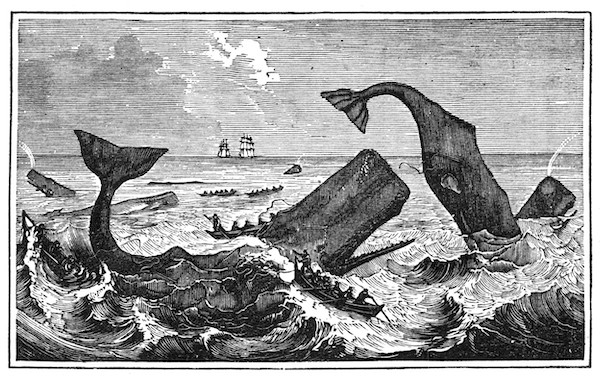
“These herds are called by whalers, ‘schools,’ and occasionally consist of great numbers; I have seen in one school as many as five or six hundred. With each herd or school of females, are always from one to three large bulls, the lords of the herd, or, as they are called, the ‘school-masters.’ The full-grown whales, or ‘large whales,’ almost always go alone in search of food; and when they are seen in company, they are supposed to be making passages, or migrating from one ‘feeding ground’ to another. The large whale is generally very incautious, and if alone, he is without difficulty attacked, and by expert whalers generally very easily killed; as frequently, after receiving the first blow or plunge of the harpoon, he appears hardly to feel it, but continues 91 lying like a ‘log of wood’ in the water, before he rallies or makes any attempt to escape from his enemies.
“Large whales are, however, sometimes, but rarely, met with, remarkably cunning and full of courage, when they will commit dreadful havoc with their jaws and tail; the jaw and head, however, appear to be their principal offensive weapons.
“The female breeds at all seasons, producing but one at a time. The young when first born are said to be fourteen feet long. The females are much smaller than the males. They are very remarkable for their attachment to their young, which they may be frequently seen urging and assisting to escape from danger with the most unceasing care and fondness. They are also not less remarkable for their strong feeling of sociality, or attachment to one another; and this is carried to so great an extent, that when one female of a herd is attacked or wounded, her faithful companions will remain around her to the last moment, or till they are wounded themselves. This act of remaining by a wounded companion, is called ‘heaving to,’ and whole ‘schools’ have been destroyed by dexterous management, when several ships have been in company, wholly from their possessing this remarkable disposition. The attachment appears to be reciprocal on the part of the young whales, which have been seen about the ship for hours after their parents have been killed.
“The young whales, or ‘young bulls,’ go in large schools, but differ remarkably from the females in disposition, inasmuch as they make an immediate and rapid retreat upon one of their number being struck, who is left to take the best care he can of himself. I never but once saw them ‘heave to,’ and in that case, it was only for a short time, and seemed rather to arise from their confusion than affection for their wounded companion. They are also very cunning and cautious, keeping at all times a good look-out for danger. It is consequently necessary for the whaler to be extremely cautious in his mode of approaching them, so as, if possible, to escape being heard or seen, for they have some mode of communication with one another in an incredibly short space of time; the distance between them sometimes amounting to five, or even seven miles. The mode by which this is effected remains a curious secret.”
THE COTTAGER TO HER INFANT.
The days are cold, the nights are long, The north wind sings a doleful song; Then hush again upon my breast; All merry things are now at rest, Save thee, my pretty babe! The kitten sleeps upon the hearth, The crickets long have ceased their mirth; There’s nothing stirring in the house, Save one wee, hungry, nibbling mouse; Then why so busy thou? Nay! start not at that sparkling light, ’Tis but the moon that shines so bright On the window pane bedropped with rain; Then, little darling! sleep again, And wake when it is day.
92
Squirrels.
[For Merry’s Museum.]
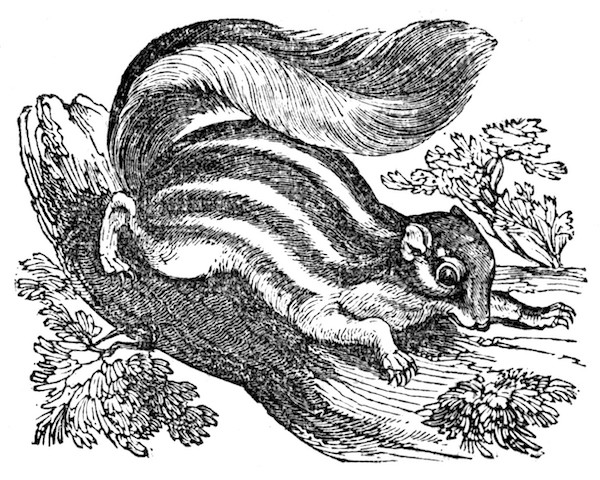
The Chip Squirrel or Ground Squirrel is the most common and familiar of all the squirrels. “He is most commonly,” says Godman, “seen scudding along the lower rails of the common or ‘Virginia’ fences, which afford him at once a pleasant and secure path, as, in a few turns, he finds a safe hiding place behind the projecting angles, or enters his burrow undiscovered. When no fence is near, or his retreat is cut off, after having been out in search of food, he becomes exceedingly alarmed, and runs up the nearest tree, uttering a very shrill cry or whistle, indicative of his distress; and it is in this situation that he is most frequently made captive by his persecuting enemies, the mischievous school-boys.” I shall presently mention a much better mode of treatment of them by children, than the one here alluded to, and which is far too common.
He is not only the most numerous, but the most beautiful of all the squirrels I have named. His general color (if it is necessary to describe an animal so well known) is a reddish brown, but he has five black stripes running lengthwise along his body, one in the middle of the back, and two on each side, and between the two on each side is a stripe of pure white. These stripes, together with white stripes on each side of his head, above and below the eyes, give him a very beautiful appearance, and it is no wonder that children, who are commonly pleased with what is beautiful in nature, take a strong liking to him. He is sometimes called the Striped Squirrel, on account of his markings, but he is more commonly called the Chip Squirrel, or Chipmuck, from the chipping sound he is accustomed to make, or the Ground Squirrel, because he makes a burrow in the ground for his lodging-place instead of residing in a tree, as the other squirrels do. Mr. Godman says he is sometimes called Hacky; but why so called, I am unable to tell. I have mentioned his being a familiar animal; I will now state a circumstance, to show how familiar he may be made, and how far 93 kind and gentle treatment operates to deprive wild animals of their fears. One, which had a hole not far from my house, used frequently to come about the house for food, which my children observing, would throw walnuts or hickory nuts to him. He soon became so gentle he would take the walnuts from their hands, and, after biting off the sharp and jagged ends of the nuts, he would stow them in his capacious cheeks or pouches, sometimes taking from their hands and stowing away in this manner four hickory nuts, two in each pouch, which he would carry off and deposit in his hole, and then immediately return for another cheekful.
The Flying Squirrel is the smallest of all the squirrels in New England, and in some respects the most interesting. He is not as well known as the other three kinds I have described, principally on account of his nocturnal habits; that is, he generally sleeps during the day, and is in motion during the night. He is not so beautiful in his colors and markings as the chip squirrel. His general color is a brownish ash or gray on the upper part of the body, and white underneath, with a yellowish margin which unites with a dark stripe that borders the gray color of the upper parts. His form and attitudes are beautiful, however; his hair very soft and silky, and his eyes, which are black, are large and prominent. But what makes him the greatest object of curiosity, is, that the skin on each side of his body is dilated and attached to both his legs, nearly or quite down to the claws, so that when he extends his legs horizontally it forms a kind of wings or parachute, by which he is enabled to sail obliquely through the air a considerable distance. He cannot, however, rise, as he never flaps his wings; but by taking a leap from the top of a tree and spreading his sails, he reaches the body of another tree several rods distant, and running to the top of the latter, he again makes a similar flight, and in this way passes rapidly through the forest. His tail is flattened horizontally, and doubtless answers the purpose of a rudder.
His food is similar to that of the other squirrels, consisting of nuts, grain, &c. They make their abode in hollow trees, from which they will frequently run out, when the tree is struck with an axe and smartly jarred, to see what is the matter.
They frequently enter human dwellings. Last winter I caught, in succession, seven, in the upper chamber of my house, and kept six of them shut up till spring, when I carried them to the woods near by and released them. They also became pretty familiar, and would eat and gambol in my presence and that of my family in their box. In the course of last summer, I again saw one in my house, probably one of the same. Three other instances have come to my knowledge in which they were found in dwelling-houses.
In the animals we have been considering, we see an interesting specimen of that wonderful variety and beauty which constitute the charm of the great world of life. The study and contemplation of the works of God, animate and inanimate, will be attended with continued and increasing admiration, and if the mind is properly attuned to the harmonies that pervade them, it will be made 94 better and better, and will be led, in the words of the poet, “from nature up to nature’s God.”
Sciurus.
Our Correspondence.
We have received the kind New Year’s greeting of R. B. Jr., for which we offer a return of our best wishes. We have also the pleasant letter of P. L. H., and that of E. D. H. His answer—Constantinople—to the puzzle, is right. We have also received the communications of D. A. B—k. Our little friend, a “reader of the Museum” at Pulaski, will see that we have hardly got room for his thoughts on “Liberty.” His sentiments, however, are very just. The puzzle from Goshen, though a good one, must be omitted. We must say the same of the geographical enigma from a place without a name. The complimentary note of Charles A. H—y is received, and his answer to the puzzle is right. The “young subscriber from New Hampshire” will see that we have not space for his pleasant enigma.
We insert the following letter with pleasure. In regard to the word “Cowpig,” as used by Mrs. Trudge, we venture to suggest that she meant Cupid; but, as we would not be too confident on this point, we propose to ask her what she did mean, when we next see her.
Sandwich, January 8th, 1844.
Dear Mr. Merry:
I wish you a happy new year. I think I have found out the answer to the puzzle in the January number, which is Constantinople. As I am not much of a poetess, I cannot put it in the form of an acrostic or rhyme, and I hope a plain answer will do. It is the first one I have ever found out, but I think it is because I have not had patience enough, for I found it very easy. I am glad you are going to have some good long stories, equal to the Siberian Sable-hunter, in this year’s Museum. I feel much interested in the story of Bridget Trudge. I laughed well at the red bonnet and yallar silk gown, and fan with Wenus on one side, and Cowpig on the other. But none of us can tell what Cowpig means. Please explain it in the next chapter about them.
P.S. My sister Lottie is very disappointed at not finding any “Little Leaves.”
E.P.C.
The letters of R. P. H., E. B. P., and James P., will appear in the next number.
We insert the following with pleasure, which the writer tells us is a true picture of a dear home. It makes our old heart glad to find that we are welcome, even among the mountains.
A WINTER EVENING IN THE COUNTRY. Away among the mountains a pleasant farm house lies, And round its fireside gather sweet faces and bright eyes; The blazing fire of maple-wood lights up the spacious room, And branches of the fragrant birch give out a sweet perfume. And we are happy—’midst these hills our childhood has been past, And beautiful they seem to us, with forests old and vast; The summer and the autumn bring golden fruits and flowers, But dearer than the summer days are pleasant winter hours. The happy winter evenings, we love their social mirth, For many pleasant tales are told beside our lighted hearth; A welcome face sometimes looks in upon our circle here, And brings to us the happiest hour in all the glad New Year. It is an old man’s face, with clustering gray hair, And a wrinkled forehead wearing, though furrowed not by care; Old Robert Merry, with his smiles, his tales of other climes, His Museum of curious things, new stories and old rhymes. We knew him by another name in years that are gone by, And loved good Peter Parley with his kind brow and eye; 95 Each month unto our mountain home, came “Parley’s Magazine,” ’Till “Merry’s Museum” took the place where it so long had been. We love our guest far better because our own young hands Have labored for the pleasure he brings from other lands; When autumn leaves fell round us, the autumn nuts grew brown, We and the squirrels gathered them as they came rattling down. O, merry was our harvest time—we made the woods ring out, Through all the long, bright autumn day, with our gay, careless shout; And then we sold our nuts, and thus have the pleasure still, Of seeing Robert Merry in our home upon the hill. M. T. B. Lowell, Jan. 4.
THE LITTLE SOLDIER.
We insert the following, with thanks to the writer, and should be glad to receive the remainder of the story:
Mr. Merry:
I am one of your “blue-eyed friends,” and although not a “little” one, I have been much interested in the articles which have appeared in the Museum, connected with the war of our Revolution.
I know many of the warm advocates for peace, query how far it is judicious to interest the minds of the rising generation, in the details of war; still, I must believe that many of the blessings we enjoy, peculiar to our own country, were purchased by the self-sacrifices of our fathers, and their “children’s children,” should not overlook this fact.
It has occurred to me that a little sketch of one who took an active part in the scenes of those eventful days, may perhaps amuse your readers. The old soldier from whom I have my history, enlisted into the army at the age of fifteen, as a fifer. He was much below the common size of boys at that age, and, for this reason, chose to be a musician. He heard the sound of the guns on the morning of the Lexington battle, and soon after this event, he was ordered, with the company to which he belonged, to New York. His good mother furnished him with all that a kind, pious mother could think of, for his comfort, even to a ball of yarn and a needle, to repair his stockings. He returned them to her, after his service in the army, “safe and sound.”
Soon after their arrival in New York, the alarm was given that the enemy were approaching; and not doubting a skirmish, at least, a company of men volunteered to go out and meet the enemy. They were ordered to be in ambush, and then rise suddenly upon the foe. The little fifer (a mere boy) joined the party, and soon found himself in the heat of battle. He has often told me that he felt no sensation of fear at the time; the dense smoke, the roaring of the cannon, the groans and shrieks of the dying, were alike unheeded by him. His only wish was to load—aim—fire, and kill one of the British. He always thought he accomplished his object, and God seems to have awarded a quick retribution.
Just as he had fired, his party were ordered to retreat, and, in turning to obey the orders, the poor fellow received a ball in the back, which lodged near the spine. He thought it must be his death-wound, and after moving on a few rods, he left his comrades, and concealing himself behind a small white oak tree, he set up his gun, and falling on his knees, he committed his soul to the Saviour. His eye-sight and hearing left him; he was bleeding profusely, and of course believed this to be his last hour on earth.
How long he was in this state he could not tell, but hoping his strength would permit, as soon as he could see and hear, he crawled on his hands and knees into the road, and soon met the surgeon, who, with the vehicle for the wounded soldiers, was on his way to the place where the skirmish was fought. The hospital was a mile distant, and the lad chose to remain where he was, until the cart came back. He was placed in it, and, in the course of a day or two after his wound had been given, the surgeon attempted to extract the ball, but it could not be done without causing instant death.
He remained in the hospital eight or ten weeks, slowly recovering his strength. He was two hundred miles from home; poor, feeble, and in this sad condition, he resolved to attempt a journey home on foot. A young man, who was his intimate friend and fellow-townsman, agreed to be his guide and protector, and they started on their melancholy journey.
If the sketch, thus far, has awakened any interest, the writer will cheerfully communicate some touching incidents connected with the “soldier’s return home.” What is your opinion, Mr. Merry?
A Soldier’s Daughter.
96
[Audio content is not currently supported on your device.
Evening.
WORDS AND MUSIC COMPOSED FOR MERRY’S MUSEUM; THE LATTER BY GEO. J. WEBB.
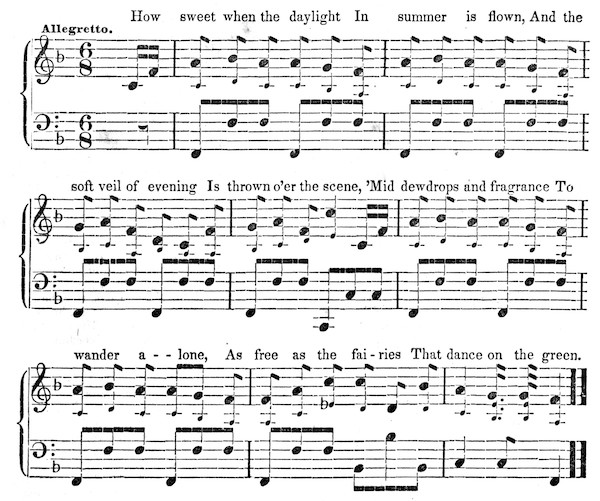
How sweet when the daylight In summer is flown, And the soft veil of evening Is thrown o’er the scene, ’Mid dewdrops and fragrance To wander alone, As free as the fairies That dance on the green. How changed is each scene! Though familiar it be, Now strange and fantastic It comes to the eye,— E’en the sigh of the zephyr, That rustles the tree, Seems the whisper of spirits That stoop from the sky. The stars, that shrunk back All abashed from the gaze, When the sun in his glory Shone down from above, Now timid and tender Melt the soul with their rays, And woo it to Heaven On pinions of love. Sweet Evening—how fair Are thy charms to the heart, And how blest thus to wander With thee all alone! Yet dearer—far dearer, Blest Evening, thou art, When I praise thee to Mary. And call her my own!
97
MERRY’S MUSEUM.
Vol. VII APRIL, 1844. No. 4.
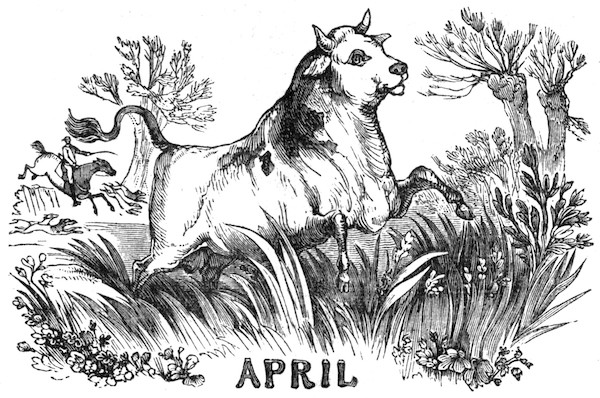
pril has stolen in upon us, and deserves a welcome at our hands. In our New England climate it is not so gentle as in some other lands. It brings us no flowers, but still, the blue-bird and the robin visit us, and tell us of a thousand pleasant things that May and June will bring with them. This month has been thus described by a lively and pleasant writer.

“April,” says the author of the “Mirror of the Months,” “is Spring—the only spring month that we possess—at once the most juvenile of all the months and the most feminine, never knowing her own mind for a day together. Fickle as a fond maiden with her first lover, toying it with the young sun, till he withdraws his beams from her, and then weeping till she gets them back again. April is doubtless the sweetest month of all the year; partly because it ushers in the May, and partly for its own sake. It is to the confirmed summer, what the previous hope of joy is to the full fruition; what the boyish dream of love is to love itself. It is indeed the month of promises; and what are twenty performances compared with one promise? April, then, is worth two Mays, because it tells of May in every sigh that it breathes, and every tear that it lets fall. It is the harbinger, 98 the herald, the promise, the foretaste of all the beauties that are to follow it.”
Dick Boldhero.
CHAPTER III.
Adventures in South America, continued.
S evening approached, I found myself quite fatigued, and my feet almost blistered from the heat of the ground. I was therefore very glad to see a coffee plantation lying to the right, and about a mile distant. Thither I went, and applied to some of the negroes for a night’s lodging, but found, however, that not one of them could speak a word of English,—Dutch being the only language with which they were acquainted. Several of them got round me, chattering like so many magpies.
Finding it impossible to make them understand by words, I resorted to signs. I suppose I must have been a pretty good mimic, for they seemed to understand me at once, and burst into the most uproarious fits of laughter. They finally concluded to take me to their master, whom I found to be a great stout man, with a swarthy complexion, and a farmer-like appearance; but he, being a Dutchman, could speak no English. The negroes, however, interpreted my wishes, and the planter gave immediate directions to have me taken good care of. I was accordingly carried off in triumph by my sable friends, who treated me as well as if I had been an emperor.
I never saw such a merry, kind-hearted set of fellows. They got some water, and one of them washed my sore feet; another brought me a bowl of milk, and a third spread my bed. After I had rested for half an hour, I was called to supper, and took my meal with the planter and his family. They were all very kind and polite. There was one black-eyed girl,—the planter’s daughter, as I supposed,—whom I thought very handsome, but very different from our New England girls. Her complexion was extremely dark; her hair black as jet, her skin being quite of an olive color. When her features were at rest, her countenance was pensive, almost sad; but the moment she spoke, there was a flash of cheerfulness over her whole countenance. I stole several glances at her, but being only a poor sailor, I deemed this a kind of theft, and tried hard not to be detected. I noticed, however, that the maiden caught me looking at her several times. I expected she would be angry, but this was far from being the case.
The habitation of the planter was very different from a snug New England dwelling. In this delicious climate there is a perpetual summer; no frost, no snow, no blustering Boreas ever comes to chill the inhabitants, to destroy the vegetation, or interrupt the genial course of nature. Little is needed for the comfort of the inhabitants, in respect to a dwelling, but a mere shelter. The planter’s residence consisted of three or four distinct buildings, of irregular shape and arrangement. One was of brick, and covered with tiles; the rest were of wood, and had more the appearance of cattle sheds than human 99 dwellings. There were no chimneys, and the windows consisted of openings without glass.
When it came night, I was put into one of these buildings. We ascended to a second loft by a ladder, and I laid down upon a bed which consisted of straw. Feeling very weary, I soon fell asleep. I continued in a sound repose for several hours, when, at last, I awoke suddenly. It seemed as if I had heard some one whispering to me, and in a sort of dream, I fancied that it was the black-eyed daughter of the planter. But when I was fully awake, and rose up in my bed, my amazement at what I beheld was indescribable.
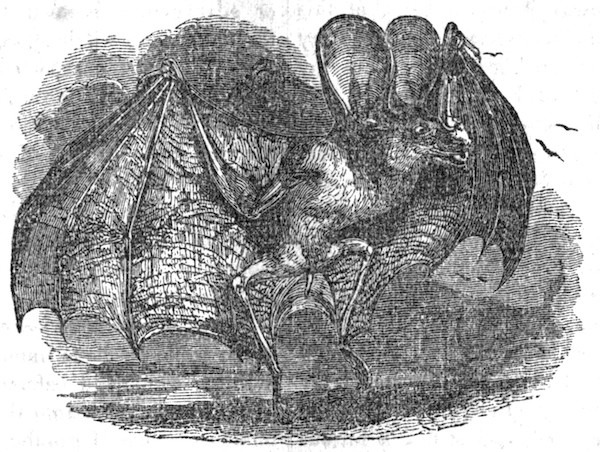
The moon was shining very brightly, and lighted the large barn-like apartment in such a manner, that I could see almost every object with distinctness. Above me, amid the dusky shadows of the room, I beheld a creature of the most extraordinary aspect. It seemed to have the head of a rhinoceros, with most enormous ears, the body of a bird, and the legs of an alligator. It had immense wings, shaped like those of a bat. To my excited imagination, the creature seemed as big as an ox; and as I gazed upon it, it seemed to wave its prodigious wings, and grin at me with a sneering and malicious expression.
My first idea was, that it was a mere night-mare; but when I recollected that I was in a strange country, and moreover remembered the adventure of the alligator, which had so recently occurred, I began to conceive that it must be a reality. There is no harm, at least, thought I, in being prepared for the worst. Accordingly, I reached out my hand, and seized my cudgel. I then laid down upon my bed, and keeping my eye fixed upon the grisly apparition, held myself ready for what might happen. I kept myself perfectly still, and at last the creature spread its wings 100 and began to make a circuit through the upper regions of the apartment.
Round and round he went, upon a noiseless wing, and at last began to make a dip at me. Never shall I forget the sensations of that horrible moment! The very uncertainty, whether it was a reality, or some grisly phantom of the brain, seemed to increase my agitation. Could I have been sure that it was a thing of flesh and blood, I should have been ready to give it battle. But the doubt, whether it was a being of this world or another, seemed to freeze my blood. I grasped my cudgel, but my arm was paralyzed.
Thus I lay for several moments, while the spectre wheeled round and round, at every evolution, stooping lower and lower, as he came near the place where I lay. At last he paused in his flight, and hovered over the foot of my bed. I could distinctly feel his claws upon my feet, as well as the fanning of his wings, which were kept constantly in motion. The sensation restored my reason and my strength. I partially arose in my bed, and struck a furious blow with my cane at the monster. It took effect, and it fell lifeless to the floor. What was my surprise, on going to the spot where the creature lay, to discover that what my excited fancy had exaggerated to the seeming dimensions of a winged ox, was, in fact, not bigger than a crow! It was one of the huge bats common to Guiana, and known by the name of the Vampire. It had no doubt come to see how a little blood drawn out of a Yankee boy’s great toe would taste. But the fellow was mistaken in his customer.
I now laid myself down upon my bed but it was in vain that I attempted to sleep. I lay for several hours, and finding it impossible to repose, I went to the window and looked forth upon the scene. The moon was shining with wonderful brightness, and from the eminence on which the plantation stood, I had a distinct view of the surrounding country. The river Surinam shone like silver in the distance, the air was filled with spicy fragrance, and a kind of dazzling light or silvery mist seemed to be diffused throughout the whole space beneath the sky. The whole aspect of nature and the objects around me was strange, yet lovely. There was a balmy softness in the atmosphere, a kind of twilight splendor over the face of nature, which excited my admiration, and, at the same time, gave me a sort of pensive and lonely feeling, at the idea that I was far, very far, from my home.
I remained at the window looking out at the scene for some time. At last the morning came, and before the sun had risen, I went forth into the fields. An immense extent of ground, belonging to the plantation, was covered with coffee trees. These were about ten feet in height, planted in rows at the distance of about ten feet from each other. They somewhat resemble the peach tree; but the leaves are longer, narrower, and highly varnished. These trees, or rather shrubs, are evergreens, and produce fruit when they are about four years old. They live to a great age—sometimes a hundred years. They were now covered with large branches of white blossoms, which gave forth a sweet odor. The coffee berry grows in a kind of 101 fruit, which is red when ripe, and has a very beautiful appearance upon the trees.
After looking about the grounds for a short time, I was returning to the house, when I met the black-eyed daughter of the planter. She bade me good morning, in English, and, to my joy and surprise, I found that she knew a few words of that language. We tried to enter into conversation, but without much success. She asked me my name; and when I told her it was Dick Boldhero, she manifested much surprise and interest. She spoke with great earnestness, and seemed to have an intense desire to know something more. At last, I saw the tears come down her cheeks, and I felt an emotion which I cannot describe. After a time, we separated, and having taken breakfast, I bade adieu to the plantation, and set forward upon my journey.
[To be continued.]
William Ellery Channing.[1]
Dr. Channing was born at Newport, Rhode Island, April 7th, 1780. His father, William Channing, Esq., an eminent lawyer of Newport, died in the midst of his vigor, and at the height of his professional success, when his son William was in his fourteenth year. His mother, was a daughter of William Ellery, one of the signers of the Declaration of Independence. She died in Boston, in 1834. His father’s character doubtless exerted an influence in forming the mind of his son, but the nearer intimacy, which, in the long period through which his mother remained the sole possessor of his filial regard, gave her a peculiar power over him.
Dr. Channing is said to have been remarked in early youth as singularly pure-minded, devout, earnest, and aspiring—leaving his friends to anticipate from him great excellence and eminence of character. He graduated at Cambridge, Mass., in 1798, bearing with him the highest honors of the institution, and having distinguished himself for habits of diligence, and for blamelessness of conduct. He now accepted an invitation to reside a year with a gentleman of Virginia, as the instructor of his children. Here he doubtless laid the foundation of that feebleness of constitution which attended him through life. Here, also, he probably adopted the resolution to devote himself to the ministry. He pursued his professional studies, partly with his uncle, Rev. Henry Channing, of New London, Connecticut, and partly at Cambridge.
Mr. Channing received an invitation to settle over the Church and Society in Brattle Square, at the same time that he received one from the Federal Street Church. He chose to accept the latter; his preference being determined “partly by considerations of health, and partly by diffidence;” his humility producing a distrust of his own fitness for the office of a Christian minister, that for a time was painfully oppressive, and finally led him, in connection with his health, to choose 102 the less conspicuous and important of the situations offered him.
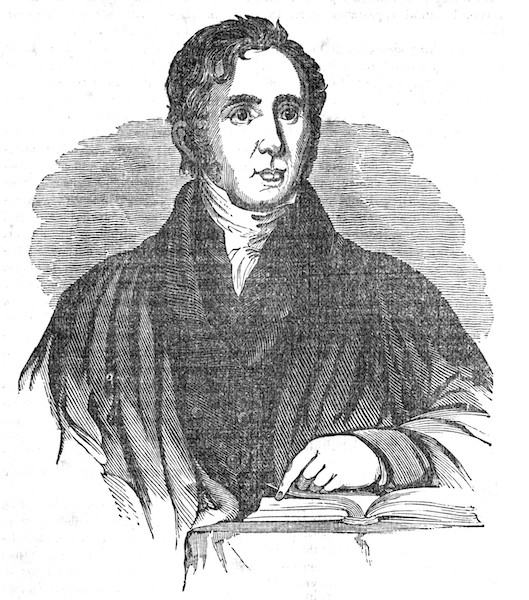
His ordination took place on the 1st of June, 1803. An old copy of the Columbian Centinel contains the following notice: “Ordination.—Yesterday was ordained to the pastoral care of the Church in Federal Street, the Rev. Wm. Ellery Channing. The Rev. Mr. Holmes introduced the solemnity by prayer. Professor Tappan delivered the sermon from Eph. iii. 8, 9; the Rev. Dr. Osgood 103 made the ordaining prayer; the Rev. Henry Channing gave the charge; the Rev. Mr. Tuckerman expressed the fellowship of the Church; and the Rev. Dr. Eckley made the concluding prayer. The ceremonial was conducted, and the services performed, with a solemnity and fervor suited to the occasion.”
Mr. Channing was appointed Dexter Lecturer on Biblical Criticism in Harvard University, in 1812, but his health did not allow him to prepare a course of lectures, and he resigned the appointment the next year. In 1813 he was elected a member of the Corporation, at which board he retained a seat till 1826. The University conferred on him the honorary degree of D. D. in 1820.
Dr. Channing first appeared as a controversial writer in 1815, when he addressed his letter to Rev. S. C. Thatcher, “on the aspersions contained in a late number of the Panoplist, of the ministers of Boston and the vicinity.” This led to a public correspondence between him and the Rev. Dr. Worcester, of Salem. In 1819 he preached the sermon at the ordination of Mr. Sparks, at Baltimore, which produced the letters of Professor Stuart, and of Drs. Wood and Ware. In this sermon he took that position in behalf of Unitarianism, which he defended in many subsequent discourses, on public occasions, and in his own pulpit.
Dr. Channing being very feeble, embarked for Europe, in May, 1822, and returned home in August, 1823. During his absence, he visited Great Britain, France, Switzerland, and Italy. In the autumn of 1830 he was again compelled, by his state of health, to leave the United States, and passed the winter of 1830-31 in St. Croix. One or two subsequent winters he spent in Philadelphia.
He probably derived permanent benefit from this absence to Europe, but still there was such an habitual want of vigor in his system, that, soon after his return, he desired an assistant in his ministry; and a colleague was settled in 1824. From this time he continued to officiate in the pulpit, with more or less frequency, as his strength permitted, till 1840, when he requested the society to release him from all obligation of professional service, though he desired to retain the pastoral connexion towards them. As his mind was relieved from the pressure of ministerial engagements, his attention was more and more given to the aspects which society, in its opinions, usages, and institutions, presents to the Christian philanthropist. He was led, by his interest in these subjects, to communicate to the public, at different times, his thoughts on questions of immediate urgency, involving high moral considerations, and devoted a large part of his time to an examination of the light which Christianity throws upon practical ethics.
Dr. Channing’s residence was in Boston, but for several years he had been accustomed to spend the summer in the country, amidst those influences of nature which he esteemed as even more grateful in their effects upon the mind than on the body. He chose his residence for the season of 1842, among the mountains that traverse the western section of Massachusetts, in whose beautiful seclusion he found a high degree of enjoyment, and a firmer tone of health 104 than he had possessed for a long time. On his journey homeward, by way of Vermont, he was exposed to a temperature unusual at the season, and too severe for him to encounter with impunity, which produced an access of disease, that prevented his proceeding beyond Bennington. Here his illness steadily advanced till it overpowered the vital energy; and what at first were the slight apprehensions of his friends, were converted into anxious fears, that only gave place to the sorrows of bereavement. He observed the progress of his disease with the calmness that was habitual with him in every situation; expressed a sense of the Divine love even beyond what he had before felt, and manifested that exquisite tenderness of affection, which gave such beauty to his private life.
Dr. Channing’s illness extended over twenty-six days. As is usual in autumnal fevers, the action of the brain was increased, and the mind was crowded with subjects and images, which at times occasioned him distress, as depriving him of that control over his thoughts, which in health, and under previous attacks of disease, he habitually exercised. The nature of his complaint, also, made it necessary to avoid the excitement of the pulse inevitable upon conversation, and he therefore, as well as those about him, abstained from long-continued discourse. Still he said much that can never be forgotten; and the beautiful serenity, and the perfect trust which he exhibited, made the apartment in which he lay waiting for death, a place of holy instruction, and peaceful sympathies. He expressed a wish to die at home, but yielded himself wholly to the Divine will. His bodily suffering was at no time extreme. Towards the close of the disease there was an oppression on the chest, and he sank rapidly. He died at half past five o’clock, on Sunday, October 2, 1820.
Chinese Ingenuity.—The ingenuity of the Chinese is too often exercised for the purpose of fraud. Sometimes you will buy a capon, as you may think, of a Chinese, but find you have only the skin of the bird, which has been so ingeniously filled, that the deception is not discovered until it is prepared for being dressed.
They also make counterfeit hams. These are made of pieces of wood, cut in the form of a ham, and coated over with a certain kind of earth, which is covered with hog’s skin; and the whole is so ingeniously prepared, that a knife is necessary to detect the fraud.
A gentleman travelling in China some few years ago, bought some chickens, the feathers of which were curiously curled. In a few days, he observed the feathers straight, and that the chickens were of the most common sort. The man who sold them had curled the feathers of the whole brood, a little while before he sold them.
Effect of Climate and Cultivation on Vegetables.—The myrtle-tree, which with us is a small shrub, grows in Van Dieman’s Land to the height of two hundred feet, and has a trunk from thirty to forty feet in circumference. The wood resembles cedar.
105
The Morse.
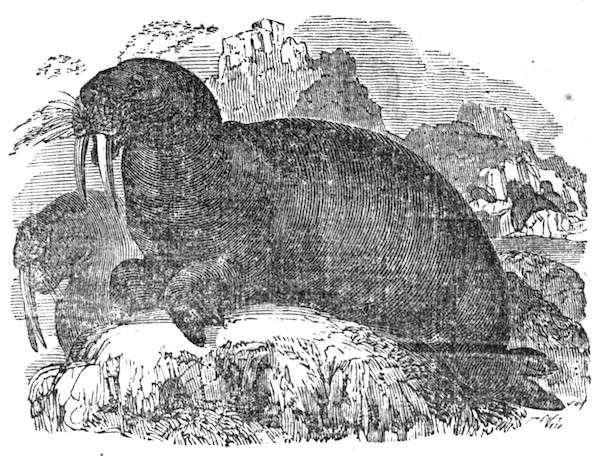
There is only one species of this remarkable animal, yet the singularity of its appearance has procured for it a variety of names, as the Walrus, the Sea-Cow, the Sea-Horse, &c. The only animal which it resembles is the Seal. It has two large tusks growing out of the upper jaw, directed downwards. From the high latitudes to which the Morse is chiefly confined, there has been but little ascertained respecting it. It is not even known with certainty upon what it feeds. Some suppose its food to be entirely animal; whilst others have represented it as feeding upon sea-weed. It is probable, however, that it may turn over the sea-weed with its long tusks, to dislodge the animals upon which it feeds, from the rocks.
The Morse is sometimes found eighteen feet long, with tusks about two feet in length. Its general color is brown. It is a social animal, and resorts in great numbers to favorite places on the far northern coast, where it lies on rocks and icebergs, till hunger compels it to resort to the water for food. It is not active on land, but its tusks enable it to climb up high banks with facility.
The Morse is esteemed for the oil which it affords. Their tusks also are very valuable. They are hunted for these articles, the ivory being harder and whiter than that of the elephant. When one of these animals is encountered on the ice, or in the water, the hunter strikes him with a strong harpoon made expressly for this purpose. The animal is then drawn to the nearest flat iceberg. They then flay him, separate the two tusks from the head, cut out the fat, and carry it to the vessel. A morse will furnish half a ton of oil.
106
Inquisitive Jack.
CHAPTER III.
The poultry yard.
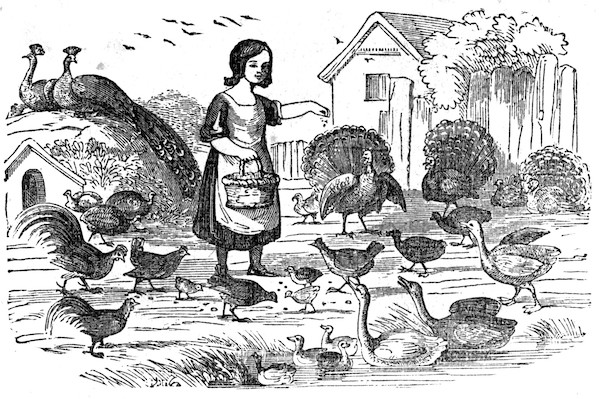
I shall not undertake to tell the whole history of the old hen and chickens, whose story is begun in the preceding chapter. If any of my readers meet with Jack, who is now a man, they can ask him, and he will tell them how the greater part of the brood grew up to be pullets or cockerels, and made a considerable noise in the world. He will tell them how the former at last became old hens, and laid eggs, and cackled like their ancestors; and how the latter, after many funny trials, learned to crow, and finally to fight, as their fathers and grandfathers had done before them. I must tell you, myself, what Jack said to his aunt about this fighting.
He had watched the chickens with a great deal of care, and he was greatly diverted to see the little roosters, as soon as they had little bits of red combs on their heads, try to crow and fight. They really seemed like some smart boys we have seen, at the age of sixteen or seventeen, trying to smoke cigars, or drink wine, or some other liquor, and appearing very ridiculous, while they fancied that they were exciting the envy and admiration of all around them, inasmuch as they were imitating the deeds of those older than themselves.
Jack laughed heartily at the ambitious efforts of the cockerels, as well in boasting as in battle—until, one day, he saw two of them fight till their heads were bloody, and one of them had his eyes picked out. This shocked him 107 greatly, and his heart being grieved, he went to tell what had happened to his aunt. She tried to comfort him as well as she could, but, at last, he spoke to her as follows: “You told me, aunt Betsey, that these creatures were governed by instinct, and that this instinct was implanted by God. You said that the obedience of the chickens to their parent was of this nature, and furnished a good example to children. Now, I wish to ask if the fighting of the cockerels is not implanted by God, and therefore a good example to children?”
Aunt Betsey smiled at the shrewdness of this question, and seeing that it was asked in earnest, and not scoffingly, by Jack, she replied seriously in these words: “I do not suppose, Jack, that instinct is the only guide of animals. It is their guide when young, but when they are older and know how to take care of themselves, then I suppose that in many things they act freely and from their own sense and judgment. When you were an infant you were guided by instinct, but now that you are older, you act freely, according to your choice. You may fight, or you may be peaceful, just as you please. Having arrived at this period, you are responsible for your conduct, for it has pleased God to make you free. It is just so, I think, with these young cockerels; they may fight, or let it alone. If they fight and get bloody noses, they only are to blame. And if they do fight, it is no example for us. God has given human beings a law of peace, and this should be their rule. Dr. Watts has said,
‘Let dogs delight To bark and bite For God hath made them so— Let bears and lions Growl and fight, For ’tis their nature too.’
“But it is quite otherwise with human beings; even if brute animals are left to tear each other in pieces, mankind are taught that peace, kindness and harmony are not only the duty, but the happiness of the human race.”
From observing the hen and her chickens, Jack’s attention was drawn to the other inhabitants of the poultry yard. The strutting turkey, the hissing, gobbling goose, the waddling duck, the screaming guinea-hen, and the fantastic peacock, each in turn became the subject of his investigation, and each seemed to him to have a character and interest peculiar to itself. If I had the power faithfully to paint all his feelings, and space to detail all his thoughts, I could make the story entertaining, but I must content myself with a very general account of the matter.
I believe there are very few persons who have not been often amused in pausing for a half hour and noticing the various airs, manners and customs, of the feathered inhabitants of the poultry yard. The hen, stealing to her nest, deposits her eggs, and then comes forth with an obstreperous cackle, to tell everybody what she has been about.
“Cut—cut—cadau cut— Lay an egg every day And have to go barefoot!”
The rooster—he that is “cock of the walk,” leads forth his body of hens, and when he finds a good fat grub, calls his favorites to come and feast on the delicate morsel. Like a polite old beau, he 108 seems to prefer the happiness of the other sex to his own; his tones and manner are soft and insinuating, and he becomes the very personification of gallantry. While he is thus tender to the females of the flock, he is harsh and unsparing to his rivals of the masculine gender. If one of them comes near, he is sure to feel his spurs, and, after the rebuke, to hear the shrill triumphant crow of the conqueror.
The turkey-cock struts round and round, grating the edges of his wings upon the ground, and displays his purple wattles, his crimson comb, and his black, bristly beard, to the admiring gaze of the tender, transcendental hens of his flock. The guinea-hen, creeping afar, amid some thicket, comes running home with a terrible cry, as if thieves, robbers and murderers were at hand! The peacock, situated upon some conspicuous mound, spreads out his tail, set with a thousand gorgeous gems, and, lost in admiration, appears to enjoy a sublime self-conceit. Amid all this exultation, the vulgar duck is dabbling in the mud, only deigning to utter his quack—quack—quack, at intervals, few and far between. At the same time, the silent and sentimental goose is swimming upon the bosom of the muddy pool, now and then plunging its long neck into the recesses of the element upon which it floats—happy if perchance some insect, lizard, or tadpole may reward its search.
It is not to be supposed that these amusing scenes escaped the sharp observation of Inquisitive Jack. He indeed, noticed the peculiarities of the several kinds of poultry, and had many a long conversation upon the subject with his aunt Betsey. We can only note the substance of what she told him.
The domestic fowls are the descendants of birds originally wild. The barn-door cock and hen came in the first place from Asia, and in some parts of India they are still to be met with, though their appearance is somewhat different from that of the tame breeds. The peacock came also from Asia, and the guinea-hen from Africa. The duck is but a tame mallard, a bird which is often shot along our coasts. The honest goose is descended from the wild gray bird, that is often seen in flocks, in spring time, high in air, and in the shape of a triangle, wending their way to the far north, where they may breed in solitude, peace and safety.
The turkey is the only original bird of America among our poultry. It was found in the forests, when the Europeans first visited this continent. It is less changed by domestication than any other bird. If you were to see it in the wilds of the west, where flocks of it are still common, you would think it only a truant turkey which had strayed from the barn-yard. It is a strutting, vain, cowardly bird, though it is very good eating. The French call it dinde, and hence our word dandy, which means a vain, cowardly coxcomb.
Promotion from the ranks.—Seventeen private soldiers of the French army, in Bonaparte’s time, by their bravery and talents raised themselves to the following distinguished stations; two became kings; two, princes; nine, dukes; two, field-marshals; and two generals.
109
Bill and the Boys.
The story of the lottery ticket, continued.
Thomas Trudge was now one of the richest men in the town of Buckwheat, in which he resided, and it was not long before his good fortune was known over the whole place. A great many people came to see him and talk with him about it, and hear the whole story from beginning to end. They desired also to see the money, and make sure that it was real, good money; for many of them could hardly believe that a poor pedlar should draw a prize of fifty thousand dollars. A great many persons also came to see Mr. and Mrs. Trudge, who had never been in their humble cottage before; and Mrs. Trudge was not slow to observe that the people now called her husband Mr. Trudge, instead of Tom, and herself, Mrs. Trudge, instead of Bridget.
The town of Buckwheat consisted of about two thousand inhabitants, who were chiefly devoted to agriculture. It derived its name from its producing a large quantity of that particular kind of grain which is famous for feeding poultry and making flap-jacks. It consisted of two villages, which bore the titles of Up-town and Down-town. In the former portion, there dwelt several families of some wealth, who had removed thither from the city of New York, during the war of the revolution, to escape from the dangers and anxieties of that period. These families, having similar tastes and habits of life, naturally associated together, and were hence called the aristocracy.
The leader of fashion among this portion of the community was a dashing widow, by the name of Mrs. Million. She was rich, and so long as she was flattered and permitted to have her own way, she was hospitable and good-natured; but if thwarted, or if her superiority in all respects were called into question, she was haughty, ill-natured, and vindictive.
While such was the state of things at Up-town, there was also a natural association formed by the people in that portion of the place called Down-town. “Birds of a feather flock together,” says the adage; and, accordingly, the Down-towners, being drawn together by similar tastes, habits and condition, associated with each other, and were called the democracy. For a long time, these names were not in use in Buckwheat, and the people, whatever inequality in their condition might exist, got along very peaceably together. But when they began to call each other names, such as aristocrat and democrat, a feeling of hostility grew up among them, and it was not long before bad blood was excited between them. Hitherto, all things had gone on peaceably; every person was at liberty to do as he pleased, provided there was nothing improper in his conduct; but now that these ugly names had got in among them, there was a great deal of scandal and back-biting abroad. It really seemed as if the introduction of these two words—aristocracy and democracy—into the good old town of Buckwheat, did as much to break up the peace and harmony of the people, as if two evil spirits had taken up their residence there, and had exerted 110 themselves to set the inhabitants by the ears.
Thomas Trudge was naturally a fair-minded, honest, good-hearted fellow, and, left to himself, would never have made any trouble in the world. But his partner, Bridget, was restless, meddlesome, and ambitious. She was always talking about the Up-towners, and nothing happened there, but it was the occasion of some sour and satirical reflection upon her part. She kept an especial watch upon Mrs. Million, particularly at the meeting on Sunday. Her dress was then thoroughly scanned, and if she ventured to come out with a new bonnet, gown, frill, or even ribbon, the amiable Bridget was sure to exclaim somewhat in this manner: “Shame upon that Mrs. Million, to be perking herself up in church with her new finery, to attract the attention of the whole congregation! What is Mrs. Million, that she presumes to catch all the best of the minister’s discourse—the corn and the kernel—and leave nothing but the husks for such people as we are. Oh, it’s because she’s rich, I suppose! But the tables will be turned, by and by. ‘Every dog must have his day!’ Dives had his, and Mrs. Million is having hers; but there’s another world to settle these accounts in!”
It must not be supposed that Bridget Trudge was a bad woman, even though she indulged in such spiteful words; her bark was a great deal worse than her bite. But still, people who get into the habit of talking harshly, will ere long feel and act harshly—and so it was with Bridget. She had been so accustomed to indulge her love of scandal towards the Up-towners, that she seemed to hate them; and as to Mrs. Million, she felt as if she owed her some particular grudge; and this was the more curious, from the fact that Mrs. Million had always treated Bridget with kindness, and had made her various presents of considerable value. Nothing, however, in the conduct of the Up-towners, could satisfy Mrs. Trudge. Their behavior, in her view, was all wrong. She accused them of being extravagant, worldly-minded, dissipated, and, what was ten times worse than all, aristocratic.
Entertaining such views as these, it may seem strange that the first idea of Mrs. Trudge, after she had settled it in her mind that they were rich, was, that she would become one of the Up-towners, join the aristocracy, and out-dash Mrs. Million. Her first great manœuvre was developed on the second Sunday after the drawing of the prize. Her husband went in his usual dress, but Mrs. Trudge appeared in all the glory of her new changeable damask, decorated with figures in gold. It was made in the height of the fashion; and as she flaunted up the broad aisle, you might have fancied that she was going to a masquerade. An enormous red satin bonnet, with huge bunches of ribbons, red shoes and a tall fan—though it was now November—served to aid the conceit. The little Trudges followed their mother, fantastically attired, while Tom, the pedlar, in his rusty, brown suit, brought up the rear.
The Scottish poet, Burns, has said a great many good things; and among these is the following couplet:
“Oh! would kind heaven the giftie gie us To see oursels as ithers see us.”