Volume 7 — CONTENTS OF VOLUME VII. (continued 4)
Reading edition
111 Mrs. Trudge supposed that on the present occasion she was exciting the admiration of all Buckwheat; that she was provoking the envy of the proud Mrs. Million, and that she was conquering the respect of the Up-towners. The text happened to be the story of Lazarus in Abraham’s bosom, and was used by the preacher to show the compensations which are to be made to the humble Christian in a future world, for the sorrows, suffering and poverty of this. Mrs. Trudge made a curious, though flattering application of the text to herself. “Yes, yes,” said she, internally, “the poor shall be comforted—those who have suffered shall have the reward. I have endured poverty and suffering, and now I am taken to Abraham’s bosom.” She enjoyed great satisfaction in this view of the case, and, for the first time in her life, fondly fancied that the preacher intended to bestow upon her the comforts of Scripture.
It is not our purpose to detail the various steps by which the Trudges changed their position in society. It will be sufficient to say that they left their humble cottage and entered a new house, which they caused to be built upon the very top of Up-town! This was constructed in the most approved style; and the grounds around were duly decorated with gravel-walks, avenues, flower-beds, shrubbery, and long straight rows of Lombardy poplars. Here, they gave tea-parties and suppers; and in the course of two years rejoiced in considering themselves as making a part of that aristocracy which Mrs. Trudge had before regarded as so hateful.
[To be continued.]
Comparison between Coal and Gold.—In a work published a year or two ago by a Spaniard, there is a comparison between the produce of gold and silver mines in America and the coal mines in England, from which it appears that the gross value of the annual produce of the coal mines, which is 18,000,000 of tons, amounts to 450,000,000 francs, including the wages and other charges, whilst the produce of the gold and silver mines, including the same charges, is only 220,500,000 francs; showing a balance in favor of the coal of England over the gold and silver mines of the New World, of no less a sum than 229,500,000 francs.
Family Men.—Malancthon is reported to have frequently studied the gravest points of theology, with his book in one hand, and, in the other, the edge of a cradle which he constantly rocked; and M. Esprit, a celebrated author and scholar, has been found reading Plato with great attention, considering the interruptions which he met with from the necessity of sounding his little child’s whistle.
The Nine of Diamonds.—The nine of diamonds is called the curse of Scotland, from the Duke of Cumberland writing on the back of that card his sanguinary orders for military execution after the battle of Culloden.
Sharp Retort.—“Will you lend father your newspaper, sir?—he only just wants to read it?” “Yes, boy—and ask him to lend me his dinner—I only just want to eat it!”
112
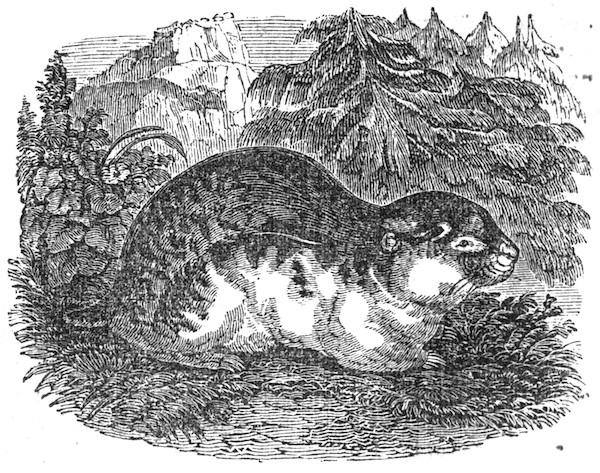
The Leming.
The Leming, which is a native of Scandinavia, is somewhat larger than a dormouse, having a short, bushy tail. Its fore legs are short, and its hind ones are long, which give it a degree of swiftness. It is particularly remarkable for its migrations, in which many millions remove from their native mountains and descend like a torrent upon the plains. They move, for the most part, in a square, marching forward by night and lying still by day. Thus, like an animated torrent, they are often seen more than a mile broad, covering the ground, and that so thick, that the hindmost touches the leader.
It is in vain that the poor inhabitant resists or attempts to stop their progress, they still keep moving forward, and though thousands are destroyed, myriads are seen to succeed, and make their destruction impracticable. They generally move in lines, which are about three feet from each other, and exactly parallel. Their march is always directed from the north-west to the south-east, and regularly conducted from the beginning. Wherever their motions are turned, nothing can stop them; they go directly forward, impelled by some strange power; and from the time they first set out, they never once think of retreating. If a lake or a river happens to intercept their progress, they all together take to the water and swim over it; a fire, a deep well, or a torrent, does not turn them out of their direction; they boldly plunge into the flames, or leap down the well, where they are sometimes seen climbing up on the other side.
If they are interrupted by a boat across a river, while they are swimming, they never attempt to swim round it, but mount directly up its sides, and the boatmen, who know how vain resistance in such a case may be, calmly suffer 113 the living torrent to pass on, which it does without further damage. If they meet with a stack of hay or corn that interrupts their passage, instead of going over it, they gnaw their way through. It is happy, however, for mankind, that they eat nothing that is prepared for human subsistence; they never enter a house to destroy the provisions, but are contented with eating every root and vegetable that they meet. If they happen to pass through a meadow, they destroy it in a very short time, and give it the appearance of being burnt up and strewed with ashes.
An enemy so numerous and destructive would quickly render the countries where they appear, utterly uninhabitable, did it not fortunately happen that the same rapacity that animates them to destroy the labor of mankind, at last impels them to destroy and devour each other. After committing incredible devastation, they are at last seen to separate into two armies, opposed with deadly hatred, and they continue their engagements till one party overcomes the other. From that time they utterly disappear; some suppose that they rush headlong into the sea; others that they kill themselves; but the most probable opinion is, that having devoured the vegetable productions of the country, they fall to devouring one another. However this may be, they are found dead by thousands, and their carcasses have been known to infect the air for several miles around, so as to produce very malignant disorders.
The Swedes and Norwegians, who live by husbandry, consider an invasion from these vermin as a terrible visitation; but it is very different with respect to the Laplanders, who lead a vagrant life like the beings themselves. They are never so happy as when an army of these creatures come down amongst them, for then they have a feast upon their flesh, which they esteem very good eating, although rejected both by cats and dogs.
Pictures of Various Nations.
CHAPTER IV.
The Indians, continued.
et us now proceed with our promised account of some of the most remarkable manners and customs of the great tribes of Indians, which occupy the western portion of the United States. Among the chief tribes, are the Osages, Pawnees, Choctaws, Creeks, Cherokees, Sacs and Foxes, Assineboins, and Winnebagoes. To the north, are the Blackfeet and the Chippewas. There are also several smaller tribes. These occupy the great tract of country which lies immediately west of the Rocky Mountains; on the other side of that range are a multitude of other tribes. All these Indians are supposed to amount to between two and three hundred thousand.
The people of these different tribes speak different languages, though these 114 have some resemblance. In their personal appearance, there is little to distinguish them. They are all copper-colored, with small black eyes, and high cheek bones. The hair is invariably black in youth, turning gray in age. It is coarse and lank, resembling horse hair. It is very glossy—a quality which is increased by the use of grease.
The men are tall and well shaped; their arms are small, but their legs are very stout. They can endure long abstinence from food, and run for a great distance with speed. They have not, however, the strength and endurance of the white man. In a personal conflict, where strength and energy of purpose are required, the white man will generally overcome the Indian.
The women are much shorter than the men, and are capable of performing a great deal of labor. All the drudgery of the household falls to their lot. The warrior and the hunter cannot stoop to the cultivation of the soil, or any of the ordinary business of life. In travelling from one part of the country to another, the women carry heavy burdens, take the entire charge of the furniture, pitch the tents, gather the fuel, and kindle the fires; cut up and dress the meat, besides taking care of the children.
Some of the tribes are stationary and live in villages, their houses being made of stone and mortar covered with coarse thatch. These tribes carry on some agriculture, and produce corn, pumpkins, and beans. They frequently send out hunting parties, who furnish a supply of meat from the buffaloes, deer, bear, and other quadrupeds.
Other tribes have permanent villages, built like the preceding, which however are occupied only in winter. In spring, they plant their grounds, and then, taking their tents, set forward, and spend their summer in roaming from place to place, chiefly for the purpose of obtaining game. The men spend their time in war and the chase, and the women in performing household duties. During these excursions, they seem for the most part to live a happy, careless life, though they sometimes suffer from the attacks of their enemies. About the middle of autumn, they return and take up their abode at their winter residence. Here they gather their harvest, which is now ripened.
Besides the great business of war and the chase, the Indian men carry on a considerable traffic in the hides of the animals they kill. White traders frequently visit their settlements, and, in exchange for their furs, give them various trinkets, blankets, knives, hatchets, powder, ball and fire-arms, together with rum and whiskey, the great bane of the Indian. The amusements of these savages are chiefly found in the serious pursuits of life, war, and the chase. Their councils, also, in which the leading men make great speeches, excite a deep and lively interest. Besides these sources of pleasure, the Indian men are very much addicted to various kinds of dances; in these they represent their feats in battle and the chase. The women take no part in such sports, except as spectators.
A great source of amusement with the Indian men is found in personal decorations. They pluck out their beards with the utmost care, probably that they may paint themselves with the more 115 facility. They now use tweezers made of wire, but they formerly used muscle-shells, the edges of which were ground smooth. The operation is performed with a jerk, like that commonly used in plucking a goose.
They paint their bodies in various colors, with various devices. They decorate themselves with necklaces of bear’s-claws, head-pieces consisting of the pate and horns of the buffalo, and ornamented robes of buffalo skins. They also wear feathers in their hair; the chief idea in these decorations seems to be to present a fierce and startling appearance.
The chief amusement of the women, aside from their laborious duties, seems to be found in gossiping. They never mingle in the sports of the men, but seem to take great pleasure in witnessing them. They are little addicted to finery, and dandyism is almost wholly given up to the sterner sex. Notwithstanding that they are the mere slaves of the men, they are talkative, lively and cheerful, and seem to possess a good deal of that sympathy and kindness of heart common to women in all conditions of society.
As I have said, the Indians have no books, no schools, and no churches. Their knowledge is almost wholly confined to the tract of country in which they live and the few arts they practise. They believe in the existence of a great and good Spirit, and also an evil Spirit. They believe that they shall exist in a future state; if they perform their part well in this life, they hope to enjoy a paradise in the next, fashioned after their notions of happiness. The Indian, about to die, addresses his mind to the Great Spirit, setting forth his feats in battle and the chase, and expresses the hope that in the future state, he shall be surrounded by obedient squaws, roam over rich prairies, feed on fat buffaloes, and find no prickly pear to wound his feet. The Indians are superstitious, and believe in the efficacy of various charms. They have sorcerers, who pretend to cure diseases by their incantations.
Mankind in all countries are formed by the circumstances in which they live. The savages of the western wilds have those faculties sharpened, which are called into frequent exercise. Those who have horses become very expert riders. The hunter and the warrior have a keenness of sight, and a nicety of observation, which are truly wonderful. It is related that a hunter belonging to one of the western tribes, on his return home one day to his hut, discovered that his venison, which he had hung up to dry, had been stolen. After taking observations upon the spot, he set off in pursuit of the thief, whom he tracked through the woods. Having gone a little distance, he met some persons, of whom he inquired if they had seen a little old white man, with a short gun, accompanied by a small dog with a short tail? They replied in the affirmative; and upon the Indian assuring them that the man thus described had stolen his venison, they desired to be informed how he was able to give so minute a description of a person he had not seen.
The Indian replied thus,—“The thief I know is a little man, by his having made a pile of stones to stand upon in order to reach the venison from the height I hung it, standing on the ground; 116 that he is an old man, I know by his short steps which I have traced over the dead leaves in the woods; and that he is a white man, I know by his turning out his toes when he walks, which an Indian never does. His gun I know to be short, by the mark the muzzle made in rubbing the tree on which it leaned; that his dog is small, I know by his tracks; and that he has a short tail, I discovered by the mark it made in the dust where he was sitting at the time his master was taking down the meat.”
This story shows that savages are very sharp in little matters to which their circumstances have directed their attention. But how great is their ignorance of many important subjects! They have no idea of geography, beyond their own travels! They do not know the shape of the world—its vast magnitude, its mighty rivers, its boundless oceans, or the nations and kingdoms with which it is covered. They know nothing of Europe, or Asia, or Africa. They know nothing of astronomy except from what they see, and the highest conception they have of the stars is that they are fires with which the Great Spirit lights his pipe. They know nothing of the great truths of the Bible, and they conceive the Deity to be a being possessing nearly the same qualities as themselves. How fearful is the darkness which rests upon uncivilized, unchristianized man, and how thankful should we be for the advantages bestowed upon us by the light of knowledge and truth of revelation!
The Old Man in the Corner.
NO. IV.
REMINISCENCES OF A RAG.
(Concluded.)
eldom has there been a gayer party than the one assembled to celebrate Phillipina’s wedding. The bride herself was in excellent spirits, and her husband, Bob, danced, frisked, and flourished as if he were mad with delight. The whole company, indeed, seemed like a parcel of happy children, heedless of the past, careless of the future, and only intent upon enjoying the passing moment. They were all slaves, bought and sold like merchandize, but they seemed not to think of that. The banjo struck up its liveliest measure, and the bride and groom opened the ceremonies with a waltz. How Phillipina did swim round the room, turning, twisting and twirling about, like a crazy peg-top! Mounted upon her head, I performed my part, and having been nicely starched, and extending to the height of half a yard, you may believe I made rather a conspicuous figure. The pure white of my complexion set off Phillipina’s glistening skin to great advantage. As we went waltzing round the room, I heard some compliments upon the loveliness of the bride, but many more as to the beauty of the turban.
“Well, it was a happy night. We 117 danced ‘Coal black Rose,’ ‘Possum up a gum-tree,’ and many other favorite measures of the kind; but as this was some years ago, ‘Jim Crow’ and the ‘Cachucha’ had not got into vogue. At a late hour, the party broke up, and on the morrow, I was laid upon the shelf. For several weeks, I was occasionally called into service to attend at parties made for the bride and groom, after which, I had a long repose in a box, with a bunch of artificial flowers, some tousled ribbons, and other old finery.
“What length of time now passed, I cannot say, but after a long space, there was a rummaging in the box, and on looking up, I perceived that Phillipina had come to take me out. The poor creature had a very sad aspect, and tears as bright as those that fall from any eyes, coursed down her cheeks. I soon learned the cause of this. Her husband had been sold to a planter, who lived in the interior, and had left her forever. Thus, what the church had joined together, man had put asunder, agreeably to the laws and customs of that Christian land. Nor was this all. Phillipina had been purchased by a Portuguese nobleman, to attend his lady; and the whole party were immediately to proceed to Portugal!
“My mistress, who had a heart, notwithstanding her complexion, took leave of her friends, shed many tears, and we went on board the ship. During the voyage, I was packed away with my old companions, the faded flowers, and tousled ribbons. We reached Lisbon, and after a few months, we proceeded toward the country seat of Phillipina’s master—a fine castle upon the mountains, on the borders of Spain. As we were passing through a deep and dark ravine, our party was attacked by robbers; a desperate scuffle ensued between our company and that of the banditti, but the latter at last prevailed, and taking our entire baggage, hurried it away into the recesses of the mountains. I was taken with the rest, and thus was forever separated from Phillipina.
“When I next saw the light, it was in a splendid castle. The robbers had selected the choicest articles from their booty, and one of them, assuming the disguise of a pedlar, took these to the castle. I was purchased by the lady, a stately dame, with beautiful black eyes, black hair, and a soft, but melancholy expression of countenance. She paid for me an enormous price, and after the pedlar was gone, she sat down and gazed at me with a delighted look. I may say it without vanity, those fair eyes had never before looked upon a piece of muslin, so sheer, even and dazzling. Phillipina—thanks to the kind-hearted creature!—had put me in the best condition; and behold, the slave’s turban now the favorite of a duchess!
“Nothing could exceed the gloomy magnificence of the castle in which I now dwelt. It stood upon the brow of a lofty rock, from the battlements of which, you looked down upon a valley threaded by a silver stream, and dotted over with vineyards and groves of olive, lemon, and orange trees. The air was filled with the most delicious fragrance, and far as the eye could reach, the lovely valley seemed to stretch out, presenting a scene of luxuriance and peace. On the other side of the castle, was a succession 118 of rugged mountains, covered with gloomy forests of cork trees, with occasional groups of oak and chestnut. The view resembled a sea of waving leaves covered by a thin atmospheric veil of a purple hue. Nothing could exceed the grandeur and richness of the spectacle.
“The castle was itself a kind of village, where there were at least a hundred people. Its master was a duke, of an ancient family, and bearing at least a dozen titles attached to his name. He was a dark, sallow and gloomy man, yet very handsome. He bore a military title, and had served in the wars. There was about him a stern, stately demeanor, befitting the soldier, yet, when he addressed the fair duchess, his manner was gentle and winning.
“The dame, however, for some cause, was unhappy. Still youthful, she spent her time in seclusion, and seemed to devote almost all her thoughts to religious duties and ceremonies. I learned that she had been married contrary to her inclination, and that in the midst of the luxuries that surrounded her, she was far less happy than the menials about the castle. In vain were all the attentions of her lord to soothe her melancholy. The heart was given to another, and her happiness had gone with it.
“The lady had no books, save a few old Spanish ballads, and these she had learned by heart. She took an occasional drive; sometimes sauntered through the magnificent gardens attached to the castle, but more frequently buried herself amid the dark labyrinths of the park, where she sometimes met a cavalier, who kissed her hand, and departed, leaving her in tears. With these exceptions, the lady spent the greater part of her time in the little chapel of the castle, on her knees, before the image of the Virgin, and in her boudoir engaged in needle work.
“A new thought now occurred to her, which was to work me into a handkerchief for the Virgin in the chapel. This design was immediately entered upon, and industriously pursued for more than a year. Some tears fell upon me during that period, but they were too bright to leave any stain behind. At last I was finished, and after a meeting between the lady and the strange cavalier in the wood, I was one evening placed around the neck of the holy mother’s image, and fastened with a diamond of inestimable value.
“I had scarcely remained a month in this condition, when, one night, a person, whose features I could not discover, entered the chapel, took the diamond pin, and crossing himself repeatedly before the Virgin, telling his beads, and saying a number of ‘ave marias,’ he went away. The theft was not discovered, for a paste pin was put in the place of the stolen jewel. Not long after this, an attack was made upon the castle by a party of French soldiers. It was bravely defended by the duke and his attendants, but without avail. He escaped with his fair dame through some of the winding passages; and their further story I am unable to tell. My own fate was melancholy indeed. One of the cannon pierced the chapel, and striking the breast of the holy Virgin, scattered the image in a thousand fragments. Torn and blackened, I was thrown upon the floor, by the side of a bleeding soldier. He took 119 me up, to staunch his wound, and when he was carried away by his comrades, I was taken with him.
“His wound was not serious; and after a short space, I was thrust into his pocket, stained with blood. For several weeks, I performed the office of wiping the fellow’s nose. Thus I was reduced to the most miserable and degraded condition. At last I was thrust into the soldier’s knapsack, and for a long period, travelled about with him. My companions consisted of a wad of lint, an old cigar, the handle of a jack-knife, a little black cross, an old seal-skin purse, besides sundry damaged articles of dress.
“After a great variety of marches and countermarches, the soldier was finally wounded in battle, and carried to some barracks. Here he was stretched out upon a bed of straw, with several other miserable wretches. They were visited once a day by the surgeon, and every morning the man with the dead-cart came round to carry away those who had expired. The dead-cart-men had become so hardened as to perform their office with as much indifference as if they were dealing with so many sacks of salt. If they could perceive no motion in the bodies, they would seize upon them and carry them away, hardly pausing to consider whether they were yet dead. So long as life and consciousness remained, the poor soldiers were accustomed to give a kick as these hearsemen performed their rounds, in order to save themselves from being borne away to the charnel-house. One morning no motion was perceived in my poor soldier. He had given his last kick, and he was borne to his grave. His knapsack was left behind, and I became the plunder of one of the attendants of the hospital.
“For a time, I remained with a heap of rubbish, where I found myself with a parcel of old rags, each of which could have told a tale, perhaps, as curious as my own. There was an old shirt, which had belonged to a man who had died of the plague; a pocket handkerchief, spun by the silk-worms of India, and manufactured by Hindoo artizans, and after being borne to Europe, had ministered to the conveniences of at least three different persons; an old frill which had flourished upon the bosom of a beau, and sundry other fragments equally curious. After a long space, we were bundled together, taken to the city of Cadiz, packed in an enormous bale, and shipped to Boston.
“Thus, I made my fourth voyage across the Atlantic, and found myself restored to the country of my birth. I had passed through various adventures, but alas, what was my present condition! How sadly did it contrast with the brighter days of my existence. Once the favorite of a duchess; once the ornament of the holy Virgin, and fit to be decorated with a priceless gem; now an old rag tumbled in, cheek by jowl, with a thousand vulgar fragments of shirts, sheets, and nose-wipers.
“I did not remain in this condition long. I was soon purchased by Messrs. Tileston & Hollingsworth, and transported to their mill at Dorchester; and here I am awaiting my fate. And what is that to be? Am I to be manufactured into a pure sheet, upon which Mr. Longfellow shall write one of his beautiful 120 sonnets; or make an immortal leaf in a new edition of Prescott’s Cortez; or shall I go gilt-edged, to some fair lady, and receive her confession to her lover; or shall I be impressed with the magic figures of a bank, and bear a value a hundred times my weight in gold; or shall I go to the office of a penny paper, and be cried about the streets by the boys,—‘Here’s the second edition of the Mail, Bee, and Times, with a full account of the last horrible murder!’”
Thus I read, or seemed to read, from the scroll, which the haggish old rag in the bin had put into my hands. As I finished the last sentence recorded above, the paper shrunk from my grasp. At the same instant, I saw the grisly image rise again from the rag-bin, but with a look so portentous, that I trembled in every limb. In the agony of the moment, I uttered a shriek, which awoke me, and behold, “The Reminiscences of a Rag” were but a dream!
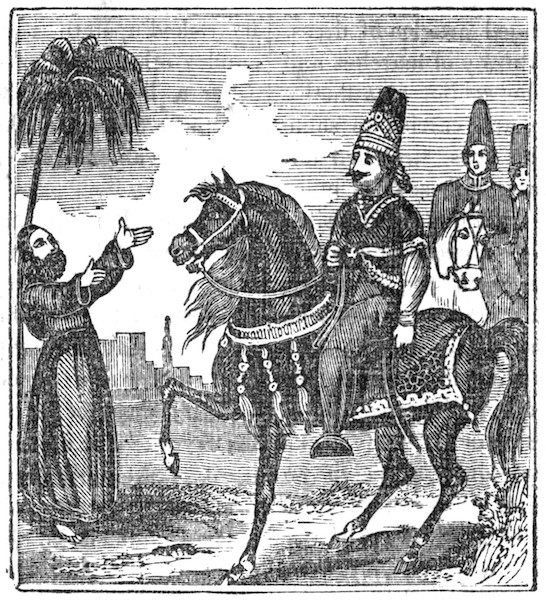
Persia.
The present kingdom of Persia, called Ivan by the natives, covers a space of four hundred and fifty thousand square miles, lying between 25° and 40° N. latitude, and 44° and 62° E. longitude, constituting an elevated table land. On the east and north are extensive plains, and on the south lie the Persian Gulf and the Indian Sea. To the east are the kingdoms of Afghanistan, and Beloochistan. The climate of Persia varies in the different portions. To the 121 north it is cold; in the inland provinces the air is serene and pure; but in the south it is hot, and the wind often proves fatal to health. There are but few rivers, and water is very scarce. In some parts of Persia, the soil is unfruitful, but the luxuriance in other spots is wonderful. The vale of Shiraz is much celebrated for the salubrity of the air, and the richness and variety of its fruits and flowers. Near Ispahan, are cultivated all the beautiful flowers that can be conceived, particularly roses, from which is made the celebrated otto of rose, held by ladies in such high esteem. Here the pomegranate tree grows wild, delighting the eye with its splendid red blossom.
In Persia, there are a great variety of wild animals and birds. In some places, the lion holds his sway; in others, wolves, jackals, and foxes abound. Leopards, lynxes, and bears are very numerous. One of the most remarkable animals is the argali, or mountain sheep. But the most beautiful creature is the gazelle, so justly celebrated for its grace and agility.
There are many tribes in Persia, many of whom live a wandering life. The Persians are distinguished for their politeness and learning. The Turkish is the common language; the Persian being only spoken by the people of science and literature.
The Persians are generally a handsome race. Their dress is peculiar and fitted to their climate. The men wear a long robe, wide trousers, and a silk or calico shirt. Robes of various kinds are worn, tied by a muslin sash. In this is stuck a dagger; and a sword is considered a necessary appendage to the dress of every Persian. All classes wear a cap made of lamb-skin. The head is shaved, except a tuft on the top and behind the ears. The dress of the women is very simple. In winter, a close-bodied robe, reaching to the knees, is worn over a kind of vest. In summer a loose dress of silk or muslin, loose trousers and a vest, form the usual attire. The head is covered with a black turban, over which a cashmere shawl is thrown to serve for a veil.
The food of the Persians is simple; they drink the wine of the country, which is delicious, and use a great deal of coffee. Tobacco is smoked by all classes. The Persians have been called the Parisians of the East, though they bear a nearer resemblance to the Greeks. They are cheerful, cunning, deceitful, and dishonest, but very social, and fond of conversation. This abounds in complimentary phrases, fables and apologues. The manner of salutation is to touch the hands, and then raise them to the forehead. When they salute the king or his officers, they bow thrice to the ground.
The wandering tribes are found in all parts of Persia. They are divided into dwellers of cities, and dwellers in the field. Many of them live in tents, which they place on the plains during the winter, and seek the pasture of the mountains in the summer. They have large flocks of cattle. They breed camels and horses for sale, and have a large trade in butter made of the milk of their asses. They feed principally on their flocks, and eat sour milk, cheese, and buttermilk. They range at liberty, over the mountains and plains, paying a tax to government.
122 There are a people in Persia called Parsees, who worship fire, which they make their idol. They live an honest and pure life, subsisting upon the fruits and productions of their lands. Many of them, suffering persecution by the Turks, emigrated to India, where there are numerous communities of them. The Arabians, who form part of the population of Persia, gain their livelihood by fishing and going to sea; some of them are merchants, while others are occupied in the planting of date trees.
The common advantages of education may be obtained by all classes in Persia, but the arts and sciences are but little attended to. The popular literature is comprised in poems, fables, and romantic tales. Some of the works of their poets are translated and much admired.
The religion of Persia is Mahometan, with some slight variations in the forms and ceremonies. There are a few Christians. There is also a Catholic mission, but it has made few converts. The Persians are generally willing to discuss the merits of different religions, and are thus open to conviction.
The usages at funerals in Persia are very peculiar. After the death and burial of a friend, the relatives mourn forty days, during which time, they suppose the grave to be watched by angels. They accordingly keep a large supply of food upon the place of interment, for the support of these ethereal watchers. They must have rather earthly ideas of the wants of angelic beings. They are also, during the forty days of mourning, in the constant habit of asking the deceased person why he died!
The government of Persia is an absolute despotism; the king himself cannot change his own edicts. Sanguinary and barbarous punishments are very common; the eyes being sometimes put out. Theft is punished by making a hole in a wall, putting the offender in, and building it up again, thus suffocating him. The lower classes are punished by the bastinado, or whipping the feet.
How to get Letters Free.—A shrewd countryman, being informed that there was a letter for him in the post-office, went accordingly for it. On the postmaster’s handing it to him, he frankly confessed that he could not read, and requested the postmaster to open it, and let him know the contents, which he very readily did. After getting all the information he wanted, he knowingly shrugged up his shoulders, thanked him for his politeness, and dryly observed—“When I have some change I’ll call and take it.”
“Love one Another.”—A Welsh parson, preaching from this text, told his congregation, that in kind and respectful treatment to our fellow-creatures, we were inferior to the brute creation. As an illustration of the truth of this remark, he quoted an instance of two goats, in his own parish, that once met upon a bridge so very narrow, that they could not pass by without one thrusting the other off into the river. “And,” continued he, “how do you think they acted? Why, I will tell you. One goat lay down, and let the other leap over him. Ah! beloved, let us live like goats.”
123
Varieties.
An Old Maid’s Will.—A maiden lady, who died in London, in 1786, left the following singular legacies in her will:—
“Item. I leave to my dear entertaining Jacko, (a monkey,) £10 per annum, during his natural life, to be expended yearly, for his support.”
“Item. To Shock and Tib, (a lapdog and a cat,) £5 each, for their annual subsistence during life; but should it so happen that Shock die before Tib, or Tib before Shock, then and in that case the survivor to have the whole.”
The legacies in remainder were bequeathed to her niece.
Frederick the Great.—A Prussian ecclesiastic, of the name of Mylius, found among his father’s papers a promissory note to a considerable amount, which the Prince Royal, afterwards Frederick the Great, had given him. He therefore immediately sent it to the king with the following letter:—
“Sire,—Among my father’s papers I have found the enclosed note. I cannot tell whether it has been through negligence or any other means that it has not been cancelled. I know not, but I leave the matter to the disposal of your majesty.”
The king immediately sent for Mylius, and said that he well remembered receiving the money from his father, and that if there was any error he would be the loser himself. He immediately paid the money, with interest.
Sir Loin.—The sirloin of beef is said to owe its name to King Charles the Second, who, dining upon a loin of beef, and being particularly pleased with it, asked the name of the joint. On being told, he said, “for its merit, then, I will knight it, and henceforth it shall be called Sir Loin.”
In a ballad of Sir John Barleycorn, this circumstance is thus mentioned,—
“Our second Charles, of fame facête, On loin of beef did dine; He held his sword, pleased, o’er the meat,— ‘Arise, thou famed Sir Loin.’”
La Fontaine.—This famous writer is said to have been the most absent of men. He was once called upon to attend the burial of one of his friends, and sometime afterwards, he called to visit him. At first, he was shocked at the information of his death; but recovering from his surprise, he observed, “It is true enough, for now, I recollect, I went to his burial.”
A dragoon, having been carried by a restive horse against Louis XIV. during an action, his majesty became angry, and lifted his cane, as if to strike him. On this, the soldier, rendered desperate by such an affront, immediately tendered one of his pistols to the king, exclaiming, at the same time, “Sire, you have bereaved me of my honor, deprive me also of my life.” The monarch, instead of being displeased at this sensibility, took the first opportunity to promote so brave a man.
124
Our Correspondence
It is said that the Yankees are very much given to guessing, and they are generally allowed the privilege of guessing when they please. In the exercise of this birthright, we venture to guess that Robert Merry, with his timber toe, is getting to be almost as much a favorite with the black eyes and the blue, as old Peter Parley was, sometime ago. We have a great many letters from these good little people, and they are full of kind thoughts, and pleasant speeches, and one thing must be set down to their credit, THEY ALWAYS REMEMBER TO PAY THE POSTAGE. Only think of that!
We cannot publish all the pleasant letters we get, though we should be glad to do so. We like to encourage the first efforts of our young friends in letter-writing, and perhaps we may now and then give them a hint that may be useful to them. And beside this, these specimens which we publish may turn the thoughts of our young readers to the writing of letters, and give them some good ideas upon this important art. Here is a letter all the way from Georgia.
Decatur, Ga., 14th Feb., 1844.
Mr. Merry:
I see that some little girls write to you. I want to say something about my little cousin Julia Ann, who lives in Petersham, Mass. I think she does not take your Museum. I wish she should; and my father says I may send it to her, and as she is a new subscriber, you say she may have the three bound volumes too, for $3.00, and when she sends for them by any of her friends, you will let her have them. Send the numbers for 1844, by mail, to Petersham.
You write a great many stories. I wish you would come to Georgia, and write us a good story about the Stone Mountain, which is in the county of Decatur, in which we live. It is a lone, solitary rock. Father says it is eight hundred feet high, and that there was once a wall near the top of it. Some think the famous Spanish adventurer, De Soto, made it a long, long time ago. Some men built a tower on the top of it, one hundred and sixty feet high, but it was blown down in a storm last year. It is not a good place to stay on the rock, for there is no water, nor any way to get it, but by carrying it up.
Some who have visited the Stone Mountain say it is second to no curiosity except the Falls of Niagara.
Hoping for more stories and plenty of pictures, I am your young friend,
S. M. W.
Quincy, Feb. 29th, 1844.
Mr. Merry:
Dear Sir,—I would be greatly obliged to you if you will be so kind as to publish the following enigma in the Museum for April or May, as you choose. And I should be very happy to have some one of your subscribers puzzle it out and put it in the Museum. From a Quincy subscriber. Good bye, Mr. Merry.
Frederick H. B.
A GEOGRAPHICAL ENIGMA.
I am composed of twelve letters. My 5, 8, 11, 4, 2 and 9, is a cape on a large island. My 6, 3, 11, 4, 10 and 11, is a large circle. My 5, 12, 3 and 8, is a tribe of Indians which inhabit British America. My 5, 2, 9 and 1, is a cape of S. America. My 7, 12, 9, 7, 2, 3 and 12, is a sea between Europe and Asia. My 1, 8, 10, 7, 10, and 1, is a river of Europe. My 11, 3, 10, 7, 8 and 12, is a small portion of Russia. My 8, 4, 1 and 12, is a burning mountain. My 11, 5, 10, 1 and 12, is a country in Asia. My 5, 8, 3, 12 and 4, is the capital of a country in Asia. My 12, 11, 5, 8, 8 and 1, is a town in a large island. My whole is the name of a large portion of this globe.
We will endeavor to comply with the request so pleasantly made in the following letter, in relation to the stars, but our little friend must give us time. The stars are a great way off, and we do not hear from them by every mail. Beside, Bob Merry “has a good many fish to fry,” and in order to make matters go right, he is obliged to let everything take its turn. Will you be patient, Dick?
125 Lexington, January 17th, 1844.
Mr. Merry:
Dear Sir,—I have been taking your Museum for some time, and I like it very much. I am sorry to have to make the same complaint that some of your other subscribers have made; that is, I do not, sometimes, get my Museum soon enough.
I would be glad if you would give us a simple account of the stars, and other heavenly bodies. I have read the first part of Bill Keeler’s story about poor Tom Trudge and his wife, and I think it is quite laughable.
I hear that almost all the great men of the country have been invited to this place or that, and I heartily wish that you would come and pay your little western subscribers a visit. You will not find yourself as much a stranger to us, as even your neighbor Hon. John Quincy Adams.
My dear Mr. Merry—won’t you come to the west? Of all the countries you’ve been in, you’ll like it the best. Here you’ll find many little ones, black-eyed and blue, And a good many grown ones, I rather guess, too, Who will give you a welcome, and plenty to eat; For if you do not like favors, you surely like meat. O, there’d be such a racket and waving of caps, Such forgetting of rulers, of masters and maps! All over the country there’d be a turn-out, And all would join in a general shout. “For your great men I’ll give not a fig nor a cherry— O, here is our good friend, the kind Mr. Merry.” For there’s not a log cabin in all the broad west, That has not of your stories, the rarest and best.
Your affectionate friend and subscriber,
Richard P. H.
Portsmouth, February 20th, 1841.
Mr. Merry:
I am a new subscriber to your Museum, and so far I like it very much. I take pleasure in studying out your puzzles, and as you have had but one this year, I thought I would make one, and if you think it worth insertion, you can insert it.
I am composed of eighteen letters. My 3, 14, 2 and 11, is often seen in rivers. My 3, 14, 6, 6, 16 and 10, is very useful. My 10, 11 and 16, is a town in New Hampshire. My 6, 2 and 18, is a nick name. My 3, 4 and 8, is an insect. My 7, 14, 15, 4, 17 and 13, is something in Boston. My 3, 16, 8 and 6, is a vegetable. My 3, 1, 2, 2 and 7, is a useful thing. My 11, 8 and 12, is an answer often given to a question. My 12, 6, 9, 16, 8 and 6 belongs to a town. My 13, 16, 7, 3, 8 and 5, is a limb. My 3, 8, 16, and 1, is much in use. My 3 and 16, is a verb. My 10, 17 and 13, is a medicine now in use. My 8, 11 and 16, spells the organ of sight. My whole is a distinguished periodical publication.
A Subscriber.
The letter which we copy below, was written in a very neat hand, showing that the little writer has good taste and good sense. The dollar spoken of, must have been a sly fellow, for when the letter came to the publishers, behold, it was missing! We have nothing to do with the money matters of the Museum—that is the affair of Bradbury & Soden. But we are curious to know something of the history of this rogue of a dollar. Will our friend Edway let us know whether it was a paper dollar or a real shiner? If we can catch the fellow, we’ll write his memoirs, and we think it will be a pleasant story. We think the life and adventures of a dollar that crept out of a letter one day, would be equal to Bill Keeler’s story of the eel in the aqueduct. If, after all, our little friend forgot to put the dollar into the letter, he may send it to the publishers of the Museum. This will be satisfactory to all parties, though it may spoil a good story of a runaway dollar.
Middlebury, Vermont, Jan., 1844.
Mr. Merry:
I have been thinking this good while, that I would write to you. You wound up your stories of Jumping Rabbit and Inquisitive Jack rather too short, I think. I should like to have you tell a little more about Jumping Rabbit—some of his hunting expeditions, &c. If you would put a little more Natural History into the Museum, 126 I think I should like it better. You had a very handsome picture in the December Museum. I like to see chickens; and I have got six hens, one rooster, and two white turkeys.
I am going to send you one dollar in this letter. I have taken the Museum ever since it has been printed. One of the volumes is bound, and the other two volumes are up to the bookbinder’s shop to be bound.
Edway B. P——.
P. S.—We are just informed by Messrs. Bradbury & Soden, that the stray dollar is found. It appears that it was in the letter, but crept on to the floor; it was caught, however, and is safely put in crib.
The following epistle, from a romantic, descriptive, warm-hearted friend, was very welcome to us, and will be so to our readers. Alas! for those bright days when everything gives pleasure, and even the flowers seem like things of life! They are gone from Robert Merry forever; but he loves to see them reflected in the eyes of his youthful friends. We have been at Springfield, and can testify to the accuracy of the following description of that beautiful town. One thing our fair correspondent has failed to notice, and that is the cemetery, which is scarcely inferior to Mount Auburn. Cannot “Constant Reader” tell us something about it? Instead of sending us the flower she promises, she may send us her miniature. We have an eye for things of that sort yet.
Springfield, Feb. 29, 1844.
A long time ago, I addressed a letter to the little readers of the Museum, and I have had it in my mind for some time to write them another. I told them how old Peter Parley learned me to make pens, and how much good Robert Merry was like him, and how very glad I was that Peter Parley gave him all his writings before he died. It is not probable that all of your little friends will recollect this, but perhaps some of them may. I was just on the point of writing to them again, and was about to say, “Little readers of the Museum,” when it occurred to me that I had never written to you. So this time I will speak to you, Mr. Merry, and tell you something about this old town, that has been settled for more than two hundred years; for you tell such good stories, and talk so much like our old benefactor, that I love you now almost as much as I did him.
Springfield is my native town, so perhaps you will not think it strange if I praise it up pretty well. I think it the pleasantest place I have ever seen. It lies upon the eastern side of the beautiful, broad, majestic Connecticut river, that comes winding down through this extensive valley. It contains about eight thousand inhabitants, not including Cabotville and Chickopee Falls—two large manufacturing villages within the limits of Springfield. The most thickly settled part of the town lies low upon the river’s bank, but the handsomest portion is built upon what is usually termed “the hill.” This elevation commands a fine view of the lower part of the town, and also gives a delightful view of the river. Oh, how beautiful it looks in summer from the brow of “the hill,” wending slowly and sweetly its way to the sea. Upon “the hill” is located the United States Armory, for manufacturing muskets. The public buildings consist of three arsenals, where many of the guns are deposited; three long buildings, each two stories high, where the labor is principally performed, and another in the centre where the officers and clerks have their offices. There are several other smaller buildings connected with the establishment, where various branches of the work are perfected. Also, at what is called “the watershops,” are a number of fine buildings belonging to the government, where the pretty Mill river affords a charming water privilege.
I once had a fine sail of two or three miles up this stream. It had been a pleasant but sultry day, and a small company of us—merry girls and boys—when the sun had sunk down behind the blue hills, filled three small boats, and while the soft, mild moon looked into the deep, clear water to see her face, the music of some thirty voices blended with the still murmur of the stream, and was echoed in the distance. Many were the yellow water lilies we pulled into our boats with their long stems, and many did we leave floating gracefully with the current, their modest heads turned gently on one side, looking down upon the bosom of that pretty Mill river. On that sultry summer’s evening did I almost wish to be one of those water lilies; for Oh, thought I, how delightful it must be, to wave so gracefully one way and the other, constantly laved by the cool waters—the stars and the moon looking down upon me in love. After enjoying for some time the luxury which this scene afforded, we went on shore, where was a cool spring of water, which seemed the best I ever drank; and close by it I found a rare flower. If ever I should find such another, I would send it to you, Mr. Merry, that Mr. Billings 127 might take a drawing of it, so that the little readers of the Museum might see it too; for I think it was the most splendid flower I have ever seen. We had a fine sail home, and sung as we went, the “Canadian Boat Song,” which many of the little girls and boys who read the Museum are familiar with.
But now, to tell about the armory. The largest arsenal, where the guns are deposited, is a long brick building, three stories in height, one hundred and twenty feet long, by forty wide. It is a noble structure, and contains ninety-four thousand muskets, elegantly arranged in racks, each rack containing two thousand and forty muskets. From the upper story of this building, we have a line view of the Connecticut, and in the summer we often see from this place many boats gaily passing up and down the river.
Does it not seem a pity, Mr. Merry, that so peaceful a spot as that on which this armory is located, should be devoted to these implements of death? Is it not time that they were changed into “ploughshares and pruning-hooks,” as the Bible tells us all these war instruments will be, some time or other?
A year or two since, two old barracks were standing on the ground belonging to the United States, that some thirty-five or forty years ago, sheltered several hundred soldiers. They are now torn down, but often, as I used to pass them, I thought how happy Peter Parley would be to sit down in one of these old buildings, and tell us children long stories about the war and the Indians. I often thought how glad I should be to run and bring a chair for him, on which to rest his gouty toe. From the spot where stood these old buildings, may be seen Mount Tom, some eighteen miles distant, holding up his tall blue head. I love to look at him, for there is always something very pleasing to me in the sight of a noble mountain; it makes one’s heart feel large, and seems silently to teach the eye to look upward to Him who created all things. I have sometimes imagined Mount Tom to be the highest peak of the Alps, and when a dense fog has covered its top, I have fancied it to be all clothed with perpetual snow; for I sometimes enjoy very much a flight of the imagination. I think I must have learned this of old Peter Parley. Oh, how many pretty stories has he told us about Mount Tom, and Mount Holyoke, and the Connecticut, as it passes through these mountains, and about Bellows Falls and the Indians catching fish with long spears.
The western rail-road passes through this town. A bridge has been built across the Connecticut, which passenger trains cross four times during the day, and freight trains twice. This bridge is firmly supported by six granite piers, of uncommon beauty and almost invincible strength, which have hitherto, and probably ever will, bid defiance to the large fields of ice that come floating down the river in the spring; and when passing it the cars may be heard for miles. This noble specimen of architecture was designed and executed by the enterprising and ingenious William Howe; and, taking it as a whole, is a very perfect work of art, and the admiration of all who see it.
We have seven churches in town, the largest of which is the first Congregational Church. It stands near the Court House, in front of which is a fine square in which stands a fountain built of marble, and many beautiful trees, and among them a number of majestic elms that are an ornament to the whole town. A tree standing near the fountain now presents a most magnificent appearance. The water flowing from the fountain has congealed upon it until it now looks like a huge monument of marble, chiseled out by some master hand. The branches of this tree, and the monument itself, are hung with large, transparent icicles of the most exquisite beauty. I hope, Mr. Merry, you will sometime give your little friends a view of this square, for I think they would be delighted to see it. Under the shade of these tall trees, gathers the Cold Water Army, on the 4th of July, to receive the spray from the fountain, and to drink of the cool water that comes gushing up and gracefully falls into its marble basin; after which they march in long procession, with gay banners, smiling faces, and happy hearts, to a most interesting place called Worthington Grove, where long tables are spread with all kinds of refreshments, and decorated with flowers and evergreens. Here, sheltered by stately oaks and canopied by heaven, we listen to interesting speeches; fill the large, tall grove with merry songs; send upward wild shouts of “Hurrah for cold water!!” and then, gathering about the tables, satisfy our appetites, and quench our thirst by water from the spring; and if now and then a dash of rain comes down upon us, we only sing and laugh the louder, and give still heartier cheers for cold water!!
There are two banks here in town; notwithstanding money is rather scarce. However, I think we do pretty well by you, Mr. Merry, if we do not abound in cash; for of late many have subscribed for your nice Museum. But I cannot write any more just now, though there is still enough to tell about this good town of Springfield. Let me say, before I am quite done, that we should be very happy, exceedingly happy, to see you here, Mr. Merry; and though the cannons might not fire a salute, 128 most sure I am that you would meet a happy greeting.
Your affectionate young friend,
Constant Reader.
New York, Feb. 12, 1844.
Mr. Merry:
Dear Sir,—In the last number of the Museum, you say that in England, February has nearly the same character as our March, and is regarded as the opening of spring. Will you please tell me, in the next number, why England or London should have an earlier spring than New York—being ten degrees north of New York?—and oblige your subscriber,
William.
Answer.
In reply to the preceding inquiry, we must first remark, that the curious fact mentioned by William, has been variously explained. Our theory upon the subject is this. Greenland, a vast island at the northern point of our continent, is a mighty ice-house, perhaps as extensive as the whole United States. Here the ice and snow are piled up from century to century, imparting to all the regions around something of its own chilly atmosphere. The northerly winds that come even to us have something of old Greenland’s breath in them.
For this reason, as we think, all the northern portions of North America are much colder than they would otherwise be.
If our correspondent, William, will look at a map of the eastern continent, he will see that the Arctic Ocean occupies the whole space to the north of about seventy-two degrees of latitude. There is no Greenland there—no great mass of land to hoard up the ice and snow from age to age, and furnish an everlasting ice-house to scatter abroad its freezing influences. To the north of the eastern continent, there is ever an open, unfrozen sea, tending rather to abate than increase the cold.
These simple facts will show one great reason why our continent should be colder than the eastern continent, and will serve in part to answer William’s inquiry. There are other curious facts in relation to this subject, which have their bearing upon the question, but we have hardly time to state them now. We will only add, that the western coast of the American continent has a much milder climate than the eastern. At Astoria, which is in latitude about forty-seven degrees, it is as mild as at Philadelphia, which is at about forty degrees. The same is the fact in relation to the eastern continent; at the southern point of Kamschatka, which is about the latitude of London, it is almost as cold and tempestuous as at Greenland. Various causes have been assigned for these remarkable facts, but we cannot notice them now.
One of our little friends seems to be suspicious that the letters we insert are invented and written by Robert Merry himself, and not by the young persons from whom they seem to come. This being the first of April, we might be excused for putting off a pleasant joke upon our readers, but it would be dishonest in us to take the credit due to others. The letters inserted are the genuine productions of the various correspondents whose signatures they bear. Every mail brings us some of these epistles, and at the end of the month, we have quite a flock of them—welcome as blue-birds in March. Good bye, till the first of May.
We have a sad story to tell, at the close of this month’s Museum. Mr. Samuel S. Soden, one of the original publishers of this magazine, and one who was largely instrumental in establishing it, died at his native place—Saxonville, in this State—on the 20th of the present month, aged 25 years. He was a man of very pleasant manners, active habits, and zealous devotion to any cause which he espoused. He took hold of Merry’s Museum with great ardor, and much of its success is to be credited to his efforts at the outset of the undertaking. His disease was a lingering consumption, which he bore with great patience and even cheerfulness. We hope our young readers will bestow upon his memory a kind thought, as one who has contributed to their pleasure—and, may we not add, to their profit?
129
MERRY’S MUSEUM.
Vol. VII MAY, 1844. No. 5.
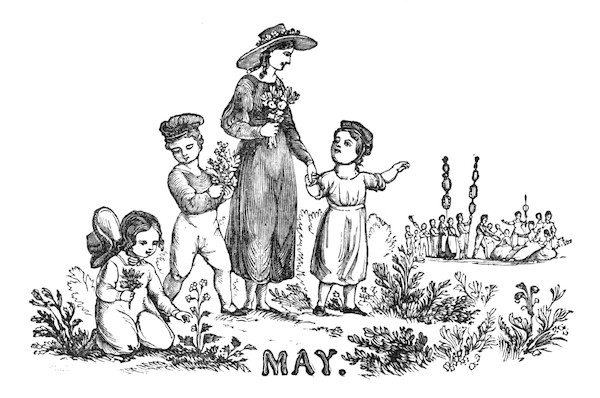
May has ever been the favorite month of the poets; yet in New England it usually disappoints our expectations. In more southern climes, it unites the soft beauties of spring with the radiance of summer. At the same time that it has warmth enough to cheer and invigorate, it does not overpower with its melting influence. The following lines describe the southern May, rather than our own:—
May, sweet May, again is come, May, that frees the world from gloom; Children, children! up and see All her stores of jollity. On the laughing hedge-row’s side, She hath spread her treasures wide; She is in the greenwood shade, Where the mocking-bird bath made Every branch and every tree Ring with her sweet melody; Hill and dale are May’s own treasures. Youths, rejoice! In sportive measures Sing ye! join the chorus gay! Hail this merry, merry May! Up then, children! we will go Where the blooming roses grow; In a joyful company, We the bursting flowers will see; Up, your festal dress prepare! Where gay breasts are meeting, there May hath pleasures most inviting, 130 Heart, and sight, and ear delighting. Listen to the bird’s sweet song, Hark! how soft it floats along. Pleasant dames! our pleasures share; Never saw I dames so fair; Therefore dancing we will go. Youths rejoice! the flow’rets blow! Sing ye! join the chorus gay! Hail this merry May!
The old rhyme tells us that
April showers Bring May flowers;
and how often have we been tempted, on May morning, to go forth, expecting to find blossoms, as we are told they do in other countries—and how have we always been disappointed! Still, May is a delightful month, even in New England, and none of us would be willing to let it slip from the circle of the seasons.
Inquisitive Jack.
CHAPTER IV.
About birds in general.
Our friend Jack, having made himself familiar with the peculiarities of the domestic fowls, turned his attention to other species of birds. He noticed particularly those which seemed to possess gentle and confiding natures, such as the sparrows that build upon the shrubs round the house; the martens that take up their abode in boxes which you make for them, and place near the eaves of your dwelling; the swallows that build in the barn, and the cheerful robin that loves to dwell in the apple orchard. All these he observed with care, noticing their modes of building and rearing their young; the food they eat, the cries they uttered, and, in general, their peculiar characteristics.
From these, Jack passed to other birds, and carefully studied them also. At last, he was pretty well acquainted with the whole subject of birds; and now he observed several important things, which I shall present to the attention of my readers.
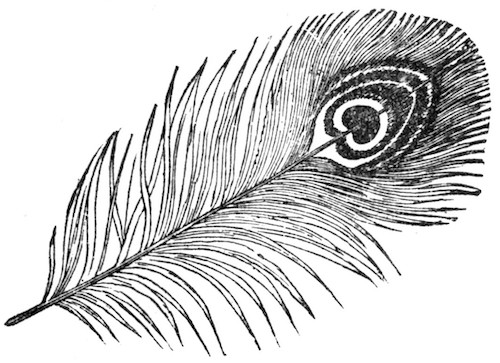
In the first place, Jack was struck with admiration at the formation of birds. They are designed to raise themselves in the air, and to spend a considerable part of their time in that subtle element. And how wonderfully adapted to this purpose are they! In the first place, a bird must have great strength, and yet great lightness: and how happily are they united! Look at the quill of the wing—how strong, and yet how light! Who could have invented anything more admirably suited to rise on the breeze and cut its way through the air? Is there a human being who could make a single quill, even if the model were placed before him? Not one.
131 And then look at the bones of the bird. These, instead of being heavy as in quadrupeds, are all hollow. They are therefore a great deal lighter than those of other animals, while they are equally strong. And then, observe the structure of the bird’s skeleton. What a wonderful and ingenious piece of machinery! Look at the wing: how easily it opens and shuts, and thus at once lifts the bird upward, and drives it forward like an arrow in its path. Look at the tail—destined, like the rudder of a ship, to direct its course—and how admirably it is turned this way and that, quick as thought, to guide the aerial voyager even among the intricacies of the forest!
Consider the feathery covering of the bird, designed to present a smooth surface, so as not to cause interruption in passing through the air, and to furnish a coat as impervious to the water as India rubber, yet light as the gossamer. How wonderfully are these objects attained! And now let us reflect upon the wisdom of the Creator, in designing a class of animals destined to soar aloft upon the air, and His power in accomplishing His purposes, as evinced in the structure of birds. How many millions of these beautiful creatures there are in the world! how diversified their structure, habits and instincts! and yet, let it be remembered that man, with all his art, cannot make a feather.
The music of birds is a very curious and interesting phenomenon, not only on account of the admirable variety and sweetness of the songs they produce, but for the strength of their voices. The lowing of the bull, or the roaring of the lion, cannot be heard at a great distance, yet the little thrush can be heard half a mile. If quadrupeds had voices equal to those of birds, in proportion to their size, an elephant could easily be heard across the Atlantic ocean.
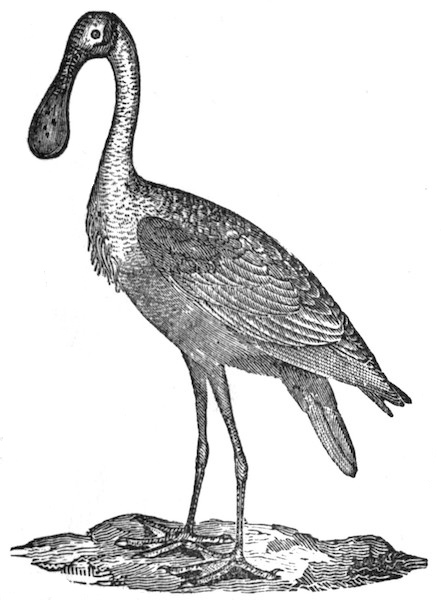
Spoonbill.
The variety in the forms of birds is a subject of great interest. How different is the duck, with its short legs, from the spoonbill, which seems to be walking upon stilts; the common barn-door fowl, with its short neck, from the flamingo, whose neck is almost a yard in length, and not half as thick as your wrist! How different is an ostrich, which will carry a boy upon its back, from the little humming-bird, which seems scarcely larger than a humble-bee!
Who can look forth upon the landscape, and notice the feathered tribes, glancing from tree to tree, and from bush to bush, delighting the eye with their 132 pleasing forms and lovely hues, and the ear with their charming melody, and the heart with that aspect of life and cheerfulness, which they throw over the meadow, forest and field, and not lift up his thoughts to heaven and say, “Oh Lord, how manifold are thy works—in goodness and mercy hast thou made them all!”
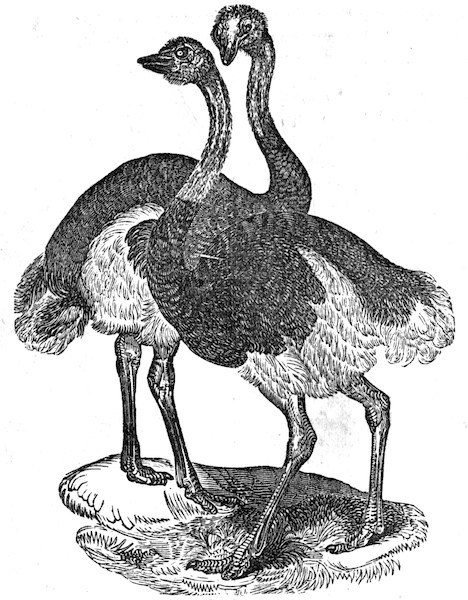
Ostriches.
But I must not forget to say one thing more about Jack in this chapter. While he was studying the subject of birds, he was very fond of getting young ones, so that he might rear them; he also caught several old ones, which he kept in cages. Now I believe that certain birds may be happy in cages, such as canaries, and many others, that are bred in confinement; but to catch wild birds and shut them up, is treating the poor little creatures very cruelly. I would not, therefore, be thought to commend Jack’s example in this respect.
[To be continued.]
133
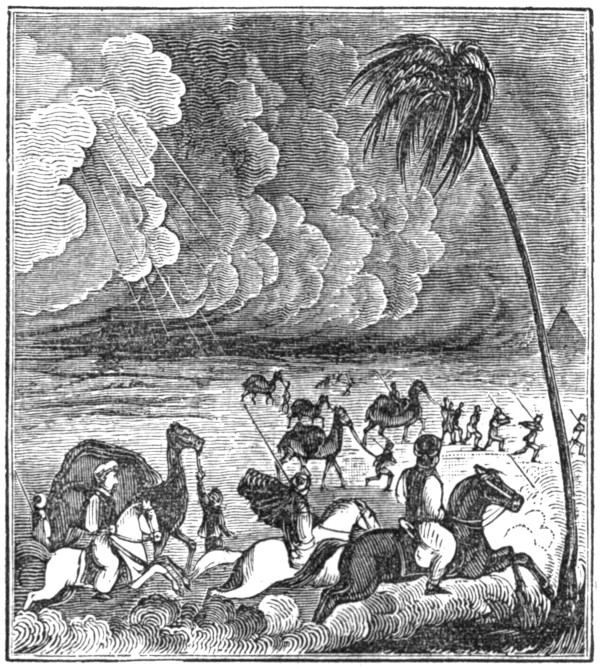
The Deserts of Africa and Asia.
In Africa, as well as Asia, there are immense tracts of land called deserts, which consist of vast plains composed of loose sand. Large portions of these are utterly destitute of vegetation, and sometimes, in crossing them, the traveller sees not a hill, or mountain, or human dwelling, or even a tree or shrub, or blade of grass. All around is a sea of sand, and far as the eye can reach, it is one scene of lifeless solitude and desolation.
These trackless wastes are traversed by caravans, which are companies of travellers usually mounted upon camels. Horses travel in these sands with difficulty. Their feet sink in the soil; they are overcome with heat, and parched with drought. The camel, on the contrary, has a large spongy foot, which does not sink in the sand; he can bear excessive heat, and by a curious contrivance of nature, is enabled to go without water for five or six days. This valuable creature is called the ship of the desert, because it enables the merchants of Asia and Africa to transport their merchandise over the sea of sand, just as a ship carries goods from one part of the world to another, across the briny ocean. It seems really as if Providence had provided this singular animal on purpose to enable mankind to traverse the great deserts which are spread out upon the eastern continent.
The desert of Sahara stretches nearly from the eastern to the western coast of Africa, a distance of almost three thousand miles. Its width is about eight hundred miles. Its whole extent is 134 nearly equal to that of the United States. This vast region, though for the most part a scene of absolute desolation, has a few spots where the water collects in pools, around which some vegetation springs up. These places, which bear a delightful contrast to the surrounding sterility, and cheer the eye of the thirsty, weary traveller, are called oases. Here the caravans quench their thirst and repose in the delicious shadow of the trees. The deserts of Arabia are far less extensive, but they are of a similar character to that of Sahara.
It might seem that these inhospitable regions would be deserted by man; but they are not only crossed by companies of travellers who wish to pass from one country to another, but by bands of wandering Arabs, who spend their whole lives upon these deserts. These are, for the most part, desperate robbers. Thus, the lonely desert has its pirates, as well as the lonely sea. These thieves have not only swift camels, but swift horses; and it is amazing to see how rapidly they will speed over the sandy plains. They come upon the traveller almost as suddenly as the hawk that descends from the sky upon its unsuspecting prey, and they disappear almost as suddenly.
It might seem that these inhabitants of the desert would lead a miserable life, and especially that they would often be swallowed up in the terrific sand storms, which sometimes sweep over these wastes. The sand, being loose and dry, is borne upward by the whirling tempest, and is seen driving over the plain, like a terrific thunder-cloud. The experienced traveller sees the coming danger, and prepares himself for it. He throws himself upon the ground, and covers his face so as not to be choked with the dust. The horses and camels, guided by instinct, also put their noses to the earth to prevent being suffocated. If the storm is slight, the party escapes; but sometimes, such immense waves of sand are drifted upon the wind, as to bury the traveller so deeply beneath it, as to make it his winding-sheet forever. Sometimes whole caravans, with their horses and camels, have been in this manner overwhelmed—thus making the waves of the desert as fatal as the waves of the sea.
Yet, despite the terrors of the desert, the Arabs are a lively and cheerful race. On their march, they stop at night; and in their tents, spread beneath the starry canopy, the laugh, the jest and the song go round. There are among them professed story-tellers, who delight the listeners with fanciful tales of enchantment, adventure, and love, or perhaps they repeat, in an animated manner, some fine specimens of Arabic poetry. Thus it is, that mankind, occupying the gloomiest parts of the earth, have amusements. As the steel is made to yield its spark, so the Arab finds pleasure in the desert.
The Merry Knight.—When Sir Henry Marshal, knight and alderman of London, received the honor of knighthood from George II., he fell flat upon the floor. The king was surprised, but on the knight rising up, he facetiously said,—“Your majesty has conferred so much honor upon me, that I was not able to stand up under it.” His majesty ever after called him the merry knight.
135
Dick Boldhero.
CHAPTER IV.
Various plantations—droll and dangerous adventures.
As I pursued my journey along the banks of the Surinam, I met with frequent plantations of coffee, sugar-cane, cotton and cacao.
The sugar plantations, at a little distance, bear some resemblance to our fields of Indian corn. The cane has a broad, long leaf, with a jointed stalk or stem. This grows to the height of seven or eight feet, and is very smooth and glossy. The sugar-cane is not propagated by seeds, but by cuttings from the root end of the stalk, which are planted in rows or hills. It puts forth large silky tassels, which have a beautiful appearance. In eighteen months from the time of planting, it is fit to cut; the stalks are put into a mill, and from the juice that is crushed out, sugar and molasses are made.
The labor of Guiana is almost wholly performed by negroes. During the period when they are making sugar, they live almost wholly upon the juice of the 136 cane, and at that time, they are said to get very fat. The laboring horses, oxen and mules, though kept constantly at work, being allowed to eat refuse stalks, and scummings from the boiling-house, thrive in the most surprising manner.
The cacao trees bear the fruit of which chocolate is made. These resemble young cherry-trees, but separate near the ground into four or five stems. The leaves are about four inches long, smooth, but not glossy, and of a dull green color. The flowers are saffron-colored, and very beautiful. The fruit somewhat resembles a cucumber in shape. Its color, while growing, is green; but as it ripens, this changes to a fine bluish red, with pink veins.
Each of the pods contains from twenty to thirty nuts or kernels, which resemble almonds, and consist of a white and sweet pulpy substance, enveloped in a parchment-like shell. These are the cacao or chocolate nuts. When the fruit is ripe, it is gathered, and the nuts are taken from the pods, and laid on leaves or skins to dry. They are then put into bags, each containing about a hundred weight, and thus packed, are exported to foreign countries.
I noticed, as I went along, a few fields of Indian corn and rice, and I was informed that two crops of these are frequently obtained in a season. I observed the castor-oil plant, growing wild, as well as the cabbage-tree, which is a kind of palm. This derives its name, not from its appearance, but from the use to which it is put by the inhabitants. The leaves grow crowded together at the top of the stem, and when these are cut off, the central ones are found to be white and tender, and when boiled, they are used as a substitute for cabbage.
I occasionally met with small patches of the indigo plant. This is cultivated by seeds, which are sown in rows, about a foot apart. In three months the top part is cut off, leaving the roots to shoot up anew. I used to suppose that indigo was a kind of mineral, but I now learned that it was made from these small plants. The tops of the herbs being cut, as I have mentioned, are steeped in vats. They are then pounded and put in water. The coloring matter, consisting of a fine powder, forms a sediment, which is cut into small pieces about an inch square, before it is perfectly dry. It is then packed in barrels, or sewed up in sacks for sale. The process of making indigo is very curious, and one thing is strange: the plant itself is harmless, but the indigo drug is a deadly poison.
Although I had frequently a lonely sort of feeling, as I pursued my way, and sometimes wished that I was snug at home with my mother and sister, I still found it, on the whole, very pleasant to travel in this strange land, and picked up a good deal of information, and saw many things that were quite rare and wonderful to me. I was constantly impressed with the strangeness of everything around me. Instead of forests of chestnut, walnut, and maple trees, so common in Connecticut, I here saw forests of gigantic mahogany, live oak, and other curious trees, the names of which I could not learn.
The birds, too, were all different from those to which I had been accustomed. The woods were all alive with flocks of 137 green parrots and red macaws, which kept up a constant chatting. The latter seemed perpetually scolding each other, and I could sometimes fancy that they were calling each other all the hard names they could think of. I saw a great many toucans, with bills half as long as their bodies; they kept bowing their heads and making a kind of motion, like a minister in the pulpit. Hence, the people call this bird the preacher.
I saw a great many other birds, most of which were adorned with magnificent plumage; but they had harsh voices, and were all very unlike my feathered acquaintances in the “land of steady habits.” I once met with a woodpecker, which resembled the red-headed thief, who spears so many of our cherries with his long bill. He nodded his head, and uttered a sort of cry, which reminded me so strongly of home, that the tears filled my eyes, and I paused and partly turned about, for the purpose of returning. But this weakness was transient, and I soon pursued my way.
My path now turned from the river, and wound through a thick forest. It was no longer a wagon-road, but a mere mule-track. The weather continued very hot, and I suffered excessively from the bite of large gnats, three times as big as our musquitoes. At first, I was half crazy from the sting of these insects; but by degrees I became hardened, and at last took it very quietly, even if one of these impertinent rogues thrust his little poisoned javelin into the point of my nose. At night I slept soundly, although these fellows feasted upon me from the crown of my head to the tips of my toes.
The forests through which I was proceeding grew more and more dense as I advanced; many of the trees rose to an immense height, and festoons of gray moss swung from tree to tree, as if they had been decorated by the hand of art. Vines, with green leaves and gaudy flowers, wreathed the trunks of the trees, and parasitical plants, with blossoms bright as gems, and of every color and form, wound around their branches. Nothing could surpass the gorgeous splendor of the scene. It appeared as if nature, in a sportive and fantastic mood, had put forth every effort here to combine the beautiful and the magnificent, in the vegetable kingdom. And as if to captivate every sense, the air was balmy, and the sweetest fragrance was borne on the gentle breezes that stole from the forest.
I was so much occupied with noticing the curiosities that met me on every hand, that I did not observe, till the sun was setting, that my path had now shrunk into little more than a deer-track, and began to suspect that I had missed my way; and this impression was strengthened by the fact that I did not reach a negro settlement, where I had expected to spend the night. I hesitated, for a few moments, whether to proceed or turn back. Resolving upon the former, I pushed on with rapid strides. My path, however, grew more and more undefined, and at last I was completely lost in a bewildering maze. It was now sunset, and the shadows of night had begun to thicken around me. I attempted to retrace my steps, but could not recover 138 the path. Finding it hopeless to attempt to extricate myself, I concluded to pass the night where I was.
My situation was not a pleasant one. I knew that these forests were the abodes of wild animals, who shrunk from daylight, yet prowled forth at night without fear or restraint. But courage is apt to come with necessity; and seeing that there was no help at hand, I sat down, clenched my cudgel, and determined to keep watch till morning. I remained in this condition for some time, listening to the strange sounds that began to steal upon the ear as the evening advanced. The day birds had gone to their repose, and their various cries had gradually faded into silence. But voices of a different kind now saluted me. Reptiles of many kinds began their uncouth songs, and droned away for hours together. Birds, known only to these solitudes, and which, even here, were silent during the day, now poured out their music without fear. Never did I hear such a jargon as seemed for a time to fill the woods around me. I could easily fancy that strange and unearthly spirits filled the air, and were trying to see what a variety of uncouth songs they could produce.
I listened to these notes for a long time, with a degree of painful excitement. It seemed to me that a thousand voices had united in one wild chorus, as if to drive me mad. I stopped my ears to keep out the din: I closed my eyes to withdraw my attention from the scene around me. At last, the sounds began to subside, and darkness gradually gave way, and I saw the moonbeams tinging the tops of the trees. Silence stole over the scene, and I fell into a profound repose. My imagination wandered to the scenes of my childhood. I was once more, as I dreamed, with my mother and my sister. They embraced me with rapture, and tears of bliss fell upon my cheeks. I remained with them for days, and a tranquil joy filled my bosom. We went to church, and once more I heard the sacred hymn, and the soothing, solemn tunes, which had become associated with all my religious emotions.
The psalm was ended, and the preacher began his discourse. He seemed at first a grave and reverend divine, holding before him a ponderous volume, containing the sacred Scriptures. But suddenly he seemed to change: his voice grew harsh and shrieking; his gestures became wild and fantastic, and at last he uttered a hideous yell, and jumping out of his pulpit, fell with a terrible crash upon the two deacons who sat beneath. Startled and terrified, I suddenly awoke; but the scene which now arrested my attention, was even more extraordinary than that which had been presented in my dream.
At a little distance, was an open glade, upon which the moonlight now fell with a dazzling splendor. In the centre of this spot there sat at least a hundred figures, which seemed to me to be men and women, about half the size of life. Upon a branch of a tree, which projected over them, was another figure, who seemed to be addressing the assembly. He uttered the most extraordinary sounds, and appeared to be speaking in a very animated manner. His gestures were strong, quick, and emphatic. Sometimes he sat upon his haunches, and sometimes 139 he stood upright. Occasionally he leaped from one branch of the tree to another, and at times he swung off from his seat, and suspended himself by his tail. This last performance led me to conclude that if this was a congregation of human beings, they must be of rather a queer species.
I sat still, and for a long time observed the scene. Nothing could exceed the seeming eloquence of the preacher, except the sympathy and sensibility of the audience. They appeared to feel every tone and gesture, and responded by sympathetic grunts, groans, yells, and every possible variety of attitude and gesticulation. At last, the orator, having uttered a tremendous burst of eloquence, leaped from his rostrum, and came with a bound into the midst of the congregation. Upon this, they all set up a shout, which echoed far and wide over the scene.
I had become so interested in this spectacle, that I had risen from my resting-place, and advanced so far as to be near the actors in this curious drama. One of them now chanced to spy me; upon which he uttered a terrific yell. The eyes of the whole assembly were turned upon me, and, uttering a frightful howl, they all set out, and came bounding toward me. Never in my life have I been placed in a situation at once so ludicrous and so appalling. A hundred monkeys now surrounded me; some mounting the trees over my head, and some winding among the bushes at my feet; some howling, and all grinning at me, and making the most threatening demonstrations.
Bill and the Boys.
The story of the lottery ticket, concluded.
We might have supposed that the Trudges, being now rich, and having attained what seemed the summit of Mrs. Trudge’s ambition, were perfectly happy. But this was far from being the case. They lived in a fine house, made a great dash, were admitted into what is called good society, and fancied that they were exciting the envy and admiration of the whole town of Buckwheat. But with all this show of bliss, there were many drawbacks to their felicity.
In the first place, as to Tom,—or Squire Trudge, as we must now call him,—he was a simple-minded, sensible fellow, and but for the example and influence of his spouse, he had borne his prosperity without intoxication. Indeed, as it was, he behaved with considerable propriety. He spoke to his neighbors, as he met them, much as before, and when he could get from under his wife’s supervision, he would stop and chat familiarly with old intimates. He demeaned himself modestly, and seemed little elated with his good fortune. He was kind-hearted, and ready to befriend the needy; but still, he had many sources of vexation.
His restless helpmate insisted that he should dress “as became his station;” and accordingly he was compelled to wear tight shoes, which pinched his corns terribly, and kept him in an almost constant state of martyrdom. When he walked abroad, he put his foot to the ground as gingerly as if he were stepping 140 on eggs. He was required to have his coat in the fashion, which trussed him up about the arms, and made those limbs stand out upon each side of him, like a couple of pump-handles. His neckcloth, of pure white, (as was the fashion then,) was lined with what was called a pudding; and to please his dame, who had a nice taste in these matters, he tied it so tight that it threw the blood into his face, and gave his ruddy complexion a liver-colored hue.
Nor was this all poor Tom had to endure. He was constantly “hatchelled” as to his manners, somewhat after the following fashion: “My dear Trudge,” his wife would say to him, “do now try to be a gentleman. Pray wipe your nose with your pocket handkerchief, and not with your fingers! Turn your toes out, man, or people will never forget that you was once a pedler. Hold your head up, step large, swing your arms bravely, and seem to be somebody. In short, pray do be genteel.”
“Well, well, wife,” Trudge would reply; “I’ll do as well as I can.” The dialogue would usually go on pretty much as follows.
Mrs. T. Do as well as you can! and is that all you have to say for yourself? Oh, dear, dear! I’m afraid I shall never make nothin’ on you. One can’t make a silk purse of a sow’s ear, as Shakspeare says. Oh, Tom, Tom, I wish you had a little more jinnysyquaw!
Tom. Jinnysyquaw! What the mischief’s that?
Mrs. T. Just as if you didn’t know what jinnysyquaw was! Oh, my dear Tom! you are as ignorant as the whipping-post. Not know what jinnysyquaw is! Oh, dear, dear! This comes of not knowing French. Why, jinnysyquaw is a—a—a kind of something-or-other—that—nobody knows nothing about—that is to say—it is a kind of can’t-tell-ish-ness. For instance, if a person has a very genteel air, they say, “He’s got the true jinnysyquaw.” All the people who have been to Paris talk a great deal about it; and I’ll tell you as a secret, Tom—Dick Flint whispered in my ear, the other night at Mrs. Million’s party, and he told me I had the real French jinnysyquaw! Now, what do you think of that?
Tom. What do I think of it! I think he’s an impudent jackanapes, and you are a--!
Mrs. T. Hold your tongue, Tom—hold your tongue! Dick Flint’s the height of fashion: everybody is running after him. He’s been abroad, sir—yes, he’s been abroad, sir! That’s more than you can say for yourself. So, hold your tongue, and listen to me. Try to be a gentleman, as becomes your station. Hold up your head, carry a stiff upper lip, and keep up an important air. There should always be about a person of consequence, something which says, “Clear the road, for I am coming.”
Tom. I suppose you mean the jinnysyquaw.
This last observation was made by Tom with a quizzical look, as if he was poking fun at his spouse. But she took it in good part, for she was too well satisfied with herself to suspect that she could be the object of ridicule.
We have thus given some idea of certain vexations which marred the happiness of Squire Trudge. Nor was this 141 the only evil of his lot. Though he had a sort of impression that he was so rich as to justify any degree of extravagance, yet he was sometimes disturbed by the sums of money which his ambitious wife lavished upon her follies.
Nor was that lady wholly without her annoyances, however she might seem to be floating upon a sea of bliss. She could not but feel the superiority of Mrs. Million, who was a woman of talent and education, and the only mode she had to supply her own deficiency, was to excel her rival in dash and splendor. Accordingly, she had fine horses and a splendid carriage. She gave parties, at which there was always an abundant feast. She appeared in the most costly dresses, and carried every fashion to its height.
While she affected to despise and hate Mrs. Million, she imitated her in everything. At last, she became so complete a caricature of that fashionable dame, that everybody discovered the ridiculous resemblance. Mrs. Million, far from being flattered by seeing such a grotesque reflection of herself, was infinitely more vexed at the involuntary homage thus rendered by Bridget, than she could have been by her envy and spleen.
A new fancy now crept into the brain of our heroine. Mrs. Million had just got a piano from New York, and, as it was the only one in the town, and a great rarity in those days, it excited quite a sensation among the fashionable circles of Buckwheat. Perceiving this, and determined to be behind in nothing, Bridget resolved to get one, and a much more splendid one than Mrs. Million’s. Accordingly, the following conversation ensued between herself and Tom the next morning.
Mrs. T. My dear Mr. Trudge, I wish you had been at Mrs. Million’s last night. She’s got the beautifullest pianny in her parlor that you ever see. Now I want you to send to New York for one for me, and I want to have the beautifullest that can be got.
Tom. What’s the use of sending to New York? Can’t you get one here?
Mrs. T. Get one here, indeed! not a bit of it. Beside, nothing will do but one all the way from New York.
Tom. Well, well! I’ll see about it.
Mrs. T. Well, let it be here on Thursday, for my sorry—that’s a good man!
Here the conversation ended, and, on the appointed day, a huge tub, set on wheels, and painted green, was brought from New York, and trundled into the front entry of the Trudges. The tub contained a splendid group of peonies, in full bloom.
“What have you got there?” said Mrs. Trudge to her husband, who was standing by. “Why, the pianny, to be sure,” says Tom. “The pianny!” said his wife, throwing up her hands; “the pianny! What a ridiculous blunder! Oh, Tom, Tom, you’ll break my heart! You’ve no more hedication than a heath-hen. I axed you to get me a pianny, and you have got me a pianny.”