Volume 7 — CONTENTS OF VOLUME VII. (continued 2)
Reading edition
The little ones grew apace, and in a short time it was thought best for them to leave the nest. You may well believe that Jack was on the look-out, to see the little creatures in their first adventure forth into the world. In the first place, one of the young birds put his head through the door of the box, and looked all round to see if the coast was clear. It was amazing to see how cunning the little fellow was, though not more than a fortnight old. The old wrens were at a little distance, chattering at a great rate, and seeming to invite the little fellow to try his wing. At last, he took courage, leaped from the box, and alighted safely upon a fence at some distance.
Now, how do you think this little bird knew how to fly,—where to go,—and how to ’light upon the fence? for you must remember that he had never been out of the box before. I suppose you will tell me that he was guided by instinct—that strange power given by the Creator; and you will tell me right. After the first one had departed, the others came out one by one, and all were successful in their first flight, except the last. This little fellow, in attempting to light upon the fence, missed his footing, and fell to the ground. The old wrens came to him immediately, and there was a prodigious chattering about what had happened. The little fellow looked very serious for a time, but at last he made a new effort, flew a little distance, and reached one of the lower rails of the fence. The old wrens cheered him with their approbation, put a big spider into his mouth, and he seemed to be quite happy.
This was a great day among the wren family. Never was there such a bustle before! The little wrens kept calling out for something to eat; the old wrens flew first to one and then to another, giving each an insect with a little good advice, and departing to provide more food.
It would take me a long time to tell all that happened upon this interesting occasion. Jack was there, and saw it all, and if you ever meet with him, you had better ask him about it. I can only tell you, at present, that, from this time, he was very much interested in birds; not as creatures to be hunted and tormented or killed, but as creatures that build nests, and have their homes, and rear their young ones, which they love very much, and whom they treat with the utmost care and tenderness. He looked 38 upon them as creatures displaying great ingenuity, many curious habits and wonderful instincts. He, therefore, found a great deal more pleasure in watching their movements, and studying their characters, than in throwing stones at them, or shooting them. I shall tell you about other birds as we proceed in our story.
Dick Boldhero.
CHAPTER I.
Early days—The keg of gold—Misfortunes—Voyages.
As I am about to tell my story, it is proper that I should say something of my birth, parentage and early days. About half way between Hartford and New Haven, in Connecticut, is a small, pleasant city, called Middletown. It is situated upon the western bank of Connecticut river, and lies upon the turnpike which constitutes the great avenue between the two places first mentioned.
About a mile and a half south of Middletown, upon this high road, is a turnpike gate, and contiguous to it is a small toll-house. This was originally called Hill-gate, being situated on a hill, but at last it was familiarly called Hell-gate. In the house which bore this ominous title, I was born, about five and forty years ago.
Our family then consisted of my father and mother, a brother, named Seth, and myself. Seth was two years old when I was born. When I was about two years old, a girl was added to our circle, and she was named Sarah. We were now very poor, but had once been in good circumstances. My father had formerly been a merchant in Middletown, in partnership with his brother Benjamin. They traded to the West Indies, with a sloop called the Carbuncle, and my uncle Ben used to command her. He usually went to St. Domingo, where he carried horses, mules, cows, oxen, potatoes, onions, &c., and brought back sugar and molasses.
From all I can learn, it seems my uncle Ben was an eccentric character, but still he managed his part of the business well, and the concern went on in a thriving way for some years. At last, it was thought best for him to remain at St. Domingo, so as to carry on the business there, and accordingly it was so arranged. He took up his residence at Port au Prince; but, in about a year after he was established there, the insurrection in St. Domingo broke out. My uncle, who was a hot-headed fellow, took some part in the struggle, in consequence of which, he was obliged to seek safety in flight from the island. Whither he went, we could not exactly find out, but we were told that he went on board a Dutch vessel, bound for Surinam. From that time, however, we heard nothing of him.
At the time that the disturbances commenced at Port au Prince, the Carbuncle was lying in port. Her cargo was in, and she was almost ready to sail; accordingly, she took her departure, and escaped. She brought a letter from my uncle Ben, very hastily written, saying that his life was in danger, and 39 very probably he might never return. He went on to say, however, that he should send a keg of gold by the vessel, which was of great value; that, if my father never heard of him more, he might consider it as his own.
You may well imagine my father’s disappointment, at finding that the precious keg was not to be found on board the sloop, when she came back. The supercargo, whose name was Ambrose Dexter, and familiarly called Amby Dexter, declared that my uncle had not time to put the keg on board,—that he was obliged to fly, and that he went hastily by night on board the Dutch vessel of which we have already spoken.
My father continued the business for a year or two, employing Dexter as his supercargo; but the trade proved unprofitable, and at last he became a bankrupt. The idea was then common that the creditor has a right over the soul and body of his debtor. Accordingly, the persons whom he owed threw him into prison, where he remained for two or three years. My mother was reduced to extreme poverty, but she still continued to pick up a subsistence.
Upon my father’s failure, Dexter took the store and continued the business, and very soon he became a rich man. For some reason, he seemed to hate my father, though he pretended to be very kind to him. He used to go and see him in prison, and promised to use his influence for his liberation; but it afterwards appeared that he had actually bought up claims against him, and caused him to be imprisoned upon them.
My father suffered so much from his confinement, that his constitution was weakened, and his health impaired forever. After his release, he obtained the situation of toll-keeper, from which he received about one hundred dollars a year. Upon this pittance, our family was now obliged to live. My mother, however, was a good economist, and though we lived humbly, we had still the necessaries of life.
As I have said, Amby Dexter advanced rapidly in wealth, and in the space of a few years he became a very rich man. In reflecting upon all the circumstances, my father became suspicious that he had embezzled the keg of gold, which had been sent by my uncle Ben, and that this was the secret of his sudden prosperity. He intimated these views, in a confidential way, to one or two whom he esteemed friends. He showed them the letter he had received from his brother, together with the documents tending to establish his views. These confidential friends, however, betrayed his trust, and told Dexter of what my father had said.
As if our cup of misfortune was not yet sufficiently full, our house was secretly entered shortly after this time, by some one at night, and my father’s papers were carried off, together with two hundred dollars, which belonged to the turnpike company. A story was soon put in circulation, that the robbery was all a sham; and it was soon generally suspected that my father had taken the money, and caused the rumor of the theft to cover up his guilt. He was tried for the embezzlement of the property, but though he was acquitted, he was deprived of his place.
40 Nor was this all. Dexter brought an action against him for defamation, in consequence of what he had said about him to his confidential neighbors. A poor man’s word is feeble, and carries little conviction with it; while the rich man’s word is full of authority. Accordingly, in this contest, my father could hardly fail to be overwhelmed by his proud and prosperous enemy. He had even lost the papers, by means of the robbery, which justified the suspicions he had expressed, and thus he was regarded by the jury as without excuse or defence.
He was sentenced to pay five hundred dollars, and being unable to do it, he was sent to prison. Here he lingered for a few months, till, at last, worn out and emaciated with confinement, and sick at heart, his spirit departed, as I trust, for a better world.
As it is a painful story, I shall not detail the course of events which followed, in respect to my mother. It must be sufficient to say, that my brother Seth grew up rather a wild fellow, and the neighbors said—“I thought it would be so, for he comes of a bad father.” At last, when he was about seventeen years old, he went to sea, and was not heard of afterwards. For myself, I went to school till I was nine years old, when I went, as cabin-boy, on board a vessel which plied between Middletown and New York. Here I continued for several years—though I was often beaten because they said I belonged to a bad family. They seemed to think I could do nothing right. However, I bore it all, and grew up a sailor. When I was about fifteen, I went on a voyage to St. Domingo, and was instructed by my mother to make inquiries about my uncle at Port au Prince. This I did, but as it was about twenty years since the events occurred which I have mentioned, I could hear nothing of him.
After my return, I made several other voyages, and was soon able to do something towards the support of my mother and sister. At last I went upon a voyage which produced results which may be interesting to the reader. I shall give an account of it in the next chapter.
The Indian and his Dog.
On the borders of the state of Pennsylvania there lived a man by the name of Le Fevre, who had a family of eleven children. One morning, the youngest of these, about four years of age, was found to be missing. The distressed family sought after him, by the river and in the fields, but to no purpose. Terrified to an extreme degree, they united with their neighbors to go in quest of him. They entered the woods, and beat them over with the most scrupulous attention. A thousand times they called him by name, but were answered only by the echoes of the wilderness.
The different members of the party employed in the search, at length assembled themselves together, without being able to bring the least intelligence of the child. After reposing for a few minutes, they formed themselves into several different bands, and renewed the search. Night came on, but the 41 parents refused to return home. Their anxiety increased by knowing that the forests were inhabited by panthers and wolves, and they could not but paint to their imagination the horrid spectacle of some of these dreadful animals devouring their darling child.
“Derick, my poor little Derick, where are you?” frequently exclaimed the mother, in the most poignant grief,—but all was of no avail. As soon as daylight appeared, they recommenced their search, but as unsuccessfully as the preceding day. At last, an Indian, laden with furs, coming from an adjacent village, called at the house of Le Fevre, intending to repose himself there, as he usually did, in his travels through that part of the country. He was much surprised to find no one at home but an old negress, kept there by her infirmities.
“Where is my brother?” asked the Indian. “Alas!” replied the negro woman, “he has lost little Derick, and all the neighborhood are employed in looking after him in the woods.” It was then three o’clock, in the afternoon. “Sound the horn,” said the Indian, “and try to call your master home—I will find his child.” The horn was sounded, and, as soon as the father returned, the Indian asked him for the stockings and shoes that the little Derick had worn last. He then ordered his dog, which he had brought with him, to smell them, and immediately proceeded to describe a circle of nearly a mile in diameter, ordering his dog to smell the earth wherever he went.
The circle was not completed, when the sagacious animal began to bark. This sound occasioned some feeble ray of hope to the disconsolate parents. The dog followed the scent and barked again; the party pursued him with all their speed, but they soon lost sight of him in the woods. Half an hour afterwards, they heard him again, and soon saw him return. The countenance of the dog was visibly altered; an air of joy seemed to animate him, and his actions appeared to indicate that his search had not been in vain. “I am sure that he has found the child!” exclaimed the Indian. But whether dead or alive, was a question which none could yet decide. The Indian then followed his dog, who led him to the foot of a large tree, where lay the child, exhausted from weakness and want of food, and nearly approaching death. He took it tenderly in his arms, and hastened to the parents.
Happily, the father and mother were in some measure prepared for the return of their child. Their joy was so great, that it was more than a quarter of an hour before they could express their gratitude to the restorer of their child. Words cannot describe the affecting scene. After they had bathed the face of the child with their tears, they threw themselves on the neck of the Indian, to whom they were no much indebted. Their gratitude was then extended to the dog; they caressed him with inexpressible delight, as the animal, who, by means of his sagacity, had found their beloved offspring; and, conceiving that he, like the rest of the group, must now stand in need of refreshment, a plentiful repast was prepared for him; after which, he and his master pursued their journey; and the company, mutually pleased at the happy event, returned to their respective homes, delighted with the kind Indian and his wonderful dog.
42
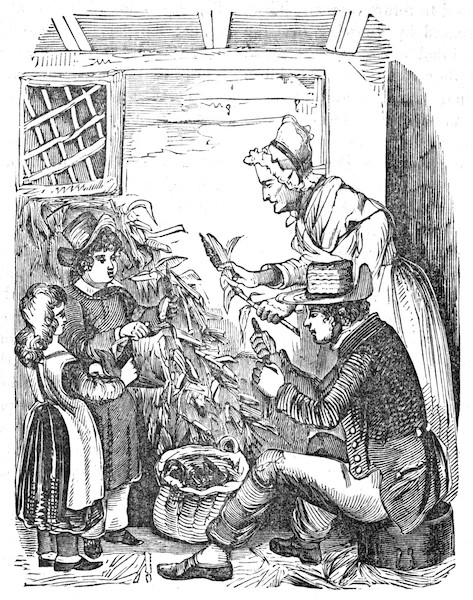
Husking the Corn.
Here they are, all at work, husking the corn—the Widow Wilkins and her three children, Tom, Dick and Lucy. The good woman is giving a lesson to Dick, how to strip off the husks—and little Lucy is trying to do as Dick does. Let us listen to the dialogue.
Mother. See there, Dick—do you see that?
Dick. Yes, ma’am.
M. Well—now you take off the husks, and then take hold of the stalk, just so.
D. Yes, ma’am.
M. And then you break off the stalk close to the ear, just so.
D. Yes, ma’am.
Lucy. There, mother! didn’t I do that better’n Dick?
M. Yes, my darling. Now, Dick, do you know how to do it?
D. Yes, ma’am.
Being satisfied that the husking was in a fair way, the widow Wilkins departed, and left her children to themselves. After she was gone, Dick spoke 43 as follows. “Can you tell me, Tom, what all this corn is for?” “To be sure I can!” said Tom: “some of it is to feed the chickens with; some of it is to feed the pigs with; some of it is to feed the horse and cow with, and some of it is to be ground into Indian meal, to make Johnny-cake and brown bread with.”
“Well done!” says Dick. “It seems to me that the corn is very useful, then; for the chickens and the pigs, and the cow and the horse, and mother and Tom, and Dick and Lucy, all live upon it. Really, I never thought of that before. Then people, when they plant and plough, and hoe, and pick, and husk the corn, are working all the while for the hens, and hogs, and cattle, and people!”
“Yes, to be sure,” said Tom; “and what did you think all this labor was for, before you found out it was useful in this way?”
“Why,” said the boy, “I thought—I thought—I don’t know what I thought; I guess I didn’t think at all—or if I did, I thought it was all a kind of play. But I know better now; I see that when people are at work, they are not playing, but they are doing something useful; and when mother sets me to work, I mean always to consider that she has a good and useful object in view, and that I must do it, not because it is play, but because it will do some good.”
“Very well,” said Tom; “I hope you will always do so.” By this time, the husking was done, and I came away.
The Old Man in the Corner; or, the Pedler’s Pack,
NO. II.
THE STORY OF THE COTTON-WOOL.
Several weeks ago I took a ramble through the beautiful town of Dorchester. In the course of my perambulation, I came to a paper-mill, and being attracted by the stirring sound of the machinery within, I entered and looked around me. In one place I saw an immense bin of rags, of all sizes and shapes, and of all hues, and apparently gathered from the four quarters of the globe. Never did I see such a motley congregation, crowded together in one place. As I was looking on the heap, the thought occurred to me that if each rag could speak and tell the adventures of its existence, we should have a collection of romances equal in extent, and perhaps rivalling in wonders, the thousand and one tales of the Arabian Nights.
While I was gazing at the heap of rags, which, by the by, was in a dim and dusky room, I thought I saw something rise up in the midst, looking very much like the skinny visage of a very thin, old woman, about to speak. I approached the bin, and looked steadily at the grisly image—but, on closer inspection, it appeared to be only an old rag, which had, accidentally, assumed the questionable shape I have described.
I proceeded to examine the several 44 processes of the mill, and great was my admiration at seeing their magical result. I discovered that the rags of any hue, being put into a vat, were bleached as white as the “driven snow;” that they were then reduced to a kind of pulp, as soft as paste; that this, being mixed with water, produced a liquid like milk; that this liquid passed over a wire cloth, through which the water oozed, leaving a thin, white, even scum, which, settling upon the wire cloth, formed the sheet of paper.
I looked on this beautiful process with wonder and delight. I saw the sheet of paper pass over several cylinders, gradually becoming firmer and firmer, by pressure and heat, until, at last, I could see it coiled up, smooth, white and polished, and several hundred yards in length. I then saw it unrolled, and, by a simple machine, cut into sheets, ready to be sent to market.
I have never seen any manufacture which seemed to me no admirable. When I left the mill, I sauntered along the banks of the river, which turned the wheels of the mill. The place was shady, and, it being summer, I sat down. While I was there, a pretty, black-eyed girl came along, and I beckoned her to me. She came smiling, and we fell into conversation. She asked me to go to her house, and being introduced to her parents, they gave the old man some food, and treated him kindly. “Will you tell me a story?” said the little girl. “I will write you one,” said I—and so we parted.
For some weeks I forgot my promise, when I received a note from the black-eyed girl, refreshing my memory on this point. At evening I sat down to write the tale: but, instead of writing, a drowsiness stole over me, and I fell into a dream. Methought I was at my writing-desk, when I heard a rustling amid a heap of papers on my table, and presently something rose up, and assumed precisely the appearance of the rag in the bin of the paper-mill, which had seemed to me so much like a haggish old woman. A sort of strange fear came over me. I could now see the distinct features of a face, though the general aspect of the horrid visage was that of an old calico rag. There was a long, thin, crooked nose; deep, twinkling, tallow-colored eyes; a pointed chin, and a mouth that seemed capable of uttering unutterable things.
I rose up and stood aloof in fear. I was about to speak, when the ghost put her finger on her lip, and, stepping forward, stood upon the middle of the table. There was something awful about this scene, and I felt chilled, with a creeping horror, to my very heart. The creature reached out a kind of crumpled hand, and in a sort of frenzy I clasped it. But no sooner had I touched it, than the image vanished, and I found in my grasp a roll of paper. This I unfolded, and found it to be an immense sheet, written over in a neat, close hand. Casting my eye at the beginning, I saw that it read as follows:
“THE REMINISCENCES OF A RAG.
“As the rising sun was just peeping over the bosom of the Atlantic, and tinging with gold the waters that play along the borders of Amelia Island, a negro man, named Bob Squash, was seen 45 putting some little seeds into the ground, upon the eastern slope of said island. This event occurred on the 4th of March, 1839, as the wooden clock of the plantation was on the stroke of four.
“The seed was covered up in the ground, but in a few days it shot forth, and, in process of time, it became a large plant, covered with tufts of cotton. These were gathered by Bob Squash, and rolled into a wad and from this time I began to have a consciousness of existence. That ball of cotton was myself. I was packed into a bag with an immense heap of other cotton, and being put into a mill, we were awfully torn to pieces, in order to separate the seeds from the fibres. The teeth of the mill, which consisted of a thousand hooks, went through and through us, and thus we were parted forever from the seeds which had been born and bred with us, and which we had cherished from our infancy. The seeds, however, were black, and the combing process made us look very nice and clean.
“I was now taken, with the rest of the cotton-wool, and put into a large, coarse sack, and, in order to make us lie snug, a little negro got into the sack and trod us down. He didn’t stop to consider how we might like it, but he went on stamping and jumping, and singing Jim Crow, all the time. When the bag was full, the mouth was sewed up, and we were marked as weighing three hundred and seventy-five pounds. In this state we were called a bale of cotton.
“You must know that there are two kinds of cotton—the short staple, or upland cotton, and the long staple, or sea island. The latter is the best, and our bale was of that sort. Of course, we, being of the aristocratic class, were proud of our descent; and, while we supposed the vulgar upland would be worked up into shirtings and sheetings, or, perhaps, cheap calicoes, we expected to be treated according to our quality, by being wrought into delicate muslins or cambrics for the fair. So it chanced, as you shall see, if you will peruse the next chapter.”
[To be continued.]
The Sea.—From the great depths which have been actually ascertained in some places, and the great extent of sea in which no bottom has been found, we may conclude that we are under the estimate when, including banks and shallows, we allow one mile in depth for the whole. Even this gives us a most enormous quantity of water; a quantity which, estimated in tons weight, we have the entire quantity of sea water, with all its saline ingredients, amounting to the enormous weight of 600,000,000,000,000,000, (six hundred thousand billions of tons.) Of this enormous quantity, between three and four per cent. consists of different saline ingredients, and the rest of pure water; so that water in the sea available for the purposes of animal and vegetable life, the supply of springs and rivers, and all other purposes for which water is needed in the economy of the land, amounts to five hundred and eighty thousand billions of tons; and the quantity of salt, at least of saline ingredients, to about twenty thousand billions of tons.
46
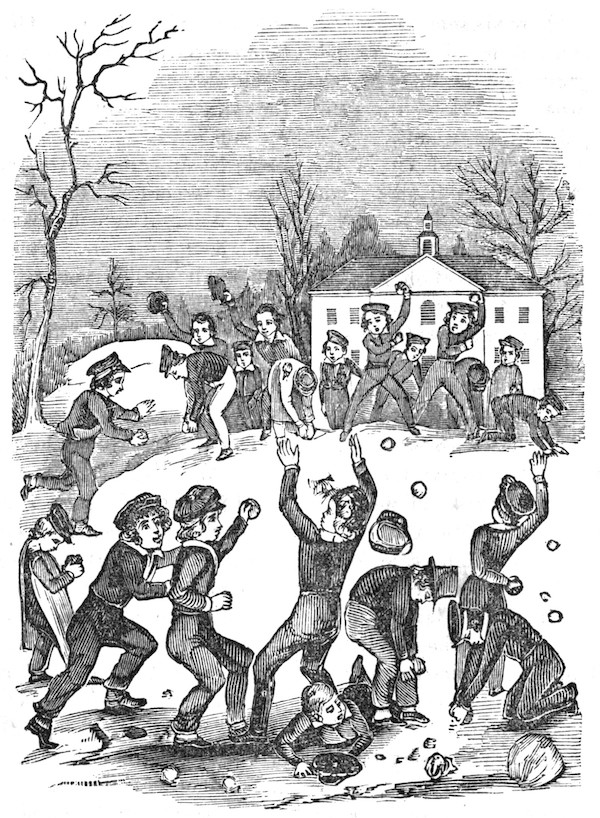
Snow-balling.
“Hurrah, boys—school’s out! come! let’s choose sides and have a snow-balling!”
At this challenge, the boys divide into two groups, and at it they go. It is capital sport—for while it gives an opportunity for the display of skill and power in hurling the missiles, it causes no broken bones—no bloody noses—no peeled shins—no black eyes. It is the very mildest, merriest, and most harmless of all fighting. A snow-ball pat in the face draws no “claret,” begets no bad blood, and only provokes a retaliation, in kind, perchance inciting the hit warrior to squeeze his ball a little harder and send it back with redoubled, but still harmless vim.
Those people who live in the sunny south, where Jack Frost never comes with his snow-flakes, surely miss one of the greatest delights of our northern 47 climes. We are willing to forego their orange groves, their fig trees, and their grape vines—bending as they may be with fruit—in consideration of the fun of snow-balling. Not that we, ourself—Robert Merry—old, decrepit and gray—ever engage in that lively sport. No—such things are past with us; but though we cannot personally engage in such merry work, we can at least look on—and that is a great pleasure.
I remember once when I was at school, the boys agreed to have a game of snow-balling, and each one was only to use his left hand. The work went on bravely and smartly, too, for some time; each boy stuck to the treaty, and faithfully worked with his left hand. But, at last, one cowardly fellow, named Farwell, got into a tussle with another chap, and as he received more balls than he sent, he broke his faith, and hurled with his right hand. This provoked retaliation, for one act of injustice is apt to beget another. Farwell was soundly beaten, and in a short time the whole treaty was violated and overturned. I have often thought of that little incident—and I close my story by suggesting the lesson it inculcates; beware of injustice—for it is very likely that you will yourself suffer from the wrongs that will be done in retaliation.
Anecdote of Washington.—At the commencement of the revolutionary war, there lived at East Windsor, Connecticut, a farmer, of the name of Jacob Munsell, aged forty-five years. After the communication by water between this part of the country and Boston was interrupted by the possession of Boston harbor by the British fleet, Munsell was often employed to transport provisions by land to our army, lying in the neighborhood of Boston. In the summer of 1775, while thus employed, he arrived within a few miles of the camp at Cambridge, with a large load, drawn by a stout ox team. In a part of the road which was somewhat rough, he met two carriages, in each of which was an American general officer. The officer in the forward carriage, when near to Munsell, put his head out of the window, and called to him, in an authoritative tone—“Get out of the path!”
Munsell immediately retorted, “I won’t get out of the path—get out yourself!”
After some other vain attempts to prevail on Munsell to turn out, the officer’s carriage turned out, and Munsell kept the path. The other carriage immediately came up, having been within hearing distance of what had passed, and the officer within put his head out of the vehicle, and said to Munsell—“My friend, the road is bad, and it is very difficult for me to turn out; will you be so good as to turn out and let me pass?”
“With all my heart, sir,” said Munsell; “but I won’t be d——d out of the path by any man.”
This last officer was General Washington. How much more noble, and how much more successful, is a mild and courteous manner, than a harsh and dictatorial one!
Question on Mathematics.—A fellow in Kentucky, with a railway imagination, wants to know how long it will be before they open the equinoctial line.
48
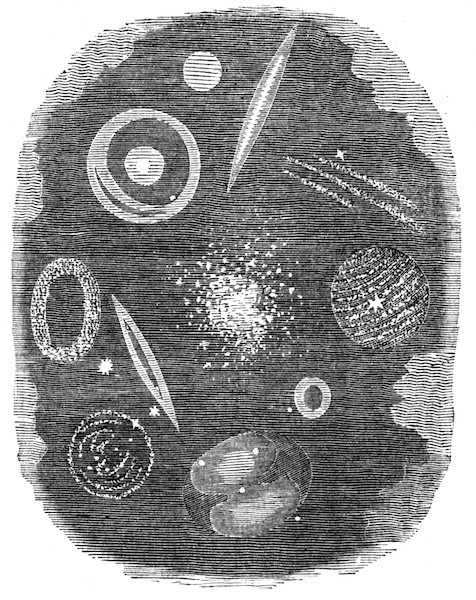
Nebulæ.
The Use of Telescopes.
One of the inventions most important to science that ever was made, was that of the telescope. The common telescope is usually called a spy-glass. It is used to look at distant objects, and it serves to bring them, apparently, nearer to view. At sea, the spy-glass is of the greatest use, for it enables the masters of vessels distinctly to see the land, which would scarcely be visible to the naked eye. He can also see vessels which are distant, and be able to tell what kind of vessels they are, what rigging they have, what colors they carry, &c., long before these things could be discovered by the naked eye.
But the telescopes, made for looking at the heavenly bodies, though apparently less useful than the common spy-glass, have still revealed to us many interesting and wonderful, and, indeed, useful, truths. By means of these, we are better acquainted with the moon; we now know that it is a rough planet of mountains and valleys, and, though resembling our earth, that it is without inhabitants, water or atmosphere.
By means of telescopes we know that 49 Jupiter, which to the naked eye seems but a little star, is a great world, with four moons, and, what is curious, we know that these moons keep the same face always turned to the planet, just as our moon does to the earth. We know that Saturn, which also seems like a little star, is a vast world, with seven moons, and a wonderful belt of light, encircling it and revolving around it. These are some of the wonders revealed to us by the telescope.
But there are still others quite as interesting. Beyond the stars which we can see with the naked eye, the telescope unfolds to the view thousands upon thousands of others, the very existence of which we had never known but for this instrument. Nor is even this all—some of the stars are not single, but two or three are close together, and evidently revolve around one another. These are called binary, or double stars. Astronomers have observed many thousands of these wonderful worlds, far away in the boundless regions of space.
You have all seen what is called the Milky-way, a broad, irregular band of light crossing the entire heavens. The ancient poets represented this as the milk spilt by the nurse of their god Mercury, and from this poor and paltry conception, it derived its name. Now, let us remark what the telescope says the milky-way is—an immense number, myriads upon myriads, of worlds! What a glorious view does this unfold to us of that God who has not only made the heavens, but us also!
But beside stars of various magnitudes, revealed by the telescope, there are other objects, called nebulæ, from their cloud-like appearance. These are of various sizes and forms, some being without defined shape, some being circular, some long and pointed, and one bearing a resemblance to a dumb bell. The engraving at the head of this article will give some idea of the appearance of these mysterious bodies, which are seen, many millions of miles off in the far regions of space.
The idea has been suggested, and with good reason, that these nebulæ are particles of matter, thin almost as air, which are in the process of being condensed and formed into worlds. We know that a detached drop of water forms itself, at once, into a little globe, by that principle which pervades all matter—called gravitation; and we may suppose that these different particles forming the nebulæ, being attracted to each other, will gradually assume a spherical form, and that, in the rush of these particles toward each other, currents will be created, which will give the globe a revolving motion. Such are the curious speculations of the astronomers, and there is some reason to think them correct. What a vast conception does this view of things unfold—for it seems that not only are there countless millions of worlds already formed, all around us, but that, in the distance, the Almighty is still carrying on the stupendous process of manufacturing other worlds! Far—far beyond the reach of the naked eye—far beyond the reach of the searching telescope—far beyond even the daring stretch of the imagination, into the unfathomed night of space—there, there, is the Almighty lighting up the regions of nothingness with existence, 50 bidding new suns to shine in the chambers of silence and death—and thus extending his dominions and spreading abroad the rays of his glory. If the angels and good spirits are permitted to look upon these things—to accompany the Creator in his mighty movements to look upon his proceedings—to fathom, in some degree, his designs—to participate in his works—to co-operate in his views—and to do all this in that blissful harmony which love to God creates—O, how glorious must be that happiness which they enjoy!
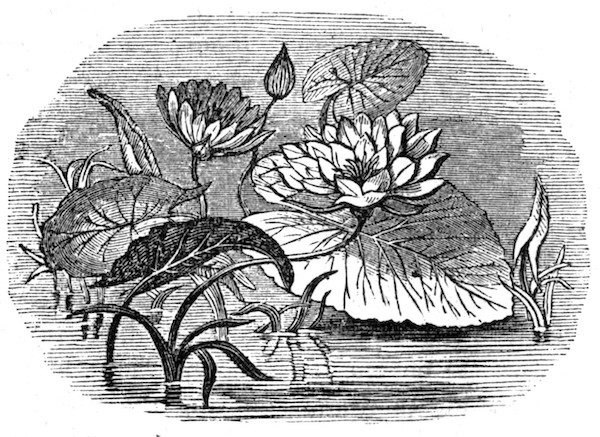
The Lotus.
The Lotus, or lily of the Nile, is a plant of great beauty and celebrity. There is one kind which is dried and made into loaves, and eaten for bread. The root, which is round and of the size of an apple, is also eaten.
The flower, at first, stands on the stalk, one or two feet above the water; but when the leaves are expanded and the seed-vessels fully formed, it gradually sinks till it rests on the surface of the water. All travellers are very much struck with the beauty of the lakes and rivers in Egypt, when, as frequently happens, they are covered with these blossoms. Sometimes they spring up in the places which are flooded during the overflow of the Nile, and seem to spread out to a vast extent, covering the entire surface of the water; yet when the flood subsides they perish.
The Miller and the Fool.—A miller who attempted to be witty at the expense of a youth of weak intellect, accosted him thus: “John, people say that you are a fool.” On this, John replied, “I don’t know that I am, sir; I know some things, and some things I don’t know, sir.” “Well, John, what do you know?” “I know that millers always have fat hogs, sir.” “And what don’t you know?” “I don’t know whose corn they eat, sir.”
51
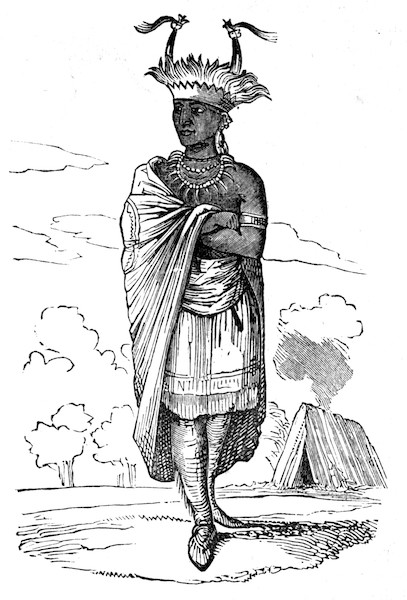
The Indian Dandy.
It must not be supposed that the love of fine dress is confined to city dandies and dandisettes. By no means; for travellers tell us that among the tribes that inhabit the far west, the young Indian men have a great fancy for dressing themselves up in a fanciful way.
The picture at the head of this article represents a young man whose name was Prairie Wolf, and it is a very good likeness. He has upon his head the horns of a buffalo, which he slew in the chase; and beneath is the hair of the buffalo’s pate, with a circular and notched piece of leather, forming together a sort of crown. He has beads around his neck, with a necklace of 52 bears’ claws. He has, also, a bracelet on his left arm. His robe is made of ornamented deer skins;—his kilt is of leather, fringed with wampum.
This dress is very modest for a young Indian. Very often the young fellows, when they wish to appear lovely in the eyes of the girls, paint themselves red, blue and green: they decorate their heads with feathers, and, altogether, make a most extraordinary display. They then mount a horse and ride swiftly around the village, coming often before the women to excite their admiration.
The grave old warriors and hunters, who have done great deeds in their day, laugh at such things, and ridicule them as very contemptible. Indeed, when an Indian has performed some distinguished feat in battle, or the chase, he usually ceases to be a dandy in dress.
One thing is curious among the Indians, and that is, that this love of dress is chiefly confined to the men. The women, indeed, decorate themselves with a few beads and other ornaments; but real dandyism belongs wholly to the other sex. The females are usually modest in their attire, and seldom seek to excite admiration by their dress. It seems to be among the Indians as among the turkies—the cocks are the only ones that strut about, showing off their fine feathers!
“Do you understand me, now?” thundered out one of our country pedagogues, to an urchin, at whose head he threw an ink-stand. “I have got an ink-ling of what you mean,” replied the boy.
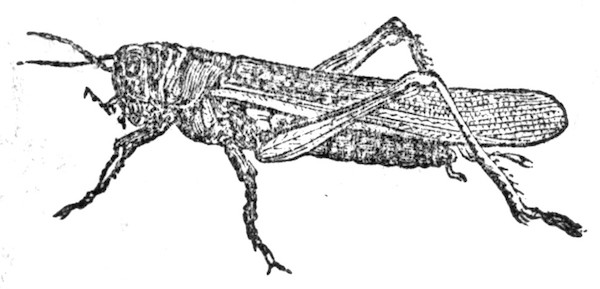
The Locust.
The Locust is an insect whose vast depredations are so little known to us by experience, that the full extent of the plague they cause in Egypt and other eastern countries, is hardly credible. A flight of these insects has been compared to flakes of snow driven about by the wind; and if the sun shines ever so bright, it is no lighter than when covered by a cloud. When they alight upon the ground, the plains are entirely covered with them, and speedily stripped of every vestige of herbage or other vegetable; while at night, locusts cover the earth in such numbers, that they lie one upon the other, four or five inches thick.
The locust, in form, nearly resembles the grasshopper; it hops and flies in the same manner, but is more robust, and has four large wings. The body is scaly, the head large, and the eyes very bright. Their legs and thighs are so powerful, that they can leap to a height of two hundred times the length of their bodies; when so raised, they spread their wings, and fly so close together, as to appear like one compact, moving mass. In most parts of the east, they are made an article of food; and in Egypt, the catching and cooking of locusts forms a regular employment. Their taste is said to be insipid.
53
St. Patrick and Father Matthew.
St. Patrick was a famous missionary, who went to Ireland about fourteen hundred years ago, and taught the people Christianity. At that time, the Irish were heathen, and their religion was a kind of idolatry. Their priests were called druids, who taught the adoration of the sun and moon, together with many superstitions. St. Patrick persuaded the people to dismiss their errors and to adopt the truths of Christianity. He accomplished this great object by the gentle arts of persuasion; and consequently his memory has been ever held in kind and honored remembrance by the greater part of the Irish people. As it is a great while since St. Patrick lived, many curious stories have been invented about him; and, among others, it is related that he drove all the venomous serpents, together with the toads, frogs, lizards and tadpoles, out of the island. Now this is no doubt a fiction. Probably these stories are a kind of allegory, by which, under the idea of reptiles, the errors of heathenism are meant, and these were cast out by the good old saint.
But, however this may be, something quite as wonderful as the tales about St. Patrick, has taken place in our day. A good priest or minister, called Father Matthew, seeing that the people of Ireland were very much addicted to drunkenness, thought he would try to induce them to give it up, and become temperate. So he drew up a pledge, and began to get the people to sign it. He succeeded very well indeed; the people signed the pledge, and many that were very miserable before, on account of the use of whiskey and other strong drinks, were reformed, and became sober, useful, and happy people. Seeing the great good that was thus done, other persons signed the pledge; and thus the great work proceeded, until five or six millions of people had signed it.
This is indeed a great and wonderful work. It is impossible to say how much evil has been prevented, and how much good has been done by Father Matthew. He has recently been to England, and thousands signed the pledge there. It is said he is coming to America, and surely we shall all be glad to see him. The following lines, about St. Patrick and Father Matthew, may be amusing to our readers, and make them remember the good they have done.
St. Patrick, ’tis said, cleared Ireland’s bogs Of serpents and reptiles—toads, tadpoles and frogs— But a saint of our day shows a far greater wonder— For good Father Matthew’s got alcohol under! St. Patrick did well—and we give him a glass Of pure cold water—so round let it pass! We drink to his name—’tis a bright one in story, And, wreathed with green shamrock, shines ever in glory; For if we will read the old legend aright, The reptiles he vanquished so bravely in fight Were druidical monsters—dark errors and crimes— Which he drove, with the cross, from Erin’s fair climes; But alas! when the saint had long slept in the grave, A serpent, more monstrous, crept out from the wave; He seemed a good genius—was joyous and frisky— 54 And so he was welcomed, and they christened him Whiskey. A favorite he grew, and at wedding or fair— By every one cherished—sure Whiskey was there! And all the world fancied, when he took a part, Though ’t were praying or dancing, it came from the heart. But at last it was seen that a demon of night Had passed himself off as an angel of light; For, in moments of glee, like a serpent he stole Unseen to the bosom, and coiled in the soul! Nor was this all—for Whiskey’s a fellow That lives in each liquor, which makes one mellow— And though he may dwell in a hogshead himself, His spirit is found in a julep—the elf! ’Twas thus by his arts that he spread o’er the isle, And millions on millions did Whiskey beguile. In vain are the efforts the evils to paint, Where Whiskey was worshipped as more than a saint! There was madness and death—there was sorrow and guile— Yet—the source of them all—he was worshipped the while! But murder will out—and Whiskey grew bold, Was detected—convicted of all we have told. St. Patrick was dead, but he left an example— And so Father Matthew adopted the sample; He attacked the old monster, and though he roared out, And flourished his tail, and turned round about— Mat laid it on well, and his blows, like a sledge, Fell heavy and thick, for he wielded The Pledge; And the last news is this—’tis surely no wonder— Father Matthew’s atop, and Whiskey is under.
The real Culprit.—A noble lady of Florence lost a valuable pearl necklace, and a young girl who waited upon her was accused of the theft. As she solemnly denied the charge, she was put to the torture. Unable to support the terrible infliction, she acknowledged that “she was guilty,” and, without further trial, was hung. Shortly after, Florence was visited by a tremendous storm, and a thunderbolt fell upon a figure of Justice on a lofty column, and split the scales, one of which fell to the earth, and with it the ruins of a magpie’s nest, containing the pearl necklace!
Combat between a Falcon and Serpent.
M. De Vaillant, a famous French traveller, gives an account of a remarkable engagement, of which he was a witness, between a falcon and a snake. The falcon is the chief enemy of the serpent in all the countries which it inhabits, and the mode in which it wages war with it is very peculiar. When the falcon approaches a serpent, it always carries the point of one of its wings forward, in order to parry off its venomous bites. Sometimes it finds an opportunity of spurning and treading upon its antagonist, or else of taking him upon its pinions, and throwing him into the air. When, by this system, it has, at length, wearied out its adversary, and rendered him almost senseless, it kills and swallows him at leisure.
On the occasion which Vaillant mentions, the battle was obstinate, and conducted with equal address on both sides. The serpent, feeling at last his inferiority, 55 endeavored to regain his hole; while the bird, apparently guessing his design, stopped him on a sudden, and cut off his retreat, by placing herself before him at a single leap.
On whatever side the reptile endeavored to make his escape, the enemy still appeared before him. Rendered desperate, the serpent resolved on a last effort. He erected himself boldly, to intimidate the bird, and, hissing dreadfully, displayed his menacing throat, inflamed eyes, and a head swollen with rage and venom. The falcon seemed intimidated for a moment, but soon returned to the charge; and, covering her body with one of her wings as a buckler, she struck her enemy with the bony protuberance of the other. M. Vaillant saw the serpent at last stagger and fall. The conqueror then fell upon him to despatch him, and with one stroke of her beak laid open his skull.
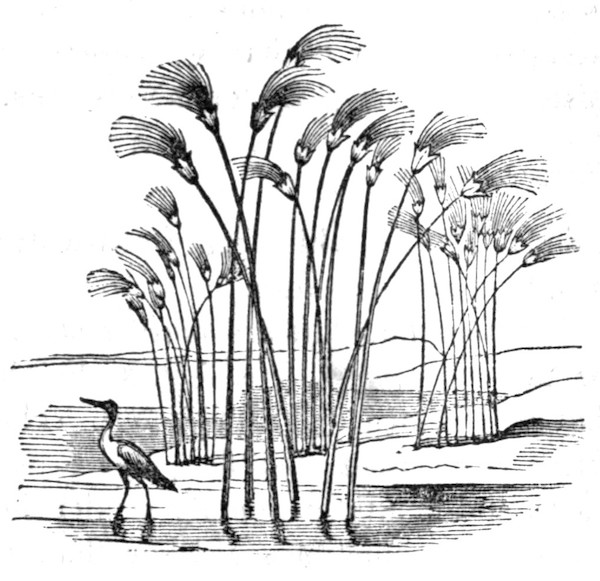
The Papyrus.
In a former number of the Museum we gave some account of the Papyrus, a kind of three-cornered reed which grows in Egypt, and from the pith of which the ancients made thin paper. We give a cut representing some of these reeds growing in the edge of the water. They are still to be found in the environs of Damietta, and on the banks of Lake Menzaleh, and nowhere else in Egypt. Perhaps the reason of this is, that, formerly, the government, in order to have a monopoly of the making of paper, caused it to be pulled up and eradicated in many parts of Egypt, and only allowed it to grow where its preparation could be superintended.
It is said that the mode of making the paper was this: the epidermis or skin of the stalk was carefully taken off, and then the spongy pith within was cut into very thin slices; these were steeped in the water of the Nile, and several layers were alternately placed crosswise, one upon the other. These were then pressed and dried, and rubbed smooth with a piece of ivory. Thus a substance was formed resembling our paper. It was very tough and durable, and many manuscripts upon it are still in existence, which are two thousand years old. It is said that the papyrus was used for the making of paper so late as the ninth century.
56
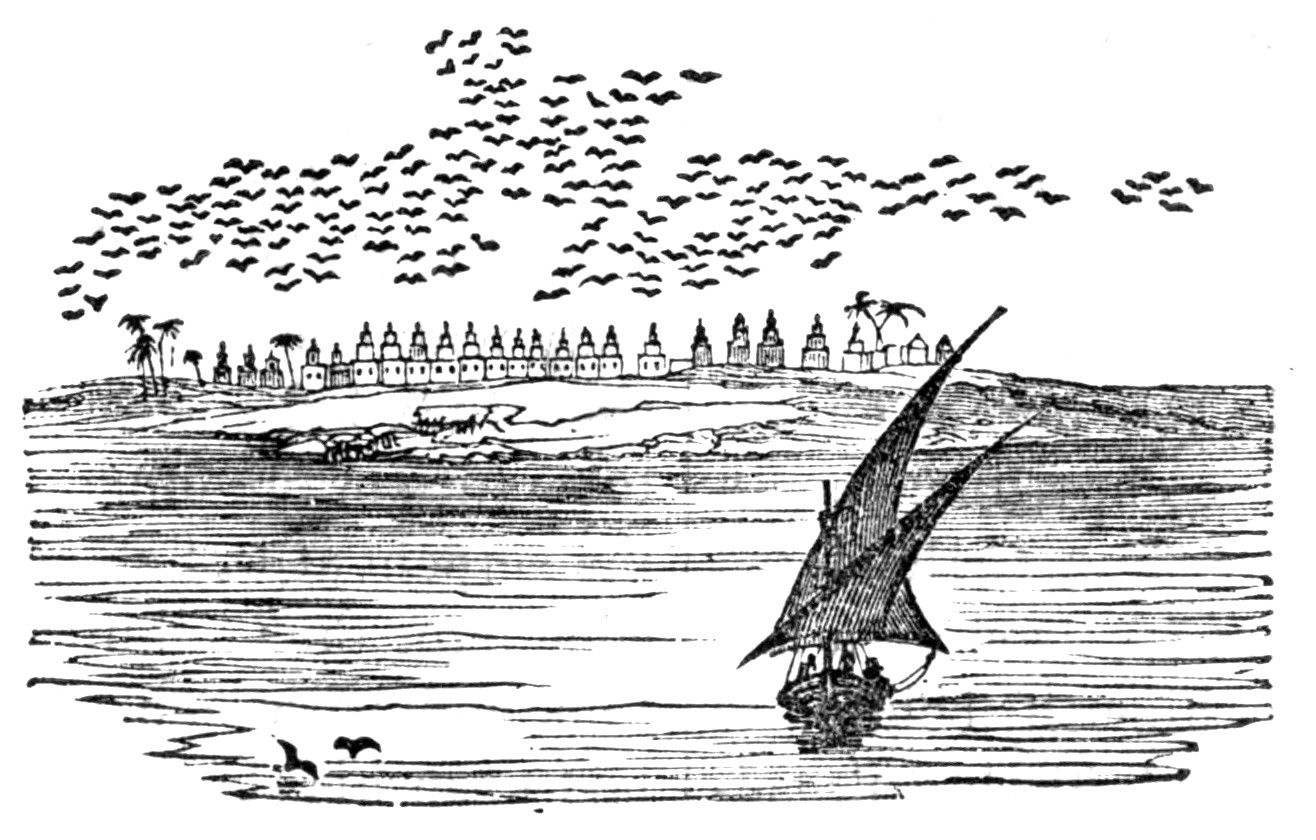
Pigeon Cones.
In Upper Egypt every house and hut is provided with small houses or cones, painted white, for the brooding of pigeons. The number of these birds, in some parts, is quite surprising. In certain districts, no man is allowed to marry or keep house, unless he is in possession of a dove house. The reason assigned for this is, that the pigeons furnish the only manure for the grounds.
Pictures of Various Nations.
CHAPTER II.
The people of Greenland—Labrador.
In order to observe some method, in our account of the people of America, we shall introduce our readers in the first place to the Greenlanders, for I shall here consider Greenland as belonging to the American continent. For a long time Greenland was supposed to be united to this American continent; but it is now ascertained to be a large island. It lies so near to America, however, on the north-east, that it is proper to speak of it in this connection.
Greenland is a cold country, and very mountainous. It is quite barren, except in spots; but the sea is well stored with fish. The country also abounds with reindeer, foxes, white bears, sea-wolves, sea-dogs and sea-cows.
The Greenlanders are short in stature, seldom exceeding five feet in height; but well formed, and rather stout. Their faces are broad and flat; their eyes, nose, and mouth commonly small; their under lip sometimes thicker than the upper; they have high breasts and broad shoulders; their complexion is brown or olive, and their hair coal-black and long.
When they rise in the morning, they appear thoughtful and dejected, but in the evening, when their toil is over, they are cheerful and happy. In general, however, they are not very lively in their temper, yet good-humored and friendly. When a person dies, they think he goes to the land of spirits where he spends his time in hunting.
57 They are very fond of hunting and fishing; and in both they are very expert. They kill many seals; these furnish them with food. The oil they use as sauce, and of the blood they make soup. They use the oil also for lamp light and kitchen fire.
The clothing of the Greenlanders is composed of the skin of the reindeer, seals, and some kinds of birds, which they sew together with the sinews of the reindeer, seal, or whale. Their best garments they keep quite neat; but their ordinary dress abounds in filth and vermin. Their clothes smell so strong, that an inhabitant of the United States would be glad to get to the windward of a Greenlander.
The dwellings of the Greenlanders are of two sorts; one for summer, the other for winter. Their summer habitations are light tents, constructed with a few poles, covered with seal skins. Their winter habitations are built of stones, filled in with moss and covered with turf. The principal apartment is chiefly under ground, and the passage to it is so low, that it is necessary to creep rather than walk to it.
The Greenland women are very much degraded, and their lives are toilsome. They act as butchers and cooks; they dress all the skins, and then make them into garments, boots, shoes, &c. They are even obliged to build and repair the winter habitations, excepting that the men assist about the carpenter’s work.
We are sure that our readers would not wish to live in Greenland; yet the inhabitants of that island think their country the best in the world. If at any time a Greenlander is carried to a warmer clime, he longs for his native snows; and, if he cannot hope to return, he sometimes pines away and dies.
Crossing Davis’ Strait, which is not very wide, we reach that part of the American continent which is called Labrador. This is the country of the Esquimaux.
These people resemble the Greenlanders in several important respects. Like them, they are low in stature, and in complexion are very sallow. Their beards are thick and bushy; but, unlike the Greenlanders, their constitutions are feeble. They are a timorous people, and stroke their breasts in token of peace, when they approach a stranger.
The word Esquimaux, signifies “eaters of raw flesh.” They are very properly named. They are a rude and miserable race of beings, but some of them, it is said, have been taught to read the Scriptures. Their food consists chiefly of fish, with the flesh of the seal and the reindeer. Their greatest luxury is seal blubber, or oil, which they devour with as great relish as boys and girls of this country do sweetmeats.
The dress of these people is made of skins. Men and women dress nearly alike. The women use no trinkets except beads; but they ornament themselves by drawing a needle and thread, blackened with soot, under the skin. This leaves a light blue mark. It is a painful operation; but they delight so much in this kind of marks, that they sometimes cover almost their whole body with them.
The Esquimaux have a singular kind of dog, of which they keep large numbers. In this country, we should think 58 it strange if a dog could not bark; yet theirs never bark. They make use of them to draw their sledges and guard their habitations. Sometimes they eat them, and use their skins for clothing.
Their dwellings in winter resemble caves or holes dug in the earth. They are rendered very filthy by the large quantities of fat or oil which are burnt in them, and which are used in cooking. In summer, they live in tents, much like the Greenlanders.
When Captain Parry made his voyage towards the north pole, a few years since, he found some Esquimaux people living north of Hudson’s Bay. These lived in huts, built of frozen snow. They were very talkative, good-humored and friendly. When they saw anything that pleased them, some fell to singing and dancing, while others screamed as loud as they could. Captain Parry’s men gave them some food; but they made up hideous mouths at it, till, at length, a sailor wet up some dried bread pounded fine, with train-oil, which they licked up with great delight. This would be a loathsome dish to some of our readers in the United States.
These people seem to have no idea of formal religious worship, yet they believe they shall live after death; and if they are good, according to their ideas, that they shall go to heaven and be perfectly happy. Perfect happiness, in their view, no doubt, consists in having plenty of blubber to eat. Without the light of the Bible, how degraded mankind are!
“John, your coat is too short.”
“Yes, sir; but it will be long enough before I get another.”
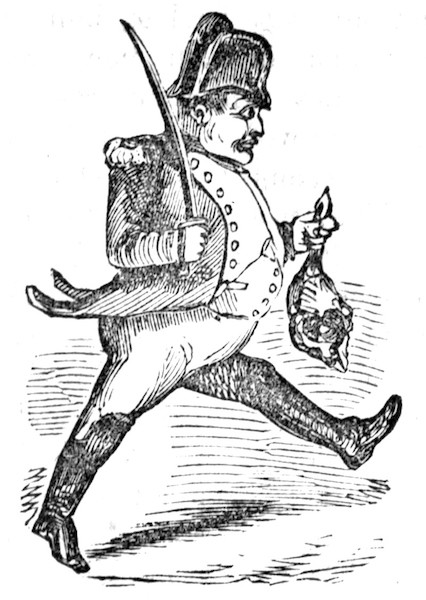
Bonaparte and the Leg of Mutton.
Some forty years ago, we are told that in England, such was the horror generally entertained of Bonaparte, that he was not only the fear of statesmen, but the bug-bear of the nursery and the schoolroom. “If you do this,” said the schoolma’m, birch in hand, “I’ll send Bony after you;” and, “if you don’t do that, I’ll do the same thing.” Bony was, in fact, the great scare-crow,—and many a child grew up under the impression that he was a sort of secondary evil spirit.
We are told by an English writer, that, at a certain boarding school, upon one occasion, a leg of mutton was stolen, and, as almost every evil thing was laid to Bonaparte, the children immediately supposed that he must be the thief! The writer himself, then a child, fancied the emperor, with the mutton in his fist, running off with it, and taking enormous strides in his eagerness to escape.
How many lasting prejudices, how many abiding errors are fixed in the 59 mind by the inconsiderate threats of those who have the charge of youth! It is probable that many of the various defects, weaknesses and eccentricities of character,—those is some cases which are fatal to success in life,—are caused by the foolish and false modes of government to which we allude. We hardly know of a more unpardonable offence than for a person to endeavor to govern a child through fear of some fictitious evil.
Names of Countries and Places.
The following countries were named by the Phœnicians, the greatest commercial people of the ancient world. These names, in the Phœnician language, signify something characteristic of the place which they designated. Europe signifies a country of white complexions, so named, because the inhabitants there were of a fairer complexion than those of Asia and Africa. Asia signifies between, or in the middle, from the fact that the geographers placed it between Europe and Africa. Africa signifies the land of corn ears; it was celebrated for its abundance of corn and all sorts of grain.
Lydia signifies thirsty or dry,—very characteristic of the country. Spain signifies a country of rabbits or conies; this country was once so infested with these animals, that Augustus was besought to destroy them. Italy means a country of pitch; and Calabria has the same signification, for a similar reason. Gaul, modern France, signifies yellow-haired, as yellow hair characterized its first inhabitants. Caledonia means a woody region. Hibernia means last habitation; for, beyond this, westward, the Phœnicians never extended their voyages.
Britain signifies the country of tin, as there were great quantities of tin and lead found here and in the adjacent islands. The Greeks called it Albion, which signifies, in the Phœnician tongue, either white or high mountain, from the whiteness of its shores, or the high rocks on the western coast. Corsica signifies a woody place, and Sardinia, the footstep of a man, which it resembles. Rhodes, means serpents or dragons, which it produced in abundance. Sicily means the country of grapes; Scylla, the whirlpool, is destruction. Syracuse signifies bad savor, so called from the unwholesome marsh upon which it stood. Ætna signifies furnace, or smoke.
Snuff-Taking.
Snuff-taking is an old custom; yet, if we came suddenly upon it in a foreign country, it would make us split our sides with laughter. A grave gentleman takes a little casket out of his pocket, puts a finger and thumb in, brings away a pinch of a sort of powder, and then, with the most serious air possible, as if he were doing one of the most important acts of his life—for, even with the most indifferent snuff-taker, there is a certain look of importance—proceeds to thrust it into his nose; after which he shakes his head, or his waiscoat, or his nose itself, or all three, in the style of a man who has done his duty and satisfied the most serious claims of his well being.
60 It is curious to see the various ways in which people take snuff. Some do it by little fits and starts, and get over the thing quickly. There are epigrammatic snuff-takers, who come to the point as fast as possible, and to whom the pungency is everything. They generally use a sharp and severe snuff, a sort of essence of pins’ points. Others are all urbanity and polished demeanor; they value the style, as well as the sensation, and offer the box around them as much out of dignity as benevolence.
Some people take snuff irritably, others bashfully, others in a manner as dry as the snuff itself; generally with an economy of the vegetable; others with a luxuriance of gesture, and a lavishness of supply that announces a more moist article, and sheds its superfluous honors upon neckcloth and coat. Dr. Johnson was probably a snuff-taker of this kind. He used to take it out of his waistcoat pocket, instead of a box.
There is a species of long-armed snuff-takers who perform the operation in a style of potent and elaborate preparation, ending with a sudden activity. He puts his head on one side, then stretches forth his arm with pinch in hand, then brings round his arm as a snuff-taking elephant might his trunk, and finally shakes snuff, head and nose together, in a sudden vehemence of convulsion. His eyebrows are all the time lifted up, as if to make more room for the onset, and when he has ended, he draws himself up to the perpendicular, and generally proclaims the victory he has won over the insipidity of the previous moment, by a snuff and a great “Flah!”
Squirrels.
In the second volume of the Museum, we told some things about squirrels in general, but did not say anything about the different kinds particularly, which we will now proceed to do. They are so interesting a class (or, as the naturalists would say, genus) of animals, and especially so to children and young persons, that we think the readers of Merry’s Museum will like to hear more about them.
They have often, I have no doubt, been delighted at seeing their gambols, and their activity in leaping from tree to tree, and especially in seeing them eat nuts, sitting on their hinder legs, or haunches, with their bushy tails turned up over their bodies, and holding the nuts in their fore-paws, and making a hole through the shell with their sharp teeth to extract the kernel. It is very amusing to observe them thus engaged, and very surprising to see how rapidly they will make a hole through the hardest shelled nut. For this purpose, without doubt, it is, that He who made the squirrels, and who is the same glorious Being that created us, has formed their teeth very strong and very sharp.
There is quite a variety of squirrels that inhabit this country, but the most common in New England are the Gray Squirrel, the Red Squirrel, the Ground or Chip Squirrel, and the Flying Squirrel. All these kinds are frequently to be seen in almost every district, though the flying squirrel, on account of his habit of stirring about in the night, and lying still in the day-time, is not so 61 frequently seen. They are all very beautiful and interesting creatures.
The gray squirrel is the largest of those I have named, and is frequently hunted for food, as his flesh is very palatable. A squirrel-hunt, in the fall, is a very common and very exciting amusement in many places in the country, and, when conducted with as much regard to humanity as practicable, is, perhaps, not only a pleasant, but a harmless and proper recreation. It is very apt, however, to be attended with the wanton slaughter of small birds, and other instances of unnecessary cruelty. In the newly-settled parts of the country, these squirrels are sometimes so numerous, that they make very serious havoc with the corn crop, and, in some cases, almost entirely destroy it. Its ordinary food, however, consists of nuts of various kinds, of which, like the other squirrels, it lays up a large supply for the winter. “This species,” says Godman, in his American Natural History, “is remarkable among all our squirrels for its beauty and activity. It is, in captivity, remarkably playful and mischievous, and is more frequently kept as a pet than any other.” I dare say many of my young readers have seen one or more of them in a rolling cage, and, by rapidly running over the bars, making it revolve almost with the speed of a mill-stone. Its general color is gray, as its name indicates, and it has a very large, bushy tail, which sometimes hides almost its whole body.
The red squirrel, or Chickaree, as he is sometimes called in the Middle States, is the next largest of the four, and is a common and beautiful animal, often seen on the trees by the road-sides. Frequently, you will hear a half barking and half twittering noise, and, looking up, you will see a red squirrel on the limb of a tree, a few feet above you, from which the sound proceeds. It seems to be a complaint for your encroachment on his premises, and a kind of warning to move out of his neighborhood. They frequently come around our dwellings for fruit and various sorts of food. Several of them now reside close by my house, and daily come into my woodshed for butternuts, which my children place there for them, and carry them up into a pear-tree standing by the side of the shed, and then devour them. I caught one of them in a box-trap, and kept him in confinement long enough to make a picture of him, and then set him at liberty, and he returns as freely as ever. Their food and habits generally are similar to those of the gray squirrel, though they are much more familiar, in the wild state, than the other. He is of a reddish brown color,—whence he takes his name,—and he has a dark stripe along his side, separating the red color from the white.
The account of the chip, or ground squirrel, and the flying squirrel, will be given in another number of the Museum.
Consolation in Sea-sickness.—A lady at sea, full of apprehension in a gale of wind, cried out, among other exclamations, “We shall go to the bottom! mercy on us, how my head swims!” “Madam, never fear,” said one of the sailors; “you can never go to the bottom while your head swims!”
62
The Blue Jay.
“A blue jay,” says Wilson, “which I have kept for some time, and with whom I am on terms of familiarity, is a very notable example of mildness of disposition and sociability of manners. An accident in the woods first put me in possession of this bird, when in full plumage, and in high health and spirits. I carried him home with me, and put him into a cage already occupied by a gold-winged woodpecker, where he was saluted with such rudeness, and received such a drubbing from the lord of the manor, for entering his premises, that, to save his life, I was obliged to take him out again.
“I then put him into another cage, where the only tenant was a female orchard oriole. She also put on airs of alarm, as if she considered herself endangered and insulted by the intrusion. The jay, meanwhile, sat mute and motionless on the bottom of the cage, either dubious of his own situation, or willing to allow time for the fears of his neighbor to subside. Accordingly, in a few minutes, after displaying various threatening gestures, she began to make her approach, but with great circumspection and readiness for retreat.
Seeing the jay, however, begin to pick up some crumbs of broken chestnuts, in a humble and peaceable way, she also descended, and began to do the same; but, at the slightest motion of her new guest, wheeled round and put herself on the defensive. All this ceremonious jealousy vanished before evening, and they now roost together, and feed and play together in perfect harmony and good humor. When the jay goes to drink, his messmate very impudently jumps into the water to wash herself, throwing the water in showers over her companion, who bears it all patiently, and venturing to take a sip now and then between the splashes, without betraying the smallest token of irritation. On the contrary, he seems to take pleasure in his little fellow-prisoner, allowing her to clean his claws from the minute fragments of chestnuts which happen to adhere to them.”
LINES PLACED OVER A CHIMNEY-PIECE.
Surly Winter, come not here; Bluster in thy proper sphere: Howl along the naked plain, There exert thy joyless reign; Triumph o’er the withered flower, The leafless shrub, the ruined bower; But our cottage come not near;— Other springs inhabit here, Other sunshine decks our board Than the niggard skies afford. Gloomy winter, hence! away! Love and fancy scorn thy sway; Love and joy, and friendly mirth Shall bless this roof, these walls, this hearth, The rigor of the year control, And thaw the winter in the soul. Mrs. Barbauld.
A German gentleman, in the course of a strict cross-examination on a trial was asked to state the exact age of the defendant.
“Dirty,” (thirty,) was the reply.
“And pray, sir, are you his senior and by how many years?”
“Why, sir, I am dirty-two.”
63 The Shoe-black and his Dog.—An English officer of the 44th regiment, who had occasion, when in Paris, to pass one of the bridges across the Seine, had his boots, which had been previously well polished, dirtied by a poodle dog rubbing against them. He, in consequence, went to a man, who was stationed on the bridge, and had them cleaned. The same circumstance having occurred more than once, his curiosity was excited, and he watched the dog. He saw him roll himself in the mud of the river, and then watch for a person with well-polished boots, against which he continued to rub himself.
Finding that the shoe-black was the owner of the dog, he taxed him with the artifice; and, after a little hesitation, he confessed that he had taught the dog the trick, in order to procure customers for himself. The officer being much struck with the dog’s sagacity, purchased him at a high price, and took him to England. He kept him tied up in London some time, and then released him. He remained with him a day or two, and then made his escape. A fortnight afterwards, he was found with his former master, pursuing his old trade on the bridge in Paris.
Advertisement extra.—The following morceau was copied from the original notice on board the steamboat William Caldwell, which plies on Lake George. The placard hung directly over the “bocks” containing the “snaick.”
A Rattel Snaick too bee Shode.—Thee history off this snaick is as follors, hee was ketcht on tunn mounting buy a poore man with a large fammely being sicks yer ould and very wenumous he is now in a bocks and cant hirt no boddy which is much better than too bee runnin wilde cause hee don’t want to eat nothun.
Admittance is sickpents for them what pleese to pay it, and thrippents for them what dont, a libberall reduckshon for fammeliees for more particklelars pleese to cawl on Old Dick.
T. N. Take notiss it was the poor man and not the snaick that had a large fammeley.
Pat-riotism.—W. E. Robinson, Esq., in a speech recently delivered in Baltimore, said that even the ridicule cast upon Irishmen was sometimes the highest praise. Thus, the nickname of Pat was a word of the very best signification. No word beginning with Pat, in the English language, had a bad meaning. Patent is applied to something valuable; Paternal means fatherly or kind; Patriarch, the father or head of the family; Patrician, a nobleman; Patriot, a lover of his country; Patrol, one who guards the garrison; Patron, a protector and guardian; Pattern, a thing to be copied.
To our Readers.
We regret that we are obliged to omit, this week, the continuation of Bill Keeler’s story of the Lottery Ticket, as well as some other articles intended for this number.
We must also defer till another number several interesting letters from our correspondents.
64
[Audio content is not currently supported on your device.
The Snow-Flakes.
WORDS AND MUSIC WRITTEN FOR MERRY’S MUSEUM.
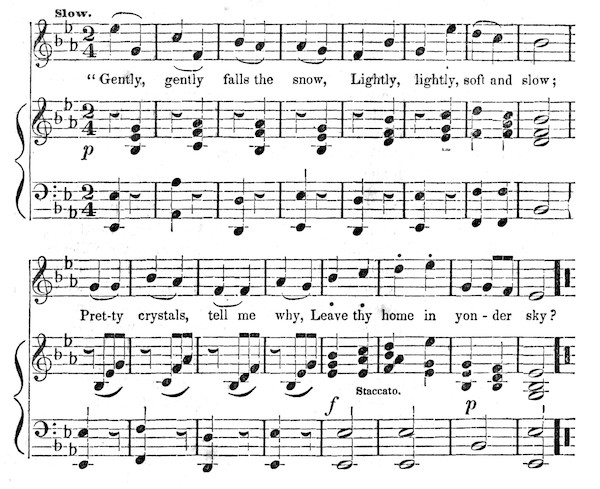
“Gently, gently falls the snow, Lightly, lightly, soft and slow; Pretty crystals, tell me why, Leave thy home in yonder sky? “All above is pure and true, Pretty snow-flakes—just like you. Then why in heaven take thy birth, Yet seek a home on this dark earth?” Thus I spoke, and seem’d to hear A gentle spirit whisper near— “Though from heaven the snow-flakes fall, And mix with earth—the fate of all— “When their winter task is done, They’ll melt and mingle with the sun; And, with his beams, in dew-drops rise, Pure as before, to yonder skies.”
65
MERRY’S MUSEUM.
Vol. VII MARCH, 1844. No. 3.
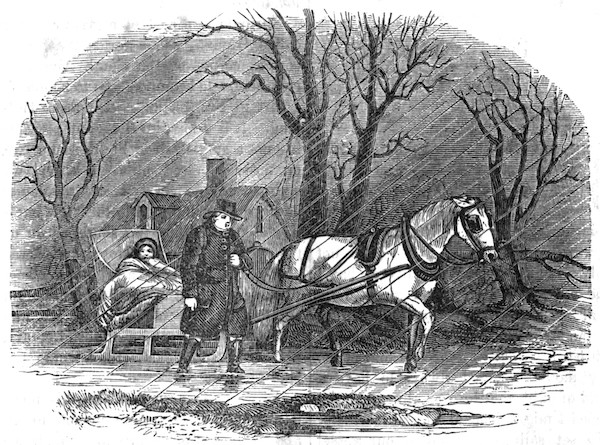
March—the blusterer—is here! It is a capricious month, often coming in like a lion and going out like a lamb; to-day it brings us sleet and tempest,—to-morrow, smiling sunshine and gentle showers. It appears to be a mixture of all the seasons—winter, spring, summer and autumn—yet not having the agreeable qualities of either. It is a sort of Jack-at-all-trades, yet good at none. Of all the months, it is the least of a favorite.
We are speaking, however, of our New England March; in the sunny south, it is otherwise. There it is a month of real spring; there it calls forth the buds and blossoms, and bids nature to assume her loveliest robes of azure, green and purple. At Charleston, in South Carolina, the people are regaling themselves with roses, lilacs and green peas, while we in the Bay State are shivering in the raw, cutting gales that come from the north-east, and bite as if dipped in acid. Well, never mind, we must button up our coats close for a few weeks longer; spring will come at last, and we shall enjoy the delights of that 66 charming season. Let old Boreas roar, if he will; his time is nearly out for the season; he is fast retreating to Greenland, where he will have to stay till December, when we shall welcome him back, with his ice and snow.
Dick Boldhero.
CHAPTER II.
Adventures in South America.
Being now about seventeen years old, and having the reputation of being a pretty good sailor, I was offered a berth on board a vessel that was going to Surinam, a Dutch settlement in South America. This I accepted, not only because the pay was liberal, but I had a vague notion that I might there hear something of my uncle Ben; for we had always understood that when he left St. Domingo he sailed for that place. My mother seemed always to have a kind of faith that he was alive, and she hoped I might hear of him at Surinam. We set sail in November, our vessel being a brig called the Sheldrake. We proceeded for some time on our voyage without any remarkable occurrence.
When we began to approach the coast of South America, I could not but be struck with the splendor of the stars at night. In those southern latitudes, we see a different set of stars from those which are visible in New England, and many of the groups are exceedingly brilliant. The beauty of a tropical night, especially at sea, even when the moon is not visible, can scarcely be conceived. The waves of the ocean are flashing with phosphoric light, and to such a degree, as to throw a lustre upon the sides of the ship. The stars are of sufficient brilliancy to light up the atmosphere, giving to all the objects, above and around, an aspect of peculiar loveliness.
Surinam is a part of a great country called Guiana, which forms the northeastern corner of the South American continent, and belongs a part to England, a part to France, and Surinam to Holland. It is a low, level region, presenting not a single hill or highland for two or three hundred miles. When we approached the coast, I saw the land; nothing was presented to the view but a line of trees edging the shore, as far as the eye could reach. Not a house was visible, nor, indeed, any other object which could give us the least intimation as to what part of the coast we had reached. We kept off the shore, and proceeded south-eastward, keeping the land in view.
As we were proceeding in this manner, a smart gale sprung up one night, and, in spite of our efforts to keep off, we were driven in toward the land. In the morning we struck the bottom, and soon found that we were stuck fast in the mud-bank which extends out three or four miles to sea, along the whole coast of Guiana. It was now December, a time when the whole face of nature is wrapped in snow in New England; but where we were, the heat was excessive.
After about two days, we contrived to work our brig out of the mud, and once more proceeded on our course. At last we saw a house upon the land, and the captain, coming to an anchor, sent a boat 67 ashore, to inquire whereabouts we were. The answer was that we were near the mouth of the river Courantin, about a hundred miles west of Paramaribo, to which place we were bound. This was very agreeable news. We now proceeded cheerfully on our way, and in the course of two days we could perceive, by the appearance of the water, that we were near the mouth of a large river. This we knew to be the Surinam, and now, pursuing a southerly course, soon found ourselves at the wharf of Paramaribo.
I had been a great deal around the world and seen a great many beautiful places, but never was I more delighted than when I walked about this little city. It is not larger than Providence, having only twenty thousand inhabitants, but the streets are long, straight and broad, and are lined with the most beautiful trees that can be imagined. These are of various kinds, such as oranges, lemons, shaddocks, tamarinds, &c. At all seasons of the year, these are bending with fruit, and yet covered with blossoms. The air is at all times filled with perfume, especially at night.
The inhabitants are generally Dutch. The houses are for the most part of wood, but they are of a curious fashion, having very heavy cornices, with abundance of queer ornaments. Nothing can present a stronger contrast than do the people in these streets to those of New England. In the latter place, there is great uniformity; in the former, all is variety. Here you may see the old Dutch planters, with their huge trowsers and broad-brimmed hats; sailors from all countries; soldiers, Jews, Indians and Negroes. The dresses of these people strike a Yankee as being exceedingly droll, and at first, I could not help laughing at almost everybody I met. By degrees, the singularity of things around me wore off, and I became accustomed to the manners of the place. The river before the town of Paramaribo is at least a mile in width, and as there are a great many boats and barges constantly plying upon its surface, the scene it presents is of a very lively character.
The soil of Guiana is among the richest in the world. The land lies so low that it is necessary to build dikes, for the purpose of keeping out the sea and the inundations of the rivers. The chief productions are coffee, sugar, cacao, cotton and indigo. It also produces ginger, pepper, cloves, nutmegs, castor oil, &c. The object of our voyage was to obtain coffee and spices. There is no country in the world more rich in its fruits. Yams, sweet potatoes, bananas, and the cocoa nut, are produced in abundance. Oranges, lemons, limes, figs, shaddocks, melons of many kinds, and other delicious fruits, abound.
Nothing can equal the luxuriance of the flowering shrubs and plants. Many of these are of gigantic stature. The trees often grow to a great height, and thousands of bright-winged birds seem to live a life of perpetual bliss amid the perfume that is shed from their perennial blossoms.
As soon as I had become a little acquainted with the town, I began to make inquiry about my uncle. I could, however, hear nothing of him, until, at last, an old sailor told me that he remembered him perfectly well; that he came 68 from Port au Prince to Paramaribo more than twenty years before, where he remained only for a year or two. The man could give me no farther information about him. He told me, however, that there was an Englishman residing up in the country about a hundred miles, who had some business with my uncle, and he could tell me all about him. As our vessel was likely to be detained about a month, I got permission of the captain to go and see this man, to whom I was referred for information respecting my uncle.
I set out on foot, and pursued my way along the banks of the river Surinam. The road was roughly paved with stones, and heavy wagons were frequently passing to and fro upon it. Although I was in a strange country, I felt no concern, for I was naturally of a fearless disposition, and beside, I was armed with a cudgel in my hand, and a pistol under my belt. So far, indeed, was I from fear, that I felt a sort of pleasant excitement in my present adventure. The strange appearance of everything around me rather excited than saddened my mind. The trees, the shrubs, the very birds, the whole aspect of nature, the forms of the houses that I occasionally met, the dress of the inhabitants, all reminded me that I was far from my own country, that I was a stranger in a strange land; but still I was light of heart, and whistling Yankee Doodle, I plodded bravely on.
I had set out before sunrise, and by ten o’clock had travelled more than a dozen miles. Finding myself weary, I turned off the road, and seated myself on the bank of the river, beneath the shade of a large tree. Here I sat for some time, listening to the incessant chatter of parrots and macaws over my head, and observing the humming birds that were buzzing among the flowering shrubs.
At last, I fell asleep, as little dreaming of danger as if I were taking a nap upon a summer day upon the banks of the Connecticut river. I slept soundly for some time, but at last I began to dream about a great many strange things. I fancied that I was wandering in a distant land—that I finally came to a great cavern, which I entered—that I was weary and laid myself down to repose—that a horrid monster stole upon me in my helpless condition, and was about to rend me in pieces; I dreamed that I attempted to rise and escape, but that I could not stir. Such at last was the horror of my mind, that I screamed aloud, and at the instant awoke from my sleep.
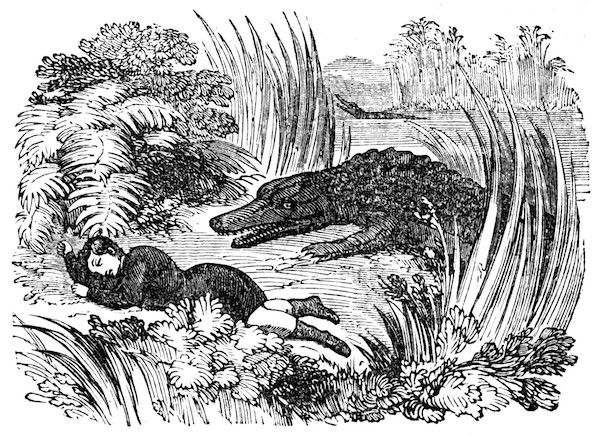
What was my horror to discover that my dream was almost a reality! At the distance of about twenty feet I saw an enormous alligator, with his jaws already distended, ready to press me in his fangs. He was slowly stealing upon me, but as I moved, he rushed forward, his enormous tail brandished in the air, and his claws spread, as if ready to grapple me. Quick as thought, I leaped from the ground, and at a single bound placed myself behind the trunk of the tree beneath which I had been sleeping. The monster perceived that he was foiled in his main object; but unluckily I had left my wallet, containing a loaf of bread and some cold meat, upon the ground where I had lain. The creature picked this up in his mouth, and wheeling 69 heavily round, marched down the bank and plunged into the water. At first, I was quite satisfied to have escaped with my life; but I soon began to lament the loss of my dinner. It was in vain, however, to repine, so I seized my cudgel, and proceeded upon my journey.
[To be continued.]
Bill and the Boys.
The Lottery Ticket, continued.
The reader will remember that Tom Trudge had set off from his home in the country, to go to New York and see to the success of his lottery ticket. He soon arrived at the great city, and found, to his vexation, that the drawing of the lottery was postponed for a week beyond the appointed time. It seemed to him hardly worth while to return to his home, but what should he do to get rid of this terrible week? When we are looking forward with impatience to a certain event, the time that stands between us and the object of desire, is considered a hateful enemy, and we set about killing it as well as we can. Some people are as anxious to kill time, as if it were a lion or a grizzly bear.
At the period we speak of, some thirty or forty years ago, a common way of killing time, or, in other words, of wasting that most precious gift of Heaven, was to go to a tap-room or tavern, and drink flip, whiskey or grog, and indulge in low and vulgar conversation. Such things are considered very silly now, but it was otherwise then. Tom could think of no other way to spend his week than to go to the Jefferson and Liberty tavern, and indulge in the amusements of the bar-room. So thither he went, 70 and by keeping himself in a state verging on intoxication, he continued to while away the awful seven days.
At last the appointed hour came. A firm conviction had taken possession of Tom’s mind, that he was to draw the prize of fifty thousand dollars. He did not seem to consider that there were twenty thousand tickets, and that his chance of getting it was only one in twenty thousand. To a deluded mind, such an obstacle is nothing; one chance in twenty thousand is just as good as certainty. When the drawing took place, the office was thronged with a crowd of people, most of them wretched in the extreme. There were old men, tottering upon the verge of the grave; there were haggard women, evidently starving for want of the money they had invested in the lottery; there were young persons, of both sexes, apparently sunk in vice and wasted with poverty; there were the sick and emaciated, mingled with the strong and the reckless. All anticipated with hope and expectation,—and yet all, or nearly all, were destined to go away with disappointment and sickness of heart.
Tom got close to the revolving wheel, and, with his ticket in his hand, watched the numbers as they were declared. Several times his heart beat violently, as a number came out near his own. The drawing continued for more than two hours, and his hopes began to fly, as he perceived that the prizes were nearly all out. At last his own number, which was 777, was announced, and immediately after, it appeared that it had drawn the prize of 50,000 dollars!!!
Tom Trudge was in general a pretty stable-minded man, but for a moment his eyes grew dim and his brain reeled. A strange variety of images glided in confusion before his fancy, among which, his wife, with a yaller damask gown and a fine fan, were conspicuous. Finding it necessary to have air, he left the crowd, and went into the street. For some time he could hardly tell where or what he was; but at last his faculties rallied, and, coming fully to himself, he began to consider what was to be done.
He made inquiries at the office, and found that he could cash his prize at once by paying 5000 dollars discount;—this he did, and immediately found himself in the possession of the sum of forty-five thousand dollars,—an immense sum in those days, especially for a pedlar, who had seldom before had fifty dollars in hand at a time. Though he was anxious to go home and communicate his good fortune to his wife, he did not forget her injunction. He went forthwith and purchased a magnificent changeable silk dress, of yellow and purple, upon which was a representation of a bathing goddess in figures of gold. He also purchased a fan, on one side of which was a Venus, and on the other a Cupid, and started for home. Stopping at every tavern on the road, he drank liberally, and by the time he reached his cottage, his brain was not a little muddled.
When he entered the little dwelling, his hair was dishevelled, and his eyes staring,—his whole aspect, indeed, was wild and singular. He, however, rushed up to his wife, exclaiming, “I have got it! I have got it!” He then kissed her over and over again; took up his 71 children and nearly stifled them with his obstreperous embraces; at the same time, he shouted, danced and whirled round like a bedlamite. “What is it ails you, Tom? What in natur’ is the matter? Are you drunk or mad?” said his spouse. “I have got it,—there, there!” said Tom, hurling the bundle of silk at his wife’s head. “There’s the yaller damask, and the fine fan! And here’s the fifty thousand dollars!” Saying this, he took an enormous bundle of bank bills from his pocket, and giving it a whirl around his head, threw it across the room, and scattered the precious bits of paper over the floor. It is impossible to depict the astonishment of Mrs. Trudge, as she beheld the shower of bank bills, of five, ten and even twenty dollars each, now lying before her, as abundant as the very chips around the wood-pile.
For a moment the dame was bewildered, and the idea crossed her mind that it was only a dream. It was indeed so much like one of those visions that often cheat the mind in sleep, that she stood still, rubbed her forehead and looked puzzled for several seconds. But in a few moments her husband, quite out of his head, began to dance among the scattered bills, and cutting his pigeon-wings where they lay thickest, made them fly in all directions. Several of them were near the hearth, and, caught by the draught, edged closer and closer to the heap of coals, and at last bounded under the forestick and were instantly reduced to ashes. Others took a flying leap up the throat of the chimney, and circling round and round, disappeared amidst the soot and coiling smoke.
These circumstances at last recalled Mrs. Trudge to her senses. She had by degrees unravelled the tangled skein of events and made out the truth. She saw that her husband had actually drawn a great prize; that, obedient to her command, he had bought the damask and the fan, and that, between tippling and delight, his wits had gone wool-gathering for a season. She saw the necessity of immediate exertion to save the bank bills, now scattered like worthless rags upon the floor, her bewitched husband still rigadooning in their midst, and grinding them beneath his feet, or making them circle about upon the eddies of air that his brisk motions created. Like a hawk pouncing upon a brood of chickens, she now stooped upon the cash, and gathered it by handfuls into her apron, which she held up by the two corners. Seeing what she was about, her addled lord came after her and chased her round the room. But Mrs. Trudge took good care to keep out of his way, and soon succeeded in picking up the greater part of the bills. At last her husband, being completely exhausted, fell upon the floor. His good wife then dragged him to bed, and leaving him there in a sound sleep, she completed her work of securing the money.
Trudge slept long and heavy, but at last he awoke. He seemed sadly bewildered, and put his hand to his forehead in a manner which showed that he not only had a pain in his head, but was troubled in mind. At last he turned to his wife, and demanded, “Where is the money?”
“Money?” said his better half,—“Money! 72 what man—money! money, indeed! I think I should like some money myself. ’Tis a pretty business indeed: you go away and leave your tender wife and suffering children for ten long days; you then come back drunk as a fiddler, cut up all sorts of cantraps about the house, almost murther your family, and then, after you have come to your senses, you ask, as innocent as a cat licking cream, ‘where is the money?’ Where is the money? say I. Zounds, where is my yaller damask and the French fan? Come, speak, man! Or is it all a dream? Didn’t you draw the big prize, after all? Oh, Tom, Tom! I told you so; I told you how it would be; I knew you had thrown away your money, and here we are, a poor innocent family, reduced to ruin, poverty and starvation!!” Upon this, the dame held her apron to her eyes, and the tears, real tears, bright as crystals, chased each other down her rosy cheeks.
Poor Tom Trudge! There he sat on the bedside, the very image of botheration. For the life of him, he could not tell whether he had really drawn the prize, or only been visited by a bewildering vision. At last, however, the mists that had hung over his mind began to clear away; the truth came more and more distinct to his mind, and finally he recollected the drawing of the lottery, his obtaining the forty-five thousand dollars, his buying the damask and the fan—his journey homeward, and the meeting with his wife. Just as he had fully brought to recollection the whole affair, he looked up, and discovered a half malicious smile shining through the tears of his spouse. She now burst into a hearty laugh, and brought forth the bundle of bank notes, nicely done up, and Tom Trudge and his wife were the happiest couple in the universe.
[To be continued.]
The Old Mansion.
The following simple but touching ballad was composed a short time since, by a girl in Maine, about seventeen years of age, who had been suffering several years from a weakness of sight, so as to prevent her reading or writing. It was taken down, from her dictation, by a friend.
There stood a stately mansion old On brow of sloping hill; There many a joyous day I’ve passed, And mem’ry loves it still. ’Twas ’neath the shade of lofty elms And evergreen dark pine, Where robins sing, with notes so sweet, In spring and summer time. There dwelt my aged ancestor, With partner of his years; They’d travell’d long together here In sunshine and in tears. Their spring-time hopes were faded, And winter days came round, Yet sunny ties of kindred Their hearts to earth still bound. My grandma’s eyes were soft and blue, And tenderly she smiled, She ne’er thought ill of any one, Her words were always mild. I never shall forget her voice, The tones of her “Good even’;” Nothing we ever asked her for But what was kindly given. 73 My grandpa’ often told us tales, All of the olden time; And of the wars for liberty He fought in “auld lang syne.” He gave us pretty picture-books On happy New-Year’s day; And poor, who hither came for aid, Ne’er empty went away. Grandma’ would tell us of the train, The beaver hat and plume, And all the fashion of the dress She wore in girlhood’s bloom. She always kept some plums or cake In cupboard saved away, To give “the children,” every time They came with her to stay. And we assembled every year In that wide ancient hall, To keep the old “Election-day,” Parents and children all. Then rang the walls with merriment, With laughter and with glee; Those sounds come o’er my memory now, And sadly seem to me. Oh, there were entries long and dark, Clock-room and pantry too; And a hole was cut in the cellar-door, Where fav’rite cat went through. Grandma’ wore parted on her brow Her own soft, silvery hair; And scissors bright at her girdle hung, E’er knitting her fingers were. A buck-horn head had grandpa’s cane, His hat was wide of brim; His silver snuff-box was a gift From Washington to him. Up in the garret long and low, Was spinnet and spinning-wheel; For grandmamma, though lady bred, Could deftly spin a reel. Then at foot of the kitchen stairs There stood a “settle” low; And cheerily the large fire blazed With log and fore-stick too. With wheels and bucket in the porch, There was a deep old well; We thought, as in its depths we gazed, A fairy there might dwell. And there were haunts so old and dark We hardly dared to stay,— Where bones and curious things were kept, And mouldering rubbish lay. We wandered in the orchard green, Where large red apples grew, And damsons purple, moose-plums sweet, Of varied size and hue. We shook the branches merrily, And strewed them on the ground; Such mellow and delicious fruit Could nowhere else be found. Down in the “Happy Valley” near A streamlet wandered by; We often crossed its bridge, to climb For wild choke-cherries high. We ran, too, in the long, straight mall, Bordered with poplar trees, Mingled with rose and currant bush, Lilacs and gooseberries. We sported in the garden aisles, And sat in the arbors old, Whose many-fancied tales of love Then laughingly we told. There grew the honied columbines, And fragrant fleur-de-lis; And grandma’s yellow marigolds, And full-blown peony. And there, with many a frolic wild, We fled the hornets’ rage; And grandma’ smiled, tho’ footsteps marred Her much-prized bed of sage. Her fav’rite pinks and southernwood With fragrance filled the air;— The summer days were always warm, And every spot seemed fair. 74 The violets were very blue, The grass was tall and green; Such colors in my womanhood I never since have seen! The cows from their rich pastures came Just at the sunset glow; And laughing maids came out to milk, And sat on cricket low. ’Tis the same sun in the sky, I ween,— Ah, now it seems more cold; And my cousin’s happy tones I miss That fell in the arbors old. That cherished place is still most fair, There blooms the peony,— He walks not o’er his broad lands now, Nor she her flowers to see. Alas! I never shall forget When cold I saw her lay; And full of years and goodness too, They bore grandma’ away. Eight times, as wont, the summer bloomed, Eight times the autumn fell, And he, the lonely, grey-haired man, Was borne by her to dwell. The flame broke wild and brightly forth, One Sabbath evening still!— In ruins fell the mansion old On brow of sloping hill.