"Rob Harlow's Adventures" (continued 7)
Reading edition
Rob made no reply, but changed his position, for he was stiff and weary from sitting so long.
“Take care, Mr Rob, sir, or you may slip down. No fear of your being swept away, but it’s as well not to get a wetting. Warm as it is, you might feel cold, and that would bring on fever.”
“I’ll take care,” said Rob quietly; and in spite of hunger only half appeased, weariness, and doubt as to their future and the length of their imprisonment, he could not help enjoying the beauty of the scene. For the water around was now one smooth mirror-like lake, save where the river rushed along with a peculiar hissing, rushing sound, augmented by a crash as some tree was dashed down and struck against those at the edge of the forest which rose above the water. In the smooth surface the stars were reflected, forming a second hemisphere; but every now and then the lad saw something which raised his hopes, and he was after a silence about to speak, when Brazier began.
“What is it keeps making little splashes in the water, Naylor?”
His voice sounded strange in the midst of the croaking, chirping, and crying going on, but it started conversation directly.
“I was just going to speak about it, sir, to Mr Rob here. Fish—that’s what it is. They’re come up out of the deep holes and eddies where they lie when the river’s in flood, and spread all about to feed on the worms and insects which have been driven out by the water. If we only had the fishing-line there’d be no fear of getting a meal. Oh, there is no fear of that. We shall be all right till the water goes down, and be able to provide for the cupboard somehow.”
“Hush! what’s that?” whispered Rob, as a terrible and mournful cry rang out from somewhere among the trees—a cry which made the puma move uneasily.
“Monkey,” said Shaddy. “One of those long spider-like howlers. I daresay it was very pleasant to its friends—yes, hark: there’s another answering him.”
“And another, and another,” whispered Rob, as cries came from a distance. “But it does not sound so horrible, now that you know what it is.”
Then came the peculiar trumpet-like cry of a kind of crane, dominating the chirping, whistling, and croaking, while the shrieking sounds over the open lake-like flood and beneath the trees grew more frequent.
There was plenty to take their attention and help to counteract the tedium of the night; but it was a terribly weary time, and not passed without startling episodes. Once there was the loud snorting of some animal swimming from the river over the clearing toward the forest. It was too dark to make it out, but Shaddy pronounced it to be a hog-like tapir. At another time their attention was drawn to something else swimming, by the peculiar sound made by the puma, which suddenly grew uneasy; but the creature, whatever it was, passed on toward the trees.
Several times over Rob listened to and spoke of the splashings and heavy plunges about the surface.
“’Gators,” said Shaddy, without waiting to be questioned. “Fish ain’t allowed to have it all their own way. They came over the flooded land to feed, and the ’gators came after them.”
It was with a wonderful feeling of relief that Rob heard Brazier say, “Morning can’t be far distant,” and the guide’s reply:
“Daylight in less than an hour, sir. Croakers and squeakers are all going to sleep fast till darkness comes again.”
“Hist! listen!” whispered Rob excitedly.
“Yes, I hear it, sir. Something moving towards us.”
“What is it?”
“Don’t know, sir. May be a deer. If it is, so much the better for us, even if it has to be eaten raw. But it’s more likely some kind of cat making for the trees. Hark at your lion there; he’s getting uneasy. Mate coming to keep him company, perhaps.”
They could see the reflections of the stars blurred by the movements of the swimming animal, and that it was going on past them; but it was too dark for them to distinguish the creature, which apparently was making for the forest, but altered its course and began to swim for the tree where the party had taken refuge.
“Oh, come: that will not do,” cried Shaddy; “we’re full here. That’s right: drive him away.”
This last was to the puma, which suddenly sprang up with an angry snarl, and stood, dimly seen against the stars, with its back arched, tail curved, and teeth bared, uttering fiercely savage sounds at the swimming creature approaching.
“Some kind of cat,” said Shaddy in a low voice. “Can’t be a mate, or it would be more friendly. Hi! look out,” he said sharply, his voice full of the excitement he felt. “It’s a tiger as sure as I’m here. Out with your knives: we mustn’t let him get into the tree. No, no, Mr Brazier; you’re too weak yet. I’ll tackle him. There’s plenty of room in the other trees. We can’t have the savage brute here.”
As the man spoke, he whipped out and opened his keen-bladed Spanish knife, and, getting flat down on his chest to have his arms at liberty, he reached out the point of his knife like a bayonet.
“Take care, Shaddy,” cried Rob hoarsely, as, knife in hand and holding on by the nearest bough, he peered forward too.
“Trust me, sir. Perhaps if I can get first dig at him before he claws me, he may sheer off. Ah, mind, sir! you’ll have me off. Oh! it’s you, is it?”
The first was a fierce shout of warning, but the second was in a tone of satisfaction.
“I thought it was you come down on my back,” growled Shaddy; “but this is as it should be. You never know who’s going to help you at a pinch.”
For without warning the puma had silently made one bound from its perch, and alighted upon the flattish surface presented by the old sailor’s back. Then planting itself with outstretched paws firmly on his shoulders, and lowering its head, it opened its jaws and uttered a savage yell, which was answered from the golden-spangled water where the new-comer was swimming.
“It is a tiger, and no mistake,” said Shaddy in a low voice; “and we’d better let our lion do the fighting, so long as they don’t claw me. Mind, old fellow! That’s right. I’ve got fast hold now.”
As he was speaking he took a firm grip of a bough by his side, and with breathless suspense Rob and Brazier waited for the next phase in the exciting episode, for they were in momentary expectation of the jaguar, if such it was, reaching the tree, climbing up, and a fierce battle between the two savage creatures ensuing, with a result fatal to their companion, unless in the darkness, while they were engaged in a deadly struggle, he could contrive to direct a fatal blow at the bigger and fiercer beast.
They could now dimly make out its shape as it swam to and fro, hesitating about coming up; for the puma, generally so quiet, gentle and docile, had now suddenly become a furious snarling and hissing creature, with its ears flat to its head and paw raised ready to strike.
“I don’t know what’s going to happen next,” said Shaddy in a low voice, “for this is something new to me. I did think I’d gone through pretty well everything; but being made into a platform for a lion and a tiger to fight out a battle’s quite fresh. Suppose you gentlemen get your knives out over my head, so as to try and guard it a bit. Never mind the lion; he won’t touch you while that thing’s in front of him. He can’t think of anything else. I can’t do anything but hold on. That’s right, messmate,” he cried, as the puma made a stroke downward with one paw. “You’ll do the business better than I shall.”
“It will be light soon,” whispered Brazier, as he leaned forward as far as he could, knife in hand.
“Look out, gentlemen; he’s going to land now!”
For the jaguar made a dash forward, after drawing back a bit, and came close up, so that they could see the gleaming of its eyes in its flattened, cruel-looking head.
The puma struck at it again with a savage yell, but it was beyond the reach of its powerful paw, and the jaguar swam to and fro again in front of their defender, evidently feeling itself at a disadvantage and warily waiting for an opportunity to climb up the tree.
This, however, it could not find, and it continued its tactics, swimming as easily and well as an eastern tiger of the Straits, while the puma shifted its position from time to time on Shaddy’s back, making that gentleman grunt softly:
“That’s right: never mind me, messmate. Glad you’ve got so much confidence in me. Keep him off, and give him one of those licks on the side of the head if he does come within reach. You’ll be too much for him, of course. Steady!”
By this time Rob had shifted his position, and was crawling down on the other side of the puma, ready to make a thrust with his knife.
Still the jaguar did not come on, but swam warily to and fro, as a faint light began to dawn upon the strange scene; and the change came rapidly, till there before them was the fierce creature, which paused at last and seemed to float out slowly, raising its paws, while its long tail waved softly behind it on the surface of the water like a snake.
“Now,” cried Rob, “he’s going to spring.”
He was quite right, for the jaguar gathered itself together, and made a dash which shot it forward; but there was water beneath its powerful hindquarters instead of solid earth, and instead of its alighting from its bound right upon the puma it only forced itself within reach of the tawny animal’s claws, which struck at it right and left with the rapidity of lightning on either side of its neck, and drove it under water.
It rose to the surface to utter a deafening roar, which was answered with savage defiance by the puma from its post of vantage upon Shaddy; but the jaguar was satisfied of its powerless position, and turned and slowly swam toward the huge tree upon their left.
“Why, it’s going to climb up there by the serpent!” cried Rob, in a voice husky with excitement.
At that moment the puma leaped from Shaddy’s back up one of the great branches nearest to the next tree, whence he poured down a fierce torrent of feline defiance upon his more powerful enemy; while Shaddy rose and shook himself just as the rising sun sent a glow of light in the heavens, and illuminated the savage drama commencing in the neighbouring tree.
Chapter Thirty Two.
“Out of the Frying-Pan into the Fire.”
For all at once, as the jaguar reached the huge trunk, and rapidly clawed its way to the fork, bleeding from both sides of its head, the serpent awoke to the presence of the intruder; its scaly folds glistened and flashed in the morning light, as it quivered in every nerve and coiled itself fold over fold, and the head rose up, the neck assumed a graceful, swan-like bend, and the jaws were distended, displaying its menacing sets of teeth, ready to be launched forward and fixed with deadly tenacity in an enemy’s throat.
“I’m thinking that we’re going to get rid of an unpleasant neighbour,” said Shaddy slowly, as the jaguar, reaching the fork of the trunk, seemed for a moment to be about to spring upon its fellow-prisoner in the tree, and then bounded to a great bough and ran up three or four yards. Here it was right above the serpent, with the large bough between them, round which it peered down at its enemy, as it crouched so closely to the rugged bark that it looked like some huge excrescence.
The serpent shrank back a little, lowering its head, but keeping it playing about menacingly, as its eyes glittered in the sunlight.
Then there was a pause, during which the puma crouched down above Rob’s head, uttering from time to time a low growl, as it watched the jaguar, which began passing its paws alternately over its wounded head and licking them, exactly as a cat would have done on a rug before the fire.
“Doesn’t look like a fight now,” whispered Rob.
“Not just now, sir; he has hauled off to repair damages, and he wants all his strength and lissomeness to tackle a great worm like that. Wait a bit, and you’ll see.”
As he waited, Rob climbed up to where he could reach the puma, hesitating a little before he attempted to touch it, for the animal’s fur was erect, and it was growling and lashing its tail angrily.
But at the sound of the boy’s voice it responded by giving a low whimpering cry, turned to him, and gave its head a roll, as if in answer to a friendly rub.
“That’s right,” said Rob gently; “you’re good friends with me, aren’t you?” and he patted and rubbed the beautiful creature’s head, while it let it lie on the branch, and blinked and purred.
All of a sudden, though, it raised its head excitedly, and Rob could feel the nerves and muscles quivering beneath its soft, loose skin.
Just at the same moment, too, Brazier and Shaddy uttered warning cries to the lad to look out, for the war had recommenced in the next tree, the jaguar having ceased to pass its paws over its head, and assumed a crouching position, with its powerful hind legs drawn beneath it and its sinewy loins contracted, as if preparing to make a spring.
The serpent had noticed the movement, and it too had prepared itself for the fray by assuming as safe a position for defence and menace as the limited space would allow.
Then came another pause, with the jaguar crouching, its spine all in a quiver, and a peculiar fidgeting, scratching movement visible about its hind claws, while the serpent watched it with glittering eyes, its drawn-back head rising and falling slightly with the motion of its undulating form.
“Do you think the jaguar will attack it, Naylor?” whispered Brazier.
“Yes, sir; they’re nasty spiteful creatures, and can’t bear to see anything enjoying itself. There’s room in the tree for both of them, and you’d think that with the flood underneath they’d be content to wait there in peace till it was gone. But if the snake would the tiger won’t let him: he’s waiting for a chance to take him unawares, and so not get caught in his coils, but I don’t think he’ll get that this time. My word! Look!”
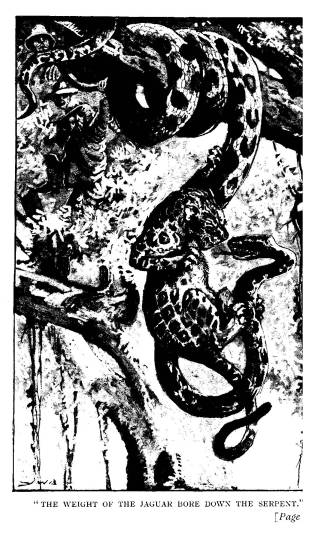
For as he was speaking the jaguar seemed to be shot from the bough, to strike the serpent on the side of the head, which it seized just at the thinnest part of the neck, and held on, tearing the while so fiercely with its hind claws that the reptile’s throat was in a few moments all in ribbons, which streamed with blood. The weight of the jaguar, too, bore down the serpent, in spite of its enormous strength, and it appeared as if victory was certain for the quadruped; but even as Rob thought this, and rejoiced at the destruction of so repellent a monster, the serpent’s folds moved rapidly, as if it were writhing its last in agony, and the next instant those who watched the struggle saw that the jaguar, in spite of its activity, was enveloped in the terrible embrace. There was a strange crushing sound, a yell that made Rob’s fingers go toward his ears, and then a rapid movement, and the water was splashed over where they sat.
For the tree was vacant, and beneath it the flood was being churned up in a curious way, which indicated that the struggle was going on beneath the surface. Then a fold of the serpent rose for a moment or two, disappeared, and was followed by the creature’s tail. This latter darted out for an instant, quivered in the air, and then was snatched back, making the water hiss.
During the next five minutes the little party in the tree sat watching the water where they had last seen it disturbed; but it had gradually settled down again, and, for aught they could tell to the contrary, their two enemies had died in each other’s embrace.
But this was not so; for all at once Shaddy uttered an ejaculation, and pointed along the edge of the submerged trees, to where something was moving about in the bright morning’s light.
It was right where the beams of the freshly risen sun gilded the rippling water, sending forth such flashes of light that it was hard to distinguish what it was. But directly after, there, before them, swimming slowly and laboriously, in undulatory motion, was the serpent, which they watched till it passed in among the branches of the submerged trees and disappeared.
“Then the tiger was killed?” cried Rob, excitedly.
“Yes, sir; I thought it was all over with him when the snake made those half hitches about his corpus and I heard his bones crack. Ah! it’s wonderful what power those long sarpentiny creatures have. Why, I’ve known an eel at home, when I was a boy, twist itself up in a regular knot that was as hard and close as could be, and that strong it was astonishing.”
“But surely that serpent can’t live?” said Brazier.
“It’s sartain, sir, that the tiger can’t,” replied the old sailor. “You see, beside his having that nip, he was kept underneath long enough to drown him and all his relations. As to the sarpent—oh yes, he may live. It’s wonderful what a good doctor Nature is. I’ve seen animals so torn about that you’d think they must die, get well by giving themselves a good lick now and then, and twisting up and going to sleep. Savages, too, after being badly wounded, get well at a wonderful rate out here without a doctor. But now let’s see what the river’s doing.”
He bent down and examined the trunk of the tree, and came to the conclusion that the flood was about stationary; and as all danger of its rising seemed to be at an end, Shaddy set to work with his knife, lopping off branches, and cutting boughs to act as poles to lay across and across in the fork of the tree, upon which he laid an abundance of the smaller stuff, and by degrees formed a fairly level platform, upon which he persuaded Brazier and Rob to lie down.
“I’ll keep watch,” he said, “and as soon as you are rested I’ll have my spell below.”
They were so utterly wearied out that they gladly fell in with the old sailor’s plan, and dropped off almost as soon as they had stretched themselves upon the boughs.
Chapter Thirty Three.
Reality or a Dream?
It was evening when Rob awoke, and found the guide waiting as he had left him when he lay down.
“Only gone down about an inch, Mr Rob, sir,” he said. “Feel as if you could do your spell at the watch now?”
“Of course. But, Shaddy, I’m terribly hungry.”
“So am I, sir. To-morrow morning we must see if we can’t do something to catch some fish.”
“Why not to-night?”
Shaddy shook his head, lay down, and in a moment or two was breathing heavily in a deep sleep.
“I can’t watch all night without food,” thought Rob, as he looked round at the waste and wondered how soon the flood would go down. He knew what food there was, and how it would have to be served, and longed for his share; but felt that unless the others were present he could not take his portion, though how he would be able to wait till morning was more than he felt able to tell.
He looked up at the puma, to see that it had carefully lodged itself on the upper fork, and was asleep. So was Mr Brazier. Only he was awake and hungry. Yes, Brazier was, too, for he woke about then with a start, to question Rob about the advance of time, and their position; ending, as he heard that the flood had hardly sunk at all, by saying that they would be compelled to watch fasting that night, so as to make the provisions last longer.
Rob gave him an agonised look, and, plucking a twig, began to pick off the leaves to chew them.
“I don’t feel as if I could wait till to-morrow,” he said faintly.
“It is a case of must,” said Brazier. “Come, try a little fortitude, my lad.”
“But a little fortitude will not do,” said Rob drily. “It seems to me that we shall want so much of it.”
“You know our position, Rob. There, lad; let’s be trustful, and try and hope. We may not have to wait longer than to-morrow for the subsiding of the flood.”
How that night passed neither of them knew, but at last the sun rose to show that the waters, which had seemed to be alive with preying creatures, had sunk so that they could not be above four feet in depth; and just as they had concluded that this was the case Shaddy sprang up, and sat staring at them.
“Why!—what?—Have I slept all night?” he cried. “Oh, Mr Rob!”
“We both felt that you must have rest, Naylor,” said Brazier quietly.
“That’s very good of you, sir; but you should have been fairer to yourselves. Did you—?”
He stopped short.
“Hear anything in the night?” asked Rob.
“Well, no, sir, I was going to say something else, only I was ’most ashamed.”
“Never mind: say it,” said Brazier.
“I was going to ask if you had left me a little scrap of the prog.”
Rob looked at him sharply and then at Brazier, who did the same, but neither of them replied; and the old sailor put his own interpretation upon their silence.
“All right, gentlemen,” he said; “you must have both been terrible hungry. Don’t say anything about it. Now, how could I manage to catch a fish?”
“After breakfast, Shaddy, please,” said Rob merrily. “Mr Brazier thought we ought to wait for you.”
“What! You don’t mean to say you haven’t had any?”
“When three people are situated as we are, Naylor, a fair division of the food is necessary. Get it at once.”
“Well!” ejaculated the old sailor, as he took down the packet from where he had secured it in the upper branches; and again, as he placed it on the loose platform, “Well!” Then—“There, gentlemen, I can’t tell you how thankful I am to you for being such true comrades. But there, let’s eat now. The famine’s over, and I mean to have some more food soon.”
“How, Shaddy?” said Rob, with his mouth full; “you can’t wade because of the reptiles, and the piranas would attack you.”
“No, sir, I can’t wade unless I could make stilts, and I can’t do that. It will be a climb for fruit, like the monkeys, for luncheon if the water doesn’t go down.”
To the despair of all, the day passed on till it was getting late in the afternoon, and still the water spread around them right into the forest; but it was literally alive with fish which they could not see their way to catch.
Rob and Shaddy set to work making a fishing-line. A piece of the toughest wood they could find was fashioned into a tiny skewer sharpened at both ends and thrust into a piece of fruit taken from high up the tree, where Rob climbed, but soon had to come back on account of the puma following him.
Then they angled, with plenty of shoals swimming about the tree, as they could see from the movement of the muddy water; but so sure as a fish took the bait there was a short struggle, and either the line broke or the apology for a hook gave way, till first one and then the other gave up in sheer despair, and sat looking disconsolate, till Shaddy’s countenance expanded into a broad grin.
“I don’t see anything to laugh at,” said Rob. “Here we have only a few scraps to save for to-morrow, and you treat it all as if it were a matter of no consequence.”
“Warn’t laughing at that, Mr Rob. I was only thinking of the fox and the grapes, for I had just said to myself the fish ain’t worth ketching, just as the fox said the grapes were sour.”
“But unless the waters go down ours is a very serious position,” said Brazier.
“Very, sir. And as to that bit of food, strikes me that it will be good for nothing soon; so I say let’s wait till last thing to-night, and then finish it.”
“And what about to-morrow?” said Rob gloomily.
“Let to-morrow take care of itself, sir. Plenty of things may happen to-morrow. May be quite dry. If not, we must kill the puma and eat it.”
“What!” cried Rob in horror.
“Better than killing one of ourselves, sir,” said the man grimly. “We must have something to eat, and we can’t live on wood and water.”
The result was that they finished the last scrap of food after Shaddy had spent the evening vainly looking out for the carcass of some drowned animal. Then night came once more, and all lay down to sleep, but only to have a disturbed night through the uneasy wanderings of the hungry puma, which kept climbing from branch to branch uttering a low, muttering cry. Sometimes it curled up beside Rob and seemed to sleep, but it soon rose again and crawled down the most pendent branch till it could thrust its muzzle close to the surface of the water and quench its thirst.
“We shall have to shove it off to swim ashore,” said Shaddy the next morning.
“Why?” cried Rob. “The fish and alligators would attack it.”
“Can’t help it, sir,” replied the old sailor. “Better eat him than he should eat us.”
“Why, you don’t think—” began Rob.
“Yes, I do, sir. Wild beasts of his kind eat enough at one meal to last ’em a long time; but when they get hungry they grow very savage, and he may turn upon us at any time now.”
Rob looked at the puma anxiously, and approached it later on in the day, to find the animal more gentle than ever; though it snarled and ruffled up the hair of its back and neck whenever there was the slightest advance made by either of the others.
That day passed slowly by—hot, dreamy, and with the water keeping exactly to the same depth, so that they were hopelessly prisoned still on their tree. They tried again to capture a fish, but in vain; and once more the night fell, with the sounds made by bird, insect, and reptile more weird and strange to them than ever.
Rob dropped asleep from time to time, to dream of rich banquets and delicious fruits, but woke to hear the croaking and whistling of the different creatures of the forest, and sit up on the pile of boughs listening to the splash of the various creatures in the water, till day broke, to find them all gaunt, wild-eyed, and despairing.
“We must try and wade to shore, and chance the creatures in the water,” said Brazier hoarsely, for, on account of his weakness, he seemed to suffer more than the others. “Where’s shore, sir?” said Shaddy gruffly. “Well, the nearest point, then.”
“There ain’t no nearest point, sir,” said the man. “Even if we could escape the things swarming in the muddy water, we could not wade through the forest. It’s bad enough when it’s hard; now it’s all water no man could get through the trees. Besides, the land may be a hundred miles away.”
“What can we do, then?” cried Rob in desperation. “Only one thing, sir: wait till the water goes down.”
“But we may be dead before then—dead of this terrible torture of hunger.”
“Please God not, sir,” said the old sailor piously: and they sat or lay now in their terrible and yet beautiful prison.
From time to time Shaddy reached out from a convenient branch, and dipped one of Rob’s vessels full of the thick water, and when it had been allowed to settle they quenched their burning thirst; but the pangs of hunger only increased and a deadly weakness began to attack their limbs, making the least movement painful.
For the most part those hours of their imprisonment grew dreamy and strange to Rob, who slept a good deal; but he was roused up by one incident. The puma had grown more and more uneasy, walking about the tree wherever it could get the boughs to bear it, till all at once, after lying as if asleep, it suddenly rose up, leaped from bough to bough, till it was by the forest, where they saw it gather itself up and spring away, evidently trying to reach the extreme boughs of the next tree; but it fell with a tremendous splash into the water, and the growth between prevented them from seeing what followed.
Rob uttered a sigh, for it was as if they had been forsaken by a friend; and Shaddy muttered something about “ought not to have let it go.”
They seemed to be very near the end. Then there was a strange, misty, dreamy time, from which Rob was awakened by Shaddy shaking his shoulder. “Rouse up, my lad,” he said huskily. “No, no: let me sleep,” sighed Rob. “Don’t—don’t!”
“Rouse up, boy, I tell ye,” cried the old sailor fiercely. “Here’s help coming, or I’m dreaming and off my head. Now; sit up and listen. What’s that?”
Rob struggled feebly into a sitting position, and fancied he could hear a sound. There was moonshine on the smooth water, and the trees cast a thick shade; but he closed his eyes again, and began to lower himself down to drop into the sleep from which there would be no waking here on earth.
“Ask—Mr Brazier—to look,” he muttered feebly, and closed his heavy eyes.
“No, no: you,” cried Shaddy, who was kneeling beside him. “He’s asleep, like. He can’t move. Rouse up, lad, for the sake of home and all you love. I’m nearly beat out, but your young ears can listen yet, and your eyes see. There’s help coming, I tell you.”
“Help?” cried Rob, making a snatch at his companion’s arm.
“Yes, or else I’m dreaming it, boy. I’m off my head, and it’s all ’mazed and thick. That’s right, listen. Hold up by me. Now, then, what’s that black speck away yonder, like a bit o’ cloud? and what’s that noise?”
“Oars,” said Rob huskily, as he gave a kind of gasp.
“What?”
“Oars—and—a boat,” cried the boy, his words coming with a strange catching of the breath.
“Hurray! It is—it is,” cried Shaddy; and collecting all his remaining strength, he uttered a hoarse hail, which was supplemented by a faint harsh cry from Rob, as he fell back senseless in their rough nest of boughs in the fork of that prison tree.
Chapter Thirty Four.
All for the Best.
Shaddy had preceded him, and neither of them heard the regular beat of oars and the faint splashing of water as four rowers, urged on by one in the stern, forced their way toward the spot from whence the hail had come, till the boat went crashing among the drooping boughs, was secured to the huge trunk, and after water and a little sopped bread had been administered, the three sufferers were carefully lowered down and laid under the shed-like awning.
Three weary days of delirium ensued before the first of the sufferers unclosed his eyes, illumined by the light of reason, and had the bright semicircle of light facing him eclipsed for the moment by a slight figure which crept in beneath the awning to give him food.
And then two more days elapsed before Rob could say feebly,—
“Tell me, Joe, have I been asleep and dreaming?”
“I hope so,” said the young Italian, pressing his hand.
“Then you are not dead?”
“Do I look like it? No; but I thought you were. Why, Rob, old chap, we only got back to you just in time.”
“But I thought—we thought that—”
Rob ceased speaking, and Giovanni, who looked brown, strong, and well, finished his companion’s sentence after turning to where the two famine-pinched feeble men lay listening for an explanation of the events of the past.
“You thought I had been drowned, and that the men had carried off the boat while you were all looking for me?”
Rob’s eyes said, “Yes,” as plainly as eyes could speak. “Of course you would,” said Joe, laughing merrily. “You couldn’t help thinking so; but I wasn’t drowned, and the men didn’t steal the boat. What say, Shaddy?”
For there was a husky whisper from where the old sailor lay—a ghost of his former self.
“Say?” whispered the guide sourly,—“that we can see all that.”
“Tell us how it was,” said Rob, holding out his hand, which Joe grasped and held, but he did not speak for a few minutes on account of a choking sensation in his breast as the sun glanced in through the ends of the awning, after streaming down like a silver shower through the leaves of the huge tree beneath which the boat was moored, while the swift river, once more back within its bounds, rippled and sang, and played against the sides.
“The men told me,” said Joe at last, with a slight Italian accent in the words, now that he was moved by his emotion—“they told me all about what horror and agony you showed as you all went off to rescue me, while there I was perched up in the branches of the great tree, expecting every moment that it would be rolled over by the river, unless I could creep up to the next bough and the next, all wet and muddy as they were, and I knew that I could not keep on long at that. But all at once, to my horror, we began to glide down—oh, so swiftly, but even then I felt hopeful, for the tree did not turn, and I was far above the water as we went on swifter and swifter, till all at once I caught sight of the boat, moored some distance onward, with the four men in it sitting with their backs to me. I made up my mind to leap into the water and swim to them, but the next minute I knew that it would be impossible, and that the branches would stop me, entangle me, and that I should be drowned. Then the tree began to go faster and drift out toward the middle, but it was caught by an eddy and swept in again toward the shore, so that I felt I should be carried near to the boat, and I shouted to them then to throw me a rope.”
“No good to try and throw a rope,” growled Shaddy faintly.
“Go on, my lad,” whispered Brazier, for Joe had stopped.
“They saw me for the first time, and gave a shout, but they all stood up directly, horrified, for the fierce stream now bore me swiftly on right down upon them, and before we could all realise it the boughs were under and over the boat, and it was carried away from where it was moored. And there it was just beneath me, with the boughs going more and more over and under it, and our speed increasing till I began to wonder whether we should roll right over and force it down, or the lower boughs lift and raise it right up. Then there was another thing to consider—whether I ought to try and drop down into the boat, or they ought to climb up to me.”
“Ah!” ejaculated Rob, heaving a long sigh and then breathing hard.
“And all this time,” continued Joe, “we were being swept down the stream at a tremendous rate, too frightened to do anything, making up our mind one way one minute, altering it the next; while, to my great delight, the tree kept in just the same position, which, I have since supposed, must have been because the roots were so laden with earth and stones that it served as a balance to the boughs.
“We went on down like this for hours, expecting every minute would be our last, for so sure as the tree touched bottom or side it must have been rolled over by the swift current, but the water was so deep that we kept on, and, at last gaining courage, I lowered myself a little and got upon another bough, which was very near to the boat, and there I stood upright.
“‘Shall I jump?’ I said, and they stood up ready to catch me, but I hesitated for a few moments before making a spring, which would take me through some thin twigs between us.
“In my hurry and excitement, I jumped with all my force, but caught one foot against a little branch, and was jerked forward so violently into the boat that in their efforts to save me they made her give a great lurch, and she began to rock violently, and nearly sent two of them overboard. The next minute we saw that she had been driven clear of the boughs which held her and was floating away, but at the same moment the branches above us began to descend slowly, for the tree was rolling over, the buoyancy of the boat wedged in among the branches having kept it stationary so long.
“Our position was now terribly dangerous, for the size and force of the boughs were sufficient, with the impetus they now had from being in motion, to drive us right under, an accident which meant death if we could not escape, but in their desperation the men seized the oars, and by pushing against the tree thrust the boat so far toward the clear water that we were only brushed by the outer twigs and thinnest parts as we were caught by the swift stream and went on down at a tremendous rate.
“It was not until night was drawing near that we thought of making fast to a tree at the side where we could rest for the time and then start back in the morning to reach you again as soon as we possibly could, for I knew you would be fancying still that I was dead, and that the men had forsaken you. So we had a meal, and I set the watches, meaning to see to the men taking their turn. Then, feeling tired out, I lay down for a few minutes to rest, but—I dropped asleep.”
“’Course you did,” said Shaddy sourly.
“And when I awoke in a fright the sun was shining, the men were all asleep at the bottom of the boat, and we were spinning down the river as hard as we could go.”
“Sarved you all right if you’d been upset,” growled Shaddy. “That would have woke some of you up.”
“Don’t scold me, Shaddy,” said the lad humbly. “I know I ought not to have gone to sleep, but I thought I could trust the men.”
“Thought you could trust them?” cried the old sailor. “Why, you couldn’t even trust yourself!”
“No,” said Joe humbly.
“Why, Mr Brazier, the pains I’ve took to make a seaman of that young chap, no one knows. I only wonder as they weren’t all wrecked and drowned,” protested Shaddy.
“Let him go on, Naylor.”
“Ay, go on, Mr Jovanni. If there’s anything more you ought to be ashamed on, speak it out and get it over. You’ll be better after.”
“Isn’t he hard upon me, Rob?” said Joe, smiling.
“Yes, but it all turned out for the best,” said his companion.
“I didn’t think so then,” continued Joe, “when I began to find that we must have been gliding down the river fast all that night, and what I had begun to find out then I knew more and more as we tried to work our way back. We couldn’t pole because the water was too deep, and we had to work our way along by the trees, sometimes getting a little way up the river and then making a slip and being swept down again for far enough, till I gave it up in despair. The men worked till they could work no longer. And all the time you were left alone without the guns and fishing tackle and food, and it used to make me mad to have to use any of the stores; so I made them fish all I could, and I did a little shooting, so that we didn’t use much.”
“Oh, come,” said Shaddy in a more agreeable tone, “that’s the best thing we’ve heard you say yet, Mr Jovanni. That’s where my teaching comes out, but don’t you never say a word to me again about your seamanship!”
“But you are keeping him from telling us how he came and saved us just as he did in the nick of time, Shaddy,” said Rob.
“All right, sir, all right! won’t say another word,” cried the old sailor querulously, “only don’t let him get bragging no more about his seamanship and management of a crew.”
“I never will, Shaddy, and I hope I shall never be placed in such a predicament again.”
“How did you manage to get up the river?” asked Rob.
“Oh, that was easy enough as soon as the flood came; we should never have got to you without; but as soon as the land was all flooded, I found that we could get right away from the swift stream and keep along at a distance, poling generally. Then we were able to take short cuts across the bends. We did get caught now and then and swept back a bit, but every day we made a good many miles, and at last as we were rowing steadily on over the flooded land, which is a good deal more open below, we neared the opening, and thought it was a good deal altered; but the men said I was wrong. I felt sure that I was right, and had just come to the conclusion that you must all have been swept away and drowned, when I heard the hail, and you are all safe once more.”
Chapter Thirty Five.
Peace in the Forest.
The three sufferers had no illness to fight against, and began to regain their normal strength very rapidly, while nature was hiding the destruction wrought upon the face of the land at a rapid rate. Tropical showers washed the mud left by the flood from leaf and twig, and the lower boughs, which had been stripped of leaves by the rushing waters, put forth new ones, so that in a very few days’ time not many traces of the flood were visible, save where banks had crumbled in and great gaps of broken earth stood out.
Fully equipped once more, Brazier, as he regained his strength, went on adding to his collection of choice plants, which had come back to him intact; and as they dropped on and on down the river, finding clearings at pretty frequent intervals, greater and greater grew the natural stores of botanical treasures, so that the collector was more than satisfied with Shaddy’s guiding.
“But what I want to know is how we are to get back,” Rob said over and over again. “We shall never be able to pull the boat up again.”
Shaddy chuckled.
“Might have another big storm and a flood, Mr Rob,” he said, “and get back as Mr Jovanni did.”
“But you don’t mean to go back that way?”
“Right, sir! I don’t. But you go on with your fishing and shooting, and let Mr Brazier do his vegetables up in his baskets. Leave the rest to me.”
The task was left to him, and they went on down the river day after day till one evening they rounded a bend, and, in obedience to their leader’s orders, the boat was rowed into a narrow stream which joined that which they had left, the junction being plainly marked by the distinct colour of the waters.
“Going up this, Naylor?” asked Brazier wonderingly.
“Yes, sir. It’s the place I’ve been making for, and I’m thinking you’ll find something quite fresh along here, for it leads up into higher ground on and on into the mountains, where the trees and flowers are quite different.”
“Of course—yes,” said Brazier eagerly. “Let’s go up it.”
“But there’s one thing to be said, sir.”
“What’s that?”
“We shall have to be careful.”
“Is the river dangerous?”
“Tidy, sir; but we can get over that. It’s the Indians.”
“Indians?”
“Yes, sir; some of them may be along the side, but if we are on the watch and take care, being well armed and a fairly strong party, I think they are not likely to interfere with us much.”
Rob pricked up his ears at this as they began gliding up the stream, noting the difference directly, for it was far less powerful, the men having no difficulty at all in forcing the boat along, save here and there where they encountered a rapid, up which they thrust the boat with poles.
“Did you hear what old Shaddy said?” Rob whispered to his companion.
“Yes. We shall have to look out then and have our guns ready.”
“But have the Indians guns?”
“No, spears and blowpipes, through which they send poisoned arrows.”
“Ugh!” ejaculated Rob uneasily.
“Horrid things! Shaddy has often told me about them,” said Joe.
“What has he often told you about, my lad?”
The boys started, for the old sailor had approached them unheard.
“Indians’ blowpipes,” said Joe.
“Ah, yes; they’re not nice things, my lads. Can’t say as I would like to be killed by one of their arrows.”
“Why?” said Rob. “What are they like?”
“Stop a moment, my lad, and I’ll tell you.”
He left them to give some instructions to the men as to the use of their poles, but returned directly.
“Know what we’re doing now?” he said, with one of his dry quaint smiles on his weather-beaten face.
“Yes, going up this river.”
“Right, my lad! But we’re going upstairs like. You’ll see we shall keep on rowing along smooth stretches where the water seems easy; then we shall come to rapids and have to pole on against a swift rush of water, and every time we get to the top of the rapid into smooth water we shall have gone up one of my water steps, and so by degrees get right up into the mountains.”
“Why are we going up into the mountains? Is it to get back to the main river?” said Rob.
“Wait a bit, my lad, and you’ll see. Besides, Mr Brazier’ll get plants up here such as he never saw before. But you were talking about the Indians and their blowpipes. I don’t mind the blowpipes; it’s the arrows.”
“Poisonous?”
“Horrid, my lad. They’re only little bits of things with a tuff of cotton at one end and the wood at the other sharpened into a point, but they dip it into poison, and just before they shoot it out of the blowpipe they hold it nipped between the jaws of one of those little sharp-toothed piranis, then give it a bit of a twirl with their fingers, and the teeth saw it nearly through.”
“What’s the use of that?” asked Rob.
“Makes it so that the arrow breaks off and leaves the point in the wound. Anything don’t live very long with one of those points left in its skin.”
“Think we shall meet any Indians, Shaddy?” said Joe.
“Maybe yes, my lad; maybe no. You never know. They come and go like wild beasts—tigers, lions, and such-like.”
“Do you think my lion will follow us, Shaddy?” said Rob eagerly.
“No, my lad; I don’t. He had a long swim before him to get to shore; and it’s my belief that he would be ’tacked and pulled under before he had gone very far.”
“How horrible!”
“Yes, my lad; seems horrid, but I don’t know. Natur’s very curious. If he was pulled under to be eaten it was only to stop him from pulling other creatures down and eating them. That’s the way matters go on out in these forests where life swarms, and from top to bottom one thing’s killing and eating another. It’s even so with the trees, as I’ve told you: the biggest and strongest kill the weak ’uns, and live upon ’em. It’s all nature’s way, my lads, and a good one.”
“Well, we don’t want the Indians to kill us, Shaddy,” said Rob merrily.
“And they shan’t, my lad, if I can help it. Perhaps we mayn’t see any of them, and one side of the river’s safe, so we shall keep that side; but if they come any of their nonsense with us they must be taught to keep to themselves with a charge or two of small shot. If that don’t teach them to leave respectable people alone they must taste larger shot. I don’t want to come to bullets ’cept as a last resource.”
“I should have liked to have found the puma again,” said Rob after a time.
“Perhaps it’s as well not, my lad,” said their guide. “It was all very well, and he liked you, but some day he’d have grown older, and he’d have turned rusty, and there would have been a fight, and before he was killed you might have been badly clawed. Wild beasts don’t tame very well. You can trust dogs and cats, which are never so happy as when they are with human folk; but I never knew any one who did very well with other things. Ah, here’s another of my steps!”
He went to his men again, for they were rowing along a smooth-gliding reach, at the end of which rough water appeared, and all hands were called into requisition to help the boat up the long stretch of rapids, at the end of which, as they glided into smooth water again, Shaddy declared that they had mounted a good twenty feet.
Day after day was spent in this steady journeying onward. The weather was glorious, and the forest on either side looked as if it had never been trod by man. So full of wonders, too, was it for Brazier, that again and again as night closed in, and they moored on their right to some tree for the men to land and light their fire and cook, he thanked their guide for bringing him, as the first botanist, to a region where every hour he collected treasures.
“And some folk would sneer at the pretty things, and turn away because they weren’t gold, or silver, or precious stones,” muttered Shaddy.
All this time almost imperceptibly they were rising and climbing Shaddy’s water steps, as he had called them. They fished and had success enough to keep their larder well stocked. Birds were shot such as were excellent eating, and twice over Shaddy brought down iguanas, which, though looked upon with distrust by the travellers, were welcomed by the boatmen, who were loud in their praise.
It was a dream-like existence, and wonderfully restful to the lads who had passed through so many troubles, while the boat presented an appearance, with its load of drying specimens, strongly suggestive of there being very little room for more.
Chapter Thirty Six.
War.
They had literally climbed a long rapid one morning, and entered a broad reach of the river which resembled a lake in its extent. The water here was smooth, and had a current that was barely perceptible, hence their progress was swift, and as they were rowing round a bend the question arose where they should halt for the midday rest, when suddenly an ejaculation escaped from their guide’s lips, and the men ceased pulling, leaving the boat to drift slowly on over the glowing mirror-like surface, which was as if of polished steel.
“What is it, Shaddy?” cried Rob quickly. “Are we going wrong?” But as he spoke he caught sight of the reason for the sudden stoppage, for there right in front, ashore and in canoes, were about twenty Indians, standing up and apparently watching them in speechless astonishment.
“Indians!” cried Rob.
“Yes, my lad, and we’ve done pretty well to come all these hundreds of miles without hitting upon them before. Don’t hurry, Mr Brazier, sir, and don’t let them think that we mind ’em, but lay the guns ready, and the ammunition, so that we can give them as good as they send, and mind, if it comes to fighting, every one’s to lie down in the boat and keep under cover.”
“Perhaps there will be no trouble,” said Brazier quietly. “They seem to be peaceable enough.”
“Yes, sir, seem to be; but you can’t trust ’em.”
Just then the Indians ceased staring at the party in the boat, and went on with the pursuit in which they were engaged as the boat swept round the bend. This was shooting at some object in the water, apparently for practice, but in a peculiar way, for the lads saw the men take aim high up in the air, so that their arrows turned far on high and fell with lightning-like rapidity upon certain shiny spots just flush with the surface of the water; and while Rob was wondering the guide whispered,—
“Shooting turtles! They’re wonderful clever at it. If they fired straight, the arrows would start off. This way they come down, go through the rough hide, and kill the turtle.”
Of this they had proof again and again as they rowed slowly on, their course taking them close to one canoe whose owner had gone off from near the shore to recover a turtle that he had shot.
This Shaddy tried to obtain, offering something by way of barter, but the man bent down to his paddle with a face full of mistrust, and forced his light vessel toward where his companions had gathered to watch the strangers.
“I don’t like that,” muttered Shaddy in Rob’s hearing, and at the same moment Joe whispered,—
“They don’t mean to be friends, and we shall have to look out.”
As he spoke he stretched out his hand for his gun, and began to examine it carefully, a proceeding that was imitated by the others, but in a quiet unostentatious way, so as not to take the attention of the Indians.
A few moments’ counsel ended in a determination not to try again to make advances, by no means to halt for the midday rest, but to keep steadily on without paying any heed to the Indians, who followed slowly as the oars were plied, and at a respectful distance.
“How far does this smooth water go, Naylor?” asked Brazier.
“Six or seven miles, sir.”
“And is there a long rapid at the end?”
“Yes, sir, as long as any we have passed.”
“Where they could take us at a disadvantage?”
“Yes, sir,” said Shaddy, grimly indeed. “If it’s to come to a fight, we had better have it out here in the open, where we can shelter ourselves in the boat.”
“Then you think it will come to an encounter?”
“I’m afraid so, sir, if you must have the truth.”
“What about your men?”
“Oh, they’ll fight for their lives if they’re driven to it, sir; but the worst of it is, these sort of fellows fight in a cowardly way, either with poisoned arrows or by shooting their arrows up straight in the air so that they come down upon you when you least expect it and can’t shelter against them.”
“A false alarm!” cried Rob joyously, for the Indians had all ceased paddling, and after a minute or two, as if by one consent, turned the heads of their canoes to the shore and went straight away, disappearing at last amongst the trees which overhung the river bank.
Shaddy made no reply to the speaker, but, the way being clear, bade his men to row steadily on for another half-hour, when a halt was called, and refreshments served round in the boat, but with orders for them to be hastily eaten.
After this the rowing was resumed till the afternoon was far advanced, and the end of the lake-like reach was still apparently far-away. The broad expanse had for a long time past been entirely free from all signs of the Indians, and Rob was congratulating himself upon their escape, when Joe pointed straight back along the broad river-lake to where a canoe suddenly shot round a corner; then another came into view, and another, and another, till there were between thirty and forty visible, each bearing four or five men, and a chill of horror shot through Rob as he felt that this must mean war, and that they would be helpless in the extreme if so large a body of men made a determined attack.
“I was afraid of that,” said Shaddy quietly, “Strange as they can’t leave us alone.”
“What do you propose doing, Naylor?” said Mr Brazier eagerly.
“There ain’t no proposing, sir. It’s all driving to do what is for the best. We must face ’em.”
“Why not land and try and find shelter in the woods?”
“Because, sir, they’d destroy our boat and follow us and shoot us down like so many wild beasts. Our only hope is to keep on as long as we can, and if the chance comes take to the rapid and get on it. They mightn’t care about venturing in their light boats. But we shall see.”
There was a very stern look in Brazier’s countenance, a look that seemed to have been reflected from that of the old sailor, as weapons were once more examined.
“I don’t like fighting, boys,” he said, “but if we are driven to it, we must defend our lives.”
Then turning to Shaddy, “Can’t you depend upon your men to help us, Naylor?” he said.
“I’m going to depend upon ’em to row, sir,” said the old sailor sternly. “We can kill quite enough people without their help. They’re the engines, sir, to take us out of danger, while we keep the enemy at a distance.”
Meanwhile the boat was being steadily propelled toward the end of the lake-like enlargement of the river, where a few low hills rose, showing where the rapids would be which they had to surmount; but it soon became evident that the light canoes would be alongside before the exit from the lake could be reached, and Rob said so.
“Yes, sir, you’re quite right, unless we can scare them off,” said the guide, who had been busy making a rough barricade in the stern by piling boxes and barrels one upon another, leaving openings through which they could fire, saying, “It isn’t strength we want so much as shelter to baulk their aim, for they’re terribly clever with their bows and arrows, Mr Rob, sir.”
But very little was said in those anxious minutes, with the little party, after their many struggles with nature, now called upon to prepare to face man in his savage form.
“Feel frightened, Joe?” whispered Rob as the two boys lay together by a couple of loopholes, well sheltered beneath the awning.
“Shall you laugh at me if I say yes?”
“Not likely, when I own to it too. I say, I wish they’d leave us alone.”
“Look here, Mr Brazier, sir,” said the old sailor just then, after admonishing his men to pull their best, “I’m going to ask you to let me manage this.”
“No,” said Brazier sternly; “I wish to avoid all the bloodshed possible.”
“So do I, sir—specially ours,” said Shaddy drily; “and mine would be the way.”
“Quick, then: explain,” said Brazier, as the boys listened eagerly. “Make haste, for the enemy are very near.”
“Soon done,” said Shaddy, “only what I proposed, sir: you folk keep me supplied with guns, and I’ll try ’em with gentle measures first, and rough ones after. I’m a tidy shot, eh, Mr Jovanni?”
“Yes, excellent,” said the lad.
“Very well, then, you shall try to stop them,” replied Brazier, “but I warn you that if I am not satisfied I shall take the lead myself.”
“All right, sir, but don’t you make the mistake of giving up and trusting these people! That means death for all of us. They must be beaten off.”
There was something very startling in Shaddy’s tones as he uttered these words, and Brazier looked at him wonderingly.
“We shall have to come back this way, so why not retreat at once with the stream?”
“Because we don’t come back this way, sir; that’s all. Didn’t the lads tell you? I’m going to take you into the big river another way.”
“I say, look out!” cried Rob excitedly, as he saw the water flashing behind at the rapid dip of the Indians’ paddles and noticed the stolid look in the heavy round faces of the men astern, who sat ready with their bows and arrows, the spears of the paddlers projecting from the front.
Almost directly after the intentions of the Indians were shown not to be peaceful, for a straggling flight of arrows came whistling through the air, several of the missiles falling just astern, some in front, but for the most part striking the boat and sticking in the awning and the shelter made astern.
“Any one hurt?” shouted Shaddy sternly, and receiving an answer in the negative, he muttered as he thrust the double gun he held through an opening,—
“That’s because they’re on the move and we’re on the move. If we’d been standing still, and them too, every shot would have told. Look out; they’re going to fire again. My turn first. Pull, my lads; don’t you mind me.”
As the words left his lips he fired at intervals of about a quarter of a minute both barrels of the fowling-piece; and at the flash of fire, followed by smoke curling up slowly and hiding the boat, the Indians stopped paddling and sat watching.
“That has beaten them off,” cried Rob eagerly. “Was it blank cartridge, Shaddy?”
“Yes, my lad. Next’s going to be number six if they come on after us.”
The men pulled hard and increased the distance between them and the canoes rapidly, while the travellers’ hopes grew high. But all of a sudden there was a yell, paddles splashed again, and satisfied of the harmlessness of the fire and smoke, the Indians took up the pursuit again.
“Oh, very well, if you will be hurt,” said Shaddy, “it’s your fault, not mine,” and he thrust the barrels once more through the opening in the barrier of boxes.
“How long will it take us to reach the next rapid, Naylor?” asked Brazier excitedly.
“Half ’hour, sir, but we must beat ’em off before we can land, or they’ll stick us so full of arrows, we shall look like hedgehogs. Hi! sit and lie close, every one. Look out! Arrows!”
But the flight was not discharged until the Indians had gained a good deal more ground. Then the whistling was heard, accompanied or followed by sharp raps, but again, in answer to Shaddy’s inquiry, there came a cheery “No!”
“Now then,” he said, “let’s see what they say to us, sir, and how far the charge will scatter and carry.”
As he spoke he took careful aim a little to his right and fired quite low, changed the position of his piece, and fired again a little to his left.
The smoke hung so heavily for a minute or two that there was quite a screen between them, beyond which shouts, savage yells, and cries of pain could be heard, while upon rowing beyond the smoke and into full view of the fleet of canoes the fugitives could see that the paddling had again ceased, and men were standing up gesticulating, while others were evidently in great pain from the stinging shots.
“Now you know that we can bite as well as bark,” growled Shaddy, “and if you’ll all take my advice you’ll go back home and leave us alone, because if you don’t I shall use buckshot, and some of you mayn’t be able to handle a paddle again.”
The babble of voices sounded strange as the oars dipped fast, and for a time they were allowed to pursue their way in peace, but at last it was seen that the wounded had all been transferred to certain of the canoes, and with a fierce yell the Indians came on again, with paddles beating, and the water splashing; while another flight of arrows whistled about the travellers, fortunately without hurting a soul.
“I shall have to give them a stronger dose this time,” said Shaddy. “I’ll try swan shot first,” and inserting a couple of cartridges loaded with heavy pellets, he took careful aim, and fired twice.
This time there were loud shrieks mingled with the fierce, defiant cries, and as the smoke was left behind it was plain to see that there was consternation in the little fleet, and for some time they did not pursue.
“What are you two about?” said Shaddy suddenly as he caught sight of Rob and Joe making some preparation.
“Wait a minute, and you’ll see,” said Rob, and he went on with his task, which was the preparation of something in the fashion of a torpedo, for about a pound of powder had been transferred from their keg to a small tin canister, in whose lid they drove a hole, and passed through it a slow match, made by rubbing a strip of rag with moistened gunpowder, which dried up at once in the hot evening sunshine. At the bottom of the canister a charge of shot had been placed, and upon trying it in a bucket the tin floated with about an inch of its top out of water.
“Now,” said Rob when he had finished, Brazier nodding his head in approval—“it’s quite calm, and when the enemy comes on again I’m going to stick a wax match in the hole with the end touching the slow match, set light to it, and let it float down towards the Indians. The wax match will burn nearly a minute, and I want them to paddle up round it to see what the floating light means, and then if we’re in luck it will go off bang and give them a startler.”
“And suppose it goes off while you are lighting it, and gives you a startler, and sends us all to the bottom, how then?”
“Oh, we must risk that,” said Rob coolly.
“I’m willing, if Mr Brazier is,” said the old sailor quietly.
“Rob will be careful,” said Brazier, and they waited with the contrivance ready, but all hoping that Shaddy’s last shots had produced the desired effect.
It was a vain hope, for once more the canoes tore on to make up for lost ground, and at last, when Brazier and Shaddy made ready to fire at the enemy, Rob gave the word for the men to cease rowing, and as the boat steadied he told Joe to light a match and lowered the canister into the water.
“Be careful, Rob,” cried Mr Brazier. “See that there is no powder loose.”
“Be quick, my lad, or they’ll be on to us.”
Crack! went the match, and as it blazed up it was applied to one stuck upright in the top of the canister. This blazed in turn, and the flame flickered a little and threatened to go out as the nearly submerged tin glided away with the stream; but directly after the flame burned up steadily, and as Rob gave the word to row once more the dangerous contrivance was left behind. A minute later they had the satisfaction of seeing the canoes gather round the tiny light and their occupants cease rowing as they sat evidently wondering what was the meaning of the fire burning in the midst of the water—a perfect novelty to them.
“No go!” said Shaddy suddenly. “Match has gone out.”
“Burned out,” said Brazier.
“All the same, sir, and hasn’t started the touch-rag. Wish it had answered, because it was clever and would have given the beggars a good lesson not to meddle with respectable people. Here, we shall have to fire, sir. They’re coming on again.”
But they were not, for the whole fleet was gathered about the canister, which, unseen by the occupants of the boat, was emitting a sputtering little fire as the touch-rag burned slowly; and the wonder of this going on from a round, silvery-looking object just above the surface of the water kept the ignorant enemy at a respectable distance.
“Pull, my lads,” shouted Shaddy. “We may get into a better place if we reach the next rapid.”
As he spoke there was a deafening roar, a column of water rose in the air, and a dull concussion struck the boat, while a cloud of smoke hung over the group of canoes, and, lifting, showed half of them to be swamped, and dozens of the Indians swimming about trying to reach the boats which floated still.
As far as the little party could make out, no one had been hurt, but the consternation was terrible. No further efforts were made in pursuit, and for the next half-hour the boat was rowed on and reached the rapid before the enemy was seen again.
“Now then,” said Brazier, as the rough, swift water of the river was once more reached, “shall we wait to give them another lesson or go on?”
“Go on,” said Shaddy firmly. “They may not follow us up now. Mind, I only hope that; but we shall see.”
Chapter Thirty Seven.
The Last Days.
Food was served out, the men drank eagerly of the water passed to them, and poling, wading, and tracking with a rope, the boat began to ascend the rapid, while the long lake-like reach was left behind, a turn or two completely hiding the enemy from sight; and though twice over they heard their shouts and yells, the scare created by the explosion had been sufficient to make them give the party what Shaddy called “a wide berth.”
“How far have we to go up this river?” asked Brazier as the men toiled on, wading and tracking in a part that was one furious torrent, which threatened to swamp the boat.
“Ah, that’s what I can’t tell you, sir,” answered the old sailor. “I’ve only got notions, you see.”
“Notions, man?”
“Yes, sir: that if we go right up to the head of this stream we can make a portage somewhere, and strike another, which will lead us down east, and so hit the Paraguay again.”
Rob laughed, and the man gave him an inquiring look.
“Make a portage,” he said, “and strike this stream and hit that? Not very plain English, Shaddy.”
“Then I don’t know what is,” growled the old sailor, who held up his hand and listened for a few moments. “Thought I heard ’em coming up after us,” he said. “Strikes me, Mr Rob, that you’d better have another of them powder tins ready, so that we could contrive to let it off and startle ’em, if they come nigh. We’ve plenty of powder, and it’s better than shooting the poor wretches, who don’t know any better. They’re used to seeing one thing kill another, and I suppose they think they ought to do the same, and we can’t teach ’em any better.”
It was rapidly getting dark now, but they reached the top of the torrent, passing again into comparatively smooth water, along which the boat was rowed for some distance before a suitable spot was found for the night’s shelter—a night full of anxiety, during which careful watch was kept.
But day broke without there being any sign of the enemy, and as soon as a hurried meal had been despatched, at which they had to dispense with freshly made bread and tea, the men, too, with their maté, a new start was made, and another rapid ascended, after which for many miles the river wound, with plenty of deep water, through valley after valley.
All this time they were on the alert for pursuing Indians, but by degrees they were able to feel confidently that they had journeyed beyond the territory occupied by the inimical people, and Brazier began his collecting once more, and the boys their fishing and shooting.
“It’s absurd, Rob,” said Brazier one evening, when the crisp cool air told that they must during the past week have attained to far above the dense forest regions. “I could have filled this boat a dozen times over.”
“Yes,” said Rob, peering hard at the stacks of dried and half-dried plants around them; “but you have got a great many.”
“A mere nothing, boy, as compared to what there is about us! Why, up here we are surrounded by quite a different growth of flowers and plants.”
“And the birds are different, too, and the insects, and fish, specially the latter,” said Rob drily.
“Indeed? I did not notice anything about the fish.”
“Good reason why,” said Rob, laughing merrily: “there haven’t been any to notice.”
Two days after, when they were in quite a desolate region, where the trees and shrubs were thin and poor, Shaddy came to Mr Brazier to announce that he and two of the men were going to leave them camped for a few hours, while they sought out the most likely course for their portage.
“But surely it will be impossible to work the boat along overland,” said Brazier. “We shall have to go back.”
“To meet the Indians, sir? No, that wouldn’t do. Perhaps I’m wrong, but we’re up here now where several streams begin, and if we can only find one, no matter how small, that flows to the east, we’re all right.”
The men set off the next morning as soon as it was light, and the party in camp shot, collected, kept up the fire, and waited impatiently for the return of the little expedition, but waited in vain; and at last in alarm Rob and Joe set off in search of them, tramping till midday and stopping to rest by a fount which bubbled out of the earth and flowed away. After resting a while they started again to tramp here and there for hours in the beautiful region near the camp, to which they returned without having seen a sign of those they sought.
It must have been toward morning that Rob, who was keeping watch, heard distant voices, and hailing, to his great delight heard an answer.
Ten minutes later the guide and his two companions staggered up to the fire utterly exhausted, for they had finished their supply of food, and were worn-out with their exhausting tramp.
“Well,” said Mr Brazier, after the men had taken a good long rest, “have you found the river to which we are to take the boat?”
“No, sir. I’m all wrong, and we shall have to go back. There isn’t a stream runs toward the east anywhere near here.”
“That there is,” cried Joe, “for we found one yesterday.”
“Eh? What? Where?” cried Shaddy, springing up, utterly forgetful of his weariness; and following the two lads, who warned him that the water was of no use for a boat, the fount was reached, and, after a very brief examination, Shaddy cried,—
“There, I’m growing old and worn-out. You two lads found directly what we three men, used to the country, couldn’t see.”
“But this place is of no use!” cried Rob.
“What?”
“There are only a few inches of water.”
“Well, they’ll help carry the boat, won’t they? and the water flows our way.”
“But you can’t get the boat along.”
“Eh? Eight of us, and not get that boat half a mile downhill? Wait a bit, my lad, and you’ll see.”
The lads did see, for after three or four days’ arduous labour expended in getting the boat up a long slope, she was guided into a great groove in the mountain side pieces of wood placed beneath her, and from that hour it was not a question of dragging, but of holding back the vessel, till the stream was struck far below its source.
Here there was no smooth water to float her, but still, as Shaddy said, enough to help lift her over the shallows, with here and there a good stretch of deep channel, along which they floated merrily before there was any need for fresh toil.
At the end of a couple of days several tiny streams had increased the body of water, and soon after they had rapids to descend, while at the end of another day so many had been the additions that the little river had grown to be of respectable size.
It was all steady descent now till a lake was reached, across which an outlet was found leading exactly in the right direction, Shaddy declared. The river proved to be fairly smooth and deep, so that the work grew very light, and the only one on board who bemoaned their fate was Brazier, who had to pass endless specimens which he could not have for want of room.
“If I’m right in my calculations, Mr Rob, sir,” said the old sailor one morning, after many days’ journey, “we shall hit the big river before to-night, and not very far from the falls.”
“What falls?” asked Rob.
“The great cat’ract which comes down a big gorge, which hasn’t been explored yet, and which we might as well try if Mr Brazier thinks good, for I should say there’s a deal to be seen in a land like that, where no man has been as I’ve ever heered on.”
“I’ll ask Mr Brazier, and hear what he says,” said Rob. But the naturalist thought they had done enough for one trip.
The guide was right, for as evening drew near a peculiar dull, heavy roar came to them on the wind, and this increased till it was felt to be prudent to moor the boat for the night. The next morning the roar which had been in their ears all night increased, and long before noon they had glided imperceptibly into the great river, which here rushed along so impetuously that much care was necessary in the navigation of their overladen craft.
But the weather was calm, and the guide’s knowledge of the management of a boat as near perfection as could be, so that in due course, after three or four more halts, they rowed one day close up among the shipping lying off the city from which they had started, and here, while waiting for an opportunity to take passage, with the great packages of plants they had prepared, they found time to make short expeditions up the river, one of which was to the mouth of the swift stream which swept off west through the great veil of trees, and from which they had struck out north and made quite a circuit through an unknown land.
A month later Brazier and Rob were once more on board Captain Ossolo’s great orange schooner, which, deeply laden as it was, found room for the specimens collected amidst so much peril and care.
The hours and days flew swiftly now amid rest and ease, use making them pay little heed to the constant ether-like odour of the orange cargo. Then, after checks on sandbanks and hindrances from pamperos, Buenos Ayres was touched at, then Monte Video, with its busy port.
Here there was a long halt before a passage could be taken east, and Rob and Brazier had plenty of opportunity for studying the slaughter of cattle, salting of hides, and to visit the home of the biscacho, that troublesome burrower of the pampas and layer of traps for unwary horsemen.
At last the vessel by which they were to return was loaded up, and good-bye said to the worthy Italians, father and son, the former being warm in his thanks for the care taken of his boy.
“What,” cried old Shaddy as he stood on the deck of the great vessel the day they were to sail, “good-bye? Not a bit of it, Mr Rob, sir! All being well, if you and Mr Brazier don’t run out to try and find a way up the gorge where the great falls rush down, I’m coming over to the old country to see you. But there, you’ll be out our way again soon.”
“What did Naylor say?” asked Brazier that evening.
“That he could take us to fresh places where you would find plants more worthy of your notice than those you found.”
“Ah! Yes,” said Brazier thoughtfully as he watched the fading shore. “I should like to go again in spite of all we suffered. As for you, Rob, I suppose you would not care to go again?”
“Not care to go again!” cried Rob; and his eyes grew dim as he half closed them and recalled to memory the great rivers, the glorious trees, and the many wonders of those untrodden lands. “I could go back now,” he said, “and face all the fight again;” but even as the words left his lips other memories came floating through his brain, and from that hour his thoughts were directed eastward to his kindred and his native land.
The End.
| Chapter 1 | | Chapter 2 | | Chapter 3 | | Chapter 4 | | Chapter 5 | | Chapter 6 | | Chapter 7 | | Chapter 8 | | Chapter 9 | | Chapter 10 | | Chapter 11 | | Chapter 12 | | Chapter 13 | | Chapter 14 | | Chapter 15 | | Chapter 16 | | Chapter 17 | | Chapter 18 | | Chapter 19 | | Chapter 20 | | Chapter 21 | | Chapter 22 | | Chapter 23 | | Chapter 24 | | Chapter 25 | | Chapter 26 | | Chapter 27 | | Chapter 28 | | Chapter 29 | | Chapter 30 | | Chapter 31 | | Chapter 32 | | Chapter 33 | | Chapter 34 | | Chapter 35 | | Chapter 36 | | Chapter 37 |