"Rob Harlow's Adventures" (continued 4)
Reading edition
The next minute Rob had decided what to do.
Creeping silently astern, he unfastened and paid out a good deal of the line which held the boat to the grapnel. Then refastening it, he went silently forward, and began to haul upon the other line, which was secured to the tree ashore, thus bringing the boat’s head close up to the bank and within half a dozen yards of the puma, which stood watching him till the boat touched the bank, when, without hesitation or fear of consequences, Rob stepped ashore.
“Fine chance for him if he does mean to eat me!” thought Rob, with a laugh. But the next moment he did feel startled, for the animal suddenly crouched, gathered its hind legs beneath it, and he could see them working as the agile creature prepared to spring.
Rob’s heart beat heavily, and a cry rose to his lips, but was not uttered, for he felt paralysed, and he would have proved to be an unresisting victim had the puma’s intentions been inimical. But the lad soon knew that they were friendly, for the great bound the creature gave landed it at his feet, where it immediately rolled over on to its side, then turned upon its back, and with touches soft as those of a kitten pulled at the boy’s legs and feet, looking playfully up at him the while.
“Why, you are a tame one,” said Rob, with a sigh of relief. “There’s no danger in you whatever,” and sinking on one knee, he patted and rubbed the great soft head which was gently moved about in his hand.
So satisfactory was this to the puma that it rolled itself about on the ground, pressed its head against Rob’s knee, and finally turned over once more, couched, laid its head against him, and gazed up in his eyes as he placed his hand upon the soft browny-grey head.
“Well, there’s no mistake about this,” said Rob aloud; “you and I are good friends, and you must be a tame one. The thing is, where is your master?”
Rob had hardly uttered the word “tame” before the puma’s eyes dilated, and it uttered a low, deep growl, staring fiercely the while at the boat.
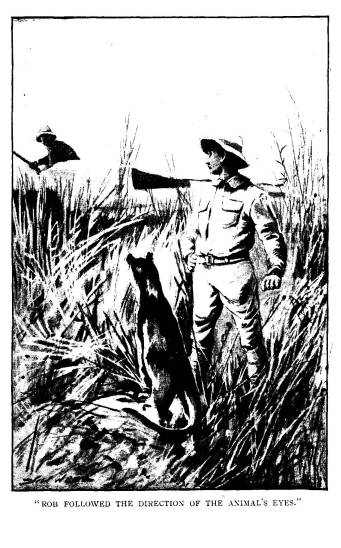
Rob followed the direction of the animal’s eyes, and saw that it was watching Brazier, who had just stepped out from the canvas cabin, holding a gun in his hand.
“Don’t! don’t do that!” cried Rob excitedly. “It’s quite tame, Mr Brazier. Look!”
He was about to bend down and caress the puma again; but as he turned it was only to see its soft, tawny skin and outstretched tail as it made one bound into the thick, low growth of bush and feathery grass, and it was gone.
“Why, Rob,” cried his leader, “how could you be so foolish as to go near that savage beast?”
“But it isn’t savage,” said the lad eagerly; “it’s as tame as any cat. It must belong to some one near.”
By this time Shaddy had heard the talking and risen, rather apologetic for sleeping so long, and as soon as he had called up his men and sent them ashore to see to the fire the case was laid before him.
“Nay, Master Rob,” he said, “there’s no one about here to tame lions. It’s a wild one sure enough. Dessay he never saw a man or boy before, and he’s a young one perhaps, and a bit kittenish. Wants to make friends.”
“Friends with a dangerous beast like that, man?” cried Brazier. “Absurd!”
“Oh, they’re not dangerous, sir; that is, not to man. I never heard of a lion touching a man unless the man had shot at and hurt him. Then they’ll fight savagely for their lives. Dangerous to monkeys, or dogs, or deer; but I’m not surprised at its taking to Master Rob here, and don’t see no call to fear.”
“Well, of course your experience is greater than mine, Naylor,” said Brazier; “but I should have thought that at any moment the beast might turn and rend him.”
“No, sir; no, sir; no fear of that! I daresay the crittur would follow him anywhere and be as friendly as a cat. The Indians never take any notice of lions. It’s the tigers they’re a bit scared about. Lions hate tigers too; and I’ve known ’em fight till they were both dying.”
“Ah well, we need not discuss the matter, for the puma has gone.”
“Thought you were going to shoot at it again, sir,” said Rob in rather an ill-used tone, for he was disappointed at the sudden interruption to his friendly intercourse with the beautiful beast.
By this time Giovanni was out of the boat, and stared rather at the account of the morning’s adventure; but the announcement soon after that the coffee was boiling changed the conversation, and for the time being the puma was forgotten.
The great natural clearing at the edge of the lake and the opening out of the river itself gave so much opportunity for Brazier to prosecute his collecting that he at once decided upon staying in the neighbourhood—certainly for that day, if not for one or two more, and in consequence the fire was left smouldering, while the boat was forced along close in shore, which was no easy task, on account of the dense growth of lilies.
The heat was great, but forgotten in the excitement of collecting, and, with the help of his young companions, Brazier kept on making additions to his specimens, while Rob’s great regret was that they were not seeking birds and insects as well.
“Seems such a pity,” he confided to Joe. “The orchids are very beautiful when they are hanging down from the trees, with their petals looking like the wings of insects and their colour all of such lovely yellows and blues, but we shall only have the dried, bulb-like stems to take back with us, and how do we know that they will ever flower again?”
“If properly dried, a great many of them will,” said Brazier at that moment.
Rob started.
“I didn’t know you were listening, sir,” he said.
“I was not listening, Rob, but you spoke so loudly, I could not help hearing your words. I can quite understand your preference for the brilliant-coloured and metallic-plumaged birds, and also for the lovely insects which we keep seeing, but specimens of most of these have been taken to Europe again and again, while I have already discovered at least four orchids which I am sure are new.”
“But if they do not revive,” said Rob, “we shall have had all our journey for nothing.”
“But they will revive, my boy, you may depend upon that—at least, some of them; and to my mind we shall have done a far greater thing in carrying to England specimens of these gorgeous flowers to live and be perpetuated in our hothouses, than in taking the dried mummies of bird and insect, which, however beautiful, can never by any possibility live again.”
“I didn’t think of that,” said Rob apologetically.
“I suppose not. But there, be content to help me in my collecting; you are getting plenty of adventure, and to my mind, even if we take back nothing, we shall carry with us recollections of natural wonders that will remain imprinted on our brains till the end of our days.”
“He’s quite right,” thought Rob as he sat alone some time after; “but I wish he wouldn’t speak to me as if he were delivering a lecture. Of course I shall help him and work hard, but I do get tired of the flowers. They’re beautiful enough on the trees, but as soon as they are picked they begin to fade and wither away.”
The conversation took place at the end of the lake, just where the river issued in a narrow stream, walled in on either side by the trees as before, and the intention was to cross this exit and go back by the other side, round to the wide clearing where they had passed the previous night.
Plans in unknown waters are more easily made than carried out.
They had halted for a short time at the foot of a majestic tree, one evidently of great age, and draped from where its lower boughs almost touched the water right to the crown with parasitic growth, much of which consisted of the particular family of flowers Brazier had made his expedition to collect.
Here several splendid specimens were cut from a huge drooping bough which was held down by the men while the collector operated with a handy little axe, bringing down as well insects innumerable, many of which were of a stinging nature, and, to the dismay of both boys, first one and then another brilliantly marked snake of some three feet long and exceedingly slender.
These active little tree-climbers set to at once to find a hiding-place, and at once it became the task of all the band to prevent this unsatisfactory proceeding, no one present looking forward with satisfaction to the prospect of having snakes as fellow-travellers, especially poisonous ones. But they were soon hunted out and thrown by means of a stick right away into the water, but not to drown, for they took to it, swimming as actively and well as an eel.
“Why, that last fellow will reach one of those boughs and get back into a tree again,” cried Joe.
“If a fish does not treat him like a worm,” said Rob; and he did not feel at all hopeful about the little reptile’s fate.
But the next minute he had to think of his own.
One minute the boat was being propelled gently through the still waters amongst the great lily leaves; the next they were in sight of the exit, and something appeared to give the boat a sudden jerk.
“Alligator?” asked Rob excitedly.
“Stream!” growled Shaddy, seizing an oar and rowing with all his might just as they were being swept rapidly down the lower river, the trees gliding by them and the men appearing to have no power whatever to check the boat’s way as it glided on faster and faster, leaving the open lake the next minute quite out of sight.
Chapter Sixteen.
In a Tropic Storm.
Rob and Joe looked at each other quite aghast as the boat was literally snatched away out of the boatmen’s control and went tearing down the river. For, beside the alteration in their plans, there was the fire waiting, all glowing embers, that would cook to perfection; there were wild fruits which the two lads had noted from the boat; and there was the puma, whose society Rob felt a strong desire to cultivate.
Then, too, there was something startling in being suddenly robbed of all power to act and being swept at a headlong speed along a rapid, for aught they knew, toward some terrible waterfall, over which they would be hurled. So that it was with no little satisfaction that they saw Shaddy seize the boat-hook and, after urging the crew to do their best to pull the boat toward the trees, stand up in the bows and wait his turn.
The crew worked hard, and kept the boat’s head up stream, and by degrees they contrived to get it closer to the side, while Shaddy made three attempts to catch hold of a branch. In each case the bough snapped off, but at the fourth try the bough bent and held, though so great was the shock that when the hook caught, the strong-armed man was nearly drawn over the bows into the river, and would have been but for one of the boatmen’s help.
It was a sharp tussle for a few moments, and then two of the men caught hold of hanging branches as the boat swung within reach. The next minute a rope was passed round a branch, and the boat was safely moored.
“Mind looking to see whether I’ve got any arms, Mr Rob?” said Shaddy. “Feels as if they were both jerked out of their sockets.”
“Are you hurt much?” asked the boys in a breath.
“Pootty tidy, young gents; but I ain’t going to holler about it. There’s no time. I don’t mind going fast, you know, either in a boat or on horseback, but I do hate for the boat or the horse to take the bit in its teeth and bolt as this did just now.”
“What do you propose doing, Naylor?” said Brazier. “It is impossible to get back, and yet I should have liked a few hours more at that clearing.”
“And them you shall have, sir, somehow. I’m not the man to be beaten by a boat without making a bit of a fight for it first. Let’s get my breath and my arms—ah! they’re coming back now. I can begin to feel ’em a bit.”
He sat rubbing his biceps, laughing at the boys, Brazier looking up and down-stream uneasily the while.
“Do you know exactly where this river runs, Naylor?” he said at last.
“Well, not exactly, sir. I know it goes right through the sort of country you want to see, and that was enough for me; but I’ve a notion that it goes up to the nor’-west, winding and twisting about till it runs in one spot pootty nigh to the big river we left, so that we can perhaps go up some side stream, drag the boat across a portage, and launch her for our back journey over the same ground or water as we came up.”
“But we shall never get back to the lake,” said Rob, as he glanced at the running stream which glided rapidly by, making the boat drag at its tethering rope as if at any moment it would snatch itself free.
“Never’s a long time, Mr Rob. We’ll see.”
He turned to his men, gave them a few instructions in a low tone of voice, and three seated themselves on the port side, while Shaddy and the fourth, a herculean fellow with muscles which bulged out like huge ropes from his bronzed arms, stood in the bows, the latter with the boat-hook and Shaddy with the rope.
“Praps you young gentlemen wouldn’t mind putting a hand to the branches when you get a chance,” said Shaddy; “every pound of help gives us a pound of strength.”
Then, renewing his orders, he seized the light rope, hauled upon it, the man beside him making good use of his hook, and between them they dragged the boat a few feet and made fast the rope, hauled again, cast off the rope, and made fast again—all helping wherever a bough could be caught.
And so they slowly fought their way back against the gigantic strength of the rapid stream, but not without risks. Rob was hauling away at a bough with all his might, when it suddenly snapped, and he would have gone overboard had not Joe thrown himself upon him and held on just as he was toppling down without power to recover his balance.
“That was near,” said Rob as he gazed on the young Italian’s ghastly face. “I say, don’t look scared like that.”
Joe shuddered and resumed his work, while Rob put a little less energy into his next movements for a few minutes, but forgot his escape directly after, and worked away with the rest.
It was toil which required constant effort, and they won their way upward very slowly. Twice over they lost ground by the giving way of the branch to which the rope had been attached, and once the boat-hook slipped from the Indian’s hand and floated down-stream past the boat, the heavy iron end causing it to keep nearly upright. For a few moments it disappeared, but came gently to the surface again just as it was passing the stern, when the boys gave a ringing cheer, for, leaning out as far as he could, Brazier secured it and passed it back to the man.
Of minor troubles there were plenty. At one moment they would be covered with insects which were rudely shaken from the boughs; at another some branch beneath which they were passing would threaten to sweep the canvas cabin out of the boat; and once it was Joe, whose flannel was caught by a snaggy end and hung there with the boat passing from under him till a chorus of cries made the stalwart boatman cease his efforts and look back at the mischief he was causing as he hauled.
But, in spite of all difficulties, the boat was slowly drawn over the ground lost in the wild race downward, till at last the lake was reached, and a few sturdy efforts sufficed to drag it once more into still water.
“Once is enough for a job like that, Master Rob,” said Shaddy, as he wiped his dripping brow with the back of his hand.
“It was hard work,” replied Rob.
“Ay, ’twas; and if you wouldn’t mind saying you were so hungry you didn’t know what to do, it would be doing us all a kindness, and make Mr Brazier think about meat instead of vegetables.”
He gave his head a nod sidewise at Brazier’s back, for as the men rested under the shade of a tree the naturalist was busy hauling down some lovely clusters of blossoms from overhead.
“You mean you want some dinner, Shaddy?”
“That’s it, sir. This here engine will soon stop working if you don’t put on more coal.”
“I’ll give him a hint,” said Rob, laughing; and he did, the result being that Brazier gave the word for the men to row right across toward the clearing—a task they eagerly commenced in spite of the heat and the sturdy effort required to force a way through the dense covering of broad green leaves. They had the river to cross on their way, and as the clear stream was neared a long way above its exit from the lake the men, as if moved by one impulse, ceased rowing, and paused to take their breath before making a sturdy effort to cross it without losing ground.
It was a necessary precaution, for the moment the bows of the boat issued from among the dense growth the stem was pressed heavily downward, and the opposite side of the stream was reached after quite a sharp fight. Then the long, steady pull was commenced again, and, with the leaves brushing against the side, they forced their way onward till the clearing came in view.
The faint curl of bluish smoke encouraged the men to fresh efforts, all thinking of broiled deer meat and a fragrant cup of coffee, both of which afforded grateful refreshment soon after they touched the shore.
“Will it be safe to attempt to continue our journey down that part of the river?” Brazier asked as they were seated afterward in the shade.
“Oh yes, sir, safe enough,” replied Shaddy.
“But suppose we have to come back the same way?”
“Well, sir, we can do it, only it will take time.”
“You will not mind, Mr Brazier?” said Joe, smiling.
“Indeed I shall, for the work is terrible. Why did you say that?”
“Because you will have such a chance to collect, sir. I saw hundreds of beautiful blossoms which I thought you would like to get, and you could gather them while the men rested.”
“Ay, to be sure, sir. Don’t you mind about that river being swift! Only wants contriving, and for you to know what’s coming, so as to be prepared. Now I know what to expect, I can manage. I shall just set two of the fellows to pull gently, and go down starn first, and always sit there ready with the boat-hook to hitch on to a tree if we are going too fast. You trust me, sir, spite of all that’s gone before, and I’ll do my best for you and the young gents till your journey’s done, though I don’t see any coming back this way.”
“Of course I shall trust you,” said Brazier. “What’s the matter?”
“Trust me now then, sir,” cried Shaddy, who had leaped up, and was looking sharply round. “Get aboard, all of you. Now, boys!” he roared to his men, and he pointed to the sky.
Shaddy’s orders were obeyed, and though there seemed to be no reason for the preparations made, the guide was so confident of the coming of a heavy storm that the waterproof sheet brought for such an emergency was quickly drawn over the canvas roof of their little cabin and made fast; the boat was moored head and stern close up to the bank and beneath a huge, sheltering tree, the balers were laid ready for use in the fore-part and the stern; and when this was all done, and the greatest care taken to keep powder and bedding dry, Brazier turned and looked at Shaddy.
“Well,” he said, “is not this a false alarm?”
“No, sir; there’s a storm coming. We shall have it soon. Good job we’d got the cooking done.”
“But I can’t see a cloud,” said Rob.
“Don’t matter,” replied Joe, who was also looking keenly round. “I’ve seen the heavy rain come streaming down when the sky has been quite clear, and the water has felt quite warm. Look at those fellows; they know the storm’s coming, or they would not do that.”
He pointed toward the boatmen, who were throwing a tarpaulin across the bows, ready for them to creep under as soon as the rain came.
“False alarm, boys!” said Brazier.
Shaddy overheard him, and wrinkled up his face in a curious grin as he looked hard at Rob. It was as much as to say, “All right! Just you wait a bit and see who’s right and who’s wrong.”
“My word, how hot!” cried Rob the next minute, for the sun appeared to be shining down through a kind of transparent haze so dense that it acted like a burning glass.
“Yes, this is fierce,” said Joe, drawing back into the shade afforded by the great tree.
“It would give one sunstroke, wouldn’t it, if we stopped in the full blaze?”
“I suppose so. But I say, Shaddy’s right. We are going to have a storm.”
“How do you know?”
“By the sun gleaming out like that.”
“Oh, I don’t think that’s anything,” said Rob. “Here, let’s get up into this tree and collect some orchids for Mr Brazier.”
He looked up into the large forest monarch as he spoke—a tree which on three sides was wonderfully laden with great drooping boughs. Consequent upon its position at the western corner of the clearing where the boat was moored, the boughs formed a magnificent shelter for their boat down almost to the water, while on the side of the opening they pretty well touched the ground.
But Rob paid little heed to this, his attention being taken up by the fact that, though there was perfect silence, the tree was alive with birds and monkeys, which were huddled together in groups, as if their instinct had taught them that a terrible convulsion of nature was at hand. As a rule they would have taken flight or scampered about through the branches as soon as human beings had come to the tree, but now, as if aware of some great danger, they were content to share the shelter and run all risks.
“See them, Master Rob?” said Shaddy, with a grin. “No mistake this time! Look out; I daresay there’ll be snakes dropping down there by-and-by, but so long as you don’t touch ’em I don’t s’pose they’ll touch us. Shouldn’t wonder if we get something else.”
Just then Brazier called him to draw his attention to some of the covering, and they heard him say,—
“Don’t see as we can do any more, sir. Things are sure to get wet; you can’t stop it. All we can do is to keep ’em from getting wetter than we can help.”
The sun still shone brilliantly, streaming down, as it were, through the leaves of the great tree like a shower of silver rain, but the silence now was painful, and Rob strained his ears to catch the peculiar modulation of one of the cricket-like insects which were generally so common around. But not one made a sound, and at last, as if troubled by the silence, the boy cried half jeeringly, “All this trouble for nothing! I say, Joe, where’s the storm?”
“Here!” was the reply in a whisper, as all at once out of the clear sky great drops of rain came pattering down, then great splashes; and directly after, with a hissing rush, there were sheets of rushing water streaming through the branches and splashing upon the tarpaulin coverings of the boat.
“I say, I never saw it rain like this before,” cried Rob as he sheltered himself beneath the tarpaulin and canvas. “Will it thunder—”
He was going to say, “too,” but the word remained unspoken, and he shrank back appalled by a blinding flash of vivid blue lightning, which seemed to dash through beneath their shelter and make every face look of a ghastly bluish-grey.
Almost simultaneously there was a deafening peal of thunder, and, as if by an instantaneous change—probably by some icy current of air on high—the moisture-laden atmosphere was darkened by dense mists whirling and looking like foam, clouds of slaty black shut out the sun, and the rain came down in a perfect deluge, streaming through the tree and pouring into the lake with one incessant roaring splash.
One moment beneath the awning it was black as night, the next it was all one dazzling glare, while in peal after peal the mighty thunder came, one clap succeeding another before it had had time to die away in its long metallic reverberations, that sounded as if the thunder rolled away through some vast iron tunnel.
No one attempted to speak, but all crowded together listening awe-stricken to the deafening elemental war, one thought dominating others in their minds, and it was this: “Suppose one of these terrible flashes of lightning strikes the tree!”
Reason and experience said, “Why shelter beneath a tree at a time like this?” but the instinct of self-preservation drove them there to escape the terrible battering of the rain and the rushing wind.
For they had ample knowledge of the state of the lake, though, save in momentary glances, it was invisible beneath the black pall of cloud and rain, for waves came surging in, making the boat rise and fall, while from time to time quite a billow rushed beneath the drooping boughs, which partially broke its force ere it struck against the side of the boat with a heavy slap and sent its crest over the covering and into the unprotected parts.
There was something confusing as well as appalling in the storm, which was gigantic as compared to anything Rob had seen at home, and as he crouched there listening in the brief intervals of the thunder-claps, the rain poured down on the tarpaulin roof with one continuous rush and roar as heavily as if the boat had been backed in beneath some waterfall.
All at once from out of the darkness a curious startling sound was heard, which puzzled both lads for some minutes, till they suddenly recollected that Shaddy had placed tin balers fore and aft, and any doubt as to their being the cause of the peculiar noise was set at rest by Shaddy, who suddenly thrust in his head at the end of a deafening roar and shouted,—
“How are you getting on, gentlemen? Water got in there yet?”
“No, no,” was shouted back, “not yet.”
“That’s right. We’re pumping it out here as quick as we can. Comes in fast enough to most sink us.”
Shaddy then went on working away out in the pelting rain, and a minute later they made out that his chief man was hard at work forward.
And still the rain came down, and the lightning kept on flashing through the dark shelter; while, if there was any change at all in the thunder, it was louder, clearer, and more rapid in following the electric discharge.
“I say, Joe,” whispered Rob at last, with his lips close to his companion’s ear, “how do you feel?”
“Don’t know: so curious—as if tiny pins and needles were running through me. What’s that curious singing noise?”
“That’s just what I want to know. I can feel it all through me, and my ears are as if I had caught a bad cold. Like bells ringing; singing you call it.”
Just then Shaddy’s voice was heard in an interval between two peals of thunder shouting to his men in a tone of voice which indicated that something was wrong, and Brazier thrust out his head from the opening at one end of the awning to ask what was the matter.
“Matter, sir? Why, if we don’t get all hands at the pumps the ship’ll sink.”
“Is it so bad as that? We’ll all come at once.”
“Nay, nay. I’ve got a strong enough crew, only we must use buckets instead of balers.”
“But—”
“Go inside, sir, please, out of the wet, and see to your things being kept dry. I was ’zaggerating, being a bit excited; that’s all. I don’t want you, and I daresay the storm’s nearly over now.”
The sound of dipping water and pouring it over the side went on merrily in the darkness and brilliant light alternately, for, in spite of the guide’s words, there seemed to be no sign of the storm abating, and while the men were busy outside Brazier and the two boys set to work piling the various objects they wished to keep dry upon the barrels which had been utilised for their stores, for the water had invaded the covered-in part of the boat to a serious extent, and threatened more damage every moment.
A few minutes later, though, the efforts of the men began to show, and Shaddy appeared again for one moment, his face being visible in the glare of light, but was hidden the next.
“Getting the water down fast now, sir,” he said. “Hope you haven’t much mischief done.”
“A great many things soaked.”
“That don’t matter, sir, so long as your stores are right. Sun’ll dry everything in an hour or two.”
“But when is it coming, Shaddy?”
“’Fore long, sir.”
They did not see him go, but knew from the sound of his voice the next minute that he was in the fore-part of the boat, ordering his men to take up some of the boards.
Ten minutes later the rain ceased as suddenly as it had begun. There was a vivid flash of lightning, a long pause, and then a deep-toned roar, while all at once the interior of the little cabin became visible, and a little later the sun came out to shine brilliantly on what looked like a lake of thick mist.
“Will one of you young gents unfasten the stern rope?” cried Shaddy, “and we’ll get out from under this dripping tree.”
“All right!” cried Rob, and he turned to throw open the stern end of the awning, while Brazier and Joe went in the other direction to where the men were still baling, but scraping the bottom hard at every scoop of the tins they were using.
The stern end of the canvas was secured by a couple of straps, similar to those used in small tents, and these were so wet that it was not easy to get them out of the buckles, but with a little exertion this was done, and Rob parted the ends like the curtains of a bed, peered out at the dripping foliage, and shut them to again, startled by what he saw.
After a few moments’ hesitation, he was roused to action by a shout from Shaddy.
“Can’t you get it undone, sir?”
“Yes, I think so. Wait a moment,” cried Rob huskily, and opening the canvas curtain once more, he stepped out boldly and faced that which had startled him before, this being nothing less than the puma. For it had either leaped from the shore into the boat or crept out along one of the great horizontal boughs of the tree and then dropped lightly down to take its place right in the stern, where it was sitting up licking its drenched coat as contentedly as some huge cat.
It looked so different in its soaked state that for the moment Rob was disposed to think it another of the occupants of the forest, but his doubts were immediately set aside by the animal ceasing its occupation and giving its head a rub against him as, hardly knowing what to do, the boy unfastened the rope in obedience to orders, set the boat free, and then wished he had not done so till the puma had been driven ashore.
“All right, sir?” shouted Shaddy, who was hidden, like the rest, by the intervening cabin-like structure.
“Yes,” cried Rob, as the puma set up its ears and looked angrily in the direction from which the voices came, while the boat began to glide out through the dripping boughs, and the next minute was steaming in the hot sunshine.
“What shall I do?” thought Rob, who was now in an agony of perplexity, longing to call to his companions and yet in his confusion dreading to utter a word, for the fear was upon him that the moment the puma caught sight of Brazier it would fly at him. And again he mentally asked the question, “What shall I do?”
Meanwhile the puma had continued contentedly enough to lick its coat, sitting up on the narrow thwart at the end once more exactly like a cat, and in such a position that Rob felt how easy it would be to give the creature a sharp thrust and send it overboard, when it would be sure to swim ashore and relieve him of his perplexity.
While he was hesitating, the word “Oh!” was uttered close behind him, and looking sharply round, there was the wondering face of Joe thrust out between the canvas hangings, which he held tightly round his neck, being evidently too much startled to speak or move.
“It came on board, Joe, during the storm,” whispered Rob; “whatever shall we do?”
The lad made no answer for a few moments, and then in a hurried whisper—
“Call Mr Brazier to shoot it.”
This roused Rob.
“What for?” he said angrily; “the poor thing’s as tame as can be. Look!”
He took a step toward the great cat-like creature, and it ceased licking itself and leaned sideways as if to be caressed.
At that moment Joe popped back his head, and Brazier’s voice was heard:—
“They want the grapnel lowered, Rob, my lad. Can you— Why, whatever is this?”
The aspect of the puma changed in an instant. Its ears went down nearly flat upon its head, and it started upon all-fours, tossing its tail about and uttering a menacing growl.
Brazier started back, and Rob knew for what.
“No, no, Mr Brazier,” he cried; “don’t do that. The poor thing came on board during the storm. It’s quite tame. Look here, sir, look.”
As he spoke in quite a fit of desperation, he began patting and soothing the animal, and when Brazier peered out again, in company with a loaded gun, the puma was responding to Rob’s caresses in the most friendly way.
“Anything the matter, sir?” said Shaddy from beyond the cabin. “Can’t you get the grapnel overboard?”
“Come and look here,” whispered Brazier; and their guide crept into the cabin and peered out behind, his face puckering up into a grin.
“What is to be done?” whispered Brazier; “I can’t fire without hitting the boy.”
“Then I wouldn’t fire, sir,” replied Shaddy. “’Sides, there ain’t no need. The thing’s quite a cub, I think, and tame enough. I don’t suppose it’ll show fight if we let it alone.”
“Stop, man! What are you going to do?”
“Go to ’em,” replied Shaddy coolly.
“But it will spring at you. It turned threateningly on me just now.”
“Don’t seem to on Master Rob, sir, and I don’t think it will. What do you say to going first, Mr Jovanni?”
“No,” said the lad shortly. “I don’t like animals.”
“Well, then, here goes,” said Shaddy coolly. “Don’t shoot, sir, unless the crittur turns very savage, and then not till I say, ‘Now!’”
He thrust the two canvas curtains apart quietly and stepped into the little open space astern, when once more the puma’s aspect changed and it turned upon the new-comer menacingly.
“Pat him again, Master Rob,” said Shaddy quietly. “I want to make friends too. Here, old chap,” he continued, sitting down, as Rob hurriedly patted and stroked the animal’s head, “let’s have a look at you. Come, may I pat you too?”
He stretched out his hand, but the puma drew back suspiciously, and, with the others watching the scene, he remained quiet while Rob redoubled his caresses, and the puma began to utter its low, rumbling, purring sound.
“Only wants time, Mr Brazier, sir,” said Shaddy quietly. “I don’t think the brute’s a bit savage. Only thinks we mean mischief and is ready to fight for himself. I could be friends with him in an hour or two. What’s best to be done—get him ashore?”
“Yes, as soon as possible.”
“All right, sir; you go and tell the men to back the boat in to where we landed before.”
The canvas hangings dropped to, and Shaddy sat perfectly still, watching the actions of their strange visitor and talking in a low voice to Rob, while a low creaking began as two of the men forward thrust out their oars and backed water.
Slight as the sound was, that and the motion of the boat startled the animal, which began to look about uneasily, but a touch or two from Rob calmed it directly, and after responding to his caresses it turned to look curiously at Shaddy, taking a step forward and then stopping.
“Well, what do you think of me, puss, eh?” said Shaddy quietly. “I say, Mr Rob, you and I had better keep him and set up as lion-tamers.”
The rough voice had its effect upon the animal, which ceased its purring sound and backed away close to Rob, against whom it stood, and began watching the bank toward which the boat was being thrust.
“How are we to get it ashore?” said Rob at last.
“You want it to go, then?”
“No,” replied Rob, “I don’t. It is so very tame, I should like to keep it, but it does not care for anybody else.”
“Don’t mind me seemingly,” said Shaddy. “Well, the best thing will be for you to jump ashore as soon as we’re close in, and then it strikes me he’ll come after you, and if you kept on petting him he’d follow you anywhere.”
“You think so, Shaddy?”
“Feel sure of it, sir, but it ain’t like a dog. You can’t make a companion of a scratching thing like that.”
“Why not? A dog’s a biting thing,” said Rob shortly.
“Well, yes, sir, but here we are. Better get him ashore. There ain’t room for him aboard here. There might be a row, for he ain’t ready to make friends with everybody.”
Rob stepped on to the gunwale rather unwillingly, for, in a misty way, he was beginning to wonder whether it was possible for him to retain the puma as a companion, though all the time he could see the difficulties in the way.
He leaped ashore, and, as Shaddy had suggested, the puma immediately made a light effortless bound and landed beside him, pressing close up to the lad’s side and rubbing one ear against his hand, while the occupants of the boat looked wonderingly on.
“What am I to do next?” asked Rob. “If I jump back on board, he’ll come too.”
“Safe,” said Shaddy; “and there’s no more room for passengers. Here, stop a moment; I have it.”
“What are you going to do?” said Brazier, who was watching the movements of the puma with anxiety on Rob’s behalf, but with keen interest all the same, as he saw the active creature suddenly throw itself down by the boy’s feet and, playful as a kitten, begin to pat at first one boot and then the other, ending by rubbing its head upon them, watching their owner all the time.
“I’m going to get Mr Rob aboard without that great cat, sir, and this seems best way.”
He drew his knife, raised the tarpaulin, and cut off a good-sized piece of the deer meat; then, bidding the men to take their oars and be ready to row at the first command, he turned to Rob.
“Look here, sir,” he said, “I’ll pitch you the piece of dried meat. You catch it and then carry it a few yards, and let the lion smell it. Give it him behind one of those bushes, and as soon as he is busy eating it dodge round the bush and come aboard. We’ll soon have the boat too far for him to jump.”
He threw the piece of dry meat to the boy, who caught it and walked as directed, the puma following him eagerly and sniffing at the food.
The next minute those in the boat saw Rob disappear behind a clump of low growth, and directly after he reappeared running toward them just as, uneasy at his being out of sight with the fierce creature, Brazier had called upon Giovanni to bring his gun and accompany him ashore.
But Rob’s reappearance of course stopped this, and the next minute he was on board and being rowed away from the shore.
“It seems too bad,” cried Rob, “just as if one was cheating the poor thing. Look, there it is.”
For just then the puma stalked out from behind the bushes and stood tossing its tail and looking round as if in search of Rob, ending by walking quickly down to the edge of the lake and standing there gazing after the boat, which was now being rowed slowly down once more toward the scene of their adventure with the swift current, Brazier having decided to stay one more day at the lower part of the lake before descending the river farther; and the object now in view was the discovery of a fresh halting-place for the night.
Chapter Seventeen.
An International Quarrel.
“What’s the matter, Rob?” said Brazier, as he turned suddenly from where he had been laying various articles of clothing out in the warm sunshine to dry and found the two lads seated together in silence, Rob with his elbows on the side of the boat and his chin in his, hands, gazing back ashore.
“I can’t get a word out of him, sir,” said Joe. “I think it’s because the lion was left behind.”
“Nonsense! Rob is not so childish as to fret after a toy he cannot have. Come, my lad, there is plenty to do. We must make use of the evening sun to get everything possible dry. Come and help. Wet clothes and wet sleeping-places may mean fever.”
Rob looked reproachfully at Joe, and began to hurry himself directly, his movement bringing him in contact with Shaddy, who was dividing his time between keeping a sharp look-out along the shore for a good halting-place suitable for making a fire, giving instructions to his men, and using a sponge with which to sop up every trace of moisture he could find within the boat.
“There, Mr Rob, sir,” he said as he gave the sponge a final squeeze over the side, “I think that’ll about do. It’s an ill wind that blows nobody any good. That storm has done one thing—given the boat a good wash-out—and if we make a big fire to-night and dry everything that got wet, we shall be all the better for it. Don’t see storms like that in England, eh?”
“No,” said Rob shortly, and he took down and began rubbing the moisture from his gun.
“Ah, that’s right, my lad; always come down sharp on the rust, and stop it from going any further. Why, hullo! not going to be ill, are you?”
Rob shook his head.
“You look as dumps as dumps, Mr Rob, sir. I know you’re put out about that great cat being left behind.”
Rob was silent.
“That’s it. Why, never mind that, my lad. You can get plenty of things to tame and pet, if you want ’em, though I say as we eight folks is quite enough in one boat without turning it into a wild beast show.”
Rob went on rubbing the barrel of his gun.
“What do you say to a nice young pet snake, sir?” said Shaddy, with his eyes twinkling, till Rob darted an angry glance at him, when he changed his tone and manner.
“Tell you what, sir, I’ll get one of my boys to climb a tree first time I see an old one with some good holes in. He shall get you a nice young parrot to bring up. You’ll like them; they’re full of tricks, and as tame as can be. Why, one of them would live on the top of the cabin, and climb about in a way as would amoose you for hours.”
Rob darted another angry look at him.
“And do you think I want a parrot to amuse me for hours?” he said bitterly.
“Have a monkey,” said Joe, who had heard the last words. “Shaddy will get you a young one, and you can pet that and teach it to play tricks without any risk to anybody, if you must have a plaything.”
He accompanied this with so taunting a look that it fired Rob’s temper, just at a time when he was bitterly disappointed at the result of his adventure. Joe’s words, too, conveyed the boy’s feeling, which was something akin to jealousy of the new object which took so much of the young Englishman’s thoughts.
Stung then by his companion’s words and look, Rob turned upon him and said sarcastically,—
“Thank you: one monkey’s enough on board at a time.”
The young Italian’s eyes flashed, as, quick as lightning, he took the allusion to mean himself, and he turned sharply away without a word, and went right aft to sit gazing back over the water.
“Well, you’ve been and done it now, Mr Rob, and no mistake,” whispered Shaddy. “You’ve made Master Jovanni’s pot boil over on to the fire, and it ain’t water, but oil.”
“Oh, I am sorry, Shaddy,” said Rob in a low tone, for all his own anger had evaporated the moment he saw the effect of his words on the hot-blooded young Southerner.
“Sorry, lad? I should think you are. Why, if I said such a thing as that to an Italian man, I should think the best thing I could do would be to go and live in old England again, where there would be plenty of policemen to take care of me.”
“But I was not serious.”
“Ay, but you were, my lad, and that’s the worst of it. You said it in a passion on purpose to sting him, and he’s as thin-skinned as a silkworm. He has gone yonder thinking you despise him and consider he’s no better than a monkey, and if you’d set to for six hundred years trying to think out the nastiest thing you could invent to hurt his feelings you couldn’t have hit on a worse.”
“But it was a mere nothing—the thought of the moment, Shaddy,” whispered Rob.
“O’ course it was, dear lad, but, you see, that thought of the moment, as you call it, has put his back up. For long enough now English folk have said nasty things to Italians, comparing ’em to monkeys, because of some of ’em going over to England playing organs and showing a monkey at the end of a string. You see, they’re so proud and easily affronted that such a word feels like a wapps’s sting and worries ’em for days.”
“I’ll go and beg his pardon. I am sorry.”
“Won’t be no good now, sir. Better wait till he has cooled down.”
“I wish I hadn’t said it, Shaddy.”
“Ay, that’s what lots of us feels, sir, sometimes in our lives. I hit a man on the nose aboard a river schooner once, and knocked him through the gangway afterwards into the water, and as soon as I’d done it I wished I hadn’t, but that didn’t make him dry.”
“I wish he had turned round sharply and hit me,” said Rob.
“Ah, it’s a pity he didn’t, isn’t it?” said Shaddy drily. “You wouldn’t have hit him again, of course. You’re just the sort o’ young chap to let a lad hit you, and put your fists in your pockets to keep ’em quiet, and say, ‘Thanky,’ ain’t you?”
“What do you mean—that I should have hit him again?”
“Why, of course I do, and the next moment you two would have been punching and wrestling and knocking one another all over the boat, till Mr Brazier had got hold of one and I’d got hold of the other, and bumped you both down and sat upon you. I don’t know much, but I do know what boys is when they’ve got their monkeys up.”
“Don’t talk about monkeys,” whispered Rob hotly; “I wish there wasn’t a monkey on the face of the earth.”
“Wish again, Mr Rob, sir, as hard as ever you can, and it won’t do a bit o’ good.”
“Don’t talk nonsense, Shaddy,” said Rob angrily.
“That’s right, sir; pitch into me now. Call me something; it’ll do you good. Call me a rhinoceros, if you like. It won’t hurt me. I’ve got a skin just as thick as one of them lovely animals. Go it.”
“I do wish you would talk sense,” cried Rob, in a low, earnest whisper. “You know I’ve no one to go and talk to about anything when I want advice.”
“No, I don’t,” said Shaddy gruffly. “There’s Muster Brazier.”
“Just as if he would want to be bothered when his head’s full of his specimens and he’s thinking about nothing else but classifying and numbering and labelling! He’d laugh, and call it a silly trifle, and tell us to shake hands.”
“Good advice, too, my lad, but not now. Wait a bit.”
“I can’t wait, knowing I’ve upset poor old Joe like that. I want to be friends at once.”
“That’s good talk, my lad, only it won’t work at present.”
“Ah, now you’re talking sensibly and like a friend,” said Rob. “But why will it not do now?”
“’Cause Mr Jovanni ain’t English. He’s nursing that all up, and it isn’t his natur’ to shake hands yet. Give the fire time to burn out, and then try him, my lad; he’ll be a different sort then to deal with.”
Rob was silent for a few minutes.
“That’s good advice, Mr Rob, sir, and so I tell you; but I mustn’t stop here talking. It’ll soon be sundown, and then, you know, it’s dark directly, and ’fore then we must be landed and the lads making a good fire. I wish Mr Brazier would come and give more orders about our halting-place to-night.”
“He’s too busy with his plants, Shaddy; and I ought to be helping him.”
“Then why don’t you go, my lad?”
“How can I, with Joe sitting there looking as if I had offended him for life? I’ll go and shake hands at once.”
“No, you won’t, lad.”
“But I will.”
“He won’t let you.”
“Won’t he?” said Rob firmly. “I’m in the wrong, and I’ll tell him so frankly, and ask him to forgive me.”
“And then he won’t; and, what’s worse, he’ll think you’re afraid of him, because it is his natur’ to.”
“We’ll see,” said Rob; and going round outside the canvas awning by holding on to the iron stretchers and ropes, he reached the spot where Joe sat staring fixedly astern, perfectly conscious of Rob’s presence, but frowning and determined upon a feud.
Rob glanced back, and could see Brazier through the opening in the canvas busily examining his specimens, so as to see if any had grown damp through the rain. Then, feeling that, if he whispered, their conversation would not be heard, Rob began.
“Joe!”
There was no reply.
“Joe, old chap, I’m so sorry.” Still the young Italian gazed over the lake. “I say, Joe, it’s like being alone almost, you here and I out there. We can’t afford to quarrel. Shake hands, old fellow.”
Joe frowned more deeply.
“Oh, come, you shall,” whispered Rob. “I say, here, give me your hand like a man. I was put out about losing the puma, because I was sure I could tame it; and it would have made such a jolly pet to go travelling with. It could have lived on the shore and only been on board when we were going down the river. It put me out, and I said that stupid thing about the monkey.”
Joe started round with his eyes flashing.
“Do you want me to strike you a blow?” he hissed angrily.
“No; I want you to put your fist in mine and to say we’re good friends again. I apologise. I’m very sorry.”
“Keep your apologies. You are a mean coward to call me a name like that. If we were ashore instead of on a boat, I should strike you.”
“No, you wouldn’t,” said Rob sturdily.
“What! you think I am afraid?”
“No; but you would be a coward if you did, because I tell you that I should not hit you again.”
“Because you dare not,” said the young Italian, with a sneer.
Rob flushed up angrily, and his words belied his feelings, which prompted him, to use his own expression, to punch the Italian’s head, for he said,—
“Perhaps I am afraid, but never mind if I am. You and I are not going to quarrel about such a trifle as all this.”
“A trifle? To insult me as you did?”
“Don’t be so touchy, Joe,” cried Rob. “Come, shake hands.”
But the lad folded his arms across his breast, and at that moment there was the sharp report of Brazier’s gun and a heavy splashing in the water among the lily leaves close up to the drooping trees which hid the cause of the turmoil.
There was a little excitement among the men as the boat was rowed close in under the trees, and there, half in the water, lay one of the curious animals known as a water-pig, or carpincho.
A rope was immediately made fast to tow the dead animal to the halting-place to cut up for the evening meal, but before they had rowed far Shaddy shouted to the men to stop.
“That won’t do,” he cried.
“What’s the matter, Shaddy?”
“Matter?” growled the guide; “why, can’t you see, sir? There won’t be a bit left by the time we’ve gone a mile. Look at ’em tearing away at it. Well, I never shall have any sense in my head. To think of me not knowing any better than that!”
He unfastened the rope hanging astern, and hauled the dead animal along the side to the bows of the boat, with fish large and small dashing at it and tugging away by hundreds, making the water boil, as it were, with, their rapid movement.
“Tchah! I’m growing stoopid, I think,” growled Shaddy as he hauled the water-pig in over the bows, the fish hanging on and leaping up at it till it was out of reach; and then their journey was continued till a suitable halting-place was reached, where by a roaring fire objects that required drying were spread out, while the meat was cooked and the coffee made, so that by the time they lay down to rest in the boat there was not much cause for fear of fever.
Chapter Eighteen.
A Catastrophe.
The next morning the sun was drinking up the mists at a wonderful rate when Rob opened his eyes, saw Joe close by him fast asleep, and raised his hand to give him a friendly slap, but he checked himself.
“We’re not friends yet,” he said to himself, with a curious, regretful feeling troubling him; and as he went forward to get one of the men to fill him a bucket of water for his morning bath, for the first time since leaving England he felt dismal and low-spirited.
“Morning, sir!” said Shaddy. “Mr Joe not wakened yet?”
“No.”
“Did you two make friends ’fore you went to sleep?”
“No, Shaddy.”
“Then I lay tuppence it wasn’t your fault. What a pity it was you let your tongue say that about the monkey!”
“Yes, Shaddy,” said Rob as he plunged his head into the pail and had a good cool sluice. “I wish I hadn’t now. It was a great pity.”
“True, sir, it was. You see, there ain’t no room in a boat for quarrelling, and if it came to a fight you’d both go overboard together and be eaten by the fish afore you knew where you were. And that would not be pleasant, would it?”
“Don’t talk nonsense, Shaddy,” said Rob shortly as he plunged his head into the bucket again.
“Certinly not, sir,” replied the man seriously. “You see, I know how it would be as well as can be. ’Talian lads don’t fight like English lads. They can’t hit out straight and honest, but clings and cuddles and wrastles. Soon as ever you began he’d fly at you, and tie his arms and legs about you in knots, and hamper you so that you couldn’t keep your balance, and as there’s no room in the boat, you’d be ketching your toe somewhere, and over you’d go. If I were you, Mr Rob, sir, I wouldn’t fight him.”
“Will you leave off talking all that stupid nonsense, Shaddy?” cried Rob angrily as he began now polishing his head and face with the towel. “Who is going to fight? I suppose you think it’s very clever to keep on with this banter, but I can see through you plainly enough.”
Shaddy chuckled.
“All right, sir; I won’t say no more. Give him time, and don’t notice him, and then I daresay he’ll soon come round.”
“I shall go on just as if nothing had happened,” said Rob quietly. “I apologised and said I was sorry, and when his annoyance has passed off he’ll be friends again. What a glorious morning after the storm!”
“Glorious ain’t nothing to it, sir. Everything’s washed clean, and the air shines with it. Even looks as if the sun had got his face washed, too. See how he flashes.”
“I can feel, Shaddy,” said Rob, with a laugh.
“That’s nothing to what’s coming, my lad. Strikes me, too, that we shall find a little more water in the stream, if Mr Brazier says we’re to go down the river to-day. Hear the birds?”
“Hear them?” cried Rob. “Why, they are ten times as lively to-day.”
“That they are, sir. They’re having a regular feast on the things washed out of their holes by the rain. As for the flowers, Mr Brazier will have no end of beauties to pick. They’ll come out like magic after this rain. He won’t want to go on to-day.”
“Yes, I shall, Naylor,” said Brazier, stepping out from under the awning. “We may as well go on, beautiful as all this is. Ah,” he continued as he gazed round and took a long, deep breath, “what gloriously elastic air! What a paradise! Rob, my lad, there can be nothing fairer on earth.”
“Don’t you be in a hurry, sir!” growled Shaddy. “I’m going to show you places as beat this hollow.”
“Impossible, my man!” said Brazier.
“Well, sir, you wait and see. Bit o’ breakfast before we start?”
“Yes,” said Brazier, and the men just then stirred the fire together, and called from the shore that the water was boiling and the cakes in the embers baked.
The sensation of delicious comparative coolness after the storm as they sat under the trees, and the fragrance borne from myriads of flowering plants was so delightful to the senses that Rob looked with dismay at the idea of leaving the place for the present. The thirsty ground had drunk up the rain, and only a little moisture remained where the sun could not penetrate, while the sky was of a vivid blue, without a speck of cloud to be seen.
But, though Brazier did not notice it, there was a jarring element in the concord of that glorious morning, for the young Italian was heavy and gloomy, and hardly spoke during the alfresco meal.
“What’s that?” said Rob suddenly as there was a slight rustling among the boughs and undergrowth a short distance away.
“Might be anything, sir,” said Shaddy. “Some little animal—monkey praps. It won’t hurt us. Maybe it’s a snake.”
In spite of an effort to seem unconcerned, Rob could not resist the desire to glance at his comrade at the mention of the monkey, and, as he fully expected, even though he could not check it, there was Joe glaring at him fiercely.
Rob dropped his eyes, feeling that Joe fully believed he was doing it to annoy him, and that Shaddy had the same intention.
Meanwhile the sound had ceased, and was forgotten by the time they were all on board once more, the rope which had moored them to a tree being cast off.
“Now, my lads, away with you!” growled Shaddy, and the oars dropped among the lily leaves with a splash, startling quite a shoal of fish on one side and a large reptile on the other, which raised quite a wave as it dashed off with a few powerful strokes of its tail for deeper water.
They were about fifty yards from the shore, when Shaddy suddenly laid his hand upon Rob’s shoulder and pointed back to the place they had just left.
“See that, my lad?”
“No. What?” cried Rob hastily. “Bird? lizard?”
“Nay; look again.”
Rob swept the shore eagerly, and the next moment his eyes lit upon something tawny standing in a shady spot, half hidden by the leaves.
“The puma!” he cried excitedly, and as the words left his lips the animal made one bound into the undergrowth near the trees, and was gone.
“Or another, one, Rob,” said Brazier. “It is hardly likely to be the same. There are plenty about, I suppose, Naylor?”
“Oh yes, sir. Can’t say as they swarm, but they’re pootty plentiful, and as much like each other as peas in a pod.”
“But I feel sure that is the same one,” cried Rob excitedly. “It is following us down the lake.”
“Maybe,” grumbled Shaddy, “but you couldn’t tell at this distance.”
Rob was going to speak again, but he caught sight of Joe’s face, with a peculiar smile thereon, and he held his peace.
An hour later they were drawing close to the mouth of the river, where it quitted the lake, and Shaddy pointed to the shores on either side.
“Look at that,” he said in a low tone. “I ’spected as much.”
“Look at what?” said Rob.
“The trees. Water’s two foot up the trunks, and the river over its banks, lad. We shall go down pootty fast it I don’t look out.”
But he did “look out,” to use his own words, and getting the boat round, he set the four men to back stern foremost into the stream, keeping a long oar over the side to steer by and giving orders to the men to pull gently or hard as he gave instructions, for the river ran like a mill-race. It was swift enough before, but now, thanks to the tremendous amount of water poured into it through the previous night’s storm, its speed seemed to be doubled.
Rob stood close by the steersman, while Joe was beside Mr Brazier, who, after the first minute or two of startled interest in their rapid descent, became absorbed in the beauty of the overhanging plants, and had no eyes for anything else.
“We’re going along at a tidy rate, Master Rob,” said Shaddy.
“Yes; the trees glide by very quickly.”
“Ay, they do, sir,” said the man, who did not take his eyes from the surface of the river before them. “I did mean to make the boys pull so that we could go down gently, but it wouldn’t be much good, and only toil ’em for nothing.”
“There’s no danger, I suppose, Shaddy?”
“No, sir, no, not much, unless we run on a sharp snag or trunk of a tree, or get swept into a corner and capsized.”
“What?” cried Rob.
“Capsized, sir. That would make an end of our expedition. Now, lads,” he shouted to the men, “pull your best.”
He gave his own oar a peculiar twist as the men obeyed, and Rob caught sight of the danger ahead for the first time. It was a huge tree which had been undermined by the water during the past few hours and fallen right out into the stream, its top being over a hundred feet from the shore and showing quite a dense tangle of branches level with the water, to have entered which must have meant wreck.
But Shaddy was too much on the qui vive, and his timely order and careful steering enabled him to float the craft gently by the outermost boughs.
They were going onward again at increased speed, when Brazier shouted,—
“Stop! I must have some of those plants.”
Shaddy did not stir.
“Do you hear, man? Stop! I want to collect some of those epiphytic plants.”
By this time they were nearly a hundred yards past, and Shaddy looked at the enthusiastic collector with a comical expression on his face.
“Always glad to obey orders, sir,” he said drily; “but how can I stop the boat now? Look at the water.”
“But you should have caught hold of one of the boughs, man.”
“When we were fifty yards away, sir?”
“Then pull back to the tree.”
Shaddy smiled again.
“It ain’t to be done, sir, no, not if I’d eight oars going instead of four. There’s no making head against the river now it’s running like this.”
“Then we’ve made a mistake in coming to-day,” cried Brazier anxiously.
“Well, no, sir, because before night we shall have made a big run right into the country you want to see, without tiring my lads, and I want to save them up. But there’s no stopping to-day for collecting.”
“But shall we be able to land somewhere?”
“Hope so, sir. If we can’t we shall have to go on. But you leave it to me, sir, and I’ll do my best. Don’t talk to me now, because I’ve got to steer and look out against an upset, and, as you know, bathing ain’t pleasant in these waters.”
Brazier looked uneasy, and went and sat down in the stern, to become absorbed soon after in the beauty of the scene as they raced down the silvery flashing river, while Joe, who was near him, appeared to be looking at the birds and wondrous butterflies which flapped across from shore to shore, but really seeing nothing but one of a company of monkeys, which, after the fashion of their kind, were trying to keep pace with the boat by bounding and swinging themselves from tree to tree along the shore.
That seemed to the young Italian’s disordered imagination, blurred, as it were, by rankling anger, like the monkey to which his companion had compared him, and his annoyance grew hotter, not only against Rob, but against himself for refusing to shake hands and once more be friends.
Meanwhile Rob stayed in the fore-part of the boat talking to Shaddy, who stood on one of the thwarts, so as to get a better view of the river ahead over the cabin roof, and kept on making an observation to the boy from time to time.
“Easy travelling this, my lad, only a bit too fast.”
“Oh, I don’t know; it’s very delightful,” said Rob.
“Glad you like it, my lad; but I wish Mr Jovanni wouldn’t sit on the starn like that. He ought to know better. Least touch, and over he’d go.”
“Look: what’s that, Shaddy?” cried Rob, pointing to a black-looking animal standing knee-deep in water staring at them as they passed.
Shaddy screwed his eye round for a moment, but did not turn his head.
“Don’t you get taking my ’tention off my work!” he growled. “That’s a—that’s a—well, I shall forget my own name directly!—a what-you-may-call-it—name like a candle.”
“Tapir,” cried Rob.
“That’s him, my lad. Any one would think you had been born on ’Merican rivers. Rum pig-like crittur, with a snout like a little elephant’s trunk, to ketch hold of grass and branches and nick ’em into his mouth. I say—”
“Well, what, Shaddy?” said Rob. The man had stopped to bear hard upon his oar.
“Pull, my lads,” he growled to his men. “Hold tight, every one. I didn’t see it soon enough. Tree trunk!”
Rob seized one of the supports of the cabin roofing and gazed over it at what seemed like a piece of bark just before them, and the next moment there was a smart shock, a tremendous swirl in the water, and a shower of spray poured over them like drops of silver in the bright sunshine, as something black, which Rob took for a denuded branch, waved in the air, and Joe plumped down into the bottom of the boat.
Shaddy chuckled and wiped the water out of his eye.
“I’m thinking so much about trees washed from the bank that I can’t see anything else.”
“But it was only a small tree, Shaddy, and did us no harm.”
“Warn’t a tree at all, lad, only a ’gator fast asleep on the top of the water going west and warming his back in the sun same time.”
“An alligator?”
“Yes, my lad. Didn’t you see what a flap he gave with his tail! But now just look there at Mr Jovanni. I call it rank obstinit. Just as if there was no other place where he could sit but right on the starn! There, you’re friends, and he’ll take it better from you. Go through the cabin and ask him to get off. I don’t want him to go overboard.”
“Neither do I, Shaddy, but we are not friends, and if I ask him he will stop there all the more.”
“Then I must,” said Shaddy. “Hi, Mr Jovanni, sir! Don’t sit there; it ain’t safe.”
“Oh yes, I’m quite safe,” cried the boy sharply. “Never mind me.”
“Hark at him! Don’t mind him! What’ll his father say to me if I go back without him? Pull, lads, pull!”
Shaddy’s order was necessary, for a huge tree—unmistakably a tree this time—lay right across their way just where the river made a sudden bend round to their left.
The better way would have been to have gone to the right, where there was more room, but, the curve of the river being of course on that side greater, there would not have been time to get round before the boat was swept in amongst the branches, so perforce their steersman made for the left.
This took them close in to where the bank should have been, but which was now submerged, and the boat floated close in to the great wall of trees marking the edge of the stream, and so little room was there that, to avoid the floating tree-top, the boat was forced close in shore, where the stream at the bend ran furiously.
“Look out!” roared Shaddy. “Heads down!” and Rob, who had been watching the obstacle in their way, only just had time to duck down as, with a tremendous rushing and crackling sound, they passed right through a mass of pendent boughs which threatened to sweep the boat clear of cabin and crew as well, as the stream urged it on.
The trouble only lasted a few seconds, though, and then they were through and floating swiftly round the inner curve toward an open patch of the shore which rose all clear of water and tree.
“Anybody hurt?” cried Brazier from inside the cabin; “I thought the place was going to be swept away after I had dived in here.”
“No, sir; we’re all right,” cried Rob. “I nearly lost my cap, though, and— Oh! where’s Joe?”
“Eh?” cried Shaddy, looking forward. “Why, he was— gone!”
All faced round to look back just in time to catch an indistinct glimpse of their companion apparently clinging to a bough overhanging the stream; but the next moment the intervening branches hid him from their sight, and a look of horror filled every face.
“Did—did you see him, Shaddy?” panted Rob.
“Thought I did, sir, but couldn’t be sure,” growled Shaddy, and then furiously to his men, “Row—row with all your might!”
The men obeyed, making their oars bend as they tugged away with such effect that they advanced a few yards. But that was all. The current was too sharp, and they lost ground again. Then, in spite of all their efforts, the most they could do was to hold their own for a minute before having to give way, pull in shore, and seize the overhanging boughs to which Shaddy and Brazier now clung to keep the boat from drifting.
“Better land, sir,” cried Shaddy. “We can’t reach him this way.”
“Reach him?” cried Rob piteously, and then to himself, “Oh! Joe, Joe, why didn’t you shake hands?”
Chapter Nineteen.
A Fresh Peril.
Shaddy’s advice was easier to give than to execute. For though by holding on to the boughs they were able to anchor the boat, it proved to be a difficult task to force it in among the submerged stems to the spot where the clear space of elevated ground offered a satisfactory landing-place.
Thanks to the skill of the boatmen, however, a landing was at last achieved, and as soon as Brazier leaped ashore he was followed by Rob and Shaddy, the latter giving his men a few sharp orders before joining the others, who were trying to force their way back along the bank toward where they had last seen their companion.
This was difficult, but possible for a short distance, and they pressed on hopefully, for, consequent upon the sudden turn of the river here forming a loop, they had only to cross this sharp bend on foot, not a quarter of the distance it would have been to row round.
But before they had gone fifty yards the high-and-dry land ended, and Rob, who was, thanks to his activity, first, was about to wade in and continue his way among the submerged roots.
But Shaddy roared at him,—
“No, no, my lad; don’t make matters worse! You mustn’t do that. The things have moved out of the river in here to be away from the rush and to get food. We don’t want you pulled under.”
“But we must go on, Naylor,” cried Brazier in agony.
“It ain’t the way to help him, getting ourselves killed, sir,” retorted Shaddy. “Let’s get more in. Water don’t go far.”
He was quite right, for after about ten minutes’ struggle along the edge they found themselves as nearly as they could guess about opposite to the spot where their unfortunate companion had been swept out of the boat, but about a hundred yards inland and separated from the regular bed of the stream by a dense growth of trees, whose boughs interlaced and stopped all vision in every direction, more especially toward the river.
“You see, we must wade,” cried Rob; and he stepped into the water with a plash, but Shaddy’s strong hand gripped him by the shoulder and drew him back.
“I tell you it’s madness, boy. If he’s alive still you couldn’t reach him that way.”
“If he’s alive!” groaned Rob.
“If he’s alive,” said Shaddy, repeating his words. “Steady a moment! He may be up in one of the boughs, for he’s as active as a monkey in rigging and trees.”
Then, putting his hands to his mouth, he shouted in stentorian tones,—
“Ahoy! ahoy!”
But there was no response, and Rob and Brazier exchanged glances, their faces full of despair.
“Ahoy!” shouted Shaddy once more.
Still no reply, and a cold chill ran through Rob and his eyes grew dim as he thought of the bright, handsome, dark-eyed lad who had been his companion so long, and with whom he had been such friends till the miserable little misunderstanding had thrust them apart.
“It must be farther on,” said Brazier at last, when shout after shout had been sent up without avail.
“Think so, sir?” said Shaddy gloomily. “I thought it was about here, but p’r’aps you’re right. Come on. River made a big twist there, and it’s hard to tell distance shut up half in the dark among the trees. I did hope,” he continued, as he forced his way in among the trees and held boughs aside for them to follow, “that the poor lad had swung himself up and would have made his way like a squirrel from branch to branch till he reached dry land, but it don’t seem to be so. There, sir, we must be ’bout opposite where we saw him. Can’t be no farther. Ahoy! ahoy! ahoy!”
They all listened intently after this, but there was no sound of human voice, only the shrieking of parrots and chattering of monkeys.
Shaddy shouted again, with the result that he startled a flock of birds which were about to settle, but rose again noisily.
They all shouted together then, but there was no response, and feeling that their efforts were useless, they went on a short distance, and tried once more without result.
“He’d have answered if he had been anywhere near, sir,” said Shaddy gloomily. “I’ll go on if you like, but take my word for it he ain’t here.”
Rob looked at both despairingly, but he was obliged to take the guide’s words for those of truth, and, feeling utterly crushed, he slowly followed the others as they began to return, feeling the while that if it had not been for the edge of the water by which they walked it would have been impossible to find their way back through the dense wilderness.
Their guide returned by their outward steps as accurately as he could, but it was not always possible, for in coming out the bushes had been forced on in the same direction and then sprung back together, after the fashion of the withes in a fish-trap, and presenting their points, thorns, and broken stems in a perfect chevaux de frise.
In these cases Shaddy had to select a different path, the exigencies of the way forcing him more inland, and at last, in spite of his experience, he stopped short, looked about him and then upwards, seeking to make out the sky, but it was completely shut off, and they stood in a twilight gloom.
“What’s the matter, Shaddy?” said Rob at last, after looking at the man’s actions wonderingly; but there was no reply.
“For goodness sake, man, don’t say that you have lost your way,” cried Brazier excitedly.
Shaddy still remained silent, and took off his hat to scratch his head.
“Do you hear me, man? Have you lost your way?”
“Don’t see as there’s any way to lose,” growled Shaddy. “I ain’t seen no path. But I have gone a bit wrong.”
“Here, let me—” began Brazier, but Shaddy interrupted him.
“Steady, sir, please! Don’t wherrit me. I shall hit it off directly. You two gents stand just as you are, and don’t move. Don’t even turn round, or else you’ll throw me wrong worse than I am. You see, the place is all alike, and nothing to guide you. One can’t tell which way to turn.”
“But tell me,” said Brazier, “what are you going to do?”
“There’s only one thing to do, sir: find the river, and I’m going to make casts for it. You both stand fast and answer my whistles; then I shall know where you are and can come back and start again. If we don’t act sensible we shall lose ourselves altogether and never get out of it.”
“And then?” said Brazier.
“Oh, never mind about then, sir. I’ve lost my way a bit, and I’m going to find it somehow, only give me time.”
“Which way do you think the river lies?” said Rob gloomily.
“I’m going to try out yonder, sir. You see we’ve turned and doubled so that I can’t tell where we are.”
“But it’s out that way, I’m sure,” said Rob, pointing in the opposite direction.
“Why are you sure, sir?”
Rob shook his head.
“Ah, to be sure, dear lad!” said the guide; “you only think it’s out that way, and I daresay Mr Brazier here thinks it’s out another way.”
“Well, I must confess,” said Brazier, “that I thought the river lay behind us.”
“Yes, sir, that’s it. I’ve been lost before with half a dozen, sir, and every one thought different. One wanted to go one way; one wanted to go another. Fact is, gentlemen, we neither of us know the way. It’s all guesswork. Once lost, there’s nothing to guide you. I can’t recollect this tree or that tree, because they’re all so much alike, and it’s as puzzling as being in the dark. There’s only one way out of it, and that is to do as I say; you stand fast, and I’ll cast about like a dog does after losing the scent till I find the right track. Only mind this: if I don’t have you to guide me back with whistle and shout I shall be lost more and more.”
“You are right, Naylor,” said Brazier; “we leave ourselves in your hands. Go on.”
“Cheer up, Mr Rob, sir; don’t be down-hearted. I shall find the way out of it yet.”
“I was not thinking about myself, Shaddy,” said Rob in a choking voice. “I was thinking about poor Joe.”
“Ah!” said Shaddy in a suppressed voice. Then sharply, “I shall whistle at first, and one of you keep answering. By-and-by I shall shout like this.”
He uttered a peculiarly shrill cry, and they all started, for it was answered from a distance.
“Why, that’s Joe,” cried Rob joyfully. “Ahoy! ahoy!” he cried, and paused to listen.
“Nay, sir, that wasn’t Mr Jovanni, but one of the wild beasts. Sounded to me like one of them little lions. Stop a bit, though; let’s try a shout or two to see if the boys in the boat can hear us now.”
He hailed half a dozen times at intervals, but there was no reply.
“Thought not,” he said. “Only waste of breath. We’ve wandered away farther than I thought, and the trees shuts in sound. Stand fast, gentlemen, till I come back.”
He paused for a few moments, and then forced his way in amongst the trees in a direction which Rob felt to be entirely wrong, but in his despondent state he was too low in spirit to make any opposition, and after marking the spot where Shaddy had disappeared, he turned round suddenly, placed his arm across a huge tree trunk, rested his brow against it, and hid the workings of his face.
“Come, come, Rob, be a man!” cried Brazier, laying his hand upon the lad’s shoulder. “Never despair, my boy, never despair!”
“Joe! Joe!” groaned Rob; “it is so horrible!”
“Not yet. We don’t know that he is lost.”
“He must be, sir, he must be, or he would have answered our hails.”
At that moment there was a shout from out of the forest, and Rob started round as if thinking it might be their young companion, but the cry was not repeated; a shrill whistle came instead.
Brazier answered it with a whistle attached to his knife.
“It was only Shaddy,” groaned Rob. “Mr Brazier, you don’t know,” he continued. “We two had quarrelled, and had not made friends, and now, poor fellow, he is gone.”
“No, I will not believe it yet,” cried Brazier; “for aught we know, he may have escaped. He is too clever and quick a lad not to make a desperate effort to escape. We shall run up against him yet, so cheer up. Ahoy!” he cried in answer to a hail, and followed it up with a whistle.
“Naylor said he should whistle for a time and then hail,” said Brazier, trying to speak cheerfully. “Come, lad, make a brave fight of it. You are getting faint with hunger, and that makes things look at their worst, so rouse up. Now then, answer Naylor’s signal.”
“I can’t, not yet,” said Rob huskily. “I am trying, Mr Brazier, and I will master it all soon.”
Just then the peculiar cry they had first heard rang out again from a distance.
“Was that Joe?” whispered Rob, with a ghastly look. “He must be in peril.”
“No, no; it was a jaguar, I think. There goes Naylor again! Whistle! whistle!”
Rob only gazed at him piteously, and Brazier responded to the signal himself.
“Come, come, Rob,” he whispered, “be a man!”
The lad made a tremendous effort to conquer his weakness, and turned away from the tree with his lips compressed, his eyes half closed, and forehead wrinkled.
“That’s right,” cried Brazier, clapping him on the shoulder. “Who says our English boys are not full of pluck?”
He whistled again in response to a signal from Shaddy, and then they listened and answered in turn for quite half an hour, during which the guide’s whistles and cries came from further and further away, but sounded as if he were at last keeping about the same distance, and working round so as to come back in another direction.
Then for a time all signals ceased, and they heard the cry of the wild beast, followed by quite a chorus of shrieks and chatterings, which ceased as suddenly as they had begun.
“He has gone too far, Mr Brazier,” cried Rob suddenly, a complete change having come over him, for he was once more full of excitement and energy.
“I hope not.”
“But he is not signalling.”
“I’ll try again.”
Brazier raised the little metal whistle to his lips and gave out a shrill, keen, penetrating note.
Then they listened, but there was no answer.
Brazier’s brow wrinkled, and he refrained from looking at Rob as he once more raised the whistle to his lips, to obtain for answer the unmistakable cry of some savage, cat-like creature—jaguar or puma, he could not tell which.
“No guns! no guns!” he muttered; and moving away from Rob, he opened the long, sharp blade of his spring knife, one intended for hunting purposes, and thrust it up his sleeve.
Just then Rob whistled as loudly as he could, and they both listened, when, to their intense relief, there came a reply far to their left.
“Hurrah!” cried the boy excitedly, and then, “Oh, Mr Brazier, what a relief!”
Brazier drew a long, deep breath.
“Whistle again, boy,” he said; but before Rob could obey there was another distant whistle, and on this being answered the signals went on from one to the other for quite half an hour, and at last there was a breaking and crashing noise, and Shaddy came within speaking distance.
“Hear that lion prowling about?” he shouted.
“Yes, several times.”
“Ah, I began to feel as if a gun would be handy. He came too close to be pleasant.”
“What have you found—the river?” cried Brazier.
“No, sir, not yet. I went far enough to be sure it ain’t that way.”
A few minutes later he forced his way to their side, looking hot and exhausted.
“Why didn’t you answer me when I whistled and shouted?” he cried.
“We did, Shaddy, every time we heard you.”
“Nay, my lad, didn’t seem to me as if you did. S’pose the trees kep’ it off at times. But all right, gentlemen, I shall soon hit it off, and we’ll get to the boat, have a good feed, and go to work again. Don’t look down, Mr Rob, sir! How do we know as Mr Jovanni isn’t there already waiting for us?”
Rob shook his head.
“Ah, you don’t know, sir. Seems queer, don’t it, to get so lost! but it ain’t the fust time. I’ve known men go into the forest only a score of yards or so and be completely gone, every step they took carrying ’em farther away and making ’em lose their heads till their mates found ’em.”
“Stop! Which way are you going now?”
“This way,” said Shaddy.
“But that’s back—the way we came.”
Shaddy laughed, and without another word forced his way again in among the trees.
“I give up,” said Brazier in despair. “It is too confusing for ordinary brains. I could have taken an oath that he was wrong.”
He answered a whistle, and they stood waiting till the crackling and rustling made by their guide’s passage ceased.
“I couldn’t have believed that we came so far,” said Rob, breaking the silence.
“I don’t think we did come very far, Rob,” replied Brazier; “it is only that the place is so hopelessly puzzling and intricate. Time is getting on, too. We must not be overtaken by the night.”
Rob could hardly repress a shudder, and, to make the dismal look of the narrow space, darkened by close-clustering trees, more impressive, the peculiar exaggerated cat-like call of the beast they had heard or another of its kind rang out hollowly apparently not very far-away.
Almost simultaneously, though, came Shaddy’s whistle, and this was answered and repeated steadily at some little distance, but at last growing quite faint.
As they were waiting for the next call there was a rustling sound overhead, which took their attention, but for some time nothing but moving leaves could be made out in the subdued light, till all at once Brazier pointed to a spot some fifty feet above them, and at last Rob caught sight of the object which had taken his companion’s attention.
“Looking down and watching us,” he said quickly, as he gazed at the peculiar little dark, old-looking face which was suddenly withdrawn, thrust out again, and finally disappeared.
“There is quite a party of monkeys up there, Rob,” said Brazier; “and the tree-tops are thoroughly alive with birds, but they are silent because we are here. Ahoy!” he shouted as Shaddy now hailed from somewhere nearer, and after a few shouts to and fro they heard him say,—
“Found it!”
A thrill of joy ran through Rob, but it passed away and he felt despondent again as they started to rejoin their guide, for the thoughts of poor Joe were uppermost, and he began thinking of the day when they should go back and join the schooner to announce the terrible accident that had befallen the captain’s son.
But he had to toil hard to get through the trees, and this work took away the power of thinking much of anything but the task in hand. Shaddy, too, had stopped short, waiting for them to come to him, and they had to squeeze themselves between trees, climb over half-rotten trunks, and again and again start aside and try another way as they found themselves disturbing some animal, often enough a serpent.
“’Bliged to stop here, gen’lemen, and mark the direction,” rang on their ears all at once. “You see, one can’t travel in a straight line, and I was afraid of losing my way again.”
“How far is the river away?”
“Not quarter of a mile if you could go straight, my lad, but it’ll be half a mile way we have to twist about. But come along. Once we get to the water’s edge, we’ll soon make the boat.”
He turned, and led on slowly and laboriously, the difficulties increasing at every step, and more than once Rob was about to break down. The last time he took hold of a tree to support himself, and was about to say, “I can go no further,” when, looking up, there was Shaddy pointing down at the water, which had flooded over right in among the trunks.
Rob dropped upon his knees directly, bent down, placed his lips to the water, and drank with avidity, Brazier following his example.
The discovery of a guide which must lead them to the spot where they had left the boat, and the refreshment the river afforded, gave Rob the strength to follow Shaddy manfully along the margin of the flood over twice the ground they had traversed in the morning—for their wanderings had taken them very much further astray than they had believed—and the result was that just at sundown, after being startled several times by the cries of the jaguar or puma close on their left apparently, Shaddy suddenly gave a hoarse cheer, for he had emerged upon the clearing at whose edge the boat was moored.
Chapter Twenty.
A Terrible Surprise.
Shaddy looked sharply round as they crossed the clearing, all three breathing more freely at being once more in the open and without the oppression of being completely shut in by trees on all sides, while the dense foliage overhead completely hid the sky. This was now one glorious suffusion of amber and gold, for the sun was below the horizon, and night close at hand, though, after the gloom of the primeval forest, it seemed to Rob and his companions as if they had just stepped out into the beginning of a glorious day.
“Don’t see no fire,” growled Shaddy. “We’re all horribly down about losing poor Mr Jovanni. But we must have rest and food, or we can’t work. Here, my lads, where are you?” he shouted in the dialect the men best understood.
They were about half-way across the opening in the forest as he shouted to the men, and the river was running like a stream of molten gold; but the boat had been probably moored somewhere among the trees, so as to be safer than in the swift current, for it was not visible.
“D’ye hear, you?” roared Shaddy fiercely, for he was out of temper from weariness with his exertions during the day. “Are you all asleep? There’s going to be about the hottest row over this, Mr Brazier, as ever them lazy half-breed dogs got into. You pay them well to work, and instead of there being a good fire, and cooked meat and fish, and hot cake, and boiling water, they’re all fast asleep in that boat.”