"Rob Harlow's Adventures" (continued 3)
Reading edition
“Do you think we had better go on?” said Brazier.
“Nay, we’ll risk it, sir. Let’s wait till the fire burns up big and strong. We’ll have a roarer to-night, and that’ll scare away most of the trash. Worst of it is, I’m ’fraid it ’tracts the ’gators and fish.”
Chapter Eleven.
An Eventful Night.
“I do like a good fire, Joe,” said Rob, as he gazed at the ruddy flames rushing up.
“Why, you’re not cold?”
“No, I’m hot, and this fire brings in a breeze and makes it cooler—on one side. But what I like in a fire of this kind is that you can burn as much wood as you like, and nobody can say it’s waste, because it’s doing good—clearing the ground for the trees around to grow. I say, look at the birds.”
“After supper,” said Joe, as he watched the actions of the principal boatman, who was head cook, busily preparing the ducks and two good-sized fish which they had caught by trailing a bait behind the boat as they came.
“Yes, I’m hungry,” said Rob. “What’s that?”
“It was Shaddy.”
“What! tumbled in?” said Rob excitedly.
“No; he took hold of a thick piece of branch and threw it into the water. What did you do that for?”
“Scare them ’gators, my lad. There’s a whole school of ’em out there, and I think they mean coming to supper. And fish too,” he added, as there was another splash and then another.
By this time he was close alongside of the boat, under whose tent Mr Brazier was busy by the light of a lanthorn making notes and lists of the flowers and orchid bulbs which he had secured that day.
“Hadn’t we better put out a line, Shaddy? If we caught a fish or two the men would be glad of them in the morning.”
“No, Mr Rob, sir; I don’t suppose they’d bite now, and even if they did, so sure as you hooked one a smiler would get hold of it, and you don’t want another fight of that sort. I’m beginning to think that we’d best get our bit o’ food, and then drop slowly down the river again.”
“What’s that?” said Brazier, looking up from his work. “That will not do, Naylor; we should miss no end of good plants.”
“Well, sir, better do that than get into a row with any of the natives here,” growled Shaddy.
“Why, you said there were no Indians near.”
“Tchah! I mean the other natives—’sects and rept’les and what not. But there, if we put a rope to the end of that largest tree and anchor ourselves yonder I don’t suppose we shall hurt. Eh? All right,” he cried, in answer to a hint from the men; “supper’s ready, gentlemen.”
“And so are we,” said Rob with alacrity; and he leaped off the gunwale on to the tree trunk by whose side it was moored.
To all appearance it was a solid-looking stem of tons in weight, but covered with mosses, creepers, and orchids, which pretty well hid its bark.
Rob’s intention was to run along it to the root end, which stood up close to the fire; but, to his intense astonishment, he crashed through what was a mere outer shell of bark into so much dust and touchwood right up to the armpits, where he stuck, with a hedge of plants half-covering his face.
Joe burst out into a fit of laughing, in which Rob joined as soon as the first startled sensation was over.
“Who’d have thought of that?” he cried. “But, I say, I’m fast. Come and lend me a hand. I thought it was a great solid trunk, and all inside here you can see it looks as if it were on fire. Oh! oh! Ah! Help!”
“What’s the matter?” cried Brazier excitedly, as Shaddy and he stepped cautiously to the boy’s side, Joe having already mounted on the tree trunk. “Not on fire, are you?”
“No, no,” gasped Rob in agonised tones; and, speaking in a frightened whisper, “There’s something alive in here.”
“Nippers o’ some kind, eh?”
“No, no,” cried Rob faintly; “I can feel it moving. Oh! help! It’s a snake.”
As he spoke there was a curious scuffling noise inside, as if something was struggling to extricate itself, and Shaddy lost no time. Bending down, he seized Rob by the chest under the armpits, stooped lower, gave one heave, and lifted him right out; when, following close upon his legs, the head of a great serpent was thrust up, to look threateningly round for a moment. The next, the creature was gliding down through the dense coating of parasitical growth, and before gun could be fetched from the cabin, or weapon raised, the rustling and movement on the side of the trunk had ceased, and Joe in turn gave a bound to one side.
“It’s coming along by here,” he cried, as, in full belief that he would the next moment be enveloped in the monster’s coils, he made for the fire.
“Where is it now?” cried Shaddy, knife in hand.
“The grass is moving there,” said Brazier, pointing a little to the right, where the tree trunks cast a deep shadow.
“Can’t see—so plaguey dark,” growled the guide; “and it’s no good if I could. Yes, I can see the stuff moving now. He’s making for the water. Now, sir, send a charge o’ shot where the grass is waving.”
But before Brazier could get a sight of the reptile it had glided into the river, down among the branches of the fallen tree, as if quite used to the intricate tangle of pointed wood beneath the bank, and accustomed to use it for a home of refuge, or lurking place from which to strike at prey.
“Did it seize you?” said Brazier excitedly.
“No, I only felt it strike against my leg and then press it to the side. I think I trod upon it.”
“Made its home, I suppose, in the hollow tree. But you are sure you are not hurt, my boy—only frightened?”
“I couldn’t help being frightened,” said Rob, in rather an ill-used tone.
“Nobody says you could,” said Brazier, laughing. “Master Giovanni seems to have been frightened too. Why, Rob, my lad, it would have almost frightened me into fits: I have such a horror of serpents. There, I believe after all these things are not so very dangerous.”
“Don’t know so much about that, sir,” said Shaddy. “I’ve know’d ’em coil round and squeeze a deer to death, and then swallow it.”
“Yes, a small deer perhaps; but the old travellers used to tell us about mighty boas and monstrous anacondas which could swallow buffaloes.”
“Ah! they don’t grow so big as that now, sir. I’ve seen some pretty big ones, too, in my time, specially on the side of the river and up the Amazons.”
“Well, how big—how long have you ever seen one, Naylor?”
“Never see one a hundred foot long,” said Shaddy drily.
“No, I suppose not. Come, what was the largest?”
“Largest I ever see, sir, was only the skin, as I telled Mr Rob about. Some half-caste chaps had got it pegged out, and I dessay skinning had stretched it a bit.”
“Well, how long was that, Naylor?”
“That one was twenty-six foot long, sir, and nine foot across; and you may take my word for it as a thing like that, all muscles like iron—say six-and-twenty foot long and bigger round than a man—would be an awkward customer to tackle. Big enough for anything.”
“Quite, Naylor.”
“But how big was this one, do you think?” said Rob, who was getting over the perturbation caused by his adventure.
“Well, my lad, seeing what a bit of a squint I had of it, I should say it were thirteen or fourteen foot—p’raps fifteen.”
“I thought it was nearer fifty,” said Rob.
“Yes, you would then, my lad. But, never mind, it didn’t seize you. I dessay you scared it as much as it did you.”
“You will not be able to eat any supper, Rob, I suppose?” said Brazier rather maliciously.
Rob looked doubtful, but he smiled; and they went to the clearest place they could find, but not without sundry misgivings, for another tree sheltered them from the fire, which now sent forth a tremendous heat, and a cloud of golden sparks rose eddying and circling up to a dense cloud of smoke which glowed as if red-hot where it reflected the flames. This huge trunk, like the one through which Rob had slipped, was coated with parasitical growth, and though apparently solid, might, for all they knew, be hollow, and the nesting-place of half a dozen serpents larger than the one they had seen.
“Hadn’t we better shift our quarters?” said Brazier.
“Yes, do,” said Joe eagerly; “I hate snakes.”
“Nobody’s going to jump through that tree and ’sturb ’em, so I don’t s’pose they’ll ’sturb us. You see, they’re a curious kind o’ beast, which is all alive and twine for a day or two till they get a good meal, and then they go to sleep for a month before they’re hungry again. It’s wonderful how stupid and sleepy they are when they’re like this. It takes some one to jump on ’em to rouse ’em up, like Mr Rob did.”
“Well, we must chance it,” said Brazier; and they seated themselves to their al fresco supper, over which Rob forgot his fright—his appetite returning, and the novelty of the position making everything delightful, in spite of the discomfort of their seat. For all around was so new, and there was a creepy kind of pleasure in sitting there by that crackling fire eating the delicious, hot, juicy birds, and all the while listening to the weird chorus of the forest, now in full swing.
Rob paused in the picking of a tasty leg, deliciously cooked, and sat in a very unpolished way listening to the curious cries, when, raising his eyes, they encountered Brazier’s, who was similarly occupied.
“We’ve come to a wild enough place, Rob, my lad,” he said; “but I don’t think we wish to change.”
“Oh! no,” said Rob, in a whisper. “One can’t help being a bit frightened sometimes, but it is grand even if we see nothing more.”
Shaddy uttered a low, jerky sound, which was meant for a laugh.
“See nothing more, lad!” he cried. “Why, look here, you may go hundreds of miles to the south, the west and the north, and it’s all savage land that man has hardly ever crossed. Don’t you think there’s something more to be seen there? Why, who knows but what we may come upon strange wild beasts such as nobody has ever set eyes on before, and— Why, what’s the matter with our young skipper?”
Joe was opposite to him, staring wildly, his eyelids so drawn back that he showed a circle of white around the irises, and his lips were apart from his teeth.
“Why, what’s the matter, lad? They haven’t put any poison stuff in your victuals, have they?”
Joe made no reply, but sat staring wildly still, not at Shaddy, but in the direction of the river beyond.
“What’s the matter, my lad?” said Brazier.
“I know!” cried Shaddy; “where’s your guns? It’s them ’gators coming up out of the water, and it’s what I expected.”
“No, no,” whispered the boy excitedly: “look lower!”
All followed his pointing finger, but for the moment they could see nothing, one of the men having thrown some fresh fuel upon the fire, which was emitting more smoke than blaze.
“Hi! one of you!” cried Shaddy, “stir that fire.”
One of the men seized the end of a burning limb, shook it about a little, and a roar of flame ascended skyward, lighting up the river and the trees beyond, but above all, striking just upon the rotten trunk through which Rob fell. There they saw a something glistening and horrible, as it swayed and undulated and rose and fell, with its neck all waves and its eyes sparkling in the golden blaze of the fire. Now it sank down till it was almost hidden among the parasitic plants; now it slowly rose, arching its neck, and apparently watching the party near the fire; while moment by moment its aspect was so menacing that Joe thought it would launch itself upon them and seize one to appease its rage.
“It’s—it’s come back!” he whispered faintly.
“Not it,” growled Shaddy; “this one’s twice as big as t’other. It’s its father or mother, p’r’aps. Better have a shot at it, sir.”
“Yes,” said Brazier, slowly raising his gun, “but this light is so deceptive I am not at all sure that I can hit.”
“Oh, you’ll hit him full enough,” said Shaddy. “You must hit it, sir. Why, if you missed, the beast would come down upon us as savage as a tiger. Take a good, quiet aim down low so as to hit his neck, if you don’t his head. Are you cocked?”
“Tut! tut!” muttered Brazier, who in his excitement had forgotten this necessary preliminary, and making up for the omission.
“Come, Mr Rob, sir, don’t miss your chance of having a shot at a ’conda. ’Tain’t everybody who gets such a shot as that.”
Rob mechanically picked up his piece, examined the breech, and then waited for Mr Brazier to fire, feeling sure the while that if it depended upon him the creature would go off scathless.
“Now’s your time, sir!” whispered Shaddy. “He is put out, and means mischief. I’d let him have the small shot just beneath the jaws, if I could. Wait a moment, till he’s quiet. Rather too much waving about him yet. Look out, sir! he’s getting ready to make a dart at us, I do believe!”
But still Brazier did not fire, for the peculiar undulatory motion kept up by the serpent, as seen by the light of the fire, was singularly deceptive, and again and again the leader of the little expedition felt that if he fired it would be to miss.
Shaddy drew in a long breath, and gazed impatiently at Brazier, who was only moved by one idea—that of making a dead shot, to rid their little camp of a horrible-looking enemy.
Then the chance seemed to be gone, for by one quick movement of the lithe body and neck the head dropped down amongst the plants which clothed the tree trunk.
“Gone!” gasped Rob, with a sigh of satisfaction.
“Eyes right!” cried Shaddy; “he hasn’t gone. He’ll rise close in somewhere. Look out, gentlemen—look out!”
He was excited, and drew his knife, as if expecting danger. And it was not without cause, for almost directly after the keen steel blade had flashed in the light of the fire, the hideous head of the serpent rose up not ten feet away, with its eyes glittering, the scales burnished like bright, many-shaded bronze, and the quick, forked tongue darting in and out from its formidable jaws.
The head kept on rising till it was fully six feet above the growth, when it was rapidly drawn back, as if to be darted forward; but at that moment both Rob and Brazier fired together, and as the smoke cleared away another cloud of something seemed to be playing about on the ground, but a solid cloud, before which everything gave way, while some great flail-like object rapidly beat down plant and shrub.
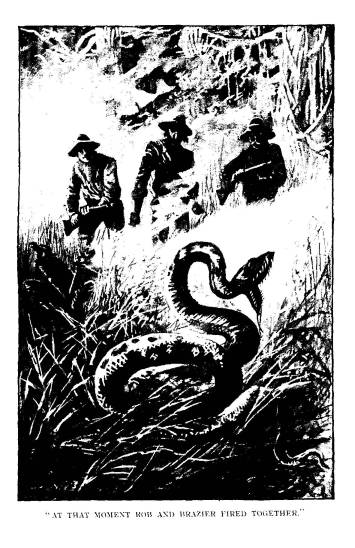
All shrank away, and, as if moved by one impulse, took refuge behind the roaring fire, feeling, as they did, that their dangerous visitor would not attempt to pass that in making an attack upon those sheltered by so menacing an outwork.
There was something terribly appalling in the struggles of the silent monster, as it writhed and twisted itself into knots; then unfolded with the rapidity of lightning, and waving its tail in the air, again beat down the bushes and luxuriant growth around.
That it was fearfully wounded was evident, for after a few moments all could plainly see that it was actuated by a blind fury, and in its agony vented its rage upon everything around. And as it continued its struggles, moment by moment it approached nearer to the blazing fire, till all stood waiting in horror for the moment when one of its folds would touch the burning embers and the struggles come to a frightful end.
But all at once the writhings ceased, and the reptile lay undulating and heaving gently among the dense beaten-down growth.
“Stop!” said Brazier sharply, as the guide moved; “what are you going to do?”
“Put him out of his misery,” replied Shaddy, quietly. “Hi! you there: give me the axe.”
“No,” said Brazier, firmly, “it is too risky a task; you shall not attempt it.”
Shaddy uttered a low growl, like some thwarted animal, and said, in an ill-used tone,—
“Why, I could fetch his head off with one good chop, and—”
“Look, look!” cried Joe. “Mind! Take care!”
“Yes,” shouted Rob; “it’s coming round this way.”
Neither could see the reptile; but the swaying herbage and the rustling, crackling sound showed that it was in rapid motion.
“Nay,” growled Shaddy, “he ain’t coming this way—only right-about-facing. It is his nature to; he’s going to make for the water. That’s what those things do: get down to the bottom and lie there, to be out o’ danger. Look, Mr Rob, sir; you can see now what a length he is. One part’s going one way, and the t’other part t’other way. Now he’s turned the corner, and going straight for the river.”
With Shaddy’s words to guide them, they could easily make out what was taking place, as the reptile now made for the place of refuge already sought by its companion.
Just then Brazier cocked his piece—click, click—and took a few steps forward to try and get a sight of the creature before it reached the river bank.
“May as well save your shot, sir,” said Shaddy gruffly. “He’s going into the water bleeding pretty free, I know; and there’s them waiting below as will be at him as soon as they smell blood.”
“How horrible!” cried Rob.
“Ay, ’tis, sir, or seems so to us; but it’s nature’s way of clearing off all the sickly and wounded things from the face of the earth.”
“But what will dare to attack such a terrible beast?”
Shaddy chuckled.
“Anything—everything, sir; little and big. Why, them little pirani fishes will be at him in thousands, and there’s ’gators enough within fifty yards to make a supper of him as if he was spitchcocked eel. Ah! there he goes—part of him’s in the water already; but I should have liked the master to have his skin.”
Invisible though the serpent was, its course was evident by the rustling and movement of the growth, and some idea too was gained of the reptile’s length.
“There! what did I say?” shouted Shaddy excitedly, as all at once there was the sound of splashing and agitation in the water down beneath the submerged trees; and directly after the serpent’s tail rose above the trunk of one of those lying prone, and gleamed and glistened in the blaze as it undulated and bent and twined about. Then it fell with a splash, and beat the water, rose again quivering seven or eight feet in the air, while the water all around seemed terribly agitated. There was a snapping sound, too, horribly ominous in its nature, and the rushing and splashing went on as the tail of the serpent fell suddenly, rose once more as if the rest of the long lithe body were held below, and finally disappeared, while the splashing continued for a few minutes longer before all was silent.
Rob drew a long breath, and Joe shuddered.
“Well,” said Shaddy quietly, “that’s just how you take it, young gentlemen. Seems so horrible because it was a big serpent. If it had been a worm six inches long you wouldn’t have thought anything of it. Look at my four chaps there: they don’t take any notice—don’t seem horrid to them. You’ll get used to it.”
“Impossible!” said Brazier.
“Oh! I don’t know, sir,” continued Shaddy. “You’ve come out where you wanted to, in the wildest wilds, where the beasts have it all their own way, and they do as they always do, go on eating one another up. Why, I’ve noticed that it isn’t only the birds, beasts, and fishes, but even the trees out here in the forest do just the same.”
“Nonsense!” cried Rob merrily. “Eat one another?”
“Yes, sir; that’s it, rum as it sounds to you. I’ll tell you how it is. A great ball full of nuts tumbles down from one of the top branches of a tree, when it’s ripe, bang on to the hard ground, splits, and the nuts fly out all round, right amongst the plants and rotten leaves. After a bit the nuts begin to swell; then a shoot comes out, and another out of it. Then one shoot goes down into the ground to make roots, and the other goes up to make a tree. They’re all doing the same thing, but one of ’em happens to have fallen in the place where there’s the best soil, and he grows bigger and stronger than the others, and soon begins to smother them by pushing his branches and leaves over them. Then they get spindly and weak, and worse and worse, because the big one shoves his roots among them too; and at last they wither and droop, and die, and rot, and the big strong one regularly eats up with his roots all the stuff of which they were made; and in a few years, instead of there being thirty or forty young trees, there’s only one, and it gets big.”
“Why, Naylor, you are quite a philosopher!” said Brazier, smiling.
“Am I, sir? Didn’t know it; but a man like me couldn’t be out in the woods always without seeing that. Why, you’d think, with such thousands of trees always falling and rotting away, that the ground would be feet deep in leaf mould and decayed wood; but if you go right in the forest you’ll find how the roots eat it up as fast as it’s made.”
“But what about these big trunks?” said Joe, pointing to the fallen trees.
“Them? Well, they’re going into earth as fast as they can, and in a few years there’ll be nothing of ’em left. Why, look at that one; it’s as if it were burning away now,” he continued, pointing to the hole through which Rob had fallen: “that’s nature at work making the tree, now it’s dead, turn into useful stuff for the others to feed on.”
“Yes,” said Brazier, as he broke out a piece of the luminous touchwood, which gleamed in the darkness when it was screened from the fire: “that’s a kind of phosphoric fungus, boys.”
“Looks as if it would burn one’s fingers,” said Joe, handling the beautiful piece of rotten, glowing wood.
“Yes; and so do other things out here,” said Shaddy. “There’s plenty of what I call cold fire; but you’ll soon see enough of that.”
Shaddy ceased speaking, for at that moment a strange, thrilling sound came from the depths of the forest, not more, apparently, than a hundred yards away.
Its effect was electrical.
The half-bred natives who formed Shaddy’s crew of boatmen had watched the encounters with the two serpents in the most unconcerned way, while the weird chorus of sounds from the depths of the forest, with yells, howls, and cries of dangerous beasts, was so much a matter of course that they did not turn their heads even at the nearest roar, trusting, as they did, implicitly in the security afforded them by the fire. But now, as this strange sound rang out, silencing the chorus of cries, they leaped up as one man, and made for the boat, hauling on the rope and scrambling in as fast as possible.
Rob’s first impulse was to follow suit, especially as Giovanni took a few hurried steps, and tripping over a little bush, fell headlong. But seeing that Shaddy stood fast, and that Brazier cocked his piece, he stopped where he was, though his heart throbbed heavily, and his breath came as if there were some strange oppression at his chest.
“What’s that?” whispered Brazier, as the thrilling sound died away, leaving the impression behind that some huge creature must be approaching in a threatening manner, for a curious rustling followed the cry.
“Well, sir,” said Shaddy, taking off his cap, and giving his head a rub as if to brighten his brain, “that’s what I want to know.”
“You don’t know?”
“No, sir,” said the man, coolly; “I know pretty well every noise as is to be heard out here but that one, and it downright puzzles me. First time I heard it I was sitting by my fire cooking my dinner—a fat, young turkey I’d shot—and I ups and runs as hard as ever I could, and did not stop till I could go no further. Ah! I rec’lect it now, how hungry and faint I was, for I dursen’t go back, and I dessay whatever the beast was who made that row ate my turkey. Nex’ time I heard it I didn’t run. I was cooking ducks then, and I says to myself, ‘I’ll take the ducks,’ and I did, and walked off as fast as I could to my boat.”
“And you did not see it?”
“No, sir. P’r’aps we shall this time; I hope so, for I want to know. Third time never fails, so if you don’t mind we’ll all be ready with our guns and wait for him. May be something interesting to a nat’ral hist’ry gent like you, and we may get his head and skin for you to take home to the Bri’sh Museum. What do you say?”
“Well,” said Brazier, drily, “self-preservation’s the first law of nature. I do not want to show the white feather, but really I think we had better do as the men have done—get on board and wait for our enemy there. What do you say, lads!”
“Decidedly, yes,” cried both eagerly.
“But we don’t know as it is our enemy yet, sir,” replied Shaddy, thoughtfully. “Hah! hark at that!”
They needed no telling, for all shivered slightly, as another cry, very different from the last, rang out from the forest—half roar, half howl, of a most appalling nature.
“Here, let’s get on board,” said Brazier.
“Not for that, sir,” cried Shaddy, with one of his curiously harsh laughs. “Why, that’s only one of them big howling monkeys who would go off among the branches twisting his tail, and scared ’most into fits, if you looked at him.”
“A monkey!” cried Rob. “Are you sure?”
“Oh, yes, I’m sure enough ’bout that, gentlemen. It’s the other thing that puzzles me.”
They ceased speaking and stood watchfully waiting; but after a retrograde movement toward the boat, so as to be able to retreat at any moment. The cry was not repeated, though, and the feeling of awe began to die off, but only to return on Shaddy continuing,—
“There’s a something there, or else that there howler wouldn’t have hollered once and then gone off. The lions and tigers, too, have slinked away. That’s a lion—puma you call him—ever so far off; and, I can hear a couple of tigers quite faint-like; but all the things near here have stopped calling, and that shows there’s that thing prowling about.”
“But the men?” whispered Rob. “They ran away as if they knew what it was.”
“Tchah! They don’t know. Their heads are full of bogies. Soon as they hear a noise, and can’t tell what it is, they say it’s an evil spirit or a goblin or ghost. Babies they are. Why, if I was to go near a lot of natives in the dark, hide myself, and let go with Scotch bagpipes, they’d run for miles and never come nigh that part of the forest again.”
All at once the chorus in the forest was resumed, with so much force that it sounded as if the various creatures had been holding their noises back and were now trying hard to make up for the previous check.
That was Rob’s opinion, and he gave it in a whisper to his companion.
“Then, it’s gone,” said Joe. “I say, didn’t you feel scared?”
“Horribly.”
“Then I’m not such a coward after all. I felt as if I must run.”
“So you did when the serpent came.”
“Well, isn’t it enough to make one? You English fellows have the credit of being so brave that you will face anything without being frightened; but I believe you are frightened all the same.”
“Of course we are,” said Rob, “only Englishmen will never own they are frightened, even to themselves, and that’s why they face anything.”
“Then you are not an Englishman?” said Joe.
“No, only an English boy,” said Rob, laughing. “I say, though, never mind about bragging. I’m precious glad, whatever it was, that it has gone.”
“I remember, now, my father telling me about his hearing some horrible noise in the Grand Chaco one night when the schooner was at anchor close in shore. He said it gave him quite a chill; but I didn’t take any more notice of it then. It must have been one of those things.”
“No doubt,” said Brazier, who had overheard his words; “but there, our adventure is over for this time, and it will be something to think about in the future.”
“Perhaps we shall see it yet,” said Rob.
“I hope not,” cried Joe uneasily.
“Gone, Naylor?” continued Brazier.
“Yes, sir, I think so.”
“Good job too. Why, Naylor, my man, I never thought you were going to bring us to such a savage, dangerous place as this.”
“What? Come, sir, I like that! Says to me, you did, ‘I want you to guide me to some part of the country where I can enter the prime forest.’”
“Primeval,” said Brazier, correctively.
“That’s right, sir. ‘Where,’ you says, ‘the foot of man has never trod, and I may see Natur’ just as she is, untouched, unaltered by any one. Do you know such a place?’ Them was your very words, and Master Rob heered you.”
“Quite true, my man.”
“And I says to you, ‘I knows the spot as’ll just suit you. Trust to me,’ I says, ‘and I’ll take you there, where you may see birds, beasts, and fishes, and as many o’ them flowers’—orkards you called ’em—‘as grows on trees, as you like;’ and now here you are, sir, and you grumble.”
“Not a bit, Naylor.”
“But, begging your pardon, sir, you do; and I appeals to Master Rob whether I arn’t done my dooty.”
“No need to appeal to Rob, Naylor, for I do not grumble. You have done splendidly for me. Why, man, I am delighted; but you must not be surprised at my feeling startled when anacondas come to supper, and we are frightened out of our wits by cries that impress even you.”
“Then you are satisfied, sir?”
“More than satisfied.”
“And you don’t want to go back?”
“Of course not. What do you say, Rob? Shall we return?”
“Oh no—not on any account; only let’s keep more in the boat.”
“Yes, I think we are safer there,” said Brazier. “But our friend, or enemy, seems to have gone.”
“Wait a bit, sir,” replied Shaddy; “and glad I am that you’re satisfied. Let me listen awhile.”
They were silent, and stood listening as well, and watching the weird effects produced by the fire, as from time to time one of the pieces of wood which the men had planted round the blaze in the shape of a cone fell in, sending up a whirl of flame and glittering sparks high in air, lighting up the trees and making them seem to wave with the dancing flames. The wall of forest across the river, too, appeared to be peopled with strange shadows, and the effect was more strange as the fire approached nearer to the huge butt of the largest tree, throwing up its jagged roots against the dazzling light, so that it was as if so many gigantic stag-horns had been planted at a furnace mouth.
And all the while the fiddling, piping, strumming and hooting, with screech, yell and howl, went on in the curious chorus, for they were indeed deep now in one of Nature’s fastnesses, where the teeming life had remained untouched by man.
“Well,” said Brazier at last to the guide, whose figure, seen by the light of the fire, looked as wild as the surroundings, “had we not better get on board? You can hear nothing through that din.”
“Oh yes, I can, sir,” replied Shaddy. “I’ve got so used to it o’ nights that I can pick out any sound I like from the rest. But we may as well turn in. The fire will burn till morning, and even if it wouldn’t, those chaps of mine wouldn’t go ashore again to-night; and I certainly don’t feel disposed to go and mend the fire myself, for fear of getting something on my shoulder I don’t understand.”
“It has gone, though,” said Brazier.
“Something moving there,” whispered Rob, pointing to the gilded mass of foliage beyond and to the left of the fire.
“Eh! where?” cried Shaddy. “Nay, only the fire making it look as if the trees were waving. Nothing there, my lad. Whatever it is, it has slinked off into the forest again. The fire drew it this way, I suppose. There, we’ve heard the last of him for to-night. Sings well when he do oblige.”
“I should have liked to hear the cry once more, though,” said Brazier; and as the words left his lips the horrible noise rang out, apparently from behind the fire, and without hesitation the little party hurried on board the boat.
Chapter Twelve.
Shaddy’s Remorse.
That last movement was not performed without difficulty, for at this fresh alarm, urged by a desire for self-preservation, the men had thrust the boat away from the bank, and were actually in the act of unfastening the mooring rope, when Rob shouted to Shaddy.
“What!” he roared, running to the other end where it was fast to a branch, and then yelling out such a furious tirade of words in their own tongue that the men shrank back, and the boat was drawn close in among the boughs that were worn sharp by the action of the stream.
“Lucky for them,” growled Shaddy, as he held the boat’s gunwale for the others to get on board, while the singular silence which had followed the first cry of the beast was again maintained. “I never did break a man’s neck yet, Master Rob,” he whispered, as they took their places on board, “and I never mean to if I can help it; but if those fellows had run off and left us in the lurch I’d have gone as far as I could without doing it quite.”
“First catch your hare,” whispered back Rob, who felt better now he was safe on board, with the boat gliding outward to the full length of the mooring line.
“Eh! what hare? No hares about here,” said Shaddy.
“I mean, how would you have managed to punish the men if they had gone off and left us here?”
“I never thought of that,” said Shaddy, shaking his head; and then they all sat in the boat listening, and thinking that it was a good thing they had had enough supper before the interruption.
There was no fresh alarm for awhile. The birds, insects, quadrupeds, and reptiles resumed their performances, the boatmen settled down to sleep, and at last, after watching the fire sinking, rising up as some piece of wood fell in, and then blazing brightly just beyond the great root, the hole from which this had been wrenched having been selected by the crew of the boat as an excellent place for cooking, Rob suddenly fell asleep, to dream of huge boa constrictors and anacondas twisting themselves up into knots which they could not untie.
It only seemed to be a few minutes since Rob had lain down, when he awoke with a start to gaze about him, wondering where he was and why the awning looked so light. Then coming to the conclusion that it was sunrise, and being still weary and drowsy, he was about to close his eyes again and follow the example of those about him, when he became conscious of a peculiar odour and a choking smell of burning.
This completely aroused him, and hurriedly creeping from beneath the awning without awakening his companions, he found that the boatmen and Shaddy were fast asleep and a line of fire was rapidly approaching them from the shore; not with any rush of flame, but in a curious sputtering, smouldering way, as the touchwood of which the huge trunk, to which they were tethered, was composed rapidly burned away.
It was all plain enough: the root had caught fire at last from the intense heat so near and gradually started the rest, so that as Rob gazed shoreward there was a dull incandescent trunk where the previous night there had been one long line of beautiful orchids and epiphytic plants.
But there was no time to waste. Waking Shaddy with a sharp slap on the shoulder, that worthy started up, saw the mischief pointed out, and shouting, “Only shut my eye because the fire made it ache,” he took up a boat-hook, went right forward, trampling on the boatmen in his eagerness, and, hauling on the line, drew the boat close up to the glowing trunk, hitching on to one of the neighbouring branches. It was only just in time, for the rope gave way, burned through as he got hold, and the smouldering end dropped into the water, giving a hiss like a serpent as the glowing end was quenched.
Brazier and Giovanni were aroused before this, and were fully alive to the peril which had been averted by Rob’s opportune awakening.
“Why,” cried Brazier, “we should have been drifting down the stream, and been carried miles, and in all probability capsized.”
Shaddy made no reply for the moment, but busied himself in altering the position of the boat before letting go, and then hooking the bough of another of the trees, one which did not communicate with the fire, and to this he made fast before rising up in the boat, taking off his cap, and dashing it down.
“Yes,” he said harshly, “right, sir. We should have been carried right down the stream— Be off, you brute!”
This was to an alligator which was approaching the boat with the protuberances above its eyes just visible, and as he uttered the adjuration he made a stroke with the hitcher harpoon fashion, struck the reptile full on its tough hide, and there was a swirl, a rush, and a tremendous splash of water full in Shaddy’s face as the creature struck the surface with its tail and then disappeared.
“Thank ye,” growled Shaddy, wiping his face; “but you got the worst of it, mate. As aforesaid, maybe, Mr Brazier, sir, we should ha’ been carried right down the stream, and run on a sharp root or trunk as would ha’ drove a hole through the boat or capsized us, and there’d ha’ been the end.”
“What could you have been thinking of, Naylor?” cried Brazier angrily; while Rob looked pityingly and feeling sorry for the staunch, brave man, who stood there abashed by his position.
“Warn’t thinking at all, sir,” he growled. “Only ought to ha’ been. There, don’t make it worse, sir, by bullying me. You trusted me, and I thought I was fit to trust, but there’s the vanity o’ man’s natur’. I arn’t fit to trust, so I’d take it kindly if you’d knock me overboard; but you’d better knock my stoopid head off first to save pain.”
This was all spoken with the most utter seriousness, and as Shaddy finished he slowly laid down the boat-hook and looked full in Brazier’s eyes, with the result that Rob burst into a roar of laughter. Joe followed suit, and after an attempt to master himself and frown Brazier joined in, the mirth increasing as Shaddy said sternly,—
“Oh, it arn’t nothing to laugh at! If Master Rob there hadn’t woke up before morning, the ’gators and pirani, without counting the other critters, would have been having a treat. I tell you I’m ashamed of myself, and the sooner an end’s made of me the better. Why, you ought to do it, sir, in self-defence.”
“How near are we to morning?” said Brazier.
“’Tis morning now, sir. Sun’ll be up in less an half an hour. No dawn here.”
“Then we had better have breakfast at once, and start, for this is anything but a pleasant spot.”
“Ain’t you going to knock me overboard, sir?” said Shaddy.
“No.”
“Well, ain’t you going to knock me down?”
“No; I’m not going to knock you down either, my good fellow. You’ve made a mistake. Over-tired, I suppose, and you dropped asleep. It was terribly neglectful of you, but I hope and trust that such an error may not be made again.”
“What?”
“Surely I need not repeat my words. You were overcome by fatigue and slept. I ask you for all our sakes to be more careful in the future.”
“Here, I say, Master Rob,” cried Shaddy huskily, and he gave his eyes a rub, “am I still asleep?”
“No, Shaddy, wide awake, and listening to Mr Brazier.”
“Well, then, it’s a rum ’un. But, I say, look here, sir; you’re never going to trust me again?”
“I am going to treat you with full confidence, just as I trusted you before, Naylor,” replied Brazier.
“Master Rob’s asleep too,” growled the man. “It can’t be true. Here, I say, Mr Jovanny, give a look at me and tell me, am I awake or no?”
“Awake, of course,” said Joe.
“Then all I can say is, Mr Brazier, sir,” said the guide, “you’ve made me ten times more ashamed of myself than I was before, and that hurt I can’t bear it like.”
“Say no more about it, man,” said Brazier. “There, it’s all over now. Let’s have breakfast, and then start for a long day’s collecting.”
“Not say no more about it?” cried Shaddy.
“Not a word. It is all past and forgotten.”
“Can’t be,” growled Shaddy.
“It shall be,” said Brazier, turning to get his gun from under the canvas cabin.
“One moment—look here, sir,” said Shaddy; “do you mean to say that you forgive me?”
“Yes, of course.”
“And I am not to say another word?”
“No.”
“Then I’ll think,” said Shaddy, “and punish myself that way, Master Rob. I’ll always think about it at night when I’m on the watch. It ain’t likely that I shall ever go to sleep again on dooty with idees like that on my brain.”
“No more talking; breakfast at once,” cried Brazier, issuing from the cabin.
“Right, sir,” said Shaddy, working the boat in close to the bank. “Quick, my lads, and get that fire well alight.”
The men were set ashore just as the sun rose and flooded everything with light, while a quarter of an hour later, as Brazier was patiently watching one of the tunnel-like openings opposite in the hope of seeing a deer come down to drink and make them a good meal or two for a couple of days, Shaddy drew Rob’s attention to the black-looking forms of several alligators floating about a few feet below.
“The brutes!” said the lad. “Just like efts in an aquarium at home.”
“Only a little bigger, my lad. I say, there he is—one of ’em.”
He pointed down through the clear water, illumined now by the sun so that the bottom was visible, and there coiled-up and apparently asleep lay either the anaconda of the previous night or one of its relatives, perfectly motionless and heedless of the boat, which floated like a black shadow over its head.
“Might kill it if we had what sailors call the grains to harpoon him with,” said Shaddy; “but I don’t know, he’d be an ugly customer to tackle. I say, look out, sir,” he whispered, “yonder across the river.”
Brazier glanced a little to his left, and directly after his piece rang out with a loud report and a deer fell dead—not having moved an inch, when the boat was with difficulty rowed across, and the welcome addition to their larder secured amidst the chattering of monkeys and the screaming of great macaws.
An hour later breakfast was at an end, the boat loosened from the moorings where the anaconda still lay asleep in ten feet of water, and they glided down the stream to commence another adventurous day, amidst scenery which grew more wondrously beautiful with every mile.
Chapter Thirteen.
The Lily Lagoon.
“Like it, gentlemen? That’s right. On’y you are sure—quite sure?”
“Oh yes, we’re sure enough!” replied Rob, as he watched the endless scenes of beautiful objects they passed. “It’s glorious.”
“Don’t find it too hot, I s’pose, sir?”
“Oh, it’s hot enough,” interposed Giovanni; “but we don’t mind, do we, Rob?”
“Not a bit. What fruit’s that?”
“Which?” said Shaddy.
“That, on that tree, high up, swinging in the wind—the dark brown thing, like a great nut with a long stalk.”
He pointed to the object which had taken his attention.
“G’long with yer,” growled Shaddy. “I thought you was in arnest.”
“So I am,” cried Rob, looking at the man wonderingly. “I mean that one. It isn’t a cocoa-nut, because the tree is different, and I know that cocoanuts grow on a kind of palm.”
“And that kind o’ nut don’t, eh?” said Shaddy, puckering his face. “Why you are laughing at me.”
“Nonsense! I am not!” cried Rob. “You don’t see the fruit I mean. There, on that tallest tree with the great branch sticking out and hanging over the others. There now! can you see?”
“No,” said Shaddy grimly; “it’s gone.”
“Yes; how curious that it should drop just at that moment. I saw it go down among the trees. You did see it?”
“Oh yes. I see it plain enough.”
“And you don’t know what fruit it was?”
“Warn’t a fruit at all, sir.”
“What then? some kind of nut?”
“No, sir; warn’t nut at all. It was a nut-cracker.”
Rob looked at him seriously.
“Who’s joking now?” he said.
“Not me, sir,” replied Shaddy. “That was a nut-cracker sure enough.”
“Is that the native name?”
Joe burst into a roar of laughter, and Rob coloured, for there was a feeling of annoyance rising within him at being the butt of the others’ mirth.
“Have I said something very stupid?” he asked.
“Why, couldn’t you see?” cried Joe eagerly. “It was a monkey.”
“I did not see any monkey,” said Rob coldly. “I was talking about that great brown husky-looking fruit, like a cocoa-nut hanging by a long stalk in that tree. Look! there are two more lower down!” he cried eagerly, as the boat glided round a bend into a long reach, two of the men being at the oars backing water a little from time to time with a gentle dip, so as to keep the boat’s head straight and check her to enable Brazier to scan the banks through the little binocular glass he carried, and be rowed close in when he wished to obtain specimens.
“Yes: there’s two more lower down,” said Shaddy, with his face puckered up like the shell of a walnut, and then Rob’s mouth expanded into a grin as wide as that of Joe’s, and he laughed heartily.
“Well,” he cried, “that is comic, and no mistake. I really thought it was some kind of fruit. It was a monkey.”
“You ain’t the first as made that mistake, Mr Rob, sir,” said Shaddy. “You see, they just take a turn with their tails round a branch, draws their legs up close, and cuddles them with their long arms round ’em, and then they looks just like the hucks of a cocoa-nut.”
“Like the what?” cried Rob.
“Hucks of a cocoa-nut.”
“Oh—husk.”
“You may call it ‘husk’ if you like, sir: I calls it ‘hucks.’ Then they hangs head downwards, and goes to sleep like that, I believe. Wonderful thing a monkey’s tail is. Why I’ve seen the young ones hold on to their mother by giving it a turn round the old girl’s neck. They’re all like that out here. Ring-tail monkeys we call ’em.”
While they were talking the last two monkeys had swung themselves to and fro, and then lowered themselves down among the branches to get close to the river and watch the boat, like a couple of tiny savages stricken with wonder at the coming of the strange white men, and chattering away to each other their comments on all they saw.
The progress made was very slow, for the boat was constantly being anchored, so to speak, by the men rowing in and holding on by the hanging boughs of trees, while Brazier cut and hacked off bulb and blossom in what, with glowing face, he declared to be a perfect naturalist’s paradise.
They had been floating down a few miles when, right ahead, the stream seemed to end, the way being blocked entirely by huge trees, and as they drew nearer there appeared to be a repetition of the entrance from the great river, where they passed along through the dark tunnel overhung by trees.
“Oh, it’s all right, sir,” said Shaddy, on being appealed to. “Dessay we shall find a way on.”
“Of course,” replied Brazier, who only had eyes for the plants he was collecting and hardly looked up; “this great body of water must go somewhere.”
“Look sharp round to the left!” cried Rob, standing up in the boat as they glided round a bend where the stream nearly turned upon itself and then back again, forming a complete S; and as they moved round the second bend Rob uttered a shout of delight, for the banks receded on either hand, so that they appeared to have glided into a wide opening about a mile long, floored with dark green dotted with silver, through which in a sinuous manner the river wound. A minute later, though, the two lads saw that the river really expanded into a lake, the stream in its rapid course keeping a passage open, the rest of the water being densely covered with the huge, circular leaves of a gigantic water-lily, whose silvery blossoms peered up among the dark green leaves.
“Look at the jacanas!” cried Joe, pointing to a number of singular-looking birds like long-necked and legged moorhens, but provided with exaggerated toes, these being of such a length that they easily supported their owners as they walked about or ran on the floating leaves.
“Wouldn’t be a bad place for a camp, sir,” suggested Shaddy, when they were about half-way along the lake, and he pointed to a spot on their left where the trees stood back, leaving a grassy expanse not unlike the one at which they had first halted, only of far greater extent.
“Yes, excellent,” replied Brazier; “but can we get there?”
“Oh yes, sir; I’ll soon make a way through the leaves.”
Shaddy seized a pole, said a few words to his men, and stepped right to the front of the boat, where he stood thrusting back the vegetation as it collected about the bows, while the men rowed hard forcing the boat onward, the huge leaves being sent to right and left and others passing right under the keel, but all floating back to their former positions, so that as Rob looked back the jacanas were again running over the vegetation which had re-covered the little channel the boat had made.
In all probability a vessel had never entered that lake before, and it caused so little alarm that great fish, which had been sheltering themselves beneath the dark green disk-like leaves, lazily issued from their lurking places to stare so stupidly, often even with their back fins out of water, that the boys had no difficulty in startling a few of them into a knowledge of their danger by gently placing a hand under and hoisting them suddenly into the boat, where they displayed their alarm by leaping vigorously and beating the fragile bottom with their tails.
“Better hold hard, young gentlemen!” cried Shaddy, as soon as half a dozen were caught; “them fish won’t keep, and we can easily catch more. Ah! Why, Mr Joe, sir, I did think you knowed better.”
This was to Joe, who had leaned over as far as he could to try and perform the same feat upon a long dark object floating half hidden by a leaf, but was met by a quick rush and a shower of water as the creature twisted itself round and dived down.
“It was only a little one, Shaddy,” said Joe.
“Little dogs have sharp teeth, my lad; and them small ’gators can bite like fury. You take my advice, and don’t do it again.”
“Hah!” cried Brazier as he leaped ashore, “this is glorious. We can make quite a collection here. See that the boat is fast, Naylor.”
This was soon done, and the men were about to light a fire, but Brazier checked them, preferring to make a little expedition for exploration purposes all about their new camping place, partly to see if there were noxious beasts at hand, partly to try and secure a few natural history specimens, especially birds, which abounded, before the noise and the fire should drive them away.
“Hand out the guns and cartridge bags,” said Brazier; and this being done the men were left in charge of the boat, and the little party started, keeping close up to the trees on their left with the intention of going all round the opening and so returning by the right side to the boat.
The walking was hard, for the earth was tangled with dense growth so that they progressed very slowly, while the heat was intense; but that passed unnoticed in the excitement caused by the novel objects which met their eyes at every step—flowers, such as Rob had never before seen, looking up as if asking to be plucked; butterflies which flapped about so lazily that they could, he felt, easily be caught, only without net or appliances it seemed wanton destruction to capture and mutilate such gorgeously painted objects. There were others too, resembling the hawk-moths in shape, with thick body and long pointed wing, which were constantly being taken for humming-birds, so rapid was their darting flight. As for these latter, they flashed about them here, there, and everywhere, now glittering in the sunshine, now looking dull and plum-coloured as they hovered on hazy wings before the long trumpet blossoms of some convolvulus-like flower whose twiny stems trailed over or wrapped the lower growth.
Beetles, too, were abundant in every sun-scorched spot or on the bare trunks of the trees, though bare places were rare, for the trees were clothed densely with moss and orchid.
Rob’s fingers itched as bird after bird flew up, and he longed to bring them down for specimens, whose brilliant colours he could gloat over. Now it was a huge scarlet-and-blue macaw, now one painted by Nature’s hand scarlet, yellow, and green, which flew off with its long tail feathers spread, uttering discordant shrieks, and startling the smaller parrots from the trees which they were stripping of their fruit.
But Brazier had told him not to fire at the smaller birds, as it was a necessity to keep their larder supplied with substantial food, the four boatmen and Shaddy being pretty good trencher-men, and making the deer meat disappear even without the aid of trenchers.
“We ought to find a deer here surely,” said Brazier, when they were about half-way round.
“Well, I don’t know, sir,” replied their guide; “deer ain’t like human beings, ready to go walking in the hot sunshine in the middle of the day. They like to lie up in the shade all through the sunny time, and feed in the morning and evening.”
“Then you think we shall not see a deer?”
“Can’t say, sir; but if a turkey goes up I should make sure of him at once. So I should if we came upon a carpincho, for this is a likely place for one of them.”
“But are they good eating?”
“Capital, sir. Now, look at that.”
He faced round at a loud, fluttering sound, and guns were raised, but the great bird which had taken flight was far out of shot, and winging its way higher and higher, so as to fly over the tops of the trees and away into the forest.
“Fine great turkey that, sir,” said Shaddy.
“Yes: can we follow it?”
Shaddy shook his head.
“Far more sensible for us to walk straight away, sir, through the open where that turkey got up: we might start another or two.”
“But the going is so laborious,” pleaded Brazier; “some of us would be having sunstroke. No, let’s keep on, we may put up something yet.”
“And try for the turkeys toward sundown, sir?”
“Yes. Come on,” said Brazier; “we had better get slowly back now to the boat. It is too hot.”
He stood wiping the perspiration from his forehead as he spoke, and then, with Shaddy by his side carrying a spare gun, went on along by the edge of the forest, Rob and Joe following some distance behind.
“I might as well have shot some of those beautiful toucans,” said Rob; “I could have skinned them, and they would be delightful to bring out at home and show people, and remind one of this place in years to come.”
“Yes, we shouldn’t have scared away much game,” replied Joe. “What’s that they can see?”
For Shaddy was holding up his hand to stop them, and Brazier, who had forgotten all about being languid and weary in the hot sunshine, was hurrying forward bending down and making for one of several clumps of bushes about half-way between them and the river.
Rob noted that clump particularly, for it was scarlet with the blossoms of a magnificent passion-flower, whose steins trailed all over it, tangling it into a mass of flame colour, looking hot in the sunshine, which made the air quiver as if in motion.
The lads stopped at Shaddy’s signal and looked intently, but they could see no sign of any game, and, rightly concluding that the object of Brazier’s movement must be hidden from them at the edge of the forest, they crouched down and waited for fully five minutes.
“Here, I’m sick of this,” whispered Rob at last; and he rose from his uncomfortable position.
“So am I,” said Joe, straightening himself. “Hullo! Where’s old Shaddy?”
“Lying down and having a nap, I expect,” replied Rob. “I can’t see him nor Mr Brazier neither. Shall we go on.”
“No: let’s wait a bit. They may be seeing a chance for something good at supper-time.”
They waited another five minutes, ten minutes, and had at last determined to go on, when Brazier’s piece was heard, the sharp report coming from about three hundred yards farther on toward the river.
“There’s Shaddy running,” cried Joe; and they saw now where he had been crawling, far beyond the scarlet passion-flower, from whose shelter Mr Brazier had evidently made a long stalk till he was close to the object of his search, a bird or animal, which had probably fallen, from the haste being made to reach the spot.
“Let’s make haste,” cried Joe, pushing forward.
“No, thank you; I’m too tired,” said Rob. “I was not so fagged before, but after lying down there so long I’m as stiff as can be. Oh, bother! something stung me. It’s one of those ants. Brush them off.”
Joe performed the kindly duty, and they were on the way to join the others, when there was a rustling sound just in front, and the young Italian started back.
“A snake—a snake!” he panted, as he caught Rob’s arm. “Shoot!”
“Well, you shoot too,” said the latter rather sharply, for Joe seemed to have forgotten that he had a gun in his hand.
But Rob could not boast, for as the dry grass and scrubby growth in front moved he raised his piece, and drew first one trigger, then the other: there was no result—he had forgotten to cock.
Lowering the gun he rapidly performed this necessary operation, and was about to raise it again and wait, for in the hurry and excitement he had been about to obey his companion and deliver a chance shot almost at random amongst the moving grass—so great was the horror inspired by the very name of one of the reptiles which haunted the moist swamps near the riverside.
But, to the surprise of both, it was no huge anaconda which had been worming its way toward them; for at the sound of the lock—click, click—a beautiful warm-grey creature bounded lithely out almost to where they stood, and there paused, watching them and waving its long black tail.
“A lion,” whispered Joe, who remained as if paralysed by the sudden bound of the cat-like creature, which stood as high as a mastiff dog, but beautifully soft-looking and rounded in its form, its ears erect, eyes dilated, and motionless, all but that long writhing tail.
In those few moments Rob’s powers of observation seemed as if they were abnormally sharpened, and as he noted the soft hairs toward the end of the tail erected and then laid down, and again erected, making it look thick and soft, he noted too that the muzzle was furnished with long cat-like whiskers, and the head was round, soft, and anything but cruel and fierce of aspect.
“Shoot—shoot!” whispered Joe: “the ball—not the small shot.”
But Rob did not stir; he merely stood with the muzzle of the gun presented toward the beast, and did not raise it to his shoulder. Not that he was stupefied by the peril of his position, but held back by the non-menacing aspect of the puma. Had there been a display of its fangs or an attempt to crouch for a spring, the gun would have been at his shoulder in a moment, and, hit or miss, he would have drawn the trigger.
“Why don’t you shoot?” whispered Joe again.
“I can’t,” replied Rob. “It must be a tame one.”
“Nonsense! You’re mad. We’re right away in the wilds.”
“I don’t care where we are,” said Rob, who was growing cool and confident; “this must be a tame one. I shall go forward.”
“No, no—don’t! He’ll claw you down.”
“He’d better not. I’ve got my finger on the trigger. Here! Hallo, old chap! puss! puss! whose cat are you?”
“He’s mad,” whispered Joe as Rob advanced, and the puma stood firm watching him, till they were so close together that, in full confidence that they had met with a tame beast, the property of some settler or Indian, he laid his gun in the hollow of his left arm, and stretched out his right hand.
The puma winced slightly, and its eyes grew more dilate; but, as Rob stood still, the wild look passed slowly away, and it remained motionless.
“Don’t! pray don’t!” cried Joe in a hoarse whisper; “it will seize your hand in its jaws.”
“Nonsense! It’s as tame as an old tom-cat,” said Rob coolly. “Poor old puss, then!” he continued, reaching out a little farther, so that he could just softly touch the animal’s cheek, passing his fingers along toward its left ear.
“There, I told you so,” he said, with a laugh, for the puma pressed its head against his hand, giving it a rub in regular cat fashion, while as, to Joe’s horror, Rob continued his caress and began gently rubbing the animal’s head, it emitted a soft, purring noise, rolled its head about, and ended by closing up and leaning against the lad’s leg, passing itself along from nose to tail, turning and repeating the performance, and again on the other side.
“I am glad I didn’t shoot,” said Rob, bending down to stroke the animal’s back. “I say, isn’t he a beauty! Come and make friends. He’s a bit afraid of us yet.”
Joe stood fast, with the loaded gun presented, ready to fire and save his friend’s life the moment the creature seized him, when, to his astonishment, the puma so thoroughly approved of the first human caress it had ever received that it lay down, rolled over, wriggling its spine when all four legs were in the air, rolled back again, scratching the ground, and finally crouched and looked up as much as to say, “Go on.”
Rob answered the appeal he read in the puma’s eyes, and going down on one knee, he patted and stroked it, when, quick as the movement of a serpent, it threw itself over on its back, seized the lad’s hand between its bent paws, patted it from one to the other, and then held it tightly as it brought down its mouth as if to bite, but only began to lick the palm with its rough tongue.
“There!” said Rob; “what do you say now? Isn’t it a tame one?”
“I—I don’t know yet. Hadn’t I better fire and kill it?”
“You’d better not,” cried Rob. “That’ll do, old chap; you’ll have the skin off. I say, his tongue is rough. Why, what beautiful fur he has, and how soft and clean! I wonder whose he is.”
In the most domestic cat-like fashion the puma now curled itself round, with its forepaws doubled under, and kept up its soft purr as it watched the lad by its side. But as he rose the animal sprang up too, butted its head affectionately against his leg, and then looked up as if to say,—
“What next?”
“Why don’t you come and stroke it?” cried Rob. “Because I’m sure it’s wild and fierce,” was the reply. “Well, it isn’t now.”
“Ahoy!” came from a distance, and the puma looked sharply about, with ears erect and an intense look, as if it were listening.
“Ahoy!” shouted back Rob. “Let’s go to them. Come along, puss.”
He took a few steps forward, the puma staring at him and twisting its tail from side to side; but it did not stir. “There, I told you so. It is wild.”
“Well, it may be, but it’s quite ready to make friends, and it will not hurt us. Come along.”
Joe did not possess his companion’s faith, and keeping his face to the puma as much as he could, he advanced toward where they could see Brazier waving his hand to them to come on.
As they advanced Rob kept on stopping and looking back at the puma, calling it loudly; but the animal made no response. It stood there with its eyes dilating again, waving and twisting its tail, till they were thirty or forty yards distant, when, with a sudden movement, it half turned away, crouched, its hind legs seemed to act like a spring, and it was shot forward into the low growth and disappeared.
“Gone!” said Joe, with a sigh of relief.
“Why, you’re actually afraid of a cat,” said Rob mockingly.
“I am—of cats like that,” replied his companion. “I’ve heard my father say that some of them are friendly. That must be a friendly one, but I’m sure they are not fit to be trusted. Let’s make haste.”
Rob did not feel so disposed, and he looked back from time to time as they forced their way through the grass and low growth, but there was no puma visible, and finally, taking it for granted that the animal was gone, but making up his mind to try and find it again if they stayed, he stepped out more quickly to catch up to Joe, who was pressing on toward where he could now see both of their companions and a hundred yards beyond the boatmen coming to meet them.
“Hi! What have you shot, Mr Brazier?” cried Rob as he drew nearer.
“Deer! Very fine one!” came back the reply.
“Venison for dinner, then, and not ‘only fish,’” said Rob as he changed shoulders with his gun. “Shouldn’t care to be always tied down to fresh-water fish, Joe. They’re not like turbot and soles.”
“I say, don’t talk about eating,” said the young Italian testily.
“Why not?”
“Makes me so hungry.”
“Well, so much the better. Proves that you enjoy your meals. I say, I wish that great cat had followed us.”
“Nonsense! What could you have done with it?”
“Kept it as a pet. Taught it to catch birds for us, and to fetch those we shot like a dog. Oh, what a beauty!”
This was on seeing the fine large fat deer which had fallen to Brazier’s gun.
“Yes,” said Brazier, with a satisfied smile; “it was a piece of good fortune, and it will relieve me of some anxiety about provisions.”
“But it will not keep,” said Rob.
“Yes; cut in strips and dried in the sun, it will last as long as we want it. You see, we have no means of making up waste in our stores, Rob, and the more we get our guns to help us the longer our expedition can be.”
The boatmen and the two lads reached the deer just about the same time, and the latter stood looking on with rather an air of disgust upon their countenances as the crew set to work and deftly removed the animal’s skin, which was carried off to the boat to be stretched over the awning to dry, while those left rapidly went to work cutting the flesh in strips and bearing it off to the boat.
“I say, Mr Brazier,” said Rob after watching the proceedings for some time, “hadn’t those strips of flesh better be dried on shore somewhere?”
“Why?”
“Because they’ll smell dreadfully.”
“I hope not,” said Brazier, smiling.
“Not they, sir,” put in Shaddy. “Sun soon coats ’em over and takes the juice out of them. They won’t trouble your nose, Master Rob, sir, trust me; and as to drying ’em on shore, that would be a very good plan in every way but one.”
“What do you mean?”
“Why, that it would be very convenient, sir, and the meat would dry nicely; but when we wanted it you may take my word it wouldn’t be there.”
“Would some one steal it?” cried Rob. “No; you told me there were no Indians about.”
“So I did, sir; but there are hundreds of other things would take it.”
“Hang it up in a tree, then.”
“Ready for the vultures to come and carry it off? That wouldn’t do, sir. No; there’s no way of doing it but hanging it up in your boat. The animals can’t get at it, nor the ants neither, and the birds are afraid to come.”
“I did not think of that,” said Rob apologetically.
“No, sir, s’pose not. I used to think as you did. I didn’t want to have anything that might smell on my boat, and I did as you advised till I found out that it would not do. Don’t take too much at a time,” he growled to the man who was loading himself, “and mind and lay out all the pieces separate. Is the fire burning?”
The man replied in his own tongue, and went off.
“I’ll get on now, sir,” said Shaddy, “and see to the pieces frizzling for our dinner, if you’ll stop and see that the men don’t leave before they are done.”
“How am I to speak to them? I don’t know their tongue.”
“No need to speak, sir. If they see you’re watching them they won’t neglect anything, but will do it properly. I was only afraid of their wanting to step off to the fireside to begin broiling bones.”
Shaddy shouldered his gun, and went off after the man who was loaded with strips of flesh to make what is called biltong, and the two left worked on very diligently, with the boys wandering here and there in search of objects of interest and finding plenty—brilliant metallic-cased beetles, strange flowers which they wanted named, birds which it was a delight to watch as they busied themselves about the fruit and flowers of the trees at the forest edge.
“I shall be glad when they’ve done,” said Joe at last, as they were walking back to where Brazier stood leaning upon the muzzle of his gun. “I am so hungry. Wonder whether these berries are good to eat!”
He turned aside into the bushes to begin picking some bright yellow fruit, and scaring away a little parrot from the feast.
“I want something better than those,” said Rob contemptuously; and he went on, expecting that Joe was close behind.
All at once, when he was about twenty yards away from where Brazier was standing, Rob saw him start, raise his gun, and cock it as he glared wildly at his young companion.
“Anything the matter, sir?” cried Rob, hastening his steps.
“Yes!” cried Brazier hoarsely. “Stand aside, boy! Take care! Out of my line of fire! You’re being stalked by a wild beast!”
Rob stared, looked round, and saw at a glance that the puma had evidently been hiding among the dead grass and thick growth, but had been following and watching him ever since he had seen it leap into the bushes. Then the truth dawned upon him that of course Mr Brazier could not know what had passed, and there he was with his gun raised to fire.
“Stand aside, boy!” was roared again; and, obeying the stronger will, Rob sprang aside, but only to leap back.
“Don’t fire! don’t fire!” he shrieked, but too late. The gun belched forth rapidly its two charges, and Rob fell and rolled over upon the earth.
Chapter Fourteen.
Frightened by False Fires.
“Naylor—Giovanni—help! help!” cried Brazier. “What have I done?”
As in a voice full of agony Brazier uttered these words, the dense smoke from the gun which had hidden Rob for the moment slowly rose and showed the lad lying motionless upon the earth. Shaddy rushed up, dropped upon one knee and raised the boy’s head, while with his keen knife held across his mouth he looked sharply round for the South American lion, ready to meet its attack.
But the animal was not visible, and it was directly after forgotten in the excitement centred on Rob.
“Tear off his clothes! Where is he wounded? No doctor! Run to the boat for that little case of mine. Here, let me come.”
These words were uttered by Brazier with frantic haste, and directly after he uttered a cry of horror and pointed to Rob’s forehead close up amongst the hair, where a little thread of blood began to ooze forth.
“That ain’t a shot wound,” growled Shaddy. “Hi! One of you get some water.”
One of the boatmen, who had hurried up, ran back toward the stream, and just then Rob opened his lips said peevishly,—
“Don’t! Leave off! Will you be quiet? Eh! What’s the matter?”
As he spoke he thrust Brazier’s hand from his head, opened his eyes and looked round.
“What are you doing?” he cried wonderingly.
“Lower him down, Naylor,” whispered Brazier hoarsely; and Shaddy was in the act of obeying, but Rob started up into a sitting position, and then sprang to his feet.
“What are you doing, Shaddy?” he cried angrily, as he clapped his hand to his brow, withdrew it, and looked at the stained fingers. “What’s the matter with my head?”
He threw it back as he spoke, shook it, and then, as if the mist which troubled his brain had floated away like the smoke from Brazier’s gun, he cried:
“I know; I remember. Oh! I say, Mr Brazier, you haven’t shot that poor cat?”
“Rob, my boy, pray, pray, pray lie down till we have examined your injuries.”
“Nonsense! I’m not hurt,” cried the lad—“only knocked my head on a stump. I remember now: I caught my right foot in one of those canes, and pitched forward. Where’s the cat?”
He looked round sharply.
“Never mind the wretched beast,” cried Brazier. “Tell me, boy: you were not hit?”
“But I do mind,” cried Rob. “I wouldn’t have had that poor thing shot on any account.”
“Are you hurt?” cried Brazier, almost angrily.
“Of course I am, sir. You can’t pitch head first on to a stump without hurting yourself. I say, did you hit the cat?”
“Then you were not shot?” cried Brazier.
“Shot? No! Who said I was?”
“Ourai!” shouted the young Italian, with the best imitation he could give of an English hurrah.
“Then I have frightened myself almost to death for nothing,” cried Brazier. “How dare you pretend that you were shot!”
“I didn’t,” cried Rob angrily, for his smarting head exacerbated his temper. “I never pretended anything. I couldn’t help tumbling. You shouldn’t have fired.”
“There, hold your tongue, Mr Rob, sir. It’s all right, and instead of you and the guv’nor here getting up a row, it strikes me as you ought both to go down on your knees and be very thankful. A few inches more one way or t’other, and this here expedition would have been all over, and us going back as mizzable men as ever stepped.”
The guide’s words were uttered in so solemn and forcible a way that Brazier took a step or two forward and caught his hand, pressing it firmly as he looked him full in the eyes.
Brazier was silent for a few moments, and then, in a voice rendered husky by emotion, he said,—
“You are quite right, Naylor. Thank you, my man, for the lesson. I deserve all you have said, and yet I am thankful at heart for the—”
He did not finish his words, but dropped Shaddy’s hand, and then turned to Rob and laid his hand upon the boy’s shoulder.
“Come to the boat, Rob,” he said. “I’ll sponge and strap up that little cut. Naylor spoke truly. We have much to be thankful for. I ought not to have spoken so harshly to you.”
“Nor I to have been so cross, sir. It was my head hurt me, and made me speak shortly.”
“Say no more now, boy. Come and let me play surgeon.”
“What, for this?” cried Rob, laughing. “It’s only a scratch, sir, and doesn’t matter a bit.”
But Brazier insisted, and soon after Rob’s forehead was ornamented with a strip of diachylon plaster, and the injury forgotten.
The men soon prepared a meal, and the rest of the day was spent in preparing the deer meat to keep in store; the effect of the hot sun being wonderful, the heat drying up the juices and checking the decomposition that might have been expected to succeed its exposure. But it in no case improved the appearance of the boat.
Toward evening Brazier did a little collecting, helped by the boys, and later on the latter fished from the boat, with no small success, so that there was no fear of the stores being placed too much under contribution for some days to come.
The fishing was brought to a close, and their captives hung over the side in a great bag composed of net, so that they could be kept alive ready for use when required; and this done, Rob turned to Giovanni.
“Come ashore, Joe,” he said.
Brazier looked up sharply from where he was taking notes and numbering his dried specimens of plants.
“Where are you going?” he said.
“Only to have a bit of a wander ashore,” replied Rob.
“No, no; be content with your day’s work. We shall have some supper soon, and then turn in for a long night’s rest. Besides, I don’t care for you to go alone.”
“Very well, sir,” said Rob quietly; “only we couldn’t go far and be lost. Shall we take Shaddy with us?”
“No; I wish you to stay in the boat this evening, and I’m going to call the men on board as soon as they have well made up the fire. There are savage beasts about, and we don’t want more trouble than we can help.”
Rob looked disappointed, but he said nothing, and went right forward to where Shaddy was busy washing out one of the guns; and there the two lads sat, gazing across the green surface of lily leaves, watching the birds which ran to and fro, the gorgeous colouring of the sky, and the many tints reflected by the water where the stream ran winding through. Then, too, there were splashings and plungings of heavy fish, beasts, and reptiles to note, and very little to see, for by the time they had made out the spot where the splash had been made, there was nothing visible but the heaving of the great lily leaves and a curious motion of their edges, which were tilted up by the moving creatures stirring amidst the stems.
“Head hurt?” said Joe at last, after a long silence, broken only by the grunts of Shaddy as he rubbed and polished away at the gun-barrel, so as to remove the last trace of damp.
“Hurt? No. Only smarts a bit,” replied Rob.
“Why did you want to go ashore again?”
There was no reply.
“I didn’t; I was too tired. Don’t care for much walking in the hot sun. Did you want to shoot?”
“No. Wanted to see whether Mr Brazier had shot that poor cat.”
“Poor cat!” said Joe, derisively: “I wonder whether a mouse calls his enemy a poor cat. Why, the brute could have taken you and shaken you like a rat, and carried you off in its jaws.”
“Who says so?” retorted Rob, rather warmly.
“I do.”
“And how do you know you were right?”
“Well, of course I can’t tell whether I’m right,” said Joe, “only that’s what lions and tigers do.”
“Seemed as if it was going to, didn’t it?” said Rob, who was now growing warm in the defence of the animal. “Why, it was as tame as tame, and I’m going ashore first thing to-morrow morning to track it out and find where it lay down to die. I want its skin, to keep in memory of the poor thing. It was as tame as a great dog.”
“Won’t be very tame ’morrow morning if you find it not dead,” growled Shaddy.
“Then you don’t think it is dead, Shaddy?” cried Rob eagerly.
“Can’t say nothing about it, my lad. All I know is that Mr Brazier fired two barrels at it, and as the shots didn’t hit you they must have hit the lion.”
“Don’t follow,” said Rob, with a short laugh. “Couldn’t they have hit the ground?”
Shaddy rubbed his head with the barrel of the gun he was oiling, and that view of the question took a long time to decide, while the boys smiled at each other and watched him.
“Well,” said Shaddy at last, “p’raps you’re right, Master Rob. If the shots didn’t hit the lion they might have hit the ground.”
“And you did not find the animal, nor see any blood?”
“Never looked for neither, my lad. But, tell you what: if you do want his skin I’ll go with you in the morning and track him down. I expect we shall find him lying dead, for Mr Brazier’s a wonderful shot.”
“And not likely to miss,” said Rob sadly. “But I should like its skin, Shaddy.”
“And you shall have it, sir, if he’s dead. If he isn’t he has p’raps carried it miles away into the woods, and there’s no following him there.”
Rob gazed wistfully across the opening now beginning to look gloomy, and his eyes rested on the figures of the boatmen who were busily piling up great pieces of dead wood to keep up the fire for the night, the principal objects being to scare away animals, and have a supply of hot embers in the morning ready for cooking purposes. And as the fire glowed and the shadows of evening came on, the figures of the men stood out as if made of bronze, till they had done and came down to the boat.
An hour later the men were on board, the rope paid out so that they were a dozen yards from the shore, where a little grapnel had been dropped to hold the boat from drifting in, and once more Rob lay beneath the awning watching the glow of the fire as it lit up the canvas, which was light and dark in patches as it was free from burden or laden with the objects spread upon it to dry. From the forest and lake came the chorus to which he was growing accustomed; and as the lad looked out through the open end of the tent—an arrangement which seemed that night as if it did nothing but keep out the comparatively cool night air—he could see one great planet slowly rising and peering in. Then, all at once, there was dead silence. The nocturnal chorus, with all its weird shrieks and cries, ceased as if by magic, and the darkness was intense.
That is, to Rob: for the simple reason that he had dropped asleep.
Chapter Fifteen.
Foe or Friend?
It was still dark when Rob awoke, and lay listening to the heavy breathing of the other occupants of the boat. Then, turning over, he settled himself down for another hour’s sleep.
But the attempt was vain. He had had his night’s rest—all for which nature craved—and he now found that he might lie and twist and turn as long as he liked without any effect whatever.
Under these circumstances he crept softly out and looked at the cool, dark water lying beneath the huge leaves, some of which kept on moving in a silent, secretive manner, as if the occupants of the lake were trying to see what manner of thing the boat was, which lay so silent and dark on the surface.
It had been terribly hot and stuffy under the awning, and the water looked deliciously cool and tempting. There was a fascination about the great, black leaves floating there, which seemed to invite the lad to strip off the light flannels in which he had slept, to lower himself gently over the side, and lie in and on and amongst them, with the cool water bracing and invigorating him ready for the heat and toil of the coming day.
It would be good, thought Rob. Just one plunge and a few strokes, and then out and a brisk rub.
But there were the alligators and fish innumerable, nearly all of which had been provided by nature with the sharpest of teeth.
He shuddered at the thought of how, as soon as his white body was seen in the water, scores of voracious creatures might make a rush for him and drag him down among the lily stems for a feast.
“Won’t do,” he muttered; “but what a pity it does seem!”
He sat watching the surface, and, as he saw how calm and still it was, the longing for a bathe increased. It would, he felt, be so refreshing—so delicious after the hot night and the sensations of prickly heat. Surely he could get a quick plunge and back before anything could attack him; and as he thought this the longing increased tenfold, and plenty of arguments arose in favour of the attempt. There were numbers of great fish and alligators, he knew, but they were not obliged to be there now. Fish swam in shoals, and might be half a mile away one hour though swarming at another.
“I’ve a good mind to,” he thought, and as that thought came he softly unfastened the collar of his flannel shirt.
But he went no farther, for common sense came to the front and pointed out the folly of such a proceeding, after the warnings he had had of the dangers of the river teeming as it did with fierce occupants.
“It will not do, I suppose,” he muttered. “I should like to try it, though.”
He glanced around, but no one was stirring. The men forward were silent beneath their blankets, and the occupants of the canvas cabin were all sleeping heavily, as their breathing told plainly enough, so there was no fear of interruption.
“I’ll try it,” said the lad, in an eager whisper.
“No. There is no one to help me if I wanted any. And yet is there likely to be any danger? Most likely the alligators would swim away if they saw me, and would be more frightened of me than I should be of them. While as to the fish— Bah! I’m a coward, and nothing else. Dare say the water’s as cool as can be, while I’m as hot as any one could get without being in a fever.”
He rolled up the sleeve of his shirt above the elbow, and, leaning over the side, thrust it down between the curves of two lily leaves which overlapped.
“It is delightfully cool,” he said to himself, and he thrust his arm down farther, when his fingers came in contact with something rough, which started away, making the water swirl in a tremendous eddy, and caused the sudden abstraction of the lad’s arm, but not so quickly that he did not feel a sharp pang, and a tiny fish dropped from the skin on to the bottom of the boat.
“The little wretch!” muttered Rob; and the lesson was sufficient. He did not feel the slightest desire to tempt the cool water more, but applied his lips to the little bite, which was bleeding freely, thinking the while that if one of those savage little fish could produce such an effect, what would be the result of an attack by a thousand.
Day was near at hand as Rob sat there, though it was still dark, and a cold mist hung over the water; but the nocturnal creatures had gone to rest, and here and there came a chirrup or long-drawn whistle to tell that the birds were beginning to stir, instinctively knowing that before long the sun would be up, sending light and heat to chase away the mists of night. Now and then, too, there was a splash or a wallowing sound, as of some great creature moving in the shallows, close up beneath where the trees overhung the water, and the boy turned his head from place to place, half in awe, half in eagerness to know what had made the sound.
But he could make out nothing that was more than twenty or thirty yards from where the boat swung to her moorings; and, turning his head more round, he sat thinking of the adventures of the previous day, and wondered where the puma might be.
“It was a stupid thing to do to run right before that gun,” he said to himself; “but I hadn’t time to think that Mr Brazier would fire, and I didn’t want the poor beast to be killed.”
Rob sat thinking of how gentle and tame the great cat-like creature seemed, and a curious sensation of sorrow came over him as he thought of it crawling away into some shelter to die in agony from the effects of the deadly wounds inflicted by Brazier’s gun.
“And if I had not tumbled down,” he said to himself, “it would have been me instead;” and now he shuddered, for the full truth of his narrow escape dawned upon him.
“It would have been horrid,” he thought; “I never felt before how near it was.”
He leaned back and looked around at the misty darkness and then up at the sky, where all at once a tiny patch began to glow and rapidly become warmer, till it was of a vivid orange.
“Morning,” said Rob half aloud; and feeling quite light-hearted at the prospect of daylight and breakfast, he sat up and looked round him at the positions, now dimly seen, of his companions, and was just thinking of rousing up the men to see to the fire, when the latter took his attention, and he turned to see if it was still glowing.
For some minutes he could not make out the exact spot where it had been made. It was in a little natural clearing about twenty yards from the bank, but the early morning was still too dark for him to make out either bank or clearing, till all at once a faint puff of air swept over the lake, and as it passed the boat, going toward the forest, there was a faint glow, as of phosphorescence, trembling in one particular spot, and he knew that it must be caused by the fanning of the embers.
That faint light was only visible for a few moments, then all was dark again, but it was a transparent darkness, gradually growing clearer. Then a tree seemed to start up on the scene, and a clump of bushes nearer the fire. Soon after he could make out a great patch of feathery green, and this had hardly grown clear enough for him to be certain what it was, when something misty and undefined appeared to be moving along the bank close to the tree to which the boat was tethered. The next moment it melted away into the soft darkness.
“Fancy!” said Rob to himself. But directly after he knew it was not fancy, for he could hear a peculiar scratching, rending sound, which put him in mind of a cat tearing with its claws at the leg of a table.
And now as if by magic there was a soft warm glow diffused around, and, to his surprise and delight, he saw again the object he had before noticed, but no longer undefined. It was grey, and looked transparent, but it was a warm-grey, and grew moment by moment less transparent, gradually assuming the shape of his friend of the previous day, alive and to all appearances uninjured, as, with its soft, elastic, cat-like step and undulating body and tail, it walked slowly down to the edge of the bank, and stood staring at Rob as if waiting for him to speak.
For a few moments the lad was silent and motionless, as he strove hard to detect signs of injury upon the soft, coat of the puma, but nothing was visible, and the animal remained as motionless as he, save that the long tail writhed and curled about as a snake might if gently held by its head.