"Rob Harlow's Adventures" (continued 6)
Reading edition
“But we can’t pass under that.”
“Well, no, Mr Rob, sir; it don’t look like a sensible sort of thing to do, though it seems cowardly to sneak away from a big land-eel sort of a thing. What do you say? Shall we risk it and let go at my gentleman with our sticks if he takes any notice of us, or go round like cowards?”
“Go round like cowards,” said Rob decisively.
“Right!” said Shaddy, who carefully took his bearings again, and, in order to have something at which he could gaze back so as to start again in the direction by which they had come, he broke a bough short off with a loud crack.
The effect was instantaneous on the serpent.
The moment before the whole body had hung in heavy loops from the bough, but at the first snap every part of it appeared to be in motion, and, as dimly seen, one fold glided slowly over another, with a curious rustling sound.
Rob made a start as if to dash off, but checked himself, and glanced at Shaddy, who was watching him; and the boy felt the colour flush into his cheeks, and a curious sense of annoyance came over him at the thought that his companion was looking upon him as a coward.
“It’s all right, my lad,” said the guide quietly; “you needn’t mind me. You’re a bit scared, and nat’rally. Who wouldn’t be if he wasn’t used to these things? I was horribly afraid of the one I first saw, and, for the matter of that, so I was about the next; but I’ve seen so many big snakes that, so long as I can keep at a little distance, they don’t trouble me much. You see, they’re not very dangerous to man, and always get out of his way if they have a chance. There’s been a lot said about their ’tacking folk; and if you were to rouse that gentleman I daresay he’d seize you, and, if he got a hold for his tail, twist round and squeeze you to death; but you leave him alone and give him anything of a chance, he’ll show you the tip of his tail much sooner than he’ll show you his head. Look here!”
Shaddy looked round and picked up a short piece of a branch, which he was about to throw, but the boy caught his arm.
“Don’t make it angry,” he said in a whisper. “The horrible thing may come at us.”
“I’m not going to make it angry,” said Shaddy; “I’m going to make it afraid,” and he hurled the piece of mouldering wood with so good an aim that it struck the branch near where the serpent was coiling itself more closely and flew to pieces.
The serpent threw itself down with a crashing sound amongst the dense undergrowth beneath, and disappeared from their sight.
“There,” said Shaddy, “that’s the way, you see. Gone?”
“No, no. Look out, Shaddy; it’s coming this way,” cried Rob excitedly, as a rustling was heard, and directly after there was a low hiss; and the movement among the twigs and dried leaves told that the creature was coming toward them.
Whether it was coming straight for where they stood neither of them stopped to see, but hurried off onward in the direction of the spot where they had seen the marks upon the leaf, and in a very short time the forest was silent again.
“Was not that a very narrow escape, Shaddy?” said Rob at last.
“No, my lad, I think not. Some people would say it was, and be ready to tell no end of cock-and-bull stories about what that serpent was going to do; but I’ve never known them play any games except once, and then the creature only acted according to its nature. It was in a sort of lake place, half pool, half river, and pretty close to the sea. It was near a gentleman’s plantation, and the black folk used to go down every day to bathe. This they did pretty regularly till one day while they were romping about in the shallow water, which only came up to their middles, one of them shouted for help, saying that a ’gator had got hold of her, and then laughed. The others took no notice, because it was a ’sterical sort of laugh, as they call it, and thought she was playing tricks; but all at once they saw that she was struggling hard and being drawn backwards. That was enough. They all made a rush and caught hold of her arms just as she was being slowly drawn down lower, and when they dragged her nearer the shore, whatever it was that held her yielded a little, though it still hung on to the poor girl; while as they got her nearer a shriek rose, and every one nearly let go, for the head of a big snake was drawn right out of the water, but at the next snatch it loosed its hold and dropped back with a splash.”
They were by this time approaching the spot where they had seen the marks, and Shaddy advanced more cautiously, scanning every leaf and twig before he stepped forward for signs of him they sought. Here and there he was able to point out marks such as Mr Brazier might have made—marks that had been passed over during their journey in the other direction. For there were places where he had evidently torn down leaves, mosses, and curious shade-loving growths, some of which he had carelessly tossed aside, and in one case the fragment thrown down was about half of the bulb of an orchid, whose home had been upon the mossy limb of a great tree overhead.
“He has been by here, sure enough, Mr Rob,” said Shaddy in a subdued voice; “and, between ourselves, it was quite a bit of madness for him to come right out here alone. Now then, sir, keep a sharp look-out, and let’s see if we can’t find the spots straight off. They were pretty nigh, I think.”
“Just there, I think,” said Rob, looking excitedly round and pointing to a darker patch of the great forest where they were.
“Nay, it wasn’t dark like that, my lad,” replied Shaddy. “It was more hereabouts.”
“Are you sure, Shaddy?”
“Pretty tidy, sir. No, I’m not. Seems to me that you are right, and yet it was this side of that great tree. I remember it now, the one with the great branch hanging right to the ground.”
“I don’t remember it, Shaddy,” said Rob. “But I do, sir. It had a bunch of those greeny-white, sickly-looking plants growing underneath it, and we shall know it by them.”
“Then it isn’t the right one, Shaddy; we must try again.”
“But it is the right one, my lad. It’s bad enough work to find a tree in this great dark place. Don’t say it isn’t right when I’ve found it. Come now, look. Ain’t I right?”
“Yes, Shaddy, right,” said Rob as he looked up and saw the faded orchids hanging beneath the branch. “Then the place is close here somewhere.”
“You’re almost standing upon it, Mr Rob,” said Shaddy. “You see, I have hit the spot,” he continued, with a look of triumph. “There, I will not be proud of it, for it comes very easy to find your way like this after a bit of practice. There you are, you see; so now where to go next?”
“I don’t know,” cried Rob despondently. “Can’t you see any fresh traces for us to follow?”
Shaddy set off, with his face as near to the ground as he could manage, and searched all round the spot where the stained leaf lay, but without effect; and after a few moments’ examination he started off again, making a wider circle, but with no better result.
“Can’t have been anything to do with a wild beast, my lad,” he said in a low, awe-stricken voice, “or some signs must have been left. It’s a puzzler. He was here—there’s no doubt about that—and we’ve got to find him. I’ll make a bigger cast round, and see what that will do.”
“Can you find your way back here?” asked Rob anxiously.
“I must,” replied Shaddy, with quiet confidence in his tones. “It won’t do to lose you as well.”
He started again, walking straight on for a couple of hundred yards through the trees and then striking off to his left to form a fresh circle right outside the first, and at the end of five minutes Rob, who stood by the great tree listening for every sound and wondering whether his companion would find his way back, and if he did not what he would do, heard a cry.
For the moment he thought it was for help, but it was repeated, and realising that it was an animal’s, he started forward in the direction of the sound, though only to halt the moment after in alarm and look back. At the end of a few seconds he set it down to fancy and went on again, but only to stop once more, for there was a rustling sound behind him; and he awoke at once to the fact that the noise could only have been made by some wild beast stealing softly after him, stalking him, in fact, and preparing to make a spring and bring him down.
Rob felt the perspiration ooze out of every pore as he stood looking back in the direction of the sound, which ceased as soon as he halted. He would have given anything to have held a gun in his hands and been able to discharge it amongst the low growth where the animal was hidden, but he was as good as helpless with only the bow and an arrow or two; and he stood waiting till he started, for he heard Shaddy’s cry again, and in a fit of desperation he shouted aloud in answer, and sprang forward to try and reach his side.
But as he made his way onward there again was the soft stealing along of his pursuer, whatever it was, for though he tried hard to pierce the low growth, the gloom was so deep that he never once obtained a glimpse of the animal.
Again Shaddy shouted, and he answered, the cry sounding not a hundred yards away; and in the hope that their voices might have the power of scaring the enemy, he shouted again, and was answered loudly and far nearer, making him give a rush forward in his desperation, and following it up with a gasp of agony, for there was a fierce roar through the forest on his left.
It seemed as if the animal, in dread of losing him by his forming a junction with his friend, had bounded on to get between them and crouch ready to spring upon him; but Rob could not hold back now, and pressed forward.
“Shaddy,” he shouted—“Shaddy, there is some wild beast close here.”
“Wait a bit, my lad,” was shouted back; and the crushing and rustling of boughs told of Shaddy’s coming, while Rob faced round now, staring wildly at a dark part among the trees where he thought he saw the undergrowth move but not daring to stir, from the feeling that if he did turn his back the beast would spring upon him and bring him down.
Thought after thought flashed like lightning through his brain, and in imagination he saw himself seized and bleeding, just as Mr Brazier must have been, for he felt sure now that this had been his fate.
It was a nightmare-like sensation which paralysed him, so that, though he heard Shaddy approaching and then calling to him, he could neither move nor answer, only stand crouching there by a huge tree, with the bow held before him and an arrow fitted ready to fly, fascinated by the danger in front.
He could not see it, but there was no doubt of its presence, and that it was hiding, crouched, ready to bound out, every movement suggesting that it was some huge cat-like creature, in all probability a jaguar, nearly as fierce and strong as a tiger. For at every rustle and crash through the wood made by Shaddy there was a low muttering growl and a sound as if the creature’s legs were scratching and being gathered together for a spring.
Rob felt this, and stood motionless, thinking that his only chance of safety lay in gazing straight at the creature’s hiding-place and believing that as long as he remained motionless the animal would not spring.
“Hi! where are you, my lad?” said Shaddy, from close at hand; but Rob’s lips uttered no sound. He felt a slight exhilaration at the proximity of his companion, but he could not say, “Here!” and the next minute Shaddy spoke again, depressing the lad’s spirits now, for the voice came from farther away. Again he shouted, “Hi! why don’t you answer? Where are you, lad?” but Rob heard the earth being torn up by the fierce animal’s claws, and now even heard its breathing, and his voice died away again as a choking sensation attacked his throat.
And there he crouched, hearing the help for which he had called come close to him, pass him, and go right away till Shaddy’s anxious cries died out in the solemn distance of the forest, leaving him alone to face death in one of its most terrible forms.
He knew he could launch the arrow at the beast, and that at such close quarters he ought to, and probably would hit it, but a frail reed arrow was not likely to do more than spur the creature into fierce anger.
He could see it all in advance. A jaguar was only a huge cat, and he would be like a rat in its claws, quite as helpless; and he shuddered and felt faint for a few moments. But now that he was entirely alone, far from help, and self-dependent, a change came over him. He knew that he must fight for life; he felt as if he could defend himself; and, with his nerve returning, his lips parted to utter a shout.
But he did not cry, for he knew that Shaddy was too far off to hear him, and with a feeling of desperation now as he recalled that he had his keen knife in his pocket, he loosened his hold of his arrow and thrust in his hand to withdraw the weapon, seized the blade in his teeth, and dragged it open.
“He shall not kill me for nothing,” he thought, and he stood on his guard, for his movements excited the animal to action, and with a roar and a rush it sprang right out from the undergrowth to within three yards of him, but, instead of crouching and springing again, it stood up before him, with its back slightly arched, lashing its sides gently with its long tail.
It was no spotted jaguar, with teeth bared, but, as dimly seen there in the semi-darkness of the forest, a noble-looking specimen of the puma family, and, to Rob’s astonishment, it made no sign of menace, but remained in the spot to which it had sprung, watching him.
And here for quite a minute they stood face to face, till, with a faint cry of wonder, the lad exclaimed,—
“Why, it must be my puma! And it has followed us all along by the banks to here.”
Then came thought after thought, suggesting that it must have been the footprints of this beast which they had seen over and over again by the side of their fire; that it was this animal which had crept to him when he was asleep; that it kept in hiding when he was with his companions, but that it had been tracking him till he was alone, and that after all he had nothing to fear.
But still he was afraid and uncertain, so that some time elapsed during which the puma stood writhing its tail, watching him before he could summon up courage enough to take a step forward.
He made that step at last, knowing that if he were mistaken the animal would at once draw back and make for a spring; but, instead of moving, the puma raised its tail erect, making the three or four inches at the end twine a little, and the next minute Rob was talking to it softly, with his hand upon its head, when the animal began to give forth a curious sound somewhat resembling a purr and pressed up against him.
“Poor old chap, then!” cried Rob; “and I was frightened of you, when all you wanted to do was to make friends. Why, you are a fine fellow, then.”
His words were accompanied by caresses, and these were evidently approved of, the puma crouching down and finally lying on its side, while Rob knelt beside it and found that he might make free with it to any extent.
Then, suddenly recollecting how Shaddy was hunting for him and their object, he sprang to his feet, and placing his hands to his mouth, sent forth as loud a shout as he could give.
As he sprang up the puma also leaped to its feet, watching him in a startled way.
Rob shouted again, and as a reply came from not far distant a low growl arose from the animal by his side.
But he shouted again, and an answer came from much nearer, when with one bound the animal sprang out of sight amongst the trees, and though Rob called to it again and again in the intervals of answering Shaddy’s cries, there was not a sound to suggest the creature’s presence.
“It’s afraid of Shaddy,” Rob concluded, and feeling bound to continue his signals, he kept on till his companion joined him.
“Why, my lad,” cried the latter, “I thought I’d lost you too,” and as soon as Rob had explained the reason for his silence, “Enough to make you, lad. But that’s right enough. He’s took a fancy to you. Only hope he won’t show fight at me, because if he does I shall have to hit hard for the sake of Shadrach Naylor; but if he’s for giving the friendly hand, why so am I. But come along; we mustn’t be belated here. I’ve found fresh signs of Mr Brazier while I was hunting you.”
“You have?” cried Rob joyfully.
“Yes, my lad, not much; but I came upon a spot where he had been breaking down green-stuff.”
“Since he—met with that accident?” said Rob hesitatingly.
“Ah, that’s what I can’t say, Mr Rob, sir. Let’s get to it, and try and follow up his trail. No; we can’t do it to-day. We must get back to the hut to-night, and all we can do is to take the spot I came to on the way. We shall only get there before dark as it is.”
“Oh, but we can’t leave him alone in the forest—perhaps wounded and unable to find his way out.”
“But we must, my lad,” said the guide firmly. “We can do him no more good by sleeping here than by sleeping there under cover.”
“Who can think of sleeping, Shaddy, at a time like this?”
“Natur’ says we must sleep, Mr Rob, and eat too, or we shall soon break down. Come along, my lad; there’s always the hope that we may find him back at camp after all.”
“But he must be wanting our help, Shaddy,” said Rob sadly.
“Yes, my lad, and if he can, camp’s the place where he’ll go to look for it, isn’t it?”
“Yes, of course.”
“Then we ought to be there to-night in case he comes to it. So now then let’s start at once. Sun goes down pretty soon, and I’ve got to take you by a round to where he broke down those flowers. Ready?”
“Yes,” said Rob sadly; and they made a fresh start.
Chapter Twenty Six.
In Painful Quest.
At the end of a few minutes Shaddy turned his head and spoke over his shoulder.
“Hear anything of your puss, Mr Rob?”
“I have fancied I heard him twice.”
“Then he’s after us, safe—depend upon it. These sort of things go along on velvet, and can get under the trees and branches for hours without your knowing anything about their being so near. Let’s be friends with him, my lad. We’re lonely enough out here, and he’ll get his own living, you may depend upon that.”
Shaddy pressed on as rapidly as he could, for the evening was drawing nigh, and, as he said, it would be black night in there directly the sun went down; but it was a long way, and Rob was growing weary of seeing his companion keep on halting in doubt, before, with a look of triumph, he stopped short and pointed to a broken-down creeper, a kind of passion-flower, which had been dragged at till a mass of leafage and flower had been drawn down from high up in the tree it climbed, to lie in a heap.
“There you are, Mr Rob, sir.”
“No, no, Shaddy; that might have been dragged down by a puma or jaguar,” said Rob sadly.
“Then he must have carried a good sharp knife in his pocket, my lad,” replied the old hunter. “Look at this.”
He held up the end of the stem, for Rob to see that it had been divided by one clean chop with a big knife.
“Yes, of course. He must have been here,” cried Rob joyfully. “Now then, we must find his trail and follow it on.”
“We must make straight for camp, Mr Rob, sir,” replied Shaddy, “hoping to find him there, for in less than an hour’s time we shall have to feel our way.”
“Oh, Shaddy!”
“Must, sir, and you know it. We must try all we know to get back, and I tell you it’s as much as I can do to find the way there. I’m sure I can’t follow Mr Brazier’s trail.”
Rob looked at him sternly.
“Fact, sir. You know I’m doing my best.”
“Yes,” said Rob, reproach sounding in his tones; but he could not help feeling that he was a little unjust, as he tramped steadily on behind his companion, who was very silent for some time, working hard to make his way as near as possible along the track by which they had come.
Rob was just thinking that from the tone of the gloom around him the sun must be very low, when Shaddy turned his head for a moment.
“Don’t think you could find your way, do you, Mr Rob?”
“I’m sure I couldn’t,” was the reply.
“So am I, my lad.”
“But you have it all right?”
“Sometimes, my lad; and sometimes I keep on losing it, and have to make a bit of a cast about to pick it up again. We’re going right, my lad, so don’t be down-hearted. Let’s hope Mr Brazier is precious anxious and hungry, waiting for us to come to him.”
“I hope so, Shaddy.”
“But you don’t think so, my lad.”
Rob shook his head.
“Heard your cat, sir?”
“No.”
“More have I. Scared of me, I suppose. Rec’lects first meeting.”
They went on again in silence, with the gloom deepening; but the forest was a little more open, and all at once Shaddy stopped short, and holding one hand behind him signed to Rob to come close up.
“Look!” he whispered: “just over my shoulder, lad. I’d say try your bow and arrow, only we’ve got plenty of food in camp, and had better leave it for next time.”
“What is it, Shaddy? I can’t see. Yes, I can. Why it’s a deer. Watching us too.”
The graceful little creature was evidently startled at the sight of human beings, and stood gazing ready to spring away at the slightest motion on their part. The next instant there was a sudden movement just before them, as a shadow seemed to dart out from their right; and as the deer made a frantic bound it was struck down, for a puma had alighted upon its back, and the two animals lay before them motionless, the puma’s teeth fast in the deer’s neck, and the former animal so flattened down that it looked as if it were one with the unfortunate creature it had made its prey, and whose death appeared to have been almost instantaneous.
“Why, it must be my puma!” cried Rob.
“That’s so, my lad, for sartain,” replied Shaddy. “Now, if we could get part, say the hind-quarter of that deer, for our share, it would be worth having. What do you say?”
Rob said nothing, and Shaddy approached; but a low, ominous growling arose, and the great cat’s tail writhed and twined about in the air.
“He’ll be at me if I go any nearer,” said Shaddy. “What do you say to trying, Mr Rob, sir?”
“I don’t think I would,” said the lad; and he stepped forward, with the result that the puma’s tone changed to a peculiar whining, remonstrant growl, as it shifted itself off the dead deer, but kept its teeth buried in its neck, and began to back away, dragging the body toward the spot from which it had made its bound.
“Let it be, Mr Rob, sir. The thing’s sure to be savage if you meddle with its food. We can do without it, and there’s no time to spare. Come along.”
There was a fierce growl as Shaddy went on, and Rob followed him; but on looking back he saw that the puma was following, dragging the little deer, and after a few steps it took a fresh hold, flung it over its back, followed them for a few minutes, and then disappeared.
They had enough to do to find their way now, for darkness was coming on fast, and before long Shaddy stopped short.
“It’s of no use, my lad,” he said. “I’m very sorry, but we’ve drove it too late. The more we try the farther we shall get in the wood.”
“What do you mean to do, then?” said Rob, wearily.
“Light a fire, and get some boughs together for a bed.”
“Oh, Shaddy, don’t you think we might reach camp if we went on?” cried Rob, despairingly.
“Well, we’ll try, Mr Rob, sir; but I’m afraid not. Now, if your friend there would be a good comrade and bring in our supper, we could roast it, and be all right here, but he won’t, so we’ll try to get along. We shall be no worse off farther on, only we may be cutting ourselves out more work when it’s day. Shall we try?”
“Yes, try,” said Rob; and he now took the lead, on the chance of finding the way. A quarter of an hour later, just as he was about to turn and give up, ready for lighting a fire to cook nothing, but only too glad of the chance of throwing himself down to rest, Shaddy uttered a cheery cry.
“Well done, Mr Rob, sir!” he said. “You’re right. Camp’s just ahead.”
“What! How do you know?”
“By that big, flop-branched tree, with the great supports like stays. I remember it as well as can be. Off to the right, sir, and in a quarter of an hour we shall be in the clearing.”
“Unless that’s one of thousands of trees that grow like it,” said Rob sadly, as he pressed on.
“Nay, sir, I could swear to that one, sir, dark as it is. Now, you look up in five minutes, and see if you can’t make out stars.”
Rob said nothing, but tramped on, forcing his way among trees which he only avoided now by extending his bow and striking to right and left.
Five minutes or so afterwards he cast up his eyes, but without expecting to see anything, when a flash of hope ran through him, and he shouted joyfully,—
“Stars, Shaddy, stars!” and as a grunt of satisfaction came from behind, he raised his voice to the highest pitch he could command, and roared out, “Mr Brazier I Mr Brazier! Ahoy!”
Shaddy took up the cry in stentorian tones—
“Ahoy! Ahoy! Ahoy!” and the shout was answered.
“There he is!” cried Rob, joyfully. “Hurrah!”
Shaddy was silent.
“Didn’t you hear, Shaddy? Mr Brazier answered. You are right: he did get back, after all.”
Still Shaddy remained silent, only increasing his pace in the darkness, lightened now by the stars which overarched them, so as to keep up with Rob’s eager strides.
“Why don’t you speak, man? Let’s shout again: Mr Brazier! Ahoy!”
“Mr Brazier! Ahoy!” came back faintly.
“I don’t like to damp you, Mr Rob, sir,” said Shaddy, sadly, “but you don’t see as we’re out in the clearing again. That’s only the echo from the trees across the river. He isn’t here.”
“No,” said Rob, with a groan; “he isn’t here.”
Just then there was a rustling sound behind them, and a low growl, followed by a strange sound which Rob understood at once.
Chapter Twenty Seven.
The Four-Footed Friend.
The lad said nothing, so great was the change from hope to despondency; and he hardly noticed the sound close beside him, as Shaddy said gruffly—
“Well, if any one had told me that, I wouldn’t have believed it!”
“Is it any use to shout again, Shaddy?” said Rob, as he looked down at the indistinctly-seen shape of the dull tawny-coated puma, which had carried its captive after them to the clearing, and had now quietly lain down to its feast.
“No, Mr Rob, sir; if he’s here, it’s in the shelter-place we made, utterly done up with tramping. Let’s go and see.”
It was no easy task to get even there in the darkness, but they soon after stood at the end, and Rob convinced himself in a few moments that they were alone.
“Oh, Shaddy!” he cried piteously, “he hasn’t come back. What can we do to find him?”
“I’ll show you, sir,” said the man, quietly. “First thing is to make up the fire.”
“For him to see? Yes; that’s right.”
“Man couldn’t see the fire many yards away in the wood, Mr Rob, sir. I meant for us, so as to roast a bit of that deer, if the lion’ll let us have it.”
“I must do something to help Mr Brazier!” said Rob, angrily.
“That’s helping him, my lad—having a good meal to make us strong. After that we’ll have a good sleep to make us rested.”
“Oh, no! no!” cried Rob, angrily.
“But I say yes, yes, yes, sir!” said Shaddy, firmly. “I know what you feel, my lad, and it’s quite nat’ral; but just hark ye here a moment. Can we do anything to find him in that black darkness to-night?”
“No,” said Rob, in despair; “it is, I know, impossible.”
“Quite right, my lad. Then as soon as it’s daylight oughtn’t we to be ready to go and help him?”
“Of course, Shaddy.”
“Then how can we do most good,—as half-starved, worn-out fellows, without an ounce of pluck between us, or well-fed, strong, and refreshed, ready to tramp any number of hours, and able to carry him if it came to the worst? Answer me that.”
“Come and light the fire, Shaddy,” said Rob, quietly.
“Ah!” ejaculated the old sailor, and he led the way to where the embers lay, warm still, and with plenty of dry wood about. Five minutes after the fire was blazing merrily and illumining the scene.
“Now,” cried Shaddy, “if your Tom would play fair, and let us have the hind-quarters of that deer, we might have it instead of the lizard. He’ll only eat the neck, I daresay. Shall we try him? I don’t think he’d show fight at you, sir.”
“Let’s try,” said Rob, quietly. “I don’t think I’m afraid of him now.”
“Not you, Mr Rob, sir,” said Shaddy; and they went together to where they had left the puma feasting upon the deer, but, to the surprise of both, there lay the carcass partly eaten about the throat and breast, and the puma had gone.
“He can’t have had enough yet,” growled Shaddy, dropping upon his knees, knife in hand; and, seizing hold of the deer, he drove his blade in just across the loins, separating the vertebrae at the first thrust, but started back directly, as a low and fierce growl came from the edge of the forest, where they could see a pair of fiery eyes lit up by the blaze they had left behind.
“I know,” cried Shaddy; “he was scared off by our fire, but he don’t want to lose his supper. What shall we do, Mr Rob? Two more cuts, and I could draw the hind-quarters away. I’ll try it.”
The puma was silent, and Shaddy slowly approached his hand, thrust in his knife, and made one bold cut which swept through the deer’s flank; but another growl arose, and there was a bound made by the puma—which, however, turned and crept slowly back to cover, where it stood watching them, with the fire again reflected in its eyes.
“He don’t mean mischief, Mr Rob, sir,” said Shaddy. “I’ll have another try. I may get through it this time.”
“No, no, don’t try; it’s dangerous.”
“But you don’t fancy that lizard thing, my lad; and I want you strong to-morrow. Now, look here: I’ll get close again, and risk it; and if, just as I say ‘Now,’ you’d speak to the beast quiet like, as you would to a dog, it might take his attention, and so we’d get the hind part clear off.”
“Yes,” said Rob, quietly. “Shall I walk to it?”
“No, I wouldn’t do that, but go a little way off sidewise, just keeping your distance, talking all the while, and he’d follow you with his eyes.”
Rob nodded, and turned off, as Shaddy crept close once more and stretched out his hand.
“Now!” he said; and Rob began to call the beast, fervently hoping that it would not come, but to his horror it did; and he could just dimly make out its shape, looking misty and dim in the firelight, with its eyes glowing and its tail writhing, as it slowly approached, while Rob walked farther away from his companion still.
All at once the puma stopped short, swung itself round, and, to Rob’s horror, crouched, bounded back toward where the carcass lay, leaping right to it, and burying its jaws in the deer’s neck with a savage snarl.
“Run, Shaddy,” shouted Rob.
“It’s all right, my lad,” came from a little distance: “I did. I’ve got our half, and he’s got his. Speak to him gently, and leave him to his supper. We won’t be very long before we have ours.”
“Got it?” cried Rob, eagerly, as he hurried after his companion.
“Yes, my lad—all right;” and a few minutes later pieces of the tender, succulent flesh, quite free from marks of the puma’s claws, were frizzling over the clear embers and emitting an appetising odour, which taught the boy how hungry he was; and as they were cooking, Shaddy talked of how tame he had known pumas to be, and of how they seemed to take to man.
“I wouldn’t trust a tiger the length of his tail,” he said, as they raked hot coals nearer to the roasting meat; “but I should never feel skeart of a lion, so long as I didn’t get fighting him. Strikes me that after a fashion you might get that chap kind of tame. Shouldn’t wonder if, when he’s done, he comes and lies down here for a warm.”
Rob thought of his former night’s experience, when something came and nestled near him; and the next minute he was doing the same as the puma—partaking of the nourishing meat, every mouthful seeming to give him fresh strength.
It was a rough, but enjoyable meal, nature making certain demands which had to be satisfied; and for the moment, as he fell to after his long fast, Rob forgot his boyish companion and the second loss he had sustained. But as soon as he had finished, the depression came back, and he felt ashamed of himself for having enjoyed his food instead of dwelling upon some means of finding out where Mr Brazier had strayed.
His attention was taken off, though, directly by Shaddy, who said slowly:
“That’s better. Nothing like a good honest meal for setting a man going again and making him ready to think and work. I say, look yonder at your tom-cat.”
The fire had just fallen together, and was blazing up so as to spread a circle of light for some distance round; and upon looking in the direction of the puma Rob could see it lying down feasting away upon its share of the deer, apparently quite confident that it was in the neighbourhood of friends, and not likely to be saluted with a shot.
It struck Rob that the animal must be pretty well satisfied now with food, and in consequence less likely to be vicious, so he rose.
“Where are you going, Mr Rob, sir?” said Shaddy.
“Over to the puma.”
“I wouldn’t. Oh, I don’t know. Best time to make friends—after dinner. I’d be careful, though, my lad.”
“Yes; I’ll take care,” said Rob, who felt a strong desire to find another friend out there in the wilderness, now that his companions were dropping away; and thinking that the time might come when he would be quite alone, he walked slowly toward where the puma was crunching up some of the tender bones of the deer.
Rob kept a little to one side, so that his shadow should not fall upon the animal, which paid no heed to his approach for a few moments; then uttered a low fierce snarl and laid down its ears, making the boy stop short and feel ready to retreat, as the animal suddenly sprang up and stood lashing its tail and licking its lips. But it made no further menacing sign, and walked quietly toward him and then stood waiting.
Rob hesitated. Nature suggested flight, but Rob wanted to tame the beast, and mastering his dread he advanced, and in spite of a warning admonition from Shaddy, took another step or two and stopped by the puma, which stared at him intently for a few moments. It then set all doubts as to its feelings at rest by suddenly butting its head against Rob’s leg, and as the lad bent down and patted it, threw itself on one side, and with the playful action of a kitten curved its paws, made dabs with them at the lad’s foot, and ended by holding it and rubbing its head against his boot.
“Well done, beast tamer!” cried Shaddy; and the puma threw up its head directly and stared in the direction of the sound; but a touch from Rob’s hand quieted it, and it stretched itself out and lay with its eyes half closed, apparently thoroughly enjoying the caresses of its human friend.
“Better get to the shelter, Mr Rob, sir,” said Shaddy suddenly; and after a final pat and stroke, the boy turned away from the puma and walked back to the fire, finding that the animal had sprung up and followed him directly for about half the distance, but only to stop short and stand there, handsome and lithe, watching them and the fire, while its tail played about and the fine hairs glistened.
“He don’t know what to make of me, Mr Rob, sir; and as we’ve no dog I may as well be friends too. Try and bring him up. He won’t be a bad companion, ’specially if he hunts deer for us like he did to-night. He’ll be good as a gun.”
“He doesn’t seem to like you, Shaddy.”
“No, sir. I’m old and tough; you’re young and tender,” said the guide grimly. “He’s cunning, as all cats are; and some day, when he’s hungry and is enjoying you, he’ll say to himself—‘This is a deal better than that tough old sailor, who’d taste strong of tar and bilge.’ Here, what are you going to do?”
“Try and fetch him here,” said Rob, smiling as he went close up to the puma, which crouched again at his approach; and full of confidence now, the lad went down on one knee, patting and stroking the beast for a minute, talking softly the while.
The result was that as he rose the puma leaped up, bounded round him, and then followed close up to the fire, but met all Shaddy’s advances with a low growl and a laying down of its ears flat upon its head.
“All right,” said Shaddy, “I don’t want to be friends if you don’t, puss; only let’s have a—what-you-may-call-it?”
“Truce,” suggested Rob.
“That’s it, sir. I won’t show fight if he won’t. Now then, sir, let’s make up the fire; and then—bed.”
Shaddy quickly piled up a quantity of wood on the embers, beating and smothering it down, so that they might have it as a protection against enemies and as a ready friend in the morning. Then, shouldering the portion left of the deer, he led the way to the rough hut, hung the meat high up in a tree and crept in, Rob following and wondering whether the puma would stop near them.
But the animal hung back as Rob followed his companion into the dark triangular-shaped space, where, after a short time devoted to meditation, he threw himself upon his bed of leaves to lie and think of his two lost companions.
At least, that was his intention, but the moment Rob rose in the darkness from his knees and lay down with a restful sigh, he dropped into a deep dreamless sleep, from which he half awoke once to stretch out his hand and feel it rest upon something furry and warm, which he dimly made out to be the curled-up body of the puma. Then he slept again till broad daylight showed in through the end of the bough, but half shut away by the figure of the guide, who said roughly:
“Now you two: time to get up.”
At that moment Rob’s hand rested upon a round, soft head, which began to move, and commenced a vibratory movement as a deep humming purr filled the place.
Chapter Twenty Eight.
The End of the Quest.
It was hard work to be dull and low-spirited in the midst of the beautiful scene which greeted Rob as he stepped out and followed Shaddy down to the fire. The clearing was one mass of glorious colour, the sky gorgeous with the sunrise tints, and the river flushed with orange, blue and gold. Birds sang, piped, and shrieked loudly, butterflies were beginning to flutter about, and a loud chattering from the nearest tree roused Rob to the fact that the puma had been following him, for it suddenly made three or four leaps in the direction of the sounds, and then crouched down to gaze at a party of monkeys, which were leaping about, scolding, shrieking and chattering angrily at the enemy watching their movements. Directly after, though, the puma returned to Rob’s side, uttering a sound strongly suggestive of the domestic cat.
“Going to have a dip, Mr Rob, sir?” said Shaddy. And then—“I’d be very careful, sir; you know how full of biting varmin the river is. Look sharp; breakfast’s ready, and as soon as we’ve done we’ll go and find Mr Brazier.”
“Try to,” cried the boy sadly.
“Find him, Mr Rob, sir. Bah! who’s going to say die on a lovely morning in a lovely place like this?”
Rob thought of his companion’s words as he turned down to the edge of the water and bathed, with the puma sitting near watching him, apparently with wonder. Then, refreshed and invigorated, he hastened back to where there was the appetising odour of roasting meat, while the puma returned to the remains of its last night’s feast.
Half an hour after, armed with rough spear, bow and arrows, and a big package of roasted meat, consisting of deer legs, and the best parts of the iguana which Shaddy had taken out and begun cooking while Rob still slept, they were threading their way amongst the trees once more, with the puma somewhere behind them, for they could hear it utter a curious cry from time to time, though they never once caught sight of it in the dense growth.
“Feel as if I was right, don’t you, my lad?” said Shaddy, as they tramped on. “Couldn’t have got through the trees like this without rest and food.”
“You were quite right,” replied Rob. “Where are you making for?”
“The place I showed you last night. I think we’ll start from there.”
It was a long time before they reached the spot, and examined it carefully, to find more traces of Mr Brazier having been there and stopping. So they shouted and whistled again and again, but there was no response, and trying to pick up the trail they started again—now utterly baffled and ready to return, now gathering fresh hope on suddenly coming upon a scrap of orchid or a bunch of woodland flowers, which had been carefully gathered and thrown down, apparently by some one wearied out. Then Rob uttered a cry of excitement, for he stumbled suddenly upon a spot which was comparatively open, so that the sunshine penetrated. It was no doubt the work of a hurricane, for great trees lay prostrate, decaying fast, and fresh flowery growths had sprung up. Birds and insects were plentiful, and the spot looked lovely after the gloom of the forest shades. Here was the crushed-down growth where he they sought had lain down to sleep, unless it was the resting-place of an Indian.
Rob suggested it and Shaddy replied angrily:
“Look here, youngster, if ever you want a nickname call yourself Wet Blanket. What a fellow you are for making the worst of everything! Some one lay down to rest here, didn’t he?”
“Yes, I think so.”
“And I’m sure. Now look at the places where the flowers have been snapped off. I know what you’re saying to yourself: ‘wild beast or Indian!’ Now, I ask you, sir, as a young English gent who has been to school and can read and write, do wild beasts and Indians go about picking flowers or collecting anything that isn’t good to eat?”
“Ah, Shaddy,” said Rob sadly, “you beat me at arguing. I’m afraid to hope that we shall find him alive, but you’re quite right, and I will try and believe.”
“Bravo, Mr Rob, sir! Three cheers for that! Never fear, we’ll find him alive yet; weak and done up, but keeping himself going. He has found bits of fruit and nuts, and when he couldn’t find them there’s something in the tops of tender grasses. Cheer up, sir! Now then, let’s give a big shout here.”
Shaddy set the example, and at the tremendous yell he sent forth there was a rush of wings from one of the trees a short distance away, where all had been perfectly still the moment before; and as a flock of birds hidden by the leaves dashed off, quite a little shower of fruit was dropped by them among the leaves.
“There, sir—that was food,” cried Shaddy; “and a gentleman who knows all about such things, as Mr Brazier does, would find them and keep himself going. Now it’s your turn. Shout, sir.”
Rob uttered as loud a cry as he could, and then twice over imitated the Australian “cooee,” following it up with a shrill piercing note from a little silver whistle; but the only response was the cry of an ara, one of the great scarlet and blue long-tailed macaws, whose harsh shriek came softened from the distance.
“Not right yet, Mr Rob, sir,” said Shaddy, quietly; “but we’re not going to despair, boy. I aren’t a religious man your way, but after my fashion I trust in God and take the rough with the smooth. What is to be will be, so don’t let’s kick against it. We’ve got our duty to do, my lad, and that’s to keep on trying. Now then, what do you say to a bit of a snack?”
“No, no—not yet, Shaddy; let’s go on.”
“Right, my lad.”
They started again, and pressed on through the breathless heat of the woods, but without finding further sign of any one having passed that way; and at last Shaddy stopped short on the banks of a running stream, which impeded farther progress, and whose waters offered refreshing draughts to those who were getting in sore need.
“We’re off his track, Mr Rob. He’s not likely to have crossed a river like this; but welcome it is, for it shows us the way back just when I was getting a bit muddled.”
“How does it?” said Rob, wonderingly.
“Because it must flow into the big river somewhere below our camp.”
“Then you have seen no traces of him lately?”
“Nothing, my lad, since we left that open patch where the birds flew out of the trees.”
“Then we must go back at once, Shaddy.”
“Not until we’ve trimmed the lamps again, my lad. Sit down on that old trunk— No, don’t; I daresay it’s full of stinging ants and things, and perhaps there’s a snake or two. We’ll sit on this root and have a good feed, and then take up our track again.”
Rob seated himself sadly down, while the guide unpacked his store of meat wrapped in green leaves; and the boy felt annoyed with himself for his want of forethought on seeing how carefully his companion put back and bound up some of the best, nodding, as he caught Rob’s eyes fixed upon him.
“For Mr Brazier,” he said. “He’ll be glad enough of a bit o’ meat when we find him.”
They began eating directly, washing down the savoury roast with handfuls of clear water scooped up from the stream which bubbled and foamed by in its rocky bed.
“Well, now look at that!” cried Shaddy the next minute, as with one tremendous bound the puma alighted just before them, and stood looking at Rob and lashing its tail. “Why, he must have come after us all the time. Trust an animal for smelling meat.”
Rob shared his portion with the great cat, which also crunched up the bones. Then once more they began their search, taking up their own trail backward, and with no little difficulty following it to the opening, from whence they kept on making casts, till night was once more approaching. They tramped back to the hut just in time to save their fire; but they had nothing to cook, the remains of the iguana being too far gone, and their meal consisted of nuts and water; though the puma feasted well.
The next morning they were off again soon after daylight, after breakfasting off fish secured by Shaddy as soon as it was light, while a couple more were roasted and taken with them.
This time they tried a fresh direction, trusting more to chance; and as they toiled on Shaddy grew more and more serious while forcing his way through the trees, and his manner was softer and gentler to his companion, who rarely spoke now save to the puma, which grew hourly more confident, and kept close at Rob’s heels, giving his leg a rub whenever he stopped short to glance about him through the solemn shadows of the forest.
For this was the third day of their search, and it was impossible to help feeling that it was the very last upon which they could cling to hope.
It passed as the others had done—in one weary tramp and struggle, but without a single sign of the lost one to give them encouragement to proceed; and at last, when they were bound to return if they intended to sleep again in camp, Shaddy said suddenly:
“God help him, my lad: we’ve done all we can. Let’s get back now. I may think out something fresh by to-morrow morning. I can’t do anything to-night, for my head’s like my legs—dead beat out.”
Rob answered with a sigh, for his heart was very heavy now; and as his companion stood calculating for a few minutes which way they should go, he waited, and then followed behind him without a word.
They were a little earlier this time, but the sun had gone down before they got out of the forest at the extreme corner on the right of their hut; and as they trudged back the puma made two dashes at prey unseen by the travellers, but without success, returning after each cautious crawl and final bound to walk quietly along behind Rob, who, in a dull, heavy, unthinking way, reached back to touch the beast, which responded with a friendly pressure and rub of its head against the extended hand.
And as they crept slowly on, with the trees crowding round them as if to hinder their progress, and the darkness of the umbrageous foliage seeming to press down upon their heads, their journey was made with greater difficulty than ever; for the spirit or energy had gone out of Shaddy, who tramped on as if he were asleep.
It struck Rob once that this was the case, and he increased his own rate so as to try and get ahead of his companion, but as soon as he drew close up his comrade stopped.
“Like to go first, my lad?”
“No, no,” said Rob hurriedly. “Are you sure of the road?”
“No, my lad, because there isn’t one. I’m only pretty sure that we are in the right direction.”
It proved that he was correct when in due time they stood out in the clearing, with the darkness falling fast; and then Shaddy said suddenly, and as if with an effort:
“Come, Mr Rob, sir, we mustn’t give up. Let’s have some food, or we shall be done. No deer meat to-night, no iguana. Get the fire going while I go and try for a fish; there’ll just be time.”
Rob tramped heavily to the fire, and the guide went to the tree where he had hung the line, baited it from the remains of the food, and strode down to his favourite spot for fishing; while Rob busied himself raking the fire together with a half-burned branch, and then, as it began to smoke, piled on it the partly-burned brands, and upon them the pieces industriously heaped together.
The blaze began to creep up and lick the twigs and branches as the blue smoke rose. Then the fire increased to a ruddy glow; and feeling chilly after the heat to which he had been exposed, Rob sat listlessly down gazing at the increasing flames, which lit up his sun-browned face as he thought and thought of his boyish comrade, then of Mr Brazier, and at last of himself.
They were sad thoughts, for he felt that he should never see home again, that he would be the next to be struck down by some savage beast, bitten by a poisonous snake, or lost in the forest, where he would be too weak to find his way back. And as he thought he wondered what Shaddy would do when he was gone—whether he would be picked up by some passing boat, or live on in a kind of Robinson Crusoe life to a good old age.
Rob started involuntarily as he reached this point, for something touched him; and turning sharply, he found that the puma was rubbing its head against his shoulder, the beautiful creature uttering its peculiar purring sound as Rob threw an arm round its neck and began to caress it, ready as he was out there to cling to anything in his weariness and desolation.
He was thus occupied when the puma started away, for there was a step behind him.
“Tired, my lad? Only got one, but he’s a fine fellow,” said Shaddy, who rapidly chopped off the head and a good-sized piece of the tail of a fine dorado.
“Not so very; only low-spirited.”
“Not you, my lad: hungry’s the word. That’s what’s the matter with me. Here, I say, squire, if you’re anything of a cat you’ll like fish,” he continued, as he threw the head, tail, and other portions of the fish toward the puma, which hesitated for a few moments and then secured and bore them off.
Meanwhile, to help his companion more than from any desire for food, Rob had risen and cut some big palm leaves, laid them down, and then raked a hole in the heap of embers ready for the fish.
“That’s better,” said Shaddy, as he lifted the great parcel he had made of the fish; and depositing his load in the embers, he took the rough branch they used for a rake and poker in one, and covered the packet deeply.
“There, Mr Rob, sir; that’s the best thing for our low spirits. We shall be better after that physic.”
“Hush!” cried Rob excitedly.
“Eh! What? Did you hear something?”
“Yes: a faint cry.”
“No!”
“But I did. And look at the puma: he heard it too. Didn’t you see it start and leave the fish?”
“Yes, but I thought I startled it. He’s very suspicious of me, and I don’t suppose we shall ever be good friends.”
“No, it was not that,” whispered Rob, whose voice trembled as if he were alarmed.
“Then it was some beast in the forest. There they are, any number of them. Frog perhaps, or an owl: they make very queer sounds.”
Rob shook his head.
“I say, don’t look so scared, my lad, just as if you were going to be ill. I tell you what it was: one of those howling spider monkeys at a distance.”
“There again!” cried Rob, starting up,—an example followed by the guide, who was impressed by the peculiar faint cry; and as Rob seized his companion’s arm, the latter said, with a slight suggestion of nervousness in his tone:
“Now, what beast could that be? But there, one never gets used to all the cries in the forest. Here, what’s the matter? Where are you going, my lad?”
“To see—to see,” gasped Rob.
“Not alone, Mr Rob, sir. I don’t think it is, but it may be some dangerous creature, and I don’t want you to come to trouble. Got enough without. Hah! there it goes again.”
For there was the same peculiar smothered cry, apparently from the edge of the forest, close to where they had raised their hut.
“Come along quickly,” whispered Rob, in a faint, panting voice.
“Yes, but steady, my lad. Let’s try and see, our way. We don’t want to be taken by surprise. Get ready an arrow, and I may as well have my knife.”
“No: come on; don’t you know what it was? It was close here somewhere. Can’t you tell?”
“No, my lad, nor you neither. I’ve been a little longer in the woods than you.”
“How can you be so dull?” cried Rob. “Now, quick: it must have been somewhere here. I heard ‘Help’ as plainly as could be.”
“What?”
Just then the cry arose again, not fifty yards away; and unmistakably that word was uttered in a faint, piteous tone:
“Help!”—and again, “Help!”
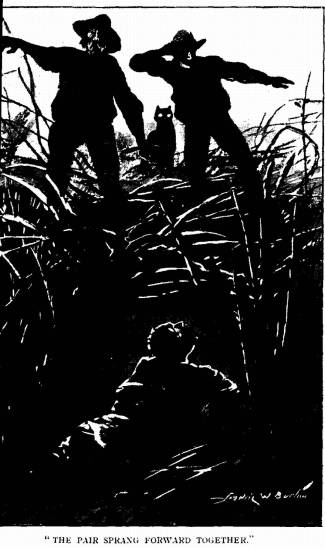
The pair sprang forward together, crashing recklessly among the branches in the direction of the sound; but as they reached the place from whence it seemed to have come all was still, and there was no response to their cries.
“All a mistake, my lad,” said Shaddy. “We’re done up, and fancied it.”
“Fancied? No, it was Mr Brazier,” cried Rob excitedly. “I’m sure of it; and— Yes, yes, quick; this way. Here he lies!”
Chapter Twenty Nine.
Friend and Patient.
They had sought in vain for the lost man; and when in utter despair they had been on the point of giving up the search, he had struggled back to them, his last steps guided by the fire when he had felt that he must lie down utterly exhausted, to die.
“Mr Brazier! At last!” cried Rob; and he went down upon his knee and grasped his leader’s hand, but there was no response, and the fingers he held were cold as ice.
“Here, lend a hand, Mr Rob, sir,” cried Shaddy roughly, “and help me to get him on my back.”
“Let me help carry him.”
“No, sir; my way’s easiest—quickest, and will hurt him least. He’s half dead of starvation, and cold as cold. Quick, sir! let’s get him down by the fire. It will be too dark in the hovel to do anything.”
Rob helped to raise the wanderer, Shaddy swung him on his back lightly and easily, and stepping quickly toward the fire, soon had the poor fellow lying with his feet exposed to the blaze, while water was given to him a little at a time, and soon after a few morsels of the tender fish, which he swallowed with difficulty.
They had no rest that night, but, with the strange cries and noises of the forest around them, mingled with the splashings and danger-threatening sounds of the river, they tended and cared for the insensible man, giving him food and water from time to time, but in quantities suggestive of homoeopathic treatment. Still they felt no fatigue for the great joy in both their hearts, for neither of them had the faintest hope of ever seeing their leader again.
Once or twice during the night Mr Brazier had seemed so cold and rigid that Rob had glanced wildly at the guide, who replied by feeling the insensible man’s feet.
“Only sleep, my lad!” he said softly. “I daresay he will not come to for a couple of days. A man can’t pass through the horror of being lost without going off his head more or less.”
“Do you think he’ll be delirious, then?”
“Off his head, my lad? Yes. It will be almost like a fever, I should say, and we shall have to nurse him a long time till he comes round.”
The guide was quite right. The strong man was utterly brought down by the terrible struggle of the past three days, and as they looked at his hollow eyes and sunken cheeks it was plain to see what he had suffered bodily from hunger, while his wanderings told of how great the shock must have been to his brain.
The mystery of the blood was explained simply enough by his roughly bandaged left arm, on which as they examined it, while he lay perfectly weak and insensible, they found a severe wound cleanly cut by a knife.
“He must have been attacked, then,” cried Rob as he looked at the wound in horror, while in a quiet, methodical way Shaddy proceeded to sew it together by the simple process of thrusting a couple of pins through the skin and then winding a thread of silk round them in turn from head to point, after which he firmly bandaged the wound before making a reply to Rob’s words.
“Yes, my lad,” he said; “right arm attacked his left. He must have been making a chop at some of the plants on a branch, and the tool slipped. You take out his knife and open it, and see if it ain’t marked.”
Shaddy was quite right, for there on the handle were some dried-up traces of how the wound must have bled.
It was a week before the patient began to show tokens of amendment, during which time Rob and Shaddy had been hard pressed for ways to supply his wants. There were endless things necessary for the invalid which they could not supply, but, from old forest lore and knowledge picked up during his adventurous life, the guide was able to find the leaves of a shrub, which leaves he beat into a pulp between two pebbles, put the bruised stems into the cup of a water flask, added water, and gave it to the patient to drink.
“It is of no use to ask me what it is, Mr Rob, sir,” said the guide; “all I know is that the Indians use it, and that there isn’t anything better to keep down fever and get up strength.”
“Then it must be quinine,” said Rob.
“No, my lad; it isn’t that, but it’s very good. These wild sort of people seem to have picked up the knack of doctoring themselves and of finding out poisons to put on their arrows somehow or another, and there’s no nonsense about them.”
The prisoners in the vast forest—for they were as much prisoners as if shut up in some huge building—had to scheme hard to obtain their supplies so as to make them suitable to their patient. Fish they caught, as a rule, abundantly enough; birds they trapped and shot with arrows; and fruit was to be had after much searching; but their great want was some kind of vessel in which to cook, till after several failures Rob built up a very rough pot of clay from the river bed by making long thin rolls and laying one upon the other and rubbing them together. This pot he built up on a piece of thin shaley stone, dried it in the sun, and ended by baking it in the embers—covering it over with the hot ashes, and leaving it all one night.
Shaddy watched him with a grim smile, and kept on giving him words of encouragement, as he worked, tending Mr Brazier the while, brushing the flies away and arranging green boughs over him to keep him in the shade, declaring that he would be better out there in the open than in the forest.
“Well done, my lad!” said the old sailor as Rob held up the finished pot before placing it in the fire; “’tis a rough ’un, but I daresay there has been worse ones made. What I’m scared about is the firing. Strikes me it will crack all to shivers.”
To Rob’s great delight, the pot came out of the wood ashes perfectly sound, and their next experiment was the careful stewing down of an iguana and the production of a quantity of broth, which Shaddy pronounced to be finer than any chicken soup ever made; Rob, after trying hard to conquer his repugnance to food prepared from such a hideous-looking creature, said it was not bad; and their patient drank with avidity.
“There,” said Shaddy, “we shall go on swimmingly in the kitchen now; and as we can have hot water I don’t see why we shouldn’t have some tea.”
“You’d better go to the grocer’s, then, for a pound,” said Rob, with a laugh.
“Oh no, I shan’t,” said Shaddy; “here’s plenty of leaves to dry in the sun such as people out here use, and you’ll say it ain’t such bad tea, neither; but strikes me, Mr Rob, that the sooner you make another pot the better.”
Rob set to at once, and failed in the baking, but succeeded admirably with his next attempt, the new pot being better baked than the old, and that night he partook of some of Shad’s infusion of leaves, which was confessed to be only wanting in sugar and cream to be very palatable.
That day they found a deer lying among the bushes, with the neck and breast eaten, evidently the puma’s work, and, after what Shaddy called a fair division, the legs and loins were carried off to roast and stew, giving the party, with the fruit and fish, a delightful change.
The next day was one to be marked with a red letter, for towards evening Mr Brazier’s eyes had in them the look of returned consciousness.
Rob saw it first as he knelt down beside his friend, who smiled at him faintly, and spoke in quite a whisper.
From that hour he began to amend fast, and a week after he related how, in his ardour to secure new plants, he had lost his bearings, and gone on wandering here and there in the most helpless way, sustaining life on such berries and other fruits as he could find, till the horror of his situation was more than his brain could bear. Face to face with the fact that he might go on wandering there till forced by weakness to lie down and die, he said the horror mastered him all at once, and the rest was like some terrible dream of going on and on, with intervals that were full of delight, and in which he seemed to be amongst glorious flowers, which he was always collecting, till the heaps crushed him down, and all was horror, agony, and wild imagination. Then he awoke lying beneath the bower of leaves, shaded from the sunshine, listening to the birds, the rushing sound of the river, and, best of all, the voices of his two companions.
Chapter Thirty.
An Unexpected Enemy.
Mr Brazier’s recovery took a month from the day of his regaining the balance of his reason, and even then he was weak; but he was about again, and, though easily fatigued, took his part in the many little duties they had to fulfil to sustain life in their forest prison. All thought of escape by their own efforts had been given up, and they had all taken the good course, roughly put by Shaddy as “making the best of things.”
In fact, the horror and shock of their position had grown fainter, the loss of poor Giovanni a softened memory, and the cowardly desertion of the Indians with the boat a matter over which it was useless to murmur. For the human mind is very plastic, and, if fully employed, soon finds satisfaction in its tasks.
It was so here. Every day brought its work, for the most part in glorious sunshine, and scarcely a night arrived without one of the three having something to announce in the way of discovery or invention for the amelioration of their lot.
“There is always the possibility of our being sought out and escaping,” Mr Brazier said; “and in that hope I shall go on collecting, for the plants here are wonderful; and if I can get specimens home to England some day there will be nothing to regret.”
In this spirit he went on as he grew stronger; and as for some distance inland in the triangle of miles, two of whose sides were the greater river and its tributary, they had formed so many faint trails in their hunting and fruit-seeking expeditions, the chances of being “bushed,” as the Australians call it, grew fewer, plenty of collecting expeditions were made, at first in company with Shaddy and Rob, afterwards alone.
One evening a tremendous storm of wind and rain, with the accompaniments of thunder and lightning of the most awe-inspiring nature, gave them a lesson in the weakness of their shelter-place, for the water swept through in a deluge, and after a terrible night they gazed in dismay at the river, which was running swiftly nearly up to the place where they kept their fire going. That the flood was increasing they had not the slightest doubt, and it promised before long to be right over where they stood, fortunately now in the brilliant sunshine, which rapidly dried their clothes and gave them hope as well.
“We shall have to go inland and seek higher ground,” Mr Brazier said at last.
“And where are you going to find it, sir?” said Shaddy rather gruffly. “There’s high land away back on the far side of the river, but we can’t get there, and all out as far as I’ve been on this is one dead level. Look yonder; there’s a lesson for us what to do if it gets much worse,” he continued, pointing toward a great tree at the edge of the forest.
“Yes,” said Rob as he watched a little flock of green-and-scarlet parrots circling round and perching in the upper branches, “but we have no wings, Shaddy.”
“No, my lad, and never will have; but I didn’t mean that. Look a bit lower.”
“Oh, you mean in that next tree. Ugh! how horrible!” cried Rob, with a shudder. “Has that been driven here by the water?”
“I don’t know what you’re talking about, sir. I mean that tree I pointed to. Look there in the fork.”
“Yes; I can see it, Rob,” said Mr Brazier. “It’s comfortably asleep. We must do as it does. Not the first time an animal has given men a lesson.”
Rob stared from one to the other as if wondering why they did not see with his eyes.
“Can’t you see it, Rob—your puma?”
“Eh? Oh yes, I see him now, but I meant in the other tree. Look! the great brute is all in motion. Why, it’s a perfect monster!”
“Phew!” whistled Shad; “I didn’t see it. Look, Mr Brazier, sir. That is something like a snake.”
He pointed now to where a huge serpent was worming its way about the boughs of one of the trees in a slow, sluggish way, as if trying to find a spot where it could curl up and be at rest till the water, which had driven it from its customary haunts, had subsided.
“What shall we do, Shaddy?” whispered Rob. “Why, that must be nearly sixty feet long.”
“It’s nearer two foot long, Mr Rob, sir. My word! how people’s eyes do magnify when they’re a bit scared.”
“But it is a monstrously huge serpent,” said Brazier, shading his eyes, as he watched the reptile.
“Yes, sir, and as nigh as one can judge, going round his loops and rings, a good five-and-twenty foot, and as big round as my thigh.”
“We can’t stay here, then!” cried Rob excitedly.
“Don’t see why not, sir. He hasn’t come after us, only to take care of himself; and I’m beginning to think it’s a bad sign.”
“That it does mean to attack us?” said Brazier.
“Not it, sir. I mean a bad sign about the flood, for somehow, stupid as animals seem, they have a sort of idea of when danger’s coming, and try to get out of its way. I should say that before long the waters will be all up over where we are, and that it’s our duty to get up a bit, too, and take enough food to last till the flood’s gone down.”
“And how long will that be?” Rob asked.
“Ah! that’s what I can’t say, sir. Let’s get together all we can, and I’m sorry to say it ain’t very much, for we punished the provisions terribly last night.”
“Yes, we are low,” said Brazier thoughtfully.
“There’s some nuts on that tree where the lion is, so we’ll take to that,” said the old sailor thoughtfully. “He’ll have to turn out and take to another, or behave himself. Now what’s to be done beside? We can’t get any fire if the flood rises much, and for certain we can’t catch any fish with the river like this. What do you say to trying to shoot the big boa with your bow and arrows?”
“What?” cried Rob, with a look of disgust.
“Oh! he’s not bad eating, my lad. The Indians feast on ’em sometimes, cutting them up into good stout lumps, and it isn’t so much unlike eel.”
“What, have you tasted it?”
“Oh yes, sir; there’s precious few things used for food when men are hungry that I haven’t had a taste of in my time.”
Just then Mr Brazier pointed to the place where they kept their fire, and over which the water was now lapping and bearing off the soft grey ashes, which began to eddy and swim round the little whirlpools formed by the swift current, before the light deposit from the fire was swept right away.
By this time, as Rob kept his eyes upon it, the great serpent had gradually settled itself down upon one of the far-spreading horizontal boughs of the huge monarch, which, growing upon the edge of the forest, found ample space for its spreading branches, instead of being kept back on all sides by fellow-trees, and so directing all its efforts in the way of growth upward toward the sun.
Brazier noticed Rob’s looks, and laid his hand upon the lad’s shoulder.
“I don’t think we need fear any attack from that, Rob,” he said, “for the water, if it goes on rising like this, will soon be between us, and I don’t suppose the serpent will leave one tree to get up into another.”
“Not it, sir,” interposed Shaddy; “and, excuse me, let’s be sharp, for the water’s coming down from miles away on the high ground, and it will be over here before long. Look at that!”
They were already looking at a great wave sweeping down the furious river, which was covered with boughs and trees, the latter rolling over and over in the swift current, now showing their rugged earth and stone-filled roots, now their boughs, from which the foliage and twigs were rapidly being stripped.
“Why, it’s right over our kitchen now.”
“And will carry away my pots!” cried Rob, running away to save the treasures which had caused him so much trouble to make.
“Look sharp, sir!” cried Shaddy; “here’s quite a torrent coming. We’ll make for the tree at once, or we shall be lost once more.”
“All right!” cried Rob, as he ran to the far edge of their fireplace, where the boughs and pieces of wood collected for fuel were beginning to sail away, and he had just time to seize one great rough pot as it began to float, when a wave curled over toward the other and covered the lad’s feet.
But he snatched up the vessel and hurried toward the tree in which the puma was curled up, Brazier and Shaddy following, with the little food they had left, and none too soon. They handed Rob’s two pieces of earthenware up to him, and then joined him in the fork of the tree.
The water was by now lapping softly about its foot, but from time to time a wave came sweeping down the river as if sudden influxes of water kept on rushing in higher up to increase the flood, and in consequence ring after ring or curve of water swept over the land, gliding now up amongst the trees of the forest, penetrating farther and farther each time, and threatening that the whole of the country through which the river passed would be flooded for miles.
The puma snarled and looked fierce as the two men followed Rob, but it contented itself with a fresh position, higher up in a secondary fork of the tree, where it crouched, glaring down at those below, but hardly noticed, for, after recovering their belongings, the attention of those on the fork was divided between the rising of the water and the uneasy movements of the great occupant of the next tree.
“I suppose we may confess to being afraid of a reptile like that,” said Brazier, measuring the distance between the trees with his eyes and looking up to see if the branches of either approached near enough to enable the reptile to make its way across.
“No fear, sir!” said Shaddy, with a smile, as he read his companion’s thoughts. “We’ve only the water to trouble us now.”
“But it will never get up so high as this?” cried Rob in alarm, as he thought of the trees which he had seen swept down the river, forest chiefs, some of them, which had been washed out by floods.
“I hope not, sir; but we have to be ready for everything in this country, as you’ve found out already.”
This set Rob thinking as he watched the waves coming down the river, each sweeping before it a mass of verdure, pieces at times taking the form of floating islands, with the low growth upon them keeping its position just as the patches had broken away from undermined banks.
“Don’t you wonder where it all goes, Mr Rob?” said Shaddy suddenly.
“Yes; does it get swept out to sea?”
“Not it, sir. Gets dammed up together in bends and corners of the river, and makes it cut itself a fresh bed to right or left. This country gets flooded sometimes for hundreds upon hundreds of miles, so that you can row about among the trees just where you like. Ah! it would be a fine time for Mr Brazier when the flood’s at its height, for we could row about just where we liked—if we had a boat,” he added after a pause.
Just then the puma gave a savage growl.
“Here, what’s the matter with you?” cried the guide sharply.
The puma snarled again and showed its teeth, but they saw that it was staring away from the tree.
“He can see the serpent,” said Rob eagerly; and they now saw the reason, for, evidently aware of their proximity, and from a desire to escape, the great reptile was all in motion, its fore-part beginning slowly to descend the tree, the head and neck clinging wonderfully to the inequalities of the bark for a part of the way, and then the creature fitted itself in the deep groove between two of the buttress-like portions, which ran down right away from the main trunk.
They all watched the reptile with curiosity, for its actions were singular, and it was exciting to see the way in which the whole length of the animal was in action as the head, neck, and part of the body glided down in a deliberate way, with the tongue darting out and flickering about the hard, metallic-looking mouth, while the eyes glistened in the sunshine, which threw up the rich colours and pattern of the scaly coat.
“He don’t like it, and is going to swim off,” said Shaddy suddenly, as the head of the serpent was now approaching the surface of the water. “I never saw one of this kind take to the water before. Say, Mr Rob!”
Rob turned to him.
“You had better get your cat down here, in case he means coming across to this tree.—No: there won’t be any need. I don’t think he could swim against this current: it might sweep him away.”
Rob drew a breath full of relief as he glanced at Brazier, whose face, pallid with his late illness, certainly looked paler, and his eyes were contracted by his feeling of horror. But their companion’s last words relieved him from his dread, and he sat there upon the huge branch that was his resting-place watching the actions of the serpent, which still glided on, and moved with its head close to the groove in the trunk till it was close to the water slowly rising to meet it, and a length of quite twelve feet reached down from the fork, like the stem of some mighty climbing fig which held the tree in its embrace.
“Yes, he’s going to swim for it,” said Shaddy eagerly. “Fancy meeting a thing like that on the river! I thought it was only the anacondas which took to the water, and— Well, look at that!”
The man’s exclamation was caused by the action of the serpent, for just as its head reached the surface of the flood one of the waves came rushing inland from the river, leaped up the tree three or four feet, deluging the head and neck of the serpent and sinking down again almost as quickly as it had risen. The reptile contracted itself as rapidly, drawing back, and, evidently satisfied with the result of its efforts to escape, began to climb again, holding on by its ring-like scales as it crept up and up till its head was back in the great fork of the tree, and the anterior part of the body hung down in a huge loop, which was gradually lessened as the great creature resumed its place.
There was nothing to fear from the serpent, to the great relief of those who watched; but it had begun to be questionable how long their present position would be safe, for the water was rising now with wonderful rapidity, great waves tearing down the river from time to time, bearing enormous masses of tangled tree and bush and sending out masses of foam, sweeping over the clearing with an angry rush, which changed into a fierce hiss as of thousands of serpents when the wave reached the edge of the forest and ran an among the trees with a curious wail till it died away in the distance.
When the waves struck the tree amongst whose branches the party were ensconced, the puma growled at the heavy vibrations, and began to tear at the bark with its claws. As one, however, worse than usual struck the trunk, it gathered itself together, uttered a harsh growl, and was about to spring off and swim, as if it feared being crushed down by the branches of the washed-out tree; but a few words from Rob pacified it, and it settled down once more, half hanging, as it were, across the fork, where it was swinging its tail to and fro and gazing down at the human companion it had chosen.
Chapter Thirty One.
A Forest Feud.
The little party sat there waiting patiently for the next event, their eyes being mostly directed across the waste of water toward the well-marked course of the stream, with its rush, swirl and eddy; and before long there was another heaving up, as if a liquid bank descended the river, spread across the opening, and directly after struck the tree with a blow which made it quiver from root to summit.
“Will it hold fast, Naylor?” said Brazier, rather excitedly.
“Hope so, sir. I think it’s safe, but it’s growing in such soft soil, all river mud, sand, and rotten wood, that the roots are loose, and it feels as if it would give way at last. I daresay this was a bend of the river once.”
“But if it does give way, what are we to do?” cried Rob excitedly.
“Swim for the next tree, sir.”
“But that has a great snake in it.”
“Can’t help that, Mr Rob. Rather have a snake for a mate than be drowned. He’s too much frightened to meddle with us. Look out, every one, and try to keep clear of the boughs, so as not to be beaten under.”
This was consequent upon the rushing up in succession of three great waves, which struck the tree at intervals of a few seconds, the last sending the water splashing up to where they sat, and at the same time deluging the serpent in the next tree, making it begin to climb higher, and exciting the puma so that Rob could hardly keep it from leaping off.
“The roots must be undermined,” cried Brazier. “Look—look!”
He pointed at the effect of the waves on the forest, for from where they sat the whole side was a ridge of foam, while the tree-tops were waving to and fro and undulating like a verdant sea as the water rushed on among their trunks.
“Can’t get much worse than this, I think,” said Shaddy, when the water calmed down again to its steady swift flow; “only it’s spoiling our estate, which will be a bed of mud when the flood goes down.”
“But will it go down?” asked Rob excitedly.
“Some time, certain,” replied Shaddy. “The rivers have a way in this country of wetting it all over, and I daresay it does good. At all events, it makes the trees grow.”
“Yes, but will it sweep them away?” said Rob, looking round nervously.
“It does some, Mr Rob, sir, as you’ve seen to-day, but I think we’re all right here.”
Rob glanced at Brazier, whose face was very stern and pale; and, consequent upon his weakness, he looked ghastly as another wave came down the river, and swept over the deeply inundated clearing, washing right up to the fork of the tree, and hissing onward through the closely-packed forest.
Another followed, and then another, each apparently caused by the bursting of some dam of trees and débris of the shores; but they were less than those which had preceded them, and an hour later the water was perfectly calm and motionless, save in the course of the river, where it rushed onward at a rapid rate.
“We’ve passed the worst,” said Shaddy; and after glancing at him quickly, to see if he meant it or was only speaking to give him encouragement, Rob sat looking round at the watery waste, for as far as his eyes could penetrate there was no sight of dry land. Everywhere the trees stood deep in water, that was still as the surface of a lake through which a swift river ran, with its course tracked by rapid and eddy, and dotted still with the vegetation torn out from the banks.
As the boy turned to the great tree beside him he could not keep back a shudder, for the monstrous serpent was in restless motion, seeking for some means of escape; and though there was no probability of its reaching their resting-place, the idea would come that if the writhing creature did drop from the tree, overbalancing itself in its efforts to escape, it might make a frantic struggle and reach theirs.
As he thought this he caught sight of the guide watching him.
“What is it, my lad?” he whispered; and the lad, after a little hesitation, confided in the old sailor, who chuckled softly. “You needn’t be alarmed about that,” he said. “If such a thing did happen your lion would be upon his head in a moment, and in a few minutes there’d be no lion and no snake, only the mud stirred up in the water to show which way they’d gone.”
“The water is sinking, Naylor,” cried Brazier just then, in an excited tone.
“Yes, sir, but very slowly.”
“How long will it take to go down?”
“Days, sir. This place will not be dry for a week.”
“Then what about food and a place to rest?”
“We’ve got enough to last us two days with great care,” said the man slowly, “and we shan’t want for water nor shelter from the sun. Rest we must get as we can up here, and thankfully too, sir, for our lives are safe. As to what’s to come after two days I don’t know. There is, I say, no knowing what may happen out here in two days.”
“No,” said Brazier sadly. “In one hour we lost our young companion and my first collection; in one minute I was hopelessly lost; and now this morning all my second collection has been swept away. As you say, Naylor, we do not know what a couple of days may bring forth.”
“No, sir,” replied the old sailor; “and there’s plenty of time yet. Every day brings its own trouble.”
“Yes,” said Brazier solemnly; “and every morning brings with it fresh hope.”
“Hope!” thought Rob; “hope, shut up here in the middle of this waste of water—in this tree, with a little food, a wild beast, and that horrible serpent looking as if it is waiting to snatch us all away one by one. How can a fellow hope?”
It was a time to think about home and the chances of ever getting back in safety, and Rob found it impossible to help wishing himself on board the great river boat as the evening drew near. At last, after standing up to talk to the puma, which accepted his caresses as if they were comforting in such a time of peril, the question arose as to how they would settle themselves for the night.
“I needn’t say one of us must keep watch,” said Brazier sadly, “for I suppose that no one will wish to sleep.”
“Couldn’t if we wanted to,” said Rob, in rather an ill-used tone; and Shaddy chuckled.
“Oh, I don’t know, Mr Rob, sir. Nice elevated sort o’ bedroom, with a good view. Plenty o’ room for swinging hammocks if we’d got any to swing. There, cheer up, my lad,—there’s worse disasters at sea; and our worst troubles have come right at last.”
Rob looked at him reproachfully, for he was thinking of Giovanni being snatched away from them, and then of the loss of the boat.
Brazier read his face, and held out his hand, which Rob eagerly grasped.
“Cheer up, my lad,” said Shaddy, following suit. “One never knows what’s going to happen; so let’s look at the best side of things. There, gen’lemen, it’s going to be a fine warm time, and we know it might have been a drowning storm like it was last night; so that’s better for us. It will be very tiring, but we must change our position now and then, and spend the night listening to the calls in the forest and trying to make out what they are.”
So as not to be left longer than they could help without food, they partook of a very small portion that night, and then settled themselves down; the puma became more watchful as the darkness approached, and whined and snuffled and grew uneasy. Now it was making its way from one bough to another, and staring hard at the tops of the trees away from the river; now its attention was fixed upon the great coiled-up serpent, which lay with fold heaped over fold and its head invisible, perfectly still, and apparently sleeping till the flood had subsided.
But Rob thought with horror of the darkness, and the possibility of the great reptile rousing up and making an effort to reach them, though he was fain to confess that unless the creature swam it was impossible.
Then the stars began to appear and the noises of the forest commenced; and, as far as Rob could make out, they were as loud as ever.
“One would have thought that nearly everything had been drowned,” he said in an awe-stricken whisper to his companions.
Brazier was silent, so after waiting for a few moments Shaddy replied:
“We’re used to floods out here, Mr Rob, sir; and the things which make noises live in the water as well as in the trees. I don’t suppose many of ’em get drowned in a flood like this. Deer and things of that sort make for higher ground when there’s a chance of the water rising; the cats get on the trees, and the monkeys are already there, with the insects and birds sheltered under the big leaves; and the snakes crawl up too, so that there isn’t much left to drown, is there?”