Queen of the Jesters
Reading edition
I. THE HUNGER OF FERDINAND DAUBERVAL
It wanted about an hour to sunset when Ferdinand Dauberval, sick with hunger and fatigue, passed through the Porte St. Denis and asked of the guard there the way to the Rue St. Paul.
“I am from Avranches, monsieur,” said he, “and though you may not think it from my appearance, this is the first time that I have set eyes upon the city of Paris.”
The guard thus addressed was a tall, good-humoured fellow, mounted upon a great black horse. He looked down, half in pity, half in amusement, at the dust-begrimed young man, who now clung to his stirrup-leather, if possible to rest his weary legs for a moment.
“Sang bleu!” said the guard. “If I took note of your appearance, my friend, I should think a good many things. You are from Avranches, you say? Then what have you to do in the Rue St. Paul?”
“That is my business,” replied Dauberval, sulkily; but correcting himself in a moment, he added, “though I don’t know why I should not tell you. I seek Mademoiselle de Montesson at the Hôtel Beautreillis. You know her house?”
The guard answered with a merry sneer.
“Oh,” cried he, “I should know that house pretty well—all the beggars in Paris go there. Follow the first blind man from the Quinze-Vingts Infirmary and he will lead you to the door like a dog at the end of a string.”
Dauberval, weak as he was, flushed with anger at the insult.
“Do you think that I ask alms?” he exclaimed.
“I am sure of it,” answered the guard, smiling maliciously; “Dame! you look as though you had not seen a crown for a twelvemonth. I should advise you to make haste. They close the gate at curfew, and then there is no more bread nor hot bean soup. You would not like to hear that, eh?”
Dauberval swore a big oath.
“If I had you upon the stones,” he snarled, “I would knock some sense into your silly head. Do you not see to whom you are talking? Oh, this Paris is a pretty place for a gentleman!”
He could have cried with his vexation, for pride, and pride alone, had brought him to the capital. It was true that his boots were in holes, while his clothes were so covered with the dust that their quality was not to be discerned; but still he plumed himself that his bearing and his manner of speaking were such as became the son of the advocate of Avranches, and it was galling to the point of madness that the first Parisian he met should talk to him as one would talk to a leper upon the steps of a parish church.
“To-morrow,” cried he, shaking his fist at the little group of idlers who had gathered about the horseman,—“to-morrow, I will return with my friends.”
“Hark to that,” roared a bellman, who was one of the first to come up, “the dusty gentleman has friends. He will return with them to-morrow. Let the Grand Chamberlain be informed, and the pages provided. Where is his excellency’s horse?”
“Do we know to whom we are talking?” chimed in a merry cooper, who stood with his hoops flung over his shoulder,—“well, it’s my belief that we talk to our Lord the Pope—”
“Or to the Captain of the Gate,” suggested a laughing hussy.
“Or to both,” said a rat-catcher.
Dauberval answered them with a word hissed out between his teeth. If he had not been so weak from hunger and fatigue, he would have run away from them, but as it was, he only walked on down the Rue St. Denis, cursing the day which had carried him to Paris; and that other day when he staked his last crown on a throw of the dice at Couches—and had lost it. Never had he thought that he, whose younger brother was high in the service of the Grand Equerry, would come to look with hungry eyes upon the bread which the very beggars ate,—much less that he himself would be mistaken for a beggar.
“Pah!” he muttered, while he fought the phantoms of hunger who seemed to dance up from the dirty gutters bearing loaves of sweet white bread in their hands, “why should I despair? The Rue St. Paul cannot be far from here, and Mademoiselle Corinne will know how to cure my troubles. Did she not find a place for Armand, my brother—and what a place! It is true that he has told her lies about me—but I shall answer them. And she will believe me. A pretty woman always believes a man when he is young and—”
He added in his heart “good-looking;” although it did occur to him that he would need a great deal of brushing and mending before he could appear without shame in Mademoiselle Corinne’s presence. He consoled himself, however, with the thought that her lacqueys would do this for him while their mistress was causing a good hot dinner to be prepared; and so keen was his imagination that the warmth of the food he awaited seemed already to fill his body with a delicious glow of heat. He began, in his fancy, to smell the pungent odour of spices; he said that he would arrive in the Rue St. Paul about the hour of supper, and that a fat capon might possibly be set before him. The horrible overpowering nausea, which was the result of his hunger, almost left him in the presence of these suggestions. He moved his mouth with the action of a man eating heartily, and a momentary return of his bodily strength enabled him to run straight on until he came out upon the Quai de l’Hôtel de Ville, and beheld the spires of Notre Dame stand up before him.
Paris was beginning to wake to the pleasures of her night then; and although it was early in the month of April in the year 1760, many people were abroad in the streets, sitting before the doors of their houses, or returning from their walk upon the ramparts. The great river itself was alive with boats; some filled by noisy students who played upon horns and drums; others with more orderly citizens bound for the wine-gardens and taverns of Passy. Dauberval stood a minute upon the quay to let the cool breeze play upon his burning face, and to watch the many strange figures and the many strange sights about him. He saw that he had never thought Paris could be so big. What a maze of threatening, cramped, yet picturesque houses was that upon the great island before him! How the cathedral dominated it all. Were there ever such fine fellows as these bucks and gallants on their way to dance with the butter-girls at the Quai de Gesvreo! Did any one ever hear such gibberish as these German mountebanks were talking! How the professional psalm-singers drawled! And there was a puppet-show too; and an acrobat from Italy, and a peoples’ letter-writer, and a hundred others; all merry, and busy, and withal good-humoured, because the day was done with and the lights had begun to twinkle in the city.
Dauberval would have been content at any other time to have spent a day upon this busy quay, but the hunger tearing at his vitals quickly made him remember his errand. He asked of a petty wench who was selling cocoa—“two goes for a liard”—the way to the Rue St. Paul, and she answered him with a saucy laugh.
“Ventrebleu!” she cried, “that you should be so blind—yonder it stands as close to your feet as a fool’s cap to his head. Oh, all the world can see where you come from.”
“And the Hôtel Beautreillis?” asked Dauberval, too weak to argue with her.
“At the corner past the Rue Charlemagne. Stop under the great bronze lamp and tell the concierge that you are a simple young man from the country. He will give you five sous to buy your supper with, and I will give you a drink of cocoa for nothing.”
She held out her can to him, and he took a little sup of the cocoa; but so great was his impatience to get to Mademoiselle Corinne’s house that he would not wait for the boiling stuff to cool, but ran on when he had gulped down a few drops of it. A minute later, he found himself under the shadow of the great walls of the Hôtel Beautreillis; and he saw the bronze lamp which the hussy had named. But it was unlighted, and the forbidding iron-sheathed door in the quaint Norman tower at the corner of the street offered to him a heart-breaking welcome. How, he asked, if the pretty philanthropist whom he had walked all the way from Avranches to see, were at her country house near Gros Bois? His brain went whirling round at the thought! He prayed to God—and it was many a year since a prayer had come to his lips—that his burden of suffering might not have this new evil added to it.
The Rue St. Paul was almost deserted at that hour. Long black shadows were stealing over the muddy flags of the wretched street. A few flickering lanterns cast a dull gleam of yellow light upon the dirty water of the open gutter. In the great house itself a dreadful silence reigned. Not a lamp shone in any of the narrow windows; not a footfall was to be heard in any of the courts. Dauberval beat with his fists upon the heavy oaken door, but he might as well have struck at the wall of the Bastille. No one answered to his puny knocking. He picked up a flag from the gutter and hurled it at the iron armour of the gate, but got for his pains only the weird echoes which went booming from cloister to cloister, and from tower to tower. And his hunger was now irresistible, horrible. His whole body seemed to be wasting away as he stood.
“Oh, mon Dieu!” he wailed, wringing his hands, and sobbing for very weakness, “have pity, have pity—one little drink of milk, oh, for Christ’s sake.”
He thought surely that he was dying; and it was cruel, he said, that he must perish of hunger at the very gate of his fortunes. The possibility that pretty Mademoiselle Corinne, who had done so much for his younger brother, Armand, might be at her château near Gros Bois, had not come into his reckoning until that moment. Never before in all his life had he known the meaning of hunger. He sat upon the stone steps before the unyielding door, and it seemed to him that a hundred demons were dancing round him, each bearing a tempting dish or a goblet of rich red wine. He beat them off with his fists, and others arose to caress him with visions of splendid feasts and tables groaning. His greedy eyes searched the gutters in the vain hope that an untrodden crust might lie there. He dipped his hands in the water of a shining puddle and bathed his burning forehead; but it only burned the more. He muttered a new prayer; and it was this—that his death might come quickly, and that he might suffer such agony no longer. And this was a prayer to which an answer was vouchsafed—but not such an answer as he had looked for.
Truth to tell, it all came upon him very suddenly. He had sunk down upon the step then, and his cheek was resting upon a slab of marble. Pain had begun to give way to unconsciousness; the turbid dreams to utter darkness of the mind. But from such a state of trance he awoke presently to find that the rays of a lantern were flashing in his eyes, and that a man dressed from head to foot in black had gripped him firmly by the arm. He had heard strange tales of the footpads of Paris; and his yawning imagination convinced him, for an awakening idea, that one such rogue sought to rob him. At any other time he would have laughed loudly at the notion; but now he was too weak to laugh—too weak almost to stand.
“Pardieu!” he snarled, “what the devil do you want with me? Can’t you see—?”
The man answered him with a word spoken to another at his elbow.
“Aubin,” said he, “take the right arm of Monsieur Dauberval, and let Joseph bring another lantern.”
Dauberval started up when he heard his name. The dazzling rays no longer blinded his eyes. He saw that the stranger’s black vest was richly embroidered with silver, and that diamonds sparkled upon the hilt of his sword. Beyond this, the great door of the Hôtel Beautreillis was now wide open, and servants were busy in its courtyard. Dauberval, who had been ready to declare that the apparition was a new cheat of his fancy, doubted no longer. Mademoiselle Corinne was in Paris. What was more, she knew that he was hungering at her gates. Never did a man’s fortune seem to be made so readily.
“Monsieur,” said he to the unknown, as they passed the lodge of the concierge, and so entered the vast central courtyard, “you have my name!”
“Assuredly,” said the other. “Your name is Ferdinand Dauberval, and you are the son of the advocate of Avranches. Five days ago, you left your home to walk to this house—having first robbed your father of a hundred crowns, the last of which you lost over the dice at Couches two days ago. I speak rightly, monsieur?”
Dauberval stood still with his astonishment.
“Ciel!” he cried, “you insult me, monsieur?”
“Oh, not at all,” replied the unknown. “You put a question to me, and I answer it. Is that an insult?”
“You say that I robbed?—” expostulated Dauberval.
“Come, come,” said the other, a little severely. “I really cannot argue with you, Monsieur Dauberval. While we wait in this draughty courtyard, your supper is getting cold. Remember how hungry you are.”
Dauberval, trembling with excitement, permitted himself to be led across the court and so to the smaller pavilion upon the left-hand side of it.
“I shall make up some tale,” he thought, “and she will believe me. Meanwhile, there will be food to eat and wine to drink. Dieu, how I could drink a cup of Burgundy! It will be time after that to remember my misfortunes.”
Like all rogues, he was easily elated. And the things which he saw about him were of a quality to satisfy any man. No sooner had he entered the pavilion than lacqueys came unbidden to brush his clothes and to bring a golden basin for his hands. While one fellow begged him to be seated and to remove his dirty shoes, another offered him a coat of velvet heavily laced with silver braid. Everything that greed of show and of wealth could prompt him to wish for was now thrust upon him unasked. Silk stockings took the place of his dusty woollen ones; the perfume of attar of roses exuded from the cooling water in which he washed the dust from his face; the lacqueys waited upon him with a homage which might have served a king. And this was the mystery of it all—that they did these things for one whom their mistress knew to be a thief.
Dauberval was too hungry at the first to debate upon such a nice problem. He did observe that the unknown man in black watched him with a curious smile—the smile of one who enjoyed some secret, but did not wish to share it. Yet this, he said, was the man’s satisfaction at his new appearance. Indeed, the stranger told him so presently, when he rose to conduct him to his supper.
“Ma foi, Monsieur Dauberval,” said he, “you will break some hearts in Paris. I never saw a coat sit so well upon a man. And you know how to carry it, too. Saint Denis, we must find you a sword presently, when the perruquier has done with you. You can use a sword, I will wager?”
Dauberval, who was the greatest coward in Normandy, drew himself up and bowed at the compliment.
“Sir,” said he, “if I were not so hungry—”
“Exactly, my friend. And since you are very hungry—come, supper is prepared for you.”
He opened a door in the ante-chamber to which they had first come, and motioned the other to go forward. Dauberval could scarce suppress a cry of delight when he saw that a table was spread in an exquisitely furnished cabinet; and that other lacqueys waited to serve him with all those good things of which he had lately dreamed. Nay, he was not sure that he did not dream still, for this room, he said, must surely be one in which kings supped. Such divinely wrought candelabra, such a painted ceiling, such a profusion of wax tapers, so soft a carpet, were not to be looked for except at the palace of the Tuilleries or at Versailles. Dauberval declared that the owner of it all must be rich beyond any woman in Paris. “And,” he said, “she means well to me or I should not be here.”
This self-assurance brought him to the table in wondrous good spirits. Although he had suffered much from his hunger, he was not so far gone that eating would be a danger to him; and when a lacquey put a little bowl of soup before him, he drank it down in great gulps. The warmth of it seemed to fill his body to the very toes.
“Oh,” he said, “how good it is—how good! Surely it is well to have suffered, monsieur, if one may—”
At this moment he turned round to find himself alone with the lacquey in the cabinet. The unknown had left him at the door; and Dauberval really was not sorry to be quit of his company.
“One can do nothing with a man,” he thought; “and he is gone to tell pretty Mademoiselle Corinne that I am here. She will come to see me presently, and I shall persuade her that I am a very honest fellow. After that, she will find me some place in Paris, and I shall have lacqueys of my own, and wine like this Burgundy. Saint John, how it warms my heart! And I have yet the half of a bottle to drink! Oh, it was a great day that took me from Avranches to my fortune at the Hôtel Beautreillis!”
Hopes like these, with a hundred others, filled his brain, while he helped himself to a dish of artichokes fried in marmalade, and afterwards to the breast of a well-boiled capon. He was careful to eat sparingly of the food, remembering how long he had fasted; but of the wine he drank abundantly. Nor did the lacqueys once speak to him while he ate. They might have been machines answering to some invisible wires. Dauberval, warmed with the Burgundy, began to assume lofty and patronising airs. He even attempted to enter into conversation with one of those who waited upon him.
“My good fellow,” said he, “is your mistress in Paris?”
The man bowed, but that was all his answer. Dauberval, more than ever anxious to play the part of the fine gentleman, pushed his chair away from the table and leant back in it posingly.
“Have the goodness,” he cried, “to inform Mademoiselle de Montesson that I crave a word with her so soon as it may please her to give me audience.”
The lacquey bowed again, and left the room with his fellows. He was careful not to laugh until he had shut the door upon his mistress’s guest; but then he laughed very heartily. Dauberval, meanwhile, was leaning back in his chair, and telling himself that this for a surety was the day of his life.
“She cannot mean to punish me for borrowing two hundred crowns of my father,” he said to himself, “or she would not have treated me like this. No doubt she has heard some slander; but I shall correct all that. And then she will give me a place. Possibly it will be with the Grand Equerry, where my brother is; or should there be no vacancy there, I would even submit to serve for a while as page to his highness the Duke of Nevers. In any case she will make my fortunes. Who knows, she might even think me handsome, as the girls of Avranches did. And then—pardieu!—and then—”
To his utter confusion, a voice of singular sweetness answered his question, which he had intended for no other ears than his own.
“And then, Monsieur Dauberval?”
“Diable!” cried the man, as he sprang up from his chair and turned round to face the intruder. But the other words he would have spoken died away upon his lips; for there, standing behind him, with the merriest laugh possible upon her pretty face, was Mademoiselle Corinne. And so great was the shame of the fellow because his silly talk was overheard that he would have thanked God if the earth had opened and swallowed him up.
“Mademoiselle,” he stammered, and he was sure that he had never seen a more exquisite vision than this of the owner of all these riches,—“mademoiselle, I do not—indeed.”
“Oh,” she said, laughing more than ever at his confusion, “but you did. And let me tell you, monsieur, that I think the girls of Avranches showed exceedingly good taste.”
Dauberval, like most rogues, could bear himself well in ordinary circumstances before a woman. He had looked to find a grand dame, haughty, imperious, exacting; but now that Mademoiselle Corinne really stood before him, and he saw that she was an exceedingly beautiful girl, whose face wore the kindliest smile he had ever beheld, he took new courage and began to look up.
“Mademoiselle,” he exclaimed, “you overheard me just now saying some very foolish things. I thought that I was alone or I should not have uttered them. I beg you to forgive me.”
“Indeed, monsieur,” she answered, still smiling, “I shall do nothing of the sort. You have yet to answer my question. Here am I agreeing with the young ladies you speak of, and dying to know what next—yet you tell me nothing. For shame, monsieur, to leave a lady ailing with her curiosity.”
“Misfortune overtake me if I do any such thing,” cried Dauberval, bowing gallantly, “yet, for the life of me, mademoiselle, I cannot remember what I was saying.”
“Oh, but I remember it perfectly, Monsieur Dauberval,” she answered; “you were saying ‘and then—’ I want to know what comes after ‘and then’—”
A quick thought passed like an inspiration through the man’s mind.
“Mademoiselle,” he cried, “you insist?”
“Certainly I do.”
“Then I will tell you in a word. I was saying to myself as you came in that if I should be happy enough to merit your favor, you would find me some place in Paris.”
He stood watching her keenly to see how his boldness would be repaid; but her immediate answer was only a command.
“Sit, mon ami,” she said, “and then we will talk of things.”
Dauberval took a chair and drew it near to the little couch upon which she was resting. He was so close to her now that he could count the diamonds which made a rope about her lovely neck. He said that he had never seen such surpassing loveliness of skin or face; never a woman worthy to sit at the feet of Corinne de Montesson. The very air about her was laden with the breath of roses. Her girlish face was like the face of one of the Madonnas which the great masters had painted. Her voice was like the note of a silver bell.
“You wish me to find you a place in Paris, Monsieur Dauberval,” she said, when they were seated. “Well, that is already done—”
“What,” cried Dauberval, forgetting himself in his surprise,—at the same time he said to himself, “My fortune is made.”
“Yes,” she continued, “after making all inquiries about you, I am willing to take you into my service.”
Dauberval’s expectation became tremendous. “She knows nothing,” he thought.
“You will consent, I am sure, monsieur,” Corinne went on, “to do as my other servants have done, and to attain promotion by your diligence and fidelity. Yet I do not forget that you were educated by the curé of Avranches, and are a man of some learning. On that account, I have determined to overlook all that I might remember about you, and to make you an usher of the table.”
Dauberval listened no more, but sprang from his chair. He was white with passion when he answered her.
“Dieu! mademoiselle,” he cried, “would you make a lacquey of me?”
“Exactly,” she replied, without so much as noticing his temper; “an usher of my table to begin with, and after that clerk to my household, if your service in the first employment warrants it. It is even possible, should you seek by the future to blot out the sins of your past, that I may remember you as the brother of Armand Dauberval—whom you drove from his home after accusing him falsely of a robbery.”
“It is a lie!” stammered Dauberval, hoarse with his anger. “I am the victim of—”
Corinne de Montesson rose from her seat, and touched a gong at her side.
“Monsieur,” she said very quietly, “to-night you remain here as my guest. If you are willing to accept the post which I offer you, hold yourself ready to begin your work at ten o’clock to-morrow morning. But I warn you that should you speak to me again as you spoke just now, my servants shall flog you at the tail of a cart. You understand me?”
There was laughter in her eyes no longer, and her cheek was warmed with a red flush. Dauberval realised for the first time what a great gulf lay between them. His hopes had gone tumbling down already pell-mell, like stones into a pit. He was cowed, and he trembled with rage and disappointment.
“Ciel!” said he, wringing his hands, “that you should wish to make a lacquey of me! Oh, mademoiselle, have pity—you know what I have suffered.”
“Say rather, that I remember what your brother suffered at your hands,” she replied. “Indeed, Monsieur Dauberval, you reap that which you have sown. Have a care, then, to treasure in the future the seeds of honesty and of love. I wish you good-night, monsieur.”
She retired with a gentle grace, a lacquey holding the door as she passed to her own apartments. Dauberval followed her with eyes in which the tears of shame and cowardice welled up plenteously. Her words had stung him like a whip; yet, he said, he could have forgotten them quickly enough had she not sought to put this insult upon him. But to make a lacquey of him! Better by far to have remained in Avranches, he thought, and to have extorted money from his father. There, at any rate, people did not forget that he was born a gentleman. But here, in this unpitying Paris—to make a menial of him, he who had dreamed that he was soon to have lacqueys of his own! Oh, it was not to be tolerated!
He had been pacing the room for some little time, gathering the threads of his anger, when the servant returned to tell him that his bed-chamber was prepared. He followed the fellow sullenly, determined already in his own heart that he would never submit to the proposed degradation. After all, he could still return to his home and say, “Father, I have sinned.” It would be a terrible humiliation; but he preferred the thought of facing it to that of remaining in the Hôtel Beautreillis. As for his brother Armand—it would be no use to beg of him. Dauberval knew well enough that he had driven his brother from their home, caring nothing if he lived or died. How then should that brother pity him?
The lacquey, meanwhile, had conducted him down a long stone corridor; thence across a little garden, and through a second passage, which terminated in a small circular hall off which five doors opened. Dauberval scarce took notice of anything that he passed; but when the lacquey opened the third of the five doors and informed him that here was his bed-chamber, a new interest occupied him. None of Mademoiselle Corinne’s reproaches seemed to fit in with the elegance of the room to which he had been conducted. It was a room for the king, he said for the second time, while the man lighted the candles in the gilt sconces and set a cup of wine upon the table. The great bed with the canopy of gold above it; the superb tapestries hung upon the wall; the many candelabra of solid silver; the luxurious carpet beneath his feet,—all these things should have been at Versailles, he thought, and not at the Hôtel Beautreillis. And it was maddening to him to remember that he was to enjoy such splendours for one night, and only for one night.
“To-morrow,” he snarled, for the servant had left him then,—“to-morrow they will make a lacquey of me! Oh, that shall never be! I swear it on the cross. She shall listen to me in the morning—I will go on my knees to her—I will humble myself—she will surely relent then. She must relent.”
He repeated these words again and again, and they were still upon his lips when he climbed into the high bed and stretched himself luxuriously upon the downy cushions. The candle was out now, and the moon’s beams flooded the room picturesquely, seeming to magnify its size and beauty. Indeed, the very splendours of the apartment awed the man. He lay for a long while unable to sleep, or to do anything but contemplate the things he would plan and say when morning came. When he had settled those to his satisfaction, and sleep still refused her friendship, he began to follow the path of the pale yellow rays and to observe the beauty of the things they touched with their caressing light. He remarked then for the first time a little picture of a Madonna hung near the wall by his bed; and when he had looked at this for some moments, he saw that it was the central piece of a shrine upon which there was a cross with a great diamond blazing in the centre of it. So beautiful were the lights which the jewel scattered, so large was it, that Dauberval asked himself why he had not seen it before. Then he sat up in bed the better to observe it, but lay down again quickly lest the thought which came to him so powerfully should remain and prevail.
“She must be very rich,” he said, as he drew the clothes over his head and fought anew for sleep. “That diamond alone would keep a man in food and wine for life. She has many more like it, I am sure, and would never miss it. If a rogue were sleeping here, he would put that cross in his pocket and she would never know its loss. Besides, she is going to make a lacquey of me. Saint John—I could be even with her if I had the mind to!”
He lay for some moments trembling with the excitement of the thought. He knew that such a diamond as the one which lay within reach of his hand would enrich him for life. He had but to slip the cross into his pocket and to climb the wall of the garden through which he had passed to his room, and he need think of being a lacquey no more. What a revenge that would be, he said. And why did he owe her any mercy? She had shown him none. Nay, she had threatened to have him beaten at a cart’s tail. “We shall see about that,” he muttered—and then he sat up in bed again. The diamond shone now with a finer, richer lustre. All the loveliest hues seemed to be commingled, and to be poured out together from its sparkling wells of light. Dauberval had not dreamed that there was such a jewel in all the world. The sight of it was to him like a cup of wine to a drunkard. “Heaven!” he muttered, “it is a prince’s ransom—and I am alone.”
He was out of bed now, and his teeth were chattering with dread of his determination. While he said all the time that he was not going to steal the diamond, he knew perfectly well that he had made up his mind to do so. Quickly and with trembling hand he drew on his boots and his fine new coat. He opened his bedroom door, and found to his satisfaction that the little hall outside was in darkness and as silent as the grave. Everything drove him on to the crime which he declared that he would never commit, but which he was even then committing. Twice he touched the diamond, and drew back his hand as though it had been burned by fire.
“Coward,” he cried, “coward, coward—to turn your back on a fortune which lies there before your eyes. Ten steps and you are in the garden; you leave Paris at dawn and set out for England—a little hiding by the way, perhaps, a little privation—and then, and then—!”
Visions of luxury, of ease, even of vice, passed before his burning eyes. A new hunger, the hunger of wealth, was upon him now. The agonies of the temptation were like the agonies of a burning fever. He stood rocking on his heels before the shrine, saying, “I will not, I will not.” He covered his face with his hands, yet the lights from the sparkling jewel seemed to flash into his very brain. When at last he grasped the stone with trembling fingers, and thrust it deep down into his bosom, phantoms of the night gathered about him in his fancy and cried, “We see, we see.”
With possession, the fever abated a little. He was in a cold sweat now; but his ideas were less confusing. When he opened his bedroom door to pass into the circular hall, he knew well enough what plan to follow. The garden, he was sure, lay not more than twenty yards from him. He had seen, while they had conducted him to his room, great trees growing against the walls of it, and he determined to climb this wall by their help and so to gain the street.
He opened his door, and stood for a moment to listen if there were any sound about the house. A little whisper of the wind sighing in the dome of the hall was the only answer to his silent question. Encouraged by the stillness, he stepped from his chamber and began to creep towards that door of the five through which he believed that he had passed to his bedroom. And here a difficulty which he had not foreseen suddenly presented itself and demanded consideration. The five doors in the hall were as alike as five drops of water. How if he opened the wrong one, and found himself, not in the garden, but in the bed-chamber of some lacquey or page? That, he declared, would mean the galleys at the least. And he blamed himself now that he had not tried the doors before leaving his bedroom. To be taken with the jewel in his possession were a folly indeed.
Dauberval was a cunning rogue at all times; but he did not know what forces of cunning and trickery were being pitted against him as he stood debating the puzzle of the doors. At the very moment when he thought he was alone, six pairs of eyes were watching him with interest and not a little amusement. True, there was a moment when he had an instinctive warning of peril hovering about him, and that was the moment when the door of the bedroom he had just quitted shut suddenly and the key grated ominously in the lock.
“Mort Christ!” he muttered, “my door has locked itself—I heard the key turn—what a thing to happen!”
There was no doubt about it at all. The door had shut and the key had turned. Dauberval stood like one petrified, pressing the jewel to his breast with both his hands, and telling himself that the wind had done the work. So unnerved was he that he did not lift a foot until minutes had passed and no other sound had come to break the whispers of the night. The vision of the galleys and the whip was ever before his eyes. When at length he moved again, it was this vision which gave him strength.
“Bah!” he said, “am I a woman to start at the fall of a pebble? If I stand here much longer I shall go to sleep, and a lacquey will find me at daybreak. Courage, then—a little courage and all is well.”
The idea put new life into him. He tried the first of the doors, but it was locked; and the second, in like manner, refused to yield to his hand. Only when he came to the fourth door did he take heart and say that success was near to him. For that door opened readily at his touch; and when he had hesitated a moment lest it should lead him to a room and not to a passage, he pushed it back inch by inch that the little light in the hall might break the darkness which now blinded him. He would have given half he possessed to hold a lantern for a minute then, so dark was the place in which he found himself; but he knew that he could not work miracles, and so he nerved himself for a last effort and boldly passed the door. In the same instant, the place was flooded by a soft yellow light, and Mademoiselle Corinne stood face to face with him.
She was dressed in a loose gown of muslin, spotlessly white and unornamented, and she held a golden candlestick high above her head that the light might fall upon the face of the man. Dauberval, staggering with terror, observed that a small diamond cross glittered upon her white neck, and that a great Russian hound crouched by her side and pressed his nose into her hand. She had entered the little cabinet through a panel opening in the wall at a spot exactly opposite to the door which led the rogue to this trap; but she appeared to be quite alone, and to know the purpose of her coming.
“Well, Monsieur Dauberval,” she cried, and there was merriment in her voice,—“well, Monsieur Dauberval, are you not pleased to see me?”
Deceived by her manner, the robber looked up. “She is alone,” he thought, “and she is a woman.” But he made no attempt to answer her, seeking rather to escape from the room into the hall behind him. And at this she laughed aloud.
“For a truth, you are a bold fellow,” she continued, as the man backed towards the door, “and I am very glad that you did not die at my gate to-night. Have a care to your steps, I beg of you, Monsieur Dauberval, or you will be of little service to the galleys. Shall I summon a lacquey to carry your plunder? How unfortunate that you should awake me at the very moment you were robbing my house!”
Something in the tone of her voice, a note of scorn mingling with the chord of her laughter, compelled the man to stand. It occurred to him that he must deal with her before he left the room, or assuredly she would awake the house, and he would be taken in the gardens of it. He determined to play first upon her pity.
“Mademoiselle,” he exclaimed, coming a little nearer to her, and speaking with an effort, “you are very cruel to me—I could not sleep—I wished to walk a little way in your gardens—do you think that I am a robber? God forbid—I swear it on the cross.”
“On the cross which you carry at your breast, Monsieur Dauberval?”
“Ciel!” he gasped, drawing back again, “you know about that?”
“You hear that I do; and since I know about it my servants are now going to carry you to the Palais de Justice, where you will have leisure to regret that you did not become a lacquey.”
She said this, and with the words she took up a padded stick and raised it as though to beat upon the gong by which she stood. For a moment, however, she held her hand; and forgetting that she had laughed, she went on to remind the man of that which he had lost.
“When you came to my house to-night,” she said, “I was content to forget the life you have lived and the crimes you have committed. For your brother’s sake, I thought to give you one more opportunity of becoming that which you will never be—an honest man. To-morrow, had you submitted for a day to the test which I chose for you, I would have remembered again that you were the son of the advocate of Avranches. You will not ask me to do that now, Monsieur Dauberval?”
Dauberval listened to her with burning ears. He watched the upraised stick as he would have watched a tiger about to leap upon him. He knew that if the gong were struck, his hope of life would die away with the echoes of the note.
“Mademoiselle,” he wailed, “for God’s sake spare me—you will never regret it—I swear it on my knees—hear me—you will not summon your servants?”
He fell upon his knees before her and raised his hands in cowardly entreaty. But her answer was unpitying.
“Nay,” she said, “I am about to summon my servants now.”
“Dieu! mademoiselle,” muttered the man, springing to his feet, “you shall do nothing of the sort.” But to himself he said again—“She is a woman, and she is alone.”
All the devils of evil were spurring him on now. He knew that it was his life or hers—the life of a helpless girl or of a man with one foot already upon the scaffold. And he was going to plead with her no more. When he rose from the floor, he told himself that he would kill her. The madness of his mood magnified and became uncontrollable. He raised his hand to strike her down, shutting his eyes that he might not see the exquisite beauty of her face.
“You shall not do it,” he cried savagely. “By Heaven, I will prevent you.”
“Indeed,” she cried, stepping back quickly, “it is already done;” and even as she spoke the blows fell,—that of the man in the air, that of the woman upon the silver gong.
Dauberval had struck wildly; but he struck no second blow. He had said “She is alone;” but never was she less alone. The great dog at her side, who had curled himself up to sleep while his mistress had no need of him, awoke at the booming of the gong, and was at the throat of the man, even while he reeled back for a new attack. With a low warning roar, the beast sprang at the robber, and felled him as an ox is felled by a butcher’s axe. Over and over upon the wooden floor the two rolled; the dog growling ferociously, the man imploring, screaming, fighting. Death seemed to breathe into his very face now. He had his arm across his throat, and the hound’s fangs touched the bone of it. He struck the brute again and again with his clenched fist; and for every blow his whole body was shaken until his teeth gnashed like the teeth of a madman.
“Kill me, kill me,” he screamed, “for God’s sake!—oh, he is tearing me limb for limb! Heaven!—what suffering!”
He had rolled now almost to the door of the room, and there the hound drew back for a moment, hearing his mistress’s voice. Dauberval, mad with fear and pain, scrambled to his feet and staggered out into the hall of the unyielding doors. A light was there now; and one of the five doors stood wide open before him; but he had no thought of asking how or for what reason. Dread of the dog drove him onward recklessly. “Anything, anything but that,” he cried; and reeling, staggering, sobbing, he passed through the door and down the long passage to which it gave access. Whither he was going or to what end, he knew not nor cared to think. One idea dominated him to the exclusion of all others—it was the idea of flight—flight to any refuge, even the refuge of the scaffold.
There was very little light in the corridor where he now found himself, and when he had run perhaps twenty yards he turned a sharp corner and was then in utter darkness. So black was it that he could not see the ground at his feet. He guided himself only by touching the wall with his fingers. It was a smooth wall, a panelled one, he saw at first; and though he knew that he might go tumbling headlong down a staircase, or crashing against a door at any step, so great was his terror that he ran heedlessly, believing ever to hear the patter of the hound’s paws upon the ground behind him, even to feel his wet and frothing lips against his hand. And he was becoming exhausted now. Often he reeled against the wall and thought that he was fainting. Would he never come into the garden, he asked? He had been running for long minutes now, and still the dreadful wall guided him onward, onward. Once he paused, panting for his breath, but his ear told him plainly that the hound had followed him. There was no mistaking that haunting “pat, pat, pat,” behind him. “God have mercy—he will tear me limb from limb,” he cried, and so wailing he began to run again.
Dauberval was a man who had known few hardships in life; but just as the past two days had taught him what it is to hunger, so did this night of agony teach him the meaning both of fear and fatigue. He had not dreamed that a man could conceive so great a horror and loathing as this horror and loathing of the hound which now possessed him. As to his fatigue, there were no words to tell of that. His life seemed to exude from his body drop by drop. Every step was a torture to him. The tears ran down his face like rain; a spasm gripped his heart and seemed to hold it still; his legs were so weary that he could scarce lift them from the ground. And to his terror of the seen, the terror of the unseen was now added. He had run for the third part of an hour by this time; and still the terrible wall led him on. He began to say that fiends were cheating him—for how could the Hôtel Beautreillis possess a corridor down which a man might run for twenty minutes? That would carry him half across Paris. Under any other circumstances he would have tried to reason with the situation, but the ominous patter of the hound banished reason from his head. More than this, he heard the soft tread of other hounds now before him, now behind him. He shrieked aloud with his fear, and fled again like a madman.
There is an end to the endurance of terror and of the false strength which it inspires. Dauberval kept his legs to the ultimate moment, for he told himself that if he fell, the hounds would tear him as they would tear a deer. But at last pitying nature came to his aid. He remembered only that he stretched out his hands before him, staggering blindly into the darkness. Then, with a terrible cry, for he heard the dogs at his very feet, he fell senseless to the floor and lay like a dead man.
When he opened his eyes, hours had passed. The ghostly dawn light streaming through a lantern tower above him told him that day had broken; but he lay motionless for long minutes, unable to remember how he had come into the place where now he was, or why he slept upon a wooden floor. He was still very weak, and his limbs were cold and stiff and painful; his brain burnt, and would shape no story for him. When at last he began to remember the events of the dreadful night, he thought first of the diamond, and pressed his hands to his breast instinctively; but the jewel was gone; nor could he recollect how he had lost it. By and by he recalled the moment when he had left his bed-chamber; and that other moment when pretty Mademoiselle Corinne stood before him and he had struck her, and from that thought he passed to memory of the hound. So potent was this in terror, that it compelled him to stagger to his feet. Half awake as he was, the whole dread of the night came rushing back to him. He could hear the hound still—that he would swear; and even when he stood up and asked himself, “Where am I?” the haunting “pit, pat” still sang in his ears.
“Oh, mon Dieu!” he wailed, “have I lost my reason? Where am I? What do I hear? Oh, pity me, pity me!”
He looked all about him and could make nothing of his environment. He was in a great building, certainly,—a building which looked like a riding-school, and was in the shape of an oval. He observed clearly that a high wall ran round this building, and that he had been lying upon a wooden corridor which made a little platform beneath the wall. Dense as he was, it began to dawn upon him that he had been running round and round this corridor; and at this thought he trembled with passion.
“Heaven!” he cried, “that I should have run round and round like a horse which amuses the people—oh, what cruelty to play me such a trick—what cruelty—”
His distress was so great that he began to wring his hands and to pace the corridor distractedly. And he had been engaged in this employment for the space of a minute, when the second of his delusions was taken from him. For, suddenly, he came upon a little fountain built into the wall of the riding-school; and as he stood a minute to bathe his hands and forehead at it, it occurred to him that the music of it was familiar; and that its “drip, drip, drip” was just like the pat of a dog’s paw upon the ground. “Holy Saints!” he cried with a sob, “that I should have run away from a basin of water. There is the patter of my hound. Oh, God! what a night of agony!”
A mocking laugh was the answer to his word of ultimate distress. He turned round to find himself in the presence of the man in black, who had met him at the gate yesterday; and he saw that a lacquey awaited the orders of the unknown.
At sunset that evening, Ferdinand Dauberval passed through the Porte St. Denis on his way to his father at Avranches.
“Halloa,” cries the bellman, “here is the dusty gentleman who has friends. Bon soir, monsieur—was the king well when your excellency dined with him?”
“It is my belief that we talk to our Lord the Pope,” exclaimed the cooper.
“Or to the Captain of the Gate,” said the saucy wench.
“Or to both,” shouted the rat-catcher.
But the mounted guard laughed heartily, and cried:—
“Good-day, little fire-eater! Did they give you alms at the Hôtel Beautreillis. Saint John, what an honest face you have! Oh, it is plain that you are a loss to Paris!”
Dauberval stood for a moment to shake his fist at them. Then he passed the gate, and Paris knew him no more.
II. THE LIBERTY OF THE LITTLE RED MAN
Coq le Roi, the highwayman, started up in his bed when the great bell of Notre Dame struck midnight. Silently, and with a waking man’s curiosity, he counted the strokes, nodding his head at each one, and thinking to himself that it would be five or six of the morning, and time for him to be about. But when the clock went on to tell the hour of twelve, an exclamation burst from his lips.
“Mort Christ!” said he to himself, “I have not slept an hour. I might know that by the music below. Saint Paul! what throats they have!”
No man cares to be deceived with the tricks of sleep; nor was Coq le Roi,—otherwise the Little Red Man, otherwise Jacques Cabot, the notorious scourge of the highways about Paris, and one of the most successful robbers that ever set spurs to a horse,—an exception to the rule. He concluded that he had a personal grievance against the night for thus cheating him. He began to tell himself that he was thirsty, and would do well to draw on his boots and venture out to a cabaret for a cup of wine. Then he remembered that he was not in the habit of losing his sleep because a few cutthroats bawled beneath the window of his garret. Some strange sound, some unusual omen of the night, must have troubled his ears while he slept, he said. And for the first time for many a day he began to remember that the guards of the new Lieutenant of Police were then hunting for him out in the woods beyond Fontenay.
“Sang bleu!” he cried, springing suddenly from his bed, and going to the window of his garret that he might look down thence to the narrow street below, “am I a woman that I should start at shadows on the wall? What a thing to tell—at the house of the Red Cock too!”
He put his head out of the window, and the moving panorama of the slum below reassured him. There, in the heart of the thieves’ quarter of the Paris of 1761, he might well think himself safe even from the early energies of Monsieur de Sartines who had just come to be Lieutenant of Police. Though the day had begun with driving sleet and bitter wind, few of the beggars in that Rue St. Sauveur thought of sleep, or indeed of anything but their pleasures. Regularly, when night fell, these rogues whom Coq le Roi now looked down upon with satisfaction, hastened to quit the church doors and the gates of the hôtels, and hurried to the labyrinth of filthy lanes and tottering houses which had marked their kingdom behind Rue Mauconseil almost since Paris had risen about the islands of the marshes. A motley group they were; blind men counting their sous; lepers washing off their sham sores; lame men carrying their crutches; orphans cursing their fathers and mothers, who cursed them back again; venders of oranges with their cry, “Portugal, Portugal;” rogues whom the gibbet long had claimed in vain. Weary with the labours of the unbefriending day, eager for the shelter of the cabaret, ripe for quarrel, or drink, or play, they now rioted in the security of the alleys behind the markets, and so hid from the night of the greater Paris, the cankering sore, which was her reproach by day.
Coq le Roi permitted the bitter wind to blow upon his face for some minutes, then he drew back his head, for he remembered his intention to drink a cup of wine at the nearest cabaret, and he found the idea a very good one.
“Bah!” said he to himself, as he tugged at his long boots and looked to his pistols, which lay, ready for priming, upon the table by his ragged bed, “what have I to do with woman’s tattle here? Guards in the Rue St. Sauveur! what a day that would be! I should like to see it.”
The notion amused him, and he chuckled to himself pleasantly; but of a sudden the laugh died down upon his lips, and he sat upon the bed like one petrified. He had become aware, in that instant, of the presence of another in the room,—a gaunt figure dressed from head to foot in black, and masked so closely that even his eyes were not visible. Noiselessly, with no drawing of bolt or creak of foot, the apparition had come to his bedside. The robber feared nothing human—but now he trembled so that the whole bed shook, and the sweat fell in icy cold drops from his brow down upon his naked chest.
“God have pity, who are you?” he asked, not daring so much as to raise his hand to the pistol beside him.
The stranger laughed merrily, and crossing before the robber, he sat himself down upon a rough oak bench which was the only seat, other than the bed, in the miserable attic. Coq le Roi could see by the little light which fell through the lattice that the visitor wore very good clothes, and that the hilt of his sword was a-glitter with diamonds.
“Bon soir, Monsieur Jacques Cabot,” said the man, leaning back against the wall, and crossing his legs for comfort,—“Bon soir; or perhaps I should say rightly, Bon jour. The clock has just gone twelve, I think.”
Coq laughed nervously. He was ashamed now that he should have so carried himself.
“I thought you were the devil,” said he.
The man neglected to see that he was unanswered.
“You are an early riser, Monsieur Cabot,” he continued playfully, “to be out of your bed at midnight. What a monk you would make!”
The robber shrugged his shoulders, and since he feared his visitor no longer, he stretched out a hand and took up one of his pistols. In the same moment the man in the mask gave a sharp lunge with his foot, and so cleverly was it done that the pistol went flying up to the roof and there exploded with a crash like that of cannon.
“Imbecile,” said he, “would you fire upon one who comes to save your neck?”
Coq le Roi sank back upon the bed with a sigh. After all, he said to himself, there was something uncanny about the coming of this mask.
“Well,” he asked doggedly, “and what next?”
The man rose and opened the window.
“This is no time for words,” said he; “let your ears tell you the tale.”
He held up his hand warningly, bidding the other to listen; and while the two stood there at the little casement a strange sound arose above the hum of the city life. It was a sound neither of beggars brawling nor of rogues at their play. When it had continued a little while, there was added to it the loud rattle of musketry, the clash of swords, and the tramp of many feet; while clear above all, and resounding like the note of a trumpet, was the cry, “The guards, the guards!”
“You hear,” exclaimed the unknown, drawing back from the window, “our friends, the cutthroats, are welcoming the guards of the new Lieutenant of Police. Shall I tell you, Monsieur Cabot, how many years it is since a dragoon dared to pass the Virgin’s statue? You have no love for history, you say. Saint Denis, I do not wonder at it, since it is for you that Monsieur de Sartines has brought about this pretty play and come into this den of beasts.”
Coq le Roi, quickened by the danger, began to prime his second pistol. His natural courage had returned to him now. Little man that he was, little and with a face like a young girl’s, he had made danger so good a bedfellow that surprise was rather pleasant than alarming to him.
“Bah!” cried he, “that Sartines should be such a fool as to look for me at the house of the Red Cock. Oh, we shall have a merry night, comrade—yet who you are and why you are here, the devil take me if I can say.”
He buttoned his cloak around his shoulders with itching fingers, convinced, though he did not say so, that this man who had come to him so mysteriously had come as a friend. Meanwhile, the whole quarter without was thundering with the clamour of the mob—hell itself seemed to have been loosed in that labyrinth of crime and squalor.
Coq le Roi was sure that his liberty was a matter of moments.
“Look you, my friend,” he continued to the unknown, who had watched him with some amusement and perhaps a little malice, “I am now going upstairs to get some fresh air upon the roof. But I shall not forget that you, whoever you may be, warned me of to-night’s affair. I wish you good-night, monsieur. When we meet again it may be your turn to thank me and to tell me how you got into this house. I hope it will be so.”
The stranger laughed aloud, insolently indifferent to the haste of the other.
“You are going on the roof, Monsieur Cabot?” he exclaimed mockingly; “surely that is very thoughtless of you.”
“And why, monsieur?”
“You shall be the judge of that when I tell you that five of Sartines’ men are there before you.”
Coq le Roi swore a full-mouthed oath. He even thought for a moment that this man had betrayed him; but he was too wise to act upon his suspicions.
“I shall see for myself,” said he, and with that he quitted the room, only to return a moment later with a face white with fear.
“Monsieur,” said he, trying to force a jest, “you reckon well. There are exactly five of Sartines’ men above us. How many there may be in the street below, I will not venture to hazard. Nor will I dispute with you any longer. If you come here to aid me, this is the time to do your work; but if you are upon any other errand—then God help you, for I will certainly blow out your brains.”
The stranger laughed again.
“I do not keep my brains in the ceiling of your garret,” said he. “Upon my word you are a very impertinent fellow, Monsieur Cabot. I am half of the mind to leave you to Sartines, who has sworn to dig up the stones of Paris rather than lose the pleasure of your company.”
“He has sworn that?” muttered Coq le Roi, beginning to tremble again.
“As I say. Did you not stop the coach of Madame Geoffrin but a week ago and wound two of her lacqueys? Very well, Madame Geoffrin complained to the king and the king to Monsieur de Sartines. And now, you see, the dragoons are coming to beat in the door of your house. Oh, the lieutenant knows well that he could only take you with dragoons. What a man he is—to trap you here like a bear in a cage! For you are trapped, Monsieur Cabot. Yon street is as full of police as an orange of pips. And hark, there are the troopers themselves.”
The clamour without, a clamour in which were commingled the hoarse cries of men, the shrieks of women, the ringing of hoofs upon the flags, the clash of steel, the loud note of command now rose up from the street below them. Coq le Roi listened to the hubbub and his knees quaked under him; but the unknown, who had timed his play to the ultimate moment, seemed at last to turn from his humour and to take pity on the trembling robber.
“Come,” said he, “follow me and ask nothing. You have a lantern there—bring it.”
The hunted man was now as clay in the hands of this maker of mysteries. He lighted his lantern mechanically; mechanically he followed the stranger down the dark and narrow stairs of the house of the Red Cock. He could hear those without beating already upon his door; but he trembled no longer. The man who went before him seemed to fill him with a new courage, as a measure is filled with wine. He did not ask, “Whence does he come, whither does he go?” He said only, “He will save me.” And when at length he found himself out in the narrow, high-walled courtyard which was called by courtesy his garden, he was like a child obeying a father, and trusting him unquestioningly.
“Monsieur,” he exclaimed with humble civility, “there is no door to the street here.”
“You lie,” said the stranger, curtly; “give me your lantern.”
Coq le Roi watched him with amazement now. When he had taken the lantern in his hand, he walked straight to the mouth of the old well, which was the one conspicuous thing in that filthy and deserted court. Then he unwound a long coil of thin rope, and attaching the lantern to this, he lowered it into the orifice. Coq le Roi, looking over his shoulder timidly, watched him as one watches a conjuror at his tricks.
“Monsieur,” cried he, “you cannot hide me in the well.”
The unknown laughed scornfully.
“St. Denis,” exclaimed he, “that a man should live five years in a house and yet know nothing of its resources! Do you follow the path of that light, my friend? Well, tell me what you see.”
“The light shows me walls green with slime and fungus,” said the robber. “I see great gaps where bricks have been; there are lizards of strange shapes, and rats feeding—and now I see the water. Holy Virgin!—you would not send me down there, monsieur?”
“Look again,” cried the other, unmoved at the plea, “upon the right-hand side of the well at a little distance above the water’s edge,—what see you now?”
Coq le Roi stretched out his neck and searched the fœtid depths with eager eyes. The twinkle of the light below was like a star seen through a black tube. The rats fled at its light; stones fell with resounding splashes while they ran; cold air oozed up and seemed to freeze the robber’s face.
“Mon Dieu!” said he, “you have discovered something, monsieur; there is a little tunnel running into the well, and the water does not cover its mouth.”
“You have said well,” answered the unknown; “through that tunnel we shall pass to our friends. After you, Monsieur Cabot. The rope which holds the bucket will bear the weight of three men. Trust your life to it rather than to your friends without. I wait for you.”
Coq le Roi shuddered.
“Holy Virgin!” said he, “I dare not go down there.”
“You dare not—do you hear those blows? They are from the sabres of the guards who beat in your door. Shall I leave you to receive your guests? I give you one minute.”
He folded his arms and waited. Coq le Roi, now wringing his hands, or running to and fro in his distress, or peering with a horrid fear into the well below, was like a woman distracted.
“God have pity,” cried he; “I cannot—I cannot.”
“The half of a minute is gone,” answered the unknown in a voice hard as iron.
“Do you wish to kill me, Monsieur?” moaned the robber.
“You have ten seconds yet,” cried the unknown.
“You torture me,” wailed the robber.
“The guards are just beating in your door,” replied the unknown.
It was as he said. The great iron-bound gate was giving way to the crashing blows which fell upon it. Coq le Roi listened for one long instant—and then, reeling, staggering toward the well, he clutched the rope and began to descend.
“When you come to the tunnel, kick against the wall, and that will swing you in,” cried the masked man, bending over to watch him; “leave the lantern until I follow.”
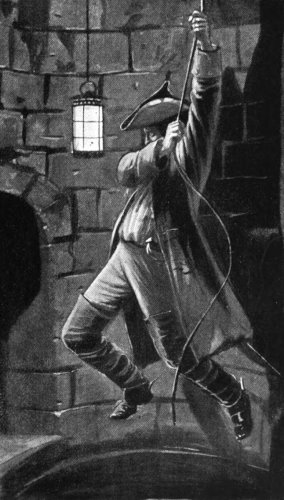
“You will find my Body,” howled the Robber.
“You will find my body,” howled the robber from the darkness.
Lowering himself hand under hand, Coq le Roi descended to the well. The unknown waited until he had reached the light, and had entered the dark hole above the water. Then he, too, clutched the rope—but he could not keep back the laugh from his lips.
“Ventrebleu! Sartines,” said he to himself, “a merry night to you, and a merrier day to-morrow. To be fooled by a woman at your time of life! Oh, you amuse us finely.”
“Are you coming, monsieur,” roared Coq le Roi below, “Oh, for pity’s sake, be quick!”
The unknown hesitated no longer, but swung himself cleverly upon the rope and so disappeared into the darkness of the well.
Five minutes later a terrible cry, like a cry of victory, arose suddenly from the ranks of the sweltering mob gathered in the narrow alley before the house of the Red Cock. From lane to lane, and street to street, it spread until it was echoed in long-drawn hooting even across the frilling waters of the Seine.
“Coq le Roi has escaped! Holà! Holà! Holà! Coq le Roi is free. Long life to the little red man. Viva! Down with the guard. À bas, Sartines! Holà! Holà!”
Loud, terrible, long sustained was the cry. Exhilarated at these unexpected tidings, spurred to new courage by the joyous news, the mob fell upon the sulking troopers with any weapon that came to its hand; and in the stifling courts and alleys there was soon to be heard the shrieks of dying men, the booming of muskets, the shriller wailing of the women. Yet it was not until dawn broke that the beggars began to number their dead, and to forget that Coq le Roi was free.
Monsieur de Sartines had supped well, as he always did at the Hôtel Beautreillis. Though he declared that the gloomy old house in the Rue St. Paul was more forbidding than the Bastille where its exterior was concerned, there was no one readier to admit that Mademoiselle Corinne de Montesson, its mistress, was the cleverest woman in Paris and the most fascinating. Besides, was she not the particular patron of all the rogues and vagabonds in the thieves’ quarter, and could she not, if she would, be of more service to the court in general and to himself, Monsieur de Sartines in particular, than a squadron of dragoons? It was a big “if,” since mademoiselle’s charity and large-heartedness were traditions in the city; but the lieutenant still hoped—and supped.
On this particular evening, the excellent man had much need of consolation, and of the rich red wine which added the lustre of the ruby to the sparkling Venetian glass in which Corinne’s guests were always served. For it was the evening of the day when Coq le Roi had slipped through his fingers in so miraculous a manner; and in escaping had set the whole city laughing at her Lieutenant of Police. Nor had the good Sartines secured at that time the reputation which in after years brought him fame beyond the fame of any who had occupied the office which he glorified. He had yet to prove himself; and in proving himself he had begun with this disastrous and long-remembered fiasco.
Depressed by the reflection, gloomy, and not a little irritable, he had gone to Mademoiselle de Montesson’s house, scarce daring to hope that she would aid him; convinced, none the less, that she would amuse him. He had found her, to his satisfaction, alone save for the presence of her wonder-loving old physician, Antonio, and of her young kinsman, Bénoît, who was said to be the finest swordsman in Paris. The supper had been unsurpassable, as it was always at the Hôtel Beautreillis; and when it was done, mademoiselle carried her guest to the great music-room, and there caused her servants to bring the delicious coffee of the East. And this being served, Hátrin, her harpist, began to touch the strings of his instrument caressingly; while mademoiselle herself, sharing a rest-giving lounge with the gloomy lieutenant, endeavoured to play wittily upon his melancholy.
“I read your thoughts, my dear friend,” said she.
“They would make a dull book, mademoiselle,” replied the other.
“Oh, not at all; such a book has yet to be finished. Gloom is the seasoning which gives joy its savour, Monsieur de Sartines—just as failure is the salt which provokes the appetite for success.”
“Of what are you thinking, my dear lady?”
“I—of what should I think but the happiness of my friends? And you are not happy, monsieur. Indeed, you are the picture of misery.”
“And you are of merriment, mademoiselle—and of beauty.”
The lieutenant bowed pompously when he uttered the compliment. Mademoiselle herself laughed a rippling girlish laugh—she had lived but twenty-three years, and the fountain of her youth still played abundantly.
“Ho, ho,” she cried, “a compliment from Monsieur de Sartines. I shall look for the question next. You will spare me the torture of the boot, monsieur.”
“It would have to be a very pretty boot, dear lady.”
“Another compliment. Oh, surely, Monsieur de Sartines is about to put the question.”
“How! You think that I have something to ask—of you?”
“And why not? There would be stranger questions.”
“You must prove that before I admit it.”
“Certainly, I will prove it in a word. You came here to-night to speak about Coq le Roi.”
Monsieur de Sartines, when he heard this, sat straight up like a man who has been hit in the back with the flat of a sword.
“Pardieu!” cried he, “what do you know about Coq le Roi?”
She laughed at him girlishly and very sweetly.
“I know much more than the Lieutenant of Police,” she said.
“You are pleased to jest, mademoiselle.”
“I—to jest—what an accusation!”
“Then convince me that you do not.”
“With the greatest pleasure possible—for instance, you would like to learn—”
The lieutenant laughed savagely.
“I would like to learn where the man is at this moment,” exclaimed he.
“Is that all—surely, nothing could be more simple. I will summon Antonio.”
“Oh! it is Antonio who is the friend of assassins, then?”
“Certainly, he is a brother to them all. Does that shock you, dear Monsieur de Sartines? If so, we will not trouble him.”
“By no means,” cried the lieutenant, who was boiling over with curiosity; “at least he will amuse me.”
“I promise that,” replied Corinne.
Sartines had expected that she would rise from her seat to summon the physician as she had promised; but she did not so much as move a finger; and when some minutes had passed the lieutenant became impatient.
“Well,” he said, “are you not going to exhibit this godfather of assassins?”
“Surely, since he is here now.”
It was as she said. The old doctor, Antonio, had entered the room during their talk; and the lieutenant felt a cold chill run down his spine, when suddenly he became aware that a strange figure stood at his side. Whence the apparition had come; from the shelter of what trap, or panel, or hiding-place, Sartines could not tell. He knew only that the old man was before him, clad in his Geneva gown, wearing a full-bottomed wig, the curls of which almost touched his elbows.
“Ciel!” cried he, “you have a light foot, doctor.”
Antonio bowed with the grace of a prince-bishop.
“At your service, lieutenant,” said he. “If all report be true, you will need many light feet for your work in Paris.”
Sartines bit his lip. The physician’s words seemed a reflection upon his mishap with Coq le Roi.
“Come,” said he, “let us talk of other things. Mademoiselle has promised that you will amuse me—”
“I am here to obey my mistress,” said the old man, “—what is your pleasure, lieutenant?”
“Oh, my pleasure is not in question, but mademoiselle has said—”
“I have said that you will tell him what the highwayman named Coq le Roi, is doing to-night,” cried Corinne, interrupting suddenly; “there is nothing more simple than that, eh, Antonio?”
“It is a child’s task, mademoiselle.”
Sartines, who had begun by treating the whole thing as an elaborate jest, listened to this talk incredulously. While he told himself that Antonio’s claim was absurd, preposterous, ridiculous, nevertheless the idea that he should put the physician to the trial was strong and fascinating. He felt like one in the presence of a conjuror. He would watch the trick closely—perhaps learn something from it. Besides, if he should get any information about Coq le Roi—but that, he said, was impossible.
Antonio, meanwhile, had crossed the great room and had seated himself before a little table upon which was an astrolabe in brass, a lamp with a green shade, and a large sheet of drawing-paper, all scrawled over with hieroglyphics and strange lettering like the lettering of an Eastern manuscript. When he had turned back the long sleeves of his gown, and had taken a pair of compasses in his hand, the doctor bade the others come near.
“Monsieur,” said he to Sartines, “you desire to know in what occupation the man Jacques Cabot, sometimes called Coq le Roi, has been employed during the last twelve hours. If you will be good enough to sit by my side, and to say nothing until the clock shall strike again, I will tell you.”
The lieutenant, assuring himself that he was a fool to take part in such mummery, sat as the physician directed. Corinne took her stand beside him; Antonio, resting his head upon his hands, cried suddenly for less light; and at the words, lacqueys entered the room noiselessly and extinguished the candles. Only the shaded green lamp remained; and from its aureole of light the figure of the old doctor stood out—motionless, stern—the figure of some weird magician risen up from the ages of the past.
Five minutes passed, and nothing was to be heard in the great room but the ticking of the clock. Sartines found himself spellbound; Corinne herself stood like a statue, scarce seeming to breathe. When, at last, Antonio broke the spell, he did so by beginning to speak in a low voice, accompanying the words with the tracing of strange lines upon the paper before him.
“Monsieur,” said he, addressing Sartines, but keeping his eyes upon the paper, “at twelve o’clock to-day Coq le Roi was at Soisy robbing the coach of his lordship, the Duke of Sabran.”
“Dieu!” cried Sartines, rising from his chair, “you say—”
Antonio, without so much as turning his head, continued to draw upon the paper. Corinne touched the lieutenant gently upon the arm, and made a sign to him that he should say nothing.
“At three o’clock,” continued the physician, whose voice was now strong and clear as the note of a bell, “I find that Coq le Roi was at Gros Bois after stopping the coach of the Grand Master of Artillery, the Comte d’Eu, and robbing him of three hundred louis d’or.”
“Ventre bleu!” cried Sartines, while he threw himself back in his chair and laughed heartily, “what a play! Oh, you amuse me very well, my dear doctor.”
Antonio ignored the interruption. His head was now so near to the paper that his eyes almost touched it. His voice was the voice of a man who speaks his thoughts aloud, unconscious that any listen.
“It is six o’clock,” he said, after a long pause, “and the rain falls heavily upon the road to Fontenay. I see a great hill, and at its foot the woods stretch out to meet the waters. One horseman keeps watch in the dark place of the valley. He is waiting for the coming of his highness, the Duke de Nevers—”
“Thousand devils,” cried Sartines, unable to control himself, “you lie, monsieur—”
Antonio turned his head swiftly; Corinne pressed the lieutenant’s arm warningly.
“Your pardon,” cried Sartines, nettled at his outburst, and now pale with excitement, “but has not this jest gone far enough?”
“It is as monsieur pleases,” cried the old physician, pushing his paper away from him; “he has asked me what the highwayman known as Coq le Roi has done to-day and I have told him, reading from the signs which have been given to me.”
“Certainly,” replied the lieutenant, “you have amused me very well; but is it not possible, monsieur, that you have not read your signs aright?”
“Oh, indeed, if you think that,” cried Corinne, interrupting quickly, “why not ask Coq le Roi himself?”
“Ask Coq le Roi?”
“As I say. Had you allowed Antonio to finish his work, he would have told you that, after stopping the coach of his highness, the Duke de Nevers, Coq le Roi turned his horse towards Paris; and that, even while we were speaking of him, he entered this house, and is now my guest in the Tower of St. Paul—which, I need not tell you, lieutenant, is still part of the Hôtel Beautreillis.”
Sartines heard her out, and when she had finished, his face was almost as green as the shade of the physician’s lamp. The sweat poured from his brow like rain; he gnashed his teeth; he laughed with the hysterical laugh of a woman.
“Am I a child, mademoiselle,” he blurted out at last, “that you should tell me such tales?”
Corinne, holding herself with great dignity, struck a gong at her side; this was her answer to him.
A lacquey answered the summons while the note was still reverberating in the hall.
“Edouard,” she said to the servant, “Monsieur Jacques Cabot, is he in his apartment?”
“He arrived an hour ago, mademoiselle.”
“And now?”
“He is sleeping, mademoiselle.”
Corinne clapped her pretty hands.
“Could anything be better?” she said. “We will have a peep at him and apologise afterwards. Come, Monsieur de Sartines, you shall doubt no more.”
She led the way from the room while the lieutenant was still gaping with his astonishment, and he, not knowing whether he stood upon his head or his heels, followed her into the courtyard of the old house, and thence across a pretty garden, darkened by great chestnut-trees and a labyrinth of bushes. The Hôtel Beautreillis, as Corinne’s home was called, formed a part of the once royal palace of St. Paul; and many strange old towers and turrets and pavilions then stood in its beautiful gardens. It was to one of these pavilions that the girl now conducted Sartines; and the excellent lieutenant was not a little surprised to find two sturdy Swiss guards standing sentry at its iron-bound door.
“Parbleu!” cried he, “you watch your guests well, my dear lady.”
“Nay,” she said, “it is the king’s wish.”
“How? The king knows that the man is here?”
“Certainly—or rather, he knows that I await him.”
Sartines asked himself for the fifth time what wine he had drunk and from what malady he suffered. Then he stumbled up the narrow stairs; and, while Corinne held aloft the lantern which a servant had given to her, he entered a small and exquisitely furnished room—and there he saw Coq le Roi.
The highwayman was no typical robber. Short to the point of absurdity, with hair as red as the sands of the sea, and clothes which spoke of long hours in the saddle, you might have taken him for a hunchback of Notre Dame or a tailor of the Rue St. Severin. All the city called him the “Little Red Man,” and the title fitted him like a glove. When Sartines then saw him he was sleeping, still dressed, upon a couch; and the light from Mademoiselle’s lantern, playing upon his strange little face, lit up features which might have been those of a girl. Beyond this, the man was splashed to his shoulders with mud; and two great pistols he always carried were displayed threateningly upon the table beside the relics of the admirable supper he had just partaken of.
“Dame!” cried Sartines, feasting his eyes upon the motionless figure of the robber, “that is Coq le Roi right enough. I could pick him from a hundred.”
“Certainly you could,” whispered Corinne, drawing back from the room.
“Very well,” cried the lieutenant, “I am content to ask no questions, mademoiselle, but in ten minutes my officers will call for their prisoner.”
“One moment, lieutenant. Be pleased first to read the king’s pleasure.”
At this word she held her lantern quite close to the lieutenant’s eyes, and showed him a little sheet of parchment which she had brought with her from the music-room. At the foot of this there was the royal seal and the signature of King Louis. Sartines took the document with trembling hands and read these words:—
“Jacques Cabot, sometimes called Coq le Roi, is to be the prisoner of Mademoiselle de Montesson until he shall steal the diamond ring from the finger of Monsieur de Sartines.”
A smile, a terrible smile, played in the eyes of the now thoroughly enraged lieutenant.
“Mademoiselle,” said he, bowing low, “I congratulate you upon the farce you are playing; at the same time his majesty’s wish is a command to me. I shall make it my business to see him to-morrow and to alter this.”
“Very well, my dear Monsieur Sartines—but remember, it is half past ten o’clock.”
“Half past ten o’clock—why should I remember that?”
“You will learn presently.”
He turned upon his heel with another stately bow, and the voices of the lacqueys were heard immediately crying for his coach. Two minutes later his horses were galloping furiously toward the Hôtel de Ville; but Corinne de Montesson was still laughing in her garden.
“Oh,” she said, “if only he will go to the king!”
Monsieur de Sartines did not go to the king—that night at any rate. His first act was to call the Captain of the Guard, and to give him precise instructions for the good of Coq le Roi.
“Take a file of men,” said he to the captain, “and surround the pavilion of St. Paul in the garden of the Hôtel Beautreillis. Coq le Roi, the highwayman, is there. Shoot him if he attempts to leave the place. Otherwise, keep the guard posted until you hear from me.”
The captain saluted and withdrew. When he had gone, Sartines called for a cup of white wine and drank it at a draught. Then he took snuff in huge quantities, seeking vainly to compose his thoughts.
“Dame!” said he to himself, “what a tale to tell! That she should be the friend of assassins—And the king supports her. Either I am mad or I have dreamed the things of this night. Jacques Cabot her guest! Holy Virgin—she will burn the Bastille next!”
Long he paced his apartment, his brain burning with his changing thoughts. Twelve o’clock rang out from Notre Dame, one o’clock was told by all the churches of Paris, and still his coach waited to carry him to his own house in the Faubourg St. Germain. At a quarter past one, when sleep had begun to battle with his perplexity, a new clatter of hoofs disturbed the silent courts of the Hôtel de Ville, and awoke him from his stupor. He had scarce started up from his chair to learn the moment of the interruption when a horseman, dripping wet and splashed from head to foot with mud, burst into his room and stood at the salute before him.
“Well,” cried Sartines.
“I have the honour to inform your excellency,” cried the man, “that Monsieur l’Abbé Lamotte was stopped upon the road to Choisy at half past ten to-night and robbed of a hundred crowns by the man called Coq le Roi.”
“What,” roared Sartines, “at half past ten! You lie, rogue—I was with Coq le Roi myself at that hour.”
“It is as I say, sir—I was one of the company, and I could pick the man from a thousand.”
“God deliver me from all devils!” ejaculated the lieutenant; “it was the hour she told me to remember.”
Monsieur de Sartines was, perhaps, as little in love with hag’s tales and superstitions as any man in Paris; but the events of that night, the strange mysteries of it, the surprises he had known, confused his brain and distracted him until he had no longer command of his reason. While the messenger was speaking to him, he found himself looking instinctively for the diamond ring upon the third finger of his left hand. It still glistened there, and he chuckled grimly when he saw it.
“Bah!” said he, “it is the king’s jest. He has posted his own guards in the Rue St. Paul, and to-morrow he will deliver up Cabot to my charge. His words prove that. ‘Until he shall steal the diamond ring from the finger of Monsieur de Sartines.’ Dame! if the liberty of Coq le Roi depends upon that, he will remain a prisoner until the day of judgment. Steal my ring—Holy Virgin, I would like to see the man who could do it!”
The thought somewhat comforted him. He determined to go to his own house and to get what sleep he could before dawn broke. He said that this report of a new outrage must be untrue, since Coq le Roi was watched by his own guards in the Rue St. Paul. He remembered that the king was still at Versailles, and that if luck were willing, he would be able to find his Majesty there in the early hours of daylight. As for the stupendous mystery now hovering about the Hôtel Beautreillis and Corinne de Montesson, his tired brain could not grapple with that. He swore when he thought of it. He recalled the days when the people had declared the girl to be a witch. He fell to sleep in his own bed at last only to dream that Coq le Roi had stolen his ring and that the king himself was wearing it.
The sun had been up an hour, when the lieutenant awoke from his troubled sleep. He found his valet standing at his bedside, profuse in apology for the intrusion.
“I am sorry to disturb your excellency,” he said, “but there is a mounted messenger below who has news which will not wait.”
“Send him up,” cried the lieutenant, springing from his bed, and beginning to dress hurriedly. “Does he come from the provost?”
“I know nothing,” said the man, “save that he craves audience.”
A moment later, the messenger, one of the new guard, was saluting his chief.
“I am to tell you, sir,” said he, “that Coq le Roi, the highwayman, was seen this morning in the woods beyond Yères.”
“Oh,” cried the lieutenant, bristling with anger, “you come to tell me that—then tell it to the devil.”
The man crossed himself devoutly.
“God save us all!” said he; “here is your excellency’s own guard in the Rue St. Paul declaring that the fellow has slept all night and has never so much as turned in his sleep.”
The lieutenant waited to hear no more. Refusing even the coffee which his servants offered to him, he called for his coach and set out at a gallop for Versailles. No fool under any circumstances, this mystery seemed to be making a fool of him. He told himself while he drove that all Paris would be laughing at him before night fell. He could have wagered his life that he had seen Coq le Roi fast asleep in the turreted pavilion of Corinne’s house. He declared either that he had dreamed the thing, or that these new stories were false. The king had made the robber a prisoner in this way for some secret purpose. That purpose he must find out. Perhaps, after all, it was only his Majesty’s love for a pair of pretty blue eyes.
He arrived at Versailles at eight o’clock, but learnt to his chagrin that the king had set out to the hunt, and was not to return to the palace until the afternoon. This was an irritating foil to his plans; but he spent the day in seeking audiences of his friends, and endeavouring vainly to glean some hints from which he could forge a key to his perplexity. Disappointed in this, he conceived the notion of walking a little way into the park; and so of catching his Majesty before he was surrounded by the host of idlers and pleasure-seekers who lay waiting to whisper a word into the royal ear.
It was nearly five o’clock in the evening when he set out on this quest; and an unusual stillness reigned in the magnificent gardens of the château. Here and there, daintily coloured lanterns gave dancing light beneath the trees; a few richly dressed fops were making love to pretty women; but the great world of pleasure was resting until the zenith of the night should awake it to new occupations. Sartines, indeed, found himself almost alone, when absorbed in his unending speculations he crossed the gardens where the fountains foamed redly in the glowing rays of the setting sun, and passed down the Avenue de Trianon into the groves of the more open park. This was quite deserted at such an hour. Valets, stablemen, gardeners—all were taking what rest they could, knowing well that the night would have need of them. The silence and the twilight suited the lieutenant’s mood well. He began to pace a deserted avenue of yew elms with the slow steps of a man bearing a burden of worry and of doubt. He looked often across the park for the advance guards of the royal party. He believed himself to be alone, and even spoke his thoughts aloud.
“Bah!” said he, remembering still the letter which Corinne had read to him, “when any highwayman shall steal my ring, then will I hang myself from the king’s bed-post. What an idea to suggest! It really amuses me—it really—ha, ha!—”
To his surprise, a mocking laugh answered his spoken thoughts. He turned round swiftly, abashed at his words, to find that the intruder was no other than an exceedingly pretty girl, apparently not yet twenty years of age, who was then sitting upon a mouldy stone bench under the shadow of the elms. She was dressed in an exquisite riding habit of green velvet, and the merriment of her laugh, together with the brightness of her eyes and the exceeding suppleness of her figure, completed a picture which arrested even the wandering attention of the Lieutenant of Police.
“A thousand pardons, mademoiselle,” cried he, bowing very low, “have I the honour—?”
“Oh,” said the young girl, laughing again, “the honour is mine, monsieur—to be forgotten by the chief of his Majesty’s police.”