Queen of the Jesters (continued 3)
Reading edition
But the Corsican officer had led him to a bedroom now; a pretty room lighted by many wax candles, and furnished with all the taste characterising a period so tasteful. It was a large apartment, with a cabinet giving off it—and the abbé observed in this smaller chamber a supper-table decked prettily with lighted candles and flowers. For this, however, he had no appreciating eyes. He felt at the moment as though he could never eat again. Foreboding, real and stern, had set his nerves itching. He began to question his conductor, hoping for some little word of comfort.
“Monsieur,” he said with pitiable anxiety, “I beg you tell me—whose house is this and where does it lie?”
“Readily,” answered the young officer. “This is the pavilion of Madame Doublet de Persau. The villagers call it the House of the Scarlet Witch. I regret, monseigneur, that your first acquaintance of it should be made so unpropitiously. Saint Denis! who would have thought that his majesty was unknown to you!”
“God help me,” answered the abbé, “I never saw him but once, monsieur, and then it was from a bench in the Place Louis Quinze. Oh, surely he will remember that!”
The Corsican shook his head, implying that he doubted.
“My Lord Bishop,” said he, “I am but a very humble servant of his majesty, and Heaven forbid that I should anticipate his decision. If you have friends, however, let me beg of you to write to them. It is possible, should their influence be not delayed, that you may yet atone for this offence with a year in the Bastille.”
“A year in the Bastille,” murmured the abbé, “a year—the Saints help me—a year for a moment’s loss of temper! Oh, mon Dieu, will you not plead for me, monsieur? I am no Lord Bishop, but only a poor curé, who is friendless and helpless as you see, my son. I conjure you, of your charity be a friend to me.”
“How!” cried the soldier, with a wondrous assumption of surprise, “you tell me, my lord, that you are not the Bishop of Blois! Oh, surely, this night’s work has robbed you of your memory. Think a little and you will recall the circumstances. Here to-day you were riding to Paris upon the business of your diocese when you fall into the hands of Madame Doublet de Persau’s merry fellows, who bring you to this house to supper. The king, learning of the jest, is driven over from the palace to enjoy it, when you, losing your temper, throw a goblet of wine in his majesty’s face, and so become my prisoner until your sentence is delivered. I exhort you, my lord, hide none of these things from yourself, but send at once to your friends and conjure them to intercede for you.”
There was a wondrous air of honesty about the Corsican’s tale; and although the abbé was more perplexed than ever when the soldier had done, he determined to trust him, and to make a last effort to help himself. Indeed, a sudden inspiration seized upon him, and when he spoke his words came quickly and his white cheeks flushed scarlet.
“Monsieur,” he said, “I see it all plainly; they have mistaken me for the Lord Bishop of Blois, and so this misfortune has fallen upon me. I have but one friend in Paris, if, indeed, she be in Paris now. I speak of my ward, Corinne de Montesson, who is to be found at the Hôtel Beautreillis in the Rue St. Paul. Could you but convey a word to her of my necessity, I know that it would not be unavailing. Indeed, she is very gentle and loving to all, and never fails to help those who are in adversity. Send to her, I beg of you, and tell her to come to St. Cloud at once. Say that the Abbé Morellet implores her assistance—”
“Ciel!” cried the Corsican, “I will tell her no such tale—for why should she come to the help of the Abbé Morellet when it is Monseigneur the Bishop of Blois whom she is to assist?”
“Sir,” said the abbé, with humble entreaty, “if you tell her that, I am surely lost.”
“Courage,” said the Corsican, “you forget, monseigneur. In a little time your memory will come back to you. I shall send to Paris at once. Meanwhile you will pardon me if I must hold you under lock and key. You heard the king’s command, my lord?”
“God help me,” cried the abbé, “I heard it too well.”
At this the Corsican withdrew and went downstairs to the supper-table. The scarlet masks of the company were all laid aside now, and the suppers no longer ate fish made of bread-crumbs. On the contrary, they were very merry over flagons of rare red wine and goblets of champagne, and trout from the Lake of Geneva, and dishes of carp’s tongues and sturgeon and mullet, and legs of venison, and fat capons. When they saw the officer, they cried out joyfully, and hastened to ask how the abbé did.
“Grimod, Grimod, what does he say, what does he do—oh, tell us quickly—we die with impatience—you have news, Grimod?”
The Corsican held up his hand for quiet. Then, addressing the scarlet witch,—whose fresh and piquant face belied her rôle now that the mask was laid aside,—he said,—
“Ma foi! Mademoiselle Corinne, the abbé asks for you.”
“For me?” said the girl; “then you have told him, Grimod?”
“Upon my word, mademoiselle, I have told him nothing. He thinks you are at the Hôtel Beautreillis, and he begs me to send a messenger there.”
Corinne clapped her pretty hands.
“Oh,” she said, “how I love him! But he will not send me to a convent after all.”
The idea that Corinne de Montesson would ever succumb to such a fate seemed to amuse the masqueraders very much. They greeted her words with extravagant enthusiasm. One love-sick swain—whose devil’s head was set mockingly upon a plate before him—turned toward her, eyes full of sheepish affection, and exclaimed,—
“Saint John, Corinne, if you go to the nuns at Charenton, you will take half Paris with you.”
“We shall have to build a city there,” cried another.
“Such a place of worship will never have been seen,” said a third.
“I go as maid-in-waiting,” lisped a pretty boy, who was busy with a dish of venison.
“And the king, what does he go as?” asked a demon, whose head was tucked away under his chair.
“Yes,” cried Corinne, joyfully, “the king, where is he? Come forth, sir, and let us see you.”
“Sacrebleu!” answered a voice from the further end of the table, “the king is very well, thank you, mademoiselle—but he will be the better when he has eaten this pasty.”
Could the abbé have seen the king at that moment his fears would have vanished like the wind. Truth to tell, his majesty looked exceedingly unkingly, seated as he was astride a small chair and holding a very large pasty between his knees. But the wretched priest in the bedroom above knew of none of these things. While the masqueraders below were at the zenith of their merriment, the miserable abbé was pacing his elegant prison; and every turn he took brought a fresh exclamation to his lips.
“Oh,” he would moan, “a year in the Bastille at the least—that I should have left my home for this! A year in the Bastille, where they put you in cages so that your bones are bent; or in ditches, where the floors are deep in slime! Heaven be merciful to me—I have thrown wine in the king’s face! Fool that I was!—his dress should have taught me better manners. And now they will punish me—oh, miserable day, unhappy hour—what would I not give to be in my bed at Yvette again!”
He, good man, had lived so noble a life that fear had not in all his years been an enemy to him. But now he feared exceedingly,—feared so that for a long while he started at every whisper of the wind or creak of board; feared until he forgot that he was hungry and had not supped. By and by, however, one of his restless pacings carried him into the cabinet which opened off the bed-chamber; and then he beheld the little table with the flowers and the wax-lights and the flagon of red wine and the well-dressed capon.
“Bah!” he exclaimed angrily, “the wine is but coloured water, the capon is made of bread—they shall not befool me a second time.”
He thought it a cruel jest, and vowed he would not be the victim of it; and so he began to pace the room again; but his steps carried him, despite his resolution, straight into the cabinet again; and at the third time of his coming, hunger and thirst so far prevailed that he poured a little of the wine from the flagon and ventured to taste it.
“Oh,” cried he, filling a goblet to the brim, “can it be true?—upon my word, this is very like the wine of Burgundy—Saint John! I have never tasted a better imitation.”
There was almost a smile upon the abbé’s face now, and he began with eager hands to help himself to the capon. A moment later he had seated himself at the little table and was busy with a groaning plate. Only when the meal was done did a haunting memory of his night’s work come back to him—and at that, the wine was soured and the bread turned bitter. He looked at the great carved bed, and told himself that sleep was not for such as him. He heard a bell without strike the hour of midnight, and the new-come day seemed to be the herald of his misfortunes. Once or twice he went to the door of his prison-chamber and listened, but could distinguish no sound, neither of voices nor of steps.
“Holy Saints!” cried he, beginning to pace his room again, “if I could only lie this night in my bed at Yvette!”
He sighed at the hopelessness of the desire; but, to his intense amazement, his sigh was echoed from the opposite side of the room. And he was very surprised when, upon turning round, he beheld, standing there by a picture let into the panel of the wainscoting, two of the masked men who had met him on the road earlier in the evening. Indeed, the abbé rubbed his eyes to make sure that he did not dream; and it was not until the tallest of the two spoke that he believed altogether in the reality of that which he saw.
“My Lord Bishop,” said the stranger, “we have kept our promise, and you see us again. Is it gladly?”
“Gentlemen,” cried the abbé, “gladly indeed—oh, Heaven knows! You have heard of my misfortune?”
The masked man raised his hand.
“Hush,” said he; “a word may cost you your life. We know all, and have come to save you. Follow me, ’seigneur, and say nothing, whatever you may see or hear.”
With this, he laid his hand upon a button in the picture, and the panel slid back noiselessly, showing a narrow aperture through which the three men passed—and then, the dazed abbé! The aperture thus disclosed gave access to a narrow flight of stairs, at the foot of which was a little door opening at the back of the pavilion directly upon the park of St. Cloud. Before the abbé had realised anything of that which was being done, he found himself out upon the soft grass with the bridle rein of a horse in his left hand and a groom at his right hand waiting to assist him to mount. The two men in their turn went to horses waiting for them, and all leaping into the saddles, the leader said presently,—
“ ’Seigneur, mount, I beg of you. We ride to Blois for your life.”
“To Blois?” gasped the abbé.
But the groom had helped him into the saddle now, and the man having sent the horse off to join the others with a lusty smack upon the quarters, the abbé found himself, for good or ill, galloping wildly through the park towards the road for Sèvres. So absorbed was he in doubt and wonder that he failed to observe that a young girl now rode with his guides—though she was masked as the others were. Indeed, those with him never drew rein nor spoke a single word until dawn broke in the sky and St. Cloud and its woods lay far behind them. Then for the first time they permitted their foaming beasts to go at the walk and the fresh wind of the morning to breathe upon their heated faces.
The place was the summit of a hill some five miles from the town of Rambouillet. Below them a valley stretched pleasantly, and in the far distance the spire of the church at Yvette stood up like a needle against the cloudless sky.
“My lord,” said the leader of the strangers as he halted suddenly at the spot, “yonder is your home. As for us, our work is done. We have but to give you this paper and to bid you make your way to Blois with all speed. I doubt not that you will obey faithfully the king’s wish that you shall not leave your new diocese for the space of one year.”
“My diocese—the king’s wish!” exclaimed the abbé, whose face was bathed with perspiration and whose limbs were so sore that he could scarce sit upon his horse.
“Certainly,” answered the masked man, pressing the paper into the priest’s hands; “read that and all will be known to you.”
The abbé read the paper; then he raised his hands in an attitude of humble thankfulness.
“Merciful Heaven be praised,” cried he, “they have made me Bishop of Blois, me—the unworthy—the simple priest—the humble curé of Yvette! Surely the king has forgiven me then. Gentlemen, I thank you from my heart for this night’s work. Never shall your services be forgotten. Tell me your names, I beg of you, that I may remember them in my prayers.”
The first of the men removed his mask.
“ ’Seigneur,” said he, “they call me Bénoît, the swordsman.”
“ ’Seigneur,” cried the second, unmasking in his turn, “I am the Comte de Guibert—the oldest friend of your ward, Mademoiselle Corinne de Montesson.”
It was the moment for the young girl now. Swiftly unmasking and turning her pretty face upon the astonished abbé, she said,—
“And I, ’seigneur, am Corinne herself.”
The abbé sat as one dumfounded. Tears welled up in his eyes. Gratitude choked his words.
“Corinne,” he said, “oh, it is to you that I owe my pardon and my fortune then! God bless you a thousand times.”
“But not at Charenton,” cried Corinne, merrily.
“Heaven forbid,” cried the abbé. “Return to your home and carry an old man’s blessing with you.”
* * * * *
The Bishop of Blois was wont to tell, even in his old age, how that at St. Cloud he had once thrown a glass of wine in the king’s face. But the knowing ones shook their heads.
“Bah!” said they among themselves, “it was one of pretty Corinne’s jests. The only king our good bishop ever met was Lekain, the actor from the king’s theatre.”
V. THE PURPLE GLASS
The Chevalier Eugène Sabatier was accounted one of the handsomest rogues in all Paris; but he looked neither handsome nor roguish when he stood in the music-room of the Hôtel Beautreillis on the third day of May in the year 1763, and reflected earnestly upon the strange tale which Antonio, the physician, had just told him.
The glorious afternoon was coming to a close then, and the old gardens in the Rue St. Paul began to be filled with the first sweetness of the night. Trees laden with blossoms, bushes with roses, rustled gently as the warm south wind breathed upon them; lengthening shadows upon the grass waged war with the delaying patches of sunlight and drove them inch by inch from the garden. The spires and turrets of the great house shone radiant a little while with fiery beams which struck upon their windows and copper domes and made them like burning beacons above the surrounding streets. In the music-room itself, a soft twilight prevailed; and this was in keeping with the gloom which had come upon those in the chamber.
There were three persons in the great room at that hour; but the young chevalier was the most prominent figure, standing as he did where the deep red light of the setting sun could strike upon the gold and blue of his dragoon’s uniform, and even send fire flashing from the heavy brass helmet he held in his hand. As for Mademoiselle Corinne, the mistress of the Hôtel Beautreillis, she sat in a low chair drawn so far behind the curtain of the window that her pretty face was all in a shadow; nor could you distinguish the colour of her robe nor the tint of the lace which hid her exquisitely white neck. But it was plain that she was very serious; and the same might have been said of her old physician Antonio, who sat at a great writing table in the centre of the apartment, and dipped his long quill pen into the ink-horn before him with irritating regularity. Never once did he look at the young officer, nor seem to remember the astonishment which a word of his had just created. And this was the more surprising since that word had told of the officer’s death.
“Monsieur,” he had said, “if you go to the Château Saint Mandé to-night, you go to the house of a man who is waiting to kill you.”
The chevalier sprang from his chair, and standing a moment with the crimson light flashing upon his young face, he appeared like one about to resent a savage insult.
“Dieu!” cried he, “do you forget that I am going to the house of my brother?”
“I forget nothing,” answered the old man, without looking up from his paper. “Should you doubt my words, monsieur, it is easy to prove them by continuing your journey immediately to the château. But the proof will be with us—for your body will lie in the Marne before midnight.”
The prophecy was that of one who weighed his words well; but so terrible was it to hear, that long minutes passed and no voice broke the silence in the music-room. As for Eugène Sabatier, he might have been stricken dumb. Doubt, dread, anger, fear—each of these played upon his boyish face in their turn. Saying to himself at one moment that the story was a hideous calumny, in the next he remembered the untold wrongs he had suffered at his brother’s hand, and a voice whispered in his ear, “The physician is right.” Corinne, meanwhile, watched her guest with sad eyes and a troubled mind. There was something beyond mere friendship in a glance like that. Had her thoughts been uttered aloud, she would have said, “I love him.” Happily for her, the curtain hid her face, and the pretty flush which added ornament to it. When she spoke, there was scarce a ring of tenderness in her voice.
“Eugène,” she said, for they had been children together, and no formalities stood between them,—“Eugène, do not think that Antonio would jest with you at such a moment. This is no new thing to him. He has known your brother, the Count of Brives, for twenty years. I sent for you to-night to save your life—repay me by forgetting everything but the fortune and the future which to-night may bring you.”
The young soldier, distracted by a hundred thoughts, turned upon her a glance full of affection yet hardly followed her words.
“Corinne,” cried he, “I know that my brother hates me—yet, that he would kill me—mon Dieu, I cannot believe that.”
“Nevertheless,” chimed in the old physician, “he killed your brother Gilbert.”
An exclamation almost of resentment broke from Sabatier.
“Monsieur,” he gasped, “you say—?”
“That your brother Gilbert was poisoned by the Count of Brives in the Château Saint Mandé two years ago to-night.”
“Oh,” exclaimed Sabatier, sinking into a seat and burying his face in his hands, “God grant that you are wrong!”
“Antonio is never wrong,” said Corinne, sadly. “If you ask him, he will tell you that your brother was poisoned three weeks after he became marshal of the palace—an appointment the Count of Brives had applied for but had failed to obtain.”
“In the same way that you, monsieur,” added Antonio, “having been ordered to Westphalia to supplant the count in a command there, will be poisoned by him on the eve of your departure.”
The old man spoke with such deliberate emphasis and conviction, his story was so plausible, that Sabatier could suffer it no longer.
“Corinne,” cried he, rising from his seat and suppressing the many emotions which rushed upon his brain, “it is all like a terrible dream to me. I must go home to reason with it. And if it be as you say, then I thank God that my brother is saved from this new crime.”
He held out his hand to her; but she did not take it.
“Eugène,” she exclaimed, “before you go home to-night you have work to do.”
“Which is, Corinne?”
“To avenge your brother Gilbert and to become the Count of Brives.”
Perplexed as he was, Sabatier smiled.
“Oh,” said he, “now you speak to me in riddles. What miracle shall make me Count of Brives to-night?”
“Supper at the Château Saint Mandé is the only miracle necessary, Eugène.”
The young man drew back with an impatient gesture.
“Corinne,” he cried, “is it an hour for jests?”
“I do not jest with you, Eugène,” she answered very tenderly. “Did not I tell you that fortune and a future awaited you to-night? It is for you to say whether you will take the gift or refuse it.”
She spoke very simply, though deep feeling gave a quaver to her voice. As for Sabatier, he began to tell himself that he had lost his wits; and he walked up and down the room like a man distracted.
“Come,” cried he, stopping suddenly at last; “what mystery is this? You say that my brother will poison me, yet you tell me to sup with him. I beseech you be plain with me—oh, do I not suffer enough that you should add to my burden?”
He turned from one to the other appealingly, his distress being so great that tears stood in his eyes, and his voice was husky and broken. But it was the old physician who answered him.
“Monsieur,” said he, laying down his pen for the first time, “you beseech me to be plain with you, and I will hasten to obey your wish. Mademoiselle tells you truly that fortune and a future await you at the Château Saint Mandé to-night; but if they are to be won, they will be won by your own courage. The Count of Brives asks you to his home that he may kill you as he killed your brother Gilbert. If you turn back now, thinking to spare him the crime, you will dishonour your father’s memory and add new shame to a house which knew shame for the first time when your eldest brother was born to it. Let me conjure you, then, to do no such thing, but to ride hence at once for the Château—”
“Where they will poison me?” interrupted Sabatier, a little angrily.
“Exactly,” continued Antonio, “where they will poison you. But you, if you are careful to do exactly as I bid you, you will awake presently from the death you shall seem to die, and being awakened, will find yourself in twenty hours Count of Brives and master of his fortune.”
Sabatier stood wonder-struck. The old man, excited now by the story he was telling, raised his hand as in warning, and continued rapidly,—
“Monsieur, there is no other in the world who is called, as you are now called, to be God’s messenger in this work of vengeance and of right. Go, then, before the clock strikes again, to Saint Mandé; and say to yourself as you enter, ‘I am come to avenge my brother Gilbert.’ Whatever you see there, whatever may happen to you—fear nothing. The eyes of those that send you to this work will watch you even as you sit. I say no more—the minutes pass swiftly; and what further counsel I can give is written here upon this parchment. Let me exhort you to read every letter of that injunction—not once, but twelve times, as you ride toward the château. For that writing is life or death—as you remember or forget it.”
There was a great stillness in the room when the old man ceased to speak. Sabatier, scarce knowing whether the words were real or the echo of a dream, took with trembling hands the paper which the physician thrust upon him. Then he turned questioningly to Corinne; but she had now risen from her seat, and coming forward she laid her pretty fingers caressingly upon his arm.
“Eugène,” she asked earnestly, “you will avenge your brother?”
“As God is my witness,” he answered, “I will know the truth this night.”
The woods of Vincennes were very dark when Eugène Sabatier passed through them on his way to his brother’s house. But his head was too full of terrible thoughts to permit him to notice the state of the night or even the dangers of the road. For the matter of that he had ridden at a hand-gallop from Mademoiselle Corinne’s courtyard; and skirting the right bank of the Seine, he drew rein but twice before the grim and forbidding home of the Count of Brives stood up in the valley before him. Then, indeed, with a little shiver of fear he permitted his horse to walk, while he took off his heavy brass helmet and wiped the sweat from his forehead.
“Ciel!” he said to himself, “what an errand to go upon! That my brother should be a poisoner. Bah, I will not believe it! Corinne has been too clever for once. That old fool of a physician has deceived her with his nonsense. As well might I expect to be Pope as to step into Charles’s shoes and become Count of Brives to-morrow. Yet I cannot forget that poor Gilbert’s body was found in the river the morning after he supped at Saint Mandé. God help me—what am I to think?”
He was riding at that moment through a wood of shivering aspens; and what with the strange, haunting music of their leaves, and the darkness of the thicket, and the weird light playing upon the river, whose course he could mark, like a great silver vein of the valley, he began to be more fearful than ever he had been in all his life. And this was surprising, since there was no braver man in Condé’s legion than Eugène Sabatier; none readier with the rapier, or more skilled in all those arts which are a soldier’s boast. It was the hidden danger—the death in the cup—that now made his heart beat so loudly. He could not hide it from himself that this old man, who had warned him, might be a fool and a boaster. How, he asked himself, if the scheme should fail and his own body be found to-morrow in the Marne? He had little to hope for in life, for he was a penniless soldier, who must make his own future; but so long as he could treasure up in his heart love for little Corinne, he was content to live, and to dream of a day when there should be no gulf of wealth and station between them. That day would come quickly enough if his brother, the Count of Brives, were to die, since the count had neither wife nor child; and title and lands would then descend to him. He remembered that Corinne had promised that all this should happen twenty hours after he had sat down to supper at the château; and he laughed again at the absurdity of her promise. Only when he remembered poor Gilbert did his own courage come back to him; and riding quickly out of the wood he swore that the truth should be hidden no longer.
He was not more than a hundred yards from the gloomy house now; and he could hear the voices of boatmen rising up from the river’s bank. Behind him lay Paris, her lights beginning to shine brightly as in joy of the newly come night; before him the road sloped gently toward the Seine, meeting it at last at a point where the Marne flows into the greater stream. He could see his brother’s château, which had the shape of an old-time fortress, standing up black and threatening almost at the water’s edge. In the distance it appeared to be the stronghold of the hamlet which lay in its shadow; a hamlet of tumbling cottages, with an old Norman church, red-roofed, squat, yet withal picturesque. But when you rode into the one street of this village, you observed that a meadow lay between the great house and its humbler children; and that the former was girded about with a wood of poplars. Indeed, it was a very lonely house, and all the villagers shunned it, as they shunned its melancholy, silent, solitude-loving master, the Count Charles of Brives.
These villagers were all going to their beds when the young captain of Condé’s legion rode at a canter through their hamlet. He, on his part, took little notice of them or of their dwellings, so entirely did apprehension of the peril to come play upon his mind. Twice already had he perused the slip of parchment which old Antonio intrusted to him with so solemn a warning; but now, at the mouth of the village, he drew rein for the third time, and holding the paper so that the light from the lantern of the inn fell upon it, he read every word of it again and again; and having read it, he repeated it twenty times aloud, to be sure that his memory had it. There were but three lines of writing in all—done clearly, in great bold characters; and Eugène soon knew them so well that he could say them backwards or forwards as he pleased:—
BEWARE OF THE PURPLE GLASS THE HALF OF THAT WITHIN IT IS LIFE THE WHOLE IS DEATH.
“Bah!” said he, tearing the paper into shreds and letting the night wind scatter it, “they tell a tale to frighten children—not men. What an injustice to believe this of my brother until I have something beyond an old man’s cackle to go upon. How should he know of a purple glass, and how can there be both life and death within it? I will listen to no such slander, but sup with the count as brother should.”
This was all very well in promise, but the performance was a different matter. Though Sabatier kept telling himself that he had nothing to fear, his heart beat wildly when ultimately he stood at the gate of the château and heard the great bell booming in the tower above him. What, he asked, if that gate, which now shut behind him with such an ominous clang, should never open to his knock again! How if the morn should find his body lapped upon by the waters yonder, sedge grass hiding his face, and the reeds trying vainly to clothe him with warmth! He could not suppress a shudder when a voice whispered in his ear—“All this is possible.” Nor did the croaking welcome of the evil-eyed, stooping, lank old servant, Armand, reassure him.
“The count, my master, awaits you in the salon, monsieur,” said he. “I pray you be careful of the steps—they are, like all else here, a little grown in age. Shall Germain bed your horse, or do you ride away to-night?”
“Ay, surely, Armand; I leave Paris to-morrow, and must be in my own bed before midnight is struck,” answered Eugène, merrily—though his heart sank lower and lower at the gloomy aspect of all he saw about him. “Let the horse have a mouthful of sweet hay and a loosened girth,” he added presently; “who knows that my hand will be steady enough to saddle him when I have done supping with the count!”
The old servant, who had thrown the reins to the lad Germain, looked up quickly at this remark, his toothless mouth opening in a horrid smile.
“Who knows, monsieur?” he said; “there was never one of your race that refused a flask of Armagnac yet. And there is none better in France than the wine in my master’s cellars. I pray you follow me lest the supper be already cold.”
With this, he took up his lantern and mounted a steep, tortuous narrow staircase, above which the great black walls of the château loomed forbiddingly. There was a wicket in an old iron-sheathed door at the stair’s head, and when they had passed through it, they stood in a vast hall, the walls of which were covered with rusting armour. But the place was forsaken and unlighted, save for the poor rays which fell from the candle in the lantern; and, indeed, the whole house was full of a silence as of the silence of death. It was a tremendous relief to Eugène when at last he entered the great salon and beheld his brother standing near the door to receive him. Every suspicion, every doubt, all the horrid stories he had heard at the Hôtel Beautreillis, were forgotten in a moment. Kinship, even affection, succeeded to them during the instant of warm welcome.
“Brother,” he said, coming forward with a light step, and stooping to kiss the count upon the cheeks,—“brother, it is good to see you again.”
Count Charles suffered rather than returned the greeting. He was a man perhaps of forty years of age: his face pitted with the small-pox; his nose squat and up-turned; his beard short and stubby; his eyes very bright and very small. He wore a suit of black velvet with ruffles of white lace; but his vest was embroidered with silver, and the buttons of it were picked out with diamonds.
“My brother,” said he, his restless eyes blinking the while, “I heard that you were named for a command in Westphalia. It was natural that I should wish to see you before you go.”
It sounded almost like an apology; but Eugène, refusing to notice the hesitation and halting manner, became frankness itself.
“It is true,” he answered, “that I have a command, Charles—though there is little hope left to us of the war. I am sure you wish me God-speed, for I am to have your old company in Condé’s legion.”
The count shrugged his shoulders.
“Pah!” said he, curtly, “if you can make those rats fight, you are a clever man. They ran at Minden like deer from the dogs. Let us sit to supper and forget them.”
He led the way to an adjoining dining-room, even a larger chamber than the one they quitted; and they sat together at the end of a long table, feebly lit by eight wax lights. The toothless old man, Armand, waited upon them, like a ghostly image from the gloom in which the greater part of the room was plunged. For a while, neither of the brothers spoke a word, eating silently and scarce looking at one another. The supper itself was of the plainest—a capon, a dish of spinach, some tender slices of venison—and for drink, champagne in long goblets of sparkling cut glass. Eugène said to himself for the second time when he lifted such a goblet and drank deeply of the foaming draught, that old Antonio, the physician to Mademoiselle Corinne, was a fool. There was no such thing as a purple glass upon the table. How, then, could he avoid that within it? They had told him a hag’s tale. Surely it was one of pretty Corinne’s jests. For a truth, he was half of a mind to hint to his brother the cruel slander put abroad about him; but restraining himself, he began to talk of the Hôtel Beautreillis and of its fascinating mistress.
“You have seen Corinne lately?” he asked indifferently.
The count looked up quickly.
“You speak of Mademoiselle de Montesson?” said he.
“Certainly I do; but I thought you were such good friends.”
Count Charles shrugged his shoulders.
“I know her a little,” said he, with assumed nonchalance, “and you—”
“Oh,” said Eugène, with whole-hearted energy, “I know her very well indeed, brother.”
The count put out his glass that Armand might fill it with champagne. The action helped him to conceal from Eugène the deep flush upon his face, and the angry brightness of his eyes. But he said no word to betray himself, and began cleverly to talk of other subjects with a loquacity quite foreign to him. As for the younger man, though he was quite content now to believe that Corinne had told him a silly story, none the less did the influence of his surroundings weigh heavily upon him. His heart was dark as the great room in which he sat; and just as in that chamber eight candles cast an aureole of light at its centre, so in his own heart was there a glow of light when he remembered his love for pretty Corinne. “Shall I ever see her again?” he asked. A relentless foreboding warned him that he might not. Danger seemed all about him. He knew that his brother hated him—hated him because his mother had loved him; hated him for his looks, his friends, his successes. But he knew then that he hated him most of all because of the word which he had spoken about little Corinne.
Supper was done now; and the count, pushing back his chair from the table, seemed to be in a more generous mood.
“Armand,” he cried to the toothless old serving man, “bring a flask of Armagnac and set glasses. You can go to the lodge then.”
Eugène was surprised at the request.
“Do you live here alone, brother?” he asked.
“Certainly,” replied the count; “am I not a soldier who has been alone all my life?”
It was a bitter question, and Eugène shuddered—he knew not why. Far from fearing his brother now, he pitied him, and would have been very glad to say so; but just when the word was upon his lips, Armand returned with the flask of the wine of Armagnac and two long glasses, which he wiped and set carefully upon the table. Eugène observed their colour immediately. They were of a deep purple tint. “Ciel!” he murmured to himself, while his heart beat fast and the blood rushed to his brain, “the purple glass.” In the same instant, Armand left the room; and a little while after a gate in the courtyard was shut with a loud clang. The brothers were alone in the house of gloom.
The count was the first to speak. He had the flask of wine in his hand; and Eugène, who watched him like one fascinated, observed that his arm trembled when he raised it.
“Come,” said he, in a thick, unnatural voice, “there is no finer Armagnac in Paris than this. Let me give you some.”
Eugène bowed his head. His face was almost livid now. For that which he must suffer, he cared nothing. He would sooner have died there and then than make sure of so horrible a truth. “My brother a poisoner,” he said to himself a a hundred times, “oh, what shame, what dishonour!”
The count filled his glass and pushed it over to him. Eugène was surprised to see that his brother helped himself also to the wine, drinking the half of a glass at a draught. The action reassured him. “They have told me a lie,” he said to himself for the twentieth time—and with this upon his lips and the warning of old Antonio ringing in his ears like a knell, he lifted the purple glass and drank from it. “The half is life,” said the voice. Eugène drank exactly one half and put the glass upon the table. The count did not appear to notice the action.
“So you leave Paris to-morrow?” said he, pleasantly.
The dragoon answered incoherently. A strange joy began to quicken the blood in his veins. He had looked to fall senseless after drinking the wine, but to his amazement nothing happened. Rather he felt elated, eager to talk nonsense, light-headed as a child. “Pish,” said he to himself, “what a calumny to spread!” The reaction was terrible, overwhelming. He had the desire to rise and embrace his brother. He spoke of little Corinne freely—even of his love for her. The count replied in monosyllables. He, too, was watching, but the light of long years of hate was in his eyes. The moment of his vengeance had come, he said.
Five minutes had passed now since Eugène drank the wine; five minutes which he declared were the happiest in his life. But, of a sudden, his joy was turned to great fear; his words were broken on his lips; cold sweat started to his forehead; his heart quickened with a pulse of weakness. In that instant he knew that the old physician had not cheated him. Death himself seemed to have touched him upon the forehead. A dreamy, irresistible sleep stole upon him, surely. Everything in the room was still clear to his eyes; but the power of action and of speech was becoming less every moment. He felt that he was sinking down into unconsciousness. “Oh,” he moaned, “I shall never see little Corinne again.” All his love for her was magnified a thousand times at the thought. He clenched his hands and swore that he would not die. With a last effort, and a last loud cry, he raised himself from his chair—only to fall headlong at his brother’s feet; and to lie there, seeing all, hearing all, but unable to move a limb or utter a word.
The Count of Brives, who had waited for the moment, rose for the first time since his brother had drunk the wine. Eugène, lying there in the trance which the poison put upon him, could observe all the other’s actions—and he watched him as a prisoner may watch a captor from whom he has no hope of mercy. Deliberately and with all the nerve of a man grown callous to crime, the count began to finish his work. He put out the lights upon the table one by one, until a single candle alone lighted the vast chamber. Then, taking this candle in his hand, he bent over the body before him and looked at it with a malignity woeful to see.
“Pah!” he said, placing the light upon the table again, “Condé’s legion will want a captain to-morrow, and Corinne a lover. He brought it upon himself—why should I pity him?”
The dragoon heard the words very plainly, and the hate in them added to that which he suffered. It was true, then, as Antonio had told him, that his brother meant to kill him when he asked him to the Château Saint Mandé. He recollected at the same time that the old man had prophesied things which he did not understand at the moment of their utterance. “You will awake presently from the death you shall seem to die, and being awakened, will find yourself in twenty hours Count of Brives and master of his fortunes.” Or again: “The eyes of those that send you to this work will watch you even as you lie.” Would he, indeed, he asked himself, wake again from this paralysis which had fallen upon heart and tongue and limb? Did some friendly eyes indeed watch him as he lay there in all the agony of a trance? He could not answer; could do nothing but think of little Corinne and pray that he might see her once again.
The Count of Brives had opened the window of the salon now, and the cool air of the May night flooded the chamber refreshingly. Eugène heard his brother pass out into the garden beyond, and when he returned to the table he had a lantern in his hand. Nerved by all the resolution of daring and cruelty, he was quick to act, that his crime might be hidden from men and from his own eyes. Ever and anon Eugène could observe his pale face as he moved swiftly about the room, or listened with strained ear to catch any sound in the house. But the silence of ultimate night reigned in the château. No human thing moved there. Not a clock ticked, not a door creaked. The wind moaned its song of solitude in the poplars of the garden—but the count was alone with his victim.
Twice he walked up to the body of the man he believed to be dead; twice he drew back with a tremor of nerve and a gesture of repugnance. When at last his iron will conquered, he stooped quickly, and bringing all his great strength to the work, he began to drag the body toward the window. It was a horrid effort even for him; and he had but begun it when a loud sound, like the sound of a door shutting in a chamber above, caused him to spring up with a great cry, and to stagger from the room as though unnumbered phantoms had come about him to proclaim the deed. Eugène heard the sound well enough, and began to hope for the second time. “They watch me, they watch me!” he cried,—“oh, how I need my courage!—if they should be too late!” The thought was unbearable, almost maddening; the agony of the bondage of helplessness greater than any man could conceive. He prayed for unconsciousness, even for death—but these were denied to him. The drug had quickened his life—and yet had robbed him of all that which life is.
In this the mood of fear unspeakable, he lay and listened while his brother passed quickly from room to room, opening and shutting the doors loudly, and often crying “Who goes there?” as though he was sure that some one else had entered the château. Nor was the count content until he had searched even the garrets, and had told himself a hundred times that the wind cheated him in his alarm. When at last he returned to the dining-room, his step was stronger and his will more sure. He picked up the body now as though it had been a common burden, and staggering from step to step down the stairs upon which the window opened, he dragged it into the garden, and so out into the moonlight, which fell plenteously upon the damp grass. There for a moment he stood panting for his breath and shading his eyes, that he might see more clearly into the garden. As for Eugène, he had felt the strength of the arms which clasped him so surely; and now when he lay stiff and voiceless upon the grass, he said that death had become his neighbour. “He means to throw my body in the Seine,” he thought; “they will come too late—they have left me to die—what cruelty!—what a night of suffering!” Had a voice then been given to him, he would have screamed in his terror. But the drug had tied his tongue; the trance held him too surely—he was dead, yet suffered as the living rarely have suffered.
Once more the count stooped to his dreadful work. The spot whereon he stood was scarce a hundred yards from the black waters of the Seine. There was to be no delay this time. Turning his
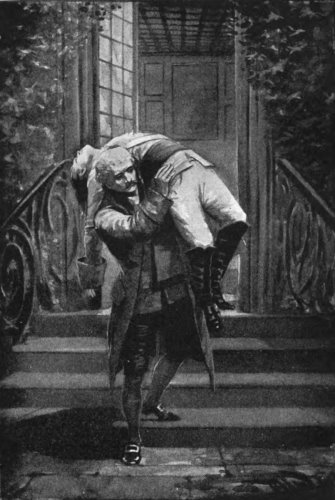
He picked up the Body and staggered down.
eyes away that he might not look upon his brother’s face again, he gripped him by the left arm and began to drag him toward the river. Two paces he took; his foot was raised for a third—when the second omen of the night sent him staggering back from his burden like one stricken with a mortal sickness. The omen was nothing less than the sound of his name uttered from a window high up in the looming wall of the château. Clear above the river’s moaning and the song of the poplars, the call came:—
“Monsieur le Comte, Monsieur le Comte, where is your brother Eugène?”
The count turned round on his heel—a cry frothed upon his lips—he reeled backward, backward, saying that the judgment of God was upon him. The château, which had been dark when he left it five minutes before, was now blazing with light. Every room on the upper story shed bright golden rays from its windows. Seen in the strong moonlight, the great house had become like a palace of the fairies. The panes of glass were so many stars shining in a setting of black stone; the very attics were beacons to guide those far away in the valley. More than all, a man clothed from head to foot in black stood plain to be seen at a casement above the salon; and he it was who called to Count Charles,—
“Monsieur le Comte, Monsieur le Comte, where is your brother Eugène?”
The count heard the call, and for a moment terror convulsed him. But fury was quick to prevail above fear; and with a great oath upon his lips, he drew a dagger and ran back to the château. In the same instant, the man in black disappeared from the window; and Eugène, watching it all with a hope not to be described, observed that the bushes near to him on the lawn opened suddenly, and that men came out of them. The face of the first of these new-comers was hidden by a mask; but when the man stooped presently to pour the contents of a phial upon the dragoon’s lips, the mask slipped and Eugène knew that old Antonio was at his side.
“My son,” said the old man, watching the red drops fall upon the feverish lips, “awake—and sleep.”
“Ciel! is it thou, Antonio?” murmured Eugène, knowing that the trance had passed from him the moment the drops fell, “Oh, blessed be God—I live—I live!”
That minute was the most exquisite of his life; but scarce had he realised the meaning of it when a sweet unconsciousness stole upon him, and he slept. And so sleeping, the men raised him in their arms and carried him quickly out of the garden.
The afternoon of the following day was drawing to its close when Eugène Sabatier awoke from his deep sleep. A ray of burning sunlight striking down through the open window of his room in the Rue Charles V., fell at length upon his eyes, and caused him to turn uneasily upon his bed. A moment later, he sat upright and began to stare about him with the air of one who is not quite sure either of the hour or of his environment. In which operation, he encountered the gaze of his servant Barnardin, who stood at the bed’s head as though he had long been awaiting the moment.
“Sir,” said the valet, advancing with his master’s clothes, “it is five o’clock, and you know that we leave Paris at eight. Will you be pleased to rise?”
“Diavolo!” cried Eugène, springing from the bed with a light step—and he was very much surprised to find how strong he was—“have I slept long, Barnardin?”
Barnardin shook his head.
“You were away from home when I left here at ten o’clock last night, my master,” said he; “but when I brought your coffee at eight o’clock this morning you slept so soundly that I could not wake you.”
The dragoon began to dress himself quickly, remembering only that he had orders to leave Paris at eight o’clock that night.
“Sang-bleu!” muttered he to himself, “I must have supped in some cabaret—and drunk too much Armagnac. What a thing to dream—that my brother poisoned me! Pah! it was a fool’s sleep, and I am paid for my folly. And yet I could swear that I talked with Corinne at her house yesterday, and that she promised to make me Count of Brives in twenty hours. Dame! I am like to wait long for that!”
The reflection made him a little gloomy, reminding him as it did how small had been fortune’s gifts to him, and how childish was his hope that he might ever speak to Corinne of his love for her. Were he Count of Brives, then would it be a very different thing; for he could hurry back from the war and make haste to deal with those estates which Count Charles treated so ill. But he told himself again and again that all his visions of the night had been phantoms of sleep come to torment him with illusions and vain words. He was still Eugène, the dragoon—with scarce ten gold pieces in his pocket and no prospect for the future save that which the war offered to him. Little Corinne remained the mistress of the Hôtel Beautreillis and of the great station which her possessions gave to her. What folly to dream that he might ever tell her that he loved her!
Saying this to himself, he made a hurried meal; and all being ready, set out for the Barrière du Trône when the clocks of Paris were striking half-past six. His baggage had gone already in the waggons of the regiment, which he was to join at Chalons; and he rode now accompanied only by his servant Barnardin, who led his second charger. Many turned in the streets to look at the handsome dragoon in the sky-blue uniform; many muttered, “There goes that rogue Sabatier to the wars;” but Eugène noticed none of them. A deep depression weighed him down; his accustomed gaiety and readiness of speech had forsaken him; he struck again into the heart of the woods of Vincennes, and the silence of the thickets was like balm to his weary mind. He was absolutely convinced that the events of the dreadful night were the events of a dream. He remembered that he must pass his brother’s château on his way to Chalons. “I will call and ask a God-speed of him,” said he to himself; “I owe him that for allowing myself ever to repeat so cruel a calumny.”
He had come by this time to that little place upon the hill whence he could look down to the Seine, and observe the gloomy towers of his brother’s house. Here, despite his resolution, a shudder of fear trembled upon all his limbs. Strange as he thought it, the dream seemed more real with every mile he rode. He could have sworn that he stood last night upon that very spot; he remembered the blood-red light upon the river; the shiver of the aspens; the foreboding which possessed him. Angry with himself that these thoughts prevailed, he set spurs to his horse, and rode at a gallop toward the village.
“A plague upon it,” said he, “it was a dream, a silly dream. I did not sup with my brother, and never shall I be Count of Brives—fool that I am to think of it!”
“Monsieur,” said a voice at his side, “permit me to tell you that you are mistaken.”
Eugène checked his horse and looked round quickly. He saw to his astonishment that a man who wore a rich dress of black cloth, and a black plumed hat, rode at his side upon a magnificent beast who kept pace with the other as easily as though he had been walking for the show of it in the Place Louis Quinze.
“Monsieur,” said the dragoon, civilly, “you said—?”
“That you are very much mistaken, sir,—you did sup with your brother last night, and you will be Count of Brives before the clock strikes again.”
The words were spoken with such a fine air that Sabatier began to ask himself if this were some new apparition come to cheat him as the others had done.
“Oh,” cried he, impatiently, “what mystery is all this! Am I in my senses, or do I still sleep?”
He reined in his horse, and the stranger came close up to his side.
“Monsieur,” said he, “you neither sleep nor dream. Ask yourself no such silly question. It is quite true that your brother attempted to poison you last night with a flask of Armagnac in which, as the physician Antonio would tell you, there were four grains of one of the most deadly drugs known to the East. You, however, remembering the warning, drank but a half of the glass set before you—and so you become Count of Brives.”
“I?” cried Eugène, impatiently, “I become Count of Brives?”
“Exactly,” said the other; “you have only to ride to yonder château to make it your own.”
The dragoon laughed scornfully.
“Pah!” said he, “how could the wine have been poisoned when my brother drank of it; and how could your physician know what the flask contained?”
The man in the plumed hat betrayed no sign of impatience.
“Monsieur,” said he, slowly, “you ask me two questions, and I will answer them. We knew what the wine contained because Armand, your brother’s servant, has long been good enough to sell us for money an account of your brother’s life. Three weeks ago the Count of Brives was offered by an agent of my mistress, Mademoiselle Corinne, a preparation of the poppy leaf brought from Yezd. So fatal is this to those whose bodies are not fortified against it by the continued and gradual habit of eating the drug, that two-thirds of a grain will kill the strongest man. You, however, drinking but a half of that which was offered to you, suffered but a passing loss of your senses. It is obvious to you that the count, having been long in the East and accustomed to the use of opium, could drink that which would mean the death of another not so prepared. The draught last night steeled his will to the dreadful crime he sought to commit. You, however, succumbed to it; and never, I swear, did the living wear the cloak of the dead as you wore it in the Château Saint Mandé.”
Sabatier groaned at the remembrance. It seemed to him that he began to suffer the terror of the garden for the second time.
“Ciel!” cried he, “it is all a miracle—I cannot believe it—I cannot.”
“It is no miracle,” said the stranger, solemnly; “it is the hand of Almighty God avenging your brother who was slain. Go then to the château—but go alone, that the eyes of no other may witness the deed which must be. I wait here until yonder church bell shall tell me that you are Count of Brives.”
He pointed with outstretched arm to the gate of the darkening house upon whose blackened walls the last crimson rays of the setting sun were dying down quickly. As Eugène rode away, he remembered that he had seen the stranger before, and he said—it was he who called from the window last night—“Monsieur le Comte, Monsieur le Comte, where is your brother Eugène?” Drawn on at the recollection as by a fatality, eager to prove, to make sure, now buoyed up with hope, now trembling with excitement, he galloped through the street of the village, and never drew rein until his hand was upon the bell at the outer gate of the château and the birds were winging upward at his clamorous peal. As it had been last night—that night of nights—so was it to-day. The toothless old Armand gave him welcome; the lad Germain held his horse. Nothing seemed altered in the great house; nothing of its silence nor of its mystery. But Sabatier’s heart beat until his whole body shook with the pulsations; and so great was his dread that he could scarce frame the question—
“Where is my brother, the count?”
“Monsieur,” said the old man, with a horrible leer, “your brother awaits you in the garden.”
Bidding him stay where he was, Sabatier ascended the rotting staircase and passed rapidly through the hall. “I will know the truth, I will learn all,” he said to himself—determined now that the mystery should blind him no more. Many as were his sensations while he strode across the great dining-room to the garden beyond, he quitted them all in the greater doubt—“Can this thing have been?” And doubting of it to the last, he opened the window and so beheld his brother.
The count was dressed as he had been on the previous evening; but his eyes were now bloodshot and inflamed; his step halting and restless; his hair dishevelled. When Sabatier saw him thus, he was walking, with bent head, to and fro upon the grass plot by the bushes; but his glance was ever upon the ground, and he muttered unceasingly, “Where is my brother Eugène?” This haunting cry had been upon his lips through every hour of that dreadful night. He had never left the scene of his crime—had touched no food, had spoken no word. From the moment when he discovered that some unseen eye watched him in his horrid task—the Count of Brives lost his reason.
“Oh, my God!” cried Eugène, aloud, moved to exceeding pity by a sight so woeful, “my brother is mad.”
The count heard the cry and looked up. For one long-drawn instant he stood quite still; then, with a moan upon his lips, he began to walk backwards down the garden. But at the third step, he fell heavily upon the grass.
“Brother,” said Eugène, running to his side,—“brother, I forgive.”
It was a word of surpassing love—but the heart of the Count of Brives had ceased to beat when it was spoken.
When Eugène Sabatier rode from the Château Saint Mandé that night to join the army at Chalons, the villagers cried after him,—
“Bon soir, Monsieur le Comte.”
And the bells of the little church soon told all Paris that Charles, Count of Brives, was no more.
VI. THE KINGDOM OF BOURGORIEAU
The Feast of the Precious Blood, on the fourth day of July, in the year 1763, sent many of Old Paris to the gardens of the Courtille des Porcherons, famous at that time for the great sign-board upon which Master Ramponeau, the host of the guinguette, was depicted, sitting astride a hogshead, and therefrom beckoning all the city to taste of his unsurpassable wines. Other courtilles, it is true, waged a good fight against the booths and bazaars of the Tambour Royal, as old Ramponeau’s house was called; but the fame of his tavern was built upon the rock of a royal patronage, and rare was the day when some masquerader from the palace did not drive to that place of arbours and of shade in quest of adventure which should oil his tongue at Trianon. Thither, too, went the butter girls from the Quai de Gesvres, ready with their pretty patois to answer the dragoons of the guard—thither, as rumour said, Madame herself had gone under the escort of the Duc de Richelieu. Bourgeois or aristocrat, priest or clerk, student or philosopher, trooper or captain,—it mattered not in the gardens of Ramponeau. He had the same welcome for all—the same witty greeting, the same civility. And he knew more of the secrets of Paris than the Canons of Notre Dame themselves. “Oh, ce bon Ramponeau, comme il est drôle,” said the women. The men spoke of his wines. There were no better in Paris. To drink them you could suffer even the music of Ramponeau’s fiddler and the dust of the drive to the Porcherons.
The Feast of the Precious Blood was a day of sun and heat; but a cool breeze came up with the evening, and many masqueraders gathered at the hour of eight o’clock in the shady avenues of the Tambour Royal. Ramponeau, whose long neck twisted unrestingly in his greetings to this great man or to that, was hoarse with proclaiming the merits of his wine of Burgundy and of his Armagnac. The weary fiddler in the great tent beat his instrument savagely, as though angry with it and the world which compelled him. The jaded dancers had abandoned the more stately steps of the Basque for the fever of the Poitou jig. Everywhere in the cool of the gardens the lovers walked—here a wit of Trianon impatient at the slow understanding of a Corydon; there a dragoon, who told himself that the masked unknown who clung timorously to his arm must certainly be a duchess. Uniforms, gorgeous in gold and lace, were to be observed through a tracery of boughs and leaves still green—the scarlet of the gendarmerie, the blue of the Corsican legion, the towering brass helmets of Condé’s men. Even cassocked priests took pleasure with circumspection, and drank the wines of Italy served from dainty flasks. So great was the press of aristocrat and of citizen that a table apart was a possession of great price. One man alone in all the throng commanded such a privilege and was not denied. He was Bourgorieau, the king’s swordsman.
A man of small stature, slightly pock-marked yet pleasant of countenance, with a beard trimmed in the Spanish fashion, and a suit of violet cloth to cover a frame of iron,—such was Bourgorieau, the swordsman. Many turned to look at him when they passed, but none so long as to draw upon himself the gaze of one who was the master even of the masters of his art. At any other time, perhaps, in the garden of the Tuileries or the theatre of the palace, it had been possible to exchange a greeting with this man of Nantes, whose sword had cut for him such a broad road to fame. But at the Tambour Royal, such a thing was not to be thought of. Even Ramponeau would cease to twist his long neck, and to speak of Armagnac when he approached the arbour of wild roses before the doors of which the maître d’armes sat. Swaggering troopers ceased to swagger when they beheld the pock-marked face and the suit of violet. Even a dancing girl had not the temerity to thrust out her tambourine for the sous of Bourgorieau. He sat alone, silent, asking friendship of none nor seeking it.
It was seven o’clock when Bourgorieau entered the tavern of old Ramponeau; it was half past eight before he remembered that Javotte, his daughter, would be waiting for him in the little house upon the island of St. Louis. She would have supper prepared against his coming. He was not one who cared very much for the hospitality of taverns; nor would he have gone to the Tambour Royal at all had not the vanity of his art compelled him. While men said that he was a sullen rogue who sat apart because of the grim shadows upon his life, he, in turn, was telling himself that it was good to observe the fear of his fellows and to assert, wherever it might be, that title of mastership which his sword had won for him so readily in Paris. For the poltroons who passed swiftly by his table he felt nothing but contempt; but the contempt was a thought of gain; and he reminded himself often that it would be a bad day for him when men ceased to remark his coming or to give him the chief seats in the guinguette. For the rest, the tipsy masquerader, the hollow wit, the glitter of colour and the music of fiddlers, he cared not at all. His life lay in his house, in the love of child and home. His arm had quivered many a time when he stood to the encounter and told himself that he might never see Javotte again. Yet the world said he did not know fear. He laughed at the world and kept his secret.
The tavern clock chimed the hour; the throng was increasing in the grove when the king’s swordsman drained his glass of Chianti and began to feel in his pocket for a crown wherewith to pay the score of old Ramponeau. He was upon the point of rising from the table when an exclamation uttered by one who passed by caused him to look up quickly and to discover that he was no longer alone in the arbour. A young man, shabbily dressed in a suit of brown cloth and carrying a traveller’s bundle upon his shoulder, had left the ranks of the masqueraders to trespass upon that forbidden ground which all Paris had conceded to the Kingdom of Bourgorieau. So quick had the action been, so little expected, that none put out a hand to touch the youth upon the shoulder or to tell him whither he went. Seeming to know nothing of the place or the people, the stranger advanced boldly to the sacred table, upon which he cast his bundle with the air of one very much fatigued. Then he fell rather than sat in the chair which awaited any person fortunate enough to enjoy the hospitality of the maître d’armes. The half-suppressed exclamation of anger which the swordsman uttered was lost upon him. He saw nothing of the gaping amazement of those who stood in the shadow of the trees; he did not hear the words of sympathy and surprise which the women uttered.
“Oh, c’est ben,” he exclaimed, as he sat, and his idiom was that of Eastern France. “I have walked far, monsieur, and there is dust upon the road to Strasbourg. You will let me sit a little while at your table and drink a cup of wine with you?”
Bourgorieau looked upon the lad as upon some curiosity fallen from the heavens at his feet. His first thought had been to call for a cudgel and to thrash the impertinent fellow soundly; but the music of the young man’s voice, his soft, pleasing, almost girlish face, his tremendous ignorance, stayed the other’s hand. He glanced quickly to that place between the trees where the carousal was at its height, and saw that many waited for him to act. How if he did not humour them? he asked himself. It was a pleasing whim, this idea of suffering the stranger at his table. And if any came to question him he would know how to answer.
“So you are from Strasbourg, mon vieux,” he said, surprised not a little at the sound of his own voice, “and yet you come in by the Porte St. Denis?”
“I live by the lodge of Neuilly,” answered the youth, simply; “to-morrow, if all goes well, I shall see my home again—but first I have my work to do in Paris, and it is for that I am come to this tavern. Oh, surely, sir, these are very great people, and I shall hear from them of him whom I seek. Is not this the house of Maître Ramponeau, whom even the queen has honoured? They said so out yonder. ‘You will find him,’ they said, and I know they speak well. To-morrow I shall go on again—the work will be done, it must be done, for God has willed it.”
He laid his head upon his arms wearily, as though all the light and music of the house could not keep sleep from his eyes. Bourgorieau knew not what chord of sympathy was struck at the note of the young man’s voice, but somehow he began to think of Javotte waiting for him at home. He said that they would make a pretty pair—this curly headed lad of Strasbourg who talked so blithely of having work to do and the little maid of his own house who alone in all Paris could find love for him. He was half a mind to bid the stranger follow him to the island of St. Louis and there to share his supper; but first he asked a question, and the answer to it was a word to set him laughing as he had not laughed since he left the salle d’armes of old Andrea at Nantes.
“You say, lad, that you are looking for some one in Paris? Who is he that his business should bring him to this tavern?”
“I seek Bourgorieau, he whom they call the king’s swordsman. You know him, monsieur?”
Bourgorieau leaned back in his chair and stared, open-mouthed, at the speaker.
“If I know him—what then?”
“Be so good as to tell me where I may find the man who murdered my father.”
Bourgorieau laughed so loudly that many came out of the grove to listen. “It is his son who has returned,” said some; others, that he had drunk overmuch Burgundy. But the stranger neither laughed with the maître d’armes nor observed those who watched him so curiously.
“I am Lucien,” he continued, “the son of Georges Duroc, who was killed in this tavern eight years ago, monsieur. I was a boy then, but to-day I am a man. I come to Paris to do the work appointed to me. Laugh as you please, I know well that God sends me here, and that my journey will not be in vain. To-morrow Bourgorieau will be dead and I shall be in my mother’s house again.”
He spoke neither loudly nor with a boaster’s voice. In his eyes there was a light as of a spiritual force working in his mind and creating visions for him. Bourgorieau laughed no longer. The frail and prettily rounded arms, the white skin, the gentle face of the youth were forgotten by him. He recalled, rather, the day when he had killed Georges Duroc in that very garden. Some trivial excuse of insult had served for the deed of that night. And this was the man’s son—sent, as he said, by God to demand a reckoning. Bourgorieau tried to laugh scornfully at all superstitions. He told himself that he could fight this lad of Strasbourg with a bandage over his eyes. But his mouth was parched when he sought to answer the youth; and he called to one near him to send another flask of Chianti.
“So you are Lucien Duroc,” he said, when he had drunk a deep draught, “and you come here to settle with old Bourgorieau? Ma foi! you have a fine conceit, my friend.”
Lucien sipped at the wine offered to him and began to bind his bundle more securely.
“Monsieur,” he replied very earnestly, “you do not understand me; I do not know if I understand these things myself, for they are God’s mysteries. It is true, as you say, that Maître Bourgorieau is the first blade in Paris; we have heard even in Strasbourg of the things he has done and the favour he has won. For myself, I have not held a sword in my hand but two or three times in all my life. How then, you ask, shall I bring such a one to his account? Sir, I know not what answer I can make if it be not to tell you of all the things I have heard and seen in the long nights of this last year at Strasbourg. Oh, monsieur, the gate of heaven has been opened for me, and I have heard the Divine voice commanding me that I should arise and go to Paris and do this thing. Often in my dreams have I heard the voices bidding me to leave the city and to delay no longer. ‘Seek and you shall find, and the angels shall keep watch over you,’ they said always. Sir, should I fear any man because I have listened to the message and have come here as I am commanded? Am I not right to say that to-morrow the justice of Heaven will fall upon him who killed my father, and that I shall go back to my mother’s house and tell her to mourn no more for him whom we loved, but to be glad because justice has been done? I am young, and I know that my life is before me. I have seen gardens of flowers in my sleep, and have walked there with those who will be with me to my life’s end. I have stood upon the banks of a great river, and the sweet breezes have blown upon my face, and I have heard the message that I shall follow the river to the new country of my dreams. Life is sweet to me, for I am young; but I shall not lose my life because God sends me to Paris; there is none that can harm me while I go to my duty and defend my father’s honour. Think not, monsieur, that I boast when I say that to-morrow Bourgorieau will be dead. The king himself could not save him now; it is written in the book of fate, and no human hand shall blot that writing out.”
He rose from the table at the words and took up his bundle as though the rest were in itself the enemy of his mission. Bourgorieau, who had sat white and silent while he spoke, now awoke as from a spell and touched the speaker upon the arm.
“Sit,” he said in a low voice,—“sit and tell me more of these dreams of yours, my friend. Who knows that this meeting is not written also in the book you name!”
Lucien rested his bundle upon the table. Bourgorieau saw that his hands trembled; there was in his eyes the light of the mystic awakened, of the dreamer made strong by the fevers of dreams.
“What will it serve me to tell you if you cannot bring me face to face with the man I seek?” he asked.
“Has he no love of life too?” asked Bourgorieau, upon whose forehead heavy drops of sweat were starting. “Has he no home to which he would return; is there none there to welcome his coming or to mourn if he should not go back? Would you make me the servant of his murderer, Monsieur Lucien? Nay, how shall I answer to his child—how shall I tell her—?”
“You shall say that you are the servant of a servant of God, monsieur. Yet do not think that I compel you if your will is not in this matter. The same hand which beckoned me from Strasbourg will point the way still. I seek the aid of none—the friendship of none. I need no courage nor skill. To-morrow my work will be done, for the voices have promised so—to-morrow Paris will know of it. And the world will be a better world for the death of this man, monsieur.”
He bowed with the grace of one born to high place, and before the other could arrest him, disappeared in the grove. For many minutes after he had gone, Bourgorieau sat staring at the masqueraders as though some after-thought would send the youth back to him and permit that opportunity of defence and argument of which surprise had robbed him. But the throng passed on, the music of the fiddlers waxed more discordant, the laughter was shriller and more brutal; and still the old swordsman sat alone. There were moments, in truth, when he believed that he had dreamed of the youth’s coming and of the words he remembered so distinctly. But this did not help him to shake off the strange foreboding which now began to possess him. It seemed to him that some miracle must have sent the lad to the gardens of the Tambour Royal. He recalled the boyish face, the dreamy eyes, the spiritual enthusiasm of Lucien’s quest. He remembered his confession, that he knew nothing of the sword, and fell to uttering the names of those great fencers who had fallen in a brawl with the untutored or the unskilled. Minute by minute his fear magnified. How if this were, indeed, the justice of God come to overtake him, he asked himself. None had dared to tell him hitherto that Paris would be a better city for his death. The words which Lucien had uttered so solemnly echoed in his ears—“it is written in the book.” All the superstitions of the superstitious West crowded upon his mind. He laughed aloud to think of them, yet racked his brain the more for any omen of the past which would explain away the mystery of the night. When he left the garden at last, he staggered through the press blindly, caring nothing for the muttered curses which followed him. At the gate of the tavern he told himself that he was already a rich man, and had promised himself some day a home in Nantes among his own people and the children of his boyhood.
The great clock of Notre Dame was striking eleven when Bourgorieau crossed the moonlit Pont Mairie and beheld again the lamp set in the latticed window of his house upon the island. Crooked and gabled and lofty, the neighbour of the little church of Saint Louis of the Isle, leaning against other houses which had looked down upon the Paris of the dark ages, the tumbling building, nevertheless, was to him a palace of palaces. Here he could forget the intrigue of court and camp; the slights of those before whom he must cringe; the slanders of his unnumbered enemies. Here all pomp and ceremony were forgotten; here, it was not his to serve nor to remember the darker side of service. At this hour of night, the city around him was hushed in the silence of sleep. So clear was the sky that the stars seemed to have come down very near to the earth, and to hang like golden lamps in the grey vault of the night. The swirling river lapped rhythmically upon the piles of the old bridge. By here and there, a belated citizen clattered across the flags and went tipsily to his home. The guard paced his beat with measured and echoing steps.
Bourgorieau stood for a long while watching the light in his house. He could see Javotte as
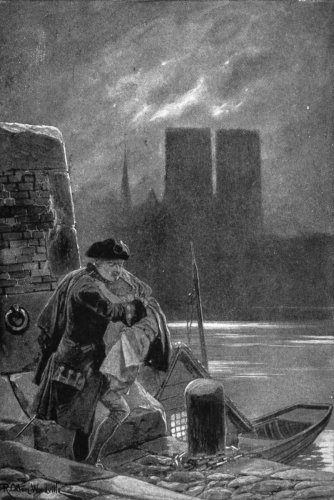
“It is thou, Dear Father.”
she waited at the window; a childish figure, weary with the vigil. He knew that the sound of his steps would animate that figure presently, would bring laughter to the sleepy eyes. He pictured the moment when he would hold her in his arms and read the joy of love written upon her face; the face of the one being in Paris who was sad at his going; who counted the hours that should bring him back again. And watching her, he heard, as though a voice answered from the shadows, the words of Lucien Duroc in the gardens of Ramponeau, “Arise and go.” Even as the voices had spoken to the lad, so now they warned him. “To-morrow,” he said, “it would be too late. Javotte would wait at the window as of old time, but the vigil would be eternal. Never again would the joy of her love shine in the eyes of the child; never again—”
Bourgorieau hurried on. The guard standing in the shadow of the church heard a child’s voice, sweet and melodious, above the murmur of the river,—
“It is thou, dear father; oh, how long I have watched for thee, how long—”
* * * * * * *
At ten o’clock upon the following morning, a horseman rode at a gallop into the great courtyard of Versailles. To the many who asked him what news, he answered only, “He is gone; the wager is won.” But to the Duc de Richelieu who waited for him in the gardens of Trianon he told a better story.
“All Paris talks of nothing else,” he said. “The king must hear of it at once. Last night at the house of Ramponeau, Mademoiselle Corinne of the Hôtel Beautreillis wagered that she would drive Bourgorieau, the bully, from the city before twenty hours had passed. She dressed as a lad of Strasbourg and prated of a divine mission. This morning, the man set out for Nantes, taking his daughter with him. He will come here no more, Monsieur le Duc—Saint John, that I should be the first with such news—”
The duke stopped in his walk and gazed open-mouthed at the messenger.
“How—Bourgorieau is gone—you say he will not come back—”
“I say well, or if he come it will be his last visit. Paris knows now that he is a coward, and twenty blades will be ready for him. We live in a day of miracles, and this is one of them. But I go to the king lest others be before me. A thousand crowns—ma foi, she should have won ten thousand!”
* * * * * * *
Bourgorieau heard of the jest in his home at Nantes. He answered those who told him by showing them the house he had built and the garden he had planted. They heard Javotte singing there, yet wondered at his indifference.
“I care not,” he said, “for she who was sent came to me from God.”
VII. THE DEVIL’S BOWL AND THE STRANGE AFFAIR AT FONTENAY
Corinne de Montesson leant back in her coach and sighed. Paris seemed so far off; the woods of Fontenay were so dark and gloomy that she began to think the sun would never shine for her again.
“Antonio,” she said, speaking to the old physician who sat opposite to her, and asking him a question which she had asked ten times since they were driven through the deserted street of Noisy le Grand—“Antonio, what time is it?”
Antonio, who was making what use he could of the passing daylight to complete a calculation which engrossed him, put down his book and began to observe the surrounding woods very closely.
“Mademoiselle,” said he presently, “it is the hour of sunset on the third day of April in the year 1764.”
Corinne laughed when she heard this very precise statement, and nestling her ruddy cheeks against the cushion of the coach, she fell to watching Antonio, who dipped his pen regularly into an ink-horn slung at his waist, and held his book close to the window that the last rays of the sinking sun might fall upon it. When she had watched him a little while, and, after that, had counted the trees which flashed by as the coach rolled down the hill of Fontenay until she had numbered three hundred, she spoke again,—
“Antonio, you know where we are?”
The old physician stopped in the middle of shaping an 8 and put his head out of the window.
“Mademoiselle,” he said, “we are half of a league from the town of Fontenay at the spot known as the Gorge of the Three Gibbets, reminding us that very lately his Majesty has caused three rogues to be hanged in this place.”
Corinne laughed again.
“My dear Antonio,” she said, “what a guide you would make!”
Antonio picked up his pen.
“My child,” said he, “unless we observe the signposts as we go, life is likely to show us a heavy road. For my part, I forget nothing when I am assured that it is worth remembering.”
“You would say that of Fontenay, Antonio?”
“Certainly, mademoiselle, I would say that of Fontenay. Strange indeed, if I forgot the place where they robbed and killed my poor friend the Count of Charny.”
Corinne shuddered. She remembered that dreadful story well. The darkening woods around her, the silence of the gloomy plantations, the phantom-like shape of tree and bush, compelled her to realise very forcibly in what a dangerous place she was, and how pleased she would be to see the lights of Paris again.
“Oh,” she said, “you are a poor comforter, Antonio—to speak of that affair now, when Bénoît remains at Gros Bois and we ride alone.”
Antonio closed his book with a snap, for the light no longer permitted him to read.
“Mademoiselle,” he said, “do you say that you ride alone when I am with you?”
“Not at all, my dear Antonio; I said that we ride alone—and lack any protector save the good will which some of these men bear to me. What a poor thing is that to rely upon! I am sure that I was very foolish to leave Bénoît behind. The sword is with thieves a better weapon than a thief’s charity, mon ami. And was there ever such a swordsman as Bénoît?”
Antonio shrugged his shoulders.
“All that you claim for our kinsman, that I will admit,” said he; “yet when you would praise the sword as a weapon, mademoiselle, then you speak as one who knows nothing of the greater mysteries. I, who am a child with the rapier in my hand, can become the equal of thousands of armies when I turn to those allies which exist neither in matter nor in the schools—but here, in thought, in conception, in, if you will, my dreams.
“To-night you ask for your kinsman and his strong arm, yet, believe me, my daughter, should misfortune overtake us, I, who have no weapon but my book, no ally but my visions, will prove the better friend. Not that I anticipate any such necessity. Another hour will see us at the barrier; we shall pass Fontenay itself before the clock strikes again. Take courage, then, mademoiselle, and forget that the sun no longer shines, and that night is in the woods.”
Corinne, who never ceased to enjoy the pompous self-assurance and the egotistical pronouncements of old Antonio, laughed in her sleeve now, and, having laughed, she buried her head in the cushions, and suffered stoically the terrible lurchings and rollings of the rut-tossed coach. After all, she said, her name was a great name amongst the robbers about Paris, and he would be a daring fellow who would venture to stop her carriage. She recalled again how she had won a pardon for the notorious Coq le Roi, who had narrated the deed in a hundred taverns since then, and had made of her, all unwillingly, a very déesse among patrons.
Should any one now attack her, she thought that it would be sufficient if her lacqueys mentioned her name. Nor did she rely at all upon the mysterious boasts and promises of the old physician, who had forgotten them already, and slept soundly with his half-open book lying neglected at his feet.
The coach rolled on deeper and deeper into the hollow of the night. By here and there the trees were so thick that the lantern which a lacquey had kindled scarce saved them from the ditch. At other times you could see a little way into the clearings of the thickets, or espy dark and noxious pools suggesting solitude and terrible deeds and the gloomy mystery of woodland life.
Corinne needed all her courage to banish the thoughts suggested by the scenes, but she had a mind powerful in obedience, and when her first alarms had passed, she compelled herself to think of the gaiety and life of Paris, and of all she would do during her long summer there. Indeed, she had made some very pretty plans for herself, and was in fancy dancing a minuet with the king, when a loud report of a musket, followed by a great clamour of question and answer and the sudden stopping of the coach, awoke her from her dream; and all her little castles came tumbling on the ground.
“Antonio, Antonio!” she cried, “do you not hear it?—they have stopped the coach, Antonio—make haste to tell them who I am. Oh, if I had not left Bénoît at Gros Bois!”
Antonio, who woke with a start, stopped a moment to pick up his book; then he put his head out of the window, but drew it back upon the instant.
“Mademoiselle,” said he, “there are three men, and they are tying your lacqueys to the trees.”
Corinne, ashamed of her first alarms, attempted to laugh, but the laugh had a quaver of fear in it.
“My dear Antonio,” she exclaimed, “pray make haste to tell the gentlemen whose coach it is.”
Antonio, thus commanded, put his head out of the window for the second time, and began to address the robbers.
“Sirs,” said he, “I beg a word with you. This is the coach of Mademoiselle Corinne de Montesson, whose name, I make sure, is very well known to you.”
To the physician’s surprise the three men made him no answer at all, but continued quietly to bind the hands of the lacqueys and then to tie them to the nearest trees. When they had done their work, the tallest of the three, who was dressed in black and silver and wore a mask upon his face, came up to the door of the coach and opened it. At the same time he doffed his cap and bowed with the dignity of a courtier.
“Mademoiselle,” said he, addressing Corinne, “a thousand pardons for the liberty we have taken. Be assured that I know your name well and that it is held in great reverence here. But I have laid a wager of a thousand crowns that you shall sup with me to-night at the house of the Silver Birch, and that I shall kiss you on both cheeks afterwards. Accord me, I beg of you, a favour so trifling, and earn the lasting gratitude of Claude Brissac.”
He stood up, a fine figure even in the sombre flare of the two torches which his companions had kindled, and now held aloft that Corinne might see to alight. Very bright eyes shone humorously beneath the velvet mask; diamonds sparkled upon the ample ruffles of lace at his wrist and throat.
Corinne had heard his name often. It was that of one of the most gallant and successful highwaymen upon the eastern roads to Paris. “La Force” they called him, for his unquenchable energy and his unfailing boldness. Corinne knew that such a man would allow nothing to turn him from his purpose, and she trembled a little when she answered him.
“Monsieur,” she said in her own pretty way, “I cannot think that you would compel me against my will. I would eat of your supper very gladly, did you choose other opportunity to invite me. But I must be in Paris to-night, and I rely upon you to hasten my journey thither. Indeed, I am sure that you will do so.”
“Saint Denis!” replied the man, “and gladly would I help you. Yet, mademoiselle, if you will but reflect a little, you will see how reasonable is my request. It must be plain to you, since your lacqueys are now keeping company with yonder trees, while your coachman is shedding tears in the ditch, that you cannot arrive in Paris before dawn at any rate. What more pleasant occupation, then, than a little supper—where, be assured, the homage due to so great a name shall be fully paid. Let this old man hasten to get out of the coach, that I may have the pleasure of feeling your pretty hand upon my arm.”