Queen of the Jesters (continued 2)
Reading edition
“I see so many faces,” pleaded Sartines, gallantly, “but that I should forget your face, mademoiselle—oh, that were impossible.”
“I think not, monsieur—since you do not remember that you met me at the château of the Comte d’Eu.”
The name of the Comte d’Eu sent a shiver down the lieutenant’s back. It recalled the old physician and his mystic prophecies.
“Pardieu!” cried he, “I remember, of course. You are a kinswoman of the count’s, I doubt not—and that being so, you know something of the misfortune which overtook him yesterday.”
“Indeed, I do,” said the girl, “since I was with him in his coach when he was stopped by the highwayman they call Coq le Roi.”
Sartines gasped. Such a striking confirmation of the old physician’s words he had never looked to hear.
“Mademoiselle,” cried he, very anxiously, “will you permit me to sit a moment while you tell me more of this affair?”
She made way for him readily upon the bench.
“Oh,” she said, “I will tell you anything you please—and I know a good deal more about Coq le Roi than you do, Monsieur de Sartines.”
The lieutenant looked at the girlish figure beside him and laughed a little contemptuously.
“You must convince me of that,” said he.
“Certainly I will—though I ought not to do so. It is dangerous to play with other people’s secrets, Monsieur de Sartines.”
“Secrets,” exclaimed the lieutenant, “why—what secrets can there be in a case like this?”
“If I were sure we were alone, I might be tempted to tell you. But look how dark it grows. Upon my word I must not stay any longer, monsieur—another time you shall learn all.”
Sartines’ eagerness was now beyond control.
“Indeed,” said he, “I beg you will do me the favour to remain, if it is only for ten minutes. Are you not safe with me?”
“I should be—but you know it is lonely here—and hush, is there not some one coming?”
They both listened a moment, but the murmur of the fountains and the echo of distant music were the only sounds in the darkness of the grove.
“Well,” resumed Sartines, “you see that we are alone—and now, I beg of you—”
The girl sighed—a sigh of regret and hesitation.
“It is very wrong of me,” she said, “and Corinne will never forgive me.”
“Corinne!” ejaculated the lieutenant, “do you refer to Mademoiselle de Montesson?”
“Certainly.”
“And what of her?”
The girl appeared to hesitate, and it was only after a long pause that she said: “Oh, she has been very unkind to you. She made a wager with the king that she would find an actress from the Opéra Comique and pass her off on you as Coq le Roi himself. And she has won, you know!”
“What!” roared Sartines.
“It is as I say. The man you thought you saw in her house last night was not a man at all. It was Mademoiselle Guérin, from the Opéra Comique.”
“Thousand devils,” exclaimed the lieutenant, rising from his seat, “I never thought of that!”
“Of course you did not. You forgot that your robber has the face of a young girl. Corinne, you know, remembered that, and so she tricked you. She has always been the friend of Coq le Roi. She warned him two days ago that spies were in the Rue St. Sauveur, and lent him the disguise in which he escaped. He told her himself what coaches he was going to rob and where. Her old physician helped her with his nonsense and his gown. And now she has set all Paris laughing at you.”
Sartines groaned like a wounded man.
“What, then, in heaven’s name means this farce about stealing my ring?” he cried, more to himself than to the pretty creature at his side.
“My dear Monsieur de Sartines, where are your wits?” said the girl. “Don’t you see that she wishes to get the king’s pardon for her friend? And the king makes this ridiculous condition, meaning that the man shall not be pardoned. Oh, it is all as plain as the Trianon there.”
“Of course it is, of course it is,” snarled the lieutenant, whose hands were trembling with rage and shame.
“I could tell you many more things, monsieur,” continued the girl, “if the sun were not in such a hurry to set—but see how dark it grows. Meanwhile, here is a letter which you may keep and read when you return to Paris to-night—it will tell you much.”
She took a letter from the breast of her habit and pressed it into the hand of the lieutenant, allowing her fingers to rest for some moments in his. Sartines, tormented by a thousand reproaches, did not even notice the pressure.
“Do you know,” he asked abstractedly, “in what disguise Coq le Roi left the Rue St. Sauveur?”
“Indeed I do, monsieur; it was in the disguise of a woman of fashion,—in fact, he wore a green velvet riding-habit which Corinne gave to him.”
“A green velvet riding-habit,” repeated Sartines, thinking of anything but the green velvet habit at his side.
“Nothing else,—a green velvet riding-habit and a little three-cornered hat. Oh, they cheated you well—but read that letter, and it will save you being fooled a third time.”
“A third time!” exclaimed the lieutenant, looking round quickly, while the clasp of the girl’s pretty fingers was strong upon his left hand, into which she was forcing the letter.
“As I say—a third time,” she explained boisterously. “Corinne has cheated you once in making you believe that a woman is a man; I have cheated you a second time in making you believe that a man is a woman.”
Her words came in a torrent; and even while they were upon her lips, she raised the gloved hand which was free, leaving the other hand still in that of the man; and very dexterously and suddenly she cast the contents of a tiny bottle she had concealed in her palm into the eyes of Monsieur de Sartines. At the same moment she grasped his fingers with a strange twist, and so sprang to her feet. But the lieutenant, whose eyes seemed on fire and who believed himself to be blind, roared like a stricken bull.
“Who, in heaven’s name, are you?” he cried.
“I am Jacques Cabot, otherwise Coq le Roi, otherwise the Little Red Man—very much at your service. Bon soir, Monsieur de Sartines. You will see very well in ten minutes. I have your diamond ring upon my left hand.”
The lieutenant uttered a terrible cry and staggered across the path, in a vain endeavour to grapple with the robber. But when the guard at last answered his cries he was quite alone, and the silence of the night reigned in the grove.
III. A PRISON OF SWORDS
Jacques de Serrefort was sleeping when the jailor opened the door of his cell; but he awoke while the keys still rattled in the lock, and sat up in his bed half blinded by the sunlight which streamed through the high window of his prison. It was a morning of early June, fresh with sweet breezes of the summer and the odour of roses in the air; but the captive, who had lived a day of the long ago in his dreams, regarded neither the hour nor the freshness of it. Every morning for fifteen years had he arisen from such dreams of the old time to forget them quickly in the terrible realities of his doom. The gentle smile upon his face, born of the visions of the night, passed at once in the first moments of the day. Sleep had carried him to the fair fields of Brittany, to the pastures of his homestead, to the ingle wherein his wife, and the daughter he had loved more than life, had been wont to greet him when the day’s work was done. But the dawn destroyed illusions so welcome. He became the slave again. Nothing to him that it was the height of summer, when all Paris was alive with merry music and feasting and the notes of bells calling lovers to the altars. Day or night, the fall of the leaf or the flowering of the blossom—the hour was long since passed when he remembered these. No more did he rave against the destiny which had made him a perpetual prisoner in the Conciergerie. His mind was rusted from long disuse; he talked and acted like a little child; tears refused him their consoling friendship. He prayed that the end might be soon; he sorrowed only because death was not given to him.
The jailor entered the cell as he had entered it every morning during those terrible years. He and Serrefort had grown old together; old in association, almost in captivity. True, Baptiste, as they called the fellow, had a little house out in the cathedral close yonder, and went there at odd hours to gossip with his neighbours; but nine-tenths of his years were spent in the Conciergerie, and he knew every stone in it, nay, almost every crack in its tremendous walls. In his way, he had been a good friend to Jacques de Serrefort—a friend in the little things of kindness whose worth to a prisoner is inestimable. Every morning, as soon as the bells of Notre Dame struck six o’clock, he would enter the wretched man’s cell to cry: “Courage, comrade; here is the day. Who knows what it will bring?” Jacques would declare sometimes that he had said the same thing every day for fifteen years. But it came out of the goodness of his heart, and was not to be resented. Indeed, the prisoner welcomed the sound of the homely voice; and when on this particular morning of June, in the year 1761, the customary greeting was not given, Serrefort turned quickly to his jailor with a question upon his lips.
“How now, Baptiste,” cried he, “you are silent this morning!”
Baptiste shook his head, and went toward the window that Serrefort might not see his face.
“Courage, comrade,” said he; “it will not be for long—your daughter will return to Paris presently, and then all will be well.”
Serrefort, who had begun to dress, sat down upon his bed again. He divined that some great misfortune was about to overtake him, though of its nature he could foresee nothing.
“Come, Baptiste,” said he, “you speak in riddles. What has my daughter to do with the Conciergerie—have I not enough to bear that you should talk of her?”
“Dame!” replied the old jailor, “I must speak of her since she alone has kept you from the Bombec Tower[1] these two years and more. Think you, comrade, that the bailiff gives windows and red wine to all who ask them? Saint Denis, you have the best quarters in the prison, and the best food. And why?—why, because your daughter has paid for such things. You don’t know that?”
“I swear to heaven that I know nothing,” exclaimed Serrefort. “You say that I have these things through my daughter, and that she pays for them?”
“How else should you have them? Sapristi! a child would not be so simple. She has paid for them since your old protector, the Sieur Buchot, died. And she will pay for them again—when she comes back to Paris. Oh, be sure of it. She is a good child, and rare is the week when she does not tell me what she means to do for you. Do not lose heart, old friend. Who knows?—she may be ill or gone away upon an affair of importance. If the bailiff were reasonable, he would think of these things. But he will not hear me, and the order now is that I am to carry you to the Bombec Tower this morning, and to show you no more favours until you can pay for them again.”
Serrefort shuddered. He had not lived in the great prison for fifteen years without hearing many a grim story of the terrible oubliettes below the level of the river Seine, wherein, shut out from God’s day and surrounded by horrors unnameable, the more wretched and poorer victims of the bailiff Hubert’s greed went all too slowly to their doom. Captivity is apt to obliterate from a man’s heart those finer affections which are fed upon freedom. Serrefort was tempted for a moment to bitter thoughts of the daughter who had left him to a fate so horrible. But anon he remembered Baptiste’s words, that she must be ill or away upon an affair of importance. And then he complained no more, but fell to wondering what her life had been since he had left her, a child of fifteen, in the old home in Brittany. He could not forget altogether that he owed this enduring punishment to her, and her alone. The hardness born of prison life closed about his heart when he told himself that if he had not struck the man who had been the shadow upon her life, he would not now be a prisoner in the Conciergerie. Such thoughts, however, passed upon the instant, and his great love of her came flowing into his heart like a freshet, and he longed, with the accumulated longing of years, to take her to his heart again.
“Lord, let me see her once more,” he prayed, and so praying he dressed himself and told Baptiste that he was ready.
“Old friend,” said he, “I have been blind indeed, to take these gifts from the hand of one whose own need must be so great. Think you that I would have permitted Irène to work for me at a time when she has neither friends nor helpers in all the city? Heaven forbid that I should have so little love for her. Oh, I am ready to follow you, Baptiste. I care not where you carry me if only you bring me news that she is well. Have I aught else in the world to remember but my little Irène? God shield her always in the shadow of His love.”
He stood up dressed now, and the sunlight fell, bright and golden, upon his clear features and snow-white hair. He had been one of Condé’s legion in the old time; a type of fine manhood and dashing courage. They said that there was no finer swordsman in the regiment; no better horseman. Nor had fifteen years of captivity robbed him altogether of that magnificent figure and soldierly carriage which had been the envy of his comrades in the long ago, when Brittany was the fairest country in the world to him, and the face of his young wife the sweetest face in all France. He stood up now, the sun showing the pallor of his face and the deep black lines beneath his eyes; but his body was erect, his shoulders square, his step firm. And so, like a soldier upon parade, he quitted the cell which had harboured him so long, and followed Baptiste to the corridor without.
There was a file of men in the passage armed with harberds and spontoons; a little army to guard a prisoner, who had never in his wildest moments dreamed of escape from a citadel so formidable as the Conciergerie. Serrefort exchanged no greeting with them; but he surveyed them with some scorn when they closed about him and began to march down the corridor, and so to the head of a flight of steps which appeared to lead into the very bowels of the earth. For one short instant a window showed him the city, and beyond that the river, bright with lapping green waves and busy boats, and the houses all huddled together in the sunlight, and the streets full of hurrying throngs, glad because the new day had come. He said that the world lay there,—the world where men hoped and loved and worked; the world he would never know again. And then the window was passed, and he found himself descending the winding stairs of the great Bombec Tower, which seemed to rise up from the very river itself. Though his guards held torches high above their heads, the place was so dark that even the garish yellow light could not penetrate the terrible blackness. Serrefort feared almost to set foot upon the ground, lest he should tumble into some horrid pit or go headlong into the waters of the Seine. So heavy and damp was the air that his lungs seemed to be filled with noxious vapours at every breath. Even the floor of the staircase was covered with wet and slime, while water dripped from the walls in a ceaseless “pat-pat-pat,” which spoke eloquently of the surpassing misery of those who must live in depths so terrible. Serrefort had heard often of the Bombec Tower. He remembered that when as a little child his father had brought him to Paris, they had shown him this great stone bastille, one of the towers of the Conciergerie springing up from the very river’s bed, and they had spoken in hushed voices of the suffering of those doomed to such a prison. And now he must learn of these things for himself. Indeed, the lesson had begun already when the sunshine was left far above him; and an intolerable longing for air and light forced him to say that he must lose his reason if they did not carry him up again to the day he had left. And so he came to the foot of the staircase, and his guards having gone some little way down a narrow and sinuous passage, one of them held a torch aloft, while old Baptiste unlocked the door of a cell and bade the prisoner enter.
“Courage,” said he, “for the love of Heaven. It is only for a little while, and your daughter will be back again. You will find a seat there—do not quit it until I come to you. It is the prison of swords you enter, God help you.”
There was a quaver in the old man’s voice when he spoke; but Serrefort did not hear. His eyes were staring horribly into the hole which henceforth must be his home. Bright as the flare of the torch was, its light could penetrate but a little way into that den wherein the sun’s rays had not entered for centuries, nor any sound been heard but the groans and sobs of the wretched victims of the dungeon.
“Oh,” cried Serrefort, pitifully drawing back, “if I might die! I cannot enter—I cannot—”
But old Baptiste cried again,—
“Courage, my son, courage; she will come back—I shall see her to-day—oh, she has not forgotten you, be sure of it.”
He spoke as a father might have spoken to a son; and pushing the trembling prisoner gently forward, he closed the door upon him and hurried back to the light and the life above. Penalty enough that he should spend moments in an abode of such horrors. Serrefort, on the other hand, took two steps forward and then sank down upon the mouldy straw with which the floor of his new prison was covered. There was no braver man in Paris, none with a stouter heart nor more noble courage; but the Bombec Tower was quick to conquer him. Fear now dominated his mind, until his whole body trembled, and his very heart seemed to stand still. The darkness weighed upon him like a crushing burden. The foul cell appeared to be full of the shapes of those who had gone before him to this agony. His lungs were scorched by the stifling air; the dreadful silence, he said, was the silence of the tomb. Every moment he waited to feel the touch of some creeping thing upon his face; he crouched like a driven animal, putting out his hand to find the walls with his fingers. But his hand was cut by the blade of a knife protruding from the stone work, and as he drew it back bleeding, he remembered what Baptiste had said, that he was then in the prison of swords. Full well he knew what the words meant. Many a time had he heard of this infamous cell wherein the walls bristled with knives, and the floor of which, as tradition told, was covered with creeping things, and even with loathsome reptiles.
“Oh, my God,” he prayed again, “have pity upon me, have pity upon me—I cannot suffer it—I cannot!”
Maddened, as many prisoners before him, he hurled himself ferociously upon the floor and writhed there with burning brain, and hands and arms cut by the sharp blades which protruded from the walls. When the fever passed, and he lay weak and motionless upon the straw, he began to ask himself by what right the bailiff inflicted these wrongs upon him. Years had gone by since he had sinned in striking the Comte de Châteauneuf, the lord of his province, who had robbed him of a fame which was more precious to him than wealth, and had sought to injure the one being for whom he would have given his life willingly. Had they such memories that they remembered the crime still? He could not believe it; but as misery grew upon him, there came back, strong and clear and life-giving, his hate of the man who had doomed him to such agonies. Often in his prison above had he prayed that the day might be his when he would meet the Comte de Châteauneuf face to face and reckon with him for these years. His brightest dreams were those wherein he fancied that his enemy lay dead at his feet, and that he, Jacques de Serrefort, had the dripping sword of victory in his hand. But these dreams were sent for his punishment, since how could he, a helpless prisoner, revenge himself upon a man who commanded in Paris an influence no less powerful than in Brittany. He knew that it could not be; yet hoped the more, and in his hope found the will to live.
It had been very early in the morning when they carried him to the Bombec Tower and old Baptiste had brought a manchet of bread and a flask of wine to the dungeon, so that Serrefort could not hope to see his jailor again before night fell. For the matter of that, he had nothing to tell him the hour; and he lay, it seemed for days, quite still in his cell, while the rats ran over his arms, and ever and anon some living thing would touch his face and fill him with loathing inexpressible. The patter of these animals was for a long time the only sign of life down there below the river’s flood; but anon he heard a gentle lapping of water, and knew that the tide was rising. It was good at the first to think of Mother Seine, which ran without like some friend of the world he had forgotten, and he took pleasure in calling to mind its aspect when last he had seen it. That was when they carried him over the Pont Neuf to prison. The river had been alive with boats then; with boats and barges, and gallant going down to Passy, and merry jesters making merry music, and all the life and brightness of the great city. To-day, he said grimly, all that world passed within a stone’s throw of him; yet his eyes were blinded to the sights; his ears deaf to the music; he would never see that river again; the world would pass for ever by and no cry of his go out, no hand of pity be offered to him. And while this thought was in his mind, the lap of the waves grew stronger; the sound of water began to fill the whole cell. He realised quite suddenly, yet with a new, an immeasurable dread, that the river would rise above the level of his cell. When at last a cold stream of water touched his feet, he cried out anew, thinking that they meant to drown him and had brought him to the Bombec Tower with that intent.
The water rose slowly, lapping about the feet and knees and hands of the prisoner. But he had imagined a fate which was not in the minds of those who had sent him to the dungeon. Twice every day the Seine washed the floor of this cell, bringing up great rats in its flood and leaving the oozing slime and filth of its waters upon the straw which made the prisoner’s bed. Just when Jacques de Serrefort was telling himself that the water would cover his mouth presently, its flow ceased, and taught him the devilish malignity of his captors. Wet and cold and shivering, the wretched man stood for long hours while the stream ebbed. Then he sank again upon his reeking bed to ask how he should support another day of torture so revolting and cruel. He could not forget that there had been prisoners who had spent long years in this very cell, who had become raving madmen and yet had lived on; sport for their jailors, but not food for death. Serrefort swore that no such fate should be his; he would find another way; he would cast himself upon the mercy of heaven and end the terror before reason robbed him of the power.
Until this time, and he judged that it must now be night, no sign had been given that those above remembered his existence. Though he listened long and called out with all his strength, he heard no answering voice, no tread in the passage without. The massive walls shut down his cries and entombed them. A fearful roof of earth seemed to weigh upon his prison and heat it with hot and choking air. Serrefort declared that he realised for the first time what anguish must be the lot of those who wake in a tomb. He would have welcomed death as a gift of mercy; but for the time being he had neither the strength nor the will to compel death. Rather he turned to think of old Baptiste’s promise that he would come again; of his assurance that his daughter Irène would return to Paris to bring him the comforts of the cells above. But the hours wore on and no one came, and hope ebbed, and the fever of the cell racked his bones. He had been known ever as one who had a clear mind, quick, active, far-seeing; but the darkness of the dungeon in the Bombec already warred upon his brain. A drowsiness crept upon him, nature’s medicine against his terror; he could not sleep, yet became almost insensible to the horrors of the cell; he forgot where he was; visions of his home and wife came back to him, so that when his cell door was opened presently and the flare of a torch lit up its inmost recesses, those who visited him found tears running down his cheeks and a word of love upon his lips.
Serrefort had thought when he heard the key grate in the lock that it was old Baptiste come back as he had promised; but as soon as his eyes were awake to the light, he looked up to see the bailiff Hubert, the governor of the prison, and with him a tall grey-haired man, whose fine dress and white ruffles were strange things to find in the Conciergerie. The same soldiers who had conducted the prisoner to the cell in the morning now accompanied the governor and ranged themselves on either side of the prisoner, bidding him rise and salute the bailiff. Serrefort did so mechanically, shutting his eyes that he might not behold the dreadful sights which the torches disclosed. All his old spirit was broken now; he held his head erect no more—one day in the Bombec had made him an old man.
“Sirs,” said he, with a sob in his voice, “I beg of your pity carry me from this place—you see how I suffer—oh, God knows what my sufferings have been.”
He stood before them sobbing like a child, fearful that they would leave him to the silence of the pit again, to the flowing waters and the maddening darkness. At any other time, his distress would have been a fine subject for merriment to the bailiff Hubert; but the man was dumb in the presence of a stranger, who did not conceal his sympathy nor hesitate to utter it.
“Monsieur,” said this stranger, presently, “you are Jacques de Serrefort, I believe, sent to this place now fifteen years ago for threatening to kill Monsieur le Comte de Châteauneuf—is that so?”
Serrefort raised his head quickly at the mention of his crime. His shoulders were squared again; he stood before them erect and fearless, as he had stood before his officers in the old days.
“Monsieur,” he said, “it is quite true that I am the Jacques de Serrefort you name. Yet whether it were a crime or no which sent me to this place I leave my God to judge.”
“Impudent fellow,” cried the bailiff, “I will have you branded upon the face with an iron.”
The stranger, who did not appear to love the bailiff, hushed him with a gesture of his hand.
“Please to hold your tongue, monsieur,” cried he, with the air of one accustomed to command; “I am here to interrogate the prisoner, not to listen to your angers.”
The bailiff bit his lip and scowled at Serrefort. It was with difficulty that he turned a smiling face to the stranger at last, and said as pleasantly as possible:—
“Your pardon, Monsieur le Comte. Yet have a care, I beg of you, how you deal with this fellow, for he is very dangerous.”
“I will be the judge of that myself,” said the man addressed as count; and then turning to Serrefort, he continued:—
“Hark you, my friend, you are not to deceive yourself with any hope that I am come here to serve you. If I carry you away from the Conciergerie to-night, it will be that I may send you back when a few hours are passed to do as the bailiff shall bid you. But first you must give me your word as a man of honour—for such I know you to be, monsieur—that you will obey me faithfully and return here when midnight is struck. Are we agreed upon that, Monsieur de Serrefort?”
Serrefort rubbed his eyes; the men, the light, the voices were unreal to him. He heard the injunction and yet could not gather the words together.
“Monsieur,” cried he at last, “if you should take me out of this place, be it only for an hour, I will thank you from my heart. You know not what a place it is—oh, there is no crime which merits such a punishment as this, monsieur.”
The count surveyed him with pity in his glance.
“Very well, Monsieur de Serrefort,” cried he, after a moment; “we are agreed upon the bargain then. You are to have your liberty until twelve o’clock in return for some information you shall give me presently. But it is understood that you return here at midnight, and that you will not seek to escape those who accompany you. I have your word, monsieur?”
“A hundred times,” replied Serrefort, to whom the thought of an hour’s liberty was dear beyond price.
The count turned swiftly to the bailiff Hubert.
“Let your prisoner be taken to my carriage at once,” said he; “what else is to be done you have learnt already. Is it not so?”
The bailiff stammered an answer.
“Monsieur le Comte,” exclaimed he, “this is a serious matter—I have no authority from the king—and—as monsieur knows—”
“Silence!” cried the count. “Should any ask you upon what authority, answer them upon the authority of the Count de Saint Florentin and of this ring.”
He held up a gold signet ring—the ring of Louis, the well-beloved king of France. That was a talisman powerful even to conquer the bailiff, who drew back with a little cry when the count spoke, and now made haste to offer his apologies.
“Sir,” cried he, “had I known that you came upon the king’s business, it would have been different. Hold me not to blame in that I remember my duty and the security of those intrusted—”
“Oh, monsieur,” said the count, whose impatience now amounted almost to anger, “if you would remember that I wait, I would even forget all your stupidities. Lead the way, sir, and let us hear less of your pestilent tongue.”
The bailiff, astounded at the rebuke and snarling with temper, commanded the guards to lead out the prisoner. Serrefort, who said still that this must be a vision of his sleep, followed the soldiers with trembling steps. Never in all his life had he known so sweet a moment as that which carried him from the foul depths of the Bombec Tower to the world above and the gentle breezes of the night. Had it not been ever in his mind that he must return to that abode of suffering when a few hours had passed, he would have said that heaven had been too good to him and that he was not worthy of such happiness. But the shadow of the dungeon lay upon him like the shadow of the living death. He thought still to hear the dreadful lapping of the water; still to feel the touch of the creeping things; still to be entombed in the very bowels of the earth, with all the weight of that mighty stone crushing him down. Nothing could free him from the loathing and the fear. He saw all things about him, the figures of the men, the torches and lanterns of the guards, the open square before the Halls of Justice, of which his prison was a part, and he said that they were phantoms of his burning brain. Nor was it different when the Count of Saint Florentin bade him enter a coach drawn up at the gates, and they drove him quickly across the Pont Neuf and to the heart of the city which he had not seen for fifteen long years. He was like a man walking in his sleep. The hum of Paris, awake to the pleasures of the night, the merry cries from the boatmen upon the river, the crowds in the streets, the flickering lamps, the great buildings—here was the world for which he had longed; but it meant nothing to him. “At midnight,” he said always,—“at midnight they will carry me to the Bombec again—oh, God have mercy upon me!”
The Count of Saint Florentin, meanwhile, sat back in his carriage and surveyed the prisoner with curious eyes. He was asking himself a remarkable question, and was busy in speculation as to the answer. And his question was this—would Jacques de Serrefort return to his cell a miserable or a contented man? “The king,” said he to himself, “has wagered pretty Corinne de Montesson a thousand gold pieces and the man’s liberty that she will not send him back to the Conciergerie willingly. She is to have him in her house until the clock strikes twelve. If then he confesses himself content to go back to his cell, Corinne wins the wager. Oh, it is a pretty question—yet, I make sure, she has lost it already. For who ever saw a fellow so gloomy? Saint Denis, the man is at death’s door now.”
The count, who was then one of the most powerful men in Paris, did not usually concern himself much about the sufferings of rogues in the Conciergerie; but something in the face of Jacques de Serrefort appealed to his pity; and beyond that, he was, like all the world, in love with Corinne de Montesson, who owned the great Hôtel Beautreillis. He began to hope that she would win her wager; though, for the life of him, he had no idea as to the way she would set about it. He, at any rate, had performed his part faithfully; and when, anon, the coach drew up before the gates of Corinne’s house, he had become as much interested in the strange experiment as though his own money had been ventured upon it.
The gates of the Hôtel Beautreillis were open when the coach rolled up. Many lights shone from the windows of the great house, and it was plain that Serrefort had been expected. No sooner did the coachman rein in the horses than lacqueys came running from the house to greet the count and to help the prisoner. Serrefort, accustomed to the gloom and silence of the prison, was half blinded by the brilliancy of all he saw; deafened by the clamour and the cries of the many servants. Indeed, he stood for a spell gazing about him wildly, pitifully; and would have remained so had it not been for a lacquey who touched him upon the arm and bade him follow. And so he passed the open courtyard to a pavilion of the house just as a clock in one of the turrets chimed the hour of nine. The bell reminded him that he had three hours of liberty before him; three hours when he might live in the world and hear men’s voices and forget the cell—if that were possible. But the promise only added to his gloom. “They torture me with a little liberty,” he said, “to make my punishment more cruel.” Nor could he imagine what strange mystery had brought him to the house. All the events of that wonderful night had put a spell upon his mind. He was like a child, obeying his master in awe and wonder.
But they had conducted him to a room in the house by this time; a cabinet with painted frieze and thick carpets, and gilded chairs and many tapers shedding a soft light. He opened his eyes when he saw the richness of the apartment, and was the more surprised when two or three servants came up and began to busy themselves with his ragged clothes.
“Monsieur,” said one of the fellows, bowing with great deference, “will you be pleased to dress now? Mademoiselle waits and will sup directly.”
“To dress?” cried Serrefort, wonderingly. “Where am I, then, and whose house is this that I should be carried here?”
“Oh, sir,” said the man, surprised that such a question should be put, “you are in the house of Mademoiselle Corinne de Montesson, and be sure that she wishes well to you. Indeed, you are lucky to have found such a friend, monsieur.”
“A friend to me,” gasped Serrefort; “how then is that—you jest, sir.”
The lacquey did not heed the question. Rather, he made haste to take Serrefort’s coat from him and to bring him water for his hands. When this was done, he spread out a uniform upon the couch and invited his mistress’s guest to put it on.
“Monsieur,” said he, “my mistress thinks that you would wish to appear here to-night in the uniform of your old regiment. It is all laid out there, and I beg you to hasten, for they will sup before the clock strikes.”
He indicated the articles one by one as he spoke, the coat of bright blue with the gold facings, the brass helmet, the high boots, the cunningly wrought sword. Serrefort gave a little cry of delight and hesitated no longer. His weary brain, thinking ever of the Bombec, forgot its task for a moment, and carried him back swiftly to the years when there had been no finer horseman, no more dashing trooper in all France, than Jacques de Serrefort. They said afterwards that his hands trembled, that there were tears in his eyes when he stood before the long glass and buckled the sword to his belt. It was pitiful to see his snowy white hair straggling beneath the rim of the great brass helmet, to watch the effort it cost him to square his shoulders and walk as he had walked in the years long ago. But courage came with the memories, and erect, proud, almost defiant, he turned to those who served him and declared that he was ready.
“Tell your mistress,” said he, “that Jacques de Serrefort awaits her commands.”
The lacquey bowed and bade him, for the second time, to follow. Had it been any other who had thrown off the veteran to ape the young man, the fellow would have laughed aloud; but there was a light in Serrefort’s eyes, a boldness in his carriage, before which many a man would have quailed. The lacquey said to himself that here was a true soldier, and there was a certain pride in his voice when he threw open the doors of a vast salon and announced—
“Monsieur Jacques de Serrefort.”
The great room was magnificently lighted, hundreds of tapers burning brightly in chandeliers and candelabra of Venetian work. Though the floor of it was of wood, none the less were the boards polished and waxed until they shone like glass; while the walls were hid by paintings of colossal size and all the ceiling was a blaze of mosaic. So vast was the place that Serrefort remained at the door silent in awe and wonder; but when he had stood an instant he heard a sweet young voice greeting him, and looking up, he beheld Mademoiselle Corinne herself. She was standing by a great armchair, set up like a throne at the other end of the chamber, a pretty figure superbly dressed, and surrounded by fifteen men and women, whose fine clothes and graceful manners were in keeping with the magnificence of the apartment.
“Monsieur,” she said, holding out both hands, “I welcome you with all my heart to this house. These are my friends,—the Duc de Richelieu, the Duc de Cosse-Brissac, the Comte de Vaudreuil, the Duchesse de Lauzan, the Comtesse d’Egmont—oh, make haste to know them all, for they will be your friends presently.”
Serrefort was stupefied. He stood motionless, staring at the gorgeous dresses, the gold, the silver, the diamonds, of the company. Though his liberty had been offered him for a word of thanks, he could not have uttered it. Minutes, indeed, passed before emotion conquered him, and he turned away with a sob in his voice.
“Oh,” cried he, “it is a dream—a dream! I shall awake presently to the darkness and the silence—God help me.”
That was a cry wrought of long years of misery, and it stilled the company to a hush of deep sympathy. As for the mistress of the house, there were tears in her eyes when she advanced swiftly to the old soldier’s side and took his hand in hers.
“Monsieur,” she said in a low voice, “have courage, I beg of you. I am your friend; you will trust me. Were you not one of Condé’s legion? Remember that and forget all else.”
She raised her pretty blue eyes to his in encouragement, and spoke so tenderly that a memory of his daughter’s voice came back to him. But chiefly he thought of this—that he had been one of Condé’s legion, and that he wore the beloved uniform again now at the eventide of his life.
“Mademoiselle,” said he, proudly, “I will remember naught but your kindness—do with me what you will.”
His voice was strong now, and he faced the company unflinchingly. They, in turn, anxious only that he should forget, began to speak of trivial things; and one of them—a fine fellow who was addressed as Bénoît—came to Serrefort’s side and talked to him of the old days in Germany, of the wars which had been his glory, and the triumphs he had won. And so well did the young man contrive things that when supper was ready and the company passed into a neighbouring cabinet, a pretty little room fit for the king, the prisoner had forgotten the Bombec, even the Conciergerie, and all that he had suffered there.
There were sixteen guests at the table, Serrefort being placed at the right hand of the hostess, while the old Duc de Richelieu sat opposite to him, and Bénoît upon his left hand. It was a long meal exquisitely served, and offering those rare and dainty dishes in which the cooks of the eighteenth century excelled. Two soups, a bisque of pigeon and cock’s combs, a side soup of hashed capon, a quarter of veal, a partridge pie, a grilled turkey, salads, creams, rissoles beignets—the dishes were multiplied in an abundancy which was to be found nowhere at that time but in the houses of the French nobles. Serrefort discovered first that he had little relish for the delicacies; his palate had been hardened for years of coarse food and sour wine; but when he had drunk some champagne from a foaming goblet and had tasted a dish of capon, his old love for good things came back to him, and he set to work to sup as heartily as the others. As for his pretty hostess, she babbled away incessantly, telling him all the news of Paris; all the jests, the humours, the intrigues, just as though he were a freeman like the rest of them, and not a prisoner enjoying a terrible furlough. For the matter of that, he began himself to forget his condition; he ceased to ask after a while, “Why am I brought here?” He said that some trick of sleep cheated him—but the sleep was very sweet, and he would enjoy it. Nor would he let himself willingly remember that when twelve o’clock struck he must set off to his prison again. The oasis in his life was too dear; heaven had taken pity upon him, he thought, and here was the answer to his prayer.
In this spirit, he began to talk presently, adding to the anecdotes and the jests. He spoke of his old deeds with the army; of the duels he had fought and the intrigues he had known. When at last supper was done, and the guests went out to enjoy the night air in the beautiful gardens, he accompanied young Bénoît readily, and found himself almost in a merry mood. For the garden was fresh and sweet at that hour; it was good to tread the soft grass; to walk upon the white moonlit paths; to smell the strong odours of the plants. No memory of a prison came to mar that hour. He was old Jacques de Serrefort again, the pride of his regiment.
This forgetfulness endured, it might have been, for the half of an hour. Young Bénoît had brought him by this time to a little grove where an arbour stood, and old trees rich in leaf; a flowery dell hid away from the world like a pool in a forest. Here they walked awhile, earnest in merry talk; but of a sudden Serrefort stood quite still, his face paled, his hand trembled. A clock in a church near by was striking the hour. The wretched man counted the bells as one doomed to death may count them upon the morning of his execution.
“Eleven o’clock,” he exclaimed at last in a hoarse voice; “you heard it strike, monsieur?”
“Certainly,” answered the young man; “it is eleven o’clock, as you say, Monsieur de Serrefort. An hour yet to midnight—when we lose you, I fear. I am sure that you will remember us all the same—as we shall remember you in our affection.”
Serrefort did not hear him. His face was set, his shoulders stooped again. “Mon Dieu!” he cried, “I cannot go back—I cannot.”
Bénoît, whose heart was cut by his piteous cry, pretended not to hear it; but turning quickly to the old soldier he said:—
“Monsieur, when our friend, the Comte de Saint Florentin, brought you here to-night, he told you that my mistress counted upon you for certain information. I am sure you will serve her so far as may be possible. As the time presses, let us talk of it without delay.”
Serrefort answered with an inclination of the head. His thoughts were set upon the dungeon below the river. The garden, the house, the fine people—he had forgotten them all again in his overwhelming dread of the cell. Bénoît observed his abstraction, but continued nevertheless:—
“Since you are willing, Monsieur de Serrefort, will you permit me to present to you one whose acquaintance you made in Brittany many years ago, a man who desires exceedingly to speak with you, and who is coming here to-night for that purpose?”
Serrefort bowed again.
“Sir,” said he, “your mistress’s wish is my wish. I knew many in the old days at Brittany, many whom I would well speak of, though, heaven knows, I shall never see them again.”
“I understand that, Monsieur de Serrefort,” cried Bénoît, “but the man in whom we are interested should even now be in this garden. I will go and seek him if you are content to rest here awhile.”
Serrefort assented indifferently. He heard the other’s words with difficulty; followed his argument at a hazard; had no mind to reason the proposition. The cool night air, the gentle rustling trees, the seclusion of the garden, brought back to his memory the years when he had known the peace of a haven like this in his own fair home at Brittany. He remembered that the sin of one man had driven him forth from that home to endure the living death of the prison. Never had his hate of the Comte de Châteauneuf, the man who had sent him to the Conciergerie, waxed so strong as it did in that instant. There was a fever in his blood at the thought of the name. “Ciel!” he murmured, “if I might meet him face to face before I die.”
It was an angry exclamation; his hand was hot upon the hilt of his sword, while the impulse of vengeance maddened him. He uttered the name of Monsieur de Châteauneuf again and again, as he paced the path with unresting steps. When he stopped at last, a great cry frothed upon his lips, the strength of ten men filled his veins; he knew that his prayer had been answered. For Monsieur de Châteauneuf stood before him in the grove—and the two were face to face at the hour of reckoning.
The count stood before him,—a man in the prime of life, dressed as the fashion of the hour dictated, in a suit of violet silk slashed with gold, and embroidered with precious stones. A sword whose hilt sparkled with diamonds hung at his side; there were diamond buckles upon his shoes; diamond pins glittering in his snow-white ruffles. But the easy placid smile which usually characterised his handsome face lighted it no longer. He stood before Serrefort with terror shining in his eyes, with quaking knees and beating heart. Ten minutes before that supreme moment, he had entered the Hôtel Beautreillis, thinking that little Corinne had some favour to grant him. They had conducted him to the garden upon that excuse, and young Bénoît had met him and brought him to the grove. But Bénoît was at his side no longer. Mysteriously, silently, he and the other guests had withdrawn from the garden. The two men, he who had sinned and he who had suffered, stood face to face in the deserted glade, and both of them knew that this was an hour momentous beyond any they had lived.
The count was the first to speak. He had suppressed a cry at the moment when first his eyes encountered those of his victim; but now, after it was plain to him that Serrefort was mad and exultant at the meeting, he turned round, thinking his guide was still at his heels.
“Monsieur, what liberty is this?”
But no one answered him. Bénoît had vanished. It seemed to the count that the silence of death was in the place. He had the impulse to flee the garden; a stupefying fear paralysed his limbs, choked his voice; the sweat of death seemed already to gather upon his forehead. Since the day when a word of his had sent Jacques de Serrefort to the Conciergerie he had forgotten the very fact that his victim lived. Now, however, it were as though a dead man had come out of his grave to demand reckoning. As for Serrefort, the ferocity of a wild beast was upon him. Anger, joy, lust for vengeance, gave incoherency to his words. The sword with which Corinne de Montesson had armed him flashed already at the count’s throat. Age, debility, long years of suffering, were powerless to mar that strength of hate and of victory. Never, in his day of youth and skill, did the trooper of Condé’s legion stand up with such confidence. The ring of triumph was already in his voice; his hand was the hand of a man who knows no mercy.
“Monsieur le Comte de Châteauneuf,” he cried, with terrible deliberation, “God surely has sent you here that I may kill you. Draw, monsieur, for your hour has come.”
The count reeled back, crying with all his voice for help. The cry moved his antagonist to a peal of mocking laughter.
“Ha,” cried he, “you would run like a lacquey, Monsieur le Comte; you who have boasted of your skill in every salon of Paris—shame on you! Must I call for a whip to beat you like a dog?—draw, I beg of you, for my patience is worn. Oh, monsieur, I have waited fifteen long years for this hour. I swear that all Paris shall not save you now.”
He pressed upon the doomed man with a new ferocity, adding light blows of his sword to the stinging taunts of invitation. Châteauneuf, who saw that he had fallen into a trap, hesitated no longer, but drew his sword and sprang to the engagement. And at this, Serrefort cried out again, and then, clenching his teeth, began to fight with the cunning and the resolution of a maître d’armes. The night, the garden, the mystery, the prison—all were gone from his thoughts. He saw but one object, the pale face of the man who had sent him fifteen years ago from the happiness of his home to the grave of the Conciergerie. Hate gave him a skill which had never been his, even in the best hour of the old time. And to the strength of hate was added the terror and the confusion and the conscience of Monsieur de Châteauneuf. The count, indeed, had death at his heart from the first. He fought with trembling hand, with quaking limbs. There was ever dinning in his ears the cry—“This is the justice of God.” He knew that he was to die, there in the silence of the garden; knew that the sun would never shine for him again.
Twice round the grove the men fought, Serrefort playing with the other like a beast with its prey. Though the ring of swords made strange music of the night, though the sharp cries and the fierce stamping of the two were to be heard even in the street without, the men remained alone. No witness of the deed was to be found in all the great house; the silence of desolation was upon it; little Corinne and her guests had vanished in the darkness. When, at last, the count raised his voice again to call out that he was the victim of an assassin, Serrefort answered with a yell of derision.
“Monsieur le Comte,” said he, “ask help of heaven and not of men, for that shall be your last cry. Ha, you have a cunning hand, monsieur, but it cannot stand the burden of your sin. Shall I tell them that I fought with a lacquey? Never let it be said.”
Goaded to madness at the taunt, the Count of Châteauneuf permitted his anger to master him. He disengaged with the skill and quickness of an old swordsman, and made to lunge in quarte; but his foot failed him in the heat of the feint, and before he could regain his position the sword of Serrefort was running through his heart.
“Assassin!” he gasped; but the word was choked upon his lips. For an instant, he stood quite still, with the sword cutting his flesh; then, turning sharply upon his heel, he fell headlong, and lay face downwards upon the grass.
But Serrefort, withdrawing his sword and running wildly into the lighter place of the garden, stood with the moonlight falling upon his face and tears glistening in his eyes. It seemed to him that some mighty miracle was wrought in that hour, for of a sudden men and women, and lacqueys with lanterns, came running out of the house, and that which had been a scene of desolation was now a glittering picture of life.
Nevertheless, had he no care for a pageant so
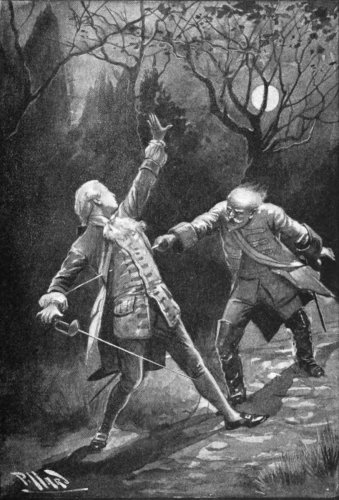
The Sword of Serrefort was running through his Heart.
strange, but standing like one in a trance, he raised his eyes to heaven and exclaimed,—
“My God, I thank Thee for this night, for surely my prison shall be a prison to me no more. Nay, Lord, I go gladly, since Thou hast given me his life.”
And so saying, he fell in a swoon, and they carried him into the house.
When Jacques de Serrefort came to his senses again, he was lying upon a couch in a little pavilion of the Hôtel Beautreillis, and his daughter, Irène, had her arms about him.
“Dear father,” she said, “turn not away from me. It is your daughter Irène who speaks,—she whom you loved in the long ago.”
Serrefort looked at her with a loving regard. Then taking her hand as he used to do in the old days in Brittany, he exclaimed:—
“Little one, you will never leave me more?”
“Oh, never,” she exclaimed, covering his hands and face with kisses. “Dear father, the king, who learnt all to-night, has pardoned you. It is Mademoiselle Corinne’s work—she who owns this house and has taken pity upon us. We are to go to Brittany to-morrow, for she has the king’s promise. I will never leave you more, beloved father.”
But Serrefort closed his eyes again. The great clock of Notre Dame was striking twelve, and all the phantoms of the Bombec came winging into the room to torture him with a memory of that which might have been. When the hour was struck, he raised himself upon his couch and kissed his daughter.
“Little one,” said he, “our God is good—let us go and thank your mistress.”
IV. AT THE HOUSE OF THE SCARLET WITCH
The Abbé Morellet heard the ring of hoofs upon the dusty road behind him and instantly stopped his long-suffering white pony. He was a man of alarms, was this good abbé; and his two servants, being dutiful servants, were for the occasion men of alarms also. All three had heard strange stories of the perils of those travellers rash enough to venture after sunset upon the great Western highway to Paris; all three had begun to regret the necessity which had carried them from the peaceful presbytery near Rambouillet to the woods upon the outskirts of the great city. Yet here they were at eight o’clock of a summer’s evening in the year 1762 still three leagues from Paris, with dark already threatening them, and all the tales of bogies and of robbers ringing in their ears like a passing bell in the ears of men about to be hanged.
“It is my opinion,” said the abbé, addressing François, his valet,—“it is my opinion that we are followed by the three young men who delayed us at the Maison Rouge. I can see a cloud of dust upon the horizon and I count three horses.”
François, the valet, and Jean, the groom, hastened in their turn to check the asses which they rode and to inspect the winding highway which they had traversed with so many misgivings. Being ready men, their tongues presently wagged together, and they declared themselves willing to submit to untold tortures if they also did not see a cloud of dust upon the horizon and count three horses.
“Sapristi!” cried François, the valet, “I suspected those fellows from the beginning. What says the proverb, my master?—he who makes friends in an inn has the devil for his comrade. Body of Saint John, I was for going on as your reverence is well aware.”
Jean, the groom, who watched the approaching horsemen with fearful eyes, yet was unwilling to betray himself, remembered now that he had been for going on too.
“Oh,” cried he, “if yon rogues are not footpads I never saw one. Did you mark how they kept their faces masked even when they sat at meat? Put me in the pillory if ever I heard of an honest man who was afraid to show his nose to his neighbour. We shall all be dead men presently, rely upon it.”
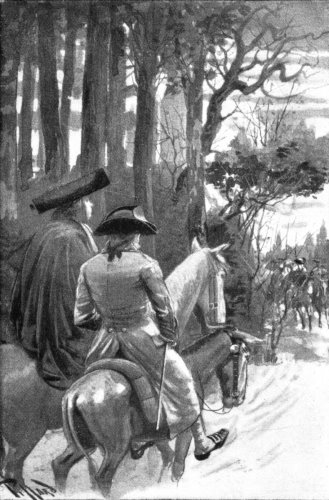
“If yon Rogues are not Footpads, put me in the Pillory.”
The abbé, who nursed a secret suspicion that the groom spoke the truth, told him nevertheless to hold his tongue. He consoled himself with the thought that his personal property was not worth a louis to any rogue; he knew that he had but ten crowns in his pouch; and those he would surrender readily. Indeed, he began to frame a little speech in which he determined both to rebuke the robbers and to conciliate them. And this was still troubling his mind when the three men rode up at a gallop, and began to parley with him. They were a strange trio—all dressed elegantly, all mounted upon horses which might well have come from the king’s stable. The abbé, stealing glances at them when he lifted his eyes a moment from his breviary, did not fail to observe the shining embroidery upon their vests nor the rich ruffles falling delicately upon their wrists, nor the diamonds glistening upon their fingers. These things had been hidden from him in the dark room of the tavern at Sèvres, where the merry fellows had kept him dallying long over a bowl of claret. Now he saw plainly that his pursuers were men of quality, and that two of them were singularly finely built, while the third possessed a figure so slim and delicately proportioned that it might well have been the figure of a young girl. But all three were masked as they had been at the tavern—and this fact alone kept the abbé’s suspicions alive.
“Sirs,” said he, closing his breviary with a sudden snap, “I observe that you wish to speak with me.”
“My lord, the Bishop of Blois,” began the tallest of the men, while he doffed his plumed hat with a gesture of profound respect, “it is evident that you are a stranger upon the road to Paris—”
The abbé interrupted him with a momentary display of irritation.
“My son,” said he, “I pray you address me by my own name and not by that to which I have no title. It is true that the Bishop of Blois is unhappily dead, but under no circumstances is it possible that so unworthy a successor should be found for the See as the humble priest who has lately enjoyed your hospitality. I, gentlemen, am the Abbé Morellet, curé of the village of Yvette, a man with whom the princes of the Church may well concern themselves but little. I go to Paris now to carry my ward Corinne—you may know her as Mademoiselle de Montesson, gentlemen—to a convent of Benedictine nuns at Charenton. And Heaven forbid that I should aspire to such a distinction as you have named.”
He spoke with great dignity, being a man accustomed to command in his own little world. His manner was that of one who has made an end of the argument; but the three horsemen, who maintained a fine gravity of demeanour during the parley, would not be put off by it; and they now held their horses at the walk while the leader answered the obstinate abbé.
“My Lord Bishop,” said he, “I fear that you jest with us. We know you well, and we are concerned to find you abroad here at such an hour. The Church has too few faithful servants that one of the stoutest of her champions should make himself a mark for footpads. Do you forget that you are about to enter the woods of St. Cloud—and that it is sunset?”
The abbé looked surprised.
“Sirs,” said he, “I have never ridden to Paris but once before in all my life, and whether this be St. Cloud or another place, I am, indeed, unable to tell you. Yet for any warning or direction you may be pleased to give me, you will find a grateful listener. I am but a simple priest, gentlemen, and I cannot think that any robber would stoop to find a victim so unprofitable. Heaven be my witness that I have an unpleasant duty to perform in the city yonder. Authority, sirs, is a physic which the surgeon may hesitate to employ, until both persuasion and counsel have been administered. Too long have I been patient—the day for that has passed. Even though the king himself were to intercede, my purpose should be delayed no more. To-morrow, gentlemen, all Paris shall hear that the Hôtel Beautreillis is closed, and that its mistress, my ward, is safe within the convent walls at Charenton.”
The abbé was emphatic. He brought this pompous speech to a fitting close with a good thwack of the cudgel nicely laid upon the pony’s quarters. His two servants, always imitative, laid two sticks smartly upon the backs of their asses, and all began to ride at a good trot towards the park of St. Cloud. As for the three horsemen, they seemed to enjoy the abbé’s company immensely; and they kept close at his side, while merry glances passed between them, and the youngest of the three—who had the figure of a girl—bent low, the better to escape observation. Thus they came altogether to the summit of the hill wherefrom they could see the thick woods about the château of St. Cloud with the river Seine flowing like a river of blood in the valley, and Paris herself away in the distance, the sunlight making red blotches of her domes and towers, and shining with a deep crimson from a thousand west-turned windows. Here, the three strangers drew rein, and one of them, who had not spoken before, addressed the abbé in a parting word.
“My Lord Bishop,” said he, regardless of the abbé’s protests, “you go on a bold task. There have been many before this who have sought to stand between Corinne de Montesson and her pleasures. Do you seek for them, you will find them in all the prisons of Paris—or gone to the wars for shame of their defeat. Beware how you act, then, and think yourself a lucky man if you ride into Paris at all. Nay, I will wager you a thousand crowns that this time to-morrow night you shall be very glad to see us and to get back to Yvette with what speed you may. Yon wood is full of strange sights and sounds, monsieur—many a man who has entered it at sundown has been known no more when dawn has come. Look to your steps, I beseech you; and Heaven grant that the witches of St. Cloud may respect the path of the Lord Bishop of Blois.”
He doffed his cap as the other had done, and all three bowing with ready grace, presently they set spurs to their horses and disappeared at a gallop into the heart of the wood. The good abbé, who had been content at first to think that some mistake had led them to give him so distinguished a title, now became very angry, and not a little alarmed.
“A plague on them and their Bishop of Blois as well!” cried he,—“three tipsy gallants, I will wager, ridden out of the palace to point the finger at me. I should not be surprised to hear that Corinne had sent them. It is well known that she is a friend to footpads. Possibly she has saved them from the gallows. But she shall gain nothing by this. Though she fall on her knees before me, I will carry her to the convent. The day for mercy has passed.”
The reflection pleased the abbé. He had been made guardian of pretty Corinne de Montesson, who, as all the world knew, was mistress of the great Hôtel Beautreillis in Paris, upon the death of her father, the count. For his part, he would have sent her to a convent at once, there to complete her education, which, he thought, had been sadly neglected. But the king had put in a word; and so Corinne was left in her great house to be the friend of all the ne’er-do-weels in the city and to disgrace, as the good abbé said, the proud position to which she had been called. Had she done anything for him personally, his anger possibly would have been more moderate. But, notwithstanding her professions of love, he remained the simple curé of Yvette—and there he had fretted two years over his misfortunes. Then came the tidings that Corinne had helped the notorious Coq le Roi, the highwayman, to escape from Sartines, the new lieutenant of police. The news awoke the abbé to his old resolutions.
“I will go to Paris,” said he, “and place her with the good nuns of Charenton. She is like a little wild animal; her claws must be cut. I have been merciful too long.”
This seemed a very simple resolution in theory; but when the abbé entered the dark woods of St. Cloud after his conversation with the three jesters in the masks, the practice of it began to be difficult. He remembered that the last time he had been to Paris they had led him such a life in the great house that he had been truly thankful to get back to his little hamlet and to his own poor people. He had just a lurking suspicion that his authority might be laughed at again. Besides, he was not in Paris yet, and there before him lay the dark woods against which the three strangers had warned him.
“Bah!” said he, as he quitted the high-road and plunged into the darkness of the silent thicket, “strange sights and sounds, indeed. Am I a child, to be frightened by old women’s tales? Never let it be said. Thank God, there is a ducking-stool still for witches; and I shall know where to complain if I am molested. We must be in Paris before midnight—that is certain.”
The reflection comforted him. It was very dark in the woods, and so silent that the sound of distant church bells or the barking of dogs sounded like voices from a far-off world. The sun had sunk below the rim of the western hills now, and only a deep blue-grey light, blended with pink at the peaks of the clouds, marked the lingering day. In the thickets themselves the mystery and spell of the night were already omnipotent. The abbé could not put off a certain dread and foreboding. His two servants did not attempt any such task. They told each other, consolingly, that they would be dead men before morning; and so they rode hand in hand, each devoutly hoping that the other would be the victim of the night, and that the abbé, their master, would precede them to the grave. No superstition was too gross for them to believe. They swallowed every goblin and witch and demon dwarf that tradition had named for a hundred years or more. There was not a ghost in all France that they would not have staked their lives upon. And here at St. Cloud—where every village lad could tell you of the scarlet witch who rode upon the wings of the wind when the sun had set and the elves were abroad in the forest—what miracle, they asked, could save them from the perils of an encounter with her?
“I have heard it said,” muttered François to Jean as they drove their stubborn asses still deeper into the woods,—“I have heard it said that you have but to look upon the woman to be for ever blind.”
Jean groaned.
“God grant that our master sees her first,” said he.
“And worse than that,” said the valet, “if you are young and good-looking, she will kiss you upon the forehead, and then you are branded like one who has been sent to the galleys.”
Jean signed.
“Saint Denis!” said he, “I knew how it would be. We shall die here, comrade—and for what? Because we follow our master. Is that our duty? I tell you he is no longer himself. Did you hear how yon fellows called him? Be sure of it—they have bewitched him already. I am ready to die for the abbé of Yvette; but a plague upon me if I ride another league for the Lord Bishop of Blois.”
He stopped his ass with the word, and François the valet made haste to imitate him. They were at this moment in a glade so deeply bordered by chestnut-trees that you could scarce see a patch of the grey sky above. The moss beneath their feet was soft and yielding, and the asses’ feet sunk in it almost to the hocks. The figure of the abbé was scarce to be discerned, although he rode but twenty paces before them. It was a gloomy spot, dark, threatening, lonely. A stag, which leaped up at their coming, set the hearts of the cowardly pair beating like pumps. And just at the supreme moment of their alarm what should they see in the hollow but a great flash of crimson light, which lit up the brake about them until every twig seemed to have been dipped in blood, every tree trunk to be a scarlet phantom conjured up by the ghostly flames! Twice the light flashed, lurid, smoking, terrible—then darkness fell; and from the wood there came a scream of many voices raised in an awful wail, like the wail of departed spirits or of men in their agony.
At the first flashing of the fire, the abbé’s pony stood quite still, shivering with fear. Nor was his master in any better plight.
“François,” roared the abbé, “Jean! do you not hear me? God help us all—what a thing to see!”
But François and Jean heard nothing. They were even then on their way back to Yvette, at all the speed of which asses are capable. Long the abbé called them in language which the Church might not have approved, but which the occasion and the abbé’s fear demanded. When he found at last that he was alone, beads of perspiration stood upon his forehead, and it seemed that a hundred spirits were mocking him in the wood.
“Oh,” groaned he, “what do I see—where am I—who is it that follows me? That I should have left my home to come to such a place! Heaven help me or I am surely lost.”
He beat his pony the more in his fear, and driving the unwilling beast through the thicket only by a generous application of his cudgel, he came at last out upon a sward upon which great trees cast shadows of fantastic shape. The spot was desolate enough for anything; but it was lighter than the copse he had just quitted; and the stars shining brightly in the grey heaven above seemed to cast down a message of courage.
“Come,” said the abbé to himself as he wiped the perspiration from his forehead and began to take heart a little, “why do I fear when I have but ten crowns in my pocket? Who would harm the curé of Yvette?—not the footpads of St. Cloud, I am sure. And I do not believe in spirits—certainly they are for hags’ tales. What I saw was the fire of some charcoal-burner. No doubt that was it. My men will come up presently, and we will all go on together. I could laugh to remember what a figure I cut.”
He did laugh at the remembrance, but it was a poor attempt—hollow and mocking, like the thought which bred it. And he began now to be very anxious for the company of his servants, bidding them come forth from the thicket where he believed them still to lie.
“François, Jean!” he bawled, “it is I, your master, who calls you. What do you fear, knaves? Am I not here to protect you? Oh, surely I will lay my cudgel upon your backs to-morrow.”
To his amazement, neither Jean nor François answered his appeal; but in the wood behind him there arose again the eerie wail, and now it was long sustained and piercing, like the wail of witches upon the wing.
“Hail to the Lord Bishop of Blois,” was the cry, “hail, hail! Whither he goes, there go we—lolalla—lolalla—lolalla!”
The echo fled from wood to wood and grove to grove, until it died away in moaning sighs, afar, at the heart of the forest. When the last note was stilled, the abbé heard a voice, sweet and fresh and young, crying,—
“What shall be done to the Lord Bishop of Blois?”
And from the woods the answer came,—
“He must suffer, he must suffer—lolalla—lolalla—lolalla!”
A loud peal of laughter followed the words, and while the laughter rang, the thicket was lit again with the flaming scarlet light. The abbé’s heart threatened to stand still when he saw, grouped there upon the green, the strangest company he had ever beheld in all his life. Dressed in scarlet, some like devils, some like dwarfs, some like hideous creatures with horns protruding from their brows, the throng appeared to be led by a woman whose sugar-loaf cap and sweeping crimson skirts answered in all things to the popular pictures of a witch. When the abbé beheld her she rode upon a great black horse, but those around her were mounted upon white ponies; and the whole company galloping out of the wood, presently they surrounded the trembling ecclesiastic and roared until the very woods rang as with demon voices,—
“Long live the Lord Bishop of Blois—lolalla—lolalla!”
It was a strange scene; the torches, which many of the masqueraders had now lighted, casting a lurid glow upon the scarlet dresses and masks and whitened faces of the dwarfs and demons—horrid monsters, who now flocked about the amazed curé of Yvette. He, on his part, knew not whether the whole were a hideous dream, or the perpetration of some masquerade of which he was to be the victim. Possibly deep down in his mind there was born the question—are these human things or spiritual? Even the learned were gross in superstition in the middle of the eighteenth century; and the excellent abbé was no wiser than other men—perhaps even a little more prone to believe in omens and the unseen than the common citizen. No wonder if the terror of the wood and the dark of the night and the horrid yells of the horned and hoofed company which now swarmed about him contributed to his bewilderment. A hundred possibilities occurred to him while the cries were still ringing in his ears. He had heard of the terrible jests which courtly masqueraders had perpetrated on those who were obnoxious to them. Could he have given offence in high places—or was it true, after all, that the woods of St. Cloud were peopled by spirits and elves and witches, and that he had fallen into their power? He said he would believe no such tale. Rather would he take courage; and if this were a jest of Corinne’s, then should two years instead of one be her portion in the convent.
With this resolution to nerve him, he turned of a sudden upon the horde who pressed about him and began to argue with them.
“Sirs,” said he, “I have heard much talk of the Lord Bishop of Blois, and I see plainly that you mistake me for him. Know then that I am but a simple priest, the curé of Yvette, sirs, and that I ride to Paris upon an affair of very great importance.”
He spoke the words very slowly, but to his astonishment no one gave any answer. All together, witches, dwarfs, and demons, they began to repeat his explanation in a sort of monotone, the key of which changed note by note until it rose to a discordant, unearthly shriek.
“Sirs,” cried they, “we have heard much talk of the Lord Bishop of Blois, and we see plainly that you mistake us for him. Know then that we are but simple priests, the curés of Yvette, and that we ride to Paris upon an affair of very great importance.”
The abbé, deafened by the clamour, put his fingers into his ears and began to shiver with fear.
“Ciel!” he murmured, “you are all mad.”
“Ciel!” repeated the scarlet company, “we are all mad.”
The sally was roared rather than intoned; and at the end of it, the whole company bent low in their saddles, the men doffing their hats to the terrified abbé, the women blowing kisses to him.
Then the scarlet woman who appeared to be the mistress of the throng, raised her fresh young voice and asked again,—
“What must be done to the Lord Bishop of Blois?”
And for the second time the answer came,—
“He must suffer—he must suffer—lolalla—lolalla—lolalla!”
The abbé was really frightened now. The wailing melancholy of the chaunt, the hideous shapes of the men who rode at his side, the strange, distorted whitened faces, seemed to him to resemble nothing human, nothing known. Minute by minute the conviction crept upon him that here was the scarlet witch of whom the common people spoke in their folk-tales. The more he said to himself “It is a jest,” the farther was his mind from accepting that assurance. He shuddered when he remembered that he was alone with jesters so terrible.
“Oh,” he moaned at last, “what do you want with me, what would you do with me?”
“Oh,” echoed the crowd with stentorian voice, “what do you want with us, what would you do with us?”
“Sirs,” wailed the abbé, “for pity’s sake have done with it and take me where you will. I have but ten crowns upon me, and those you shall find in my pouch. Get them, I pray you, and permit me to go in peace.”
A mocking peal of laughter attended this simple confession.
“What shall be done with the ten crowns of the Lord Bishop of Blois?” asked a great horned goblin who rode upon the smallest of the small white ponies.
The girl with the crimson hat answered,—
“He shall buy a supper at the house of the scarlet witch.”
The command moved the company to frenzies of turbulent delight. Before the bewildered abbé could protest or answer, strong hands had clapped a bandage to his eyes, and knotted it so tightly behind his ears that the whole of the strange vision of grotesque and grinning figures was shut instantly from his view. He knew only that his pony was carrying him rapidly through the forest, that the air became fresher as he mounted to the higher places of the park, that he was led it might have been for the space of ten minutes before his beast was stopped and he was lifted gently to the ground. Never once, however, while the procession moved, did the throng cease their unearthly monotone. The chaunt rose ever like a voice of the night, the wail of spirits wandering, or of phantoms at their pleasures. When it stopped at last with a sudden crash, the abbé’s pony stopped too. A strong arm encircled his waist; he was lifted from the saddle and bidden to walk,—he knew that he was entering some room in a house,—a gentle hand forced him into a seat, it removed his bandage; the abbé could see again.
By this time the unhappy man was incapable of surprise. The scene in the wood had robbed him of all power of reason. When they stripped him of his bandage, and he was able to look about him, he neither spoke nor wondered. Yet the spectacle was strange enough to have amazed a bolder man. For the abbé sat at that moment in a room draped in scarlet; and more than that, he sat in a high chair before a long table lit pleasingly by the soft light of many wax candles, and so weighed down with plate and exquisite cut glass that the scarlet drapery below was hardly to be seen. As for the company, that also was a scarlet company,—devils, demons, witches; their whitened faces now hidden by crimson masks, their very hair appearing to be of the brightest red. Even the walls were draped in the same glaring colours; while the attendants, some in hideous masks, some garbed like scarlet elves, capped the scheme fittingly. Yet this was the curious thing—no word was spoken, no greeting given. The company sat like mutes. The abbé shuddered again, for he could not altogether suppress the thought that he might be supping with the risen dead.
Such a haunting suggestion was quick to pass. Though a grim foreboding pursued him while he asked himself, “Where will it end, what did they mean when they called me the Lord Bishop of Blois and said that I must suffer?”—the abbé, good man that he was,—and there was none better in France,—was like other men in possessing a healthy appetite. The groaning table put some heart into him. “I have ridden far, and a well boiled capon with a cup of Burgundy will not come amiss to me,” he thought. And so, for the first time since he had entered the terrible wood, he permitted himself to hope. “They will let me ride on when supper is done,” he assured himself, “and I shall be in Paris, after all, by the last day of the month. It would never do to be delayed over to-morrow, for the king returns to Paris then, and Corinne will see him and cheat me once more. Certainly, I must be in Paris to-morrow. Meanwhile, I will see what sort of a supper it is, for I am very hungry.”
One of the servants had set a plate before him now,—a plate upon which was a little silver dish exquisitely garnished and served. So tempting did the morsel look that the good abbé hastened to plunge his fork into it—but at the first mouthful he made an ugly grimace and was unable to withhold an exclamation.
“How now!” cried he, “that is nothing but bread-crumbs!”
He looked round the table appealingly, but no one in the masked company vouchsafed to him an answer. All were busy upon similar dishes, of which they appeared to partake with exceeding relish. Indeed, they had finished their portions before the abbé had recovered from his astonishment; and while he was still looking at them, a lacquey, dressed in crimson, carried in a dish upon which was a smoking fish of great size, and began to serve slices of it—to the abbé first, and afterwards to the other suppers. At the same moment, another attendant filled the abbé’s glass—a magnificent glass of the rarest Venetian work—with wine from a crystal goblet, and then did a similar service for the rest of the company. The action reassured the hungry curé. For the second time he plunged a ready fork into the dish before him. “Fish is fish,” he said to himself, while he smacked his lips in famished anticipation. The assurance scarce had comforted him when he broke out with a word which was neither ecclesiastical nor abbatorial.
“Name of the devil!” he exclaimed, “but this is bread too.”
How it came to be, in what manner the cheat had been contrived, the abbé knew no more than the dead. Yet there was the fish right enough, and a second mouthful convinced him that it was made of nothing but bread.
“Saint John,” cried he, sitting back in his chair, “who ever heard of that—a fish made of bread-crumbs—and every one eating of it as though it were a mullet from the king’s table! Body of Saint Paul!—they are all mad.”
Mad or sane, the scarlet company appeared to enjoy the fish very much. Their heads bent over their plates, the suppers varied their occupation of eating only by the equally pleasant one of taking long draughts from the crystal goblets before them. They did not appear so much as to notice that the abbé was appealing to them. His words, his exclamations, his questions fell alike upon deaf ears. Not a man listened to him, not a woman raised her eyes to watch him. Nor did his anger, which succeeded presently to his hunger, help him at all. That, too, was absolutely unobserved. Had he roared like a bull, the masked company would have remained oblivious of his presence.
“Ho, ho!” said he at last, while he leant back in his chair and raised the goblet in his hand, “a plague upon the table which sets bread-crumbs before a hungry man!”
He put the goblet to his lips and took a long draught from it. The wine, he had said, would at any rate wash the tasteless bread from his mouth—and so he held the cup long. When at length he put it down, there was upon his face the most unclerical grimace that had ever sat there.
“Maledetto!” cried he, “but that is water.”
He spoke loudly; nor did he look for an answer, being quite assured by this time that he was dreaming, or if he were not, then that he had become the victim of the strangest jest yet played in France. And he was very much surprised when a voice behind him greeted him with the first word he had heard since he entered the room. For the matter of that, the voice was hardly raised before all the suppers leaped to their feet and stood in an attitude of respectful attention.
“And what is the trouble of the Lord Bishop of Blois?” asked the speaker, as he advanced to the abbé’s chair.
He was a man slightly above the medium height, and he wore a dress of white velvet, upon which a lace-work of the whitest diamonds glittered. The abbé observed that he was somewhat advanced in years, and that his features were clear-cut and singularly handsome. He was attended now by two pages, who wore trunk-hose of purple and purple cloaks above them; while an officer in the blue uniform of the Corsican legion stood at his heels as though expecting some command.
“Ho, ho,” thought the abbé, as he watched the stranger, “here then is the rogue who has played this jest upon me. I will find a word for him at any rate.” And so he spoke aloud.
“Sir,” said he, “who you may be I do not wish to know; but if this be your house, permit me to tell you that I have been the victim of a great liberty.”
The stranger feigned astonishment.
“What,” cried he, “have you not supped well, ’seigneur?”
“Sir,” answered the abbé, “I beseech you that you will not call me ‘ ’seigneur,’ for to such a title I have no claim. As for your supper—I would not offer it to a dog.”
“But surely,” cried the other, feigning great astonishment, “that is turbot which you eat, my friend—and do you not hold a cup of the wine of Burgundy in your hand?”
“Monsieur,” said the abbé, with hungry dignity, “whoever has told you that has lied. There is nothing but water here.”
“Oh, indeed,” cried the new-comer; “pray permit me to put it to my lips, ’seigneur. You say that is water?—Saint Louis, I would like to have a cellar full of such water as that!”
He tasted the draught as he spoke, and smacked his lips over it as though it had been a delicious nectar. The abbé, staggered at the action, was silent for some moments; but after a pause he took the cup up in his hands, and did that which was a rare thing for him to do—he lost his temper.
“My son,” he asked, “you declare that to be the wine of Burgundy?”
“Most certainly,” replied the stranger; “most admirable wine.”
“Then I pray you drink it,” exclaimed the abbé—and at the invitation he threw the contents of his goblet into the new-comer’s face.
It was a deserved retort, perhaps, but the miserable curé, had he foreseen that which was to follow, would have cut off his right hand before he allowed his temper to carry him so far. Scarce was the thing done when a cry of horror burst from the company about the table. Fifty hands were raised as if to strike the cowering priest. Threats, execrations, remonstrances were hurled at him until his head buzzed with the clamour. The stranger alone appeared to be unmoved. He wiped his face with a handkerchief of lace, and then turned to the Corsican at his elbow.
“I am sorry,” said he, “but I must ask you to arrest monsieur, the Bishop of Blois. You will take him to his room and keep him there until my pleasure is known.”
“Your majesty is obeyed,” was the answer.
There was a great silence in the place now; and it lasted while the Corsican stepped forward and bade the quaking priest follow him. As for the abbé, he was like one petrified.
“Great Heaven!” he moaned, when they led him from the room, “it is the king who speaks. And I have thrown my wine in his face. God help me, for my day has surely come.”
All else was forgotten in this; the visions of the night, his purpose in riding to Paris, even the offences of little Corinne, gave place to the tremendous fear which his folly had brought upon him. He saw it all now—mystery no longer perplexed him. The masquerade in the woods, the horrible apparition, the flashing of the crimson fire—what was it all but the work of the jesters at the palace of St. Cloud! They had gone out to seek whom they could devour, and they had lighted upon the curé of Yvette, he said. Then the king—he had heard, of course, of their pastime, and had come to witness its consummation. And thus had the abbé been led to the perpetration of a crime so terrible. Nothing, not even religion, was held as sacred, in that year 1759, as the body of the king. The abbé knew full well that unless mercy were shown to him, he might spend the remaining years of his life in the prison of Fort-l’Évêque or even in the Bastille. Men had come to such a punishment for mere words—but to throw a goblet of wine in his majesty’s face! The very memory of his offending compelled him to shudder like one who was already doomed.