Queen of the Jesters (continued 4)
Reading edition
He held his plumed hat still in his hand, and his manner was in all things the manner of Trianon. Corinne did not fail to see that no words of hers would turn him from his purpose; but old Antonio was by no means so willing to surrender readily.
“Sir,” cried he, “you are a very impertinent fellow; if you do not have a care, all Paris will come presently to see you hang at your own door.”
“Saint John!” said the robber, grimly, “if that day come, old man, surely I will ask for the halter which thou hast worn. Get down, lest I hasten thy steps with my boot.”
Then, turning to Corinne, he continued:—
“Mademoiselle, our supper is getting cold while we wait. Bid this old man be silent, I implore you, lest injury befall him. You have heard of me, I doubt not, and will know how little I am disposed to take ‘no’ for my answer when I have set my mind upon a ‘yes.’ ‘La Force,’ they call me, mademoiselle, as I shall call you my friend presently.”
He bowed again, and seeing that Antonio still hesitated, he put his hand roughly upon the physician’s collar and dragged him from the coach. Corinne, on her part, convinced that further resistance was useless, stepped lightly from the carriage and took the robber’s arm.
“Monsieur,” she said, “I am trusting to you as to one of my own kinsmen. But I warn you that you will find me a dangerous guest.”
The robber laughed.
“Mademoiselle,” said he, “my own daughter shall not win greater respect. You have but to command and I obey.”
“In that case,” said she, “I beg you permit my lacqueys to accompany me, and to bring the coach to your house, so that when we have supped I can continue my journey.”
He answered her very gallantly,—
“Your lacqueys are even now following us—and look, your coachman is again upon his box. If they no longer carry pistols, mademoiselle, it is that they may not shoot themselves. Take my word for it, they will never shoot any one else.”
He laughed gaily, and gave the pretty white arm which rested upon his own the suspicion of a squeeze. Had Corinne been certain that the adventure would have begun and ended with the supper at the house of the Silver Birch, her alarm would have been less. As it was, she had a great dread of her company and of the very dark wood which the highwayman now entered.
As for old Antonio, he stumbled along behind her, muttering to himself like a man demented. But he still carried his book, his pen, and his ink-horn; and now and then, had there been light whereby to observe it, a meaning smile might have been seen playing upon his usually placid face. The lacqueys, on the other hand, were in the last stages of fear; and while the coachman cried out that his coach would surely be found in the ditch, the others behind clung to their straps desperately and rolled against each other as men drunk with wine. It was five minutes before this strange cavalcade reached the house of the Silver Birch.
The robber’s house lay snug in the thicket as a nest in the hedge. Save for a small clearing near the door, where a stagnant pool gleamed as with the face of a blackened mirror, the copse put walls of bramble and of bracken about the simple chalet, and so sheltered it that only the eyes of a woodlander might detect a habitation in the vicinity.
Nor did there seem to be any one to guard a retreat so remarkable. Not a light shone from the windows when the guests arrived; not a dog barked or a sound made itself heard. Corinne, who was shivering with the rasping air of the night and the noxious and humid miasma of the swamp, began at last to be seriously alarmed. Her coach, perforce, had been left in the more open glade a hundred yards from the robber’s home.
“La Force” was accompanied now by one only of the torch-bearers. He had left the other heavily armed to watch the terrified lacqueys. Old Antonio in his turn had become green with anger and cold and impatience. He mumbled no longer, even to himself. The highwayman alone remained self-possessed and talkative; indeed, he assumed a more plausible politeness with every step he took.
“Mademoiselle,” he said, producing a great key from his pocket, and bidding his fellow hold the flambeau nearer to the door, “why do you tremble? Am I not here to protect you? In half an hour you shall have eaten a good supper, and be on your way to Paris again. Judge me not harshly since my honour is at stake.”
Corinne stamped her foot.
“Your honour, monsieur!” she cried; “if that be at stake, then surely the wager is trifling.”
“Saint John! madame, it is no trifle, since my honour intrusts to me so precious a charge.”
He spoke with exceeding deference, and stood bareheaded, despite the raw cold of the night, while he threw open the door for her to enter, and bade the torch-bearer hold up the light. None the less did Corinne continue to tremble when she passed into the house and found herself at once in the chief room of it. She asked only that the adventure might draw quickly to its end, for she felt very helpless, and thought how different it would have been had Bénoît accompanied her from Gros Bois. As for her old physician, who had been so ready with his boasts and his talk of mysteries, she could have laughed aloud at his undisguised distress. The shadow of death seemed already upon him. He started at every sound.
The robber entered the house, and, quickly divesting himself of his heavy cloak and his mask, he lighted candles in a heavy silver candelabrum. Directly the pale yellow light flooded the room, Corinne uttered a little word of surprise, for she had never thought that so poor a house could afford such a feast to the eye as this room now presented. Though the chalet itself was rough hewn of wood from the surrounding thickets, its internal ornament was worthy of the Louvre. Rare tapestries hid bare walls; dainty cabinets filled with fine china, chairs and tables reflecting the delicate taste of the period, a fine copy of the Apollo and Marsyas of Raphael, a genuine sketch by Jean de Paris, another by Rigaud, added to the wealth of its decoration.
Corinne felt her feet sinking into soft white skins the moment she passed the door of the house. A blazing fire of fagots spangled with golden stars the polished wood of the ingle-nook. The table itself was almost hidden by bouquets of spring flowers and early fruits. The whole place was redolent with the air of dishes steaming, and of good things made ready.
“Come,” said “La Force,” when he had indicated the seat of honour, and had placed Corinne therein, “you will forgive me that I have no lacqueys as you have, mademoiselle. I am a lover of solitude, and my secrets are not well worn in company. But you will find my supper none the less excellent, believe me. As for our friend here, let there be no hot blood between us. I have not forgotten the service he did to Coq le Roi. Saint John! it is I who should fear with such a wizard for my guest.”
The bloodless eyes of the old physician twinkled when the compliment was paid. He, for the first time, appeared to forget the pass to which things had come, and to observe the supper now being served by the comrade of their host. When at length he sat down, a smile of satisfaction played upon his face, and he hastened to admit so much to the robber.
“Monsieur,” said he, “it is to my mistress that your friend Coq le Roi owes thanks. My own share in that business is not worthy of mention.”
“Ciel!” cried the robber, helping Corinne to a goblet of Chianti, “you are modest, Monsieur le Médecin; did you not, as the story goes, tell the lieutenant of police everything that Coq le Roi was about to do during the next four-and-twenty hours? Holy Mother of God! I would have given a hundred crowns had I been there to hear the jest.”
Antonio looked up from his plate.
“My friend,” said he, “it was a jest, I grant; yet had it been my intention, I could have told the future of Coq le Roi not for one day, but for a year.”
“La Force” roared with laughter; the wine had warmed him, and his wager was nearly won.
“Name of the devil,” cried he, “you are a true magician, old man; have a care lest you provoke me to ask a like experiment.”
“Indeed,” intervened Corinne, who had exchanged a quick glance with the doctor, “you do Antonio an injustice. A very little provocation, Monsieur Brissac, will induce him to grant your request. He has been absorbed in some calculation ever since we left Gros Bois.”
“La Force” drained a goblet to the dregs.
“Saint Denis!” said he, “we will put him to the proof upon the spot. Did not Coq le Roi tell me that he drew little lines upon a piece of paper? Very well, then, your physician has paper, mademoiselle, and I see an ink-horn at his waist. Let him tell me what I shall be doing this time to-morrow night. If he can do that, I will conduct you to your coach before the clock strikes again.”
Corinne looked at Antonio inquiringly, but the doctor shook his head.
“It is true,” said he, “that I told Coq le Roi’s fate, and traced the orbit of his day; but that, I would ask you to remember, was a jest. To-night we leave the jester’s mask behind us, and neither pen nor paper will serve our purpose. Command, I pray you, monsieur, that your servant bring me yon silver bowl full to the brim with boiling water.”
“Pah!” exclaimed the robber, “you think that I am a child!”
“I think nothing, monsieur. I wait to act. But if you do not choose—”
“La Force” shrugged his shoulders; the wine had quickened his more brutal instincts.
“Oh,” replied he, “as for that—I choose; but I tell you plainly, mon ami, if this be another of your jests, you shall drain the bowl to the dregs.”
Had the robber been sober enough to detect it, he would have observed that old Antonio’s eyes were lighted for a moment by a look which boded no good to him. But he was too busy with the flagons of wine, and the excellent supper his fellow rogue had cooked, to observe it, and the look passed upon the instant, to leave the physician unmoved and apparently unconcerned. Even a close observer would not have foretold anything of the comedy then about to be played in the house of the Silver Birch.
None the less, Corinne foretold it. A subtle instinct warned her from the first that her old friend had not forgotten altogether his boasts in the coach. She knew not what plan he had contrived, nor what weapon he sought; but she began to take heart, hoping that she might, after all, be revenged on this insolent fellow who had subjected her to such an insult. In truth, her pride was sore hurt; and although she hid her feelings very prettily, nevertheless she told herself that the highwayman known as “La Force” should find her, as she had declared, a dangerous guest.
All this passed through her mind when the lesser rogue, who aped the rôle of lacquey, brought the silver bowl from the kitchen, and the steam from the boiling water began to moisten the air of the supper-room. Antonio had now tucked up the sleeves of his heavy gown, and was prepared, apparently, to fulfil his promise to the ultimate letter.
“Monsieur Brissac, you have asked me to tell you upon what employment you will be engaged at this hour to-morrow night. When the steam from that bowl shall have cleared away, I will ask you to look at the surface of the water, and to read your own fate therein.”
The robber laughed scornfully.
“At your pleasure, friend,” said he, “though if you fail me, I warrant you I will keep my word.”
Antonio bowed, but said nothing. Corinne felt her heart beating quickly, while the blood surged up into her head and made her dizzy. She began to fear that Antonio was embarked upon some very dangerous enterprise, in which failure might leave her alone with this ruffian who had stopped her coach. She was tempted almost to beg her friend to desist, but he refused steadfastly to exchange a glance with her, and she, by a great effort of will, held her peace.
A minute passed, perhaps, before the steam floated away from the circle of the bowl. When it was quite clear Antonio rose from his chair and began to peer into the water very diligently.
“Monsieur,” said he, with great dignity, “come near and tell me if the water of life has any message for you.”
The robber bent over the bowl, and examined its contents very narrowly. “Bah!” he answered, “you mock me; there is nothing there.”
Antonio looked again.
“My son,” said he, speaking now with the air of a doctor, “fate is not the child of man, that he shall say to her, do this, and she will do it. Seek rather to approach these mysteries with awe, for they are mysteries to which God alone holds the key. Let there be obedience in your heart and humility in your mind, since the hour of your death is about to be made known to you.”
“Monsieur,” said he, “for the third time, I tell you, beware how you jest with me.”
In spite of his braggadocio, “La Force” trembled. His hand shook a little when he bent over the table; the colour rushed from his face and his lips were bloodless.
“Speak not of jests, I say,” cried the old physician, solemnly,—“speak not of jests, for the book of God is about to be opened before your eyes. Nay, my son, let there be a prayer upon your lips, and the fear of God in your mind. Behold, the picture shapes itself.”
Swiftly and deftly he took a phial from his pocket and cast the contents upon the face of the water. The robber, wound up to a surpassing dread and curiosity, bent over the bowl until his eyes almost touched the water. At the same moment the white powder from the phial began to mix with the liquid and to set up a great effervescence, with a noxious odour which filled the whole room: a seething vapour, which hurt the lungs of those who breathed it. “La Force,” who all unwillingly inhaled the vapour as he bent over the water, uttered a loud cry and made to draw back from the table; but old Antonio had gripped him by the neck now, and was strong with the strength of ten men.
“Behold, my son, behold, and read the book of life,” he cried, with a ferocity which was almost devilish, while he forced the robber’s head down until his brow touched the silver rim. “Did I not tell you that the hour of your death was written there?—look well then, for the hour is come.”
During a terrible instant, the struggle was a doubtful one. The bowl rocked and spilt the water upon the table; glasses fell and were crunched under the elbows of the men; the robber, about whose throat the bony fingers of the physician were twined, fought like a wild beast. For the first fumes of the drug had robbed him of breath, almost of sense; his lungs were scorched as by burning needles; his eyes were blinded and smarting; it seemed as though a hand of iron had been put upon his heart to still it.
Presently sense began to leave him; and after a moment of suffering, when he thought that he was sinking down, down into a vast abyss of darkness, the idea began to recur in his mind that he was lapping the water of the bowl; and this quickened and quickened, as ideas will in the brains of those who are on the point of losing sensibility, until he sank as one dead upon the floor, and silence fell upon the room again.
Silence fell upon the room, but half of a minute was not marked on the clock before it was broken. The robber’s comrade, awakened to curiosity by the hush of voices, appeared suddenly at the door of the supper-room, and stood half choked by the vapours. Corinne herself was upon the point of fainting, when the old physician unbarred the shutters of the little window, and let the night breeze come blowing in like a gift of life.
“Mademoiselle,” said he, “stand here at the window, and your faintness will pass; I am going to deal with this fellow as I have dealt with his master.”
The second of the robbers gave a great cry, for he saw the body of “La Force” huddled upon the floor, and did not neglect to observe the broken glasses and the disordered table.
“Holy God!” exclaimed he, “ ‘La Force’ is dead.”
“As you say, my friend,” answered Antonio, “ ‘La Force’ is dead. Let me conjure you to leave this house quickly, lest my art strike you as it has struck him.”
The man answered him by levelling a pistol at his head; but, when he pulled the trigger, the powder did not even flash in the pan.
“You see,” continued Antonio, “that pistol is my servant also. Begone, then, lest you lie there with your master.”
He pointed impatiently to the door, whereto the man slunk in awe, muttering “ ‘La Force’ is dead.” They heard him a moment later galloping wildly through the woods with the same cry upon his lips.
“Mademoiselle,” said Antonio, very quietly, “it is fortunate that I took the opportunity to spill my wine upon the pan of yon fellow’s pistol while we sat at supper, or assuredly he would have blown my brains out. Now, if it be agreeable to you, we will bind up this rogue in his own table-cloth and carry him to Paris with us as a souvenir of this evening.”
“To Paris!” cried Corinne, in amazement, “and what shall we do with him in Paris, my dear Antonio?”
“We shall punish him for his audacity in stopping the coach of Corinne de Montesson. Did I not tell you that my mysteries were more powerful than the sword of your kinsman, Bénoît? Have patience a little while and you shall doubt my word no more.”
Corinne could not repress a word of fear.
“You carry your jest far—it seems to me that the man is dead.”
“Indeed, there is very little the matter with him, mademoiselle—so little that I fear to hear him tell us so if we delay. Run back to the coach, then, and bid one of the men attend me. If the third knave should desire to know what we have done to his master, ask him to come to the house and I will show him.”
She did not answer him, but, drawing her cloak about her, ran off swiftly through the thicket.
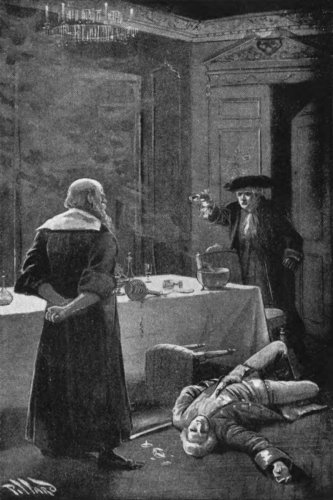
The Man answered him by levelling a Pistol.
When the lacqueys and the third of the robbers arrived at the chalet presently, they found “La Force” already bound hand and foot with the white cloth from his own table.
Indeed, a physician alone could have told that he lived; and when the remaining highwayman saw the body he reeled back as though a pistol had been fired in his face.
“Rascal!” cried Antonio, taking advantage of the situation to grip him by the throat and to clap a pistol to his head—one of the pistols he had snatched from the belt of “La Force”—“rascal! I have killed your master as you see, and am taking his body back to Paris as a warning to those who do not respect the name of my mistress. Choose, then, whether you will throw down your arms and have your liberty, or be taken to Paris to die upon the gibbet.”
The man writhed and gasped under the powerful hand—but impotently—for the lacqueys had taken heart now and had made haste to seize him by the arms. When he spoke, it was to beseech the old physician to give him his liberty.
“By the God above me, we have trapped the devil this night!” said he; “show me but the back of a horse and you shall see my face no more, monsieur.”
Two minutes later, he also was galloping through the woods, crying like one demented, “ ‘La Force’ is dead.” But the body of his master lay secure upon the top of Corinne’s coach, where, rolling and jolting like a log, it rested until the barrier was passed and the horses were driven through the gateway of the Hôtel Beautreillis. Dark as the night proved, many stopped in the narrow streets of the great city to point the finger at a burden so curious; many cried, “They carry a dead man,—what a thing to see!” But others only crossed themselves and lifted their hats. “She jests with the dead,” they said, and hurried on, afraid.
It was one o’clock in the morning when “La Force,” who had been conscious of a restless and troubled sleep, and of strange happenings in his dreams, wholly recovered his senses and sat up in the bed upon which unknown hands had laid him. He thought at the instant of waking that he had slept out in the woods by Gros Bois again; but when he rubbed his eyes and looked well around him, some of the events of the night began to shape themselves again in his brain, and to be acted anew, until he remembered all things—even to the silver bowl and the horrible draught of vapour he had drunk therefrom.
“Mort Dieu!” said he, springing from his bed angrily, “it was the devil’s bowl I drank from—a curse upon them! And now—and now—?”
He began to examine the room with questioning eyes, but his curiosity was soon satisfied. It was a small apartment with walls of stone, in shape, a horseshoe; having for furniture a stool and a table, in addition to the plain wooden bed whereupon he had slept. Its only ornament was a crucifix hung high upon the crown of the apse.
“La Force” saw that the door was sheathed with iron and monstrous thick, like the door of a dungeon. A little window, heavily barred, permitted him, when he stood upon the tips of his toes, to see the world without. At the moment, however, such a privilege was worth little, for the night was moonless, and his keen eyes could detect nothing beyond a great black shape, which had no meaning to him. None the less did he begin to be haunted by the thought that he was in a prison; and when he had reflected a little while, he said it would be the prison of the Conciergerie.
This thought was slow to be accepted, slow to force itself upon his mind. He found himself at first laughing at the idea as a folly; but he could pause in his laughter to feel the damp sweat upon his brow and to sink upon the bed shivering with fear. Well he knew that, if his surmise were true, he might ask nothing more of life. They would send him to the galleys—possibly to death. He remembered the dashing life of the road, the women he had kissed, the gay company he had enjoyed, the debauches which had been kept in the house of the Silver Birch; and these pleasant memories helped him to stave off the dreadful omens of the cell. “God!” he said, “it cannot be that I shall never see the woods again!”
It needed a great effort to banish a sense of peril such as this; but he refused to hear the damning voices which haunted him; and anon, he got into bed again and tried to sleep. He was very weak after the trial of the night; and when he lay down and pulled the heavy covering over his head to shut out the light of the lantern which illumined the apartment, he found that he was hot as one in a fever, and that there was a new pain in his lungs which forbade him to rest.
Do what he would, recall as he might the most pleasant scenes of his past, a phantom figure ever at his side seemed to whisper, “You are come to the judgment.” For a while he battled bravely with the spectre, but when a clock without struck two, he was able to endure the vision no longer, and he sprang from his bed in an agony of fear and of foreboding.
“Jesus!” he said, “it is my dream; that which I see is a thing of sleep. The sun will shine in my eyes presently, and I shall behold the forest again. My horse will come to me, and we will—”
A shadow falling across the floor cut short his pleasant promises. It was a dreadful shadow, magnified by the lantern’s feeble light until it represented nothing human, being a horrid shape, eyeless, with masked face, and a head upon which a cap like a fool’s cap was placed. “La Force” staggered against the bed when he beheld it, and covered his eyes with his hand.
“Mother of God!” he sobbed, “what do I see?”
“Monsieur,” was the answer, in a low and gentle voice, “fear nothing from me. I come to warn you.”
“La Force” turned his head and looked. A figure dressed in the rough black robe of a monk, but having the head and face covered with a pointed black hood, like the hood of the Misereri in Rome, stood motionless at his side. For a moment the highwayman succumbed to an overwhelming panic. He shrieked aloud at the terrible aspect of the phantom, believing that the devil stood with him in the cell.
“Oh, for pity’s sake,” he wailed, “tell me what this means.”
“My son,” said the monk, “it means that you have stopped the coach of Mademoiselle de Montesson; for which crime you now find yourself a prisoner in her house, where—”
He paused, as though he did not wish to finish the sentence; but the robber, being assured now that the apparition was no ghostly one, could not suppress his curiosity.
“Yes—yes,” he asked eagerly, “where—?”
“Where you are to die at dawn,” said the monk.
“La Force” wiped the sweat from his brow and laughed like an hysterical woman.
“Bah,” he said, “she will not kill me.”
“My son,” said the monk, very earnestly, “she will think no more of killing you than of crushing an insect in her path. Do you hear those blows? They are the blows of the axes which hew a scaffold for you. If you doubt me, look from yon window and you shall see—”
“La Force” ran to the window, and standing upon the tips of his toes looked into the court. Where darkness had prevailed ten minutes before, light—the light of fifty torches—now mastered the night. The highwayman saw that these torches were held by men gowned as his mysterious visitor, all in deep black, with hoods covering their faces, and holes for their eyes, which gave them an ogreish aspect terrible to behold.
But that which interested him more than all was the great structure they were helping to build—a structure of wood heavily draped in black. Very familiar to him was that warning shape—the great cross-beam, the heavy side supports, the platform for the victim. He could even see a coil of rope curled like a snake upon the black carpet.
“Jesus!” he said, dropping upon his feet again, “they build a scaffold.”
“Exactly,” said the monk, “and at dawn they will have finished their work.”
“La Force” felt his heart beating quickly, but he nerved himself to look out of the window again.
“Holy God, have pity upon me; I see a coffin!” he exclaimed, reeling back from the casement and falling, terror-struck, upon the bed. “Oh, monsieur, of your charity beseech a little mercy for me. I cannot die—I have sin upon my soul.”
The monk watched his agony unmoved.
“My son,” said he, “of that which we sow assuredly we must reap. Forget not that your harvest is death. At dawn you will garner the fruit you have fostered so well. Remember that the sun will shine down to-morrow, not upon your eyes glad to behold the day again, but upon the earth which lies heavy upon a spiritless body. Think of that, and be warned, for here mercy is unknown.”
“La Force” answered him with a great oath and a threat, lifting his clenched hand to strike the speaker; but the monk seized the upraised arm by the wrist and threw the robber to the ground with such force that he lay there many minutes stunned and bruised. When he looked up again the monk had left the cell.
He heard a clock strike three at this time; but the sound of hammering still continued in the court without, and although he dared not to look again, he made sure that the scaffold must be now near its completion.
Had it been given him to die upon the high-road in some affair where swords clashed and pistols made merry music, he would have shown a bold face enough; but to be killed like a rat in a trap, to swing like a common thief, simply because he had compelled a woman to sup with him against her will, was a punishment not to be borne.
There were moments when he raved like a madman, beating with his fists against the cold stone wall, or casting himself in rabid fits of fury at the iron-sheathed door. At other moments he lay upon his bed in a stupor, scarcely seeming to breathe, trying in his mind to imagine that the end was passed, and that he lay in his coffin, still and voiceless, beneath a heavy weight of earth. When at length a glimmer of day struck the dark court without, and came with timid step even into his cell, he had no longer the mind either to fear or hope. A dull and merciful insensibility to thought prevailed.
It was half-past five precisely when the door of his cell was opened, and the monk, accompanied by three others similarly habited, re-entered the prison and bade “La Force” arise.
“Monsieur,” said the monk, “the hour has come. Have courage, then, and drink a cup of wine. Remember what a reputation you bear, and do not let them speak of you as other than the brave man I know you to be.”
“La Force” opened his eyes, for he was half asleep.
“Christ!” said he, “I dreamed that I was in the woods again.”
He was like a man walking in a sleep now; and he drank off the wine they offered him, protesting that he was ready to die; but no sooner were the words spoken, than he fell into an uncontrollable fit of sobbing, and, throwing himself upon his knees, he craved mercy of them. The four hooded men gave no sign that they heard him, but stood like messengers of death, silent and unmoved. Nor did they speak when they led him from the cell presently, and, coming out into the court, he beheld a towering scaffold with a masked executioner upon the steps of it, and other hooded men ready to assist in the last great act.
“La Force” had never thought that death could wear a shape so awful. The cold light of dawn, the silent, hooded figures, the gaunt black scaffold, struck his heart with a deadly and overwhelming fear. He gave one long-drawn cry of agony, and then fell fainting upon the stone floor.
But at the moment when he fell, a great shout of laughter went up in the court, and one of the monks, pulling aside his hood, exclaimed: “Haste to drive him to Gros Bois. The drug that was in the wine acts for three hours. Let him be quite alone when he awakes.”
“La Force” awoke when the church bells in the village of Gros Bois were proclaiming the Angelus. They had laid him in the heart of a solitary thicket, wherefrom, through a bower of the trees, he could espy a little pond shining like a silver mirror in the generous sunshine. But he was very weak when the spell of the drug passed, and he lay for long minutes content to feel the sweet morning air blowing upon his face, and to gaze up at the cloudless heaven above him.
“Holy Virgin,” he said, “can it be that I live—that I have dreamed the things of the night! Is it I, ‘La Force,’ who speaks, or do I hear voices in the grave? Oh, Heaven pity me, for I have suffered.”
Slowly and with painful effort he dragged himself to the pond. A horse whinnied in a neighbouring brake as he went, and he knew that it was his own horse calling to him.
“Oh,” he said, “how good it is to live—how good! Last night I died ten deaths, but to-day—to-day—”
He tried to collect his thoughts and to knit the story of this night together, but confused images played with his brain, and he could recall nothing. Once or twice the old fear came back to him. His heart quickened when he remembered the masked men and the heavy blows of those who had hewn out his scaffold. But this mood passed, and at length he crawled to the pond and began to lap up the water.
A tree shaded the place where he lay, and the water being clear and without a ripple, he beheld his own image reflected in it; and at this he started back from the bank, and his trembling hands clutched the grass convulsively.
“God!” he said, “she was right—she is a dangerous guest.”
VIII. YERUT THE DWARF
Chamillart, Marquis de la Suze, entered the garden of the Hôtel Beautreillis when the clocks of Paris were striking five. He was dressed with scrupulous care, but the heavy coat of black satin with the ample skirts, dictated by fashion in the year 1766—the heavy coat, and the full wig which fell upon his stooping shoulders, were allies of the summer heat. Chamillart, Marquis de la Suze, also Grand Marshal of the palace, used his handkerchief very freely, and declared that the weather was atrociously warm. And this was an observation not to be contested.
There was no one in the garden—an old garden umbrageously sweet and alive with the vesper note of birds—when the lacquey led so distinguished a visitor to a little bower of chestnut-trees, girt about with roses in full bloom, and carpeted with ripe grass and the petals of the flowers of yesterday. Here was a couch of ivory and satin and a little table, upon which a golden flagon of wine was set, and cups beside it, and fruit to cool the lips. Chamillart, Marquis de la Suze, bade the lacquey tell his mistress that his business was urgent. Then he filled a cup of wine and drank it at a draught. Certainly, the day was atrociously hot.
Had it been anywhere else than the Hôtel Beautreillis in the Rue St. Paul, had the mistress of the house been any one but pretty Corinne, with whom all Paris was properly in love, the Grand Marshal would have swollen visibly before the eyes of that lacquey who had asked him to cool his heels in a garden; but since it was the Hôtel Beautreillis, and Corinne was unquestionably mistress of it, he contented himself with a prodigious pinch of snuff and many impatient shufflings of the feet, and an attempt to stoop and pick a trailing rose; but there nature hindered him, for he was very stout,—without doubt it was a hot day.
Corinne de Montesson came tripping out of the house like a schoolgirl from a convent. She was dressed in that costume known as the négligé apparent—a girlish dress, suggesting shepherdesses and Elysian fields, and masquerade at Trianon. A straw hat half concealed the wealth of pretty silken hair which fell upon her shoulders, and was rebelliously untrammelled about her little ears. Her arms and neck were bare, and white as the marble of the fountains. She carried a volume of Racine in her hand; a merry laugh rippled upon her lips.
Chamillart, Marquis de la Suze, leaned heavily upon his gold-mounted cane, and watched the pretty picture.
“Ventrebleu!” he said to himself, “she cannot be twenty-five years old—I do not believe it; she is eighteen, fifteen—she is an angel, and I am going to make her cry.”
It may have been that, among the other reflections of this wicked old fop, there was one which told him how pleasant it would be to wipe away the tears of Corinne de Montesson. But that he concealed when he rose to salute her. Indeed, following the extravagant habit of the times, he stood bowing for quite a long time; and while he did so, he covered his heart with his three-cornered hat, as though in heart and hat lay all the emotions which had prompted his visit.
“Chère Corinne, you have no pity, you make me wait,—me, Chamillart—the minutes are hours—I grow old in this garden—”
She laughed coquettishly, for the day was rare when Chamillart, Marquis de la Suze, did not amuse her very much.
“Oh, monsieur, it is really too hot for compliments,” she said, sinking into a low chair placed by the side of his couch. “Am I not grateful to any one who comes to the Hôtel Beautreillis on such a day? Let me give you some wine, and you shall repay me with all the news.”
The Grand Marshal put down his hat very carefully, and then took up that position upon the sofa whence he could look with least effort into the pretty eyes of his hostess.
“The news!” he said, “oh, as for that, there is no news. Madame de Bouffleurs is not in Paris.”
“She is at Yères, then?”
“Nowhere else. She left yesterday with two coaches, seven lacqueys, and a letter full of scolding from her kinsman, the Bishop of Bruges. She has gone to keep a retreat, and the Chevalier Leduc will follow her to-morrow. But, of course, we do not know that he is going to Yères.”
The Grand Marshal chuckled horribly. Corinne was amused.
“If Madame de Bouffleurs has gone to Yères,” she cried, “we shall have a holiday indeed. It will be Lent again, my dear marquis. There will be no scandals, and think of it, no unhappy lovers. How will Paris live for a week when that wicked tongue is still?”
“Impossible, my child. As impossible as the happiness of Chamillart, without the words of Corinne de Montesson.”
“A compliment, a compliment! Is not that forbidden, Monsieur le Marquis?”
“Mademoiselle, beauty is as far above the law as the stars above the darkness.”
He covered his heart with his hand again, and said to himself,—
“It is a pity that she must cry presently.”
But Corinne knew nothing of his thoughts. She was telling herself that the visit of this doddering old man, whose gallant antics had amused her so often, was a misfortune of an already troublesome day. How long was he going to stop? Why was he at the Hôtel Beautreillis at all?
“You come from the palace, monsieur?” she asked, when the Grand Marshal had ceased for a moment to ogle her.
“From the palace, mademoiselle.”
“And of whom were they talking?”
“Of the Count of Brives, chère Corinne.”
Corinne’s face flushed crimson. The Grand Marshal turned away his head.
“I would give half my riches if she would flush for me like that,” he thought.
“And what did they say of the Count of Brives?” asked Corinne, making a violent effort to conceal her emotion.
“They were very sorry for him, mademoiselle.”
“Sorry, monsieur, for Eugène—that is, for Monsieur le Comte?”
“Certainly, my child; but have you not heard the news?”
“Did you not tell me there was no news?”
“Yes; but how should I know that this would be news—to Corinne de Montesson?”
“Oh, for pity’s sake, tell me!” she exclaimed, rising and stamping with a pretty gesture of impatience. “Tell me, Monsieur le Marquis, what are they saying of Eugène Sabatier?”
The Grand Marshal shrugged his shoulders.
“She is going to cry,” he thought, “and I forgot to bring a second lace handkerchief.” But Corinne persisted.
“Mademoiselle,” he said at last, “I thought you would have known. Madame has prevailed with the king, and the Count of Brives will be in the Bastille to-morrow.”
A cry escaped her lips; Corinne’s cheeks were rosy no more. She stood, white as marble; a blow would not have hurt her more than the tidings which the Grand Marshal carried.
“Oh, it cannot be! it cannot be!” she cried. “Eugène—the Bastille—oh, I will not believe it!—what crime has he committed—whom has he wronged—is he not the king’s friend, monsieur?”
“Without doubt, all that is true, my child; but there are other friends, and they are more powerful. It has been the misfortune of Monsieur le Comte to offend one of those friends. He who puts honesty against a pretty face fights a losing battle, Corinne. When that pretty face has for its neighbour the ear of a king, poor honesty is already worsted. Your friend the count is young, or he would know that the compliments we pay a woman are the apologies for the slander we shall put about when that woman’s back is turned. He is also very foolish to be so many months at the palace without finding a word of flattery for its mistress.”
He chuckled, for he was grown old in the practice of polished mendacities. But Corinne was thinking—her quick brain was already at work; one idea possessed her—she must save Eugène Sabatier.
“Tell me,” she cried with sudden impatience, “did the king wish this, monsieur?” And then, without waiting for his answer,—
“Oh, I do not believe it; the king is his friend; if Eugène could speak for himself, it would never be. They have told lies about him; it is the work of Madame du Barry—she has hated him from the first; it is her triumph, but it will not last—I shall prevent it, Monsieur le Marquis, I, Corinne de Montesson—”
Her face was crimson again, but it was with excitement. Old Chamillart watched her with chuckling admiration. His little eyes danced; he leered and ogled like some old man of the sea who found himself, clothed in satin and jewels and fine lace, in some welcome garden of delights.
“Ma foi,” he cried enthusiastically, “who would not have such a deliverer! Of course you will save him. It is for that I am come here. You will begin work now—to-day, this instant.”
She stared at him with a new surprise, but began to listen intently.
“Hark to this,” continued the Grand Marshal, with new gravity, “the Count of Brives is now at his château by the Weeping Rock of Ussy. If he could be warned to-day, to-night—if he could be warned by one who would tell him to ride for his life to the palace and there to see the king without a moment’s delay, the letter which Villefort, the Captain of the Gendarmerie, now carries to Ussy, might yet be powerless to harm him—”
“They have sent Villefort, then!” exclaimed Corinne.
“He left Paris at four o’clock; he carries the king’s warrant for the arrest of Eugène Sabatier; he will arrive at Ussy at midnight. After that hour, chère Corinne, no one in all France can save Monsieur le Comte from the woman he has insulted, and whose hour of vengeance has come. But you will act before then—you will be on the road before the clock strikes again—you will find a plan. Ma foi, it will be a strange day when Corinne de Montesson, the cleverest woman in Paris, is outwitted by Villefort, the buffoon of the guard, the lumberer, the ape! But she will not be outwitted; to-morrow I shall hear a good story. It will be the story of the confusion of Captain Villefort—”
But Corinne was listening to him no longer. The great silver gong at her side already gave out its mellow note warningly; Bénoît, her kinsman, the first swordsman in Paris, came hurrying to her side.
“Where is Yerut?” she asked, utterly unable to suppress her excitement. “Send Yerut to me, and then let them bring horses. We ride to Ussy before the sun sets.”
“Bravo! bravo!” cried the Grand Marshal, as he rose to go. “It is my own Corinne after all; to-morrow all Paris shall laugh at the Captain of the Guard and his twenty men—”
“You said twenty, monsieur?”
“No more, no less; twenty and one against the prettiest wits in Paris. It is good to have the friendship of those pretty wits, chère Corinne—but, blood of Paul, who comes here?”
He started, clutching his cane convulsively, for there came of a sudden to the bower a figure so strange that nothing like to it had been seen by any one in Paris. It was the figure of Yerut, the dwarf. Hideous, stunted, with hair shaggy as the fur of a bear, with hands like claws, with deep-set shining eyes, agile and quick, ready to leap or dance—Corinne de Montesson had no more faithful servant in all her great house than Yerut. And now she knew that the life of her lover depended upon the sagacity and the fidelity of this poor creature.
“Yerut,” she said, “you know Villefort, the Captain of the Guard?”
A grunt of assent seemed to come from the heart of the dwarf.
“He has ridden from Paris to arrest the Count of Brives. He will pass the Weeping Rock before midnight. You must overtake him at the Inn of Ussy and detain him there until we come. Take the swiftest Arab we have—you understand?”
Yerut bowed low. He vanished from the garden like an arrow from a bow.
“To horse! to horse!” cried Corinne, clapping her hands impatiently. “There is not an instant to lose.”
But old Chamillart hobbled away to his coach with a heavy heart.
“I should have postponed the day of my birth for thirty years,” he said to himself. “Certainly, she will never cry ‘to horse’ for me.”
And that was another observation not to be contested.
* * * * * * *
The great clock in the tower of the monastery of Franchard struck eleven when Villefort, the Captain of the King’s Guard, found himself at the foot of the Roche qui Pleure. He could hear the strange note of that watery bell, melodious as the sound of weird music, in the silence of the vast forest of Fontainebleau. Winter or summer, drought or flood, the great rock would shed its silver tear musically into the pearly shell below it. Guides listened for the splash of the water, and went on gladly because of it; peasants worshipped before the heavenly well, and quenched their thirst at the pure fount of miracles. But to Villefort it was no more than the signal that his work was almost accomplished; that when another hour had passed he would lay his hands upon the traitor, Eugène Sabatier.
He rode slowly, his twenty men following with heavy eyes and hard words for a task which brought them to the forest when they should have been in their comfortable beds in Paris. The glory of the hour was nothing to Henri de Villefort. The enchanting light which fell upon the mighty thickets, the moonbeams playing upon the rippling lake, the lengthening shadows, with all their suggestion of elves and spirits, had no enchantment for him. For Henri de Villefort was afraid—afraid of the dark places of the wood, afraid of the silence, afraid of the hag’s tales which his men had not failed to recite to him during their ride from the Barrière d’Enfer.
“Bah!” he had said, spurring his horse in anger. “Who would believe such things, at this time of day? I shall follow the great road to Ussy; there are twenty men with me. I care not a crown for all the devils in the legends. Saint John be my witness, I fear no living man.”
The trooper addressed shrugged his shoulders disdainfully.
“They do not live, captain,” he said gloomily. “They are the dead who died a thousand years ago; they breathe upon you cold breath, and your skin dries up with fever. You go mad and leave your bones for them to lie upon. I heard it at Franchard when I was a singing boy there. God bring us all back to Paris again, is my word.”
Villefort swore a big oath, and rode on in silence. He did not speak again until the music of the Weeping Rock was a melodious echo, but thereafter he began to learn that it was no great highway which led to the Château of Ussy. Through dreadful copse and darkened brake, by paths overhung with trailing creeper and thorny bramble, in the gloom of mighty oaks and spreading chestnuts,—so must this hostile pilgrimage be made. The glory of the moonbeams, sparkling upon the dewy grass, did but light up weirdly the tangled heart of the deeper forest. The fireflies glowing in the woods were for him the evil eyes of the elves he could not see. The nightingale sang warningly. It was as though unseen enemies peopled the groves about him. He thought every minute to feel the touch of a hand upon his shoulder.
And this was his state of mind when a dreadful cry, like the cry of a soul in agony, came without warning out of the thicket upon his left hand and seemed to freeze the very blood of the twenty-one who rode to Ussy.
“Saints and angels, hark to that!” cried Villefort, drawing rein with trembling hands.
Again the cry arose—again and again. The troopers sat still as statues in the moonlight. Villefort could hear his heart beating; the fiend himself, he thought, was at his elbow.
“Pish!” he said presently, though the words seemed to choke him, “it is a wolf at supper, and that is the cry of the dish. Are we all women, to draw rein at shadows?”
“Not at all, Monsieur de Villefort, not at all,” answered a voice from the thicket whence the cry came; “I will stake my life that there is not a woman among you, or if there be, why then she wears a better face than the Captain of the King’s Guard.”
A deep laugh, like the boom of a merry bell, followed the words. The guards were still listening to it when, with a great snapping of twigs and bursting of bramble, the speaker forced his horse from the covert and confronted Monsieur de Villefort.
“Holy Michael, defend us from all devils this night!” groaned Villefort, while cold sweat stood upon his brow and his quaking hand closed nervously about the butt of his pistol.
Yerut, the dwarf, for it was he who had raised the cry and had answered the Captain of the Guard, was clothed from head to foot in scarlet. Great boots, which appeared to be almost as large as the wearer, dangled from his saddle-flaps nearly to the ground. He wore a three-cornered cap cocked on the side of his shaggy head, and rode an Arab horse which still champed at his bit, though spurred from Paris to the Weeping Rock. Never did a stranger apparition confront man.
“Amen to your prayer, Monsieur de Villefort,” cried the dwarf, gaily,—“amen and amen. The holy saints save us from all devils, and give us the light of their lamps to follow the road to Ussy.”
“You go to Ussy, monsieur?” asked Villefort, taking heart a little when he saw the diamonds glistening upon the hilt of the stranger’s sword. At the same time he said to himself, “Here is a brother of all the fiends.”
The dwarf did not answer the question put so directly to him, but fell instead into a fit of uncontrollable laughter. The very woods rang with his merriment; he reeled in his saddle until his forehead touched the mane of his horse.
“Ho, ho, ho, ho!” he laughed, “how you amuse me, Monsieur de Villefort!”
“Amuse you,” exclaimed Villefort, losing his temper; “who the devil are you that you should be amused?”
“A cat may laugh at a king, monsieur, and I am the cat. Is it not good to laugh? If it come to that, I have as good a reason to laugh as the Captain of the King’s Guard to cry.”
“As good a reason—?” gasped Villefort.
“Certainly, since I go to Ussy to bury its master.”
Villefort reined in his horse with a gesture as much of surprise as of will.
“To bury its master, monsieur!” he stammered, “but he is not dead. How can you bury a man who is not dead?”
The dwarf burst again into a merry fit of laughter.
“Ho, ho, ho, ho!” he roared, “what a dull fellow you are, Monsieur de Villefort! It is lucky for you that we met this night.”
“Lucky?” exclaimed Villefort.
“As I say, lucky. For what is luck but gain, monsieur, and what is gain but happiness, and what is happiness but laughter, and what is laughter but wine,—which, by my faith, carries us back ex argumento to this, that wine is luck, and that Monsieur de Villefort of the King’s Guard is a fool.”
Villefort spluttered with rage; the dwarf touched his Arab lightly with his spurs, and began to hum the popular ballad,—Voilà la taverne à la mode.
“Name of the devil!” said Villefort, when he had found his tongue, “I have the mind to write my answer upon your back, coquin—”
The dwarf turned in his saddle, and showed a face so horrible that the Captain of the Guard felt his blood run cold. It was like the face of a Barbary ape. Villefort crossed himself instinctively; he prayed to all the saints to bring him quickly out of the cursed wood.
“Monsieur,” snarled the dwarf, chattering horribly, “he who writes upon the back of Yerut the singer will read his own epitaph.”
Villefort shuddered; the twenty behind him rode with white faces and prayers upon the bloodless lips.
“Yerut the singer,” said the Captain of the Guard, in a very humble voice; “you sing then, monsieur?”
“Like Lucifer himself,” answered the dwarf; and then he fell into a strange, weird chaunt in a voice so harsh and grating that the very leaves of the thicket seemed to tremble—
“De tous les corps de métiers, Voilà ce fléau redoutable.”
“Sing!” he continued, breaking off suddenly; “have I not the charm of Levasseur and the style of Legros? Do you not admit that, Monsieur de Villefort?”
“Certainly he is mad,” muttered Villefort, in a low voice, but not so low that the dwarf did not hear him.
“Mad,” he repeated, “ay, surely, as mad as Monsieur de Villefort, who goes to Ussy and blows a horn to tell all that he is coming.”
“A horn,—I blow no horn,” cried de Villefort.
“Let us not chop words. And I will tell you this, monsieur, that if you think to arrest the Count of Brives you are a fool for your pains.”
“Pah!” said Villefort, “I ride with one of his friends.”
“With so good a friend that at dawn I shall sing a requiem for him.”
Villefort pricked up his ears.
“How can that be?” he asked.
“Ma foi,” answered the dwarf, “it is no good asking you riddles, my captain. A wench at a book would be quicker. Do you not see that if I am to sing a requiem for the Count of Brives at dawn, some one must kill him to-night?”
“Ho, ho!” cried Villefort, “it is a duel, then?”
“Exactly, a duel.”
“He goes out with you, monsieur?”
“With me?—pah, I do not kill men with swords.”
Villefort bit his lip. His head was clearer now, and fear of the forest possessed him no longer. They had passed from the darkness of the wood by this time, and the lights of an inn shone through the vista of the trees. The Captain of the Guard was perplexed. He did not know what to make of the dwarf or of his story.
“Come,” he said after a pause, “there will be no duel to-night; I shall prevent it.”
“You!” replied the dwarf, who did not attempt to conceal his contempt. “You will prevent it, Monsieur de Villefort!”
“Certainly; I shall arrest the Count of Brives.”
The dwarf roared with laughter.
“Ho, ho, ho, ho!” he laughed; “we will kiss the sun, we will walk with the moon, we will put the stars in our pockets.”
Villefort ground his teeth.
“You think that I cannot arrest him?” he snarled.
“Think? I think nothing, monsieur; it is for the count to say. Were there no eyes in yon wood when we rode through? Were there none to cry, ‘Here comes the fat Villefort to arrest our master’?—none to gallop to Ussy and give news of you? Body of Paul! if you think that you came unheralded to the château, you have not the wits of a German mountebank.”
Villefort swore lustily.
“I never thought of that,” said he. “You mean that he has been warned of my coming?”
“What else could I mean?”
“Then I have ridden upon a fool’s errand.”
“Could you ride upon any other, Monsieur de Villefort? I beg you, if you can employ those great ears of yours, to listen to that music. It is a horn winded in the park of the Château of Ussy. What think you now of your journey?”
The clarion note of a horn rang out musically in the stillness of the night. It echoed from copse to copse, and thicket to thicket, as though phantom horsemen hunted in the purlieus of the forest.
“Thousands devils!” exclaimed Villefort, “I am too late.”
“There is no doubt of that, my dear captain. And being too late, you will do well to draw rein awhile at yonder tavern, where I shall introduce you presently to the Count of Brives himself.”
“The Count of Brives is coming here?”
“Unquestionably he is. He will come before the clock strikes again, to fight my master, who stands before the door there. Meanwhile let me present you to the Chevalier Guibert.”
They rode up to the tavern door with a great clatter of spur and caparison. Villefort, on his part, did not know whether he stood on his head or his heels; he was saying to himself that the Count of Brives had escaped him after all. While he did not believe the dwarf’s story, and was still determined to search the château, he had the wish, nevertheless, to hear what the stranger might say, and to delay for that purpose while the host of the auberge could water the horses of his men and bring cups of wine. The troopers, glad in their turn to leave the darkness of the wood behind them, dismounted joyously, and were soon swarming in the little courtyard, to the great delight of the wenches of the inn, and the great confusion of its master.
There were two horsemen before the door of the auberge; one a big fellow dressed in black velvet, the other possessing a figure so fragile and so pretty, so slim and boyish, that passers-by might well have called it the figure of a girl. A group of servants, heavily armed and mounted on magnificent bay horses, stood apart, awaiting the pleasures of the travellers, the younger of whom was dressed in a suit of purple silk, and carried a sword in a scabbard frosted with diamonds of exceeding brilliancy. It was to the latter that Yerut the dwarf now presented Monsieur de Villefort.
“My master, the Chevalier Guibert—the Chevalier Guibert, my servant,” he said, with a gesture of self-importance not to be described.
“Your servant!” roared Villefort. “Body of Paul, I have the mind to write that upon your tongue!”
The dwarf grinned horribly.
“You could not spell it, Monsieur de Villefort,” said he.
Corinne, for she it was who wore the purple dress, silenced Yerut with a look.
“Monsieur,” she said very sweetly, “you must forgive one who, though young in years, is old in liberties. That will be easier to do, since I am able to be of some service to you to-night.”
“To be of service to me, monsieur?”
“As I say, to be of service to you. Have you not come to Ussy to arrest Eugène Sabatier?”
Villefort regarded the questioner closely.
“You know that, monsieur?”
“Undoubtedly, I know it; and since I alone can help you to succeed, you may not think it a waste of time to drink a cup of wine with me.”
Villefort bowed stiffly, and entered the house with her. At the same moment, the dwarf was deep in talk with Gaspard, the rider in black, who had turned his horse towards the forest.
“We shall keep him an hour, if that be possible,” said the dwarf. “The men will be drunk before then. Let the count ride for his life to Versailles; if time serve, he will find us at the cross-road beyond Essonne.”
“The devil dry their throats!” muttered Bénoît, giving rein to his horse. “I count upon you, Yerut, in all things. Hold yon booty but an hour, and no woman in France shall keep Eugène Sabatier from the king.”
The dwarf stood to watch the darkness of the forest enshroud the galloping figure. Then he returned to the inn and found that Villefort and the Chevalier Guibert, his mistress, were already busy over a flask of wine, set out in a little room upon the first floor. But while the mock chevalier was comfortable in a low wooden chair, the Captain of the Guard paced the room as one who delays but an instant, and that unwillingly.
“Chevalier,” he was saying, “it may be true that the Count of Brives is warned of my coming; yet if that be so, what madness will carry him to this inn when he should be upon the road to the frontier?”
“The same madness which makes the lark sing at dawn and the sun set at eve, monsieur,” chimed in the dwarf, who squatted upon the table and raised a flagon merrily; “the madness of the cow for the moon; the howl of the dog when the horn is winded—the folly of Monsieur de Villefort who chases the stag—ma foi, the quest of a wench’s pretty lips, and hey, for her eyes in the dark.”
Villefort stopped in his walk. The flickering light of spluttering candles fell upon his angry face weirdly.
“Heaven deliver me from this madman!” he cried.
“Monsieur,” said the dwarf, “it is the duty of fools to be sane. Would you have me dull my wits until they were no brighter than those of Henri de Villefort? And there you fall upon a plain tale, and shall see how truly I am mad. For if Nature teaches the lark to call for his mate, and sheds the dew upon the thirsty ground, shall she less befriend the man who, learning that the wench is at the inn, has the mind to sample the lips of yesterday! God’s truth, my captain, it is writ as large as the nose on your ugly face.”
Villefort raised his fist as though to strike the dwarf, but Corinne stood between them.
“Hold your tongue, Yerut,” she said. “Indeed, monsieur, I know not how to excuse him, unless it be that with it all he tells you the truth. The Count of Brives would go a hundred miles to avoid this inn if he knew that the Chevalier Guibert awaited him here; but he would ride a hundred miles to reach it if one told him that Corinne de Montesson was to make it a house of call.”
Villefort forgot his anger.
“You mean to say that he will come here to-night to meet her?”
“As he thinks, monsieur. My servant has even now ridden to the château to tell him that you have turned back to Franchard, and that Corinne de Montesson is here with news which will save his life.”
Villefort roared with laughter. The dwarf roared, too; so that the very rafters rang with their shouts.
“Ho, ho, ho!” laughed Henri de Villefort, “you tell him that his mistress is here, and when he comes you will cut his throat. How you love him, Chevalier!”
“How I love him!” muttered Corinne; and she meant every word she said.
“How he loves him!” roared the dwarf, choking with laughter and with wine.
But Corinne’s heart beat wildly. She was asking herself if the tale had, indeed, borne such good fruit. She looked at the clock and saw that they had been already twenty minutes in the inn. She said that Bénoît was at the château, now; they were saddling the horses,—oh, for an hour, for an hour yet to win her lover’s liberty!
Villefort ceased to laugh and went to the window.
“Saint John!” said he, “if the Count of Brives rides towards the inn, I will even go a little way to meet him,” and then he bawled to his troops: “ho, there, you sots!—do you hear me calling?”
The dwarf leaped from the table and put his grinning head beside that of the captain.
“Ho, there, you sots,” he repeated; “another bottle apiece to the health of the Chevalier Guibert!”
The troopers, who had come out into the moonlight, went, shouting, back to the kitchen of the inn—
“Ho, there, another bottle apiece to the health of the Chevalier Guibert!”
Yerut pulled Monsieur de Villefort from the window and shut it. Corinne’s heart seemed to stand still.
“Upon my word, Monsieur de Villefort,” said the dwarf, “you are a very foolish man. Would you tell all Ussy that you lie here this night? For Heaven’s sake, hold your tongue, or if you cannot do that, bury it in this flagon.”
He pushed a flagon of wine toward the Captain of the Guard. Villefort did not notice the curious taste of the liquor; but when he had drunk, his head swam and the candles danced before his eyes.
“I shall go to Ussy,” he cried doggedly. “It is a plot to detain me here.”
The dwarf took a pack of cards from his pocket and began to cut it. Corinne looked at the clock. Would the great hand never reach the hour? It seemed so to her.
“Go or stay,” cried Yerut, with indifference, “it is the same to me and to my master; and I will tell you this, captain, that if we did not wish to see the Count of Brives very much we would not rest another hour with so impertinent a fellow.”
Villefort, who was dizzy with the drugged wine
Brought it with a Crash upon the Head of Henri de Villefort.
and enraged beyond endurance, drew his sword and confronted the dwarf.
“Dog!” he roared, “I will teach you manners. That is the tenth time you have insulted me this night.”
“The eleventh, monsieur,” said Yerut, who still squatted upon the table. “The eleventh, as I live; and you do well to count, for I am going to make it twelve.”
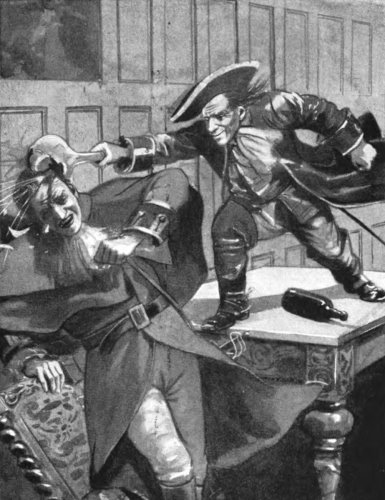
Leaping up with a cat-like agility, the dwarf seized a flagon of wine and brought it with a crash upon the head of Henri de Villefort. So terrible was the blow, that the Captain of the Guard reeled back to the wall; and, while the liquor still poured down his gaudy vest and dripped from his lank hair, the drug they had given him did its work, and he fell senseless upon the sanded floor.
Two minutes later the Chevalier Guibert and Yerut the singer rode from the courtyard of the inn. To the troopers, gathered round them inquiringly, they said,—
“Another flask to the health of the Captain of the Guard!”
And so, throwing crowns upon the flags, they galloped from Ussy, and soon were lost to view in the labyrinth of the forest.
* * * * * * *
Dawn, grey-garbed and melancholy, was hovering above the valley of the Seine when the Count of Brives and Bénoît, who rode with him, drew rein at the parting of the ways beyond Essonne. A mist of morning lay upon the awakening pastures; the rushes bent to the flood of the swirling waters; night answered reluctantly to the heralds of the lagging sun. Dew lay thick upon the brown-burnt grasses; the air was chill and searching as a breath of winter.
“They do not come,” said Bénoît, whose horse, like that of the other, was white with foam. “God grant that Yerut has not failed us.”
“I think of mademoiselle,” said the count, impatiently. “What is it to me that I am upon the road to Versailles if misfortune has overtaken her at Ussy?”
“Ma foi, you complain too soon, count. Hark to that music; it is the ring of hoofs behind us!”
They listened a little while, and then were sure. The sounds magnified and became clearer; care passed from the boyish face of Eugène Sabatier.
“It is Corinne,” he cried joyfully. “Oh, God be thanked!”
Two figures loomed up from the mists; two horses were reined back upon their haunches.
“Eugène, is it thou?”
“Corinne, beloved!”
But Yerut the dwarf was looking at the river, and Bénoît, the kinsman of mademoiselle, became so blind of a sudden that he could scarce see the mane of his horse.
Henri de Villefort entered the gardens of Versailles at three o’clock of the afternoon. He still wore a coat upon which purple patches spoke of the inn at Ussy. His high boots were brown with the dust; his head was bandaged and his walk uncertain. Side by side with him walked Chamillart, Marquis de la Suze.
“You have failed, monsieur,” exclaimed Chamillart, with assumed astonishment, “yet the Count of Brives was at his château last night.”
Villefort ground his teeth.
“His friends surprised me,” he stammered; “I crossed swords with one of them, and was wounded. There is fresh blood upon my coat now, and it was fifteen hours ago—”
He was about to continue his apologies when from a tree upon his right hand there came that haunting demoniacal cry he had heard in the forest of Fontainebleau when Yerut the singer had confronted him. It rose and fell like the wailing of the wind; it froze the words upon the lips of Henri de Villefort.
“Thousand devils!” he yelled, “it is the man monkey again—”
“At your service, Monsieur de Villefort—you seek the Count of Brives; he is yonder with the king, who has just given him a command.”
The dwarf was perched upon the branch of the tree. His lap was full of sweetmeats; he grinned like a cat, but fell presently to laughing incontrollably, as he had laughed in the forest.
“Ho, ho, ho, ho!—you crossed swords with one of the count’s friends, Monsieur de Villefort! Body of Paul, it was with the wine bottle that you fought—”
“You lie,” retorted Villefort; “I fought with the Chevalier Guibert—”
“Who is yonder with the count?—but he wears a petticoat this morning, my captain. What a thing to tell in the palace that Henri de Villefort was worsted by a woman!”
“Dog!” roared Villefort, “it is to you that I owe this, to you and your lies—you who were to bury the master of Ussy—”
“Tais-toi, tais-toi,” answered the dwarf, “look at yon pair, and tell me if my mistress is not also master of Ussy, cher Monsieur de Villefort. But the Chevalier Guibert we buried last night. A truth, a truth! And now they laugh at you, captain. The king laughs. The queen laughs. I, Yerut, laugh.”
Villefort could stand it no more. He strode away with the dwarf’s horrid laughter still ringing in his ears; but old Chamillart, who watched Corinne and the count pacing the distant avenue by the side of Louis the Well-beloved, chuckled horribly.
“I said she would fool him,” he muttered; “I said that she would save her lover—Saint John, if she would but look into my eyes like that!”
“Ho, ho!” said the dwarf in the tree, “she can look into the eyes of a wolf every day.”
And then he fell to singing:—
“A quel diable ce drôle allait-il à l’école?”
Chamillart, Marquis de la Suze, shook his cane at the imp, and turned sadly from the garden.
THE END