Volume 153 — TWO DUMB WARRIORS.
Reading edition
I.—HYLDEBRAND.
When the Heatherdale Hussars received a two-hours' notice to "trek" they, of course, dumped their mascot, Hyldebrand, a six-months-old wild boar, at the Town Major's. They would have done the same with a baby or a full-grown hippopotamus. The harassed T.M. discovered Hyldebrand in the next stable to his slightly hysterical horse the morning after the H.H. had evacuated, and informed me (his village Sanitary Inspector) that "as I was fond of animals" (he had seen me distributing fly-traps and painting horse-trough notice-boards) I was henceforth in sole command of Hyldebrand until such time as his owners should reclaim him. A grant of five sous per diem had been left for the piglette's maintenance.
I took charge of Hyldebrand, provided an old dog-kennel for his shelter, an older dog-collar for his adornment and six yards of "flex" for his restraint. I further appointed the runner—a youth from Huddersfield, nicknamed "Isinglass," in playful sarcastic comment on his speed—second in command. He was to feed, groom and exercise Hyldebrand. I would inspect Hyldebrand twice a week.
Hyldebrand rose fast in village popularity. One forgot that his parents had been shot for cattle maiming, body snatching, breaking into granaries and defying the gendarmerie on the public roads. But Hyldy was all docility. He ate his way through the grant, the office stationery, and the central tin dump with the most disarming naïvété. He was the spoilt darling of every mess. The reflected glory which Isinglass and myself enjoyed was positively embarrassing.
But as the summer advanced so did Hyldebrand. He became (to quote his keeper) a "battle pig," with the head of a pantomime dragon, fore-quarters of a bison, the hind-legs of a deer and a back like an heraldic scrubbing-brush. In March I had inspected him as he sat upon my knee. In June I shook hands with him as he strained at his tether. In mid-September we nodded to each other from opposite sides of a barbed wire fence. Yet Isinglass retained the most complete mastery of his ferocious-looking protégé, and beneath his skilful massage Hyldebrand would throw himself upon the ground and guggle in a porcine ecstacy.
One sunny afternoon, when there had come upon the little village street the inevitable hush which preceded Hyldebrand's hour for exercise, I espied the village cripple making for his home with the celerity of an A 1 man. He glared reproachfully at me, and, with an exclamation of "Sacré sanglier!" vanished in the open doorway of the local boulangerie, that being nearer than his cottage. Then came Hyldebrand, froth on his snout and murder in his little eyes, and after him Isinglass more than living up to his equine namesake. I joined him, and, following Hyldy in a cloud of dust, the runner informed me between gasps that it was "along of burning his snout-raking for a bully-beef tin in the insinuator."
A band outside B Mess was nearing the climax of GRIEG'S "Peer Gynt" suite. Hyldebrand just failed to perpetrate the time-worn gag of jumping through the big drum, but he contrived to make that final crashing chord sound like the last sneeze of a giant dying of hay-fever. The rest the crowd saw through a film of dust. Hyldebrand headed for the turning by the school, reached it as the gates opened to release young France, and comedy would have turned to tragedy but for the point duty M.P. and his revolver.
There was a note and a parcel for me a day or so after. The note, which was addressed to and had been opened by the T.M., stated that Hyldebrand was being sent for by the Heatherdale Hussars on the morrow. Outside the parcel was scrawled, above the initials of the G.H.Q. officers' cook, a friend of mine, "It's top hole—try it with a drop of sauce." Inside was a cold pork chop!
II.—ERMYNTRUDE.
It so happened in a quiet part of the line that men were scarce and work abundant, so it was decided to use mules to carry the rations further than usual. All went well until one night when friend Fritz changed his habits and put some assorted fireworks rather near the mules.
Now the transport, being human and moreover unaccustomed to fireworks, disliked this entertainment. Therefore they sought what shelter they could. In a few minutes the Hun repented, but no mules and no rations could the transport see. Moreover it began to rain. So back they went and spoke at great length of the hundreds of seventeen-inch which had blown up all the mules.
The morning began to come and a machine-gun subaltern, looking at a black East in search of daylight, so that he might say, "It is now light; I may go to bed," was somewhat startled. "For," he said, "I have received shocks as the result of too much whisky of old, but from a split tea and chloride of lime—no! It must be the pork and beans." However, he collected eight puzzled but peaceful mules and handed them to a still more bewildered adjutant, who knew not if they were "trench stores" or "articles to be returned to salvage."
In the meanwhile the Transport Officer was making inquiries, and he recovered the eight mules. "All," he said, "are back, except Ermyntrude. I grieve for Ermyntrude, but still more for my driver's fate."
Where Ermyntrude spent the day no one knows. All that is known is of her conduct the next night. About eleven o'clock she stepped on a shelter, and, being a heavy mule, came into the trench abruptly. This worried but did not hurt her, and she proceeded down the trench at a steady trot, bumping into the traverses. She met a ration party, and for the first time in their lives they took refuge over the top, for Ermyntrude was angry.
Ermyntrude reached the end of the trench and somehow got out, heading, by chance, for Germany. That was her undoing. In a minute or so three machine-guns began firing, bombs and rifle shots were heard, and Verey lights innumerable flared. We never saw Ermyntrude again. But we heard of her—or rather we read of her—for the German official report wrote her epitaph, thus: "Near the village of —— hostile raiding detachments were repulsed by our machine-gun fire."
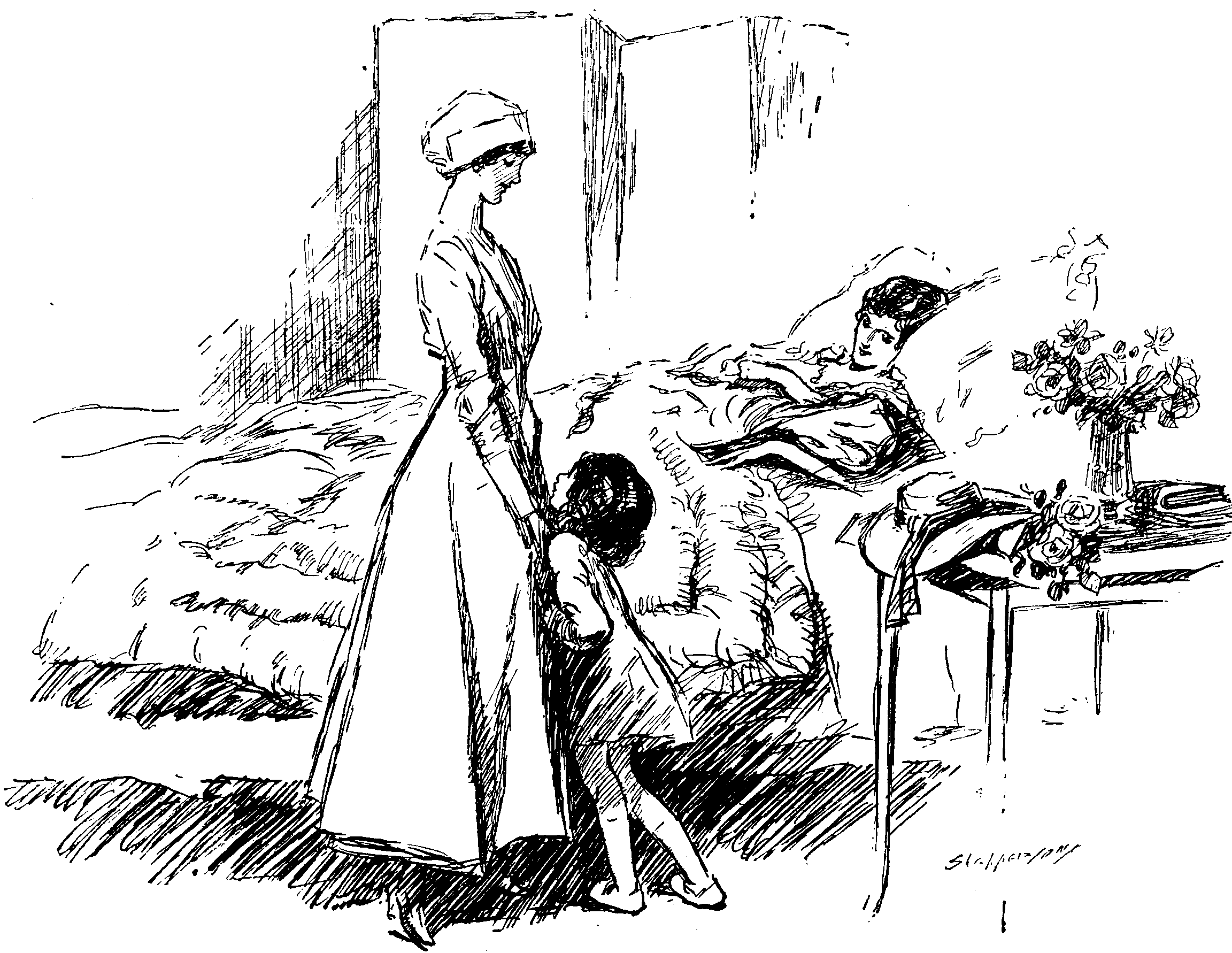
Monica (Taken in to See Her Mother and Her New Sister, Who is Fretful—to Nurse). "TAKE HER AWAY AND BRING ONE THAT DOESN'T CRY."
MOTTO FOR ALLOTMENT-HOLDERS.
"LET US SPRAY."
"We welcome back to a position he once filled so well, the Rev. ——, who is taking on the pork of the parish for the duration of the war."—Bath and Wilts Chronicle.
We trust it will agree with him.
"WANTED, a Very Plain Girl, very good references and photo asked, to care for three children and do housework."—Morning Paper.
You can almost see the green-eyed monster lurking in the background.
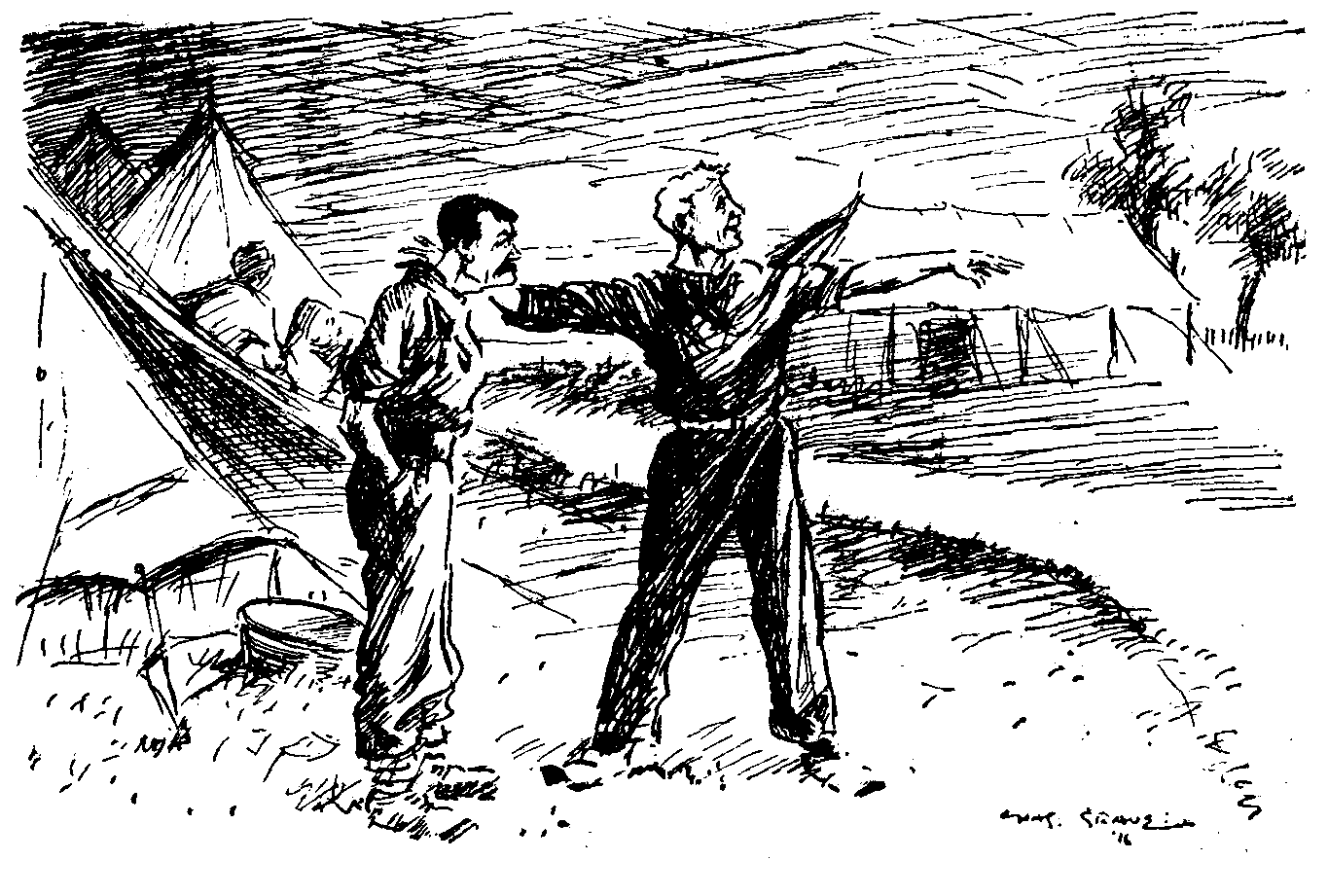
Soulful Soldier (carried away by red sunset). "BY JOVE! LOOK AT THAT! ISN'T IT GLORIOUS?"
His Tent Mate. "YUS. ANOTHER MUCKIN' 'OT DAY TO-MORRER."