Volume 153 — AT THE PLAY.
Reading edition
"THE BETTER 'OLE."
I must congratulate Mr. CHARLES COCHRAN on his courage in transforming the Oxford Music-hall into a home of "the legitimate," and still more on his good fortune in securing for the initiation of his new venture the play which Captain BRUCE BAIRNSFATHER and Captain ARTHUR ELIOT have written round the adventures of "Old Bill." In form it resembles a revue, but I prefer to call it a play, because it possesses a plot, distinct if slight—an encumbrance banned by most revue producers; and because it contains an abundance of honest spontaneous fun. The authors start with the advantage, if it be an advantage, that the principal characters are already familiar to the audience through the medium of Captain BAIRNSFATHER's popular drawings; but they have not been content with reproducing their well-known, now almost hackneyed, adventures, but have added many others which are new and yet "come into the picture."
Their greatest piece of luck was in finding a comedian exactly fitted to fill the part of the humble hero. Mr. ARTHUR BOURCHIER as Old Bill is absolutely "it." His make-up is perfect; he might have stepped out of the drawing, or sat for it, whichever you please. But, much more than that, he seems to have exactly realised the sort of man Old Bill probably is in real life—slow-speaking and stolid in manner, yet with a vein of common-sense underlying his apparent stupidity; much addicted to beer and other liquids, but not brutalized thereby; and, while often grousing and grumbling, nevertheless possessed almost unconsciously of a strong sense of duty and an undaunted determination to see it through. It is a tribute to the essential truthfulness of Captain BAIRNSFATHER'S conception and Mr. BOURCHIER'S acting that one comes away from The Better 'Ole feeling that there must be thousands of Old Bills at the Front fighting for our freedom.
Admirable work is done, too, by Mr. TOM WOOTTWELL as Bert, the incorrigible amorist, for whom each new girl is "the only girl," and who has an apparently inexhaustible supply of identity-discs to leave with them as "sooveneers"; and by Mr. SINCLAIR COTTER as Alf, the cynical humourist—"Where were you eddicated, Eton or Harrod's?" is one of his best mots—who spends most of his time in wrestling with an automatic cigar-lighter. I think it would be only poetical justice if in the concluding scene, when Old Bill comes into his own, the authors were for once to allow Alf to succeed in lighting his "fag."
Of the many ladies who add charm to the entertainment I can only mention Miss EDMÉE DORMEUIL, who as Victoire has an important share in the plot and saves Old Bill's life; Miss GOODIE REEVE, who sings some capital songs; and Miss PEGGY DORAN, who looks bewitching as an officer of the Woman Workers' Corps. The music, arranged by Mr. HERMAN DAREWSKI, is catchy and not uncomfortably original: and the scenery, designed by Captain BAIRNSFATHER, gives one, I should say, as good an idea of the trenches as one can get without going there. In fine I would parody Old Bill and say, "If you knows of a better show, go to it!"
L.
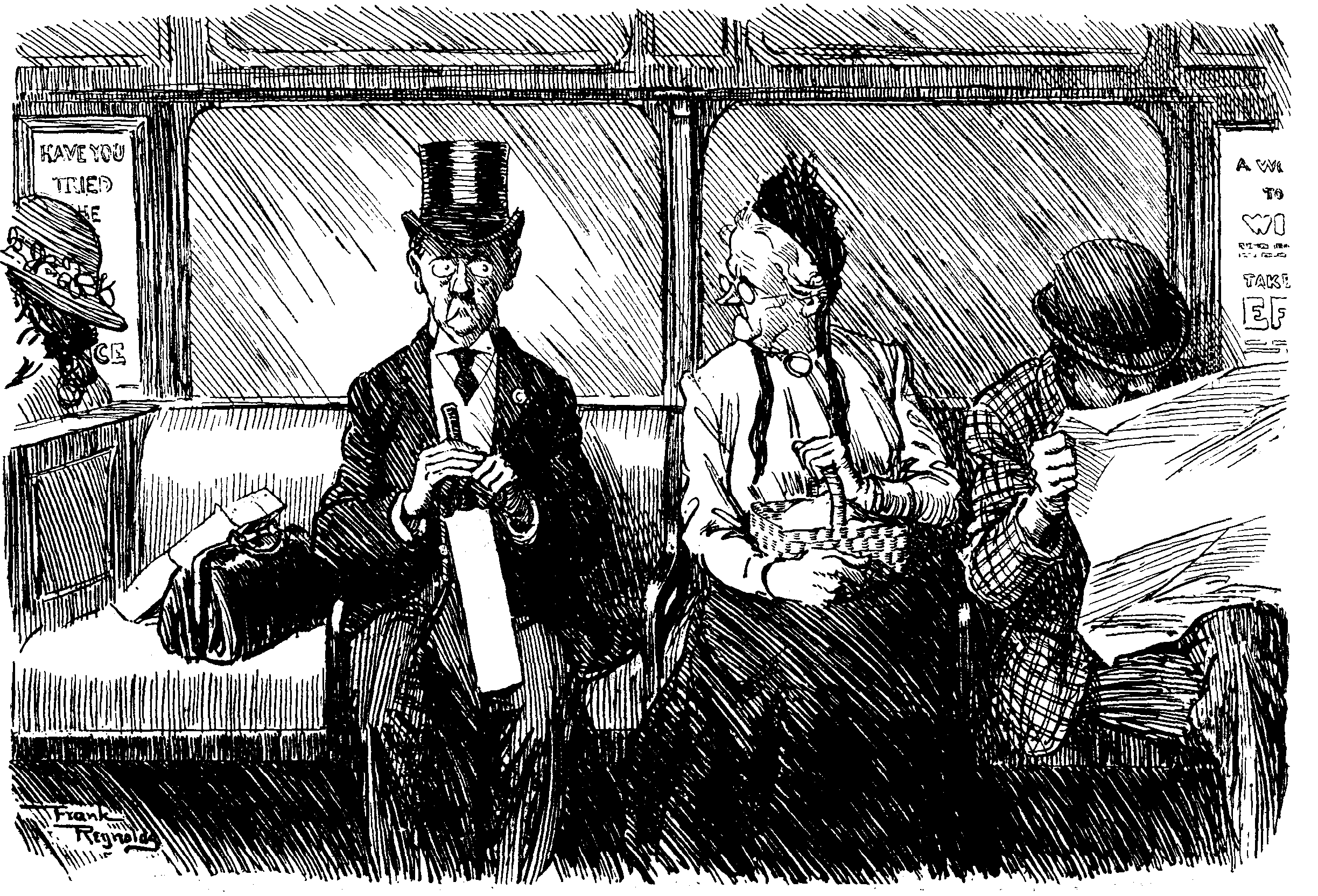
Perfect Stranger (To Jones, Who Has Not Forgotten Willie's Birthday). "AIN'T YOU ASHAMED TO GO BATTING THESE DAYS?"
TO A MODERN MUSE.
O Metaphasia, peerless maid, How can I fitly sing The priceless decorative aid To dialogue you bring, Enabling serious folk, whose brains Are commonplace and crude, To soar to unimagined planes Of sweet ineptitude. Changed by your magic, common-sense Nonsensical appears, And stars of sober influence Shoot madly from their spheres. You lure us from the beaten track, From minding P.'s and Q.'s, To paths where white is always black And pies resemble pews. Strange beasts, more strange than the giraffe, You conjure up to view, The flue-box and the forking-calf, Unknown at any Zoo; And new vocations you unfold, Wonder on wonder heaping, Hell-banging for the over-bold, And toffee-cavern keeping. With you we hatch the pasty snipe, And all undaunted face Huge fish of unfamiliar type— Bush-pike and bubble-dace; Or, fired by hopes of lyric fame, We deviate from prose, And make it our especial aim Bun-sonnets to compose. I wonder did the ancients prove Responsive to your spell, Or, riveted to Reason's groove, Against your charms rebel. And yet some senator obese, In Rome long years ago, May have misnamed a masterpiece De Gallo bellico. We know there were heroic men Ere AGAMEMNON'S days, Who passed forgotten from our ken, Lacking a poet's praise; But, though great Metaphasiarchs Have doubtless flourished sooner, I'm sure their raciest remarks Have been eclipsed by S*****r.
THE LIMIT.
"The daily cost of the war has shown an alarming tendency to mount, and has gone beyond the 700 millions which some folk thought must be the limit a few months ago." Sussex Daily News.
"Junior Assistant wanted to Grocery, Spirit and Provision business; send copy references and salary expected."—Irish Paper.
Quite a promising idea for getting more capital into a business.
INVENTIONS.
"Amongst a number of new inventions," says the Frankfischer Tagwacht, "is an imitation of the smell of Limburger cheese." This has caused some alarm and not a little interest in this country, as the following extracts will show:—
"Berlin Resident" states that he has too long been fed up with imitation meals, and for weeks past has had nothing to eat but holes from Limburger.
"Cynic" remarks that it is impossible for the German scientists to defeat the WOLFF wireless at inventions.
Mr. WINSTON CHURCHILL is anxious to know whether they have yet discovered a substitute for The Morning Post.
The Times Greenwich correspondent wires: "If they have invented a method whereby a news report will make a noise like 'Passed by Censor' will they wire terms?"
Inscription on a French picture post-card:—
"Une locomotive abandonée devant Thiepval. One locomotive a profligate woman forepart Thiepval."
Smith minor is avenged.
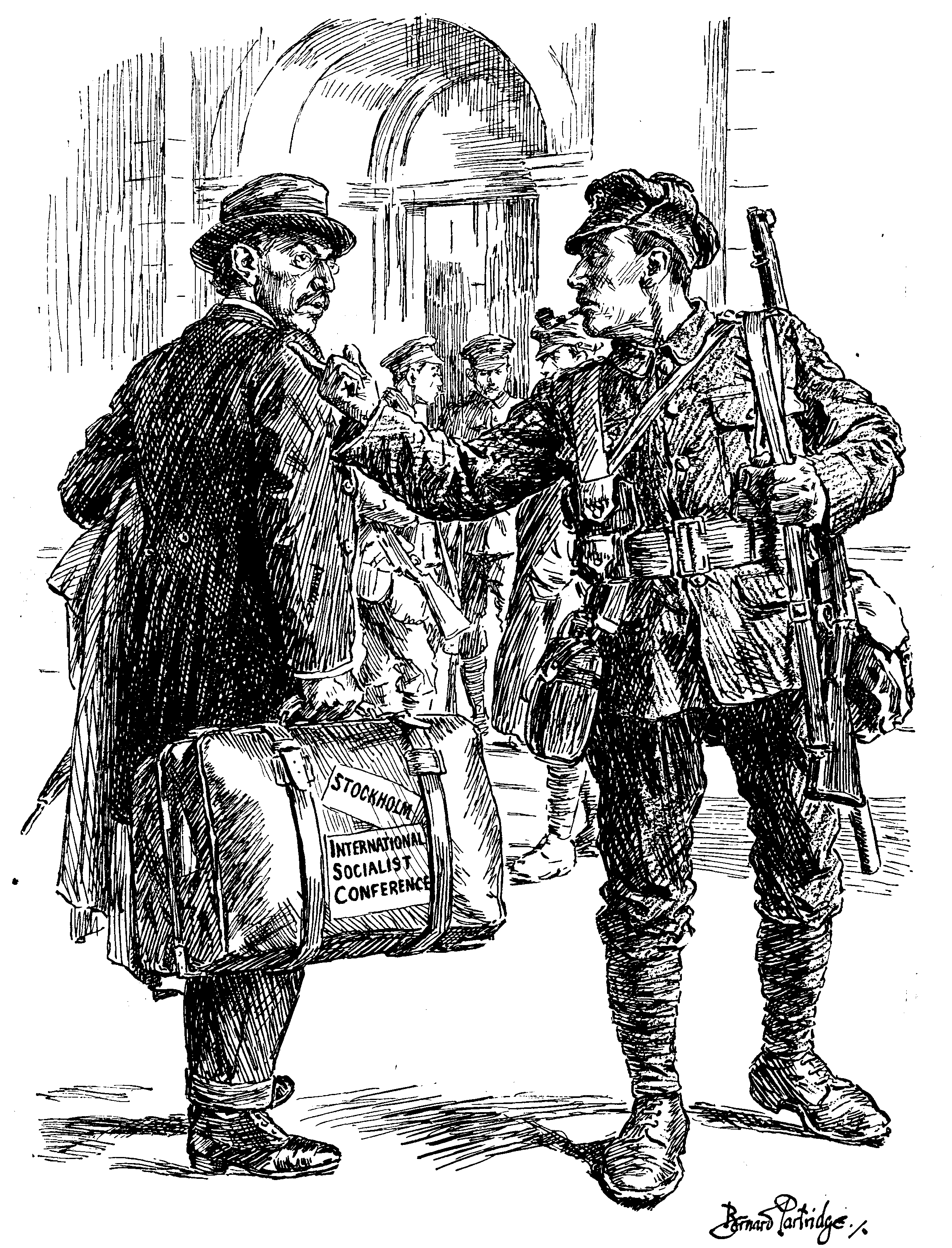
THE REAL VOICE OF LABOUR.
TOMMY. "SO YOU'RE GOING TO STOCKHOLM TO TALK TO FRITZ, ARE YOU? WELL, I'M GOING BACK TO FRANCE TO FIGHT HIM."