Volume 153 — THE WATCH DOGS.
Reading edition
LXIV.
MY DEAR CHARLES,—Since I last wrote to you I have enjoyed seeing again an officer with whom I had many curious dealings in the past, and who, if half the facts he divulges about himself were true, would certainly be the wickedest Colonel in the B.E.F., notwithstanding that he fought busily in the early stages and had the best part of himself knocked out in so doing. He has performed many strange duties since, and the steps he took to qualify for one of them will, I think, illustrate for you his wickedness. It has been found, on experience, that modesty is out of place when you are being called upon to state your qualifications for a post. The knowing, upon being asked if they possess certain attributes, reply in an immediate affirmative and add others, just to be on the safe side. It is felt that what is really required in this War is thrust and ingenuity, things which adequately make up for the absence of any specialist knowledge. Accordingly my friend found himself described as possessing, among other things, "French, fluent." It was not until he was informed that the Official Interpreter would like to hear a little of this that he looked more closely into the matter and discovered that he knew no French at all. Undismayed, he spent the two days' interval before the vivâ-voce examination in learning some. You might suppose that two days is a short time in which to become so familiar with a strange language that you may be able to understand and answer any question which may be put to you in it. Sly friend, however, did not let this worry him. He learnt by heart a long and detailed narrative, embracing all the most impressive idioms and all the most popular slang, the subject of which was an accident which had occurred to him in the earlier days of the campaign, a long and a vivid story, which, once started, would last indefinitely and could not be interrupted meanwhile. Armed with no other knowledge of the French language than this, my friend duly presented himself before the Official Interpreter, greeted him with a genial salute and waited throughout his opening speech, which was in French and contained many inquiries. My friend made no endeavour to follow these simple questions. He knew he couldn't succeed and had no intention of giving himself away by an attempt. Advancing towards the Interpreter's table and putting his right hand to his ear, "Pardon, monsieur," he said, "mais je suis un peu sourd, depuis mon accident." "Quel accident?" said the Interpreter; after which my friend did not stop talking until he was passed out with a "French, garrulous." We met quite recently and talked over things in general, telling each other, in confidence and on the best authority, all those exciting details of the progress of the War which men go on saying and believing until they are officially contradicted. Getting down to realities, he told me that he has now the greatest difficulty in believing in the War at all, though he is within ear-shot of it all the time. His difficulty is due to the last thing he saw before he left his office: three men standing at his gate, in that attitude of contented and contemplative leisure which one associates with Saturday afternoons and village pumps, looking at nothing in particular and spitting thoughtfully as occasion required. One of them was a British soldier, one a French soldier and one a German soldier. The whole picture suggested anything but war; if there was a war on, which nation was fighting against which? My friend, however, is somewhat oddly situated in this respect, since he commands for the moment a detachment of German prisoners in our back area. Some of them, he tells me, are extraordinarily smart. One Prussian N.C.O. in particular was remarkable. Dressed in his impressive overcoat, hatted for all the world like our Staff and carrying under his arm his dapper cane, this N.C.O. went round from group to group of working prisoners, accompanying the English sergeant in charge of the party and interpreting the latter's orders to the men. So striking was his get-up that all paused to look at him. Thinking it might please you, my friend showed me an official memo., which he had just received from one of his officers in command of an outlying detachment, and of course of the odds and ends of British personnel adhering thereto: cooks, guards, etc. The memo. ran as follows, and it repays careful study and thinking out; I give you the whole of it:— "To the Commanding Officer, Orderly Room, Hqrs." The undermentioned is in my opinion entirely unfitted for the duty to which he has been detailed with this detachment. He shows no signs of either intelligence or industry, and I propose, with your approval, to take the necessary steps to get rid of him forthwith. A. B. SMITH, Capt. i.c. 'B' Detachment. My friend was much concerned to hit upon exactly the right form of reply. Eventually we agreed:— "To Capt. A. B. Smith, i.c. 'B' Detachment. Good-bye. C. D. JONES, Lt.-Col., O.C., etc., etc." Finally, let me tell you a disgraceful tale of my same friend, which does not refer to his present command, and is, I hope, untrue of him in any command. The crowd for which he was then responsible was suddenly threatened with inspection by the General who is charged with the welfare of such people, and who very properly desired to satisfy himself that they were both well disciplined and well tended. So that success might be assured my friend had a rehearsal parade. All inspections and manoeuvres being completed, my friend stood the crowd at ease and thus addressed them:— "All ranks will take the utmost care to turn themselves out smartly for the inspection and to make the inspection a success. As the General passes along the lines inspecting you, you will stand rigidly to attention, eyes front. You will be asked if you have any complaints to make, and each of you will have an opportunity of making a complaint in the correct manner. "In making his complaint the man should advance two paces forward, salute smartly, stand to attention and make his complaint. "And, by Heavens, if anybody does...!" Yours ever, HENRY.
A TRACT FOR GROUSERS.
Ernest and I were seated by the river. It was very pleasant there, and it seemed a small thing to us that we were both still disabled.
"Did you ever say to yourself, when you were out there, that if ever you got out of it alive you'd never grumble at anything again?'" said Ernest.
My reply was in the affirmative.
We were silent for a while, remorse weighing heavily upon us.
"The worst case," said Ernest at length, "was when I got my commission and came home for my kit."
I composed myself to listen, piously determined not to grumble however tedious I might find his recital.
"We'd been near a place called Ypres," he began.
"I seem to have heard the name," I murmured.
"I hadn't been sleeping really well for a week—we'd been in the trenches that time—and before that I had lain somewhat uneasily upon a concrete floor."
"Yes, concrete is hard, isn't it?" I said.
"We came out at three in the morning, and arrived at our billets about seven. I knew this commission was on the tapis—French word meaning carpet—so I hung round not daring to turn in. At eleven o'clock I had orders to push off home to get my kit. You'll guess I didn't want asking twice. I made my way to the railhead at once in case of any hitch, and had to wait some time for a train. It was a goods train when it came, but it did quite well and deposited me outside the port of embarkation about nine o'clock at night. I walked on into the port and found the ship that was crossing next morning. I went below in search of a cabin. There was a French sailor there to whom I explained my need."
"How?" I asked, for I do not share Ernest's opinion of his mastery of the French language, but he ignored this.
"It was dark down there," he went on, "too dark for him to see that I was in a private's uniform, so I put on a bit of side and he took me for an officer."
"A French officer?"
"Very likely. Anyway he found me a beautiful cabin with a lovely couch in it all covered with plush. You would have thought I should want nothing but to be left to sleep; but no, I saw that the officer in the next cabin had a candle, and there was no candle for me. Instantly my worst instincts were aroused. I felt I was being put upon. I demanded a candle. The sailor declared there wasn't one left."
"You're sure he understood what you were asking for?"
"Yes, I know that candle is boogy, thank you. I argued with him for ten minutes and then turned in, grumbling. Queer, wasn't it?"
"Yes," I said.
I sat there for a while, thinking over Ernest's story, which had, it seemed to me, something of the tract about it.
Later the midges began to attack us.
"Aren't these midges absolutely—" I began, and then stopped, remembering Ernest's tract. It only shows, as I said to Ernest, that we may learn something even from the most unlikely people.
"Wanted, a strong Boy, about 15 years old, for bottling, &c. The Brewery, Brixham." The Western Guardian.
"Waiter, bring me a bottle of the boy."
"... contest the right of the Spanish authorities to intern damaged submarines seeking refuse in neutral ports."—Star.
The Spanish authorities are expected to reply that if that is what the U-boats are after there is no need for them to leave home.
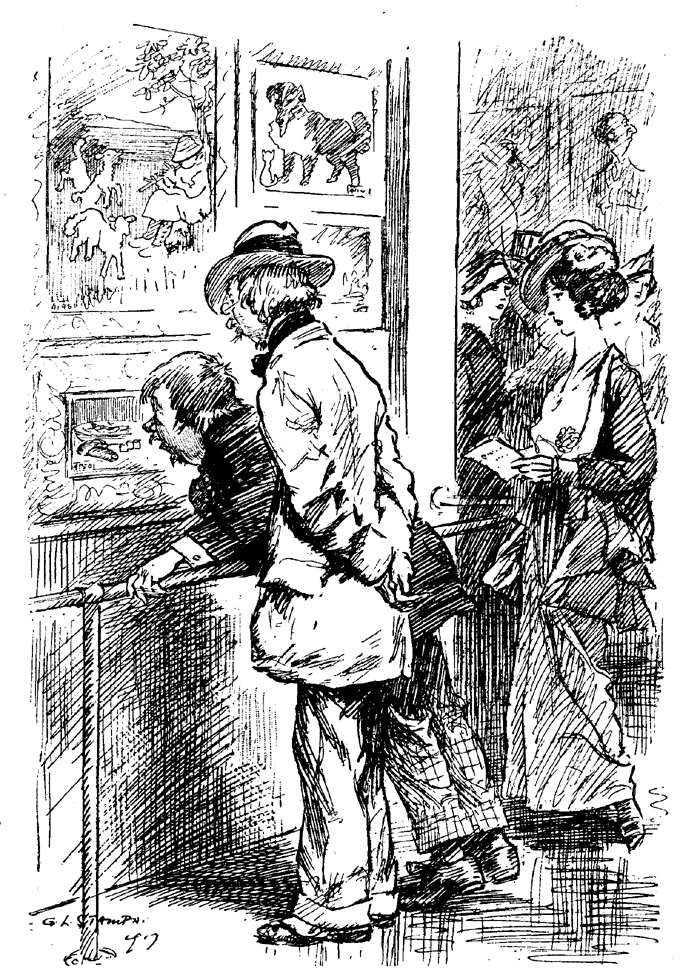
First Artist. "BY GAD! OLD PARSLEY'S SURPASSED HIMSELF. LAMB CUTLETS, TWO CHOCOLATE CAKES AND THREE LUMPS OF SUGAR. RATTLING GOOD SUBJECT."
Second Artist. "I THOUGHT OF ONE NEARLY AS GOOD, BUT COULDN'T AFFORD THE MODELS."